



Abstract
Theory building is a scholarly pursuit that requires rigor in the process of observation, classification, and then defining relationships. The first step of observation in exploring a potential theory of lodging began with the initial perspectives offered by Roberts and Shea, where the behavior of the guest was noticed as different while at home versus during an overnight stay at a commercial lodging establishment. In this article, the next step of model building is explored.
Theory building is a scholarly pursuit that requires rigor in the process of observation, classification, and then defining relationships (Carlile & Christensen, 2004). Babbie (2013) described theory as “systematic sets of interrelated statements intended to explain some aspect of social life” (p. 44). The first step of observation in exploring a potential theory of lodging began with the initial perspectives offered by Roberts and Shea (2017), where the behavior of the guest was noticed as being different while at home versus during an overnight stay at a commercial lodging establishment. In this article, the next step of model building, systematically classifying the components, is explored.
In reviewing the lodging literature, several scholars have completed studies that segmented the experience into identifiable components. Clow, Garretson, and Kurtz (1994) listed six aspects: security, service, reputation, appearance, location, and price. Callan (1995, 1998) identified 166 characteristics that were then grouped into 11 headings, which were essentially advancements of the work of Clow et al. (1994). Roberts and Shea (2017) also considered the lodging experience and identified four behavioral dimensions of an overnight stay: individual safety and security, health and well-being, the comfort of daily routines, and the personal level of responsibility for the facilities.
The first of those behavioral concepts is safety and security. When asleep, every human is physically vulnerable. At home, the individual becomes familiar with the setting, learns the sounds and feel of the environment, and can make adjustments in order to believe the access points, such as doors and windows, can be secured. What the subconscious detects when one is asleep becomes familiar and comfortable. When sleeping away from home, the individual wants the same feeling so that he or she can sleep without fear of intrusion or attack. In a lodging facility, the guest is new to the room. All aspects of familiarity are replaced by foreign sounds, smells, temperatures, and even air currents. Door and window locks are likely different from those used at home, but the guest wants to assume that the security is adequate so that they can sleep in peace.
The next dimension is the issue of health and well-being. Guests want a hotel room that is clean and free from harmful germs and disease. This aspect of the lodging experience has been previously studied (Cadotte & Turgeon, 1988; Dolnicar & Otter, 2003; Field, 1999). The presumption is that the room, which includes the sleeping space and the bathroom, has been sanitized and is a healthy physical environment. The bed linen and bathroom towels have been replaced with clean, sanitized items. The bedspread is routinely laundered, the carpet thoroughly vacuumed, and the furniture has been dusted and wiped clean. The typical expectation is that the room is a private space that has not been contaminated; that the guest is living in an environment that is free of disease and that his or her well-being is protected by the housekeeping department.
The third dimension is about the daily comforts of life. When at home, an individual can develop habits and preferences for dressing, bathing or showering, use of cosmetics, and the selection of linens and towels that meet personal preferences. Soaps, shampoos, toothpaste, and so on, are selected that best accommodate one’s individual personal features, tastes, and needs. Clothing is purchased and stored, laundered, and ready to wear. Daily routines are developed over time to aid one in getting ready for the day after having a healthy night’s sleep.
During the lodging stay, the traveler duplicates some of these items through what is packed in luggage. Transportation restrictions, such as security concerns at airports or issues of weight with luggage, influence what can be brought along. Hotels often provide some of the more common supplies such as soap, shampoo, and body lotions. They also supply towels, sheets, pillows, and so on. While these amenities are needed by most travelers and fulfill their purposes, the brand, quality, and texture may not match that which is at home. The traveler makes allowances for these differences, sometimes contentedly, sometimes not, knowing that the compromise is temporary as it is only for the short length of the lodging stay.
There are other aspects of daily life that require adjustment. The machines and devices in the room are probably not the same as in the home. The room temperature controls are likely different and the guest must spend a bit of time working with them in order to achieve the desired warmth or coolness. Time is spent experimenting with the shower controls in order to produce a water temperature that is comfortable. The windows are typically covered with some sort of curtain or blind, which is likely different from what is at home. The room lighting may be too bright or too dim, causing the guest to make adjustments. The remote control for the television usually requires study in order to operate the set correctly. Overall, it takes the guest a bit of time to learn how to manage these room features.
The fourth dimension is the sense of responsibility for one’s immediate environment. To a guest who is renting the space, there is a sense of entitlement. The hotel room becomes the person’s home for that night. Whether the guest is feeling detached from the space (“it’s just a room”) or views it with loving care (“it’s my home for now!”), the payment gives the guest the belief that they have the right to use the space in any reasonably private way that is desired. However, in contrast to how the home is provisioned, the guest is well aware of the transitory nature of an overnight stay. The guest will not have to live with the consequences of his or her actions in that room. If a piece of furniture is dinged by an awkward piece of luggage, the guest would not have to see the marred item after checkout. If a towel is used to clean shoes, the guest knows that housekeeping will take the towel away and replace it with a clean one. If the curtains are pulled slightly from the overhead rod when attempting to open or close them, the guest knows that hotel maintenance will conduct repairs later. If food is dropped onto the bedspread when eating while watching television, the guest knows that housekeeping will take care of the matter. The room can be as hot or as cool as desired and lights operated continuously with no consideration given to the utility costs.
In short, the guest feels a limited sense of responsibility for the room features and services. Certainly, if something significant were to happen, such as the television screen is smashed or the bed is set on fire, the guest is aware of personal liability. But absent of something major of this nature, the guest forgets about the room, and anything that may have happened therein, the moment he or she departs on the day of checkout. In contrast, the home is something that is provisioned for over a long period of time. Furniture is purchased with certain functions or styles in mind and is expected to be used for many years. If it is damaged, the owner is responsible for any repairs. Utilities are generally paid separately from mortgage or lease payments so care is exercised in managing their monthly use. Laundered items, such as clothing, sheets, towels, and so on, are handled much more carefully as the owner intends to use them many times over the years. In summary, guests of a lodging facility treat their physical environment differently than they treat the physical environment in their home. They have a reduced sense of responsibility and increased sense of entitlement while staying in a lodging facility.
The relationship of these four dimensions is useful to examine. Using Maslow’s (1943) Hierarchy of Needs as a basis for prioritizing these four dimensions into a hierarchical order (see Figure 1), the issue of safety and security would be primary. If one does not feel safe and secure when sleeping, all other concerns are set aside until safety is achieved. This primary concern is represented by the largest, outside circle in the model as it overarches everything about the guest room experience. Next would be personal health and well-being in the hotel room. While one’s basic physiological needs would presumably be met prior to traveling, one would not want to endanger that status through an unwitting health exposure in an unclean hotel room. This is represented by the second outside circle, again encompassing the next two dimensions. If health and well-being is knowingly threatened, it is likely the guest will address these concerns before anything else during the lodging experience. Third in priority would be the daily comforts of life. Being able to enact one’s desired routines of resting, cleaning up, and getting ready for the day helps bring a sense of normalcy, especially when traveling and sleeping in a strange environment. This is represented by the large, middle circle in the model. While it does represent the majority of activities in the guest room, the prior two dimensions must be satisfied before the guest can comfortably engage in routine behaviors. Finally, the sense of responsibility for the guest room would be ranked last and is represented by the smaller circle inset toward the bottom of the model. While there is a fundamental sense of responsibility to reasonably care for any public space, the payment for the temporary use of the lodging facility gives the guest a sense of entitlement to a certain but limited degree. Knowing that there are little or no repercussions for minor marring of furniture or misuse of linens enables the guest to engage in these misdemeanors.
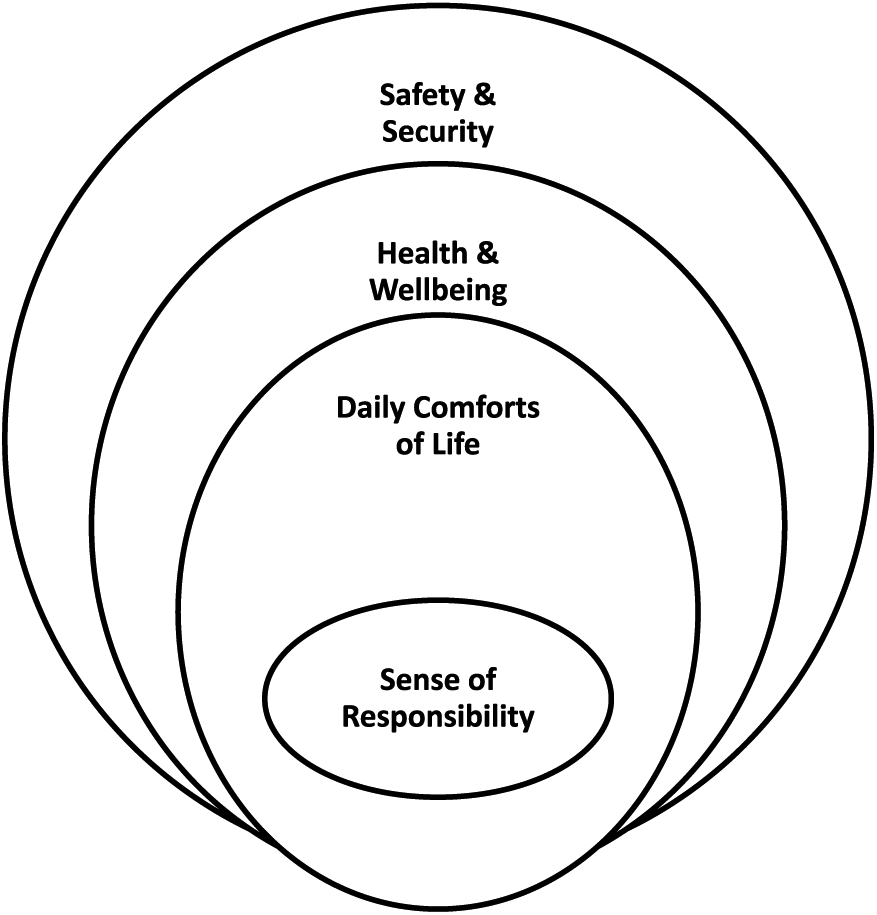
Model of Lodging Guest Behavioral Dimensions
As viewed in the proposed model, the dimensions are the same ones that travelers address in their own homes; however, the priority given to each is different when in a lodging facility. The short-term nature of the lodging stay engenders a heightened sense of wanting to sleep in a safe space and wanting to clean and dress in a hygienic environment. A desire for the familiar while traveling results in an attempt to replicate some of one’s daily life comforts while incorporating and adjusting to those provided in the hotel room. The sense of responsibility is lessened in the lodging facility when compared to home, and the guest knows that any minor misuse of room features and utilities will be forgotten the moment after checkout since they are provided by the vendor for a nightly fee.
This model depicting how guests behave in a lodging guest room is intended to capture observations of how a human being perceives and interacts with the rented sleeping space when away from home. The behaviors are distinctive when viewed in these different environments. The purpose of this effort was an attempt to crystalize those observations into a model that would concretely capture those differences.
The model can be useful to lodging operators as it could aid in the design of the lodging product and services that are offered. Understanding how the lodging guest would perceive the role of the room and its use could enable designers to accommodate these differences. As examples, furniture could be selected and placed to facilitate the unfamiliar movement of awkward luggage shapes. Window coverings could be selected for their ease of operation by unfamiliar users rather than for their stylish appearance. Gift shops could carry more daily use comfort-of-life products in a wider array of choices, such as different brands of toothpaste, shampoo, and so on. Housekeepers could better understand guest activity and anticipate how to provide clean products and services to meet those desires.
The model can also be of use to scholars. Consumer behavior research could be expanded to incorporate this guest room behavior. Operations management theory could be impacted to accommodate the shift in guest perspectives when using hotel room facilities. The line of reasoning in this article demonstrates that the view “a room is a room is a room” does not hold under all conditions. For the typical hotel guest, the value, role, and use of the paid overnight stay is distinctive from similar accommodations provided at home.
As with our initial exploration of these ideas (Roberts & Shea, 2017), we invite scholars to engage in a robust discussion to consider our observations and proposed model. We value the input given at the 2017 ICHRIE summer conference in Baltimore. Those scholars were encouraging in the discussions and we have incorporated many of their thoughts into this article. The differences in human behavior while staying in a hotel room appear to have been established and are distinctive. Commentaries and conceptual articles to help us advance this scholarly effort are encouraged.