



Abstract
Nowadays to post online review is becoming a common practice. However, apart from limited studies, little is known how online reviews can prejudice subsequent reviews. Our three experimental studies demonstrate that following negative service experiences, reviewers are influenced by earlier posted reviews when writing their own reviews. Exposing reviewers to negative (positive) valence reviews encourages them to write reviews with a higher (lower) intensity level of negative word of mouth (n-wom). Their level of immersion in the earlier posted reviews (i.e., perceived transportation) is the underlying explanatory mechanism behind this relationship. However, this mediating effect is stronger for novice (vs. expert) reviewers. Illuminating the potential influence of online reviews, this research suggests that online reviews should not be embraced literally by consumers and firms but should be utilized judiciously to enhance their service experiences and service quality.
Introduction
As consumers become more digitally empowered, online review platforms (e.g., Amazon.com, TripAdvisor.com, Yelp) have increasingly turned into the predominant gateway for those searching for product information including hospitality services. Prior research mainly investigated online reviews as an information source from the perspective of consumers and firms in general (Cantallops & Salvi, 2014). Many studies have centered on the question of how online reviews are used by consumers to assist their decision-making process (Filieri & McLeay, 2013; Hamby, Daniloski, & Brinberg, 2015; Hwang, Choi, & Matilla, 2018; Leung, Law, Van Hoof, & Buhalis, 2013; Sparks & Browning, 2011; Tsao, Hsieh, Shih, & Lin, 2015; Vermeulen & Seegers, 2009). Firms have also benefited from utilizing online reviews as tools to better predict their sales (Duverger, 2013; Nieto, Hernández-Maestro, & Muñoz-Gallego, 2014; Phillips, Barnes, Zigan, & Schegg, 2016; Xie, Zhang, & Zhang, 2014; Ye, Law, Gu, & Chen, 2011; Zhang, Ye, Law, & Li, 2010) and improve their pricing strategy (Öğüt & Onur Taş, 2012; Yacouel & Fleischer, 2011; Ye, Li, Wang, & Law, 2014).
Despite the maturity of this research field, studies examining online reviews from the perspective of reviewers—those who write the actual reviews—are still underexplored (Ring, Tkaczynski, & Dolnicar, 2016). We argue that it is equally important to focus on this aspect given that the reviewers are the ones who produce the source of information that will eventually be used by both readers and firms to make better-informed decisions. This is even more crucial given the fact that many consumers still perceive online reviews to be the most credible and trustworthy source of information (Cheng, Lam, & Hsu, 2006; Sparks & Browning, 2010, 2011). Hence, this research focuses on the impact of online reviews on the reviewers and addresses the intriguing question that has so far received little attention “Assuming that the belief that genuine reviewers are not influenced by pressures from companies is true, are there any contextual factors that affect the way they write their actual reviews?”
Only few studies have attempted to address the above question. Bronner and de Hoog (2010) found that reviewers with high self-directed posting motivation write more negative reviews compared to those with high other-directed posting motivation. Other researchers have examined the impact of earlier posted online reviews on reviewers’ decisions about what to post. Schlosser (2005), for instance, revealed that reviewers tend to evaluate products less favorably after being exposed to negative reviews posted previously. Wu, Mattila, Wang, and Hanks (2016) showed that, when exposed to reviews that are congruent (vs. incongruent) with what consumers experience, consumers in a high power state are more likely to write reviews containing experience-incongruity cues while consumers in a low power state are more likely to include experience-congruity cues in their reviews. Examining the linguistic pattern of written reviews, Aerts, Smits, and Verlegh (2017) found that when previously posted reviews contain concrete (abstract) language, a subsequent reviewer would write a review using more concrete (abstract) language. These sporadic findings from few studies suggest that reviewers are not free from some biases when they post their own reviews. Inspired by this stream of research, this study aims to contribute to understanding of the effect of exposure to earlier posted reviews on reviewers’ posting behaviors. It does this in three ways.
First, we examine the effect of earlier posted reviews on the intensity with which reviewers spread negative word of mouth (n-wom). Intensity of n-wom is both a manifestation and central characteristics of emotional responses. Intensity of n-wom here is defined as the level of negativity expressed in the written reviews. Online review platforms are often used as a medium to express one’s feelings (Sparks & Bradley, 2017), thus focusing on emotional side of posted reviews allows us to infer the degree of frustration and dissatisfaction with the service encounter. Readers of these reviews can feel such emotions through the valence conveyed by the writing, which later can influence their own comments. In order to portray a more comprehensive picture, this research investigates the extent to which review valence (positive vs. negative) can influence the intensity of reviewers’ n-wom. To better capture this variable as a proxy of affective response of reviewers expressed in their written reviews, our research focuses on reviewers’ posting behavior following their negative service experiences. This allows us to safely assume that reviewers exhibit negative emotions when embarking on their writing review journey (Mattila & Ro, 2008) and are likely to post more negative reviews. Since negative reviews have a more powerful impact than positive reviews (Xie et al., 2014), focusing on this context is deemed of particular interest to firms as they understand the importance of embracing customers who publicly express their dissatisfaction online. To the best of our knowledge, no studies to date have examined the emotional side of posted reviewers.
Second, in our study we approach online reviews as stories that is often missed in empirical research. We thus construe online reviews as word-of-mouth stories that consumers (i.e., story tellers) share with others on online platforms (Moore, 2012) and these stories have such persuasive effects that they can later influence consumer behaviors (Green & Brock, 2000). Drawing on the narrative transportation theory (Green & Brock, 2000), we argue that, when reading online reviews, consumers are immersed in these shared experiences where they exercise their mental systems and capacities to imagine others’ experiences and at the same time integrate all felt affective content and emotions to empathize with storytellers. These stories may be reflected in consumers’ perceptions, attitudes, beliefs and, ultimately, behaviors. We therefore aim to establish that the persuasiveness of the narratives will influence how reviews are eventually written.
Third, prior research has demonstrated that consumers in general perceive reviews written by experts as being trustworthy and useful (Chen & Xie, 2008). Hence, they are more inclined to seek reviews written by expert reviewers and to follow their suggestions (Ashenfelter & Jones, 2013; Hilger, Rafert, & Villas-Boas, 2011; Zhang, Zhang, & Yang, 2016; Xie & So, 2018). This research is intended to shed light on the moderating effect of reviewer expertise (experts vs. novice) on the relationship between exposure to earlier online reviews and the intensity of n-wom.
In the next section, we provide the theoretical background and present the arguments leading to our hypotheses. We then explain and discuss the findings of our three scenario-based experiments. We conclude by discussing the theoretical and managerial implications of our findings, acknowledging the limitations of our study, and suggesting future avenues of research.
Theoretical Background and Hypotheses Development
The overarching theory guiding our research is the narrative transportation theory. Gerrig (1993) is believed to be the first to introduce the concept of narrative transportation when explaining the persuasive impact of fictional narratives (i.e., novels) on their readers (van Laer, de Ruyter, Visconti, & Wetzels, 2014). His work has since inspired many researchers to apply narrative transportation as a general mechanism that justifies why narratives can affect individuals’ beliefs. The types of narratives investigated are also varied from books (Green & Brock, 2000; Wang & Calder, 2006), blogs (Stubb, 2018; van Laer & de Ruyter, 2010), brand stories (Hamby & Brinberg, 2016; Lee & Jeong, 2017), films (Bezdek & Gerrig, 2017), product reviews (Hamby et al., 2015), TV commercials (Park & Lee, 2014), to even pictorial advertisements (Phillips & McQuarrie, 2010). The application of this concept has been largely supported in the context of media psychology from where it is originated and increasingly gaining attention in the field of marketing (van Laer & de Ruyter, 2010), advertising (Phillips & McQuarrie, 2010; Wang & Calder, 2006), and tourism and hospitality contexts (Mattila, 2002; Lee & Jeong, 2017; Tussyadiah, Park, & Fesenmaier, 2011). This is not surprising as these respective contexts often promote experiential and intangible services that require narrative forms of communication to be uniquely effective (Mattila, 2000).
This theory postulates that narratives have a strong persuasive power over individuals who read them (van Laer et al., 2014). The persuasive power of narratives depends on the psychological connection the readers develop through self-constructing mental stories of the presented narratives (Escalas, 2004a; Feagin, 2007; Fishbein & Yzer, 2003; van Laer et al., 2014). This connection is established if individuals could relate the essential elements from the narratives to their own experiences stored in memory, and to imagine the story plots in a vivid way (i.e., mental imagery). The stronger the connection, the more “transported” the individuals will be to the narrative, and thus the persuasive impact of narratives on individuals is likely to be long lasting (van Laer et al., 2014). In this research, the narratives are online reviews that portray reviewers’ personal stories of their consumption experiences (Jurafsky, Chahuneau, Routledge, & Smith, 2014; Moore, 2012).
In our research, reviewers encounter negative service experiences and then are exposed to previous online reviews prior to writing their own reviews. These online reviews differ in their valence intensity such that the emotions expressed in each review could also be transmitted to reviewers who read them during this comparison process and will influence their subsequent behaviors (Howard & Gengler, 2001). Browning, So, and Sparks (2013) stated that in the case of online reviews, it is unlikely to have neutral valence as the nature of such reviews is derived from either good or bad customer experiences. Hence, in this study we focus on negative and positive valence reviews. Negative valence reviews generally describe unpleasant experiences, while positive valence reviews communicate pleasant experiences (Anderson, 1998). This suggests that negative valence reviews radiate negative emotions, while positive valence reviews express positive emotions (Hamby & Brinberg, 2016). Since reviewers embark on the review writing journey after experiencing negative incidents, their initial emotions are assumed to be negative. The emotions transmitted by the reading of previous online reviews can alter their emotional state which will influence how they actually write their reviews.
When reading negative valence reviews, reviewers would feel a high degree of familiarity with other consumers’ stories as they also have encountered negative experiences. When they feel a stronger connection with these stories as well as the negative emotions reflected in these negative reviews, their initial negative emotions triggered by the experienced incidents may be intensified. On the other hand, if they read positive online reviews, they would feel a low degree of familiarity as their experience does not match what others have experienced. The weaker connection with the stories, along with the contrasting emotions reflected by these positive reviews, may attenuate their initial negative emotions following the experienced incidents. Hence, it is reasonable to assert that reviewers reading negative reviews will be more likely to write reviews with higher intensity of n-wom compared with those reading positive reviews. On the other hand, if they are not exposed to any online reviews, they do not have an anchor that they can refer to as or reference point (Furnham & Boo, 2011). In this case, they are not able to make any comparisons so that they rely solely on their own experience when writing their own reviews. We therefore hypothesize the following:
As discussed earlier, when reviewers read earlier posted negative reviews, they can relate to other consumers’ experience because of similar negative experiences. When individuals have themselves experienced negative incidents, they are able to imagine the story plots described in the posted reviews more vividly. On the other hand, if they read positive online reviews that appear to contradict what they have experienced, this may prevent their engagement with these reviews. This disengagement may reduce their ability to imagine the story plots in a vivid way. All these mental processes and capacities that reviewers exercise allow them to be immersed (or not immersed) into the narrative flow of the online reviews as it unfolds is called perceived transportation (Wang & Calder, 2006). The positive and negative emotions expressed in the posted reviews play a great influencing role in determining reviewers’ writing behaviors as they are posited to influence reviewers’ perceived transportation level (van Laer et al., 2014). More specifically, those reading negative valence reviews may develop greater empathy toward other consumers’ experiences as they may be better able to identify themselves with the latter and are more likely to be immersed in the presented narratives, compared with those reading positive valence reviews. Moreover, this contention is reinforced by previous research that demonstrates that negative reviews elicit higher level of transportation into the reviews (Hamby et al., 2015). Consequently, we argue that compared with reviewers exposed to positive online reviews, those exposed to negative online reviews will experience a higher degree of perceived transportation and will therefore demonstrate a higher intensity of n-wom. Hence, we propose the following:
The persuasiveness of narratives in predicting individual behaviors depends on the level of individuals’ perceived transportation to the stories presented to them that can be influenced by their personal characteristics (van Laer et al., 2014). We propose one boundary variable that could potentially influence the perceived transportation level of reviewers toward the earlier posted online reviews—that is, their prior experience in posting such reviews. In this research, we define prior experience as the consumer’s degree of proficiency in writing online reviews (Vermeulen & Seegers, 2009).
Previous research has shown that highly experienced (experts) reviewers are less influenced by others than are the low experienced (novice) reviewers (Ma et al., 2013; Moe & Schweidel, 2012; Schlosser, 2005). One explanation could be that those with high levels of experience in posting reviews have better knowledge of the online review platforms and thus have more confidence in utilizing such platforms and in expressing their own opinions. This insight is aligned with the typical characteristic of expert consumers who tend to rely on their prior knowledge structures compared with novice consumers (Mattila, 2002). It is also supported by prior research showing that highly experienced online users tend to have less trust in information provided online (Aiken & Boush, 2006; Brown, Broderick, & Lee, 2007; Cheema & Papatla, 2010; Filieri, 2016; Zhu & Zhang, 2010). Filieri (2016) also indicates that consumers with more experience writing travel reviews have more knowledge about them and are more confident in their opinions, which influences how they process information. These rationales lead us to suggest that novice posters pay more attention to, and therefore are more immersed by, previous online reviews than are the expert posters. Hence, their perceived transportation level is higher and has a stronger influence on the intensity of their n-wom. We thus propose that prior experience in posting online reviews moderates the mediating effect of narrative transportation on the relationship between exposure to online reviews and the intensity of n-wom. Hence, we posit the following:
Three experimental studies were conducted to test our hypotheses as illustrated in Figure 1. Hypotheses 1, 2, and 3 are tested in Studies 1, 2, and 3, respectively.
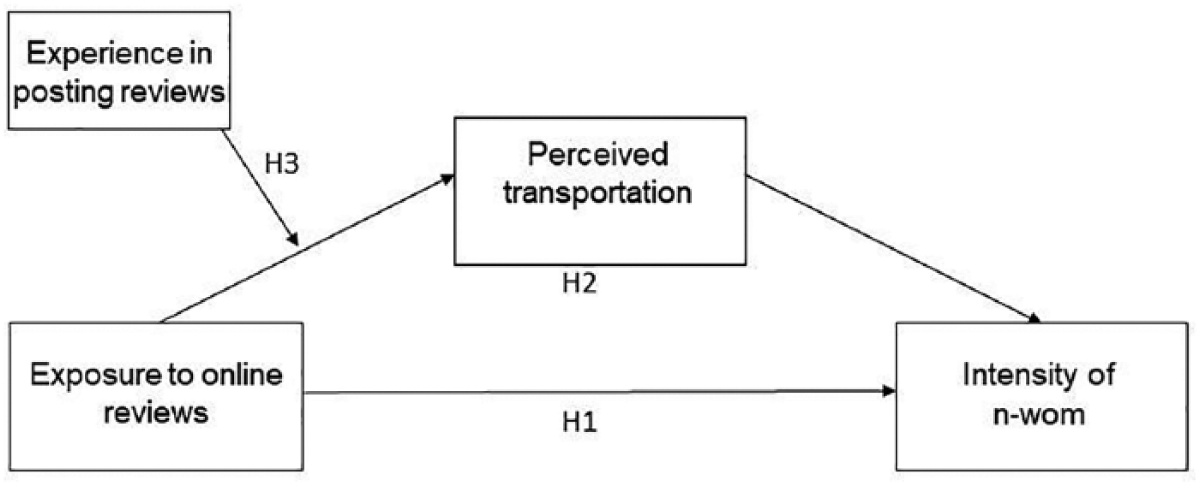
Conceptual Framework
Method
Study 1
Study 1 investigates the effect of exposing (vs. not exposing) reviewers to previous online reviews (positive vs. negative valence reviews) on reviewers’ intensity of n-wom. To recap, in this research, the intensity of n-wom is a proxy measure of reviewers’ affective responses expressed in their actual written reviews. It represents the level of negativity of the experiences they share with others on the online consumer review platforms.
Participants, Design, and Procedure
We recruited a convenience sample of 131 U.S.-based adult participants from M-Turk. Four cases were removed as participants failed the attention check questions, leaving a total of 127 cases for the analysis (mean age [Mage] = 36.3 years, standard deviation [SD] = 11.5; 59.1% male). 83% of the participants reported an education level of college degree or above, and 77% of the respondents were Caucasian. Participants were paid U.S.$1 for their participation.
Participants were first asked to imagine that they had experienced a negative hotel stay (see the appendix). This scenario was pretested to determine its realism. In this first pretest, 57 participants recruited from M-Turk evaluated the realism of the scenario using four items adapted from Sparks and Browning (2011) and Sparks, So, and Bradley (2016) on a 7-point Likert-type scale (1 = strongly disagree to 7 = strongly agree): “I could imagine myself experiencing a negative service situation like this when staying at a hotel,” “I was able to adopt the role of someone who stayed at a hotel and experienced this negative service situation,” “I think there are negative service situations at hotels like this one in real life,” “I think the negative service situation at the hotel was realistic.” Results revealed that participants perceived the scenario as very realistic (α = .88, M = 5.82, SD = 1.11).
Participants were then randomly allocated to one of the three conditions. In the condition where they were not exposed to online reviews, participants were directly asked to write a review that they intended to post on a review website. In the condition where they were exposed to online reviews, they were randomly exposed to all positive or all negative online reviews of the hotel (see the appendix). The selected online reviews to which participants were exposed were most commonly stories shared by consumers in the hotel review context (Sparks & Browning, 2010) and were derived from our content analysis of a prominent hotel review website. After the writing task, participants completed a set of items measuring their perceived severity of the negative hotel experiences, manipulation check items and several demographic questions.
In this second pretest, we recruited 50 participants from M-Turk (Mage = 38, SD = 11.59; 42% male) to ensure that the presented positive (negative) reviews were perceived as being not significantly different in their levels of positivity (negativity). Each review was rated using one item asking whether participants perceived the review as having a negative or a positive valence (1 = negative; 4 = neutral; 7 = positive). Findings revealed that no significant differences were found across all positive reviews and negative reviews in relation to their positivity, Mpvalence = 5.93, F(3, 196) = .69, p = .56, or negativity, Mnvalence = 1.68, F(3, 196) = 0.74, p = .53.
Measures
The dependent variable employed was consumer intensity of n-wom; this was measured by three linguistic experts’ assessments of the reviews written by participants using three items adapted from Floh, Koller, and Zauner (2013), Goyette, Ricard, Bergeron, and Marticotte (2010), and Heitmann, Lehmann, and Herrmann (2007): “I think that what the reviewer wrote was . . .,” “When the reviewer wrote the review, he/she tended to write things that were . . .,” “In this post, the reviewer mostly said things that were . . .” Each item was rated on a 7-point rating scale anchored by 1 = extremely positive and 7 = extremely negative (α = .81, M = 5.30, SD = 0.74). The intraclass correlation coefficient (ICC) was .81 (p < .001), indicating that the optimal intraclass correlation and agreement among these three raters were achieved (LeBreton & Senter, 2007). We then calculated the average of scale items obtained from the three linguistic experts for each review and used this index to represent the construct of intensity of n-wom in this study.
The covariate was the perceived severity of the negative hotel experience and was measured using three items adapted from Hess, Ganesan, and Klein (2003). Using 7-point scales, we asked participants to rate their perceived severity according to three dimensions: mild-severe, minor-major, and insignificant-significant (α = .97, M = 5.41, SD = 1.49).
For the manipulation check, participants were asked to indicate the valence of all the presented reviews on one 7-point scale (1 = negative, 4 = neutral, 7 = positive) adapted from Floh et al. (2013).
Results
Participants in the positive review condition perceived that the presented reviews were more positive (Mvalence = 6.55, SD = 0.64) in comparison with the perceptions of participants in the negative review condition (Mvalence = 1.49, SD = 1.35). This difference was significant, F(1, 81) = 464.19, p < .001, η2 = .85, confirming our manipulation check.
To examine the effect of online review exposure (positive vs. negative vs. no reviews) on intensity of n-wom, controlling for participants’ perception of the severity of the negative hotel experience, we conducted a one-way analysis of covariance test. As predicted and indicated in Figure 2, analysis of covariance showed a significant effect of online review exposure on intensity of n-wom, F(2, 123) = 13.06, p < .001. The follow-up contrasts showed that participants who were exposed to all negative reviews reported a higher level of intensity of n-wom (Mnegative = 5.67, SD = 0.35) than did the participants who were exposed to all positive reviews (Mpositive = 4.88, SD = 0.82) and participants who were not shown any reviews at all (Mno review = 5.32, SD = 0.74). It was also observed that participants who were not exposed to any reviews at all actually reported higher level of intensity of n-wom than those who were exposed to all positive reviews, indicating that positive reviews reduce the motivation to vent n-wom. The exclusion of the covariate from the analysis did not change the patterns of significant results. Hypothesis 1 was thus confirmed.

Study 1: The Impact of Online Reviews Exposure on Intensity of Negative Word of Mouth (N-Wom)
Study 2
Study 2 extends Study 1 by investigating the mediating role of perceived transportation as the underlying mechanism of the relationship between exposure to earlier posted online reviews (positive vs. negative valence) and the intensity of n-wom.
Participants, Design, and Procedure
We recruited a convenience sample of 110 U.S.-based adult participants through M-Turk. Seven cases were removed as participants failed the attention check questions, leaving a total of 103 cases for analysis (Mage = 35.7 years, SD = 10.4; 42.7% male). 82% of the participants reported an education level of college degree or above. 75% of the respondents were Caucasian. Participants were paid U.S.$1 for their participation.
Participants followed the same task as in Study 1. Before being asked to write a review, they were randomly allocated to one of the two conditions: either seeing all positive reviews or all negative reviews. After the writing task, participants responded to the same set of items as in Study 1, with the addition of items measuring perceived transportation.
Measures
Similar to Study 1, intensity of n-wom was also measured through three linguistic experts’ assessments of the reviews written by participants, using the same three items (α = .83, M = 5.34, SD = 0.76). The ICC was .82 (p < .001), indicating that optimal intra-class correlation and agreement among these three raters were achieved (LeBreton & Senter, 2007). We then calculated the average of scale items obtained from them for each review and used this index to represent the construct of intensity of n-wom.
The perceived transportation was measured using five 7-point rating scales (1 = not at all to 7 = very much) adapted from Appel Gnambs, Richter, and Green (2015). These items assessed the extent to which participants were able to easily imagine and be mentally involved in the service situations described in the reviews, as well as the extent to which the participants were emotionally affected by the service situations described in the reviews (α = .76, M = 4.98, SD = 1.10).
Our covariate, the perceived severity of the negative hotel experience, was measured by the same three items as in Study 1 (α = .97, M = 5.36, SD = 1.47).
For manipulation check, participants were asked to indicate the valence of all the presented reviews on one 7-point scale (1 = negative, 4 = neutral, 7 = positive) adapted from Floh et al. (2013).
Results
Participants in the positive review condition perceived that the presented reviews were more positive (Mvalence = 6.54, SD = 0.63) in comparison with participants in the negative review condition (Mvalence = 1.52, SD = 1.28). This difference was significant, F(1, 101) = 646.29, p < .001, η2 = .86, confirming our manipulation check.
To test Hypothesis 2, we performed a regression-based mediation analysis following Hayes’ PROCESS macro (Hayes, 2013, Model 4). We specified exposure to online reviews (0 = positive reviews and 1 = negative reviews) as the independent variable, perceived transportation as the mediator, and the intensity of n-wom as the dependent variable. Perceived severity was included as our covariate. The exclusion of the covariate from the analysis did not change the patterns of significant results.
As shown in Figure 3, the bootstrapping analysis (n = 5,000) confirmed the significant indirect effect of online review exposure on intensity of n-wom through perceived transportation (b = .14, 95% confidence interval [CI] [.039, .313]). The results further revealed that participants exposed to all negative online reviews (vs. all positive online reviews) experienced a higher level of narrative transportation (b = .81, t = 3.99, p < .001), which later led to significantly higher intensity of n-wom (b = .18, t = 2.51, p < .05). Hypothesis 2 was confirmed.
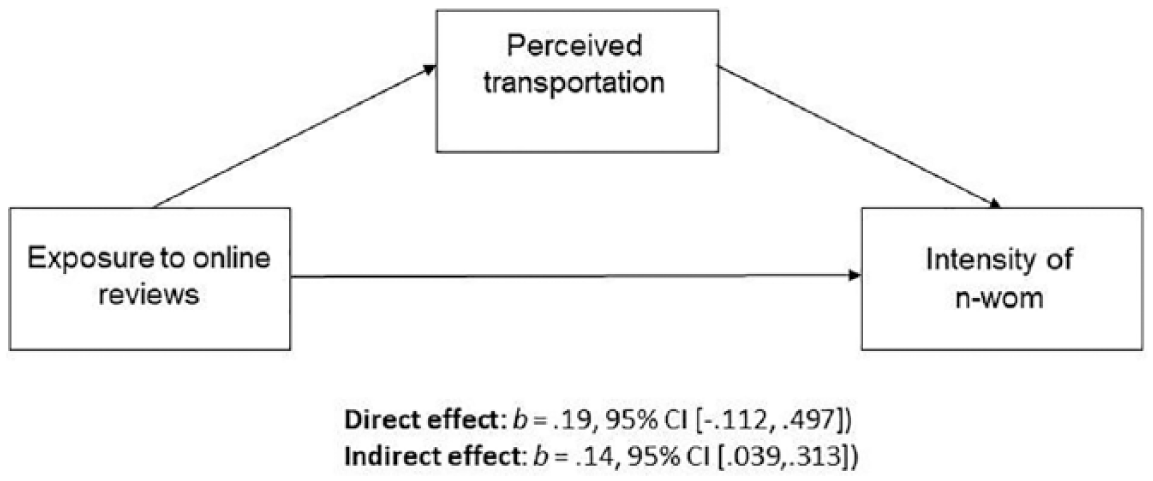
Study 2: Mediation Analysis
Study 3
Study 3 builds on Study 2 by examining reviewers’ experience in posting online reviews as a boundary condition for an increased level of perceived transportation in predicting the intensity of their n-wom. In Study 3, we again manipulated exposure to online reviews (positive vs. negative) and used a self-reported measure of consumers’ experience in posting online reviews.
Participants, Design, and Procedure
We recruited a convenience sample of 180 U.S.-based adult participants from M-Turk. Six cases were removed as participants failed the attention check questions, leading to a total of 174 valid cases for analysis (Mage = 40.7 years, SD = 11.9; 52.9% male). 83% of the participants reported an education level of college degree or above. 77% of the respondents were Caucasian. Participants were paid U.S.$1 for their participation.
Participants followed the same task as in Study 1. Prior to being asked to write a review, they were randomly allocated to one of the two conditions: either seeing all positive reviews or all negative reviews. All reviews were the same as those presented in Studies 1 and 2. After completing the writing task, participants answered the same set of items measured in Study 2, with the addition of a question related to their experience in posting online reviews.
Measures
Intensity of n-wom was measured in the same way with the same three items as in previous studies (α = .81, M = 5.86, SD = 0.69). The ICC was .81 (p < .001), indicating that optimal intraclass correlation and agreement among these three raters were achieved (LeBreton & Senter, 2007). We then calculated the average of scale items obtained from the three linguistic experts for each review and used this index to represent the construct of intensity of n-wom.
Perceived transportation was measured using the same items as in Study 2 (α = .75, M = 5.07, SD = 1.04). The perceived severity as the covariate was measured by the same items as in Study 2 (α = .97, M = 5.21, SD = 1.52). To measure reviewers’ prior experience in posting online reviews, participants were asked to rate their experience in writing online reviews using one 7-point rating item adapted from Wu, Shen, Fan, and Mattila (2017) (1 = no experience at all, 7 = very experienced; M = 3.90, SD = 1.65).
For the manipulation check of online reviews’ valence, participants were asked to indicate the valence of all the presented reviews on one 7-point scale (1 = negative, 4 = neutral, 7 = positive) adapted from Floh et al. (2013).
Results
Participants in the positive review condition perceived that the presented reviews were more positive (Mvalence = 6.30, SD = 1.05) compared with participants in the negative review condition (Mvalence = 1.28, SD = 0.61). This difference was significant, F(1, 172) = 1475.1, p < .001, η2 = .89, confirming our manipulation check.
We performed a regression-based moderated-mediation analysis following Hayes’ PROCESS macro (Hayes, 2013, Model 7). We specified exposure to online reviews (0 = positive reviews and 1 = negative reviews) as the independent variable, perceived transportation as the mediator, reviewers’ prior experience in posting reviews as the moderator, and intensity of n-wom as the dependent variable. Perceived severity was included as our covariate. The exclusion of covariates from the analysis did not change the patterns of significant results.
As shown in Figure 4, our findings indicated a significant index of moderated mediation (b = −.03, 95% CI [−.065, −.003]) (Hayes, 2015). The bootstrapping analysis (n = 5,000) confirms that there is a significant conditional indirect effect of online review exposure on the intensity of n-wom through perceived transportation for low level (1 SD below mean) of prior experience in posting reviews (b = .14, 95% CI [.039, .278]), and high level (1 SD above mean) of prior experience in posting reviews (b = .06, 95% CI [.005, .173]), with the effect being significantly stronger in the condition of low level of prior experience in posting reviews. These findings suggest that those reviewers who are less experienced in posting online reviews are more likely to be persuaded by exposure to other online reviews, which later increases their intensity of n-wom when posting their own reviews. This suggests that exposure to negative reviews elicits higher levels of perceived transportation in reviewers with low prior experience in posting reviews, which in turn increases the intensity of their n-wom in comparison with that of more experienced reviewers. Hypothesis 3 was supported.
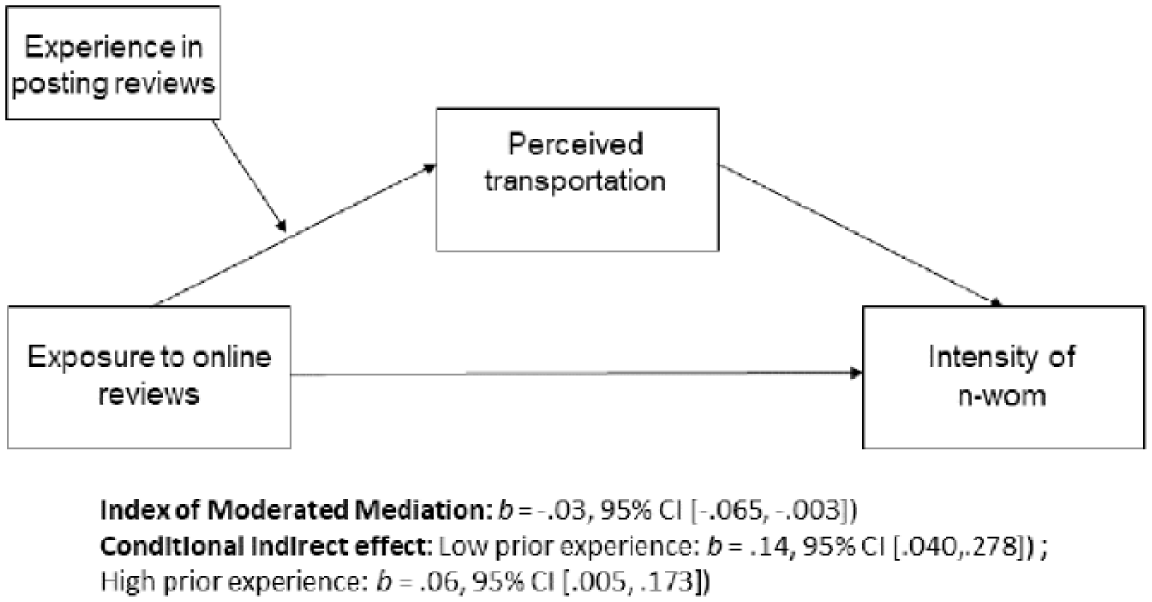
Study 3: Moderated Mediation Analysis
General Discussion
Our three studies validate our argument that, following negative experiences, reviewers exposed to previously posted reviews show differences in the intensity level of n-wom captured in their own written reviews. In particular, the intensity level of n-wom was influenced by the review valence whereby exposure to negative valence reviews leads reviewers to write more negative valence reviews compared with those that were exposed to positive valence reviews or not exposed to any reviews at all. To a certain extent, this finding reaffirms an earlier study by Aerts et al. (2017), which found that people mimic other people’s language style when writing their own reviews. However, in this study, we investigate the emotional aspect of the written reviews. That is, we show that reviewers’ initial negative emotions following their experienced negative incidents can be influenced by the (positive vs. negative) emotions expressed in earlier reviews, which in turn influences how they write their own reviews.
Perceived transportation was found to mediate the relationship between exposure to online reviews and the intensity of n-wom. Reviewers exposed to negative (positive) valence reviews were more (less) transported into the presented online reviews, which then led to higher (lower) level of intensity of n-wom. This mediating relationship was further moderated by reviewers’ experience in posting online reviews. Those exposed to negative reviews and perceived themselves as less experienced in posting online reviews displayed a higher level of narrative transportation, which then led to higher level of intensity of n-wom compared with those who were exposed to negative reviews and perceived themselves as being more experienced. This finding suggests that novice posters are more influenced by the review valence presented in earlier posted reviews than are the experienced posters—lending a support to prior research showing that novice posters tend to imitate others’ behavior in the online forum, while active posters are more independent in terms of their postings (Moe & Schweidel, 2012).
Theoretical and Managerial Implications
This research addresses recent calls for more integrated consumer research on online reviews from the perspective of the reviewers (Ring et al., 2016). First, our findings provide new insights into the powerful impact of review valence as it affects not only the readers of reviews (Hamby & Brinberg, 2016; Hamby et al., 2015), but also the writers of reviews. We demonstrate that taking into account reviewers’ initial emotional state prior to embarking on their own review writing journey indeed influences the intensity level of the n-wom expressed in their own review. This occurs after exposure to both positive and negative valence reviews and in the context of reviewers experiencing negative incidents.
Second, we validate the narrative transportation theory in the aftermath of transgression situations by using online reviews as the narratives but, most importantly, we examine one outcome of perceived transportation that has not been largely explored, that is, the affective response. In particular, showing that emotions can influence the level of perceived transportation signifies the importance of examining the individual’s affective response in addition to the most commonly investigated cognitive responses of perceived transportation (Escalas, 2004b).
Third, we revealed that expert reviewers are less susceptible to earlier reviews due to their lower level of perceived transportation toward these reviews. This provides an alternative explanation of why consumers often have more trust in expert, rather than novice, reviewers because the general belief is that the comments of expert reviewers are more reliable and trustworthy due to their greater product knowledge compared with novice reviewers (Zhang et al., 2016).
Our findings also offer significant managerial implications. First, this research highlights the potential affective influence of reviews posted on online platforms. Understanding that after having negative experiences, reviewers are likely to write more (less) negative valence reviews when exposed to all negative (positive) valence reviews, online reviews should not be taken at face value by both readers and firms. Readers should utilize online reviews as means of precaution to enhance their experiences. Similarly, firms should perceive online reviews as monitoring tools for the continuous improvement of service quality.
Second, while some firms (e.g., Amazon) do not show any recent reviews, some other firms (e.g., TripAdvisor) still show recent reviews for those about to write reviews. Now that our study found a significant impact of the affective influence of online reviews on the reviewers, firms need to think of strategies to lessen such impact. They could either follow the Amazon’s path or they could offer options for reviewers to indicate their preferences to see or not to see recent reviews. When their reviews are finally posted, firms can clearly advise readers which reviews were written by reviewers who are exposed (vs. are not exposed) to earlier posted reviews. This would serve as additional cues for the readers to make better informed decisions.
Third, our findings suggest that those with greater prior experience in posting reviews tend to offer more independent reviews as they are less transported to and influenced by experiences shared by others. Hence, firms should find a way to differentiate between novice and expert posters and establish this categorization on their online review platforms. TripAdvisor, for example, promotes its TripCollective Reviewer Badges to better differentiate between regular contributors and new ones. While this is promising, firms are further encouraged to better promote such categorization to review readers more explicitly so that they have a clear understanding of the differences among such categorization.
Limitations and Future Research
As in any empirical studies, this research has limitations. First, as our context, we employed scenario-based experiments using negative experience in a hotel. While the story and presented reviews are adapted from real hotel review websites, the focus on one particular context may limit the generalizability of our findings. Future research could replicate our study in different hospitality contexts.
Second, future study could extend this research by selecting other moderating variables, for example, predispositional information about the evaluated object (Xie, Miao, Kuo, & Lee, 2011) or individuals’ personality trait (Hwang et al., 2018), to investigate the extent to which valence of reviews influence reviewers’ intensity level of n-wom.
Third, firms increasingly respond to online reviews posted by their consumers. Prior study found that how firms respond to n-wom (e.g., offering an apology or compensations) influences consumers’ attitude toward them (Lee & Cranage, 2014). Furthermore, Sparks et al. (2016) showed that consumers rated firms that provided responses to their consumers’ negative valence reviews as more trustworthy and caring than those that did not. These findings imply that the way in which firms respond to reviews may influence readers’ emotions as well as their ability to identify themselves with the earlier posted reviews. Hence, future research could investigate whether in this situation, readers’ level of perceived transportation may be influenced, which in turn determines the intensity of their n-wom.
Conclusion
Prior research on online reviews have widely acknowledged that consumers are significantly influenced by online reviews in making purchase decisions. Consequently, firms perceive online reviews as powerful and often modify their strategic decisions based on posted online reviews. However, the critical question remains unanswered is, “Are these online reviews are totally genuine—free from the influence of any contextual factors—as many would assume?” Focusing on the context of negative experiences, this current research shows that reviewers are indeed influenced by earlier posted reviews when writing their own. Through a series of experimental studies, we consistently found that following negative experiences, reviewers exposed to previously negative valence reviews write more negative valence reviews compared with those who were exposed to positive valence reviews. This effect is observed through the different perceived transportation levels experienced by the reviewers after reading the previously posted reviews but before writing their own. In addition, the experience of the reviewers in posting online reviews was found to moderate this mediating relationship. That is, novice posters are more likely to be influenced by earlier posted online reviews compared with experienced posters. This research, therefore, signal both readers and firms to not fully adhere to posted online reviews; rather to use them as decision-making tools judiciously when they are relevant to them.
Footnotes
Appendix
Scenarios used for Studies 1, 2, and 3:
You are traveling solo on a holiday. You have booked several days at a hotel. After a long flight, you arrive at your hotel close to midnight and check in. You receive your key and go to your room. You are about to lie down when you notice stains on the bed sheet. After this incident, you decide to write a review about this hotel. You log into a popular hotel review website and search for the hotel. Your hotel is listed on this website. You find the following reviews posted by previous customers.