




Abstract
In this article, a standard model is used to examine the economic effect of market structure in travel destinations. We show that favorable changes in the push and pull factors are good for enhancing local hospitality business to the extent that they stimulate external tourism demand. We also find that rising competition in the hospitality industry, albeit boosting its sales, may have no effect on its revenue but can affect its profitability adversely due to resulting price drops that are desirable only to incoming visitors. Our policy implication is that there is no need to push for competitive industry structure, which is locally inefficient given that hospitality business catering to nonresident tourists is for profit and not for altruism.
Keywords
Introduction
Mainstream research on tourism and hospitality used to be more an art than a science, but recently, decision sciences are increasingly applied to business research for those industries given their rising significance for revenue generation and job creation in many travel destinations (World Travel & Tourism Council, 2015). The recent research, while having made substantial progress, still remains to be improved for several reasons. First, theoretical studies are observed to have been much less successful than empirical investigations. Numerous regressions are often based on common sense with no sufficient theoretical underpinnings (Copeland, 1991). Second, while plenty of research is devoted to tourism demand from source markets, little effort has been made to study the impact of hospitality supply by local firms, especially in the theoretical literature (Li, Song, & Witt, 2005). Thus, it is still unclear how interactions between demand and supply affect cross-border markets for tourism and hospitality. Third, a common wisdom among many authors holds that market competition is good for efficiency and therefore should be promoted to the fullest extent. Yet such popular presumption may not be valid in practice since incoming customers for local hospitality are nonresident visitors or even foreign tourists (Gu & Tam, 2014, Sheng & Gao, 2018).
This article intends to fill the aforementioned gaps through rigorous and realistic theorization. Our attempt to enrich the literature is made on three fronts. First, a theoretical model for inbound tourism is formulated along with the concise proof of its key predictions. We base our model on previous studies (Song, Dwyer, & Zhengcao, 2012) but make it more rigorous by following standard economics applied to hospitality business that caters for visitors. Second, pull factors arising from a travel destination and modelled as a parameter of its hospitality supply function are incorporated into the tourism demand function. Push factors originating from source markets are introduced in the utility function to capture the effect of tourism attractiveness on consumer preferences (Morley, Rossello, & Santana-Gallego, 2014). This factor analysis provides a theory base for empirical analyses of how hospitality business cycles follow cross-border tourism flows (Croes & Ridderstaat, 2017). Third, our modelling emphasizes the role of market structure for economic welfare in a travel destination to make the analysis more realistic. For example, casino tourism markets seem far more competitive in Nevada with much more of gaming firms than in Macao (American Gaming Association, 2012). However, only a small number of big firms dominate the Nevada hospitality market with numerous small firms acting only as followers. It is thus necessary to shift from the usual presumption of perfect competition to the actual structure of oligopolistic market, as done in this work. In so doing, one can drive novel policy implications and useful managerial insights from predictions of hospitality modelling.
The rest of the article is structured as follows. We first derive external tourism demand and local hospitality supply. Next, we present market equilibrium determination and comparative static analysis. Then, we discuss economic welfare for travel destinations. Finally, we provide concluding remarks.
Tourism Demand and Hospitality Supply
Tourism demand arising from source markets is derived from all consumers’ desire for travel within their financial ability. The satisfaction of a typical tourist’s desire is expressed as her utility U from consuming all goods and services in her visited travel destinations by as much as Q and in her home community by C. The utility function, U(C, Q) = CaQb, is specified to explicitly characterize her preferences for travel as well as for consumption, where a > 0 and b > 0 are utility elasticities with respect to both activities. Specifically, b = boB(γ) is assumed to separately capture the roles of a push factor bo > 0 for travel desire and of a pull factor γ > 1 in affecting such desire. Tourism attractiveness is measured by γ whose higher value increases her preference for travel to the extent that B(γ) > 1 and B′(γ) > 0, where B(γ) = γ is used for analytical simplicity.
The consumer’s decision, subject to her income level Y as another push factor, is also affected by the composite price pC of her consumed goods and services and by her total expenditures incurred during both the time of transit on the road and the time of stay in her visited destinations. Let p refer to the average cost of all goods and services supplied by the hospitality industry of the destination, and λ > 1 to the ratio of total expenditures to the money spent during the stay time. Thus, the consumer’s budget constraint is expressed as pCC + λpQ ≤ Y. Her decision problem, {max(C, Q)U = CaQboγ, s.t. pCC + λpQ ≤ Y}, is solved for her optimal amount of travel:

Obviously, ∂QD/∂(Y, bo, γ) > 0 unconditionally in Equation (1). We then arrive at:
Hospitality supply is affected by the cost of production among all firms servicing visitors in a travel destination. A typical firm employs labor L and uses capital K to produce output Q based on a technology Q = γLαKβ, where α > 0 and β > 0 are the output elasticities with respect to the two inputs. Also, γ > 1 indicates that nicer natural amenities and manmade facilities are directly good for higher hospitality output to the same extent as with the local tourism attractiveness; this is because more tourists implies better business for the hospitality industry. With the wage rate denoted by w and the users’ cost of capital by r, the firm’s optimal inputs (L*, K*) and cost function C* are derived from its choice problem {min(L, K)C = wL + rK; s.t. γLαKβ = Q}:

where

Unlike many other discussions for competitive markets, ours is devoted to addressing uncompetitive markets for inbound tourism and hospitality business. Firm supply is not to be presented here, but will be combined with market equilibrium for an integrated analysis as done shortly. But for now, we notice ∂C*/∂γ > 0 from Equation (2) and can thus establish:
Market Equilibrium and Comparative Statics
Market equilibrium for travel to a destination is reached when the sum of all its hospitality firms’ supplies is equal to the sum of individual demands over all interested tourists. Yet such aggregation can be quite complicated since a traveler may visit more than one destination while each such destination receives visitors coming from many source markets (Morley et al., 2014). If assuming representative firms and tourists as in mainstream macroeconomics, however, we can avoid aggregation procedures used to acquire market demand and industry supply. Hospitality markets are observed to be dominated by a small number n (>1) of firms in many destinations. The optimal output Qi* of firm i strategically interacting with others is derived from maximizing its profit Π i or solving the problem {max Qi Π i = p(Q)Qi − Ci(Qi)}. Outputs Qi* of all firms i are added up for the equilibrium amount Q* of market transaction because the market demand function p(Q) has been incorporated into the problem.
Suppose that those n firms are involved in a Cournot equilibrium for the oligopolistic market. Let si (= Qi/Q) be firm i’s share in the total market transaction amount. The first-order condition for its profit maximization now takes the form of

where ε(Q) < 0 is the price elasticity of the market demand. The condition in Equation (3) is the same as that for the monopolist except for the si term (Varian, 2003). To simplify the analysis, assume that all firms are identical, so each will have the same cost structure Ci(Qi) = C(Qi) and the same market share si = 1/n of output in equilibrium. Also, a unitary elasticity, ε = −1, prevails for market demand derived from Equation (1). Thus, Equation (3) can be rewritten as p(Q) = MC(Qi)[1 − 1/n]−1, where Q = nQi.
Oligopolistic market outcomes are derived from this simplified version of Equation (3) in terms of four equilibrium indicators: firm i’s output Qi*, revenue Ri*, and profit Π i *, as well as the market price p*. Their expressions are given below:
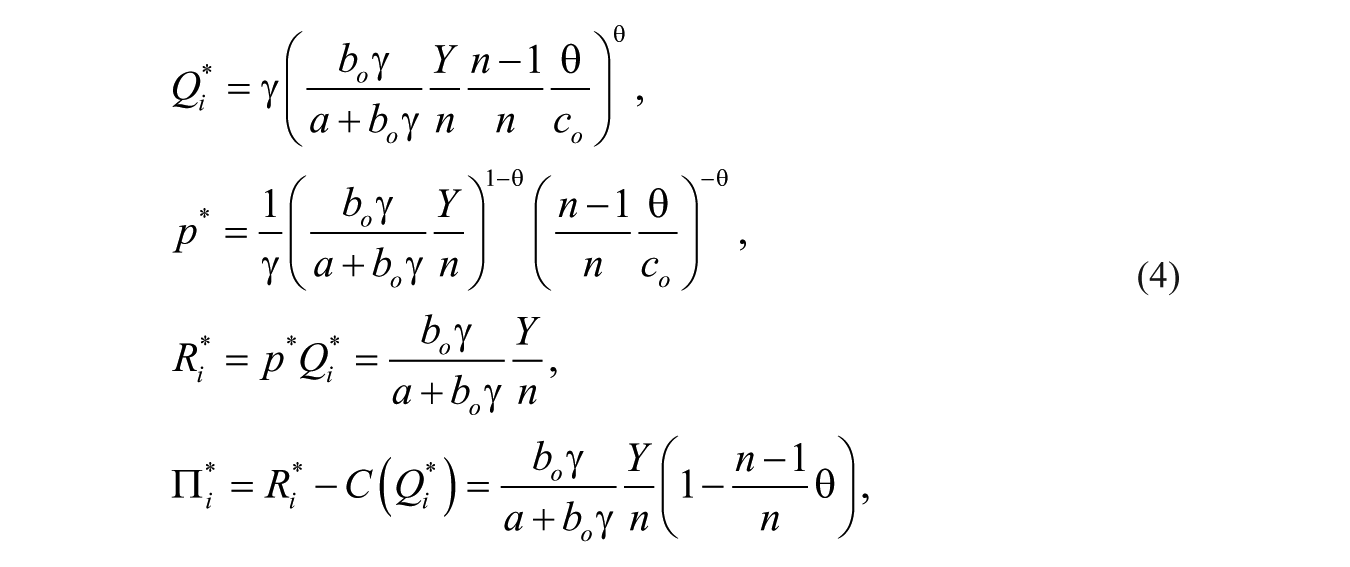
where 1/θ + 1/n > 1 is assumed to ensure a positive profit, implying that the hospitality industry can only accommodate fewer (n↓) firms given the market demand if they seek higher returns to scale (θ↑) in their production.
As shown in Equation (4), the business performance of individual firms hinges on all push and pull factors (Y, bo, γ), among other things such as (n, co, θ). It then follows that ∂(Qi*, Ri*, Π i *, p*)/∂(Y, bo) > 0, ∂(Qi*, Ri*, Π i *)/∂γ > 0, and ∂p*/∂γ < 0. The signs of these derivatives lead to:
Economic Welfare
Economic welfare from hospitality business needs to be analyzed with respect to both the market structure of allowing for oligopolistic firms and the business nature of catering for nonresident tourists. Such welfare analysis, while conducted from the industry-wide perspective, should also be compared with situations of individual firms that operate in the oligopolistic market. Simple aggregation of performance indexes in Equation (4) across those firms yields:

The effect of market structure on business performance can be clarified by looking at the derivatives of performance indicators with respect to the number of oligopolistic firms in the hospitality industry. To do this, one needs to use a little more math by defining y = (1 − x)x and noting y′(x) > 0 for x
Policy implications can be extracted from our work on the economic performance of local hospitality. Two points are worth making for this issue. First, the result of Proposition 2 seems at odds with the common wisdom that competition is good for efficiency. Such wisdom is only valid if consumer surplus is taken into account. Yet this is not the case in a travel destination, where its consumers are mostly nonresident or even foreign visitors. There seems no need, as is true in practice (Walker, 1999), for the local economy to care about consumer surplus for those tourists. Second, although total revenue is a popular index for hospitality performance among official statistics, a more proper measure should be local profitability that excludes labor costs. Since much of the labor force in many destinations is outsourced (Montgomery & Spragg, 2017; Thornton, 2016), concerns about imported labor’s welfare do not weigh heavily on industry leaders. Therefore, the net profit or producer surplus of hospitality business may be an appropriate indicator of local fortunes, as has been found in our welfare analysis for travel destinations.
It is worthwhile to further explain the usefulness of Proposition 2 with real-world examples. It is natural to use Macao and Las Vegas for explanation since they are the world’s two largest casino tourism resorts. First, as the world’s most attractive destination for travel and vacation, Las Vegas receives more visitor arrivals and hence sells more tourism products than does Macao. However, the after-tax net return on assets of casino hotels in Las Vegas is only about 1/3 of its Macao counterpart. This large difference of hospitality profitability is attributable to the fact, among other things, that tourism markets are much more competitive in Las Vegas and the rest of Nevada with 256 casinos than in Taipa and the rest of Macao with only 35 casinos (American Gaming Association, 2012). Second, Macao’s gaming tourism sector had been a monopoly for many decades up to 2002. Its market structure has since changed to an oligopolistic industry through opening up to foreign investment. The Herfindahl index for Macao gaming is estimated to decrease from 0.592 in 2005 through 0.278 in 2007 to 0.187 in 2011, indicating that the degree of industrial concentration was declining over time in this period (Gu & Tam, 2014). As a result, the level of profitability on its gaming tourism fell substantially after controlling for the offsetting effect of rising demand, and some casino operators have repeatedly requested the local government to grant tax relief even when their sales are strong. Rising competition among hospitality firms in Macao, albeit good for tourist welfare, is obviously bad for local businesses in terms of their net profitability.
If conducting an analysis with respect to the number n of firms in the industry, one can expose the adverse effect on economic welfare of market competition for hospitality business among local oligopolists. This effect can be more conveniently displayed by comparing oligopoly (n < +∞) with perfect competition (n → +∞) to invalidate the common wisdom mentioned above. This comparison is facilitated by using analytic geometry, as depicted in Figure 1 for si = 1/n in Equation (3). Under profit maximization, the oligopolist chooses output Qn such that Π n (Qn) > Π n (Q) for all Q ≠ Qn including the competitive output Qc, that is,

As seen from Figure 1, area A measures the reduced producer surplus following a hypothetical shift from oligopoly to competition, while area C records the increased producer surplus due to such a shift. Since A = (pn − pc)Qn and C = (Qc − Qn)pc − ∫(Qn, Qc)MC(Q)dQ, we notice from Equation (6) a net producer loss: C − A < 0. In addition, there is a rise in consumer surplus for visiting tourists by as much as A + B, which, however, is not in the interests of the travel destination. The result from the above arguments is presented in:

Efficiency Comparison Between Oligopoly and Competition
Conclusion
In this article, we show that favorable changes in push factors stimulate tourism demand from source markets. Enhanced pull factors from travel destinations also give a boost to the demand while reducing the production cost and selling price of hospitality output supplied to visitors. Such good variations in both types of factors improve hospitality business for individual firms in terms of their revenue and profit. Those results are obtained in the context of Cournot game for an oligopolistic market as the most realistic formulation of a hospitality industry. Our findings are consistent with, and also provide theoretical support for, extant empirical studies in tourism and hospitality (Prayag & Ryan, 2011).
We establish that heavier competition is bad for hospitality business among individual firms by depressing their sales, revenues, and profits. For the whole industry, rising competition, albeit boosting its sales, has no effect on its revenue but affects adversely on its profitability. This result about the link between industry concentration and business profitability is confirmed by some evidence as in the Taiwan hotel industry (Pan, 2005) but at odds with other empirical observations as for the U.K. hotel sector (Davies, 1999). This inconsistency may have little to do with market structure but rather with other key elements such as market liberalization as in Macao (Eadington & Siu, 2007).
We also find that uncompetitive market structure can be desirable for maximizing local economic welfare from running hospitality business. The policy implication of this result is that there is no need to push for market competition. Local industry leaders may not care much about the interests of nonresident tourists and imported workers since their doing business is for profit not for altruism. Our result seems to contradict the common wisdom but is actually in line with observed realities (Walker, 1999). Not many studies in this respect can be found in the tourism/hospitality literature (Ma, Weng, & Yu, 2015). Only a few descriptive papers with qualitative analyses advocate market competition with free entry and call for opening up casino gaming to foreign operators (Eadington, 2007; Sheng, Li, & Gao, 2019). Their recommendation works for foreign interests, whereas our assertion is applicable to tourist resorts for local welfare.
This work on tourism and hospitality remains to be deepened and widened in future studies. More insights into industry structure will be generated along two lines of research. First, our work is a static theorization with limited findings. It can be extended to a dynamic model if attempting to provide a theoretical account for the cross-time dependence of hospitality profits on business cycles via tourist flows across borders (Bronner & de Hoog, 2017). Second, product differentiation is observed to significantly reduce market competition (Mazzeo, 2002), and price coordination is pursued in some tourism resorts under product sophistication (Andergassen, Candela, & Figini, 2013). To better address these practices, one needs to apply models of monopolistic competition and oligopolistic collusion to industries of tourism and hospitality. Theoretical modelling should be strengthened to provide support for related empirical studies that have started to emerge in the literature.
Footnotes
Funding
This research has been funded by the University of Macau, MYRG2018-00032-FSS.
