



Abstract
The hospitality and tourism industries now acknowledge that engaging with customers via social media is an essential element of marketing strategy. Given the high variability of success with which firms have been attracting customer interest online, however, it is clear that businesses are having a difficult time determining the best way to use these emerging technologies. This study investigates the impact of certain social media post attributes on customer engagement, using restaurants on Facebook as an example. We introduce a novel set of text analytic features that positively affect customer engagement and test them against a big data set (174,000 posts). Findings indicate that appeals to a feeling of belonging to the community have a significant positive effect on engagement. This study contributes to the body of knowledge on customer engagement and offers concrete recommendations for how restaurants can interact with customers online.
Introduction
Customer engagement (CE) has emerged as a topic of great interest to both researchers and practitioners (e.g., Brodie, Hollebeek, Jurić, & Ilić, 2011), particularly for hospitality and tourism (Wei, Miao, & Huang, 2013). Improved CE has been shown to positively impact a variety of performance outcomes, including sales (Roberts & Alpert, 2010), competitive advantage (Sawhney, Verona, & Prandelli, 2005), profits (Bowden, 2009), and brand evaluation (So, King, Sparks, & Wang, 2016). In a review of the fundamental propositions of CE, CE essentially describes an interactive experience between a business and its customers (Brodie et al., 2011). While Hollebeek, Conduit, and Brodie (2016) conceived of CE as a combination of cognitive, emotional, and behavioral manifestations, Gambetti and Graffigna (2010) proposed that CE is a more complex construct involving processes at different levels of emotional, cognitive, and behavioral activation.
Social media has provided enhanced opportunities for CE, and social media sites have become the key locus of interactions among customers as well as between customers and a firm (Mariani, Di Felice, & Mura, 2016; Viglia, Pera, & Bigné, 2018). Social media has become a platform for the exponential spread of word-of-mouth opinions and for collaborative innovation (Swani, Milne, & Brown, 2013). Since word-of-mouth dissemination of information frequently occurs via social media, a strong online presence is essential for regulating brand image and promoting brand awareness (Chen, Fay, & Wang, 2011). The nature of social media has forced firms to reevaluate their marketing strategies. The shift from direct advertising toward sustained, two-way conversations with customers reflects the growing importance of social media for businesses (Xie & Lee, 2015). Moving beyond traditional one-way marketing strategies, firms increasingly seek methods to develop relationships with customers (Hoffman & Fodor, 2010). Many firms are investing in digital marketing strategies to enhance CE on social media. These investments often see a substantial return on investment, because positive customer interactions on social media experience a ripple effect as they extend from an individual user out into the broader social network (Kumar & Mirchandani, 2012).
For restaurants, in particular, social media has become a major marketing channel, because the dominant players tend to be small, independent restaurants that lack the resources to use other marketing channels such as TV and radio (Wang, Tang, & Kim, 2019). Due to the intangibility of restaurant services, content on social media is a particularly important reference for individuals when choosing a dining venue (Kim & Tang, 2016). Thus, social media platforms have become a critical marketing channel for relationships between restaurants and customers.
Research indicates that discussions on social media affect a firm’s bottom line (Kumar & Mirchandani, 2012; Luo, 2009), and the monetary value of a single Facebook “like” to a business is considerable (Sashi, 2012). There is a growing interest in determining exactly what instigates likes, comments, and shares (Mochon, Johnson, Schwartz, & Ariely, 2017), and marketers have begun to move toward brand-based content and away from promotion-based content with the intent of increasing social media activity (Kacholia, 2013). In general, previous studies of Facebook “liking” behavior have fallen into two major categories: (1) those that focus on user motivation, explaining online behaviors through psychological and sociological theoretical lenses (Gummerus, Liljander, Weman, & Pihlström, 2012; Wallace, Buil, de Chernatony, & Hogan, 2014) and (2) those that focus on the message content (Lee, Hosanagar, & Nair, 2014). The content-focused studies have been limited, however, in the extent to which they have fully leveraged recent advances in text analytics. Text analytics has provided a promising set of tools for analyzing social media text content directly, particularly in the area of novel feature sets, sentiment analysis, and semantic understanding. See Supplemental Appendix A (available online) for a summary of recent text analytic research.
Although identifying specific attributes of posts on social media that motivate CE (embodied here as likes, comments, and shares) could supply valuable strategic insights to practitioners, the potential of big data text analytic methods has been underexplored. The aim of the current study is to fill this gap by identifying specific textual attributes of restaurants’ posts on social media that lead to CE. In particular, drawing from theories from social belongingness, this study examines whether linguistic appeals to community belongingness contribute to CE.
The present study advances the understanding of business activities on social media by empirically showing that community-oriented language increases customers’ responses and therefore represents an effective tactic for increasing CE. This study suggests that restaurants should leverage the identity of the surrounding community, with its unique vocabulary and customs, because rhetorical moves that reinforce this community lead to increased CE.
Literature Review and Development of Hypotheses
Customer Engagement on Social Media
CE can refer to a psychological state (Mollen & Wilson, 2010) or to a measurable set of behaviors (Bijmolt et al., 2010). The term originated in industry, but as academic interest has grown over the past two decades, the precise definition of CE has evolved (Brodie, Ilic, Juric, & Hollebeek, 2013). Bowden (2009) conceptualized CE as a combination of rational and emotional bonds which form customer loyalty, while Bijmolt et al. (2010) considered CE to be more of a behavioral construct. Brodie et al. (2011), in seeking to clarify CE’s relationship with several overlapping concepts (relationship marketing, customer relationship management, brand loyalty), proposed that CE refers to a customer’s cognitive, emotional, and behavioral investment in interacting with a business. Brodie et al. (2011) and other researchers (Dijkmans, Kerkhof, & Beukeboom, 2015; So, King, & Sparks, 2014) have proposed that CE consists of a combination of cognitive, emotional, and behavioral components. Recently, Hollebeek et al. (2016) agreed that CE has cognitive, emotional, and behavioral aspects and that both business-to-customer and customer-to-customer interactions are critical subjects for research.
With the success of social media, academic groups have called for research on CE in the online brand communities context (Brodie et al., 2013). In the context of a social media–based virtual brand community, CE comprises cognitive and emotional aspects, which trigger behavioral aspects through interactive experiences (Hollebeek, Glynn, & Brodie, 2014). The cognitive aspect of CE refers to a customer’s thought process in a particular interaction with a brand, while the emotional aspect is a customer’s degree of positive affect toward a brand. The behavioral aspect refers to a customer’s performance of interactive activities that require time, effort, and energy (Hollebeek et al., 2014). Viglia et al. (2018) measured engagement through visible interactions which can derive from the cognitive and emotional components of engagement on social media. For example, customers engage with firms by commenting on a brand’s Facebook Fan Page, liking posts on Instagram, retweeting posts on Twitter, or writing a review on Yelp. Therefore, customers’ behavioral manifestations occur when a firm’s activities on social media stimulate CE (Beckers, van Doorn, & Verhoef, 2018). Thus, CE on social media tends to elicit participative experiences (Gill, Sridhar, & Grewal, 2017), which serve to build strong and long-term relationships between a firm and customers. Furthermore, customers’ behaviors on social media such as liking, commenting, and sharing likely represent critical performance indicators (Dimitriu & Guesalaga, 2017; Wallace et al., 2014). These actions appear to represent the progressive levels of users’ engagement: conversation (like), amplification (comment), and applause (share; Kaushik, n.d.). On Facebook, the number of likes, comments, and shares can be viewed as visible indicators of the progressive levels of CE (De Vries, Gensler, & Leeflang, 2012; Mariani et al., 2016; Viglia et al., 2018).
The present study adopts the following working definition of CE, which borrows from Hollebeek et al. (2014) and Hollebeek (2011): CE is the voluntary nontransactional, value-adding interaction of a customer with either the business or other customers of the business. Social media is an essential enabler of these interactions, allowing users to add and share content or to engage in social networking. CE is a multidimensional construct consisting of cognitive, emotional, and behavioral dimensions. In the current study, we view social media engagement actions as behaviors that result from cognitive and emotional processes. This study therefore operationalizes CE as customers’ liking, commenting, and sharing behaviors on a firm’s activities on social media—specifically on the Facebook Page.
Social Media, Brand Community, and Belongingness
When a firm creates a social media page where it can interact with customers, it is creating an opportunity for individuals to participate in a community (Bhattacharya & Sen, 2003). Social media provides a means to strengthen brand community involvement (Habibi, Laroche, & Richard, 2014). A brand community is a virtual gathering place for enthusiasts of brands (Muniz & O’Guinn, 2001, p. 412). De Valck, Van Bruggen, and Wierenga (2009) further defined online brand communities as “specialized consumer knowledge reservoirs” (p. 185) that share a common passion for the brands and the experiences they generate (Kozinets, 1999). Customers are drawn to these brand communities for many of the same reasons they are drawn to social media in general: information, entertainment, remuneration, social interaction, and identity formation (Muntinga, Moorman, & Smit, 2011).
Theories from social psychology suggest that individuals join online brand communities for social reasons such as finding friends or gaining emotional support (Ridings & Gefen, 2004) and participate in social media to share their feeling and ideas (Park, Kee, & Valenzuela, 2009). Individuals participate in brand communities in large part due to the “need to belong,” (Gangadharbatla, 2008). Therefore, understanding the extent to which contents on social media satisfy individuals’ belongingness needs is critical.
Social identity theory holds that the groups to which individuals belong are a critical source of self-esteem because of a person’s sense of their social identity (Tajfel & Turner, 1979). The innate drive to belong to some collective underlies much of human behavior (Baumeister & Leary, 1995). Other motivators, such as accomplishment or the drive for power, may actually be manifestations of a more fundamental desire to feel included. Depression can arise when individuals feel a lack of belongingness (Myers, 1992), and clinical psychologists often encourage depressed patients to seek out social connections (Brehm, 1987).
While the belongingness hypothesis has theoretical roots in evolutionary biology and modern psychoanalysis, belongingness as a basic need has had an extensive empirical demonstration. Literature on social belongingness has investigated the degree of people’s willingness to form strong attachments with a group. Individuals continuously monitor social situations for indications of belonging. One study found that when subjects perceived a lack of belongingness to a group, they experienced selective attention to stimuli, leading to a biased recollection of events (Gardner, Pickett, & Brewer, 2000). Many celebrations and rituals are in fact reaffirmations of our connections some group (Baumeister & Leary, 1995).
Brand communities demonstrate the traditional markers of community: a sense of moral responsibility, shared consciousness, tradition, and rituals (Brodie et al., 2013; Muniz & O’Guinn, 2001). People engage with brands to be “part of the family,” and they enjoy recognizing the visual and lexical elements of a brand’s vocabulary (McAlexander, Schouten, & Koenig, 2002). Brands have a strong “social identity” (Bagozzi & Dholakia, 2006), and participating in a brand community entails rational brand admiration combined with the emotional gratification of shared experiences. Brand community–oriented advertising strategically invokes the shared icons and stories of the community, such as Apple’s culture of creative iconoclasm and Harley Davidson’s idiom of rugged comaraderie (Kilambi, Laroche, & Richard, 2013).
Brand communities on social media experience beneficial impacts on shared consciousness and shared rituals, as well as on impression management, brand use, and brand loyalty (Laroche, Habibi, & Richard, 2013). Consequently, shared consciousness, a sense of rituals, and social identify influence the sense of belonging to the brand community.
The particular brand community relevant to this study is the City of Boulder, Colorado. Cities have recognized the importance of conceiving of themselves as brands and have started pursuing traditional brand marketing strategies (Zenker, 2018). Although product branding and city branding have clear differences, because components of the product marketing mix are inapplicable to city brands (Kavaratzis, 2009), many elements of corporate branding (Balmer & Greyser, 2006) can be beneficially adapted to city branding (Hankinson, 2007). Several frameworks for city branding have been designed that were inspired by corporate branding. For example, the Anholt Hexagon (Anholt, 2006) proposes a city branding evaluation scheme that examines Presence, Place, Potential, Pulse, People, and Prerequisites. A similar framework suggests a “place branding toolkit” (Trueman & Cornelius, 2006) with five Ps: Presence, Purpose, Pace, Personality, and Power. A key component of these and other frameworks (Kavaratzis, 2009; Stephens Balakrishnan, 2009) is the promotion of iconic city symbols, and we note that our procedure below to locate community-oriented terms resulted in the emergence of several Boulder icons. Messages that reference the city brand, we hypothesize, celebrate, and reinforce the community identity and invite the user into a feeling of belonging.
Although the customers in the current study are interacting with restaurants on Facebook, we contend that messages from the restaurant can invoke the surrounding community brand, and that these messages enjoy higher levels of CE. Thus, a community building social media post in a brand community can potentially inspire a textured reaction in a reader: The reader is reminded of the shared community and derives satisfaction from participating in that community. By taking some action (i.e., like, comment, or share behaviors), customers express their solidarity with the community and experience some degree of fulfillment of their belongingness needs.
Evoking a Sense of Community Through Both Concrete and Abstract Languages
Communities have their iconic symbols that prompt recognition from their members (McAlexander et al., 2002), and these symbols derive their strength from their particularity. Just as sports brands energize their fans with distinctive logos, mascots, and cheers, localities can excite their community members with anything that is distinctive and recognizable, such as landmarks, historical events, and local figures (Anholt, 2006). Language that references such imagery is therefore highly specific and concrete. Several studies have investigated the effect of concrete language and have found that greater concreteness provokes trust (Elliott, Rennekamp, & White, 2015; Gorbatai & Nelson, 2015). Concrete language is processed by the brain more efficiently (Binder, Westbury, McKiernan, Possing, & Medler, 2005), and has been shown to increase the success of online crowdfunding campaigns (Parhankangas & Renko, 2017). Consumers are more willing to share positive information about a product after reading an ad written in more concrete language (provided that the ad is a narrative; Pitardi & Dessart, 2018).
On the other hand, referring to specific local symbols is not the only means of evoking a sense of community. Language can also refer to a sense of community in the abstract, with phrases such as “community,” “we’re all in this together,” “team,” “welcome,” and “join us.” Whereas concrete language has the advantage of vividness, abstract language has the potential to appeal to a larger audience. Concrete and abstract statements are processed on different neural pathways (Binder et al., 2005), and psychologists have found that concrete and abstract concepts are organized differently in the mind, with abstract concepts being organized with associative links and concrete concepts being organized by category (Marques & Nunes, 2012).
Both of these types of messages are intended to strengthen community feeling, and we hypothesize that both of them will provoke engagement. There is no clear theoretical guidance for why one would have a different impact from the other, but to fully measure the “community building” nature of a text message, we need to attend to both concrete and abstract language.
Conceptual Framework
Based on the previous discussion, we argue that a sense of belongingness to the brand community is a motivator for social media users to engage with content through liking, commenting, or sharing. Thus, identifying the influential factors on social media that induce a sense of belongingness is critical if firms want to maximize the benefit of their social media investments.
We postulate that a sense of belongingness to a brand community can be stimulated in the abstract (community building) or in the concrete (community centrism). Abstract language is that which references the general notion of togetherness, community, common collective, and so on. These kinds of words and phrases evoke the social side of interacting online, and the potential for fulfilling social needs. Consequently, the content emphasizing a sense of belongingness to a community may relate to higher levels of CE on social media. Customers may gain a positive effect from abstract language that emphasizes a feeling of community and becomes more willing to like, comment, or share content with others. Therefore Hypothesis 1 is
Community belongingness language can also be concrete, invoking a lexicon of distinct symbols, inside jokes, specialized vocabulary, and so on, that are unique to the community and known to insiders. Below we describe a technique for finding the shared concrete language of a particular community, and we hypothesize that this language enhances CE. Thus, Hypothesis 2 is
The conceptual framework that guides the development of these hypotheses appears in Figure 1. The framework illustrates the relationship between community building language (abstract), community centric language (concrete), and CE on social media, defined here as likes, comments, and shares on Facebook. The posts’ features and a firm’s fan-page features on Facebook are control variables.
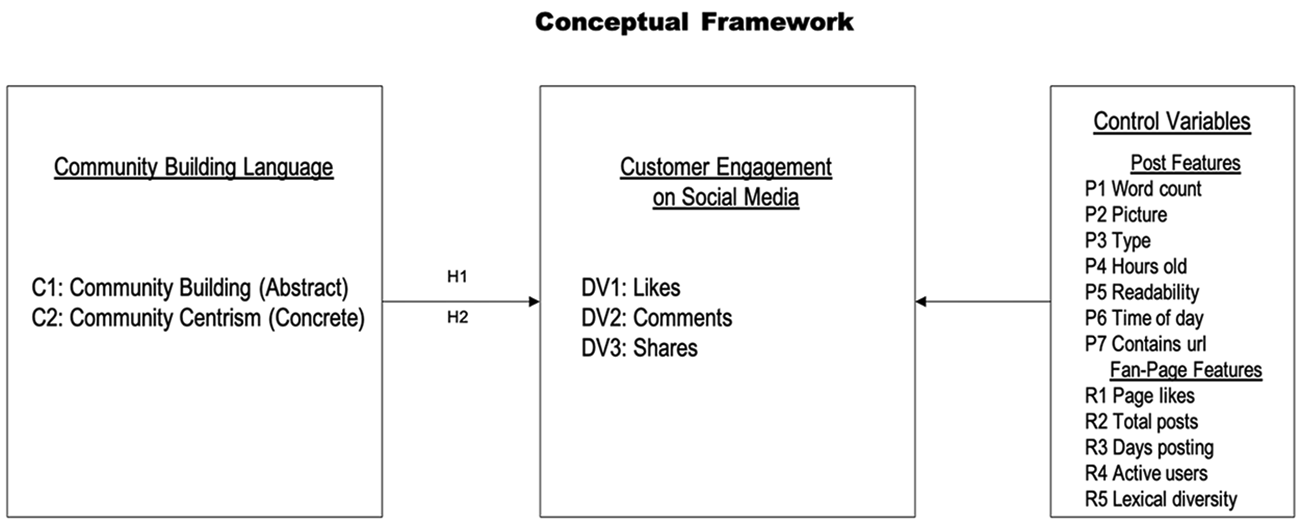
Conceptual Framework
Method
Study Context
To investigate the effect of community belongingness appeals on CE on social media, this study adopts a big data text analytic methodology using a set of Facebook posts from restaurants in Boulder, Colorado. Based on the premise that CE is context-specific, social media foster the creation of interactions among customers and a brand and represent a rich context for engagement manifestations such as the number of likes, comments, and shares. For this reason, an online brand community embedded on a social media platform serves as the context of this study.
The choice of Boulder as an example for restaurants on social media was driven by several considerations. First, Boulder has a famously vibrant restaurant scene: It was recognized as “America’s Foodiest Town” by Bon Appetit magazine (Knowlton, 2010), and its Pearl Street was profiled as a top foodie street in Food & Wine magazine (Hamadey, 2013). Second, a National Geographic survey of 250,000 Americans determined that Boulder was the happiest city in the United States (Stone, 2017), due in part to its strong “sense of community.” Boulder’s population is large enough—107,000 in 2016—to have a sufficient number of restaurants active on Facebook, but still small enough to have an identity distinct for the community. Place attachment, which refers to the emotional ties to a person’s place of residence, is negatively related to population (McKnight, Sanders, Gibbs, & Brown, 2017). A sense of community has a significant positive relationship to civic involvement (Davidson & Cotter, 1986), and civic involvement has a significant negative relationship to city size (Oliver, 2000). This combination of a sense of community and a strong restaurant scene makes Boulder a promising example for whether community building posts are effective for restaurants.
Data Collection
To test whether community-oriented language (community building & community centrism) enhances CE, we collected data from the 1,625 restaurants in Boulder, Colorado with Facebook pages. After identifying the Boulder restaurants with Facebook pages using a web query, we used the Facebook Graph API to download the restaurants’ posts. The Graph API (https://developers.facebook.com/docs/graph-api) allows clients to programmatically crawl and download publicly available Facebook resources, including posts from organizational pages. The API makes available several features of organizations and posts, of which we used the subset described below. Of the 1,625 Boulder restaurants with Facebook pages, 428 of them posted at least once. We downloaded a total of 174,706 posts from these 428 restaurants. Posting dates ranged from October 1, 2015, to May 15, 2016.
From the Facebook posts, we extracted basic numerical features, added our experimental derived language attributes, and built a regression model that allowed for the assessment of the relative effects of all of the features together. The following sections detail this procedure.
Control Variables
Post features and fan-page features, which would likely also contribute to higher CE, were used as control variables to help isolate the effects of community-oriented language.
Post Features (P1-P7)
We control for Word count (
Restaurant Fan-Page Features (R1-R5)
Page likes (
Independent Variables
We derived the two experimental community features—Community Building (
Community Building
To identify the posts that are primarily motivated by community building, we constructed a supervised machine learning classifier and trained it with a manually coded sample of posts. We drew a simple random sample of 3,000 posts and had 13 undergraduate students each code a random subsample of 200. Coders were instructed to read each post and assign one of the following categories: Event, Menu, Community Building (CB), Operations Update, Promotion, and Accolades. These categories originated with a content analysis of organizational tweets (Stvilia & Gibradze, 2014) that we adapted to the restaurant industry using Kwok and Yu (2013) as a guide. A detailed coding protocol with definitions of each category appears in Supplemental Appendix C.
The training data set for the classifier consisted of 5,035 distinct judgments from the 3,000 posts. Inter-rater agreement for the 6-post-type scheme was 58% (Cohen’s κ = .51). A binary field indicating simply whether a post was Community Building had an interrater agreement of 77% (Cohen’s κ = .53, meaning modest agreement [Landis & Koch, 1977]). Of the 2,557 usable labeled posts, 805 represented Community Building. These coded data were used to train a stochastic gradient descent model for classifying the posts as Community Building or other. On an 80/20 train/test split, the classifier achieved an accuracy of 73% (precision [the proportion of posts identified as CB that were truly CB] = 0.71, recall [the proportion of CB posts that were identified as such] = 0.73). The terms with the strongest differentiating power appear in Supplemental Appendix D in porter-stemmed (Robertson & Jones, 1976) format. Of the 160,581 posts that contained a message, 11,475 were classified as Community Building.
Community Centrism
To quantify the extent to which a post uses concrete language belonging to a particular brand community, we took as our “brand community” the city of Boulder and scored each post according to the prevalence of Boulder-specific terminology. This list was obtained by crawling Boulder’s Wikipedia page and contrasting it with those of 20 comparable cities in Colorado to see which terms were the most distinct for Boulder. We created document-term matrices and selected the terms in the Boulder matrix with the highest TF * IDF. The TF * IDF metric quantifies the distinctiveness of a term in a document. It is the product of the term frequency in the document (TF) and the reciprocal of the frequency of the term across an entire document collection (IDF). Thus a term that frequently appears in a document but rarely in other documents would have a high TF * IDF (Jones, 1972). For the Boulder term list, see Supplemental Appendix C.
Dependent Variables
Our dependent variables are our three engagement measures (likes, comments, and shares). Posts on Facebook are presented in a user’s news feed, along with buttons for interacting with the posts appearing at the bottom (Figure 2). The scale for each dependent variable is a count of the number of times users have performed that engagement action on that post as of the download date. Summary statistics and distribution charts for each dependent variable appear in Supplemental Appendix E.
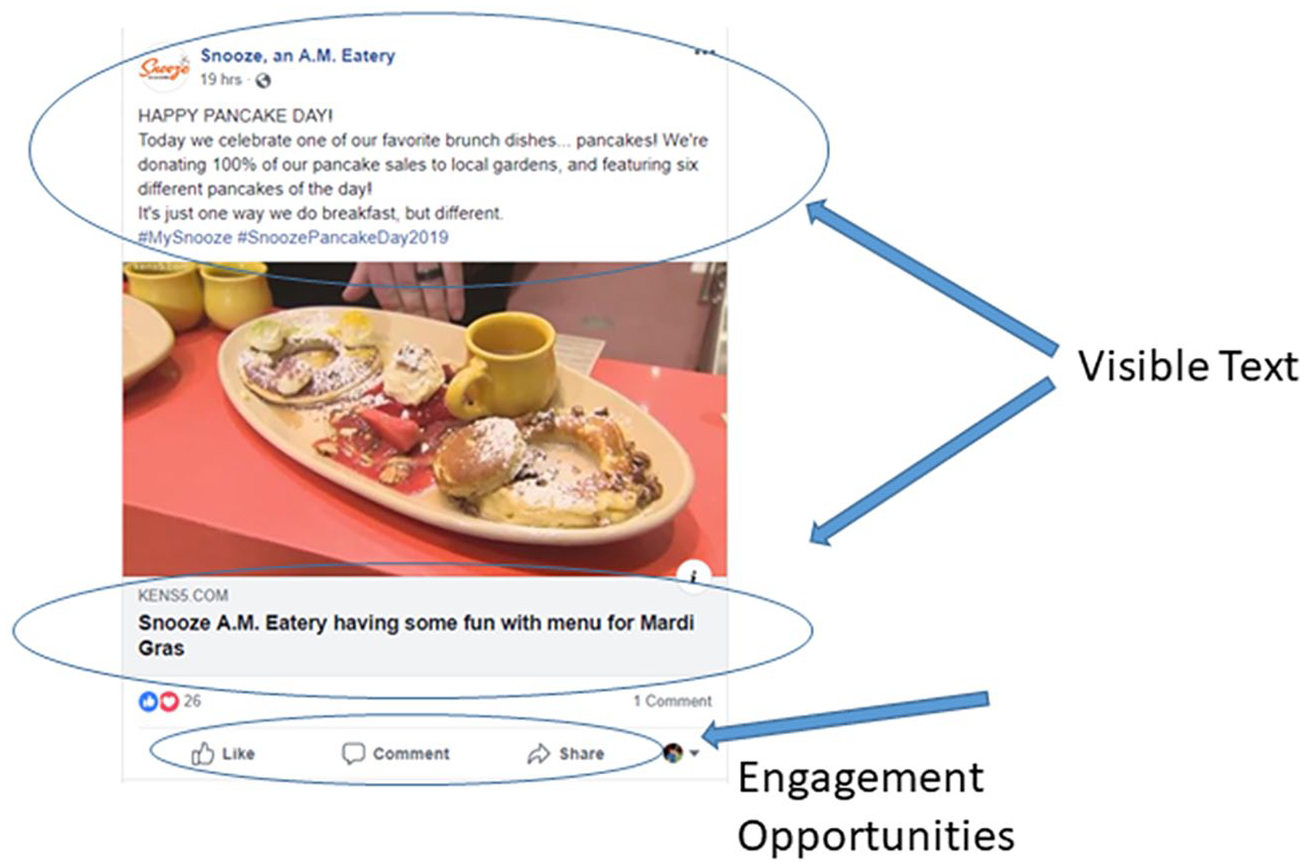
A Typical Organizational Facebook Post
Data Analysis
The three dependent variables—likes, comments, and shares—are discrete counts with occasional high outliers and many zeroes (see charts in Supplemental Appendix E). The dispersions of all three dependent variables are too great to treat as Poisson random variables: Even if we removed extreme outliers, likes have a distribution with a mean of 5.37 and a variance of 122, comments have a distribution with mean of 0.69 and a variance of 2.65, and shares have a distribution with mean of 0.52 and a variance of 2.19. A zero-inflated negative binomial regression, which relaxes the Poisson assumption of equal mean and variance, is therefore appropriate.
Because the observations in the data set exist at two levels (posts nested within restaurants) a hierarchical model is necessary. Ordinary least squares regression requires independent observations (Raudenbush & Bryk, 2002), and because of this nested structure, this assumption would be violated and the estimates would be biased. This study therefore employs a hierarchical mixed model, using the restaurant id as the grouping factor for a random intercept. A similar approach to handling Facebook post data in a regression model appears in Gruss, Abrahams, Song, Berry, and Al-Daihani (2020). In the model, the CE measure of post i in restaurant j is modeled as

where each x is one of our seven post-level variables. Log is the standard link function for the negative binomial generalized linear model. The intercept is a function of restaurant-level variables:

where each w is one of the six restaurant-level variables. Combining and rearranging results in

So each restaurant has an intercept equal to the overall mean intercept
The zero-inflated negative binomial mixed model was estimated using the glmmADMB package in R. As a preliminary step, it was verified that the intercept-only negative binomial was a better fit than a Poisson model (likes AIC 75,515 vs. 48,452, comments AIC 23,830 vs.19,874, shares AIC 19,459 vs. 14,842). AIC (Akaike information criterion) is a goodness-of-fit measure that considers both information loss and model simplicity, and the model with lower AIC is a better model. This analysis then ran three progressive zero-inflated negative binomial mixed models for each CE measure, first with intercept-only, then with controls, and finally the full model with controls and experimental community variables.
Results and Discussion
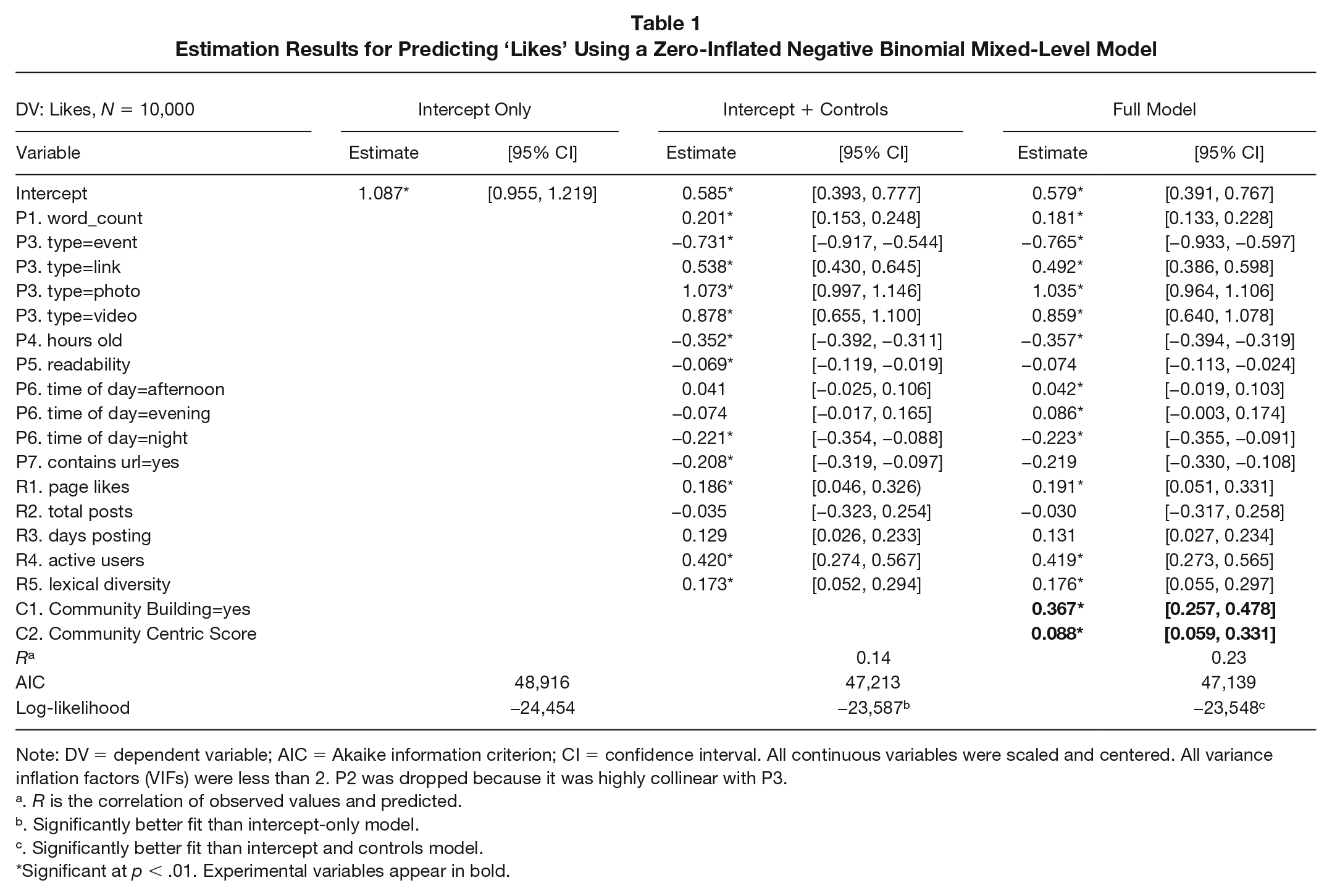
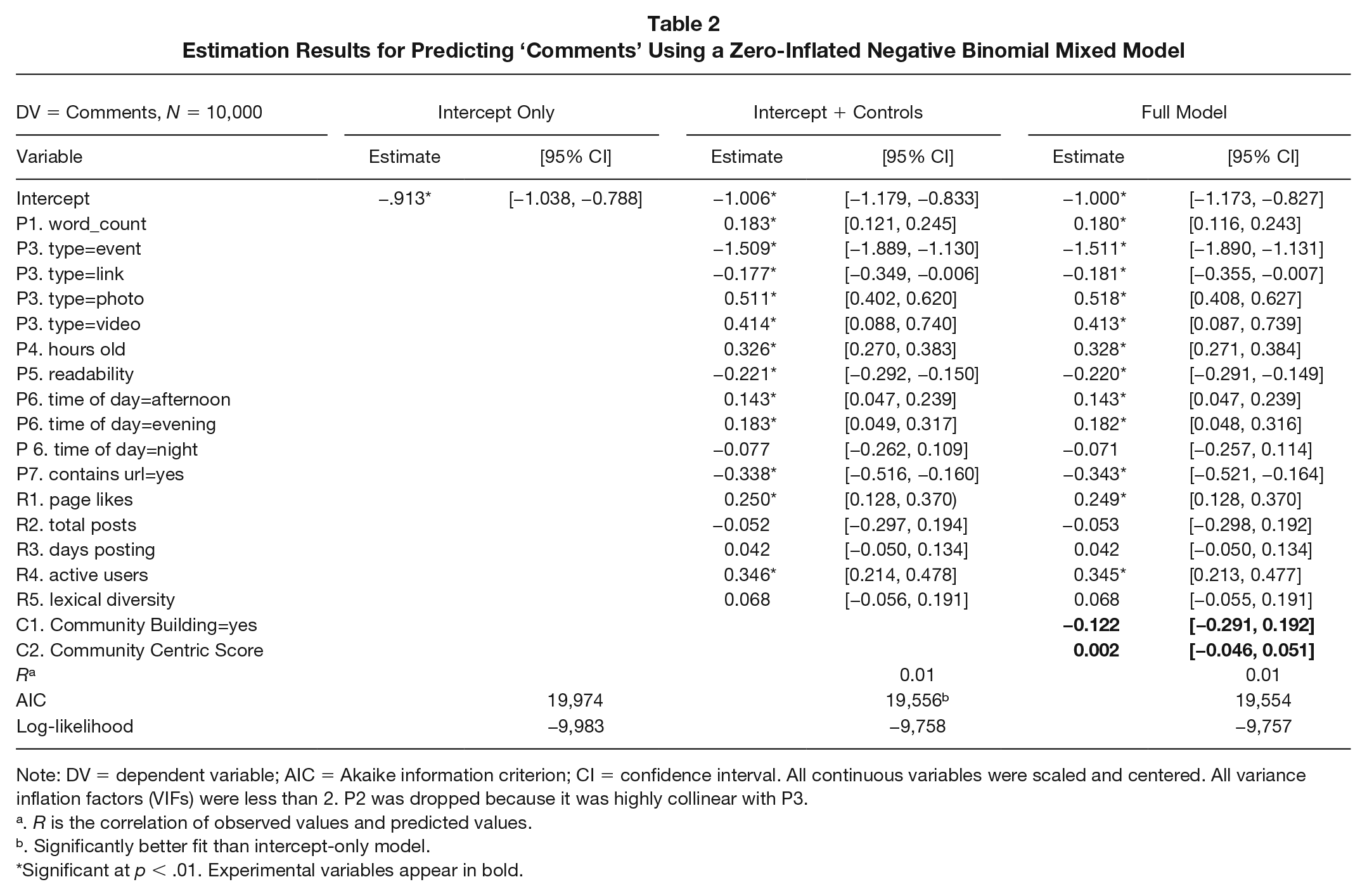
Regression results appear in Tables 1 to 3. Large sample sizes such as ours lead to artificially low standard errors, and thus deflated p values, which could make variables appear significant even when their actual effect on the dependent variable is miniscule. M. Lin, Lucas, and Shmueli (2013) recommend that researchers with large samples communicate the real impact of their independent variables by (1) reporting incremental model improvement (increases in goodness-of-fit measures as variables are added), (2) providing understandable interpretations of effect magnitudes, and (3) stating confidence intervals. For all CE measures, the addition of the control variables results in a significantly improved model fit over the intercept-only model. The addition of the community-oriented variables results in a significant improvement in model fit for likes and shares based on AIC and log-likelihood, but not for comments. Although the data are noisy—correlation between fitted and actual counts for likes is 0.24, comments 0.01, and shares 0.13—many independent variables still have significant effects on the CE measure (Frost, 2014). Although the precise effect size of an independent variable on the CE measure will vary depending on the value of the other variables and how close the variable is to its mean, we can understand the approximate multiplicative effect size as
Estimation Results for Predicting ‘
Note: DV = dependent variable; AIC = Akaike information criterion; CI = confidence interval. All continuous variables were scaled and centered. All variance inflation factors (VIFs) were less than 2. P2 was dropped because it was highly collinear with P3.
R is the correlation of observed values and predicted.
Significantly better fit than intercept-only model.
Significantly better fit than intercept and controls model.
Significant at p < .01. Experimental variables appear in bold.
Estimation Results for Predicting ‘
Note: DV = dependent variable; AIC = Akaike information criterion; CI = confidence interval. All continuous variables were scaled and centered. All variance inflation factors (VIFs) were less than 2. P2 was dropped because it was highly collinear with P3.
R is the correlation of observed values and predicted values.
Significantly better fit than intercept-only model.
Significant at p < .01. Experimental variables appear in bold.
Estimation Results for Predicting ‘
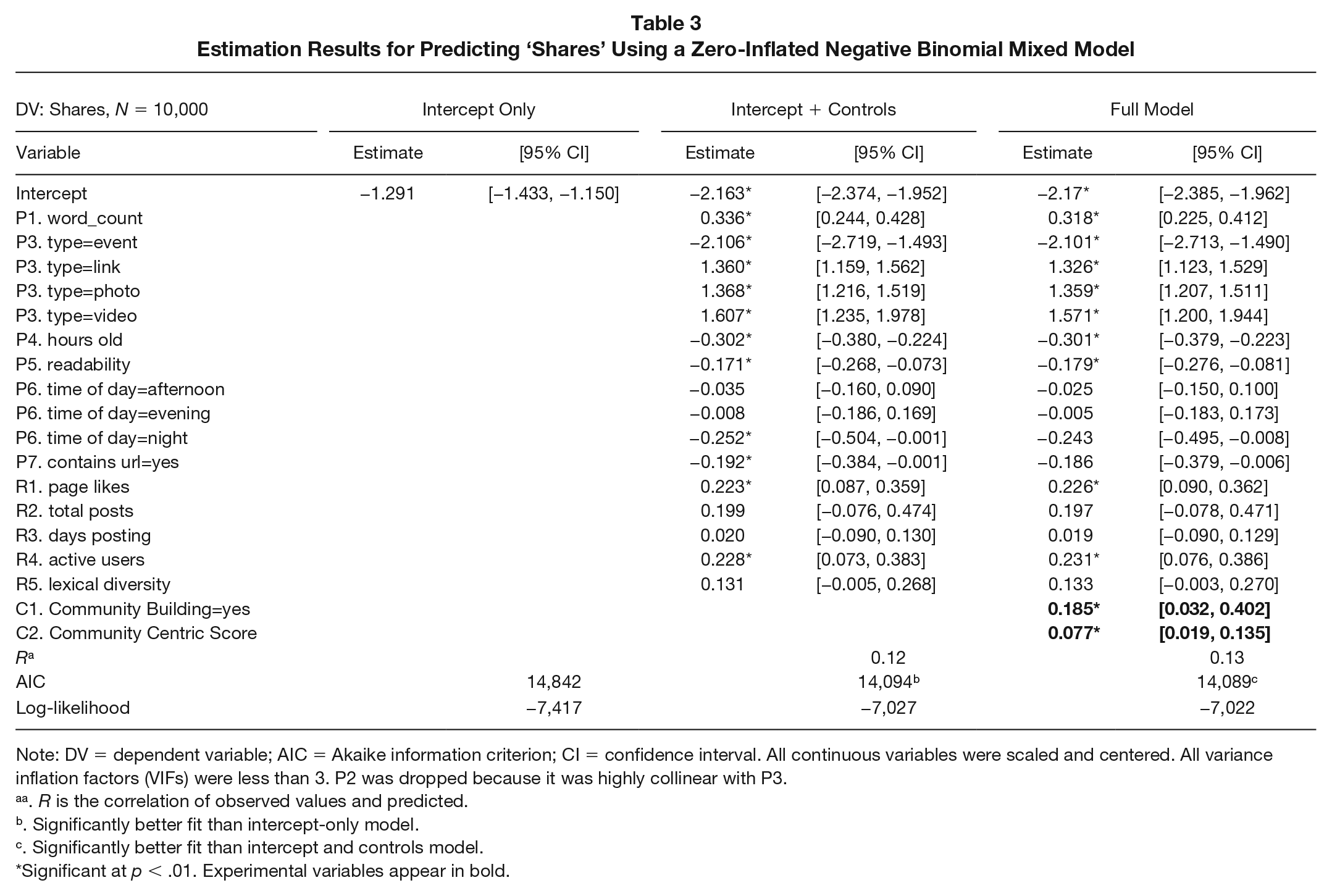
Note: DV = dependent variable; AIC = Akaike information criterion; CI = confidence interval. All continuous variables were scaled and centered. All variance inflation factors (VIFs) were less than 3. P2 was dropped because it was highly collinear with P3.
R is the correlation of observed values and predicted.
Significantly better fit than intercept-only model.
Significantly better fit than intercept and controls model.
Significant at p < .01. Experimental variables appear in bold.
The presence of abstract community building (C1) language raises the number of likes by approximately 44%
Both abstract and concrete community references have a positive effect on likes and shares, but not on comments. This finding suggests that likes, comments, and shares are distinct modes of interacting with social media content with their own triggers. Likes and shares require little effort but are nevertheless broadcast to a user’s friends. They are therefore convenient, low-cost ways for an individual to declare affiliation, and thus have belongingness needs met. Comments exhibit a different pattern, however. The fact that community-oriented posts gain significantly more likes and shares, but have no impact on comments, exposes something about the nature of social media commenting. It is possible that comments result from messages that are surprising or controversial, attributes that would be uncharacteristic of a community-oriented post. We note that one of our control variables, readability (
Significant patterns in our control variables yield some useful insights for those managing a social media presence. Multimedia have a strong effect on CE: Photos increase likes by 190%, comments by 66%, and shares by 260%. Videos increase likes by 140%, comments by 51%, and shares by 400%. Posts that appear at night have consistently fewer likes, comments, and shares compared with those posted in the morning. Event announcements tend to have low CE counts. The presence of a URL has a consistently negative effect on CE, possibly because URLs are forwarded content or because they invite the user to move on to an external site. Interestingly, there is a positive relationship between word count and CE across all three measures, suggesting that shorter posts might be skipped over. Posts written in simpler language tend to win more response: Each grade-level increase in complexity results in 7% fewer likes, 20% fewer comments, and 26% fewer shares. Variety of content, operationalized here as lexical diversity, wins 19% more likes and 14% more shares.
The proposed models suggest several pragmatic recommendations. First, language that fulfills peoples’ need to belong, either through general community building or through community-specific references (community centrism), will provoke more liking and sharing behavior. Exactly what drives more comments behavior should be investigated in future work. Second, social media content should (1) contain photos and videos, (2) be posted earlier in the day, (3) be lengthy but written in simple language, (4) should not be a reference to another URL, and (5) should have a variety of content over the long term.
Implications
This study provides an empirical confirmation that a sense of belongingness to the brand community (community building and community centrism) is a key motivator for generating customers’ engagement behavior, operationalized here as likes and shares on social media. Accordingly, the results of this study provide new theoretical insights into the effectiveness of language that encourages CE on social media.
First, this study is arguably the first attempt to assess the effect of belongingness language on customers’ nontransactional behaviors on social media. In particular, no previous hospitality and tourism studies examined the language of posts’ contents. This study highlights the importance of a sense of belongingness to a community using community activations words. By examining the text in social media posts, the study unveils how the language of community can enhance CE on social media.
Second, this study is novel in observing CE behaviors, rather than just intentions. CE has been defined and measured with different levels and intensity of cognitive, emotional, and behavioral activation (Hollebeek et al., 2016). While many studies have measured CE on social media based on customers’ perceptions or intentions (Harrigan, Evers, Miles, & Daly, 2017; So et al., 2014), few studies have measured actual customers’ behaviors through visible interactions on social media (Kwok & Yu, 2013; Viglia et al., 2018). Our empirical verification of how certain language in social media posts prompts a measurable response constitutes a novel contribution to the literature on CE.
Third, this study adds the literature on social media branding with a particular focus on customer engagement in brand-customer communications. As social media has transformed traditional marketing communication and strategy, understanding how communications on social media may increase customer engagement with a firm (and with other customers) is critical. Given that social media channels generate interaction between firm and customer while traditional media channels only communicate from firms to customers, this study fills a significant gap in the extant literature of brand marketing and social media.
Fourth, with an advanced methodological approach, the present study significantly contributes to the methodological literature and academia by applying insights from big data text analytics. While a few scholars have analyzed the characteristics of posts on social media using similar data sets, the present study is unique in how it leverages text analytics. The use of text analytics gives originality to the present research, since it represents one of the first applications in the hospitality and tourism literature. The construction of predictive models for CE based on innovative linguistic features could represent a promising research area. Academia should be cognizant of the important impact of implicit, derived features—specifically, community activation words—on response variables. Careful consideration of supplementary features which are not explicit in the source data is essential for improving model performance, particularly in predicting CE, as illustrated. Consequently, the present research provides a substantial methodological foundation for future studies that investigate CE from social media.
In addition to advancing research through theoretical contributions, the present study provides unique contributions to marketers in businesses, especially in hospitality and tourism. First, using the findings of this study, practitioners can better understand the importance of such derived features, and, accordingly, design more effective marketing strategies to encourage CE via social media. For example, language that fulfills peoples’ need to belong, through general community building or community centrism, will provoke more liking and sharing. Specifically, marketers may find that incorporation of community-specific activation words may engage the base of customers. For example, local businesses could use specific reference words that tie to the community. Marketers should design content that connects and inspires the community, and by so doing, can assist local businesses to compete with even the most significant national brands for customers’ attention.
Second, using community activation words that evoke social belongingness could help marketers take the initiative in creating a valuable community for the public, as the findings of the study show that people interact more when messages create the sense of belongingness. Consequently, language related to social belongingness (community building and community centrism) offers a unique strategy for amplifying customers’ engagement on social media. By showing that a business cares about people and a community, marketers can engender a powerful sense of belongingness that will create an enduring desire to maintain a valued relationship. One good example is the belonging campaign of Airbnb, one of the largest providers of accommodations in the world. Airbnb announced that belonging is the core value of the company and initiated a series of campaigns related to belonging. The belongingness campaign is based on the community-based brand which brings local flavors to their customers. As belongingness has always been a fundamental driver for people and representative of that feeling, Airbnb became a symbol of belonging. After launching campaigns emphasizing belonging, Airbnb became hugely popular on social media, gained significant positive publicity, and gained plaudits from social network users worldwide. For Airbnb customers, communication and interactions communicate the degree of connectedness and belongingness to the community and assist retention.
Third, we found other features of posts that impact CE, and marketers should utilize the information for effective strategies for managing social media, by including multimedia, scheduling the appropriate timing of posts, and constructing concise and varied posted content. For example, inserting well-placed photos or videos will help to enhance CE. Live video with community-oriented words can gain more attention and provide the feeling of connectedness since real-time interaction encourages customers to join the community and also virtually interact with employees or other customers. This invitation to participate in the brand’s story allows reaching beyond the brand’s physical location.
Limitations and Future Research
Despite the important theoretical and managerial implications of the findings, interpretation of the results of this study must recognize several limitations requiring further research. First, assessing the precise number of people who have seen a given post is difficult. Even the potential audience (in page likes) and the “reach” metric provide only approximations of the number of views: Information about individual users’ habits, such as log-in frequency and number of friends is necessary, since a post may be easily hidden in a long news feed. One potentially fruitful follow-up to this study would be an experiment in which organizations identify activation terms and test the degree to which usage effects the number of likes or shares received. Organizations are already attempting to build brand-based communities (Kang, Tang, & Fiore, 2014; Stvilia & Gibradze, 2014), indicating the perceived value for the rewards, but a study which modifies messages with specific manipulations would help quantify this effect and further validate the patterns observed in the current study.
As we noted earlier, Boulder, with its vibrant restaurant scene and a strong sense of community, makes an auspicious subject for an initial investigation into community building on social media from restaurants. But what about restaurants that are in communities without such a strongly differentiated identity? The consequences are either that those restaurants lack a substantive set of local icons and symbols to choose from, or that those symbols are not impactful because the community identification is not as strong. In the case of the first, such a study as ours would have difficulty finding any locally significant terminology. In the case of the second, we would find that community building messages win no more engagement than any other messages. Future work might investigate whether the findings from this study still hold for other cities that may not have as cohesive a notion of place. From a management standpoint, a long-term remedy to this situation is that local businesses, as key stakeholders, could work with city strategic marketers in “developing and delivering the brand” as suggested in (Kavaratzis, 2009).
Future research might also investigate the differential impacts of abstract versus concrete language for achieving CE. We treat them here as slightly different expressions of the same basic construct, but future work could scrutinize their individual effects. Community is likely a complex construct with myriad levels of linguistic manifestations, and future studies could seek to flesh out a conceptualization further. Ultimately, organizations desire engagement with clientele to promote products or services and should evaluate the value of online engagement with respect to that larger goal. Some previous inquiries question whether or not Facebook engagement truly captures brand loyalty, since even enthusiasts tend not to participate in Facebook’s brand communities (K. Y. Lin & Lu, 2011). Testing whether or not increases in engagement are, in fact, assisting hospitality and tourism firms to meet larger organizational goals requires field research. Survey-based studies that extend beyond text analytics and investigate operational improvements could aid validation of the effectiveness of the business’ online presence.
Concluding Summary
With the wide use of social media in business, understanding the language that provokes CE has become increasingly important in almost all industries. This research isolates some of the linguistic factors that enhance CE on social media. Findings indicate that abstract language appealing to the sense of social belongingness (community building language) has a strong positive effect on likes and shares, but not on comments. Also, we find that each community has a set of terms unique to that community, and these concrete terms likewise contribute significantly to the number of likes and shares. Although abstract and concrete community-oriented language plays a role in CE, other factors such as time of day, length, multimedia, and linguistic complexity have a larger impact on CE. The present study advances the current understanding of businesses’ activities on social media by empirically showing that community-oriented language increases customers’ responses on social media, thereby representing an effective strategy for increasing CE. This study suggests that restaurants should seek to create social media postings that reference the vocabulary and customs that evoke a sense of belongingness to a social community, because this language leads to increased CE.
Supplemental Material
supplemental_material – Supplemental material for Engaging Restaurant Customers On Facebook: The Power Of Belongingness Appeals On Social Media
Supplemental material, supplemental_material for Engaging Restaurant Customers On Facebook: The Power Of Belongingness Appeals On Social Media by Richard Gruss, Eojina Kim and Alan Abrahams in Journal of Hospitality & Tourism Research
Footnotes

Supplemental Material
Supplemental material for this article is available online.
References
Supplementary Material
Please find the following supplemental material available below.
For Open Access articles published under a Creative Commons License, all supplemental material carries the same license as the article it is associated with.
For non-Open Access articles published, all supplemental material carries a non-exclusive license, and permission requests for re-use of supplemental material or any part of supplemental material shall be sent directly to the copyright owner as specified in the copyright notice associated with the article.
