



Abstract
Our study aims at investigating how the “Lucca Comics & Games Festival” has grown to become a major revenue generator for the hotel industry and the overall Lucca economic activity. Our study placed a specific interest in analyzing, estimating, and approximating the monetary impact of “Lucca Comics & Games Festival” on the hotel and hospitality segment, and provided extensions to the larger economic activity of the Lucca economy. Our article is an empirical paper, and as such we do not claim to make significant theoretical contributions in terms of model development. Instead, we provide a useful set of tools to estimate and assess the value added of the festival on the economic performance of the hotel sector in the city of Lucca. The article makes a clear contribution to the knowledge related to experiential creation in the field of tourism. Particularly, we provide a simple methodology that allows us to estimate a value-added impact measure.
Keywords
The hospitality industry in local/regional locations, with mainly family-owned hotels, generates most of their operating revenue from the selling of a perishable item, night stays. In this context, a sustained average occupancy rate over the business cycle plays a pivotal role. This is particularly more relevant when we account for the fact that most hotels in regional locations display low levels of product/service differentiation and minimal to nonexistent selling of complementarity products/services. The demand for night stays is normally a function of time of the year, income, attractiveness of the location, and/or proximity to a given location, and of course price. Given these considerations, we proposed to study the case of the Lucca Comics & Games Festival (LC&GF) and estimate its effect on the hospitality industry in the Tuscan region of Lucca, Italy. Lucca hosts over 400,000 people in a city with a population of about 82,000 inhabitants (Lemmi et al., 2018).
In this context, efforts by local/regional governments to develop unique, experiential, and regional-themed specific events may serve as a bridge and provide the necessary resources for hotels (and related industries) to counterbalance income from low seasons, or even possible declining economic activity (Tonga Uriarte et al., 2018). Experiences/events fitting these properties normally occur during a limited time period and are part of the process known as creative tourism. The LC&GF takes place in the city of Lucca, Italy, during the fall season. This event provides a very interesting opportunity to study the development and effects of such a business model/approach to create value and to provide the necessary push to hold many business actives functioning and operating throughout the year.
In this setting, it is also relevant to note that local and regional authorities engage in creative tourism activities to build on the possible benefits deriving from the interaction between tourism and territory (Tonga Uriarte et al., 2018). Such events are on the one hand too expensive to be financed by individual entities, and on the other hand events like this have the potential to generate spillover effects to a multitude of economic sectors within the same region (see Colomb & Novy, 2016; Del Chiappa, 2012; Dirksmeier & Helbrecht, 2015; Hall, 2011; Maitland, 2010; Maitland & Newman, 2004; Vernon et al., 2005, among others). However, because of its relative newness, creative tourism may represent a relatively unstudied recent trend of development of territorial policies in the tourism sector (see Janusz et al., 2017; T. H. Lee, 2013; Nunkoo & Gursoy, 2012; Prayag et al., 2013; Reiser & Crispin, 2009, for instance). Studying the case provides an interesting opportunity to estimate and assess the value added that creative tourism provides.
Particularly, our study aims at estimating how the “LC&GF” has grown and become a major revenue generator for the hotel industry and the overall Lucca economic activity. Our study places a specific interest in analyzing and estimating the monetary impact of “LC&GF” on the hotel and hospitality segment, and provide extensions to the larger economic activity of the Lucca economy.
We organize the rest of the article as follows. In the next section, we provide a thorough review of the most salient literature in the field of creative tourism and related fields. We then provide a detail description of the Lucca experience, and an explanation of our parsimonious research approach to study and estimate the impact of this phenomenon. We conclude the article with some analysis, limitations of our study, and possible policy recommendations.
Literature Review
It is generally agreed on that tourism brings both opportunities and challenges to the region where it takes place (see Del Chiappa, 2012; Lankford, 2001; Lemmi et al., 2018; Lesego, 2010; Vernon et al., 2005; Wieslaw, 2013). The literature provides several studies analyzing tourism from a supply-side perspective. Particular emphasis is given to the provision of opportunities for the visitor(s) to enjoy location-specific elements/events/experiences. In this line of research, however, few studies focus their attention on issues such as the following: (a) tourist perception explaining the behavior of the tourist destination choice (Klenosky, 2002; Leiper, 1990; Richards, 2002); (b) understanding which factors play a decisive role on tourist attractions; and (c) evaluating the attractiveness of a destination (J. Chang & Hsieh, 2006; Chen et al., 2009; Dwyer et al., 2004; Sangpikul, 2008).
In some studies, quality and/or customer services play a significant role when tourist assign a score to a destination image (Ryu & Jang, 2008). Other studies aim at explaining the development of new tourism trends all around the world. Such papers study fields like dark tourism (Farmaki, 2013), medical (Lam et al., 2011), creative (de Bruin & Jelinčić, 2016), wine (Quadri-Felitti & Fiore, 2016) and other types of tourism which have become more relevant during the past decades (De Micco et al., 2017). The common factor of all these fields is the relevance that new, creative, and experiential events may have in the value perception and consequent willingness to pay that visitors may have when selecting a location to visit.
Looking at the early work of Richards and Raymond (2000), they define the concept of combining cultural tourism and creativity as creative tourism. According to them, creative tourism is characterized by a process that goes beyond an attempt to find new market niches in the field of cultural tourism. The literature in this field is prompt and resolute to indicate that location plays an important role in the interaction between suppliers/locals and consumers where the experience takes place (see Bellini & Pasquinelli, 2016; Della Lucia & Segre, 2017; Long & Morpeth, 2016; Richards, 2014). In fact, a segment of the literature links creative tourism to the cultural industry (see, e.g., Andersson & Thomsen, 2008; Della Lucia & Segre, 2017; Long & Morpeth, 2016; Richards, 2014, among others). Della Lucia and Segre (2017) particularly investigates—with a specific focus on Italy—how the cross-links between cultural, creativity, and tourism may be functional to the encouragement of local development. On a similar line of thought, S. Chang et al. (2014) investigated the tourist behavior psychology in term of consumption in order to understand how it is possible to create new products enriched by services oriented to the customer’s needs. This is an important theoretical issue that open to the possibility of creating integrated concept of creativity by developing a more engaging form of experience. Richards and Marques (2012) observe how the link between creative and tourism has several positive impacts in terms of (a) reinvent tourism in destinations where the market is saturated and (b) new entrepreneurship opportunities with the creation of new small creative companies. They observe also how many destinations, such as Manchester, Barcelona, Paris, or the case of Austria, launched the creative activities and/or events in order to attract creative and educated people and in order to become more creative destinations. Creative tourism is not one format of tourism: different are the applications that arise from the link between creative and tourism (Richards, 2018a). Several studies confirm the positive link and impacts between tourism and the creative economy, favoring locally, regionally, and nationally creative economic policies, supporting specific sectors and activities, giving importance to knowledge and networking in tourism activities, and stimulating the growth of specific “creative tourism” experiences (Richards, 2011). In this direction, according to Richards (2018b), “The convergence of tourism and the creative economy has in many areas occurred naturally through the growth of the creative industries, creative clusters and the creative class [ . . . ]” (p. 15).
The LC&GF falls in the category of creative cultural transformational tourism and represents a significant shift in the value creation process from production to consumption in the region of Lucca. In this context, LC&GF can be considered as a form of network tourism based on the capacity of suppliers and consumers to interact with each other in the generation of value (Lemmi et al., 2018).
Creative tourism emerges as a relevant and significant form of tourism leading to further development in regions that may have reached a plateau stage, experience sluggish growth or exhaust any inherent competitive advantage. Its increased importance in the value creation process can be explained from a double lens perspective. First, as an answer to the need for the tourism sector to reinvent itself in response to a more demand-driven approach; and second as a horizontal differentiation strategy in destinations that may have potentially reached a market saturation stage. Here is perhaps relevant to note that some locations/regions are endowed with an advantage as opportunities do not follow naturally an even distribution across space (see Ellison et al., 2010). Certain locations may be strategically capable of developing multiple attractions that are location-specific even when an initial location-specific advantage was not present (Tonga Uriarte et al., 2018). In such a location, initial differentiation processes lead to spillover effects benefiting related and even competing sectors. In this context, we argue in line with Tonga Uriarte et al. (2018) that the combination between culture and creativity in a tourist dimensions may result in positive synergy for creative tourism.
There is also a body of literature emphasizing the empirical aspects of the correlation between the level of tourism development at the destination and residents’ attitudes to the expansion of tourism as one of the main economic activities in the locality/region (Hunt & Stronza, 2014; Lemmi et al., 2018). These studies show how the relationship between tourism development and residents’ local responsiveness is not linear (see Almeida-García et al., 2016; Andereck et al., 2005; Bestard & Nadal, 2007; McGehee & Andereck, 2004; McKercher, Shoval, et al., 2015; McKercher, Wang, et al., 2015; Ward & Berno, 2011; Yoon et al., 2001, among others). It is precisely here that we believe that creative tourism and its related forms of experiential tourism may provide larger benefits than costs to local residents and consequently provide an array of opportunities for local and regional development. Tonga Uriarte et al. (2018) noted that in the case of LC&GF, the event had no initial existing ties to the location, yet it grew over time and the local community has been able to appropriate location-specific advantages. Furthermore, Lemmi et al. (2018) stated that the debate in terms of residents’ perceptions toward the development of transformational tourism goes beyond a cost/benefit analysis, but also includes issues related to city image and identity itself. This debate is particularly more relevant when trying to measure the gains to the local economy deriving from the touristic attraction and the value that tourists derive from their visit. That is, what are the economic benefits and the overall economic impact to the region where the tourist event/attraction occurs? As noted, two recent studies play particular attention to the LC&GF. On the one hand, Tonga Uriarte et al. (2018) specifically studied the inner working mechanisms of the case of LC&GF and provided a clear and detailed analysis of how an organization with a public mission provides the necessary support for private enterprises to conduct successful business activities and foster a healthy relationship between public and private sectors. Whereas Lemmi et al. (2018) studied the phenomenon of transformational cultural tourism based on the case of LC&GF.
Moving from the relevance on the social, economic, and cultural development for the territories and the communities, creative tourism introduces the derived concept of “experience.” We argue that location-specific experiences are nonscalable and nontransferable; thus, they are unique, rare, and hard to imitate or substitute (Barney, 1990). Therefore, either the development or appropriation of any such experience has the large potential of generating significant positive economic effects (Tonga Uriarte et al. [2018] provide a good review of the historical development of LC&GF). According to Landry (2008), creative tourists are looking for a new and more intensive and engaging form of experience. The experience in creative tourism is an important driver to make the cultural features of a place more accessible. Lemmi et al. (2018) noted that in the case of Lucca, LC&GF provides such an experience. In addition, Richards (2003) argued that creative tourism is an active form to live the experience through the creation of a new relationship between the visited (host) and the visitor (guest). In this direction, it is clear in the current literature that experiences have assumed a decisive role in the development of contemporary tourism (Oh et al., 2007).
The review of the literature provides evidence supporting the idea that tourism experience represents a significant example of a broader transformation of the overall economy into what Pine and Gilmore (1999) define as “the experience economy,” and more recently, Lemmi et al. (2018) call transformational cultural tourism. Earlier we noted that Ritchie and Hudson (2009) described the evolution of scholarly conceptualizations of the tourism experience. Following the literature debate, the European Union in 2010 issued the Green Paper on Cultural and Creative industries giving legitimation of demands for more studies of and intervention in the creative field (European Commission, 2010). In 2014, the Organization for Economic Co-operation and Development (2014) report argues that creative economy is a concrete support to tourism in term of developing engaging creative content and experiences, increasing innovation and making destinations more distinctive and attractive.
In this context, this article aims to expand our understanding of how creative and transformational cultural tourism could become a driver of local economic development and an opportunity for local communities through the creation of added value, with emphasis on estimating the monetary impact on the hotel segment in the city of Lucca. In general, the event has grown over time both in magnitude and scope and created a fundamental source of revenue in a very short period of time during the business cycle of hotels.
The Case of Lucca Comics and Games Festival
Description
In its core design, the LC&GF is a creative tourism project developed and undertaken by a rural city in a historical region of Italy. Thus, the LC&GF provides an opportunity to investigate the potential derived from reciprocal and spillover influences between creative tourism and the hospitality industry in a typical Tuscan town.
The origins of the LC&GF trace back to the winter of 1965 when the “1st International Comics Exhibition,” was held in Bordighera. Soon after (September 1966), the city of Lucca, in Western Tuscany, decided to internalize and consequently host the International Exhibition of Comics. The festival was renamed multiple times, and since 2000 has been housed in Lucca and known as the Lucca Comics & Games Festival. 1 Several characteristics make this festival an interesting case analysis because of the interaction between the local government and private businesses. On the one hand, the organizational model builds on the value creation activities in the form of new and creative sections, such as but not limited to the International Exposition of Comics and the Exhibition Market, Creation of the Movie area, Creation of Japan Town, Creation of the stage for cosplay, among others. Such events are added to increase value for visitors and consequently expand the impact of the festival in the city. On the other hand, throughout the years, the municipality and local governance bodies of Lucca have had a more active role in the planning and execution of this growing event, developing a sustainable business approach that involves public offices, generates employment, and provides transparency and accountability of all related business activities. For instance, as part of the city’s plans and efforts to promote and attract local tourism, the municipality of Lucca covers all promotion costs related to the event. More specifically, the LC&GF organizational model pursues a local and regional strategic development perspective, where the event provides a unique opportunity to create synergies among complementary economic sectors, provides possible spillover effects across economic sectors, and propels the city of Lucca beyond simply hosting the annual event. This strategic move of the local government in Lucca constructs a redefinition of the notions of authentic experience and cultural transformational interaction within the inventive and imaginative framework of creativity (see Lemmi et al., 2018; Salman & Uygur, 2010). In this sense, the LC&GF has provided throughout the years opportunities to create value for its visitors and develop opportunities for local businesses, such as but not limited to the hospitality sector.
The event today is a colossus of about 500,000 visitors 2 and 10,000 accredited professionals hosted by a city of about 82,000 inhabitants. The success of LC&GF has created a model that has become normative for all the other Italian events in the sector and today there is practically no one that is not inspired, often in the name, as the festival based in Lucca.
A particular and determinant feature of the organizational model of LC&GF is that implies a radical change in the city dynamics and overall layout of it. In a typical day, the town of Lucca is a quiet, parsimonious city where time seems to have come to a stop. However, during the 4 to 5 days when LC&GF takes place, the town undergoes a total transformation. Schools close for 5 days, shops change their products/service offerings and relocate selling points around town, the historic city center fills with tourists dressing up in customs, and to manage and direct the overflow of visitors, the area outside the city walls turns into a giant parking lot. Furthermore, to manage and transport the inflow/outflow of visitors, charter trains arrive from nearby Florence and Pisa to transport tourists arriving from all over Italy and from the rest of the world.
Data Description and General Overview
Our article is an empirical paper, and as such we do not claim to make significant theoretical contributions in terms of modelling development. Instead, we provide a useful set of tools to estimate and assess the value added of the festival on the economic performance of the hotel sector in the city of Lucca. Hence, we use a parsimonious approach to conduct our empirical analysis of the estimated economic impact of the LC&GF in the hotel segment, as well as an overall estimation of the impact on the city of Lucca. This approach is appropriated to consider and to represent such peculiarities. This is confirmed also by other case studies we examined before conducting our analysis: one for all the case of Umbria Jazz Music Festival in Italy (Bracalente et al., 2011). The choice of the method in fact allows to respect the foundations of the theory of value creation and the usefulness of the empirical assessments to policy makers. This is coherent with the international literature (Brown et al, 2002; Gazel & Schwer, 1997; Herrero et al., 2006; I. Lee & Arcodia, 2011; Saayman & Rossouw, 2011; Schunk & Teel, 2002; Tohmo, 2005), where the case studies are not so numerous and methodological approaches have heterogeneous nature.
There are several elements justifying our primary focus on the hotel industry. The hotel sector is conditioned by a series of variables that remain relatively constant over time, namely number of beds and rooms making its measuring easier and consistent. This is most predominantly in a highly fragmented sector such as family-operated hotels. This is also unique in comparison with the behavior of other variables in other tourism services. For example, in the restaurant segment, you can think of the relative easiness with which the number of seats could be adjusted up or down at a relatively low marginal cost; yet data on this segment is much harder to gather, and one suspects less accurate. However, in the hotel segment, the number of beds is not easily adjustable and thus this number is sticky; as reflected by the slow increase in number of available beds in Lucca. In addition, Lucca being a walled city, there are strict space limitations preventing the expansion of new hotels or even major renovations to existent ones. Because of this stickiness, occupancy rates on hotels makes for a superior measure to estimate the impact of an event like LC&GF in terms of filling the capacity or the presence of excess capacity.
Using local hotel level data, we propose to estimate the economic impact of cultural tourism on the hospitality segment of the Lucca economy. We operationalize the selection of this goal under the following assumptions. First, the model used to evaluate the economic impact is created by merging data from multiple sources. In particular, to estimate the economic impact of LC&GF on the town of Lucca, we collected data from different datasets. Using the AIDA data base (Computerized Analysis of Italian Companies) provided by Bureau Van Dijk (Moody’s Analytics Company), we analyzed about 117 hospitality providers. Then using the Tuscany Region Tourism Database, we collected data concerning the arrivals and the number of overnights stays in the province and in the municipality of Lucca between the years 2012 and 2016. The organizational agency of LC&GF (Lucca Crea) provided data concerning the annual visitors’ occupancy, festival performance in terms of tickets, and web-data management. We chose to estimate the overall revenue for hotels operating in the city of Lucca as the benchmark for the economic dimension impact of the festival.
Before we proceed to assess the economic impact of LC&GF, it is relevant to consider some official figures as presented in Table 1.
Lucca Comics and Games Festival
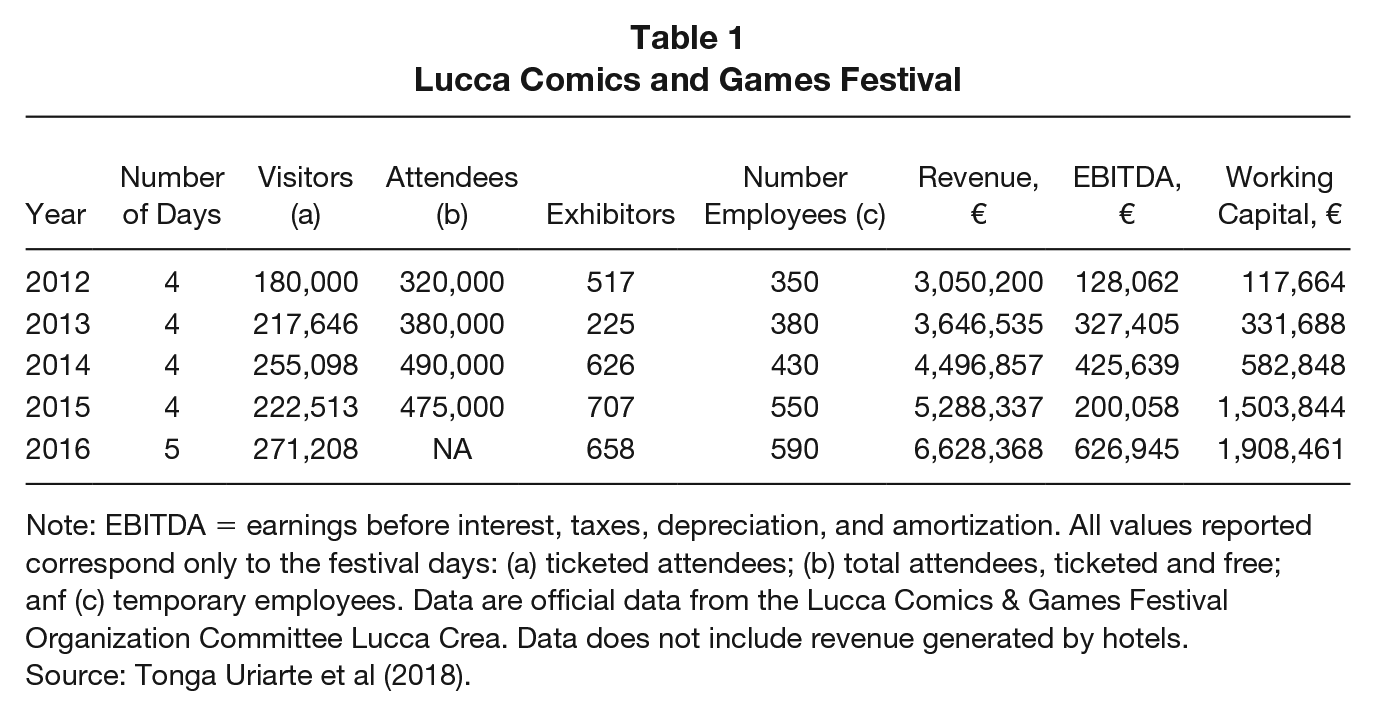
Note: EBITDA = earnings before interest, taxes, depreciation, and amortization. All values reported correspond only to the festival days: (a) ticketed attendees; (b) total attendees, ticketed and free; anf (c) temporary employees. Data are official data from the Lucca Comics & Games Festival Organization Committee Lucca Crea. Data does not include revenue generated by hotels.
Source: Tonga Uriarte et al (2018).
A general overview of the initial data covering the quinquennial from 2012 to 2016, allows us to notice a direct positive impact on the financial statement of LC&GF. It is relevant to note that the LC&GF is a public entity that organizes the festival and it is not related to the hotel segment of the Lucca economy. The official figures clearly note that total revenue increased from 3,050 million to 6,628 million of euro, a cumulative growth of 85.81%. More significantly is the progressive increase of the EBITDA (earnings before interest, taxes, depreciation, and amortization), from 128,062 euro to 626,945 euro, that is, 343.42% in 5 years. Representing the overall financial position/impact of LC&GF, also the working capital had a significant increase from 177,664 euro to 1,908 million euro equal to 347.34% in 5 years. Finally, an approximation of the social–economic impact of LC&GF in the town of Lucca is measured by the numbers of temporary employees involved in the different activities during the festival: 350 temporary employees in 2012 up to 590 in 2016, an increase of about 68%. For further understanding of the LC&GF organizational model and overall history, Tonga Uriarte et al. (2018) provided an excellent review.
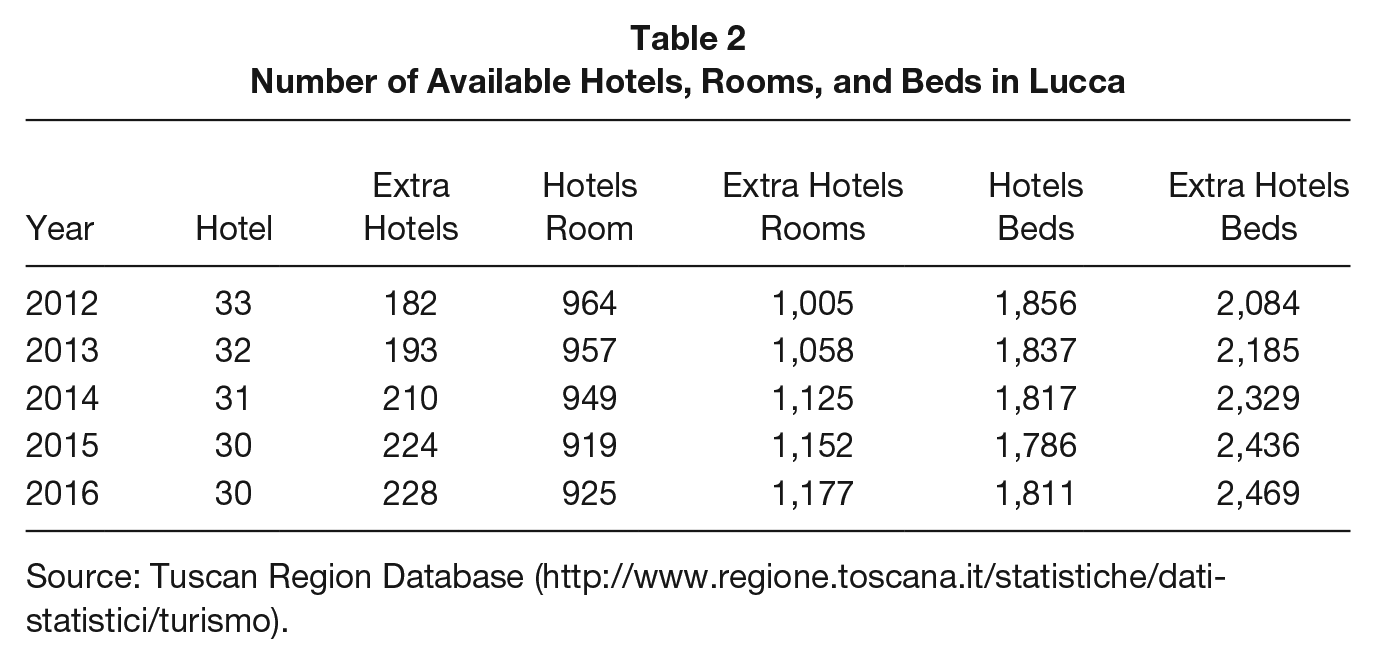
Second, to estimate the impact of the LC&GF on the hotel and hospitality segment, we focus on the number of arrivals and overnights, as presented in the Tables 2 and 3. To begin with, we indicate the separation between festival days and the rest of the year. Data for annual overnight stays serve as a good, easy to measure, lead indicator of number of tourists arriving to Lucca every year. In addition, the number of available beds provides an excellent proxy variable for visitors and intentions to participate in the festival. With this data, we can decompose and compute the value added of the LC&GF by looking at the increased occupancy rates in hotels and the increase in price per night, in relation to the nonevent days. Following this idea, we first decompose the data between visitors staying in Lucca and in the nearby localities. Tables 2 and 3 present the overall number of beds and related production capacity 3 in the city of Lucca. These values are relevant because they indicate the overall capacity that Lucca has had to increase in order to accommodate a larger presence of tourists during the days of the LG&CF. A distinctive characteristic of the festival days is that during the festival, the occupancy rate in all city hotels increases to 100%. This fact, in conjunction with the number of beds (constantly increasing in the period of analysis), demonstrates the efforts made by hotels in the city of Lucca to increase their lodging capacity to accommodate a growing number of visitors. It is precisely the fact that we can accurately measure the impact of the LC&GF on the occupancy rate of local hotels that allows us to estimate the value added that the festival has on this segment of the economy by estimating the average occupancy rate for the rest of the year. We repeated this process for every year and then computed the change across years as well.
Number of Available Hotels, Rooms, and Beds in Lucca
Source: Tuscan Region Database (http://www.regione.toscana.it/statistiche/dati-statistici/turismo).
Overall Number of Beds, Usage Rate, and Load Factor in the Comune de Lucca
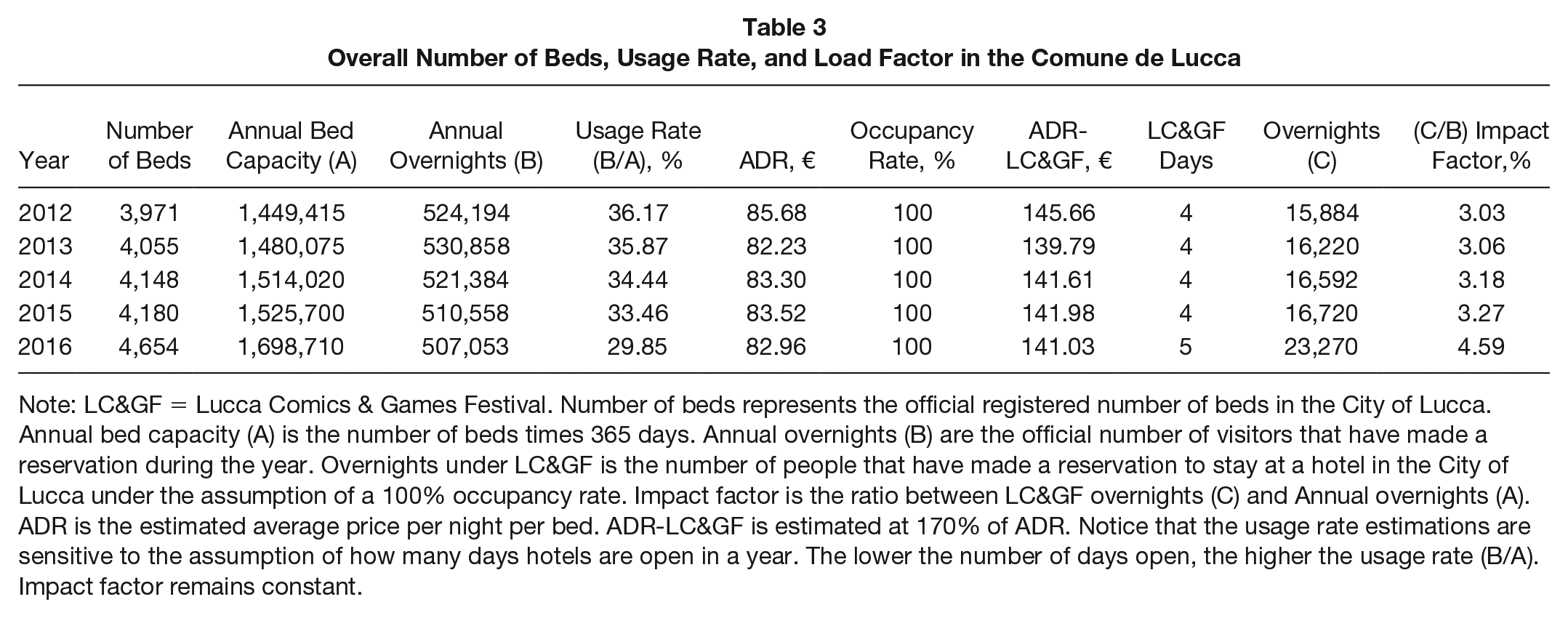
Note: LC&GF = Lucca Comics & Games Festival. Number of beds represents the official registered number of beds in the City of Lucca. Annual bed capacity (A) is the number of beds times 365 days. Annual overnights (B) are the official number of visitors that have made a reservation during the year. Overnights under LC&GF is the number of people that have made a reservation to stay at a hotel in the City of Lucca under the assumption of a 100% occupancy rate. Impact factor is the ratio between LC&GF overnights (C) and Annual overnights (A). ADR is the estimated average price per night per bed. ADR-LC&GF is estimated at 170% of ADR. Notice that the usage rate estimations are sensitive to the assumption of how many days hotels are open in a year. The lower the number of days open, the higher the usage rate (B/A). Impact factor remains constant.
Estimation of Economic Impact of LC&GF and Hotel Revenue
Our approach to estimate the value-added impact (VAI) is rather simple yet very useful. We used available data to estimate the aggregate value (creation) of the festival for the hotel industry. To do this, we estimated ranges of value creation as presented in the next subsection. This approach is developed because not all information for average daily occupancy rates and average price per night exist. Thus, once we have a general set of estimates on occupancy rates and average prices, we then could do sensitivity analysis to approximate the overall impact of the festival. Our particular approach makes use of inferential formulas with a level of confidence of 90% as explained in further detail later.
We also propose to develop a VAI estimate to assess the overall impact of the event on the hotel segment of the city of Lucca. In general, the model we propose is useful because it allows us to estimate/provide an approximation of the value-added effect. This could be extended to other events, where firms may have an idea but are not sure of the monetary effects generated. To accomplish this, first, we could approximate its value by inferring the provincial (Lucca region) occupancy rate and then estimate the proportion considering the number of hotels in the city of Lucca. A second variation would be to approximate the average overnight price (ADR), and then multiply it by the number of overnight stays in the city of Lucca in a year. 4
The calculation of the average overnight price. Let us begin with the calculation of the average overnight price

Using official and verified data (collected, verified, and provided by the Tuscany Region Tourism Database), we know with certainty the number of visitors in the province of Lucca at every given time of interest (see Table 1). These data are verified by some indisputable parameters such as the “tourism tax,” the daily communication to the police headquarters, and the fees paid by the coaches to enter and stop in Lucca. However, for the calculation of the overall revenue, we must assume the overall occupancy rate for the sample of hotels and thus infer the overall revenue for the entire year. To do this, we applied the inferential formulas, which resulted in a range of values. We set the desired level of confidence at 90%. Therefore, in year i, the range of values within which the value of the overall revenue is given by:

Where µipL is the estimate of the sample average of the global and provincial revenue in the year i,
Estimated Annual Average Price Per Night (ADR) and Average Price Per Night for Festival Days
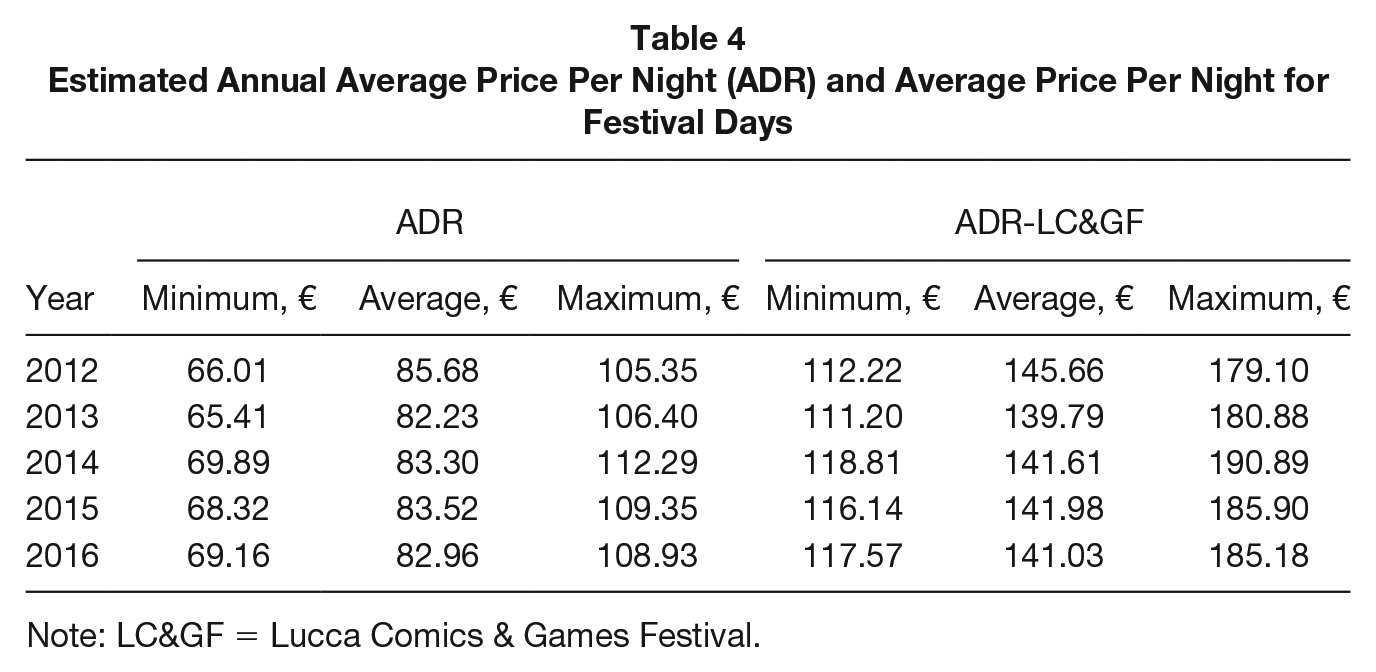
Note: LC&GF = Lucca Comics & Games Festival.
Data for Lucca Comics and Games Festival Estimated Value-Added Impact of LC&GF on Lucca Hotels Global Revenue
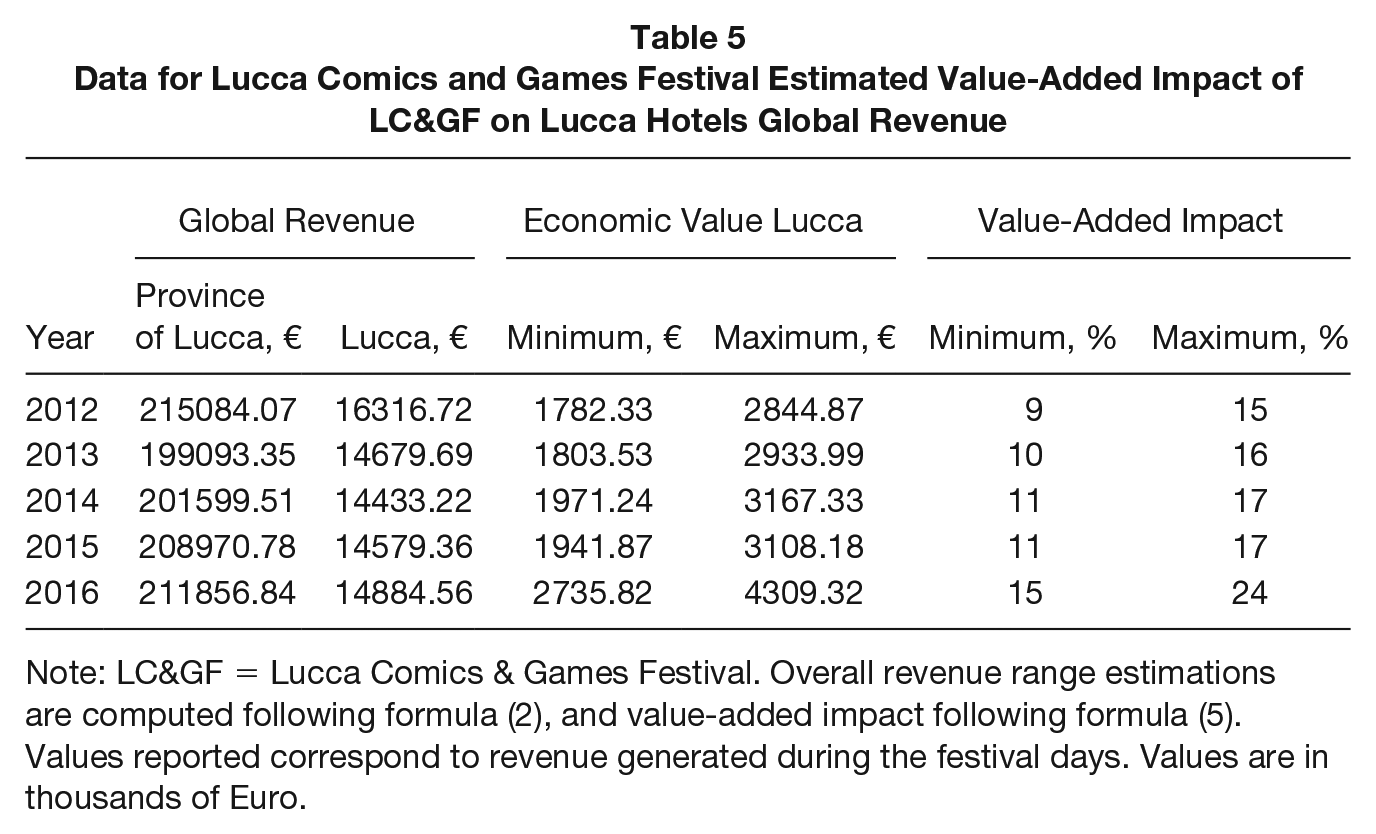
Note: LC&GF = Lucca Comics & Games Festival. Overall revenue range estimations are computed following formula (2), and value-added impact following formula (5). Values reported correspond to revenue generated during the festival days. Values are in thousands of Euro.
The calculation of the hotel overall revenue. The next step was to compute the average hotel revenue for the city of Lucca for every year. We define this variable as

Now, considering a hotel occupancy rate of 100% during the festival, to estimate the economic value (EV) of the LC&GF

in which,
Recall that we are approximating the EV by the count of officially registered beds in the town of Lucca as reported by the local authorities. Thus, to have an adequate approximation of the potential economic value (overall impact), we needed to consider the two possible limit scenarios. To do this, we must consider the following:
The EV generated by the event is maximum and the GR of Lucca is minimal, or
The EV generated by the event is minimal and the GR of Lucca is maximum.
The following formula summarizes the general case, where the VAI of the event in year i, on the city is calculated as the ratio between the EV generated by the event and the annual GR (hotel revenue), considering the maximum and minimum values:

In this context, if the LC&GF is a value creating activity and provides a boost to the economic activity of the hotel industry and the overall Lucca economy, then the value of the VAIi index is defined to be strictly greater than 0. Initial inspection of the estimates in Table 5 confirm the expectations. To provide a thorough sensitivity analysis, we conduct the minimum and maximum scenarios.
Analyzing the Economic Impact of the Lucca Comics and Game Festival
We proceed to analyze the projected economic impact of the value creation experiential tourism event LC&GF on the city of Lucca. The first set of results is presented in the Table 5. Here there are several relevant elements to discuss. First, notice the growing effect across impact factor estimations that the LC&GF has on the overall economic value for hotels in the city of Lucca. If we focus on the VAI load, we observe that the overall impact has close to double in a record period of 4 years. Under this scenario, LC&GF represents close to 23.97% of the economic value for the city. This is a significant demonstration of the potential that a value creation experiential event can have in a single location, in a period of just 4 days a year. Also notice that since this is a festival, the recurrence of the event has a cumulative effect that is progressive. In comparison with early estimates (reported in Table 3) of the impact factor, we can see that the impact factor of 4 days of festival amounts to 3.03% to 4.59% of all the usage capacity of hotels in the city of Lucca. This increase manifests itself in the higher revenue as represented by the VAI factor.
If we take a more conservative approach and assume the minimum impact scenario as the most likely outcome, we still observe a significant value creation process that translates to an overall relevant economic VAI load. Under the low-end estimations, the overall economic impact ranges from 9.28% to 15.22% with a steady growing trend. Notice as well, that the overall impact demonstrated a growing tendency toward the most recent years.
In this context, recent growth in popularity of the event, expanded presence in the local, regional, national, and international dimensions of it, have resulted in a faster growth of the economic impact. Per our estimations, the value creation of the festival has taken a more relevant role in more recent years. Particularly, if one looks at the 2015-2016 data, the overall impact in terms of euro amount and VAI load, demonstrated a sharp increase in comparison with the data from previous years. The estimated growth impact ranged from an additional 5.53% to 8.72% difference from minimum to maximum impact ranges across years, respectively.
To have a more comprehensive picture of the overall economic impact of value creation events, we reported the overall regional and local (Lucca) figures as well as the number of people that specifically attend the event. With this information, we computed the rates of change and first difference year to year. Notice in Table 5 how the estimated values of EV Lucca (min and max) both displayed a steady growth tendency. It is also relevant to recall that across the years the number of visitors has grown at a steady pace as well. The overall combined effect of the festival, using the city of Lucca hotels’ revenue, indicates the presence of growth across the border. In this context, one observes how the growth factor (under both possible scenarios) dramatically increased from 2015 to 2016. Notice, as we have stated that this forecast is done for officially registered hotels in the city of Lucca, and does not include Airbnb and other derived economic activities. The latter would clearly increase the economic impact of the festival on the city.
However, a striking reality of the hotel sector in Lucca is best represented in the next computations. Here, we observed several relevant elements at play. Since our interest is in analyzing the effect of the LC&GF, we present the overall revenue with and without the festival (see Table 6). In general, we noticed that revenue for the official hotel sector in Lucca has been declining consistently, yet levels off at around 14.6 million euro for the period 2015-2016. There are several issues to consider here in relation to forces operating in opposite directions. On the one hand, revenue throughout the year is declining, and on the other, revenue deriving from LC&GF is increasing at a steady rate.
Sensitivity Analysis of the Economic Value Creation Impact of LC&GF on Hotels Revenue (Annual Values)
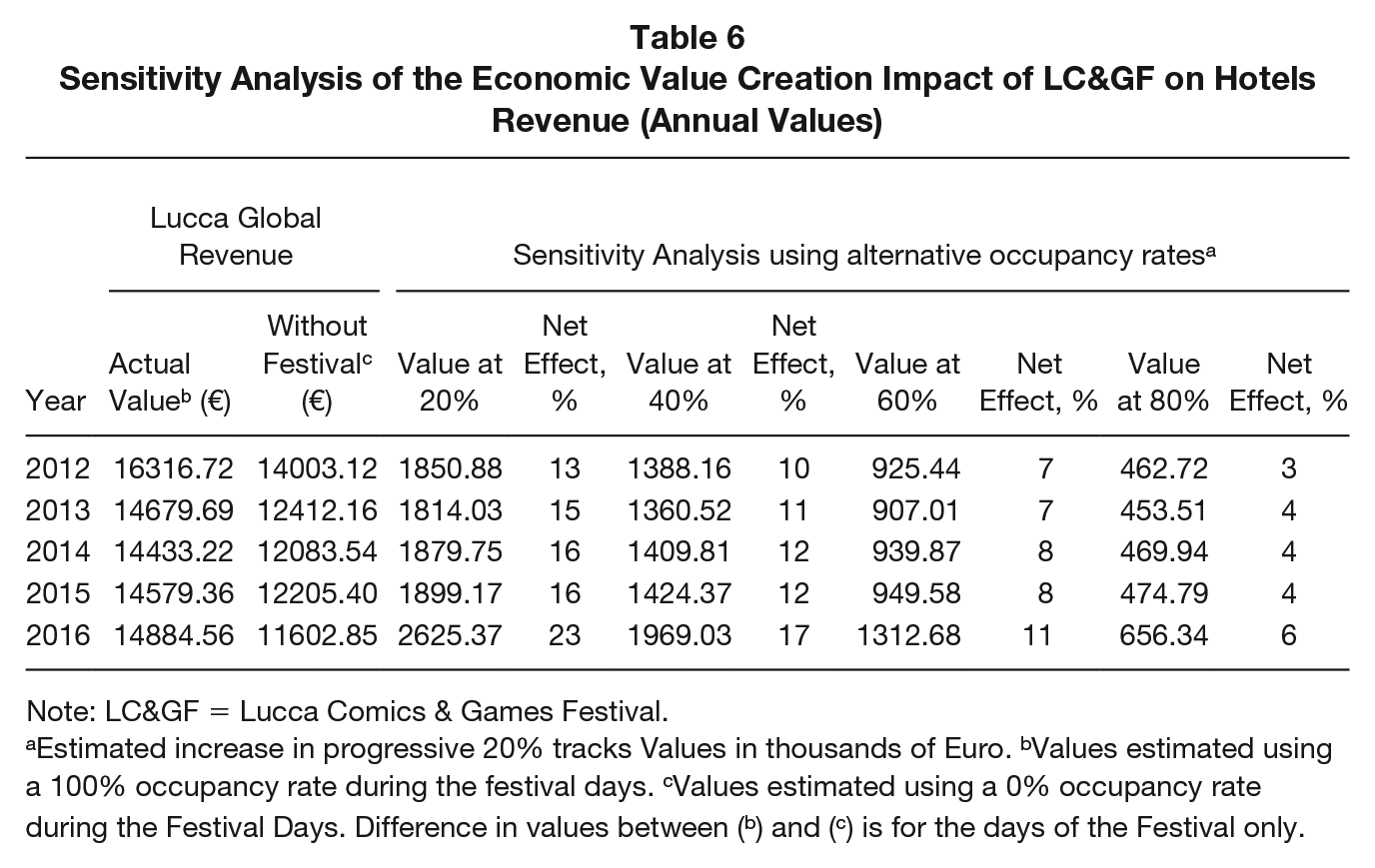
Note: LC&GF = Lucca Comics & Games Festival.
Estimated increase in progressive 20% tracks Values in thousands of Euro. bValues estimated using a 100% occupancy rate during the festival days. cValues estimated using a 0% occupancy rate during the Festival Days. Difference in values between (b) and (c) is for the days of the Festival only.
Particularly, the recent rise of Airbnb could be singled out as one of the strongest factors in the decline in revenue derived from the hotel sector. In conjunction with previous data on the number of beds available and the total number of beds available in the city of Lucca, the hotel industry presented a steady decline from about 16.3 million euro in 2012 to an estimated value of 14.8 million euro in 2016. This decline is much more pronounced should we compute the Lucca global revenue without the LC&GF effect in it. Notice how the total value declines from 14 million euro in 2012 to about 11.6 million euro in 2016. This decline occurred at a much faster rate in the without segment than in the with segment (total revenue).
However, the analysis just described is based on the assumption that the hotel industry in Lucca has a 100% or a 0% occupancy rate during the days of the event. Since only the 100% case is a certain event, our initial estimation of the overall value added created by the festival is surely overestimated. Thus, to have a more accurate assessment of the VAI of the festival on the hotel sector, we conducted a sensitivity analysis. The results of this exercise are presented in Table 6 above.
Sensitivity Analysis
To measure the overall value added to the hotel segment in Lucca, we made several assumptions regarding possible occupancy rates in the event the festival had not occurred. Here, we illustrate occupancy rates in tracks of 0%, 20%, 40%, 60%, and 80%. Each of the estimated occupancy rates is accompanied be the expected increase in revenue in comparison to the certain event of 100% occupancy rate during the festival, and then the difference is taken. In addition, we were able to compute the impact factor of the festival on the assumed occupancy rates, and we call this the net effect. This net effect is the value-added factor of the festival over the assumed occupancy rate.
Another issue that we had to consider was the upward limit in terms of revenue generation that limits the hotels in Lucca, because the numbers of beds tends to grow in a sticky fashion. That is, it is expensive and difficult to just increase the number of beds. In this sense, the overall value as indicted by the Lucca global revenue is constraint and cannot reflect the full potential for growth derived from the event.
Now, looking at the sensitivity analysis, we observed that the added revenue of the festival is negatively related to the assumed rate of occupancy. The higher the assumed rate (without the festival), the lower the overall net effect, as expected. This said, we can safely illustrate that the most likely net effect of the festival is to consistently increase, regardless of assumed occupancy rate. This first factor is important because it represents the combined effects of hotels being able to increase the number of beds and the increase price per night, plus the added day to the event in the year 2017. Second, we observed that assuming a natural rate of occupancy in the ranges of 20% to 40%, the overall net effect of the festival is in the range of 10% to 13% for the year 2012, and grew consistently to the highest level in 2016, with a range of 17% to 23%.
The evidence from the sensitivity analysis supported the claims that the LC&GF is a major source of value creation for the hotel segment of the Lucca economy and represents a growing proportion of the overall revenue derived from the hotels. These results have several implications worth mentioning.
In the first place, our estimates provide an accurate and detailed assessment of the contribution that an experiential touristic event can have on the traditional segment of hospitality. Second, the results, given the upper bound in the hotel industry relating to the number of beds, indicated that the expected net gains for other segments of the Lucca economy with less upper bound limitations, may have a much higher net gain from the event; that is, the potential of positive spillover effects are large for the Lucca economy. Third, the evidence indicated that the hotel segment could clearly benefit to an even larger level, should related diversification strategies be developed.
Now, the growing gap between the with and without figures, combined with a relatively slower decline in the total revenue figures, points out to a positive effect deriving from the value creation captured by hotels in relation to the festival. That is, hotels in the city of Lucca have been able to sustain an otherwise declining sector. The revenue generated in a 4- to 5-day period provides a tremendous inflow of revenue, as hotels achieve a 100% occupancy rate on a larger number of beds available. The evidence clearly indicated that experiential tourism through the LC&GF has had a positive effect, large enough, capable of offsetting most of the declining trend in the hotel segment for the rest of the year. Furthermore, the marginal addition of one more day to the festival beginning in 2016, had a marked increase in the overall revenue generated by hotels in the amount of an extra range of 2% to 7%, depending on the assumed initial occupancy rate should the festival have not occurred. This marginal change proves to be a major player in the financial position of the hotel segment of the economy, as well as for the number of people attending the event and the overall financial performance of the LC&GF organizational committee.
Now as we have indicated before, our measure of value capturing was exclusively related to the hotel industry, and thus left out other sectors of the economy that direclty benefit from the festival. The effect in the rest of the local economy appears to be large. Thus, while we observed a positive effect in a declining segment of the market, registered hotels in the city of Lucca, we also observed a steady flow of spillover effects onto other fast-growing segments of the market. That is, the value creation process derived from the experiential tourism of LC&GF had an overall positive and growing effect in the city of Lucca.
In general, our statistical analysis of the hotel segment in the city of Lucca, provided evidence of a significant positive impact from experiential tourism activities. We concluded that not only the declining hotel sector of Lucca benefits greatly from the festival but also the entire city and most likely surrounding localities as well. The overall growing trend in terms of visitors to the festival, the added features of the festival, and the exploitation of the prime location for it, have resulted without a doubt in a major economic boost to the city of Lucca. Our evidence thus indicated that through a creative process, involving a prime location, a set of creative ideas, and the involvement of communities, provided the opportunity to stimulate economic growth and development, while serving the visitors with a unique experience.
Limitations and Caveats of the Study
It is very important to be aware of several limitations of this study as we continue to explore the topic of experiential tourism and the value creation process in the location of interest and related areas. First, we recognize that our study was based on a single case, and that creates limitations. Second, we have to remember that our study made its estimations of economic impact using official data including only the registered hotel segment from the city of Lucca. That is, we did not have access to other relevant data when assessing and quantifying the overall possible economic impact in related and competing sectors, such as but not limited to, rooms provided by Airbnb, increased revenue of cantinas, apartments available for renting during the festival, garage and parking services, street vendors, among others. That is, we are well aware that our estimates of the overall spillover effect of the festival were underestimated, yet we do not have access to any reliable information to account for these additional sources of competition to the hotel industry and additional sources of revenue for the city of Lucca. This is a research topic of further exploration as related effects may be larger in relative terms than those computed for the hotel sector alone.
As noted earlier, the number of official beds available in hotels in Lucca has increased consistently throughout the years, but this growth is sticky given the difficulty for hotels to add more beds. This is a highly capital-intensive and consequently expensive process, and therefore, we believe that a significant component of the derived growth from the LC&GF experiential tourism festival has been channeled in a different direction, not captured in our estimation. This is clearly a line of research that needs to be expanded on, yet outside the scope and possibilities within this study.
In addition, there is a significant amount of taxable income that the city of Lucca is not receiving because of the slow administrative procedure to implement the required legislation. In this sense, some of the economic activities derived from the festival have gone untaxed, resulting in a much lower than optimal tax revenue for the city.
Conclusions
The present study demonstrates, using the case of the LC&GF, how creative tourism supports the local cultural, social, and economic development as it becomes an important driver for tourism-related territorial competitive advantages to develop. We particularly argued that a continuous event of 5 days during a full business cycle is capable of providing a significantly large inflow of people, generate revenue, and as such develop opportunities for local and family-owned and operated hotels to successfully navigate revenue valleys throughout the year.
The overall evaluation and assessment of the economic figures relating to LC&GF indicated that this event is a win–win case study where the economic advantage for residents is well matched with the creation of value for the visitors as an experiential event. The case of LC&GF allowed the hypothesis that experiential tourism is an evolving form of creative tourism. In the same way, the creation of the LC&GF has developed new market niches in the field of cultural and creative tourism for the town of Lucca. This reflects a significant shift in the value creation process from production to consumption in the society network.
In summary, our results demonstrated the presence of spillover value-added effects of the festival to the hotel industry, and other related sectors. In a 4- to 5-day period, the festival provides a tremendous inflow of revenue, as hotels achieve a 100% occupancy rate. The evidence clearly indicated that experiential tourism through the LC&GF has a large positive effect capable of offsetting most of the declining trend in the hotel segment for the rest of the year. These benefits extended to other segments of the Lucca economy that benefit from the growth of the LC&GF.
