




Abstract
The marketing literature has demonstrated that political animosity influences consumers’ boycott intention. However, this question has rarely been examined in the hospitality setting. Thus, by utilizing cognitive appraisal theory and value-belief-norm theory, this study proposes a model to investigate the effect of animosity on ethnic dining behavior. To this end, this study examines the effect of animosity on switching intention by examining the structural relationships among anticipated negative emotions, personal norms, and switching intention. Study results demonstrate that individuals’ animosity beliefs influence their intention to switch to a different ethnic restaurant through anticipated negative emotions and personal norms. The current study’s findings provide ethnic restaurateurs with insights on how to revise marketing strategies when animosity is raised toward the origin country of which their ethnic cuisine is based on.
Introduction
The international business literature demonstrates that conflicting political relations affect the consumption of products that have an “unfriendly” national identity (Y. Yang & Tang, 2014). For example, the dispute between China and Japan on the issue of sovereignty over the Diaoyu (or Senkaku) Islands in April 2012 have severely affected the sales of Japanese companies operating in China. By September 2012, the sales volumes of three major Japanese auto companies declined by 41% as compared with the previous year (Y. Yang & Tang, 2014). Previous researchers who have studied consumer animosity reasoned that customers develop hostile attitudes toward an “offensive” country and products with that national origin (Ettenson & Klein, 2005; Fong et al., 2013, 2015). This animosity effect may be evident in the ethnic dining sector.
Previous studies found that products and services with prominent cultural and/or national features of an offensive nation are subject to increased boycott intention among consumers because consumers can easily identify them and negatively evaluate their quality (Ishii, 2009; Russell & Russell, 2006). While most ethnic restaurants operate domestically, they generally have strong foreign attributes, such as foreign flavors, foreign languages and cultural cues to promote the restaurant, and foreign employees to cook and/or service customers, all to provide an authentic experience (Kim & Jang, 2016). Furthermore, regardless of the specific ownership of the business, consumers might believe that ethnic foods are served because these businesses are owned and/or operated by foreign restaurateurs, and thus, consumers might perceive them as foreign businesses (Gao, 2014). Despite the implications of animosity aroused by a political incident, especially for the ethnic dining setting, to the best of our knowledge, no study has examined the influence of negative political relations on ethnic dining choices. Thus, it is imperative that this study investigates the influence of consumer animosity against ethnic restaurants offering cuisine of an offensive nation.
In addition, the extant animosity literature does not provide a theoretical model to elucidate the influence of animosity on consumer behavior. Accordingly, Leong et al. (2008) recommended that animosity research should employ a more theory-driven approach. In recent years, some researchers have utilized cognitive appraisal theory and have suggested that animosity influences boycott intention through negative emotions resulting from the purchase or use of products (Harmeling et al., 2015). However, the influence of individuals’ cognitive responses, such as personal norms, on a negative political event and their consequences has been ignored. Previous studies have reported that social pressures and personal norms drive particular behaviors in prosocial environment (Stern et al., 1999). In the animosity setting, Maher and Mady (2010) suggested that individuals would feel an obligation to demonstrate prosocial behavior by boycotting the products/services of the offending country. Therefore, the current research extends the existing animosity model with value-belief-norm (VBN) theory and positing personal norms as a mediating variable. Because both cognitive appraisal theory and VBN theory can be helpful for comprehending consumer behavior in the animosity context, we integrate both theoretical aspects into a comprehensive conceptual framework in this study.
In summary, the purpose of the current study is to develop and test a conceptual model that enhances our understanding of consumer animosity and its consequences in an ethnic dining setting. Specifically, by merging two major theories (i.e., the cognitive appraisal theory of emotions and VBN theory), the extended consumer animosity model captures the underlying cognitive and emotional mechanisms of consumer animosity. The findings of the current study offer significant theoretical contributions by extending the animosity model with a focus on contemporary political conflict that has not been well addressed. Additionally, this study should enrich the extant literature by explaining how consumer animosity affects dining intentions in an ethnic restaurant context. Empirically, the results of the study can be used by ethnic restaurateurs to develop or revise their marketing plans during animosity crisis periods.
Literature Review
Influence of Political Relations on Consumer Behavior
Previous researchers have noted that negative political relations between countries have various causes, including territorial disputes, economic arguments, diplomatic disagreements, and religious conflicts (Davis & Meunier, 2011), and have considerable impacts on individual consumption behaviors (Q. Yang et al., 2015). Hall (2002) reasoned that specific conflicts and negative incidents are magnified and spread to the public through the media that provide meaning to and interpretations of the incident. Consequently, such negative incidents foment animosity among individuals against the offending country.
The literature has become increasingly focused on investigating the consequences of such bilateral disputes on consumer behavior. Previous researchers reached a general consensus that animosity has a significant impact on consumer preferences in various countries (Cheah et al., 2016; Kim, 2019; J. E. Park & Yoon, 2017, Sánchez et al., 2016). Accordingly, this study investigates the influence of political relations on ethnic dining behavior in a light of a recent conflict between China and South Korea.
Cognitive Appraisal Theory
Cognitive appraisal theory was originally developed by psychologists to understand the causes of the elicitation of emotions (Lazarus, 2001; Roseman et al., 1990). Roseman et al. (1990) noted that the appraisal of an event determines “whether an emotion will be felt and which emotion it will be” (p. 899) because cognitive appraisals form the beliefs on the basis of which individuals hold a proposition about something to be true; such appraisals are therefore essential to individuals’ emotional responses. Then, behaviors occur in response to induced emotions, and the recognition of this has led to the emergence and widespread acceptance of the cognitive appraisal approach to emotions in consumer behavior studies as a theoretical construct to understand emotional responses (Song & Qu, 2017). While the original theory does not study the direct influence of personal beliefs on behavioral responses, previous animosity studies have reported significant influence of consumer animosity on their purchase intention (Heinberg, 2017; Kim, 2019; Sánchez et al., 2016; Q. Yang et al., 2015). Thus, we extend cognitive appraisal theory by studying the direct influence of consumer animosity on switching intention and its indirect influence operating through negative emotion.
The Effects of Animosity Belief
In the literature, consumer animosity is defined as “the remnants of antipathy related to previous or ongoing military, political, or economic events” (Klein et al., 1998, p. 90). However, previous researchers widely combined cognitive belief and emotions into a single construct while assessing consumer animosity (Harmeling et al., 2015). This is problematic as a distinction between cognitions and emotions has long been made. Specifically, Lazarus (1991) suggested that “emotion is always a response to meaning” (p. 824) and cognitions of perceived threat or misdeeds act as a precursor to negative emotions (Averill, 1983). Therefore, in our study, we separated animosity beliefs from emotional responses. For example, in the animosity context, cognitive appraisal refers to individuals’ beliefs about the extent of the damage and/or potential future threat attributable to a negative event. We refer to such cognitive appraisals as animosity beliefs.
The animosity model of a foreign product postulates that individuals’ animosity belief toward a country has a direct negative influence on consumer behavior (Klein et al., 1998). Thus, the current study examines the influence of animosity belief on switching intention. Switching intention refers to the possibility of transferring existing transactions with a company to a competitor (Han & Hyun, 2013). Earlier studies reported different causes of switching intentions such as inconvenience, price, service failure, or unethical business practices (Jung & Yoon, 2012; Mattila & Ro, 2008). Furthermore, Q. Yang et al. (2015) reported that consumer animosity as a result of negative political relations between countries may lead to boycott intention. According to Ettenson and Klein (2005), Australians consumers’ animosity toward France has a direct and positive impact on boycott participation. Moreover, in a recent animosity study in tourism setting, Sánchez et al. (2016) assessed Turkish people’s animosity toward Saudi Arabia, Israel, and China and suggested that animosity affects not only the consumption of goods from the offending country but also the intention to visit the country. In line with previous findings, we offer the following hypotheses:
Lazarus (1991) noted that cognitive appraisals of events that fail to comply with individuals’ expectations usually result in negative evaluation and generates negative emotions. Thus, some animosity researchers advanced the original animosity model by including anticipated emotion (i.e., forward-looking affective responses to purchasing a product; Perugini & Bagozzi, 2004) as a mediator between animosity belief and purchase intention to increase our understanding of why animosity leads to less buying behavior. For example, individuals develop animosity beliefs about a political conflict that cause emotional responses (Harmeling et al., 2015). Corroborating this notion, Nes et al. (2012) found that individuals’ animosity belief increases the negative emotions of guilt and embarrassment. Thus, we offer the following hypotheses:
The Influence of Anticipated Negative Emotions on Switching Intention
Cognitive appraisal theory also provides explanations for the indirect influence of the animosity effect through the mechanism of negative emotion. For example, the theory posits that emotions elicited by cognitive appraisal guide behavioral responses, such as switching intention (Lazarus, 1991). Accordingly, in the marketing literature, previous studies have suggested that negative emotions influence customers’ behavioral intentions (Jang et al., 2011; Kim et al., 2017). For example, Ou and Verhoef (2017) found that negative customer emotions of anger, regret, and distrust significantly decrease repurchase intention. Furthermore, in the animosity literature, researchers have noted that purchasing a product from the target of animosity leads to negative feelings (e.g., guilt), and therefore, consumers are motivated to refuse to purchase the product to avoid such feelings (Nes et al., 2012). Based on this discussion, we offer the following hypotheses:
VBN Theory
In the animosity context, individuals’ purchase behavior could be influenced not only by anticipated negative emotions but also by a moral obligation to boycott products/services from an origin country that has a political conflict with the home country (Maher & Mady, 2010). Stern et al. (1999) developed the VBN theory and theorized that personal norms are influenced by perceived relations between humans and environment, their consequences, as well as an individual’s obligation to take corrective actions. Although VBN theory has been used mostly in a proenvironmental context, humans develop personal norms to engage or refrain from specific behaviors in numerous prosocial settings (Schwartz & Howard, 1981). Therefore, employing the VBN theory to elucidate the influence of personal norms would complement the cognitive appraisal theory in predicting Chinese ethnic diners’ behavioral intention in the animosity context.
Nevertheless, this study modified the original model by excluding the values factor, which was originally discussed as an antecedent of belief. The rationale behind this decision is as follows. In the animosity context, consumer ethnocentrism may be an antecedent of animosity belief toward a specific country and directly influence consumer behavior. However, contradictory findings are reported in the literature. For example, some researchers (e.g., Ahmed et al., 2013; Klein, 2002) found that consumer ethnocentrism is positively related to boycott intention. In contrast, others reported insignificant influence of ethnocentrism on consumer behavior (Cheah et al., 2016; Ma et al., 2012; Narang, 2016; Wong et al., 2008). These discrepant results could be attributed to the different product categories being studied. According to Nijssen and Douglas (2004), consumer ethnocentrism is likely to become insignificant in the absence of availability of local or domestic products. In the current study setting, we targeted ethnic diners and asked about their switching intention toward other ethnic cuisines rather than domestic ones. Thus, in line with Nijssen and Douglas’s (2004) notion, we excluded consumer ethnocentrism from our study model.
The Influence of Animosity Belief on Personal Norms
As discussed above, animosity belief indicates individuals’ understanding of the consequences of political tension between their home country and a target country. Based on VBN theory, individuals’ beliefs form a sense of obligation to behave in a specific manner. Personal norms are “feelings of moral obligation to perform or refrain from specific actions” (Schwartz & Howard, 1981). Previous research has empirically tested and validated the causal link between beliefs and personal norms (Choi et al., 2015; Kiatkawsin & Han, 2017). In the hospitality setting in the context of studying proenvironmental behavior, previous researchers have agreed that individuals’ proenvironmental personal norms are influenced by their beliefs on the ability to control negative consequences. Accordingly, we offer the following hypotheses:
The Influence of Personal Norms on Anticipated Negative Emotions
Previous researchers have noted that anticipated emotions arise as a result of self-regulatory procedures and dynamic responses to real or probable consequences, and therefore, anticipated emotions rely on appraisal processes in which predictable outcomes are compared with personal norms (Bagozzi et al., 2003). Thus, individuals develop a specific valence of emotion that is either positive or negative, consistent with their moral norms for conducting a behavior. Previous researchers confirmed positive associations between personal norms and anticipated emotions (Han et al., 2015; Klöckner & Matthies, 2004). Han et al. (2015) found that consumers’ moral obligation to participate in proenvironmental consumption significantly affected their positive anticipated emotions (i.e., excitement, delight, happiness, and gladness) when staying at a green hotel. On the other hand, practicing a behavior that is inconsistent with personal norms arouses negative anticipated emotions of guilt, shame, and pride (Klöckner & Matthies, 2004). Thus, individuals’ personal norms to engage in supporting their own countries by avoiding the purchase of products from a hostile country will trigger negative emotions when they purchase them. Consistent with this, we offer the following hypotheses:
The Influence of Personal Norms on Switching Intention
According to VBN theory, personal norms directly affect individuals’ behavioral intentions (Stern et al., 1999). In support of this theory, previous researchers have confirmed that behavior and behavioral intention are consistent with one’s subjective norms. For example, Han et al. (2015) found that individuals’ obligation to take proenvironmental actions significantly increased the likelihood of staying in a green hotel. In the animosity context, a few researchers have examined the influence of norms on behavioral intention. For example, Farah and Newman (2010) found that Muslims’ subjective norms to boycott American products affected boycott participation. Corroborating this finding, Maher and Mady (2010) found Kuwaiti consumers’ social norms to avoid purchasing Danish products significantly affected boycott intention. Thus, we offer the following hypotheses:
Cultural Familiarity
In addition to the factors discussed above, we included a control variable for cultural familiarity because we believe that individuals’ cultural familiarity may mitigate the animosity effect on negative emotions, personal norms, and switching intention. The rationale behind this argument is as follows.
Social categorization theory suggests that individuals tend to categorize themselves into a social group (i.e., in-group and out-group, Sumner, 1906). Such group identity is not deterministic (Schlenker, 1986) and is often chosen by individuals of their own will (Swann, 1987). For example, Nes et al. (2014) discussed that individuals develop an affinity toward a foreign country and consider that country to be one of their in-groups because they find the culture of the country attractive or they find that their identification with the country contributes to their social identity. Various cultural content can make consumers feel cultural proximity and consider that country as an in-group (Jang & Kim, 2015). Thus, we operationally defined cultural familiarity as a consumer’s accumulated exposures to a country’s popular culture (e.g., music and movies), food, and history. According to Tajfel and Turner (1986), individuals are motivated to maintain positive perceptions of in-groups. Thus, when in-group members perform harmful actions, individuals may defend (or downplay) the negativity of the actions of fellow group members and exhibit a high tolerance for these actions.
In sum, the current study posits that animosity belief significantly affects ethnic dining choices both directly and indirectly through anticipated negative emotions and personal norms. These relationships and hypotheses suggest the model shown in Figure 1.

Conceptual Model
Method
Research Context
This study was conducted among Chinese nationals living in Guangzhou, the largest city in Guangdong Province. As of April 1, 2017, there were 1,380 Korean ethnic restaurants in Guangzhou (Dianping.com). Chinese consumers’ reactions to South Korea’s deployment of a U.S. antimissile system in South Korea, the so-called Terminal High Altitude Area Defense (THAAD), was treated as the stimulus in this study. THAAD is designed to shoot down North Korean missiles in their terminal phase by intercepting with a hit-to-kill approach. However, the Chinese officials are concerned that the United States and South Korea may look into Chinese territory and monitor military activities through THAAD (Daniels, 2017). The tension between China and South Korea deepened when the Lotte group, which is one of the biggest South Korean corporations, decided to offer a site for deploying THAAD. During the following week, the Chinese media unanimously condemned Lotte and South Korea, calling for a boycott of products from South Korea. Therefore, to assess the influence of the incident on Chinese nationals’ opinions regarding their intention to dine at a Korean restaurant, we collected data from April 1 to May 13, 2017.
Procedure
This study conducted an online survey by targeting residents of Guangzhou, China. Participants were informed through an online cover letter that their responses would be aggregated to maintain confidentiality. We initially employed a quota sampling method. After reviewing the total number of respondents for different age groups and gender, we determined the size of the initial sample pool for each group in proportion to the number in the local population. From April 1 to May 13, 2017, a group of seven students made initial contact with potential participants in various locations. A screening question asking if they dined at a Korean restaurant in the 3 months prior to the THADD event (i.e., between December 2016 and February 2017) was utilized to recruit the sample. A total of 500 qualified respondents then received a link to the survey developed in Sojump, a major online survey website in China.
Measures
Scale instruments measuring each construct were identified from the literature and modified to fit the current study setting. All the variables were measured on a 7-point Likert-type scale ranging from 1 (not at all) to 7 (very much). First, animosity belief was assessed utilizing two items from Harmeling et al. (2015), for example, “There is a political dispute between China and South Korea.” Personal norms were tested by two items from Han et al. (2015): “I feel a moral obligation to choose an ethnic restaurant with a country of origin that has good political relations with China,” and “I feel a moral obligation to take the political relations between China and an ethnic restaurant’s country of origin into account when making an ethnic dining choice.” We measured negative anticipated emotions and switching intentions by employing three items from Han et al. (2016) and J.-Y. Park and Jang (2014), respectively. Moreover, the control variable of cultural familiarity was measured using four items adapted from Jang and Kim (2015) and Toyama and Yamada (2012): “I am familiar with Korean food,” “I am familiar with the history of Korea,” “I am familiar with Korean movies,” and “I am familiar with Korean music.”
English version of the survey questionnaire was first developed and tested for cultural compatibility by two Chinese colleagues, who are fluent in English and had received graduate degrees in the United States. The survey was translated into Mandarin and Cantonese by an expert from language service center. These two versions were then back-translated by the Chinese colleagues for linguistic and conceptual equivalence. The survey was then pretested with 100 undergraduate students, and they did not report any problems with understanding the survey items.
Results
Participants
A total of 268 respondents completed the online survey (response rate: 53.6%). The sample included equal numbers of female and male participants (48.9% vs. 51.1%). The age of the participants ranged from 18 to 63 years, with the majority in age 21 to 30 group (46.7%). In addition, a majority of them hold a college degree (37.0%; Table 1).
Demographic Profile

Note: Entries are the number of respondents with valid percentages in parentheses. As of November 2018, the exchange rate of CHY1 (Chinese Yuan) to U.S. dollars was 0.14. The percentages were rounded up to 1 decimal point.
Descriptive Statistics for Scale Items
Prior to performing the formal data analysis, the data set was examined using a normality test. A Shapiro–Wilk test was conducted using SPSS (version 20). The results showed that the data distribution is nonnormal (p < .001). Thus, a nonparametric bootstrap estimation technique was conducted (Preacher & Hayes, 2008).
Confirmatory Factor Analysis
Reliability and validity of the measurement model were assessed before testing the structural model (Anderson & Gerbing, 1988). Eisinga et al. (2013) suggested using the Spearman–Brown formula for two-item scales and accordingly, this study reports the Spearman–Brown coefficient instead of Cronbach’s α for animosity and personal norms.
A confirmatory factor analysis was conducted using AMOS version 20. The overall fit of the measurement model was χ2/degrees of freedom (df) = 1.33 (χ2 = 89.11, df = 67); comparative fit index = .99; normed fit index = .97; incremental fit index = .99, and root mean square error of approximation = .04. All the goodness-of-fit indices demonstrated that the measurement model fit the data very well. As shown in Table 2, the Cronbach’s alphas of all five constructs exceeded the minimum requirement of .70, ranging from .88 to .92. All the measurements items’ factor loadings on their underlying constructs were greater than the generally accepted threshold of .70 (ranging from .75 to .91). Thus, convergent validity was established. In addition, the average variance extracted of each construct (ranging from .68 to .82) exceeded the minimum requirement of .50. Last, all the squared correlations of the paired constructs were smaller than the intended average variance extracted values. Therefore, discriminant validity was supported (see Table 3).
Confirmatory Factor Analysis Results
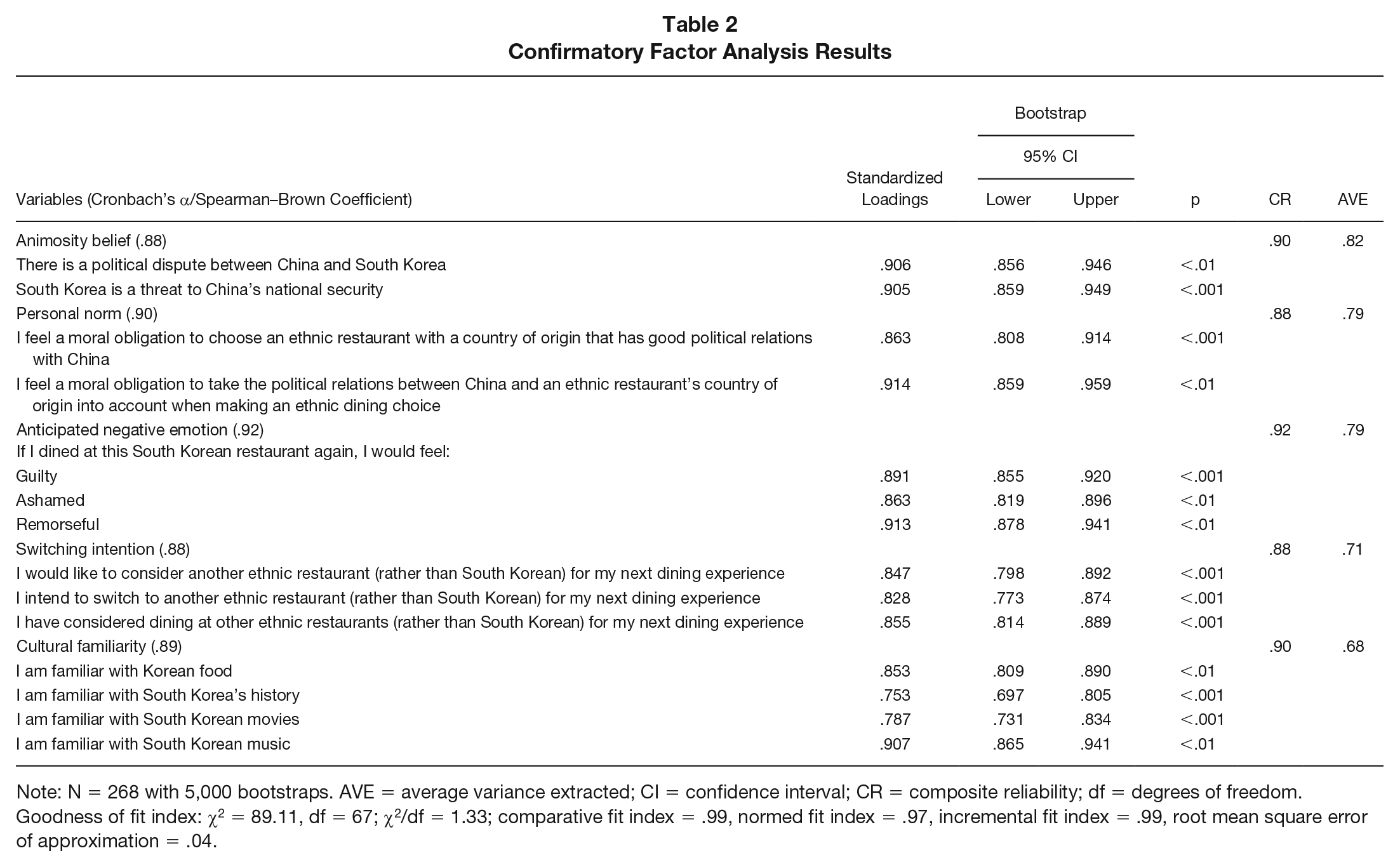
Note: N = 268 with 5,000 bootstraps. AVE = average variance extracted; CI = confidence interval; CR = composite reliability; df = degrees of freedom. Goodness of fit index: χ2 = 89.11, df = 67; χ2/df = 1.33; comparative fit index = .99, normed fit index = .97, incremental fit index = .99, root mean square error of approximation = .04.
Construct Intercorrelations
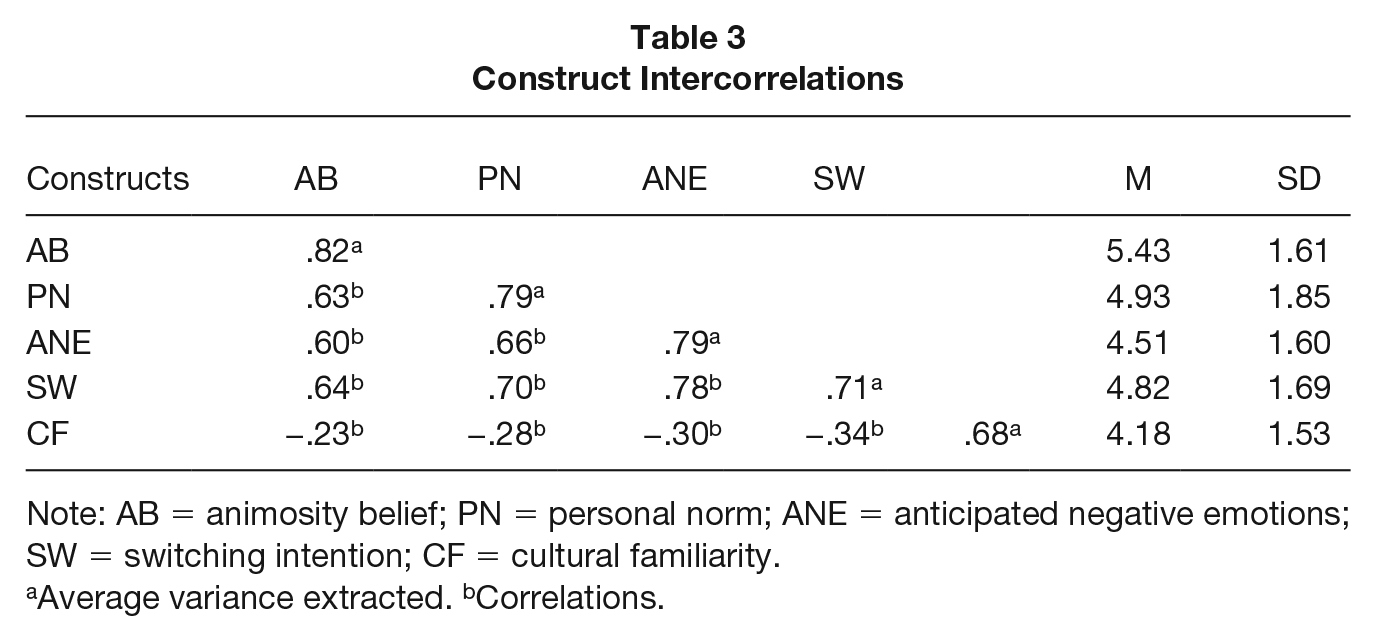
Note: AB = animosity belief; PN = personal norm; ANE = anticipated negative emotions; SW = switching intention; CF = cultural familiarity.
Average variance extracted. bCorrelations.
Hypothesis Testing
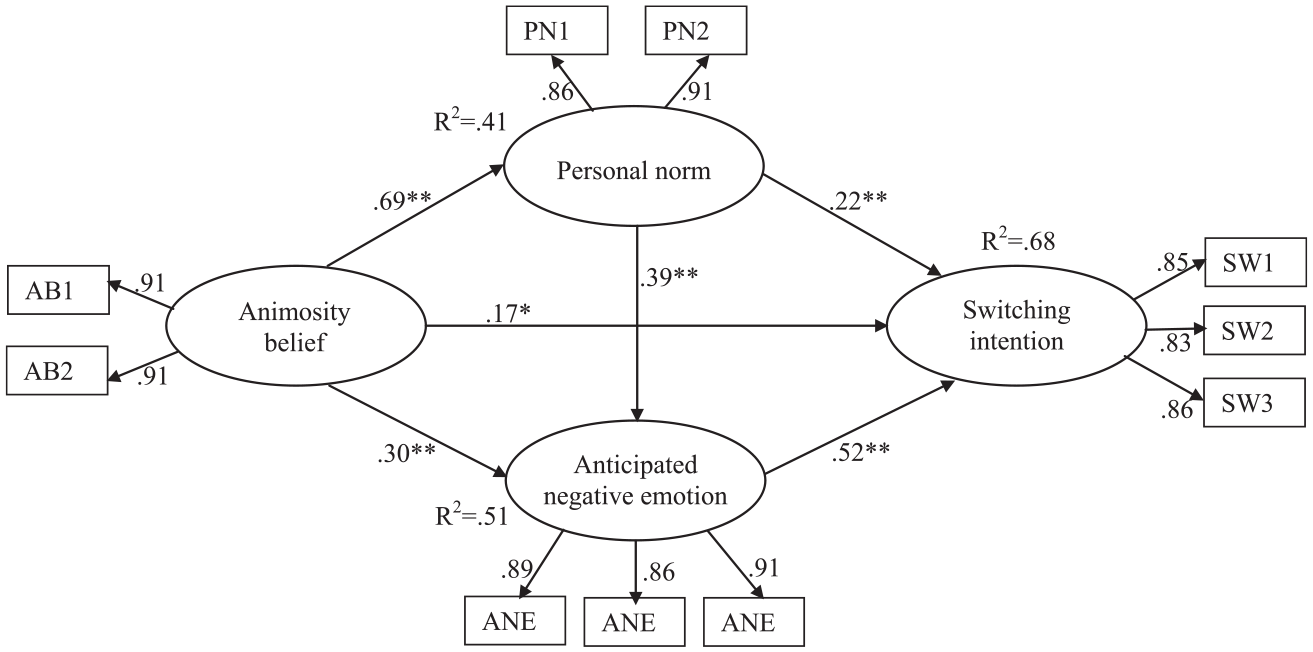
In the next step, utilizing the PROCESS tool described by Hayes (2013), we calculated bias-corrected bootstrap confidence intervals using 5,000 resamples. The bootstrap estimation technique is recommended for making inferences about all the effects in a mediation model (Hayes, 2009). As shown in Figure 2 and Table 4, significant effects were found in the causal paths supporting the study hypotheses. The R2 values indicate the explanatory power of the predictor variable for each construct.
Results of the Structural Model
Mediation Results

Note: AB = animosity belief; PN = personal norm; ANE = anticipated negative emotions; SW = switching intention; CI = confidence interval; LL = lower limit; UL = upper limit. Unstandardized regression coefficients are reported; standard errors in parentheses; Bootstrap sample size = 5,000.
p < .05. **p < .01. ***p < .001
The bootstrapping results indicated significant effects of the covariate (i.e., cultural familiarity). Individuals who are familiar with Korean culture exhibited weaker personal norms (β = −.164, 95% confidence interval [CI; −.279, −.049], p < .01), negative emotions (β = −.112, 95% CI [−.205, −.019], p < .05), and a lower likelihood of switching (β = −.083, 95% CI [−.161, −.004], p < .001). Consistent with Hypotheses 1 and 2, animosity belief predicted switching intention (β = .17, 95% CI [.078, .270]) and anticipated negative emotions (β = .30, 95% CI [.186, .404]). Moreover, in support of Hypothesis 3, a positive effect of anticipated negative emotions was found on switching intention (β = .52, 95% CI [.418, .621]). Hypothesis 4 predicted that animosity belief would influence personal norms. Support was found with a significant path from animosity belief to personal norms (β = .69, 95% CI [.578, .797]). Furthermore, the paths from personal norms to anticipated negative emotions and switching intention were all significant (anticipated emotions: β = .39, 95% CI [.290, .482]; switching intention: β = .22, 95% CI [.126, .305]), supporting Hypotheses 5 and 6. Both personal norms (indirect effect: β = .148, 95% CI [.064, .240]) and anticipated negative emotions (indirect effect: β = .153, 95% CI [.087, .233]) mediated the influence of individuals’ animosity belief on intention to switch. Study results indicated that animosity belief is a significant antecedent of enhancing switching intention through personal norms and negative emotions. Additionally, the influence of animosity belief on switching intention was significantly less than the mediators (personal norms and negative emotions). The mediation effect was calculated using Kappa-squared (κ2) values. As reported in Table 4, the mediating effect of negative emotions (κ2 = .250, 95% CI [.087, .230]) was greater than that of personal norms (κ2 = .241, 95% CI [.064, .235]). Last, the outcome of multiple mediation paths indicated: animosity belief → personal norms → anticipated negative emotions → switching intention (indirect effect: β = .138, 95% CI [.091, .204]). The standardized effect size of this indirect effect was κ2 = .225 (95% CI [.091, .199]).
Discussion
Theoretical Implications
This study makes several theoretical contributions to the literature. Overall, this study enriches our understanding of Chinese ethnic diners’ switching intention from the perspective of consumer animosity. Previous animosity studies discussed the significant effect of political animosity on consumer behavior (Alvarez & Campo, 2014; Jiménez & Martín, 2010; J. E. Park & Yoon, 2017). However, little research has been conducted in the hospitality field to identify and elucidate the influence of consumers’ animosity beliefs on consumer behavior. Consistent with earlier studies, the results of current study indicated a critical role of animosity in the intention to boycott ethnic restaurants that share the cultural theme of an offending nation (Cheah et al., 2016; J. E. Park & Yoon, 2017).
This study also developed and tested a comprehensive theoretical framework integrating theories based on both emotional and cognitive responses. The VBN theory has mainly been employed in diverse fields for prosocial behavior settings. However, earlier studies did not apply the VBN theory in the animosity literature. Furthermore, we extended cognitive appraisal theory by also examining the direct influence that animosity belief has on switching intention. The CFA results showed the adequacy of the measurement structure, with satisfactory levels of reliability and validity. Findings from the structural analysis reported that our proposed conceptual model included a strong ability to predict Chinese ethnic diners’ choices in the animosity context, and support all proposed causal pathways. Furthermore, current research illuminates a critical sequential process of individuals’ animosity belief and its influence on consumer behavior in an ethnic dining as well as significant effects of personal norms on behavioral intention. From a theoretical perspective, we found that personal norms indirectly affect switching intention through anticipated negative emotions. This result supports the findings of previous researchers who identified the positive relationship between personal norms and anticipated emotions (Han et al., 2015; Klöckner & Matthies, 2004). Additionally, our results also showed evidence that animosity belief affects switching via anticipated negative emotions.
The other significant theoretical contribution of this study is that we suggested a significant role of cultural familiarity in the animosity model. We found that Chinese ethnic diners’ cultural familiarity with the origin country of an ethnic restaurant mitigates the animosity effect on personal norms, negative emotions, and switching intention. Previous animosity studies have already found a significant role for similar concepts, such as familiarity with foreign brands (Jiménez & Martín, 2010) and cultural similarity (Ma et al., 2012), in influencing individuals’ product evaluation and purchase intention. However, there are still relatively few studies in the literature identifying cultural factors that weaken the animosity effect on boycott intention. This study contributes to the underresearched field of the impact of cultural familiarity on ethnic dining behavior during animosity crisis. The results can be interpreted as consistent with social categorization theory (Tajfel & Turner, 1986). For instance, individuals categorize foreign countries into in-groups and out-groups based on their affinity and cultural proximity levels, developed from the accumulated exposures to a country’s culture (Nes et al., 2014). When dealing with issues between an individual’s home country and a foreign country, cultural familiarity becomes salient in developing in-group favoritism and out-group prejudice (Ma et al., 2012). Likewise, our results indicated that consumers who are familiar with Korean popular culture (i.e., music and movies), food, and history showed weaker personal norms, less anticipated negative emotions, and low likelihood of switching.
To summarize, our results showed evidence that animosity belief affects switching via personal norms and anticipated negative emotions. Thus, animosity researchers should recognize that customers’ boycott intention is based largely on moral and emotional considerations. Utilizing this concept can be an essential process when examining and theorizing about consumer animosity. Furthermore, as our results suggest, cultural familiarity is an important factor that affects the variables in the animosity model. Accordingly, animosity research should consider the role of cultural familiarity in comprehending the consumer decision-making process when purchasing products from a hostile country.
Managerial Implications
The current study offers important practical suggestions for ethnic restaurateurs. The findings indicate that political animosity decreases consumers’ intention to dine at an ethnic restaurant that represents the offending nation. In particular, we report a significant influence of animosity belief on switching intention via negative emotions. Thus, when analyzing a foreign market’s potential, marketing research should gauge the level of emotional responses associated with political events in the target foreign markets. Furthermore, previous animosity literature suggests localization strategies to alleviate consumers’ negative emotions toward products from an offending firm (Fong et al., 2015). Accordingly, ethnic restaurateurs may benchmark previously discussed strategies for globalization of ethnic cuisines (Cook & Crang, 1996), such as hybridization (i.e., Korean–Chinese food, which is made with ingredients used in China) and fusion (i.e., adaptation of serving processes and service systems to the local culture), and utilize them in the animosity context.
This study also found that cultural familiarity plays an important role in mitigating the negative effect of animosity belief on switching intention in the ethnic dining setting. Because customers who are familiar with Korean culture and interest in Korean popular culture consider South Korea to be the in-group and are less influenced by negative news about South Korea. Previous researchers (Jang & Kim, 2015; Lee et al., 2015) discussed that the use of popular culture, such as films and dramas, is an effective tool to enhance cultural familiarity and a country’s image. Thus, marketing strategies collaborating with Korean celebrities (i.e., celebrity endorsement) and television dramas (i.e., promoting Korean foods in the show) may benefit Korean ethnic restaurateurs.
Less attention has been devoted to what local or other ethnic restaurants can do in such circumstances. Eruptions of animosity against a foreign country may develop into a temporary competitive advantage for local and/or other ethnic businesses (Heinberg, 2017). For example, Heinberg (2017) noted that local brands in emerging markets might benefit when there is an outbreak of animosity against the West. Local and other ethnic restaurants may also profit from consumers by promoting “buy local” campaigns or using consumers’ ad hoc statements against contemporary political conflict.
Limitations and Suggestions for Future Research
While the study provides critical insight on political animosity’s influence on switching intention, there exist a number of limitations. First of all, this study collected data during the peak of political tension between the two nations. As a result, animosity effects may have been overestimated and thus provide less generalizable long-term managerial implications. A future study may consider using longitudinal data to study the resilience of political animosity effects. This study measured individuals’ animosity beliefs based on the individual’s political animosity. Because other sources of animosity, such as economic animosity, war animosity, religious animosity, and personal experiences with nationals of a foreign country, also influence individuals’ animosity beliefs (De Nisco et al., 2016; Nes et al., 2012), future studies should include other animosity factors that were not examined in this study.
The current study also measured switching intention rather than actual behavior. Although previous animosity researchers have widely employed behavioral intention as a proxy for likely behavior (Alvarez & Campo, 2014), some researchers have reported concerns about its low ability to predict actual purchases. For example, in the organic product literature, researchers have documented a significant discrepancy between self-reported purchase intention and actual purchases (Buzby & Skees, 1994). Thus, the results may not accurately explain switching behavior. However, Ajzen (2005) noted that the intention to act in a certain way is an immediate determinant of behavior, and therefore, if measured accurately, intention will be the best predictor of behavior.
Conclusions
The purpose of this study was to propose and test an extended animosity model in the ethnic dining setting. By merging cognitive appraisal theory and VBN theory into one theoretical account, the model tests the underlying mechanisms of consumer animosity. The findings confirmed the combined influence of animosity belief, personal norms, and anticipated negative emotions on ethnic diners’ switching intention. Accordingly, the results suggest that consumer animosity against the origin country of an ethnic cuisine should be taken into account as an important factor of ethnic dining marketing.
Footnotes
Authors’ Note:
This work was supported by the National Natural Science of China (No. 71750110541)
