




Abstract
This study investigates modes of moving visitors in a tourist location using a location-based service. Two field experiments were conducted at a zoo using real visitors as participants and behavior-based dependent variables. Experiment 1 included 2,618 visitors and investigated whether the amount of rewards, in the form of free spins on a wheel of fortune, would affect the choice to move to this wheel and claim the offered rewards. The choice of using this offer was used as a dependent variable. Experiment 2 included 970 visitors and investigated whether labelling participants with a fitting trait led them to move to a certain location. Geographical data using iBeacon logging was used as the dependent variable. Using chi-square tests for independence, we causally show that both the reward and the label had a positive and significant effect on moving the visitors to the targeted location.
Introduction
Smartphones have become constant companions of their owners, largely due to their portability. This companionship has made phones an alternative means for tourism companies to communicate with customers (Murphy et al., 2016). The location-sensitive nature of smartphones opens the way for communication that is sensitive to the location of the customers. The aim of such implementations can be to promote sales—for example, to use location data to increase purchase intentions (Bues et al., 2017)—or to improve the effectiveness of company resources by managing visitor movement (see, e.g., Buhalis & Amaranggana, 2014). Managing visitor movement can also be of direct value for visitors. For instance, such value could stem from reduced queuing by steering visitors to activities that are temporarily less frequented, or from opportunities to experience activities and places that a visitor is unaware of (Raun et al., 2016). However, more research is needed to understand how location-based services and mobile messaging may be used to affect the behavior of tourists (Rubino et al., 2015).
The location sensitivity of smartphones is an important tool for tourism researchers because it allows the tracking of visitor movement (see, e.g., Shoval & Ahas, 2016). For example, location-based services can be used to execute field experiments using real visitors at real locations—a research design that is required within tourism research (Fong et al., 2016). The current article presents two such field experiments that aim to investigate modes of moving visitors in a tourist location using messages triggered by a location-based service. Since such movement can be expressed using both choice and location data, we utilised both sources of behavior data. In the first experiment, we verified that an extrinsic motivator (i.e., performing an activity for a separable outcome; Ryan & Deci, 2000), in the form of free spins on a wheel of fortune, would motivate people to move to the location of such a wheel to claim these spins. In a second field experiment, we used location data to investigate whether a message that labelled (Tybout & Yalch, 1980) the participants with a fitting trait to a location would render the participants more likely to have had their presence at this location verified using geographical data. In essence, this means that the visitors were paid to move in Experiment 1 and nudged to move in Experiment 2.
Brief Background and Hypothesis Development
Information technology within the tourism industry has developed from being wired (connected to the internet) to wireless (connected through mobile devices). More recently, this development has also come to include being connected through smart technology such as sensors and cloud services (Koo et al., 2015), and having good coverage of sensors is one characteristic of the smart tourism destination’s environment (Buhalis & Amaranggana, 2014). Dyreparken in Kristiansand is a Norwegian zoo and amusement park that has evolved according to this description. Over the past couple of years, Dyreparken has developed a location-based service that allows for real-time location-based customer logging and communication through an app that utilizes sensors (iBeacons) to track its customers. The service logs information such as visitors’ movement in the park, what locations they visit, and what attractions visitors interact with (e.g., tracking the usage of offers received through the app). The location-based customer communication includes messages such as invitations to evaluate activities in the zoo when the visitor has been located in direct proximity of the activities’ location at the time of the activity and marketing communication personalized according to visitor location. In cooperation with Dyreparken, we collected data using their location-based service and tweaked their ordinary messages. This cooperation allowed us to use a field experimental approach for causal inferences regarding psychological mechanisms and their effect on behavior generalized beyond the laboratory.
Hypotheses Development
Performing an action for the purpose of attaining a separable outcome means that such an action is extrinsically motivated (Ryan & Deci, 2000). Particularly, considering behaviorism and the operant conditioning paradigm (Skinner, 1953), this type of motivation has been commonly studied in the form of rewards that reinforce behavior (Sundel & Sundel, 2005). Consequently, since a reward is an extrinsic motivator (and therefore motivates behavior), the plausibility of such behavior should increase as the size of such a reward increases. Therefore, we present the following hypotheses:
Dual-process theories divide thinking into two modes, which Stanovich and West (2000) named Systems 1 and 2. System 1 handles mental activities that are effortless, fast, automatic, and emotional, while System 2 handles mental activities that demand effort and are slow and conscious (Kahneman, 2003). System 1 is biased, which can be utilized to nudge people toward specific decisions (Thaler & Sunstein, 2008). Labelling is one such nudge. When labelling, a person is classified or described as having certain characteristics. The aim is to affect this person’s actions so that these actions become congruent with this classification or these characteristics. Using a self-perception perspective, this effect works through a process by which people see themselves as belonging to this class or having these characteristics. Consequently, they will act in congruence with the label (Tybout & Yalch, 1980), since people desire to act in accordance with established ideas about themselves and their self-image (Cialdini & Goldstein, 2004). For instance, within a marketing context, labelling someone as being interested in environmentally friendly products increases the sales of environmentally friendly products to this person (Kristensson et al., 2017).
Method
Experiments 1 and 2 both had a 1 × 2 between-groups design. In Experiment 1, the participants were randomly assigned to a condition in which they received a message offering them either one or five spins on a “wheel of fortune.” In Experiment 2, the participants were randomly assigned to either (a) a condition in which they received a neutral message that promoted a pirate-themed event at a location or (b) a condition in which the same event was promoted; in this latter case, the message labelled the participants as pirates.
Procedure and Participants
In Experiment 1, the location-based service sent the messages to visitors during 12 days in high season. During these 12 days, the message shifted according to the condition every second day. In Experiment 2, the service sent the messages to visitors during 28 days during high season. In this case, the message shifted according to the condition weekly. In both cases, messages were only sent to visitors who resided in a limited area that surrounded the messages’ target locations.
Participants
The messages were sent to users of Dyreparken’s location-aware app, which had been at certain locations in the park at certain days. Consequently, we used convenience samples. The total number of participating visitors was 2,618 in Experiment 1 and 970 in Experiment 2. The participants were only identifiable through the device that they were using. Consequently, a participant was represented by a device, which means that more than one person could be involved in the decisions regarding messages stemming from this device. We were primarily interested in nonfrequent visitors (e.g., nonseason ticket holders), so we limited the data to include only people who had been registered as visitors by the app on no more than 2 days during the current high season.
Dependent Variables
In Experiment 1, the app tracked the dichotomous choice of using an offer. The staff at the wheel of fortune registered this choice when the participants utilized the offer. This excluded the same participant from using the offer more than once.
In Experiment 2, the dichotomous decision to move to a location was tracked using two specific iBeacons that were situated at the target location. If the app logged a participant at one of these iBeacons at least once, the participant was considered to have moved to this location.
Apparatus
Dyreparken has developed the location-based service used in this study. The service includes a mobile app and allows for real-time location-based customer interactions and tracking. The tracking was implemented using iBeacons. During the study, approximately 180 iBeacons were installed in the park, and these were primarily situated in highly crowded areas and commonly used visitor paths. The service can send messages to visitors, such as notifications regarding popular activities or reminders requested by the visitor regarding happenings in the park. The service can also send commercial messages—even though the number of such messages is limited to avoid irritating visitors. Visitors can decline further messages of any type at any time. The service continuously tracks the location of the participants, which ensures that it can send messages triggered by visitor location. The location-based functionality rests on the backend system Pinch. 1
Results
To evaluate Experiment 1, we used a chi-square test for independence (with Yates continuity correction). We found that receiving an offer to make five free spins on a wheel of fortune had a significantly larger impact on the participants’ decision to move to a location to utilise this offer than receiving one such free spin; χ2(1, n = 2,618) = 18.98, p < .001, ϕ = .086. A second chi-square test for independence (with Yates continuity correction) was used to evaluate Experiment 2, and we found that labelling participants as pirates in a message that promoted a pirate-themed event at a location had a signification impact on the propensity of the participants to move to this location; χ2(1, n = 970) = 5.10, p = .024, ϕ = .075.
Consequently, we found support for both Hypotheses 1 and 2. This means that we can conclude that the five free spins and the label manipulation causally increased the proportion of people who moved to the targeted location (Table 1). While the ϕ/phi values of these effects could be considered somewhat low (Cohen, 1988), this can be expected considering the field experimental approach, the strength of which is ecological validity.
Cross-Tabulation of Moving to a Location Both Number of Received Free Spins and Labelling
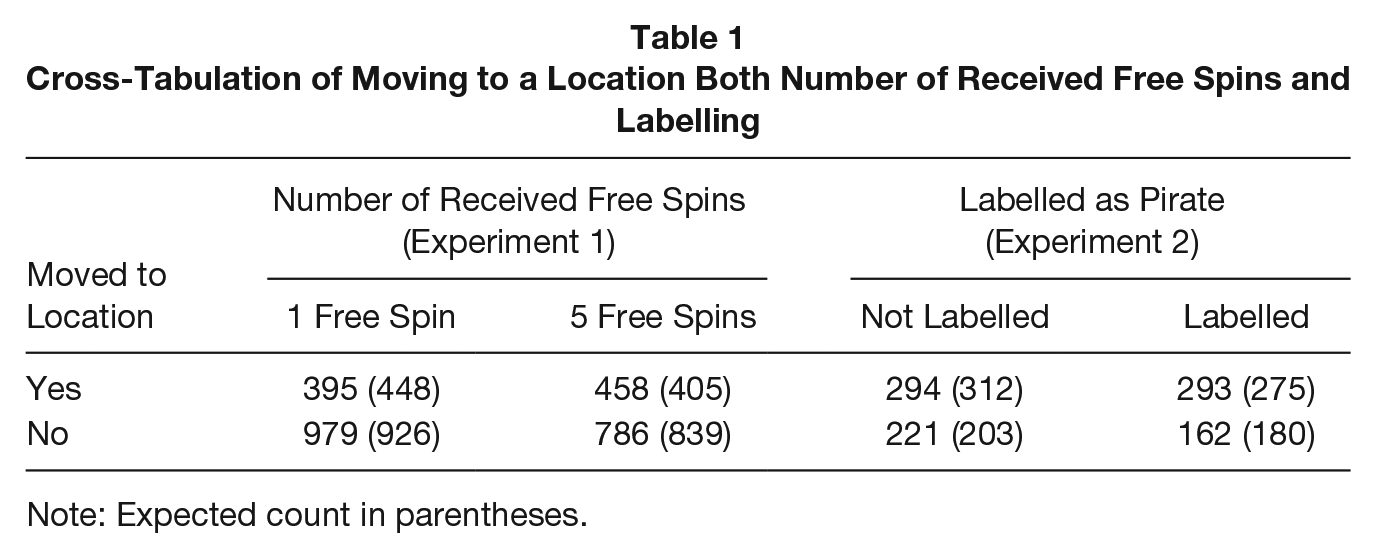
Note: Expected count in parentheses.
Discussion
This article presented two field experiments using behavior-based dependent variables. In the first experiment, we found that the amount of a reward (in the form of free spins on a wheel of fortune) offered in a message triggered by a location-based service had a significant effect on visitors’ choice to move to this wheel and claim the offered reward or rewards. In the second experiment, we found that messages that labelled visitors with a fitting trait (for the targeted location) significantly affected visitor movement, using geographical data to verify that they had been at this location.
Essentially, we investigated whether visitors could be paid and nudged to move, and our findings indicate that both are valid tools for moving such visitors at a tourism location. However, by offering a reward to affect behavior, such behavior becomes extrinsically motivated. Even though the effect of extrinsic motivation is well established (e.g., Sundel & Sundel, 2005), it also has drawbacks; for instance, rewards might cost money for the service provider. In addition, research shows that extrinsic motivators can thwart intrinsic motivation (Deci et al., 1999)—where intrinsic motivation is doing something because it is inherently enjoyable or interesting (Ryan & Deci, 2000). Consequently, a reward could make something less fun or interesting. This means that there might be good reasons to go with our second investigated approach, which is nudging. In the second experiment, we investigated the nudge labelling that previous research found to affect behavior (e.g., Kristensson et al., 2017; Tybout & Yalch, 1980). This mechanism has, to the best of our knowledge, not been investigated in a field experimental setting using smartphones before. Thus, our study generalizes the knowledge about this mechanism to a smartphone-based service context. In comparison, Kristensson et al. (2017) investigated this effect on a sign in a store and, in a second experiment, used staff who gave participants a label in person. It appears that the effect in the latter condition could potentially be triggered by a social pressure mechanism that might not be part of a smartphone setup.
There are several practical implications of managing visitor movement. As mentioned in the introduction, it can increase sales (Bues et al., 2017) and improve the effectiveness of company resource (Buhalis & Amaranggana, 2014). An additional implication is to focus on the experience of visitors. The current tourism experience research suggests that satisfaction and quality are not enough to describe the experiences that tourists seek. In fact, researchers suggest that these experiences must also be memorable (see, e.g., Kim et al., 2012; Tung & Ritchie, 2011). Location-based services present opportunities for tourism producers to create such memorable experiences. For example, they could be used to curate experiences, possibly using location data and time data to infer location that could be fitting for a specific visitor. Thus, together with an ability to focus on satisfaction dimension of the experience (e.g., manage visitor streams to decrease cuing), these services have great potential to create both satisfying and memorable experiences. Since the psychological mechanisms investigated in this research could improve the capability to move visitors, they should also have the potential to improve the ability of these services to create satisfying and memorable experiences.
Limitations and Future Research
In one of the experiments, a message labelled the participants as pirates, and we argued that the effect of labelling is driven by a self-perception mechanism (Tybout & Yalch, 1980). Because the setting was a zoo, it seems safe to assume that several of the participants are part of a group (e.g., a family). It also seems likely that children affect the decisions of these groups to a large extent; children who are presumably more inclined to be able to perceive themselves as pirates. Therefore, our results might have been different if only adults were part of this decision. Furthermore, the fact that the decisions were made by more than one person could be seen as a limitation to our experiments. However, this could also be seen as necessary for achieving ecological validity due to a presumed prevalence of group decisions that are part of a visit to a zoo.
For companies in general, a marketing initiative might backfire since consumers generally have a negative attitude toward mobile marketing communications that are sent without permission (Tsang et al., 2004). Therefore, the company should ask for permission before utilizing push communication (Barnes & Scornavacca, 2004). This might be particularly important for the tourism producer, considering the experiential aspects of the tourism industry. Consequently, the impact that the investigated type of service has on the experience of visitors—both considering tracking and messages—would be a welcome addition to tourism and hospitality research. This should preferably be done using field experimental studies for causal inferences and for generalizability to real-world settings.
Conclusion
In two field experiments, we have shown how visitors at a tourism location can be physically moved using messages triggered by a location-based service. These messages included a reward, which means that the visitor was essentially paid to move or employed the nudging technique labelling. Our field experimental approach allows for causal inferences regarding these psychological mechanisms, showing that they are generalizable beyond the laboratory and into the real-world. In addition, our study shows that labelling is generalizable to a smartphone message context, which has not been done before. These are ecologically valid findings that could help tourism producers create value for themselves and for their visitors.
Footnotes
Authors’ Note:
This study was funded by the Norwegian Research Council (Grant Number 256783) and the Swedish Hospitality and Retailing associations (Grant Number BFUF 2016-196).
