




Abstract
This study develops a vector error correction model of hotel demand to incorporate both the short-run demand fluctuations and the long-run tourism growth. We distinguish between endogenous and exogenous variables in model development to advance previous tourism demand modeling. In addition, we develop a weighting scheme to account for the importance of explanatory economic variables that are pertinent to source markets of a destination to increase model accuracy. With an analysis of the Swiss hotel data from the first quarter of 1975 to the fourth of 2016, we found no evidence that the long-run market equilibrium exists among all three endogenous variables in the model, namely hotel nights, Swiss real gross domestic product, and real exchange rate of the Swiss franc. However, the short-run hotel demand fluctuations could be attributed to behavior persistence of tourists.
Introduction
The success of tourism and hospitality firms, such as hotels, airlines, and restaurants to name a few, depends not only on better meeting the needs of consumers but also on accurately anticipating demand, as unsold hotel rooms, flight seats, and restaurant tables cannot be stored and resold (Archer, 1987; Dharmaratne, 1995; Jackman & Greenidge, 2010; Song & Witt, 2006). It is thus crucial for these firms and a destination as a whole to accurately forecast tourist arrivals and demand in a wide range of tourism and hospitality sectors, particularly hotels (Pan et al., 2012; Rajopadhye et al., 2001; Song et al., 2009). Yet no consensus has yet to be reached on a forecasting method that makes empirical results comparable across destinations and across hospitality sectors (Dharmaratne, 1995; Song & Li, 2008; Witt & Witt, 1995). Nor does a single demand model tend to outperform others because prediction accuracy also depends on the nature of the data used, the forecasted horizon, and various destination-specific characteristics (Gunter & Önder, 2015; Li et al., 2005; Song & Li, 2008).
While tourism growth is intertwined with macroeconomic situations of both origin and destination countries, the long-run relationship between tourism demand and economic growth in empirical studies is far from clear (Crouch, 1994a, 1994b, 1996; Song, Wong, et al., 2003). Incorporating macroeconomic variables in model development is instrumental as research has verified the effect of economic development of destinations, including infrastructure and hotel supply, on tourism demand (Choi et al., 1999; Choyakh, 2008; Eugenio-Martin et al., 2008; Provenzano, 2015; Seetanah et al., 2015). Also, a close economic linkage between two countries, such as bilateral trade, may exert a positive externality on tourist flows between them not least because trade is the driving force of business travel between trading partners (Kulendran & Wilson, 2000a, 2000b; Kulendran & Witt, 2003). Thus, disregarding the linkage between international trade and tourism would bias tourism demand estimates (Shan & Wilson, 2001).
To better understand tourism demand that changes with the macro economy, we model tourism demand by factoring in both endogenous and exogenous variables of a destination’s economy. In order to reflect the importance of origin countries in tourism demand for the destination, we weight the explanatory variables pertinent to the origin countries as suggested by previous studies (Dogru et al., 2017; Luzzi & Flückiger, 2003; Smeral, 2010; Smeral & Weber, 2000). We test the model in Switzerland due to its macroeconomic characteristics, such as having its own currency and autonomous monetary policy, that can easily distinguish between endogenous and exogenous variables. Not only do these characteristics set Switzerland apart from other European countries but they also help avoid reverse causality with regard to the effects of the global economy on the Swiss economy. While the Swiss context sheds light on unraveling the relationships between tourism growth and the macro economy, it has been underexplored in the literature (Luzzi & Flückiger, 2003; Sund, 2006), so have these relationships yet to be elucidated.
Literature Review
Demand for Tourism and Hotels
Tourism demand is normally measured as tourist arrivals at a destination or tourist departures from an origin country (Li et al., 2005; Song et al., 2009; Song & Li, 2008). Since tourist arrivals cannot be directly translated into market demand for tourism products and services at the destination, tourist expenditure is adopted to examine the fulfilled market transactions (Crouch, 1994a, 1994b, 1996; Li et al., 2005). In cases where collecting data of tourist arrivals is difficult, hotel room stays are used not only as a proxy for tourism demand in general but also as a key performance indicator of the hotel industry. From a theoretical point of view, Luzzi and Flückiger (2003) argued that hotel room stays are superior to tourist arrivals in measuring tourism demand as they not only take into account tourists’ length of stay and consumption patterns but also exclude tourists who stay with their friends and relatives. Moreover, the number of nights at commercial hospitality establishments allows researchers to better interpret their empirical results, especially in relation to a wide range of demand elasticities (Luzzi & Flückiger, 2003).
Supply-Induced Tourism Demand
The effects of a wide range of determinants of tourism demand, from income, price, to travel cost, may vary between developed countries and developing countries (Eugenio-Martin et al., 2004; Naudé & Saayman, 2005). Eugenio-Martin et al.’s (2004) study in Latin America showed that sufficient economic development, including infrastructure investment, is crucial for low-income destinations to attract tourists, while social development, such as health services supply, is important for medium-income destinations. Naudé and Saayman’s (2005) study found that tourism demand in African countries was largely affected by political stability, tourism infrastructure, as well as overall economic development of the destinations. Zhang and Jensen (2007) found that technology and investment in infrastructure were more important for less-developed countries than for Organisation for Economic Co-operation and Development (OECD) countries in attracting international tourists. These studies lend support to the argument that developing countries need to reach a threshold of economic and social development from within before they can trigger tourism demand from outside (Eugenio-Martin et al., 2008).
Economic Growth and Tourism Demand
The relationship between tourism demand and economic growth leads to the hypotheses of tourism-led growth and growth-led tourism (Brida & Risso, 2010; Chen & Chiou-Wei, 2009; Copeland, 1991; Katircioglu, 2009; Seetanah, 2011). Yet empirical evidence for supporting either of the two hypotheses is mixed. Seetanah (2011) found a bicausal relationship between tourism demand and economic growth in island destinations, suggesting that economic growth, measured by real gross domestic product (GDP) of a destination, stimulates inbound tourism demand, which, in turn, fuels economic growth thereafter. According to Seetanah (2011), the economic development of the destination indicates increased capacity of tourism supply, particularly hotel rooms, which is a determinant of tourism demand. Such a reciprocal relationship between tourism demand and economic growth was also supported by Katircioglu’s (2009) study in Malta and by Chen and Chiou-Wei’s (2009) study in Korea. Nevertheless, also in the Korean context, Oh’s (2005) study concluded that economic growth of the destination country drives tourism demand, not the other way around.
The growth-led tourism hypothesis lends support to the effects of supply-side factors, which are pertinent to the destination, on tourism demand. Zhang and Jensen (2007) argued that supply-side factors, especially natural resource endowments, technology, and infrastructure, represent the comparative advantages of a destination and can therefore better explain inbound tourism demand. Seetanah et al. (2010) found that the economic growth of South Africa, measured by real GDP per capita and tourism infrastructure, has a considerable positive impact on inbound tourism demand. In Provenzano’s (2015) study in Sicily, both inbound and domestic tourism were found to be affected by various supply-side factors, ranging from natural and cultural resources to road infrastructure and urban environment. Besides economic factors, many studies found that social and political factors are instrumental in determining tourism growth in developing countries (Eugenio-Martin et al., 2008; Khadaroo & Seetanah, 2008; Provenzano, 2015; Seetanah et al., 2010).
Bilateral Trade, Exchange Rate, and International Tourism
International tourism and trade are interdependent (Kulendran & Wilson, 2000a, 2000b; Leitão, 2010; Santana-Gallego et al., 2011; Shan & Wilson, 2001; Van De Vijver et al., 2014). Shan and Wilson (2001) verified a two-way Granger causality between trade growth and inbound tourism demand in China by referring to the role of China’s major trading partners in boosting tourism demand. In Katircioglu’s (2009) study of Cyprus, not only were tourist arrivals stimulated by economic growth of the destination, they were also boosted by the growth of both exports and imports of the country. Leitão (2010) found that bilateral trade was one of most important determinants of international tourism in Portugal. A similar result was found by Surugiu et al. (2011) in Romania, where the effect of trade volume on inbound tourism demand displaced the price effects. Such a bicausality was found evident in OECD countries, where trade in goods and services facilitates the flow of tourists, which further promotes trade between these countries (Santana-Gallego et al., 2011).
Underlying the indissoluble relationship between international tourism and trade is the role of exchange rate. Since some tourism products and services, such as hotel rooms, are immobile at the destination, and hence are nontradables, an influx of inbound tourists would affect the real exchange rate of the destination country through inflating the prices of the nontradables (Copeland, 1991; Socher, 1986). The change of real exchange rate would, in turn, lead to the change of relative prices of tourism products and services in general at the destination, thereby affecting tourist flows and commodity trade (Socher, 1986). Hanly and Wade (2007) found that the real exchange rates of both the U.S. dollar and Canadian dollar had positive effects on American and Canadian tourists’ expenditure in Ireland, respectively. Similarly, Falk (2015) found that Swiss tourism demand in Austria with respect to the real exchange rate of the Swiss franc was elastic. Eilat and Einav (2004) went on to find that exchange rate actually affects tourism demand in developed countries but not in developing countries.
Since increased inbound tourism, namely tourism exports, can lead to an appreciation of real exchange rate in a destination country, the growth of inbound tourism may end up crowding out other exports of the destination economy. This crowd-out effect can lead to the contraction of the whole economy of the destination, and thus jeopardize economic growth potentials, if revenues which would otherwise be generated from other exports outstrip tourism receipts (Copeland, 1991; Dwyer et al., 2000; Narayan, 2004; Socher, 1986). For instance, Easton (1998) found that tourism exports in Canada did lead to the appreciation of the Canadian dollar in real terms, and eventually squeezed other commodity exports. Narayan (2004) also found that the expansion of inbound tourism in Fiji led to price and wage increases in the country, and thus an appreciation of the real exchange rate of the Fijian dollar, thereby hurting commodity exports. Given the fact that real exchange rate of the destination country can be altered by tourism exports, the net contribution of inbound tourism on economic growth depends on whether the increased value of tourism exports outweighs the fall in other exports of the economy (Narayan, 2004).
Research Gaps
In modeling tourism demand, previous studies did not make a clear-cut distinction between exogenous and endogenous determinants of tourism demand. In the dichotomy of supply- and demand-driven models of tourism demand, when the demand-side factors—those factors pertinent to the origin countries such as the income of tourists—are concerned, many studies treated all explanatory variables exogenous and thus tourism demand in a particular destination becomes a shock in the destination’s economy (Song & Witt, 2000, 2003; Song, Witt, et al., 2003; Song, Wong, et al., 2003). On the other hand, when supply-side factors are concerned, almost all factors are seen as endogenous for eliciting the long-run relationship between tourism demand and economic growth of the destination (Eugenio-Martin et al., 2004, Eugenio-Martin et al., 2008; Naudé & Saayman, 2005; Zhang & Jensen, 2007). Empirical studies in this regard were exclusively devoted to developing or the least developed countries as destinations, attempting to validate the relationship between tourism demand and economic growth (Eugenio-Martin et al., 2008; Seetanah, 2011; Seetanah et al., 2010). This is because developing tourism to boost national economy outstrips other economic alternatives for these countries.
While ample empirical evidence seems to suggest that the relationship between tourism growth and economic development depends on the growth stage of a destination’s economy (Eugenio-Martin et al., 2004; Naudé & Saayman, 2005). Previous research suggests that at the initial stage of economic growth, to which developing economies are referred, economic growth is a prerequisite to boosting tourism (Eugenio-Martin et al., 2008), yet whether it holds true in developed economies is not clear. As far as Switzerland is concerned, not only is the classification of growth stages vital, but Switzerland as a developed economy does not resemble others in many aspects. Inbound tourism in Switzerland can affect the real exchange rate of the Swiss franc and therefore affects other exports in the economy and, ultimately, the whole economy of the destination. This endogeneity has not yet been explored.
Method
The Swiss Context
Tourism exports have long been a major contributor to Swiss GDP. Back to as early as the late 1890s when international tourism burgeoned in Switzerland, the gross added value of tourism was around 3.5% of Swiss GDP. In the aftermath of World War I, tourism growth in Switzerland, measured by hotel room stays, far exceeded that of industrial production (Andrist et al., 2000; Forschungsstelle für Sozial-und Wirtschaftsgeschichte, 2017). Due to the diversification of the Swiss economy ever since, tourism contribution to the national economy stood at 2.8% of GDP, of which 4 billion Swiss francs was generated in the accommodation sector in 2017 (Federal Statistical Office [FSO], 2018, 2019a). Because Switzerland is landlocked at the heart of continental Europe, and tourists can travel freely across its borders, measuring tourist arrivals is difficult. Thus, hotel room stays have been widely used as a proxy to tourism demand in both statistics and academic research (FSO, 2019b; Luzzi & Flückiger, 2003; Sund, 2006; World Tourism Organization, 2018).
Switzerland depends heavily on international trade that includes tourism exports. The fast growth of Swiss GDP since 1997 has been led by foreign trade (FSO, 2017), particularly with the United States and United Kingdom as well as its neighbors, namely France, Germany, and Italy. Not only are these economies major trading partners of Switzerland but they are also major source markets of Swiss inbound tourism. Because the Swiss economy is advanced, diversified, and open, the Swiss context is an ideal setting to examine how tourism growth and the macro economy are intertwined with each other. Even compared with its European counterparts, Switzerland stands out in its autonomous monetary policy and currency, which allow us to further decouple tourism growth in Switzerland from the development of the world economy.
Variables and Data
Building on the effects of the supply-side factors on tourism demand (Eugenio-Martin et al., 2008; Katircioglu, 2009; Santana-Gallego et al., 2011; Seetanah et al., 2010; Shan & Wilson, 2001), we specify three categories of independent variables that respectively address the effects of the supply-side factors in a destination country, demand-side factors in an origin country, as well as trade interdependence between the two (Katircioglu, 2009; Kulendran & Wilson, 2000a; Kulendran & Witt, 2003; Seetanah et al., 2010; Seetanah et al., 2015). First, the supply-side factors include Swiss real GDP, which accounts for economic growth, and temperature, which accounts for seasonality of tourism demand. Tourism demand seasonality in Switzerland is featured by a watershed separation between skiing activities in winter and various sports activities in summer. Second, the demand-side factors include real GDP of an origin country for accounting for the income of inbound tourists. Third, we use the real exchange rate of the Swiss franc to account for trade interdependence between Switzerland and its trading partners.
While it is commonplace to use GDP of an origin country to measure the income of inbound tourists (Crouch, 1994a, 1994b, 1996; Song, Wong, et al., 2003) and GDP of a destination to indicate tourism and hospitality supply, measuring the price of tourism at the destination is not straightforward. Previous studies suggested that tourists are more aware of the change of (nominal) exchange rate than that of prices when choosing a destination (Falk, 2015; Witt & Martin, 1987). Based on studies addressing the effects of the exchange rate of the Swiss franc on tourism demand (Falk, 2015; Luzzi & Flückiger, 2003), we argue that the effect of the exchange rate of the Swiss franc would be more pronounced than that of other currencies due to its unique status and the associated monetary policy. Moreover, using the real exchange rate of the Swiss franc as a proxy to price allows us to model its direct effect on tourism demand, in relation to bilateral trade between Switzerland and its trading partners.
We retrieved data of hotel room nights for both domestic and inbound tourists from Swiss FSO (2016) from the first quarter of 1975 to the fourth of 2016, for which the data are available and most up to date. We used TRAMO 1 to seasonally adjust and fill missing values for the year 2004. We retrieved macroeconomic data of Switzerland and its major trading partners from OECD national accounts, including nominal GDP (annual), real GDP (reference year 2005, annual), deflator, and growth rate (quarterly), all seasonally adjusted using TRAMO. We collected data of nominal exchange rates between the Swiss franc and the euro, the British pound, and the U.S. dollar from European Statistical Office from the third quarter of 1974 to the fourth of 2016. We retrieved temperature data from Swiss Federal Office of Meteorology and Climatology, which was also seasonally adjusted using TRAMO. Table 1 summaries the variables, measurement, and data sources.
Summary of Variables, Measurement, and Data Sources
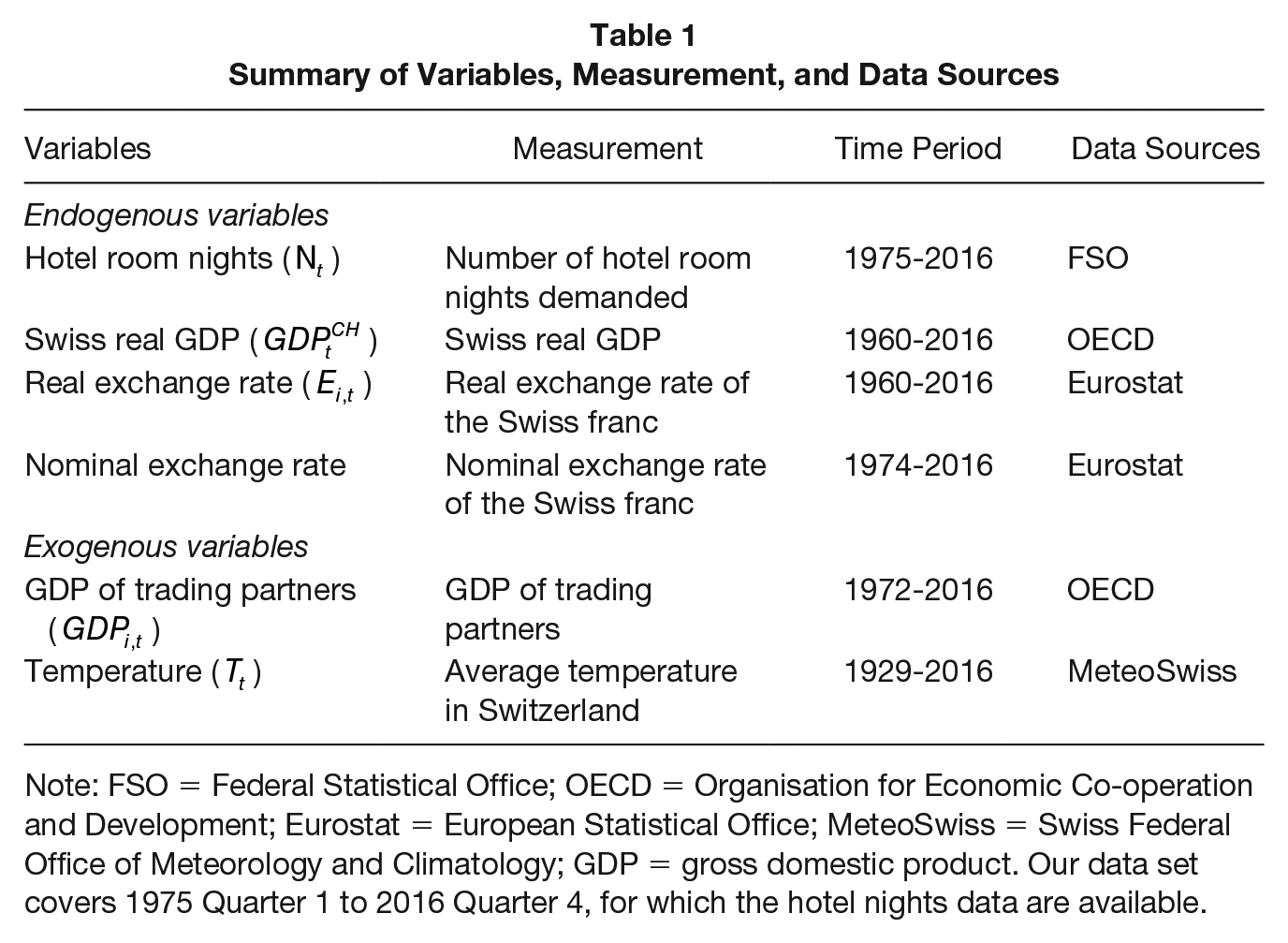
Note: FSO = Federal Statistical Office; OECD = Organisation for Economic Co-operation and Development; Eurostat = European Statistical Office; MeteoSwiss = Swiss Federal Office of Meteorology and Climatology; GDP = gross domestic product. Our data set covers 1975 Quarter 1 to 2016 Quarter 4, for which the hotel nights data are available.
Weighting Schemes
As suggested by previous studies (Copeland, 1991; Kulendran & Wilson, 2000a, 2000b; Kulendran & Witt, 2003; Socher, 1986), bilateral trade can affect tourist flows and, hence, tourism demand between trading partners in two ways. First, since a basket of tourism products and services, such as hotel rooms, are mainly nontradables at the destination, tourist flows between two countries can affect bilateral trade due to the fact that inbound tourism inflates the prices of nontradables at the destination and, hence, alters real exchange rates of the local currency (Copeland, 1991; Socher, 1986). Second, irrespective of the influence on real exchange rates, trade openness can boost inbound tourism, specifically in the form of business travel, between two trading partners (Kulendran & Wilson, 2000a, 2000b; Kulendran & Witt, 2003; Santana-Gallego et al., 2011). These results lend support to the role that a destination’s major trading partners play in determining tourism demand.
Therefore, we argue that the market share of an origin country’s tourism demand in a destination country is not only important in affecting tourism demand in its own right but can also signify the importance of various explanatory variables that are pertinent to the origin country. In other words, despite using the same explanatory variable to explain tourism demand from various origin countries, the importance of the variable depends on the market shares of inbound tourism from these origin countries. This proposition suggests multiplying the explanatory variable with a scalar to capture the scaling effect of market share in model development. Previous studies adopted various weighting schemes for the same sake, based on an origin country’s proportion in the total tourism demand of a destination (Smeral, 2010; Smeral & Weber, 2000). Besides using a fixed weight, Luzzi and Flückiger (2003) suggested updating weights periodically not only to account for the change in tourism demand over time but also to increase the precision of model esteems.
Following Luzzi and Flückiger’s (2003) method, we constructed a weighting index for the two explanatory variables pertinent to an origin country, namely real GDP of the origin country and real exchange rate of the Swiss franc against the currency of the origin country, to manifest the market share of the origin country in Swiss inbound tourism. First, we divided Swiss inbound tourism market into eight countries/regions, namely Germany, the United Kingdom, the United States, France, Italy, the Netherlands, Belgium, plus the other region that incorporates all other countries combined to be compatible with the seven countries. Second, we computed the weights as the market share of each of the eight countries/regions in Swiss inbound tourism. Supplement Figure 1 (available in the online Supplement) shows the dynamics of weights of the eight countries/regions over the study period.
Notice that we used the GDP of OECD European countries as a proxy for the average real GDP of all other countries combined in the eighth category, because these countries are not only the major trading partners of Switzerland but also contribute far larger tourism imports. Also, the results were robust when using the GDP of OECD European countries as a proxy. We converted the real GDP of the eight markets into the Swiss franc for weighting the variables. We obtained the bilateral real exchange rates between the Swiss franc and the euro, the British pound and the U.S. dollar from Swiss National Bank, with the reference year setting at the fourth quarter of 2000. We rebased the time series to obtain four quarters of 2010 as the reference year. The bilateral real exchange rate accounts for the competitiveness of Switzerland compared with its trading partners. It is defined as the amount of foreign currency bought by one Swiss franc adjusted for the price index for both Switzerland and its trading partners. The real exchange rate thus accounts for both the change in the exchange rate and the change in prices, 2 and thus an increase in bilateral real exchange rate suggests an appreciation of the Swiss franc in real terms. The weighting index is constructed as follows:

where
Model Specification
We used vector autoregression (VAR) to model the linear relationships between the time series of these variables. Since VAR does not rely on prior assumptions on causality, it provides more flexibility to examine the interdependence between economic growth and tourism demand in the long run. It also allows to establish causality between these variables and test the effects of a shock to all the variables in the model. While VAR treats variables as endogenous and interdependent, recent development of econometrics theory allows it to account for both endogenous and exogenous variables in a model (Pesaran et al., 2000). As far as our study is concerned, we distinguished between endogenous and exogenous variables in model development. We regarded the supply-side economic variables, namely Swiss real GDP and hotel demand as endogenous, while demand-side economic variable, namely the weighted GDP of an origin country, as exogenous. In addition, the weighted real exchange rate of the Swiss franc is an exogenous variable in the model. While temperature as a noneconomic variable is supply-specific, it is exogenous because no evidence has yet to suggest that Swiss economic growth leads to temperature changes in the country.
The distinction between endogenous and exogenous variables helps demarcate the bidirectional causality between tourism demand and economic growth. On the one hand, the increase of GDP of a destination due to investment in infrastructure and tourism facilities can lead to more demand for hotel rooms and increase in tourist arrivals, suggesting the growth-led tourism hypothesis (e.g., Oh, 2005). On the other hand, inbound tourism growth can lead to higher GDP for a destination, other things being equal, which suggests the tourism-led growth hypothesis (e.g., Chen & Chiou-Wei, 2009). Such bidirectional causalities can also be detected between tourism demand and real exchange rate between two countries (Copeland, 1991; Dwyer et al., 2000; Narayan, 2004). Worth noting is that Swiss GDP and inbound tourism depend much on the GDP of Switzerland’s major trading partners through tourism or other exports, not the other way around, because Swiss imports and outbound tourism only account for a tiny fraction of the GDP of its trading partners. This situation renders the GDP of Swiss trading partners exogenous in modeling Swiss inbound tourism demand.
We implemented the VAR model as follows. First, we log transformed all variables, except temperature as it takes negative values. Second, using the modified Dickey–Fuller test and the Augmented Dickey–Fuller (GLS) test (Perron-Qu), we verified that all five time series, namely hotel nights (
Therefore, the three VECM equations are specified as follows:

where

where
α stands for the speed of the adjustment of the error correction, suggesting how fast a deviation from the long-run equilibrium relation is reabsorbed.
This model aims to generate accurate forecasts for hotel nights in Switzerland based on endogenous macroeconomic variables, including Swiss real GDP, the weighted real exchange rate of the Swiss franc and hotel nights in previous quarters. It tests which of these variables contribute(s) to the short-run and long-run hotel demand. With the inclusion of the exogenous variables, such as GDP of the trading partners and temperatures in Switzerland, the model also tests whether these exogenous variables affect hotel demand in one way or another.
Results and Discussion
Long-Run Hotel Demand
Table 2 shows that there is only one long-run equilibrium equation verified between the three endogenous variables, namely hotel nights (

which suggests the long-run equilibrium effects of Swiss real GDP (

Long-Run Equilibrium Relationships Among Endogenous Variables
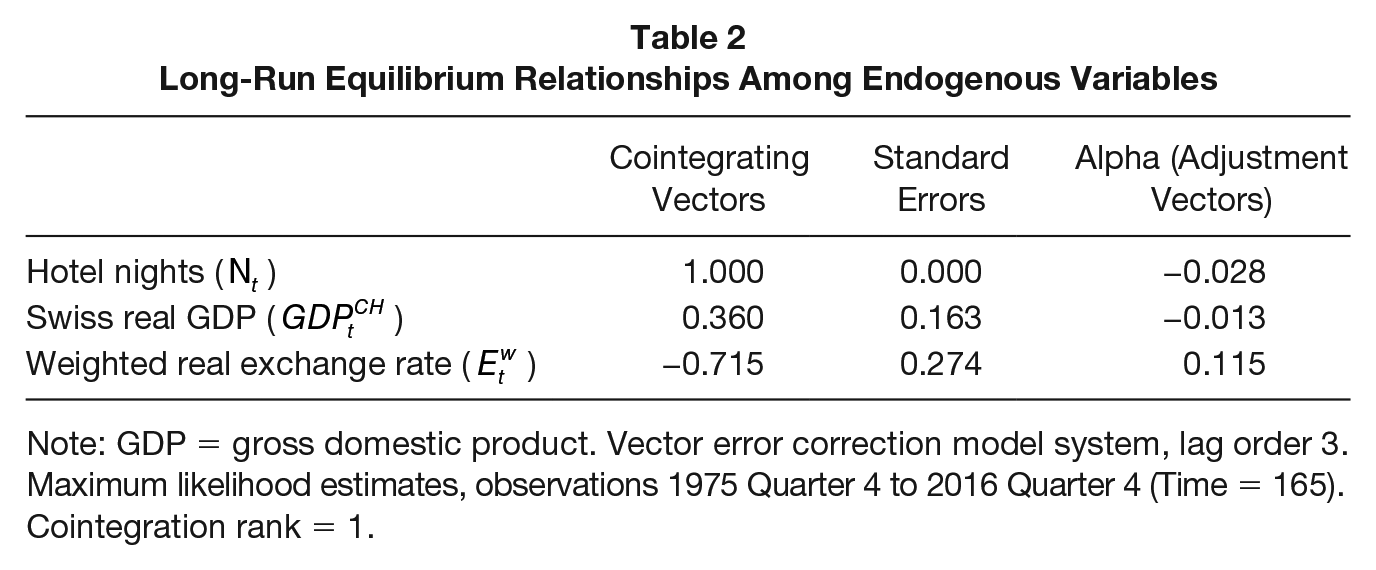
Note: GDP = gross domestic product. Vector error correction model system, lag order 3. Maximum likelihood estimates, observations 1975 Quarter 4 to 2016 Quarter 4 (Time = 165). Cointegration rank = 1.
Since all the three endogenous variables are statistically nonsignificant, we reject the long-run equilibrium relationships in the model. In the absence of the long-run effects of Swiss real GDP (
We did not find evidence for the impact of the weighted real exchange rate of the Swiss franc (
As a matter of fact, we have considered the impact of the real exchange rate of the Swiss franc. The two components of the real exchange rate are prices and nominal exchange rate. Given the interest rate parity condition, nominal exchange rate depends on interest rate. However, at the end of the medium run and, a fortiori, in the long run, money is neutral (Blanchard & Johnson, 2013), which implies that interest rate is equal to real interest rate. Real interest rate is determined only by the productivity of capital (formally it is the marginal product of capital). As a result, interest rate is related to the aggregated supply but not to the aggregated demand. At the end of the medium run and in the long run, prices do not play any role. Hence, in the long run, we should expect a neutrality of the real exchange rate.
Short-Run Hotel Demand
Table 3 shows that the model explained 57.9% of the variance in hotel nights (
Short-Run Effects On Hotel Nights (
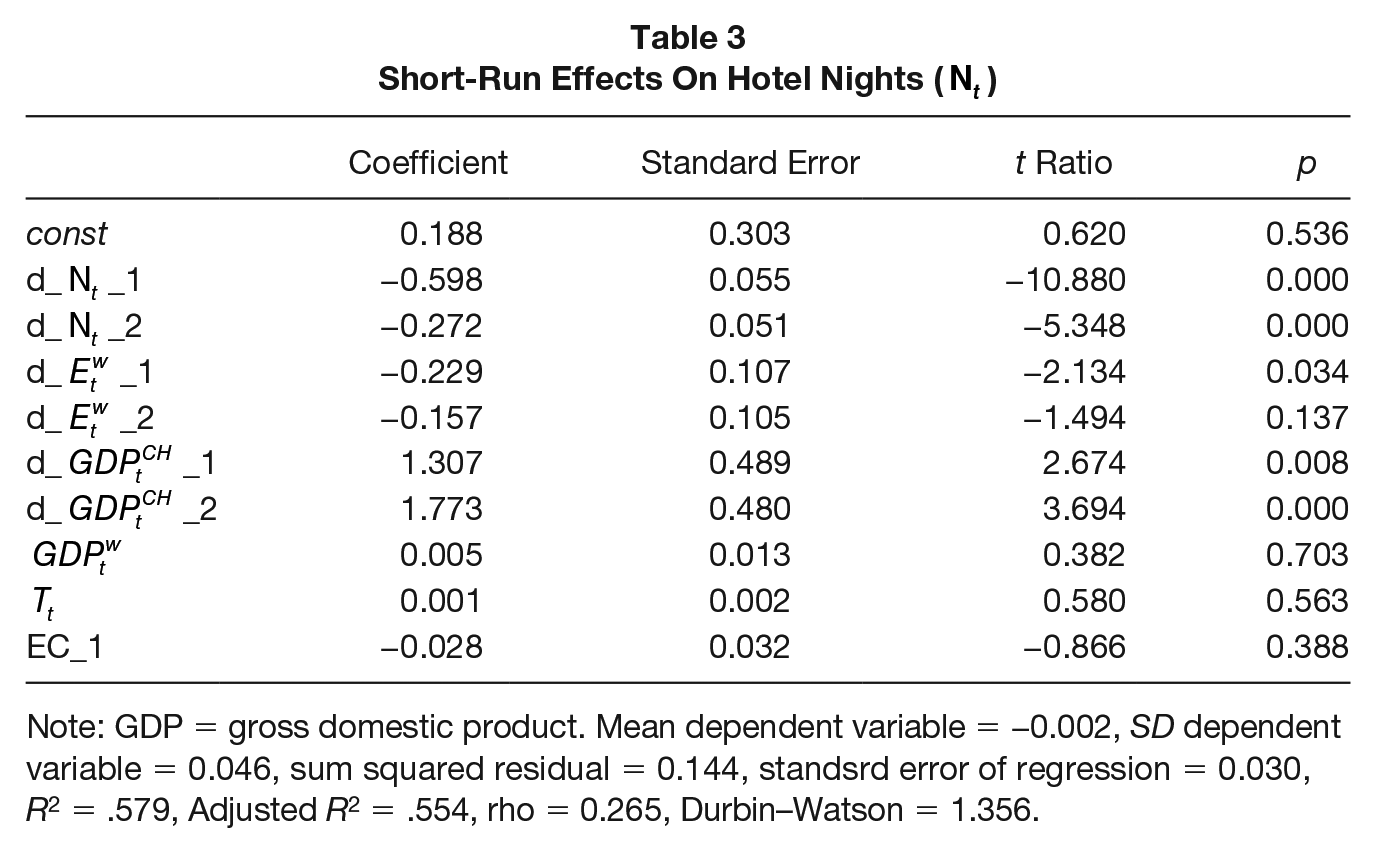
Note: GDP = gross domestic product. Mean dependent variable = −0.002, SD dependent variable = 0.046, sum squared residual = 0.144, standsrd error of regression = 0.030, R2 = .579, Adjusted R2 = .554, rho = 0.265, Durbin–Watson = 1.356.
We argue that Swiss inbound tourism perhaps demonstrates a negative network externality, rendering tourism demand less elastic, or even nonsignificant, with respect to all the explanatory variables in the model. Ayres (1998) found a positive network effect in Cyprus’s inbound tourism, suggesting that inbound tourism is almost entirely tied to previous visits, hence obscuring the relationships between price, income, and tourism demand. An explanation peculiar to Switzerland would be that much of natural resource endowment, on which major tourist attractions, such as ski resorts, are based, is not differentiated from other European countries. Therefore, tourists with experience in Switzerland would switch to other destinations that can offer similar tourism products and services, resulting in a negative relationship between two consecutive time periods in tourism demand.
Table 3 also shows that the demand elasticity of hotel nights (
Table 4 reports the effects of the explanatory variables in the model on Swiss real GDP (
Short-Run Effects on Swiss Real GDP (
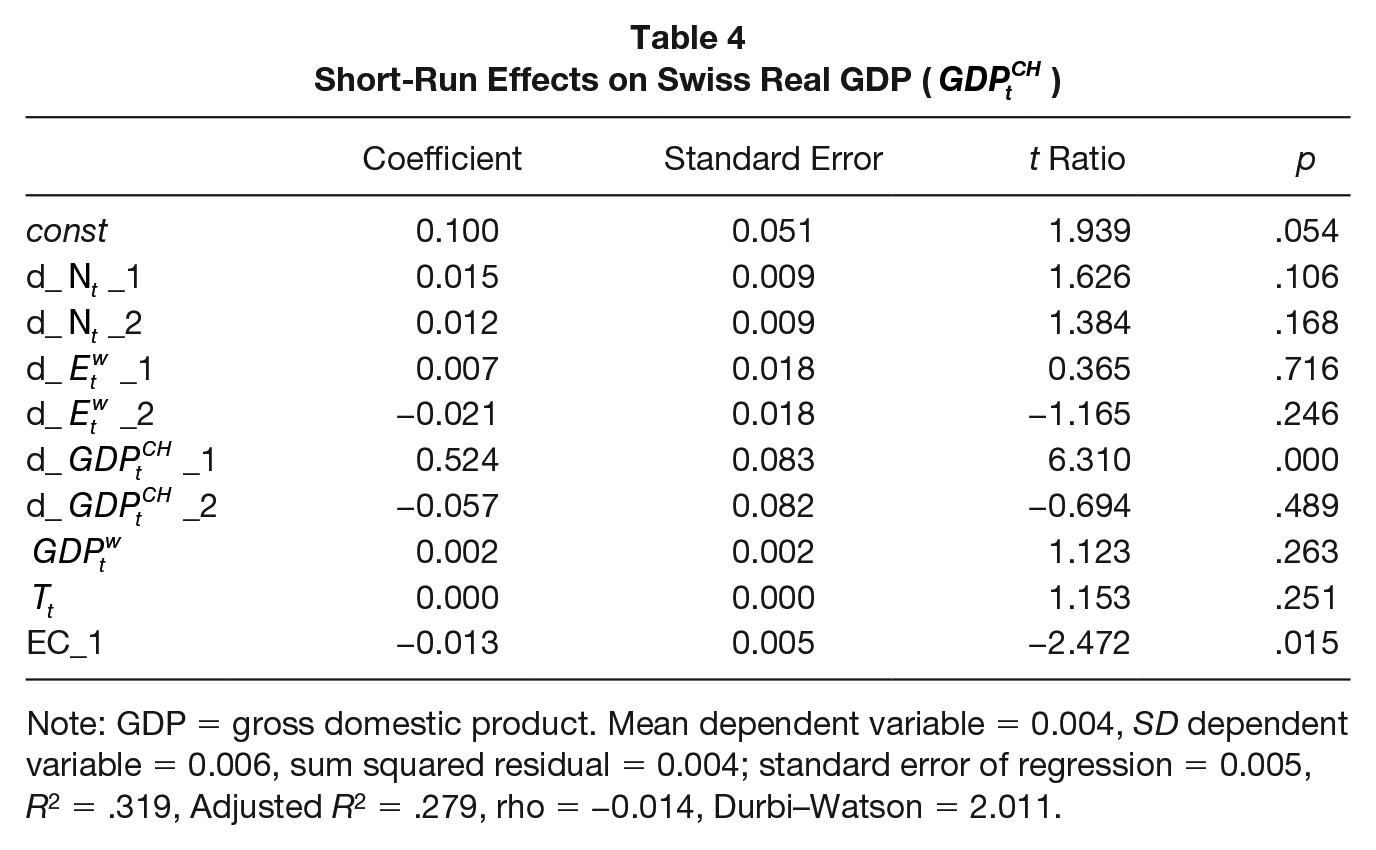
Note: GDP = gross domestic product. Mean dependent variable = 0.004, SD dependent variable = 0.006, sum squared residual = 0.004; standard error of regression = 0.005, R2 = .319, Adjusted R2 = .279, rho = −0.014, Durbi–Watson = 2.011.
Table 5 shows the effects of the variables on the weighted real exchange rate (
Short-Run Effects on Weighted Real Exchange Rate (
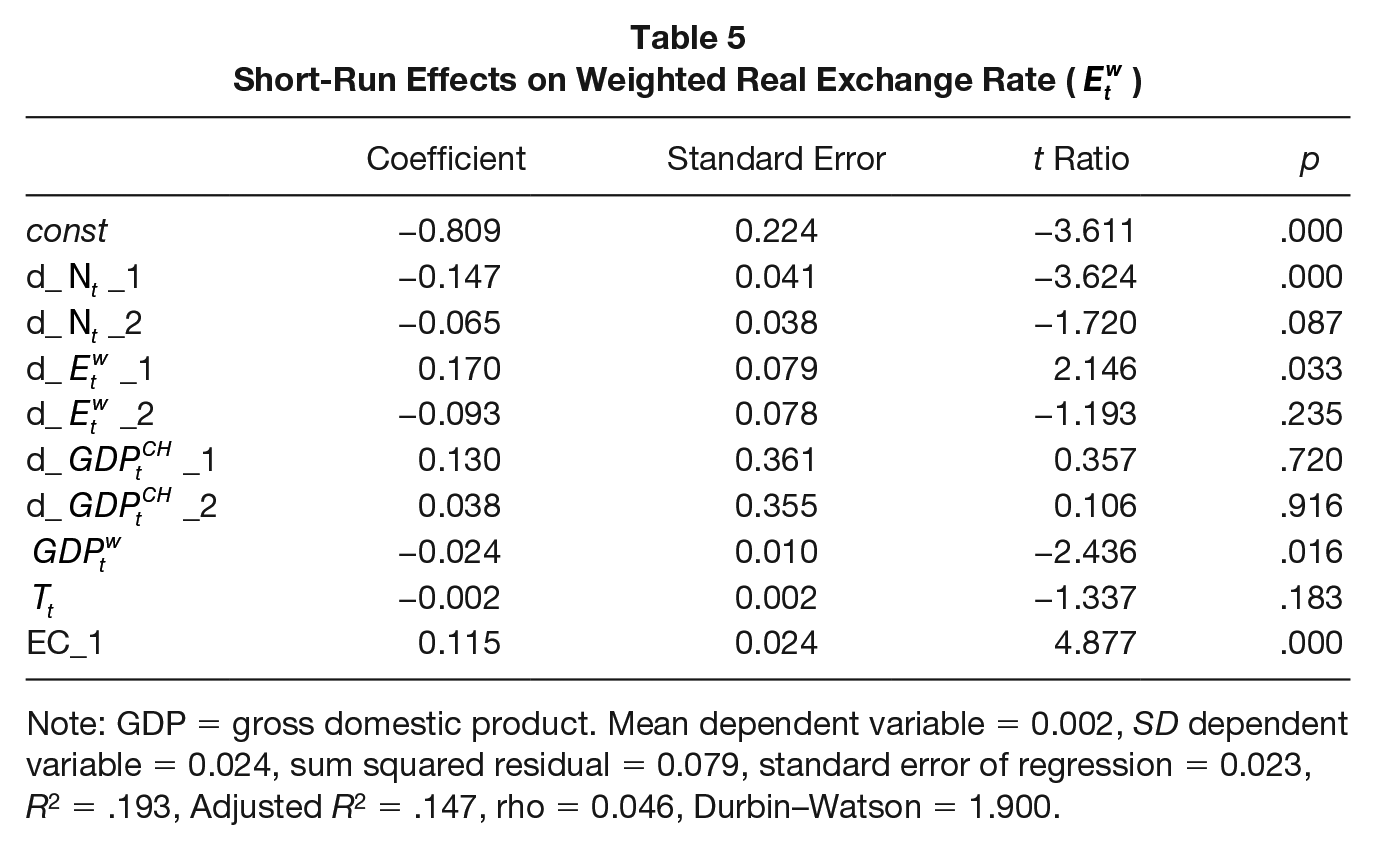
Note: GDP = gross domestic product. Mean dependent variable = 0.002, SD dependent variable = 0.024, sum squared residual = 0.079, standard error of regression = 0.023, R2 = .193, Adjusted R2 = .147, rho = 0.046, Durbin–Watson = 1.900.
We found that the weighted real exchange rates of the Swiss franc in two consecutive quarters are positively correlated. We also found that the weighted real exchange rate is affected, albeit not substantially, by the GDP of origin countries/regions in the short run, suggesting that an increase in the GDP of Swiss trading partners leads to the depreciation of the Swiss franc. This is perhaps because when the GDP of Swiss trading partners increases, consumers and investors in these countries step away from hoarding the Swiss franc, resulting in the franc depreciation. Moreover, an increase in the real GDP of the trading partners leads to an increase in money demand in Switzerland, which translates into an increase in the interest rate of the franc. Following the interest rate parity condition, an increase in interest rate translates into an appreciation of the local currency.
Notice that in all three models that addressed the short-run effects (Tables 3 to 5), no evidence was found for the effects of temperature (
Impulse Analysis
The impulse-response function plots the response of a variable following a shock of one standard deviation to another variable in the model and how this shock propagates over time (Supplement Figure 2, available in the online Supplement). It therefore delineates the evolution of a shock over one specific variable in both the short run and long run. The first graph (
Conclusion
Theoretical Implications
A lot of studies in the tourism demand literature examined demand by taking a demand-driven perspective, namely that the determinants of tourism demand specific to an origin country, such as income, are instrumental (Crouch, 1994a, 1994b, 1996; Smeral & Weber, 2000; Song, Witt, et al., 2003; Song, Wong, et al., 2003). In such model development, a set of origin country-specific variables are exogenous in examining tourism demand at a particular destination, and inbound tourism is seen as a demand shock in the destination economy. The supply-side factors, such as economic growth of the destination, have been explored in the context of developing economies but are largely overlooked in advanced economies. First, in addition to taking a supply-side perspective, our study contributes to the literature by providing evidence for the endogeneity of tourism growth in an advanced economy. Our results showed that neither tourism-led growth nor growth-led tourism hypothesis can be verified in developed countries in the long run. As far as developed economies are concerned, we conclude that tourism demand growth is rather a transitory phenomenon.
Second, we distinguished between exogenous and endogenous variables in modeling tourism demand to reconcile the demand- and supply-driven tourism growth. We therefore tested both the short- and long-run hotel demand, which helps distinguish between the fluctuations of hotel demand and the growth of the tourism economy. The long-run tourism growth can be ascribed to the endogeneity of explanatory variables on the supply side, namely the growth of the destination economy, while the short-run demand is affected by variables on the demand side that are exogenous to the destination, such as income of tourists and their preferences. Consistent with the first contribution, we did not find evidence for the long-run market equilibrium of the three endogenous variables, namely hotel nights, Swiss real GDP, and the real exchange rate of the Swiss franc. However, we found that the short-run hotel demand depends largely on behavior persistence of tourists, which may have obscured the relationship between tourism demand and other macroeconomic variables.
Third, we developed a dynamic weighting scheme that scales up the effects of economic variables pertinent to origin countries. The rationale is that the market share of tourism demand of an origin country in the destination would amplify the effects of the explanatory variables that are specific to the origin country. It is the scaling effects of these variables that manifest the dependence of tourism growth of Switzerland on its trading partners, and thus need to be factored in tourism demand modeling. In this sense, not only the cointegration relationship between tourism exports and real exchange rate but also that between real exchange rate and other commodity exports should be considered. This goes beyond simply treating real exchange rate as a proxy of price at the destination, but to explore how it is determined by tourism exports as well as by the trade-off between tourism exports and other commodity exports for countries like Switzerland which depend heavily on trade.
Practical Implications
Previous tourism demand studies are mainly focused on developing countries as the destination, especially Small Island Developing States (SIDS), because using tourism to leverage the destination’s economy is vital for these countries. Our study provided empirical evidence in the Swiss context for this line of literature. First, tourism was historically important for Switzerland as it has been for SIDS, but the difference is that the Swiss economy is not tourism-dependent. This helps us decouple the short-run hotel demand from long-run tourism growth. Second, like many advanced economies, Switzerland is an open economy, but Switzerland maintains a strong economic and monetary autonomy. This allows us to examine the effect of the exchange rate of the Swiss franc on hotel demand, particularly from its trading partners. Third, in the eight countries/regions considered in our model, only Belgium has a smaller economy than Switzerland, which implies that the Swiss economy depends more on trading partners rather than the other way around.
There is little literature in tourism and hospitality that distinguished between endogenous and exogenous variables in VECM demand modeling. Despite developed in the Swiss context, the application of the model is flexible. We addressed the issue of generalizability by distinguishing between endogenous (real exchange rates of the Swiss franc, Swiss real GDP, and hotel demand) and exogenous variables (GDP of Swiss trading partners) in order to make the analysis applicable to other economies. The classification of exogenous and endogenous explanatory variables in the model should therefore be regarded as a standard approach to modeling tourism demand. Yet how the effects of endogenous and exogenous variables are manifested can be country-specific and, thus, are left to researchers to decide. If we look at the United States as a destination, all macroeconomic variables in our model would be seen as endogenous because the GDP of U.S. trading partners would affect U.S. GDP substantially, which at the same time affects the world GDP to a large extent.
Limitations and Future Research
While our model was developed in the Swiss context, it can be applied to other economies where close economic ties can be drawn between a destination and its trading partners. Future research should incorporate expert opinions on upcoming trends in the hotel industry and thus refine the present model by using a Bayesian approach. In general, experts and professionals in the hotel industry could be invited to provide predictions of future trends (Rajopadhye et al., 2001), which would help increase the accuracy of the model. Instead of focusing on Switzerland as a whole, future research can focus on particular regions in the country to further explore how, if at all, temperatures, snow conditions or sunshine hours affect tourism demand that may vary across regions. Finally, future research can test whether temperature is an endogenous variable for large economies, because temperature may increase due to the increased production that generates greenhouse gases. Thus, a cointegrating relationship may exist between temperature and economic growth, so may the relationship exist between temperature and tourism demand.
Summary
This study has addressed the relationship between hotel demand and a set of macroeconomic variables that may have influenced tourism demand in one way or another. Since the model we developed was analyzed with the data of hotel demand in Switzerland, which enabled us to distinguish between exogenous variables and endogenous variables empirically. This distinction is important because tourism development and economic growth are dependent on each other, especially in small economies, which casts doubt on the direction of causality between tourism demand and economic development. We found no evidence for the long-run relationship between hotel demand in Switzerland, Swiss real GDP and real exchange rate of the Swiss franc, suggesting that both tourism-led growth and growth-led tourism conjectures are perhaps inconclusive in small advanced economies. Nevertheless, the short-run fluctuations in hotel demand are considerable, which reflects the nature of tourism demand in general.
Supplemental Material
JHTR-17-12-467.R2_supplement – Supplemental material for The Short- and Long-Run Hotel Demand in Switzerland: A Weighted Macroeconomic Approach
Supplemental material, JHTR-17-12-467.R2_supplement for The Short- and Long-Run Hotel Demand in Switzerland: A Weighted Macroeconomic Approach by Giuliano Bianchi and Yong Chen in Journal of Hospitality & Tourism Research
Supplemental Material
JHTR-17-12-467.R2_supplement_appendix – Supplemental material for The Short- and Long-Run Hotel Demand in Switzerland: A Weighted Macroeconomic Approach
Supplemental material, JHTR-17-12-467.R2_supplement_appendix for The Short- and Long-Run Hotel Demand in Switzerland: A Weighted Macroeconomic Approach by Giuliano Bianchi and Yong Chen in Journal of Hospitality & Tourism Research
Footnotes

Notes
Supplemental Material
Supplemental material for this article is available online.
References
Supplementary Material
Please find the following supplemental material available below.
For Open Access articles published under a Creative Commons License, all supplemental material carries the same license as the article it is associated with.
For non-Open Access articles published, all supplemental material carries a non-exclusive license, and permission requests for re-use of supplemental material or any part of supplemental material shall be sent directly to the copyright owner as specified in the copyright notice associated with the article.
