




Abstract
This article explores how cycling tourists build trust in the process of transition from online community to offline travel companions. It uses data collected from participant observation and interviews of a cycling tourist group in China. The findings indicate that after building a social circle in an online community, the members of the “community” build trust by: identifying travel companions’ attitudes, values, knowledge, and experiences to build dispositional trust; identifying companions’ preferences, activities, or the patterns of cycling behavior to build institutional trust; identifying companions’ cycling experiences, occupations, and hobbies to build interpersonal trust. After the identification of travel companions and trust has developed, online community members make the decision to travel together as companions and their online social circle becomes a regulated group without hierarchy. A “triple-jump” explanatory model to explain the trust-building process and practical recommendations from these insights were outlined.
Introduction
There is a growing trend in using online travel communities for connecting travelers worldwide, sharing travel information, and even seeking travel companionship. Helping people to find travel companions has become one of the key roles of online travel communities in recent years (Koh & Kim, 2003; Lee, 2014; Lin, 2007; Sproull & Faraj, 1997). The increasing popularity of such online community activities may stem from consumers’ stronger trusting (cognitive) beliefs about online community interactions in comparison with their trust of more traditional offline community agents such as travel agents (Lovelock, 2004). These online communities sometimes transition into offline groups by connecting strangers who are in search of a balance between group and individual travel (Money & Crotts, 2013; So & Lehto, 2008). Trust and sympathy have been shown to be mediators in this process of offline group formation (Kunz & Seshadri, 2015).
Creating opportunities to find travel companions on a network platform has clearly become an important function of online communities (Y. Wang et al., 2002). “Travel with companions” is by origin an offline activity but, through the influence of the Internet, it has become a combination of both offline and online activities. Trust formed in other online communities such as transaction networks or organizations has been shown to be vital in shaping behavior (Buntain & Golbeck, 2015). Nevertheless, the question of how members transfer trust created in an online community to trust of offline action remains unknown. Specifically, there are few studies that adequately explain the transitional process of trust building from online community to offline travel companions. Given this gap in the literature, it remains unclear how the trust-building process affects ad hoc travel group formation and decision making, because most destination choices and travel decision research rests primary on individuals rather than groups (Moore et al., 2012; Um & Crompton, 1990; Wong et al., 2016).
This article draws on qualitative data collected from a cycling tourist group to address the question of how online community members transfer their online trust to offline action and thereby become offline travel companions. This study contributes to the body of online community knowledge by explaining the trust transformation process and the dynamics of group decision making evident from online community to offline travel companions. In turn, this study provides insights into how online virtual markets become offline real markets, how global online communities can be targeted more effectively, and how technology mediates the process of ad hoc group travel decision making.
Literature Review
Online Community and Social Circle
An online, or virtual, community can be defined as “a group of people who may or may not meet one another face to face, and who exchange words and ideas through the mediation of computer bulletin boards and networks” (Rheingold, 1994, p. 3). An online community is characterized by four components, namely: members (people); relationships; a shared purpose/property/identity or interest; and regulation (Koh & Kim, 2004; Preece, 2000; Sirdhar, 2001). Armstrong and Hagel (2000), identify four types of online communities based on the primary needs of their members: interest communities, relationship communities, fantasy communities, and transaction communities. The tourist online community is a type of online interest community in which e-friends sharing travel hobbies or experiences communicate via the Internet (Y. Wang et al., 2002). In such online communities, members can fill online roles that differ from their offline social roles (Koh & Kim, 2003; Y. Wang et al., 2002; Zhang, 2014).
Prior research suggests that relationship building and information exchange serve as primary motives for online community participation (Kunz & Seshadri, 2015). However, online relationships often remain weak owing to insufficient identity information and low commitment (Lin, 2007; Matei, 2004; Xie, 2008). In the specific context of China, an online community manager is usually responsible for regulating the community regulation and the behavior of its members. Many communities establish strict regulations with respect to membership requirements, communication styles, accepted patterns of conduct, privacy regulations (e.g., anonymity), security regulations, and other unwritten codes of behavior (Koh & Kim, 2003; Y. Wang et al., 2002). At the same time, online community members have freedom and flexibility to develop relationships within the bounds of the community rules (Zhang, 2014).
A number of recent studies have shown that after communicating online several times, “e-friends” maintain contact by forming an online group called a “social circle” (Hamill & Gilbert, 2010; Verbeke & Wuyts, 2007; Xie, 2008). A social circle conveys a meaning similar to “Guanxi,” a Chinese term which emphasizes social relationships or connections (Hwang, 1987; Y. Luo et al., 2012). Social circles are subgroups in a network, which lack clear boundaries and which form through interactions around shared interests or beliefs. So-called “e-friends” can create their own online social circles based on their interests, hobbies, needs, and emotions, with the online social circle usually having a small number of members and limited structure (Zhang, 2014; Zhao & Yang, 2013). A measure of a social circle in an online community is its ability to provide meaning and identity to its members, especially where the members were previously strangers. Many such social circles show high levels of cohesion and belonging, despite their “fuzzy” and nonbinding boundaries (Y. Wang et al., 2002).
This social phenomenon can be explained by the social exchange theory (Cropanzano et al., 2017) and social penetration theory (Baack et al., 2000), as both theoretical underpinnings point to the fact that people develop a social bond through reciprocated exchange of value (e.g., information). The valuation of exchanges rests on a cost and benefit relationship in that when people perceive benefit in interacting with others, they delve further into building and fortifying the relationship with voluntary support to the group (Grant et al., 2008). In essence, a person develops a strong devotion to the group and hence, identifies strongly with it, as the social identification theory posits (Kreiner & Ashforth, 2004). Organizational identification hence reinforces group membership and further improves one’s relationship with other community members (Epitropaki, 2013).
Offline Community and Travel Companions
When e-friends, members of online communities, meet together for their desired purpose, they become an offline community. Early research germane to backpacker tourism has acknowledged the role of online community development among backpackers, who utilize online platforms and forums to form social groups that not only provide information about travel but also help organize itineraries and travel arrangements (H. Chen & Weiler, 2014; Pei et al., 2014). Yet traveling with e-friends is still considered a nontraditional form of travel behavior, when compared with travel behaviors involving family and friends (Bargh & McKenna, 2004; Campo-Martínez et al., 2010; Sirakaya & Woodside, 2005). Specifically, a group of real-world travel companions is expected to have stronger relationship ties compared with an online community or online “social circle” (Lin, 2007; Xie, 2008; Zhang, 2014).
Travel companions critically affect the overall quality of the travel experience, because they influence the activity preferences of nature-based tourists (J. S. Chen et al., 2016) and plans to visit particular tourist destinations (Choo & Petrick, 2015). However, finding suitable travel companions is not an easy task. It can be affected by many factors including word of mouth (WOM) of acquaintances, knowledge and experiences, travel types, destination information, and the composition of the travel group (Lehto et al., 2004; Miao & Bao, 2007). Trust can be a powerful tool for building travel companion relationships because it encourages the exchange of information and helps team members deal with (and reduce) uncertainty (Abdul-Rahman & Hailes, 2000; Salo & Karjaluoto, 2007; Y. Wang et al., 2002). To date, however, very little research has explored how trust developed in an online community can transition to offline travel companions.
Trust Transfer From Online to Offline
Trust is a subjective feeling that the trustee will behave in a certain way according to an implicit or explicit promise she or he makes (Mayer et al., 1995). Trust helps reduce complexity and uncertainty, and facilitate problem solving. The stability of a community depends very much on the right balance of trust and distrust obtained (Abdul-Rahman & Hailes, 2000). Much research into trust assumes an organizational or team perspective, however, studies of interpersonal trust between individuals are increasingly important, especially virtual communities play such a significant role in contemporary daily life (J. S. Chen et al., 2016). It is perhaps, thus, no great surprise that interpersonal trust in electronic commerce (e-commerce) transactions and virtual collaboration are now two of the most studied areas in the trust literature (Mennecke et al., 2011; Rafiq et al., 2013). Some recent studies on “e-Trust” emphasize trust that forms through online interactions between Internet users (Cohen et al., 2013). When there is uncertainty as to how others can behave, trust is a prime determinant of what people expect from the situation and how they behave (Gefen et al., 2003). In sum, trust is a central feature of many virtual economic transactions within online communities.
It has been shown that the cross-over between offline and online worlds for social network members has important implications for other aspects of online behavior such as governance rules, people’s roles, and norms of reciprocity (Kavanaugh et al., 2005). Trust in online communities serves as a moderator that facilitates mutual communication and leads to improved relationships (Jarvenpaa et al., 2004; Shankar et al., 2002). Research also demonstrates that, in the specific context of travel relationships, community member reputation, online communication behavior, and perceived similarity are critical determinants as to whether travelers engage in offline relationships during their travels, where trust and sympathy are important mediators of relationship development (Kunz & Seshadri, 2015).
According to the typology model of trust advocated by (McKnight & Chervany, 2001), three types of trust exist, namely: dispositional trust, institutional trust, and interpersonal trust. Interpersonal trust represents the trust one individual has toward another individual, based on knowledge of that individual. Thus, WOM, as a source of knowledge about individuals, affects interpersonal trust (Bronner & de Hoog, 2008; Carter, 2005; J. D. Luo, 2005; Q. Luo & Zhang, 2016; Ring et al., 2014). Institutional trust, meanwhile, refers to trust that is based on the perceived properties or reliability of a system or institution. Trust in the institution can transfer to individuals within the institution. For example, if an individual trusts a community, then it is possible for the individual to trust the members of the wider community (Ba, 2001). Finally, dispositional trust describes the general or “baseline” trusting attitude of the trustor (Cai & Jun, 2003; Carter, 2005; J. D. Luo, 2005; Hsu et al., 2007). This concept originates primarily from trait psychology, which states that actions are molded by certain prior experience-derived attributes that become more or less stable over time. Thus, people with different prior experiences will be disposed differently toward trusting others. As such, knowledge and experience influence dispositional trust in particular (Abdul-Rahman & Hailes, 2000).
There are also a number of studies demonstrating that the affective factors of trust in online communities include members’ perceptions of the system reputation, features of posts, interactive features, and other characteristics of the tourist online community (Cai & Jun, 2003; Delone & McLean, 2003; Hsu et al., 2007). Despite this interest, we found no published research in the tourism literature explaining how online community trust transfers to offline companions.
Identity and Online Community
Prior research suggests that identification may be a significant determinant of participation in online communities (Shen & Khalifa, 2010; Zhou, 2011), whereby social identity reflects one’s conception of self in terms of the relationship to another person or group (Bagozzi & Lee, 2002). Prior research in tourism has suggested that online communities facilitate the identification process among tourists such as backpackers and its cyberspace communities (Pei et al., 2014). The social identification theory posits (Ashforth & Mael, 1989) that the main function of social identity is to help people evaluate in-group similarities and out-group distinctiveness in social comparisons and create an interpretive structure that guides how people behave and feel in a social context. Most prior studies on social identity have found that people who identify with a specific group will evaluate in-group members as more trustworthy, honest, loyal, cooperative, and valuable to the group than out-group members (Kane et al., 2005). As a result of these evaluations, individuals may feel more comfortable sharing knowledge with groups with whom they share a social identity than with groups with whom they do not share such an identity (Phillips et al., 2003). Studies have thus reported that social identity is key factor in explaining online community members’ behaviors (Kane et al., 2005; Shih & Huang, 2012). Importantly, the identification process encourages members of a group to form social ties and to further develop into travel companions (Pei et al., 2014).
Although many studies demonstrate that social identification and trust are important for relationship building and participation in online communities, few studies have investigated how trust and social identification jointly influence the process of online community transition to offline group formation and behaviors. How members build trust in the process and how they take action in the offline group remains unknown. This article aims to inform this question. Next, a summary of the methodology is outlined.
Methodology
Data Collection
The objective of this study is to enrich the theoretical terrain pertaining to trust and in-destination decision making in the context of tourism. A qualitative methodology was used to understand and evaluate how online–offline trust was fortified as well as how the underlying trust-building process facilitates ad hoc decision making. This study utilized an ethnographic approach (Atkinson et al., 2007) through a series of participant observations, travel logs, and semistructured interviews in both online and offline naturalistic settings over the course of 4 months.
Participant observation
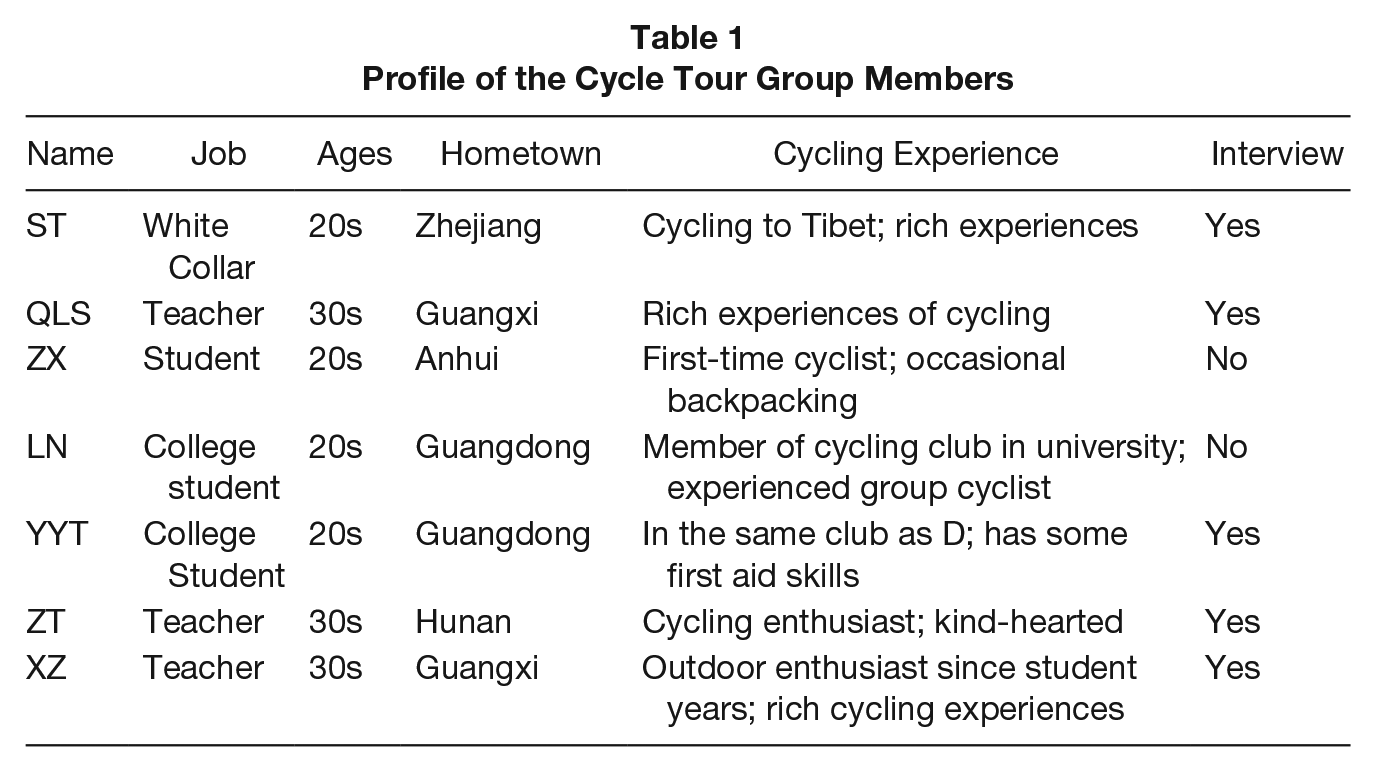
To implement the method of participant observation, one of the coauthors participated in a cycle tour around Hainan Island, which is a popular cycling tourism route in China. First, the author connected with an online community of a Youth Hostel in Hainan Island when searching for travel information on Hainan. When searching, he noticed a number of discussions about cycling around Hainan Island, discussions that evoked his interest as a keen cyclist. After several rounds of discussions about the actual itinerary in the online community, 10 members of the online community committed to cycling around Hainan Island for 6 days. Of these 10 members, 7 became an actual travel group and cycled around Hainan Island. Group members originated from different parts of the country (see Table 1). The author cycled with the whole group and made friends with them for a week. He then remained in contact with them once the cycle tour had finished. Throughout the entire tour, the coauthor, himself an active team member, observed the behaviors of all team members. An overt observational method (Atkinson et al., 2007) was used, with the field investigator present as an observer of the cycling group, allowing participants to acknowledge his presence as to be mindful about behaviors among group members. In particular, the investigator informed all the team members that he was a cycler and also an observer who was undertaking cycling tourist research. With the permission of all the members, the investigator cycled together with other cyclists and shared the same responsibilities as other members during the trip.
Profile of the Cycle Tour Group Members
Travel logs
The trip took place in January 2014. The investigator wrote travel logs every day at the end of the daily activities while he cycled with the group. The cycling logs recorded events over 7 days of cycling in Hainan Island, including arrival in Haikou, checking into the YHA, and completing the composition of the team. In particular, they included making friends with cyclists, observing their behavior and words, and recording the stories and relationships between them. The daily notes provided the majority of the research data with supplementary material consisting of direct experience, social behavior, informal chatting, photos, analytical thoughts, and personal perceptions of the coauthor.
In-depth interviews
In-depth interviews were conducted with members of the cycling group. Most interviews took an average of half an hour, while some took longer. Prior to each interview, the author informed the participants about his identity as a field investigator and sought permission for the interview from the participants. The author then asked them about their demographic information, cycling experiences, and the influences of their past travel experiences with companions. The interviews also addressed the process of searching for companions online, feelings about traveling together with e-friends, and plans for future travel with companions. In the interview process, the field investigator did not ask informants directly about their trust of others in the online community. Instead, he listened for evidence of trust in their discussions about the process of choosing e-friends and travel companions, and asked follow-up questions for more detail as needed. Interviews were semistructured and conducted informally during daily interactions.
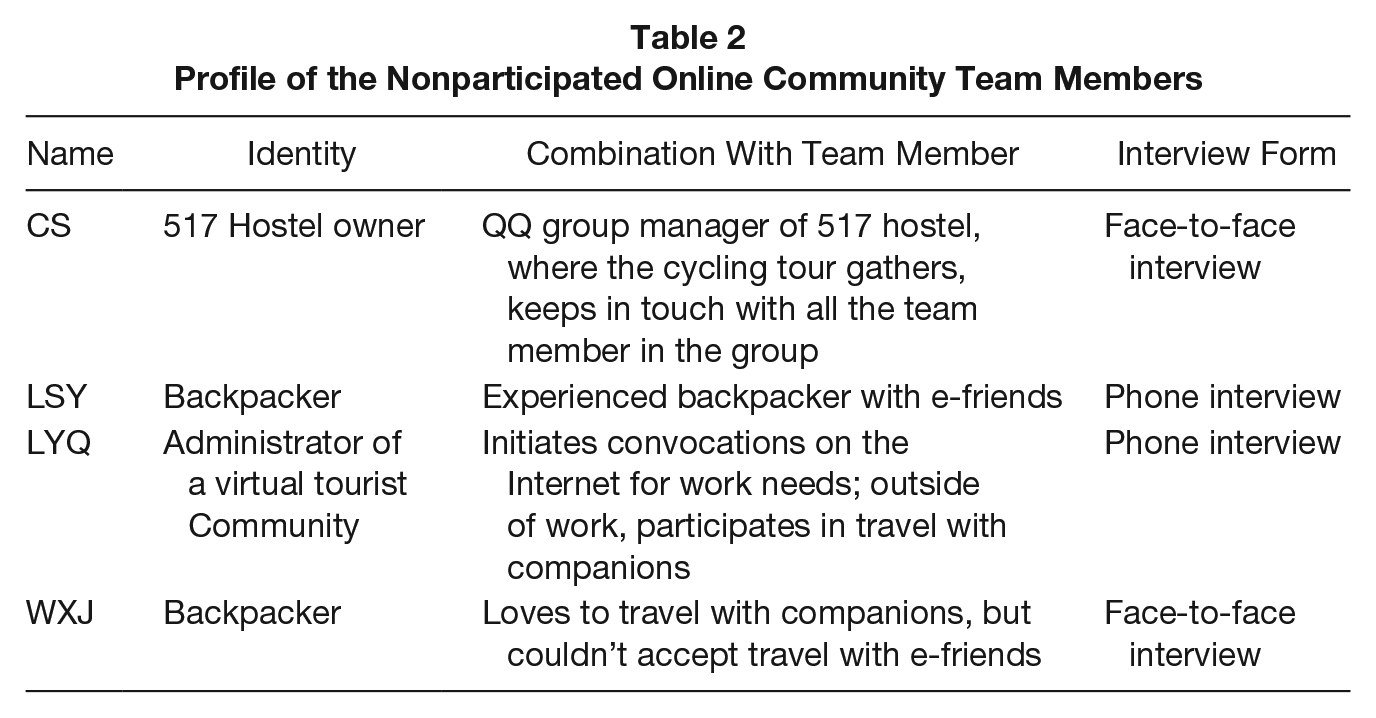
The investigator also conducted interviews with other key online community members who did not participate in the cycle tour but who had close connections with members of the cycle group. One interviewee was the 517 QQ group 1 manager who administered the QQ group that had become the platform for cyclists’ communication. The group manager was also the owner of the Hainan Cycling 517 hostel, where most of the cyclists had met at the start of their tour. The 517 QQ group had more than one thousand members, consisting mainly of hostel managers, volunteers, and cyclists who have ridden or want to ride around Hainan Island. Three additional interviews were conducted with active and experienced cyclists or backpackers from the QQ group (see Table 2) with whom the coauthor and his cycling companions consulted frequently online for cycle information and tour experiences. Interviews covered their demographic information, relevant experiences and feelings about travel with companions, and their attitudes and perceptions about cycling or travel with companions.
Profile of the Nonparticipated Online Community Team Members
All interviews were recorded and transcribed. The analysis comprised three stages. First, behaviors, conversations, relationships, roles, and experiences of the individual participants were analyzed and coded. A total of 121 pages of field notes and interview transcripts were produced. Concepts and phenomena in the text were identified, refined, and defined by the authors together. Second, events during the actual Hainan cycle tour were sorted and arranged into flow-chart form. These were then collated as evidence of the travel companion case study. Third, following studies by (Lofland & Lofland, 1984), the structure and formation of the group was preliminarily assessed, based on insights from the participant observations and knowledge of the flexibility of social context units such as relationships and groups. Drawing from the data and prior research, the authors discussed together for the right concepts and conceptual model of the trust building process, after several rounds of discussion and we all agreed to use the concepts of social circles, travel companions, and travel decision to describe the characteristics of the group at different stages of becoming travel companions. Other theoretical strands such as social exchange theory, social penetration, and social identification theory were also drawn up. We also examined how members of the group reached consensus and made decisions, to draw conclusions about the process from “social circle” to “travel companions.” Through classification and comparison, we triangulated the findings from observation sources with conclusions from the travel logs and in-depth interviews, to assess the validity and robustness of the concepts of “social circles” and “travel companions.” Finally, we translated all communications into English.
The coding process was completed in two stages by following Saldana’s (2009) coding approach. In the first-cycling stage, an initial line-by-line coding was employed in order to partition the data into discrete parts (e.g., sentences, phrases, and words) as well as to “attune [the researchers] to words and phrases that seem to call for bolding” (Saldana, 2009, p. 75). Next, in vivo codes were developed and were used to assess “behaviors or processes which will explain to the analyst how the basic problem of the actors is resolved or processed” (Strauss, 1987, p. 33). In the second-cycling stage, in vivo codes developed in the first stage were organized into higher order codes (secondary codes) through pattern coding, which “pull[s] together a lot of material into a more meaningful and parsimonious unit of analysis” (Saldana, 2009, p. 152).
The coding process involved four researchers. First, two researchers coded the data corpus independently. A third researcher who had no prior connection with the study conducted a follow-up coding analysis. The entire enquiry, including the ethnographic fieldwork and the coding process, was overseen by one of the coauthors of the study, who helped resolve differences among coders and to build consensus among them. This coding process was also guided by the literature with respect to trust and destination choice as aforementioned, for example, as the researchers considered a large repertoire of academic publications, historical narratives, and press journals in building the codes and defining meanings associated with them. To further ensure the validity of the results, initial findings were presented to a panel of three tourism experts to seek their feedback and consensus.
Findings
Online Community Social Circle and Ad Hoc Travel Group Building
Open with rules
In contrast to some other online communities, QQ was one of the most convenient and direct methods for travelers to seek and find companions in China. In this case, the manager of the Hainan cycling 517 hostel, located at the starting point of the Hainan cycling circuit, had established the “517 QQ Group” (hereafter, QQ group). The QQ group had its own identity, and anybody could apply to join it.
Clear rules existed for the QQ group. For example, every new entrant was required to construct their online username as “living city and province + name + expected cycling time” to help others more easily recognize their need. Members could check another member’s identity to explore their real identity information, but members rarely use their real names as their QQ IDs. That said, community members could learn more about others’ backgrounds by tracking their QQ identities to follow their QQ blogs. Other rules forbade the use of impolite words or sending commercial advertisements to the community. Silent membership (“lurking”) was also discouraged and members were removed for inactivity. Any person wishing to cycle around Hainan Island was eligible to join but group members had to accept these rules to be approved as a member of the QQ group.
Ten members from the QQ group found the time to cycle together with all 10 establishing a new, smaller QQ group; thus, an ad hoc travel group was created. Discussion in this new group focused on the specific date, time, and itinerary for the cycle trip, even while the small QQ group remained open for new members to join or members to leave.
Loose connection and weak link
The original QQ group was an open, unbounded group with membership varying from time to time. The group was so open that if members were unable to find travel companions for a suitable timeframe, they would most probably leave the group or be removed from the group for inactivity. Even within the smaller QQ group, the connections among the members remained loose and weak and it was easy for members to leave if they wished. The group formed initially with 10 people (including the investigator), but two members left owing to changes in the schedule. Our results focus on the seven remaining participants.
People usually selected a few small groups concurrently before beginning cycling and ultimately remained with the group that best fit their needs. Likewise, if a member lost his travel companion(s) in one group, he could easily turn to another online option because there was no expectation of loyalty to any group. Any member of a group had the right to change the schedule at any time, which meant that travel with some companions could be delayed or cancelled for any reason and have no penalty levied. This evidence demonstrates the dynamic process of contemporary ad hoc travel group formation and their choice of travel. The use of technology, such as smartphones, apps, and social media, helped individuals communicate in ways that bridged individual differences and preferences to form temporary social circles for travel.
Pattern of difference sequence
While connections among online community members were loose and weak, stronger ties existed between those who were physically acquainted. In the focal cycling QQ group, LN and YYT were friends from the same university. Their friendship was such that they usually made joint decisions before everyone else. As a result, both LN and YYT were very influential members of the group, leaving others feeling powerless to influence the group in any shape or form. This group structure is what (Hwang, 1987) termed the “Pattern of Difference Sequence” whereby a social circle becomes characterized by the strong ties between acquaintances and high consistency for collective action.
Transit to Travel Companions Offline
Based on the investigator’s travel log, the coauthor summarized the process of transition from an online community social circle to travel companions’ offline action in the form of four questions: Will they? Why do they? Where do they? With whom? Each step helped confirm social identity and to build trust while avoiding risk:
Dispositional trust building: Mode identification
Considering travel with an e-friend offline, one of the interviewees commented that Acquaintances typically share several characteristics, such as having the same preferences for food and accommodation. I suppose people who choose to seek companions online always have a strong personality. But I won’t try to stay with them deliberately if we don’t have a common goal. . . . Is it safe, is it easy to deal with them, is it hard to reach agreements? . . . All of these are challenges for me.
However, if one has successfully travelled with an e-friend before, one’s attitude may be different. For example, another informant commented that This is not my first time traveling with strangers. Once in Chengdu, I traveled with some strangers to Mount Emei and Leshan Giant Buddha. I met them in the hostel or on the journey. I felt great because they were all students or teachers and we got along with each other very well. The experience was wonderful.
Such experiences encouraged her to try joint travel again. The attitude toward new companions was the primary challenge for travelers because they needed to establish basic trust at the outset. If a traveler wanted to choose this travel mode, he or she needed to identify himself/herself as the type of person who could travel easily with strangers.
Institutional trust building: Activity identification
After deciding to travel with e-friends who mostly had never met face-to-face before, came the question: “what do I do to travel with them,” or more specifically, “how can I trust them knowing that the activity discussed online will actually be offline?” As one of the informants commented, “There are a lot of people offline, but it is not easy to make an appointment with them, especially when we want to set out from the same place and same time.” Social media provided a platform for strangers to share information and bridge their individual differences. It thus offered a communication channel to build trust and a means to mitigate the potential risk involved. In addition, a well-established media group, such as the 517 hostel, helped fortify people’s confidence through defining and enforcing rules and protocols that guided travel companions within the community (Fong et al., 2018). For example, one informant commented that “The guys who have the experience of Youth Hostel travel are usually well educated and reliable.” This type of trust is based on the perceived properties or reliance on the system or institution within which that trust exists, namely institutional trust. Correspondingly, this activity identification referred to the perception of the activity where perception is viewed as what consumers’ perceive they are expecting (Cohen et al., 2013; Lehto et al., 2004).
Interpersonal trust building: Companion identification
The last question for the offline travel companion was “with whom to travel?” Everyone selected their traveling companions using different criteria. The more they communicated, the clearer their requirements for a good companion fit. Online members developed trust in their potential traveling companions as they learned more about their cycling experience, identity, occupation, hobbies, and interests. Traveling companions require trust because they make decisions with a special kind of stranger who they have met only on the Internet but who they have never met in reality. Two interviewees explained their considerations when trying to find traveling companions online: Before meeting with each other, each member confirmed each other’s identity information from their conversation and their home page information, to establish basic trust. Tentative “pick up” or “being picked up” as a group member is widely accepted as part of getting to a basic level of trust.
To reduce risks, group members usually judged the promise of the potential companions on occupation, experience, and so on. For instance, the interviewees insisted: “It is easy to trust a teacher because teaching is a well-perceived career,” “I will try to search the companion’s webpage to know about his/her job and hobbies, to confirm that he or she is a true travel enthusiast.” When the investigator arrived at the hostel where they had agreed to meet on the first day, he found that one cyclist had temporarily changed his companion just because he found another seemingly more congenial cyclist. Thus, in this process, the composition of a group emerged from the selection of companions while identification depended on interpersonal trust (Abdul-Rahman & Hailes, 2000). Information disclosure and word-of-mouth of friends helped establish interpersonal trust.
Traveling Behavior With Companions Offline
After overcoming these three difficulties (mode identification, activity identification, and companion identification), the mix and goals of offline companions differed from those of online companions.
Clear role and strict regulation
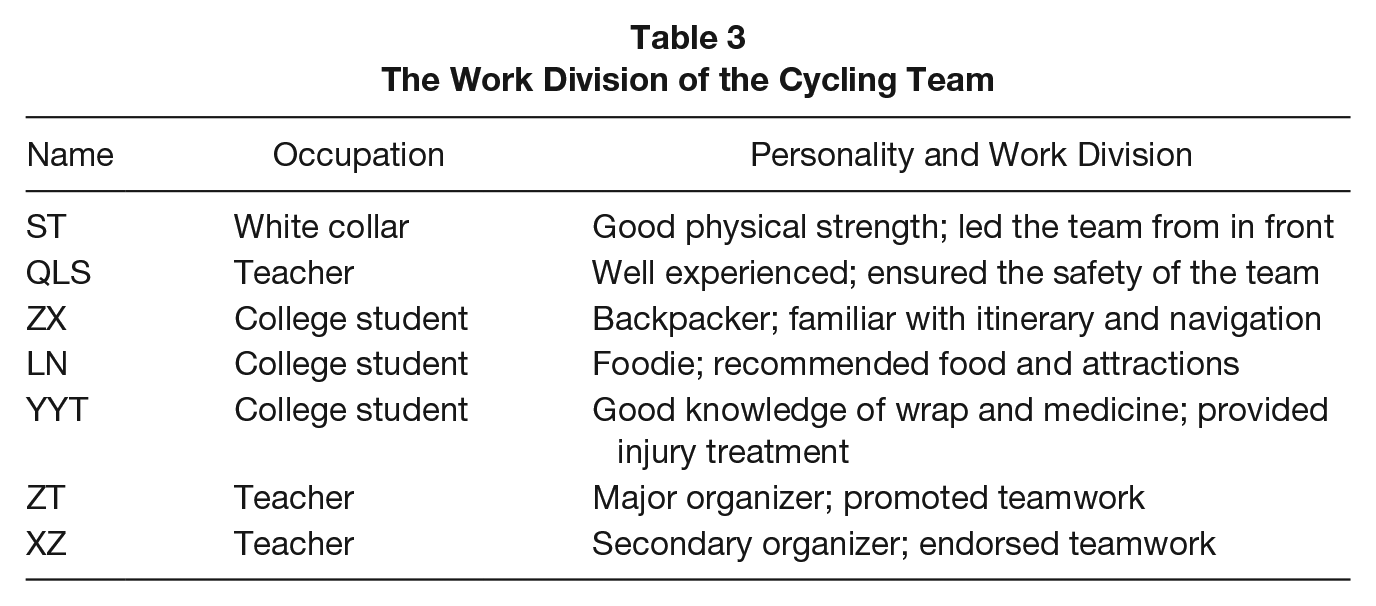
When the offline group was finally ready to start, the goal of offline companions became clear as the role of every member became clear and stable. At noon on the first day of travel, the cycling group had their first lunch together. Each person introduced himself or herself to break the ice before everyone jointly negotiated the cycling plan. The group even discussed how to keep in touch after the trip finished. Everyone accepted the composition of the team in this brief communication and the team reached a consensus of “never cast aside and never give up.” There were no leaders although there existed a clear division of work and regulations with regard to joining. Responsibilities were allocated based on the specialties of group members (see Table 3). For instance, QLS and ST were experienced travelers and they became responsible for any technical problems. ZT was acquainted with everyone earlier than the others, so he was allocated the role of communication lead. When compared with the open online community there was a clear boundary for the offline “action set,” where joining and retreating from the group was restricted. The team remained at seven members throughout the trip. These regulations kept the action set working in an efficient and stable way. During 5 days of cycling, the group met several other cycling teams. Each team had its own itinerary and arrangements, so it was difficult to change teams and no one sought to do so. ZT had earlier been in contact with a team from Beijing, but after becoming a member of the focal team, she turned down their invitation because of having developed a deeper emotional connection with the current team as well as a commitment to the itinerary. We thus see that the composition of offline groups is more stable than online groups, and the goals of offline companions are activity-focused rather than interest-focused as for online e-friends.
The Work Division of the Cycling Team
Multicore member without hierarchy
Compared with the online community circle structure, the pattern of the group was reconstructed. Once the group started its journey, the common goal was to arrive at a predefined destination. At the beginning, the weak relationships among the travel companions caused problems. For example, QLS complained as follows: We didn’t play well in Boao, which was unfortunate. We waited for you at the front, but you went the wrong way. The team was not well organized. We should pay more attention to communication next time.
However, the more widespread the communication among the team members, the more familiar they became with one another. When the team members knew each other better, they consciously created a division of work for the greater good. Compared with the online community, the pattern of difference sequence in the group changed. First, as physical acquaintances, X retreated from the team because of sickness, but LN and YYT chose to stay with the team. While during the journey LN and YYT were very close with each other they also became good friends with the other team members. Interestingly, prior physical acquaintances did not affect the group as much as with online communities. At the same time, there were core members who were responsible for different jobs and were close with every member. That is, the action set was characterized by a clear boundary and a clear core, in which the pattern of difference sequence of the acquaintance circle of LN and YYT was rebuilt.
Technology-Mediated Ad Hoc Travel Group Decision
The above results highlighted several key facets of travel decisions and behaviors among this new ad hoc travel group phenomenon. In fact, the phenomenon describes above showcases the dynamic process of contemporary ad hoc travel group formation and their choice of travel. The process was facilitated by technology such as smartphones and social media. This technology-mediated ad hoc travel group decision-making process blurred the boundaries and constraints in forming travel groups; thus, it fostered faster and more rapid travel decision making. We integrate these observations with the extant literature to develop the model illustrated in Figure 1.
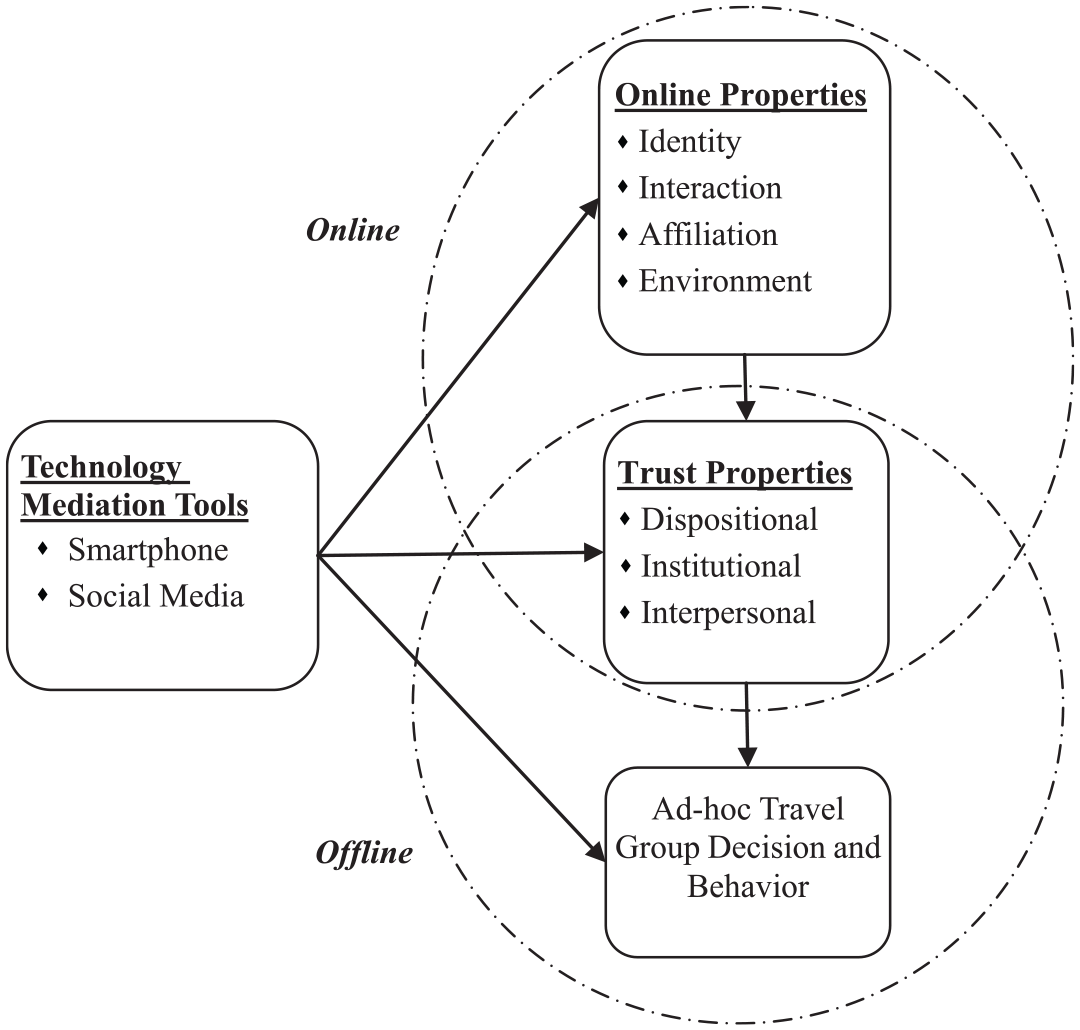
Technology-Mediated Ad-Hoc Travel Group Decision Model
The social actor model articulated by Lamb and Kling (2003) proposes that use of technology represents actors’ decisions and behaviors in utilizing technologies to present their identities, foster interactions with others, exchange information within a confined affiliated social network, and shape their social environment. With respect to the current study, our data showed that dispositional, institutional, and interpersonal trust among group members was enhanced by the use of technology. The social media, for example, provided a critical means for members to share and acquire other social actors’ identify and affiliation. Actor-to-actor interactions were also facilitated through such a medium. The social media created the necessary environment that enabled online communities (e.g., the 517 hostel) to set communication protocols that guided member ethics and behaviors.
Second, these four technology induced actor aspects helped reinforce the three types of trust (dispositional, institutional, and interpersonal), which further assisted the formation of the ad hoc travel group and worked in tandem with the group’s decisions. Unlike the traditional, more linear and reflective decision-making process documented in prior research (Moore et al., 2012), members of the ad hoc travel group made decisions on the fly while in-destination decisions were rather spontaneous. For example, an informant noted that “even if we arrive at the agreed place, there is still concern about whether we will still agree on the activities in the itinerary.” Because destination choices were often not well confirmed a priori, and the travel itinerary could be altered at any time, the role of technology to gauge travel decisions became more intense, as an informant explained as follows: The behavior of traveling with online friends is suitable for small destinations like towns. If one were in a big city with attractions scattered in several locations far from each other, I think the mode would not be suitable because there could be more coordination problems. It is easier if the attractions are geographically concentrated.
The above discussion suggests that use of technology fosters a more spontaneous mode of travel decisions. Technology, however, works as a double-edged sword in that the formation and behaviors of such a group are unstable and unpredictable as group members can come and go without signs of loyalty, especially early on in the group’s establishment. For example, an informant complained that My e-friends kept their promises and arrived at the appointed place, but we found that there were some different preferences that could not be coordinated. So we had to give up the idea of traveling together.
Discussion
In response to the growing popularity of seeking travel companions in online communities, this article sought to elicit how trust in an online community transitions into offline travel companionship. Our findings from a qualitative study of cycle tourists in Hainan Island, China, led to the “triple-jump” model of online community transformation to offline companions, represented in Figure 2.
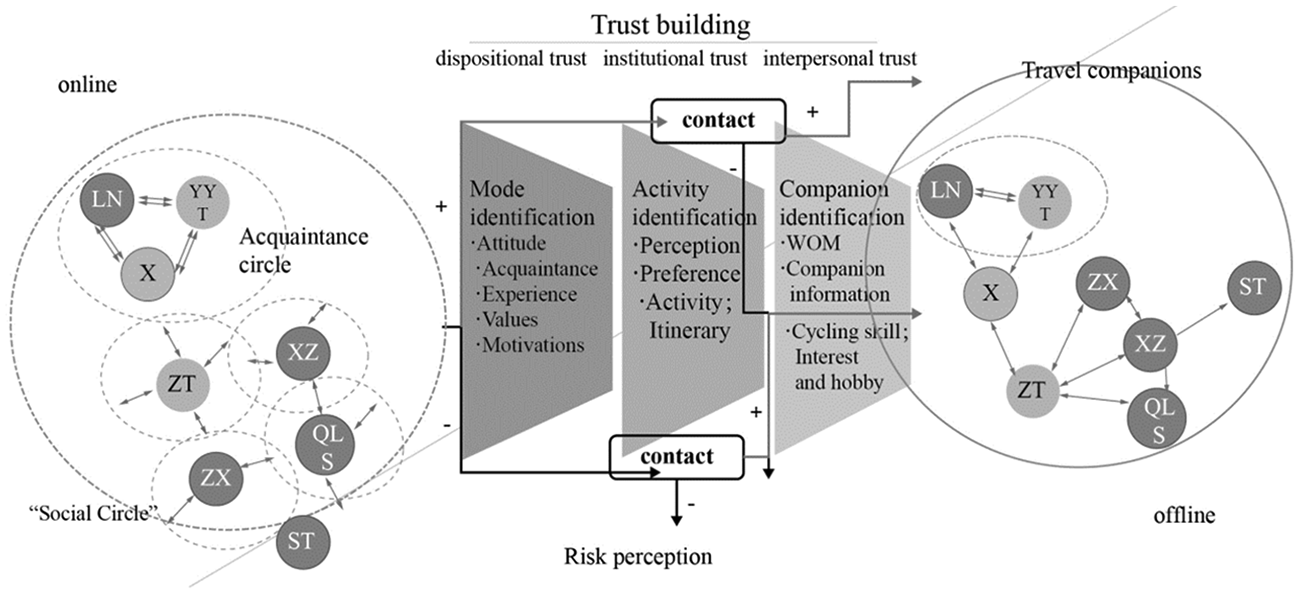
Triple Jump Trust Building Model
The First Jump: Social Circle Building
When seeking travel companions in online communities, the first and the most important thing is to find like-minded people and form a collection of an online group with fuzzy and nonbinding boundaries. With basic communication rules, members of the group identify themselves as possible members of the community that will travel together. Referred to by (Y. Wang et al., 2002) as a social circle in an online community, this social circle normally displays high levels of belonging, despite having fuzzy and nonbinding boundaries (Y. Wang et al., 2002).
The Second Jump: Establishing Trust for Transformation
The second phase is the most important step, although it does consist of three types of trust establishment and identification—namely, model identification through dispositional trust building, activity identification through institutional trust building, and companion identification through interpersonal trust building (see the section above, for details on the trust-building process in relationship to the identification process). At first, a person has to identify the possible companions’ attitudes, values, knowledge, and experiences. This mode of identification is designed to build dispositional trust, or the basic trusting attitude of the trustor. Second, a person has to identify the specific activities and itinerary in the travel, and has to identify the potential companions’ preferences, activities, or the patterns of cycling behavior. This process of activity identification is to build system trust, which refers to trust that is based on the perceived properties or reliance on the system or institution within which that trust exists (Abdul-Rahman & Hailes, 2000). Third, a person has to know more about their companions, including their cycling experiences, identities, occupations, hobbies, and other information that could affect the choice of companions, as does WOM. These factors have greater and more direct effects on the establishment of trust and risk perception between companions, especially interpersonal trust.
The Third Jump: Put Into Action
When an online “social circle” turns into actual travel companions, three aspects change. First, the goal of offline companions becomes clearer and the composition is changed. Second, the regulation of the group is changed to a stable community. As the community core is established, the costs of joining and retreating rise and the boundary of the community becomes more defined. Third, the relationships between members is strengthened and the pattern of difference sequence in acquaintance is reconstructed. Relationships may be weak at first, but the relationships between group members becomes closer even though the lifespan of the offline group is relatively short.
Research shows individual reputation, online communication, and perceived similarity among travelers, play significant roles in online relationships as they transition to offline behavior with trust and sympathy among community members mediating this decision process (Kunz & Seshadri, 2015). However, this research shows that trust itself is a dynamic process, with the process of identification strengthening the buildup of trust and ultimately real-world action. Online communities seeking travel companions are evidently open and loose with patterns of sequence difference in online social circles. In contrast, offline travel companion groups are close and regulated groups without hierarchy. Offline travel companion groups engage in mode identification, activities identification and companion identification, which contribute to dispositional trust, institutional trust and interpersonal trust and transform their trust from online community to offline travel companions; namely the “triple jump.”
The proposed triple jump trust building model for transitioning social circles in online communities to offline travel companions in this research contributes to online social interaction and trust building research, and sheds light on the dynamic process of transitioning from potential online markets to offline real markets. The study also pays attention to the cultural background of the Chinese online “social circle” (Guanxi) as it demonstrates that the online social circle influences the offline travel companions’ behavior. This insight, in turn, could also enlighten the industry vis-à-vis how to attract tourists via online community or related tools, especially for those tourists like cyclists.
From a broader theoretical stands, this research highlights how relationship development through an online–offline travel companion building process. First, the triple jump trust building mechanism is nascent in that it renders an evolution of how tourists gradually develop confidence with others in a travel team-building process. Trust sets the foundation of future actions that people take on their travel behaviors. To this end, this study enriches the literature on trust building (Buntain & Golbeck, 2015; Mayer et al., 1995; Morgan & Hunt, 1994) that is latent in the tourism context rather than in a conventional branding and organizational research domain.
In light with the above discussion, this study also contributes to the literature by delineating a social phenomenon in which tourists’ gradually build relational bonds with stranger others to form online travel community and physical travel groups. It encompasses a concept of onion-like relationship building mechanism that goes beyond the theoretical understanding drawn from the social exchange theory (Cropanzano et al., 2017) and social identification theory (Ashforth & Mael, 1989). Rather, as members of the group delve further into building intimate relationship and strongly identify themselves as members of the travel group, they created a strong social bond that is build on trust and reciprocal support; such a mechanism further allow them to share ideas and exchange information without leader–member hierarchy and reservation. Such a phenomenon seems resonate closely with the social penetration theory (Altman & Taylor, 1973; Baack et al., 2000) in which members develop greater respect and intimacy through self-discourse and working together in a longitudinal manner. Such findings could help tourism scholars gain a better understanding of the complexity of relationship penetration through online–offline interactions as Figure 1 illustrates.
Another contribution of the study stems from how trust building facilitates ad hoc travel decision making. Trust building not only facilitates development of travel companions, but it also fosters ad hoc travel group decision making through the use of smartphones and social media. To date, the literature only reported cursory attention to technology-mediated decision making in respect to individual travel decisions (D. Wang et al., 2016) or in a family context where children were empowered to make travel decisions through the use of smartphones (Yu et al., 2017). The ad hoc travel group phenomenon presented in this study sheds new light on the complexity and dynamics of technology-mediated group behaviors. It deviates from the conventional means of building travel groups, and also departs from existing understanding in making destination choices (Um & Crompton, 1990) and travel decisions (Moore et al., 2012).We believe that it will fuel a growing interest among tourism scholars to further investigate how technology might influence ad hoc travel group decisions and behaviors in other social contexts.
From a practical point of view, this study addresses several unanswered questions that are of interest by tourism operators. First, it helps answer the question of why tourists would spend countless of efforts and time to develop online relationship with strangers. Operators could utilize the findings to develop online platforms that proactively build cyber communities that encourage potential tourists to build friendship and exchange information relating to specific destinations of interest. Operators could also build knowledge repository and encourage destination ambassadors (Edwards et al., 2017) to further aid ad hoc travel groups to gain trust and better plan their excursions.
Limitations and Future Research Directions
Potential limitations and drawbacks to the study may be associated with the participant observation case study approach. Cyclists, for example, may differ from other types of tourists in companion seeking, because cycling is more group-driven and so companions’ experiences and safety issues become important factors to consider. Insight from experience and other fields suggests that, after converting a social circle from online to offline and converting travel companions from offline to online, relationships strengthen gradually over time. Travel companions come from the online social circles and then turn back once again to the online social circles. Future work may focus on the question of what will then happen to the relationship in the online community when the process is repeated? With the application of smart phones and the “mobile” Internet there is also the question, and dynamics, of the mobile Internet breaking through two major constraints, namely time and place. The boundary between online and offline is already fragmented, so what might be the outcome when tourists can travel with companions “online” and “offline” at the same time?
Concluding Summary
For years, the literature has built a solid foundation on travel decision making based on individuals rather than on groups. The prevalence of smart phone and social media usage during trip has espoused a new phenomenon in which individual travelers clustered together to form travel groups on fly and make ad hoc decisions. Based on a qualitative research inquiry with a group of cyclists, this research not only showcases how this travel phenomenon unfolds, but it also illustrates the framework of technology-mediated ad hoc travel group decision-making process. More important, results point to an evolution from online group building to actual travel behaviors in three stages (i.e., the triple jump model: building social circle, establishing trust for transformation, and putting into action). This evolution has not only fostered a better understanding of how online community transits into offline travel actions, but it also demonstrates how dispositional, institutional, and interpersonal trusts help bridge individual actors to form ad hoc travel groups.
Footnotes
Authors’ Note:
The authors would like to express their gratitude for the National Science Foundation of China for supporting the research (project serial number: 41471122).
