




Abstract
Resource heterogeneity is a key aspect of one of the most important theories of strategic management: the resource-based view of the firm. This theory suggests that the performance effects of a firm’s strategy depend on the firm’s individual resources and capabilities and the setting within which it is operating. In this article, we argue that the current methods for measuring hotel performance and its determinants may be inconsistent with this theory. To measure efficiency, hotels should be viewed as heterogeneous firms, and the relationships between determinants and performance must be assessed for each individual hotel rather than as an average across hotels. Accordingly, we use a random-effect Bayesian stochastic frontier model to estimate the profit frontier and the effect function of the inefficiency for each hotel. The results indicate that hotels tend to choose strategies based on the heterogeneous resources that maximize their performance in their individual statuses.
Introduction
Due to the tourist industry’s growing importance to the economic development of many countries, there is abundant literature on efficiency measurement and its determinants, especially regarding the hotel industry (Aissa & Goaied, 2016; Arbelo et al., 2017; Arbelo et al., 2018; Assaf & Barros, 2013; Assaf et al., 2010; Bernini & Guizzardi, 2010; De Jorge & Suárez, 2014; Oliveira et al., 2013; Wang et al., 2006, among others). From a strategic perspective, evaluating the efficiency of hotels is important because it enables comparisons of performance between competing hotels, control over organizational results, and comparisons of the profits obtained using different inputs (C. F. Chen, 2007). Likewise, rapidly increasing competition in the global hotel industry is eroding hotel profitability; this implies a need to improve efficiency (Assaf & Cvelbar, 2011; Shang et al., 2010). Improving efficiency is also crucial for international expansion and diversification (Assaf & Magnini, 2012). As such, a study of efficiency and how to measure it has been configured as a central element for business management.
Most studies on efficiency in the hotel industry begin with the hypothesis that all hotels are homogeneous and therefore operate under the same possibility frontier, differing only in their degree of inefficiency. This perspective is based on the idea that environmental conditions explain the performance of a firm (Caves & Porter, 1977; Porter, 1980, 1985). This environmental approach implicitly assumes that all firms in an industry are homogeneous in terms of their strategically relevant resources (Porter, 1981).
However, strategic management was developed to explain and predict phenomena at the individual firm level and assumes that all firms in an industry are heterogeneous (McWilliams & Smart, 1993). Thus, resource heterogeneity is key to one of the most important strategic management theories: the resource-based view (RBV) of the firm (J. Barney, 1991). This theory suggests that the performance effects of a firm’s strategy depend on the firm’s individual resources and capabilities and the setting within which it is operating. Consequently, previous studies on efficiency that view hotels as homogeneous firms are inconsistent with the central assumption of many strategic management theories, which state that firms maximize their performance by choosing strategies that exploit their heterogeneous resources and their individual conditions (Mackey et al., 2017).
Although copious empirical research on efficiency in the hotel industry exists, there is a certain incongruence between the theoretical literature and the empirical research on this subject. For some strategic management theories like the RBV, efficiency and its determinants must be estimated for individual firms. However, most empirical studies usually measure the efficiency of a firm in relation to an average industry frontier and study the average impact of the efficiency determinants. This is a serious drawback since it can lead to inaccurate measures of efficiency and the impacts of efficiency determinants. That a hotel is inefficient in relation to an average industry frontier does not necessarily mean that it cannot be efficient in relation to its individual frontier. Likewise, the fact that a determinant, on average, has a significant and positive (or negative) effect does not necessarily mean that it has a significant and positive (or negative) impact on the performance of a specific hotel. The proximity of a hotel to its frontier and the determinants of its efficiency will both depend on the resource heterogeneity of the hotel and the context in which it operates.
Several studies address heterogeneity among hotels by introducing endogenous and exogenous variables into the efficiency analysis (e.g., Assaf et al., 2010; Assaf, Josiassen, et al., 2017; Bernini & Guizzardi, 2015; Z. Yang et al., 2017). However, these studies also measure efficiency by comparing the position of each hotel with a common possibility frontier and/or estimating the average impact of the determinants of the inefficiency, but they do not adequately consider heterogeneity. There is little to no literature that examines efficiency by first considering hotels as heterogeneous firms and then studying the impacts of the determinants of performance on individual hotels. Therefore, unlike the studies that have been conducted to date, the purpose of this article is to measure the profit efficiency of each hotel based on the distance to its own possibility frontier and to estimate the impacts of the determinants of the inefficiency for each hotel individually rather than the industry average. To this end, we apply a stochastic frontier model with random coefficients to a sample of 461 hotels and individually estimate the profit frontier and effect function of inefficiency for each hotel. This approach is more suitable than estimating the relationship between hotel efficiency and its determinants for a “hypothetical” average hotel.
This research study makes two important contributions to the literature: (1) it provides empirical evidence for the measurement of profit efficiency assuming hotel heterogeneity, and (2) it is the first study to examine the impacts of different performance determinants on individual hotels. This article is organized as follows. The following section briefly discusses the theoretical background. The third section describes the methodology. The fourth section presents the empirical model, the data, and the variable selection. The fifth section summarizes the empirical results and the last section provides the study’s limitations and conclusions.
Theoretical Background
Understanding why some firms in an industry are more competitive than others (and thus achieve above-average performance) is a key issue for academics and business managers alike. Answering this question involves determining the sources of competitive advantage, identifying the underlying elements of these advantages, and specifying how they can be sustained over time. Two perspectives dominate the literature on strategic management regarding the sources of competitive advantages: environmental models, which focus on an industry’s structure (Porter, 1980, 1985); and the RBV, which focuses on a firm’s attributes and characteristics (J. Barney, 1991).
The environmental models are based on the theory of industrial organization, which focuses on the study of market structures and their effects on performance. The essence of the model is that a set of industry characteristics such as the degree of (industry) concentration, diversification, barriers to entry, and economies of scale all influence a firm’s strategy and consequently its performance. In this context, a firm’s performance depends on how it adapts to the industry’s structure, and its sustainability depends on the relative impacts of the competitive forces that the firm must withstand (McGahan & Porter, 1997).
The environmental models are implicitly based on two assumptions. First, they assume that all firms in an industry are homogeneous regarding their strategically relevant resources (Porter, 1981; Rumelt, 1984). Second, they assume that there is perfect mobility of these resources between firms (J. B. Barney, 1986). Although these two assumptions are important for understanding the performance impact of the industry effect, McWilliams and Smart (1993) contend that applying the theory of industrial organization’s principles to strategic management may be inappropriate because (1) it is the wrong level of analysis, (2) it employs static analysis, and (3) it identifies entry barriers as determinants of performance.
Conversely, the RBV views a firm as a set of exclusive resources. Rather than analyzing the relationship between the environment and performance, it focuses on the impact of a firm’s characteristics and attributes on its performance. Unlike the traditional theory of industrial organization, the RBV focuses on the internal analysis of the differences in firm resources and explains how these differences can be a source of sustained competitive advantage (J. Barney, 1991; Peteraf, 1993; Wernerfelt, 1984). From an analytical perspective, the RBV approach believes that a firm’s competitive position depends on the specialization and differentiation of its resources, assets, and capabilities and focuses on the efficient use of these to create a sustained competitive advantage.
According to this approach, the only strategically relevant resources are those that enable a firm to formulate and implement strategies that improve its efficiency and effectiveness (Wernerfelt, 1984). Additionally, for a resource to be strategically relevant, it must be valuable, rare, inimitable, and nonsubstitutable (J. Barney, 1991). Therefore, this theory highlights the importance of a firm’s resources and capabilities in performing above the industry average. This is based on two assumptions that diverge from the environmental models: (1) firms within an industry may be heterogeneous regarding their resources and capabilities and (2) these resources may not be perfectly mobile across firms, and so the heterogeneity can be sustained over time (J. Barney, 1991).
Although the environmental models and the RBV have both made important contributions to the field of strategic management (Amit & Schoemaker, 1993; Conner, 1991; Foss, 1996), they disagree on the sources of competitive advantages. The RBV emphasizes the firm effect to explain above-normal performance. For the environment models, a firm’s performance is fundamentally a function of the industry effect. Therefore, we cannot assert that the debate has been settled regarding the relative performance impact of the industry effect versus the firm effect (Spanos & Lioukas, 2001).
The assumption of resource homogeneity in the environmental models has important implications for empirical research since it assumes that all firms in an industry share the same possibility frontier. However, this assumption is very constraining and often unrealistic (Huang, 2004; Tsionas, 2002), which results in biased estimates of efficiency. For example, when estimating the efficiency of an industry, assuming that all firms operate under the same possibility frontier even when these firms have different resources does not allow for the identification of a firm’s specific inefficiency (managerial efficiency) from among the heterogeneous resources. It could therefore be concluded that a firm without the same resources is more inefficient than another simply because of these different resources and not because of poor management, or vice versa.
There are many studies in the literature that measure hotel efficiency relative to a common frontier and/or examine the average impacts of different determinants (e.g., age, size, location) on performance (Aissa & Goaied, 2016; Arbelo et al., 2018; Z. Yang & Cai, 2016, among others). Although most hotel industry efficiency studies are based on the hypothesis of homogeneity, some studies, such as those by Assaf et al. (2010) and Bernini and Guizzardi (2015), use the meta-frontier concept (O’Donnell et al., 2008) to address the possible differences between various groups of hotels. Walheer et al. (2019) extend the concept of meta-frontier to study the performance of the hotel industry in China, while considering both the number of stars and the multiservice nature of hotels. Other authors, such as Z. Yang et al. (2017), Assaf, Oh, and Tsionas (2017), Walheer and Zhang (2018) and Dong et al. (2020), introduce endogenous and exogenous variables into the analysis of hotel efficiency to study the problem of heterogeneity. In practice, these studies measure efficiency by comparing the position of each hotel with a common frontier. However, given that the resource heterogeneity across hotels implies adopting the hypothesis that hotels operate under different production frontiers, it is suggested that the impact of the determinants of efficiency on performance depends on the resources that are owned by each individual hotel and the context in which it operates.
Assuming this hypothesis, considering that companies in the same industry may have different possibility frontiers seems realistic. Therefore, traditional fixed-coefficient stochastic frontier methods are not appropriate for estimating efficiency and its determinants, since they could lead to inaccurate results (Assaf, 2009, 2011; Huang, 2004; Tsionas, 2002). This article estimates profit efficiency (as a hotel industry performance measure) and its determinants, assuming resource heterogeneity across hotels. This approach is more congruent with the strategic management theories that argue that firms maximize their performance by choosing strategies that exploit their heterogeneous resources and their individual circumstances.
Methodology
The main methods used in the body of literature for estimating efficiency are data envelopment analysis (DEA), first introduced by Charnes et al. (1978), and the stochastic frontier approach (SFA), introduced simultaneously by Aigner et al. (1977) and Meeusen and van den Broeck (1977). These two techniques differ mainly in how they treat the error term. Whereas the DEA ignores the existence of random errors, the SFA allows for the isolation of a firm’s inefficiency from potential fluctuations that are not under its control. In this manner, any deviation from the optimal frontier is due to inefficiency and random errors, which is why measurement errors and/or random fluctuations are not included in the inefficiency term (Aigner et al., 1977; Coelli et al., 2005; Meeusen & van den Broeck, 1977). In contrast, in the DEA, since random errors are not considered, any error and statistical noise will be reflected in the efficiency score. In addition, the deterministic nature of the DEA makes it very sensitive to outliers.
Another difference between the two methodologies is that the SFA requires a priori specifications of the model and of the inefficiency term, while the DEA does not require the functional form of the frontier to be specified, and the efficiency scores are obtained from solving linear programming problems (C. M. Chen et al., 2015). However, due to the inclusion of the error term in the SFA estimation, the possible errors that are associated with selecting an inappropriate frontier functional form are represented in the error term. Finally, the DEA estimates relative and not absolute efficiencies. The frontier in the DEA is defined by the best-practice firm, comparing each firm with this frontier but not with a theoretical maximum (Z. Yang et al., 2017). In contrast, in the SFA, inefficiency is measured in relation to a theoretical optimal frontier, thereby simplifying the inclusion of heterogeneity into the model. Based on the above, this research uses the SFA to measure hotel efficiency.
The SFA methodology has traditionally been estimated using maximum likelihood techniques. However, due to the complexity of the log-likelihood function, this classic method of estimation requires some very complex procedures (Huang, 2004). Additionally, probability statements about unknown parameters, hypotheses, or models cannot be made, nor can prior knowledge be incorporated into the estimation process (Coelli et al., 2005). Instead, the Bayesian estimation technique is becoming more prevalent due to its greater flexibility and benefits compared to the maximum likelihood method. The Bayesian approach easily incorporates nonsample information in the analysis and presents results in terms of probability density functions (PDFs); it also allows the estimation of more complex and robust models (Assaf, Oh, & Tsionas, 2017). In addition, the Bayesian estimation method is unbiased in relation to sample size (Z. Chen et al., 2016).
Estimating the stochastic frontier using the Bayesian approach was proposed by Koop et al. (1997), and it is called the Bayesian fixed-frontier model. Both the Bayesian fixed-frontier model and classic SFA estimation assume that all firms are homogeneous and therefore have the same possibility frontier. However, this assumption is not realistic in practice. To relax this restrictive assumption, we use a model with random coefficients (Tsionas, 2002) that allows efficiency estimation assuming heterogeneity among firms. This model can be expressed as follows:

where
In addition, to study the heterogeneity of the inefficiency determinants, the specification proposed by Tsionas (2002) extends to the inefficiency function by including random coefficients in the inefficiency covariates. In this way, the random specification of the inefficiency determinant coefficients captures the effects of different specific characteristics on each firm, enabling one to study the relationships between different determinants and profit efficiency for individual firms.
In the Bayesian approach,

where the inefficiency
The

where

where
Regarding the inefficiency component, we assumed that it follows an exponential distribution such that
The posterior distributions of each parameter are estimated using the WinBUGS software package. For this estimation, the Markov chain Monte Carlo approach and the Gibbs algorithm (Koop et al., 1995) are used. A total of 50,000 interactions are generated, and the first 10,000 are discarded in a burn-in phase.
Data, Variables, and Model
Data and Selection of Variables
The sample used in this study includes Spanish hotels with accounting data available in the Iberian Balance Sheet Analysis System (SABI) for the 2012-2017 period. Spain is a destination of great importance in the global tourism sector. It ranks second in both the number of international tourists and in tourism revenues, with almost 82 million visitors and more than 68 billion dollars generated annually (UN World Tourism Organization, 2018). A total of 461 hotels in category 551 of the National Classification of Economic Activities (CNAE-2009) were analyzed. The data were extracted from the balance sheets and income statements of these firms for each year analyzed, which represents a total of 2,766 observations.
Financial results and data regarding the prices of their inputs and outputs were needed to analyze the profit efficiency of the hotels, as described below:
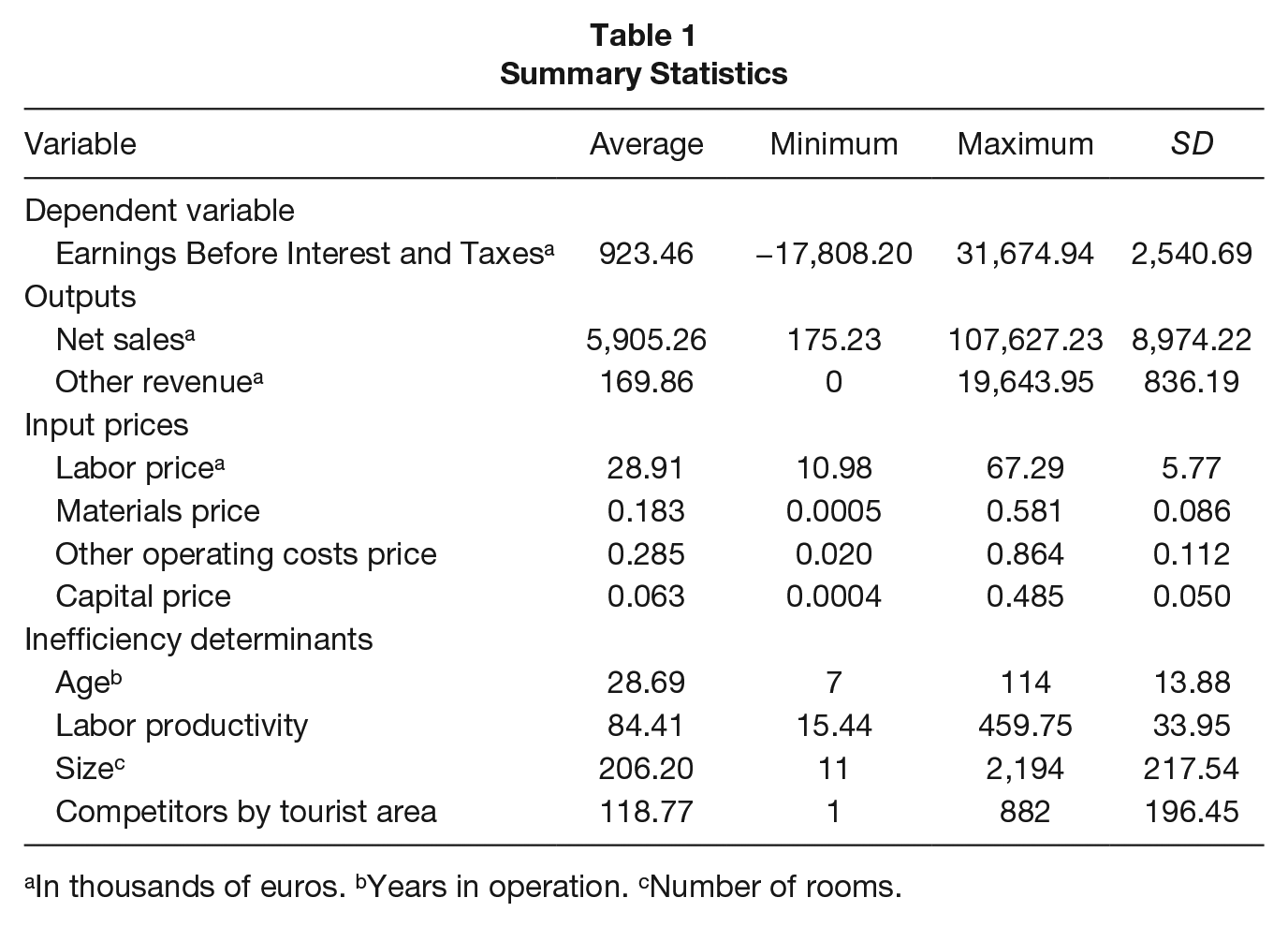
The dependent variable (π) is Earnings Before Interest and Taxes.
Outputs: (1) net sales (x1), which includes the hotel services revenue from their primary activity, and (2) other revenue (x2), which includes revenue from other activities (e.g., laundry service, hairdressing, casinos, etc.).
Inputs: number of workers, materials, physical capital, and other operating costs. The price of the inputs is approximated by the following: Price of labor (x3), which is calculated as the ratio between total labor costs and the number of annual full-time equivalent employees (Arbelo et al., 2018; Assaf & Cvelbar, 2011; C. F. Chen, 2007; Hu et al., 2010; Pérez-Rodríguez & Acosta-González, 2007). Price of materials (x4), which is defined as the ratio between the total cost of materials and total operating revenues (Arbelo et al., 2018; Assaf & Cvelbar, 2011; C. F. Chen, 2007). Price of other operating costs (x5), which is the result of dividing other operating costs (e.g., leases and external supplies) and total operating revenues (Hu et al., 2010). Price of capital (x6), which is defined as the relationship between total amortization and total fixed assets (Arbelo et al., 2018; Pérez-Rodríguez & Acosta-González, 2007).
The input and output variables that were selected for calculating the profit frontier were determined based on data availability and existing hotel efficiency studies in the literature. The following hotel profit efficiency determinants are also included:
Firm age. The age (Z1) variable is measured as the number of years that the hotel has been operating in the marketplace and is intended to capture the hotel’s cumulative knowledge. Numerous studies indicate that a positive relationship exists between age and business efficiency (Biggs, 2002; Charoenrat & Harvie, 2014; C. H. Yang & Chen, 2009). More established firms are characterized by having more experience and accumulated knowledge in the development of their production and commercial processes, making them more efficient.
Labor productivity. The labor productivity (Z2) factor is obtained by dividing net sales by the number of employees. The relationship between labor productivity and efficiency is relatively direct (Datta et al., 2005). The skills and knowledge of employers facilitate the introduction and use of new technologies, stimulate innovation, and increase the efficiency of resource use (Bernini & Guizzardi, 2010; Pérez-Rodríguez & Acosta-González, 2007).
Firm size. To examine the impact of the size (Z3) variable on hotel profit efficiency, the number of rooms is used as a measure of hotel size. In general, the economic literature considers that larger firms are more efficient than smaller firms, mainly due to the advantages that are associated with scale (Arbelo et al., 2018; Barros & Mascarenhas, 2005; Such & Mendieta, 2013).
Number of competitors. Last, variable Z4 measures the number of hotel competitors for each tourist area. One of the main advantages of competitiveness is that it stimulates efficiency (Ros, 1999). Greater competitive pressure tends to lead to a better allocation of available resources in firms and, therefore, to improved efficiency and innovation (Nickell, 1996).
Table 1 presents the summary statistics of the main variables described above. All monetary values were deflated according to the consumer price index for 2016.
Summary Statistics
In thousands of euros. bYears in operation. cNumber of rooms.
Empirical Model
To assess hotel profit efficiency based on the hypothesis of hotel heterogeneity, we use the profit function specified in Equation (1). The two most commonly used functional forms in the literature are the Cobb–Douglas and Translog. To determine which functional form is the most suitable, we will use the deviance information criterion (DIC). This criterion establishes that the model with the lowest DIC is the most suitable. The DICs that are obtained are DICCobb–Douglas = −7806.1 and DICTranslog = −8321.67. Therefore, the Translog is the selected functional form, which results in the following specification of the model to be estimated (under conditions of homogeneity and symmetry):
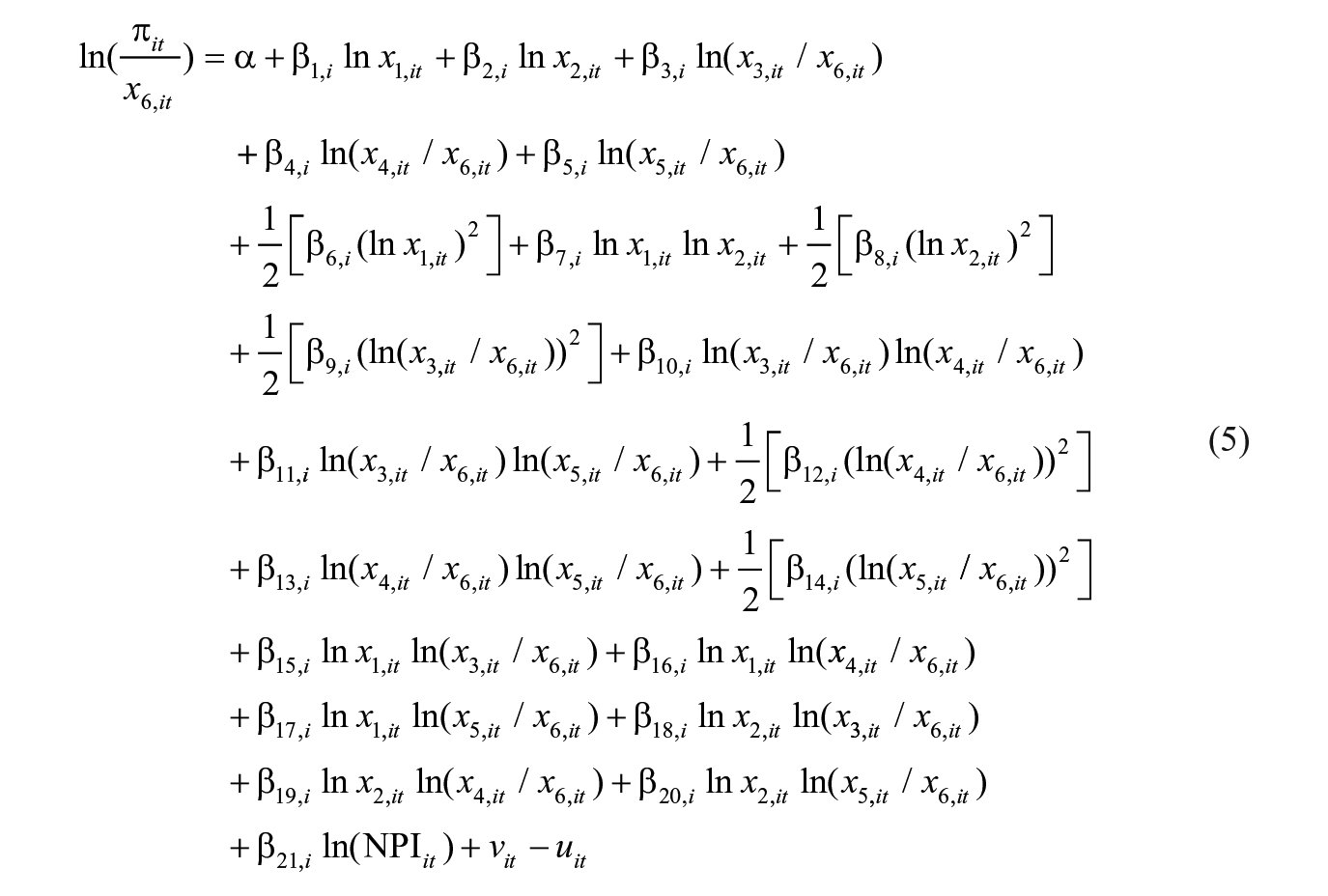
where
where the dependent variable (πit) and the independent variables (
To study the determinants of profit efficiency when assuming hotel heterogeneity, we use the inefficiency function specified in Equation (2). The model used to estimate is

where the
Results
This article uses a Bayesian stochastic frontier model with random coefficients to evaluate profit efficiency and its determinants for individual hotels in a sample of 461 heterogeneous hotels. As this methodology estimates a profit frontier for each hotel, a large number of coefficients are generated by the model. Consequently, it is not practical to report the coefficients for each hotel. In addition, if we assume that the sample is composed of heterogeneous hotels, it is difficult to generalize for the entire group of hotels. Therefore, when making estimates at the individual firm level, any generalization of the results should be done with special care (Mackey et al., 2017). In Supplemental Table 1 (available online), we will only report profit efficiency and the posterior mean and posterior standard deviations for all frontier parameters.
It is important to note that although the coefficients of the profit frontier have not been reported for individual hotels, their estimates exhibit a certain degree of variability, indicating that the hotels in the sample have different profit frontiers. The mean profit efficiency for the studied period is 61.17% with a standard deviation of 25.97%. In other words, hotels could increase their profits by 586,200 euros if they were all completely efficient.
Regarding the evolution of the average profit efficiency during the study period, Supplemental Figure 1 (available online) shows a growing trend. In the first years of the period, the degree of efficiency in hotels remains constant. However, starting in 2015, the average profit efficiency takes a great leap, increasing by more than 10 percentage points. Although there is still a high margin for improvement, Spanish hotel firms are improving the management of their revenues and costs.
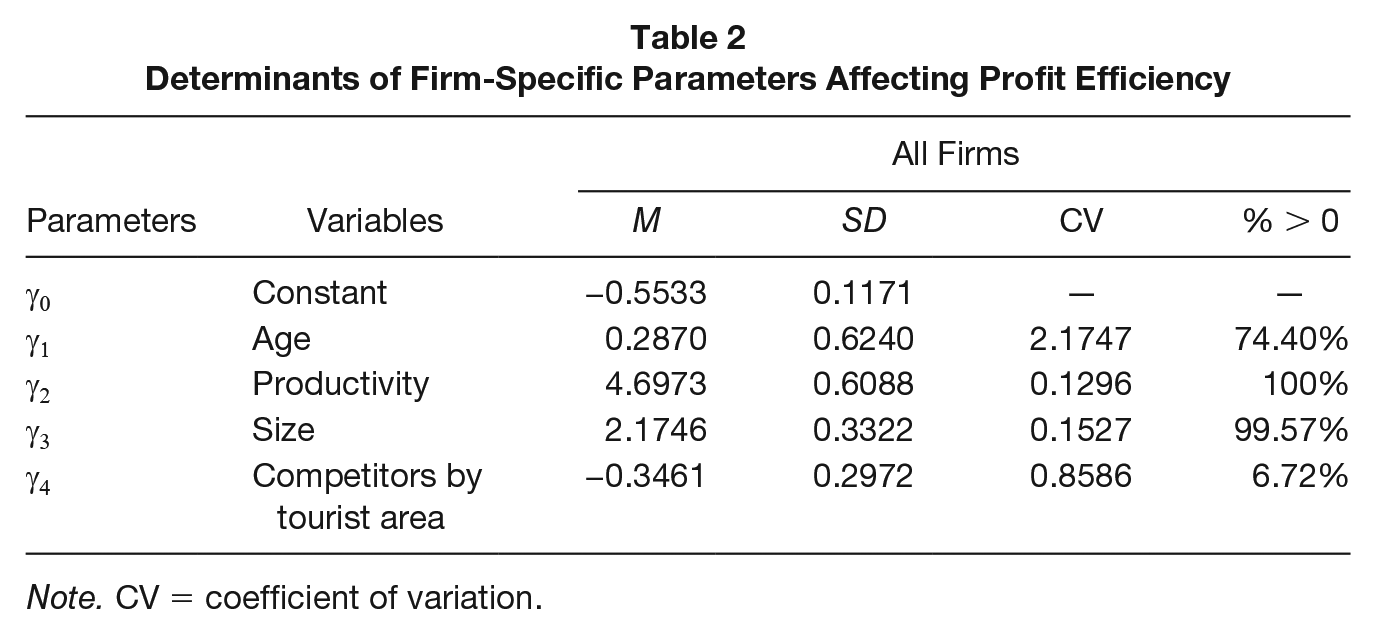
Regarding the inefficiency effects function, the coefficients for each variable and for each hotel in the sample have also been estimated individually. However, the number of coefficients estimated once again make it impractical to report these individually. Table 2 reports the posterior mean, posterior SD, coefficient of variation (CV) and percentage of hotels with a positive coefficient for the efficiency determinants. The CV expresses the standard deviation as a percentage of the mean, showing the degree of distribution variability. Therefore, as the CV increases, the distribution values become more dispersed and its mean becomes less representative. Figure 1 presents a chart of the results.
Determinants of Firm-Specific Parameters Affecting Profit Efficiency
Note. CV = coefficient of variation.

Effects of Age, Labor Productivity, Size, and Number of Competitors on Inefficiency
The mean of the coefficients for the variable Age (
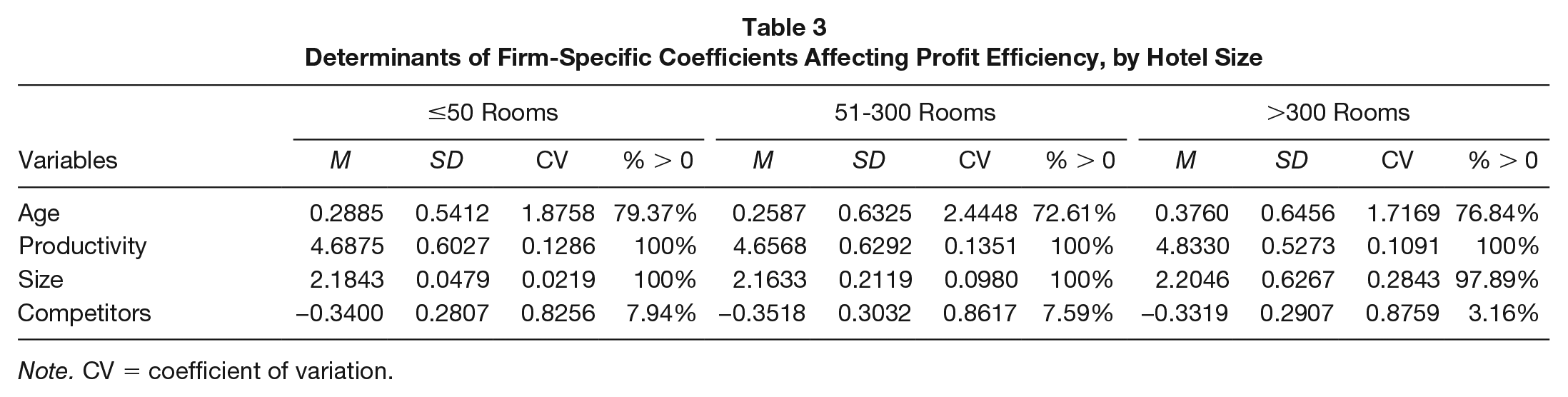
To analyze whether these results vary according to the number of hotel rooms, the sample was divided into three size categories: small hotels (up to 50 rooms), medium-sized hotels (51-300 rooms), and large hotels (more than 300 rooms). As shown in Table 3, the mean of the age variable’s coefficient is still positive for all three hotel sizes, although the effect of age on efficiency varies depending on hotel size. For example, age increases profit efficiency for 79.37% of small hotels and the distribution mean is 0.2885, which means that small businesses have an expected efficiency increase of 28.85% as age increases. For medium-sized hotels, age is expected to increase profit efficiency for 72.61% of the group. The distribution mean is 0.2587; therefore, as medium-sized hotels increase in age, efficiency is expected to increase by 25.87%. Lastly, age increases efficiency for 76.84% of large firms, with a distribution mean of 0.3760. That is, for hotels with more than 300 rooms, an increase in age is expected to increase efficiency by 37.60%. Likewise, the variability coefficient for the age variable is also high for all three hotel sizes, demonstrating the heterogeneity of the hotels. This heterogeneity is more pronounced among medium-sized hotels.
Determinants of Firm-Specific Coefficients Affecting Profit Efficiency, by Hotel Size
Note. CV = coefficient of variation.
Regarding the labor productivity determinant, the estimated mean coefficient of this variable (
Figure 1 also shows how the individual hotel coefficients of the labor productivity variable are concentrated around the distribution mean. This finding indicates less heterogeneity among hotels in relation to labor productivity. Despite this lower heterogeneity, labor productivity’s positive impact on efficiency still differs among hotels. For the effect of this variable by hotel size, there are no significant differences in the distribution mean or in the CV between the different sizes (see Table 3).
Regarding the size factor, its estimated coefficient (
The results for hotel size reveal that the greatest heterogeneity is found in the hotels with the largest number of rooms. In this group, there are a few hotels (2.11%) whose size negatively affects their performance; the remaining 97.89% of hotels enjoy positive effects from size. In addition, the higher CV also indicates that the effect of size on efficiency is more heterogeneous among hotels with more than 300 rooms.
Last, the coefficient of the number of competitors variable (
The results for the number of rooms indicate that 7.94% of the hotels with the fewest rooms are positively affected by a higher number of competitors (see Table 3). However, for the other small hotels, the number of competitors produces an average efficiency decrease of 34.00%. The distribution mean for medium-sized hotels is −0.3518; therefore, an increase in competitors for these hotels is expected to reduce efficiency by 35.18%. However, 7.59% of medium-sized hotels have a positive coefficient; therefore, more competitors will have the opposite effect—an efficiency increase. Last, efficiency for large hotels is also negatively affected by the number of competitors since their coefficient is −0.3319. Again, for 3.16% of the large hotels, the number of competitors has a completely opposite effect—an efficiency increase. These results once again confirm the heterogeneity of hotels and proves that the “average” results can be misleading.
Implications and Concluding Remarks
The goal of this study is to evaluate the profit efficiency and its determinants in the hotel industry assuming heterogeneity of resources across hotels. The concept of profit efficiency that is used in this study reveals how much profits a hotel could achieve if it were completely efficient in its use of resources. Unlike most previous studies, which estimate efficiency using a research methodology that assumes hotel homogeneity, we apply a random-effect Bayesian frontier model to estimate the profit frontier and the effect function of inefficiency for individual hotels in a sample of Spanish hotels. The results obtained contribute a new perspective to the debate in the literature regarding the measurement of performance and its determinants in the hotel industry.
First, the results suggest that each hotel has its own profit frontier that depends on its individual resources and capabilities. The proximity of each hotel to this frontier (inefficiency) will depend on the ability of its managers to efficiently manage those resources and capabilities. These findings support our hypothesis that there is unobserved heterogeneity across hotels and that ignoring this heterogeneity can lead to an underestimation of the profit efficiency. In this sense, the profit efficiency that is estimated in this article (61.17%) differs substantially from that estimated by Arbelo et al. (2018). These authors estimate profit efficiency (51.48%) in Spain but do so based on a common frontier, which highlights the underestimation of efficiency that can result when it is estimated using a common frontier.
Second, the analysis of the profit efficiency determinants reveals that their effects on performance also significantly differ across hotels and even produces an opposite effect in some cases. Without the random-effect Bayesian frontier model used in this study, the unobserved heterogeneity’s impact on hotel performance measurement could not be perceived. This methodology enables us to predict the performance effects of resource and capability management on individual hotels.
More specifically, the factors age and number of competitors stand out. The impact that these two determinants have on efficiency is positive for some hotels and negative for others. This result leads us to conclude that the performance effects of these determinants differs significantly between hotels and can even have an inverse effect. Regarding labor productivity and size, although the impacts of these determinants on profit efficiency are positive for virtually all hotels, it is important to note that there are significant differences in the level of impact on individual hotels. The variability of the impact is especially relevant regarding labor productivity. Since the hotel industry is labor intensive, it is more important for hotel managers to understand the individual effect of labor productivity on performance rather than the average effect. Therefore, although this effect is positive for all hotels (as expected), its impact on hotel performance is very uneven. These results are more accurate because they provide individualized information on the impacts of the determinants. On the other hand, the studies carried out so far only provide information on the “average effect” of the determinants. Consequently, these findings also support our hypothesis of unobserved heterogeneity across hotels.
In summary, the conclusions of this article demonstrate that at best, average impacts can only provide information on whether a resource or capability can increase or reduce performance for a hypothetical “average hotel”. At worst, if hotel heterogeneity is ignored and only the average effect is considered, hotels may experience results that are contrary to expectations. Therefore, instead of trying to determine the relationship average between a resource and performance, researchers should examine the resource–performance relationship for individual hotels.
The results of this study are clearly consistent with the RBV theory. That is, hotels maximize performance by choosing strategies that exploit their heterogeneous resources in their operational contexts. Thus, the best way to understand the sources of competitive advantage (and therefore better performance) for a hotel is to focus first on the characteristics of its resources and capabilities and then identify how these help a hotel achieve a sustained competitive advantage in different competitive contexts. Therefore, the importance of incorporating the heterogeneity of resources among hotels in the empirical analysis is quite clear. If this heterogeneity is not appropriately included in the empirical methodology, it can lead to inaccurate measurements of efficiency and therefore inaccurate measurements of hotel performance.
This research has remarkable implications for both academics and hotel management. Regarding the academics, we have argued that RBV is a theory that focuses on the individual characteristics of a firm (J. Barney, 1991) rather than average results that actually conceal the differences between firms. For academics, it is more interesting to know the probability of a given resource or capability being a source of competitive advantage rather than knowing (on average) if that resource or capability has a negative or positive impact on performance (Hansen et al., 2004; Mackey et al., 2017).
Regarding the implications for hotel management, if a manager knows the average impact (positive or negative) of a resource on hotel performance, it would be wrong to assume that there will be similar performance impacts for all hotels. For example, our study found that the average effect of age on profit efficiency is positive (0.2655), but it also found that there was a negative effect on 27.77% of the hotels. Similarly, the study found that the average effect of the number of competitors on hotel performance is negative (−0.2638), although a positive effect for 9.54% of the hotels was identified.
Supplemental Material
Supplemental_material – Supplemental material for Heterogeneity of Resources and Performance in the Hotel Industry
Supplemental material, Supplemental_material for Heterogeneity of Resources and Performance in the Hotel Industry by Antonio Arbelo, Marta Arbelo-Pérez and Pilar Pérez-Gómez in Journal of Hospitality & Tourism Research
Footnotes

Supplemental Material
Supplemental material for this article is available online.
References
Supplementary Material
Please find the following supplemental material available below.
For Open Access articles published under a Creative Commons License, all supplemental material carries the same license as the article it is associated with.
For non-Open Access articles published, all supplemental material carries a non-exclusive license, and permission requests for re-use of supplemental material or any part of supplemental material shall be sent directly to the copyright owner as specified in the copyright notice associated with the article.
