



Abstract
The effects of Airbnb on the hotel industry have been debated in different academic forums without a close answer about whether its effects on the hotel industry are complementary or substitutive. To help clarify this issue, this article proposes a business failure model to analyze the impact of Airbnb on the bankruptcy of traditional hotels. In particular, we develop a study case based on a sample of hotels in the city of Barcelona between 2015 and 2018. In addition, we distinguish Airbnb listings’ characteristics such as type of room or market concentration to show an additional understanding of Airbnb effects. Our results show that Airbnb plays a double complementary and substitutive role in traditional hotels’ disruption. In particular, we conclude that Airbnb’s private rooms and the concentration of the Airbnb market in fewer hosts are the main threats to traditional accommodation providers.
In the past few years, the tourism sector has experienced a significant transformation related to sharing economy. This is a new market model where clients and suppliers keep contact through two-sided online platforms, also known as peer-to-peer applications. In the particular case of the accommodation sector, Airbnb allows people to rent their own apartments for different time periods through an online marketplace. As a consequence of this new market, clients now have access to a wide variety of options—more than 5,000,000 accommodation listings in over 191 countries of the world (Airbnb Stats 1 ). The innovative character of this new market typology and its high growth rate have had a notable impact on professional and academic forums. Discussions revolve around the legitimacy of Airbnb’s market model or its potential effects on the different economic agents involved. As a demonstration, googling “Airbnb hospitality sector,” results in more than 35,000 news items from different newspapers, magazines, and trade journals, which analyze Airbnb’s influence on the hospitality sector. Most present Airbnb as a significant competitor, which is producing a negative impact on the hotel industry (see, e.g., Dogru et al., 2019; Lane & Woodworth, 2016; Zervas et al., 2017). In addition, professional associations in the hospitality sector claim that the principles of the collaborative economy, which underpins Airbnb, are a fantasy; indeed, there is a tendency for the Airbnb market to become concentrated in fewer hosts who see the sharing platform as a way to maximize profit—no longer peer-to-peer but rather a direct competitor to traditional accommodation providers (Kwok & Xie, 2019). This runs contrary to Airbnb CEO Brian Chesky’s argument that Airbnb plays a complementary role in the hospitality sector; he claims that most of Airbnb’s accommodation offers are located in different areas to traditional hotels. In particular, he asserts that 70% of Airbnb property listings are outside of hotel districts (Intelligence, 2017). Therefore, Airbnb arguably provides clients with a varied territorial distribution of accommodation in addition to that offered by traditional hotels (Gutierrez et al., 2017). This more varied offer, and more competitive prices, provide clients with the opportunity to travel abroad when it might not otherwise be possible for them to do so.
In this context, researchers have developed studies to determine the effects of Airbnb on the hotel industry. Though most of the previous studies find a significant and substitutive effect of Airbnb on the traditional hotel industry (Guttentag & Smith, 2017; Zervas et al., 2017), there is also evidence about a significant complementary effect (Dogru et al., 2017). Thus, the extent to which Airbnb plays a substitute or complementary role for the traditional hotel industry needs further investigation. To deem into this topic, this article aims to provide empirical evidence of Airbnb’s effects on Barcelona’s hotel industry. In particular, we examined traditional hotels’ environments to contrast whether accommodations surrounded by high densities of Airbnb’s listings present higher or lower probabilities of failure. Previous literature also highlights the relevant role of territorial characteristics in this context. In this sense, Gutierrez et al. (2017) compared territorial distributions in hotels and Airbnb’s accommodations in Barcelona identifying differences in their determining external factors. Lopez et al. (2020) considered the spatial distribution of the accommodation industry concluding about the existence of spatial concentration areas with similar Airbnb’s prices. Finally, the recent studies of Chica-Olmo et al. (2020) and Tong and Gunter (2020) contrast the effects of geographical proximities in the accommodation sector finding that some closeness to some facilities play a significant role on the accommodation prices.
To differentiate from the previous studies, we evaluated Airbnb’s impact on the traditional accommodation sector estimating the probability of business failure as an approach of “disruption” in the hotel industry. To our knowledge, this is the first study proposing a business failure model to determine Airbnb’s effects on traditional hotels. In particular, we part from the theory of externalities to propose several hypotheses about the significant role of Airbnb’s locations on its complementary or substitutive effect in the hotel industry. To do this, we presented a case study in the city of Barcelona. This provides additional relevance to this analysis given that this city is the one with the highest number of Airbnb accommodations in Spain. 2 Our findings have important implications for managers and politicians providing additional understanding of some key questions about the way in which it would be necessary to regulate the sharing economy platforms in this sector.
Literature Review
Business Failure and Airbnb
There is a growing literature that highlights the relevant role of environmental characteristics in business performance that have been found significant when business failure is examined (Mate-Sanchez-Val et al., 2018). The theory of external economies states that business location affects the way in which companies interact with their environments (Marshall, 1920). In particular, the existence of spatial concentration areas offering similar services would attract more clients getting benefitted by these activities. Thus, according to this framework, the growing Airbnb’s offer in a location would increase the number of clients generating a positive externality on the incomes of traditional hotels in this area and, therefore, reducing their probabilities of failure. From this perspective, Airbnb would play a complementary role on the traditional hotel industry. In addition to this, the existence of dense areas with high volume of Airbnb’s listings stimulates the local competition among accommodation companies (Dogru et al., 2019). To deal with this situation, traditional hotels focus on new management practices creating the most specialized offer orientated to population’s preferences to attract new consumers. In addition, geographical proximity between hotels and Airbnb’s accommodations facilitates the transmission of knowledge between them (Khelil, 2016). This provides hotels additional understanding about others’ practices and clients characteristics to be incorporated in their business strategies (Maskell, 2001). These kinds of innovations in their organizational systems would decrease their probabilities of business failure (Gemar et al., 2019). Therefore, according to previous theoretical understandings, a positive effect should be expected from hotels surrounded by high-density areas of Airbnb’s accommodations.
Nevertheless, regarding empirical results, we found positive and negative results when Airbnb’s effect on the traditional hotel industry—considering different performance indicators—was examined. In this sense, Dogru et al. (2017) concluded about a positive and strong effect of Airbnb on some performance indicators, such as revenues or occupancy rate, in traditional hotels. Lane and Woodworth (2016) identified risky hotels in the United States as consequence of the growth of Airbnb’s offer. According to these authors, traditional hotel prices decrease as Airbnb’s offer becomes larger. Zervas et al. (2017) provided evidence about the platform’s substitutive economic character, in relation to the hotel industry. Airbnb is a substitute for certain hotels and, therefore, will have a negative impact on the sector’s income—with different effects depending on the area being analyzed. The authors studied Airbnb’s impact on the hotel industry in Texas and concluded that for each 10% increase in Airbnb’s accommodation offer, there was a fall of 0.39% in hotels’ room prices; this effect is more marked for those hotels with fewer services, of lower categories, and for cheaper or nonaffiliate hotels. Xie and Kwok (2017) examined the connection between hotel behavior and Airbnb pricing in Texas. Their findings showed a significant impact of Airbnb prices on the revenues of traditional hotels situated in their closer neighborhood. Guttentag and Smith (2017) analyzed the substitutive impact of Airbnb for traditional hotels based on an investigation on North American Airbnb guests. They determined that two thirds of respondents reported that Airbnb played a substitute role. Along similar lines, Blal et al. (2018) analyzed the possible substitutive or complementary character of Airbnb on hotel sales in San Francisco. Their findings suggest that Airbnb’s impact is not specifically related to the number of offers but rather to the pricing and guests’ perception of value. Therefore, for Blal et al., Airbnb has a substitutive role by providing comparisons between the different services being offered to potential clients. Dogru et al. (2019) examined the impacts of Airbnb on the behavior of the hotel industry and evaluated hotel performance metrics with a sample of 10 American hotels. Their results show a negative relationship between Airbnb supply and hotel performance metrics.
From a theoretical perspective, this negative effect could be explained by the existence of high-concentration areas offering similar services, which would increase the competition and decrease the probabilities of survival for these companies (Khelil, 2016). Da Silva and McComb (2012) and Folta et al. (2006) found the same result in the service sector concluding that the probability of business failure rises in territories with an extended number of companies operating in the same sector. If we translate this effect to the hospitality sector considering Airbnb, then the high competence of these new accommodations would play a substitutive role increasing the competition, which could even reduce the probabilities of survival of traditional hotels.
Regarding previous literature, we found theoretical motivations for both substitutive and complementary effects of Airbnb on different indicators in the hotel industry, which at the end could affect the probability of business failure of these companies. Thus, we need further evidence about the role played by Airbnb on the hotel industry to test which of the previous theoretical arguments are verifying in this case. Based on previous results, we proposed the following hypotheses to contrast the effects of Airbnb on the hotel industry.
In contrasting these hypotheses, we determine whether Airbnb’s impact on the traditional hotel industry is consistent with external economies and competition theories in local environments.
The Hospitality Sector in Barcelona
Traditional Hotels and Airbnb
Barcelona is one of the biggest cities in Spain. According to the data provided by the Spanish Statistical Office, 3 the GDP (gross domestic product) of Barcelona in 2017 was 78,807 million euros with an annual growth rate of 3.3%. This represents 34% of the total economy of the Autonomous Community of Catalonia, and almost 7% of the entire Spanish economy. Barcelona is divided into 10 different districts, of which five are subdivided into 74 neighborhoods (see Figure A1 in Supplemental Appendix A available online).
In terms of tourism, in 2018, the Spanish tourism industry accounted for 11% of Spain’s annual GDP; Spain is now the second most-visited country in the world after France. Among Spanish cities, Barcelona was the second most-visited tourist destination with more than 7.2 million international arrivals in 2018, which made it 17th in the world (Top Cities Destination Ranking 2017 4 ). This high volume of visitors has driven the development of an accommodation sector composed of traditional hotels and, during the last decade, by a growing accommodation offer from collaborative short-term rental platforms, of which Airbnb is the most used worldwide. Spain has the fourth largest number of Airbnb properties in the world, and Barcelona is the Spanish city with the largest number of Airbnb listings–more than 18,000 in 2018. 5 Its rapid growth has caused concern among some local hoteliers who view Airbnb as a competitor.
Airbnb: A Genuine Competitor to the Traditional Hotel Industry?
The average growth rate of Airbnb listings in Barcelona over this period was 10.62%, with annual rates around 20% during the first couple of years of the period analyzed (2015-2018). Despite these figures, when compared with Airbnb listings, the number of hotel rooms remained much higher across the whole study period (see Figure A2 in Supplemental Appendix A available online).
In addition, the growth in Airbnb listings seems to have plateaued in the past 2 years, with the number of accommodation offers remaining constant. 6 The growth in the number of hotel rooms being offered in Barcelona has also been supported by a stable occupancy rate over this period—60% in 2017—whereas this rate was only 28% for Airbnb (see Table A1 in Supplemental Appendix A available online).
Types of Airbnb Accommodation Close to Hotels
Airbnb offers three kinds of accommodation: shared room, private room, and entire apartment. Following Heo et al.’s (2019) study, we excluded shared rooms from the analysis as they are not viewed as serious competition to hotel rooms. Furthermore, we treated entire apartments as if they were one room because although an apartment may have more than one room, it is offered as one unit rather than as individual rooms. When we examined the proportion of full apartments against private rooms in 2015, we found that the number of full apartments was greater than the private rooms; however, this proportion has since changed and the number of private rooms and full apartments available are now quite similar—with private rooms reaching 45% of the offer in 2018 (see Figure 1).
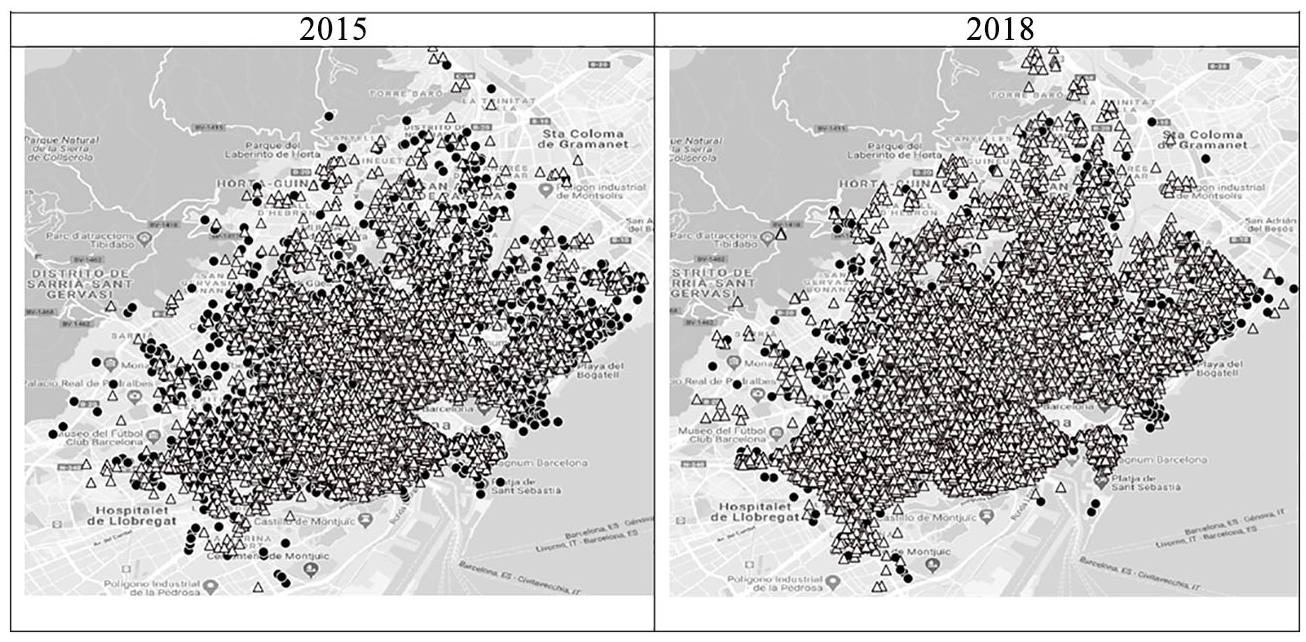
Airbnb Distribution in Barcelona by Type of Listing
In addition, average prices for full apartments and hotel rooms were closely matched and followed the same temporal trend during the study period (see Table A2 in Supplemental Appendix A for further details).
Another important characteristic of Airbnb that warrants examination is the existence of multilistings, that is, the number of offered listings by the same host. Supplemental Appendix Table A2 (available online) shows that the number of Airbnb hosts has increased between 2016 and 2018 but not by as much as the number of listings. Thus, the Airbnb market has experienced a degree of concentration, as a growing number of multilistings hosts. This general trend toward a more concentrated market would corroborate those hotel industry experts who recently are arguing that Airbnb operates like a traditional business rather than as a collaborative economy tool. Finally, to evaluate the complementary and/or substitutive character of Airbnb from a spatial perspective, we examined the spatial distribution of Airbnb listings in relation to hotels in Barcelona. We found similar spatial distributions for both kinds of accommodation. Both are more concentrated in the district of Ciutat Vella—a tourist district (corresponding to the darkest color on the maps in Figure 2).

Quartile Maps at a District Level of Aggregation
Consequently, this result contradicts arguments about the complementary character of Airbnb, for which Airbnb listings would be located in nontourist districts rather than similar locations to hotels.
Testing the Complementary and/or Substitutive Character of Airbnb in Barcelona
Descriptive analysis in Section 3 highlighted arguments both for and against Airbnb as either complementary or substitutive. To provide more detailed analysis, this section presents an empirical application that evaluated Airbnb’s impact on business failure probability in Barcelona’s hotel industry.
The Model: Business Failure in the Hotel Industry
Regarding financial literature, we find very few studies focused on hotel bankruptcy prediction (Gu, 2002). Gu and Gao (2000) developed the first analysis forecasting bankruptcy in the hospitality sector. Based on this study, further studies examined the way in which financial variables and environment characteristics affect business failure. H. Kim and Gu (2006) applied a logit regression to determine explicative factors for a sample composed of 16 bankrupt and 16 sane hotels. Li and Sun (2012) used a sample of seven failed and 16 sane Chinese hotels to determine the best methodology to predict insolvency. Pacheco (2015) proposed a business failure model with a logit estimation to identify which elements determine a larger probability of failure in a sample of reduced-size hotels located in Portugal. Their results suggest that financial indicators are the best business failure predictors. Fernandez-Gamez et al. (2016) used financial and nonfinancial variables to estimate the probability of business failure before reach this situation. Their empirical findings suggest that return on assets is the best forecaster of failure when financial information 3 years before bankruptcy is applied.
Based on these studies, we proposed a logit model to analyze the probability of business failure in the hotel industry. In particular, when analyzing business failure probability, we calculated hotel i’s probability of failure in period t by

where
Database and Variables
To develop this empirical application, we obtained firms’ financial and accounting information from the Sistema Annual de Balances Ibericos (SABI) database. From these data, we selected hotel industry companies in Barcelona. Based on this sample, we chose those companies with local hotel branches in Barcelona. We dropped those multinational companies with branches in Barcelona with the aim of minimizing the effect derived from the fact that some company could own many properties and, therefore, their financial statements depend on the consolidated accounts. The resulting sample consisted of 235 hotels with information available for 2013 to 2018. This sample represented a 67% coverage rate of reduced size hotels in 2018 (INE, 7 2018). In addition, we obtained qualitative information about these hotels by applying web-scraping techniques to the TripAdvisor website. This database was merged with SABI database through a manual process. Apart from this information, we also used the Inside Airbnb website—http://insideairbnb.com/—as a database to get information about the different Airbnb listings in Barcelona from 2015 to early 2018. This data set collates publicly available information from the Airbnb website, including reviews for each listing, type of listings, prices, some host information, the minimum number of nights per stay, and the geo-location of all Airbnb accommodation listings.
Based on previous financial studies, we applied the economic failure definition to evaluate financial distress. Previous analyses concluded that this is a precise definition of business failure because we could find financially failed companies that never file for bankruptcy, whereas we could find financially sane firms filing for bankruptcy due to strategic motives. Therefore, the alternative legal definition of failure could cause a biased sample composed of failed and nonfailed companies (Balcaen & Ooghe, 2006). Thus, according to the economic definition, we identified financial failure companies as those firms that present three straight accounting periods of negative shareholders’ equity or two straight accounting periods of negative shareholders’ equity and 1 year for which there is no available information in their accounting registers (Mate-Sanchez-Val et al., 2018). 8 Then, we proposed a dichotomous dependent variable, which had a value of one if the hotel was classified as failed and as zero otherwise.
To test the complementary and/or substitutive character of Airbnb, we identified a number of variables that evaluated the characteristics of Airbnb listings in the areas surrounding each hotel in the sample. To this end, we defined each “hotel’s local environment” in terms of distance within a specific radius (ri). From each hotel, all the elements included in the circle defined by ri were considered as “neighboring.” 9 Based on this radius, we built Airbnb density variables by considering the number of Airbnb listings inside radius ri from each hotel in the sample. In addition, this variable was defined considering three different categories: (a) Airbnb Density (DENSAIR) evaluates the number of Airbnb listings located in the circle defined by ri from each hotel, (b) Airbnb Full Apartment Density (DENSAIR_APARTMENT) considers the number of Airbnb listings for full apartments within the circle of radius ri, and (c) Airbnb Room Density (DENSAIR_ROOM) includes the number of listings offering private rooms inside the area of influence of each hotel and defined by ri. We also defined Airbnb’s average listing price within ri from each hotel as an explicative variable of this model (PRICEAIR). This variable was also differentiated for Full Apartments (PRICEAIR_APARTMENT) and Private Rooms (PRICEAIR_ROOM). Finally, we also distinguished listings according to their hosts. In particular, we identified those listings whose hosts offered more than two Airbnb listings, from those offered listings by hosts with less than three listings (Xie & Mao, 2017; Zhao & Rahman, 2019). We referred to the former as professional hosts, since controlling a high number of listings assumes a greater experience for the administration of the offers and the end of their activity is to maximize benefits. 10 This group represents around 30% of the total Airbnb offer (see Table A2 in Supplemental Appendix available online).
In accordance with previous studies, we included some control variables for hotels’ financial and qualitative characteristics. In particular, from the SABI database, we defined the size of the hotel (SIZE) as the logarithm of total assets. From previous business failure literature, we expected a negative sign for this variable (Back, 2005). Larger hotels would, therefore, be expected to present certain advantages related to economies of scale and greater market prestige in comparison with reduced-size hotels; therefore, large hotels should have lower failure probabilities. Profitability evaluates hotels’ ability to generate profits, and it is unsurprisingly one of the most significant financial ratios for calculating business failure probability (Fernandez-Gamez et al., 2016). The profitability of the hotel (PROFITABILITY) was evaluated, from the financial statements in SABI database, as profits before interest and taxes on total assets. Previous studies suggest a negative relationship for this variable (S. Y. Kim & Upneja, 2014; Vivel-Bua et al., 2015). To define this variable, we used 3 years temporal lag of the profitability ratio given the predictive power of this variable to predict bankruptcy (Fernandez-Gamez et al., 2016). Apart from this financial variable, we included others directly related to hospitality sector characteristics from the TripAdvisor webpage. In this sense, we considered the hotel’s average room price (PRICE). Following previous literature, we also considered this variable in square terms to control for nonlinearities in the variable (PRICE2). We also defined the hotel’s market position (POSITION) using TripAdvisor rankings for each hotel as an additional explanatory variable. These ranges from one to five as a function of guests’ opinions. Finally, the model takes regional heterogeneity into account, which may be caused by the particular economic characteristics of each administrative area of Barcelona; the model included the index of income per capita (INCOME) for the district where each hotel is located as an explanatory variable. This variable was selected from the Open Database of Barcelona Council Town. 11 For further details about the database, Supplemental Table B1 in Appendix B (available online) gives an overview of the variables defined in our model as well as some descriptive information concerning median values and standard deviations distinguishing between failed and nonfailed companies with significant differences between subgroups.
Findings
To delve further into the complementary and/or substitutive character of Airbnb, we undertook a first estimation of the model (1), which included all types of Airbnb listings; subsequently, we estimated two additional regressions where Airbnb listings were subdivided in accordance with their specific characteristics. To define the Airbnb-neighborhood for each hotel, we generated an ri value by applying an iterative procedure from which we selected the ri value that best fitted the estimated model by maximizing the likelihood function of the estimation (1). We based this procedure on Da Silva and McComb’s (2012) and Mate-Sanchez-Val et al.’s (2018) studies, which chose the radii that provided the highest significance for the model’s coefficients. Table 1 presents the results for these estimations.
Fixed Effect Logit Results: Panel of Hotels in Barcelona, 2015-2018
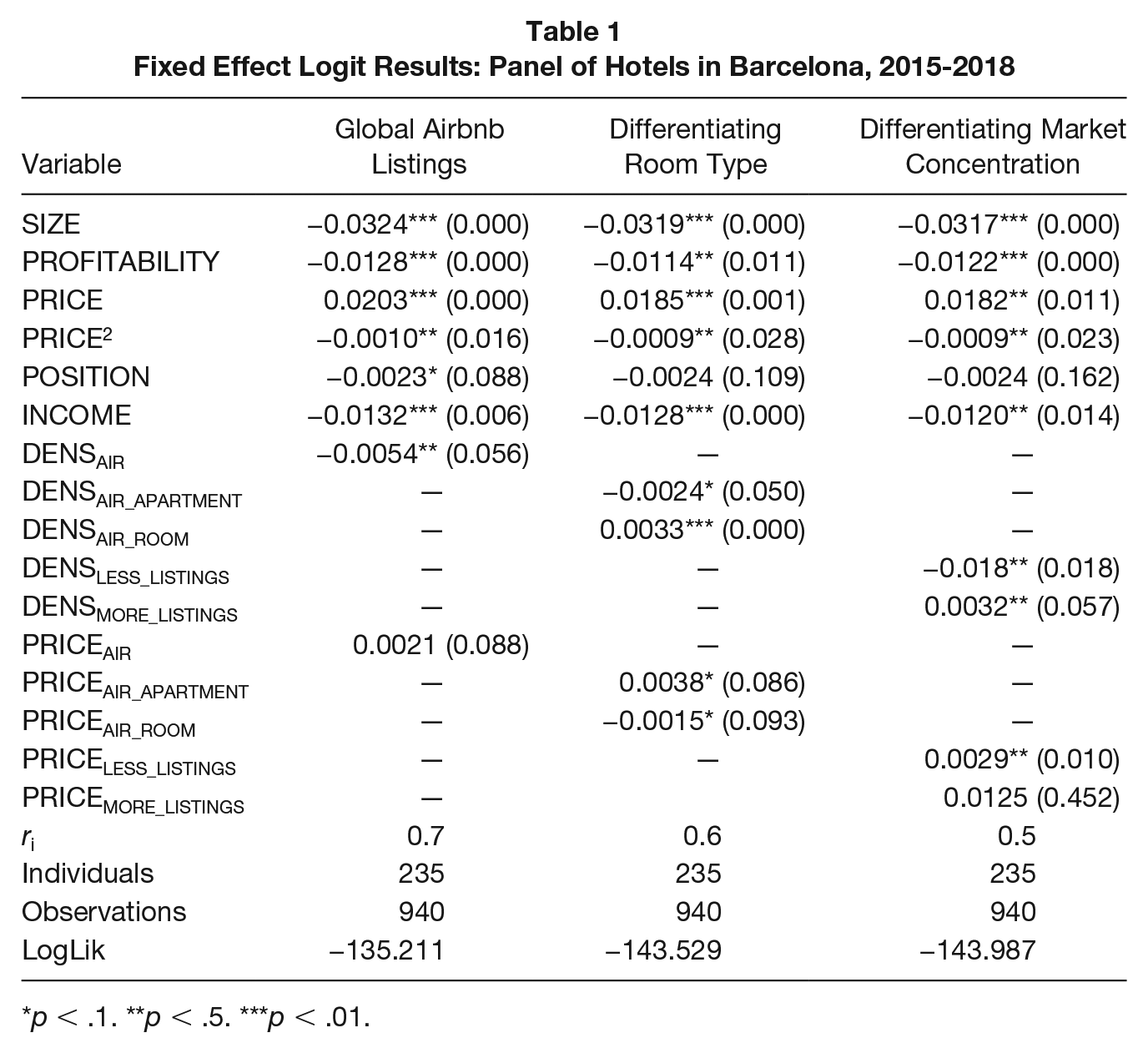
p < .1. **p < .5. ***p < .01.
For the first estimation, we found that the control variables did provide the expected results for the impact of firms’ characteristics on hotels’ failure probability. In this sense, SIZE and PROFITABILITY both show negative and significant signs, which agrees with previous literature highlighting lower failure probabilities for larger and more profitable companies (Khelil, 2016). The PRICE of the hotel shows a nonlinear and statistically significant correlation: An increase in hotels’ room prices decreases business failure probability; however, above a certain price, this relationship turns positive—actually increasing the probability of business failure. This pattern could be explained by potential clients’ perception of the hotel’s quality, as they may equate high room prices with high hotel quality until certain value (S. Y. Kim & Upneja, 2014). In addition, the POSITIONING of the hotel from TripAdvisor is a significant variable with a negative relationship in some cases. In this regard, recent literature has highlighted the importance of brand reputation through social networks and positive comments from clients on the economic and financial behavior of the hotel (Vivel-Bua et al., 2015). Finally, INCOME has a negative and significant sign, with business failure probability decreasing as the income per capita of the district increases (Altman et al., 2010).
The Complementary and/or Substitutive Role of Airbnb in the Barcelona Hotel Industry
The first estimation showed that Airbnb density (DENSAIR) had a negative and significant coefficient (−0.0054), which indicates that hotels surrounded by a high number of Airbnb rentals had a lower probability of failure. This first result seems to indicate, therefore, that Airbnb actually does play a complementary role—at least to a certain extent (Dogru et al., 2017). The positive complementary character is strengthened by the complementary and significant sign for the variable PRICEAIR, which represents the average price of Airbnb listings surrounding each hotel.
To explore this finding further, we proposed additional estimations. First, we differentiated between types of listing: Full Apartment and Private Room. These results are in the second column of Table 1. In this case, we found that Airbnb has a double—that is to say, both complementary and substitutive—effect. On the one hand, when we examine Airbnb’s full Apartments, we obtain a negative and significant sign for the density variable (DENSAIR_APARTMENT), indicating that high numbers of this kind of listing plays a positive role on the hotel industry by decreasing the failure probability for hotels surrounded by a high number of Airbnb’s Full Apartments. Therefore, in this aspect, Airbnb plays a complementary role. On the other hand, Airbnb’s Private Rooms show a substitutive effect—with a positive sign for the density variable (DENSAIR_ROOM in Section 2). This result together with the descriptive analysis provides some interesting findings. In this regard, we have to take into account that the type of listings with a substitutive role, Airbnb’s Private Rooms, are those which have had a higher growth rate—and have now reached similar numbers to Airbnb’s Full Apartments. Thus, this result would partly confirm the hypothesis that Airbnb is becoming a serious threat to traditional hotels.
Airbnb Multilisting Hosts
To provide a more fine-grained analysis of Airbnb’s role in the industry, we also differentiated listings by taking into account Airbnb’s multilisting hosts. For this purpose, the third column in Table 1 shows the estimation results of the model (1) but differentiating Airbnb’s accommodation offer between those which offer more than two listings on the Airbnb website (MORE_LISTINGS) and those whose owners have less than three listings available on Airbnb (LESS_LISTINGS). As we can see, these data also suggest that Airbnb plays a double substitutive and complementary role. For these criteria, Airbnb’s multilisting hosts seem to be an important threat to the hotel industry by playing a substitutive role when the hosts offer more than three listings, while the opposite happens when we consider listings attached to hosts offering just one or two listings on Airbnb. This result evidently links in to the ultimate aims of the hosts using the Airbnb platform—as a peer-to-peer service to supplement their income or as a business proposition in and of itself.
Causality Granger Test
To provide additional understanding about the significant role played by Airbnb’s density and Airbnb’s prices variables on the probability of business failure, we computed Granger’s causality test. Table 2 shows these results.
Granger’s Causality Test (5 Years Temporal Lag)
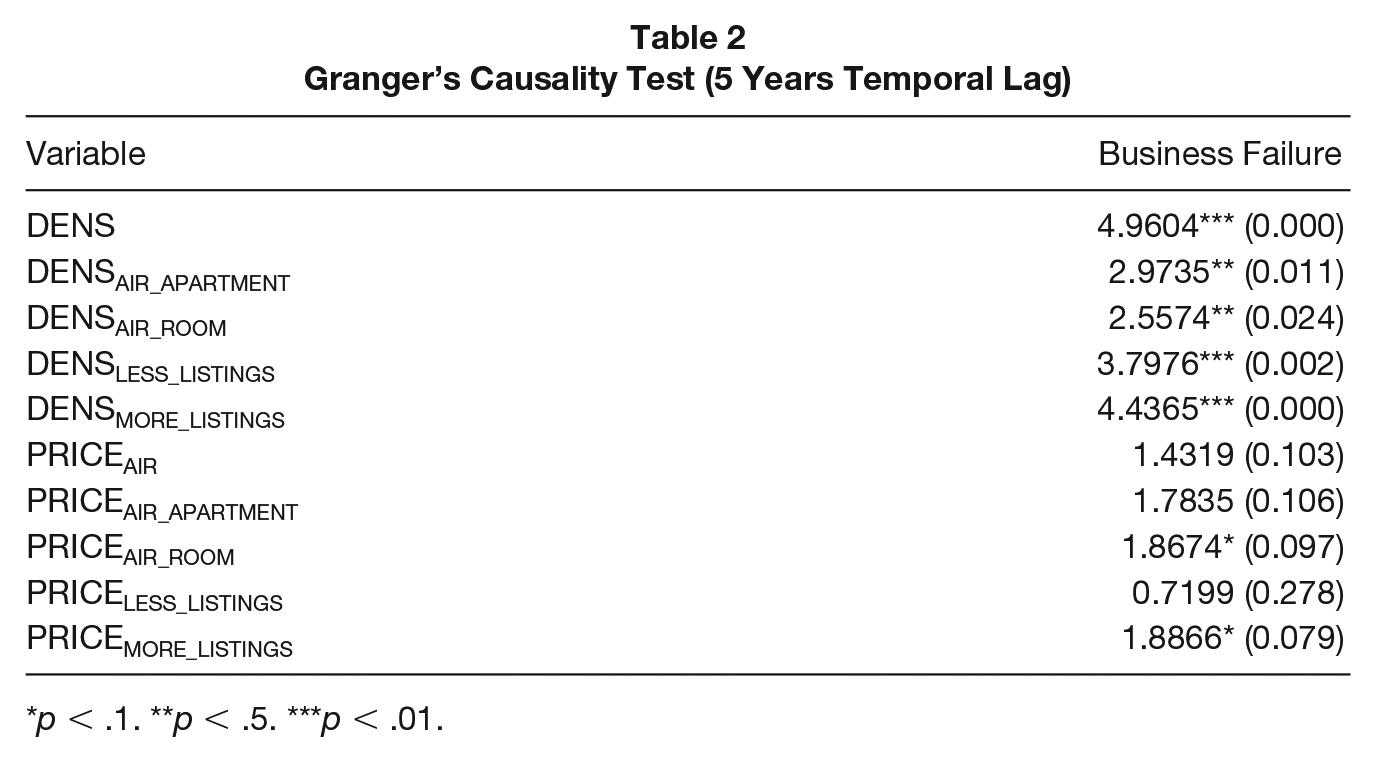
p < .1. **p < .5. ***p < .01.
Causality test was significant for Airbnb’s density variables when we distinguished between subsamples. This result confirms the significant role of Airbnb’s listings spatial concentration around the selected hotels in Barcelona when their financial distress is examined. But when we analyzed related variables to Airbnb’s prices, we find significant results only for nonprofessional and private rooms. Thus, the prices of these kinds of Airbnb’s offer would affect the financial situation of traditional hotels in Barcelona.
Discussion and Limitations
Companies working in the sharing economy—with Airbnb as one of the principal exponents—have burst into the tourism sector, to the alarm of hoteliers who have seen the platform’s growing accommodation offer as a threat to their economic survival. Professional bodies in the hotel industry have complained about unfair competition hidden under the umbrella of the collaborative economy; in contrast, for many in the industry, the real effect is to maximize particular hosts’ profits. For Barcelona in particular—the city with the second highest number of Airbnb listings in the world—the traditional hotel industry is dealing with a rapid growth in Airbnb’s accommodations that could damage the survival of the traditional sector.
Our initial findings showed that Airbnb plays both a complementary and a substitutive role in relation to the traditional hotel industry (Blal et al., 2018; Zervas et al., 2017). In addition to understanding these results further, we have provided more details about this effect by examining Airbnb listings’ impact as a function of their specific characteristics. To this end, we have differentiated between kinds of accommodation listings (private room or full apartment), and between multilisting host types (“hosts” with more than three accommodation offers and those with three or fewer listings). Our results confirm the proposed hypothesis about the significant role of Airbnb on the traditional hotel industry and the need of distinguishing between the kinds of listings when these analysis are developed. In particular, we concluded that Airbnb’s private rooms and the growing number of multilisting hosts are the main threats to traditional accommodation providers. These results appear to at least partially confirm previous perceptions from hoteliers. Nevertheless, in accordance with previous studies (Dogru et al., 2017), we have also found results that favor Airbnb. Our results show that Airbnb can indeed act as a complementary service that strengthens the hotel industry in locations where traditional hotels do not have sufficient numbers of rooms available to meet demand, and therefore may indeed boost the local tourist industry by providing holidaymakers with the opportunity to travel to some destinations that would otherwise not have been possible.
As a consequence, this study allows the effect of Airbnb to be differentiated based on the characteristics of Airbnb listings and provides statistically significant results for these impacts. Our results highlight the importance of a fine-grained analysis of the specific characteristics of the Airbnb accommodation offer in relation to local conditions when its impact is examined. Although this study is a contribution to previous research that focuses on the effect of Airbnb on the traditional hotel industry, it goes further to draw attention that the new Airbnb’s offer could even cause business failure. Previous studies that look at the importance of Airbnb on traditional hotel industry are mostly based on economic performance indicators. Our contribution to filling the gap in the literature involves us in examining and thus confirming that the growing Airbnb offer could affect the probability of failure of traditional hotels in Barcelona. Our findings provide some interesting implications for the design of local policies aimed at maximizing the benefits of the tourism sector. These policies should be designed under the assumption that Airbnb plays both a complementary and a substitutive role. Following on from this, proposals that would eliminate or drastically reduce the Airbnb offer through new regulation could actually damage the local hotel industry, due to the fact that the positive—complementary—effects of Airbnb would also be eliminated. Nevertheless, local policies regulate Airbnb and Airbnb-like accommodation offers should take the particular characteristics of the different accommodation offers into account. In the particular case of Barcelona, our results indicate that local policies should be focused on limiting or even rolling back the trend toward Airbnb rentals becoming concentrated in a few hosts. For example, a specific tax for Airbnb hosts with multiple properties could be implemented to avoid or ameliorate this situation. As regards the types of accommodation, private room or full apartment, although our results highlight that full apartment listings can be complementary to the hotel industry, the broader effects on other sectors—such as the housing sector—of apartments being used for this purpose should also be considered before adopting any regulatory changes (Dogru et al., 2019).
Despite the evident value of these results, we must also consider some limitations of our study—which may be considered as opportunities for future research. Proposed policies to regulate Airbnb should be evaluated from a broader perspective and take into account the specific social and economic effects of Airbnb for the specific local situation. Along these lines, Zervas et al. (2017) have highlighted the importance of Airbnb for the labor market by creating employment via a boost in the number of tourists to the particular destinations. In addition, Lee (2016) has examined the impact of the rise in Airbnb supply on the rental housing market; they conclude that regulations are needed to control the numbers of properties used as Airbnb accommodation. Therefore, more complex models that consider the social and economic interactions involved in the impact of Airbnb should be developed in future studies. An additional limitation is that this study was focused on the specific situation in Barcelona. Given that we have shown that local factors have an important influence on the particular effects of Airbnb rentals, our results cannot easily be generalized or straightforwardly applied to other places. Clearly, we would expect to find variations in results as a function of the particularities of each territory examined. As a consequence, it is evident that further studies that analyze the effects of Airbnb on other cities, and possibly larger territories as well, are needed in order to generalize results about the platform’s impact with confidence.
Concluding Summary
Our findings confirm that Airbnb plays a double—complementary and substitutive—role on the probability of business failure of the traditional hotel industry. To find this result, Airbnb listings’ specific characteristics were considered. In particular, we distinguished between private room and full apartment Airbnb accommodations and Airbnb’s multilisting hosts. In accordance with previous experts, we found that the offer of Airbnb listings’ private rooms and the existence of hosts offering more than three or four accommodations are harmful for the survival of traditional hotels in the city of Barcelona. Thus, our results provide further understanding on Airbnb’s impact on the hotel industry. This knowledge could be applied to propose specific policies with the objective of taking advantage of the positive effects of Airbnb minimizing its negative impact on the hotel industry.
Supplemental Material
Supplemental_material – Supplemental material for The Complementary and Substitutive Impact of Airbnb on The Bankruptcy of Traditional Hotels in The City of Barcelona
Supplemental material, Supplemental_material for The Complementary and Substitutive Impact of Airbnb on The Bankruptcy of Traditional Hotels in The City of Barcelona by Mariluz Maté-Sánchez-Val in Journal of Hospitality & Tourism Research
Footnotes
Author’s Note:
The author acknowledges the financial support received from Fundación Séneca, Science and Technology Agency of the Region of Murcia, Contract No. 19884/GERM/15.
Supplemental Material
Supplemental material for this article is available online.
Notes
References
Supplementary Material
Please find the following supplemental material available below.
For Open Access articles published under a Creative Commons License, all supplemental material carries the same license as the article it is associated with.
For non-Open Access articles published, all supplemental material carries a non-exclusive license, and permission requests for re-use of supplemental material or any part of supplemental material shall be sent directly to the copyright owner as specified in the copyright notice associated with the article.
