



Abstract
Peer-to-peer (P2P) businesses in the hospitality and tourism industry pose a regulatory challenge that has disrupted traditional regulatory schemes. This article proposes peer regulation as a form of regulation that complements and supplements command-and-control regulation and platform self-regulation in a P2P business model. Using the polycentric coregulation framework and impression management theory as a theoretical basis, this study systematically explores peer regulation at intrapeer (i.e., self-monitoring and prosocial behaviors), interpeer (i.e., trust-enforcing mechanism and belongingness-enhancing mechanism), and platform (i.e., peer-centric platform self-regulation and de-individualization) levels. The article also discusses critical peer regulation issues such as P2P evaluation and reputation systems in a multifarious regulatory environment, P2P employment, and leveraging platform self-regulation and jurisdictional regulation. This article offers a theoretical account of multilevel peer regulation as a form of P2P regulation and provides future research directions on the topic.
Keywords
Peer-to-peer (P2P) online platforms such as Airbnb have become one of the most powerful forces in the past decade, disrupting the traditional hospitality and travel industry and fundamentally transforming how hospitality and travel services are rendered and consumed (Moon, Miao, et al., 2019; Moon, Wei, & Miao, 2019). Incumbent hospitality companies have largely responded to Airbnb as an external threat and have imposed pressure on municipalities around the world to tighten regulatory measures to limit Airbnb’s exposure to the conventional hospitality and travel market. Airbnb, for its part, considers itself one of the major players in the hospitality and travel industry, even claiming to be the most prominent lodging company in the world. Indeed, the platform had more than three million listings worldwide and a presence in more than 65,000 cities and nearly 200 countries in the prepandemic years, surpassing hospitality giants such as Marriott and Hilton (Mirza, 2019). With its much-anticipated public stock debut in December 2020, Airbnb is undeniably poised to be one of the key players in the hospitality and travel industry rather than an outsider to the sector. Moreover, Airbnb’s response to the COVID-19 crisis has largely been perceived by industry observers as agile, timely, and innovative. Its swiftly implemented measures included a shift to long-term rentals, capitalization on last-minute bookings, and a focus on local travel (Mauguin, 2020).
However, one can argue that the notable agility demonstrated by Airbnb compared with the conventional hospitality businesses results at least partially from a lack of regulation or the presence of regulatory loopholes in the P2P market. Incumbent hospitality companies claim this to be an unlevel playing field that gives Airbnb an unfair competitive advantage. Indeed, the P2P business model represents a “regulatory disruption” that challenges existing regulatory schemes (Cortez, 2014, p. 177). While many cities such as San Francisco and New York have taken the traditional top–down regulation approach by introducing a series of laws to exert greater judiciary control over P2P transactions, many municipalities realize that enforcing such legislation would require a considerable amount of time, labor, and resources that many jurisdictions cannot appropriate. For example, in many cases, single listings would require more resources to prosecute than the lost tax revenue (Mirza, 2019). In addition, the individual-to-individual and city-by-city nature of P2P business transactions adds extra regulatory challenges to the traditional command-and-control legislative scheme. The lack of effective regulatory solutions to the P2P business model render it susceptible to issues such as racial discrimination, violation of safety and security codes, and suboptimal service quality. These issues not only threaten the growth of P2P online platforms but also undermine public trust, which lies at the core of the hospitality business.
How can more P2P hospitality businesses be more effectively regulated? In this conceptual paper, we propose peer regulation as a form of regulation that complements and supplements traditional command-and-control regulation, and platform self-regulation in a P2P business model. We further suggest that peer regulation is a multilevel system inherent in a P2P ecosystem. Using the polycentric coregulation framework (Finck, 2017) and impression management theory (Leary & Kowalski, 1990) as a theoretical basis, this study systematically explores the regulatory function that peer customers and peer providers serve in a P2P ecosystem at intrapeer, interpeer, and platform levels. We then identify critical issues related to peer regulation in a P2P business model.
Multilevel Peer Regulation in a P2P Business Model
A Polycentric and Multifarious Approach to P2P Regulation
New, digital, data-driven, sharing-economy platforms greatly challenge contemporary regulatory paradigms, suggesting the need for a fresh perspective on regulatory mechanisms in P2P businesses (Finck, 2017). In traditional business-to-consumer (B2C) businesses, governmental interventions—also called command-and-control or top-down regulations—play a dominant role in regulating market transactions. Earlier discussions of the topic assume that regulatory agencies primarily enforce legislation that governs P2P platforms. However, the effectiveness of heavy reliance on command-and-control regulation in a P2P business model is being increasingly questioned. There is growing recognition that P2P platforms must adapt to a range of regulatory solutions. Finck (2017) proposes a polycentric coregulation approach to govern P2P markets. Unlike top–down regulation through legislative control, polycentric coregulation is process-oriented and regulates P2P markets on the basis of power-sharing and a decentralized, reflexive, and cooperative framework. Multiple actors, such as governments at different levels, platforms, peer consumers, peer providers, nongovernmental organizations, and social partners, all work together for regulatory purposes. Therefore, peer consumers and peer providers can play a critical regulatory role. Indeed, online platforms, peer providers, and peer consumers are the most important actors in a P2P business model (Lin et al., 2019). Vargo and Lusch (2017; see also Vargo, 2011) argue that a variety of actors operate in a service ecosystem, including individuals, groups, organizations, competitors, and regulators. These actors interact with each other within the system at the micro (i.e., between individual service providers and customers), meso (i.e., individuals who link with social collectives), and macro (i.e., social collectives, platforms, and policy makers) levels (Brodie et al., 2019).
In addition to the proposed paradigmatic shift from command-and-control to polycentric regulation, P2P regulation is multifarious. Traditionally, regulation is associated with legal instruments used to implement social and economic policy objectives (Cohen & Sundararajan, 2015). Regulation in this legal sense compels individuals or organizations to comply with prescribed behaviors under penalty of sanction (Den Hertog, 2010). However, enforced legal sanctions manifest disparately across nations, states, and organizations. This suggests the need to recognize other strategies that drive people’s regulatory behaviors more fundamentally. Social psychology literature demonstrates how self-regulation can unfold in ways other than the legal approach. Psychologists refer to self-regulation as conscious, deliberative, and goal-directed actions in which people engage to attain desirable and valuable outcomes (Hagger et al., 2010; Hofmann et al., 2008). Encompassing peer providers and peer consumers in a regulatory framework and expanding regulation from a legal instrument to guiding behavioral tendencies through feedback control and reinforcement (Carver & Scheier, 2001) may help address some regulatory challenges and remedy information asymmetries, promote evidence-based regulation, and increase networked policy making (Finck, 2017).
In keeping with the paradigmatic shift to polycentric and multifarious regulation of P2P businesses, we propose peer regulation as a form of regulation that complements and supplements top-down regulation and platform self-regulation in a P2P environment. We define peer regulation as guidance systems that facilitate behavioral outcomes in consideration of a participant’s relationships with others and how others view the participant. While peer regulation lacks sufficient recognition in the regulation literature and practice, the concept is not new; some industries, such as education, accounting, medicine, and law, are largely self-regulated through various forms of peer review (Hilary & Lennox, 2005), with the prevailing form of peer review being firm-on-firm. Peer review as a regulation system has distinct features in a P2P model. Unlike firm-on-firm peer review, P2P review is directed at both peer providers and peer consumers, expanding regulatory functions to both parties. It is more public and more intimate, it is fundamental to transactions, and it has less lag. As a system, it offers more precise error detection, thus especially serving an auditing and flagging function. Platforms adopt trust-enforcing mechanisms, such as continuous ratings and peer review, to facilitate self-policing during P2P transactions. By making peer reviews and ratings visible to the public, platforms literally engage in crowdsourcing regulatory agencies. Most significantly, peer regulation mechanisms are embedded in the core of P2P systems. Thus, they are inherent to the P2P structure, robust, and to some extent, self-enforcing. Peer regulation is particularly effective at reinforcing conformity, reducing discrepancies, and discouraging deviant behaviors. If peers are encouraged to become involved in shaping rulemaking and collective vigilance, they will be more likely to recognize, comply with, and implement standards and rules over time.
Figure 1 illustrates multilevel peer regulation in a P2P business model. Intrapeer regulation recognizes individual peers who are governed by digital reputation and monitoring systems, and who are thus more likely to be self-motivated to regulate their own behaviors. Interpeer regulation stresses peers’ high exposure to large numbers of other dispersed peers, which might foster a unique interpersonal regulatory environment. Platform regulation highlights the central position of digital-sharing platforms in the P2P social network, which has the power to define regulatory frameworks, rules, and risks (Dredge & Gyimóthy, 2015). It also emphasizes or de-emphasizes individual peers and governs peers through platform self-regulation.
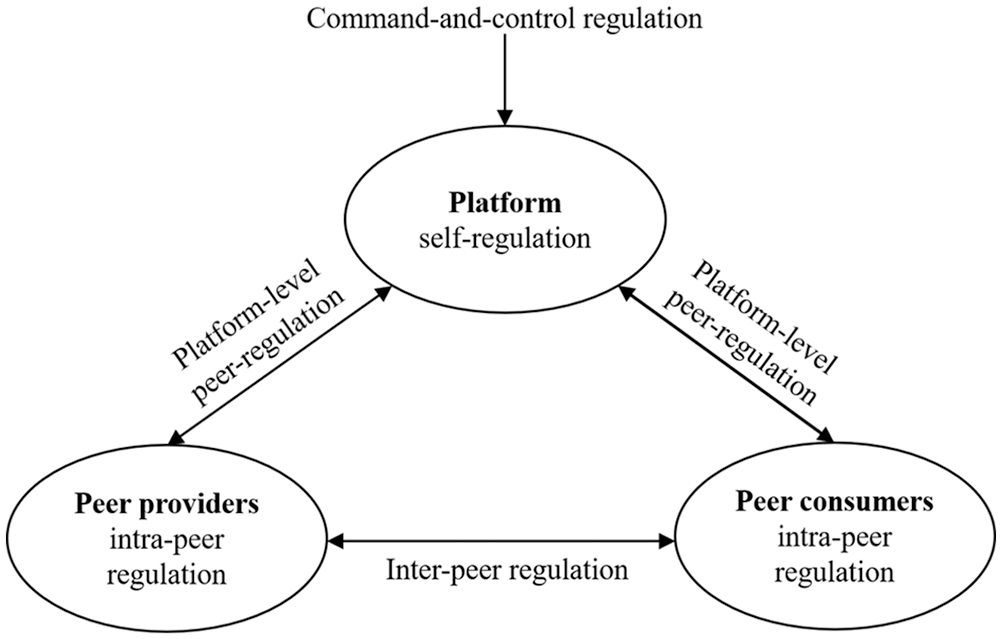
Polycentric and Multifarious Peer Regulation
We use impression management theory (Leary & Kowalski, 1990) as a theoretical framework to explore peers’ regulatory function at the intrapeer, interpeer, and platform levels. Impression management has been often drawn on to understand social interactions in settings involving certain forms of performance appraisals (Harris et al., 2007; Higgins & Judge, 2004; Wayne et al., 1997). Specifically, impression management denotes a process through which actors create, maintain, protect, or influence the images their “target others” have of them through controlling and regulating accessible information (Bozeman & Kacmar, 1997). The fundamental motivations driving individuals to use impression management consist of gaining rewards and presenting themselves in a manner consistent with their desired personal identity (Leary & Kowalski, 1990; Rosenfeld et al., 1995). Some active forms of impression management require monitoring and modification of behaviors to achieve a public image, which means that many active impression management responses are naturally self-regulatory (Vohs et al., 2005). Impression management regulates people’s behaviors in that it maximizes the reward–cost ratio when people deal with others, enhances people’s self-esteem, and facilitates the development of desired identities (Rosenberg, 1979). Peer behaviors in a P2P environment are thus regulated by individuals’ drive to influence both other peers’ impressions of themselves and peers’ own views of themselves.
Intrapeer Regulation
Individuation of peers in a P2P context. Peers in a P2P context are subject to greater public exposure, their identities are more personal, and their behaviors are governed by reciprocal evaluation. Interactions in a P2P context occur most commonly at the individual-to-individual level (Lin et al., 2019). Peer providers blur lines between the personal and professional (Cohen & Sundararajan, 2015) while peer consumers transform from choosers and users to “prosumers.” In other words, peers play the role of both providers and consumers (Ritzer & Jurgenson, 2010) and are likely to treat peer providers as real people like themselves (Eckhardt et al., 2019). Evaluation reciprocity is common in a P2P business model. In a reciprocal evaluation, both peer providers and peer consumers are compelled to engage in proper transactional and social exchange behaviors (e.g., hosts treating guests equally and honestly, and guests using a room responsibly). Because of a less anonymous, more individuated, and reciprocal P2P environment, we propose that intrapersonal self-regulation through self-monitoring and prosocial behaviors is heightened in a P2P context, and can be used to promote self-policing to serve a regulatory function.
Self-monitoring as an intrapeer regulatory mechanism. Self-monitoring expressive behaviors refer to an individual’s tendency to regulate and control verbal and nonverbal expressions according to situational cues (Snyder, 1974). This represents a desirable quality, relating to better personal performance such as desirable public appearances and harmonious relationships (Day et al., 2002). Given the heightened self-monitoring in a P2P environment and its close relationship with impression management, we propose that self-monitoring regulates peer behaviors because individuals actively construct their public selves. Individuals who focus on public, social, or self-presentational motives are concerned with others’ desires and perceptions (Snyder, 1974). Consequently, they behave in ways congruent with others’ expectations and external cues (Gangestad & Snyder, 2000). Digital reputation and monitoring systems used to protect buyers and prevent market failures have significant regulatory power and promote self-policing in a P2P business model (Sundararajan, 2012). Lin et al. (2019) suggest that reciprocal reviews screen out bad actors. Peer engagement behaviors are one of the most important components of reputation and monitoring systems. These behaviors are “manifestations of a peer’s voluntary and discretionary effort to interact and/or cocreate with other peers in a peer-to-peer context” (Lin et al., 2019, p. 391), and go beyond fundamental transactions. Therefore, they strengthen peers’ tendencies to modify their expressive behaviors to meet others’ expectations. People also construct and cultivate public identities to induce favorable outcomes (Gangestad & Snyder, 2000). Peer behaviors that are decentralized and dispersed among multiple relationships are beneficial to the construction and cultivation of individuals’ public selves. For example, in a peer provider-to-peer provider dyad, when one member exchanges information about a peer consumer with another peer provider, he or she cooperates with others to complete tasks that cannot be done by a single peer provider, thereby helping other peer providers. Through such peer behaviors, he or she not only strengthens social identities related to an in-group, but improves social appearances and images in a peer-provider community. Thus, the following proposition is put forward:
Prosocial behaviors as an intrapeer regulatory mechanism. In a P2P context, peer providers participate in the market not only for economic but also for social reasons (Kim et al., 2018). Similarly, one motivation for peer consumers to participate in P2P markets is interpersonal interactions with peer providers (Boateng et al., 2019). Beyond commercial relationships, peers sometimes also develop socially focused, personal friendships based on mutual benefits and trust. For example, with Airbnb, financial transactions represent gateways to social exchanges and interpersonal interactions normally reserved for family and friends (Lampinen & Cheshire, 2016; Lin et al., 2019). Heide and Wathne (2006) suggest that when firms play a friend role, they use the logic of appropriateness (i.e., a moral imperative) rather than consequence (i.e., maximization utility). Prosocial behaviors (i.e., helping, sharing, and cooperating) engaged in to benefit others are prominent in P2P interpersonal relationships, and can potentially exert regulatory power and promote the self-policing of peers.
Social and noneconomic aspects have become increasingly relevant in the P2P business model. Thus, the inclusion of prosociality is critical in the assessment of users’ behaviors (Schneider, 2017). The sharing economy is arguably an economy built around concern for people and the environment (Martin, 2016). Prosocial motives (i.e., helping others, social embeddedness, and enhanced community spirit) have been observed when people participate in this economy (Hellwig et al., 2015). Habibi et al. (2017) suggest that socialization, sustainability, and community growth are three axioms of management in the sharing economy. Lin et al. (2019) argue that the success of the P2P system depends on peer contributions (i.e., engagement behaviors). Consequently, an increasing number of P2P businesses is pursuing strategies that promote positive peer behavior, representing role-prescribed behaviors that are expected in the P2P system. Some researchers suggest that a prosocial orientation arouses empathic and vicarious emotions regarding the suffering of others, which in turn deters individual aggressive behaviors (Bandura et al., 2001). Positive peer behaviors can help peer consumers derive economic and emotional benefits as well as enhancing satisfaction and perceived trustworthiness of other peers and the platform (Lin et al., 2019). This, in turn, inhibits bad behaviors while promoting good ones. Thus, the following proposition is put forward:
Interpeer Regulation
The omnipresence of others in a P2P environment. In P2P businesses, a salient component is the presence of other people (i.e., peer consumers and peer providers), whether real or virtual. The presence of others in a P2P environment has two unique features. First, the presence of others in a P2P context exists in both physical and technological spheres. The presence of others can be both offline (i.e., physical proximity) and online (i.e., digital proximity), independent and dependent of online technologies. For example, the perceived virtual presence of other peer consumers and peer providers often manifests itself through peer rating digital platforms on which reciprocal ratings are available to both peer consumers and peer providers. At the same time, physical collocation among peers is likely and sometimes expected; the physical presence of both peer consumers and peer providers in the same accommodation (e.g., couch-surfing service) and/or transportation vehicle (e.g., ride-sharing service) is required for the service transaction to occur. Second, the presence of others in a P2P environment can be both asynchronous and synchronous. When peer consumers share the same good/service in the same physical environment at the same time with other peer consumers and peer providers (e.g., ride-sharing), the presence of others is synchronous. When peer consumers share the same good/service in the same physical environment at different times with other peer consumers and providers (e.g., two groups of guests check into the same Airbnb accommodation at different times), the presence of others is asynchronous. To capture the nature of the presence of others in a P2P context, we define the context as omnipresence to highlight the high degree of presence of both peer consumers and peer providers whenever and wherever. This omnipresence of others, accompanied by the unique features of a P2P business model, jointly foster a unique interpersonal regulatory environment at the peer-to-peer level. We identify two interpeer regulatory mechanisms in this environment.
Trust-enforcing as an interpeer regulatory mechanism. One possible regulatory mechanism at an interpeer level is a trust-enforcing mechanism. External regulation is often required in the event of a low degree of trust that fosters opportunism among exchange partners (Chiles & McMackin, 1996). Trust becomes even more important in P2P businesses. P2P transactions are characterized by perceived uncertainty (Bialski, 2013), the digital anonymity underlying most ratings systems (Botsman, 2017), the transience of the interactions (Moon, Miao, et al., 2019), and the reciprocity of interpersonal relationships (e.g., two-way evaluations; Lin et al., 2019), all of which require a significant role of trust throughout the P2P interactions (Bialski, 2013; Molz, 2014). Consequently, trustworthiness and P2P rapport are recognized as vital to the very existence and success of P2P accommodation as a viable form of lodging (Moon, Miao, et al., 2019). However, as Eckhardt et al. (2019) point out, little is known about the role of trust as a regulatory mechanism in P2P. This is because the bulk of marketing research in this field was conducted prior to the rise of sharing platforms (e.g., Moorman et al., 1993).
Given the omnipresence of others throughout P2P transactions, this article theorizes that peers are motivated to engage in self-regulation at an interpeer level for promotional purpose (e.g., impression regulation, self-glorification) to gain trust. For example, to establish trust among peer consumers and further a sustainable business reputation, peer providers often participate in activities beyond the scope of transactions, such as offering a free ride to the airport or recommending local activities and events based on personal experience. However, owing to the reciprocal nature of P2P, peer consumers may also be driven by the goal of gaining trust from peer providers to build a positive “customer reputation.” Therefore, peer consumers are likely to display behaviors such as volunteering in a trial run of a new service to facilitate a peer provider’s development (see, e.g., Lin et al., 2019).
The reciprocity of a P2P business model can also regulate the behaviors of bad actors, linked to a trust mechanism established in prior research (Cabral & Hortacsu, 2010; Einav et al., 2016). Specifically, to promote trust among the involved actors in P2P transactions, both peer consumers and peer providers are driven to take actions to protect each other from malicious behavior. By sharing information about a misbehaving peer consumer with other peer providers, the peer providers alert peer consumers to behave more mindfully during a consumption experience. Peer consumers also often affect other peer consumers’ perceptions and knowledge about a peer provider by posting on social media platforms or spreading word-of-mouth. For instance, Airbnb guests write reviews to expose problematic hosts, which makes it harder for those hosts to secure a reservation in the future (Einav et al., 2016). This effectively regulates the hosts’ behaviors. Thus, the following proposition is put forward:
Belongingness-enhancing as an interpeer regulatory mechanism. The human need for belonging and interpersonal connectedness in classic theories suggests that individuals need to feel a sense of belonging to either large social groups or to experience small social connections by sharing (Alderfer, 1969; Maslow, 1943). Belonging to a group is sufficient to yield benefits, such as collective vigilance, sharing of resources and information, and competitive advantages (Baumeister et al., 2016). An individual’s likelihood and need to identify with others is particularly salient in a P2P context for several reasons. First, the omnipresent others make it more conducive for peers to feel a sense of belonging in a P2P community. Second, the unique characteristics of P2P also make peers more prone to identify with other peers, including a peer focus, role fluidity (i.e., the role of users as both consumers and providers), reciprocity (i.e., two-sided review), and dispersed beneficiaries (see, a full discussion, in Lin et al., 2019). Third, P2P businesses are unique in terms of the transience of interactions (Moon, Miao, et al., 2019), perceived uncertainty (Bialski, 2013), the reciprocity of interpersonal relationships (Lin et al., 2019), safety (Kennedy et al., 2019), security (Phua, 2019), and discrimination concerns (Cheng & Foley, 2018). These characteristics heighten the need of both peer providers and peer consumers to team up and seek alliance because there is power in belonging. By engaging with other peers, their purpose may not necessarily be to seek a common identity with other peers, as often suggested in identity literature (e.g., Tajfel & Turner, 1986); instead, they are likely to work together to defend their mutual benefits (e.g., monetary values, shared resources and information, a sense of accomplishments) in a P2P community.
The construction of one’s sense of belonging has been found to be facilitated by interpersonal interactions (e.g., Parker & Ward, 2000; Wei et al., 2017). In a P2P business context, peers can heighten their sense of belonging through engagement with each other (e.g., recommendations and sharing of information and resources). Such behaviors often promote prosocial behaviors and expose bad behaviors in a P2P community. Both “praise” and “penalty” become more visible, which helps raise people’s awareness of the consequences of their own behaviors, leading to better regulation in the P2P community. Driven by the need to belong, peer providers are more likely to engage in behaviors such as augmenting a peer provider’s offering by spreading positive word-of-mouth and working together to finish tasks that cannot be done by one peer provider. For example, Airbnb hosts often leave comments about their guests on the Airbnb booking platform. Other hosts can access such comments for information and recommendation. Such exposure of both good behaviors and bad behaviors can effectively raise peer consumers’ mindfulness before they act. This is because they can more readily see the consequences of their behaviors, thereby increasing self-regulation. By partaking in such behaviors, peer providers jointly regulate the behaviors among each other and among peer consumers, eventually increasing their collective competitive advantage as a unique type of P2P business over traditional B2C businesses. Consequently, peer providers are more likely to engage in self-regulatory behaviors. Thus, the following proposition is put forward:
Platform-level Peer Regulation
A polycentric regulatory approach entails both public and private actors collaborating to coregulate P2P transactions (Cohen & Sundararajan, 2015). In such a regulatory environment, legal liability is diffused by shifting from firms to individuals (Erickson & Sørensen, 2016). Self-regulation at the platform level is constructed voluntarily, without involving direct government mandates (Black, 2001). In this section, we discuss how peer regulation is enforced at the platform level.
Peer-centric platform self-regulation. P2P online platforms are increasingly taking a peer-centric self-regulatory approach to individualize peer consumers and peer providers to reduce anonymity and verify peers as individuals in the marketplace. For example, some platforms authenticate by using face recognition and identification authorized by governments (e.g., driver’s licenses or passports). A peer-centric regulatory approach also decentralizes risks and liabilities, aiming to regulate activities that occur at the peer-to-peer level. For example, many platforms in P2P business models such as Airbnb, Eatwith, Lyft, and Uber have established limitation of liability for the platforms, thereby laying out the responsibilities of peer providers and peer consumers. This contrasts with the conventional B2C business model, in which an employee’s service failure is attributed to the organization (Migacz et al., 2018). To mitigate risks, platforms employ peer-centric measures to regulate peers’ individual activities. For example, to reduce financial risks, Airbnb hosts are “not allowed to ask for a Security Deposit (i) after a booking has been confirmed or (ii) outside of the Airbnb Platform” (Airbnb, 2020a). To minimize physical risks, Eatwith, a P2P meal-sharing platform, restricts interactions among peers for up to four hours.
The effect of such peer-centric regulation on individual peers is likely to be mediated through evaluation apprehension. Evaluation apprehension is depicted as a “person’s active anxiety-toned concern” that the person may be evaluated in a negative manner (Rosenberg, 1969, p. 281). This notion is often considered both a motivator and a barrier to an action. People often attempt to perform well to be positively perceived by others or are hesitant to take an action in a case of knowledge sharing (Bordia et al., 2006; Feinberg & Aiello, 2006). With a peer-centric regulatory approach, evaluation apprehension is heightened as peer providers and peer consumers are vulnerable to one another’s evaluation. Peers in P2P transactions may be more cautious of their behaviors in both online and face-to-face interactions with the other party because every peer plays the role of an evaluator. Thus, the following proposition is put forward:
Deindividualization as a platform-level peer regulatory approach. An opposite regulatory force in a P2P business model is that platforms are also increasingly regulating peer providers and peer consumers through a more centralized approach to control peers’ power and variance of services. They do so by setting certain policies for peers to observe and deindividualizing both peer providers and peer consumers. Deindividualization does not necessarily mean that peers become anonymous and hide their identities within a group; peers are deindividualized o some degree by a platform’s emphasis on their role as a consumer or provider instead of their peer role as an idiosyncratic individual. Deindividualization is also reflected in asymmetric power between platforms and peers. Platforms often govern operational systems and peer behaviors through self-established regulations (Moon, Miao, et al., 2019). Platform-level regulation imposes liability to peers for various policies (e.g., posting content and interacting with other peers), which determines how peers behave in a P2P business model. Although peer providers and peer consumers can manipulate a platform’s power to some extent in a situation, the platform acts as the ultimate decision-maker (Farmaki & Kaniadakis, 2020). Power asymmetry is particularly apparent in P2P complaints and resolutions (Moon, Miao, et al., 2019). In the case of Airbnb, the power balance appears to be maintained between hosts and guests through mutual reviews and ratings, but Airbnb holds power over hosts by changing policies during bargaining, as per guests’ complaints (Farmaki & Kaniadakis, 2020). It is interesting to point out that the asymmetric power that platforms wield can also be regulated through peer engagement behaviors when peers complain about a platform on a third-party website or initiate a lawsuit (Kosoff, 2017). Thus, the following proposition is put forward:
Critical Peer Regulation Issues
This article discusses peer regulation as a form of regulation in a P2P business model at intrapeer, interpeer, and platform levels. We now identify some critical peer regulation issues that warrant further conceptual and empirical exploration.
How to Build a More Effective P2P Evaluation and Reputation System in a Multifarious Regulatory Environment?
While existing online platforms in a B2C business model (e.g., Tripadvisor, Yelp) build their reputation in a market, there is a lack of external evaluation or reputation systems for the P2P platforms. Russo and Stasi (2016) raise the need to define the relevant market in the sharing economy, which can help authorities evaluate platforms’ market power and examine competition among the platforms. Currently, platforms are highly dependent on peer providers and peer consumers’ performance during P2P transactions to build the platforms’ positive image and trustworthiness in the market. For example, to demonstrate a P2P business model (e.g., Airbnb) as a safe transactional environment without fraud, both peer providers and peer consumers are required to leave online reviews about the other party after their transactions (Ranchordás, 2015). To keep online reviews positive, platforms go beyond merely setting a mutual evaluation system, but also provide guidelines for peers regarding the content of their postings on an online platform (Airbnb, 2020b). In this regard, platforms control peers’ behaviors through peer-centric regulations to secure benefits subsequently derived from peers’ evaluations of one another (e.g., online reviews and ratings). In a P2P business model, peers’ positive reviews of other peers bring about a skeptical gaze as those reviews can be superficial under the effect of the platform-level norm (Bridges & Vásquez, 2018). While the P2P platforms build positive images through self-regulation, peers can be subject to social pressure by such regulation, which would eventually yield more uncertainty of the platforms’ reputation. In this respect, it is critical for both practitioners and researchers to consider how to evaluate platforms using external systems in a multifarious regulatory environment in which traditional incumbents and other P2P platform competitors coexist.
Can Peer Providers Be Regarded as Long-term Employees in a P2P Business Model?
Supply-side flexibility, which refers to whether suppliers can readily list and delist the products they offer, is one of two essential factors, along with technology innovation, that enables rapid growth of P2P businesses (Zervas et al., 2017). Unlike traditional firms that build long-term employment relationships with employees, P2P platforms, such as Uber and Postmates, develop looser, more flexible employment relationships with peer providers (Einav et al., 2016). This results in many problems, such as insufficient protection for peer providers and inability to govern them. The lack of employment-related protection for peer providers was exacerbated during the COVID-19 pandemic. Platforms did not produce offerings and could neither control quality nor guarantee consistency because of high reliance on peer providers to offer qualified goods and services (Eckhardt et al., 2019). Peer providers are not a platform’s representatives because they do not work for the platform (Lin et al., 2019). Hazee et al. (2017) argue that individual providers have abundant agency but are not employees or franchisees of the platform. Moreover, they are not subject to legitimate power or authority. Hence, tight ex ante contracts cannot govern provider behaviors fully while ex post influence attempts by a platform are ineffective (Carson & Ghosh, 2019). To protect flexible workers in a P2P business model, some local governments and public organizations in recent years have claimed that contractors on P2P platforms should be viewed as long-term employees, and platforms should be required to provide them with more consistent or highly trained services. For example, the California Labor Commissioner ruled that an Uber driver was technically an Uber employee. Platforms must determine the net influence of treating peer providers as contractors or employees by assessing both the benefits and costs created by it. There is room for both theoretical research to assess the trade-offs that platforms experience when they rely on contract workers, and empirical research to estimate the consequences and evaluate the arguments for and against imposing employment regulations on P2P businesses.
How to Leverage the Regulatory Role of Jurisdictional Regulation and Platform Self-Regulation?
Eckhardt et al. (2019) point out that an interesting question regarding regulatory challenges is who should regulate the sharing economy. In B2C businesses, government intervention such as ex ante screening is adopted. However, this lacks frequent monitoring while P2P platforms rely heavily on reputation systems to provide continuous monitoring and use far less upfront screening. Farronato and Zervas (2018) believe that platform self-regulation might work in some specific contexts while judiciary intervention is effective in other contexts. Because of the complex, contested, and asymmetric relationships among actors in P2P consumption (Dredge & Gyimóthy, 2015), and the advantages and disadvantages of these two regulatory systems, both platforms and regulatory agencies at different levels need to transform their focus on who should regulate P2P markets to optimize their own strength and exert greater effectiveness in regulating P2P markets. From a platform perspective, questions include the extent to which a well-functioning feedback system removes the need for upfront screening or quality certification; which peer feedback ratings and reputation systems work in regulating peer behaviors; whether peer providers and peer consumers can be leveraged as the regulatory agents of the platform, and if so, how? From a legislative perspective, the questions include the extent to which jurisdictions should participate in regulating P2P markets; in which areas jurisdictional intervention is required; and what are the regulatory forms that regulatory agencies should adopt.
Conclusion
P2P hospitality businesses pose a critical regulatory challenge. This study proposes a paradigm shift from reliance on legislative agencies to a polycentric regulation framework that leverages the regulatory power of peer providers and peer consumers that are inherent in a P2P business model. This conceptual article identifies several peer regulatory functions embedded in a P2P model that are psychological, innate, yet robust. It is our hope that the conceptual framework proposed in this study, the propositions put forward, and the critical issues identified can spur more scholarly and regulatory efforts to bring about more effective solutions to this emerging challenge.
