



Abstract
This study examines the effect of employer brand on employees’ brand love by applying value congruence theory. A survey was conducted with employees of well-known hotel brands in South Korea. The results show that not all employer brand dimensions equally contribute to the formation of brand love. While economic, social, and development values positively influence brand love, interest value and application value did not affect brand love formation. Employees’ value congruence perceptions mediate this effect because employees could infer what values employers care about based on the benefits that a hotel brand offers. This study contributes to the literature by linking value congruence with employer branding and brand love. Based on our findings, hospitality managers can redesign all work activities and apply employer branding principles to reflect employment value to achieve employee’s brand love.
Highlights
This study emphasizes the importance of providing employment value to hospitality employees through employer branding.
Employer branding can be a precursor for employees to perceive value congruence and contribute to employees’ brand love.
Theoretically, this study extends the existing literature by showing that employment experience can lead to value congruence perception and brand love.
To implement employer branding strategies, hotel managers are encouraged to understand the employee values thoroughly and identify cultural factors that might inhibit employees’ employer branding experience.
Introduction
Earlier studies have addressed the importance of strengthening brand identity and developing unique brand values to help organizations survive in a competitive market. Although the previous literature advocates for the need to involve both internal and external stakeholders in the brand management process (de Chernatony & Harris, 2000), these endeavors mainly emphasize external stakeholders (e.g., customers) rather than internal stakeholders (e.g., employees). However, in the delivery of core services in hospitality companies, the attitudes and behaviors of employees influence not only customers (Grønholdt & Martensen, 2019) but also current employees (Saini & Jawahar, 2019), and potential job applicants (A. Y. Kang et al., 2019).
Addressing the importance of employees’ roles in branding, the concept of employer brand, which refers to “the package of functional, economic, and psychological benefits provided by employment, and identified with the employing company” (Xie et al., 2015, p. 125), emerged. While consumer-based brand-related concepts aim to investigate how to attract and retain more customers, employer branding is concerned with talent acquisition and retention in the job market (Mosley, 2014). However, the investigations of employer branding effects on employees are still incipient and largely lacking in empirical evidence, thus calling for more research in this area (Biswas & Suar, 2016). In practical terms, without knowing more about this relationship, hospitality companies are likely to underutilize the employer branding-related resources that could enhance talent attraction and retention of employees (Schlager et al., 2011). Despite the importance, the theorization of the employer brand concept is still in its nascent stages (Ronda et al., 2018) and our knowledge of the antecedents and consequences of employer branding is limited.
In terms of consequences, brands have cognitive and affective attributes that influence behavioral and emotional responses (Alwi & Kitchen, 2014). Practically, as brand differentiation has become more challenging, marketers have tried to find ways to create emotional connections with the target audience. Consequently, the need to understand the psychological process that leads to emotional outcomes (e.g., brand love) has been accentuated (Huber et al., 2015). Thus, employees’ brand love is a theoretically and practically meaningful concept that captures a strong emotional connection with a brand. The employer branding effect, which provides a means for the hospitality firms to attract and retain talent, has not been examined alongside brand love even though both concepts have substantial implications for employees. Also, although previous literature explains the positive relationship between employer brand and brand attractiveness and its negative association with turnover intention, the psychological distance between employer brand and outcome variables is large enough to leave an underlying psychological effect mechanism that has not been studied. Investigating the mediating variables will increase theoretical predictions and the understanding of the employer branding effect.
Previous studies that bridge employees and the branding literature often address the critical roles of value congruence in the connection between brands and employees (Byza et al., 2019). This approach, which accords with the person–organization (P-O) fit literature, highlights why individuals are more engaged with the brands’ values and philosophies when both parties’ values are congruent. Nested within value congruence theory, this study aims to understand the effect of employer branding on existing employees’ emotional consequences, such as brand love. Also, this study seeks to uncover the psychological process of developing employees’ brand love by addressing the mediating mechanism of value congruence. Data were collected from 11 hotels in Seoul and Incheon, South Korea, that have strong brand positioning in the market. Employees who have been working for the hotel for at least 1 year were recruited for this study. This article is organized as follows: theoretical background, hypotheses development, method, results, discussion, and implications.
Theoretical Background
Employer Brand
Employer brand refers to “a package of functional (developmental and/or useful activities), economic (material or monetary rewards) and psychological (feelings such as belonging, direction, and purpose) benefits provided by employment and identified with the employing company” (Ambler & Barrow, 1996, p. 187). The value of employer brand is determined based on how employees assign importance to brands’ ability to provide benefits for employees (Ambler & Barrow, 1996). Barrow and Ambler (2016) delineate the benefits of an employer brand as (a) increased equity, (b) lower recruitment costs, (c) greater engagement of employees, (d) improved delegation, and (e) greater agility. Employer branding thus constitutes an effort to establish a consistent management model that aims to increase employee productivity, recruitment, and retention (Alves et al., 2020). Berthon et al. (2005) explain that the core to achieve a strong employer brand is to establish a “compelling brand promise” (p. 154) for employees that reflect brand promises for customers.
Although Berthon et al. (2005) and Schlager et al. (2011) acknowledge a similarity between internal branding and employer branding, these two constructs are conceptually different. Miles and Mangold (2005) called this process the employer branding process. The focus of this effort is on customers rather than employees. Through the internal branding efforts, employees acquire knowledge of the desired brand image and can infuse the brand meaning in the service delivery process (Miles & Mangold, 2005). Whereas the core to employer branding is all about positioning the brand in the prospective and current employees’ minds that the brand is the best place to work by offering various benefits (Ewing et al., 2002).
To facilitate employer brand into a practice, Backhaus and Tikoo (2004) highlight that companies should first know what their brand stands for (e.g., mission and objectives) and contemplate making attractive value propositions for employees. This process is called employer brand management (Kunerth & Mosley, 2011). Berthon et al. (2005) proposed that five values could be manifested in employer brand management: interest, social, economic, development, and application. Interest value is determined by evaluating the psychological benefits of a job’s characteristics (e.g., exciting work environment, novel work practices, using employees’ creativity, innovation of products, and services; Kashive et al., 2020). Social value is related to a fun and happy working environment, a good relationship among colleagues, and a team atmosphere (Berthon et al., 2005). Economic value refers to monetary and nonmonetary benefits, such as a competitive salary, compensation packages, job security, and promotion opportunities (Berthon et al., 2005; Kashive et al., 2020). Development value refers to recognition from the organization, self-worth and confidence, career-enhancing experience, and a steppingstone for a future career (Kashive et al., 2020). Finally, application value relates to the opportunities for employees to apply what they have learned and teach others at work and a customer-driven, humanitarian value-focused work environment.
Recently, the hospitality human resources management literature has shown that when companies facilitate high levels of benefit offerings for employees, employees see this as a positive signal of organizational support (Jolly et al., 2020) in contrast to negative industry characteristics (e.g., low pay, long hours, work–life conflicts, high turnover; Guchait et al., 2015). Jolly et al. (2020) assert that employees could assume from the benefits packages they receive and feel that the employer is more responsive to employees’ basic and socioemotional needs. When they form such an impression, hospitality employees experience increased P-O fit perception; thus, designing an all-inclusive benefits package is essential. As the theory illustrates, value congruence is a prerequisite for positive employer/employee relationships, and value congruence incubates employees’ psychological attachment to the employers (Cable & Edwards, 2004).
Value Congruence Theory
In value congruence theory, values are defined as “general beliefs about the importance of normatively desirable behaviors or end states” (Edwards & Cable, 2009, p. 655). When values are consistent between a person and an organization, value congruence is perceived (J. J. Wang & Zhang, 2017). Value congruence theory has been widely applied to investigate the effect of person–organization fit on employees’ behaviors and attitudes (Langer et al., 2019). The theoretical tenets of value congruence theory explain that greater value congruence between a person and an organization predicts positive organizational outcomes, such as organizational identification, perceived organizational support, peer-rated citizenship behaviors, turnover intention, and job satisfaction (Cable & DeRue, 2002). In addition, Edwards and Cable (2009) explain that value congruence enhances organizational trust and attraction because employees’ preferences and organizational goals are aligned.
Value congruence is conceptualized in two different ways: subjective and objective. Subjective value congruence refers to the agreement between the employees’ and the organization’s values as determined based on employees’ perceptions (Kristof-Brown et al., 2005). Meanwhile, objective value congruence is assessed based on comparing the employees’ and the organization’s values. Generally, an evaluation of objective congruence is made based on the observations of other employees (e.g., managers or coworkers; Edwards & Cable, 2009). However, the original conceptualization of employer brand values indicates that the judgment of what values are offered to employees and how well they are implemented is evaluated at the level of the focal employees’ perception rather than that of other coworkers (Ghielen et al., 2021).
Brand Love
Brand love is “the degree of passionate, emotional attachment a satisfied consumer has for a particular trade name” (Carroll & Ahuvia, 2006, p. 81). Consistently, in this study, brand love refers to employees’ passionate, emotional attachment to the employer brand. According to Sternberg’s (1986) triangular theory of love, brand love consists of three subdimensions: intimacy, passion, and commitment (Shin & Back, 2020). The first dimension, intimacy, refers to a feeling of closeness and connectedness between partners (Shin & Back, 2020). The second dimension, passion, is related to the emotion that includes various forms of arousal, such as motivation, engagement, and identification (P. Chen et al., 2020). The third dimension, commitment, is linked to long-term-oriented love (Sternberg, 1986) and related to identification, shared values, belongingness, dedication, and similarity (Fullerton, 2003). A perceived normative and moral obligation is required to maintain a relationship between partners, even when better alternatives are offered (Batra et al., 2012).
Brand love is a uniquely different concept despite some similarities among brand love and related constructs (e.g., brand loyalty and satisfaction). In terms of brand loyalty, it stems from cognitive satisfaction that does not necessarily require experience. Oliver (1999) explains that even vicarious knowledge about a brand would be sufficient to establish brand loyalty. However, brand love, a more robust concept than a positive feeling, creates positive emotional connections with a brand (Batra et al., 2012). Carroll and Ahuvia (2006) observed that brand love focuses on psychological satisfaction from actual experiences, and these experiences serve as a prerequisite to brand love. In Batra et al.’s (2012) extensive study on brand love, brand loyalty is identified as a consequence of brand love; thus, these two variables are conceptually distinct. Later, brand love concepts and measurement are validated across the samples from many different (Bagozzi et al., 2017). Brand love is also different from satisfaction. While satisfaction is more transactional, brand love is based on long-term interactions with a brand (Carroll & Ahuvia, 2006).
Concerning employer brand, Budhiraja and Yadav (2020) addressed a gap in the literature on how employer branding achieves emotional outcomes. They explained that the all-inclusive packages that employer branding efforts provide can attract talent by enhancing the emotional bonding process. Long-Tolbert and Gammoh (2012) explain that satisfaction without emotional attachment or connection can lead to loyalty switching; when the temptation of attractive job offerings is aroused, brand loyalty without brand love does not safeguard talented employees from moving (Tsai, 2014). However, most brand love studies involve tests at a customer level (e.g., Shin & Back, 2020; Y. C. Wang, Qu, et al., 2019). Just as brand love contributes to maintaining long-term customer relationships (Carroll & Ahuvia, 2006), employees’ brand love can enhance employees’ positive behavior toward the employer brand (Y. C. Wang, Ryan, et al., 2019).
Hypotheses Development
Employer Brand and Value Congruence
The employer brand literature highlights that providing all five subdimensions in the employment experience is fundamental to successful employer brand implementation (Berthon et al., 2005), perhaps because providing all employer brand could potentially tap into various employees’ values. In terms of interest value, the employer brand literature explains that when an organization facilitates jobs involving innovation and excitement, a more significant employer branding effect can be expected (Berthon et al., 2005). The innovativeness of a brand requires employee participation, and when employers provide employees with opportunities to be innovative in their day-to-day jobs, employees’ values can be satisfied (Al-Sada et al., 2017). When employers show that they assist employees’ basic needs to be innovative and creative through work, employees could perceive enhanced value alignment between themselves and the employer brand. Applying this logic, if employees have an impression that the employer cares about interest values, but that component is not provided in the employment experience, a salient incongruence would be experienced, as the things employees value are not offered through employment experience. Therefore, it would increase the subjective evaluation of value congruence.
The link between social values and value congruence perception is unclear. A plausible explanation can be drawn from the characteristics of the hospitality industry and the workplace fun management literature. Hospitality workers are intrinsically motivated by a nurturing, social, and collaborative work environment (Tesone & Ricci, 2006). Positive social relationships with colleagues are essential for hospitality employees (Redmond & Sharafizad, 2020) because hospitality employees enjoy working with other people, such as customers and colleagues (Brown et al., 2015). Thus, they tend to consider social values important motivations to work (Stone et al., 2017). However, these motivations can sometimes be suppressed due to irregular working hours and emotional labor, and these situational impediments are challenging to change. Thus, Xu et al. (2020) explained that facilitating a fun and happy work environment is critical for hospitality organizations. Such an environment can serve as compensation for hard work and a success factor for employee retention. When employers make an effort to provide a fun and social work environment, employees perceive that they care about the employees’ social values. These prior studies prove that value congruence with employer brand will increase if employees’ reasons to work in the hospitality industry are satisfied through employers’ efforts to provide a social work environment.
Previous studies have explained that employers can elicit positive behaviors and attitudes if employers provide attractive monetary and nonmonetary benefits to employees through employer brand (Berthon et al., 2005; Biswas & Suar, 2016). Despite our incomplete understanding of economic values and value congruence, motivation theory can provide a plausible rationale. Employees consider economic value a fundamental reason to work (Chi et al., 2018) because economic values can fulfill employees’ basic needs (Chi et al., 2018). Nevertheless, due to the characteristics of the hospitality industry, such as inadequate compensation (Chang & Tse, 2015), economic values are the primary reasons for ending the employment relationship (Brown et al., 2015). Therefore, Chiang and Birtch (2010) explain that when organizations implement a fair pay and performance match system, it helps employees align their values with the organizational values, as these are essentially intertwined. Consequently, economic values offered by an employer brand can improve P-O fit perception (Chiang & Birtch, 2010). Moreover, the previous literature identified that pay is one of the central values of hospitality employees (Wildes, 2008). Thus, it is anticipated that when employer branding efforts could show that employer brand cares about economic values of employees, congruence perception between the brand and self will also be enhanced.
The employer branding literature shows that providing career development opportunities can improve work-related behavior and attitudes (Berthon et al., 2005). Career development is related to one’s long-term goals and is an important motivation to work (Brown et al., 2015), and hospitality workers value development (Wildes, 2008). However, the hospitality industry is notorious for not providing sufficient career development opportunities, leading to high turnover (Brown et al., 2015). Therefore, when employer branding offers development opportunities, the effort could be seen as though what employers value aligns with employees’ motivation to develop their careers and fulfill their long-term goals. As a result, it could be plausible that employees perceive greater value congruence with the employer brand’s values when the development values are embedded in the employment experience.
Employees’ feeling of being able to contribute to the organization and apply their knowledge to their work can lead to the positive effects of employer brand. Knowledge sharing between employees relates to employees’ motivation because it is critical to delivering excellent customer service and preventing service failures (Swanson et al., 2020). Employees feel more satisfied when their needs to contribute to the service value creation are met through the employment experience (S. A. Lee & Kim, 2017). Furthermore, the ability to devote themselves to society is why employees choose to work in the hospitality industry (Stone et al., 2017). Therefore, when employer branding efforts provide opportunities to share their knowledge and contribute to customer service and society, hospitality workers who value these aspects would see more value congruence with the employer because they see that the employer cares about these values.
Value Congruence and Brand Love
In the organization behavior literature, value congruence is synonymous with a definition for P-O fit, and value congruence is a basis for building strong emotional bonds with employers (Cable & DeRue, 2002). Although it is unclear how value congruence influences the subdimensions of brand love, it can be presumed, by bridging the consumer and employee behavior literature, that when employees perceive greater value congruence due to the employer’s branding efforts, it might lead to enhanced employee’s brand love. Regarding intimacy, the earlier literature explained, albeit limitedly, that value congruence reduces the psychological distance between employer and employees, potentially increasing the feelings of intimacy toward the employer (H. Chen & Li, 2018). If this proposition holds, it is plausible that value congruence would positively affect employer brand intimacy.
Employees who perceive congruence between their values and employer brand’s values tend to identify with the brand (Cable & DeRue, 2002), to be better motivated (Li et al., 2015), and to be more engaged with their employers and work (Li et al., 2015). The combination of all three of these aspects is referred to as brand passion. Amos and Weathington (2008) further explain that value congruence leads to positive behavioral outcomes such as job satisfaction. However, positive behavioral consequences are likely to occur only when employees perceive that their employers value the employees. Thus, when employers embed comprehensive brand benefits into employee work experiences, the enhanced value congruence perception can offer satisfying job experiences, thus fulfilling employees’ need for satisfaction and increasing their passion for their work (K. J. Lee, 2016).
The previous literature explains that when employees perceive strong value congruence with their employers, employees’ feelings about organizational belongingness increase due to the enhanced similarities that employees perceive between themselves and employer brand’s values (Wei, 2015). Therefore, similar to how customers perceive value congruence with a brand and how it enhances the connection with the brand (J. Kang et al., 2015), it is possible that when employees perceive high value congruence, they experience increased connectedness with the employer brand. In this case, it is anticipated that value congruence will lead to high employer brand commitment (Figure 1).
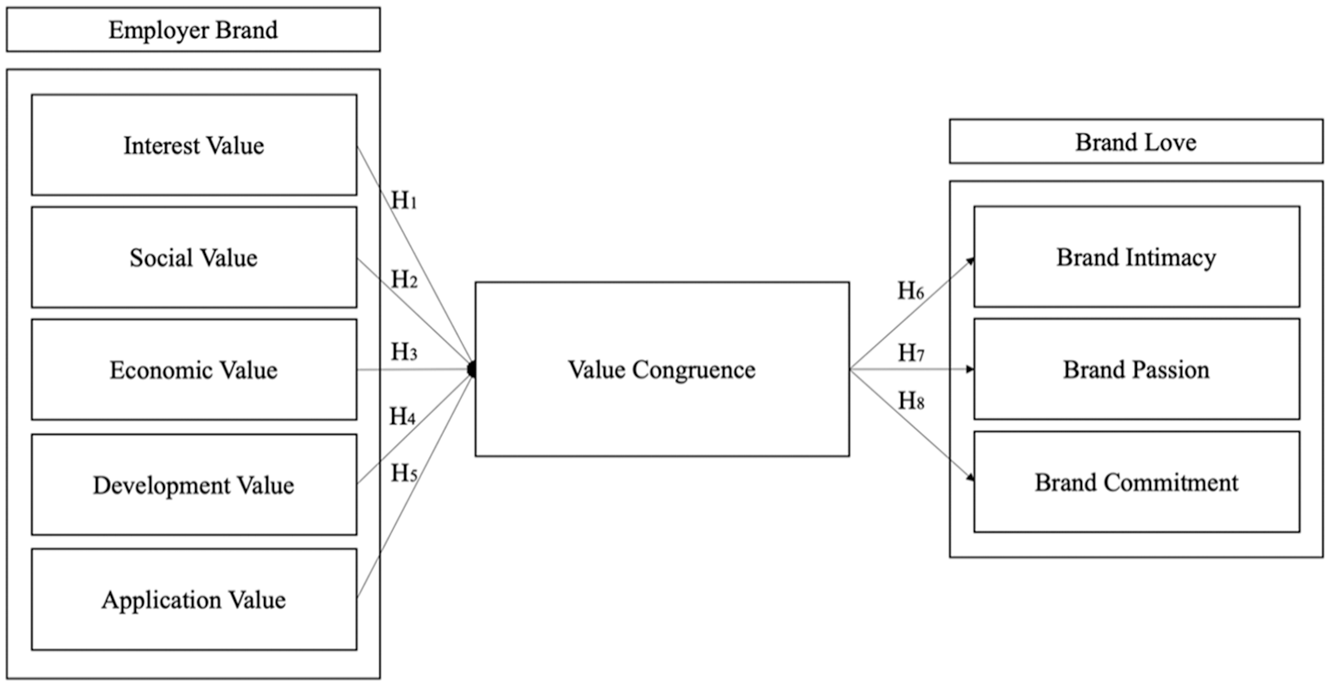
Conceptual Framework
Method
Data Collection
The data set was collected from the employees of 11 five-star hotels with more than 250 rooms for business customers, from a global and domestic chain located in Seoul and Incheon, South Korea. Employees prefer all 11 hotels because they have substantial employer brand benefits instilled in the work experience. The surveyed employees have more than a year work experience. Directors of human resource departments or general managers administered the surveys. To improve respondents’ understanding of employer branding, the survey administrators verbally explained the employer brand concept to respondents, and both concepts were explained in the questionnaire cover and each section. Of the 340 questionnaires distributed, 305 completed questionnaires were received between December 2019 and January 2020.
Measurement
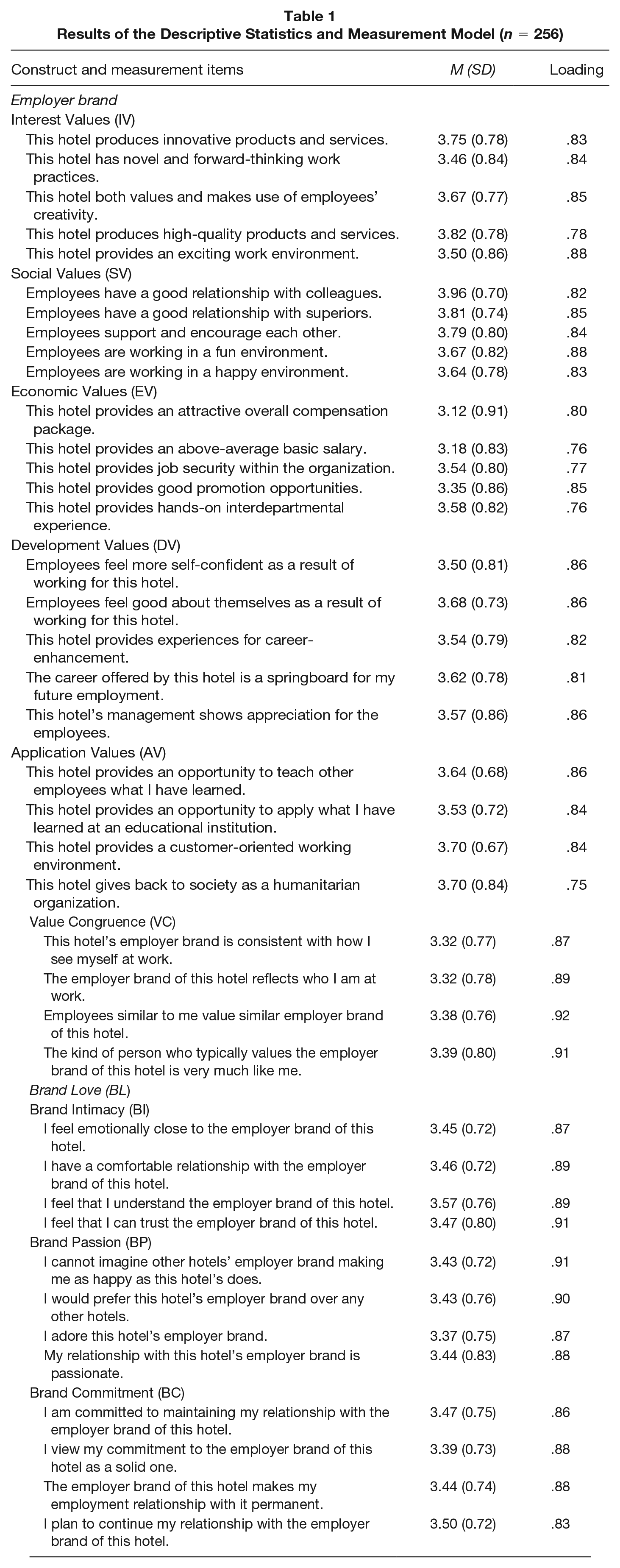
All constructs were measured with multi-item measurements using a 5-point Likert-type scale from (1) = strongly disagree and (5) = strongly agree. Employer brand consisted of five values adopted from Berthon et al. (2005) to measure the employer brand provided by the company: interest value, social value, economic value, development value, and application value. Value congruence was measured using four items adapted from Sirgy et al. (1997). Brand love was measured by the degree of employees’ passionate, emotional attachment to the employer brand with three dimensions (intimacy, passion, and commitment); each of these dimensions was measured with four items (adapted from Y. C. Wang, Qu, et al., 2019; see Table 1). All measurement items were translated into Korean using a back-translation method (J. Kang et al., 2015). Two experts who are proficient in English and Korean were employed for this process. Later, we hired one more expert who is fluent in both languages to confirm the translation quality. A pilot test of 30 hotel employees across all 11 hotels was conducted to detect any errors in the questionnaire and ensure the scales’ validity. After the pilot test, to improve participants’ understanding, the definition of employer brand and examples of educational institutions and humanitarian organization activities were added to the application value items.
Results of the Descriptive Statistics and Measurement Model (n = 256)
Analysis
First, data screening and descriptive analysis were performed to check for missing data and relevant assumptions, and a conservative 17 missing data points were removed. Next, we deleted 32 data points that were extreme outliers in the boxplot (Sim et al., 2005). The Shapiro–Wilk test was used, and the results indicated that all of the items were not normally distributed (p < .001). Next, multicollinearity issues were examined with bivariate correlations among the constructs and variance inflation factor (VIF) values. Then, as Valle and Assaker (2016) recommended, we examined measurement (outer) and structural (inner) models. The proposed model and hypotheses were tested using the partial least squares structural equation modeling (PLS-SEM) method. PLS-SEM has greater flexibility with data assumptions such as data distribution constraints and tests predictive relationships between constructs as an alternative technique to covariance-based SEM (Valle & Assaker, 2016). Finally, to minimize differences across different hotels, we dummy coded all 11 hotels and used them as control variables.
Results
Profile of Respondents
Of the 305 respondents, 49 cases were deleted due to incomplete answers and outlier analysis. Thus, 256 responses were used for the analysis. More than half the respondents were male (62.9%), and the mean age was 36.85 years old. Of the respondents, 63.3% had a bachelor’s degree, and half were not married (50.4%). Half the respondents worked at a supervisor level (50.4%), and 48.8% worked in a food and beverage department. The mean employment period for the current hotel was 7.09 years.
Measurement (Outer) Model Analysis
Indicator loadings for each item ranged from .75 to .92 (higher than .70). All the Cronbach’s α results for internal consistency and composite reliability measures were higher than .70 (Hair et al., 2011; see Tables 1 and 2). The average variances extracted, indicating convergent validity, were between .62 and .81, which is over the .50 threshold (Hair et al., 2011). The discriminant validity is assessed with the Fornell–Larcker criterion, cross-loadings, and heterotrait-monotrait ratios of correlations (Henseler et al., 2016). All correlation values for discriminant validity were less than the square root of the average variance extracted values (Fornell & Larcker, 1981). The results of heterotrait-monotrait ratios of correlations showed that all figures were smaller than the threshold of 1.0 (Henseler et al., 2016; see Table 3). As reported above, all measurements of this study satisfied the reliability and validity requirement for PLS-SEM. A Harman’s one-factor test was used to check for common method bias (Podsakoff et al., 2012). All items are loaded into one common factor. The single-factor variance was 46.79% (less than 50.0%), indicating no critical common method bias issues.
Discriminant Validity (Fornell–Larcker Criterion) and Measurement Quality
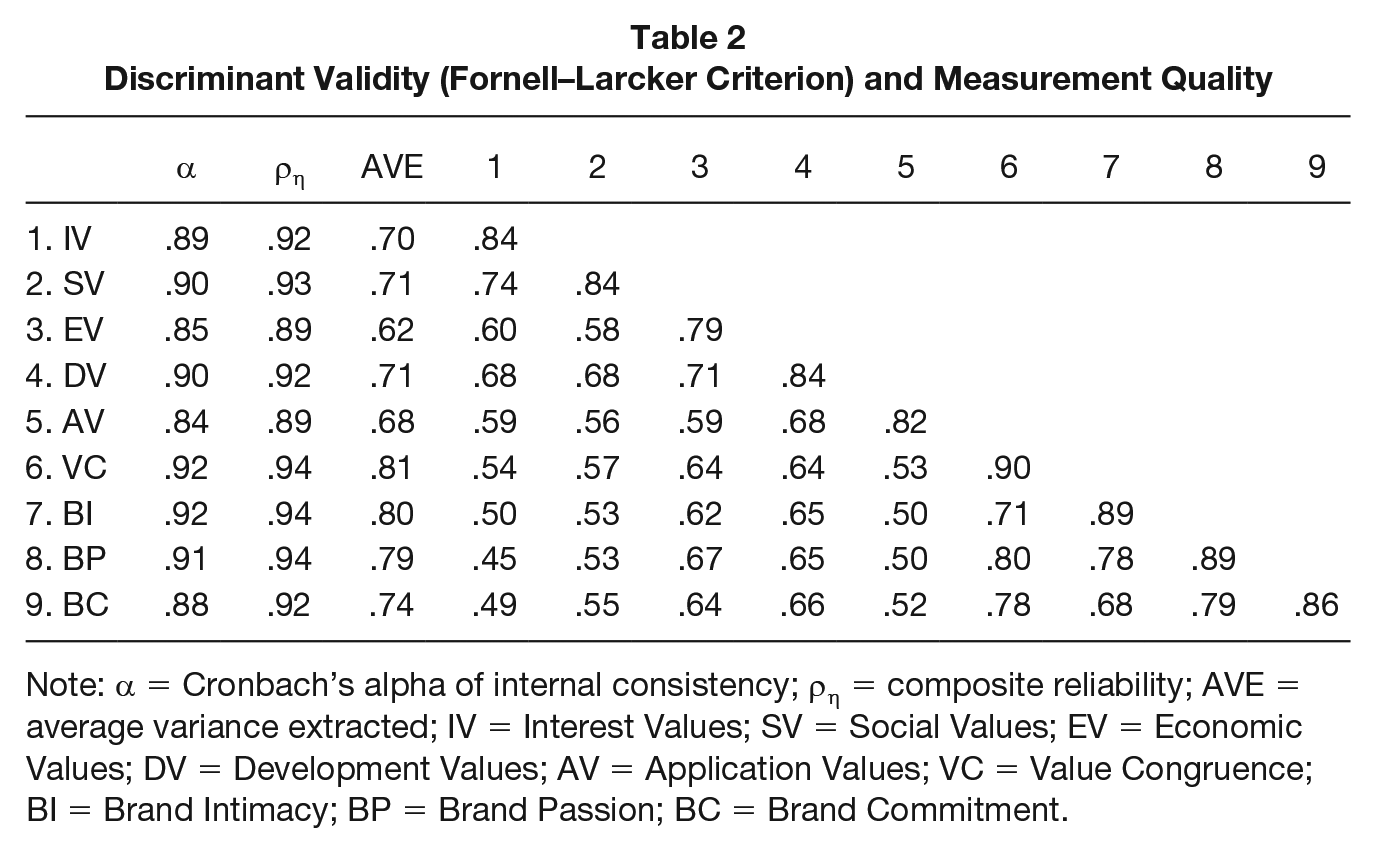
Note: α = Cronbach’s alpha of internal consistency; ρη = composite reliability; AVE = average variance extracted; IV = Interest Values; SV = Social Values; EV = Economic Values; DV = Development Values; AV = Application Values; VC = Value Congruence; BI = Brand Intimacy; BP = Brand Passion; BC = Brand Commitment.
Heterotrait-Monotrait Ratios of Correlations
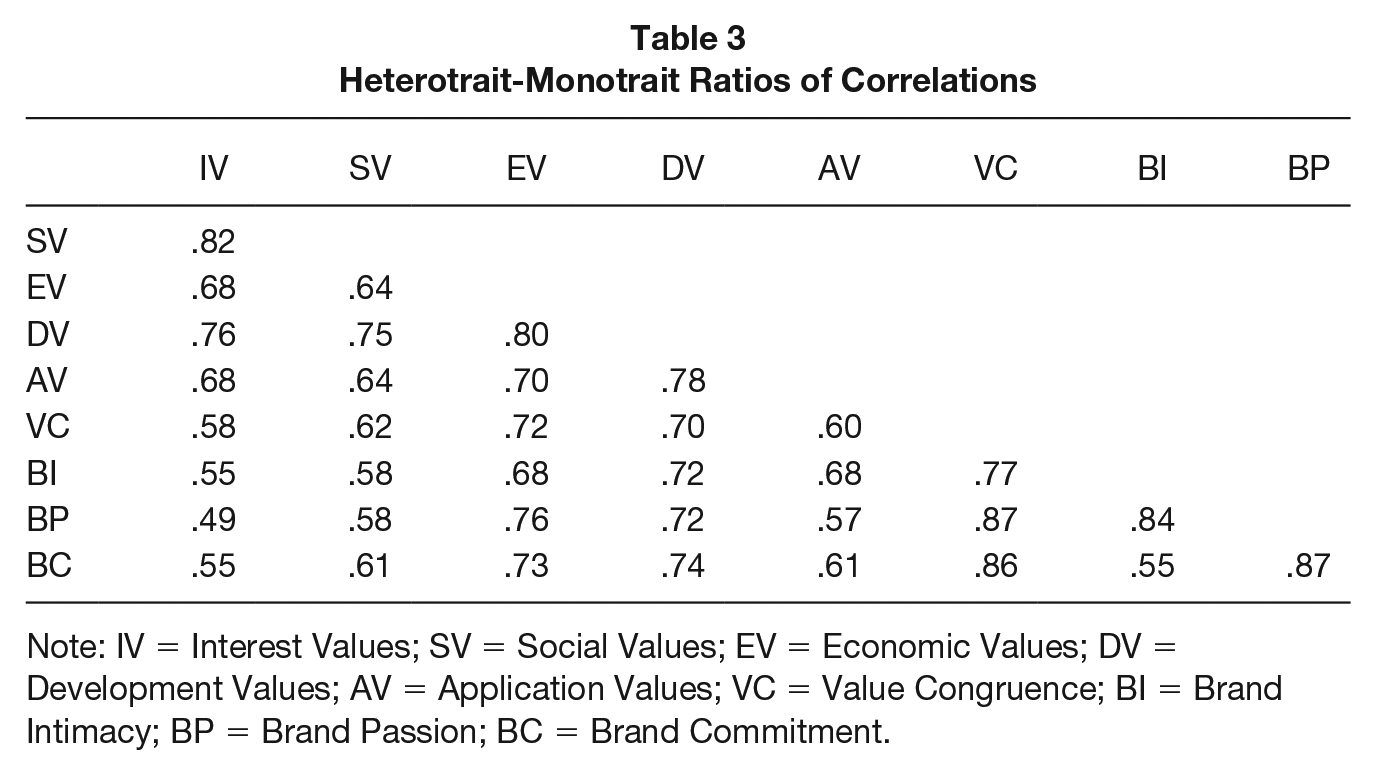
Note: IV = Interest Values; SV = Social Values; EV = Economic Values; DV = Development Values; AV = Application Values; VC = Value Congruence; BI = Brand Intimacy; BP = Brand Passion; BC = Brand Commitment.
Structural (Inner) Model Analysis
To detect potential multicollinearity issues, correlations among variables and VIF values were estimated in this study before examining the proposed hypotheses. In the results, all of correlation values were under .80, and the VIF value for each indicator was less than 5.0 (Hair et al., 2011). To assess the inner model’s predictive relevance, Q2 was evaluated by using the blindfolding procedure (Hair et al., 2011). All Q2 values were larger than 0 (Q2VC = .397, Q2BI = .392, Q2BP = .499, Q2BC = .450); thus, our model had predictive relevance (Hair et al., 2011). Path analysis results while controlling for 11 hotels showed that the model explained variance of value congruence by 49%. Adjusted R2 values of employer brand intimacy, employer brand passion, and employer brand commitment explained 50%, 63%, and 61% of variance, respectively. Hypothesis testing results showed that social value (β = .18, t = 2.36, p = .018, ƒ2 = .03), economic value (β = .30, t = 4.26, p = .000, ƒ2 = .08), and development value (β = .22, t = 2.60, p = .009, ƒ2 = .03) of the employer brand had positive influence on value congruence. Thus, Hypotheses 2, 3, and 4 were supported, but Hypothesis 1 (p = .955) and Hypothesis 5 (p = .177) were rejected. The ƒ2 values referring to effect sizes were categorized as small (.005), medium (.01), and large (.025; Kenny, 2016). The three variables showed large effects on value congruence. Among these three variables, economic value seemed to have the strongest effect on value congruence. In accordance with testing Hypotheses 6 to 8, value congruence positively and strongly affected employer brand intimacy (β = .69, t = 16.29, p = .000, ƒ2 = .87), employer brand passion (β = .79, t = 22.53, p = .000, ƒ2 = 1.58), and employer brand commitment (β = .77, t = 24.98, p = .000, ƒ2 = 1.40), supporting Hypotheses 6, 7, and 8 (see Table 4). The effect sizes among significant variables are different. The results show that the effects of social value (ƒ2 = .03), economic value (ƒ2 = .08), and development value (ƒ2 = .03) on value congruence are less than the effects of employer brand intimacy (ƒ2 = .87), employer brand passion (ƒ2 = 1.58), and employer brand commitment (ƒ2 = 1.40). None of the control variable paths to the outcomes were significant (see Table 4). Consequently, the variation of hotels did not affect the relationship between the focal variables.
Structural Equation Model Results

Note: VIF = variance inflation factor; IV = Interest Values; SV = Social Values; EV = Economic Values; DV = Development Values; AV = Application Values; VC = Value Congruence; BI = Brand Intimacy; BP = Brand Passion; BC = Brand Commitment; Adjusted R2: VC = .49; BI = .50; BP = .63; BC = .61.
p < .01. **p < .05. *p < .1.
Mediation Test
The results of the mediation test showed that value congruence had significant mediation effects between social value (β = .12, t = 2.35, p = .020), economic value (β = .21, t = 4.18, p = .000), and development value (β = .15, t = 2.55, p = .011) on the one hand and employer brand intimacy on the other. A mediation test demonstrated that social value (β = .14, t = 2.35, p = .020), economic value (β = .24, t = 4.11, p = .000), and development value (β = .17, t = 2.59, p = .010) had influences on employer brand passion via value congruence. The results also indicated that value congruence mediated between social value (β = .14, t = 2.34, p = .020), economic value (β = .23, t = 4.14, p = .000), and development value (β = .17, t = 2.56, p = .010) on the one hand and employer brand commitment on the other (see Table 5). The results of mediation test including control variables were found to be insignificant (see Table 5). Thus, as in the hypothesis test, hotels were found to have no role in the mediating relationship between focal constructs.
Mediation Analysis Results

Note: All effects are estimated using the bootstrap resampling procedure in SmartPLS (256 cases, 5,000 bootstrapping runs, 1,000 PLS iterations). IV = Interest Values; SV = Social Values; EV = Economic Values; DV = Development Values; AV = Application Values; VC = Value Congruence; BI = Brand Intimacy; BP = Brand Passion; BC = Brand Commitment.
p < .01. **p < .05. *p < .1.
Discussion
Given that employment enables basic economic activities (e.g., purchasing food) and is a fundamental reason that employees work for a company, and given the notorious reputation of the hospitality industry for providing few economic benefits (Chang & Tse, 2015), employees perceive the most value congruence with the employer brand when opportunities to increase economic values are offered to them (Chuang & Dellmann-Jenkins, 2010). This finding is perhaps why this study observed the strongest beta coefficient for economic values on value congruence. This finding is consistent with other literature around merit pay and performance (Chiang & Birtch, 2010). Regarding development values, when a career-enhancing experience is offered through employer branding, employees have a greater overall value congruence perception of the employer brand. This is because development values suggest a long-term future in the organization and opportunities to grow, which are the core motivations for hospitality workers (Berthon et al., 2005; Brown et al., 2015). Hospitality companies have a notorious reputation for high turnover; thus, employers’ efforts to help employees grow their careers within a company could be a value-aligning factor (Brown et al., 2015). Additionally, as collegial social relationships are paramount for hospitality employees (Tesone & Ricci, 2006), employers facilitating positive social relationships can positively relate to employees’ value congruence perceptions. These findings align with previous studies highlighting the significant roles of economic values, development values, and social values in perceived employer brand (Schlager et al., 2011).
Despite the importance of interest value and application value, these were not statistically significant. A potential explanation for this finding lies in the South Korean hospitality organizational culture, which is more hierarchical and bureaucratic than Western organizations. In hierarchical and bureaucratic organizations, a significant emphasis is on employees’ positions; thus, such characteristics become hurdles to facilitating interest and application values. Moreover, even though these values are offered, the cultural norm might hinder their benefits. As a result, employees experience hardship in voicing their innovative ideas, and a strong cultural focus on compliance with senior managers’ ideas is imposed on organizations’ policies.
Moreover, in a bureaucratic culture under the significant cultural and societal influence of Confucianism, the concept of creating an exciting environment conflicts with bureaucratic characteristics; indeed, a stimulating environment provided by supervisors can be a burden to employees (Kim & Plester, 2019). With a rigid organizational structure that is highly position-oriented, opportunities to apply knowledge in ways that influence fellow employees are often only given to senior managers. Due to these characteristics of the South Korean hospitality organizational culture (Kim & Plester, 2019), employees might not see their values being enacted in their work, resulting in nonsignificant results of these two values.
The results indicate that value congruence has a significant impact on all three dimensions of brand love. The effect sizes demonstrate that the value congruence perception of employees has the most potent relationship with the following: brand passion, brand commitment, and brand intimacy. Our study results show that perceived value congruence increases employees’ passion for their employers’ brands because it enables employees to work in more harmonious relationships with employers without worrying about dissonance or discomfort due to dissimilar values. As a result, employees can be motivated to put additional resources and passion into their work.
The mediation analysis results indicated that social, economic, and development values strengthen employees’ brand love due to perceived values congruence. When the employer brand offers various values in the employment experience, employees perceive greater value congruence because employees make inferences from the benefits offered and perceive that the company’s values align with theirs (Jolly et al., 2020). Then, the value congruence helps employees genuinely fall in love with the brand. Consequently, employees can overcome negative working environments (e.g., high turnover, low pay, extensive hours) and love the company more. Economic values have the strongest indirect effect on the brand love, followed by developmental and social values, perhaps because hospitality workers are greatly concerned about pay (Wildes, 2008). Companies that offer competitive economic values can differentiate themselves from their competitors. Therefore, employees could interpret this effort as employers caring for economic values, seeing it as a value aligning factor. Reflecting the rank order shown in Wildes’ (2008) study, our study results indicated that when employer branding efforts include development and social values, employees perceived increased value congruence, leading to greater brand love. Similar to economic values, this outcome could result from companies’ efforts to embrace what employees care about in their employment experience, increasing the perception of congruence. In contrast, the results showed that value congruence has no mediating effect between interest and application value and brand love because it is difficult to reflect interest and application values in employer brand due to the hierarchical and bureaucratic organizational culture of the South Korean hospitality industry.
Conclusion
Theoretical Implications
First, this study responds to the calls for research on employer branding (Biswas & Suar, 2016). It provides meaningful theorization on how employer branding contributes to value congruence and brand love. This study also demonstrates that how employers facilitating values and benefits in employment experiences can improve employees’ judgments of the value congruence between the brand and themselves. This result is consistent with the previous literature that when brands offer diverse benefits to employees, employees perceive the support for their personal needs, wants, and beliefs, increasing value congruence perception (Jolly et al., 2020). Our conceptualization and conclusions show that value congruence is a subjective judgment of employees’ that depends on employers’ efforts to stay competitive in the labor market while actively reflecting employees’ needs (e.g., diversity; Madera et al., 2018). Therefore, this study extends the scope of internal brand management literature by building a bridge to employer branding. This is a critical effort, as some researchers point out that previous employer branding literature is biased in a sense that it is only limited to the external framework (De Stobbeleir et al., 2018; Tumasjan et al., 2020).
Second, this study’s findings bridge the organization behavior and branding research by introducing a solid emotional outcome, brand love, which has rarely been applied to employees but has been applied more widely to consumers (Batra et al., 2012; Y. C. Wang, Ryan, et al., 2019). By doing so, this study highlights the effects of employer brand on affective outcome variables such as brand passion, brand intimacy, and brand commitment. Moreover, in the limited brand love literature, the brand love concept is used as an antecedent rather than an outcome variable (Y. C. Wang, Ryan, et al., 2019). Our study results show that brand love can work as a likely outcome variable and that employees’ value congruence perception positively relates to all three dimensions of employer brand love. However, despite these positive effects, the extent to which value congruence is related to brand passion, brand commitment, and brand intimacy can vary.
Third, although employer brand has been shown to positively affect attitudinal and behavioral outcomes (e.g., Biswas & Suar, 2016), empirical explorations of mediating variables between employer branding and outcome variables are very limited. Thus, there are problems related to understanding the underlying psychological mechanisms that drive such behavioral changes. This problem weakens the theoretical predictions for the behavioral consequences because of the psychological distance between endogenous and exogenous variables. Our study offers evidence that the positive effect of employer brand on brand love is due to an increased level of value congruence perception. The results confirm the legitimacy of our proposed theoretical conceptualization, suggesting that benefits offered in the employment experience could support employees’ inference-making process and judge value congruence; in turn, these efforts lead to brand love.
Practical Implications
This study explains that monetary and nonmonetary benefits offered by employers can work as an inference-making point that the employees could use to form value congruence perceptions. Thus, this study suggests that corporate brand managers and human resources directors should collaborate to understand employees’ motivations to work for their companies and consider how those values are instilled in benefit offerings, especially all-inclusive packages. Furthermore, before implementing employer branding strategies, it is advisable to examine the cultural influences (e.g., Eastern culture, hierarchical organizational culture) that might inhibit the employer branding from being fully experienced by employees.
For established brands with more rigid cultures that experience difficulties changing employees’ work experience to accord with the brand, this study recommends focusing on economic, social, and developmental values to achieve greater values congruence with employees. While addressing all five dimensions is likely to produce the best outcome, it is also possible for each organization to differ in terms of the resources available to enable such changes. Therefore, companies can first revise compensation, benefits packages, and promotion opportunities because creating a match between employees’ work performance and pay could help employees align their values with organizational values (Chiang & Birtch, 2010). However, if this is challenging due to resource constraints, social and developmental values could be incorporated into the employer branding efforts. For example, providing career development opportunities, organizational recognition, feelings of self-worth, and an environment that enhances self-confidence could be one solution. Additionally, offering team-based working atmospheres and facilitating good collegial relationships could be another approach to implement the findings of this study.
This study emphasizes that employer branding enhances employees’ brand love based on the perception of increased value congruence. This finding offers two implications. First, companies that disregard the importance of employer branding that reflects employees’ motivations to work or fail to incorporate employer brand’s values into employees’ work experience could experience negative employee behaviors, such as decreased employer brand passion and commitment, which might lead to high turnover rates. Our study results indicated that when employers do not provide any benefits that show cares for employee’s values could result in false inference making of employees. Second, an employee’s performance is often evaluated with performance-based measures. However, this study introduces brand love that is a long-term and emotion-based performance measure. Managers of hospitality brands can apply our theoretical model to examine the “soft side” of employees’ attachment to the brand. By implementing employee surveys about brand love, companies can gauge how their employer branding efforts could increase employees’ motivation to “go above and beyond” in their job performance, which is generally not captured in performance-based evaluation measures.
Limitations and Future Research
This study has several limitations. First, there has been a notable emphasis on the organizational culture’s influence on value congruence perception in the organizational behavior literature. Therefore, future researchers can investigate the influence of cultural differences (e.g., Western vs. Eastern) on employer branding effects. Future research can also explore the potential moderating effect of organizational culture and different brand personalities (e.g., sincere brands vs. exciting brands) while testing the theoretical model proposed in this study. Second, although the challenging hospitality work environment (e.g., low wage, extensive and irregular working hours, and emotional labor) is similar across the globe, this study was conducted in South Korea, where organizational culture and structure are influenced strongly by societal norms (e.g., Confucianism). Thus, future researchers can investigate cross-cultural differences in the employer brand effect.
Summary
This study examines the effects of employer branding on brand love. This study, nested within the value congruence theory, highlights the mediating effects of value congruence between employer brand and brand love. The findings of this study demonstrate that not all dimensions of employer brand contribute to the development of brand love, especially interest and application values.
