



Abstract
This study examined tourist motivations to determine whether peer-to-peer dining is a new, pursuable tourism product. A two-stage analysis of semistructured interview data from 28 individuals yielded three push dimensions (i.e., seeking variety, gaining authentic experience, and enhancing social circle) and six pull dimensions (i.e., food items, atmosphere, relationship with the host, value, service quality, and type of food), which were linked by word-of-mouth and publicity for peer-to-peer dining. Several motivational differences identified between participation in the sharing economy and in conventional dining have suggested that peer-to-peer dining reflects a novel product in food tourism. Interestingly, findings also suggested that tourists perceive local and overseas peer-to-peer dining services differently. This research contributes to the existing literature on the sharing economy and bears practical implications for food destination development and branding.
Introduction
The rapid and overwhelming growth of peer-to-peer platforms has rewritten the rules for how tourism providers develop tourism-related products and stage travel experiences in destinations (Fang et al., 2016). However, the existing literature focuses almost exclusively on Airbnb (Cheng, 2016), possibly producing the false impression that accommodation-sharing is the only business model in the sharing economy and thereby overlooking the three other types of tourism-related businesses in the sharing economy, that is, transportation-, food-, and trip-sharing services (Adeyinka-Ojo & Abdullah, 2019). Food-sharing services remain critically understudied (Frenken, 2017). Food spending uniformly represents up to one third of tourists’ total travel expenditure (Hall & Sharples, 2003), and Euromonitor International (2014) named food sharing one of the biggest trends in the tourism industry.
After several years of viewing the sharing economy with profound optimism and reserving their judgment, scholars have begun to criticize how its disruptive nature threatens traditional sectors (Cheng, 2016; Guttentag, 2015; Martin, 2016). Solutions designed to alleviate the competitive relationship between the traditional economy and the sharing economy have received increased attention, and researchers have called for evaluating whether all peer-to-peer platforms share the same disruptive characteristics (Mody et al., 2017). One approach to examining whether a new product is disruptive is to investigate whether it only appeals to a niche market (Guttentag, 2015), that is, targeting what drives the new products’ consumption. McKercher et al. (2008) suggested two criteria to determine if a new tourism product is worth pursuing or not: whether it (a) appeals to a new market and (b) improves on what is currently available. However, given the literature’s focus on accommodation-sharing services in the tourism literature, limited research has investigated what draws tourists to use food-sharing services.
A systematic academic inquiry into tourists’ motivations for participating in peer-to-peer dining services is timely and needed. The current study responds to the call for research to explore the other motivational dimensions of sharing economy participation (Bocker & Meelen, 2017; Tussyadiah, 2015). Specifically, Dann’s (1977, 1981) push–pull motivation framework was adopted at the general level to achieve two baseline research objectives: (a) to shed light on the factors motivating peer-to-peer dining services, and (b) to examine whether peer-to-peer dining services are worth pursuing as a new product in food tourism.
Literature Review
The Birth and Growth of Peer-to-Peer Dining in the Sharing Economy
The sharing economy enables users to share or exchange their underutilized goods and services (Karlsson & Dolnicar, 2016). The number of users and businesses on these platforms has experienced dramatic growth (Lutz & Newlands, 2018), enabling a new form of economic and social interaction (Sundararajan, 2016) by facilitating “a decentralized, equitable, and sustainable economy” (Martin, 2016, p. 154).
In the food and beverage sector, peer-to-peer dining is beginning to enter markets. Given the development of information technology and increasing participation in the sharing economy, dining in a stranger’s home is no longer unrealistic. In peer-to-peer dining, centralized platforms provide diners with an opportunity to enjoy a meal prepared by a resident in a private home. It is more than a simple meal, and experiences are cocreated by hosts and diners, shaping how people travel and dine (Lawler, 2014). Hosts make money establish connections with diners worldwide by sharing their stories and food; diners experience authentic cuisines and learn about the culture in a local’s home.
However, the sharing economy is not always seen in a positive light. Many studies suggest that the sharing economy should be viewed through the lens of disruptive innovation theory (Guttentag, 2015), which suggests that traditional businesses can falter due to the upward encroachment of sharing economy businesses. Countries hold conflicting beliefs on this issue: Although the work facilitated by the sharing economy is stable, it nevertheless threatens to disrupt existing markets. The contradictory positions taken by regulatory authorities places the burden on industry to optimally facilitate the integration of conventional tourism and sharing economy businesses. Recognizing the competitive relationship between conventional restaurants and peer-to-peer dining services may sound straightforward, given the assumption that they share a homogenous customer base. However, this overlooks the possibility that peer-to-peer dining services expand the market rather than seize a part of the market.
Peer-to-peer dining remains at an embryonic stage with an uncertain future; its development should concern the food and beverage sectors after witnessing many protests against Airbnb expansion (“Ten Cities Ask EU for Help,” 2019). The best way of assessing its disruptive potential toward the existing market is to examine whether peer-to-peer dining platforms only appeal to a niche market (Guttentag, 2015). Some studies examine the motivations for sharing economy participation to shrug off the emerging threat of the sharing economy; however, these studies adopt either a general or specific perspective of accommodation- or transportation-sharing service (e.g., Boateng et al., 2019; Guttentag et al., 2018). Moreover, people vary in motivation to participate in the sharing economy, and this diversity of motivation also varies across different peer-to-peer services (Bocker & Meelen, 2017; Milanova & Maas, 2017), leaving a critical gap in the literature on the peer-to-peer dining phenomenon.
Motivations for Peer-to-Peer Dining
Motivation is a psychological term representing the driving force that impels individuals to act (Schiffman & Kanuk, 2003). In tourism research, motivation reflects a set of factors predisposing a tourist toward a particular activity (Pizam et al., 1979). Given that the survival of tourism businesses depends on understanding tourist motivation, motivation study is an essential strategic tool in marketers’ arsenal to perform marketing segmentation (Guttentag et al., 2018), competitive analysis, and marketing positioning (Dolnicar, 2012).
Several motivation theories have been developed to explain why a tourist engage in particular behaviors. Nonetheless, Dann’s (1977, 1981) two-dimensional push–pull motivation framework is the most extensively applied framework in the tourism literature (e.g., Zhang & Peng, 2014). In this framework, push factors refer to the internal drives that inspire a tourist to engage in a particular behavior from a tourist’s side, whereas pull factors refer to the external factors that cause a tourist to value a specific behavior over another from the supplier’s side (Klenosky, 2002).
The push–pull motivation framework was adopted to study motivations for peer-to-peer dining at the general level for two main reasons. First, this two-sided conceptualization of motivations coincides well with McKercher et al.’s (2008) suggestion that a new tourism product is worth pursuing only if it (a) improves the current offerings or (b) appeals to a new group of tourists. Hence, it helps examine whether peer-to-peer dining is worth pursuing as a new product in food tourism, which has implications for the competitive relationship between conventional businesses and sharing economy businesses. Second, the sharing economy challenges the relationship between push and pull factors. Push and pull factors are neither mutually exclusive nor entirely independent because they can influence each other (Klenosky, 2002). Whyte (2017) recognized that the relationship between push and pull factors is linked by the company’s promotional materials, while the sharing economy stresses on the bilateral service or product exchanges among individuals (Perren & Kozinets, 2018). Reinforcing the links between customers’ specific motives and the ability of peer-to-peer dining to satisfy them is no longer dominated by a commercial company but by individuals, making the motivations for peer-to-peer services more complicated (Bocker & Meelen, 2017). Hence, there is a need to refine the push–pull motivation framework before applying it to peer-to-peer services, especially on the relationship between push and pull factors.
Pull factors for restaurant selection. Many food and beverage studies have applied the push–pull motivation framework to investigate how a consumer selects a restaurant. Some studies have explored the attributes that influence consumers’ restaurant selection, which are theoretically similar to the pull factors (Pan & Ryan, 2007). Cadotte and Turgeon (1988) first identified 15 restaurant attributes. Along with the rapid development of the service sector in the 1990s, Stevens et al. (1995) exclusively shifted their focus to service quality and advanced the SERVQUAL model to develop the DINESERVE scale. This instrument was recognized as a reliable tool until Kivela et al. (1999) criticized its failure to capture salient attributes specific to the restaurant industry. Liu and Tse (2018) summarized 32 restaurant attributes into five dimensions—namely food quality, service quality, price and value, atmosphere, and convenience—but many attributes continue to influence diners’ restaurant selection. This limited consensus may result from the different study contexts because diners’ perceived meanings of dining out influence how they value a dining activity (Kivela, 1997).
Given that peer-to-peer dining is a new type of dining service, inductively investigating the pull factors for peer-to-peer dining will show how the importance of restaurant attributes varies across different restaurant types. It will also help identify peer-to-peer dining’s competitive advantages over traditional dining, which is important when assessing whether peer-to-peer dining services improve on current offerings. Hence, this study proposes the following research questions to evaluate peer-to-peer dining service as a new product mix in food tourism:
Push factors for restaurant selection. Push factors “deal with tourist motivation per se,” which help assess the potential of peer-to-peer dining services to attract new tourists and disrupt the existing food and beverage market (Dann, 1981, p. 190). Such factors explain consumers’ initial interest and can guide a certain group of tourists toward peer-to-peer dining events (Crompton, 1979). Less emphasis has been placed on push factors in the existing literature because food is a physiological need; in other words, hunger is often considered the only push factor motivating an individual to look for food.
However, dining preference is highly complicated and driven by a complex interplay of motivations. To illustrate, Tikkanen (2007) adopted Maslow’s hierarchy of needs to demonstrate how food can satisfy a tourist’s five needs, and Zou (2018) identified six reasons (i.e., social, conformity, show-off, self-hedonic, quality-pursuing, and self-gift motivation) for students to eat at fast-food restaurants. Both findings imply that individuals choose to patronize restaurants not only to satisfy hunger but also to satisfy emotional needs. Su et al. (2020) identified three push and three pull factors driving tourists to participate in food tourism. They further linked their result with those of Getz et al. (2014) to reaffirm the three types of foodies, that is, dynamic, active, and passive foodies. This typology of foodies implies that tourists are satisfied by a good food experience, but not all types of food experience are attractive to all tourists.
The following research questions guide the current study to evaluate the peer-to-peer dining service as a new product mix in food tourism:
Method
Data Collection
This exploratory study used a qualitative approach to conceptualize tourist motivations for peer-to-peer dining by utilizing in-depth, insightful interview data. The principle of inductive reasoning guided data collection, analysis, and interpretation. This principle assumes a relativist ontology to consider the existence of multiple realities, whereby reality is considered the product of individual consciousness (Chell, 2014). It is a common approach to develop explanations of a particular phenomenon (Jennings, 2010).
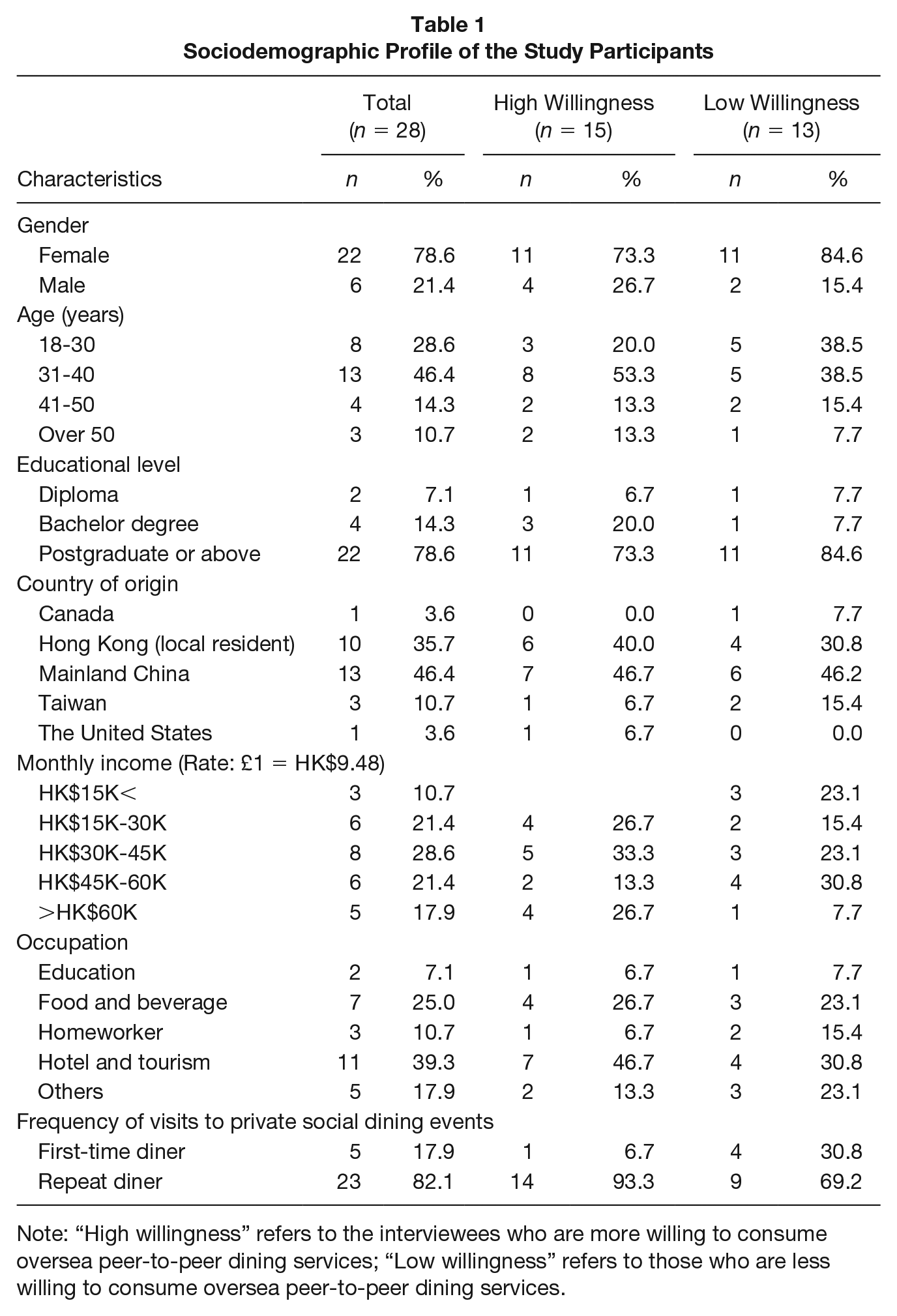
A convenience snowball sampling technique was utilized to recruit respondents who had peer-to-peer dining experiences. After sharing interview recruitment through social media platforms (i.e., Facebook and WeChat), the research team conducted in-depth personal interviews with 16 peer-to-peer diners in the beginning stage. Subsequently, these initial participants were encouraged to refer to the interview invitation to other peer-to-peer diners in their network. This sampling technique has been widely used to gather information about emerging and niche tourism behaviors (e.g., Chen & Chen, 2015). Because this study is concerned with new theory development rather than population representation, the snowballing procedure was supplemented with a theoretical sampling technique to “decide what data to collect next” by progressing data collection and analysis concurrently (Coyne, 1997, p. 625). This technique allows greater data collection flexibility, which enables a more in-depth exploration of peer-to-peer diners’ motivations. The interview procedure continued until theoretical saturation was reached, which was signaled when no new themes emerge in terms of dimensions and further interview data adds little to the conceptualization (Baker & Kim, 2018, 2020). The final sample consists of 28 interviewees who shared their local and overseas peer-to-peer dining experiences (Table 1). Most interviewees (82.1%) were repeat diners who expressed that they intentionally utilize peer-to-peer dining services.
Sociodemographic Profile of the Study Participants
Note: “High willingness” refers to the interviewees who are more willing to consume oversea peer-to-peer dining services; “Low willingness” refers to those who are less willing to consume oversea peer-to-peer dining services.
Although this exploratory study does not aim to generalize demographic findings to the population of interest, the sociodemographic profile of the sample implies three possible characteristics of peer-to-peer diners to support existing literature on food tourism; namely, female (Ignatov & Smith, 2006), well-educated (Ritchie, 2009), and a professional background in the hospitality/tourism industry (Robinson & Getz, 2014).
Semistructured interviews were conducted in person or on the phone and lasted approximately 40 minutes. The interviews were carried out in either Chinese or English by the first author, a native Chinese speaker who is also fluent in English. Interview questions were developed based on previous studies on restaurant selection (Chan & Lam, 2009; Kivela, 1997; Roberts & Shea, 2017), diner satisfaction (H. J. Kim et al., 2013), and food tourism (Ellis et al., 2018; Mkono, 2013). Prior to each interview, participants were shown examples of peer-to-peer dining events posted on EatWith.
The interviewer (the first author) first prompted the participants to recall their most memorable peer-to-peer dining events and compare them with conventional dining activities. The interviewer then asked the participants to discuss the overall dining experience (e.g., “Can you describe your dining experience at that time?” “What were the experiences that made the activity memorable?”) and the drivers behind their participation (e.g., “Why did you choose to consume peer-to-peer dining service at that time?” “What does peer-to-peer dining mean to you?”). The participants were also requested to rate their satisfaction with the dining events on a scale from 1 to 10. Such a scale allowed the interviewers to probe more about their expectations on peer-to-peer dining events. For example, if a participant rated nine for his or her satisfaction level, the interviewer probed further to ask why one mark was deducted. Following the theoretical sampling, one interview section was added to identify the participants’ willingness to consume peer-to-peer dining events when traveling abroad (e.g., “Are you willing to participate in overseas peer-to-peer dining events?”) and its drivers or barriers (e.g., “What are the drivers or barriers behind your willingness or unwillingness?”) after several initial participants shared different drivers behind their participation in their hometown and overseas.
During the interviews, the interviewers probed, paraphrased, and summarized the information received to ensure accuracy and reduce ambiguity. All audio-recorded interviews were transcribed verbatim by a professional transcriber independent of this study and translated into English by the authors for further analysis.
Data Analysis
Data analysis consisted of two stages. The first stage followed Braun and Clarke’s (2006) six-step thematic analysis, which consists of advancing from content analysis to paying “greater attention to the qualitative aspects of the material analyzed” (Joffe & Yardley, 2004, p. 56). First, the authors reviewed the transcripts several times to familiarize themselves with the data. Second, the first author analyzed all Chinese transcripts to ensure no word unique to the Chinese language was lost, and the third author analyzed English transcripts for initial coding. In accordance with the principle of inductive reasoning, no predefined categories were imposed on the data. The second author served as an auditor to verify both processes and the reliability of data analysis (Baker & Kim, 2020). Third, the authors examined potential themes and recoded the data when necessary. Fourth, the authors collectively reviewed the initial codes and the resulting themes for internal homogeneity and external heterogeneity until an agreement was reached between the authors before finalizing the themes in the fifth step (Z. Huang & Miao, 2013; K. Kim & Baker, 2020). Sixth, the authors wrote up the report. Throughout the thematic analysis process, consensus was achieved via joint discussion among the authors.
Building on the first stage, the second stage of data analysis calculated the frequencies of each theme identified during the first stage to assess their relative importance (Creswell, 2008). This approach helped compare how diners select conventional restaurants and peer-to-peer dining events differently and, therefore, highlighted the uniqueness of peer-to-peer dining activities compared to other conventional restaurants.
Results and Discussion
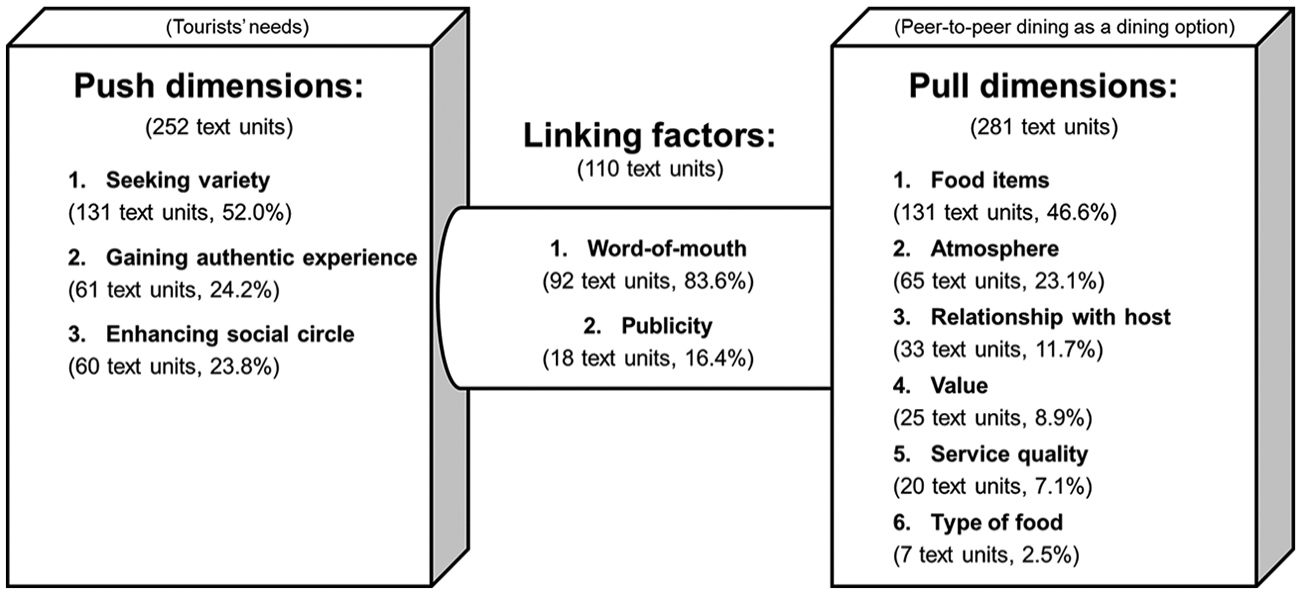
This study applied Dann’s (1977, 1981) push–pull motivation framework at the general level to evaluate tourists’ motivations behind engaging in peer-to-peer dining. Figure 1 provides a diagram of our theoretical model that consists of push factors (39.2%, 252 text units), pull factors (43.7%, 281 text units), and linking factors (17.1%, 110 text units). Push factors are internal motivations, which are relatively stable over an individual’s life, whereas pull factors reflect external motivations based on the appeal of the specific characteristics (Pearce, 2011) of peer-to-peer dining. Building on Dann’s (1977, 1981) framework, linking factors are newly recognized to categorize factors that trigger push factors externally by introducing pull factors to potential customers.
Push and Pull Motivational Framework for Private Social Dining
Push Factors
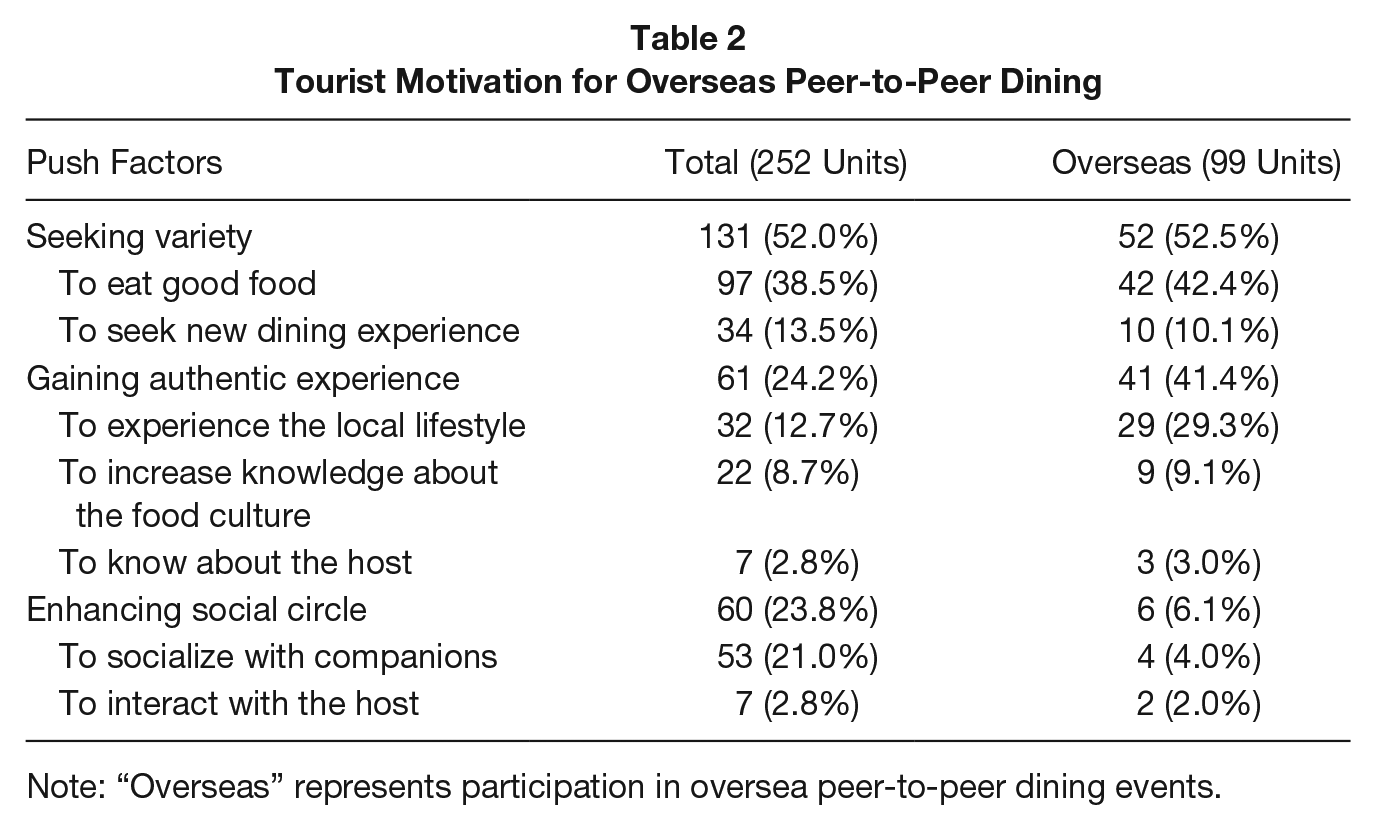
Data analysis revealed eight push factors, which were organized into three dimensions: (a) “seeking variety,” (b) “gaining local experience,” (c) and “enhancing social circle.” Table 2 shows that “seeking variety,” had the strongest weight at 52.0% (131 text units), followed by “gaining local experience,” and “enhancing social circle,” which had 24.2% (61 text units) and 23.8% (60 text units), respectively. However, the results for push dimension “enhancing social circle,” becomes nonsalient when specifically examining overseas peer-to-peer dining. These results are discussed below.
Tourist Motivation for Overseas Peer-to-Peer Dining
Note: “Overseas” represents participation in oversea peer-to-peer dining events.
Seeking variety. It is the most frequently mentioned dimension of push factors for tourists to consume peer-to-peer dining services, even if the result is directed to overseas peer-to-peer dining. This dimension consists of two push factors: (a) to eat good food, and (b) experience a new catering experience. In other words, peer-to-peer diners recognize a dining event as an activity of food consumption and an experience in which they can become engaged.
The first push factor in the dimension of “seeking variety” is the desire to eat good food. Interviewees defined good foods as food that is authentic (36.1%), special (35.1%), or tasty (28.9%). This finding suggests that peer-to-peer dining should be considered a new product mix in food tourism to target foodie tourists given that food serves as a primary factor (Ellis et al., 2018). Similarly, Su et al. (2020) suggested that the taste of food is a primary motivation for food traveling. The three characteristics of good foods as defined by respondents coincide well with H. J. Kim et al.’s (2013) finding that food tourists are looking for local, new, and delicious foods. Given that globalization in food production has forced many restaurants to standardize their food choices to appeal to broad customer groups under the pressures of marketization (Trichopoulou, 2012), tourists looking for authentic or special food may be motivated to try peer-to-peer dining (Antonelli & Vigano, 2018): If you visit Quanjude [a famous Chinese restaurant established in 1864], I think the taste and other elements have already changed. . . . Yes, the foods are standardized, and the so-called authenticity suffers seriously. (Informant #13)
The second push factor in the dimension of “seeking variety,” is to seek new catering experiences. Although the interviewees could not clearly articulate what a new dining experience is, they claimed that they are bored with routine dining experiences. This finding supports Ellis et al.’s (2018) suggestion that food tourism providers should focus more on designing new dining experience rather than just on diversifying food offerings. This study reveals a new aspect of dining experience related to the needs for adventure in the peer-to-peer dining context. In other words, unlike conventional food tourists who focus mainly on the taste of food (Su et al., 2020), peer-to-peer diners also seek unexpected and surprising experiences that transcend taste: But if you go to a chain restaurant, regardless of whether it is on the street or inside a shopping mall, you have already known what it is. But for peer-to-peer dining, you can only know the things inside when you enter, which is a mysterious experience. (Informant #17)
Gaining authentic experience. The second dimension, “gaining authentic experience,” consists of three push factors: (a) to experience the local lifestyle, (b) to know about the local food culture, and (c) to get to know about the host. This dimension focuses on the authenticity of elements embedded in dining activities apart from the food, whereas food authenticity was categorized as a subfactor above in the push factor of “to eat good food.” Interestingly, the importance of this dimension increases dramatically from 24.2% to 41.4% for the overseas group, suggesting that tourists expect to have more authentic experiences in foreign countries than in their respective hometowns. This finding relies on the concept of cultural distance in tourism studies to argue that food distance is positively correlated with tourists’ intentions to experience peer-to-peer dining in unfamiliar destinations (Lord et al., 2004): It [whether I consume overseas peer-to-peer dining events] depends on the cuisine type. Even if it is in overseas countries, I am familiar with some cuisine type [sic], especially Asian foods. As I expect to learn authentic food cultures, I would go if it offers some foods with which I am unfamiliar. (Informant #21)
The first push factor in the dimension of “gaining authentic experience” is the desire to experience the local lifestyle. It is common for conventional restaurants to stage authentic dining experiences, relying mostly on interior design and restaurant decoration (Skinner et al., 2020). However, this factor suggests that peer-to-peer diners also look for opportunities to be intimately included in everyday life, thereby supporting Mkono’s (2013) contention. One interviewee stated, Because I want to understand the lifestyle of local residents, then I think peer-to-peer dining contains some specialties that cannot be found in other restaurants. These specialties allow me to experience the local lifestyle. (Informant #2)
The second and third factors in the dimension of “gaining authentic experience” are to learn the local food culture and to get to know the host’s biography. Their knowledge needs provide empirical evidence to confirm that peer-to-peer diners are likely dynamic foodies according to the tri-classification of types of foodies suggested by Getz et al. (2014) because they were passionate about learning and desired authentic experiences related to food activities. Unlike diners who find products (i.e., foods) in conventional restaurants to be educational (J. Huang, 2017), peer-to-peer diners show greater interest toward producers (i.e., the chef): Peer-to-peer dining represents the chef more than the food. I went there because the chef is very famous, and I wanted to know how he/she started his/her own business. His/her personal stories and cooking ideas would be the attractiveness for me. (Informant #17)
Enhancing social circle. The third dimension, “enhancing social circle,” consists of two push factors: (a) to socialize with accompaniers and (b) to interact with the host. Surprisingly, “enhancing social circle,” is nonsalient push dimension (6.1%, 6 text units) for overseas peer-to-peer dining. This observation contradicts the general belief that social interaction is a key element in both peer-to-peer services (Bocker & Meelen, 2017; Guttentag et al., 2018) and conventional food travel activities (Getz et al., 2014; Su et al., 2020). This finding suggests that tourists do not participate in overseas peer-to-peer dining to seek social opportunities, which breaks from the social motivation observed in other peer-to-peer activities.
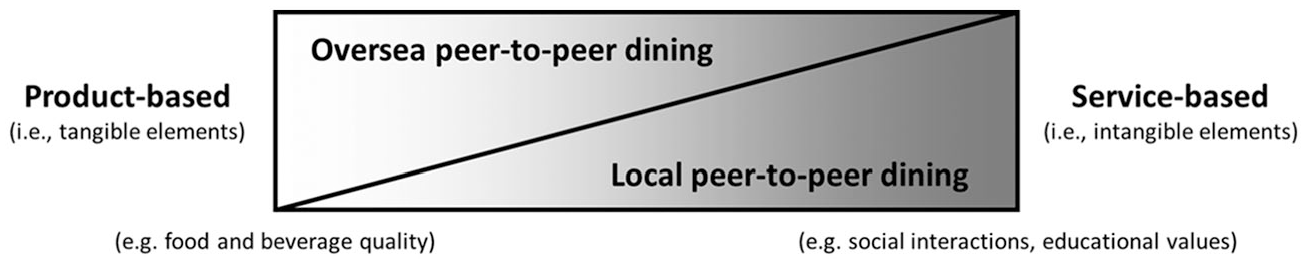
Unlike other service-based peer-to-peer products (e.g., accommodation, transportation), catering is a product-service hybrid. Peer-to-peer dining hosts simultaneously sell a service (e.g., dining services that involve social interactions) and products (e.g., foods). This difference with other sharing economy activities can be explained by the Product–Service continuum, wherein the importance of social motivation decreases if service contents are reduced (Bocker & Meelen, 2017; Figure 2). In other words, tourists focus more on the service content for local peer-to-peer dining events, but they focus more on the product content for overseas peer-to-peer dining events. Thus, tourists generally consider overseas peer-to-peer dining services as a product-consuming activity rather than socializing activity. This aligns with the finding that the top push factor is “to eat good foods,” If I am in Hong Kong, I usually consume peer-to-peer dining services with my friends, which is the main purpose . . . I mean, I don’t really care about food in Hong Kong. But, if I am in foreign countries, I think eating dinner at the local’s home is an experience . . . [Experience] new things, local foods, and local living style. (Informant #19)
Product–Service Continuum Describing the Difference Between Local and Overseas Private Social Dining Events
The first push factor in the dimension of “enhancing social circle” is to socialize with accompaniers. Customers often visit a restaurant for a social occasion to pursue functional and hedonic values (Park, 2004). While social interactions in a dining event have been highlighted in conventional restaurants (Jin et al., 2012), they are limited to interactions within the dining group. The second push factor is to interact with the host, highlighting the nature of peer-to-peer services (Guttentag et al., 2018). Peer-to-peer diners also look for social interactions with strangers (e.g., the chef). Notably, interaction with the host is theoretically distinct from their motivation for the authentic experience, as peer-to-peer diners prefer a casual chat with the host rather than a learning process: We [The host and I] ate together; I was satisfied with that kind of feeling, just like chatting with my friends. It expanded my social circle because we still kept in touch on Facebook. (Informant #10)
Pull Factors
Unlike push factors, pull factors focus more on the service attributes, attracting people to value peer-to-peer dining services over other alternatives. Six dimensions were identified: “food items” (46.6%, 131 text units), “atmosphere” (23.1%, 65 text units), “relationship with host” (11.7%, 33 text units), “value perception” (8.9%, 25 text units), “service quality” (7.1%, 20 text units), and “type of food” (2.5%, 7 text units). These six dimensions featured fourteen pull factors for peer-to-peer dining.
To shed light on whether peer-to-peer dining services improve on conventional offerings in food tourism, these pull dimensions (i.e., “atmosphere,” “relationship with the host,” and “type of food”) were compared with Kivela’s (1997) findings on conventional restaurant selection for two reasons (Table 3). First, most respondents in this study had peer-to-peer dining experience in Hong Kong. Likewise, Kivela’s (1997) study was also conducted in Hong Kong, which helps control for confounding effects such as restaurant availability and food cultural differences. Second, Kivela’s exploratory study has been empirically validated by later studies on restaurant selection (e.g., Caber et al., 2018).
Comparison of Pull Factors Between Peer-to-Peer and Conventional Dining
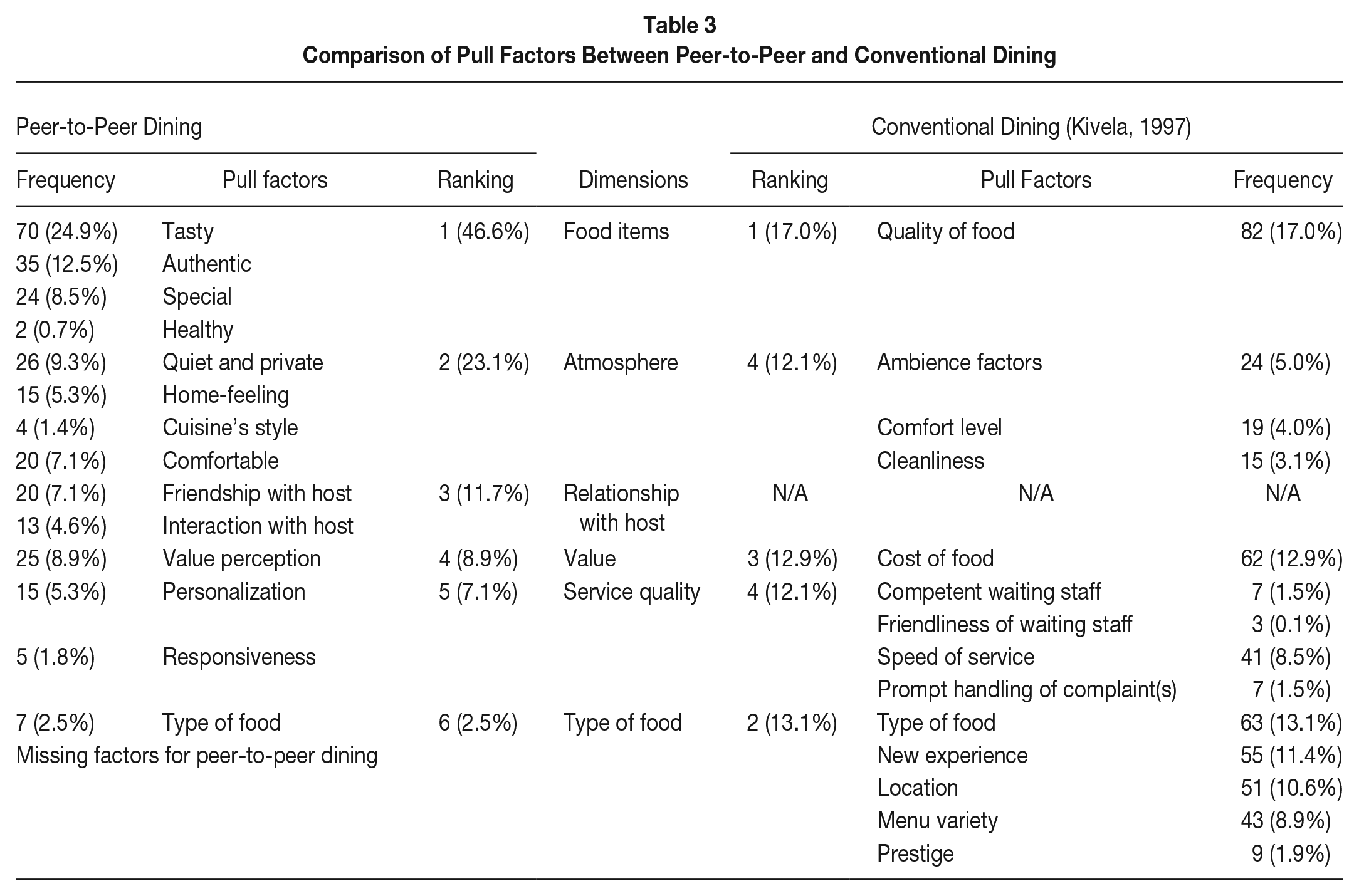
Although this study used inductive data analysis, five of the six pull dimensions in the study duplicate to some extent with 10 of the 14 restaurant attributes identified by Kivela (1997). In other words, four attributes identified by Kivela (1997), namely, “new experience,” “location,” “menu item variety,” and “prestige,” were not identified in this study. The absence of “new experience” is attributed to its implied status within the top push dimension of “seeking variety.” In other words, respondents do not recognize the new experience itself as a pull factor. Although “prestige” was not identified as a pull factor, it is reflected across a combination of push and pull factors discussed later. The absence of “location” and “menu item variety,” on the other hand, highlights the uniqueness of peer-to-peer dining. Additionally, the three key differences between peer-to-peer dining and conventional dining—”atmosphere,” “relationship with the host,” and “type of food”—are discussed to assess whether peer-to-peer dining improves on the conventional food tourism offerings from a tourist’s perspective.
Atmosphere. It is the second most important pull dimension to emerge for peer-to-peer dining. This dimension consists of four atmospheric pull factors: (a) quiet and private, (b) home-feeling, (c) comfortable, and (d) cuisine-related atmosphere. In Kivela’s (1997) study, atmosphere highlights the adversarial relationship between authenticity and commercialization in peer-to-peer dining, suggesting that the peer-to-peer transaction downplays customers’ commercial motives in conventional restaurants (Beverland, 2006).
Interviewees frequently mentioned a quiet and private atmosphere as the main reason why they value peer-to-peer dining services. This finding not only helps triangulate support for “enhancing social circle,” as an important push factor for peer-to-peer dining, but it also explains why “location” in Kivela’s (1997) study was not identified in peer-to-peer dining. Conventional diners look for convenient dining places located in commercial areas, but this convenience may dissatisfy tourists, especially those who prefer an undisclosed dining area in which to socialize with companions (Chan & Lam, 2009): I want to gather with my friends and enjoy a meal together; then I prefer to find a quiet place. And, peer-to-peer dining events are held in an apartment in a small residential area or a villa. They [the host] rent a whole villa, and the environment is better, the atmosphere is quieter and more private. (Informant #12)
Tourists are also attracted by a home-feeling atmosphere in peer-to-peer dining events. This atmosphere is not easily replicated in conventional restaurants (Chan & Lam, 2009), highlighting one area where peer-to-peer dining services may have a competitive advantage. This atmospheric factor is also associated with a high comfort level to satisfy peer-to-peer diners: Because peer-to-peer dining events are usually held in a remote location or even people’s home, it has a stronger home-feeling. I think this atmosphere makes me comfortable and relax. (Informant #4)
This differentiation in terms of a home-feeling atmosphere is also reflected in the relatively limited mention of cuisine-related atmosphere, as authenticity is reduced by commercialization (Lin et al., 2017). In other words, tourists believe that a deliberately decorated dining environment blurs the lines between these two types of catering services: I mean, peer-to-peer dining is a small-scale activity, and this is their market positioning. If it is in a big scale [with many beautiful decorations], I don’t think it is a peer-to-peer dining event. . . . It is too commercial, which I don’t want to go. (Informant #18)
Relationship with host. The dimension “relationship with hos,” is a special attribute that differentiates peer-to-peer dining events from conventional dining experiences. This study identified two pull factors related to this dimension: (a) friendship with the host and (b) interaction with the host. These findings further suggest that the two main roles of the host in peer-to-peer business models are building trust with customers (Tussyadiah & Park, 2018) and enhancing the dining experience (Tussyadiah, 2015). Specifically, prospective peer-to-peer diners make a booking only when all parties involved are expected to act competently and dutifully (Tussyadiah & Park, 2018). All 28 interviewees declared an existing friendship of the host with them or their accompaniers to demonstrate a trustworthy relationship with the service providers. Specifically, while peer-to-peer dining services involve a friendship development process, it is usually mediated by loyal customers who knew the host before: Yes [I know the host before] . . . I would first tell my friends that the host is my friend because I think it builds more trusts [between my friends and the host]. (Informant #10)
In addition, tourists believe that interacting with the host is a core element of peer-to-peer dining services. However, this belief limits only to local peer-to-peer dining events. Apart from the language barrier, tourists’ skewed perception of overseas social dining service as a product-based business also prevents tourists from interacting with the host when traveling.
Type of food. The current study found that “type of foo,” was the least important pull dimension for peer-to-peer dining. Although this finding contradicts with Kivela (1997) and Vu et al. (2019), who suggests that tourists value food variety in vacations to satisfy their reliance on their national cuisine, it also triangulates support for “seeking variety” as the top push dimension. It also helps explain why “menu item variety” was not valued by peer-to-peer diners, as they take a more open-minded approach to unfamiliar types of food. No matter how limited the number of food items is on the menu, peer-to-peer diners are satisfied because “the distance from home and familiar patterns, the differences in cuisine, and the awareness that we [peer-to-peer diners] are not observed by people that we [they] may know” trigger their feeling of novelty (Roberts & Shea, 2017): If I am in Hong Kong, I would try somethings that contain specialties. I will try if they are attractive, no matter it is Sichuan or French cuisine. (Informant #14)
Linking Factors
Two linking factors simultaneously triggered potential diners’ interests (i.e., push factors) and enhanced their knowledge about peer-to-peer dining events as an alternative to traditional restaurants (i.e., pull factors), respectively: “word-of-mouth,” (83.6%, 92 text units) and “publicity,” (16.4%, 318 text units). These two factors reflect the “prestige” of a dining place, as identified by Kivela (1997).
“Word-of-mouth,” represents both informal physical and digital communications between customers regarding a particular product or service (Jeong & Jang, 2011). This kind of information is more trustworthy because it is perceived to be distributed by experienced diners rather than service providers. Unlike word-of-mouth, which is neither controllable nor manageable, “publicity,” is usually managed by the media. Lu and Liou (2015) distinguished word-of-mouth from publicity based on the volume of information, suggesting that publicity may represent the restaurant’s frequency of quotations in newspapers or magazines: I am now looking for some peer-to-peer dining events providing Mediterranean foods. I think they are very special and tasty when I was reading a magazine [in Hong Kong]. (Informant #6)
These two linking factors help distinguish those interviewees who are more willing to experience peer-to-peer dining when traveling from those who are less willing. Specifically, many interviewees expressed willingness to use peer-to-peer dining services when traveling; however, this willingness is dampened by the limited availability of word-of-mouth recommendations when searching for overseas peer-to-peer dining: I want to go [peer-to-peer dining when traveling], but there must be recommendations from someone with which I am familiar . . . I won’t participate in these [Barcelona’s] events [posted on EatWith] because I don’t know what it is and whether it is real or not. (Informant #18)
Peer-to-Peer Dining Service as a New Food Tourism Product
McKercher et al. (2008) suggested two criteria to determine if a new tourism product is worth pursuing or not: the potential to attract new groups of tourists, and whether it improves the current offerings. The first measure depends on the identification of push factors. Many studies (Guttentag, 2015; Karlsson & Dolnicar, 2016) have suggested that tourists in the sharing economy are socially motivated. Notably, Bocker and Meelen (2017) suggested that social motivations play the strongest role in food-sharing activities than other sharing activities. However, the findings in this study suggest that push factors for peer-to-peer dining are heavily skewed toward “seeking variety,” Thus, peer-to-peer dining satisfies not only foodies but also pragmatic novelty seekers who value excitement and uniqueness elements beyond what conventional dining can provide (Guttentag et al., 2018).
Despite this finding, peer-to-peer dining appeals to a much narrower market segment than do other peer-to-peer services. None of the interviewees mentioned that their consumption was motivated by the economic benefits and sharing economy ethos. Couple with the nonsalient social motivation for overseas peer-to-peer dining in this study, many tourists in the sharing economy, such as budget travelers, collaborative consumers, and interactive seekers, may find peer-to-peer dining unappealing (Bocker & Meelen, 2017; Guttentag, 2015; Guttentag et al., 2018). Likewise, the analysis of pull factors evaluates whether peer-to-peer dining improves the current offerings in food tourism. The results revealed that peer-to-peer dining outperforms conventional dining in several areas, especially in food items, atmosphere, and relationship with the host, to satisfy tourists who look for novelty, authenticity, and social needs.
Despite these merits, conventional restaurants perform better in safety-related fields, as many participants’ remain concerned with the security issues of peer-to-peer dining when they are unfamiliar with the service providers and dining places. These safety-related issues are common in the sharing economy (Guttentag, 2015); although some of these issues have been resolved by other peer-to-peer contexts (e.g., Airbnb’s Superhost Program), it remains an ongoing issue in peer-to-peer dining. Personal apartments or cars are periodically regulated by government authorities to ensure safety even if the owners do not have an eligible business license, whereas government authorities only intervene on behalf of food hygiene or fire safety concerns when the dining establishment is a registered business. In other words, participating in peer-to-peer dining events may involve more risks than staying at a stranger’s house and riding in a stranger’s car. This relatively high risk is expected to obstruct peer-to-peer dining from capturing mainstream diners who value safety (Lee & Wilkins, 2017). Hence, at least for the moment, the threats for peer-to-peer dining to upward encroach the existing business market are limited.
In sum, peer-to-peer dining, at least from a perspective of diner’s motivations, is not a disruptive innovation because they are less likely to be positioned as substitutes of conventional restaurants. Specifically, peer-to-peer dining likely constitutes an advanced travel activity that satisfies specialist tourists’ desires, especially foodies who pursue special and high-quality dining experiences.
Limitations and Future Research
This study is not free of limitations. First, the study utilized a snowball sample of 28 tourists to explore the disruptive potential of the peer-to-peer dining context. As suggested by many studies, tourist motivations vary largely depending on cultural backgrounds and demographic characteristics. Although this study attempt to gather a diverse array of responses, this study only focuses on people who have experiences or similar experiences in peer-to-peer dining. Consequently, certain motivations may not have emerged as factors in this exploratory research.
Future research should attempt to validate and extend the push–pull motivation framework across different sociodemographic variables (e.g., cultural backgrounds, educational backgrounds, and nationality) and external variables (e.g., destinations, type of cuisines, and food cultural backgrounds). Investigating the relationship between motivational factors and outcome variables such as word-of-mouth and revisit intentions to consume would also be interesting to understand how their behavioral responses on peer-to-peer dining are developed. Empirical validations are required to see if specific motivations are perceived with high importance for peer-to-peer dining and are readily applicable in marketing food tourism. Consequently, this study develops a scale to measure motivations for peer-to-peer dining which can assist in future research to foster the investigations of causal relationships.
Conclusion
The current study unearths new data about peer-to-peer dining in the sharing economy by examining tourists’ motivations. Based on the findings from 28 in-depth interviews with peer-to-peer diners, this study presented a theoretical framework of tourist motivations for peer-to-peer dining consisting of three push dimensions (i.e., seeking variety, gaining authentic experience, and enhancing social circle), six pull dimensions (i.e., food items, atmosphere, relationship with the host, value perception, service quality, and type of food), and two linking factors (i.e., word-of-mouth and publicity).
Theoretical Contributions
This study makes meaningful theoretical contributions to the current sharing economy and food tourism literatures. First, although most studies of the sharing economy have focused on either accommodation-sharing services (i.e., Airbnb) or transportation-sharing services (i.e., Uber and Lyft), this study explores food-sharing services in the tourism and hospitality industry. This perspective is important because the sharing economy’s effects on many nonaccommodation and nontransportation economic sectors remain poorly understood, and food-sharing activities involve even higher risks than other peer-to-peer services. This study takes the first step toward identifying tourists’ motivations for peer-to-peer dining.
Second, in addition to validating many possible motivations initially explored in the sharing economy and food tourism literatures, this study identified several differences in the push and pull factors of peer-to-peer dining compared with both the broader sharing economy and conventional dining. These differences suggest that peer-to-peer dining is distinct from other widely criticized peer-to-peer services, as it constitutes a relatively stand-alone market segment. Hence, it does not directly compete with conventional dining; instead, it diversifies the current product mix in food tourism. Tourists value social interactions with peer-to-peer dining service providers much lower than those with other hosts in the sharing economy because of the centrality of food during the dining experience distracts diners from socializing with others.
This finding somewhat challenges our understandings of social motivations in the sharing economy. Social motivation may has been exaggerated in the sharing economy to hide individual’s self-actualization needs, highlighting the potential for other studies to be misleading when they studied tourists’ motivation to participate in the sharing economy. This challenge provides another perspective for future scholars investigating the sharing economy.
Finally, this study successfully uses the push–pull motivation framework to assess whether a new tourism mix is worth pursuing or not. Although the framework is an old-fashioned approach to study motivations, it effectively identified several factors influencing activity participation. This study not only advances the push–pull framework by proposing two linking factors to highlight potential marketing efforts for peer-to-peer services, but it also demonstrates its capacity to qualitatively evaluate McKercher et al.’s (2008) two criteria of new tourism product development. This framework should be used by scholars who want to determine whether a new tourism product should be developed and invested or not.
Managerial Contributions
This study also bears practical value for three stakeholders: peer-to-peer dining service providers, traditional restaurants, and destination marketers. First, identifying the push and pull factors driving tourists’ interest in peer-to-peer dining is insightful for peer-to-peer dining service providers to effectively attract and fulfill the needs of potential patrons. Although comparing the motivations for local and overseas peer-to-peer dining was not the main goal of this study, this research observed that people’s perceptions of peer-to-peer dining depends on whether they are in foreign countries or not. Specifically, “enhancing social circle,” appears to be a nonsalient push factor for overseas peer-to-peer dining, as tourists are more motivated by eating good food and experiencing the local lifestyle and less motivated by social interaction. This finding suggests that peer-to-peer dining service providers should consider staging dining experiences differently for local and overseas tourists. Additionally, peer-to-peer dining service providers should also be aware of the equilibrium point on their site decorations because overdecoration results in overcommercialization and distracts a large group of peer-to-peer diners who value authenticity and special dining experiences from conventional restaurants.
Second, fine-dining restaurants that share a similar target market with peer-to-peer dining services should be ready for challenges even though this study suggests that peer-to-peer dining serves as a stand-alone market segment and has a limited impact on the existing catering industry. The finding that peer-to-peer dining services may be desirable to three types of travelers: (a) female travelers, (b) well-educated travelers, and (c) hospitality/tourism professionals was based on a relatively small sample size and requires additional empirical investigation. Nevertheless, this finding is insightful for fine-dining restaurants to prevent direct competitions with peer-to-peer dining by adjusting their target markets, for example, by focusing on family and business travelers.
Last, this study affirms that peer-to-peer dining is a new product mix in food tourism, suggesting those destinations with rich food cultural backgrounds such as Japan, Korea, and China to market peer-to-peer dining events. This marketing effort is not only done to attract food tourists but also to diversify their catering offerings. Many tourists strongly prefer their national cuisine over local cuisines, and can easily become dissatisfied by the absence of their national cuisine when they travel to a foreign destination (Vu et al., 2019). The promotion of peer-to-peer dining allows destinations to diversify their food choices by utilizing social resources. For example, an Indian living in Spain can operate peer-to-peer dining events by cooking Indian foods, which will simultaneously satisfy Indian tourists who prefer their national foods and local Spanish residents who value novelty.
Footnotes
Authors’ Note:
This work was supported by The Hong Kong Polytechnic University (Grant No. G-YBND) and Research Grant Committee, The HKSAR Government (Grant No. PolyU 156053/18B)
