




Abstract
By using Web 2.0, backpackers can easily collect travel information and plan their trips. In this study, the theory of planned behavior and the technology acceptance model were integrated with interpersonal influence, electronic word-of-mouth, flexibility, personal innovativeness, and critical mass to measure their effects on behavioral intentions toward self-service travel. A sample of 284 questionnaires was collected via an online survey. The results indicated that attitudes, subjective norms, and perceived behavioral control had significant effects on backpackers’ behavioral intentions. In addition, the perceived usefulness, perceived ease of use, and flexibility of travel websites had significant effects on attitudes toward a given behavior. Moreover, the effects of electronic word-of-mouth, critical mass, and interpersonal influence on subjective norms, and those of self-efficacy and facilitating conditions on perceived behavioral control were significant. Based on these empirical results, theoretical and practical implications for promoting self-service travel websites are proposed.
Keywords
Introduction
Due to economic growth and improved quality of life, the demand for leisure activities has typically increased. As the tourism industry has grown, the number of trips involving both group travel and self-service travel has increased (Xiang et al., 2015). As many self-service travelers who organize accommodation and transportation themselves also carry backpacks to store their personal belongings, these travelers are often called backpackers. Unlike group travelers who rely on travel agents to make travel arrangements, backpackers collect travel information on the internet and organize their own travel plans (Sigala, 2001, 2009). In addition, as more and more travelers shop online, the need for e-commerce sites dedicated to tourism has also increased.
Over the past decade, the number of travel websites has significantly increased. Today, tourism websites offer complete solutions for groups and self-service travelers. Travelers can purchase travel packages or tickets and make hotel or flight reservations on a single website. By offering convenience, immediacy, useful information, and low prices, tourism websites have become consumers’ first choice for buying tourism products. In response to this radical change, some traditional travel agencies have moved their activities online. As a result, e-commerce has become the key to success in the travel industry (Nusair, 2010).
The competition between travel websites is fierce. According to a 2009 survey, ezTravel was Taiwan’s top-ranked tourism website, in fact its’ turning point between traditional travel agent move to online travel agent website, that traditional agencies moving their activities to online market (Ip et al., 2010). However, the site fell to fifth place in 2014. This suggests that more and more traditional travel agencies have gradually moved their activities online with more flexible online travel e-commerce platform and mobile device with convenient internet environment (Lai, 2013; L. Y.-S. Lee, 2013; Manganari et al., 2012; Tang-Taye & Standing, 2013), bringing more and more competitors to the online market every year (Tseng & Wang, 2016).
Kim et al. (2011) stated that the internet has opened a new era for the tourism industry. The combination of tourism and the internet has also led to innovation and restructuring in the industry (Xiang et al., 2015). Travel websites offer consumers the advantages of frequent travel information updates, multiple options, and a high degree of interactivity (Tseng & Wang, 2016). Before purchasing a product, consumers can read not only the detailed descriptions provided by the website but also the comments of other experienced travelers (Chou & Hsu, 2016; Manganari et al., 2012). Buying travel products online can therefore be a pleasant experience for consumers due to its convenience, flexibility, and speed (Kim et al., 2011; Tseng & Wang, 2016; Wu & Chen, 2005).
To better understand backpackers’ behavioral intentions to choose travel websites, this study adopted the theory of planned behavior (TPB; Ajzen, 1991). According to the TPB, people’s behavior is affected by three factors: attitudes, subjective norms, and perceived behavioral control (PBC; Pereira et al., 2019). In addition, whether backpackers will use a given tourism website to organize their travel plans is influenced by their own website preferences, the viewpoints of significant others on this website, and their ability or willingness to use this website to collect the information they need (Hsu & Huang, 2010; Lai, 2013; Manganari et al., 2012).
This study measured the effects of each predictor construct of the TPB on the behavior of backpackers using self-service travel websites (L. Y.-S. Lee, 2013). In addition, antecedent variables that influence attitudes, subjective norms, and PBC were identified to develop an extended TPB model. Because tourism websites involve the use of self-service technology, the technology acceptance model (TAM) was also integrated into the research model (Venkatesh et al., 2012). Therefore, the attitudes construct was composed of flexibility, innovation, perceived usefulness (PU), and perceived ease of use (PEOU), derived from the TAM. In addition to interpersonal influence, electronic word-of-mouth (eWOM) and critical mass were considered as factors affecting subjective norms. For the PBC construct, the concepts of self-efficacy and facilitating conditions were retained from the TPB. In summary, the study examined the respective predictive powers of flexibility, innovation, PU, and PEOU on attitudes; of interpersonal influence, eWOM, and critical mass on subjective norms; and of self-efficacy and facilitating conditions on PBC.
The current study attempted to investigate the backpackers’ Intentions, in this research we used the TPB and the TAM was integrated with interpersonal influence, eWOM, flexibility, personal innovativeness, and critical mass to measure their effects on behavioral intentions toward self-service travel website. The study contributes to the theoretical development of backpackers’ intentions formation by enhancing the self-service website sufficiency of an accepted consumer behavior model. Results of the study also provide practical implications for the backpacker’s special tours that are as convenient as group tours in terms of transportation or accommodation, this could be their blue ocean strategy in the broader tourism industry, in terms of marketing, operations, and planning.
Literature Review and Hypothesis Development
The TPB is an extension of the theory of reasoned action (TRA). According to the TRA, an individual’s behavior is based on people’s behavioral intentions and that person’s behavioral intentions are affected by his or her attitudes and subjective norms (Ajzen, 2002; Fishbein & Ajzen, 1977). The TRA has been widely used in marketing and consumer behavior (Lam & Hsu, 2004; C.-C. Lee, 2005; Sheppard et al., 1988).
The TPB differs from the TRA by adding PBC as an antecedent of behavioral intentions. Ajzen (2002) suggested that the behavioral intentions of an individual depend not only on attitudes and subjective norms but also on that person’s ability and resources, and on any barrier presented by the external environment. However, the TRA only considers volitional factors, ignoring that a person’s behavior can be affected by nonvolitional factors such as resources or opportunities (Park, 2004; Teng et al., 2013). This is the main shortcoming of the TRA.
For example, if consumers have a positive attitude toward travel websites and these websites are supported by their friends, consumers will be more willing to use the services of these websites. However, if travel websites cannot provide them with enough information, or if they do not have the ability or knowledge to search for the products they need, consumers will be unable to complete their travel planning or any online transaction (Chou et al., 2018). Therefore, the TPB is a more suitable model than the TRA for predicting consumer behavior regarding the use of travel websites. Previous research on the TPB and consumer behavior is reviewed below.
Han et al. (2010) used the TPB to explain consumer behavioral intentions to choose a green hotel. They found that the TPB model had better explanatory power and a better goodness of fit than the TRA model. In many previous studies, the TPB has been integrated with other theories. For example, Casaló et al. (2011) used the TPB, trust, PU, and interpersonal influence to predict whether consumers would accept suggestions from travel social networks. Hinson and Boateng (2007) added top management commitment, the perceived benefits of an e-business, and organizational readiness to the TPB to explore the intentions of travel providers to develop e-commerce.
Casaló et al. (2010) combined the TPB, TAM, and social identity theory to evaluate consumers’ intentions to join firm-hosted online travel communities. Their integrated research model had very good power to predict consumers’ intentions to use the products of the host firm or to recommend the host firm. In a study of overseas tourists traveling to Australia, Quintal et al. (2010) used the TPB, risk perceptions, and uncertainty to explain the decision-making behavior of tourists from South Korea, China, and Japan. Yamada and Fu (2012) also applied the TPB to understand tourists’ intentions to visit a museum and to measure the strength and importance of salient beliefs. Their study showed that subjective norms and PBC had significant effects on the behavioral intentions of the three groups of tourists. Based on the review above, three hypotheses are proposed and discussed in the following sections.
Attitudes
The TPB states that people’s behavior is determined by three factors: (1) their attitudes toward the behavior (internal factor); (2) subjective norms (external factors); and (3) PBC (a factor of time and opportunity). In the TPB, Ajzen (1991) an attitude can be described as “the degree to which a person has a favorable or unfavorable evaluation or appraisal of the behavior in question” (p. 188). For example, whether consumers have a positive attitude toward using self-service travel websites to plan their trip or purchase products will affect their behavior (Ip et al., 2010; Pereira et al., 2019). Consumers will conduct an evaluation before performing a particular behavior (Cheng et al., 2006). If the result of this evaluation is preferable, this particular behavior will be encouraged (Ajzen, 1991; Cheng et al., 2006; C.-C. Lee, 2005).
Perceived Usefulness and Perceived Ease of Use
Because self-service travel websites use self-service technologies to sell tickets and travel packages, PU and PEOU adapted from the TAM were used in this study and added to the research model. PU refers to the degree to which users believe that the use of new information technologies is useful for their work or performance. PEOU refers to the degree to which users consider new information technologies to be simple and easy to use.
Cho (2006) suggested that PEOU can positively affect consumer attitudes toward a specific technology. For example, Zehrer et al. (2011) pointed out that the usefulness of the blog post had a significant effect on the intentions of bloggers. When blogger to share their travel experience and tourist destination image as strong intention to build their expert on travel planning to other backpacker (Pereira et al., 2019), each usefulness of tourism specific blog posts can enhance backpacker’s intention to used self-service travel websites to range their travel planning (Lai, 2013; Tseng & Wang, 2016). Many studies on travel websites have combined the TPB and TAM to understand consumer usage behavior (Casaló et al., 2010; Liao et al., 2007; Lu et al., 2009; Wu & Chen, 2005). These studies suggested that applying TAM constructs to the TPB can be useful in predicting consumer behavior when using travel websites. Therefore, the following hypotheses are proposed:
Flexibility
Pearce and Foster (2007) identified five characteristics of backpacker travel: low accommodation requirements, willingness to interact with other travelers, personalized journeys, relatively long travel days, and preference for informal activities. Among them, preferences for “personalized journeys” and “informal activities” suggest that backpackers prefer flexible travel plans. In addition, Riley (1988) proposed that backpackers seek low budget transportation and accommodation and want to have full control over their travel plans. That is, they want their trips to be flexible. Poon (1993) also noted that the tourism industry has changed over time in response to consumer demand, whether for group travel or in terms of flexible and personalized travel plans. To understand the effect of flexibility on self-service travel websites, the following hypothesis is proposed:
Personal Innovativeness
Agarwal and Prasad (1998) suggested that personal innovativeness affects individual perceptions of IT innovations. Personal innovativeness refers to people’s willingness to change their current status (Hurt et al., 1977) and to tolerate risks (Bommer & Jalajas, 1999). Similarly, Jones et al. (2002) studied salesmen using automated sales systems and found that personal innovativeness was positively correlated with their attitudes toward the new system. In addition, Li and Buhalis (2006) segmented internet surfers (i.e., “lookers”) and customers who actually placed an order online (i.e., “bookers”) in the context of Chinese tourism websites. They concluded that bookers were more innovative than lookers.
Based on these studies on the effect of innovation on attitudes toward travel websites, the following hypothesis is proposed:
Subjective Norms
In the TPB, subjective norms affect behavioral intentions. Ajzen (1991) defined a subjective norm as “the perceived social pressure to perform or not to perform the behavior” (p. 188). In other words, subjective norms refer to the influence from an individual’s friends, colleagues, or business partners on that person’s decision-making process. In marketing and consumer behavior research, subjective norms have been shown to play a key role (Baker et al., 2007; Cheng et al., 2006; Laroche, 2001; C.-C. Lee, 2005). Accordingly, whether backpackers will use travel websites is affected by the advice of their friends.
Electronic Word-of-mouth
Word-of-mouth is an evaluation behavior that occurs after consumers have purchased products or services. It basically refers to any interpersonal communication between consumers, in which they share shopping experiences or product reviews (E. W. Anderson, 1998; Cheng et al., 2006). When consumers are involved in the decision-making process, word-of-mouth is one of the main factors affecting their buying decisions (Cheng et al., 2006; Herr et al., 1991). Brown et al. (2005) stated that word-of-mouth helps consumers reduce the costs of information collection when making decisions.
As word-of-mouth occurs naturally and is not marketing oriented, it is more convincing than personal sales efforts or advertisements via commercial channels. Word-of-mouth can be positive or negative for a given product (Cheng et al., 2006; Francis, 1997). Positive word-of-mouth communication improves a company’s reputation and attracts new customers. In contrast, negative word-of-mouth communication can reduce customers’ willingness to buy a given product or to patronize a given business (Gruen et al., 2006; Wangenheim, 2005; Wangenheim & Bayón, 2007). In addition, negative word-of-mouth spreads much faster than positive word-of-mouth (Samutachak & Li, 2012).
eWOM plays a key role not only in social networks, but also in Internet marketing (Chen et al., 2012; Xie Karen, 2016). For example, Yoo and Gretzel (2008) reported that 74% of consumers took advice from other tourists when planning their itineraries. They considered customer reviews or word-of-mouth as more reliable, fun, and timely than any communication from travel services. Ye et al. (2011) also stated that eWOM is a critical factor influencing consumer behavior when using travel websites. Therefore, we propose the following hypothesis:
Critical Mass
Oliver and Barnes (2010) introduced the concept of critical mass. According to this concept, a crowd will follow certain social tendencies when its size reaches a critical mass. After exceeding this critical mass, users will adapt quickly and the behavior of the whole group will change accordingly (Lou et al., 2000). In other words, when the number of system users reaches a certain majority, they will be more willing to use the system.
Sledgianowski and Kulviwat (2009) pointed out that once the number of people using the Internet exceeded the critical mass, the number of users increased geometrically. This explains why the number of internet users has increased so rapidly in recent years (Chen et al., 2012; Rogers, 2010; Sledgianowski & Kulviwat, 2009). Critical mass is a key factor affecting user acceptance of a new technology (Chen et al., 2012; Lou et al., 2000). It can increase users’ willingness to use a new technology and speed up the implementation of computerized systems in a company (Tseng & Wang, 2016; Zhu et al., 2003). Thus, we propose the following hypothesis:
Interpersonal Influence
According to a study conducted by Bearden et al. (1989), interpersonal influence can be divided into normative and informational dimensions. Normative influence refers to when consumers feel pressure from other individuals or groups to follow the expectations and preferences of others to gain recognition (L. Y.-S. Lee, 2013; Manganari et al., 2012). Informational influence refers to when a reference group provides consumers with information to improve their decision-making ability. The power of informational influence is determined by the level of trust that consumers place in the reference group. The higher the level of consumer trust in each group, the more consumers will be influenced by it.
In addition, Lascu and Zinkhan (1999) indicated that interpersonal influence is a critical variable to explain marketing phenomena. Consumer buying behavior is often affected by reference groups and/or the desire to gain group recognition. Moreover, interpersonal influence has been shown to have a great effect on social networks (Bagozzi & Dholakia, 2006; Dholakia et al., 2004). In the internet context, customers care more about what other people know about products and services than how others judge their purchasing behavior (Chou & Hsu, 2016). Casaló et al. (2011) also suggested that interpersonal influence is an important factor in predicting whether consumers accept suggestions from tourism social networks. Because interpersonal influence is an external factor that can affect subjective norms, the following hypothesis is proposed:
Perceived Behavioral Control
The third variable that influences behavioral intentions is PBC. PBC can be interpreted as the degree of difficulty perceived by an individual when engaging in something (Ajzen, 1991; Lam & Hsu, 2006), or the feasibility assessment made when facing problems (Ajzen, 2002; Ajzen & Madden, 1986; Chang, 1998). Many studies have pointed out that an individual’s behavioral intentions are affected by self-confidence (Baker et al., 2007; Casaló et al., 2010; Cheng et al., 2006; Han et al., 2010; Hung et al., 2012; Y. Lee & Kozar, 2008; Li & Buhalis, 2006; Quintal et al., 2010).
People can have stronger behavioral intentions if they have the ability or resources (e.g. opportunities, funds, or time) to adopt the behavior in question. Casaló et al. (2010) investigated consumers’ intentions to use the products of a host firm or to recommend this host firm (Venkatesh et al., 2012). They found that PBC had a greater influence on intentions than attitudes or subjective norms. Therefore, the importance of PBC has been demonstrated regarding consumer purchases and postpurchase behavior regarding tourism products.
Self-Efficacy
The concept of self-efficacy was first proposed by Bandura (1995), a social cognitive theorist, in 1995. Bandura stated that self-efficacy refers to an individual’s faith in their ability to complete specific tasks and defined it as “the belief in one’s capabilities to organize and execute the courses of action required to manage prospective situations” (p. 2). Similarly, Kurbanoglu (2004) proposed that self-efficacy refers to the belief in one’s competence in a particular area of work or performance.
Compeau and Higgins (1995) indicated that computer self-efficacy refers to whether users believe that they can use information systems to accomplish their missions. In previous studies of user behavior involving information technology, self-efficacy has been shown to have a significant effect on PBC (Hung et al., 2012; Taylor & Todd, 1995). Moreover, Li and Buhalis (2006) found that bookers (those who actually ordered tourism products online) had a higher degree of self-efficacy than lookers (those who only looked at products but made no purchases). Based on the discussion above, the following hypothesis is proposed:
Facilitating Conditions
The term “facilitating conditions” refers to the availability of resources that can be used to complete a task (Bhattacherjee, 2000) and Venkatesh et al. (2003) can be defined as “the degree to which an individual believes that organizational and technical infrastructure exist to support use of the IS” (p. 453). Taylor and Todd (1995) divided facilitating conditions into two types: resource facilitating conditions and technology facilitating conditions. Resource facilitating conditions are associated with time and money. Conversely, technology facilitating conditions are related to technological convenience and technology (software and hardware; Cheng et al., 2006). A user’s behavioral intentions and actual usage decrease if there is a lack of time, money, or technology (Buhalis & Leung, 2018). Taylor and Todd (1995) and Hung et al. (2012) confirmed that facilitating conditions affect PBC. Therefore, we propose the following hypothesis:
Methodology
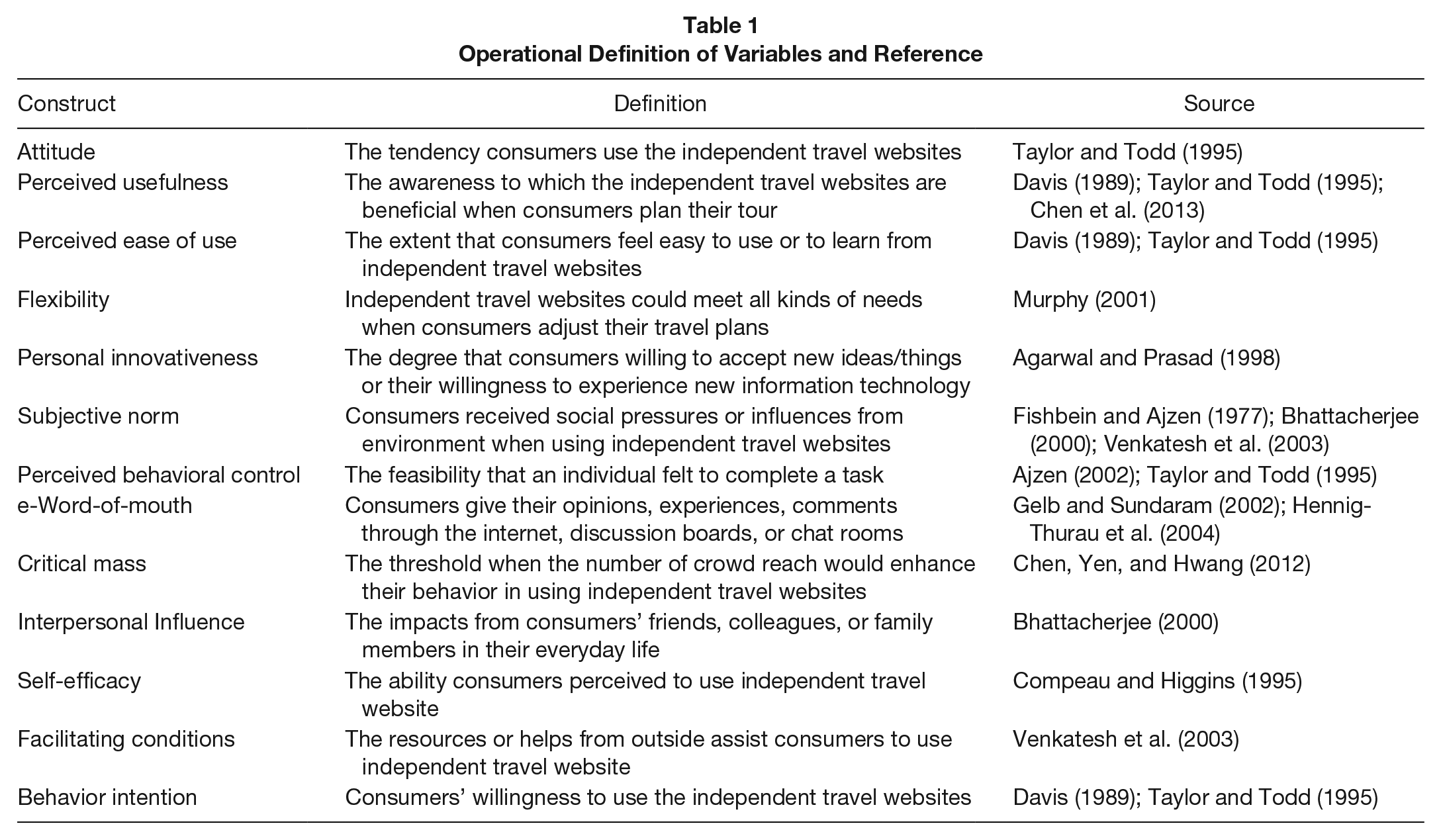
This study sought to determine the effects of attitudes, subjective norms, and PBC on backpackers’ behavioral intentions. Attitudes were measured in terms of PU, PEOU, flexibility, and personal innovativeness. Subjective norms were measured in terms of eWOM (Cheng et al., 2006; Hsu & Huang, 2010), interpersonal influence, and critical mass. PBC contained the factors of self-efficacy and facilitating conditions. A questionnaire was developed based on the literature review, then modified by self-service e-tourism experts and blog administrators to fit the purpose of this study. The operational definitions of this study and the literary sources are listed in Table 1.
Operational Definition of Variables and Reference
This study explored backpackers’ continuing intentions to use self-service travel websites. Data were collected via the mySurvey website. In order to obtain an effective research sample, this study first refers to the Taiwan Network Information Center’s mobile commerce-related market research report to grasp the profile of mobile service users and to plan the number of participants required for analysis according to gender and age. On the other hand, according to the requirements of J. C. Anderson and Gerbing (1988), the minimum sample size must be at least 150 individuals if the structural equation model is used as the analysis method. In order to achieve the purpose of the research, this research uses several backpacker’s community websites or fan pages with more than 10,000 users in Taiwan to solicit volunteer participants who meet the needs of the research, and then sends hyperlink via email. The survey was opened for 70 days and received 308 responses and the proportion of potential participants collected rate form more than 10,000 users in Taiwan are about 3%. After eliminating 24 invalid questionnaires, a total of 284 valid questionnaires remained, with a response rate of 92.21%. The demographic profile of the respondents is presented in Table 2. The partial least squares method was used to explore the relationship between the constructs and to validate the fit of the model. The fit of the model was determined using confirmatory factor analysis and reliability and validity tests. Structural model analysis was used to examine the differences between the research model and the data. Finally, the analytical results of standardized factor loadings, path coefficients, and t values were used to support or reject the hypotheses.
Sample Structure of This Research
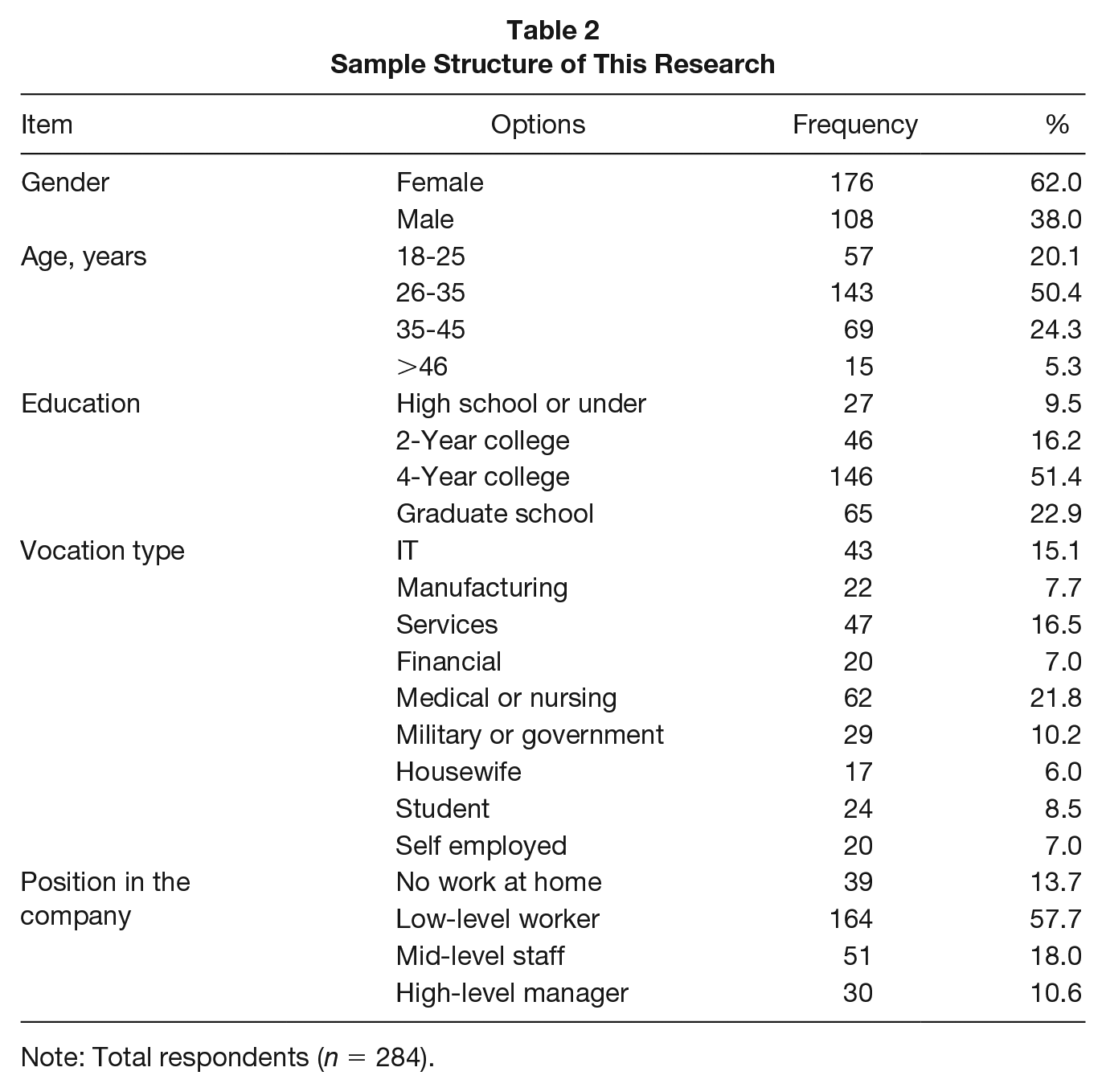
Note: Total respondents (n = 284).
Analysis and Results
Measurement Model
SmartPLS 2.0 was used to conduct the data analysis. The partial least squares method is suitable for complex model predictions (Hair et al., 2019; H. Lee et al., 2009; Tsai & Huang, 2009). As this method does not use model fit indicators, the coefficient of determination, R2, was used to determine the explanatory power of the model. A path coefficient indicates the strength and direction of the relationship between two constructs, while a measurement model examines reliability, convergent validity, and discriminant validity (Ali et al., 2018).
Cronbach’s α and the composite reliability (CR) values of the latent variables were used to measure the internal consistency of the constructs. A Cronbach’s α value of .7 or higher indicates good reliability (Bagozzi & Yi, 1988). If the CR of the latent variables is high, it indicates that the variables are highly correlated and have high internal consistency. The latent variables can effectively explain the measurement variables. It is recommended that CR values be 0.7 or higher (Fornell & Larcker, 1981).
Factor loading indicates the extent to which a question can be explained by a latent variable. Chin (1998) suggested that factor loadings should be greater than 0.7 at the 95% confidence level. In this study, all factor loadings for the questions were greater than 0.7 (Supplement Table 3 located in the online supplement material). All Cronbach’s α and CR values were also higher than the recommended values, so the measurement model had good internal consistency (Hair et al., 2019).
Convergent validity measures the degree to which multiple questions in a construct are related. In general, the average variance extracted (AVE) is used to determine convergent validity (Black et al., 2010; Hair et al., 2019). An AVE value calculates the explanatory power of the latent variables in relation to the measured variables. If the AVE value is equal to or greater than 0.5, the construct has good convergent validity (Fornell & Larcker, 1981; Hair et al., 2019). As all AVE values in this study were higher than the recommended value of 0.5, all constructs had good convergent validity, as shown in Table 3.
Discriminant validity is used to examine the difference between the constructs. Discriminant validity exists when the correlation between them is weak, which indicates that the constructs are distinct. If the standardized factor loadings are greater than the cross-loadings, the variables have discriminant validity. In this study, the standardized factor loading of each variable was greater than its cross-loading, showing discriminant validity between the constructs (Supplement Table 4 located in the online supplement material).
Structural Model
Path analysis is used to measure the interactions between constructs. Inner model analysis is also called structural model analysis. The significance of the path coefficients in an inner model is determined using a one-tailed test at the 95% confidence level. The test results of the research model are shown in Figure 1.

Standardized Solution of Path Analysis
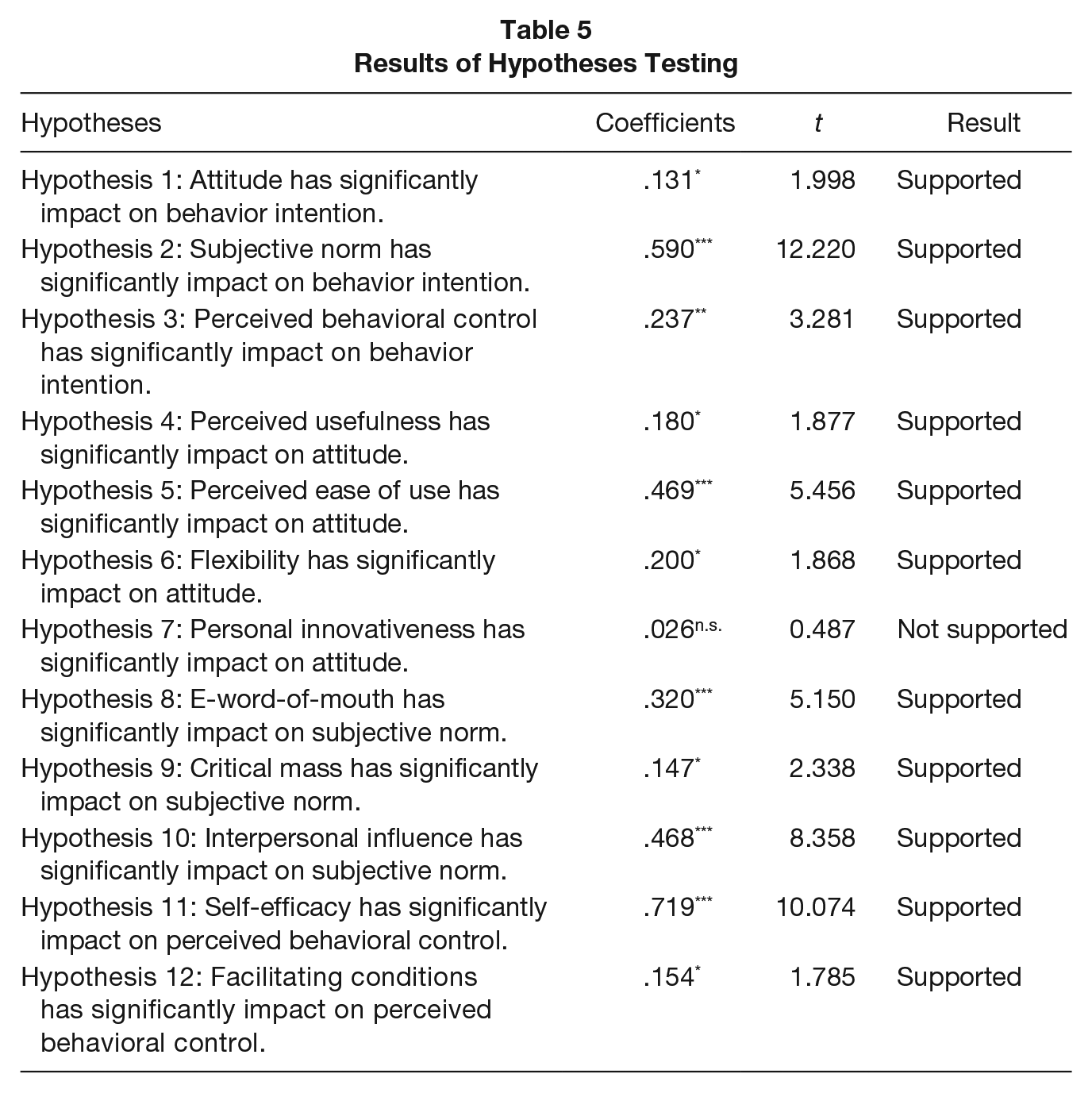
In regression analysis, the coefficient of determination, R2, represents the ratio of the explained variation divided by the total variance. An R2 value of .19 or less indicates that the model has little explanatory power, a value of .33 indicates moderate explanatory power, and a value of .67 or higher indicates that the model has good explanatory power (Ali et al., 2018; Chin, 1998; Hair et al., 2019). In this study, all R2 values were between .65 and .72, indicating that the explanatory power of the research model was good. Hypothesis 1 shows (β = .131; t = 1.998), backpackers’ attitude on self-service travel websites’ behavior intention is significantly accepted, which indicated that null hypothesis, Hypothesis 10 “backpackers’ attitude does not significantly effect on behavior intention” is rejected; Hypothesis 2 shows (β = .590; t = 12.22), backpackers’ subjective norm on self-service travel websites’ behavior intention is significantly accepted, which indicated that null hypothesis, Hypothesis 20 “backpackers’ subjective norm does not significantly effect on behavior intention” is rejected; Hypothesis 3 shows (β = .237; t = 3.281), backpackers’ PBC on self-service travel websites’ behavior intention is significantly accepted, which indicated that null hypothesis, Hypothesis 30 “backpackers’ PBC does not significantly effect on behavior intention” is rejected; Hypothesis 4 shows (β = .180; t = 1.877), backpackers’ PU on attitude is significantly accepted, which indicated that null hypothesis, Hypothesis 40 “backpackers’ PU does not significantly effect on attitude” is rejected; Hypothesis 5 shows (β = .469; t = 5.456), backpackers’ PEOU on attitude is significantly accepted, which indicated that null hypothesis, Hypothesis 50 “backpackers’ PEOU does not significantly effect on attitude” is rejected; Hypothesis 6 shows (β = .200; t = 1.868), backpackers’ flexibility on attitude is significantly accepted, which indicated that null hypothesis, Hypothesis 60 “backpackers’ flexibility does not significantly effect on attitude” is rejected; Hypothesis 7 shows (β = .026; t = 0.487), backpackers’ personal innovativeness on attitude is not supported, which indicated that null hypothesis, Hypothesis 70 “backpackers’ personal innovativeness does not significantly effect on attitude” is accepted; Hypothesis 8 shows (β = .320; t = 5.150), self-service travel websites’ e-word-of-mouth on subjective norm is significantly accepted, which indicated that null hypothesis, Hypothesis 80 “self-service travel websites’ e-word-of-mouth does not significantly effect on subjective norm” is rejected; Hypothesis 9 shows (β = .147; t = 2.33), self-service travel websites’ critical mass on subjective norm is significantly accepted, which indicated that null hypothesis, Hypothesis 90 “self-service travel websites’ critical mass does not significantly effect on subjective norm” is rejected; Hypothesis 10 shows (β = .468; t = 8.358), self-service travel websites’ interpersonal influence on subjective norm is significantly accepted, which indicated that null hypothesis, Hypothesis 100 “self-service travel websites’ subjective norm does not significantly effect on subjective norm” is rejected; Hypothesis 11 shows (β = .719; t = 10.074), self-service travel websites’ self-efficacy on PBC is significantly accepted, which indicated that null hypothesis, Hypothesis 110 “self-service travel websites’ self-efficacy does not significantly effect on PBC” is rejected; Hypothesis 12 shows (β = .154; t = 1.785), self-service travel websites’ facilitating conditions on PBC is significantly accepted, which indicated that null hypothesis, Hypothesis 120 “self-service travel websites’ facilitating conditions does not significantly effect on PBC” is rejected, The hypothesis testing results are presented in Table 5. All hypotheses were supported, except Hypothesis 7.
Results of Hypotheses Testing
Discussion and Conclusions
This study discussed the factors affecting backpackers’ intentions to use self-service travel websites. This section presents the analytical results, discusses the findings, and offers practical recommendations for the tourism industry. Directions for future research are also suggested.
Discussion
In addition, this study sought to identify the antecedent variables of these three constructs and to explore their effects on these constructs. Accordingly, 12 research hypotheses were developed. The first three hypotheses sought to determine whether attitudes, subjective norms, or PBC had an effect on backpackers’ behavioral intentions to use self-service travel websites. The results showed that the overall predictive power of the proposed model was 71%, indicating that the proposed research model could predict backpackers’ behavioral intentions to choose self-service travel websites.
Attitudes, subjective norms, and PBC, the three constructs of the TPB, were found to have significant effects on backpackers’ behavioral intentions (supporting Hypothesis 1, Hypothesis 2, and Hypothesis 3). In addition, PU, PEOU, and flexibility had significant effects on attitudes toward a given behavior (supporting Hypothesis 4, Hypothesis 5, and Hypothesis 6). This means that backpackers will be encouraged to use self-service travel websites if they find these websites useful. Moreover, if self-service travel websites are easy to use, backpackers will be more willing to visit these sites when planning their trips. Similarly, if self-service travel websites are able to provide a lot of information to backpackers to organize their travel with more flexibility, these websites will attract more customers.
The effect of personal innovativeness on attitudes was not significant, indicating that Hypothesis 7 was not supported. Although having an innovative personality may help backpackers accept new information technologies more easily, backpackers with this personality type were not more willing to use self-service travel websites.
In contrast, the effects of eWOM, critical mass, and interpersonal influence on subjective norms were significant (supporting Hypothesis 8, Hypothesis 9, and Hypothesis 10). This indicates that when a self-service travel website has a better reputation, more backpackers want to use it. In addition, if backpackers are surrounded by people who have used self-service travel websites for travel planning, they will be influenced by them to use these websites. Moreover, backpackers’ willingness to use self-service travel sites will increase if their family, colleagues, or friends have had positive experiences with or indicate positive perceptions of these websites.
Self-efficacy and facilitating conditions had significant effects on PBC (supporting Hypothesis 11 and Hypothesis 12). If backpackers can surf the Internet and access websites with confidence, they can use self-service travel websites to plan their trips. Accordingly, backpackers with higher self-learning ability have stronger behavioral intentions to use self-service travel websites than those with less self-learning ability. With more and more travel resources available on the Internet, backpackers are increasingly willing to use self-service travel websites to plan their trips because the facilitating conditions are better now than in the past.
Conclusion
Based on the TPB, Ajzen (2002) concluded that an individual’s behavioral intentions are affected by that person’s attitudes toward the given behavior, subjective norms, and PBC. This study confirmed that these three constructs have significant effects on backpackers’ behavioral intentions to use self-service travel websites.
This study has many theoretical and practical implications. This is the first study to adopt the TPB and TAM to examine backpackers’ behavioral intentions to use self-service travel websites. In the research model, PU and PEOU were found to have significant effects on attitudes, demonstrating that it was meaningful to include both the TPB and TAM in this study. This result is consistent with those of other IT studies (Casaló et al., 2010; Liao et al., 2007; Lu et al., 2009; Wu & Chen, 2005). In other words, whether or not backpackers use travel websites depends on their information proficiency and the information provided by the websites. Among the four factors, PEOU had the greatest effect on attitudes. This indicates that if the interface of travel websites is designed to be easy to use, it will increase the positive attitudes of consumers toward these websites. Indeed, the main users of self-service travel websites are members of the general public, and the easier a website is to use, the lower the barriers for customers. Therefore, if website administrators wish to improve consumers’ attitudes toward their websites, they should first seek to simplify the operational interfaces of their sites to make them as user-friendly as possible.
Second, the regression coefficient between subjective norms and behavioral intentions reached 0.59. The results showed that subjective norms had a greater influence on behavioral intentions than attitudes and PBC. In addition, eWOM, critical mass, and interpersonal influence all had significant effects on subjective norms. These results are consistent with the studies conducted by Nusair (2010), Quintal et al. (2010), Wang and Fesenmaier (2004), and Ye et al. (2011). When making travel arrangements, users of self-service travel websites often accept recommendations from other consumers because they consider the information provided by their fellow consumers to be more credible and interesting than that provided by the websites. eWOM comes from the actual experiences of tourists and can convey useful information that shortens the decision-making process of a trip planner. Another interesting finding is that among the three aforementioned factors, interpersonal influence had the greatest effect on subjective norms. This reflects the likelihood that when an individual discovers that people around them have used self-service travel websites for travel planning, that person will be more willing to learn how to use these websites even if they have never done so before. To some extent, people may feel behind the times if they do not know how to use self-service travel websites to plan a trip.
Among the three constructs in the TPB, subjective norms had a greater effect on behavioral intentions than attitudes or PBC. Thus, website administrators could increase the number of users of their websites by strengthening subjective norms. For example, encouraging current users to recommend self-service travel websites to friends or family via their social networks could attract new users. Other practical methods include opening new discussion boards on their websites for users to share their travel experiences, offering prizes to encourage website users to vote for the best self-service travel websites or the best travel articles, and combining sweepstakes, such as free tickets or accommodation giveaways, with website activities. All these incentives could attract many new visitors looking for travel information and could in turn increase sales of travel products. Once the number of website users exceeds a certain threshold, the effect of critical mass will become an influencing factor. As a result, using self-service travel websites for travel planning could become a social trend.
Third, the effect of PBC on behavioral intentions was found to be second to that of subjective norms. Among the two factors influencing PBC, the regression coefficient of self-efficacy on PBC was much higher than that of facilitating conditions on PBC. This result is similar to that of Hung et al. (2012) and (Taylor & Todd, 1995). Thus, it seems that if one seeks to enhance PBC, increasing self-efficacy will be more effective than improving facilitating conditions.
This finding indicates that increasing the self-efficacy of their customers should be important to administrators of self-service travel websites. Simply put, administrators need to make their users feel that they have the capacity to organize their travel, purchase tickets, and book hotels online (Hoare et al., 2010; Tseng & Wang, 2016). In self-website design for backpacker could also include Confucian influence design concept, which is concerned with one’s relationship with self-service website content provider through computer-mediated communication, suggested swift-guanxi (relationship networks) with the self-service website on trust through interactivity and presence as the dominant characteristics of Confucianism influence consumers intention to access and adopted (Fu et al., 2017; Ou et al., 2014). These phenomena can be explained by the self–other relationship dyads endorsed by Confucianism (Chan & Lby, 2002).
In this regard, learning or imitating relevant behaviors can be very important for website users. As such, administrators of self-service travel websites should highlight success stories or experiences on their websites that will encourage their users to use or shop on these websites with confidence.
Finally, the self-service travel market continues to grow each year. With the popularity of the Internet and the penetration of smartphones, people can organize their own travel with ease. This indicates that traditional travel agencies are unlikely to survive in the future if they cannot foresee trends in the tourism market, observe customer demand, integrate various resources (i.e., transportation or hotels), and develop Internet marketing strategies. Special tours, such as polar exploration tours or African hunting safaris, are very profitable to the tourism industry. As such, if self-service travel websites can offer backpackers special tours that are as convenient as group tours in terms of transportation or accommodation, this could be their blue ocean strategy in the broader tourism industry.
Research Limitations and Future Work
This study has some limitations. First, about half of the respondents were between 26 and 35 years old and earned between NT$30,000 and NT$50,000 per month. As a result, the overall sample may not be representative of the entire population of self-service travel website users in terms of age, income groups, and views. Indeed, variations between different socioeconomic groups were not considered in the research model. For example, the correlation coefficients of the path analysis may be different for high-income and low-income groups. Future studies should overcome this limitation by performing multigroup comparisons to explore the effects of different demographic groups on self-service travel websites. This could allow sellers to segment the market and use different marketing strategies to target different buyer groups accordingly.
Second, this study collected data via a network system. That is, all respondents were internet users. As such, the results of the study only apply to the behavior of Internet users. Future studies should overcome this limitation by investigating different backpacker groups, such as backpackers organizing their trips via traditional travel agencies. Such research will determine whether the research model proposed in this study can also explain the behavioral intentions of backpackers who use travel services other than websites.
Third, this study found that subjective norms had the greatest effect on behavioral intentions and that interpersonal influence had a major effect on subjective norms. Is it possible that interpersonal influence affect behavioral intentions by moderating subjective norms? Future research should explore in more detail the relationship between interpersonal influence, subjective norms, and behavioral intentions.
Fourth, there are different types of self-service travel websites. Some focus on e-commerce, while others are content or community based. This study did not distinguish between different types of self-service travel websites. Therefore, future research should compare and discuss different backpacker behaviors for different types of self-service travel websites.
Summary
The main aim of this study was to integrate the TPB and the TAM with interpersonal influence, eWOM, flexibility, personal innovativeness, and critical mass to measure their material effects on backpackers’ behavioral intentions toward self-service travel. Questionnaire was developed based on existing items which were modified by self-service e-tourism experts and blog administrators to suit the purpose of the study. Data were collected via the mySurvey website from the backpacker’s community with more than 10,000 users in Taiwan who met the needs of the research. The partial least squares method was used to explore the relationship between the constructs and to validate the fit of the model. Analysis of 284 questionnaires collected through the online survey revealed these key findings: attitudes, subjective norms, and PBC have significant material effect on backpackers’ behavioral intentions toward self-service travel. Also, other constructs such as PU, PEOU, and flexibility of travel websites significantly affected attitudes toward a given behavior. It is equally important to underscore that exogenous variables such as eWOM, critical mass, and interpersonal had significant effects on subjective norms. Related to this, self-efficacy and facilitating conditions had a significant effect on PBC. This study sought to contribute to the body of knowledge applying TPB and TAM to examine backpackers’ behavioral intentions to use self-service websites.
Supplemental Material
sj-pdf-1-jht-10.1177_1096348021994166 – Supplemental material for Understanding Extended Theory of Planned Behavior to Access Backpackers’ Intention in Self-Service Travel Websites
Supplemental material, sj-pdf-1-jht-10.1177_1096348021994166 for Understanding Extended Theory of Planned Behavior to Access Backpackers’ Intention in Self-Service Travel Websites by Shih-Chih Chen, Din Jong, Chia-Shiang Hsu and Chung-Hsuan Lin in Journal of Hospitality & Tourism Research
Footnotes

Supplemental Material
Supplemental material for this article is available online.
References
Supplementary Material
Please find the following supplemental material available below.
For Open Access articles published under a Creative Commons License, all supplemental material carries the same license as the article it is associated with.
For non-Open Access articles published, all supplemental material carries a non-exclusive license, and permission requests for re-use of supplemental material or any part of supplemental material shall be sent directly to the copyright owner as specified in the copyright notice associated with the article.
