



Abstract
Moral Foundations Theory is used to help explain human behavior and beliefs across cultural contexts. In this study, one specific foundation, loyalty, was used to predict intentions to stay in an organization and job embeddedness. Regulatory focus was proposed as a moderator to the association with prevention focus being found to be particularly salient. A total of 744 hospitality workers were recruited and acted as participants for this study. A two-wave time-lagged design was applied for the data collection. The results showed that loyalty as a moral foundation predicted organizational retention, and that the association was mediated by job embeddedness. Furthermore, the results suggested that prevention focus moderates the relations between hospitality employees’ loyalty and job embeddedness, and between loyalty and intention to stay. The positive associations become stronger for the prevention-focused employees.
Highlights
We present evidence that loyalty as a trait variable is predictive of the turnover process within the hospitality industry
We support the arguments of Moral Foundations Theory that individual moral foundations predict individual outcomes
We supports neo-career literature, especially work on the Protean Career that suggests careers are managed like a series of self-directed goals
We presents evidence that loyalty is negatively associated with turnover and that the association is mediated by job embeddedness and moderated by regulatory focus
Introduction
In order for the industry to recover from the losses sustained in 2020 (U.S. Bureau of Labor Statistics [BLS], 2021; American Hotel and Lodging Association [AHLA], 2020), firms will need to be able to hire workers back into the industry. Hiring workers back could be a potentially difficult task since many hospitality workers view themselves as having transferable skills allowing them to work in many different industries (McGinley et al., 2014). It may be of particular importance for managers in the hospitality industry to hire back their staff given the difficulty of overcoming constraints on attracting new workers to the industry, such as perceptions of low pay and high levels of work-life conflict among those with no industry experience (McGinley et al., 2017). Hiring the right people should be especially salient to hospitality managers, because the industry faced high levels of turnover before the pandemic (U.S. BLS, 2018, 2019). Accordingly, managers should focus on those who have a high likelihood to return to hospitality employment or maintain their employment therein.
The scholarly discussion regarding employee retention has focused on loyalty as an outcome, or, as Doan et al. (2021) described it, as a consequence of employee personality, or employees exchanging their effort and loyalty to an organization for material and socio-emotional rewards that are bestowed by the organization (Eisenberger et al., 2019). Employee loyalty to a company has also been conceptualized as being predicted by levels of organizational commitment (Meyer & Allen, 1991). Employee loyalty—as an outcome of various organizational efforts—is summarized by Long et al. (2012) who claim their meta-analysis: differentiates and has actually categorized all types of turnover models and tries to associate each of them with the employees’ job satisfaction and organizational commitment. To instill loyalty and for employees to share their intellectual capital, organizations must find ways to engage them. Retaining talent is a major challenge for companies, especially during a growth boom, when employee recruiting between companies is commonplace. (p. 290)
To further emphasize the point, Park and Min (2020) conducted a meta-analysis in the hospitality literature and examined 35 antecedents of turnover from 144 independent studies, but did not discuss loyalty as an antecedent in the same way job embeddedness was discussed.
The extant literature has conceptualized loyalty as a state or an outcome of organizational and industrial conditions (Park & Min, 2020). Recently, however, an alternative conceptualization has been proposed by Joseph and Haidt (2007): Loyalty can also be thought of as the correct and moral way in which to live, regardless of external factors, according to Moral Foundations Theory (Joseph & Haidt 2007; Haidt & Joseph, 2004). While loyalty can be conceptualized as organizational retention (Doan et al., 2021; Eisenberger et al., 2019), it can also be thought of as a guiding principle in a person’s life that determines choices made. Loyalty as a moral foundation, then, is defined as having virtues grounded in trust, patriotism, heroism, and sacrifice for the group, and where betrayal, dissent, and criticism of authority or other in-group members is considered immoral (Prince, 2010), which distinguishes loyalty as a personal characteristic from an outcome resultant from organizational conditions (Doan et al., 2021; Eisenberger et al., 2019). Loyalty as a moral foundation is further defined as viewing a lack of an esprit des corps in the group, as weakening the overall group, and rituals designed to strengthen group solidarity are seen as virtuous (Joseph & Haidt 2007; Haidt & Joseph, 2004). By employing the conceptualization of loyalty proposed by Moral Foundations Theory (Haidt & Joseph, 2004), researchers can begin to distinguish between the two different types of loyalty. The first is what Park and Min (2020) documented in their meta-analysis, which is loyalty as a state that is determined by organizational and industrial conditions; and the second is what Moral Foundations Theory proposes: a personality trait that helps to inform a person’s sense-making process.
Recent research suggests that loyalty as a personal trait is elemental in how we as humans form friendships, and predicts who we befriend to a greater degree than other factors, like similarity and propinquity (Liberman & Shaw, 2019). In fact, the importance of trait loyalty increases as we age in its ability to predict with who we form friendships (Liberman & Shaw, 2019). Evidence from political science literature supports the Moral Foundations Theory argument that loyalty is a state, in that loyalty predicts people’s voting patterns, level of partisan political support, and intention to take political action (voting), making loyalty a key predictor of political outcomes (Clifford, 2017). From a business operations perspective, the extant literature also supports the idea that loyalty can be predictive of organizational outcomes, as stated by Tsai and Tsai (2017): An important implication of this study is that the attitudes and behaviors of employees are shaped by loyalty and developed further during participation, and obedience is evident later. This order of occurrence of the three phases plays an important role in the context of OCB. This result explains the mentality of employees; namely, employees show loyalty first, and loyalty is the most important element in the context of the development of OCB. (p. 74)
Loyalty to a group is also predictive of participation levels in the group, such as when loyalty to a union increases the likelihood of a member participating in union activities (Fullagar & Barling, 1989). Therefore, this study focuses on people who display a strong moral foundation for loyalty (referred to as “loyalty” throughout the paper) in order to test if the arguments made by Moral Foundations Theory predict if hospitality workers will remain active industry participants.
The Bureau of Labor Statistics estimates that roughly 2 million jobs were added to the U.S. economy in the first 6 months of 2021 (BLS, 2021). The same report also indicates that total employment is still below the pre-pandemic high. What this means is a challenging hiring environment where both out of work and currently working hospitality employees have a wide array of alternatives to work, a key driver in the decision to turnover according to Mobley’s (1977) interlinkages theory of the turnover process. Mobley (1977) suggested several factors for why people begin the turnover process, but the availability of attractive alternative employment options is what makes the decision. Similarly, work on neo-careers theory, for example, Protean Career scholars, have suggested that as workers see more possibilities external to their firm, they are more likely to seek out work elsewhere (Baruch, 2014; Hall, 2004). Given the labor market in the hospitality industry and the economic situation more broadly, workers are more likely to seek out novel employment experiences during the post-coronavirus recovery than they were during the pre-pandemic period (Baruch, 2014; Mobley, 1977). The question regarding who is more likely to remain in their chosen company and industry becomes increasingly important, and one factor that should explain this question is the degree to which employees’ sense of moral correctness, which is defined by the importance of being loyal. Given the industrial conditions of massive job openings during the coronavirus recovery period (BLS, 2021) industrial conditions should reduce workers’ level of loyalty given the availability of viable alternative jobs (Mobley, 1977). However, there is little that managers at an individual organization can do when industrial conditions are determining behavior. Therefore, this paper uses the Moral Foundation Theory conceptualization of loyalty to examine if people who believe that loyal behavior is moral correct will remain in their organizations even when the industrial labor market conditions are likely to suggest they should be less loyal, which can help to guide managers when making hiring decisions.
A person’s moral foundation is considered static and is responsible for predicting important behaviors like voting patterns and relationship management (Clifford, 2017). Moral Foundations Theory (MFT) is used to explain innate personal reasoning and variations in idiosyncratic human perspectives (Graham et al., 2013, 2018). While Clifford (2017) explains that each person agrees with each foundation to a degree, they tend to be guided by either care and fairness, or loyalty, respect for authority, and purity. The argument of MFT argues for loyalty as an antecedent of the turnover decision, and therefore explains why people behave or intend to behave in a certain way. Loyalty may, therefore, have a direct link to turnover intentions as it may create the conditions for people to feel more connected to their jobs due to feelings of moral correctness for making a sacrifice for their group and a disdain for anything that could be construed as betrayal (Prince, 2010). Loyalty may inform people’s perceptions regarding how connected they feel about a given job and, as Holtom et al. (2014) and Yao et al. (2004) stated, connectedness to a job contributes to a sense of embeddedness. Stated differently, as people believe that engaging in loyal behaviors is the morally upright thing to do (Joseph & Haidt 2007), they should feel a greater sense of embeddedness to their group. Therefore, they could see increases in affective responses to being connected to a company, which is a central theme of the job embeddedness literature (Holtom et al., 2014; Yao et al., 2004). Additionally, a loyal moral foundation also helps to increase the desire to be in good standing within a community by engaging in deferential acts to the group (Sinn & Hayes, 2017), a similar conceptualization to how job embeddedness’ scholars report on community-level assessments (Holtom et al., 2014).
Additionally, under the assumptions of neo-career theorists like Hall (2004) and Baruch (2014) careers are the pursuit of a series of self-directed goals that an individual strives to achieve. Higgins (1997) posits two main types of chronic regulatory focus, which includes prevention focus and promotion focus. The former describes people who seek to avoid losses and setbacks when striving for goal attainment, and the later describes people who aspire to obtain gains and benefits while striving for goal attainment. A person’s regulatory focus should, in turn, help to determine how strong of an effect loyalty has on the decision to turnover, because it would explain whether or not someone is focused on avoiding mistakes or striving for accomplishments during goal obtainment (Higgins, 1997), which may moderate the effect of loyalty. Furthermore, evidence from the hotel industry in South Korea suggests that regulatory focus plays a role in the turnover decision when it is consistent with other motivations of the workers: “Hotel employees’ turnover intent decreases when they are motivated by strategies corresponding to their regulatory focus” (Jung & Yoon, 2015 p. 283). As loyalty (as a foundational principle of one’s moral compass) increases, individuals should be motivated to avoid harming their group, which is why people who are highly loyal tend to abhor betrayal (Graham et al., 2009) and work to avoid subverting their group (Prince, 2020). Those who are prevention focused should likewise be motivated to avoid setbacks like subversion and betrayals, and, as such, the motivations of people with a high level of loyalty and prevention focus should align.
This paper ultimately seeks to answer the question: who is more likely to remain as a part of the hospitality industry during the coronavirus induced economic crisis and post-pandemic recovery? By answering this question the inquiry also seeks to provide evidence towards a series of other objectives as well: 1) to explore if loyalty as a trait has value to hospitality practitioners and scholars in the same way loyalty as a state does; 2) to determine individual identifiable factors that future scholars can use to further study and advance our knowledge regarding turnover in hospitality; and 3) to provide evidence for hospitality managers to use when making hiring and operations-level decisions.
Literature Review
Moral Foundations Theory
MFT was proposed as a way to explain similarities in human behavior across cultural divides and different national contexts, such as dissimilar government structures, histories, and economics (Joseph & Haidt 2007; Haidt & Joseph, 2004). Haidt and Kesebir (2010) stated that “moral systems are interlocking sets of values, virtues, norms, practices, identities, institutions, technologies, and evolved psychological mechanisms that work together to suppress or regulate selfishness and make cooperative social life possible” (p. 165). One of the critiques of this approach to moral reasoning is that it is not based on any specific theory of cooperation that explains a person’s moral foundation the way morality-as-cooperation approaches suggest (Curry et al., 2019).
However, MFT explains phenomenon beyond cooperative behaviors, for example, why people are attracted to different political affiliations and perceive social dangers (Van Leeuwen & Park, 2009), and how people create their own politically driven ideological narratives (Clifford, 2017). In fact, MFT even explains why and how sports fans form such tight-knit communities and their significance in their lives (Winegard & Deaner, 2010). At work, MFT explains why certain leaders are perceived as either ethical or unethical (Egorov et al., 2020). Whether discussing politics, sports, or workplace ethics, MFT has been able to explain how people negotiate their social lives and what groups they wish to be associated with. Given the focus on intention to remain as part of a group, the moral foundation that would apply to explain such behavior would be one’s loyalty foundation.
Loyalty
Those who have a moral compass focused on loyalty believe that it is morally correct to stand with their group, family, or nation, and find betrayals to be particularly heinous (Graham et al., 2009). The loyalty foundation is theorized to stem from our ancestral hunter-gatherer past, where inter and intra tribal conflict were common and potentially cataclysmic for groups (Sinn & Hayes, 2017). Because of our common ancestral heritage where group loyalty was beneficial, loyalty is a fairly common moral foundation that does not have a great degree of variance across national cultures and gender (Atari et al., 2020). In the modern world, people who possess a high degree of loyalty as a moral foundation are more likely to believe that trust between parties is essential, that patriotism and heroism are virtuous and, ultimately, that sacrifice for the good of the larger group is one’s duty—rather than their counterparts, whose moral foundation is less centered around loyalty (Prince, 2010). Additionally, as loyalty increases so, too, does a feeling that negative events like betrayals, dissent, and anything viewed as critical of legitimate authority, are immoral acts, and should thus be avoided (Prince, 2010). To a certain extent, loyalty predicts who we freely associate with, either through the formation of personal friendships (Liberman & Shaw, 2019) or through how we affiliate and identify with specific political parties (Clifford, 2017).
Work reinforces familial bonds when adults in a household have gainful employment (Damaske, 2011). While loyalty in hospitality has often been seen as an outcome of factors like organizational commitment (Yao et al., 2019), MFT argues that loyalty should be considered as being determinative of behaviors like turnover because it is central to an individual’s sense making process, determining what is a moral or immoral behavior (Graham et al., 2009). Evidence suggests that loyalty is predictive of both participation in union activities (Fullagar & Barling, 1989) and participation in organizational citizenship behaviors (Tsai & Tsai, 2017). Given the importance of work and the ability of MFT to explain a series of choices that people make, it stands to reason that individual employees may feel a sense of loyalty to an organization. Because people with a high loyalty foundation abhor betrayals (Graham et al., 2009), and workplaces are important to people’s family connections (Damaske, 2011), workers with high loyalty scores may be more likely to remain within their organizations to avoid behavior violating their morality. As such, we propose the following hypothesis:
Job Embeddedness
Loyalty may predict intentions to remain within an organization because it could foster feelings of being embedded within an organization. Job embeddedness is defined as “the combined forces that keep a person from leaving his or her job” (Yao et al., 2004, p. 159) and accounts for various perceptual and contextual forces that coalesce around a feeling of connectedness to a particular job (Holtom et al., 2014; Yao et al., 2004). Job embeddedness is often conceptualized as an antecedent to turnover (Afsar et al., 2018). In a meta-analysis published in the Journal of Applied Psychology, where a total of 65 independent samples were used, the authors found that job embeddedness has a negative association with turnover intentions (Jian et al., 2012). By using Conservation of Resources Theory, recent hospitality evidence argues that embeddedness plays a mediating role between an organization’s diversity climate and turnover intentions (Jolly & Self, 2020). Within the hospitality context, job embeddedness has also been shown to be positively associated with supervisor support (Chen & Ayoun, 2019) and with overall job attitudes (McGinley, Line et al., 2020). Given the potentially widespread ability of job embeddedness to predict organizational outcomes like turnover (Afsar et al., 2018), job attitudes (McGinley, Line et al., 2020), and workplace relationships (Chen & Ayoun, 2019), it is theoretically important to examine factors that could potentially alter workers’ levels of job embeddedness.
The level of job embeddedness may, in part, be determined by a person’s level of loyalty as a moral foundation. Those with high loyalty moral foundations attempt to avoid behaviors that could be construed as a betrayal (Graham et al., 2009) and, as such, may feel a greater affective level response to being connected to their organization, which is one of the tenets of job embeddedness (Holtom et al., 2014; Yao et al., 2004). The loyalty foundation of MFT also explains that a person desires to be a good community member through actions that show deference to their group (Sinn & Hayes, 2017), which is similar to how job embeddedness’ scholars discuss how community-level assessments (Holtom et al., 2014). Loyalty may act as an idiosyncratic characteristic that makes it easier for people to feel embedded within groups because it fosters a greater sense of willingness to work for the benefit of a collective as opposed to focusing more on the benefit to the self (Sinn & Hayes, 2017) which is similar to Holtom et al.’s (2014) definition of embeddedness as connectedness to a group. In fact, if loyalty levels were low within individuals, it seems unlikely they would feel connected to their group membership. Accordingly, as loyalty levels increase and people view group membership as increasingly beneficial (Atari et al., 2020), they should also feel a greater sense of being embedded into that group. We therefore propose the following hypothesis:
Furthermore, because empirical evidence around job embeddedness has shown a robust predictive association between it and turnover (Afsar et al., 2018; Jian et al., 2021; Jolly & Self, 2020), it may also serve as the underlying psychological mechanism that links loyalty to the intention to stay. MFT describes loyalty as a sense of “one for all and all for one” (Dobolyi, 2021), which may account for some of the various perceptual and contextual cues that allow people to feel a greater sense of embeddedness to a job (Holtom et al., 2014; Yao et al., 2004). Greater feelings of loyalty may increase both an individual’s cognitive and affective assessments, that ultimately allows for a sense of embeddedness to increase (Holtom et al., 2014), which reduces turnover intentions (Afsar et al., 2018; Jian et al., 2021; Jolly & Self, 2020).
Job embeddedness would be expected to mediate the association between a loyalty moral foundation and the intention to stay with an organization. As loyalty increases, the likelihood that an individual engages in deferential behaviors to their group should also increase (Sinn & Hayes, 2017) and, as has previously been argued, harbor strongly held negative views on betrayals (Graham et al., 2009). As a consequence, loyalty may not only influence how individuals feel about their roles in a group leading to a greater sense of embeddedness within an organization, but it may also play a direct role on actions taken by a group member. Loyalty then serves as a personal characteristic that makes it easier for a person to feel a greater level of connectedness to an organization, because that organization is their in-group that they are not to betray or subvert (Prince, 2020), allowing for feelings of embeddedness to that organization to flourish. The level of embeddedness a person feels toward their employer may serve as the psychological mechanism that connects a moral foundation of loyalty to behavioral intentions like the intent to stay. As such, we argue that the underlying psychological mechanism that explains why loyalty leads to a greater tendency to remain in an organization is because it increases a person’s sense of job embeddedness:
Regulatory Focus
In addition to loyalty, people may be more or less likely to remain in an organization if they prefer to avoid losses and setbacks or if they prefer to strive for accomplishments and take risks. Higgins (1997) explains that a person’s regulatory focus thus determines if a person is interested in achieving outcomes by obtaining goals and taking risks (promotion focused), or achieving outcomes by avoiding setbacks and following the rules (prevention focused). Furthermore, evidence from the hospitality industry argues that regulatory focus moderates the association between work-to-life conflict and job satisfaction with those with a promotion focus who were less satisfied with their jobs when work interfered with familial life, and those with a prevention focus who were less satisfied with their jobs when familial life interfered with their work (Zhao & Namasivayam, 2012). Additionally, regulatory focus also affected people’s attitudes toward the importance of work and the desire to seek out alternative employment, with promotion-focused workers who were more likely than their prevention-focused peers to be open to seeking between-company job opportunities (Hofstetter & Rosenblatt, 2017).
According to MFT, the concept of loyalty as morality comes from our ancestral heritage of avoiding inter and intra tribal conflict (Atari et al., 2020). Because loyalty helps us avoid conflicts that could be deleterious to our ability to achieve our goals it is possible that, for those who are more prevention focused, loyalty is a more salient construct than for those who are more promotion focused. Under this logic, loyalty could be thought of as inherently loss prevention oriented, because both are concerned with avoiding negative outcomes, which explains why people who are morally predisposed to loyalty seek to avoid anything perceived as negative—like challenges to their authority figures—and view betrayals as immoral acts (Prince, 2020). Just like how a person with a chronic prevention focus would seek to avoid negative outcomes while striving for goal attainment (Higgins, 1997), a loyal person would seek to avoid negative outcomes for the group (Graham et al., 2009). Hofstetter and Rosenblatt (2017) argue that prevention focused workers avoid a negative outcome by managing a career conservatively through remaining in an organization. Furthermore, loyal workers may remain in an organization to avoid a potential betrayal of their group. Ultimately, being both prevention focused and loyal may lead to greater feelings of connection with the job and other organizational members, thereby reducing the likelihood of quitting, because feelings of job embeddedness rise. This is consistent with neo-career theorists (Baruch, 2014; Hall, 2004) who argue that modern, or protean, careers are self-directed endeavors where individual workers define success subjectively, are in charge of their own career development, and manage careers like a series of goals to achieve.
Consequently, regulatory focus may moderate the associations between both loyalty and embeddedness and loyalty and organizational retention. Those who are more prevention focused wish to avoid setbacks (Higgins, 1997), and those who have a moral compass guided by loyalty also desire to avoid betraying a group (Graham, et al., 2009) or causing loss to their in-group members (Atari et al., 2020). It is possible that the positive associations between loyalty and both embeddedness and retention are moderated by regulatory focus in that the links are more salient for prevention focused individuals. Those with a more promotion focus tend to be more open to job mobility (Hofstetter & Rosenblatt, 2017), being potentially less concerned with their group, which would be the opposite of loyalty as a guiding principle in decision making (Atari et al., 2020). Stated differently, those who are both loyal and promotion focused are in conflict with their views on professional mobility as being a positive or negative, which should lead to ambivalence regarding turnover, whereas people high in both loyalty and prevention focus should view leaving an organization as a categorically bad outcome. Therefore, the following hypotheses are proposed:
Figure 1 depicts the theoretical model of our study and summarizes the hypotheses that are tested.
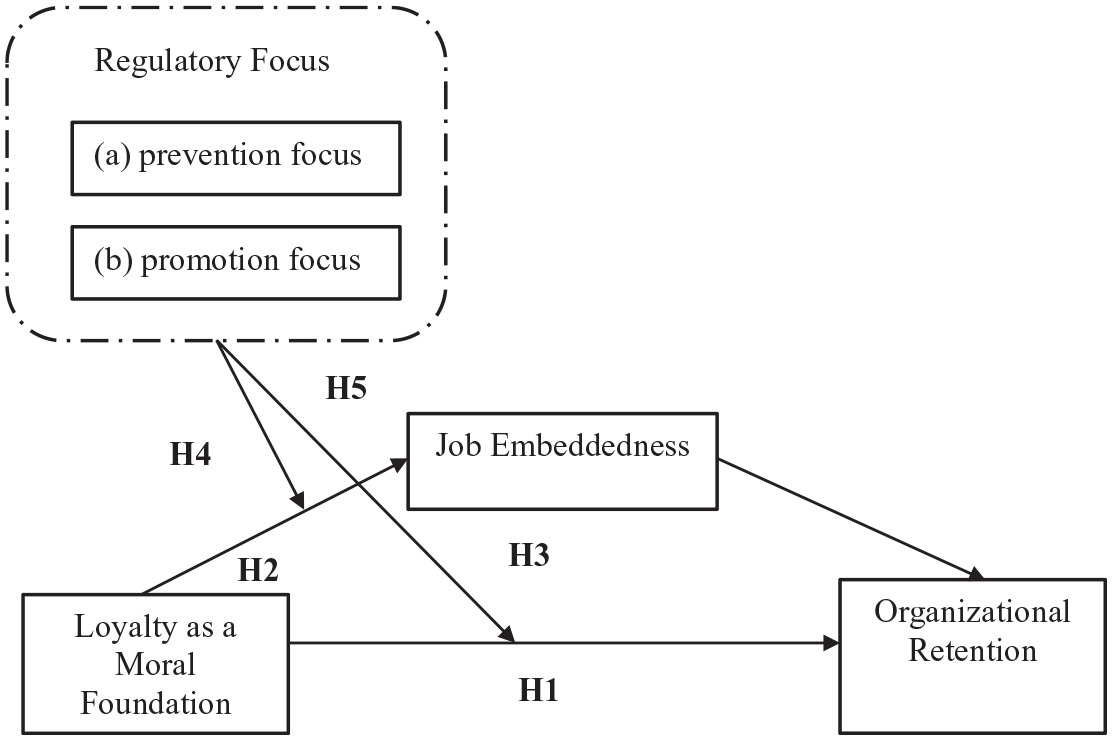
Conceptual model
Methodology
Research Design and Procedures
Participants were full-time employees from the hospitality industry in the United States. We focused on employees from the general hospitality industry and did not limit the data collection to the specific sectors (e.g., the hotel industry, the restaurant industry) in this industry. Recent studies regarding the pandemic influences on the hospitality industry have shown that all the sectors, such as hotel, tourism, meeting, and foodservice, have been affected (e.g., Singh et al., 2021). Data for both the pilot study and the major study were collected via Amazon Mturk. A screening question was used to limit participants to hospitality employees. The participants were asked the select the industry they were currently working in from a full list of industries. Only the participants who selected the airline industry, foodservice industry, hotel industry, recreation industry, cruise industry, or tourism industry were directed to take the survey.
A two-wave time-lagged design was used to create the temporal separation in data collection, which helped to minimize common method variance (Podsakoff et al., 2003). Data collection was conducted in October, 2020. Participants were awarded US$ 0.50 for completing the Time 1 survey and US$1.00 for completing the Time 2 survey. Participants who were in the pilot study were excluded from participating in the major study. The same screening question used in the pilot study was used in the major study for selecting the qualified participants. The Time 1 survey included measures of loyalty and demographic information. At Time 2, approximately 2 weeks after the completion of the Time 1 survey, participants who successfully completed the Time 1 survey were invited to do a survey with the measures of job embeddedness, regulatory focus, and intention to stay in their current industry. To keep the information confidential, participants were only asked to provide their Mturk worker ID in each survey, and this was used for matching the data of each participant from Time 1 and Time 2. No other personal information was asked for data matching. In addition, participants were asked to indicate the industries they were currently working in at both times. Only the information from participants who provided consistent answers was used. Attention check questions were also embedded in the survey design to screen out careless responses as suggested by Meade and Craig (2012). In Time 1, a total of 1,516 participants were qualified and passed the attention check questions. In Time 2, a total of 772 participants from Time 1 participated in the study and passed the attention check questions.
After matching the data from Time 1 and Time 2 based on the Mturk worker ID and the industry information provided by the participants, the final sample size was 744. Around 65% of the participants were male. The majority (44.5%) were aged 25–34. Approximately 63% held a bachelor degree. Around 80% were married, and the rest were either single, divorced, or living with significant others. The respondents’ profiles are displayed in Supplemental Table 1, available online.
Measures
Loyalty (Time 1)
We measured loyalty by using the 6-item Graham et al. (2011) method. Participants were asked to respond how important each statement reflecting ingroup/loyalty foundation is to them, using a 7-Likert scale from 1 (not at all important) to 7 (extremely important). A sample item is “Whether or not someone did something to betray his or her group.” The Cronbach alpha is 0.82.
Job embeddedness (Time 2)
Job embeddedness was measured by using a 7-item scale from Crossley et al. (2007). Sample items are “I feel attached to my organization” and “It would be difficult for me to leave my organization permanently.” The Cronbach alpha is 0.84.
Regulatory focus (Time 2)
Regulatory focus was measured by using an 18-item scale developed by Neubert et al. (2008). The prevention focus scale includes 9 items. Sample items are “I concentrate on completing my work tasks correctly to increase my job security” and “I focus my attention on avoiding failure at work.” The promotion focus scale also includes 9 items. A sample item is “I take chances at work to maximize my goals for advancement.” The Cronbach alpha for prevention focus and promotion focus are 0.87 and 0.88, respectively.
Organizational retention (Time 2)
We used the 4-item scale of employees’ intention to stay from Kim and Gatling (2018) to measure organizational retention. Sample items are “I plan to work at my present job for as long as possible” and “I would hate to quit this job.” The Cronbach alpha is 0.86. The variables at Time 2 were measured on a 7-Likert scale (1 = Strongly disagree, 7 = Strongly agree).
Control variables (Time 1)
Career stage was used as a control variable, as it was found to influence employees’ intention to stay (McGinley & Martinez, 2018). Participants were asked to select if they were currently supervising line-level team members, supervising other managers, or in a position that does not supervise any other employees. The first two categories were combined and named as the manager group. The third category was named as the non-manager group. The manager group was coded as 0 and the non-manager group was coded as 1. R studio was used for conducting data analysis. We used lavaan, stats, and emmeans packages for conducting the factor analysis, regression analysis, and moderation analysis.
Results
Preliminary Analysis
Descriptive statistics are presented in Supplemental Table 2, available online. Although we have adopted several strategies, such as collecting data at two different time points and inserting attention check questions in the survey, we still performed a post-hoc analysis by using Harman’s single factor test to further examine if common method bias is present in the current study. According to the result, the total variance extracted by one factor is 36.9%, which is under the 50% threshold value (Fuller et al., 2016). The information provides further support that common method bias is not an issue in this study.
Data were subject to a confirmatory factor analysis to confirm the construct validity. One item from intention to stay and one item from job embeddedness were removed because the two reverse-coded items did not perform well. The model fit indices of the overall measurement model indicated an acceptable model fit with the data (
Hypothesis Testing
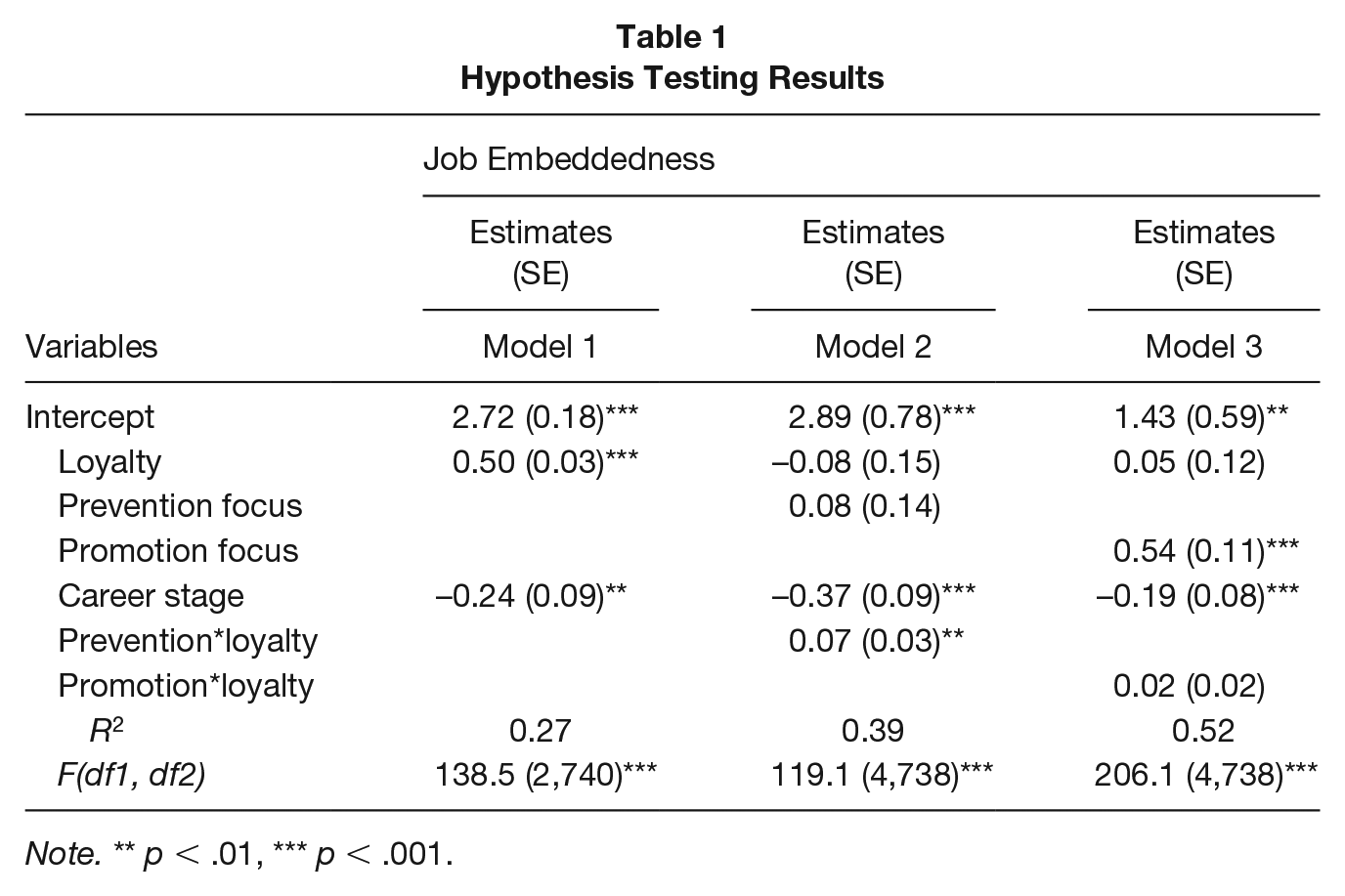
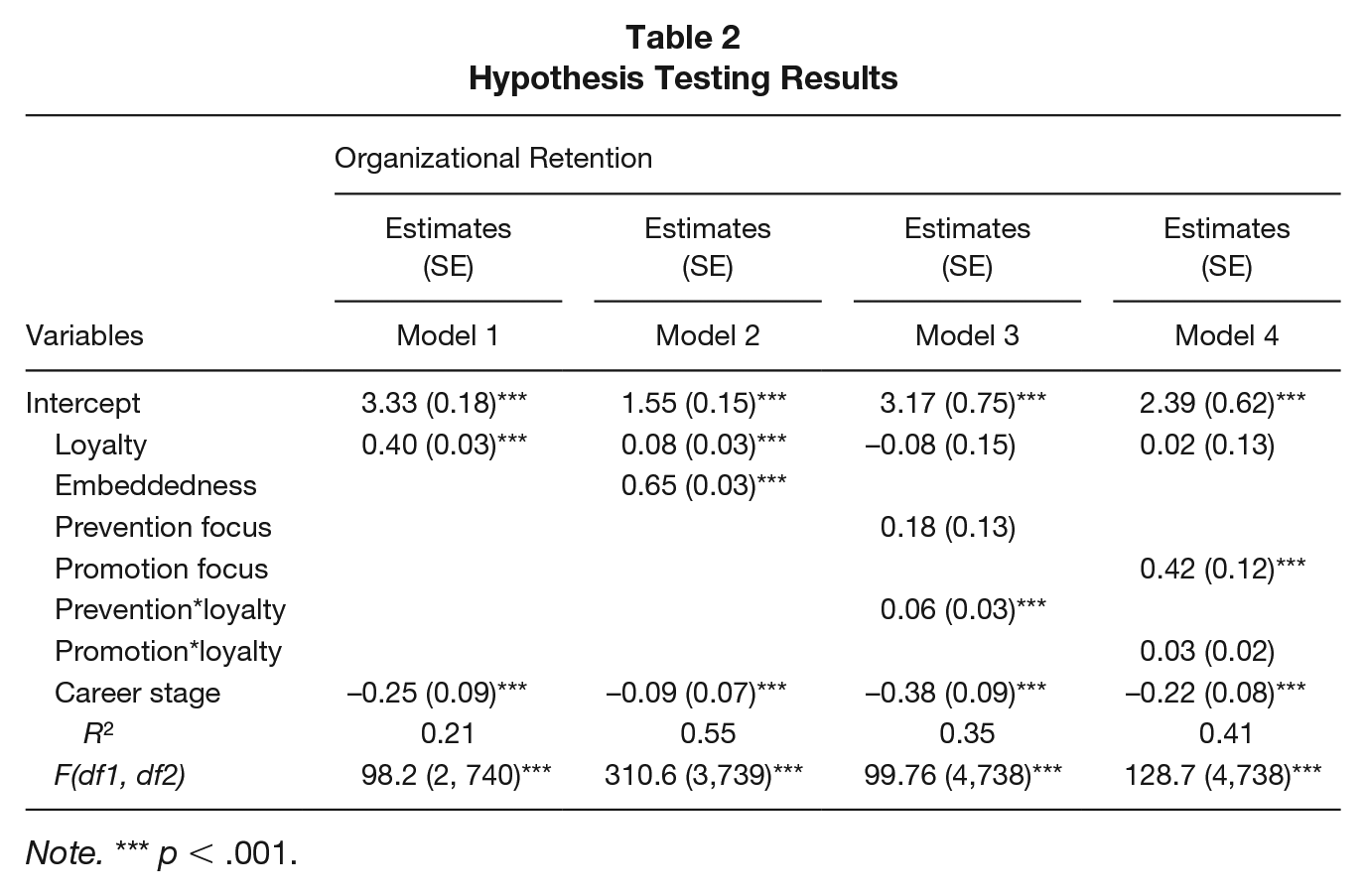
Hypothesis 1 states that there is a positive association between loyalty and organizational retention. Results in Model 1 from Table 1 (b = 0.40, p < .001) supported Hypothesis 1. Model 1 in Table 1 shows that there is a positive link between loyalty and job embeddedness (b = 0.50, p < .001), supporting Hypothesis 2. To test the mediating effects of job embeddedness between loyalty and organizational retention, we first test the direct association between job embeddedness and intention to stay. There is a significant positive relationship between employees’ job embeddedness and organizational retention (b = 0.69, p < .001). Furthermore, we regressed both loyalty and embeddedness on employees’ organizational retention scores (see Model 2 in Table 2). The results show that the effects of loyalty on organizational retention (b = 0.08, p < .01) became smaller when job embeddedness was added in the model. To test if the mediation effects of job embeddedness is statistically significant, the Monte Carlo Method for assessing mediation suggested by Selig and Preacher (2008) was applied. The results indicate the indirect effect of job embeddedness is statistically significant, with CI [0.30, 0.39]. In summary, the results support Hypothesis 3.
Hypothesis Testing Results
Note. ** p < .01, *** p < .001.
Hypothesis Testing Results
Note. *** p < .001.
Hypothesis 4 states that the positive association between loyalty and embeddedness only exists among employees who are prevention focused and not among those who are promotion focused. Results of Model 2 and Model 3 in Table 1 supported Hypothesis 4a and Hypothesis 4b. Prevention focus moderates the association between loyalty and embeddedness (b = 0.07, p < .01). Promotion focus does not moderate the association between loyalty and embeddedness (b = 0.03, p = ns.). Furthermore, Figure 2 and slope tests showed that the positive relations between loyalty and embeddedness are stronger among employees who are high in prevention focus (1 S.D. above the mean; b = 0.40, with 95% CI [0.33, 0.48]) than those who are low in prevention focus (1 S.D. below the mean; b = 0.28, with 95% CI [0.20, 0.35]).
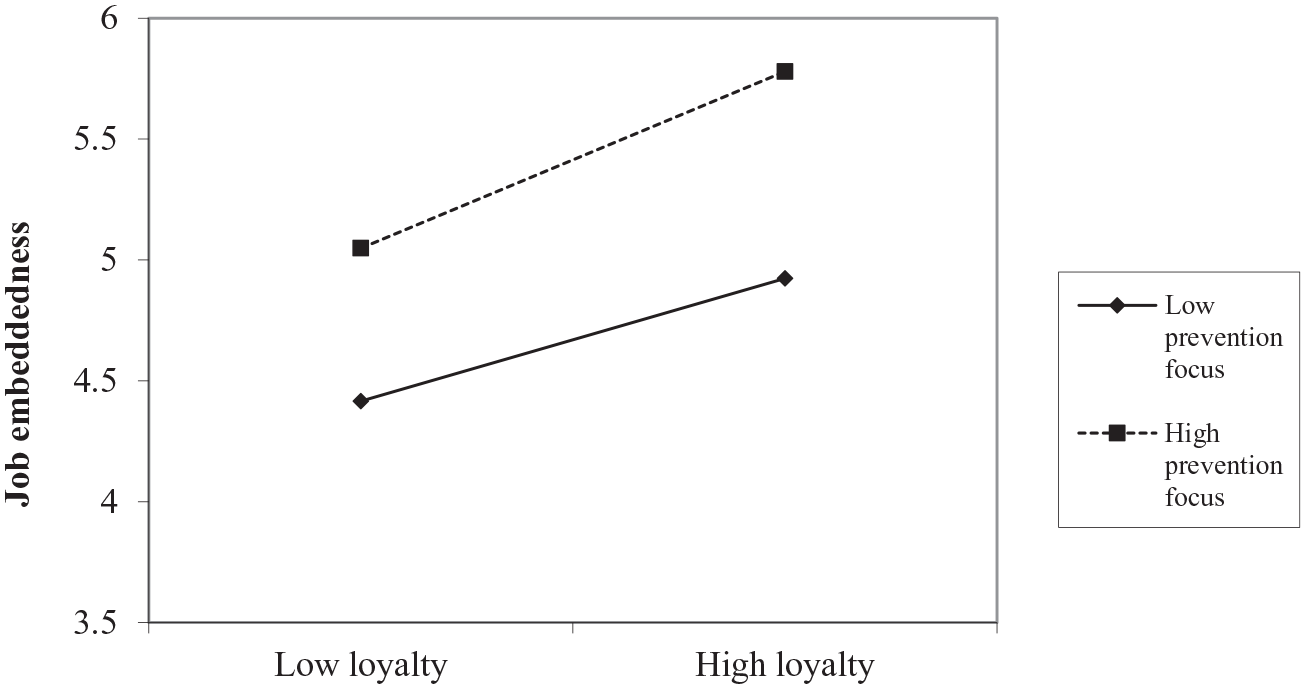
The Interactive Effect of Loyalty and Preventive Focus on Job Embeddedness
Hypothesis 5 states that the moderating effects of prevention focus and promotion focus in the association between loyalty and organizational retention. Model 3 in Table 2 shows that prevention focus moderates the positive association between loyalty and organizational retention (b = 0.06, p < .001). Model 4 in Table 2 indicates that promotion focus does not moderate the above association (b = 0.03, p = ns.). Furthermore, slope tests, as shown in Figure 3, showed that the positive relations between loyalty and organizational retention is stronger among employees who are high in prevention focus (b = 0.29, with 95% CI [0.22, 0.36]) than those who are low in prevention focus (b = 0.20, with 95% CI [0.12, 0.27]). Therefore, Hypotheses 5(a) and 5(b) are supported.
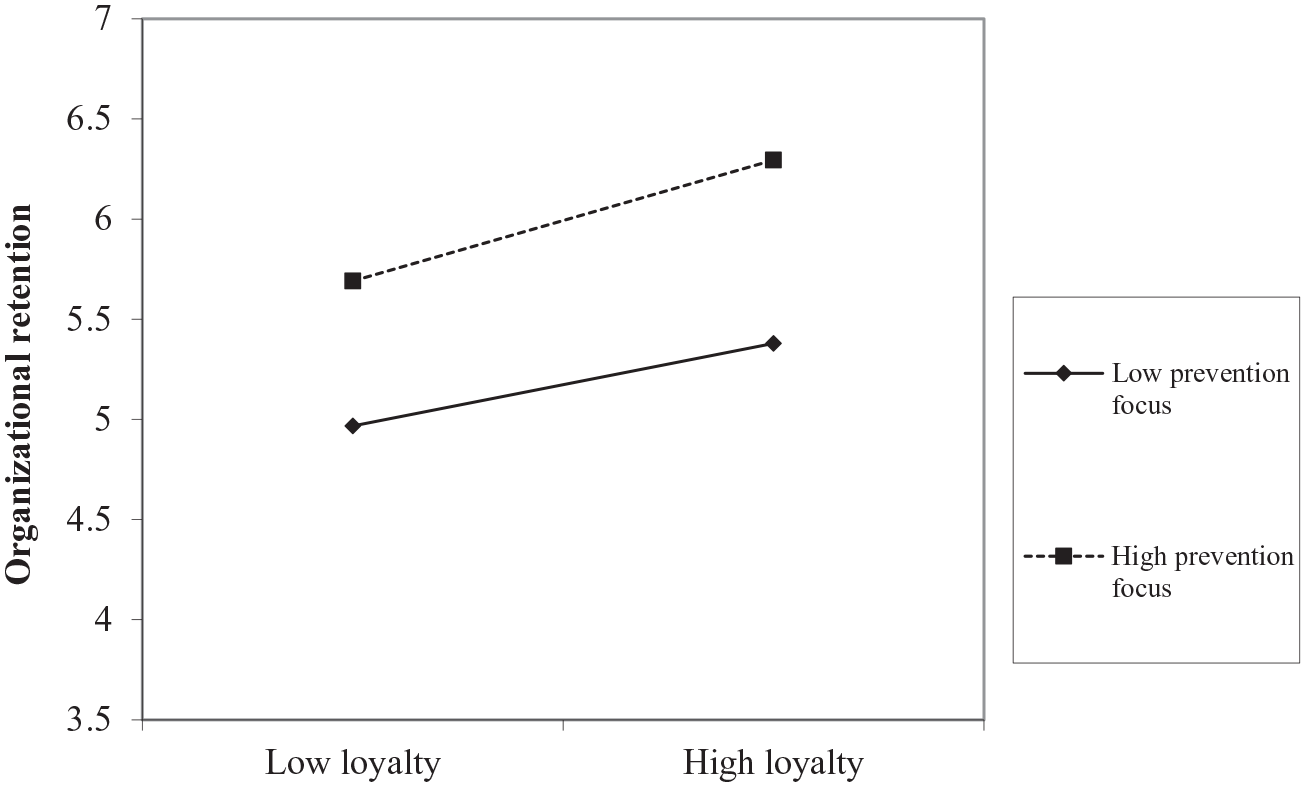
The Interactive Effect of Loyalty and Preventive Focus on Organizational Retention
Discussions
The results of this study help to explain organizational retention during a time of industrial crisis by extending the arguments of MFT to the ongoing scholarly conversation. The use of loyalty as a component of MFT allowed for a discussion of loyalty that is different from previous work in the hospitality context (see Doan et al., 2021; Eisenberger et al., 2019). Loyalty was found to predict both organizational retention and job embeddedness. Both are important industrial topics given the generally recognized high turnover rates in the hospitality industry and the importance of embeddedness to several organizations’ outcomes (Park & Min, 2020). Consequently, our results support the theorization surrounding MFT by Joseph and Haidt (2007), in that our observations suggest loyalty is associated with a reduction in turnover much like Graham et al. (2009) stated that loyal people are more likely to stand with their groups. In line with our hypotheses that the association of loyalty with turnover is mediated by job embeddedness, our results support the idea that job embeddedness predicts turnover, which is congruent with the work of Afsar et al. (2018). Furthermore, our study expands the general understanding of neo-career theories like the Protean Career (Baruch, 2014; Hall, 2004; McGinley, 2018) regarding careers as a collection of goals to be achieved and how different personal factors affect people’s choice of managing careers to obtain their goals, which is consistent with the work of scholars studying regulatory focus like Hofstetter and Rosenblatt (2017) and Higgins (1997).
Theoretical Implications
This study focused on loyalty as a moral foundation to determine both organizational retention and job embeddedness. In fact, loyalty as a moral foundation explained a large degree of peoples’ intentions to remain within their organization. In an industry with a historically high turnover level that struggles to attract new workers to the industry (McGinley et al., 2017), it is important to understand who is more likely to have long-tenured careers and identify factors that explain organizational retention. Our study showed that a person’s moral foundation can be used to help predict voluntary turnover, which further deepens the discussion on loyalty in the literature. While studying loyalty as an outcome is important (see Doan et al., 2021; Eisenberger et al., 2019) our study argues that there is also value is examining the effect of loyalty as an inherent characteristic of people in that it plays a significant role in their sense-making process.
The results of this study indicate that loyalty can be studied as an idiosyncratic trait people have, which helps to explain myriad potential phenomena, and, in the case of this study, a few key factors of employment, namely turnover intentions and job embeddedness. While the conceptualization of loyalty as an individualistic trait is consistent with MFT, its application here broadens the theoretical scope of MFT, by explaining the underlying psychological mechanism that links loyalty to retention—embeddedness. In essence, people high in the loyalty trait feel a greater sense of embeddedness to the organization. Therefore, they intend to remain in their organizations more than do their counterparts who are lower in the loyalty trait.
Second, loyalty had a somewhat robust association with retention for hospitality workers, even during a time when a great number of employment alternatives are present in the labor market (US BLS, 2021). The work of Mobley (1977) and of neo-career scholars like Hall (2004) would suggest that given the economic circumstances present now, that workers would be more likely to exit their current organizations and industries. However, our results are consistent with MFT that, regardless of the external economic situation, people with a moral compass driven by loyalty are more likely to remain within their groups. In the case of this study those groups are their companies. Loyalty then could be seen as a predictor of organizational retention that does not wax and wane with factors that are external to an organization, like economic conditions. Additionally, Park and Min (2020) highlighted the challenges of studying factors that predict turnover across cultures. However, MFT is applicable across cultural lines (Haidt & Joseph 2004) and in fact, because loyalty is thought to stem from our common ancestral past of hunter-gather societies, it is especially well-known for presenting little variance between gender and culture (Sinn & Hayes, 2017).
Additionally, the observed association between loyalty and organizational retention was mediated by job embeddedness. Our results suggest that the underlying psychological mechanism that links one’s moral foundation to the intent to remain at an organization is how embedded a person is in their job. One of the primary critiques of MFT is that is does not put forward an overarching theoretical explanation of how and why people undergo certain social processes to arrive at given outcomes, but rather uses an ad hoc approach to explaining social phenomenon (Curry et al., 2019). While this is a rather unorthodox approach to theory building, it allows a certain degree of freedom for scholars to expand on the ideas in innovative and unexpected ways. We continue this tradition of ad hoc theoretical development that was established by Haidt and Joseph (2004) and Joseph and Haidt (2007) to argue that the effect of moral foundations (specifically loyalty) are mediated by other constructs; in the case of organizational retention it is job embeddedness. Job embeddedness is one of the factors that has a robust correlation with turnover intentions in the hospitality industry with a correlation of – .40 in a recent meta-analysis (Park & Min, 2020) and, as such, studying factors like loyalty that help determine a worker’s level of job embeddedness is an important addition to the scholarly conversation.
Moreover, we also report on the limitation of loyalty as a moral foundation for explaining social phenomenon like the intention to remain within an organization. For people who reported low levels of prevention focus loyalty did a relatively poor job explaining organizational retention. Conversely, those who reported high levels of prevention focus loyalty had a robust predictive quality. Given our results that regulatory focus moderates the associations, we support the work of neo-career theorists who argue that modern careers are a series of self-directed goals (Baruch, 2014; Hall, 2004). How people strive to achieve those goals, especially in the unstable labor markets of the hospitality industry, is still an understudied phenomenon (McGinley, 2018). Our results help to address the issue of how hospitality employees manage their careers by suggesting that the veracity of loyalty as a predictor of organizational retention is in part determined by other personal factors like regulatory focus. Regulatory focus moderated the nomological network that linked loyalty to organizational retention as mediated by job embeddedness. Our results offer scholars exploring MFT an important take-away. Not only may the association between a person’s moral foundation be mediated by an underlying psychological mechanism, but it may only hold true under certain moderated conditions. Our results did explain a large share of variance when the moderation effect seemed to increase the salience of loyalty; however, that was not true when the moderation effect seemed to reduce the salience of loyalty.
Finally, our results support neo-career scholars and papers like Baruch (2014), Hall (2004), Hofstetter and Rosenblatt, (2017), and McGinley, (2018). Under neo-career theories, like the Protean Career, people are thought to manage their careers under their own definition of success, thereby viewing job progression as a way to satisfy self-created goals. The results presented in this paper show that how people prefer to strive for goal attainment can limit the veracity of MFT as an explainer of action, specifically the role of loyalty as a predictor of embeddedness and turnover intentions. As such, while MFT may provide a novel explanation of the turnover phenomenon in the hospitality literature, through the association between loyalty and turnover, careers are still viewed as a series of self-directed goals. Therefore, MFT should be thought of as a way to supplement the work of neo-career theorists and not as a tool to replace them.
Managerial Implications
Modern organizations typically ask applicants to fill out a battery of personality questions to determine their potential and fit for the specific job and company they applied for. Therefore, organizations could add the loyalty scale developed by Graham et al. (2011) to help them make their selection decisions. Incorporating regulatory focus may also benefit managers making these decisions with priority given to applicants who are more prevention focused and have a strong moral foundation in loyalty. In short, managers could increase retention through the selection process. By doing so, managers will lower costs associated with turnover and increase employees’ productivity by not having to train new employees constantly, leading to better organizational outcomes (Tracey & Hinkin, 2008).
Furthermore, the results presented in this paper extol the importance of job embeddedness as it relates to a person’s intention to stay within their company. While an individual’s loyalty was observed to explain some of the variance in job embeddedness, managers should also look to learn from their workers’ reported levels of job embeddedness. Most organizations conduct employee satisfaction surveys on an annual or bi-annual basis, by including the job embeddedness scale developed by Crossley et al. (2007), and managers could begin to predict areas of the organization that may be particularly vulnerable to turnover. Managers could take preventative action in departments, brands, or geographic areas that are more likely to see high levels of turnover in the upcoming year as a result of the survey. Managers may also highlight the benefits of working for a particular company or come up with programs that employees will benefit from by remaining in the organization, thereby highlighting the potential losses associated with turnover. This study suggests that as prevention focus increases for people with high levels of loyalty, so does job embeddedness. As such, creating new benefit programs or highlighting existing ones may be a particularly effective strategy to increase retention, because these will highlight losses associated with quitting. Programs may include ways to help employees find new jobs inside the organization, promoting greater feelings of internal employability, or bonuses for hitting a certain number of years of service with the company. All of these strategies may help to increase job embeddedness which is a robust predictor of hospitality turnover (Park & Min, 2020) while costing the organization little money.
Limitations and Future Research Suggestions
Data were collected from the same resource and, therefore, may have been adversely influenced by common method bias. Although collecting data at two time points helps to control for method biases, we acknowledge that to examine the mediating effects, it is ideal to collect data at three time points for our model. However, considering the great uncertainties (e.g., the changing of job status, leaving the industry) among hospitality employees during the pandemic, we collected data at two time points to minimize the possibility that participants’ employment status might be changed. By using Harman’s single-factor analysis as a statistical remedy, we showed that common method bias is not a concern in our data. However, using one statistical remedy may not completely rule out the possibilities of method biases. Hence, we recommend future studies utilize multiple statistical remedies, such as marker variable approach and multiple method factors, that are summarized and suggested by Podsakoff et al. (2003). Besides using the between-person approach, we still recommend future studies adopting longitudinal design with a within-person perspective to examine the causal relationships.
Additionally, because this study sought to test whether MFT could play a role in the career management decisions of hospitality workers, future work could build on our observations by employing qualitative methods that expand on the theory tested in this study. While we observed that loyalty influences organizational retention and embeddedness, we are unable to make inferences based on what other moral foundations might predict these outcomes, or what other outcomes loyalty may predict. As such, we suggest that future scholars use Grounded Theory to continue to build theory and create a rich explanation of action that will further elucidate the role that one’s moral foundation plays in career management.
Supplemental Material
sj-docx-1-jht-10.1177_10963480221085510 – Supplemental material for Loyalty as a Guide to Organizational Retention: Applying Moral Foundation Theory to Hospitality
Supplemental material, sj-docx-1-jht-10.1177_10963480221085510 for Loyalty as a Guide to Organizational Retention: Applying Moral Foundation Theory to Hospitality by Sean P. McGinley and Xiaolin (Crystal) Shi in Journal of Hospitality & Tourism Research
Footnotes

Supplemental Material
Supplemental material for this article is available online.
References
Supplementary Material
Please find the following supplemental material available below.
For Open Access articles published under a Creative Commons License, all supplemental material carries the same license as the article it is associated with.
For non-Open Access articles published, all supplemental material carries a non-exclusive license, and permission requests for re-use of supplemental material or any part of supplemental material shall be sent directly to the copyright owner as specified in the copyright notice associated with the article.
