



Abstract
Slow food and the consequent slow movements are becoming more evident in research and media with the recognition of its implications for sustainability in many spheres of society. This study—the first systematic literature review of this topic—offers a comprehensive interdisciplinary investigation into slow movements which allows us to gain a systems view of the scholarship; stakeholder-oriented insights; and a holistic understanding of slowness while recognizing the various movements within and providing future research directions for tourism and hospitality researchers. This study identifies that slowness has extended to most aspects of our everyday life, such as the slow city, slow management, slow fashion, slow philosophy in general, and slow tourism; the latter offering COVID-19 post-pandemic recovery opportunities through sustainable tourism and hospitality. This study acts as a springboard for a better understanding of the slow(ness) movements to encourage more proactive interactions with key stakeholders and to develop the field further.
Highlights
Informetrics provide a systems view of the current literature on slow movements.
Cognizance and discourses of slowness have gaps between academia and stakeholders.
Cross-disciplinary outlooks ameliorate our understanding of slowness within and outside tourism.
The scholarship needs to develop interest in sustainable business models afforded by slow movements.
Introduction
The slow food movement was officially established in 1989 as the first slow movement. The literature on slow movements has since steadily increased as there is an inherent relevance of slowness to sustainability. Choosing to follow the slow movement philosophy fits seamlessly with activating a lifestyle towards more sustainable production and consumption (Lowry & Back, 2015). The movement is expanding its recognition and sustainable development in numerous directions and contexts including food (Campisi, 2013; Jones et al., 2003; Moskwa et al., 2015; Parkins & Craig, 2009), tourism and travel (Conway & Timms, 2012; Hall, 2009; Lumsdon & McGrath, 2011; Park & Kim, 2016; Presenza et al., 2015), urban planning and design (Girard, 2014; Heinonen et al., 2006; Pink & Lewis, 2014), agriculture (Bowen & Mutersbaugh, 2014; Lotti, 2010), health (Adams et al., 2014; Mannina et al., 2015; Neves & Pires, 2018), and others (Fletcher, 2010).
In the context of tourism and travel, slow tourism has been recognized as an alternative model for sustainable tourism; one which enables the tourism impacts in the social and environmental spheres to be more sustainable (Serdane et al., 2020). Sustainable development of environment, economy, and society within tourism and travel has been criticized for its lack of practicality (Kucukergin & Ozturk, 2020). However, slow tourism, in line with other slow movements, takes a hard line of institutionalized activism. Werner et al. (2021) pointed out that institutional frameworks have provided operational rules and guidelines in relation to the size and volume of tourism flow, and the managing and marketing of the slowness concept.
The connotation of “slow” tourism is greater than the concept of pace, and equally encompasses quality led by ethical consumption and practice, as opposed to traditional and conventional (mass) tourism (Lowry & Back, 2015; Miretpastor et al., 2015). In this regard, slow tourism and related slow movements, especially slow city so-called cittaslow, is often studied through a sustainable tourism lens. Research focusing on a destination-oriented approach has viewed the slow city as a platform for enhancing social sustainability, enticing community engagement and empowerment, as well as sense of belonging (Park & Kim, 2016). Slow city was shown to be a destination that better performs or manages tourism in a more sustainable manner (Ince et al., 2020; Kim et al., 2022; Serdane, 2020). Other studies have extended it to the tourist perspective of their experiences in slow city destinations as a new form of less impactful but more meaningful tourism (Chi & Han, 2021; Shang et al., 2020).
Within this literature, Serdane (2020) has precisely observed that the slowness concept has been vaguely interpreted. It is thus unsurprising that significant questions about the nature and trajectory of slow movements and their wider implications still remain unanswered. It is only fitting that such an important, timely topic with broader implications necessitates a systematic and comprehensive account of the state of the current literature to provide sound directions for future research to ameliorate theoretical development. The key objective of this paper, therefore, is to undertake a comprehensive and informetric review to map and explore the available data within the academic and wider stakeholder literature on slowness and/or slow movements.
The academic literature is represented by publications listed in Scopus, one of the largest academic databases, complimented by publications available in Clarivate’s Web of Science and Google Scholar. Therefore, the academic publications include journal articles, books, book chapters, conference proceedings, research notes, research letters, review papers, and other publications in the aforementioned databases. This review will enable the researchers to identify the themes that emerge in the literature, particularly those associated with the concept of slowness and subsequent implications to garner more sustainable tourism and hospitality.
Furthermore, this study will compare and contrast the perspectives of academic scholars vis-à-vis the stakeholder-oriented publications such as magazines, trade journals, and reports available in ProQuest Central database. The comparative analysis of both literatures highlighted above, will serve to provide a systems perspective of slow movements and thus suggest an invaluable insight concerning the possibilities of progressing academic scholarship to align with stakeholders’ interests for greater impacts on all sectors of our society.
The main questions guiding this study are: What is the current state of scholarship on slow movements with a particular focus on (sustainable) tourism and hospitality? and What are the main slow movement concepts that need to be classified in one study to help develop the field further? There are four key objectives in this study: (1) to provide a holistic systems view of the current literature on slow movements from an interdisciplinary perspective; (2) to systematize slow movements concepts into one typology; (3) to compare industry insights with academic scholarship on slow movements to bridge the gap between academia and practice; and (4) to provide tourism and hospitality researchers with a number of suggestions for future research in relation to the slow(ness) movements.
Science Mapping of the Slowness Research
The current study demonstrates the use of informetric methods in carrying out a systematic literature review of the scholarship of “slowness” or “slow movements.” Science mapping through the use of innovative informetric techniques is becoming an increasingly popular method of visualizing academic research. Creating maps based on extracted studies using specific search criteria and the consequent content co-occurrence of terms within topic areas of the extracted dataset provides a systems overview of the scholarship that allows researchers to connect diverse knowledge domains (see Klarin & Suseno, 2022, pp. 251–252). Scholars in varied disciplines may utilize science maps to overcome the boundaries between knowledge domains and create value through collaboration in knowledge advancement (Hu & Zhang, 2017).
To gain a systems overview of the scholarship, the study utilizes VOSviewer clustering software which is based on identifying key thematic terms and placing such themes on a map close to each other based on the rate of co-occurrence. The software algorithmically creates clusters which occur as a result of assigning nodes in a network on the basis of relationships between terms. Publications that are assigned to the same clusters are likely to have a theme in common (for a more detailed technical explanation, please see Korom, 2019; van Eck & Waltman, 2014). The algorithmic clustering allows for delineation of the key concepts that are grouped under the umbrella term “slowness” (Klarin, 2019; Markoulli et al., 2017).
The rationale for utilizing informetric methods for this systematic review is four-fold. First, informetric methods utilize objective, consistent, transparent, and reproducible results that can inform the audience in a most reliable manner. Compared to traditional reviews that are prone to Type II bias of subjective presentation and interpretation of data, this method relies on complex algorithms that allow for the most unbiased, objective outlook on the research topic (Klarin, 2019).
Second, the substantial body of scholarship contained in selected databases allows for the most comprehensive understanding of the chosen research domain. This is, by far, a more holistic approach to studying a topic, as opposed to traditional narrative reviews in one discipline. The view of the scholarship also allows connections to form between crucial gaps found within disparate disciplinary boundaries. This is especially pertinent for tourism studies where complex interdisciplinary research objects create divisions among academics (such as the business of tourism and the non-business aspects of tourism) and between academics and practitioners (Darbellay & Stock, 2012).
Third, this method compares academic scholarship with other sources such as stakeholder-oriented publications. Finally, this objectively synthesizes not only the bibliometric findings to organize the scholarship in a systematic manner, but also creates a content analysis of large datasets allowing concepts for typologies, major trends, and key impact topics among other content-related findings to be extracted.
Systematic reviews apply scientific methods that explicitly aim to limit systematic errors or bias through identifying, appraising, and synthesizing all relevant studies (dependent on the design) in order to deal with a question or a set of questions (Schlosser et al., 2007). Tranfield et al. (2003) proposed three stages of conducting a thorough, transparent and a reliable systematic review: (1) planning and outlining a review protocol; (2) execution of the protocol; and (3) reporting.
In the planning stage, the current study chose to use the entire Scopus database as it is considered the second largest scientific knowledge database after Google Scholar, and exceeds that of the Web of Science (WoS; Harzing & Alakangas, 2016). Google Scholar has many stray citations where minor variations produce duplicates. Furthermore, the disorganized nature of the database includes sources that may not pass strict scientific standards (Harzing & Alakangas, 2016). It has been shown, too, that Scopus and WoS have major overlaps, meaning that the search results will have only marginal divergences between the two databases especially if looking to compare large volumes of publications (Vieira & Gomes, 2009). Nevertheless, we used both WoS and Google Scholar to find further studies that were not listed in Scopus.
In the second stage of the execution of the protocol, the identification of search terms, selection of studies, studying the quality assessment, data extraction, and synthesis procedures were followed. The dates of the document search were set from the beginning of Scopus listing to July 5, 2021. Using Boolean search parameters for Scopus, the search criteria was set as follows: “slow food” OR “slow tourism” OR “slow travel” OR “slow philosophy” OR “citta slow” OR “slow city” OR “cittaslow” OR “city slow” OR “Cittáslow” OR “slow housing” OR “slow design” OR “slow cinema” OR “slow management” OR “slow art” OR “slow counseling” OR “slow counselling” OR “slow education” OR “slow fashion” OR “slow gaming” OR “slow gardening” OR “slow goods” OR “slow marketing” OR “slow medicine” OR “slow money” OR “slow parenting” OR “slow photography” OR “slow religion” OR “slow scholarship.”
The search returned 967 documents that contained any of these terms within the titles and abstracts of the original works. To identify and map clusters of research, the authors read through all 967 articles and excluded 380 publications as they had no relevance to slowness (some studies for example, had the necessary term(s) but did not discuss the underlying concept of slowness), which resulted in a total of 587 publications. Both WoS and Google Scholar databases were further searched to find another 21 publications that were not present in the initial search, to end up with 608 publications.
Each author independently read through the topic areas (titles, abstracts, and keywords) for each paper, screening and excluding those that did not fit the criteria—namely those papers which failed to mention or discuss any of the slow movements. The results of three resultant datasets were compared using Microsoft Excel for divergence between the datasets, and the Cohen’s kappa agreement level between the researchers was 96%, indicating a reliable comparison (McHugh, 2012). The authors then discussed the differences in a meeting and included or excluded publications from the dataset based on the voting system.
Finally, after a thorough revision of the paper based on feedback from experts in the field, we went further and searched the databases for additional publications based on the following search terms: “slow movement*” OR “slow theory” OR “slow media” OR “slow ethic*” OR “slow living” OR “slow reading” OR “slow conservation” OR “slow writing” OR “slow politics” OR “slow book movement” OR “slow care” OR “slow life.” We identified 52 additional publications that we included in the analysis resulting in a total of 660 publications as of February 4, 2022.
After we had searched for the above phases, the e-Delphi technique was used to achieve a common viewpoint from experts that would lead to reaching a consensus on a final list of search terms. Using an email survey between April 25 and May 15, 2022, we individually contacted 27 top scholars who had published in the field of slowness movements based on the 660 publications, as presented in Supplement Table 1. The email survey provided a full list of the search terms already utilized and asked them to suggest further terms that we may have omitted.
Supplement Table 1 lists the experts as well as their suggestions for further terms to be included in the fifth column. It was thus necessary to search for further publications in Scopus and WoS containing these additional search criteria as well as those that emerged whilst reading the literature: “slow + transport,” “activit*,” “thought,” “science,” “scholarship,” “sex,” “cities,” “academia,” “professor,” “radio,” “sport,” “media,” “gaming,” “religion,” “photography,” “education,” “medicine,” “technology,” “politics,” “gardening,” “writing,” “art,” “pace tourism/travel,” “mobilities tourism/travel,” “event,” and “ark of taste.” We added an additional search string to exclude the previously searched terms. The additional search resulted in 2,716 publications as of May 16, 2022. After excluding unrelated scientific fields (Klarin, 2020) including medicine, physics, earth, energy, engineering, pharmacology, mathematics, immunology, chemistry, and others, the additional dataset resulted in 91 publications combined between Scopus and WoS. After reading through the topic areas for relevancy and, when in doubt, the full publications, it was deemed necessary to add a final set of 39 publications to finally end up with 699 publications.
The results of the search and selection process are presented in Figure 1. This study utilised the search of all publication types (including editorials, letters, books, book chapters, proceedings, etc.) as a large-sample thematic study of the scholarship requires a semantic analysis of noun terms regardless of the mentioned criteria (van Eck & Waltman, 2014).

Results of the Search and Study Selection Process.
The overarching mapping review was carried out using the VOSviewer, innovative science mapping software that utilizes citation and content analysis that demonstrates relationships between informetric indicators in a visual map. The study combined bibliometric analysis that provides results related to authors, documents, organizations, keywords, sources, and countries of publication with advanced methods of thematic analysis made available by extracting commonly occurring noun phrases. This method maps the content of the extracted literature (699 documents) on slowness to clusters. In the process of generating the map of research, the commonly extracted noun phrases that occurred in at least 10 different documents were used.
The researchers removed generic noun phrases that refer to purely academic terms in articles such as “practical implications,” “in-depth interviews,” “paper,” “research limitations,” and so on as these terms occurred universally across the corpus of the research and so provide no value in data analysis (Inkizhinov et al., 2021). British English-spelt terms were combined with American English-spelt nouns (for example, “behaviour” to “behavior”). When running the analysis, cluster alignment occure where terms that are strongly associated with each other are automatically placed in the same cluster thereby providing an emergent taxonomy of the literature.
The Current Status of Slowness Research
The algorithmic analysis identified four clear clusters of slowness research (see Figure 2): yellow cluster—slow tourism; blue cluster—slow food; green cluster—Cittaslow; and red cluster—emerging slow movements. In Figure 2, the frequency of occurrences is represented by the size of the noun phrase, that is, larger circles represent a higher number of occurrences of the term. Nevertheless, it should be noted that the number of occurrences does not represent the value of the term; what matters more is the context within which the terms are utilized. To provide a thorough investigation of the areas of research, each cluster was analyzed according to the themes that are presented within each cluster.

Interdisciplinary Scholarship Map of Research on Slowness.
Utilizing a visual representation of the slowness scholarship from an interdisciplinary perspective, this study provides several tables and figures to highlight bibliometric and thematic results. Table 1 demonstrates: (1) the themes that are prevalent in documents that receive the highest citation counts (that is, top impact terms); (2) the themes that appear in the articles with the most recent publication date (that is, top trending terms in current use); and (3) the indicative disciplinary domains. Supplement Table 2 demonstrates the top 20 journals that have published the most research on slowness. Supplement Figure 1 shows the growing interest in slowness research over time, while Supplement Figure 2 maps out the research volume by country.

Note. aTop trending terms represent the most recent average publication period sorted by recentness.
Top impact terms represent the highest average citation counts beginning with the highest citation rate.
As shown in Supplement Figure 2, research on slowness has largely been driven by the United States, with 139 publications, and Europe where the United Kingdom and Italy lead the continent with 107 and 87 publications respectively. This is followed by East Asia and Oceania (that is, Australia and New Zealand) responsible for 69 and 63 research outputs respectively. Whilst Western research is still predominant, an increased interest in the subject area within the pan-Asian region is noteworthy.
Tourism appears as one of the primary domains of slowness research representing the yellow cluster named “slow tourism” (see Table 1), predominantly approached through the disciplines of tourism and/or hospitality as well as business and management. This is expected, given that considerable evidence of the slowness concept relating to sustainable tourism has been documented (Ekinci, 2014; Park & Kim, 2016). This “slow tourism” cluster intersects with all three of the other clusters: “slow food,” “Cittaslow,” and “emerging slow movements,” largely representing other indicative disciplinary areas such as food science, sociology, cultural studies, regional and urban studies, (human) geography, environmental studies, film studies, and philosophy and arts.
Of the key terms identified in Figure 2, locality, slow movement, contradiction, innovation, motivation, individual, management, service, slow design, and choice are located in the intersectional areas. This suggests that the slow(ness) movement, as a social and cultural phenomenon, is an inherently interdisciplinary or multidisciplinary research area. Thus, it is indicative that cross-disciplinary approaches are meant to ameliorate our understanding of the slow(ness) movement within and outside tourism and hospitality. However, the current study has little evidence to support that previous studies on the subject over the last 2 decades have genuinely cooperated on such research endeavors.
As shown in Supplement Table 2, approximately 30% of the top 20 journal publications for research papers on slow movements are tourism-focused journals. Of these, the Journal of Sustainable Tourism has topped the list, publishing 15 papers, followed by Current Issues in Tourism. It is noteworthy that Tourism Management, publishing four papers, has the highest number of citations for each of its published works, that is 32.75 citations per document, on average. The results further support that “tourism” and the “slow(ness) movements” are essentially intertwined within the discourse of sustainability or sustainable development (Heitmann et al., 2011). Consequently, this study seeks immediate calls for research to investigate slow movements globally, preferably through cross-disciplinary research endeavors that substantiate its benefits and advantages in enlightening all sectors of our societies (Darbellay & Stock, 2012).
This study further provides a bibliometric citation analysis of the current slowness literature to identify the top 20 authors or groups of authors who published at least two documents on slowness based on citation counts, as shown in Supplement Table 1. Groups of authors are built on at least two documents published together. Identification of top authors in each field is useful in bringing attention to top scholars in each research stream, which is of value to those new to the field or those interested in the field in general (Nazarov & Klarin, 2020).
Yellow Cluster: Slow Tourism
Similar to how alternative slow food and Cittaslow is to the globalized homogenization of the eating and living environment (Nilsson et al., 2011), slow tourism is deemed to be an answer to globalization and standardization of the travel environment and behavioral patterns, via the rationalization of local distinctiveness and place-based knowledge (Dickinson & Lumsdon, 2010). As an example, Conway and Timms (2010) demonstrate that the traditional Caribbean sun, sand, and sea tourism may have hit saturation point, from which slow tourism may develop as an alternative to reinvigorate local economies largely dependent on tourism. This argument still remains valid, since sustainable development in the Caribbean is increasingly dependent on how local businesses, products, and institutions engage in the slow form of tourism (Walker et al., 2021).
Indeed, slow tourism offers local meals, communal get-togethers, and musical and cultural events in which the local heritage and cultural richness of a region can be showcased and shared by tourists and locals, with their families and friends as inclusive participants. This is becoming an increasingly potent travel trend (Cosar & Kozak, 2014; Ekinci, 2014; Jung et al., 2015). For example, Björk and Kauppinen-Räisänen (2014) show that traditional slow food preparation and atmospherics contribute to local food experiences that may lure travelers to visit certain locations not necessarily considered mainstream tourism destinations.
This view aligns with the food tourism phenomenon described as “cultural anthropology through understanding the interactions of tourists with places through the medium of food” (Ellis et al., 2018, p. 261). As such, tourists tasting local cuisine on their trips to new locations, with an increasing emphasis on understanding the complex and multifaceted role of food in authentic tourist experiences (Corvo & Matacena, 2018), has consistently been documented in the context of slow tourism, slow food and festivals, and food tourism literature (Heitmann et al., 2011; Parasecoli & de Abreau e Lima, 2012; Park et al., 2021; Sidali & De Obeso, 2018).
The major theme in this cluster relates to how slow tourism has created a niche for travelers seeking an alternative to city dwelling and a general fast-paced lifestyle (Markwell et al., 2012). Slow tourism, therefore, encourages qualitative (re)development as an alternative. The conventional approach of unsustainably aggregating tourism growth inevitably reduces natural capital and adversely impacts host communities and beyond (Dickinson & Lumsdon, 2010; Hall, 2009). Thus, slow travel or tourism fundamentally seeks to increase value and benefits for all stakeholders over the longer term. It argues for shorter distances, lower carbon consumption, and a greater emphasis on mitigating harm and damage to host communities who would normally end up with few or none of the promised benefits of tourism (Higgins-Desbiolles et al., 2019). Notwithstanding the interconnectedness and interdependency between tourism and hospitality, the discourse of slow tourism in relation to the hospitality and foodservice sector has yet to be fully researched.
Blue Cluster: Slow Food
This research domain discusses the various implications of slow food for the past and current societies. This stream tends to use slow food as an example of aesthetics of various regional and rural traditions that not only emphasize the “gastronomic aesthetics of [local] food” but also “aesthetics of entertainment” since dining experiences in restaurants (Miele & Murdoch, 2002, p. 312). Pietrykowski (2004) demonstrates that food has a symbolic role in identity formation. Specifically, this dual process of pleasure-seeking and politicization is able to transform cultural capital—a taste for food and wine usually associated with class, status, and conspicuous consumption—into social capital.. . . The pleasures of the table become a form of resistance to corporate, standardized, mass produced foods. (Pietrykowski, 2004, p. 318)
A number of studies in this cluster discuss slow food and alternative food networks (AFN) as new business models or paradigms. Nosi and Zanni (2004) demonstrate that information provision as well as symbolic and psychological experience help drive “aware consumption” of these products and services. Sebastiani et al. (2013) suggest that collaborations between companies and social movements can effectively contribute to improving the social context in which ethical purchases occur. It has been shown that the buyer behavior is indeed irrational, contrary to the homo economicus profiling purported by the neoclassical economic school. Fair-trade product prices are higher, the networks of alternative consumption more constraining. However, actors who look for coherence between their ideals and their practices view mass consumption as detrimental to society, and view organic, local, and fair production as an ideal to aspire to, with such choices becoming more logical (Bossy, 2014).
This cluster also discusses artisan production techniques, their growth, and the consequent globalization. For example, Friedmann and McNair (2008) demonstrate that agrarian social movements, while not notable, do have the potential to determine the future based on global interconnections among diverse farming systems, which are embedded in their cultural and natural contexts. Lotti (2010) further examined the competing interests between conventional commoditization of agricultural production against the slow food’s movement of guardianship of global agrobiodiversity. Fonte (2006, p. 203) explored the strategy of “local production for distant consumers” from “local production for local consumers” which provides the potential to increase the competitiveness and sustainability of slow food producers. Bowen and Mutersbaugh (2014) examined three directions of research in AFN which include the discussion of what constitutes “local,” collectivism, and alternative distribution schemes.
This cluster further discusses health impacts of slow food and/or fast food. One such premise is demonstrating that fast foods undermine a body’s capacity to regulate its energy intake at healthy levels because they impair the congruent association between sensory signals and metabolic consequences. Slow food, on the other hand, allows for sensory exposure and higher levels of satiation (de Graaf & Kok, 2010). To support these findings, Von Stumm (2012) shows that slow food is associated with better cognitive ability and cognitive growth in childhood. Adams et al. (2014) call for traditional forms of knowledge production that might continue to be of use in the endeavor to improve health on a global scale as opposed to normative paradigms in global health research.
The slow food movement has grown into something more than the preservation of and attention to traditional foods and related rituals: it continues to grow into issues related to economic growth, community support, political movement, access to resources, environmental protection, and the general reconceptualization of a healthy life (Hayes-Conroy & Martin, 2010; Parkins, 2004; Sassatelli & Davolio, 2010; van Bommel & Spicer, 2011). Hirsch and Tene (2013) demonstrate how hummus production is simultaneously an agent of globalization and of the localization of hummus: it expands the popularity of hummus globally and at the same time it sometimes attempts to fix to it a local (“national”) identity. This is consistent with the increased concern about the eclectic approach to the commercialization and preservation of culinary heritage and identity associated with endangered traditional food such as fresh Japanese udon noodles in the context of food tourism (Kim & Iwashita, 2016).
Similarly, Jones et al. (2003) investigated the co-existence of fast food/culture and slow food/movement and found that slow food offers an exciting and valuable contrast to the fast food culture; nevertheless, it is unlikely to be able to challenge the power of commercialized fast food or to promote widespread changes in contemporary eating habits. However, the phasing out of the “culture of the table,” as in the preparation and sharing of meals, is contested by the slow food movement as it is more than simple cooking and eating but a philosophy for nature, societies, culture, and health (Campisi, 2013) which translates to tourists’ slow attitude and behavior towards local food consumption while on holiday. This draws parallels with the new lifestyle trend toward quality over quantity (Corvo & Matacena, 2018).
Green Cluster: Cittaslow
Cittaslow, slow city, or Citta Lente was first conceived in 1999 when mayors of four Tuscan towns started working together towards the preservation of the environment, the conservation of local traditions, and support for local products and services including agricultural produce, cuisine, and crafts. The goal was to foster the development of places that enjoy a robust vitality based on good food, healthy environments, sustainable economies, and the seasonality and traditional rhythms of community life (Knox, 2005; Mayer & Knox, 2006). Pink (2009) demonstrates that the Cittaslow movement is a subtle form of mobilization and persuasion through living examples and experiential education rather than by public demonstration and disruption.
Although it is an alternative movement, it is deeply embedded within politics as its members are themselves local town council members and supporters. Similar to the slow food movement, Cittaslow is also politicized for sustainability and traditionalism (Donaldson et al., 2012; Jaszczak et al., 2021; Pink, 2008a, 2008b; Radstrom, 2011).
Conservation is the other sub-theme in this cluster. Mannina et al. (2015) go beyond the social science sphere to discuss the chemical composition of honey produced by Sicilian Black honeybees, which have been identified as being at risk of extinction. Migliore et al. (2015) demonstrate that genetic biodiversity might be a great resource for the selection of illness resistance in goats, which is necessary for the conservation of endangered breeds and their typical food productions. A study of the Christian practice of the Eucharist meal is connected to allowing Christians to engage in ecological reflections, and the slow food movement can be a conducive environment for these practices (Galbraith, 2009). Neves and Pires (2018) argue that growing the slow food sector of olive oil production in the Iberian Peninsula through shifts in production modes and general modernization have negative environmental effects on the ecosystem.
In relation to the previous two sub-themes, the third direction relates to policymaking and administration to promote slow tourism destinations and sustainable township development. As such, locales aiming to boost the recognition of a Cittaslow membership may join the “Cittaslow Association” which aims to facilitate the creation of a platform for learning and exchanging good practices and utilizing innovative solutions (Presenza et al., 2015). A number of objectives must be met in order to become a Slow City, including environmental sustainability, specific hospitality offerings, infrastructural policies, social cohesion, and other measures (Cittaslow International, 2022; Hatipoglu, 2015; Presenza et al., 2015), thus creating barriers for some locations to become a Slow City member (Ekinci, 2014). Interestingly, a case study in New Zealand demonstrated that Cittaslow concepts work for Eurocentric, affluent communities that are already “slow” and embrace a sustainability culture, but prove a challenge for towns that are outside this characterization (Semmens & Freeman, 2012). Current research reports community resistance towards policy-oriented, city branding Cittaslow (Semmens & Freeman, 2012) but community support towards collaborative Cittaslow that involves local communities for progressive change (Park & Kim, 2016). Implications for policymakers are noted in supporting communities via environmental education, sustainability promotion, and encouraging local participation in projects (Girard, 2014; Ilhan et al., 2021; Pécsek, 2015; Pink & Lewis, 2014).
Red Cluster: Emerging Slow Movements
This cluster extends the slow movement to emerging areas including science, reading, fashion, scholarship, art, and others. One such example is the slow cinema movement. Slow cinema originates from the slowness philosophy and puts an “emphasis on the passage of time in the shot, an undramatic narrative or non-narrative mode, and a rigorous compositional form that is designed for contemplative spectatorial practice” (Flanagan, 2012, p. 5). Although the term “slow cinema” may not be the best representation of art and film, with authors often using terms such as “slow film(s),” “cinema of slowness,” or “contemplative cinema” (see, for example, Koutsourakis, 2019; Lim, 2014; de Luca, 2021), it is generally the most prevalent and accepted term, and is primarily the domain of film studies scholarship.
With the growing attention on mindfulness and slow philosophy, it is unsurprising that slow cinema has been gaining attention in academic circles in recent decades, with a number of books (see, for example, de Luca & Jorge, 2016; Lim, 2014; Schrader, 2018) and articles published in this sphere. True to the nature of slow philosophy, slow cinema emphasizes a collective experience (de Luca, 2021), creates awareness (Hamblin, 2019; Pecic, 2020), offers an alternative to the mainstream (Schrader, 2018), and, most importantly, urges reflection, understanding, contemplation, and deceleration (Koepnick, 2017). Although there are different streams of slow cinema, it falls outside this review to delve deeply into cinematography studies, and we thus refer the reader to the rich literature on slow cinema. An excellent starting point is Slow Cinema, a handbook edited by de Luca and Jorge (2016).
Delineating Slowness Concepts into a Typology
To bring clarity to the various slow movement concepts, we propose to further classify them into a typology. Commonly occurring slowness concepts that appeared in the dataset of 608 publications were extracted and allocated between the four clusters, as shown in Table 2. For example, the slow food concept falls under the blue cluster as the majority of the publications discussing this particular concept can be grouped together there. However, this is not to say that the slow food concept is exclusive to the blue cluster. Rather, this is a representation of research identifying that the slow food concept is, more often than not, related to slow food and its corresponding cluster.
Common Slowness Concepts Across the Taxonomy of Slowness Research.
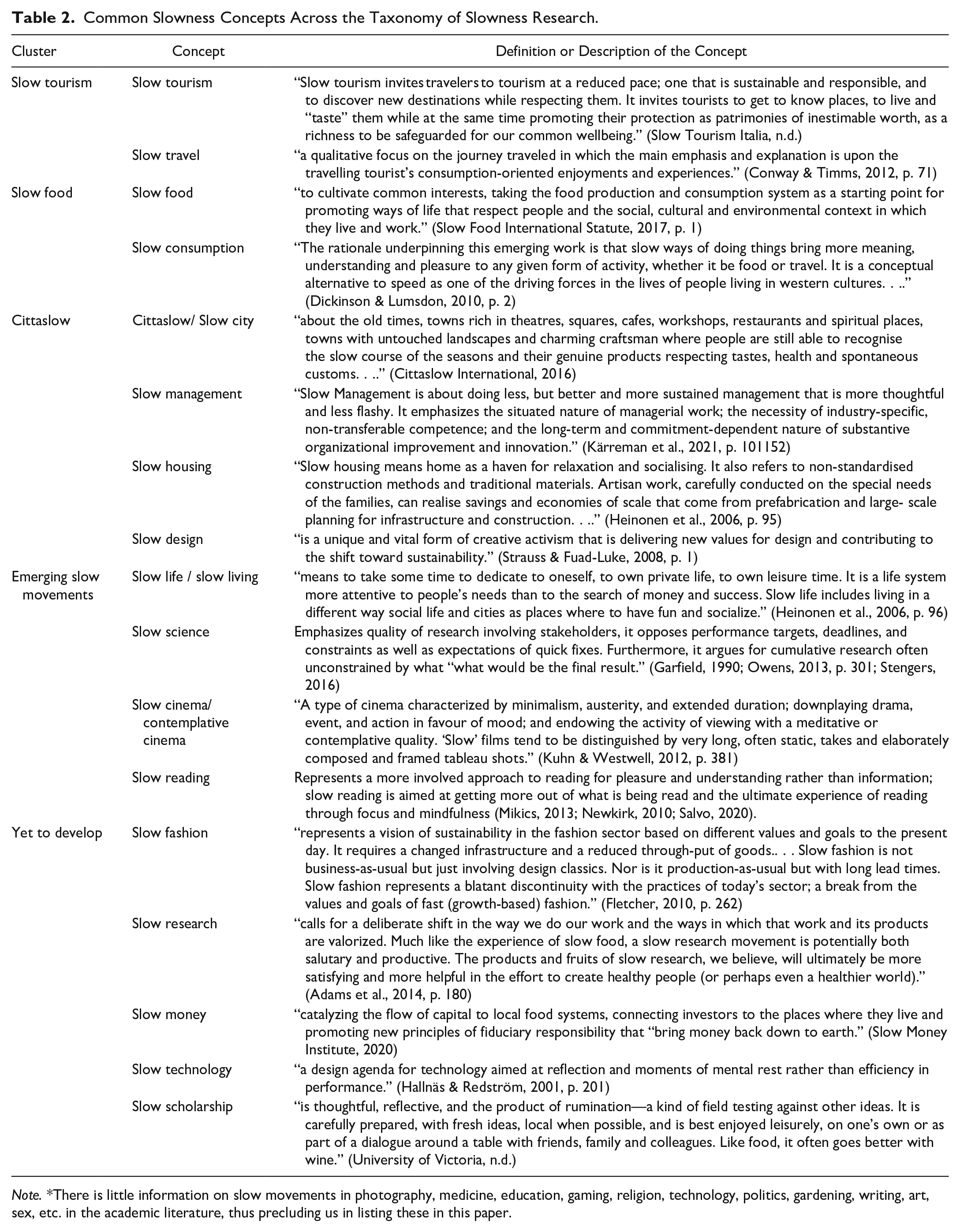
Note. *There is little information on slow movements in photography, medicine, education, gaming, religion, technology, politics, gardening, writing, art, sex, etc. in the academic literature, thus precluding us in listing these in this paper.
It is also acknowledged that the slow food concept may share major overlaps with concepts such as “slow movement,” “slow life,” and “slow management” (Moskwa et al., 2015; Parkins, 2004; Vitari et al., 2012) among others. The concepts that amass their own following and meanings may diverge from other slow food concepts which are further identified in Table 2. What has been done here is an attempt to delineate slowness concepts further in order to highlight the use of the specific slowness concepts in certain clusters. This provides useful guidance for future studies.
Despite the large volume of research on slow food and food consumption, its relationship to tourism in general—and food tourism in particular—is still undocumented with few exceptions (for example, Chung et al., 2018; Corvo & Matacena, 2018; Sidali & De Obeso, 2018; Williams et al., 2015). This finding is somewhat surprising, given the increasing popularity of food tourism and given that its relevance to sustainable tourism and food destination development has been well documented (Ellis et al., 2018). As such, Fusté-Forné and Jamal (2020) assert that slow food tourism can be a pathway to a new paradigm of tourism by supporting the way of slow living (and life) and more responsible and ethical food production and consumption.
This can be extrapolated to the hospitality and foodservice sector, given that food waste, sustainable food supply chains, and food (in)security are becoming more topical and require more research (Dhir et al., 2020). This would encourage greater awareness of the importance of a sustainable environment, ecology, and agrobiodiversity as well as the joy of rewarding travel and hospitality experiences. In this regard, food tourism research and its relevance to hospitality and foodservices areas can legitimately find scope for new directions between slow food, slow tourism, and Cittaslow.
Furthermore, slow tourism focuses on tourist behaviors and experiences that are related to more responsible and sustainable travel in the quest for quality over quantity, respect for others rather than exploitation of communities, and travel at a reduced or slower pace. Likewise, our universal wellbeing is at the center of slow tourism. Existing literature in this cluster, however, informs us that there is a lack of management and marketing relating to slow tourism in relation to a distinguishable mode and form of tourism.
Meanwhile, research in the Cittaslow cluster tends to be destination-oriented with particular focus on local communities and authentic tourism experiences through active and conscious relationships between hosts and guests, often in small-scale, personalized settings (Park & Kim, 2016; Presenza et al., 2015; Serdane, 2020). This is more in line with a redefined tourism practice of placing local communities at the centre of the phenomenon, described as “the process of local communities inviting, receiving and hosting visitors in their local community, for limited time durations, with the intention of receiving benefits from such actions” (Higgins-Desbiolles et al., 2019, p. 1936).
It is also related to destination identity and heritage, sense of place, and sustainable tourism development (for example, Ekinci, 2014; Nilsson et al., 2011; Park & Kim, 2016). Overall, research in this cluster provides implications for the intrinsic relationships between place and people, that encompasses both local communities and tourists, from which future tourism research can further examine the complexities between place and people in the context of slow(ness) movements.
Furthermore, the lifestyle perspective can be incorporated into future research on tourism experiences in relation to slow life and slow cinema. For example, social and cultural changes in our everyday commercial culture around the creation, trade, usage, and consumption of objects such as fashion items, including clothing, can be examined in the context of slow(ness) movements, representing, as Fletcher (2010, p. 262) posits “a vision of sustainability in the fashion sector based on different values and goals to the present day.”
Bridging the Gap Between Academia and Stakeholders
The slow movements have gradually gained prominence in the last decade (see Supplement Figure 1), due to increased demand for sustainable living and mindfulness. Having started in Italy, the movements have gained traction across the world disseminated by media with mass recognition as an alternative to fast-paced life, partially brought forth by globalization and modernity (Molz, 2009). Often social movements develop faster than the pace of academic research and thus media is considered an important source of knowledge for future research (Galvin et al., 2021). Indeed, media plays a key role in dispersing social movements globally, especially with the advent of information communication technology (Xiao & Klarin, 2021). In this study, we propose a comparison of the content of stakeholder and scholarly literature to identify potential scholarly gaps that the mainstream media may fill due to the nascent nature of this phenomenon.
Comparisons of mainstream media and scholarship are common in informetric studies (see, for example, Klarin, 2020; Markoulli et al., 2017), especially on emerging phenomena. The perceived knowledge of emergent themes is predominantly distributed through wider stakeholder media sources (Schmidt et al., 2013). (Mass) media serves as the interpretive system of our modern society by raising awareness and disseminating information (Schmidt et al., 2013). Media picks up and conveys “what is happening” and the topics that are important to society, while media conveys a strong message to the public about current topics in a field and is capable of producing “an agenda setting” effect (McCombs, 2013). Media sources signal the relevance of an issue to the practitioners and might potentially influence the priority given to it by institutional-building authorities (Schmidt et al., 2013).
Thus, a thematic analysis of the content of the slowness narrative can offer a rich foundation for comparing what is known to emerging ideas. In particular, for some time scholars have been raising concerns about discrepancies between the topics considered in the slowness scholarship and the topics of interest on slowness by stakeholders (see for example, Brabazon, 2013; Molz, 2009).
To date, there are no studies that compare wider stakeholder data to academic literature on the topic of slowness and slow movements. A comparative analysis will provide future research directions, helping to bridge the research–practice divide through discrepancy analysis of scholarly-stakeholder interests. Specifically, this paper aims to perform topic-level discrepancy analysis to identify where the scholarship and the wider stakeholder outputs diverge. The results of topic-level discrepancies between academic and practitioner-oriented literature will indicate which wider stakeholder themes are potentially under-researched. This will direct further research into this important, rapidly developing domain and technology.
This study followed the same review procedures (as described in the above methodology) when selecting and analyzing the media and industry insights for the comparison dataset. For this step it was necessary to utilize the ProQuest Central database as it is the largest multidisciplinary full text database, consisting of 47 databases including those pertaining to stakeholder-oriented sources (ProQuest, 2021). There is simply no other database for academics to gain stakeholder-oriented insights in one extracted dataset for a particular topic, and thus it is the only option to identify a variety of stakeholder-oriented publications in one database.
The ProQuest database was utilized to extract 1006 publications from magazines, trade journals, online newspaper feeds, and reports in English, with abstracts available. After manually reading through the outputs, 38 outputs that had no relevance to the slow movement phenomenon were removed, including outputs with slow travel referring to speed, slow housing referring to the development of housing policies, slow money flows, and other irrelevant outputs. As such, the software extracted 12,946 nouns or noun phrases from 986 general stakeholder outputs, compared to 14,505 nouns or noun phrases in 699 academic outputs.
To compare the results, a five-step process was adopted. First, the total list of the Top 50 occurring terms were selected from the practitioner-oriented insights. Terms that had little meaning (e.g., “part” or “issue”) were excluded. Once again, this study compared the agreement between researchers; the Cohen’s kappa agreement level between the researchers was at 93%, indicating a reliable comparison (McHugh, 2012). If the researchers disagreed on particular terms, rather than excluding them, these terms were included in the final list for comparison. Second, it matched the top 50 terms in the general stakeholder-oriented literature with those in the academic literature. For example, one of the highest occurring terms in the practitioner-oriented literature was “chef,” with 120 publications mentioning the term, but this term only appeared in six academic articles.
Third, proportions of each term occurrence for both the general stakeholder-oriented literature and academic articles were calculated. Fourth, the prominence proportion was calculated, which demonstrates the proportion of industry results divided by the proportion of scholarly results to demonstrate the over- or under-emphasis of general stakeholder literature occurrences over the scholarly mentions. Finally, the proportion of all occurrences of a term in scholarly articles was subtracted from the proportion of all industry output occurrences of the term to see the discrepancy between the two sources, that is, the emphasis discrepancy (Klarin et al., 2021). The topic discrepancies between general stakeholder-oriented outputs and academic scholarship are presented in Table 3.
Top 50 Terms a in Stakeholder-Oriented Outputs Compared to Academic Outputs.

Stakeholder-oriented output measurement: n = 12,946 terms; academic publication sample: n = 14,505 terms.
The ‘prominence proportion’ is the division of the proportion of stakeholder-oriented publications referencing each term by the proportion of scholarly publications referencing that term.
The ‘prominence variance’ is calculated by subtracting the proportion of all scholarly publications referencing a term from the proportion of all stakeholder-oriented publications referencing the term.
Considering that the general slow movements originated from the slow food movement, it is unsurprising that the areas most emphasized in stakeholder-oriented literature include food-related discourses, commercialization, the extension of the movement to other areas, and location discussions. The first noticeable divergence relates to business models related to slow food, as presented in bold in Table 3. This is highlighted by emphasis on terms such as brand, business, founder, money, farmer, farm, time, organization, production, and so forth. This further supports the view that alternative food networks, and in particular slow food, should be investigated as viable business models and market offerings, most notably in conjunction with tourism and hospitality in general (i.e., agritourism, farm tourism, food tourism, and cafés and restaurants) and the diversification of tourism-focused local food produce.
The second ground for discrepancy is a representation of the slow food movement as artifacts, which is underlined in Table 3 and reflected in terms such as chef, Carlo Petrini, wine, cheese, meal, taste, pleasure, and a few others. Therefore, it is suggested that future research should look at business models from all levels of micro, small, and medium enterprises where firms consider extending their knowledge to aid the (re)development of alternative food networks, and where tourism, hospitality (and the foodservices’ sector) has the potential to contribute directly or indirectly to these networks. Research into food science and technology should also consider the complexities of slow food offerings to extend and disseminate knowledge more widely. This, in turn, could aid in the sustainability of these cuisines, food cultures and foodways and how they relate to cultural studies, tourism and hospitality, and policy studies (Ellis et al., 2018).
Additionally, further research could compare slow food and fast food offerings that intersect with slow life, culture, education, money, policymaking, and tourism and hospitality. As discussed earlier, it is apparent that an interdisciplinary approach to slow movements would be beneficial for closing the gap between practitioners and scholars and would enable the collective approach required for a paradigm shift. This suggests a pragmatic approach and solution towards sustainability across various fields of studies.
Third, as indicated by terms with broken-line-underlining in Table 3, an emphasis on terms including slow fashion, art, slow money, film, slow cinema, awareness, and movement indicates the dissemination of the slowness movements to other areas of everyday life. This is somewhat underrepresented in the academic literature, despite a recognition of creative tourism based on such an industry being compatible with slow tourism that promotes a better relation between the hosts and tourists, quality of life and local knowledge, and stewardship for sustainable tourism (Richards, 2021). Although the research on slow movements has been growing steadily over the last 20 years or so, it is anticipated that there will be further developments of slow movements research into the existing and nascent areas of slowness. Such under-researched areas provide an opportunity to investigate the ever-changing landscape of tourism, in terms of workforce; the increase in digital nomad tourists; and the increased population participating in “workations,” combining work and travel (Chevtaeva, 2021; Hannonen, 2020; Matsushita, 2021). This certainly requires a fresh lens to understand the underlying meanings of a destination and the quality of travel and tourism in a broad social and cultural context.
Moreover, it is evident that impacts of the COVID-19 pandemic have been discussed in regard to sustainable tourism and slow tourism (Le Busque et al., 2021; Marek, 2021) as well as in a more radical discourse of tourism degrowth (Higgins-Desbiolles, 2021). Everingham and Chassagne (2020), for example, argue that the pandemic provided a timely opportunity to re-imagine and re-think tourism towards more sociocultural and environmental wellbeing goals, incorporating meaningfulness and mindfulness amongst all stakeholders, including tourists and grassroots communities. This is consistent with other recent critical pieces (Higgins-Desbiolles, 2021; Higgins-Desbiolles et al., 2019), and the current study provides a platform to support further studies in the context of slow movements. This is also highlighted in the discrepancies in discussions of sustainability, earth, biodiversity, planet, and environment.
Finally, Table 3 also demonstrates the top trending terms in the stakeholder-oriented literature, which will be of particular use for researchers to ameliorate our understanding of the slow movements and its broader implications for the next level. Interesting developments in recent stakeholder media outlets include slow fashion, woman/women, family, child(ren), and biodiversity directions that are notably still in the concept or early stages of scholarly research. This will surely demand further attention from both academics and businesses in pursuit of theory development and knowledge enhancement. In this regard, the taxonomy of slowness and/or slow movements, as found in Table 2, will be beneficial in making a step toward theory development around the subject areas, given that the reviewed current literature in this study is as yet in the infant stage, with its greatest focus on descriptions of the phenomenon.
Conclusion
The comprehensive informetric review of slowness and/or slow movements based on 699 academic publications reveals four broad research directions namely, “slow tourism,” “slow food,” “Cittaslow,” and “emerging slow movements.” This systems analysis allows the researcher to gain a bird's-eye perspective on the studied topic, identify the cross-disciplinary research trajectories and themes within the clusters, and propose future research directions.
The study contributes to the literature in several ways. First, the visual representations of the results offer a more holistic and richer picture of the substantial body of slowness literature and the related research themes. The informetric mapping essentially creates a delineation of slowness academic scholarship into four research streams or clusters, as mentioned above, highlighting the main areas of existing research on slow(ness) movements in a global context.
Second, in a timely manner, it offers a typology of slow(ness) movements which was made possible through an interdisciplinary viewpoint of the topic with a particular focus on tourism and hospitality implications and directions for future studies on the subject. In the discussion section earlier, this study offers concepts including slow tourism, slow city, slow money, and others, that originated from the initial slow food movement and are gaining traction in the literature. We expect these concepts to gain further development not only in the academic literature, but also in the mainstream media as the pressures for sustainability are mounting due to the increasing challenges of reaching ecological limits and intensified discussions on global climate change and the subsequent greater sociocultural tensions that occur (Higgins-Desbiolles, 2021; Higgins-Desbiolles et al., 2019). As such, it becomes more important to shed light on these various concepts of slow(ness) movements holistically and from an interdisciplinary perspective, in order to delineate the concepts from each other and to enable future research which may enlighten all sectors of our society.
Last, but not least, such a comparative analysis between the academic body of literature and the highly regarded and reliable stakeholder-oriented media insights intends to bridge the gaps between academia and stakeholders, which, in itself, is a prerequisite of academia, to inform and enable interaction with all stakeholders including the general public. Specifically, slowness or slow movements have been experiencing steady growth globally due to their inherent features of social, environmental, and economic appeal that align with the increasing volume of global discourse around sustainability, including the United Nations Sustainable Development Goals for 2030.
The wider stakeholders including communities, governments, supranational institutions such as NGOs, and industries, are all participating to drive the sustainability of society. A swathe of media publications is available on this highly important topic. The major lesson learned from the current study’s comparison is that the scholarship needs to further develop interest in sustainable business model opportunities afforded by the slow(ness) movements. This does not only concern the tourism and hospitality sectors, but also the agricultural, leisure, and various closely related and interconnected service sectors with pressing sustainability issues are institutionalized upon economies and the stakeholders within. In conclusion, this firmly suggests that scholarly research needs to keep up with stakeholder-oriented outlets to keep theoretical and empirical research relevant at the practical level.
Limitations
Several limitations to this overarching review of slow movements have been identified. First, despite its sheer volume, the literature search was limited to the Scopus, Web of Science databases, and Google Scholar search engine for academic literature as well as ProQuest Central for stakeholder-oriented insights. There may be important publications that have not been picked up in this broad yet extensive search. Second, slow movements are disparate in nature and are evidenced in all aspects of our everyday life, as they emerge and rapidly develop. Thus, it is possible that the study did not include all slow movements, and therefore they are not reflected in the search terms. For example, terms that do not contain “slow” in front of a phenomenon may have been omitted in the search since different types of movements develop continuously.
Third, the dataset of results is generated from the extraction of publications with relevant terms using the search string. Although the search string in this study is extensive, it does not preclude missing studies that fit the topic but do not explicitly mention any of the phrases/terms in selected fields (titles, abstracts, and keywords) of a publication.
Fourth, considering that this study is an overarching informetric, systematic literature review, there are limited direct theoretical contributions and/or developments, compared to integrative critical literature reviews that often synthesize literature in such a way as to enable new theoretical frameworks and perspectives (Snyder, 2019). Informetric mapping research papers rarely contextualize or discuss nuances of particular themes found in in-depth critical literature review studies. Nevertheless, informetric studies offer mapping of large unstructured interdisciplinary research in a rigorous way by providing a holistic overview of the literature, identifying themes and their connections within, identifying gaps, and providing directions for future research, and thus are considered a legitimate means of scientific contribution (Donthu et al., 2021; Klarin & Suseno, 2021; Zupic & Čater, 2015). Consequently, our aim in this study was to provide a meaningful taxonomy of research on the growing interdisciplinary nature of slow movements, providing a typology of slow movements, providing bibliometric insights, and offering a set of future research directions based on a systems overview of the scholarship and comparing it with current media discourses.
Finally, although the literature that has been covered in this study is rich and diverse, given that it is impractical and almost impossible to discuss every single unit for all 699 publications due to academic paper constraints, we highlighted and addressed the most representative publications found in each cluster and comparison discussions.
Supplemental Material
sj-docx-1-jht-10.1177_10963480221116049 – Supplemental material for The slow movements: Informetric mapping of the scholarship and implications for tourism and hospitality
Supplemental material, sj-docx-1-jht-10.1177_10963480221116049 for The slow movements: Informetric mapping of the scholarship and implications for tourism and hospitality by Anton Klarin, Eerang Park and Sangkyun Kim in Journal of Hospitality & Tourism Research
Footnotes
Declaration of Conflicting Interests
The authors declared no potential conflicts of interest with respect to the research, authorship, and/or publication of this article.
Funding
The authors received no financial support for the research, authorship, and/or publication of this article.

Supplemental Material
Supplemental material for this article is available online.
Author Biographies
References
Supplementary Material
Please find the following supplemental material available below.
For Open Access articles published under a Creative Commons License, all supplemental material carries the same license as the article it is associated with.
For non-Open Access articles published, all supplemental material carries a non-exclusive license, and permission requests for re-use of supplemental material or any part of supplemental material shall be sent directly to the copyright owner as specified in the copyright notice associated with the article.
