



Abstract
Celebrity endorsements via live streaming continue to draw attention in the tourism industry. This research examines the effects of such endorsements on tourism live streaming. We specifically compared celebrity streamers to key opinion leader streamers and brand streamers across two types of live streaming (travel live streaming vs. tourism e-commerce live streaming). Drawing on the flow theory, we developed a theoretical framework to explain why and how celebrity streamers can inspire travel intention more effectively than key opinion leader streamers and brand streamers. Results indicate that celebrity streamers’ endorsements enhance travel intention via informativity, entertainment, and interactivity, compared with endorsements from key opinion leaders and brand streamers. This effect is further amplified during travel live streaming.
Highlights
The study examines how live streamer types influence consumers’ travel intentions.
We reveals the mediating roles of informativity, entertainment, and interactivity.
We show that live streaming type moderates how live streamer type affects travel intention.
We conclude that celebrity endorsement has entertainment- and interactivity-driven effects on travel live streaming.
Introduction
Celebrity endorsement is a prominent and successful marketing tactic in the tourism industry, as it can ignite people’s intentions to visit destinations (S. Lee & Jeong, 2023; Roy et al., 2021). To stand out in today’s marketplace, a rising number of destinations are turning to celebrity endorsers to share tourism-related places and products with domestic and overseas visitors. For instance, American pop singer Taylor Swift promoted New York City in 2014, and famous Australian actor Chris Hemsworth expressed support for Australia’s coast in 2016 (W. Yang, 2018). Celebrity endorsement has also infiltrated tourism businesses’ efforts to capture a larger market share. Promotional examples include tourism advertisements (Glover, 2009), short-form travel videos (J. Yang et al., 2022), films and TV dramas (Teng & Chen, 2020), and social commerce (Zafar et al., 2021).
Technological advances have spurred the global development of live streaming sales as an advertising mode (Lin et al., 2022). In 2021, the market for live streaming e-commerce reached US$11 billion in America and roughly US$184 billion in China (Du et al., 2023). This innovation has invigorated the tourism economy and helped spearhead a transformation in travel-related marketing (Buhalis & Sinarta, 2019). Meanwhile, intense competition has compelled a growing number of businesses to integrate celebrities in their advertising plans. Live streaming platforms represent a fresh avenue for celebrity endorsement, piquing followers’ interest by offering promotion-related details or product recommendations (Park & Lin, 2020). In one instance, Chinese business celebrity James Liang generated US$3.84 million in transactions in a single hour during a live streaming sales event and drew 1.15 million viewers (Lin et al., 2022).
Although celebrity endorsement via live streaming continues to draw attention in tourism (Hu et al., 2017; D. C. Li et al., 2022; Meng et al., 2021; Sun et al., 2019), more academic attention is needed to examine this emerging mode of celebrity-based marketing (Du et al., 2023; Meng et al., 2021; Park & Lin, 2020). Celebrity live streaming and other forms of celebrity endorsement vary based on the hedonistic nature of live streaming itself and its instantaneous service and real-time interaction. Therefore, it remains unclear whether findings from the general celebrity endorsement literature are applicable to the live streaming context. Identifying the underlying psychological mechanisms of how celebrity streamers affect viewers’ travel intentions will enrich this area of inquiry.
Notably, hiring celebrities as streamers can be costly: they are already known for their achievements, have a robust fan base, and can quickly draw consumers into their broadcasts (Escalas & Bettman, 2017). Tourism businesses and marketers must therefore determine whether this strategy is worthy. In practice, key opinion leader streamers who are experts in the tourism field are also popular with audiences (Niu et al., 2023). Some tourism destinations and enterprises have begun to hire employees themselves as brand streamers for live marketing. Using other types of live streamers to replace celebrities can reduce companies’ initial investment (Gräve & Bartsch, 2022; Jun et al., 2023; Roy et al., 2021). Clarifying if celebrity streamers outperform key opinion leader streamers and brand streamers in marketing efficacy can inform tourism advertisers’ decisions. Given the particularity of experiential tourism products, tourism e-commerce live streaming has developed as an offshoot of traditional e-commerce live streaming. In another form, travel live streaming live streamers broadcast their trip experiences, capture real destination scenery, and interact with audience members in real time (Deng et al., 2021). Specifying the marketing outcomes tied to each live streaming type should unveil useful insights as live streaming platforms feature both types.
The current research aims to explore whether and how celebrity streamers affect viewers’ travel intentions. We built on flow theory in pondering why viewers’ travel intentions are stronger when consuming content from celebrities (Hyun et al., 2022). Three studies were undertaken to test our hypotheses. We found that the role of celebrity endorsement on travel intention manifested through informativity, entertainment, and interactivity. We further explained why the celebrity endorsement effect appeared more pertinent to travel live streaming than to tourism e-commerce live streaming from a flow perspective. An interaction emerged between live streamer type and live streaming type, with the celebrity endorsement effect being amplified in travel live streaming due to entertainment and interactivity.
Our research makes theoretical and practical contributions. It reveals the underlying mechanism of the celebrity endorsement advantage in tourism live streaming by dovetailing studies on such endorsement with flow theory. It enriches the celebrity endorsement and live streaming literature, particularly with respect to the trending focus on tourism live streaming. Our findings expand the extant literature from a macro viewpoint by exploring the effects of live streamer types; this effort responds to earlier calls for theoretical investigations of the distinctions among influencer categories (Schouten et al., 2020). This research offers insights regarding ideal live streaming marketing strategies for tourism businesses and destinations. We present a macro perspective to help stakeholders choose suitable live streamers and live streaming types.
Literature Review and Hypothesis Development
Live Streaming and Live Streamers
Live streaming is a novel social media format that blends multiple communication technologies and enables timely information transmission through live broadcasts that include audio, video, and text (Deng et al., 2021; Hu et al., 2017). Its capacities for immediate service and real-time interaction have made live streaming increasingly popular in online marketing (Buhalis & Sinarta, 2019). Compared with conventional online marketing tools, live streaming offers consumers a more genuine, efficient, and worthwhile viewing experience to potentially increase their engagement and purchase intentions (Lin et al., 2022). It also enables streamers to respond promptly to audience members’ comments, thereby providing viewers with individualized and expert guidance to further shape consumer behavior (Chen & Lin, 2018; Deng et al., 2021). Tourism companies and practitioners have gradually begun to use live streaming to market destinations and products (Deng et al., 2021; Lin et al., 2022).
Live streamers, as endorsers, play key roles in live streaming. Several scholars have considered live streamers’ promotional techniques (Hou et al., 2019; Niu et al., 2023; Wongkitrungrueng & Assarut, 2020). Three types of live streamers are prevalent in the tourism literature. Celebrity streamers are highly visible individuals with a robust fan base and can quickly draw consumers into their broadcasts. These live streamers can be movie stars, singers, professional athletes, or models (Escalas & Bettman, 2017). Key opinion leader streamers are experts in a particular field (Niu et al., 2023). In tourism, these streamers may be established tour guides, reputed travel bloggers, or travel vloggers who possess a wealth of knowledge and can professionally market tourist attractions or products. Brand streamers are usually hired by businesses to sell products or are enterprise employees themselves (e.g., workers from tourist attractions or destinations). Celebrities have received the most industry attention among these streamer types. Amid increasingly fierce competition, tourism companies and marketers are eager to incorporate celebrity endorsement into live streaming to achieve better results (Du et al., 2023; Meng et al., 2021).
Celebrity Endorsement in Live Streaming
Celebrity endorsement has been deemed a powerful tool in modern marketing (Bergkvist & Zhou, 2016; Carlson et al., 2020; McCracken, 1989). Celebrity endorsers influence marketing results in several respects: advertisements’ credibility; consumers’ brand recognition, brand-related attitudes, purchase intentions, and behavior; and people’s evaluations of products, services, and experiences (Bergkvist & Zhou, 2016; Schimmelpfennig & Hunt, 2020). Tourism research has documented similar trends, arguing that effective celebrity endorsements can boost destinations’ visibility, improve individuals’ destination-related perceptions, promote tourism products and services, and enhance consumers’ travel intentions (J.-G. Lee & Thorson, 2008; Zhang et al., 2020).
Four dominant theoretical models can identify psychological mechanisms behind celebrity endorsements’ success. These frameworks have guided celebrity endorsement research (Schimmelpfennig & Hunt, 2020; W. Yang, 2018). The source credibility model (Hovland & Weiss, 1951; Hovland et al., 1953) considers celebrities as credible information senders and opinion experts about the brands they endorse. This confidence improves consumers’ acceptance of advertising, which in turn affects their attitudes and behavior. The source attractiveness model (Chaiken, 1979) acknowledges that celebrities’ physical attractiveness and virtuous characteristics (e.g., personality, lifestyle, and intellect) make these individuals aspirational to many (Cohen & Golden, 1972). Consumers can link endorsed brands with positive reviews based on favorable perceptions of celebrities. The match-up hypothesis contends that strong brand–celebrity congruence generates highly persuasive endorsements (Kamins, 1990; Kamins & Gupta, 1994). Celebrities and products can have deep cultural associations. As such, McCracken (1989) put forth the meaning transfer model, wherein repeatedly linking brands and celebrities creates symbolic image transfer from the celebrity to the brand. This image is based on information unrelated to the endorsement, such as the celebrity’s social standing, lifestyle, or professional achievements. Transferring a symbolic image to consumers leads them to believe that the brand also embodies that image. Consumers can then be inspired to make a purchase (Magnini et al., 2008).
Despite growing research on celebrity endorsement based on these models (i.e., source models, the match-up hypothesis, and the meaning transfer model), theoretical and empirical efforts to link them with practical contexts are lagging. Celebrity endorsement continues to prevail as a powerful marketing strategy in tourism live streaming. However, little is known about how and why celebrity endorsement affects consumers’ responses to tourism live streaming. The current research bridges the flow experience mechanism, as theorized and empirically examined in the live streaming literature, with celebrity endorsement studies to illuminate whether and how celebrity streamers surpass other types of streamers in generating positive consumer responses.
Impact of Live Streamer Type on Viewers’ Travel Intentions: Mechanisms via Informativity, Entertainment, and Interactivity
We referred to flow theory to better understand celebrity endorsement effects in tourism live streaming. This theory is commonly used to explain individuals’ online experiences and behavior (Hyun et al., 2022). A flow experience is a state in which a person is intensely attuned to what is happening: they are engrossed in an activity, filter out irrelevant information, feel like time is flying, and thoroughly enjoy the event (Csikszentmihalyi & Csikzentmihaly, 1990). Flow experiences in a live streaming context entail consumers’ sense of engrossment and deep focus: viewers enter a flow state, which naturally boosts marketing effectiveness (Hausman & Siekpe, 2009). Tourism is an experiential product wherein related choices are rooted in “fantasies, benefits, and fun” (Dai et al., 2022). In tourism live streaming, viewers who enter this type of state may mentally rehearse a trip (Dai et al., 2022), which can then pique their interest in traveling (Xu et al., 2021) and subsequently shape their intentions and behavior: viewers who have flow experiences will presumably enjoy live streams and wish to visit the featured destination (Zheng et al., 2023).
Lv et al. (2022) further identified informativity, entertainment, and interactivity as antecedents of viewers’ flow experiences in tourism live streaming. Informativity refers to the product information conveyed through live streaming. When consumers see live streaming as useful, they tend to concentrate on it. This emphasis can lead a viewer to enter a flow state, thereby influencing their feelings and actions (Gao & Bai, 2014; Lv et al., 2022; Martins et al., 2019). Entertainment applies when viewers enjoy a live stream, such as when they feel happy, relaxed, or emotionally relieved (e.g., via escapism) while watching. These reactions promote enjoyment and flow experiences (Chen & Lin, 2018; Martins et al., 2019). Interactivity reflects real-time interactions between live streamers and viewers through bullet screens or live chat rooms (Hou et al., 2019; Sun et al., 2019). Live streamers can instantly respond to viewers’ questions, and other viewers can interact in the meantime (Deng et al., 2019; Hou et al., 2019).
In tourism live streaming, celebrity streamers surpass key opinion leader streamers and brand streamers in eliciting viewers’ flow experience through informativeness, entertainment, and interactivity. According to the meaning transfer model (McCracken, 1989), when celebrities act as endorsers, their symbolic image (e.g., social status, professional accomplishments) can transfer to the tourism brand or destination. When watching celebrity live streaming, viewers envision successful and glamorous lifestyles from the tourism brand’s service and the destination. This “celebrity fantasy” represents an aspirational motive in the dual entertainment path model (Hung, 2014), in that a viewer may assume the celebrity’s perspective as their own (Tan, 2008). An aspirational motive, when added to a playful motive (e.g., happiness, relaxation, escapism, or emotional release), affords viewers greater entertainment value from celebrity streamers compared with other streamers.
In terms of para-social interaction, viewers accept celebrities’ images and actively crave communication (W. Gong & Li, 2017). Live streaming renders consumer–celebrity interaction possible and even vivid (Dai et al., 2022). Viewers are especially eager to interact with celebrities’ live streams—to learn not only about the featured tourism brand or destination (i.e., as with key opinion leaders and brand streamers) but also celebrities’ views on these services (e.g., based on personal use). Viewers may also want to hear about celebrities’ lives beyond what is shared in the media (Chung & Cho, 2017). Therefore, celebrity live streaming enables close interactivity. In addition, para-social interaction can grant viewers a sense of intimacy, friendship, and identification with celebrities, thus raising the celebrity’s credibility (W. Gong & Li, 2017). Celebrity streamers are typically more appealing than other streamers. Source models imply that the information obtained during celebrity live streaming is particularly impactful due to the source’s (e.g., celebrity’s) credibility and attractiveness. We thus hypothesize the following:
H1: Live streamer type affects travel intention such that the celebrity streamers will generate stronger travel intention than key opinion leader streamers and brand streamers.
H2: The live streamer type effect on travel intention is mediated by (a) informativity, (b) entertainment, and (c) interactivity.
Moderating Role of Live Streaming Type: Travel Live Streaming Versus Tourism E-commerce Live Streaming
Live streaming continues to infiltrate tourism (Hu et al., 2017; Lin et al., 2022; Sun et al., 2019), with tourism e-commerce live streaming and travel live streaming being prominent. Tourism e-commerce live streaming blends live streaming with tourism e-commerce, mirroring generic shopping live streams (Lv et al., 2022; Xie et al., 2022). This type entails live streaming in a fixed location to market tourism products. The live streamer is typically situated in a dedicated broadcast room or recording studio, using professional screens or posters to display footage (e.g., photos or videos) of recommended destinations. Travel live streaming refers to a type of live streaming that combines live streams and virtual exposure. Travel live streaming content producers develop live streams to broadcast their travel experiences, capture actual destination scenery, and interact with audience members in real time (Deng et al., 2021). This streaming type represents a cutting-edge way to share travel-related information, opening a new channel for pre-trip familiarity. A live streamer is usually in the pictured destination or scenic spot, interacting with viewers online to promote the area and sell tourism products.
Real-time visuals are often more diverse and intriguing in travel live streaming than in tourism e-commerce live streaming; the showcased scenes bring together people from far-flung places and afford viewers a sense of “almost being there” (Deng et al., 2019). When celebrity streamers engage in travel live streaming, real-time visuals can amplify entertainment. The “celebrity fantasy” can then manifest more easily and spark aspirational and playful motives, as per the meaning transfer model (McCracken, 1989) and the dual entertainment path model (Hung, 2014). Celebrity streamers actually experience travel destinations or brand services (vs. simply endorsing them): Live streaming portrays streamers’ immediate reactions, which provide viewers with rich information while provoking interaction. Elevated levels of informativity, entertainment, and interactivity should enhance viewers’ flow experiences: Feeling as though one is accompanying a celebrity on a trip could then produce greater travel intentions. We hypothesize the following:
H3: Live streaming type moderates the live streamer type effect on travel intention so that the effect is more pronounced in travel live streaming than in tourism e-commerce live streaming.
H4: In the travel live streaming context (but not in the tourism e-commerce live streaming context), the live streamer type effect on travel intention is mediated by (a) informativity, (b) entertainment, and (c) interactivity.
Research Overview
Three studies were undertaken to test our hypotheses. This research featured two scenario-based experiments and a comprehensive content analysis. In Study 1, we manipulated several live streamer types to evaluate their respective impacts on travel intention. We also assessed underlying psychological mechanisms by examining whether the mediating role of informativity, entertainment, and interactivity accounted for the effect of live streamer type on travel intention (H1 and H2a–c). In Study 2, our focus shifted to replicating Study 1’s findings while extending this investigation to include live streaming type as a potential moderator (H3 and H4a–c). Study 3 was intended to verify our results’ robustness and external validity: We gathered live streaming content (e.g., viewer comments, likes, saves) using a web data crawler and analyzed the information to pinpoint how celebrity endorsement affects travel intention.
Study 1
Objectives and Design
Study 1 was conducted to empirically test H1 and H2a–c. Accordingly, we manipulated live streamer types (celebrity streamer vs. key opinion leader streamer vs. brand streamer) and performed a single-factor between-subject experiment in which participants were randomly assigned to one of three conditions.
Participants
In October 2023, 240 Chinese participants were recruited from the online platform Credamo, a website deemed suitable for recruiting subjects for experiments (Y. Gong et al., 2021). Our sample size was sufficient (f = 0.25, α = 0.05, power = 0.90) based on G*Power estimation (Faul et al., 2007). Eligible participants were adult consumers who consistently watched travel live streams. Upon excluding data from 19 participants who failed an attention check, 221 participants completed the study for nominal compensation (about $0.5). The experiment took about 12 minutes to complete. The sample comprised approximately 67.0% women and 33.0% men. Of these, 74.2% were between ages 20 and 40. Roughly 96.8% reported having completed at least some college. About 28.1% earned a monthly income below 3,000 CNY, which is approximately USD 470 (based on an exchange rate of approximately 1 CNY = 0.157 USD). Participants’ demographics are summarized in Table 1.
Study 1: Participant Profile.
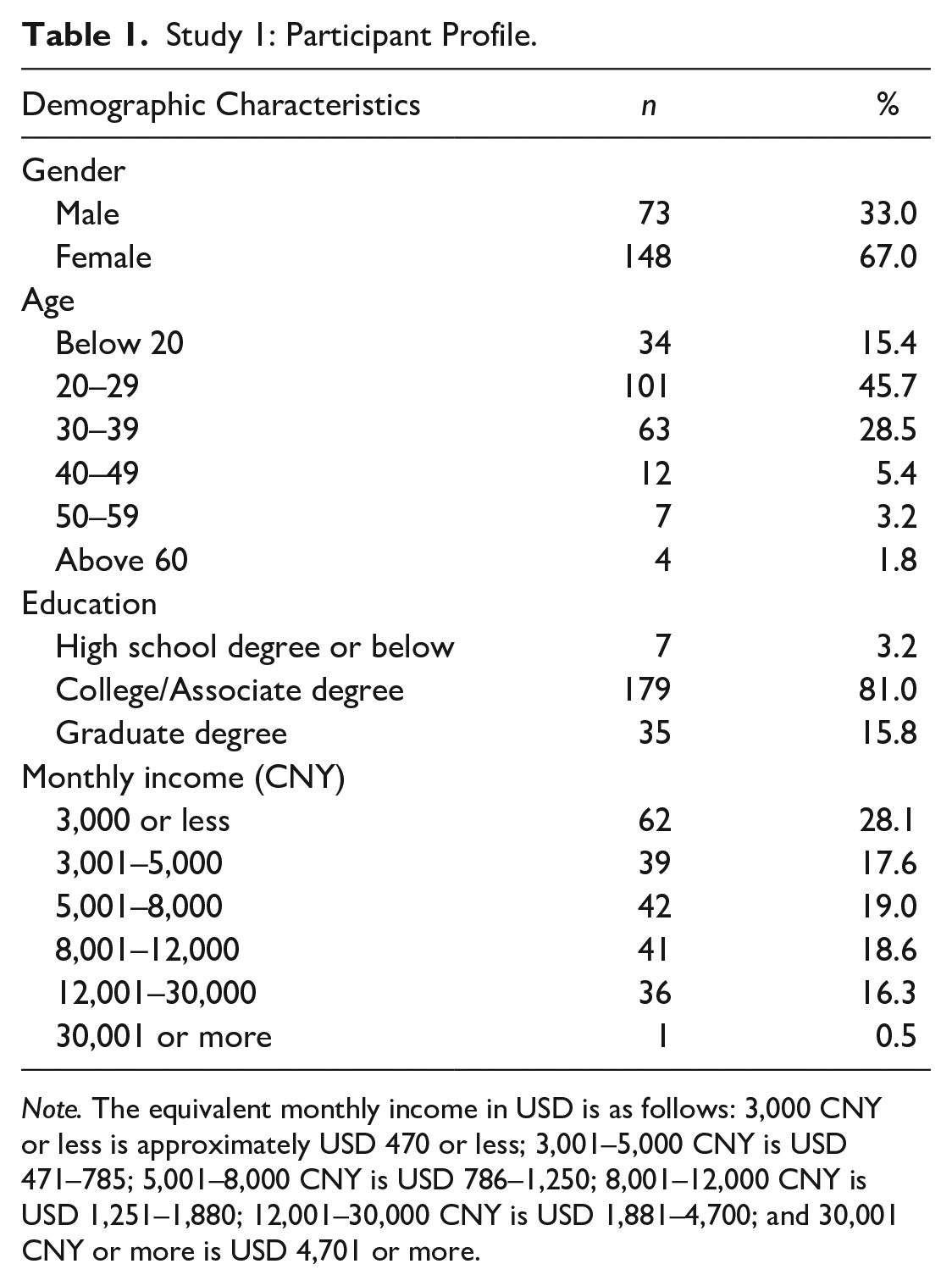
Note. The equivalent monthly income in USD is as follows: 3,000 CNY or less is approximately USD 470 or less; 3,001–5,000 CNY is USD 471–785; 5,001–8,000 CNY is USD 786–1,250; 8,001–12,000 CNY is USD 1,251–1,880; 12,001–30,000 CNY is USD 1,881–4,700; and 30,001 CNY or more is USD 4,701 or more.
Stimuli and Manipulation
We manipulated live streamer types via a recall task whose validity was verified through a pilot study. Participants in the experimental condition completed a memory arousal task with different manipulations of live streamer types. In accordance with Kim et al. (2021), they were instructed to recall a recent live stream on a tourism product in as much detail as possible. Participants were also asked to write down details to better jog their memory; this technique has been used in experimental psychology (Bunnell et al., 2020). The live streamer type differed by condition: 77 participants were assigned to the celebrity streamer condition, 78 to the key opinion leader streamer condition, and 66 to the brand streamer condition.
Measures
Following the manipulation of live streamer type, participants answered a series of questions related to the study objectives. Travel intention was measured with a 3-item scale adapted from Zhang et al. (2017)—for example, “I intend to visit in the future”; “It is likely that I will visit in the future” (1 = not at all, 7 = extremely; Cronbach’s α = 0.860). Informativity was assessed on a 5-item scale adapted from Gao and Bai (2014) and Lv et al. (2022)—for example, “Tourism live streaming is informative to me”; “Tourism live streaming provides comprehensive product or service information for me”; “Tourism live streaming provides up-to-date product or service information for me” (1 = strongly disagree, 7 = strongly agree; Cronbach’s α = 0.840). Entertainment was evaluated via a 5-item scale adapted from Chen and Lin (2018) and Lv et al. (2022)—for example, “I feel that tourism live streaming is fun to watch”; “I feel that watching tourism live streaming is entertaining”; “I feel that tourism live streaming is imaginative” (1 = strongly disagree, 7 = strongly agree; Cronbach’s α = 0. 746). Interactivity was measured based on a 4-item scale adapted from Hou et al. (2019) and Lv et al. (2022)—for example, “While watching tourism live streaming, the danmaku, a real-time interactive option, made me feel that the streamers and viewers wanted to listen to me”; “Tourism live streaming facilitated two-way communication between me and the streamers and other viewers” (1 = strongly disagree, 7 = strongly agree; Cronbach’s α = 0.747). To check whether the manipulation of live streamer type was effective, participants were asked to indicate whether the streamer was a celebrity, key opinion leader, or brand via a 3-item scale—for example, “Do you think the streamer is a celebrity in the tourism live stream you recalled?” (1 = strongly disagree, 7 = strongly agree). Participants provided their demographics (i.e., age, gender, education level, and income) in closing.
Manipulation Check
Data were analyzed in SPSS (Version 26). Compared with participants in the key opinion leader streamer (MKOL = 1.49, SD = 0.50) and brand streamer (MBRA = 2.61, SD = 0.98) conditions, those in the celebrity streamer condition (MCEL = 6.64, SD = 0.61) scored the “celebrity” item significantly higher than the other options: F(2, 218) = 1122.6, p < .001, ηp2 = 0. 91. Similarly, participants assigned to the key opinion leader streamer condition rated the key opinion leader item higher: MKOL = 6.71, SD = 0.65 versus MCEL = 2.09, SD = 0.33 versus MBRA = 2.09, SD = 0.34; F(2, 218) = 2438.3, p < .001, ηp2 = 0.96, whereas those assigned to the brand streamer condition rated the brand-specific item higher: MBRA = 5.12, SD = 2.05 versus MCEL = 2.04, SD = 0.52 versus MKOL = 1.77, SD = 0.98; F(2, 218) = 142.91, p < .001, ηp2 = 0.57. Our manipulation was therefore effective.
Results
Main effect
Participants in the celebrity streamer condition (MCEL = 5.84, SD = 0.99) displayed significantly stronger travel intentions: F(2, 218) = 7.72, p < .001, ηp2 = 0.07, than those in the key opinion leader streamer condition: MKOL = 5.65, SD = 0.99, or the brand streamer condition (MBRA = 5.17, SD = 1.10). We also included participants’ age, gender, education level, and income in an analysis of covariance (ANCOVA; see Table 2). The effect of live streamer type on travel intention remained robust: F(2, 214) = 5.42, p < .01, ηp2 = 0.05. H1 was thus supported.
Study 1: ANCOVA Results for Travel Intention.
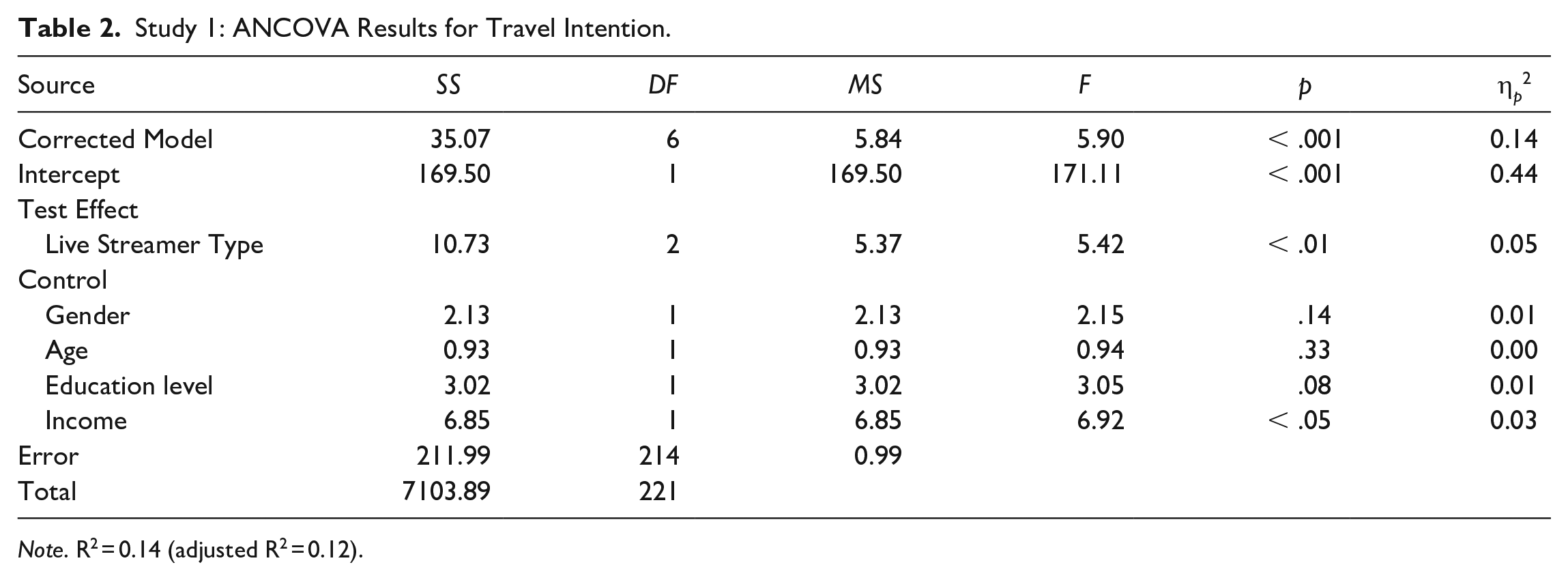
Note. R2 = 0.14 (adjusted R2 = 0.12).
Mediation effects
To test mediation effects, PROCESS Model 4 (Hayes et al., 2017) was applied to participants’ travel intentions (Variable Y) with live streamer type as the independent variable (Variable X; 0 = celebrity streamer, 1 = key opinion leader streamer, 2 = brand streamer). Using the indicator coding scheme, informativity, entertainment, and interactivity (Variable M) were taken as three parallel mediators in a single analysis (5,000 bootstrapping iterations). Informativity significantly mediated the impacts of the key opinion leader streamer (vs. the celebrity streamer: indirect effect = −0.08, SE = 0.06, 95% Boot CI [−0.22, −0.02]) and the brand streamer (vs. celebrity streamer: indirect effect = −0.22, SE = 0.08, 95% Boot CI [−0.41, −0.10]) on travel intention. H2a was accordingly supported. Taking the celebrity streamer as the reference category, the effects of the key opinion leader streamer (indirect effect = −0.07, SE = 0.04, 95% Boot CI [−0.18, −0.01]) and the brand streamer (indirect effect = −0.22, SE = 0.08, 95% Boot CI [−0.42, −0.09], excluding 0) indicated that entertainment significantly mediated the effect of live streamer type on travel intention. Thus, H2b was supported. Interactivity also mediated the impacts of the key opinion leader streamer (vs. the celebrity streamer: indirect effect = −0.11, SE = 0.02, 95% Boot CI [−0.28, −0.06]) and the brand streamer (vs. celebrity streamer: indirect effect = −0.25, SE = 0.08, 95% Boot CI [−0.48, −0.12]) on participants’ travel intentions, lending support to H2c.
Study 2
Objectives and Design
Given Study 1’s support of H1, and H2a-c, we carried out Study 2 for two reasons: (1) to replicate the celebrity endorsement effect on travel intention and (2) to explore the mediating mechanism via informativity, entertainment, and interactivity. Study 2 also aimed to enrich our findings by testing whether live streaming types moderated the proposed effect between live streamer types and travel intention. To achieve these objectives, we employed a 3 (live streamer type: celebrity streamer vs. key opinion leader streamer vs. brand streamer) × 2 (live streaming type: travel live streaming vs. tourism e-commerce live streaming) between-subject design. Participants were randomly assigned to one of six conditions.
Participants
Aiming for a sample size of at least 270, we recruited 360 Chinese participants on Credamo (f = 0.25, α = 0.05, power = 0.90). The eligibility criteria were identical to those in Study 1. Data from 24 participants were excluded due to a failed attention check; in all, 336 participants completed this study for nominal compensation (approximately $0.50) in October 2023. The experiment lasted about 12 minutes. Our sample consisted of roughly 53.0% women and 47.0% men. Most participants (78.9%) were between 20 and 39 years old; the majority (97.0%) reported having at least some college education. About 46.2% earned a monthly income of 8,000 CNY, which is approximately USD 1,250 or higher. Table 3 summarizes the sample’s demographics.
Study 2: Participant Profile.
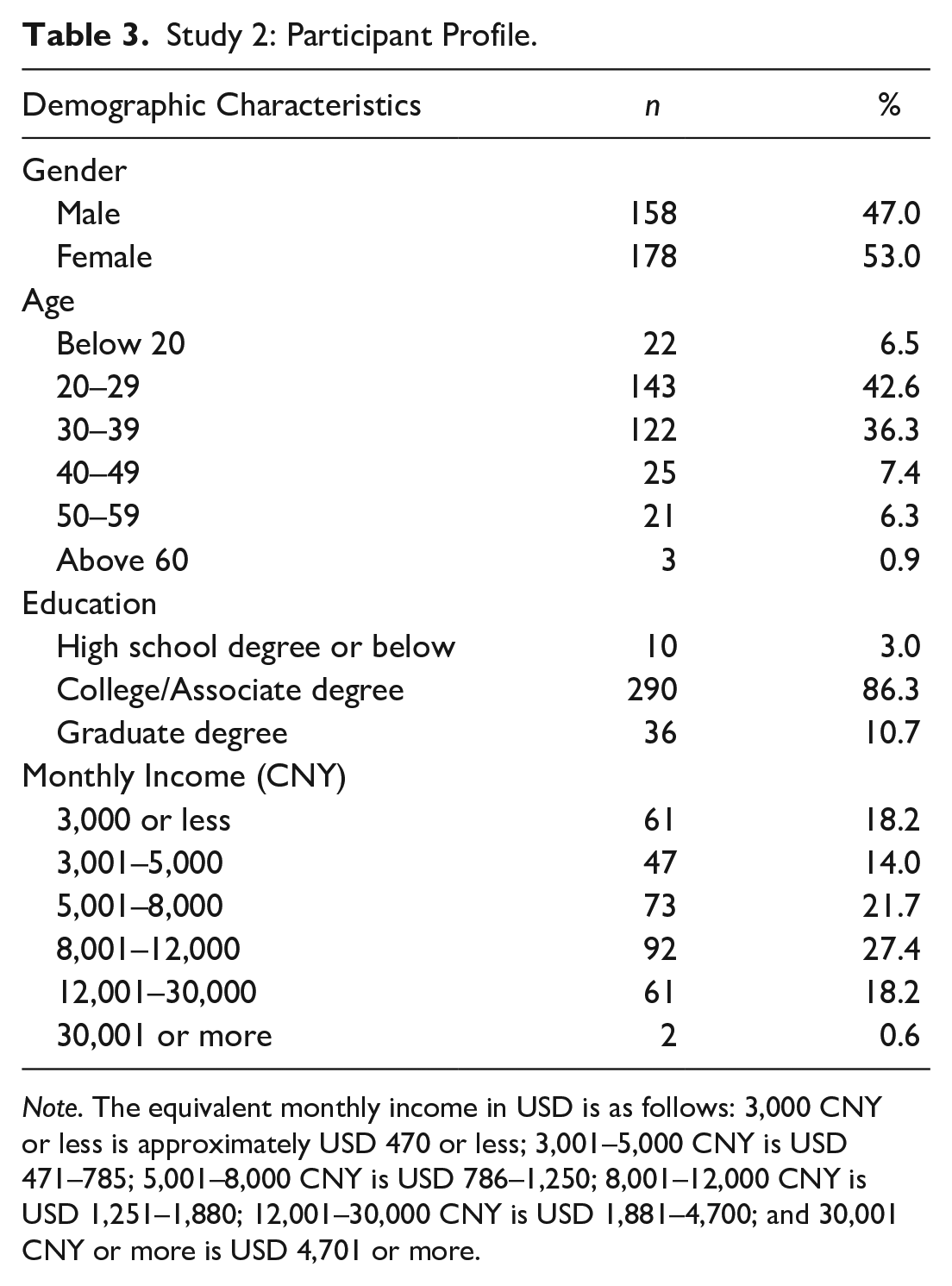
Note. The equivalent monthly income in USD is as follows: 3,000 CNY or less is approximately USD 470 or less; 3,001–5,000 CNY is USD 471–785; 5,001–8,000 CNY is USD 786–1,250; 8,001–12,000 CNY is USD 1,251–1,880; 12,001–30,000 CNY is USD 1,881–4,700; and 30,001 CNY or more is USD 4,701 or more.
Stimuli and Manipulation
Similar to Study 1, we used recall tasks in this study to manipulate the six live streaming types. A pilot study was carried out prior to the formal experiment to test if the manipulations were valid. We provided participants with descriptions of different types of live streaming and live streamers. After reading these materials, participants were asked to recall a recent similar viewing experience and to write at least five sentences about it (D. C. Li et al., 2022). Fifty-eight participants were assigned to the celebrity streamer × travel live streaming condition, 58 to the celebrity streamer × tourism e-commerce live streaming condition, 56 to the key opinion leader streamer × travel live streaming condition, 56 to the key opinion leader streamer × tourism e-commerce live streaming condition, 58 to the brand streamer × travel live streaming condition, and 52 to the brand streamer × tourism e-commerce live streaming condition.
Measures
As in Study 1, participants were directed to answer a series of questions related to the study objectives. The scales on travel intention (Cronbach’s α = 0.877), informativity (Cronbach’s α = 0.854), entertainment (Cronbach’s α = 0.780), and interactivity (Cronbach’s α = 0.785) were retained from Study 1. To confirm that our manipulation was effective, we asked participants to indicate the streamer type in their recalled live stream using the same measures as in Study 1. Participants were also instructed to indicate whether the recalled live stream involved travel live streaming or tourism e-commerce live streaming based on a 7-point bipolar scale (1 = totally e-commerce, 7 = totally live streaming). Participants provided their demographics (i.e., age, gender, education level, and income) in closing.
Manipulation Check
The experimental manipulations were successful. A one-way ANOVA analysis showed that participants in the celebrity streamer condition (MCEL = 6.77, SD = 0.70) scored the “celebrity” item significantly higher than the other options: F(2, 333) = 3343.6, p < .001, ηp2 = 0.95, versus participants in both the key opinion leader streamer (MKOL = 2.05, SD = 0.32) and brand streamer (MBRA = 2.07, SD = 0.38) conditions. Those assigned to the key opinion leader streamer condition rated the key opinion leader streamer item higher: MKOL = 6.80, SD = 0.44 versus MCEL = 2.09, SD = 0.40 versus MBRA = 1.54, SD = 0.62; F(2, 333) = 3855.4, p < .001, ηp2 = 0.96. Participants assigned to the brand condition rated the brand item higher: MBRA = 6.74, SD = 0.60 versus MCEL = 1.94, SD = 0.44 versus MBRA = 1.63, SD = 0.52; F(2, 333) = 3305.3, p < .001, ηp2 = 0.95. An independent t test revealed that participants assigned to the travel live streaming condition rated the same item higher, whereas those assigned to the tourism e-commerce live streaming condition rated this item lower: MTLS = 6.45, SD = 1.20 versus MTES = 2.88, SD = 1.04; t(334) = 29.17, p < .001.
Results
Interaction effect
To test the proposed hypothesis, we conducted a 3 (live streamer type: celebrity streamer vs. key opinion leader streamer vs. brand streamer) by 2 (live streaming type: travel live streaming vs. tourism e-commerce live streaming) between-subject ANCOVA on travel intention. Results are reported in Table 4. As in Study 1, we controlled for participants’ gender, age, education, and income. Supporting our hypothesis, findings revealed that live streamer type significantly affected travel intention: F(2, 326) = 21.25, p < .001, ηp2 = 0.12. The interaction effect between live streamer type and live streaming type on travel intention was also significant: F(2, 326) = 3.48, p < .05, ηp2 = 0.02.
Study 2: Between-Subject ANCOVA Results for Travel Intention.
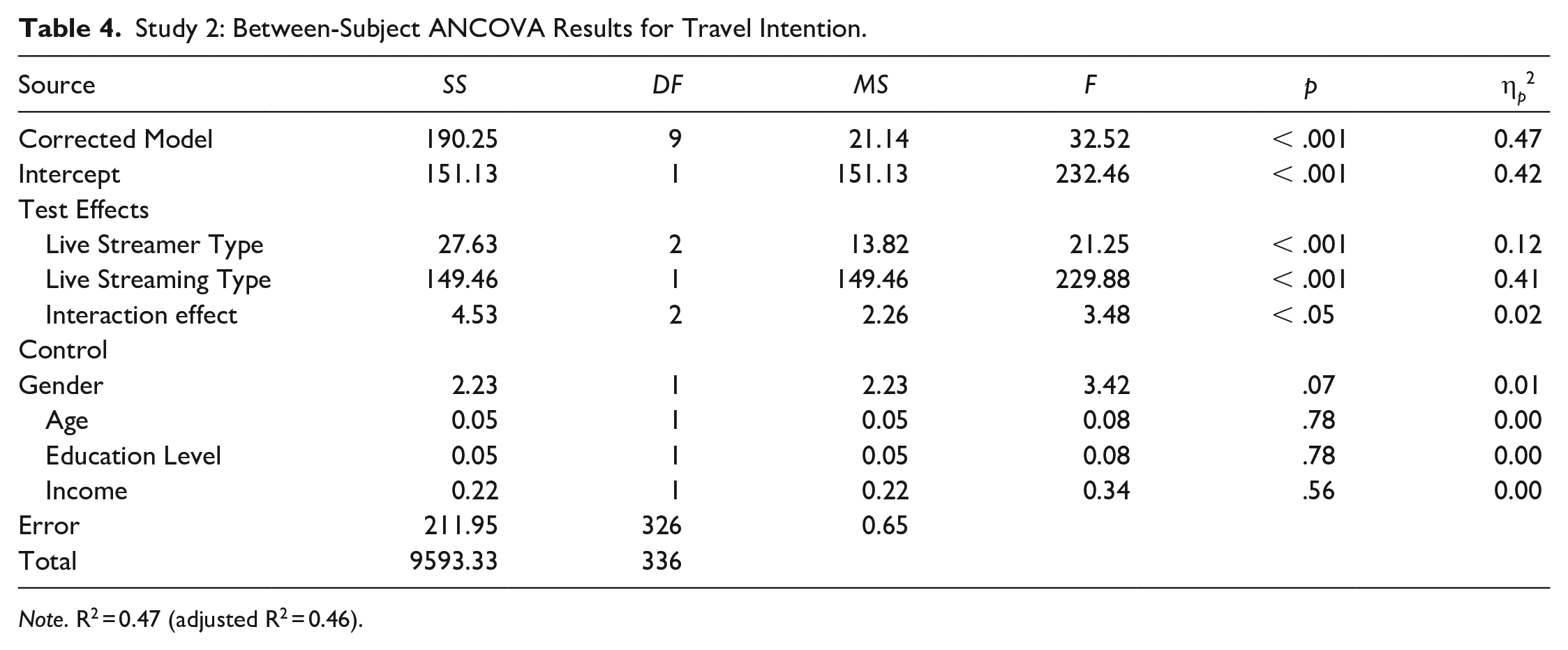
Note. R2 = 0.47 (adjusted R2 = 0.46).
Pairwise comparisons were conducted to further dissect the roles of live streamer type in the travel live streaming and tourism e-commerce live streaming conditions. As pictured in Figure 1, in the travel live streaming condition, celebrity streamers’ involvement led to significantly stronger travel intentions than for key opinion leaders: MCEL = 6.17, SD = 0.50 versus MKOL = 5.86, SD = 0.57; t(112) = 3.11, p < .01, and brand streamers: MCEL = 6.17, SD = 0.50 versus MBRA = 5.65, SD = 0.73; t(112) = 4.42, p < .001. For participants in the tourism e-commerce live streaming condition, celebrity streamers’ involvement led to significantly higher travel intentions versus brand streamers: MCEL = 4.87, SD = 1.11 versus MBRA = 4.01, SD = 0.70; t(108) = 4.89, p < .001. No significant difference emerged between celebrity streamers and key opinion leaders: MCEL = 4.87, SD = 1.11 versus MKOL = 4.79, SD = 1.06; t(106) = 0.36, p = .72. H3 was thus supported.

Study 2: Interaction Plot of Live Streamer Type and Live Streaming Type on Travel Intention.
Conditional mediation effects
To test conditional mediation effects, PROCESS Model 8 (Hayes et al., 2017) was applied to travel intention (Variable Y). Live streamer type was taken as the independent variable (Variable X: 0 = celebrity streamer, 1 = key opinion leader streamer, 2 = brand streamer), with live streaming type as the moderator (Variable W) and informativity, entertainment, and interactivity (Variable M) as three parallel mediators in a single analysis (5,000 bootstrap samples). Results indicated that, in the travel live streaming condition, informativity significantly mediated the effect of live streamer type on travel intention (conditional indirect effect = −0.08, SE = 0.03, 95% Boot CI [−0.17, −0.03]). In addition, in the tourism e-commerce live streaming condition, informativity significantly mediated the impact of live streamer type on travel intention (conditional indirect effect = −0.09, SE = 0.03, 95% Boot CI [−0.16, −0.04]). Therefore, H4a was partially supported. In the travel live streaming condition, entertainment significantly mediated the effect of live streamer type on travel intention (conditional indirect effect = −0.05, SE = 0.02, 95% Boot CI [−0.11, −0.02]). However, in the tourism e-commerce live streaming condition, the conditional mediation via entertainment was attenuated for travel intention (conditional indirect effect = −0.19, SE = 0.09, 95% Boot CI [−0.36, −0.03]). H4b was hence partially supported. Interactivity significantly mediated the impact of live streamer type on travel intention in the travel live streaming condition as well (conditional indirect effect = −0.06, SE = 0.03, 95% Boot CI:[−0.21, −0.07]). On the contrary, in the tourism e-commerce live streaming condition, the mediation effect via interactivity further decreased for travel intention (conditional indirect effect = −0.16, SE = 0.03, 95% Boot CI [−0.32, −0.05]). Thus, H4c was partially supported.
Study 3
Objectives and Design
Study 3 included big data from real tourism live streaming marketing and focused on three types of tourism live streamers to further verify how the celebrity endorsement effect of tourism live streaming influences travel intention. We used a web data crawler to gather live streaming content (celebrity streamer vs. key opinion leader streamer vs. brand streamer), covering viewer comments, likes, saves, and shares. A content analysis was subsequently performed to evaluate how the celebrity endorsement effect of tourism live streaming influenced travel intention.
Data Collection
Data were acquired from the prominent video-sharing platform TikTok (http://www.douyin.com). This website boasts nearly 1 billion registered users in China. TikTok also features an online community—users can express their opinions through likes, reviews, saves, and shares, all of which reflect individuals’ experiential evaluations of videos and live streams.
Three tourism live streams were chosen to assess the impacts of different types of tourism live streamers on travel intention. Each live stream conveyed a different streamer category (celebrity streamer vs. key opinion leader streamer vs. brand streamer). A Java-based web data crawler program was developed in July 2023 to systematically collect data. We focused exclusively on live streams from one city, Datong, to mitigate the potential effects of factors such as live streaming duration, live streaming type, attraction location, the live streamer’s gender, and season. The following control measures were applied: a male streamer, travel-related content, the same video duration (10 min), and matching seasons. These parameters helped us to isolate the streamer type as the variable of interest. Our resultant dataset consisted of 10,431 reviews, covering the posted content, review dates, likes, saves, and shares per live stream.
Variable and Content Analysis
Given the roles that online content can play on consumers’ intentions and behavior, researchers have dedicated considerable attention to this concept (Karimov & Brengman, 2011; Yan & Wang, 2018). We defined live streamer type as an explanatory interval variable, denoted by numerical values ranging from 0 to 2. Following previous studies, we addressed user engagement indicators (e.g., likes, saves, shares, percentage of positive reviews, and proportion of reviews explicitly expressing travel intention) as major factors affecting travel intention (H. Li et al., 2024; Zhao et al., 2023).
Content analysis originated in the 1940s (Krippendorff, 2018) and is typically employed to derive replicable, valid insights from text-based or other meaningful sources (Weber, 1990). Content analysis is popular in hospitality and tourism research (Au et al., 2010; Carson, 2008; Pan et al., 2007; Wenger, 2008). We used this analytic approach to discern key categories influencing travel intention. The identified categories were then quantified within selected reviews.
Text Parsing
First, to gain a comprehensive sense of our review set, we aggregated all reviews from a CSV file into a unified text corpus. We then sought to ascertain pivotal factors influencing travel intention. To facilitate this process, we harnessed the capabilities of ICTCLAS, a program developed at the Institute of Computing Technology of the Chinese Academy of Sciences (Cen et al., 2008; Zeng et al., 2011). This tool allows for Chinese word segmentation, term reduction, and word frequency analysis; it has demonstrated an impressive word segmentation accuracy of 98.45% (H. Li et al., 2013). To enhance precision, we augmented the default user dictionary with a custom lexicon featuring terms corresponding to the major scenic locations in Datong.
Second, we computed the word count and word frequency within a given review based on the default user dictionary and a user-defined lexicon. A Python program was used for word frequency analysis by isolating high-frequency terms within the text. We then curated a collection of “stop words” (e.g., “a,” “an,” “this,” and “those”) to be excluded from analysis.
To realize greater semantic precision, we identified synonyms in the text to reduce the number of terms while increasing their importance. We next employed the SnowNLP program to compute emotional responses (i.e., positive, neutral, or negative) and the respective proportions of each sentiment. Ultimately, we extracted high-frequency terms from the online reviews, Table 5 (see Appendix A in the online supplemental materials) lists high-frequency terms associated with the three live streamer types of interest.
Results
Our hypotheses concerning the celebrity endorsement effect of tourism live streaming on travel intention were tested using common indices associated with a high likelihood of traveling. We specifically compared the celebrity streamer, key opinion leader streamer, and brand streamer groups. Table 6 (see Appendix A in the online supplemental materials) highlights certain metrics (e.g., the number of reviews explicitly expressing travel intention; the percentage of positive reviews, likes, saves, and shares) as substantial indicators of participants’ travel intentions. The celebrity streamer group achieved notably higher scores than the key opinion leader streamer and brand streamer groups. Collectively, this evidence reinforces the role of celebrity endorsement on travel intention in terms of tourism live streaming.
General Discussion
Findings from these three studies supported our theoretical framework. Study 1 demonstrated that live streamer type affects travel intention: celebrity streamers could generate stronger travel intention than key opinion leader streamers and brand streamers (H1 supported). Informativity, entertainment, and interactivity mediated the live streamer type–travel intention relationship (H2a–c supported). Replicating this pattern, Study 2 revealed the moderating role of live streaming type (i.e., it moderates the live streamer type effect on travel intention). This impact was more pronounced in travel live streaming than in tourism e-commerce live streaming (H3 supported). In addition, informativity, entertainment, and interactivity mediated the live streamer type–travel intention relationship in the contexts of travel live streaming and tourism e-commerce live streaming (H4a–c partially supported). Finally, Study 3 involved a content analysis based on live streaming big data to further ensure our results’ robustness and external validity.
Theoretical Implications
This research contributes to the literature on celebrity endorsement and live streaming, particularly with respect to the emerging topic of tourism live streaming. Celebrity endorsement has long been considered a worthwhile marketing tool in the tourism industry (Glover, 2009; Teng & Chen, 2020; J. Yang et al., 2022; Zafar et al., 2021). We sought to extend this stream of work by scrutinizing how and why celebrity endorsement influences consumers’ responses in the emerging tourism live streaming context. In particular, we illuminated whether and how celebrity streamers surpass other types of streamers (i.e., key opinion streamers and brand streamers) in evoking consumers’ travel intentions. Our effort responds to a call for studies distinguishing influencer types; such investigations can guide theory and practice by promoting optimal endorser choices (Schouten et al., 2020).
The celebrity endorsement effect applies to live streaming (Roy et al., 2021). We observed that celebrity streamers enhanced viewers’ travel intentions through tourism live streams as well. These findings corroborate earlier studies conveying how celebrity endorsement operates in tourism (J.-G. Lee & Thorson, 2008; Zhang et al., 2020). We built on flow theory (Hyun et al., 2022) in contemplating why celebrity streamers are superior to other types of streamers (i.e., key opinion streamers and brand streamers) in generating viewers’ travel intentions; the underlying psychological mechanism was the flow experience arising from informativity, entertainment, and interactivity. This psychological mechanism echoes prior efforts (Lv et al., 2022) that highlighted its theoretical prominence in sparking positive consumer responses (Y. Li & Peng, 2021; Xie et al., 2022; Ye et al., 2022). Our research also answers Lin and colleagues’ (2022) call to study live streaming in terms of flow theory.
In line with our theorization, we also identified the moderating impact of live streaming type. Result showed that live streaming type moderated the live streamer type effect on travel intention. This impact was more pronounced in travel live streaming than in tourism e-commerce live streaming. Celebrity streamers unexpectedly produced stronger travel intention than brand streamers in the tourism e-commerce streaming condition. A possible explanation is that celebrity streamers may be better at integrating entertaining elements to create a relaxed atmosphere, which promotes audience immersion (Chen & Lin, 2018; Lv et al., 2022). Another potential justification is that viewers might assume a celebrity’s perspective as their own (Tan, 2008) and want to travel to a recommended destination if viewers are fans of the specific streamer.
Findings also showed entertainment- and interactivity-driven effects of celebrity endorsement in travel live streaming. These impacts are likely associated with diverse, intriguing real-time visuals in this context. The “celebrity fantasy” can manifest easily and spurs entertainment (Deng et al., 2019; Hung, 2014). Meanwhile, live streaming portrays celebrities’ immediate reactions and can provoke interactivity (W. Gong & Li, 2017). Our content analysis further substantiated these outcomes: we found that celebrity streamers surpassed other types of streamers in generating more positive reviews expressing travel intention. Other examples in these reviews alluded to entertainment (Chen & Lin, 2018; Hung, 2014), such as “feel happy,” “feel relaxed and peaceful,” “enjoy,” and “relieve work pressure.” Stronger interactivity can be reflected through likes and shares as well. Our research additionally clarified which components of the flow experience (i.e., entertainment and interactivity) especially influence consumers’ psychological processing of tourism content. Findings thus contribute to research on flow theory and the flow experience with respect to live streaming when considering celebrity endorsement models.
Managerial Implications
This research offers insights regarding ideal live streaming marketing strategies for tourism businesses and destinations. We present a macro perspective to help stakeholders choose suitable live streamers and live streaming types. Celebrity endorsement comes with a considerable financial outlay, but the promotional effect is optimal: This form of endorsement enhances audience members’ flow experiences through informativity, entertainment, and interactivity. When tourism businesses and destinations choose celebrity streamers, these stakeholders need to highlight entertainment and interactivity while boosting informativity. Key opinion leaders represent a viable alternative for tourism businesses and destinations that cannot use celebrities due to finances or other reasons.
In addition, we unearthed an interaction between live streamer type and live streaming type. The celebrity endorsement effect was more pronounced in travel live streaming, namely thanks to greater entertainment and interactivity. All tourism businesses and destinations that wish to conduct live streaming campaigns are encouraged to consider travel live streaming to enhance marketing effectiveness. At the same time, based on the chosen live streamer type, we recommend that live streamers’ informativity, entertainment, and interactivity be tailored to heighten viewers’ travel intentions (Lv et al., 2022; Zheng et al., 2023).
Limitations and Future Research
Several limitations of this research leave room for future work. First, using live streamer type as the independent variable may have caused internal differentiation issues by type. Although we implemented several measures in our experimental design to reduce this possibility, the impacts of personal preferences may not have been fully mitigated. The results’ purity should be ensured more rigorously in future endeavors.
Second, we examined how live streamer types affect travel intention in tourism live streaming. The number of tourist anchors is increasing along with the continued growth of live streaming in the tourism industry. Subsequent studies can compare more live streamer types (e.g., tourism officers, influencers outside the tourism industry, and artificial intelligence streamers). Scholars can also investigate other industry contexts, such as restaurants or hotels.
Third, we were primarily interested in the interaction between live streamer types and live streaming types. More interaction effects can be considered in the future, such as for tourism product types (e.g., tickets vs. package tours) and platform options (e.g., online shopping platforms vs. social media platforms). Furthermore, our sample consisted solely of Chinese consumers due to geographical constraints. However, tourism live streaming has also become popular in countries such as Australia and Japan (Lin et al., 2022; Xie et al., 2022), and people from different cultural backgrounds embrace technology in various ways (Sun et al., 2019). Therefore, follow-up research could address the moderating effects of power distance beliefs on celebrity endorsement in the live streaming context. Cross-cultural samples may also be recruited in more diverse settings.
Supplemental Material
sj-docx-1-jht-10.1177_10963480241251449 – Supplemental material for How Celebrity Endorsement Affects Travel Intention: Evidence From Tourism Live Streaming
Supplemental material, sj-docx-1-jht-10.1177_10963480241251449 for How Celebrity Endorsement Affects Travel Intention: Evidence From Tourism Live Streaming by Lin Zhang, Da Shi, Zixuan Huang, Aixia Zhang and Bingchao Zhang in Journal of Hospitality & Tourism Research
Footnotes
Declaration of Conflicting Interests
The authors declared no potential conflicts of interest with respect to the research, authorship, and/or publication of this article.
Funding
The authors disclosed receipt of the following financial support for the research, authorship, and/or publication of this article: This research supported by 2022 Liaoning Provincial Postgraduate Teaching Reform Research Project (Project No. LNYJG2022436), National Natural Science Foundation of China (Project No. Grant 72302037), Basic Research Fund of Yunnan Provincial Department of Science and Technology (Project No. 202401AU070110), Science Research Fund of Yunnan Provincial Department of Education (Project No. 2024J0598), and 2023 Scientific Research Fund Project of Yunnan University of Finance and Economics (Project No. 2023D26).

Supplemental Material
Supplemental material for this article is available online.
Author Biographies
References
Supplementary Material
Please find the following supplemental material available below.
For Open Access articles published under a Creative Commons License, all supplemental material carries the same license as the article it is associated with.
For non-Open Access articles published, all supplemental material carries a non-exclusive license, and permission requests for re-use of supplemental material or any part of supplemental material shall be sent directly to the copyright owner as specified in the copyright notice associated with the article.
