



Abstract
Despite scholarly interest in changes in masculinity, no study to date offers quantitative measures of nontraditional masculinity ideologies. We identify common denominators of “new masculinity” (NM) ideology rooted in therapeutic discourse, which includes themes of authenticity and holistic self-awareness. A theoretical construct of NM was formalized from in-depth interviews and operationalized as the NM Inventory (NMI). The NMI was tested for structural and external validity in two quantitative samples of Israeli men. The inventory demonstrated discriminant validity with traditional and consumer masculinity ideologies, converged with self-labeling as feminist, and was uniquely predicted by lower levels of modern sexism. This suggests stronger associations between NM and feminist attitudes than previously argued. Lay responses confounded between self-labeling as new man and as metrosexual, echoing ambiguities in public rhetoric of NM. As a unique measure of nontraditional masculinity, the NMI can spur more systematic research into variable outcomes of contemporary understandings of masculinity.
Keywords
Despite extensive scholarly discussions of the changes in norms and values of masculinity in postindustrial Western societies, the majority of measures used in quantitative research on masculinity addressed only attitudes associated with traditional masculinity (hereafter TM; e.g., Levant et al. 1992; Mahalik et al. 2003; O’Neil 2008; Thompson and Pleck 1986). Although norms of masculinity are conceptualized as a social construction that may alter according to social–historical shifts, attitudinal shifts away from TM have been measured so far only in terms of rejection of traditional norms (e.g., Levant et al. 1992; Luyt 2005). Thus, no quantitative studies to date examined systematically whether alternative sets of attitudes held by contemporary men have crystallized into distinct masculinity ideologies that are not reducible simply to a negation of TM. In this study, we propose one direction for exploring alternative conceptions of masculinity by introducing a measure for a distinct ideology of “New Masculinity” (hereafter NM) rooted in the growing cultural impact of a “therapeutic discourse” in Western societies (Furedi 2004; Illouz 2008).
In sociological and historical terms, men’s gender apprehensions have been framed as the “crisis of masculinity” that accompanied the transition from industrial to postindustrial societies, as men confront wide-ranging changes in gender practices and gender power structures at the interpersonal, social, and political level (Kimmel 1987; Whitehead and Barrett 2001). Against this backdrop, men’s movements as well as popular media frequently evoke various lay perceptions of the “new man” (Messner 1993, 273) or the “sensitive new age guy” (Connell 1996, 54; Rickabaugh 1994). However, beyond vague notions about men “loosening up” or adopting a “gentler,” “feminine-like” approach (Segal 1993, 633−34), there seems to be little agreement among scholars as to the actual content of NM ideology. This ambiguity stems, in part, from the way that NM rhetoric is simultaneously employed in men’s liberation discourse premised on a vocabulary of authenticity and self-awareness (Connell 1995) and in consumerist context associated with metrosexual body- and fashion-consciousness (Clarkson 2005; Nixon 2001).
Consequently, despite popular interest, much of the scholarly literature on changing masculinity shies away from explicitly assessing or even defining the concept of NM. Those commentators who have explicitly addressed the term “New Man” often criticized its proponents for drawing on a therapeutic vocabulary of self-expression, understood as a self-serving stance that does little to address gender inequality (Connell 1996; Messner 1993).
Against this backdrop, the current study aims to identify common denominators of NM ideology rooted in therapeutic discourse that distinguish it from other masculinity ideologies and to develop the New Masculinity Inventory (hereafter NMI) as a measure of this novel conceptualization. In order to validate this measure, we examine its relations with measures of TM and sexism and with men’s self-identification with labels of new masculinity. We also provide a preliminary examination as to whether the therapeutic vocabulary underling the proposed construct of masculinity ideology is gender egalitarian.
Research on TM Ideology
Most quantitative research on men and masculinity is conducted from a social psychological perspective, situated in the growing field of psychology of men. Studies in this field measure mainly the dominant attitudes about male behavior. This set of expectations conceptualized as the “traditional” construction of masculinity (Pleck, Sonenstein, and Ku 1993, 91) is rooted in ideals of the enlightenment and values of industrial Western societies. It includes notions of stoicism, invulnerability, assertion of male status, toughness, and avoidance of femininity (Brannon and David 1976; Levant 1996; Pleck, Sonenstein, and Ku 1993). Moving away from earlier psychological formulations of masculinity as essentialized personality traits, Pleck and his associates (Pleck, Sonenstein, and Ku 1993; Thompson, Pleck, and Ferrera 1992) emphasized the theoretical significance of understanding masculinity as an ideology. This normative approach has followed sociological scholarship on masculinity (Connell 1995; Kimmel 1996) in underscoring a social-constructionist formulation of gender.
Researchers in psychology of men have recognized that there maybe competing conceptions of masculinity ideologies (e.g., Levant et al. 2007, 84; Pleck, Sonenstein, and Ku 1993, 91), following Connell’s theorization of multiple masculinities (Carrigan, Connell, and Lee 1985; Connell 1995). However, so far, none have attempted to develop a formal conceptualization and empirical measure of any non-TM ideology. Instead, TM is repeatedly conceptualized as the only “widely prevalent” social construction of masculinity (Pleck, Sonenstein, and Ku 1993, 91) and as such has attracted the lion’s share of empirical attention. Smiler’s (2004) comprehensive overview of psychological conceptualizations and measures of masculinity since the 1970s identifies five distinct “movements” of research in the field, none of which addresses measures of non-TMs.
Psychologists developed several scales to measure TM and related theoretical constructs, such as the Male Role Norm Scale (MRNS; Thompson and Pleck 1986), Male Role Norms Inventory (MRNI; Levant et al. 1992), and Conformity to Masculine Norms Inventory (CNMI; Mahalik et al. 2003). Although these scales do not fully converge in their conceptualization and operationalization of TM, some common core themes emerge: (a) assertion of male status through competition, (b) emotional restrain and self-reliance, (c) toughness associated with risk-taking and aggression, (d) staunch avoidance of femininity and effeminacy, as well as homophobia, and (e) nonrelational, objectified attitudes toward sexuality. These measures were then employed mainly to demonstrate how the restrictive roles of TM limit men’s potential to lead a well-adjusted life. Psychologists have focused predominantly on the negative, “dysfunctional” emotional outcomes resulting from the inevitable failure to live up to the standards of TM (Sinn 1997; O’Neil 2008) and emphasized its “precarious” nature, requiring continual social proof and validation (Vandello et al. 2008). Another recent development in the field is the introduction of a positive psychology/positive masculinity framework, which seeks to affirm and build upon the potential strengths of TM rather than its restrictive potential and centers on men’s adaptive behavior as the starting point for therapy (Kiselica 2011; Englar-Carlson and Kiselica 2013).
Taken together, despite their theoretical assumption about the social construction of gender roles, masculinity still emerges in these various models and measures as a stable and universal trait-like variable or an internalized social norm, as noted in recent discussions of the field (Luyt 2015; Whorley and Addis 2006). If masculinity is understood as a historically contingent social construction, it should also be studied as such, taking into consideration changing cultural discourses such as the rising tide of consumerism and the spread of therapeutic discourse in Western societies.
Some measures do purport to measure nontraditional or “progressive” content of masculinity ideology, either as attitudes toward changing masculinity norms (e.g., Moreland and Van Tuinen 1978) or by incorporating within scales of TM norms items that probe nonconforming attitudes (Mahalik et al. 2003; Levant et al. 1992; Luyt 2005). Yet, the actual items used in these measures generally resemble reversely coded items in scales of TM and thus do not provide new content that may point to alternative masculinity ideologies.
Demonstrating that men may reject traditional norms tells us little about what they do endorse: this rejection can be rooted in any of the several and distinct non-TM ideologies (for a related argument on measuring gender-egalitarian views, see Braun 2008). To conclude, we are not aware of comprehensive quantitative models designed to explore any of the emerging forms of non-TM ideologies.
NM and Therapeutic Discourse
Part of the difficulty in specifying and operationalizing ideological alternatives to TM stems from the way that a rhetoric of an NM is employed to demarcate different contents in different social arenas. On the one hand, this rhetoric appears in the men’s movement, as part of a shared vocabulary of authenticity and self-discovery situated in the growing cultural impact of a therapeutic discourse (Furedi 2004; Illouz 2008). On the other hand, when an NM rhetoric appears in popular media, it is often employed to address and market among men values of consumerism and metrosexual imagery (Clarkson 2005; Nixon 2001). In both instances, the growing importance assigned to individual self-expression in postindustrial societies has led to the questioning of TM norms. We argue, however, that different masculinity ideologies may play a part in these changes (Rosenmann and Kaplan 2014). In particular, we distinguish between a masculinity ideology rooted in therapeutic discourse and addressing themes of authenticity and holistic self-awareness and in consumerism and consumption of lifestyles.
The therapeutic discourse has taken center stage in postindustrial societies since the late twentieth century. Rooted in the science of psychology and nested in the processes of individualization and liberalism, this cultural discourse challenges individuals to become more self-reflective and to create an authentic narrative of personal transformation (Furedi 2004; Taylor 1991). The postindustrial era is characterized by greater affluence, which allows middle-class individuals to attend to less tangible concerns of personal self-expression and the pursuit of meaningful, fulfilling lives (Inglehart and Baker 2000). As part of the quest for authenticity, individuals come to think of themselves “as creatures with inner depths,” whose heightened self-reflectivity (Taylor 1991, 26) creates the self as an ongoing project, a “work in progress,” ever improving and becoming. In particular, the therapeutic discourse challenges individuals to create a narrative of personal transformation from suffering to salvation, working through past experiences of distress as means to become more whole (Illouz 2008). This discourse has ideological implications for the social construction of gender. It prescribes an “emotionally correct hierarchy of virtuous behavior” (Furedi 2004, 35), which in turn refashions a new hierarchy of masculinities. It advocates a self-conscious, reflexive emotional style as the only healthy form of masculinity and pathologizes the emotional style of self-restraint associated with TM (Illouz 2008, 231).
Calls for changing norms of masculinity in line with the therapeutic discourse are particularly salient in (although not limited to) men’s liberation discourse. Since the 1980s, the call for a new man that departs from the social expectations of TM has been raised by men’s groups in response to the rise of feminism and the crisis of masculinity. Politically, these responses have been diverse and, indeed, at times contradictory: the term NM is simultaneously invoked by proponents of progressive initiatives for social change and gender equality (e.g., Morrell 1998; Ruxton and van der Gaag 2013), by promale alliances in homosocial enclaves striving to uncover men’s inner selves (e.g., Kimmel and Kaufman 1993; Magnuson 2005) as well as by those attempting to reclaim men’s rights and leadership in the domestic sphere (e.g., Hansen 2012).
Yet despite their often divergent agendas, advocates of men’s liberation appear to draw on a shared vocabulary, as they mutually validate their experiences of pain and address “costs attached to adherence to narrow conceptions of masculinity” (Messner 1997, 12). Central to these experiences is a shift toward greater self-awareness, sensitivity, and intimate expressivity in both male-to-female and male-to-male interactions (e.g., Bartkowski 2001; Falabella 1997; Nardi and Nardi 1992). Additional themes and idioms activists commonly associate with NM are personal growth, authenticity, and spirituality (Karoski 2007; Magnuson 2005; Russell 2009). This vocabulary is also linked with a reprioritization of life goals and greater investment in issues of care, domesticity, and nurturing connected to fatherhood (Real 1997; Marsiglio and Roy 2012).
Particularly salient in this context is the growing pull of New Age movements that negotiate expressions of newly found holistic spirituality and explore its implications for understanding masculinity (Krondorfer and Hunt 2012). The best studied example of these is the “mythopoetic movement” and its offshoots endorsing a self-reflective exploration of mythological archetypes to access an authentic, inner masculine reality (Barton 2000; Karp 2010; Kimmel and Kaufmann 1993). Departures from TM are also invoked in conjunction with increased awareness to health considerations (Hearn et al. 2012) and specifically with a new perspective on health and well-being based on holistic mind–body attentiveness and integration, extending the pursuit of self-reflectivity, and authenticity to men’s engagement with their bodies (Robertson 2006; Wienke 1998; Rosenmann and Kaplan 2014). Taken together, these various formulations present a shared attempt to improve men’s well-being through authenticity, inner harmony, and balance across life spheres, reflecting a holistic perspective of the self, its relationship to the body and with others. While most of these formulations seem to depart from the norms of TM, some have called attention to ways that themes associated with men’s well-being, such as care and investment in fathering can be reclaimed from within TM (Kiselica 2011; Englar-Carlson and Kiselica 2013). This suggests that the emerging ideology of NM associated with the therapeutic discourse may not entirely contradict TM ideology and, furthermore that interpretations of TM ideology may also alter over time.
NM in Consumerist Discourse
NM rhetoric and the imagery of the new man are further obfuscated by their frequent use in popular media in service of very different goals, those of consumerism. The same postindustrial conditions that spurred a transformed vocabulary of masculinity associated with therapeutic discourse have also facilitated the channeling of heightened self-expression into consumption of “lifestyle” choices. These lifestyle choices serve to communicate membership in sociocultural groupings while expressing personal uniqueness in consumerist settings (Holt 1997). Under the emerging norms of this “consumer masculinity” (hereafter CM), conspicuous consumption of products that display refined, prestigious tastes and personal aesthetics are considered well-deserved leisurely activities that modern-day men should be entitled to (Clarkson 2005; Conseur, Hathcote, and Kim 2008). In particular, media representations have evoked a new image of the “metrosexual” man, encouraging urban heterosexual men to become unapologetic, hedonistic consumers of men’s fashion and grooming practices previously considered strictly feminine or effeminate (Clarkson 2005; Simpson 1994). Metrosexuality guides men to replace the traditional emphasis on body functionality with that of body appearance and idealized aesthetics. The metrosexual body is an object perfected by the possibilities of consumption for the viewing pleasure of self and other (Rosenmann and Kaplan 2014). Initially, the imagery of metrosexuality depicted this new heterosexual man as unafraid to be in touch with his feminine side and holding more gender egalitarian views (Clarkson 2005). Over time, however, commercial interests led marketers and advertisers to drop such politically contentious connotations of metrosexual imagery in order to make CM more appealing to a wider male audience (Alexander 2003).
CM replaces the industrial-era emphasis on production, which has characterized TM, with a postindustrial injunctive norms that redefine masculinity ideology as a matter of proper consumption. In this, CM ideology aims to socialize men to resolve their insecurities by pursuing lifestyle choices and perfecting their outward appearance (Alexander 2003). Along these lines, recent empirical studies have addressed changing attitude toward the male body and suggest that men’s self-esteem is increasingly associated with concerns over body appearance (Grogan and Richards 2002; Mishkind et al. 1986). Media images play an additional role in reinforcing these increasingly rigid standards of physical attractiveness among men (Martin and Kennedy 1994). Conseur, Hathcote, and Kim (2008) connected these trends with CM and reported that basing self-worth on outer appearance correlates with consumer masculinity measured in terms of metrosexual fashion consciousness and interest in men’s lifestyle media. Given the popular use of NM rhetoric in conjunction with both the therapeutic discourse and consumerism, empirical research is called for to examine which of these ideologies is intended by laymen when self-identifying as new man.
NM and Gender-egalitarian Views
There has been much debate as to whether the societal shifts away from TM and toward NM promote greater gender equality. Empirical studies consistently link endorsement of TM with rejection of gender-egalitarian views (Sinn 1997; Fischer and Good 1998) and with sexist attitudes that ignore continued gender discrimination against women (Martínez and Paterna-Bleda 2013). Endorsing the alternative, an NM ideology is arguably linked with gender-egalitarian views, as it coincides with a broader cultural transition that sanctions authentic, individual self-expression and considers traditional hierarchical distinctions between social groups and gender-based differentiations as arbitrary and unduly constraining for self and others (Inglehart and Norris 2003).
At the same time, commentators have argued that adherence to an NM is a matter of style rather than substance, consisting of a self-serving, individualistic stance that is no more gender egalitarian than the more blatantly sexist attitudes of TM. Thus, Connell (1996) associated the lion’s share of men’s liberation with a politics of “masculinity therapy.” These originally provided a critical, profeminist examination of the traditional notion of male norms but have increasingly shifted to heightened individualism resulting in the practical effect of turning “heterosexual men inward to their own troubles” while ignoring the broader structure of social and gender inequality (Connell 1996, 62). Similarly, Messner (1993) argued that although participants in men’s groups employ a therapeutic vocabulary to connect with other men in ways that are both nurturing and mutually empowering, they ignore their privileged status as upper-middle-class men. Thus, these “shifts in the cultural and personal styles” of masculinity mitigate aspects of traditional male norms that are considered emotionally constraining but “do not necessarily contribute to the undermining of conventional structures of men’s power over women” (Messner 1993, 725). A similar argument is made by Shugart (2008) with respect to the metrosexual imagery associated with heightened consumerism, suggesting that it legitimizes practices formerly considered feminine and reanchors them as means to further goals common to both traditional and consumerist masculinity ideologies, namely, achieving professional success and sexual access to women.
Because popular and scholarly references to NM are ambiguous, straddling between the therapeutic and consumerist contexts, and in the absence of empirical measures of non-TM ideologies, we have no way of examining whether endorsement of NM coincides with gender-egalitarian views or reproduces sexist views and gender inequality, as argued above. The current study aims to address this caveat by empirically explicating NM ideology, as it emerges in therapeutic discourse and contrasted away from attitudes associated with both CM and TM. To this end, we have developed the NMI following Simms’ (2008) conceptual guidelines for scale construction. First, we present our construct conceptualization and development of initial item pool. This is followed by a description of two studies which served for item selection and the establishment of structural validity, as well as assessment of external validity in terms of convergent and discriminant validity. In doing so, we present a systematic account of NM ideology, in hopes of spurring more nuanced research into various conceptualizations of masculinity and its implications for gender relations, self-identifications, and lifestyle practices.
Construction of the NMI
The first step in constructing the NMI was to define a set of beliefs that are most relevant to the proposed theoretical construct of NM ideology associated with the therapeutic discourse. In addition to the general themes and idiom identified in the aforementioned literature review, we conducted a pilot study with men who identify with NM or engage in associated practices in their everyday lives. Notably, this pilot research group, as well as the larger samples detailed below, draw from a specific sociocultural context, that of Jewish Israeli men. However, Israel’s Jewish majority ranks highly in indexes of globalization and repeatedly aligns itself with its cultural dictates (Rosenmann 2015). In societies affected by globalization, gender ideologies are becoming increasingly homogenized (Connell 1995; Inglehart and Norris 2003). Along these lines, a great deal of correspondence was found between our Israeli interviewees’ ideas of new masculinity, and those found in the aforementioned literature, originating mainly from the US setting.
Twenty-four in-depth interviews were held with Jewish–Israeli men whose life choices depart from the mandates of TM: seven male activists in men’s movements, six men in female-dominated occupations (social work, preschool teachers), seven men in nontraditional body-related occupations (Yoga teachers, mind–body therapists, and dancers), and four stay-at-home fathers. The aim was to directly probe attitudes, values, and beliefs underlying NM rather than creating an ad hoc inventory of attitudes that contradict traditional masculine norms, as attempted in some of the existing measures (Mahalik et al. 2003; Luyt 2005).
A theoretical construct of NM was formalized from the themes gleamed from these interviews and informed by existing literature. These men value authenticity, self-realization, and self-growth in various life spheres including domestic life, work, and leisure. They take a holistic and nurturing perspective on the self and body as well as in relationships with others. This entails attentiveness to the body as well as open communication and dialogue with intimate others. The overarching principle is a reprioritization of men’s life goals: positioning these various facets of self-awareness, rooted in the therapeutic discourse, as more important than adherence to established masculine norms and gendered restrictions. The original themes derived from our qualitative work and their formalized conceptualizations were submitted to three expert judges who were asked to evaluate whether these encompass and exhaust their understanding of the domain and facets of NM. Following their comments, the formal definitions were revised and refined.
Out of this theoretical construct, we developed NMI items in accordance with guidelines highlighted by previous work taking the normative approach to measure masculinity ideology (Luyt 2005; Pleck, Sonenstein, and Ku 1993; Thompson, Pleck, and Ferrera 1992): (a) items referred to male standards only rather than compare men to women; (b) items were written in prescriptive terms (what men should be like), avoiding as much as possible descriptive language (what men actually are); and (c) whenever possible, items were written as third-person rather than first-person statements in order to confine responses to culturally shared normative views and avoid personal evaluations of self. The pool of items was tested for face and content validity by two focus groups, one of graduate students in men studies and the other of laymen with no involvement with NM practices. Based on these procedures, items were refined and expanded to arrive at an initial pool of forty-six items for the NMI.
Study 1
The aims of Study 1 were to explore the psychometric properties of initial NMI items and distill an internally consistent and unidimensional measure that taps the different themes and facets of NM content. In addition, the study provided an initial step toward establishing the external validity of the NMI as a measure of NM ideology.
Given that our conceptualization of NM ideology positions it within a therapeutic (and not consumerist) discourse, we opted first to test the discriminant validity of the NMI vis-à-vis indices of CM and metrosexuality. Because CM ideology has not been operationalized, as of yet we included two measures that draw on its different facets: (a) the extent to which self-worth is contingent on physical appearance, a measure predictive of shopping and grooming behaviors (Crocker et al. 2003) and specifically to consumer masculinity (Conseur, Hathcote, and Kim 2008) and (b) metrosexual consumption behaviors (i.e., purchase of fashion products and personal hygiene; Conseur, Hathcote, and Kim 2008).
In light of the aforementioned ambiguities in lay perceptions and public rhetoric of NM, we also probed respondents’ self-identification with two nontraditional masculine labels, new man and metrosexual. This allows to simultaneously assess the extent that these labels had gained traction among men, as well as to explicate the lay meaning attached to them. We expected NMI scores to be associated with self-labeling as new man but not with self-labeling as metrosexual, thus providing converging validity to the NMI. In addition, because new spirituality was identified as an important correlate of men’s movements (Krondorfer and Hunt 2012; Magnuson 2005), participating in new spirituality practices is also expected to converge with NMI.
These validation hypotheses are detailed below, all of which were expected to emerge while controlling for social desirability and demographic variables.
Methods
Participants
For this initial study, we turned to a convenience sample of educated men who were more likely to be acquainted with the terms new masculinity and metrosexuality, as these terms are often employed indiscriminately in popular discourse among the general population. Participants were recruited through advertisements on social networks, responding to an invitation to participate in an online survey on men. Respondents were admitted after stating that they were adult men and gave their informed consent. No incentives for participation were offered.
Of the 297 men who completed the questionnaire, 4 were excluded due to response invariance to both positively and negatively worded items. 1 The final sample consisted of 293 Jewish Israeli men, mainly secular (80.9 percent), of diverse age (M = 36.26, SD = 10.88), and highly educated (35.9 percent attained a bachelor’s degree; 39.8 percent attained a master’s degree or beyond). A majority of respondents were heterosexual (87.7 percent), and roughly two-thirds were married or in a committed relationship, either with children (45.4 percent) or without children (20.1 percent).
Measures and procedure
The questionnaire was administered in Hebrew and took approximately twenty minutes to complete. 2 Measures are listed in their order of presentation.
NMI
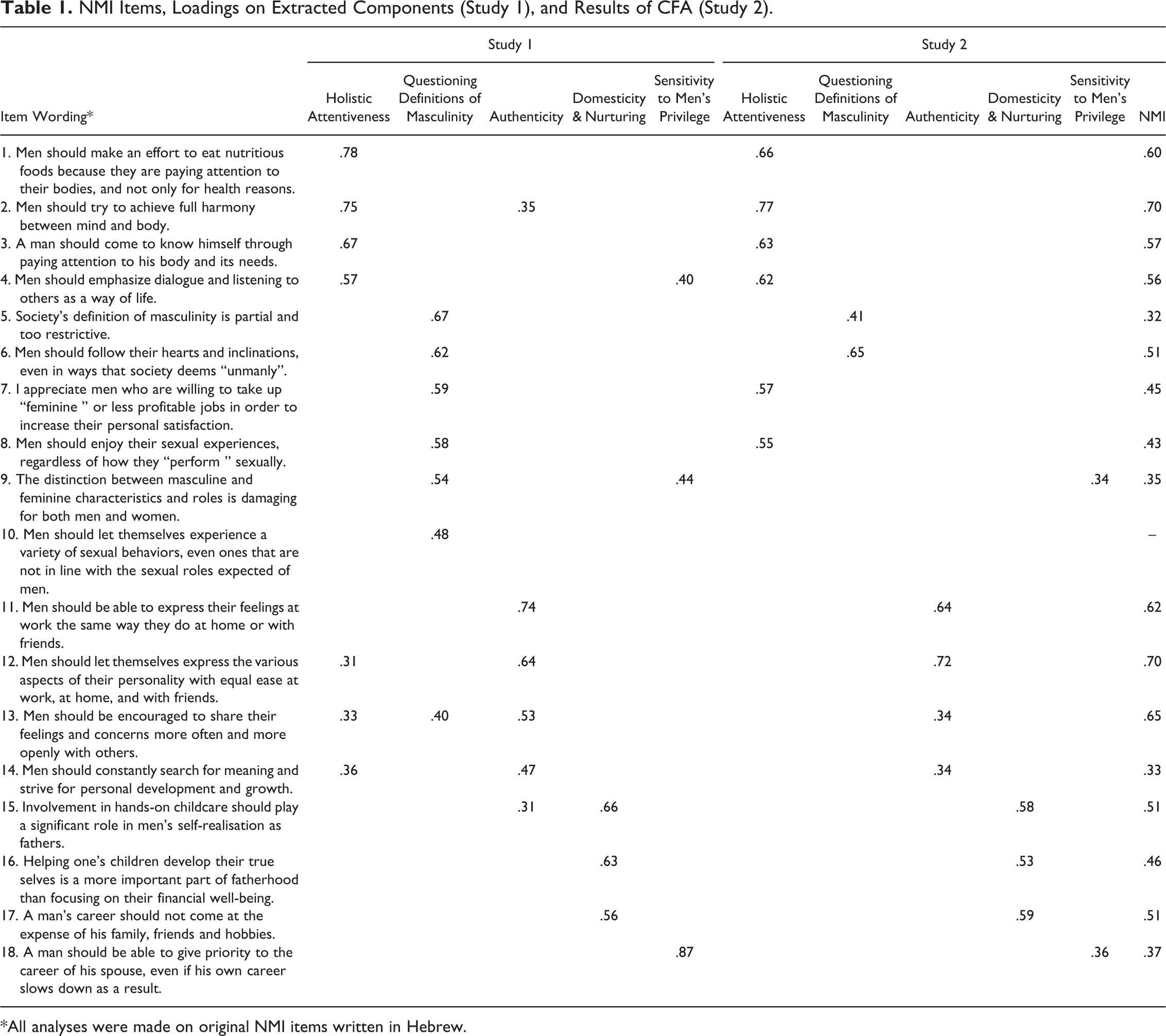
The complete pool of forty-six items was administered. A working version of the NMI was derived through a reiterative procedure utilizing principle component analyses (Varimax rotation). In this procedure, items were retained if they loaded substantially (over |0.4|) on any of the extracted components. As NMI was intended to form a unidimensional composite measure (as opposed to one comprised of various subscales), cross loading was not grounds for item deletion. Unexpectedly, the reversed items clustered into a single component regardless of their specific content. Because studies show that the introduction of reversed items creates method effects and reduce the unidimensionality of measures (DeVellis 2012; Herche and Engelland 1996), these items were dropped. This procedure resulted in an eighteen-item working version of the NMI, which included five extracted components with eigenvalue greater than 1 (accounting for 57 percent of item variance). Components were titled: holistic attentiveness (four items), questioning societal definitions of masculinity (six items), authenticity (four items), domesticity and nurturing (three items), and sensitivity to men’s privilege (one item; see Table 1). All subsequent analyses were conducted on the eighteen-item composite measure, which was internally consistent, α = .84 (reliability analyses not indicative of any further item deletions). Respondents indicate the extent they agreed with each statement using a 6-point Likert-type scale ranging from 1 (“completely disagree”) to 6 (“completely agree”).
NMI Items, Loadings on Extracted Components (Study 1), and Results of CFA (Study 2).
*All analyses were made on original NMI items written in Hebrew.
Indices of CM
Two related but distinct indices of CM were included. The first was Appearance-contingent Self-worth, a subscale of the Contingencies of Self-Worth Scale (Crocker et al. 2003). After the reliability analysis required deletion of one item, the remaining four items (e.g., “when I think I look attractive, I feel good about myself”) were averaged; α = .77. Responses were solicited on a 5-point Likert-type scale.
The second measure, Metrosexual Consumption, tapped behavioral manifestations of metrosexual lifestyle. This included two items adapted from Conseur, Hathcote, and Kim (2008), which asked respondents for the number of different toiletries (deodorants, hair products, skin lotions, etc.) they used daily and for the number of different pairs of shoes they wore in public during the past week. Respondents entered a numeric value for each item. Because this produced nonnormal distributions, the raw counts were recoded according to sample’s quintiles and then averaged; r = .22, p < .01.
Nontraditional masculine self-labels
Respondents were asked to indicate the degree that they define themselves as new man and metrosexual on a 1–5 scale, with higher scores indicating higher levels of self-labeling. Alternatively, respondents could indicate that they lacked familiarity with the term or its exact meaning.
Social desirability
Social desirability response bias was measured with a thirteen-item abbreviation of the Marlowe–Crowne Scale (Reynolds 1982). Respondents were asked to indicate if each of the statements were true or false (e.g., “no matter who I’m talking to, I’m always a good listener”; seven reversely coded items), α = .72.
New spirituality practices
Respondents indicated whether or not they “have actively participated in spiritual or New Age workshops or seminars.” Response options included “no” (n = 244), “yes, but not often” (n = 38), and “yes, often” (n = 11). Because of the small number of respondents in either affirmative options, these were pooled into a single category.
Demographic variables
Respondents indicated their age, religiosity, highest educational attainment, income level, sexual orientation, relationship status, and parental status. With the exception of age and income level, demographic variables were dummy coded into secular or religious; academic or nonacademic education; heterosexual or nonheterosexual (i.e., bisexual or gay) orientation; and single, coupled (whether married or in a committed relationship) with children, or coupled without children.
Results
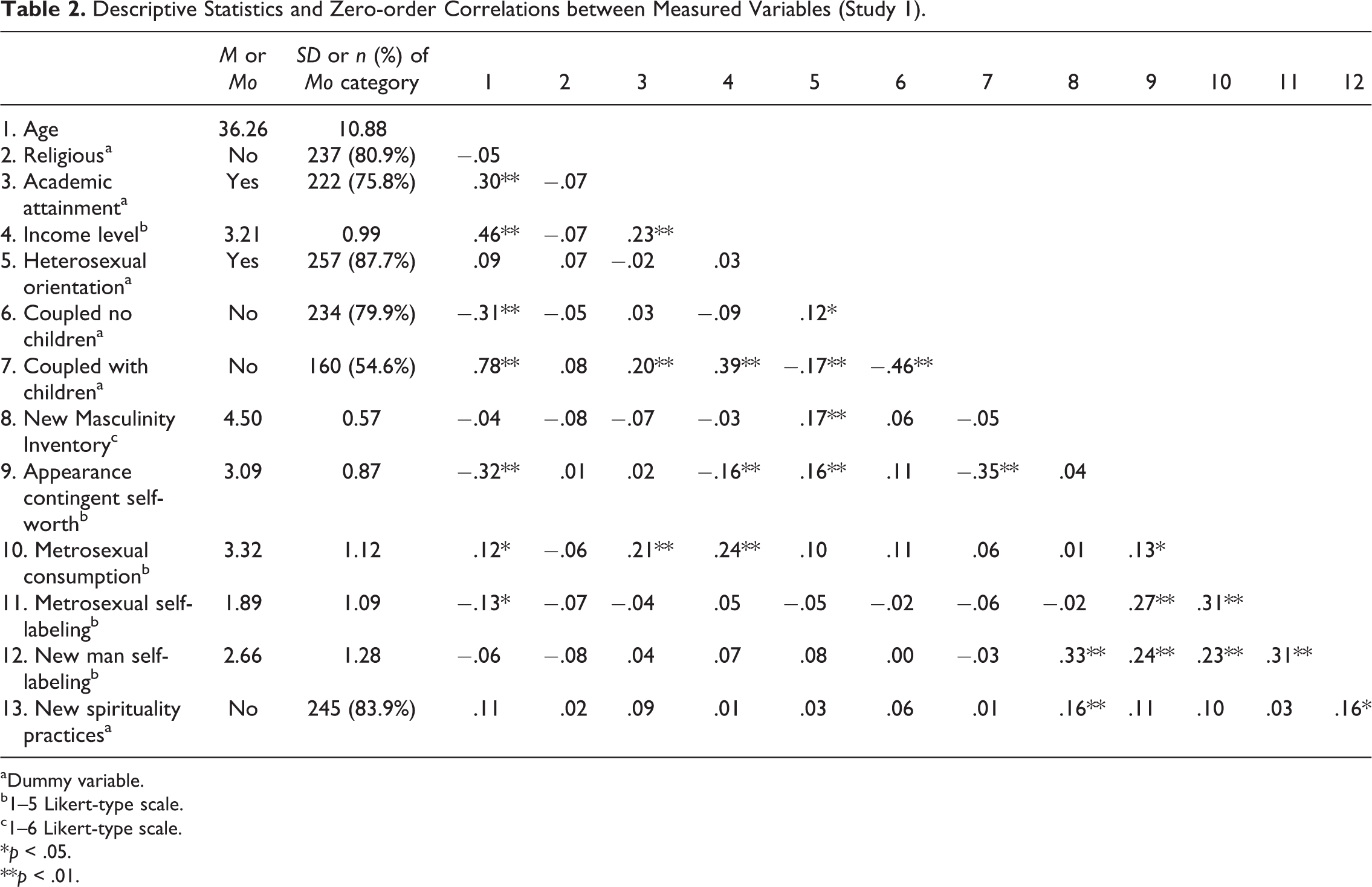
Descriptive statistics and zero-order correlations for all study variables appear in Table 2. In order to test Hypothesis 1, NMI scores were regressed on the demographic variables (age, religiosity, academic attainment, income level, heterosexuality, coupled without children, and coupled with children; block 1), social desirability (block 2), and the indices of consumer masculinity (Appearance-contingent Self-worth and Metrosexual Consumption; block 3). As expected, the third block (containing indices of consumer masculinity) did not improve upon the prediction of the preceding blocks, ΔR 2 = .01, F (2, 280) = 0.96, n.s. The second block containing social desirability scores, however, did contribute significantly to the overall model, R = .27, R 2 adj = .05, F (8, 284) = 2.81, p < .01. In addition to social desirability scores, heterosexuality emerged as an inverse predictor of NMI scores (see Table 3, after deletion of an outlier). 3
Descriptive Statistics and Zero-order Correlations between Measured Variables (Study 1).
aDummy variable.
b1–5 Likert-type scale.
c1–6 Likert-type scale.
*p < .05.
**p < .01.
Regression Model Predicting New Masculinity Inventory Scores (Study 1).

**p < .01.
Regarding the unexpected link between social desirability and NMI scores, an ad hoc analysis revealed that this link holds in the subsample of participants who had attained an academic degree (n = 221, r = .17, p < .05) but does not hold among participants who had not attained an academic degree (n = 71, r = .04, n.s.).
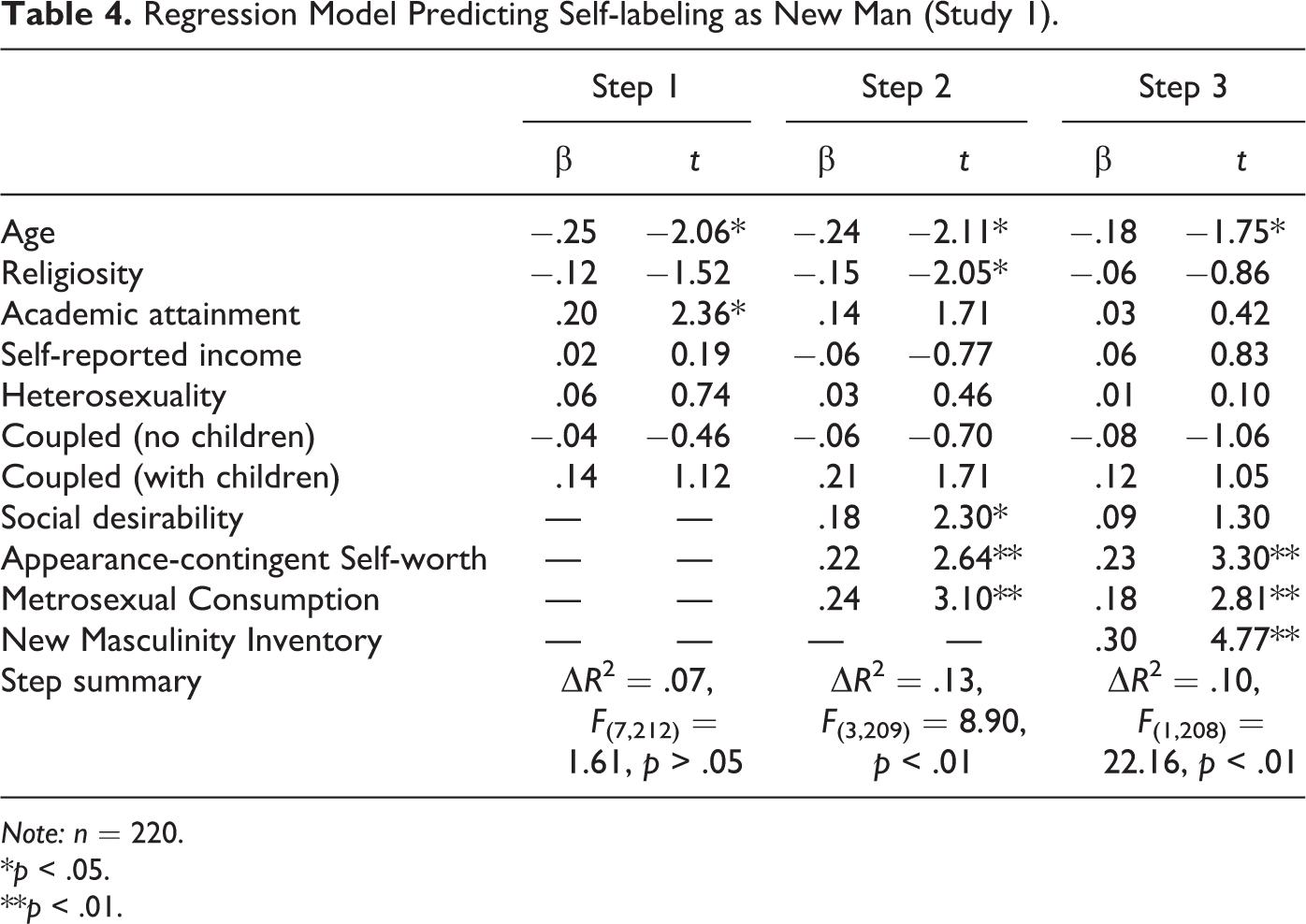
In order to test Hypothesis 2, self-labeling as new man was regressed on the demographic variables (age, religiosity, academic attainment, self-reported income, heterosexuality, coupled without children, and coupled with children; block 1), social desirability and indices of consumer masculinity (block 2), and NMI scores (block 3). The third block significantly improved upon the prediction of preceding blocks and contributed to a significant model, R = .46, R 2 adj = .18, F (10, 209) = 5.72, p < .01 (see Table 4). As expected, greater self-labeling as a new man was associated with higher NMI scores as well as with higher Appearance-contingent Self-worth and Metrosexual Consumption.
Regression Model Predicting Self-labeling as New Man (Study 1).
Note: n = 220.
*p < .05.
**p < .01.
Hypothesis 3 employed the same hierarchical regression model as Hypothesis 2 to predict self-labeling as metrosexual. As expected, the third block, which contained the NMI scores, did not improve upon the prediction of preceding blocks, ΔR 2 < .01, F (1, 221) = 0.74, n.s. The model excluding this block was significant, R = .48, R 2 adj = .19, F (10, 232) = 5.49, p < .01 (after deletion of an outlier, see Table 5). Metrosexual self-labeling was thus not uniquely predicted by NMI scores but was associated with higher Appearance-contingent Self-worth and Metrosexual Consumption, beyond contributions made by demographic variables.
Regression Model Predicting Self-labeling as Metrosexual (Study 1).

Note: n = 243.
*p < .05.
**p < .01.
Finally, a binary logistic regression was used to test Hypothesis 4. The same model structure used to test Hypotheses 2 and 3 was employed here to predict active participation in new spirituality workshops (n = 49). This model become significant, R 2 Nagelkerke = .16, χ2 (11) = 29.58, p < .01, only after inclusion of the third block, χ2 (1) = 8.19, p < .01. In addition to NMI scores (B = 1.06, SE = .34, p < .01), Appearance-contingent Self-worth (B = 0.46, SE = .23, p < .05) and older age (B = 0.08, SE = .03, p < .01) predicted greater likelihood for such participation.
Discussion
This study yielded preliminary support for the proposed conceptualization of NM and its measurement with NMI. This working version of the NMI included a balanced account of the initial themes identified as pertinent to the theoretical conceptualization of NM ideology, while constituting an internally consistent measure. NMI scores demonstrated discriminant validity vis-à-vis behavioral and attitudinal indices of CM as well as with self-labeling as metrosexual. At the same time, they converged with participants’ self-labeling as new man and with active participation in meetings associated with new spirituality.
These results additionally demonstrate the ambiguities of NM terminology in the lay public: CM indices were linked both with new man self-labeling and with metrosexual self-labeling (see Tables 4 and 5). We return to this point in the general discussion.
In this sample, NMI scores were weakly, but significantly, associated with social desirability. This effect was limited to the (substantive) subsample of those who hold an academic degree. It seems that those who have received academic education perceive NM ideology to be socially desirable, even if in actuality they do not endorse it more than others, as academic attainment per se was not predictive of NMI scores. This conclusion is consistent with observations that the discourse of NM has become a privileged, socially legitimate style of upper-middle-class sensibility (Messner 1993; Illouz 2008).
Study 2
The goals of Study 2 were to confirm the internal structure of the NMI and to further assess its discriminant and convergent validity. We also opted to test the measure on a more representative sample of Jewish Israeli men and explore potential associations with demographic variables.
Given that our main rationale for studying NM ideology was to explore it as an alternative to the well-studied construct of TM ideology, the NMI was expected to demonstrate discriminant validity vis-à-vis measures of TM ideology. Because NM is not reducible to a negation of TM, we predicted higher NMI scores to be only weakly associated with lower scores in measures of TM.
In terms of convergent validity, and supplementing the previously tested associations with new spirituality and self-labeling as new man, we explored in Study 2 the convergence of NMI scores with rejection of overt and covert forms of sexism (Swim et al. 1995). The former endorses negative stereotypes and unequal treatment of women, whereas the latter reflects a more specific rejection of feminist attitudes (Campbell, Schellenberg, and Senn 1997). While men increasingly reject blatant prejudice against women, they may also believe that discrimination of women is a thing of the past, reflecting a covert, modern form of sexism that is antagonistic toward women’s continued demands for equality and advancement (Swim et al. 1995). Because men endorsing NM ideology are likely to hold more gender-egalitarian views, we expect NMI scores to be negatively associated with both indices of sexism. Studies further suggest that among men, endorsement of gender-egalitarian attitudes is robustly associated with self-identification as feminist (McCabe 2005). Thus, in addition to the new man and metrosexual labels, we probed for respondents’ self-labeling as feminist.
The following hypotheses were expected to emerge while controlling for demographic variables.
Methods
Participants
Five-hundred and forty-six participants were recruited from an internet panel managed by iPanel, Israel’s largest “opt-in” Internet survey institute using random stratified sampling (estimated at 100,000 members at the time of study; iPanel n.d.). Panel members voluntarily sign up to receive e-mail invitations to participate in online surveys, for which they are offered compensation. Members are filtered for nonreliable biased responses such as social desirability. Male panel members over the age of twenty-one received an e-mail invitation to participate in the online survey. Of these, forty-five participants were excluded for providing incomplete data alongside additional eighteen who demonstrated response invariance, leaving a final sample of 483 (88.5 percent of the initial sample). The final sample was for the most part secular (63.8 percent), of diverse age (M = 44.73, SD = 14.40), and half of the men have attained an academic degree (49.9 percent). Participants were predominantly heterosexual (93.6 percent) and a majority were married or in a committed relationship, either with children (67.1 percent) or without children (8.5 percent). These characteristics are more representative of the general population of Jewish–Israeli men than the sample in Study 1.
Measures and procedures
The questionnaire was administered in Hebrew and took up to thirty minutes to complete. Order of the first three measures was counterbalanced such that half of the sample responded first to the NMI and the other half responded first to the two other measures.
NMI
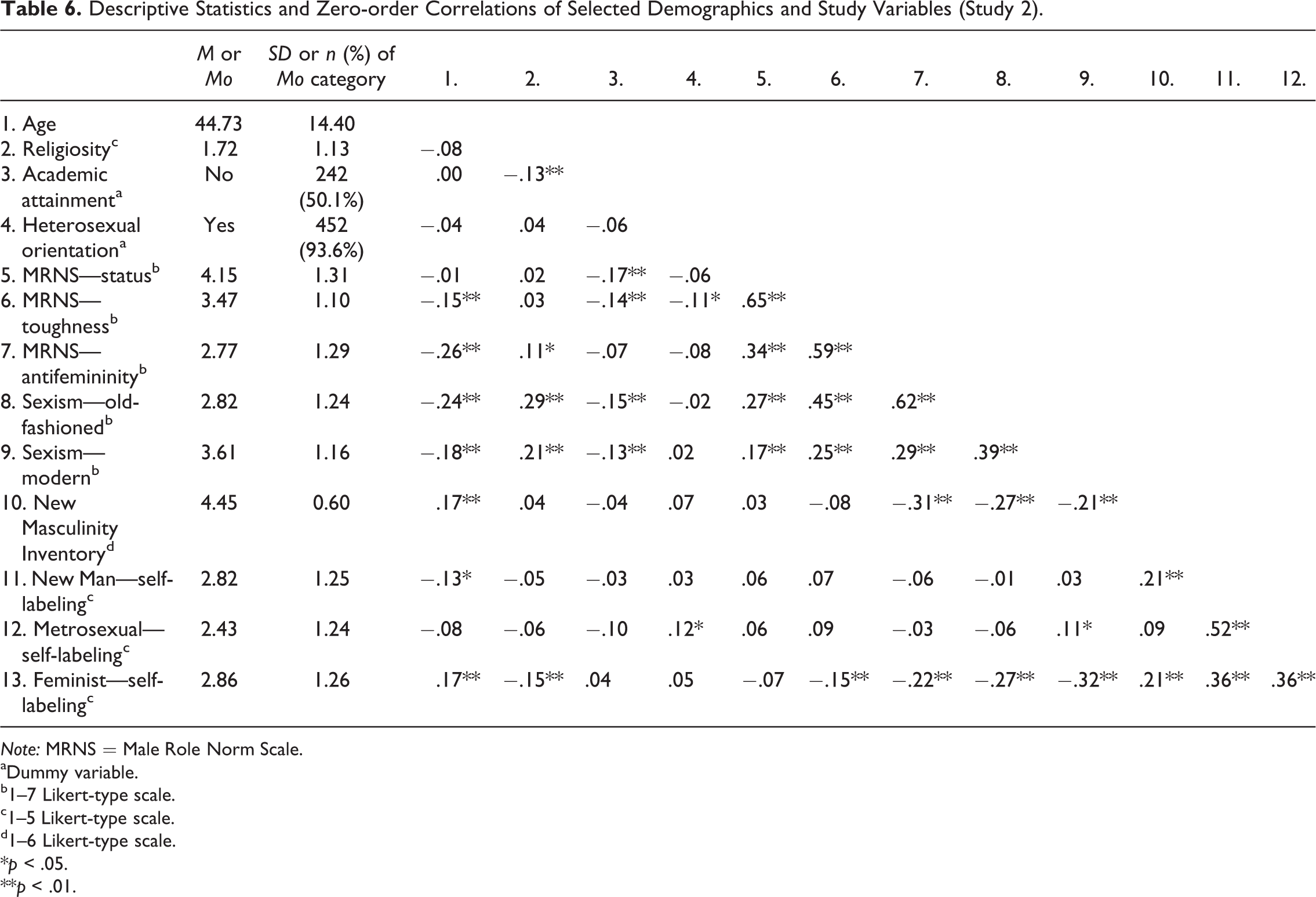
Before confirmatory factor analysis (CFA) was employed to test the measurement model delineated in Study 1, one item (#10, see Table 1) was excluded. This item exhibited a nonnormal distribution, Shapiro–Wilks’s W = .93, df = 483, p < .01, and failed to achieve satisfactory average interitem correlation (r = .09). The remaining seventeen items were submitted to CFA with items #4 and #9 (which cross loaded in Study 1) were first treated as indicators of both latent variables and then trimmed according to paths’ significance. This resulted in item #9 being reassigned to sensitivity to men’s privilege, while item #4 remained an indicator of holistic attentiveness. The final measurement model fitted these data well, χ2 (86) = 175.95, p < .01; SRMR = .04, CFI = .96, RMSEA = .05, with all the expected paths reaching significance. This model specified that the NMI loaded the five endogenous latent variables (representing components identified in Study 1) and through them, all individual items. While the overall score on the scale was high (see Table 6), there was no indication of a nonnormal distribution or ceiling effect (skewness = −.43; kurtosis = −.80). Internal consistency for the final seventeen-item version of the NMI was α = .86, with no further deletions indicated. Details on CFA procedure, standardized regression weights, and total effects (equivalent to loading on the overall NMI latent variable) are presented in Table 1 (see graphic depiction in Appendix A).
Descriptive Statistics and Zero-order Correlations of Selected Demographics and Study Variables (Study 2).
Note: MRNS = Male Role Norm Scale.
aDummy variable.
b1–7 Likert-type scale.
c1–5 Likert-type scale.
d1–6 Likert-type scale.
*p < .05.
**p < .01.
MRNS
To assess endorsement of TM ideology, we employed the MRNS (Thompson and Pleck 1986). A Hebrew version was adapted from a previous study with the MRNS administrated on a sample of Israeli men (After 2005). To improve content validity, the scale was translated and back translated by two proficient bilinguals and items were revised by the authors accordingly. The MRNS includes three distinct subscales: Status (six items, e.g., “success in his work has to be man’s central goal in this life”; α = .84), Toughness (after one item dropped during reliability analysis twelve items remained, e.g., “a real man enjoys a bit of danger now and then”; α = .87), and Antifemininity (seven items, e.g., “it bothers me when a man does something that I consider feminine”; α = .86). Ratings are made on a 7-point Likert-type scale with higher scores indicating greater endorsement of TM.
Indices of sexism
To assess overt and covert forms of sexism, we employed the Old-fashioned and Modern Sexism Scales (Swim et al. 1995). Old-fashioned sexism refers to explicit endorsement of an unequal treatment of women and negative stereotypes about women’s competence (five items, e.g., “women are generally not as smart as men;” α = .73). Modern sexism denies that gender discrimination still exists and rejects feminist demands for women advancement (eight items, e.g., “it is rare to see women treated in a sexist manner on television;” α = .82). Ratings are made on a 7-point Likert-type scale with higher scores indicating greater sexism.
Nontraditional masculine self-labels
Respondents were asked to indicate the degree that they define themselves as new man, metrosexual, and “feminist” on a 1–5 scale, with higher scores indicating higher levels of self-labeling. Alternatively, respondents could indicate that they lacked familiarity with the term or its exact meaning.
Demographic variables
The same probes as in Study 1 were used. Given the relative heterogeneity of the current sample, religiosity was measured on a 1–5 scale (secular to orthodox) and another family status dummy variable was included (single with children). All other variables were coded in the same way as in Study 1.
Results
Descriptive statistics and zero-order correlations for all study variables appear in Table 6. In order to test Hypothesis 1, NMI scores were regressed on the demographic variables (age, religiosity, academic attainment, income level, heterosexuality, coupled without children, coupled with children, and single with children; block 1) and indices of TM ideology and sexism (MRNS subscales, Old-fashioned and Modern Sexism; block 2). 4 The second block improved the prediction offered by the first block and contributed to a significant model, R = .45, R 2 adj = .18, F (13, 463) = 9.06, p < .01 (after deletion of six outliers; see Table 7). MRNS’s Antifemininity subscale and Modern Sexism emerged as significant inverse predictors of NMI scores (see Table 7). Higher NMI scores were additionally predicted by religiosity when the second block was entered.
Regression Model Predicting New Masculinity Inventory (Study 2).

Note: MRNS = Male Role Norm Scale.
*p < .05.
**p < .01.
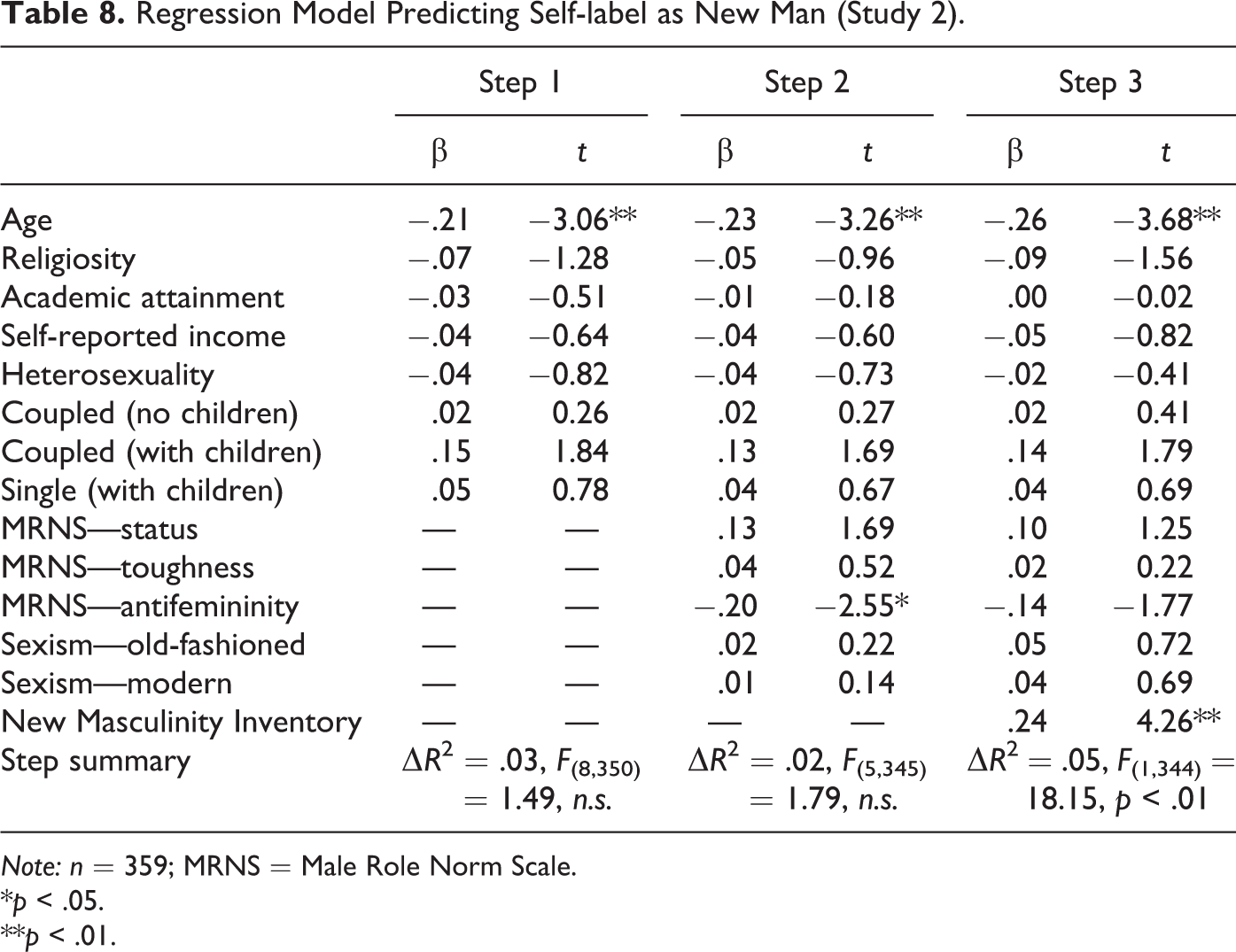
In order to test Hypotheses 2, 3, and 4, self-labeling as new man, metrosexual, and feminist were regressed on the demographic variables (age, religiosity, academic attainment, income level, heterosexuality, coupled without children, coupled with children, and single with children; block 1), indices of TM ideology and sexism (MRNS subscales, Old-fashioned and Modern Sexism; block 2), and NMI scores (block 3). Replicating the findings from Study 1, and in accordance with Hypothesis 2, self-labeling as new man was uniquely predicted by NMI scores. Inclusion of the third block contributed to a significant model, R = .32, R 2 adj = .07, F (14, 344) = 2.87, p < .01, where greater self-labeling was associated with higher NMI scores (see Table 8). The meaning of the new man label was not clear to a sizable minority of participants (n = 124; 25.7 percent; see Table 8).
Regression Model Predicting Self-label as New Man (Study 2).
Note: n = 359; MRNS = Male Role Norm Scale.
*p < .05.
**p < .01.
Further replicating the findings from Study 1, and in accordance with Hypothesis 3, self-labeling as metrosexual was not uniquely predicted by NMI scores, as the third block did not improve prediction, ΔR 2 < .01, F (1, 336) = 1.71, n.s. The model excluding this block was significant, R = .30, R 2 adj = .06, F (13, 337) = 2.57, p < .01 (see Table 9). Similarly to the new man label, the meaning of this label was not clear to a sizable minority of participants (n = 132; 27.3 percent).
Regression Model Predicting Self-label as Metrosexual (Study 2).

Note: n = 351; MRNS = Male Role Norm Scale.
*p < .05.
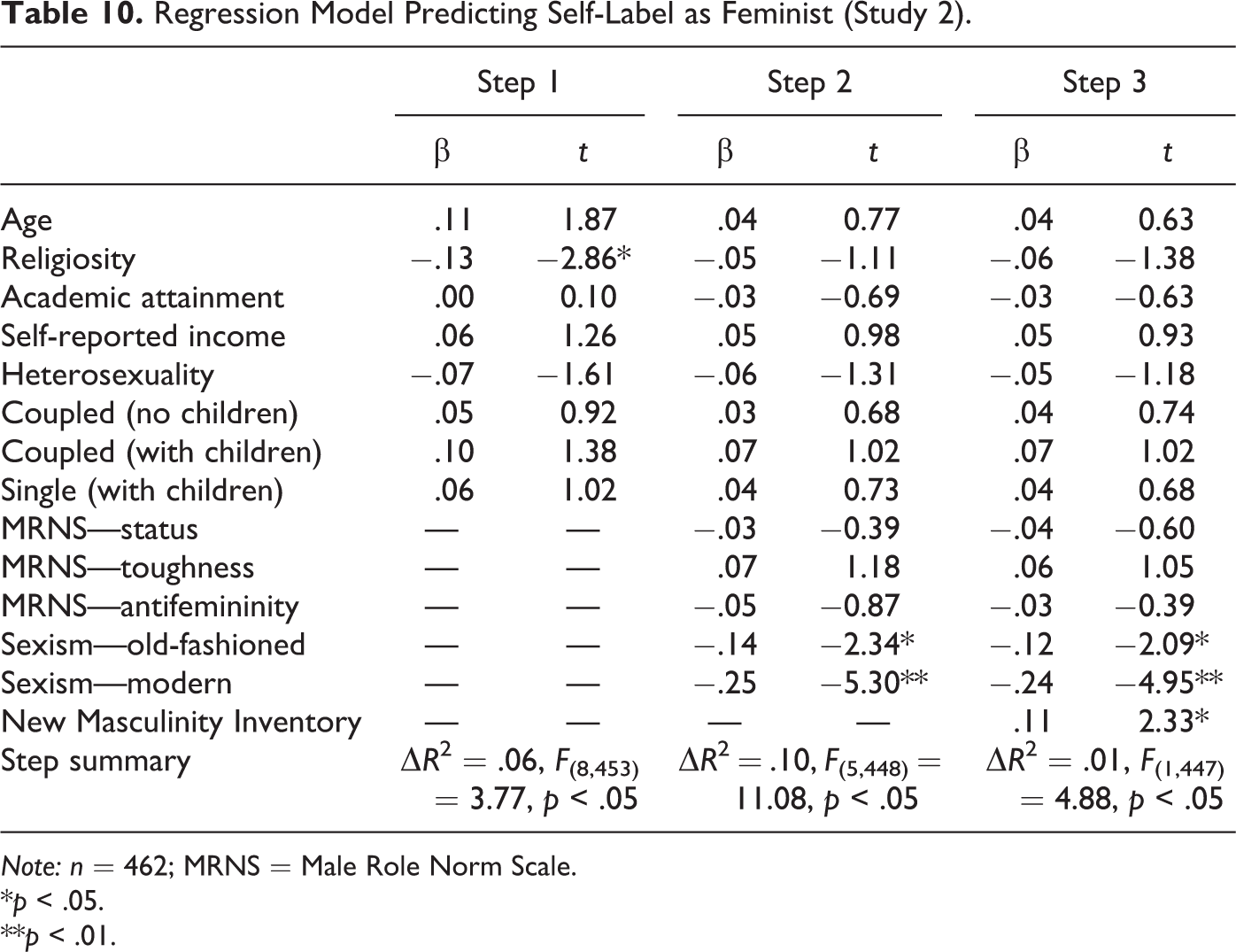
Finally, in accordance with Hypothesis 4, self-labeling as feminist was uniquely predicted by NMI scores. The third block contributed to a significant model, R = .42, R 2 adj = .15, F (14, 447) = 6.75, p < .01 (after exclusion of a single outlier and those who reported not being familiar with the concept, n = 20; 4.1 percent; see Table 10). Greater self-labeling as feminist was associated with higher NMI scores above and beyond the inverse contributions of Old-fashioned and Modern Sexism (see Table 10). These findings add to NMI’s convergent validity with respect to antisexist attitudes, as tested in Hypothesis 1.
Regression Model Predicting Self-Label as Feminist (Study 2).
Note: n = 462; MRNS = Male Role Norm Scale.
*p < .05.
**p < .01.
Discussion
The results of Study 2 generally confirmed the internal structure of the NMI and expanded on its discriminant and convergent validity. After omitting one item and resolving cross loadings, the final, seventeen-item version offers a well-balanced representation of our theoretical conceptualization of NM ideology, while retaining the five components that emerged in Study 1: holistic attentiveness (four items; α = .78), authenticity (four items; α = .72), questioning societal definitions of masculinity (four items; α = .69), domesticity and nurturing (three items; α = .59), and sensitivity to men’s privilege (two item; α = .18). Beyond the replication of discriminant findings with respect to self-labeling as metrosexual, Study 2 demonstrated the discriminant validity of the NMI with respect to measures of TM ideology. Higher NMI scores were predicted by lower levels of the MRNS Antifemininity subscale but at the same time were not predicted by the MRNS Toughness and Status subscales. In line with our understanding of NM ideology as an alternative to TM ideology, which does not entail its outright rejection, the relatively little common variance shared by the two measures offer clear evidence for the distinct content domain of the NMI, one that does not simply reflect negation of dominant traditional masculine norms.
Study 2 not only replicated NMI’s convergent validity with self-labeling as new man but also found that NMI scores converged with self-labeling as feminist, suggesting that NM ideology is more strongly associated with feminist attitudes than previously argued (Connell 1995; Messner 1993). This is especially noteworthy, as NMI’s contribution to feminist self-identification went above and beyond that of direct measures of antifeminist, sexist attitudes (see Table 8). Furthermore, while NMI scores correlated negatively with measures of both Old-fashioned and Modern Sexism (see Table 6), only modern sexism was found to be uniquely predictive of lower NMI scores (see Table 7). In contrast, modern sexism was found to be uniquely predictive of higher self-labeling as metrosexual (see Table 8), suggesting that while men who identify as metrosexual may avoid blatant discrimination, they are still antagonistic toward women’s demands for equality. Taken together, these findings indicate that NM ideology is uniquely associated with feminist attitudes and as such provide another support for a masculinity ideology differentiable from both consumer and traditional masculinities.
General Discussion
Despite growing scholarly awareness to the ideological nature of masculinity, and thus to the potential multiplicity of such ideologies, quantitative researchers shy away from investigating masculinity ideologies beyond TM. In line with Sinn’s (1997, 133) passing comment almost two decades ago, the field still lacks “alternative constellations of factors upon which individuals might base their conception of masculinity.” This project addressed this caveat by introducing a model for measuring one particular alternative. We demonstrated that some of the social standards expected of men in postindustrial societies have crystallized into a set of beliefs associated with therapeutic NM, a distinctive ideology that is not reducible simply to a negation of TM ideology. Rather, as a discrete worldview with its own content matter that developed in part in response to TM and challenges its hegemony, this ideology should be evaluated systematically through a separate measure.
As our point of departure, we suggested that postindustrial trends associated with heightened self-expression spurred two related but distinct ideological responses to TM. The first is NM embedded within therapeutic discourse associated with authenticity and holistic self-awareness. The second is CM ideology associated with metrosexual lifestyle choices and preoccupation with image and appearance concerns (Rosenmann and Kaplan 2014). A theoretical construct of NM was then formalized from in-depth interviews and existing literature and operationalized into items of the NMI, addressing themes of authenticity and self-realization across life spheres and holistic attentiveness to the self, body, and intimate other, alongside a questioning of established gendered restrictions. Finally, structural and external validity of the NMI were tested in two quantitative samples that demonstrated discriminant validity with respect to TM and CM ideologies. Higher NMI scores were only weakly associated with lower measures of TM and hence are not reducible to a negation of traditional masculine norms; nor was the NMI associated with indices of CM.
Whereas patterns of response to measures of NM and CM ideologies clearly differentiated between these constructs, lay perceptions tended to confound the corresponding labels of new man and metrosexual, as is evident by their substantial correlations (see Tables 2 and 6). In this, our findings echo the inconsistencies in public rhetoric of NM, which straddles between therapeutic and consumerist contexts. This further attests to the need for measures such as the NMI in order to identify specific attitudes associated with distinct alternative to TM, against this backdrop of obfuscating terminology surrounding contemporary shifts in values of masculinity.
There has been much debate as to whether changes in masculinity, in therapeutic or consumerist contexts, lead to more gender-egalitarian views. Scholars have argued that under the facades of emotional self-expression and refined modes of consumption, men’s privilege and dominance have remained largely intact (Connell 1995; Messner 1993; Shugart 2008; Illouz 2008). Our findings, however, suggest a clear differentiation between NM and CM ideology in this respect, as the former disagrees with sexist and antifeminist attitudes, whereas the latter appears to be antagonistic toward women’s demands for equality. In addition, as NMI scores remained stable across socioeconomic status even in the more representative sample of Study 2, it appears that the therapeutic discourse underlying NM ideology is quite pervasive and is not restricted to the upper echelons of society, as often assumed (Messner 1993; Illouz 2008).
It is also important to note that NMI scores were associated with feminist self-identification even though none of the NMI items explicitly address feminist or gender-egalitarian attitudes. This predictive power of NMI goes above and beyond that of direct measures of sexist attitudes. Because feminist men are important advocates for gender equality, employing the NMI can contribute to the much needed explication of the complex associations between a variety of masculinity ideologies, gender-egalitarian attitudes, men’s life experiences, and their self-identification as feminist (Anderson 2009).
Finally, only a few associations were found between NMI scores and demographic variables and those failed to emerge consistently across samples. In Study 1, nonheterosexual orientation was found to predict higher NMI scores. This may coincide with studies that report lower endorsement of traditional masculine ideology among gay men compared to heterosexual men (Wade and Donis 2007). Perhaps more surprisingly, in Study 2 religiosity predicted higher NMI scores. This opens up new empirical questions as to whether the quest for holistic spirituality over and against material values, as advocated by New Age strands within the men’s movement (Krondorfer and Hunt 2012; Magnuson 2005), strikes a chord among some religious men.
Patterns regarding age were also inconsistent. While in Study 1, age was not predictive of NMI scores, in the more heterogeneous sample of Study 2, older participants tended to score higher on the NMI (see Table 6). However, this correlation disappeared once indices of sexism and TM ideology were entered into the regression model (see step 1 vs. step 2; Table 7). Additionally, younger age was generally predictive of self-labeling as new man and as metrosexual. 5 In other words, although younger men more readily identify themselves with the trendy labels associated with new manhood or metrosexuality, they are not more inclined, or even less inclined, to endorse NM ideology. Possibly, two opposing trajectories are at play here: while younger cohorts maybe more open to novel ideas and labels of masculinity, developmental research suggests that teenagers and young adults are under social pressure to endorse traditional masculine norms, which partly mitigates over time (Marcell et al. 2011). This appears to coincide with the pattern found in Study 2, where TM ideology mediated the correlation between older age and higher NMI scores.
Several limitations of this study should be noted. First, it is based on samples of Jewish Israeli men, and further research is required to validate the generalizability of the NMI to other globalized Western contexts. This concern is somewhat mitigated by the agreement regarding the content of NM found between our Israeli interviewees and the available, mostly American, literature. Furthermore, messages regarding the proper (i.e., cosmopolitan Westernized) construction of gender in the social order are a prominent feature of the emerging global culture (Inglehart and Norris 2003). In highly globalized contexts, such as that of Jewish Israeli society, these messages are well heeded, as they help define the local group as progressive and contemporary (Rosenmann 2015). It is therefore reasonable to assume that NM ideology has significant “etic” components that are common across cultural groups within Western societies, as have been found for TM ideology (Doss and Hopkins 1998).
Second, in Study 1 social desirability emerged as predictive of NMI scores among a subsample of participants who have attained an academic degree. Although participants in Study 2 were prefiltered for response biases, no equivalent measure of social desirability was employed and further research is needed to address this matter. Lastly, whereas the discriminant validity of the NMI with respect to TM was demonstrated based on a conceptually parallel measure of masculinity ideology, such ideological measure was not available for CM. Instead, we opted to use proxy behavioral and trait indices of CM, which are arguably less methodologically compatible with NMI. Future studies should expand this preliminary attempt to address CM ideology by providing a more comprehensive measure of this ideology.
In conclusion, the NMI opens new avenues for studying societal changes in masculinity ideologies. It can be employed to various research questions such as generational trends, agendas of social movements (men’s liberation, feminist, and ecological), work and family interface, organizational cultures, lifestyle choices, interpersonal relations, or sexuality. Whereas a rich body of literature has studied the (predominantly dysfunctional) outcomes associated with TM, we lack equivalent tools to explore the behavioral and social implications associated with the endorsement of therapeutic NM as well as other understudied, alternative masculinity ideologies. As noted by Sinn (1997, 133), better understanding of these contemporary choices might also help men “develop more adaptive ideas about what the admonishment ‘Be a man!’ means to them.”
Footnotes
Acknowledgment
The findings reported in this study are adapted from portions of a PhD thesis written by Sara Shuhendler and a master’s thesis written by Shani Almog, both submitted to Bar Ilan University, Israel. We wish to thank Shani Almog, Or Anabi, Sylvie Fogiel-Bijaoui, Ruth Gaunt, Liat Kulik, Avigail Moor, Dalia Moore, Shira Ofer, Ruth Sharabany, Rachel Pasternak, and participants at the graduate workshop on masculinity and therapeutic discourse at Bar Ilan University for their valuable comments and feedback at different stages of this project. We are also grateful to Michael Kimmel and the anonymous reviewers for their constructive comments on the manuscript.
Appendix A
Declaration of Conflicting Interests
The author(s) declared no potential conflicts of interest with respect to the research, authorship, and/or publication of this article.
Funding
The author(s) received no financial support for the research, authorship, and/or publication of this article.