



Abstract
The criminalization of poverty, the process in which recipients of social security benefits are construed as frauds, is a well-documented phenomenon. Two aspects of this process are the use of stereotypes as a tool in fraud accusations and the targeting of marginalized populations. In this article, I wish to expand the gendered discussion of this phenomenon to men by examining the process of the construction of Israeli fathers wishing to take parental leave as welfare frauds. I will claim that this process is based on gendered assumptions that deny the possibility of fathers wishing to care for their children. The program that allows fathers to share parental leave experiences a high reported rate of fraud by fathers claiming parental leave benefits. However, analysis shows that the evidence does not support these reports and that claims on fraud and abuse are the result of a tendentious interpretation of the data by bureaucrats. This tendentiousness is based, I argue, on implicit assumptions about the nature of men. As this case shows, criminalization of benefit recipients can be targeted at nonmarginalized or even privileged groups. This sheds new light both on the criminalization process and on the workings of the gendered power structure.
The Criminalization of Poverty
The process in which personal ailments of citizens come to be understood as social problems, and the way they are construed as such problems, has received ample attention in the literature. Focusing on the latter, even after a certain phenomenon has been brought to the attention of the public and of policymakers, it can be perceived from multiple perspectives, each having different—and many times contradictory—implications as for the policy steps required for contending with this problem. Thus, players in the policymaking field often employ power in a struggle to advance the perception that best promotes their interests (Kingdon 2014; Steensland 2006). The framing of certain practices as “welfare fraud” is a central arena in which such struggles take place.
The subject of welfare fraud is central to the understanding of social policy on many aspects, such as the ways in which discourse on welfare fraud is used to delegitimize benefit recipients and through this to delegitimize the benefit system itself. True to the formula “from welfare fraud to welfare as fraud” (Chunn and Gavigan 2006, p. 217), policymakers, public opinion makers, and welfare system bureaucrats act on two fronts simultaneously to undermine welfare programs: the criminalization of poverty on the one hand and discrediting the entire welfare system through a discursive focus on welfare fraud.
On the one hand, the welfare system is designed in ways that criminalize common behaviors that were previously deemed normative—either by redesigning welfare legislation or by reinterpreting current legislation and deepening its enforcement. This leads to high reported rates of benefits abuse and fraud, and those are then seen as the proof of the criminal nature of benefit recipients, thus serving to justify further benefit cuts and further measures to guard against fraud. This mechanism was thoroughly described in the context of the 1990’s American welfare reform. The Personal Responsibility and Work Opportunity Reconciliation Act (PRWORA) had, simultaneously, created a complex set of rules which benefit recipients found hard to understand, let alone follow—and a mechanism for monitoring and enforcing these rules and punishing transgressors (Gillespie 2012). The outcome was dubbed “the criminalization of poverty”—instead of being an issue of public support, benefits have increasingly become associated with fraud and criminality.
According to Gustafson (2009, 646), the criminalization of poverty is “a web of state policies and practices related to welfare.” She distinguishes between three kinds of criminalization. The first includes practices that result in extended surveillance and regulation of people in poverty through practices that are part of the welfare system and are part of the welfare eligibility requirements—leading to increasing stigmatization of the poor.
The second is the assumption of latent criminality—the assumption that people in poverty have a tendency for crime and immoral behavior. This, in turn, leads to the design of programs that focus more and more on preventing fraud and detecting fraudsters and less and less on providing welfare.
The third type of criminalization includes a growing intersection and collaboration between the justice and welfare systems. The goals of these two systems regarding the poor become more and more overlapping, which, in turn, leads to collaborations between these two distinct branches of the state (Gustafson 2009, 2011).
On the other side of the criminalization process, public discourse on the subject of welfare fraud is commonly used to discredit the benefit system. When discussing these topics, politicians and media commentators focus on the issues of fraud and on the alleged misconduct of benefit recipients, often focusing on individual cases of fraud while implying they are the representative of the entire benefit recipient population. The depiction of the entire recipient population as fraudulent is then used to discredit the benefit system itself and to promote proposals for its reduction or limitation (Lundström 2013).
Criminalization between Class, Race, and Gender
The process of criminalization is not targeted at all groups of welfare recipients equally. This process intersects with other societal processes relating to groups suffering from exclusion and marginalization—most commonly based on race and gender—basing the claims of fraud on stereotypes relating to these groups. As Ann Cammett (2014, 242) aptly puts it, “[M]ajoritarian consensus about social norms and how we should address problems like entrenched poverty is informed by longstanding biases about race, class, gender, and entitlement.”
Again, this process has been well documented in the American case. The process of delegitimization of welfare recipients which preceded PRWORA (discussed above) relied on many gendered and racialized metaphors, relating to women, to single mothers, to Afro-Americans, and specifically to Afro-American single mothers (and to the fathers of their children, discussed below; Cammett 2014).
The metaphor of the Welfare Queen is a powerful illustration of this dynamic. This term, relating to Afro-American single mothers, has been widely used to attack the welfare system from the end of the 1970s onward. The Welfare Queen is depicted as opposing common norms on both gendered and economic levels. Lacking a male breadwinner, she is seen as deviating from the “normative” family structure; living outside the workforce (by choice, presumably), she is seen as deviating from expected economic behavior (Hancock 2004). As Hancock notes, although not all references to welfare queens mention their race, they are nonetheless widely understood to be Afro-American—as these deviations are based on stereotypes against black people, which date back to the slavery era, relating to their laziness on the one hand and to their lustiness on the other.
The process of the criminalization of poverty stands in stark contrast to the criminalization of white-collar crime. The main difference arises from the social positions of white-collar criminals and welfare recipients. Unlike the latter, those engaged in activities that may be defined as white-collar crimes belong to the elite and hold substantial societal power. Therefore, their ability to influence the definition of crime and the social outcomes of activity defined as criminal is much more significant. As a result, the criminalization process of white-collar crime is much more limited, and the consequences for those defined as criminals are minor. White-collar crimes are often seen as minor offenses, carrying minimal social stigma, if any (Sutherland 1940 ; Mackenzie 2006).
Friedrichs (2010) attributes this difference to neoliberalism, which relates very differently to white-collar crime and to poverty-related crimes. While, as shown above, the process of the criminalization of poverty has intensified under neoliberalism, white-collar crime has seen a trend in the opposite direction. Deregulation processes, common in the United States and elsewhere since the 1980s, have decriminalized many activities that were considered white-collar crime until that period.
The Process of Criminalization in Israel
The focus of the current study is the Israeli parental leave program for fathers. Examining criminalization in Israel, we can see patterns similar (although not identical) to the American case. The process of criminalization climaxed during the 2003 economic reforms, led by the then finance minister, and later prime minister, Benjamin Netanyahu. These reforms included massive cuts to safety net programs and specifically to programs aimed at single mothers. In the ensuing public debate, amidst vocal protests by single mothers, proponents of the cuts justified them using stereotypes similar to those applied to the Welfare Queen—central to them those of laziness, undeservingness, and dependence (Ajzenstadt 2009; Herbst 2013).
The process of using existing stereotypes as a tool in the criminalization of welfare recipients can be seen in Israel in two additional notable cases—the criminalization of Palestinians with Israeli citizenship and of Ultra-Orthodox Jews. Stereotypes against these populations are used mainly (but not exclusively) in the struggle against child allowances (Doron 2010).
The pattern that emerges shows that the process of criminalization of welfare recipients, used to discredit and delegitimize the benefit system, has two common characteristics: (a) the criminalization is based on existing biases, stereotypes, and metaphors and (b) the criminalization targets marginalized groups, suffering from exclusion on other levels as well.
However, one may ask if these two aspects must be coupled or can they appear separately in various contexts. To answer this question, I turn to the field of critical studies of men and masculinities.
One of the basic tenets of this field is challenging the classical assumptions regarding the structure of power relations, rejecting the classical direct gender hierarchy perspective, and adopting the structural inequality perspective. Rather than assume that because men are privileged they hold the power in society, the assumption here is that power is part of the structure of society and is directed at women and men at the same time (albeit not equally, and with differing consequences; Holter 2005).
One of the main ways in which men are subject to gendered mechanisms of power is the punishing of men deviating from normative, or hegemonic, masculinity, and its expected behaviors. As masculinity enjoys high cultural status, men who do not conform to its norms are punished in various ways (Connell 1995; for a specific discussion in the context of fathers taking parental leave, see Hojgaard 1997).
The move from direct gender hierarchy to structural inequality perspective allows us to rethink the coupling of the two aspects of the criminalization of welfare recipients, discussed earlier. When power is seen as part of the structure of society, directed at men as well as women, criminalization of welfare recipients may be based on existing stereotypes and metaphors, even when not directed at marginalized groups, and perhaps even when directed at members of privileged groups—namely, men—when those deviate from the expected behavior for their group.
The criminalization of welfare benefits in the context of men as a gendered category (as opposed to men suffering from exclusion based on class or race but seen as ungendered) has rarely been studied. One prominent example is that of the Deadbeat Dad—again, emerging from the 1990s welfare reforms in the United States. The reforms included, alongside cuts in benefits to single mothers, a strengthening of the enforcement of child support payments by noncustodial fathers as an alternative means of subsistence to those mothers. The process of policy reform was accompanied, again, by an attack on noncustodial fathers that was heavily based on stereotypes concerning poor, and especially Afro-American, fathers (Cammett 2014).
As critical theories of masculinities predict, we can see here that men deviating from the norms of masculinity—in this case, deviating from the norm of the breadwinning father by failing to financially support their children—are stigmatized, and this stigmatization is used to attack the benefits’ program. However, this case does not provide the required distinction between the act of stereotypization and the act of targeting marginalized groups, for two reasons: first, this case differs substantially from those described above because stereotypization is meant to delegitimize the benefit system but is not aimed at the benefit recipients (the mothers) but on a third party (the fathers). Second, although the people targeted by stereotypization—the deadbeat dads—are privileged by the fact of their being men, they are marginalized in other aspects of their identity, mainly class and race.
In this article, I aim to describe a case in which the process of criminalization is aimed at a privileged group—high-income Ashkenazi Jewish men, Israel’s most privileged population—in the context of the program for parental leave for fathers—and thus to add to the body of research showing how structural power is brought to bear not only on marginalized groups but also on groups enjoying privileges, in order to maintain the existing gender order (and other types of order).
One of the prominent expressions of the insights of the critical studies of men and masculinities in social policy is the opening of parental leaves for the use of fathers. Almost all welfare states grant a leave to parents following the birth of a child, to assist families in supplying the intensive care needed in this period (Moss 2013). Historically, this option was given exclusively to mothers, as caring for newborn children was seen as a female responsibility. However, in recent decades, policymakers have acted to change the allocation of leave solely to mothers (Gornick and Meyers 2008). Since the 1970s, states across Europe have taken varying measures that either enable fathers to take part of the existing parental leave or granting them an individual right for leave, independent of the mother’s leave.
The reasoning behind this change was, in most cases, dual: the goal of the legislation is, on the one hand, to minimize the damage to women’s careers caused by long absence from the labor market and, on the other, to allow fathers to care for their newborn children, hoping to create a long-term change in the connection between fathers and children and in the distribution of labor within the household (see, e.g., Hobson 2002; Gornick and Meyers 2008; Kamerman and Moss 2009). In Israel as well, these two types of justification have served together in the reasoning behind the legislation of a parental leave for fathers program in Israel (Perez-Vaisvidovsky 2013).
These two types of justification—and especially the second one, referring to fathers’ ability to care for their newborn children—adopt, explicitly or implicitly, the logic of the structural gender hierarchy perspective. The attempt to enable or encourage fathers’ ability to care for their children relies on the assumption that fathers don’t take part in caring not (only) because they don’t want to, but because structural barriers limit their ability to do so. This assumption, in turn, recognizes that men are also subject to gendered power relations, thus rejecting the premises of the direct gender hierarchy perspective and adopting those of the structural inequality perspective.
However, as might be expected in the case of social policy based on progressive premises, programs granting leaves to fathers experienced backlash, denying their effectiveness by questioning those premises. When such backlash takes the form of the criminalization of fathers taking leave, it provides an opportunity to examine a case of criminalization of privileged populations.
Families, Gender, and Masculinity in Israel
Israel is often perceived as enjoying relatively high levels of gender equality, both generally and in the context of its gender-related policy, and specifically family policy. However, as many scholars have noted, reality fails to live up to this standard. When analyzing actual gender relations and actual policy, Israeli society and Israeli policy do not achieve the levels of gender equality portrayed in public opinion.
One of the main channels through which this gap is maintained is the relationship between the two logics of citizenship active in Israel. According to Peled (1992, 2008), Israeli citizenship discourse is based on two layers: the first is a thin liberal layer, providing basic rights on a universal basis; the second is the ethno-republican layer, providing rights and allocating resources according to a group contribution to the Jewish-Zionist common good.
While Peled understands this contribution mainly as the military service of men, Berkovitch (1997) extends this explanation to women’s citizenship and to family policy. The principle of a “Jewish and Democratic State,” basic to the definition of Israel, can only be maintained by securing a sizeable Jewish majority. Thus, Berkovitch claims that women are granted rights and allocated resources according to two principles, matching Peled’s two layers. According to the equality principle, the state must work to obtain gender equality; the contribution principle requires that women be rewarded for contribution to the common good—through childbearing.
While Berkovitch shows this principle at work in the early days of the Israeli state, other writers (Ajzenstadt and Gal 2001; Helman 2011; Herbst and Benjamin 2012) claim that despite major changes to the Israeli citizenship regime, a version of this situation still persists. Israeli women’s citizenship is still based primarily on their role as mothers, turning to the principle of equality only when it does not interfere with this role. In family policy, this manifests in programs that allow women to seek equality in the labor market only after they have fulfilled their maternal role.
As an outcome of this policy, among other things, families in Israel are considered central and receive much more public importance than in other affluent countries. This manifests in high birth rates, high marriage rates, low divorce rates, and low rates of single-parent families. Beyond the statistical data, the centrality of the family affects the life goals and life chances of Israeli women (Fogiel-Bijaoui 1999).
This situation, however, affects not only women but also men. Men are construed, first and foremost, as potential soldiers (Kaplan 2003; Sasson-Levy 2002). To use Peled’s terms, they receive ethno-republican rights based on their military contribution—which contradicts their role as fathers. Therefore, Israeli policy does not create a space for men to act as fathers (Perez 2010).
Gender relations in Israel have, then, several relevant characteristics: first, a gap between perceived and actual gender equality; second, a discourse that emphasizes the importance of the family and the importance of the mother within it; and lastly, the assignment of the military role as the main role preserved for men, alienating them from the family.
Methodology
This article is part of a larger project, focusing on different aspects in the formation of parental leave for fathers program in Israel. In this project, data were collected on discussions surrounding the legislation process of the program from its initial presentation in 1994, up to 2007 when the program was eventually made permanent. Collected data came from various open sources: minutes of discussions in the Knesset plenum and committees, court proceedings relevant to the program, such correspondence and policy papers coming from bureaucrats which were accessible to the public or given to me by informants. The pivotal document was an internal National Insurance Institute (NII) report, published by the motherhood branch of the NII to an undocumented addressee in 2001, documenting the first two years of the program.
In addition, interviews were held with several sources—bureaucrats in the NII; Ministry of Industry, Trade, and Labor, and its predecessor, the Ministry of Labor and Welfare; the Ministry of Justice; MKs involved in the legislation process; and civil society activists who lobbied in favor of this amendment.
A semistructured interview design was conducted, aimed at discovering the interviewees’ opinions on the legislation process. The interviewees were asked to relate to three subjects: what, in their opinion, was the preferable solution for parental leave for fathers; what did they do to promote this solution; and what obstacles did they encounter in trying to promote the solution. Interviewees were given free rein to answer those three questions as they saw fit and were later asked complementary follow-up questions needed to gather fuller information. Interview durations were forty-five minutes on average.
The data collected amounted to seventeen in-depth interviews, thirty intraorganizational letters and research reviews, 500 pages of minutes, and 200 pages of court proceedings. For the purposes of the analysis displayed hereafter, data were analyzed on a two-tier analysis method: in the first round, data were analyzed to map the factual claims on rejection, fraud and abuse, and to map the meaning attributed to those concepts, and the data used to back these meanings. On the second round, a thematic content analysis method was used, aimed at uncovering the perceptions of family, of fathers, and of fatherhood behind those meanings.
One main limitation of this method is that it focuses on perceptions of policymakers and top bureaucrats. Data on fathers taking leave were not collected; therefore, this research only examines the internal consistency and meanings of the perceptions of these policymakers and bureaucrats; it cannot attest to the factual validity of those perceptions.
Findings
Parental Leave for Fathers in Israel: Reasons for Failure
The leave provided following the birth of a child in Israel is called birth leave (חופשת לידה - Hufshat Leida), a maternal leave that gives mothers fourteen weeks of paid leave. The leave is funded by the NII, which pays 100 percent of the monthly income for mothers who have worked and paid the insurance funds for the set period prior to birth. In 1998, legislation was passed that enabled the mother to transfer a portion of the leave to her spouse, under limiting conditions.
In the following decade, several legislation attempts were made both by those wishing to expand the leave for fathers on the one hand and by those wishing to impose further limitations on this option on the other. The latter group had two main arguments for opposing the expansion and supporting limitations. The first concerned the low usage rates of the program; the second, the high perceived rates of abuse by those who did use it.
First, opposers pointed to the low usage rates of the program—less than 0.5 percent of maternal leaves were shared by fathers. These low rates were seen as an indicator that such a program was not needed (Perez-Vaisvidovsky 2014).
This article will focus on the second reasoning given by opposers: the perceived abuse of the program. The reasoning here was that even among the few fathers taking leave, many did not seek to share the burden of childcare with their spouses or to take part in the early stages of childcare 1 but rather to achieve material gain and to receive undue funds from the NII. However, examination of the data these claims are based on shows them to be based on shaky evidence at best. In the following pages, I will try to show that these claims cannot be based on the evidence provided and that the reason for the claims is probably ideological rather than factual.
It is important to note that this article does not try to make a claim about the actual behavior of fathers. That is not the purpose of this article, and the data collected are not suitable for such an inquiry. My goal here is different and perhaps more modest: to examine not the actual behavior of fathers on leave but the claims made by policymakers on the behavior of those fathers. The data on father’s behavior mentioned hereafter are incomplete and partial in scope. This is because such is the data policymakers chose to rely upon—a choice that has meaningful reasons and consequences, discussed below.
Origins of the Fraud Claims: The 2001 Report
The origin of those claims is an NII internal report on the rejection rates of claims for benefits from fathers sharing the leave with their spouses. The report, published internally in 2001, reviewed the first two years of the program. It is central to this article, as it has been widely referenced in later discussions, both internal to the NII and in other forums, including the Knesset—the Israeli parliament.
The report refers to the low number of claimants, but its main finding is the high rate of rejection. According to the report, from June 1998 to December 2000, 706 claims have been filed, of which 139 (20 percent) were rejected. The authors wrote that this indicated “mass-scale abuse of the program,” noting that the rejection rate for maternity benefit claims for women in that period stood at only 2.4 percent. The report then listed the distribution of reasons for rejection and made some points regarding those reasons (to be discussed below), and finally stated that the high level of rejections placed a heavy burden on the institution, requiring many resources to investigate claims, and ultimately hurting other benefit claimants. This, combined with the low usage rates of the program, “points to the fact that there is no social need to the program,” as the report puts it.
This report sets the frame of reference for this subject, which is manifested in later reports and in various discussions and interviews. This frame of reference takes three distinct terms—rejection, abuse, and fraud—and treats them as if they were one, which ultimately serves to allow opponents of benefit programs to paint a bleaker picture of the rates of welfare abuse and to argue for restricting or canceling benefits’ programs.
Rejection, Abuse, or Fraud? Disentangling the Concepts
The first term, rejection, carries the least judgment and is the most technical of the three. It refers to a situation where a claim for benefits has been submitted, reviewed, and not authorized.
The second term, abuse, contains judgment of the claimant’s motives. Abuse refers to a situation where a claimant files a claim while knowing that he does not comply with the intentions behind the program. His claim may (or may not) comply with all the terms of eligibility stated by the program, but his intentions do not comply with the program’s aims. It is important to note that abuse is an ideologically charged term, as it requires assumptions on a program’s aims and goals, which are often in dispute.
The last term, fraud, is the most judgmental of the three toward the claimant. It refers to a case in which the claimant supplied false information—or intentionally withheld relevant information—in order to receive benefits to which he is not entitled, thus committing a criminal offence.
In the discourse on fathers taking parental leave, the three terms are often mixed and blurred and are used in ways that imply more severe forms of behavior. In the aforementioned report, the terms “rejection” and “abuse” are frequently used synonymously, with no distinction made between them. The section of the report that describes the factual findings speaks of rejection and the section that provides conclusions and policy recommendation speaks of abuse when relating to the very same cases. The term “fraud” does not explicitly appear in this report but is implied (e.g., by reference to the need for extensive investigations to deal with the rejection phenomenon) and in later documents, the numbers this report uses to measure rejection rates are quoted as referring to rates of fraud.
Disentangling the three differing terms may shed light not only on the evidential basis of the claims regarding high rates of fraud and abuse but also on the discursive mechanism behind those claims.
Separating Rejection from Fraud
The first step in this disentanglement seeks to separate rejection from fraud. Those two terms are often mixed, and the abovementioned statistic of 20 percent rejection is interpreted as evidence to 20 percent (or more) of fathers taking leave committing fraud.
This is how then minister of labor and welfare, Shlomo Benizri, interpreted these data, when arguing for the need for limitation to the legislation in the Knesset plenum: After three years of implementation, the legislation does not indicate a real social need. Only few men have taken leave, and most with high income levels […]. That is, what actually happened until now: after around a month and a half the husband decides to go on leave. In practice, the woman stays home with him. He takes the parental leave, but in many cases he continues to manage a firm, or two or three firms, and he receives a sum of tens of thousands of Shekels […], and the state is played for a fool. […] We have only 230 requests to replace the man [in the leave; error in original. N.P.V.], of which 20.5% were rejected —70% of which for reason relating to the man in particular, because in reality men did not take parental leave. By the way, 20% in which we found deficiency and fraud, that’s only what was looked into, and if we had taken the investigations further we would have had revealed even more astounding things. This fraud usually comes from people with high incomes, where the woman has a career and it is beneficial for her to return to work […]
2
Second, the rate of rejection is seen not only as indicative of the rates of fraud but as underestimation (“that’s only what was looked into, and if we had taken the investigations further, we would have had revealed even more astounding things”). The assumption—here and in other places—is that the number of rejections represents only those fraudsters being caught, while many others would have been receiving benefits improperly.
This quote also frames the way fraud is perceived: a man, usually self-employed or owning a firm, files a claim for parental leave benefits. He then continues to work and receives both his usual income and the benefits. Meanwhile, his wife (or, in other examples of this argument, a paid caretaker) stays home with the newborn child.
In all materials surveyed—interviews, internal correspondences, and minutes of discussions—only one case of such fraud was described in detail. In this case, a father who was a self-employed taxi driver took parental leave. When an NII investigator came to his house, he met a hired caretaker. When the caretaker was asked as to the whereabouts of the father, she replied “why, at work of course. Where else would he be at this hour?”
This one case is used whenever the speaker feels the argument on welfare fraud needs strengthening. Evidence to its use was found over a timespan of a decade—from 2001 to 2011, while in this period, as mentioned above, no other cases of fraud were described.
(Lack of) Evidence of Fraud
This perception of the fraud phenomenon is very common, but stands on a shaky evidential basis, as can be guessed from the incident described in the “taxi driver” case. I will now turn to examine this basis.
First, let us examine the breakdown of the reasons for rejections, as presented in the aforementioned report and detailed in Table 1, taken from the NII report of 2001 and representing the period of 1998–2001. 3 The most common description of fraud, described above, falls under the category of “father working during parental leave and/or no twenty-one consecutive days of leave,” which accounts for 50 percent of rejections (or 10 percent of fathers on leave). There is no breakdown of the two differing categories, and the exact number of fathers working during the leave cannot be determined, but there is an upper limit of 10 percent to the number of fathers whose claim has been rejected because they have worked during the leave—and it is safe to assume that the numbers are much smaller.
Reasons for Rejection (Based on National Insurance Institute Report, 2001).
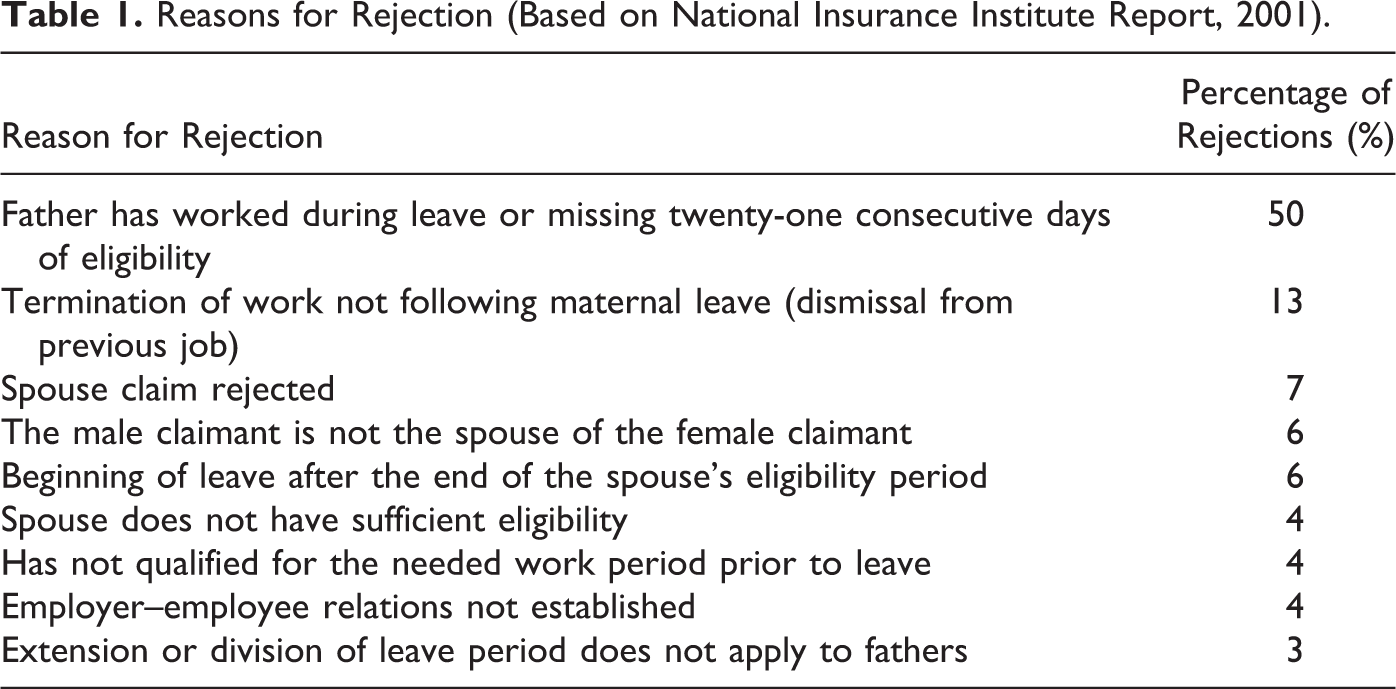
Thus, the number of fathers fitting the common description of fraud, working during leave, is not 20 percent but less than 10 percent. But do all fathers whose claims were rejected for “having worked during leave” fit the description of continuing to work while receiving leave benefits?
Examining court cases of fathers appealing against the rejection of their claims shows that the definition of “work” in this context is not as clear-cut as one might assume, and that the NII adopts a restrictive position on this issue when men are concerned, thus classifying men as “working during leave” even in cases that are at the very least open to interpretation.
Many men and women, especially those in managerial positions, maintain some relation to their workplace during parental leave. In the case of women, the NII have recognized this practice and adopted a liberal position. Women who keep their connection to their workplace on low levels are entitled to their benefits; those who attend their workplace on a more substantial basis are denied benefits—but only for the relative amount of time worked.
However, looking into the five relevant cases brought before the court during the research period, of total seventeen cases regarding parental leave for fathers, one finds that the NII—and following it, the courts—has adopted a restrictive position regarding the amount of work men might undertake during parental leave, stating that men who are found to be doing any amount of work during leave are automatically denied the entire benefits.
The cases reviewed show how the conditions for receiving benefits for men are unclear, confusing, and restricting. Thus, one may assume that many of the rejections were not based on an intentional attempt to deceive the institution but on a misunderstanding of the terms—even in the category of “father working during leave.”
Another example of the restrictive and mistrustful way the institution treats fathers taking leave is that according to NII bureaucrats, an investigator is sent to each and every father taking leave (it is not clear if investigators are sent only to self-employed fathers or to salaried workers as well).
The third indication to the shaky basis of the claims regarding pervasive fraud comes from the number of self-employed fathers taking leave. The type of fraud described by the informants, as mentioned above, is that of a father working during leave, without reporting his work to the institution, thus claiming both regular income and leave benefits. Such fraud is possible only for self-employed fathers, as every salaried worker’s paycheck is automatically reported to the institution, which can then easily detect fraud in such cases. The self-employed, however, may opt to receive payments for work done during the leave before or after the leave, thus pretending not to have worked or not to report income received during the leave at all. 4
If the numbers of frauds were indeed as high as claimed, this would have been reflected in the rate of self-employed fathers taking leave being significantly higher than the national rate of self-employment. However, as an NII paper reports, only 18 percent of fathers taking leave are self-employed (Eliav 2001)—a figure very close to the national rate of self-employed men (16.6 percent). When taking into account that the number of fathers who are self-employed is higher than the average for men, and that high income fathers (a criteria fitting most of the fathers taking leave) have even higher rates of self-employment (Central Bureau of Statistics 2014), it is safe to assume that the rate of self-employment among fathers taking leave is no higher than in the general population of fathers with the same socioeconomic profile.
This may be seen as an indication for the numbers of frauds being much lower than claimed. If 20 percent of men taking leave were self-employed men, claiming leave benefits while still working, and assuming that the rate of self-employed men taking leave with the honest intention of caring for their newborn should not be lower than the rate of salaried workers doing so, the numbers of self-employed men taking leave (frauds and honest leave takers combined) should have reached more than 30 percent. Even if the rate of fraudsters was 5 percent, the rate of self-employed men should have been above 20 percent.
These three indications—the breakdown of the reasons for rejection, the harsh treatment of fathers found to be working during leave, and the low number of self-employed fathers taking leave—all indicate that the claims regarding high levels of abuse are unfounded. Research of the type done here, involving only secondary sources, cannot determine the actual fraud rate, but based on the data brought above, it is safe to assume that it is much lower than claimed, reaching a tenth of the quoted rate of 20 percent at most.
As mentioned above, the claims on fraud are based on the data gathered for the 2001 report. However, this report has had influence that lasted throughout the research period. The report was the only occasion in which data on rejection—framed as fraud—were collected (or at least, the only occasion on which it was published). It had, however, long-lasting effects on the discourse on fraud and abuse in the following discussions.
The report was published before the discussion on the extension of the program in 2001. It has greatly influenced these discussions, as the issue of fraud and abuse took a central place in the discussions in the NII, in the government, and in the Knesset. Following the centrality of the fraud issue, severe limitations were placed on fathers.
However, the effect of the report was not limited to these discussions. In further discussions on the legislation, the issue of abuse and fraud played a central role, serving mainly to avoid the expansion of the program. Both in 2004, in the second extension of the temporary bill, and in 2007, when the bill was made permanent, the same data on rejection rates (again, frames as fraud rates) were still in use. This is how the NII representative in the Knesset committee explains his objection to extending the amount of time men can take: No, I don’t think a change [of leave periods] is due. I’m only saying, to put things into perspective, that we are talking of 200 claims filed each year, out of which 20% are rejected.
5
What of other players in the policymaking process, then? The picture here is less uniform. In general, players outside the NII have viewed the program more positively. Members of other state branches held a mixed view of the program, and Knesset members and Non Governmental Organizations lobbyists viewed it very positively. However, since NII has a monopoly on usage data—including rejection and fraud rates—they have not been able to dispute the data. Therefore, the claims on fraud have remained central to the debate and played a key role in undermining the expansion of the program. 6
Abuse Examined
Let us now turn to examine the second claim regarding the rates of abuse. Abuse, as the term is used in the field of research and as defined above, refers to a case where the benefit claimant’s intentions do not comply with the intended aims of the benefits’ program. In the case at hand, in the beginning of the legislation process, the central aim of the program was to minimize interruptions in women’s careers by shortening their birth leave (Perez-Vaisvidovsky 2014). Thus, when a leave did not seem to serve to promote the mother’s career, it was seen as abusive.
The common claim regarding abuse refers to fathers who take their part of the leave not in order to promote the mother’s career but to make financial gains by receiving benefits based on the father’s income, which is usually higher than the mother’s.
This is how MK Shaul Yahalom describes the concept of abuse, when discussing the requirement that the mother should return to work for the father to go on leave: He says: six weeks have passed, and the woman says: I want to be home some more, but your salary is higher than mine, you five salaries [five times the average salary—N.P.V.] and me—only three. Let’s make a salary and a half on the expanse of the state. She does not return to work, she asked for a non-paid leave, it’s natural that she will get it, and then he takes the leave and gets more money, and she goes back to work. In the end, both did not work, but the state treasury lost a salary and a half times, say two average salaries. […] This is not fraud. They are both not working for six weeks. He’s not working thanks to this program, she—thanks to the non-paid leave, and it is all done to earn an extra salary and a half.
7
The origin of these claims, as can be seen in Yahalom’s example and in other instances, is the substantial income differences between fathers taking leave and their spouses. In 2001, the time when the claims on abuse first surfaced, 91 percent of the fathers taking leave earned more than the average salary in Israel, and their salary was 60 percent higher than that of their spouses’ (Eliav 2001). The data for later years were quite similar (Wasserstein 2011).
Based on these data, policymakers have assumed that the main goal of the program—as they perceived it—was not fulfilled. This goal, as mentioned previously, was to help women avoid harming their career by taking an extended leave of absence. But the income differences were seen as indicative of this not being the case. As R, a bureaucrat from the legal department of the NII explains it: The original purpose [of the program] was to allow […] career women to return to their […] usual career path as soon as possible, by letting their husband replace them [at home]. […]. Now, if that was the purpose, in order for it to be fulfilled, as the legislator intended, we would want to see high-salary women, yes, the career-holding person in the family, being replaced by husbands with equal or lower salary. The…less career-oriented person stays at home, the more career-oriented goes to work. This is the natural outcome from the purpose of the legislation. This isn’t what happened. In all cases […] where benefits were paid to the man, the man was making more than his wife.
The logic behind this argument is that if a hiatus due to a parental leave is harmful to the career, the family—as a unit—will seek to prevent harm to the more developed and higher paying career. Therefore, in families where the man’s income is higher, the aim of the leave cannot be to prevent harm to the woman’s career.
This line of argument is problematic, for a variety of reasons. However, whether this reasoning is valid or not, it leads bureaucrats to seek an alternative explanation for the decision of those fathers who do go on leave. The answer, as can be seen in MK Yahalom’s quote, must be financial considerations: fathers replace their spouses on leave in order to maximize the benefits received. As the benefits are equal to the income prior to the leave, a higher income for the father also means higher benefits paid to the family.
However, this assumption suffers from a central flaw: while it is true that when the higher-income parent goes on leave the amount of benefits rises, it is not true for the family’s total income.
Parental leave benefits are based on an income-maintenance basis. As such, they are equal to 100 percent of the parent’s income prior to the leave. Thus, when a person goes on leave, his income does not change (leaving fraud aside in this context). As this is true both for the mother and the father, it means that the total family income also doesn’t change when the father replaces the mother on leave. The family loses the mother’s benefits and gains the mother’s salary (both at the same rate); and coincidentally, it loses the father’s salary and gains the father’s benefits (again, at the same rate).
Thus, the claims that fathers going on leave do so for financial reasons are problematic, as no financial gain is made by going on leave.
As can be seen, then, both claims concerning the integrity of the motives of fathers going on leave—those concerning fraud and those concerning abuse—suffer from evidentiary and reasoning flaws, and the data they are based on do not prove what they claim to prove.
Moreover, the evidential problems discussed above were known to policymakers and to bureaucrats at the time of those discussions and were documented in internal correspondences of the NII, when bureaucrats supporting the program raised them as counterarguments. However, this has not stopped those opposing the program from continuing to use the claimed high rates of fraud and abuse as arguments against expanding the program and in favor of its cancellation.
Discussion: Seeking a Stereotypic Explanation to an Unstereotypical Behavior
The above discussion raises the question: why did bureaucrats and policymakers continue to make claims regarding high levels of fraud and abuse, despite the evidential problems of these claims?
My assumption is that the continued use of these arguments stems from policymakers’ need to resolve an unexplained phenomenon. They encountered fathers—a relatively small but not insignificant group of them—who willingly chose to take a break from their career to care for their newborn children.
The logic behind the program provided two possible explanations: the prevention of harm to the woman’s career and the wish of fathers to care for their newborns. However, these two explanations are opposed to hegemonic conceptions on the nature of masculinity and on the behavior of men and of families.
The first explanation, referring to the prevention of harm to women’s career, assumes that when the father elects to go on leave, he puts the mother’s career before his own, preferring to prevent harm to her career, even at his own expense. This stands in contrast to the breadwinner regime in Israel, which sees women’s main role as mothers, with a secondary role as workers, while men are seen as workers with a secondary role as fathers (Frenkel, Braudo, and Hacker 2011; Ajzenstadt and Gal 2001). Thus, policymakers find it hard to accept that men risk harming their own career in favor of their wives’.
The second explanation—that of fathers taking leave to care for newborn children—is at odds with a gendered assumption that is even more basic than the previous one: that men are neither interested in nor good at caring for children, and especially caring for babies. This assumption is even made explicitly by some of the bureaucrats in this study: What useful thing can the man do while at home? Care for the newborn? I don’t know many who would find it easy or comfortable. They do it, my husband changed diapers too, but it isn’t easy and comfortable and I don’t…don’t always think that…probably, because it is not so easy, women…men find it hard to replace the women. (V, a NII bureaucrat)
This assumption on the lack of desire to care for newborns on the side of fathers is also reflected by the nature of the claims on fraud, as they were put by the NII in the courts. As mentioned earlier, in the cases reviewed above, there was no disagreement on the fact that the fathers worked during leave; the disagreement was whether they could be considered on leave while maintaining their connection to their workplace, in a manner similar to many women.
That is, the state does not suspect fraud on the basis of how much men have worked but on the basis of how much time they devoted to care. Based on the assumption that men do not wish to care, the state assumes that if they have maintained their connection to their workplace, they have done so while neglecting their care duties—an assumption that does not exist in relation to women.
As the two readily available explanations are at odds with hegemonic gender perceptions, policymakers look for other explanations. Those of fraud and abuse came in handy, as they fit the common perceptions of masculinity and of the expected behavior of men. As demonstrated above, both explanations portray fathers taking leave as favoring financial considerations—maximizing the household income—over care considerations, such as securing fitting care for a newborn child. This brings us back to the world of normative fathers, who are expected to be seeking financial gain not wishing to care for newborns.
Thus, bureaucrats in the institution faced the unexplained phenomenon of fathers taking parental leave and assumed that there must be a hidden motive to it. They then started looking for such motives—either by sending institution investigators to examine the claim of each and every father taking leave or by devising complex and unfounded explanations of a mysterious financial gain.
What we see here may be defined as a reversal of the original argument. In the original argument, presented above, policymakers claimed that high rates of fraud and abuse prove that men do not wish to care for newborns. However, after these claims have been shown to have little evidential grounding, it seems that the actual course of events is reversed: the claims of high rates of fraud and abuse are based on the assumption that men do not wish to care for newborns, and on the seeking of alternative explanations to their behavior.
This course of events bears many similarities to the cases described above of the criminalization of poverty—the framing of welfare recipients as frauds in the process of delegitimizing the benefit system. Returning to Kaaryn Gustafson’s (2009) definition of criminalization, one notices that most elements of criminalization exist in this case. The first type of criminalization described by Gustafson included the stigmatization, surveillance, and regulation of the poor (or in this case, of benefit recipients). The regulation of fathers taking parental leave takes the form of more and more complicated sets of rules regarding fathers’ eligibility for leave and the stringent application of these rules. The surveillance manifests in sending an investigator to every case of a father taking parental leave. Stigmatization does not take place in regard of the general public (which is not surprising, considering the negligible numbers of leave takers) but in the eyes of those related to the program inside the state apparatus.
The second type of criminalization described by Gustafson refers to the latent criminality of benefit recipients. This type, too, appears in the case of fathers on parental leave. The assumptions of NII bureaucrats that fathers taking leave are all potential frauds or abusers have been discussed in detail above. Thus, they assume that fathers taking leave are potential criminals and work to stop them. The last type of criminalization—the intersection of the welfare and justice systems—does not appear in this case.
As in those cases, here one also sees how stringent definition of entitlement conditions on the one hand and strict enforcement on the other lead to the definition of fathers as criminals and to overstatement of the number of frauds when arguing against these programs.
This stands in sharp contrast to the nature of white-collar crime, in which those framed as criminals, holding positions of power, have the means to minimize the effects of criminalization or avoid it completely. The fathers in this case study, however, did not display societal power or utilize it to minimize the effects of criminalization. While they may hold privileged positions, 8 those positions do not help them in combating their criminalization.
The discussion above also highlights two aspects of the criminalization process: (a) criminalization is based on existing biases, stereotypes, and metaphors and (b) criminalization is targeting marginalized groups, suffering from exclusion on other levels as well.
The case described in this study, that of men taking parental leave being framed as frauds and abusers, fully agrees with the first point. As shown, existing stereotypes and biases are extensively used in the process—mainly stereotypes about men’s reluctance to care for newborn babies, and their preference for financial considerations over familial ones.
However, the second point does not appear in this case. Fathers taking leave are, needless to say, men. As mentioned before, their income is high—usually much higher than the average. Data concerning their nationality and ethnicity are not directly available, but when examining the distribution of fathers taking leave among the NII branches during the research period (1998–2010), one notes that almost all fathers come from Jewish cities, and most from cities which are predominantly Ashkenazi (such as Tel-Aviv, Ramat Gan, or Kfar Saba; Eliav 2001; Wasserstein 2011)
Thus, the profile of the “average” father taking leave is that of the Jewish Ashkenazi high-income man—which researchers agree is Israel’s most privileged group (Shafir and Peled 1998; see, e.g., Peled 2008; Ram 2008). However, this privilege does not protect them from accusations of fraud and abuse.
This does not mean that the privilege does not exist or limits its scope. As the aforementioned studies show, this privilege is substantial, as this group holds almost all positions of power in Israel, enjoys cultural esteem and favorable labor market conditions.
However, it does shed light on the nature of privilege and specifically of the privilege of masculinity. While this privilege entails substantial benefits for those complying with its norms, this case study shows that it also entails harsh punishment for those deviating from them. The very same men that enjoyed high status and high income on the basis of belonging to the correct group are now subject to suspicion and ridicule when adopting behavior that is not perceived as masculine, such as taking parental leave.
As a caveat, I will note that I do not claim that these sanctions bring men taking parental leave to a level on par with people from unprivileged groups. The hardship suffered by Palestinian citizens of Israel, Mizrachi Jews, and even middle-class Ashkenazi women is much greater than the occasional defamation and revocation of benefit allowances. Welfare recipients coming from marginalized groups are heavily dependent on the welfare system, and therefore, the criminalization process is much harsher on them for two distinct reasons: first, they are much more dependent on welfare benefits, and therefore, the denial of those benefits poses a much more serious problem for them; second, people from marginalized groups encounter the welfare system much more often than those from privileged groups and, therefore, suffer from criminalization on a much more frequent basis.
However, although the punishment of deviating fathers is much smaller than the punishments suffered by other, less privileged groups, it is important as it sheds light on the ways the gendered power structure maintains itself and on the way power and privilege work.
It is interesting to note that in the context of this study, women who are perceived to be deviating from the norms of femininity—specifically, the so-called career women, who choose to prioritize work over care by shortening their parental leave—are lauded by policymakers who seek to encourage and reward this behavior. 9
Conclusion
This article examined the process of framing fathers taking parental leave as frauds in Israel, contrasting it with the criminalization of other benefits recipient group. Although the cases show many points of similarity, one main difference is that unlike other groups suffering from criminalization, fathers taking leave do not belong to a marginalized group. However, the privilege they enjoy in general does not protect them when they claim social benefits for an action that is deemed inappropriate to their gender role; stereotypes and biases then come into play, and they are framed as welfare frauds.
This process sheds new light both on our understanding of the criminalization of welfare recipients and on our understanding of the influence of gendered power relations on men as a privileged group. In the context of welfare criminalization, this case highlights the distinction between two characteristics of the suffering population—that of being subject to stereotypes and that of belonging to a marginalized group. Although both are important, this case shows that criminalization can happen when just the first is present (although with less harsh outcomes).
In the field of the critical studies of men and masculinity, this case study adds another aspect to the field of evidence examining the ways in which men—and specifically, men belonging to privileged groups—are still subject to gendered relations and power and may still be sanctioned for transgressing against the gender norms they are expected to conform to.
Footnotes
Declaration of Conflicting Interests
The author(s) declared no potential conflicts of interest with respect to the research, authorship, and/or publication of this article.
Funding
The author(s) received no financial support for the research, authorship, and/or publication of this article.