




Abstract
Discussions of cross-border marriages between women from developing countries and men from economically advanced countries often focus on the objectification of women, while the process through which men are presented as “marriageable entities” is rarely examined. In this article, I explore the case of China, where middle-aged, divorced women are seeking second-chance marriages with Western men via international cyber-dating agencies. Contrary to the stereotypical portrayal of Western men as rich and powerful in the Chinese media, many of the Western men enrolled at the cyber-dating agencies I am studying earn a modest income. I analyze the agencies’ portrayal of their Western male clients as caring, family oriented, and worthy of marrying despite their lack of wealth. Results from this article show that masculinity is fluid, malleable, and continuously being reconstructed in accordance with the changing demographic and socioeconomic patterns of the globalizing world.
Keywords
In 2012, I was working as a volunteer English teacher at a China-based cyber-dating agency that provided service to local women and men from Western countries. Contrary to the stereotypical Western media image of a foreign bride as young, never married, and poor, the majority of the women in my class were middle-aged, divorced, and could afford to pay US$1,000 as annual membership fee to their dating agencies. To this day, I still remember my own surprise when I heard one of the managers advise her client as follows, “If you were in your twenties, I would encourage you to seek out a Chinese man. But at the age of forty-five, your chances are next to none. The uncontestable social reality in China is that middle-aged women have no market. Why do so many women choose to move abroad? Ultimately, it is because they want a love-based marriage, which they can only find with Western men, given their age.”
This article examines how international cyber-dating agencies construct and market idealized images of Western masculinity to their Chinese female clients. Through examining how the agencies market Western men, I explore the “gendered social imaginary.” The gendered social imaginary refers to how potential migrants imagine the nature of gender relations to be in their future migration destinations (Pessar and Mahler 2003). It has a significant impact on people’s actual decisions to move because “much of what people actually do transnationally is foregrounded by imagining, planning and strategizing” (Appadurai 1990; Pessar and Mahler 2003, 817). My work explores how commercial forces shape the gendered social imaginaries that foster Chinese women’s transnational desire to marry and migrate.
My study is unique in that I focus on the role of commercial cyber-dating agencies. Most academic literature analyzes how cultural and sociostructural factors such as the media, popular culture, or socioeconomic policies shape migrants’ desires and imaginations while overlooking the intermediary hubs that link individuals to society. Among the few studies that examine cyber-dating agencies (Schaeffer 2013; Starr and Adams 2016), they focus on how the agencies market women as marriageable entities to men, but not vice versa. This article fills a gap in the literature by analyzing how commercial agencies construct masculinity and women’s reversed role as consumers during the international cyber-dating process.
This article also contributes to literature on global masculinities. Contrary to mainstream Chinese media stereotypes of Western men as wealthy providers, many of the male clients enrolled at the agencies in my study are modest earning and struggling in their home countries following the decline in the agricultural and manufacturing industries in the West during the past forty years. In contrast, some of the middle-class Chinese women they date were once married to nouveau-riche Chinese men. My data show that the agencies portray Western men as devoted, family oriented, and hence marriage worthy despite their lack of wealth. Moreover, they denigrate Chinese men as promiscuous and unreliable and therefore undesirable despite their newfound economic status. As such, this article shows that masculinity is fluid, malleable, and continuously being reconstructed in the context of a changing global economic order. In light of China’s economic ascendance and the emergence of rich Chinese business elites, previous associations of Western masculinity with wealth are now fading. Despite this relative economic decline of the West, however, I argue that Western masculinity continues to retain its global hegemonic power. This article chronicles the process through which Chinese cyber-dating agencies construct a new form of hegemonic Western masculinity that focuses on men’s internal qualities instead of their financial capital and deems Western men as morally superior to Chinese men, despite their declining economic status.
Hegemonic Masculinity in a Global Context
Hegemonic masculinity refers to a pattern of masculinity practices that legitimize the subordination of women to men (Connell 1987, Connell and Messerschmidt 2005). As a by-product of domination, it also marginalizes other forms of masculinity that are deemed as subordinate (Connell and Messerschmidt 2005; Kim and Pyke 2015). Although it is the dominant cultural ideal of masculinity in a society, it is certainly not the statistical norm, given that only a minority of men are privileged enough to enact it (Connell and Messerschmidt 2005).
Hegemonic masculinity does not refer to a rigid set of role expectations or to one particular identity (Connell and Messerschmidt 2005). Instead, it is a fluid, adaptable concept that is subject to change alongside shifting social and historical contexts. During the European colonization era of the nineteenth and twentieth centuries, discussion of hegemonic masculinity often centered on themes such as conquest, settlement, and empire building (Connell 1998). In the postcolonial neoliberal twenty-first century however, control of global wealth and power has shifted to transnational business corporations (Connell 1998). Hence, a variation of the traditional hegemonic masculinity model, called “transnational business masculinity,” is now used to describe a rising class of male business elites who dominate the global stage (Connell 1998; Kimmel 2003).
When considering transnational business masculinity, Hoang (2013) urges us to move away from the binaries of “traditional/modern, East/West, global/local,” as the economic ascendance of the Asia Pacific region has produced a newly emerging group of Asian business elites (Harvey 2012; Hoang 2013) who now embody the transnational business masculinity previously associated with Western men. In Vietnam, for example, Western businessmen no longer represent the most elite segment of the market for commercial sex consumption, given the emergence of Vietnamese business elites (Hoang 2014, 519). Similarly, Western expatriates no longer represent the wealthiest segment of the population in China (Harvey 2012; Song and Hird 2014). Moreover, the “othering” of Caucasian women as “objects of desire for moneyed Chinese men” is prevalent in both the Chinese popular media and high-end Beijing nightclubs that recruit Russian female dancers (Song and Hird 2014, 170). Moving away from traditional portrayals of the affluent Western male and the destitute Asian female, these examples show that images of transnational business masculinity are malleable and reflective of recent changes in international geopolitics.
Compared with previous models of hegemonic masculinity, transnational business masculinity is more sexually libertarian (Connell 1998). For example, numerous studies cite the rise of a global pornography and prostitution industry that caters to international businessmen (1998). While transnational business masculinity reveals men’s libidinous nature, another masculine ideal type that emphasizes their devotion to family has also emerged in the United States. Called the “new man” or “new fatherhood” masculinity, this ideal type describes middle-class, white male professionals that are nurturing, emotionally expressive, and highly involved with their families (Hondagneu-Sotelo and Messner 1994). It is considered a “hybrid” form of masculinity (Demetriou 2001; Messerschmidt 2010; Messner 2007) because it incorporates some elements typically associated with femininity. However, this is mostly a transformation in style rather than in substance (Messner 1993). Although this model blurs gender differences and boundaries, it does not ultimately challenge the institutional position of power that men enjoy (Bridges and Pascoe 2014; Demetriou 2001; Messner 1993).
Both transnational business masculinity and the hybrid new man masculinity are hegemonic. Transnational business masculinity legitimizes women’s subordination to men by legitimizing commodified relationships between wealthy men and women that are less economically advantaged (Connell 1998). The new man model, in turn, marginalizes other forms of masculinity associated with less privileged men, including men of color and non-Western men (Messner 1993). For example, African American and Latino men are often associated with a “hyper-masculine, sexist, domineering” form of masculinity (Heath 2003; Kim and Pyke 2015, 510; Pyke 1996). Meanwhile, Asian men are often stereotyped as “unemotional,” “unloving,” and “poor communicators” (Kim and Pyke 2015, 518). In this article, I will examine how the transnational business masculinity and new man masculinity models intersect with the Chinese cyber-dating agencies’ reimagination of Western men in the context of a changing global economic order.
The Context of China
Prior to its 1979 socioeconomic reform, China experienced a long period of enclosure from the outside world. In the eighties and nineties, many people imagined the West—and the United States in particular—as a “land of free and open sex” (Zheng 2006). Western men’s reputation for being hedonistic and libidinous stems from Chinese women’s firsthand experiences with Western expatriates who seek out young women at local nightclubs for sexual adventure (Farrer 2010; Moskowitz 2008; Stanley 2012). They are also based on media and pop culture images. For example, Wei Hui’s (2001) bestselling fiction novel Shanghai Baby tells the tale of a Chinese woman struggling to choose between her impotent, effeminate Chinese boyfriend and her virile, sexual Western lover (Zheng 2006). Moreover, throughout the eighties and nineties, when the income differential between Chinese locals and Western expatriates was much bigger than it is today, many Chinese women perceived Western men as wealthy providers (Stanley 2012).
In contrast, few Chinese men were in a position to be wealthy and libidinous during the state socialist period (1949–1979), when ownership of private property was banned, income gaps were small, and sex outside of marriage were heavily sanctioned by the state (Farrer 2002). The situation has changed, however, following China’s 1979 reform and opening up, when a new capitalist class dominated by local men began to emerge (Farrer 2002; Osburg 2013; Song and Hird 2014). These new business elites are reputed for their consumption of female sexuality as part of their business socializing and deal-making practices (Farrer 2002; Osburg 2013; Song and Hird 2014; Zheng 2006). Smartly dressed, well-mannered, and libidinous, they appear to embody the transnational business masculinity previously associated with Western men.
In contemporary China, masculinity has been restructured such that the dominant ideology is centered on men’s capacities to make money (Osburg 2013; Xiao 2011). As such, these newly empowered businessmen and entrepreneurs are highly favored in the marriage market (Osburg 2013; Xiao 2011; E. Y. Zhang 2001). However, in recent years, Chinese women are also becoming increasingly concerned with male infidelity. China’s urban rate of divorce rose from 2 percent in 1970 to 27 percent in 2013 (Li 2012, Wu 2014; C. Zhang, Wang, and Zhang 2014). Divorce rates among the new rich are even higher than that among the general population (Osburg 2013; Tang 2009). Moreover, extramarital affairs have been cited as a major reason behind divorce (Xiao 2011). In response, alternative masculine ideal types that emphasize men’s emotional engagement and devotion to family have emerged during the last decade. For example, terms such as “beita male” (Chinese translation of “beta male”), “cooking man,” or “economic and practical man” (jing ji shi yong nan) describe men that are not necessarily tall, handsome, or wealthy but have other redeeming qualities that make them ideal candidates for marriage (Xie 2010). [Economic and practical men] are of average height, wear a conventional hairstyle, and have an ordinary, unremarkable appearance and a moderate personality. As husbands, they unquestioningly hand over their salary to their wives and never smoke, drink, turn off their phones, go to bars, or have intimate associations with beautiful women. They are responsible, family-oriented salarymen…they are able to make down payments on housing and usually work in fields such as education, IT, and technology. (Song and Hird 2014, 101)
Research Setting and Methods
This article draws from data I collected at three different China-based cyber-dating agencies from 2008 to 2014. Instead of recruiting male clients on their own, they work in partnership with a foreign company that provides them with access to men from developed countries. As of 2014, this male supplier company had 1.6 million registered male clients, 90 percent of whom reside in North America or Western Europe. This company partners with various female supplier agencies across China, Southeast Asia, and Eastern Europe. The female clients rely on translators at their local agencies to facilitate their online communication, including e-mail exchanges, phone calls, and online chats with the men. Couples typically correspond for several months before some men travel abroad to visit their potential brides. During these visits, the translators also facilitate communication between couples.
I acquired access to the three Chinese cyber-dating agencies through a family friend who happened to be an owner at one of the agencies. She then introduced me to managers at the other two agencies. After acquiring Institutional Review Board (IRB) approval and consent from the staff and clients, I conducted on-site research during summer 2008, summer 2009, April 2011–June 2012, and January 2014. I was also given access to the agencies’ intranet, and the demographic data in this article draw from this source. Two of the agencies are located in a “second-tier city” while the third is in a “first-tier” metropolis. In China, second-tier cities are less developed than first-tier cities such as Beijing or Shanghai but still serve as important cultural and economic hubs to the nation.
This article draws from data collected using a variety of methods, including text analysis, interviews, and participant observation. First, I analyzed how the agencies portrayed the Western men by conducting content analysis on 154 promotional blog articles that they published online between 2007 and 2014. Written by the staff, these articles describe how couples meet and marry, while some entries also follow up on the women’s postmarital lives abroad. They are posted on various publicly accessible websites. These articles serve as crucial promotional tools for the agencies because they are the primary means through which the female clients learn about the men. On the other hand, the actual male client profiles are rarely useful to the women. First, the women encounter a language barrier since the profiles are self-written by the men in English. Moreover, few women have time to read male profiles one by one. The men’s response rate to the women’s self-introduction e-mails is so low that most women must write to hundreds of men.
To analyze the 154 blog articles, I used inductive coding techniques rooted in grounded theory (Charmaz 2006). My coding proceeded in two stages. During the first stage of open coding, I noted the various types of Western masculine traits that appeared in each article and the extent to which they were emphasized. During the second stage of selective coding, I reread my coded data and refined my coding categories (Strauss and Corbin 1990). I integrated smaller subcategories into a few primary categories and eliminated some categories that were only briefly mentioned in the articles without further elaboration. In the results section of this article, I will present six of the most frequently occurring and most strongly emphasized Western masculine traits that appeared in the articles.
I also review the female clients’ mate-selection criteria and discuss how that may have affected the agencies’ portrayal of the men. My analysis draws from the interview and participant observation data I collected on-site. Between 2008 and 2014, I interviewed 61 of the 1,740 female marriage migrants across the three agencies. I also interviewed twenty Western men who were visiting their potential brides as well as the entire staff of four managers and thirty translators. Due to the highly private nature of my research topic, I did not recruit my subjects by randomly selecting their name from a list and cold calling them. Instead, I recruited a number of subjects after meeting them on-site when they came in to communicate with their translators or when they attended the weekly English classes I volunteered to teach for the agencies. Other respondents were selected through snowball sampling. In addition, the staff sometimes stepped in to help me arrange for interviews with clients whom they thought would be interested in meeting with me.
Compared with the actual client population, a greater proportion of women in my sample were middle-aged and divorced. The staff told me that their younger clientele is less invested because they have more dating opportunities in China. Thus, they rarely visit the agencies and almost never end up marrying.
Most client interviews were informal, one-on-one, and conducted off-site, either at a restaurant or in a client’s home. They covered basic background questions as well as intimate questions about their previous family life, why they sought a foreign spouse, their expectations about their future marriages, and their experience with the agencies. Due to the private nature of my research topic, I chose not to voice record my interviews with the clients. Instead, I jotted some notes during the interviews and wrote up a completed version from memory on the same day or the next day. On the other hand, all my interviews with the staff were recorded and transcribed. Having moved to the United States from China at the age of eight, my ethnicity and fluent Chinese enabled me to build excellent rapport with the women who perceived me as a local who understood their perspective and yet provided them with valuable knowledge about life abroad.
In addition, I visited the agencies regularly to observe client–staff, staff–staff, and client–client interactions on-site. I was also given permission to attend their weekly staff meetings. When a Western man visited his prospective bride, I sometimes accompanied the couple and their translator and sat as a fourth person at the dinner table. I also attended a number of off-site social gatherings such as client engagement parties, weddings, dinners, or karaoke nights. Some events included both clients and staff, some were staff only, while others were client only. The participant observation allowed me to see how clients spoke of each other, thereby providing an additional perspective to my analysis.
Findings
The Western Male Clients
The online database does not allow female clients or translators to search for men by income. Thus, I selected 1,000 male client profiles through random sampling. The majority of the men among this sample were modest earning. Based on their self-reported salary, 50 percent earned less than US$50k, which was below the 2013 US median household income (US Census Bureau 2013). More detailed demographic information about these men can be found in Table 1.
Male Clients Self-Reported Demographic Information.
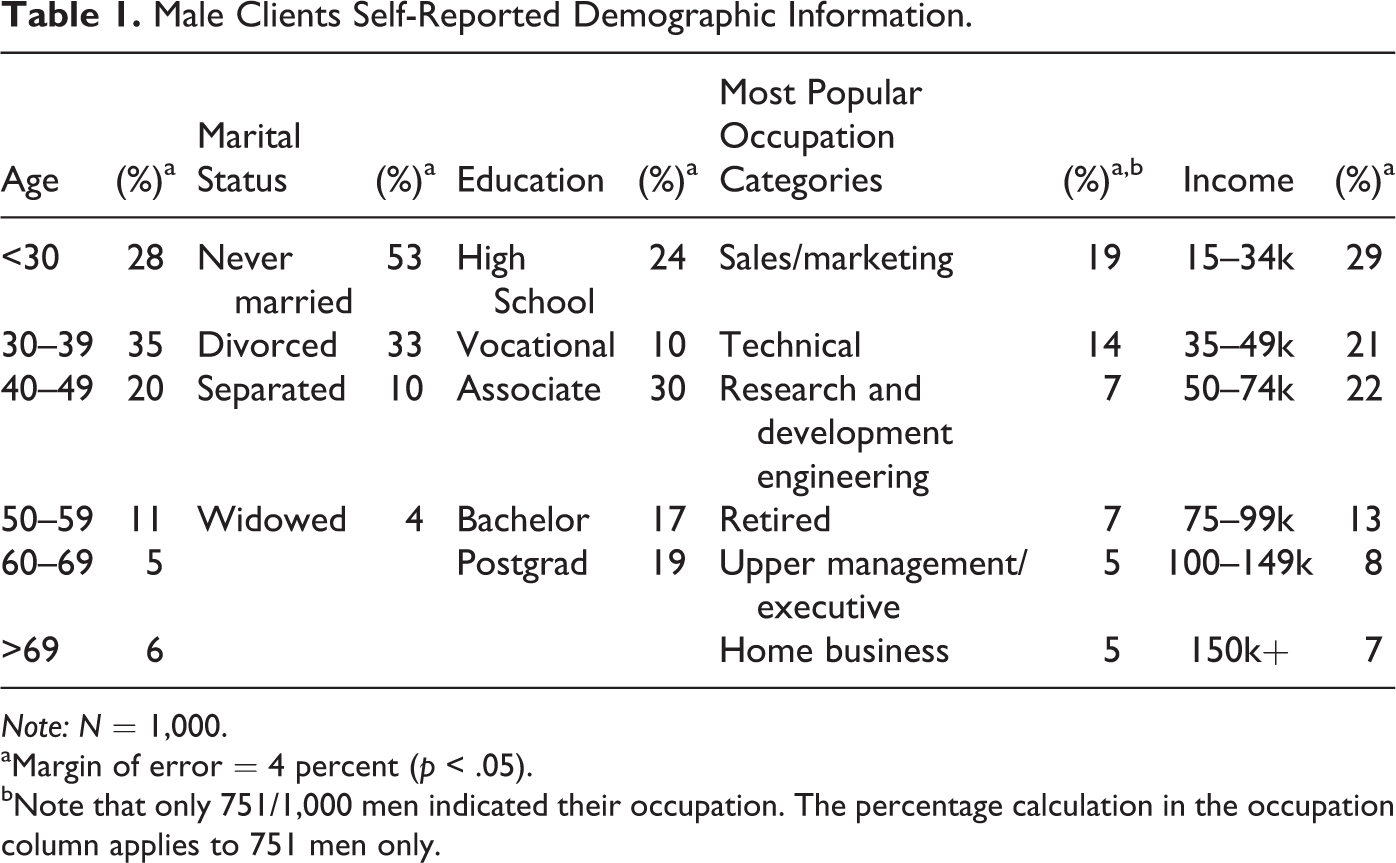
Note: N = 1,000.
aMargin of error = 4 percent (p < .05).
bNote that only 751/1,000 men indicated their occupation. The percentage calculation in the occupation column applies to 751 men only.
On average, each agency had three or four male visitors who traveled on-site to China each month to meet with the women. Among them, I interviewed twenty men. Based on my interviews, I hypothesize that these men’s motives and desires were similar to those described in the existing scholarship on international cyber dating. That is, they associate their lack of success in the Western marriage market with forces of global capitalism and feminism, which have supposedly made Western women overly independent, materialistic, and self-centered (Schaeffer-Grabiel 2006; Starr and Adams 2016). As such, they seek to “reproduce the traditional American family” by selecting foreign women (Starr and Adams 2016), whom they imagine to be “untainted by modern capitalist relations” (Schaeffer-Grabiel 2006).
For example, Ted, a divorced truck driver said, “I want to date Asian women because American women are so individualistic, they care about nobody but themselves. I like China because China is like 1940s USA. People have family values and they help each other out. American women are lazy, many do not know how to do housework.” Jason, a never married police officer said, “My ex-girlfriend turned lesbian and ran off with a woman. I don’t know what the hell she is doing with that. Western women are not family oriented and they are materialistic…they always want the latest hand-bag, the latest jewelry, etc. That’s so wrong.” Lawrence, a divorced business owner said, “In other countries like the Ukraine and Europe and China, there is more tradition…you can still be smart, you can still be educated, but the family comes first. The family doesn’t come first in America. American women also fight to be equal to men, so you always have to put up with that too…I have a close friend who tells me every other day that she has made it in man’s world. Who cares? Now who wants to date someone like that, someone who is always competing with you?”
The Female Clients Seek Family Men
While the demographic characteristics of the Western male clients diverge greatly from the traditional Chinese media stereotype of Western men as wealthy and powerful, the female clients also diverge greatly from the stereotypical Western media portrayal of “mail-order brides” as young and never married. Of the 1,740 women enrolled at the agencies I studied, 57 percent were divorced and 68 percent were between the ages of 35 and 67. 1 In fact, only 22 percent were below the age of thirty. While some women migrated from rural areas during their younger years, they all currently reside in the cities. Their class status ranges from upper-middle-class to working-class, with “clerk” cited as the most popular occupation, followed by “sales/marketing,” “finance/accounting,” and “teacher.” Moreover, clients in the second-tier city were more likely to marry than clients in the first-tier city, who were more financially successful and choosier.
Just like women among China’s general population, the female clients in my study were concerned about China’s rising marital instability. Around half of the women I interviewed stated male promiscuity as an important factor driving them to seek Western husbands. For example, Ruby, a retired female client, complained of her ex-husband’s promiscuity. He was a nouveau-riche businessman who eventually left her for another woman. While they were married, he often said, “men are like teapots, they should be paired with multiple teacups.” Ruby blames his behavior on China’s current revival of pre-1949 practices such as mistress keeping, which she calls “old, ugly, and shameful.” Moreover, she laments that China’s entrepreneurial class got too rich too quickly while their inner quality (suzhi) lags behind. They don’t pay attention to the spiritual side of life and overlook the importance of family. They abandon their wives for younger women whom they treat as trophies or objects of consumption.
While male promiscuity is a leading concern for the female clients I interviewed, it is not the only one. Around one-third of fifty-five divorced interviewees cited men’s failure to provide for the family as a reason behind their breakup. Women in this group left ex-husbands who could not responsibly cope with their job loss as state enterprises shut down during the reform era and turned to drinking, gambling, and/or domestic violence. For example, a female client named Lili said, “Chinese men are cowards. When things get tough they just run away and leave the women and children behind.” Lili’s first husband turned to gambling after he lost his job, while her second husband left her alone in debt after their business failed.
Moreover, around half of my interviewees indicated age as a primary motivating factor for seeking a foreign husband. They felt disadvantaged in their domestic marriage market because Chinese men of similar age and socioeconomic status as them want to remarry much younger women. In addition, the majority of female clients with children from previous marriages assumed that Western men were more accepting of stepchildren and cited this as an important factor motivating them to seek foreign husbands. Many divorced mothers believed that Chinese men were only interested in raising their biological children. For example, Bai, a twice-divorced female client whose brief marriage with her second husband ended when he refused to support her son from her first marriage said, “in China, it is almost impossible to have a second marriage where stepparents treat their step-children like their own, and where the couple will not quarrel over money. Each party has his or her own child and own priority.” In summary, Western men appeared to be an attractive option for my respondents, many of whom had been disappointed by Chinese men. They saw migration as an opportunity to leave their past behind and start a new marriage that is built on loyalty and stability.
Portraying Western Men as Family Men
My work tells the tale of “two unmarriageables” in their home countries who seek an imagined “better life” based on the idealized gender images that their translators construct during the cyber-dating process. As we will see, the agencies market their Western male clients in ways that coincide with the needs of their Chinese female clients. As discussed in the methods section, I analyzed a total of 154 promotional blog articles written by the staff. I inductively coded them based on the most commonly appearing traits of Western men. In the subsections below, I will present six of the most frequently appearing and most strongly emphasized Western masculine traits. Note that the traits are not mutually exclusive, so two or more traits may appear in the same article.
Willing to date older women
The agencies depict Western men as more receptive to older women than Chinese men. One common phrase I hear translators tell their clients is, “Western men do not care about age.” The excerpt below describes Ms. Lin, a woman in her 50s, with no dating prospects in China. The author later describes how Ms. Lin met a Western man who cherished her and asks why Chinese men could not do so. The author exclaims that women like Ms. Lin are “disposable like garbage” in China. Yet, Western men pamper them, thus enabling them to bloom with a never-before seen beauty. The author praises Western men for overlooking a woman’s youth and physical attractiveness while implying that Chinese men are more superficial by comparison. It saddens me to see so many middle-aged women being forced to seek men abroad. Why do women like Ms. Lin—someone whose youth and beauty has been sucked dry like a dying weed while in China—bloom into a flower with a beauty that we have never before seen when Ronald showered her with love and affection? In China, men perceive 50-year-old women as women to be disposed, like garbage. Yet, why do so many foreigners pamper them? At our agency, there is an increasing number of women in their fifties marrying Western men. In China, it’s virtually impossible for such women to marry men in good economic-standing…from this phenomenon we can see that Western men have a different standard of beauty than Chinese men. Western men will not overlook women’s inner beauty because of her physical age.
Devoted
Moreover, the blog articles also depict Western men as devoted and thus worthy of marrying even if they earn only a modest income. I will use the story of Donald and Qing to illustrate this point. Donald is an American taxi driver who married Qing, a divorced retail sales clerk. The article opens by introducing three different men with whom Qing had corresponded, including a rich man from England, a Swiss doctor working in China, and Donald, a taxi driver from the United States. The author proceeds to discuss why Qing chose Donald over the other suitors. Donald loves Chinese martial arts. After his involvement with Qing, he became even more enamored with everything that is Chinese. From each of his letters you can feel his attention to detail and his timidity in front of the woman he loves. He studied Chinese for Qing and tried to listen to Chinese music. He thought that Chinese music was the most beautiful in the world. He even planned on watching the Olympics with Qing. Whenever he thought of watching TV with his Qing from the Far East, his eyes became filled with tears. He felt so enchanted by the grandeur of China. Moreover, he is proud to be in love with a woman from this majestic country! Imagine a big man throwing himself over a map every day, searching for Qing’s city, and imagining that the Qing he is deeply in love with might just be sitting under the shade or taking a walk in the park…. Qing was once hesitant on her relationship with Donald and she contemplated what she wanted out of life. Ultimately she chose Donald, the man with the average salary who gave her massages and told her bedtime stories. She chose this taxi driver who was willing to study Chinese for her.
Family oriented
Around half of the articles also portray Western men as being more invested in family life than Chinese men. This means spending less time working or socializing and more time with family. I use two excerpts to illustrate this point. The first one describes how Western men go home after work rather than socialize with their coworkers. This stands in contrast against China’s yingchou (business socializing) culture, which became prominent in the post-reform era as more men entered business (Osburg 2013; Song and Hird 2014; Uretsky 2008; E. Y. Zhang 2001). The author claims that Chinese men pursue financial success at the cost of compromising their family lives. On the other hand, Western men “take care of children, cook, and clean up the backyard.” These disparities supposedly reflect cultural differences, where the Western “husband culture” is deemed superior to the Chinese husband culture. After American men marry, they pay a lot of attention to family. Americans rarely socialize outside of work. Most people go home and spend time with their families. Foreign men pay much more attention to family than Chinese men. In reality, for women, family always comes first. Even if men made a lot of money, it would still not make women happy unless the family was harmonious. Thus, foreign men’s devotion to family is very attractive to Chinese women. In China, a lot of marriages fail because men focus too much on their careers and ignore their wives. In the West, men always spend time with their families when they are not working. They take care of children, cook, and clean up the backyard. It is pretty obvious which one of the two “husband cultures” is more attractive to women. Every morning, he [Rui’s husband] would gently say “good morning”; after you complete the housework, he would kiss you to thank you, he would prepare a cup of tea or coffee for you; most evenings he does not have social or business events planned (even if he did we would attend together); after work, he would do housework with you, then we would take walks or see a movie together; on weekends we would shop, swim, or visit friends together…this is the kind of life I always wanted.
Responsible
Around one-quarter of the articles portrayed Western men as responsible caretakers. I will use the story of Ming and Lee to illustrate this point. Lee is a divorced Canadian who raised the children his deceased ex-wife brought from her previous marriage. Later on, Lee married Ming from the agency. The author uses Ming’s words to portray Lee as a responsible husband. In the quote below, Ming describes Lee as a kindhearted and responsible man, as shown by his willingness to raise his ex-wife’s children. This image of Western men as responsible caretakers may be especially appealing to women whose ex-husbands ran away from home after they experienced career failure in the post-reform era. Ming said she chose Lee primarily because he was a kindhearted, down-to-earth man. Although he did not have biological children with his now deceased wife, she brought two children from her previous marriage, and he continued caring for them even after she passed away. Ming said to me, this is the kind of man I can rely on for life.
Innocent
Around one-third of the articles highlighted Western men’s “romantic innocence.” I use the example of Patrick to illustrate this point. The excerpt below portrays Patrick as a hopeless romantic with a boyish innocence. The writer praises Patrick for flying across the continent for Si, a Chinese woman he had never met. The writer depicts him as a hopeless romantic who is willing to take risks for love and greatly admires his courage, optimism, and passion. This image is supposed to appeal to older women who want romance but cannot get it from middle-aged Chinese men whom the author claims are too jaded to believe in romance. Patrick White knew that life was short. Thus, when he saw an opportunity for true love, he wanted to grasp it immediately. To leave Si with a good impression, he lost nearly 40 pounds before flying to China to see her…he planned to marry her on the spot if things felt right. In America, women usually change their last name when they get married, so Patrick fantasized about bringing Mrs. Si White back to the U.S. As the manager, I always admired Western men because they have the heart of a child. They really are more passionate when compared with Chinese men of the same age. At least, they still believe in love and they are willing to travel thousands of miles for love. This courage inspires me.
Caring stepfather
Finally, around one-fifth of the articles portray Western men as caring stepfathers. I will use the example of Lin Lin to illustrate this portrayal. Lin Lin is a sales clerk struggling to support her teenage daughter. She married Nathan, a successful businessman from France. Lin Lin’s Chinese ex-husband had a gambling addiction and ignored his duties as a father. The article written on this couple did not focus on the economic disparity between them, as the two lines that describe Nathan’s wealth is buried in the middle of the article. Moreover, the author never mentioned the fifteen-year age gap between them, which exceeded the initial age limit that Lin Lin had set for herself. Lin Lin’s youth, vivaciousness, and sex appeal to a much older man like Nathan was not the focus. Instead, the author emphasized the couple’s mutual desire to build a family.
In the passage below, Nathan appears to enjoy spending time with Lin Lin and her daughter because they gave him familial love. This supposedly became the driving force behind his decision to marry. The author also describes in detail how Nathan and Lin Lin’s daughter expressed their love for each other at Lin Lin’s wedding. On the whole, the author emphasized compassionate love over romantic love. These sentimental portrayals of Western men as dedicated stepfathers can be especially appealing to divorced women with children. After three months of email exchange, the couple met. Lin Lin’s daughter came to see Nathan too. She was a sweetheart, always smiling. She called Nathan “Daddy,” which made him very happy. Nathan did not grow up in a warm, caring home. Even after he married and started his own family, his children were never close to him. Upon meeting a soft-spoken, tender woman like Lin Lin and her sweet and clever daughter, Nathan suddenly knew he had a loving home. Spending just one day with Lin Lin and her daughter made him feel more loved than he ever has in his entire life. This made him appreciate Lin Lin and her daughter ever so much…. At the wedding, Lin Lin’s daughter cried as soon as she got up on the stage. Her childhood experience had been unique in that she never grew up with fatherly love. Yet, from that day on, she knew she had a father…seeing the child cry, Nathan ran up to give her a hug. He told her not to cry and wiped tears off her eyes…at that moment, the world belonged to the three of them…
Constructing the Gendered Social Imaginary
The images presented above are gendered social imaginaries. They may not always represent the men accurately. Several factors contribute to this discrepancy. First, the agencies often use cultural explanations to interpret the men’s behavior while overlooking other underlying sociological forces. For example, my interview data with the men show that their desire to date middle-aged women may stem from pragmatic considerations rather than particular cultural ideologies that deemphasize feminine youth. One respondent in his sixties who dated various women significantly younger than himself before marrying a Chinese woman his own age said, “it’s always nice to have a young woman, ok, but the reality of that is, the energy of each decade changes…if I married someone ten to twelve years younger than myself, that would be fine…beyond that, it’s not practical…eventually it ends the relationship because she is still growing and he slows down.” Another respondent in his forties said, “I just don’t believe that a woman in her twenties would marry me because she genuinely wanted to be with me.” He told me that he learned a hard lesson after dating a twenty-something-year-old woman with a substance addiction who sought him out for financial support. Another middle-aged female client who married a Western man a few years younger than herself said, “at first I could not understand why he did not choose a younger woman, but after moving abroad, I realized that, given his limited financial means and reclusive personality, he probably felt more secure with me.” As we can see, factors such as prior life experience or lower socioeconomic status in their home countries may influence the men’s decisions to date middle-aged women. Yet the blog articles rarely address them. Instead, they denounce Chinese culture for encouraging men to pursue young women and praise Western culture for enabling men to appreciate older women.
Moreover, while many female clients are middle-aged, the men they marry can still be significantly older. Among the thirty-one married women that I interviewed, their husbands were on average nine years older than them. In one-quarter of the couples, the men were older by fourteen years or more. This persistent age gap contradicts the idea that “Western men don’t care about age.” While reviewing articles written about couples whom I had personally met, I noticed that the writers often left out client age when reporting on couples with significant age gaps.
While portraying the Western men as “family oriented,” another factor that the agencies often overlook is the men’s socioeconomic status in their home countries. The female clients’ impression of Chinese men often draws from their experience with their Chinese ex-husbands who tend to congregate along opposite ends of China’s postreform socioeconomic ladder. One group consists of men who climbed to the top: nouveau-riche businessmen who left their wives for younger women. The other group consists of men who fell to the bottom: these are men who lost their jobs when state-owned enterprises shut down during the reform and later resorted to drinking, gambling, and shirking familial responsibilities. Wealthy men are more likely to be unfaithful, and this is a universal phenomenon (Atkins, Baucom, and Jacobson 2001). In the United States, men who hold higher-status jobs with greater autonomy such as businessmen, lawyers, or doctors are more likely to commit adultery (Stoller 2007). In contrast, most of the Western male clients in this study have a modest earning. Hence, their fidelity in marriage may simply reflect their lack of opportunity, rather than their devotion to a particular gender ideology. On the other hand, Western men engaging in cross-border marriages must also provide evidence of a stable income in order to facilitate their Chinese spouses’ immigration, while men from the United States must undergo further screening for substance abuse, domestic violence, and so on (US Citizenship and Immigration Services 2011, 2013). As such, these men also differ from the unemployed Chinese men who drank and gambled. In summary, I argue that some of the traits and behavior that the Western male clients exhibit may be more attributable to their class background rather than their ethnic and cultural background, as the agencies suggested.
Moreover, it is important to remember that the articles rely heavily on the men’s words before marriage rather than their actions. Many articles do not follow up on the couples’ postmarital lives abroad. Even when they do, they usually draw from interviews with the women, many of whom are inclined to present an overly positive image of their new life abroad in front of their friends and family. Hence, the blog portrayals may not always represent the men accurately. For example, Bai married Edmond partly because she thought he would be a good stepfather. Before marriage, Edmond always said he wanted to be an “amazing” and “loving” dad to her son and “help him grow into a real man.” Yet, in my follow-up interview with the family in their new American home, I discovered that Edmond had a strained relationship with her son. For example, Edmond shut off their air conditioner each morning when he left for work and turned it back on only at night when he returned home. He did so even though he knew that Bai’s son stayed home during the day, when the weather was hottest. Bai asked me not to tell her Chinese agency, however, because she thought it would be a loss of face if other clients discovered that her new marriage was troubled.
Finally, it is important to note that the agencies’ method of case selection provides a skewed sample. For example, one owner told me that the three companies I studied have had more than 2,000 successful marriages, although they only published 154 cases. This is partially because many clients chose not to publicize their stories. Moreover, the majority of the Western men registered on the website wrote e-mails to the women without ever visiting them. Thus, the blog depictions hardly represent the 1.6 million registered men, let alone Western men at large.
The articles, most of which were written by the managers, certainly reflected their own gendered imagination as middle-aged, divorced women. In fact, one of the managers avidly sought a Western husband for herself through her own website because she believed that they were more loyal, more caring, and more willing to date women of their own age. Yet the translators, over 90 percent of whom were in their early to mid-twenties, took on a different perspective. While a few have married Western men through their website and moved abroad, the majority preferred local Chinese men. As one translator stated, “you know, many big sisters at this agency are disappointed with Chinese men because they are from a different generation. Chinese men of my generation are much better—responsible, caring, and sexually skilled.”
Conclusion
This article contributes to gender studies by showing that masculinity can be reimagined and restructured in light of macrolevel sociostructural change. Given China’s rising economy and the emergence of local business elites, Western expatriates no longer represent the wealthiest segment of the population (Harvey 2012; Song and Hird 2014). On the other hand, the cyber-dating agencies in my study are now associating the average-earning “family man” image with Western men. As we can see, gender ideal types can shift alongside a changing global economic order.
The agencies’ portrayal of Western men as family men is particularly interesting because devotion to family is not otherwise a trait unique to Western men. In China today, the rise of feminist awareness among women from the post eighties and nineties generations has brought a new model of familial masculinity into media prominence (Song and Hird 2014). As previously discussed, new Chinese masculine ideal types such as economic and practical man, cooking man, or beita male (Chinese translation of beta male) have emerged during the last decade. The translators’ perception of Chinese men as “responsible, caring, and sexually skilled” reflects this shift in gender norm among young men in China. Yet, the agencies overlook these trends. In line with their female clients’ age and life experience, they choose to focus instead on middle-aged nouveau-riche men who make up a small subset of China’s general population.
In some ways, the agencies’ portrayal of Western men as family men resembles the American new man masculinity. Both models emphasize men’s emotional expressiveness and devotion to family. However, since the agencies’ portrayal is tailored for their Chinese female clients, it includes additional components, such as willingness to date older women, romantic innocence, and acceptance of stepchildren. I suggest that the agencies’ portrayal of Western men is hybrid and hegemonic just like the American new man masculinity ideal type in that it marginalizes other forms of masculinity. In particular, the blog articles denigrate Chinese masculinity as backward, deficient, and in need of Western liberation. Western family men supposedly reject polygamy and look beyond women’s physical age. Their “richness” comes not in the way of their material possessions but rather in their moral purity and refined temperament. This stands in striking contrast against the materialistically “rich” but spiritually “poor” Chinese businessmen whose mistress-keeping practices reflect a revival of pre-1949 patriarchal ideologies in China today, which clients like Ruby regard as old, ugly, and shameful. By casting Western men as morally superior to Chinese men, the commercial agencies create a Chinese desire for Western masculinity, thereby reinforcing the global hegemonic power of Western culture.
Finally, this article shows how Chinese women’s gender ideologies have shifted in light of China’s postsocialist reform and path toward modernization. Inglehart’s (1997) theory of postmaterialism suggests that as societies undergo modernization, there is an observable shift in emphasis from “materialistic values” that encourage economic accumulation to “postmaterialistic values” that give higher priority to the quality of life. The women in my study, most of whom are not poor, seek a sense of stability after having experienced adultery, divorce, and age discrimination during the post-reform era. These problems, which are more spiritual in nature than material, point to a state of “values vacuum” in China today (Link, Madsen, and Pickowicz 2013). Following the collapse of socialist ideals, “money making and materialism have become the most conspicuous public values, and these values have been satisfying, but only up to a certain point” (Link, Madsen, and Pickowicz 2013, 3). Many people now pay attention to the spiritual side of life and question what it means to be a good person beyond money-making. On the other hand, some nouveau-riche men who engage in excessive drinking, banqueting, and womanizing are derided as “low quality” (di suzhi) for their lack of internal cultivation (Osburg 2013). The agencies, in turn, market Western men as ideal marital partners to the women, many of whom are financially secure but emotionally dissatisfied in China.
In summary, this article contributes to the studies of gender, race/ethnicity, immigration, and globalization by examining how commercial forces shape the reimagination of Western masculinity in light of China’s socioeconomic reform. While many existing studies focus on how Western forces change Asian societies, this article examines how endogenous forces within Asia influence the reimagination of the West. Results from this work may inspire future scholars to continue investigating how local, regional, and global forces shape the reimagination and reconstruction of gender across borders. Countries undergoing rapid socioeconomic development may be particularly interesting to examine, given that many new desires of the private sphere emerge as these societies transition.
Nevertheless, it is also important to acknowledge the limitations of this study. This research examines the construction of Western masculinity by cyber-dating agencies that target a specific market of middle-aged, divorced Chinese women who seek marriage with foreign men. These women make up a small segment of China’s general population. Hence, results from this study do not reflect how the mainstream Chinese Internet, print, or television media portray Western men. Analyses of Western male representations in mainstream Chinese media outlets would likely reveal much more versatile and complex portrayals of Western masculinity that diverge from the “devoted, caring, and home loving” image presented in this article.
Footnotes
Declaration of Conflicting Interests
The author(s) declared no potential conflicts of interest with respect to the research, authorship, and/or publication of this article.
Funding
The author(s) disclosed receipt of the following financial support for the research, authorship, and/or publication of this article: This research was supported by grants from: Fulbright – Institute of International Education, University of California Pacific Rim Research Program, University of California Office of the President, University of California Institute for International, Comparative and Area Studies, and University of California Department of Sociology.