



Abstract
Current research into male body image has identified several areas of body dissatisfaction among men, including perceptions associated with the penis. This is the first article to present a structured review, synthesis, and critical analysis of research into male perceptions of the penis, the psychosocial, and sexual correlates and to provide a comparison of outcomes between men who have sex with men (MSM) and heterosexual men. Analysis of twenty-six international studies suggests that men’s accounts of the penis indicate diverse ways of negotiating normative masculinity. Key findings include that most men perceive their penis to be of an average size but would still like a larger one; and differences exist between MSM and heterosexual men in ratings of penis size, emphasis placed upon penis size, and impact of penis size upon sexual behavior. This narrative synthesis has addressed a gap in knowledge concerning how accounts of the penis by men expressing different forms of sexual identification indicate diverse ways of negotiating masculinity.
The penis and penis size have been understood differently across times and cultures (Friedman 2008). For example, smaller penises have been favored in some ancient Greek and Roman contexts (see Kimmel, Milrod, and Kennedy 2014). In contrast, larger penises, in more recent times, have been understood (and with racial overtones) as animalistic, being made to stand for closeness to brute nature as opposed to (human) culture (Dines 2007), thus signaling loss of status if not infrahumanity (Hall 1997).
However, contemporary research into male body image has identified several areas of body dissatisfaction among men (Mellor et al. 2010; Janlowski, Diedrichs, and Halliwelle 2014; Murray and Lewis 2014), where penis size, appearance (Lever, Frederick, and Peplau 2006; Tiggemann, Martins, and Churchett 2008; Grov, Parsons, and Bimbi 2010), and overall genital appearance (Liossi 2003; Janlowski, Diedrichs, and Halliwelle 2014) feature prominently. Body dissatisfaction usually manifests in distorted body size estimation, a discrepancy between ideal versus perceived reality, and negative feelings about the body (Ogden 2012). Concerns about penis size compared to other males are associated with adverse psychosocial and sexual outcomes (Tiggemann, Martins, and Churchett 2008; Herbenick et al. 2013; Veale et al. 2014). The penis is prized in virtually every culture as it is symbolic of power (Wylie 2008), but it can also be a source of anxiety if one is considered underendowed (Vardi and Lowenstein 2005). Indeed, Wylie and Eardley have observed a link between dis/satisfaction with the body and penis size that represents a form of body dysmorphia among men with sizes within the normal range. Also, evidence suggests that men who have sex with men (MSM) may be more vulnerable than heterosexual men to body dissatisfaction (Morrison et al. 2004; Strong, Singh, and Randall 2000; Tiggemann et al. 2008) and that this may arise from the increased importance of appearance ideals within gay subcultures (Gettleman and Thompson 1993; Janlowski, Diedrichs, and Halliwelle 2014; Siever 1994), but evidence suggesting the reverse is also discussed in what follows. It is though worth noting that MSM who engage usually in receptive anal sex (whether self-identified transmen and/or “bottoms”) might downplay/disregard the significance of penis size for themselves (Grov, Parsons, and Bimbi 2010) but not necessarily apropos any sexual partners (Drummond and Filiault 2007).
This structured narrative review of twenty-six studies across various nations/continents (American Europe, Asia, and Australasia) argues that men’s accounts of the penis represent diverse ways of negotiating normative masculinity, though we note transmen’s appropriation of the penis/phallus in ways that challenge this form of masculinity. 1 While there is some convergence between the accounts of heterosexual men and MSM concerning penis size and overall body image, some key distinctions indicate the persistence of a heteronormative masculinity understood as more traditional, which can weigh heavy on heterosexual men and affect their sexual and overall self-esteem as much as MSM. Research into male perceptions of the penis has not been evaluated systematically, and such a study will assist the development of research into male genital body image and differences of sexual identity. Throughout this article, the term MSM is used rather than gay because some MSM identify as bisexual, heterosexual, fluid, or may prioritize other aspects of identity (such as ethnicity) over their sexuality and thus reject the label “gay.” Conversely, not all men who have sex with women are exclusively heterosexual in terms of their sexual/sexualized behavior. Ward (2015) questions the rigidity of heteromasculinity in drawing attention to forms of sexualized behavior ranging from hazing rituals, online personal adverts seeking other men with whom to masturbate (practices that still objectify women and deride effeminacy), to anonymous sex in public toilets (see also Humphreys’s [1970] classic study of “tearoom trade”).
The aim of this article is to present a structured review and synthesis of the available research into male perceptions of the penis, the psychosocial, and sexual correlates and to provide a comparison of outcomes between MSM and heterosexual men. We are also motivated by concern for the self-esteem if not mental health of men who are encouraged to feel anxious about penile dimensions. We are thus concerned to contribute to questioning of dominant, heteronormative models of masculinity which can inflict emotional harm not just on MSM but also heterosexual men who have been persuaded to invest in or revere such ways of thinking (Connell 1995). Providing an overview of the literature also helps to mark limits to the homogenizing view that a small penis is almost universally a matter of shame as a symbol of failed masculinity and allows clarification of the conditions under which different men from different cultures might react in varying ways to discourses concerning penis size. While shame and misery might be a dominant story about (smaller) penis size, this story should not be universalized and may occlude other stories and experiences, which we aim to illuminate. The results and discussion below indicate that men capitulate, negotiate with, ignore, or challenge discourses of shame.
The key questions addressed in this review concern similarities and differences between straight men and MSM in relation to (i) subjective estimation of penis size; (ii) ideal penis size compared with perceptions of straight men and MSM and, in some cases, actual measurements; (iii) the importance of genital dis/satisfaction relative to dis/satisfaction with other parts of the body; (iv) genital perceptions and effects on general self-esteem; and (v) psychosocial/sexual outcomes—effects of perceptions of the penis on social and sexual behavior.
We recognize the contingency of meanings attached to the penis and how, in particular, being well-endowed can operate in gay male cultures as sexual capital often independently of socioeconomic power (Green 2011). However, our findings offer support for Connell’s (1995) theorizing about hegemonic masculinity. This concept refers to a form of masculinity that is prized over others. Simultaneously, it refers to a collection of practices that constitute and are constituted by social, economic, political, and cultural structures and institutions and that underpin and normalize relations of (male) domination and (female) subordination. Also, within this hierarchy, men who embody subordinate masculinities, variously gay, nonwhite, or working-class men, find themselves disadvantaged in comparison to white, elite/middle-class, heterosexual men. In distancing themselves from femininity, gayness, and low status, the latter are thought to represent the most legitimate form of masculinity marked by success, social esteem, emotional self-control, and favorable access to formal political power. As will be seen in the Discussion section, semen and, by definition, the penis are implicated in this power complex and represent extension and renewal of hegemonic masculinity (Moore 2002, 2007).
Method
Our study was motivated by a wish to deepen and extend knowledge on how differences in sexual identity affect body and genital image. In particular, we wanted to examine whether MSM may be more vulnerable than heterosexual men to such body dissatisfaction (Morrison et al. 2004; Strong, Singh, and Randall 2000; Tiggemann et al. 2008). Such knowledge could inform differentiated strategies designed to overcome any lack of genital self-esteem.
Search Strategy
The search strategy was divided into two stages. The first stage involved the identification of existing reviews focusing on male genital perceptions and psychosocial/sexual outcomes. This search was conducted by searching the Cochrane Library and five major databases (PsycINFO, Pubmed, EMBASE, CINAHL, and SocIndex). No systematic reviews were identified.
The second stage of the search strategy consisted of a search for English-language primary studies published up until June 2015 on male genital perceptions and psychosocial/sexual outcomes. The following databases were searched: PsycINFO, Pubmed, EMBASE, CINAHL, and SocIndex until June 2015. The same search strategy was employed in all databases: (men OR gay men OR bisexual men OR heterosexual men) AND (genital OR penis OR penis size OR penis satisfaction) AND ((body image OR body satisfaction OR body dissatisfaction) OR (masculinity) OR (wellbeing) OR (self-image) OR (self-esteem)). Using the above search strategy, 449 articles (again, up to June 2015) were identified.
The two authors scrutinized all the titles and abstracts returned and identified studies eligible for inclusion based on the review’s inclusion and exclusion criteria (as detailed below). Further searches were conducted of the bibliographies of relevant reviews and publications to identify additional studies for inclusion.
Inclusion and Exclusion Criteria
After the removal of duplicates, the titles and abstracts of papers were screened by both authors to assess whether they met the inclusion criteria. For a study to be included, it had to report genital perceptions, genital satisfaction, genital self-esteem, or psychosocial/sexual outcomes associated with genital perceptions, provide sufficient detail on the above outcome measures to allow comparison across studies, report data on participants who were not part of a sample that had undergone genital surgery, report quantitative, qualitative, or mixed methods methodology, written in the English language, and published in a peer-reviewed journal.
Included studies focused specifically on men’s perceptions of their genital size/appearance, genital satisfaction, genital self-esteem, or psychosocial/sexual outcomes associated with genital perceptions. A wide range of study designs were included, spanning quantitative, qualitative, and mixed methods. Exclusion criteria included any study that was not published in English, was not published in a peer-reviewed journal, did not contain primary data, did not include a sample of male participants, did not include male genital body image as the main focus, focused on clinically diagnosed or postsurgery patients, and was a review article.
Data Extraction
Data were extracted from full texts by the authors and included information about study aims, authors, date of publication, location of study, sample size and composition (including sexual orientation), study design, validated outcome measures/tools, and genital perception, image, esteem measures, and associated psychosocial/sexual outcomes. Data extraction was reviewed by the authors with a view to highlighting any discrepancies; a discrepancy occurred for only a small number of studies which was resolved by discussion. The search strategies identified 449 articles. Following review of abstracts and titles and the removal of duplicates, 391 articles were excluded and the remaining 58 were considered eligible and retrieved for full-text review. Articles were rejected for one or more reasons: no outcome measures on male self-perception of the penis, the article was a review article, the article reported data on males with clinical diagnoses related to the genitals or on males who had undergone genital surgery, the article contained only objective penis outcome measures, insufficient information regarding measurement of variables, and an absence of original data.
Clinical studies which reported data on participants who had undergone urological surgery (e.g., for cancer or hypospadias) or who had received a physical urological diagnosis (e.g., small penis syndrome) or psychiatric diagnosis (e.g., anxiety or depression disorder) were excluded from this review. While it is acknowledged that this is a wide area in the medical literature, the inclusion of such studies would have made the study samples too heterogeneous. Men who have undergone genital surgery or who have been diagnosed with genital or psychiatric conditions bring with them a range of related experiences and comorbidities that were outside of the scope of this article.
The full texts of the fifty-eight articles were then examined by both authors to assess whether the inclusion/exclusion criteria were met. A further thirty-two articles were excluded for failure to meet the inclusion criteria. A total of twenty-six articles met the inclusion criteria and have been included in this review. Figure 1 presents a flowchart of study selection at each stage, along with categorical data on excluded studies.
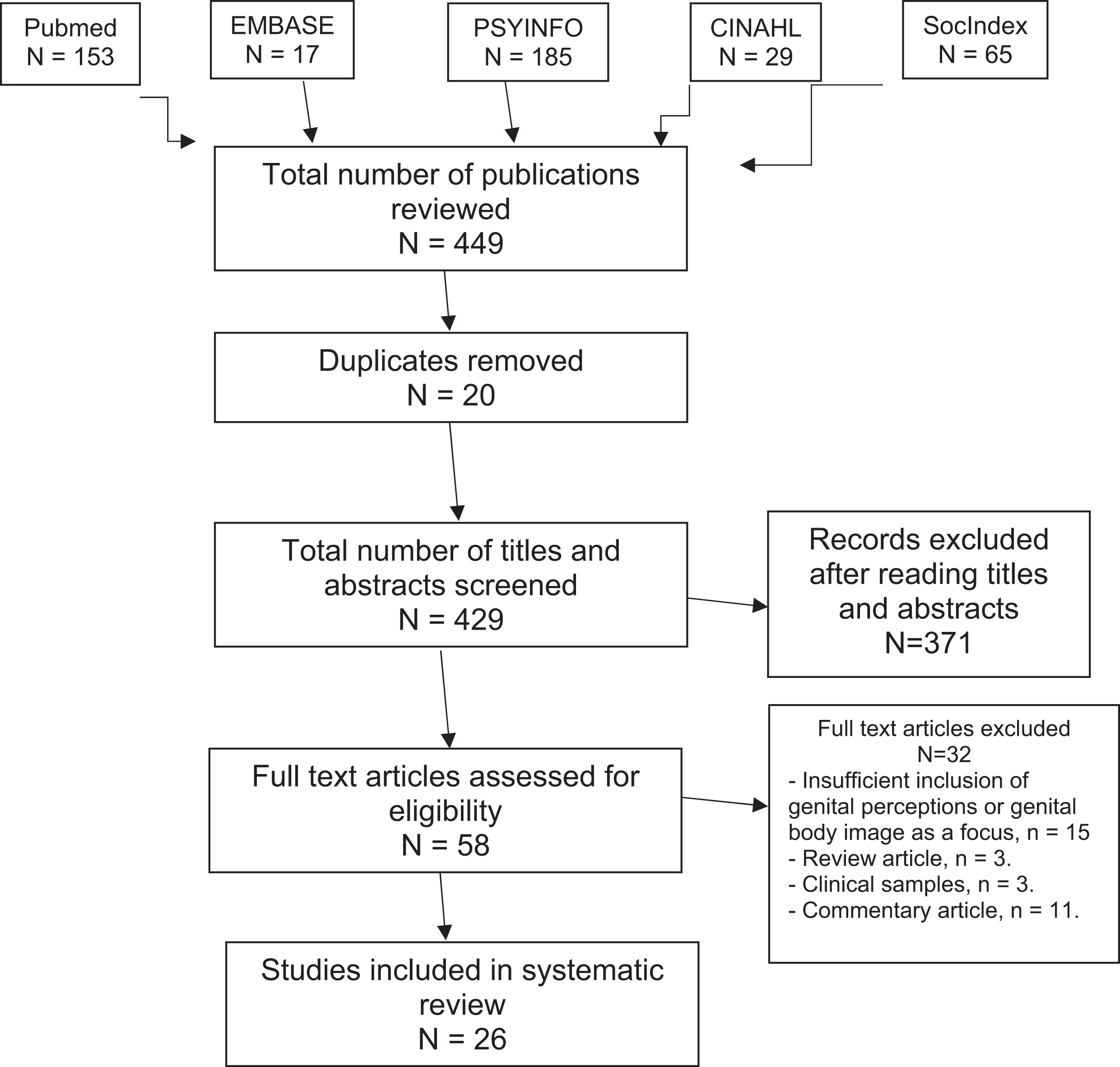
Flow diagram of search and selection strategy of included articles.
Study quality was assessed by authors employing the Timmer, Sutherland, and Hilsden (2003) checklist for qualitative studies and the National Institute for Health and Care Excellence (United Kingdom; 2007) appraisal checklist for quantitative studies. The Timmer, Sutherland, and Hilsden’s (2003) checklist for quantitative studies, which has been demonstrated to have good construct validity, was adapted for this review (three items pertaining to intervention studies were removed; Roy and Payette 2012). A total of sixteen items were utilized and, as per the guidelines, two points were allocated if the item was fully met, one if partially met and none if not met at all. Up to five extra points were awarded based on study design. A ratio score between 0 and 1 was computed, with 1 representing the highest-quality score and 0 the lowest.
The National Institute for Health and Clinical Excellence quality appraisal checklist for qualitative studies was used to assess the quality of the qualitative studies in this review (National Institute for Health and Clinical Excellence [NICE] 2012). It employs thirteen items to assess six components of qualitative studies (aims, design, recruitment and data collection, analysis, findings/interpretation, and research implications). Items were scored dichotomously, with total quality scores of “++” where an article has addressed at least eleven of the thirteen items, “+” for articles addressing seven to ten of the thirteen items, and “−” for articles addressing fewer than seven of the thirteen items. Quality ratings for each study are presented in Table 1.
Study Details and Summary of Results.

Note: BMI = Body Mass Index; DFSI = Derogatis Sexual Functioning Inventory; IIEF = international index of erectile function; IIED = International Index of Erectile Dysfunction; MGIS = male genital image scale; QoL = quality of life; SSS = sexual self-esteem scale.
Data analysis was undertaken by means of a thematic content analysis, whereby a systematic classification process of coding for themes by the two authors enabled a subjective interpretation of the data (Braun and Clarke 2006). The following five themes were identified: (1) subjective penis size estimation; (2) ideal penile size versus perceived reality; (3) relative importance of genital image dissatisfaction; (4) genital perceptions and self-esteem; and (5) psychosocial/sexual outcomes.
Results
Study Characteristics
The findings presented are synthesized from twenty-six studies (detailed in Table 1), published between 1995 and 2014, sampling a total of over 37,000 men worldwide. Nine of the twenty-six studies had samples that either partially or totally comprised gay/bisexual men (see Table 1). Sample sizes ranged from small-scale studies (Drummond and Filiault 2007; n = 14) to very large-scale surveys (Lever, Frederick, and Peplau 2006; n = 25,594). All studies were cross-sectional, twenty-two were quantitative, three were qualitative, and one consisted of a mixed-methods design.
Findings: Describing the Data
Five themes were identified: (1) subjective penis size estimation; (2) ideal penile size versus perceived reality; (3) relative importance of genital image dissatisfaction; (4) genital perceptions and self-esteem; and (5) psychosocial/sexual outcomes. Table 1 presents details of the studies in terms of methodological design, sample composition and demographics, study quality rating, key study characteristics (validated outcome measures), and a summary of results.
Penis Size Estimations
Five studies provided quantitative data on male perceptions of penis size compared to the norm (Lee 1996; Son et al. 2003; Lever, Frederick, and Peplau 2006; Grov, Parsons, and Bimbi 2010; Johnston, McLellan, and McKinlay 2014). Of these five studies, only one used a sample of gay men (Grov, Parsons, and Bimbi 2010).
Earlier studies into male penile perception estimates suggest that a large proportion of the population inaccurately perceived their penis to be smaller than it is objectively and thus believed their penis to be smaller than average (Lee 1996; Son et al. 2003). Similar results regarding “average” perceptions were reported by Lever, Frederick, and Peplau (2006) with a large-scale study of heterosexual men. Lever et al. found that that two-thirds of the (heterosexual) respondents rated their penis size as average, 12 percent rated themselves as below average, and 22 percent rated themselves as above average. Penis size perception was inversely correlated with age. These estimates are supported by Johnston, McLellan, and McKinlay’s (2014) research, which also found that most of their heterosexual sample accurately saw themselves as having an average-sized penis. However, differences between heterosexual and gay samples become apparent when Grov, Parsons, and Bimbi’s (2010) sample of gay men is used as a comparison. The latter report that a lower percentage of gay men rated their penis size as average (53.9 percent as compared to Lever et al.’s 66 percent of heterosexual men), but a much higher percentage rated their penis as above average (35.5 percent as compared to Lever et al.’s 22 percent of heterosexual men). Further, fewer in Grov et al.’s homosexual sample rated themselves as having a below average penis compared to Lever et al.’s heterosexual sample (6.9 percent compared to 12 percent). This is echoed in Moskowitz and Hart’s (2011) study of MSM, who generally rated themselves above average in response to items on masculinity and penis size.
While distorted penis size estimation error may form the basis for penis size dissatisfaction in some men, research has shown that even when men accurately perceive their size as being average, they may still experience dissatisfaction arising from dissonance between their accurate penile perceptions and preferred ideal size (Johnston, McLellan, and McKinlay 2014; see also Wylie and Eardley 2006). This theme of dissonance is discussed just below.
Mind the gap: Ideal penile size versus perceived reality
Ten studies provided quantitative data on male perceptions of ideal penis size versus perceived reality (Mondaini et al. 2002; Lever, Frederick, and Peplau 2006; Martins, Tiggemann, and Churchett 2008; Tiggemann, Martins, and Churchett 2008; Grov, Parsons, and Bimbi 2010; Algars et al. 2011; Ferreira dos Reis et al. 2013; Herbenick et al. 2013; Cranney 2015; Johnston, McLellan, and McKinlay 2014). Of these ten studies, only two utilized a sample of gay men (Martins, Tiggemann, and Churchett 2008; Grov, Parsons, and Bimbi 2010).
Four studies containing samples of heterosexual men (with medium- to high-quality scores) reported a high level of dissatisfaction with the size of the penis (Lever, Frederick, and Peplau 2006; Tiggemann, Martins, and Churchett 2008; Herbenick et al. 2013; Johnston, McLellan, and McKinlay 2014). Herbenick et al.’s (2013) study of heterosexual, gay, and bisexual men found the highest genital self-image among heterosexual men, followed by gay men then bisexuals. Among heterosexual men, the percentage of men who were dissatisfied with their penis and desired a larger one ranged from 45 percent (Lever, Frederick, and Peplau 2006) to 68 percent (Tiggemann, Martins, and Churchett 2008), with satisfaction with penis size decreasing as penis size perception decreased (Lever, Frederick, and Peplau 2006). Tiggeman, Martins, and Churchett (2008) also found that heterosexual men believed that their penis size was smaller than the body image ideal of the average man (the size that they believed other men would want). Herbenick et al.’s (2013) study found that one in five men indicated some dissatisfaction with their genital size, but this study did not provide data on the component genital body parts. A similar discrepancy between ideal size versus perceived reality among gay men has also been demonstrated by Grov, Parsons, and Bimbi (2010) who reported that over two-thirds expressed a desire for a larger penis. A similar study to Tiggeman, Martins, and Churchett (2008) but with a sample of gay men (Martins, Tiggemann, and Churchett 2008) demonstrated a discrepancy between their perceptions of their own penile size and their rating of the ideal size and of the male ideal (what they believe gay men would find most attractive); nearly six in ten respondents wished they had a larger penis.
Further, even men who perceive their penis to be of an average size express a desire for a larger penis (Lever, Frederick, and Peplau 2006; Grov, Parsons, and Bimbi 2010). This is supported by research which indicates that many of the men who seek penile augmentation do so in spite of having normal-sized penises (Mondaini et al. 2002). Indeed, this report notes that “…all penile measurements were within the normal range, which is defined by a length above the 2.5 percentile (flaccid length of 4 cm; stretched length of 7 cm).” The authors stated that there was an “absence of any penile abnormality” in their study (Mondaini et al. 2002, 285). In Grov, Parsons, and Bimbi’s (2010) study of gay men, four in ten respondents who perceived their penis size to be of an average size and 14.7 percent who reported an above average size, wished they had a larger penis. Similar findings have been reported in respect of heterosexual men. Lever, Frederick, and Peplau (2006) found that nearly half of the respondents reporting an average size penis also wished they had a larger penis, which is similar to the 45 percent of all respondents in the same study. Further, the desire for a larger penis (range 42–46 percent) does not significantly decrease as men get older (Lever, Frederick, and Peplau 2006).
Relative importance of specific body part dissatisfaction
Seven quantitative and two qualitative studies addressed the related issues of genital satisfaction, the relative importance of component genital parts, and the importance of these in relation to other body image concerns (Lever, Frederick, and Peplau 2006; Morrison et al. 2005; Drummond and Filiault 2007; Khan et al. 2008; Martins, Tiggemann, and Churchett 2008; Tiggemann, Martins, and Churchett 2008; Algars et al. 2011; Davis et al. 2013; Veale et al. 2014). Three out of the seven studies contained gay or bisexual samples (Drummond and Filiault 2007; Martins, Tiggemann, and Churchett 2008; Veale et al. 2014).
Studies addressing the issue of genital satisfaction and associated concerns indicate some variability in study results plus some differences according to sexual identification. Morrison et al. (2005) found generally high genital satisfaction scores among heterosexual men. The study highlighted that men are more dissatisfied with the length of their penis as opposed to other features of their genitals. This was also reflected in a study by Davis et al. (2013) of gay and straight men in their validation of the Index of Male Genital Image scale. The authors noted, despite their differences, that men generally scored highly on genital satisfaction ratings and the best predictor of genital satisfaction was (in order) penis size, shape, ejaculation, appearance, and circumcision status (whether circumcised or not). Circumcision, which is widely practiced among followers of Judaism and Islam as well as in the United States (World Health Organization 2008), has an important bearing on penile aesthetics because it is often experienced as beautifying and making the penis appear larger (Kennedy 2015) and perhaps more sexualized and adult-looking. Indeed, Kennedy draws attention to a complex politics of anticircumcision that promotes nonsurgical, do-it-yourself methods of foreskin restoration (the latter can involve stretching the remaining skin to cover more of the glans). This social movement regards both circumcision and surgical attempts to replace a foreskin as forms of mutilation that can impair rather than enhance sexual experience. The movement invokes the (socially constructed) idea of the foreskin as a natural masculine state that they have been denied. Lack of foreskin is felt to compromise status as a real/entire male. Further, Kennedy (2015) highlights how such discourses are implicated in “homosocial performances” that are obsessed with size and involve distancing from the feminine. Such thinking can be contrasted with work, for example, addressing transmen and the penis (Wylie, Wootton, and Carlson 2016) that self-consciously avoids gender in binary terms. Nonetheless, Kennedy’s theorizing usefully connects the kind of body projects she identifies with other kinds (i.e., Viagra or body building) and to the broader issue of how individualism encourages control/fixing of the body-self when (dominant) masculinity is felt as threatened. Also, this work usefully connects these body projects (like Viagra or body-building) to the broader issue of how individualism encourages control/fixing of the body-self when (dominant) masculinity is felt as threatened.
In contrast to Davis et al.’s (2013) observations noted in the previous paragraph on generally higher levels of satisfaction concerning penile dimensions and appearance, Khan et al. (2008, 41) concluded from their qualitative study of a heterosexual sample that “only a few men were satisfied with the size, shape and action of their penis.” A study by Veale et al. (2014) of gay and straight males revealed that 30 percent of study participants were dissatisfied with their penis size and 54 percent had concerns over penis size. Concerns over penis size also differed markedly by a margin of nearly 20 percent between heterosexuals (48 percent) and MSM (67 percent). Veale et al.’s mixed sample demonstrated that men with penis size concerns tend to be older and were more likely to be homosexual or bisexual (p < .05). Qualitative research by Drummond and Filiault (2007) further attests to the importance placed upon penis size by gay men and beliefs about how other gay men see size as an important signifier of masculinity.
Results from studies which have examined the importance of and concerns about the genitals in comparison to other body parts indicate that genital concern (but not importance of genitalia) varies as a function of sexual identification (Martins, Tiggemann, and Churchett 2008; Tiggemann, Martins, and Churchett 2008). While gay men have demonstrated dissatisfaction with the size of their penis (59.8 percent), the more visible body weight and muscularity rank higher in perceptions of being attractive and are parts of the body that give more cause for concern (Martins, Tiggemann, and Churchett 2008), though see the section below on psychosexual outcomes. While heterosexual men have also demonstrated penis size dissatisfaction, and to a higher degree, they too rank body weight, muscularity, head hair, and height as more important than penis size (Tiggemann, Martins, and Churchett 2008). Further, these two studies found that heterosexual men (Tiggeman, Martins, and Churchett 2008) and gay men (Martins, Tiggemann, and Churchett 2008) ranked penis size as the fifth most important body part, but heterosexual men ranked this third in terms of body parts causing “worry” and gay men as fifth in order of concern about aspects of the body. The latter datum indicates that penis size is more a concern for heterosexual men.
The relative importance of satisfaction with penis size and its relationship to body image satisfaction for heterosexual men is highlighted by two further studies (Lever, Frederick, and Peplau 2006; Morrison et al. 2005). Lever, Frederick, and Peplau (2006) revealed that heterosexual men’s penis size perception was significantly related to their satisfaction with other parts of body/traits, including the face, overall perceived physical attractiveness, and comfort of being seen in swimming trunks (where an outline of penile dimensions usually discernible—with or without padded gusset). Morrison et al. (2005) also established that genital perceptions were positively correlated with body image satisfaction among heterosexual men with the three key areas of genital dissatisfaction being the nonerect penis length (28.6 percent), penis circumference (15.9 percent), and penis appearance (25.4 percent). Further, a study by Algars et al. (2011), involving 3,331 men (sexual orientation unspecified), reported an association between overall body image and satisfaction with penis size.
Genital perceptions and self-esteem
Eight quantitative studies and one qualitative study provided data on genital perceptions and measures of genital, sexual, and overall self-esteem (Herbenick et al. 2013; Khan et al. 2008; Morrison, Harriman, et al. 2004; Morrison et al. 2005, 2006; Morrison, Morrison, and Bradley 2007; Tiggemann, Martins, and Churchett 2008; Grov, Parsons, and Bimbi 2010; Cranney 2015). Three out of the seven studies contained gay or bisexual samples (Herbenick et al. 2013; Grov, Parsons, and Bimbi 2010; Morrison, Morrison, and Bradley 2007). All studies had medium- to high-quality ratings.
While heterosexual men may worry more than MSM about their penis (Martins, Tiggemann, and Churchett 2008; Tiggemann, Martins, and Churchett 2008), this does not necessarily correspond to levels of genital self-image. Research indicates that genital perceptions and self-esteem vary to some extent by sexual identification. It has been demonstrated that heterosexual men have a higher genital self-image than gay or bisexual men (Herbenick et al. 2013), which is supported by findings that a high proportion of gay MSM admit to having lied about the size of their penis (Grov, Parsons, and Bimbi 2010). It has also been noted that men with children, more likely to identify as heterosexual, report higher levels of penile satisfaction and are less likely to be concerned about its size (Algars et al. 2011). Further, genital self-esteem is significantly positively correlated with sexual self-esteem in gay men (Morrison, Morrison, and Bradley 2007) and quality of gay life (Grov, Parsons, and Bimbi 2010). This could be linked to gay aesthetics that place a primacy on youthful appearance (Simpson 2015) such as a desire for more head hair if balding (a sign of ageing), less body hair, given the fashion for muscularity—a hairless or shaven body enables clearer display of a muscled torso (“six-pack”). We acknowledge, however, that gay aesthetics are more heterogeneous not necessarily tied to youth, for instance, “bears” (bigger/fatter, hairier men) and daddies (mature men; see Hennen 2005; Simpson 2015; Whitesel 2014). Nonetheless, we found that important factors associated with genital self-esteem for gay men include the desire for muscularity and internalization of homonegativity; factors which have been significantly negatively correlated with genital self-esteem (Carballo-Diéguez et al. 2004; Grov, Parsons, and Bimbi 2010; Morrison, Morrison, and Bradley 2007). Furthermore, sexual self-esteem and internalized homonegativity are also negatively correlated (Morrison, Morrison, and Bradley 2007).
Evidence suggests that while dissatisfaction with penis size is not a key predictor of overall self-esteem for heterosexual men, the importance that an individual places upon their penis size and anxiety over such a priority are key predictor variables (Tiggermann et al. 2008). In a multivariate analysis, worry about penis size came second in importance to worry about body weight in predicting self-esteem. Further, for heterosexual men, there is a significant correlation between genital perceptions and sexual self-esteem (Morrison et al. 2005), a negative correlation between exposure to pornography images on the internet and genital and sexual self-esteem (Morrison et al. 2006) and significant correlations between sexual experience and genital perceptions, sexual self-esteem, and sexual anxiety (Morrison, Harriman, et al. 2004). This is supported by Khan et al.’s (2008, 41) qualitative findings that heterosexual men watched pornography to learn what constituted a “good” penis, what good sex meant, where “the erect penis of a ‘sexually potent’ man is shown as 10–12 inches long” and a small penis is deemed shameful.
Also, the effects of pornography on genital and general self-esteem emerged as a key theme in seven studies (Cranney 2015; Khan et al. 2008; Lee 1996; Morrison et al. 2004a, 2006, 2007; Peter and Valkenburg 2014). While Kahn’s (2008) study allows that pornography can influence perceptions of “ideal” size and appearance, care should be taken to qualify the effects of pornography to avoid overstating its influences. Indeed, there is evidence that consumers are able to distinguish the exceptional from the ordinary in adjudging the penile proportions of pornographic actors atypical (Peter and Valkenburg 2010). Further, while the “big dick” discourse remains hegemonic, there is evidence of resistance to such thinking. In a qualitative study of photographic and social media images, Lehman (2007) has highlighted the complex aesthetics and politics of the penis. In particular, displays of the (smaller) penis on D-I-Y porn/sex sites and naked marchers at gay pride parades normalize diversity of shape and size. For Lehman, such instances render visible the smaller penis (with minimal shaft when flaccid) that has been absent from media and cultural production. The men involved in these activities are thought to expose the culturally constructed character of the desire for a large(r) penis.
Psychosocial/Psychosexual Outcomes: Masculinity, Body Image, and Sexual Practices
Ten quantitative studies, one qualitative study, and one mixed-method study provided data on psychosocial and psychosexual outcomes associated with genital perceptions (Del Rosso 2011; Reinholz and Muehlenhard 1995; Carballo-Diéguez et al. 2004; Grov, Parsons, and Bimbi 2010; Herbenick et al. 2013; Johnston, McLellan, and McKinlay 2014; Khan et al. 2008; Lever, Frederick, and Peplau 2006; Morrison et al. 2005; Nutgeren et al. 2010; Moskowitz and Hart 2011; Veale et al. 2014). Three out of the seven studies contained gay or bisexual samples (Grov, Parsons, and Bimbi 2010; Herbenick et al. 2013; Veale et al. 2014).
The psychosocial and psychosexual outcomes described in this review include experience of stigma, which can encompass embarrassment, level of comfort when seen in a swimsuit, hiding one’s penis during intimacy, lying about the size of one’s penis, sex role behavior, sexual experience and anxiety, depression, and social phobia. Approximately one in six men experience embarrassment in relation to their genitals (Herbenick et al. 2013). This is reflected in the relationship between perceived penis size and the level of comfort reported in swimming trunks and overall body satisfaction (Lever, Frederick, and Peplau 2006). Similar results were reported by Johnston, McLellan, and McKinlay (2014) who found that the level of comfort with others seeing their penis was related to a discrepancy between their reported and ideal penis size. As Lever, Frederick, and Peplau (2006) have documented, men who perceived their penis to be small were less likely to undress in front of their partners (15 percent) and were more likely to hide their penis during sex (15 percent) than those reporting average or above average size. Hiding the penis during sex was also related to penis size satisfaction. Nutgeren et al.’s (2010) study of heterosexual men (who perceived their penis to be “too small”) found that 67 percent of participants felt shame in intimate situations with women and in communal male showers.
Within one MSM study (Grov, Parsons, and Bimbi 2010), perceived penis size was unrelated to the number of sexual contacts. In contrast, within heterosexual samples, there appears to be a stronger relationship between genital perceptions and quantity and kind of sexual activity. For example, heterosexual men were more satisfied with their penis size and reported higher levels of sexual satisfaction, less sexual anxiety, and less delayed or premature ejaculation (Algars et al. 2011), though the direction of causality here is undetermined (Algars et al. 2011; Reinholz and Muehlenhard 1995).
Moreover, men who considered themselves underendowed reported discomfort when engaging in certain kinds of sexual activity, for example, fellatio in a heterosexual context (Reinholz and Meuhlenhard 1995). Consequently, such men made “careful partner choices” to find one who was supportive or understanding (Nutgeren et al. 2010). Finding such a partner may not be too difficult when women seem seldom concerned about penis size (Nutgeren et al. 2010) and prioritize other qualities or attributes, including emotional commitment (Illouz 2012). While Martins, Tiggemann, and Churchett (2008) have reported that for gay men, body weight and muscularity rank higher than penis size in perceptions of attractiveness, in contrast, Moskowitz and Hart (2011) conclude that for MSM, penis size and a general sense of masculinity are more influential than muscularity, height, weight, and hairiness on the role adopted during sexual activity, that is, whether individuals fulfill receptive or insertive2 roles. While there is a difference between these two studies in their findings of the relative importance of penis size, these outcomes can be interpreted in the light of the associations that were employed. In an Australian study populated by ninety-two gay men aged between 18 and 40 and largely resident (64 percent) in Sydney/New South Wales, Martins, Tiggemann, and Churchett (2008) found that penis size was not ranked highly in terms of the impact on men’s perceptions of themselves as attractive. In their study conducted in 2008, of 429 Canadian gay men (mostly white and aged between thirty and fifty years with a mean age of 40.88), Moskowitz and Hart (2011) found that penis size was considered an important body part in the determination of the role adopted during sexual activity (receptive or insertive). These two findings on the importance of perceived penis size are not necessarily conflicting: the former study relates perceived penis size to another self-perception (that of attractiveness), while the later relates it to one’s behavior that is one’s type of sexual interaction with another. Nonetheless, self-perceptions were by no means uniformly negative. For instance, Morrison et al. (2005) found that heterosexual male nonvirgins evidenced more favorable genital perceptions than male virgins. Similarly, sexually active males reported more favorable genital perceptions than nonsexually active males. In their study, virgins were those who had never engaged in anal or vaginal intercourse, while nonsexually active refers to those who had not been sexually active within the four weeks immediately preceding participation in the study. This finding is echoed by Reinholz and Muehlenhard (1995) who reported that genital perceptions were positively correlated with the frequency of sex.
Concerns over perceived penis size also affect experience in social domains where, for example, men have reported lying about the size of their penis to maintain masculine status. A negative correlation between perceived penis size and lying about penis size was reported by Grov, Parsons, and Bimbi’s (2010) gay sample and this held true even for those men who perceived their penis to be of an average size; 38.6 percent of such men stated that they had lied about the size of their penis. While the perceptions of penis size among gay and bisexual men have been found to be unrelated to their frequency of sexual partners (Grov, Parsons, and Bimbi 2010), there would appear to be a strong association between penis size and sex role behavior. Grov, Parsons, and Bimbi (2010) reported that gay men with below average penises are more likely to identify as “bottoms” (taking an anal-receptive role) and those with above average penises are significantly more likely to identify as “tops” (taking an anal-insertive or more dominant role). Similar findings were reported by Moskowitz and Hart (2011) and Carballo-Diéguez et al. (2004). This potential relationship between penis size, sex role behavior, and perceived masculinity has some support from the qualitative research of Khan et al. (2008). This study in Bangladesh reported that a large penis was associated with being “sexually potent,” while a small penis was a “weak” penis one that was deemed shameful. The authors argued that “the penis is situated at the core of masculinity” (2008, 45) and that “the size, shape, length, appearance and overall performance of a penis are crucial indicators of cultural concepts of masculinity” (2008, 45–46). Such thinking is redolent of Del Rosso’s (2011) ethnographic study where a small penis was considered stigmatizing and men reported anxiety about exposure and fear of shame and ridicule and Buchbinder’s view of masculinity as “phallocentric” (1998, 49).
Wider psychosocial adjustment effects for gay men have also been reported. Gay men who perceive their penises to be below average size have been found to also score lower on gay life satisfaction, promoting the positive aspects of one’s life and higher on gay-related stigma (Grov, Parsons, and Bimbi 2010). Veale et al.’s (2014) study of heterosexual and gay men found wide-ranging associations with beliefs about penis size which positively correlated with anxiety, depression, and social phobia. Such beliefs also negatively correlated with body image quality of life, erectile function, satisfaction with penis size, importance attached to penis size, and concerns about penis size, shape, or appearance.
Discussion
Following the above format, we discuss the theoretical implications of the findings in terms of size estimations; the ideal versus reality, which we have collapsed with considerations of genitalia and association with self-esteem; dissatisfaction with the penis in relation to other elements of body image; and psychosexual and psychosocial outcomes. Our analysis concerns men’s responses to normative masculinities, which, although subject to change, are those which are more highly esteemed, legitimated, and require a distancing from femininity or gender ambiguity (Connell [1995] 2007). Our findings indicate support for Connell’s (1995) theory of hegemonic masculinity where concerns about penis size as part of this discourse can weigh just as heavily if not more on heterosexual men. As intimated, this concept refers to a culturally idealized form of manhood that undergirds a hierarchy that privileges all-round strength including economic and political power (at institutional and interpersonal levels) as well as physical strength and essentially “manly” characteristics (Wylie and Eardley 2006), which could include being well-endowed as an enhancer of masculinity (Lever, Frederick, and Peplau 2006). Hegemonic forms of masculinity are thought to be implicated not just in the subordination of women but also of nonnormative expressions of masculinity like those associated with gay men or straight men who cannot or even refuse to embody performances of masculinity associated with aggression, competitiveness, and domination.
Further, we would support Moore’s (2002, 2007) appropriation of Connell’s concept in her exploration of the symbolic value of semen. For Moore, hegemonic masculinity, as expressed in scientific and popular discourses concerning semen, works in ways that naturalize (as common sense) sexual and gender differences and inequalities. Indeed, the author argues that in an era of gains in equality for women courtesy of feminism, scientific sperm narratives (which have commonly used metaphors from football, competition/war, and motor racing) reproduce heteronormative beliefs about gender which sustain hegemonic masculinity.
Size Estimations
The tendency across studies for men to estimate within the average range is clear (Lee 1996; Lever, Frederick, and Peplau 2006), and it appears that older men also seem prone to underestimating their penis size. This desire to appear within the normal range indicates the operation of discursive pressure to avoid a stigmatized masculinity that risks ridicule. The age dimension suggests the strength of this discourse may not diminish as men grow older and especially among gay men (Veale et al. 2014), who might remain sexually experimenting into midlife and beyond (Simpson 2015). This phenomenon could also be connected with a wider perceived loss of masculinity with age as physical, economic, and political power might also diminish as men are thought to lose status as they grow older (Connell and Messerschmidt 2005). MSM’s tendency to claim a larger size (Grov, Parsons, and Bimbi 2010) indicates pressures to claim legitimate masculine status (on heteronormative terms) and thus belonging within a sexual hierarchy where they are less esteemed as men and where (even in conditions of greater tolerance toward gayness) their masculinity is in doubt because the benchmark is heterosexual (Connell [1995] 2007). It should be borne in mind that MSM will have grown up in normatively heterosexual male social worlds. Such a conclusion is indicated in Moskowitz and Hart’s (2011) study which found that gay men tend to rate themselves as above average on (related) items concerning penis size and masculinity.
The Ideal, the Reality, and Self-esteem
Although the majority of men regardless of sexual identification described themselves as being within the average or normal range, there were high levels of dissatisfaction with penis size (Lever, Frederick, and Peplau 2006; Tiggemann, Martins, and Churchett 2008; Algars et al. 2011; Herbenick et al. 2013; Johnston, McLellan, and McKinlay 2014). It has also been observed that gay men commonly report larger sizes (Grov, Parsons, and Bimbi 2010) yet record lower genital self-esteem than heterosexuals (Herbenick et al. 2013). Again, a normative masculinity could be at work when it appears that men with children (commonly heterosexual) are less likely to be exercised by penis size, having affirmed their masculinity through reproduction (Algars et al. 2011). It appears that the common desire even among those of average size for a bigger penis affects men regardless of sexual identification (see Lever, Frederick, and Peplau 2006, for heterosexuals, and Grov, Parsons, and Bimbi 2010, for homosexuals).
In humanistic psychology, which stresses human needs for self-realization, self-esteem has been theorized as a function of the gap between the ideal self (what we would like to be) and the actual self (what we think we are). These selves operate dialectically and are products of a mix of the individual’s own self-perceptions and understanding of how others view us (Rogers 1980; Malär et al. 2011). The reasoning here is that the smaller the gap between the two selves, the higher the self-esteem and vice versa. While it appears that size matters to many men, we need to bear in mind the contexts in which such concerns are articulated. Indeed, it seems likely that influences of penis size on overall esteem are fairly negligible as is evidenced in findings on pornography use (Cranney 2015; Khan et al. 2008; Lee 1996; Morrison et al. 2004a, 2006; Morrison, Morrison, and Bradley 2007; Peter and Valkenburg 2014). However, evidence in Algars et al. (2011) indicates that, where this does it occur, it is likely to weigh more heavily on MSM, which, again, suggests the operation of heteronormative, phallocentric masculinities that equate authentic masculinity with larger penis size.
The Penis and General Body Image
In terms of satisfaction with the penis itself, findings remain variable and inconclusive from Morrison et al.’s (2005) finding of generally high genital satisfaction scores among heterosexual men to Veale et al.’s (2014) finding of higher levels of dissatisfaction with penis size that was heightened among (older) gay men. Such differences could reflect sample bias and/or cohort characteristics, though it appears that the penis is the main component of satisfaction with genitalia and was prioritized even over general appearance of the latter and ejaculation (Veale et al. 2014). However, again, concerns about the penis are contextual when we consider that, regardless of sexual identification, anxieties can be related to even eclipsed by anxieties over other aspects of the body. Morrison et al. (2005) and Algars et al. (2011) showed an association between satisfaction with penis size and overall body image among heterosexual men and apropos gay men penis size was ranked lower in gay men’s considerations of importance (and attractiveness; Tiggemann, Martins, and Churchett 2008) than straight men (Martins, Tiggemann, and Churchett 2008). Not only do such findings highlight how men generally negotiate masculine attractiveness and the need to appraise the penis and attractiveness in terms of wider bodily, psychosocial, and psychosexual contexts, they also present a challenge to reductive, homophobic stereotypes that construct gay men as obsessed with genitalia and sexual activity (Drummond and Filiault 2007; Klesse 2012). Such findings also offer support for Bordo’s (1999) theorizing that media and societal attention on men’s bodies, now more commodified and (appropriately) sexualized, have meant that younger heterosexual men face pressures similar to gay men to manufacture a more athletic look.
Psychosexual and Psychosocial Consequences
As intimated, the self-perception of falling short of the better-endowed masculine ideal can influence not just identity performance but also psychosexual behavior. The reviewed studies have tended to highlight the stigma of the small penis as lack of masculinity when we consider men’s attempts to hide or disguise putative underendowment (Lever, Frederick, and Peplau 2006; Johnston, McLellan, and McKinlay 2014; Lever, Frederick, and Peplau 2006; Nutgeren et al. 2010; Reinholz and Meuhlenhard 1995). A smaller penis could affect sense of stigma and quality of life for gay and straight men (Veale et al. 2014). However, we also need to consider the psychosexual contexts for the responses of MSM and straight men to a small penis, which reflect a key distinction between them and can affect each group in different ways. While we have noted the operation of heteronormative discourse on MSM’s accounts of penis size, this has not gone without challenge. Despite gay men’s prioritization of penis size, it appears that having a small penis is not necessarily a barrier to sexual contact or experimentation with many partners (Grov, Parsons, and Bimbi 2010). This is reinforced by findings in the previous paragraph about the lower ranking accorded to penis size by MSM in relation to other physical attributes. This makes sense when we consider that the nonnormative positioning of MSM, as a “subordinated” form of masculinity, furnishes opportunities for critical deconstruction of notions of a “real” or hegemonic masculinity (Connell 1995; Carballo-Diéguez et al. 2004). Another distinction for MSM is that perceptions of penis size can influence the role adopted during sexual activity, that is, whether receptive or insertive (Grov, Parsons, and Bimbi 2010; Moskowitz and Hart 2011; Carballo-Dieguez et al. 2004; Khan et al. 2008). This indicates another expression of heternormativity that can encourage MSM (and wider society) to apprehend gay sex though the lens of heterosexual gender differences. In sum, we see a range of contextual responses to a small penis by sexual identification, psychosocial, and psychosexual contexts.
It is worth considering the impact of circumcision status upon men’s perception of their penis, for while research is limited within nonclinical populations, this has been raised by some studies evaluating patient satisfaction following urological surgery (where circumcision was an additional outcome of the procedure; e.g., Aulagne et al. 2010; Mureau 1997; Bracka 1999; Eray et al. 2005). It may be expected that the impact of circumcision status upon men’s perception of the penis may be culturally determined; in some countries, it is considered the norm and desirable, whereas in others, its incidence is rare and may cause social embarrassment. Considering the importance of circumcision as one aspect of penile appearance, it is worth noting Ruppen-Greeff et al.’s (2013) study which while reporting differences in genital perceptions between male patients who had undergone penile surgery and controls also found that these differences persisted in statistical analyses even when the variable of circumcision was held constant.
While much of our findings and discussion on men’s accounts of the penis in research offer support for hegemonic masculinity theory, such theorizing warrants some discussion in view of recent challenge to it. Although it doesn’t specifically focus on concerns with the penis, inclusive masculinity theory (IMT) has developed a critique of hegemonic masculinity. IMT holds that cultural change, mainly in the form of secularization and emergence of the women’s and gay liberation movements together with socioeconomic changes associated with globalization, have resulted in lower levels of “homohysteria” and sexism (Anderson 2010). Such changes have facilitated exploration of a wider range of more emotionally attuned masculinities organized more horizontally than hierarchically that incorporate progay and progender equality stances and thus represent a challenge to existing power structures. In view of the social changes identified, IMT argues that hegemonic masculinity, with its emphasis on hierarchy and a dominant kind, has little explanatory value in a more egalitarian age where men are more emotionally attuned.
We certainly recognize the profound changes in masculinity brought about in response to the work of liberation movements, but we also concur with Bridges and Pascoe (2014) that the “hybrid masculinities” identified by IMT, which involve borrowing from subordinate masculinities such as gay/emotionally sensitive men, reveal more about the flexibility and survivability of patriarchal discourse, and social–institutional structures. Such expressions of masculinity obscure and, in doing so, help to shore up existing systems of dominance and inequalities between men as well as between men and women. If anything, IMT, based largely on research with young, white, middle-class heterosexual men, focuses on styles of emotional self-expression and leaves unexamined underlying differences in social positioning and enduring power asymmetries. Having the cultural resources (privilege) to incorporate hybridity (borrowed from gay struggles for recognition and equality) suggests renewal not replacement of the patriarchal dividend and is the antithesis of challenge to the status quo. Indeed, hybrid masculinities are often expressed in ways that define selves against nonwhite and working-class men who are represented as bearers of regressive masculinity. Again, such thinking simultaneously obscures and reestablishes rather than blurs sexual differences inequalities that result from differentiation (Bridges and Pascoe 2014; Ward 2015). Similarly, and in relation to the penis, Kennedy (2015) has argued that while a movement of men seeking foreskin restoration challenge dominant penile aesthetics (in favor of circumcision in the United States), emphasis on the foreskin as restoring length, and priority accorded the penis in their definition of masculinity reinforces hegemonic masculinity.
Finally, a strand of poststructuralist–feminist scholarship has highlighted changes, courtesy of Viagra, in expectations of performance of the (ageing and/or faulty) penis. Loe (2001) has highlighted a crisis in masculinity in terms of how erectile functioning has become even more closely tied to legitimate and hegemonic maleness. On this view, failure to achieve tumescence represents a “broken masculinity” that can now be repaired by a quick technofix, which itself represents an intensification of pharmacological–discursive control over sex, gender identity, and reproduction. The pathologization of erectile dysfunction as failed heteromasculinity (seen largely as a physical problem for men) is further examined by Potts (2000). This work extends hegemonic masculinity theory in ways that recognize its implication in reductive, genitocentric view of male sexual pleasure that impairs its enjoyment at physical and emotional levels.
Concluding Thoughts
This structured review has addressed a gap in knowledge concerning how heterogeneous accounts of the penis by men expressing different forms of sexual identification (heterosexual, gay, and MSM) indicate a variegated politics of the penis. Such a politics involves diverse ways of negotiating penis size (inter alia) as a totem of masculinity. Our review has highlighted contradictions in perceptions and accounts of the penis, drawing attention to both convergences and differences between the accounts of heterosexual and MSM concerning penis size and overall body image, the latter suggesting the endurance of a more traditional, heteronormative masculinity, as theorized by Connell (1995, 2005), which can have esteem costs for both heterosexual men and MSM. It appears that hegemonic masculinity remains the organizing principle of men’s accounts of and relations with the penis.
The intended audience of this article is wide-ranging. It is hoped to be of value to not only academics working in the area but also health-care professionals, surgeons and, not least, those who are the subject of this study via distributed health-care information, support, and minority interest group websites.
There are some limitations to this study. First, non-Anglophone research or that reported in the “gray” literature has been missed. The inclusion and synthesis of studies from different countries may have affected the validity of the synthesis due to cultural nuances and differences. Second, while the majority of studies had medium- to high-quality ratings, a small number (n = 4) did score lower. However, the peer-reviewed nature of the studies represents a modicum of quality. Third, the greater bias toward studies concentrating on heterosexual samples provides somewhat unbalanced samples for comparison, though some pertinent results have been obtained by synthesizing the available research. Directions for future research clearly indicate not only a need for more samples containing MSM but also for studies with samples of MSM and heterosexual men that enable comparison and contrast. As part of an agenda for research, we have highlighted the need for studies exploring penile aesthetics (which include circumcision status—whether men are “cut” or “uncut”) and penile anxieties among male virgins or those who are not sexually active. We also advocate studies on transmen and concerns/practices in relation to prosthetic or fashioned penises and the testing of hegemonic masculinity in relation to men from differing ethnic communities and disabled men (currently conspicuous by their absence from scholarly work) and how such influences interact with social class in relation to stories/concerns about the penis.
Moreover, there were variations between studies in terms of sampling strategy. Some limitations include small sample sizes, convenience sampling and response rates, sampling methods, or measurements not being reported. We are also conscious that our analysis reflects the apparent bias in the literature toward “Western” samples save for those few articles that focus on Asian (Khan et al. 2008), Latin American (Carballo-Diéguez et al. 2004), and South East Asian men (Son et al. 2003). Nevertheless, the issues just described highlight the need for more robustly designed comparative studies that might also factor in the influence of the ageing process more fully to understand specific body image concerns and their correlates. Further limitations are related to the fact that different measuring instruments were used across the studies, some validated and others not. This is an indication of the relative infancy of research within this field and also acts as a guide for greater rigor and consistency in future studies.
However, we consider the limitations of the study counterweighted by contributions to knowledge and by the fact that our arguments are informed by theorizing of Connell (1995), which not only explains reasons for penile/bodily anxieties but also serves as a resource to question hegemonic masculinities and recuperate various other forms. In more practical terms, our theoretically informed work could help counselors and clinicians develop both common and differentiated resources and strategies for helping and advising men who present with concerns about penile/genital dimensions. Note that anxiety appears endemic—an institutionalized and widely internalized narrative. Practitioners could, depending on service users’ circumstances, emphasize a form of size realism (see Wylie and Eardley 2006), which owns that well-endowed porn star dimensions are uncommon; bodily factors over which men can have more control (such as weight and appearance); and that partners are usually more concerned with broader aspects of subjectivity. We would though qualify that more effort needs to be made by specialists to make helpful information available in plainer terms that are accessible to nonspecialists and their significant others who are seeking or in need of support. Such information could be used to inform and educate through public literature and group events, meetings and conferences, and so on. Fundamentally though, our study has illustrated how concerns at the individual/microlevel are inextricably linked with broader social issues. Following the sociological classic, it seems that privately felt concerns have decidedly social causes (Mills 2000).
Footnotes
Declaration of Conflicting Interests
The author(s) declared no potential conflicts of interest with respect to the research, authorship, and/or publication of this article.
Funding
The author(s) received no financial support for the research, authorship, and/or publication of this article.