



Abstract
The aim of this article is to engage with unaccompanied migrant Maghrebi boys’ styles of physical self-presentation, “looks,” and hairstyles as a source of knowledge on the construction of masculinities. In order to observe such bodily expressive practices, we used general ethnographic methodology and, in particular, a workshop built around different artistic techniques. Since masculinity is inextricably defined in relation to specific agents and contexts, insights into unaccompanied migrant teenagers’ enactments of masculinity are dependent on (1) the collective imagination lying behind such “looks” and bodily images, (2) the discomfort and tensions created in the institutional communities in which these minors live—especially among social workers, and (3) the dialogue and relationships that emerge between the aesthetic and bodily expressions of these young migrants’ own culture and those of the other cultural groups that coexist, in our case, in a European city.
Taking advantage of my visit to Bilbao (Basque Country, Spain), I met up with Rayan 1 and let him know how the thesis was coming along. I brought a printed draft of the thesis for him to take a look at. We agreed to meet at Abando railway station (Bilbao) where he was waiting for me with a friend who was currently living at the residential center where he too had been staying a year ago. Both of them were perfectly presented. Rayan had his hair brushed in a quiff. He was growing it out in order to cultivate a samurai man bun (see Figure 1).

Hairstyles. Left, Rayan’s current hairstyle and right, a samurai man bun. Illustrations by Jesús Belizón, illustrator and graphic designer, who the first author came to know through one of the participants who follows him on Instagram.
Leaving Abando station, we strolled toward the Plaza de Moyua. As we walked, they explained to me how the center had changed since I finished my fieldwork. Rayan’s friend, who had evidence of self-harm around his shoulders, said goodbye when we got to the square to let us work undisturbed.
We began looking through the manuscript. We came to the chapter on body grooming and I explained that much of the work done on the bodily appearance of young migrants focused, for example, on self-inflicted lesions “like the ones your friend had,” but not really on other aspects, such as the importance of clothing or hair care. As he perused the chapter and saw the pictures, he said: “For me, my hair is the most important. If I had to leave the house without combing my hair…I just wouldn’t go out.” Then he explained why his friend had cut himself: “He did that on his arms because he is going through a bad time with his girlfriend. His girlfriend is not well, she wanted to kill herself…They drugged her and raped her and another friend…she doesn’t remember anything, and he doesn’t know how to help her.”
Rayan’s story in this opening vignette illustrates how the body becomes capital through which young migrant men can express their experiences and subjectivities (Despret 2004; Latour 2004; Michael 2000; Thorsen 2014). Thus, Rayan turns our attention to the male body as a subject of analysis. In one regard, it underlines how care of the hair (and body) orders young migrants’ daily lives and identities. At the same time, it illustrates how, in periods of stress and anxiety, the body is also a canvas upon which to display both anger and frustration (Empez 2015; Rodríguez 2011, 2015).
Nevertheless, there has been no thorough research into embodiment and masculinity that focuses on the cases of the unaccompanied minors embarking, over recent years, on the irregular migration from North Africa to Europe. In the absence of apparent family, and therefore legally categorized as “unsupported,” these young migrants are either cared for institutionally by local public organizations for child protection (Gimeno 2015; Jiménez 2015) or disappear entirely.
In this article, we explore the shaping of transnational masculinity (Connell 2015; García Selgas 2016; Hearn, Blagojević, and Harrison 2013; Jansen 2008), arguing against the “disembodiment” often found in the media and in scholarly work on the men of the Middle East and North Africa (MENA; Ghannam 2013, 4). The term “disembodiment” refers here to the tendency to equate a person with their mind, paying little or no attention to aspects such as their emotions, feelings, or their physical appearance in terms of body, hair care, and clothing (Ghannam 2013).
This article focuses specifically on young unaccompanied migrants aged sixteen to seventeen years, who have left Morocco to build a life in Spain, particularly in Bizkaia (Basque Country). As these minors cross the border without the presence of a responsible adult, they are deemed to be “unaccompanied.” In recent decades, young unaccompanied migrants who migrate irregularly to Spain have been received in the residential centers of the regional protection services. Thus, in line with international and local agreements, the authorities take on responsibility for them as legal guardians until they reach the age of majority. The numerous unaccompanied foreign minors arriving in Spain over the last twenty years have proved a challenge for protection services, which have been forced to adapt their procedures to the specific needs of these adolescents. In Bizkaia, these young minors live in residential centers dedicated to unaccompanied foreign minors, that is, separate from Spanish minors also in care.
It should be noted here that these unaccompanied minors are marked by an ambiguity of status, being both minors and foreigners. On the one hand, they are considered
Since we started our ethnographic work in different facilities for “unaccompanied foreign minors” in 2014, the male body as an object of analysis became fundamental to our understanding of the daily lives of these young people and the tensions generated between them and their teachers. The way these young men worry about their hair, their clothes, the brands they wear, and the colors they combine is very apparent. Indeed, the first dispute we observed between two young men at the Urrun 2 residential center was over a hair trimmer. This fight was followed by multiple pleas by minors to their teachers to buy hair dryers and straightening tongs. It was common to find these youngsters spending their afternoon with hair straightening masques in their hair or spending their little money on anti-dandruff shampoo. This surprising concern over hair caught our attention from the start.
As will be seen in this article, we understood that the complex negotiations around the meanings assigned to masculinity occur in the flow of everyday life (Coffey 2016) and that there are different ways of “doing” masculinity. Masculinity can be presented as a space for resistance and action but sometimes for exchange and for participation within the target culture (Connell 2015; Coles 2008; Jensen 2010). However, despite the importance that young migrants place on their daily aesthetic practices and body care regimes, there is almost no research into how these young migrants groom themselves (Empez 2015; Gimeno 2015; Rodríguez 2015). Thus, the focus of this article is on aesthetic practices expressed through clothing, dress, and hairstyle. By “aesthetic practices,” we mean the empirical reality of dressing bodies and hair care. The approaches we draw on derive from anthropological traditions that regard clothing and hair practices as a form of material culture, a type of situated body practice, and part of the lived experience of people’s lives (Guy, Green, and Banin 2001; Hansen 2004; Weber and Mitchell 2004; Miller and Kuchler 2005).
As we will see in this article, these young people, from their marginalized positions as institutionalized migrants, participate in the processes of globalization in becoming subject to the influences of global and local youth cultures in their looks and hairstyles (Thorsen 2014). But at the same time, they are producers and promoters of such cultures (Corsaro 1992; Hearn 2015; Osella and Osella 2000). This focus is important for a group such as unaccompanied migrant teenagers from the Maghreb (North Africa), who are not normally considered within studies of fashion. Even as ethnic minorities, whose dress is often regulated by the institutional communities in which they live, these youth do influence fashion norms. In the era of globalization, consumption is a form of participation (Hearn 2015), but for these young migrants, it is also a way to “buy” the “looks” that demonstrate their transition from dependent children to independent young adults and successful migrant men (Osella and Osella 2000; Veale and Donà 2014). Their position as both young people and migrants allows them to develop hybrid cultural identities that mix here with there while remaining connected to their global peer culture (Bartholomaeus and Tarrant 2016; Corsaro 1992; Mendoza Pérez 2015).
Here, we aim to contribute to current studies on gender and masculinity by engaging with migrants’ styles of physical self-presentation as a source of knowledge revealing social, economic, political, cultural, and religious forces. In addition, this contribution is specifically situated in an area of two frontiers—migration and youth culture (Corsaro 1992)—two vectors that are defined by trajectories in which new cultural productions meet or fail to meet but also by the reproduction of cultural practices that in the meeting between the here and the there are legitimized (or not) by the various institutions and social agents within which these minors coexist. For this purpose, we will explore the male body as a subject of analysis, observing the body care regimes and aesthetic practices adopted by unaccompanied Maghrebi migrant teenagers in terms of relevant “looks” and hairstyles.
Studying Migrant Youth in Basque Country
This article draws on an ethnographic study carried out over fifteen months between April 2014 and June 2015, in four different facilities that attend to unaccompanied migrants in the province de Bizkaia (Basque Country, Spain). Until about twenty years ago, the reality of unaccompanied foreign minors was unknown in Spain in terms the provision of resources for the care of children and adolescents at risk (Gimeno 2015; Jiménez 2015; Mendoza Pérez and Belarra 2015). But with the increase in numbers of young people in this situation since the year 2000, it is an issue that has taken on increasing importance for social services, both in Spain and in the rest of Europe (Cemlyn and Nye 2012; Gimeno 2014; Hek, Hughes, and Ozman 2012; Hopkins and Hill 2010; Kohli 2006; Shamseldin 2012; Westwood 2012).
Although, geographically speaking, Bizkaia (Basque Country, Spain) is one of the provinces furthest from Spain’s southern border, it is the primary point of entry for these minors. Within the Spanish state, it is one of the main provinces in which they settle or seek transit to the rest of Europe (Ararteko 2014; Mendoza Pérez and Belarra 2015). The majority of unaccompanied foreign minors in Bizkaia comprise male teenagers, aged fifteen to seventeen, from Morocco (80 percent), Algeria (9 percent), and West Africa (11 percent).
In this article, we will focus exclusively on one of the four facilities where we met these unaccompanied minors, the Urrun residential center. Urrun is located at a good distance from the city center in Bilbao, in an outlying rural area. At the beginning of our study, the center was divided into four sections, each catering to about twelve minors with seven caretakers 3 working in shifts.
Our aim was to explore the day-to-day presentations of the body, that is, the aesthetic practices of these unaccompanied migrant teenagers, in order to analyze how masculinity was embodied. In terms of methodology, we were aware of the limitations of certain data-gathering techniques
With this in mind, and given that our aim was to turn our attention to the communicative power of corporeal expression, wherein the body, hair, and physical grooming take on a predominant role (Ghannam 2013; Pink 2004), we chose to organize workshops built around different artistic techniques that would invite young migrants to become active participants in the generation of data about their daily lives, which naturally included their concern for their physical image and their personal grooming routines (Mendoza Pérez and Morgade Salgado 2016; Morgade Salgado and Müller 2015; Pink 2004, 2012). The final fruits of the workshops included highly personalized cartographic representations of Bilbao and its surroundings, and a similar mapping of Tangier (Morocco), along with a sixteen-minute documentary in which the participants talk about their lives at the residential center. Both in the process of mapping the city and recording the documentary, as well as in the final products themselves, the personal experiences and day-to-day lives of the participants are clearly documented. This methodology also allowed us to generate knowledge and to represent and disseminate it in various ways and formats, thereby facilitating the generation of multiple forms of knowledge (Pink et al. 2010; Wright and Schneider 2010). By using ways for understanding that go beyond oral or written language, such as images, videos, or performances (Morgade Salgado et al. 2016), our study allowed young interlocutors to participate in multiple forms of expression.
The workshops took place between March 26 and June 4, 2015, chiefly in a space provided by the Bilbao Fine Arts Museum, with the participation of five minors, plus two students of social integration, and the first author of this article. In this space, we organized twelve sessions, one weekly two-hour session, to which we attached five sessions of filming and photography in the streets of Bilbao and in the residential center (see Figure 2).
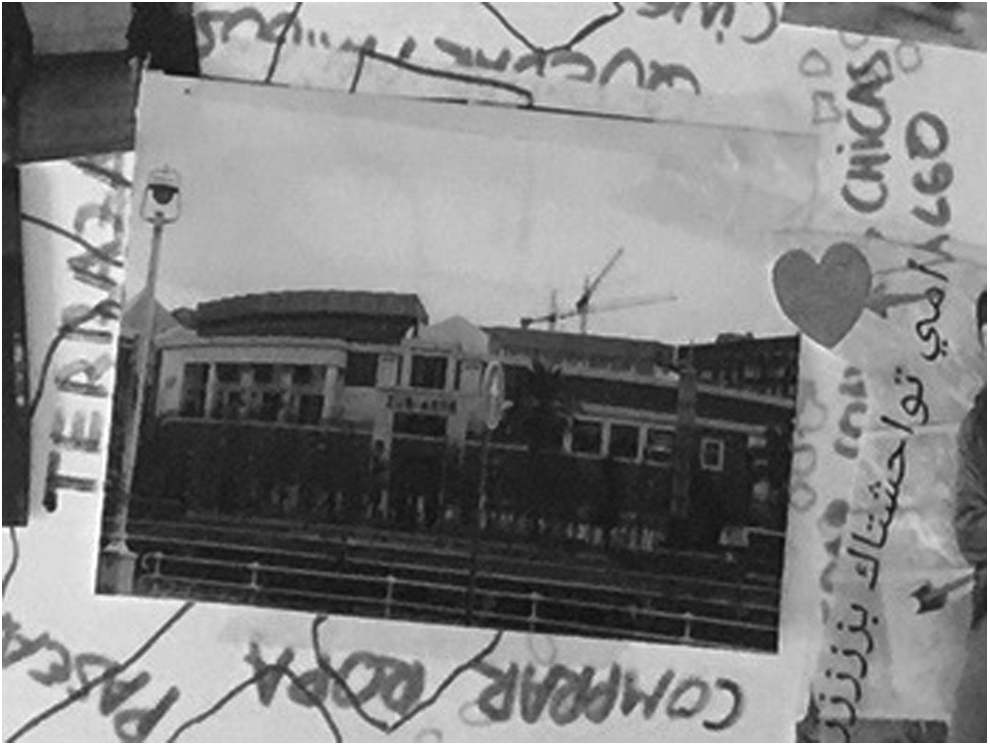
Shopping centers, clothes, and girls. Photograph taken from the maps generated in the workshops showing one of the shopping centers depicted. Surrounding the photo of the Zubiarte shopping center (Bilbao) appear the words: buy clothes, meet girls, take a walk, pavement cafés, meet friends.
Beyond the final products of the workshops themselves (a sixteen-minute documentary showing life in the city center and maps of the cities of Bilbao and Tangier, sites of their daily practices), the process (i.e., how things were made, the material chosen or rejected as part of the final product, etc.) was vital to an understanding of the meanings of such products. Thus, all workshop sessions were recorded and later transcribed, and field notes were also taken after each session. Furthermore, all pictures and videos produced by participants were filed together with the notes taken by the researcher on how they were recorded.
Clothing as Aesthetic Practice
The aesthetic practices of these young migrants are also expressive practices with more than just personal significance, which take place in contexts of social interaction, such as at school, at the residential center, in their country of origin, at leisure sites, on social media, at the hairdresser’s, and so on. In this way, these young adolescent migrants, through their aesthetic practices, establish a relationship between the world of the adolescent, the consumer market, their culture of body care, the culture of the residential center, their family back home, the hairdresser’s, and beyond, producing their own aesthetic dynamics (Osella and Osella 2000; Thorsen 2014). These aesthetics, their development and circulation, are part of what authors such as Corsaro (1992) define as “peer culture” or “youth culture” (Corsaro 1992; Thorsen 2014). Today, such youth culture is reinforced by the use of mobile phones, which play an important role in its spread (Chittenden 2010; Ito et al. 2009a). But at the same time, in the case of young migrants, youth culture must be thought of as transnational or an enormously rich mix of cultures in which young people are positioning themselves and making decisions about their aesthetics.
Migrant adolescents, like any other teenagers (Chittenden 2010), are going through bodily changes and learning who they are and how they fit into the world, which means that clothing and body care take on a major role in their daily lives. Meanwhile, in the residential center, the practices of physical grooming of these minors are regulated by rules and institutional routines.
These youngsters are aware that clothing is a sign of social status, acting as an element of class identity (Bourdieu 1984). Thus, clothing functions as a marker distinguishing class and is an aspect of cultural capital. Through clothing and the care taken over it, elites establish, maintain, and reproduce positions of power, reinforcing relations of domination and subordination (Bourdieu 1984). But these young people also understand that their bodies and the way they dress constitute a projection of themselves that precedes them, introducing them, and inserting them into communication with others (Barthes 1990; Davis 1994; Lurie 1992).
Fragment 1: Notes from the Field Diary, February 30, 2015
I was in the grounds eating toasted sunflower seeds with five minors from different blocks. I noticed that Mohammed and Nabil were wearing the same blue tracksuit with yellow stripes, so I asked them about this tracksuit. Mohammed looked with displeasure at the tracksuits they were wearing: “we all look the same”. They explained to me that in the Initial Reception Centre everyone is given the same clothing. He was waiting anxiously for them to buy him some new clothes now that he was in Urrun.

Reflection. Photographic still captured from the documentary.
The clothing issued by the initial reception and residential centers reflects the intention to promote a certain austerity in the interventions with these young people (Beck [1999] 2007, 129). Meanwhile, the exuberance of the aesthetic promoted by the young people themselves shocks care workers (Jones 2013, 17) and clashes with the symbolic structure based on an assumption of victimization and exclusion from the world of consumerism that underlies the administrative policies covering these minors (Gimeno 2014, 153).
Dressing the body is a proactive process with room for choice, expressiveness, and agency (Finkelstein 1991; Polhemus 1994; Thorsen 2014). This is why the different aesthetic practices that these young people actively develop are a very useful way of building the persona they want to present to the world, one which is no less complex than that of their individual characters (Weber and Mitchell 2004).
Fragment 2: Notes from the Field Diary, June 3, 2016
Whenever I return to Bilbao I call up the workshop participants to spend some time with them. It is nice to catch up with them and to visit those places that they once marked on their maps. I met up with Mouad at Abando station; he was happy that we were going to see each other again. He had not seen Yassine for a long time either, because he is now in an apartment for former residents of the Residential Centre in Leioa (Bizkaia) and does not often come down to Bilbao. Jokingly he told me that he was not sure that Yassine would recognise him because every time they see each other, he’s wearing a different style of clothing. He was dressed in drainpipe trousers pulled up over his ankles, an open checked shirt over a t-shirt that was longer at the back than the front. His sneakers were a Nike green camouflage pattern. Personally, it did not strike me that he had changed as much as he claimed. However, he added that he no longer liked trousers like the ones he was wearing, because “I’m too old for these trousers.” As we were walking through Bilbao we entered a sports shoe shop where they looked at the prices and new ranges from Adidas and Nike. Yassine then bought an imitation Louis Vuitton bag from the manteros (illegal street vendors) for €10. After buying it, he realised that it was defective and showed his annoyance.
As we see in this vignette, care over body image not only consists of the act of dressing, it also incorporates activities such as shopping. Shopping centers, whether visited with an intention to buy or not, have become “meeting points” where young people and teenagers parade their current “look,” a creation of a unique and individual version of the self through consumer goods (Osella and Osella 2000; Twigg 2014). These looks transmit information to their peers that would not be communicable in words (Solomon 2008; Weber and Mitchell 2004). In addition, going shopping does not merely involve the requirement of time and money, it also forces us to see our own bodies reflected, both personally and through the eyes of others, in the search for the “look” that will best transmit who we are or would like to be (Weber and Mitchell 2004).
Yet, in their situation as young migrants within the juvenile protection system, it is the center that supports them, which controls the material resources that would enable the acquisition of clothing. In this case, the center only allocates two payments annually of €75 to cover the purchase of clothes. Such limited and infrequent amounts of money generate moments of significant tension between the boys and their teachers. The former ask that the two annual payments are made when the sales are on, in order to be able to buy more. The latter complain because the youngsters only want designer shoes rather than necessary basic clothing. Conflicts over the regulation of purchases are interpreted in different ways. The preoccupation of the minors with certain brands is understood by teachers as an enslavement to a level of consumerism beyond their means, and they are seen as constantly “demanding” and “abusing the system” (Rodriguez 2015). However, for these young men, designer sneakers or clothes are symbols of social position that will increase their social visibility in certain contexts.
Consumerism represents the route to integration into the globalized symbolic structure that has been established for middle-class young people from the local population, something from which these migrant minors seem to be excluded until they obtain employment (Osella and Osella 2000; Thorsen 2014). However, despite this exclusion, migrant minors generate a range of alternatives, sometimes legally dubious (Mucchielli 2013), which offer the possibility of expanding their clothing budget, but with the clear intention of integrating themselves into the lives of the local adolescents. For example, it is common for these minors to share photos on social media displaying different looks that they are trying out in the changing booths of shops. At the same time, there is a strong sense of solidarity among them, and the loan or exchange of clothes is common. Thus, a pair of sneakers or a T-shirt might be worn by a number of people other than the owner. Furthermore, some young migrants somehow acquire designer clothes and shoes that cannot be accounted for by the residential center and would indicate a purchasing power beyond their weekly €10 allowance.
Bad Hair Days
In the course of history, hair has taken on importance in areas as diverse as biology, religion, and medicine as well as the social and political sciences. For example, anthropometry has used hair in the identification of different races. Meanwhile, many groups have used hairstyles as an aesthetic feature indicating identification with the group to which they belong (e.g., the shaved hair of the “skinheads”) but also with the desire to differentiate themselves from other groups (e.g., the long hair of “hippies”). In the rites of different religions, hair, and indeed the body, also plays an important role in the corporeal presence of both men and women (Byrd and Tharps 2014).
For these young migrants, as in their Arab and African cultures of origin, hair plays an important role and forms part of daily personal and social rituals (Byrd and Tharps 2014). Rayan opened this article by telling us that he would not leave home without doing his hair. However, on more than one occasion, he went out with his hair unbrushed or not to his taste, but this was not apparent to others because he hid it beneath a cap or hood. Thus, Rayan and Jamal explained that, in Spain, if they do not have time during the week to comb their hair properly, they will go to class wearing a cap. But on the weekend, they comb their hair, applying gel and wax, and, if necessary, go to the hairdresser where, once a fortnight, they invest part of their weekly allowance.
For these young people, doing their hair is synonymous with displaying a good image in society. Indeed, sometimes they will cut their hair prior to an important event.
Fragment 3: Notes from the Field Diary, March 2, 2015
Tomorrow, Mohammed is moving to the Basic Care Network,
4
which he is very happy about. For the occasion, he wants to look “handsome and give a good impression,” so he has asked one of the teachers in our block for permission for Abdul, a boy from another block who studies hairdressing, to come and cut his hair. Abdul tells him how he intends to cut his hair. Mohammed leaves him to do it as he likes, only asking him to leave the front and the top longer to allow his highlights to show. He shaves the back of the neck and leaves the hair longer as he works his way up, keeping the highlights. On one of his temples, he creates shaves two lines. Mohammed is satisfied with the result and declares himself “ready to go to the new flat.”

Stars. Photographic still captured from the documentary where one of the Yassine’s haircuts is shown.
Respect for their families, which would limit the possible hairdos available to these teenagers, is often extended to other figures such as their teachers. Thus, Mouad tells me that he would love to dye his hair blonde and may do so in the summer. His idea is to dye it blonde for the summer and then shave it off when he starts back after the holidays because he does not want to show up to class with dyed hair “out of respect for the teacher.”
As we can see, hair dyeing or shaving patterns into the hair is another way for young migrants to perform their personal identity through experimenting and trying new things, given that piercings and permanent tattoos that other boys of their age might wear are considered haram under Islam. However, despite this prohibition, some minors fantasize about getting such piercings. Thus, Rayan, on returning one day from the workshop, when passing a piercing shop, told us that he would like to get several piercings such as in his lip or tongue.
Returning to the question of hair, the creation of hairstyles that transmit who they are or want to be does not take place at an individual level but is rather a co-construction arising from interactions in different contexts such as on social media, in groups of friends, at school, at the hairdresser’s, among others. In particular, social networks are a good place to look for inspiration but also to share new haircuts and get feedback from others (Chittenden 2010). Likewise, hair salons and hairdresser’s form the cornerstone that feeds and shapes the highly varied hair tastes of these minors. But the hairdresser’s is also an ideal place for interaction and exchange with other Maghrebi boys (Alexander 2003; Byrd and Tharps 2014; Edwards 2008). For these young migrants, hairdresser’s, in both Morocco and Bilbao, are spaces where, in addition to having their haircut, they can have a good chat about things that matter to them. Going to the hairdresser’s is another opportunity for cultural development, maintenance, and dissemination that goes beyond mere aesthetics (Alexander 2003).
Fragment 4: Notes from the Field Diary, April 3, 2015
We met up to take a walk around Bilbao together and to take photos of the places we were going to talk about in the map-making workshops. We had to wait a quarter of an hour for Yassine and Mouad, who were delayed because they were at the hairdresser’s cutting their hair. Mouad still had a few stray hairs on his face, which Rayan, on seeing them, brushed off with a tissue. During the walk the allusions to the hairdresser were constant. Several participants explained that in Morocco they went to the hairdresser frequently (more or less once a fortnight) and that here they tried to go just as frequently by spending their weekly allowance on it. A haircut in an Arab hair salon in Bilbao is usually around €6 to €8. In Morocco, when they were small they used to be accompanied by a relative, but when they were considered to be old enough they went alone. Going to the hairdresser alone is accepted by parents as part of growing up and becoming a man. Rayan described with pleasure the visits to the hairdresser’s in his neighbourhood: “You went there, waited, you chatted a bit with the hairdresser, you know? He’s from your neighbourhood so he knows about what’s going on there.”
However, the teachers, who wield the power in the residential center, try to instill their own aesthetic values by criticizing the young people’s hairstyles. Some Spanish-born teachers try to convince them not to dye their hair or get designs drawn on their heads, arguing that: “the girls here don’t like these types of haircuts.” The teachers often brand haircuts, hairstyling, and hair care as “gay.” In fact, I have heard teachers say to boys: “I didn’t recognise you with that poncey fringe you’ve given yourself,” or otherwise ridicule their hairstyles.
Fragment 5: Notes from the Field Diary, February 30, 2015
I was outside, waiting for the lads from my block to arrive on the bus. I saw four boys come out of the Residency block with very similar haircuts; they looked like a mosaic of different layers. One of the lads sat down to wait for someone on the stairs. Then the director passed by; he looked at the boy’s haircut, then looked at me, sitting further away, and shouts over to me: “Have you ever seen anything so ugly?” I did not answer. Without asking permission, he tried to take pictures of the boy’s haircut on his mobile phone. The youngster said nothing, but he covered his head with his hands to prevent him from taking the photograph.
Conclusion
As we have seen throughout these accounts, the new masculinities that these young Maghrebis present through their aesthetic practices, embodied in different “looks,” can be seen as a space of resistance and action, as well as in some cases a means of exchange with one another or a form of participation in the local culture (Connell 2015; Osella and Osella 2000). In general, these unaccompanied, male migrant teenagers from across the Maghreb pay great attention to their aesthetic practices and the ways they present themselves physically in public (Mendoza Pérez 2015; Osella and Osella 2000). They invest as much money as they can spare in maintaining “cool” haircuts and employ a wide range of strategies to acquire fashionable clothes to wear and color-coordinated outfits for when they go out or for the images they share on social media. Fashion and hairstyles represent a key source of empowerment for adolescents, providing a range of material and symbolic resources from which to create identities (Chittenden 2010; Subrahmanyam 2015). These young migrants are aware that they are under the gaze of others and will be judged in part by their appearances. However, such judgments are sometimes directly opposed to what the young people intended to provoke.
In addition, when we talk about migrant minors, we cannot overlook their use of new communication and information technologies. These are “connected” migrant teens who hold conversations and exchanges in local, national, and global contexts (Connell 2015; García Selgas 2016; Hearn, Blagojević, and Harrison 2013; Jansen 2008; Ito et al. 2009b). As we have seen, they might draw inspiration for a new haircut from the Internet, or from the illustrations of Jesus Belizón, and at the same time share their new haircut on social media in the hope of feedback, thereby reaching unsuspected places. Thus, sharing pictures showing their current “look” on the Internet has become an important way for migrant teenagers, and teenagers in general, to learn about themselves and explore their relationships with others (Chittenden 2010; Ito et al. 2009a). The ability to display oneself visually, through pictures, videos, and emojis, in a digital space draws on a postmodern aesthetic, which Creeber (2009, 17) describes as indulging in “increased levels of intertextuality, generic hybridity, self-reflexivity, pastiche, parody, recycling and sampling.” In this way, by sharing their pictures on the Internet, migrant teens have the opportunity to play with the ways they represent themselves to others, learning from how people respond to their posts, but also acquiring a deep knowledge of the tools they use to do so (Chittenden 2010).
The emergence of new arenas of social relationships on a global scale creates new patterns of “doing” masculinity (Connell 2015; Coffey 2016; Grogan and Richards 2002; Griffiths 2015; Norman 2011). These populations and their diasporas are involved in a constant exchange of ideas about bodily presentation, male hairstyling, care regimes surrounding the body, and the like (Gimeno 2015). Consequently, Samurai man buns are reaching Morocco, and the importance of hair salons and hair care is spreading among teenage men in Spain (Hearn, Blagojević, and Harrison 2013). We should remember that, unlike in Europe and the Western world in general where the trend is toward an aging population, in postcolonial Arab societies, young people account for more than half of the total population. Thus, the transnational circulation of discourses and images representing the “desirable” physical appearance for these adolescent men is contributing to the slow transformation of masculinities on a national and international level.
In summary, simple stories about unaccompanied migrant teenagers who care about their clothes, shoes, and hair involve mundane issues that are nevertheless important to write about in order to counter stereotypes and generalizations about these young men and Middle Eastern men in general (Abu-Lughod 1989; Connell 2015; Ghannam 2013; Inhorn 2012). Thus, studying the aesthetic practices of these unaccompanied migrant teenagers means approaching the concrete and more “humanist” realities of these young people and exploring the social and political hierarchies that shape their bodily appearances and their subjectivities (Ghannam 2013; Griffiths 2015; Inhorn 2012). But in addition, it implies recognizing their complex nature as subjects, being sensitive to their daily concerns, frustrations, achievements, failures, and successes. In other words, it means understanding the unaccompanied migrant teenager as an embodied agent (García Selgas 2016; Hearn, Blagojević, and Harrison 2013) who pays attention to his bodily presentation and cares about his appearance within a complex transnational context.
Footnotes
Authors’ Note
Karmele Mendoza Pérez is currently affiliated to Facultad de Educación, Universidad de Extremadura, Badajoz, Spain.
Declaration of Conflicting Interests
The author(s) declared no potential conflicts of interest with respect to the research, authorship, and/or publication of this article.
Funding
The author(s) received the following financial support for the research, authorship, and/or publication of this article: The authors thank the Basque Government Department of Education, Language Policy and Culture for awarding the first author of this article with the Non-doctoral Research Staff Training Program which led to the development of this research.