




Abstract
One of the side effects of India’s rapid socioeconomic transition has been a growing demographic masculinization with millions of “missing” women. Modern technologies have enabled couples to determine and select the fetal sex. Since the 1990s, political efforts to control sex selection have met with little success. This article assesses policy effectiveness and the role of political masculinities in India’s fight against sex selection. This qualitative analysis draws from policy files and forty-seven in-depth semistructured expert interviews conducted in Delhi, Punjab, and Haryana in 2014–2015. Interview participants included national policy makers, state and district implementers, and representatives from nongovernmental and international organizations. This article finds that state action against sex selection frequently follows the logic of “protecting,” “tracking,” and “emancipating” females—analogue to roles of a family patriarch toward his kin and thus reproducing gender biases and undermining policy efforts against sex selection.
Keywords
India has been fighting declining child sex ratios for over three decades with numerous policies and programs to enhance the value of the “girl child,” yet little progress has been made to balance the scales. At the heart of the diverse forms of discrimination girls face before and after births lays at large a patriarchal kinship system. India has a strong tradition of patriarchal, male-headed households in which assets are passed through the male line, and exclusive privileges are given to sons over daughters. Girls are frequently marginalized, discriminated against, or equipped with fewer resources, resulting in excess female mortality. Patriarchy runs through the society and its institutions. It is therefore not surprising that at times political institutions, actors, and policies produce, reproduce, or promote patriarchal value systems. In order to understand why the government lacks behind in tackling sex selection, this article explores the role of political masculinities as representations of a “patriarchal” state.
This article extends the logic of the different roles a family patriarch may play toward his kin to the roles of the state toward its citizens (Young 2003). By doing so, this article explores the different facets of political masculinities. By political masculinities, I refer to both individual and institutionalized expressions of masculinity. On the one hand, political masculinities are the masculinist/gendered attitudes, practices, and behaviors of individual agents in political power—who may be male or female. On the other hand, political masculinities are—on a more abstract level—representations of a patriarchal sociopolitical system.
The purpose of this article is to reveal (gender) attitudes and behavior representative of government officials tackling sex selection. I take Purewal (2010, 35) as a starting point and follow her question, “What do [political] acts against female infanticide or foeticide represent which fail to challenge and/or which operate from within the very structures of caste and masculinist power which sustain it?” Differently put, to what degree does political action against sex selection sustain or reproduce the same gender biases, which are the root of the problem? By revealing gender biases in anti-sex selection campaigns and discourse as expressions of the “paternalism of the state” (Purewal 2010, 45), I show how the Indian government undermines its own efforts in tackling sex selection.
Over the past three decades, India has emerged as one of the largest and fastest growing economies in the world. Rising income levels and better job opportunities have alleviated poverty and improved the lives of many. Yet, many of India’s 1.25 billion inhabitants have been left behind. Over 20 percent of the population live on US$1.90 or less per day, and over 50 percent lack access to sanitation (World Bank 2016). Among the most vulnerable—beyond caste, class, religion, ethnicity, and linguistic background—are women and girls. In this largely patriarchal country, women have been marginalized and discriminated against for centuries leading to excessive female mortality at different stages of their lives—from female infanticide to sati. 1
Against the backdrop of a rapidly developing economy, which has led to an improved status for many women, a new form of gender discrimination has emerged: the elimination of females before they are born (Croll 2000). Paradoxically, it has been the more educated and wealthy urban families who have turned to prenatal sex selection. 2 The access to ultrasound and modern reproductive technologies has enabled couples to determine and select the fetal sex in their aspirations for small families with at least one son (Guilmoto 2009). As a consequence, millions of females have silently disappeared (Sen 2003). Bongaarts and Guilmoto (2015) estimate that forty-six million Indian women have gone “missing” between 1980 and 2015 due to prenatal and postnatal gender discrimination. Recent Government figures even point to sixty-three million women missing ( Times of India 2018).
This growing demographic imbalance is reflected in skewed sex ratios at birth (SRB) and child sex ratios (CSR) in the zero to six age-group. 3 The abnormally low number of girls born and entering childhood in comparison to boys has caused concern not only among human rights activists but also among the media, the international community, and within the Indian government itself. Indeed, the long-term, multigenerational consequences of gender-biased sex selection (GBSS) 4 are ominous. In societies were females are scarce, women are more likely to suffer from increased gender-based violence, bride trafficking, and other human rights violations. Men suffer from forced bachelorhood which impacts their physical and psychological health and contributes to rising disaffection and crime (Kaur 2013).
Since the 1990s, political efforts to combat GBSS and reverse the trend of a declining CSR have continuously increased. A comprehensive legal framework has emerged with the passing and the amendment of the Pre-Conception and Pre-Natal Diagnostic Techniques Act (PC-PNDT Act) in 1994 and 2003, respectively. The act bans the use of all diagnostic techniques for the purpose of sex determination. Violations of the law are not restricted to sex determination but also apply in the case of improper record keeping or nonregistration of equipment. This has allowed the government to make the implementation of the law more stringent. Besides the ban on sex selection, the government has introduced numerous awareness-raising campaigns, schemes, and conditional cash transfer programs to enhance the value of girls. The current government has further increased efforts to combat sex selection with the launch of the 2015 Beti Bachao Beti Padhao (hereafter BBBP) 5 flagship program under Prime Minister Narendra Modi.
Despite these efforts, SRB and CSR have continued to deteriorate, with some exceptions, and the problem has spread into formerly nonaffected areas. 6 Some suggest that the PC-PNDT Act has prevented a worse scenario (Nandi and Deolalikar 2013), while others claim it has failed to correct the situation due to poor law enforcement (Asian Centre for Human Rights 2016). Scholars have pointed to existing biases and confused messages in the campaigning against sex selection (Joseph 2007; Naqvi 2008). However, the overly masculinized messages, attitudes, and practices by state representatives themselves have escaped research attention. In order to understand why policies have been unable to effectively address sex selection, political masculinities must not be ignored. Studying political masculinities can help us to better understand gender biases and son-preferring attitudes within the sociopolitical sphere.
According to Priola (2010, 548), “To avoid the articulation of singular and stereotypical images of femininity and masculinity, gender analysis needs to focus on practices and analyze the roles that such practices play within a variety of organizations (e.g., bureaucratic and nonbureaucratic) in maintaining and reiterating gender inequalities and oppression.” We therefore review different practices or approaches of sex selection prevention and analyze the gendered roles of such practices (as a reflection of the power dynamics between the state and its citizens). I draw from the work of Young (2003) who established the “logic of masculinist protection.” By that she referred to a “paternalistic state power, which gets its support partly from the unity a threat [e.g. war] produces and our gratitude for protection” (Young 2003, 2). I show that Young’s concept is not just applicable to states during wartime, but that the logic of masculine protection also applies to “save” citizens from internal, sociodemographic threats like sex imbalances.
Political masculinity studies are an emerging research field in India. 7 This article aims to contribute to this field by investigating political masculinities in the context of sex selection and son preference. Nanda et al. (2014) have provided an analysis on masculinities, son preference, and sex selection in seven states of India, yet political masculinities were not treated in the study. Purewal (2010) deals with the concept of a “paternalistic state” and traces its origin back to the colonial and postcolonial discourse on son preference in South Asia. Her work provides valuable insides for this analysis. Feminist activists have criticized the “patriarchal politics” (Kumari 2014) for hampering female political participation, and lawyers have criticized gender biases within the Indian legal system for hindering gender equality (Singh 2013). However, the link to policy (in)efficacy has not been made explicit. By going beyond current explanations, this article suggests that the role of political masculinities provides a further reason for the limited efficacy of policies against GBSS.
Method
This article forms part of broader research project on policy interventions against sex selection and their effectiveness in selected Asian countries. This broader research project was designed to understand what governments do to tackle sex selection and how effective it is? To answer this question, the author visited areas with some of the highest SRB where anti-sex selection efforts reportedly had made a difference by improving sex imbalances. 8 In India, it became apparent over the course of many interviews that the language that was being used by bureaucrats was unusually masculine and gender biased. This motivated the author to investigate the themes of masculinity that emerge among government officials addressing sex selection.
Theoretical and Conceptual Considerations
This article’s broader conceptual and theoretical framework was inspired by Peng (2011) who places public policies within their broader social, political, and economic contexts. The idea is that policy effectiveness cannot be measured as a simple connection between policy and its outcome. In this case, the simple connection would be between the anti-sex selection policy and the changes in reproductive behavior reflected in improved SRB. Instead, the analysis has to take into account the sociopolitical milieu these policies act in. We offer one window into this complex milieu by revealing (gender) attitudes and behavior representative of government officials tackling sex selection.
Data Sources
The qualitative analysis was performed using two data sources collected between December 2014 and July 2015: (a) forty-seven in-depth semistructured interviews with government officials and nonstate actors directly concerned with anti-sex selection policies and (b) a desk review of policy documents including laws, policies, programs, and campaigns against sex selection carried out in India between 1994 and 2015.
Participants
Participants were selected through a snowball sampling. The author made initial contacts during a 2013 United Nations Population Fund (UNFPA) conference on GBSS in New Delhi that brought together policy makers, activists, and scholars. Potential interviewees were contacted that formed part of the small pool of initial informants who provided further contacts to interviewees who met the selection criteria. The selection criteria were that they (1) were directly involved in anti-sex selection policy, (2) represented a broad cross section of different viewpoints on the issue (i.e., different levels of governmental and nongovernmental organizations [NGOs]), (3) had their principle experience in states or districts where sex selection was politically prioritized. 9 The diverse backgrounds of the interviewees, who are engaged in anti-sex selection efforts at different levels, allow us to examine the role of political masculinities from multiple angles. 10 The respondent’s demographic information is given in Table A1.
The participants included five national policy makers, five state officials, seven district officials, five doctors, 10 NGO members, nine scientists, and six representatives of international agencies. All interviewees were one way or another directly involved in informing anti-sex selection policies (e.g., through research, capacity building, awareness raising, political activism, policy design, implementation, or evaluation; A detailed list of the interview participants is given in Table 3). This article draws from all forty-seven interviews but places specific focus on the sample of policy makers (seventeen interviews). These are current and former senior government officials of the Ministry of Health and Family Welfare (MoHFW) and Ministry of Women and Child Development (MoWCD) at the central level, state-level PC-PNDT Nodal Officers, and district-level authorities including deputy commissioners, health workers, and child development project officers. As mentioned earlier, the language used by these political actors was unusually masculine, which led the author to investigate further the role of political masculinities. It is important to stress that the analysis goes beyond representations of masculine or feminine behavior of the individual but rather stresses how sociolinguistic gender biases can be a reflection of unequal power dynamics and gender hierarchy.
Procedure
The interviews were guided by an interview schedule with a set of eight predetermined questions revolving around four topics: (1) sex imbalances in the given locality; (2) policies and stakeholders/institutions addressing sex selection in the given locality; (3) implementation, monitoring, and evaluation of policies against sex selection; and (4) personal gender preferences for children. The same key questions were asked to all respondents, but there was a degree of flexibility with regard to the order of questions and expertise of the participants. The interviews lasted seventy minutes on average. They were conducted in English. When prior authorization was given, the interviews were voice recorded. Otherwise extensive notes were taken. The data were subsequently transcribed resulting into forty-seven word documents with a total length of 300,000 words over 500 pages.
Method of Analysis
The analysis is conducted within an essentialist/realist paradigm, in which the connection between meaning and language is straightforwardly interpreted. Responses were analyzed using N-Vivo software (version 11.4.0) and following the inductive thematic analysis procedure described by Braun and Clarke (2006), which included six steps: Getting familiar with the data set: this included rereading of the transcribed interviews and notes taken during the interview. Initial coding of the collected data: the entire data set was imported into N-Vivo software and coded. Initial coding phase included conducting word frequency and text search queries. Searching for emerging themes: candidate themes were identified and codes (e.g., “women’s safety,” “pregnancy tracking,” and “women empowerment”) were clustered under the corresponding themes. Reviewing themes: in a next step, I measured the theme frequency and verified the completeness and accurate representation of themes. Naming themes: I choose to stick as closely as possible to the language used by experts. For example, I use “tracker” instead of “controller” theme, even if latter may be more accessible to a wider audience. On the other hand, I deviated from the language used by experts and used “emancipator” instead of “empowerment” theme because “emancipation” (literally referring to “to detach from a guiding hand”) fitted the theme precisely. Presenting results: the final step included the write-up and argumentation to answer the initial research question.
Limitations
Due to the inductive approach of this thematic analysis from a data set designed for a larger research project, the author makes no claims to exhaustiveness or general applicability herein. The sample size of the data set (forty-seven participants) is insufficient to make specific claims representative of all India. The intention is rather to draw a greater picture of political voices from a select sample of experts from various geographic places and sociopolitical levels that are most critically engaged in anti-sex selection policies.
Results
The political discourse on sex selection is highly gendered. The thematic analysis points to three dominant themes. Government officials stress the importance of “protecting,” “tracking,” and “emancipating” females in order to address sex selection. The logic behind each of these pragmatic approaches is very different, yet their commonality is that they all put men in a dominant role to women. The result has been a patronizing environment for women, which hampers policy efforts designed to improve gender equity.
The “protector,” “tracker,” and “emancipator” schemas are analogous to patriarchal father figures toward their children or wards, which are characterized by a dominant-subordinate hierarchy and power dynamics. Their logic, structural elements, and frequency in the interviews are summarized in Table A2.
Protector Schema
The protector schema refers to the basic logic that women and girls are “vulnerable” and require ongoing (state) protection by powerful men to ensure their safety. 11 One of the reasons for preferring boys or for not sending girls to school or extracurricular activities is that parents must fear for the safety of daughters much more so than for sons. Structural elements of the schema are the male protector versus female protectee. The key words used in this schema were “save,” “protect,” “guard,” and “secure” in relation to women, the girl child, girls, daughters, and fetus. The protector schema was the most frequent theme in the data set.
Seventy-four percent of all interviewees (80 percent of males and 70 percent of females) stressed the government’s role in protecting its female citizens making as many as seventeen references throughout one interview. The government’s paternalistic role to protect females throughout their life cycle was emphasized by 65 percent of the policy makers and 80 percent of nongovernmental actors. “The government is paternalistic in many ways…in some cases men start working for women, rather than with women” (IN 39). As the quote illustrates, the government but also individual state representatives were conceived as masculinist or paternalistic.
The following examples are from district, state, and national authorities and illustrate the protector schema. The responsibility of protecting female fetuses, in particular, was frequently assigned to local- or even village-level officials. We start out with one district officer who stated that the local leaders are directly responsible for saving female fetuses of their villages: “Sarpanch [village head] is the king of the village. Once he is the king of the village, he also has certain responsibilities. Power doesn’t come free. Powers come with responsibilities. Why can’t we impose a responsibility on him being a custodian of the human resources, that he shall preserve every fetus…It is our responsibility to guard her—the female fetus” (IN 35).
In this case, the elected village head is described as a powerful male authority, “the king of the village,” and it shall be within his power to be “a custodian of the human [female] resources.” In the quote, the district official describes the village head’s and his subordinates’ direct responsibility to protect (guard) female fetuses. Notice that the language is such that there is no abstract term of government or community responsibility nor is there a reference to cooperation or participation in tackling sex selection. Instead, there is a reference to forcefully “impose” responsibility to lower administrative levels. The dynamic here is a single male authority is tasked to protect its female villagers. District officials in Shahid Bhagat Singh Nagar (formerly Nawanshahr district) in Punjab reported that they used to follow the same strategy by holding village heads directly responsible for the bad sex ratio of their village. “He [the district collector] declared that the Sarpanches would be targeted, if the sex ratio was found in a bad condition” (IN 18; which was confirmed by IN 16 and IN 46).
While at district level the political pressure to improve sex ratios is frequently passed down to village heads, state-level officials seek cooperation from an “aggressive” media to raise awareness on the issue. “If the media takes it up on a war footing, there is no reason why we [authorities] can’t save daughters” (IN 21). Successes in actually saving girls were reported with significant (male) pride. “You will definitely agree with me, it’s very difficult to save one life…we saved 1 lakh [100,000 girl children] approximately” (IN 21).
As for national authorities, some recognized the masculinized approach of governing. For example, a former Minister of Health criticized the Indian government for taking an overly masculine approach by protecting female citizens instead of empowering them. He expressly equated masculinity with state protection when he claimed, “We are also saying, ‘let’s protect’ [women]. I mean that masculinity, that we as state authority, we’ll protect you” (IN 29). However, the government’s umbrella of protection does not cover all women equally. National policy makers place more emphasis on ensuring protection up to adulthood, whereas state and district officials focus on females in the age-group of zero to six. Single women were recognized to be of particular vulnerability: “Currently a woman who is not married is not under a safety net [by her husband]. She is physically and economically vulnerable and insecure. We need to change that” (IN 07).
These extracts show that government officials from local to national levels clearly conceptualize the problem of sex selection in terms of a divide between male protective authorities and females requiring protection. Several NGO representatives specifically pointed out that the government stresses female protection over women’s rights. According to one respondent: “[The government] is very protectionist. Any problem occurring to women, you are supposed to give protection. Everywhere we talk about safety and security. This safety and security is not about giving more rights to women, but it is about giving more protection to women” (IN 04).
This expert comments on the ubiquity of the protection schema within the political discourse. In this case, the respondent draws from his professional experience as a representative of a national coalition of over 400 civil organizations across India, whose declared mission is to challenge patriarchy, stop sex selection, and inform policies to balance sex ratios (Girls Count 2017).
According to the protector schema, women are considered as “vulnerable” and only safe under ongoing male protection and in (male) designated areas. Unquestionably, the Government of India has a constitutional obligation to protect its citizens. The protection of women and girls is further enshrined in a number of laws, policies, programs, and schemes. 12 As such the “Save the Girl Child” campaign has been an ongoing effort to eradicate pre- and postnatal sex selection in India since the 2000s and has recently been expanded under Prime Minister Modi. In this case, the protector schema is plainly evident in the use of the verb “save” in the title. The policy title itself encourages government officials to stress their role as “protectors” or “saviors” of females.
Interestingly, according to many experts, women are not the only group in need of male protection. Policy makers themselves turn to their superiors for help when implementing the law. Several interview partners reported that they face severe societal pressures and threats from a strong medical lobby with ties to the government. Higher officials pledge allegiance to lower officials when “going against society” (IN 16). In this sense, the masculine “savior” is himself vulnerable and in need of protection. The aforementioned former state official from Punjab, who stated that he and his team have saved approximately “1 lakh” girls, went on to state that “My life was in danger” (IN 21). He relied on the state government for his personal protection (I took this social issue as an officer, and I had the backing of my government. The state government helped a lot). Also national authorities reported on the need to extend protection to local authorities who feared that people with “political influence” would turn against them (“I said, ‘District Appropriate Authority, nothing will happen to you. You will be protected’” [IN 29]).
These excerpts can be interpreted as classical examples of hegemonic and subordinate masculinities in postcolonial India. India has emerged from its colonial status seventy years ago, where it was cast as the “subordinate” and “effeminate” culture in need of strong “manly” British rule (Sinha 1995, 1999). The British colonizers strategically used gender to maintain control over the region. Harmful cultural practices they encountered in India such as widow immolation, dowry, or female infanticide were branded as “barbaric” and “backward.” It gave the British a basis to express their moral superiority, justified their control over both public and private spheres, and to underpin their claim of power. The double standard was eminent. On the one hand, cultural practices such as female infanticide were publicly denounced, studied, analyzed, and legally prohibited. On the other hand, the patriarchal family system underpinning such practices was not questioned but rather maintained as it was seen necessary to ensure social order and uphold colonial rule (Purewal 2010). Furthermore, members of the very clans that engaged in harmful practices toward women (e.g., Rajput) served as strategic allies and soldiers to the British. 13
Hegemonic masculinities also played a subtle yet far-reaching role in the founding of India as a sovereign nation. This is enshrined in the story of Brahmen Nathuram Godse, the political activist who assassinated Gandhi. One of the justifications Godse gave in his defense speech on 1948 was that Gandhi was a nonviolent “weakling” and was too effeminate to be India’s leader. By killing Gandhi, Godse wanted to ensure that India became a strong nation state (Nandy 1980). In many ways, the political masculinities that exist today in India are direct descendants of the colonial and postcolonial history.
Over the past decades, the Indian government has introduced wide-ranging laws, policies, and programs to protect women and girls, but it did not make any serious attempt to challenge patriarchal family structures that are at the root of son-preferring attitudes and behaviors. According to Purewal (2010, 40), “[d]espite the many efforts to raise the awareness of female foeticide made in earnest, governmental and non-governmental actions on female foeticide have followed a directive to ‘battle female foeticide’ with this sense of otherness of the very populations they are attempting to access and educate.” To a degree, this type of “otherness” (or othering) we have seen of the British addressing infanticide during colonial times is continued by Indian authorities addressing “feticide” today. The only difference is that political actors today (unlike the British) share a common cultural background and operate from within the social norm set that they seek to overcome through political action. As one IAS officer and former implementer of anti-sex selection campaigns put it, “It’s not that simply the state introduces policies. Who makes the policies? Our politicians, our bureaucrats; they are part of the same society…Why doesn’t the society care if the girl is killed in the womb?…Because ultimately, no doubt we can say that the policy was good or bad. But what is a policy? Policy in a democracy is the aggregation of the demands of the people, which are being aggregated by the politicians, and then they will come out in the shape of a policy” (IN 16).
The same respondent noted that he represents “the top 5 percent elite in Punjab” and that even among his peer group “they’ll think that a boy should be there.” He draws from his personal experience stating that “my first child was a boy, so there was no pressure on me to have another child…but had it been reversed, that I had gotten a daughter first, it’s pretty sure that we’ll think of another child sooner because we’ll be thinking of another child as a boy” (IN 16). Five politicians openly revealed personal son preference during the interviews. This is by no means representative, but it serves to illustrate that the sociocultural milieu of son preference extends through all social levels and therefore is prevalent among policy makers themselves.
As for the protector schema, it was the most commonly referenced theme within the interview data set. The roles of “saving,” “protecting,” and “securing” girls and female fetuses were reoccurring themes also among the policy files. Not only was it common to reference women in terms of needing protection but also the patriarchal power dynamics are such that subordinate political actors can themselves become the “protectees” of dominant higher authorities. While there is a degree of “othering,” externalizing the problem of sex selection to other groups and not oneself, policy makers themselves acknowledge son-preferring attitudes. Thus, they operate within the some paradigm they are supposed to overcome.
Tracker Schema
The second theme pertains to government officials executing their power by “tracking” females. The logic behind the tracker schema is that women require (state) monitoring, control, and discipline to act according to public interests. Structural elements of this scheme are male tracker versus monitored female. Frequently used key words were “track,” “monitor,” and “catch” in relation to pregnant women, fetuses, mothers, and families (see Table A2).
Tracking refers to the monitoring of expecting women during critical periods of their pregnancy, for example, three months, five months, eight months, delivery, and six months after birth. Pregnancy tracking is done by grassroots health workers who live in the community and monitor the well-being of mother and child throughout the pregnancy. These health workers can then report irregularities to authorities. Authorities maintain digital records such as birth history and expected delivery date. This allows officials to filter and screen women who run high “risks” to undergo sex-selective abortions, for example, those with previous female children. “We are building records to know the health of the woman and also the risk possibility. We will reconcile this data and…monitor if suddenly the fetus goes missing. We will monitor, where that fetus is” (IN 35).
The tracker schema was the second most commonly cited example of masculinized discourse. Fifty-five percent of the all interviewees (65 percent of males and 48 percent of females) commented on the government’s role of tracking pregnancies with up to sixteen references within one interview. Fifty-nine percent of the policy makers and 53 percent of nongovernmental actors made references to it. Unlike the protector schema, in which informants uniformly expressed the need for women’s protection, pregnancy tracking was very controversial. Seven of the interview participants were in favor of pregnancy tracking (six politicians, three coming from district levels, one state level, and two national level; and one doctor). The share of opponents was more than double as high. Fifteen interview partners strongly opposed the practice, mainly coming from NGOs and international organizations (IOs). Three politicians (two national level and one state level) spoke out against pregnancy tracking, while four interview participants (including one policy maker) remained neutral.
Government officials in favor of pregnancy tracking argue that it serves a dual purpose (a) to make reproductive health services accessible to women, improving maternal and child mortality and (b) to prevent sex determination and sex selection: “They are saying, we are killing two birds or three birds with one stone: monitoring pregnancies, [antenatal] checkups. The child growth will be better, and women are better off. Plus we ensure that the ladies have institutional delivery and…also check for sex-selective abortion” (IN 29). Among the supporters of pregnancy tracking are senior representatives of the MoWCD whose mission is to advance women’s and children’s rights and well-being. One senior female bureaucrat from this ministry said the practice would allow for “catching” women early on in their pregnancy: “You can catch hold of the mother from the 1st trimester itself. Then you start tracking the mother…till she delivers a baby and the baby becomes 6 month old…The moment the pregnancy stops, people would like to know the reasons…That is where you will catch the mother and the family…you are going to the grassroots, catching hold of every individual” (IN 43).
The notion of “catching hold” of women at grassroots levels was echoed by a district official who wants to pressure expecting mothers, so they constantly feel like they are being “watched” by authorities: “2-3 months [after conception] is when basically the [sex-selective] abortions or tests happen. It is very important that we catch hold of the culprits in this [period]”. “That mother will always feel that…somebody is watching me.” “The moment we get it [the information] in the database, it’s over! We catch hold of them” (IN 35).
The language used here casts women as potential criminals or culprits. “Who is the true culprit? The patient herself and her family” (IN 37). In order to curb the practice of sex selection, authorities seek to put pregnant women under government surveillance, so that women feel “watched” and can get “caught.” This represents a much more aggressive approach than the protector schema introduced above. Here, the divide between the dominant and the subordinate is reflected in the logic that the state authority monitors and controls women’s reproduction.
This notion of state authority entering into intimate spheres of female reproduction to control population outcomes reminds us of Foucault’s famous concept of biopolitics. 14 Certainly, governments aim to shape the reproductive outcomes of their nation through numerous avenues (e.g., population policies, social policies, and fiscal policies) and by appealing to their citizens through either force or social acceptance. Especially, India has a long history of population control policies, which at times stressed quantitative goals to lower fertility over the health and well-being of women. Popular instruments to date to counter population growth are incentive schemes to promote female sterilization, simply because male sterilization is deemed culturally unacceptable. 15 Pregnancy tracking can be interpreted as yet another form of “invasive” biopolitics, a type of politics that invades into female reproduction rather than masculine mind-set.
The idea of monitoring pregnancies has gained momentum with the suggestion by Union Minister for Women and Child Development Maneka Gandhi to lift the existing ban on sex determination and make prenatal screening compulsory for all pregnant women in order to follow up female births. The idea was met with large criticism among the opposition party and women’s rights activists (Pandey 2016). Indeed, pregnancy tracking and mandatory sex determination have received significant criticism among the majority of academics, NGOs, and IOs representatives interviewed. One of the leading Indian activists fighting sex selection claimed there are no legal grounds for such action. “The WCD minister [Maneka Gandhi], she is saying that the sex should be determined and it should be tracked to find out if the pregnancy is there. When you talk about abortion rights, this is the worst…The law is very clear. The law says that you regulate medical technology. There is no point in tracking women” (IN 38).
According to another interviewee, the founder of a Delhi-based women’s right organization, monitoring pregnancies was like going against “the weakest link in the whole chain of female feticide and sex selection” (IN 05). She is referring here to the low status of Indian women in general and their subsequent vulnerability to the various social and legal pressures caused by anti-sex selection policies. Experts also raised doubts about (a) the overall feasibility (“You cannot track all pregnancies. It is practically impossible” [IN 09]), (b) privacy rights (“You are intruding into privacy” [IN 05]), and (c) possible infringement of access to safe abortions 16 (“When you talk about abortion rights, this is the worst” [IN 38]). Opponents stressed that the practical implementation of the tracker schema leads to the further victimization of women who are already vulnerable: “Laws and policies should not end up penalizing the victims themselves” (IN05).
The concerns regarding the revictimization of women are to some degree valid. The following example shows how an officer puts a woman’s health at jeopardy by being more concerned with his personal image as a district authority than with the well-being of his female constituent: “We tracked this woman and we put her on vigil for 10 days, and we also monitored her activities…. We got the information that there is a quack who’ll be…conducting an abortion. The women had already administered the tablet [pill for termination of pregnancy] and the fetus had come out and we could actually see the fetus. Then the quack disappeared. What will we do with the fetus, and what will we do with the lady? It becomes so embarrassing.” He continues, “The fetus is with us…the lady ran away. She was in very bad situation. We sent the fetus for examination, [the] quack went missing, and finally people are gathering from the village, and me and only three of my people were there. So this becomes a very tricky area” (IN 35).
In this case, women’s reproductive rights and physical well-being were directly being jeopardized due to policy intervention. District officials were tracking a woman who was allegedly undergoing a sex-selective abortion. They were reportedly too understaffed and overwhelmed to deal with the situation, which therefore became a source of personal “embarrassment.” However, the physical and psychological effects of such an event on women during delivery are potentially horrendous. This extract illustrates the power dynamics of a—in this case—male authority tracking a pregnant woman to a degree that it has real ramifications in terms of human rights and physical and psychological well-being of the pregnant woman.
This type of intervention is certainly not representative for all of India. In fact, there are noticeable regional differences with regard to government officials tracking pregnancies. Tracking has been carried out in select states and districts of Punjab and Haryana but not in Maharashtra. According to the former PC-PNDT Nodal Officer of Punjab, “Certain people went explosive and people went out of the gambit of the PC-PNDT Act in different districts of Punjab. That was also where women were targeted” (IN 21). A district official from Haryana reported they “were tracking this lady for 10 days and we were also tracking the quack” (IN 35). Meanwhile authorities from Maharashtra stated that “In Maharashtra we don’t track any pregnancy and we are not supposed to track that. We only regulate the technology to prevent misuse” (IN 10).
Unlike the protector schema where women are considered “vulnerable,” women under the tracker schema become “culprits” who need to be “caught” when going against the law. This is paradoxical because as a legal principle the PC-PNDT Act excludes women from punishment. In the PC-PNDT Act (Section 23.4), women are presumed innocent because it shall be assumed that they were “compelled” to undergo sex selection. According to key informants, district authorities can, however, bypass existing legislation through “an administrative executive order, which doesn’t require any legal act” to track pregnancies after all (IN36).
How can this conflict between policy and practice be explained? Is there a lack of guidelines from the central government level? The MoHFW is in charge of the PC-PNDT Act. According to one representative of this ministry at the central level, clear guidelines were given that pregnancy tracking is not within the scope of the existing laws on sex selection and abortion. “We have given clear messages that we are not interested in the tracking of pregnancies or tracking of MTPs [Medical Termination of Pregnancy Act], because the PNDT [Pre-Natal Diagnostic Techniques Act] doesn’t have anything to do with either the pregnancy or maternal health” (IN 40).
There are two separate legislations (the MTP Act and the PNDT Act) that clearly detached abortion from sex selection in legal terms. In practical terms, however, the PNDT Act is very much linked to pregnancy and maternal health, since ultrasound regulated under the act serves as an important prenatal diagnostic tool for antenatal health care. One thing is that abortion and sex selection–related legislations are difficult to separate and implement in practical terms. Another thing is that the MoHFW encourages “innovative” approaches and gives significant leeway to local levels to come up with their own solutions on how to step up efforts against sex selection. “They [district officials] have been told that there is a space for them also to experiment, to innovate in a sense that they can increase their efficiency or improve their results because they have been given targets to improve 10 points of sex ratio in their respective districts” (IN 40). Instead of targeting women, the MoHFW suggests to target medical practitioners. “We are saying, we don’t want that you are tracking. The tracking of pregnancy—in case you want to do it—will be only to track the clinics” (IN 40). The same policy maker recognizes that women are a “soft target” compared to “wealthy and influential doctors,” which according to the interviewee may explain why local authorities are compelled to “go after” women instead of doctors (IN 40). This is another example of the aforementioned “weak link” argument, in which vulnerable women end up victimized when pressure is applied. It also shows how pressure is applied from within the same gender-biased structures that gave rise to sex selection in the first place.
Aspects of pregnancy tracking can also be found in the current BBBP campaign. On the one hand, the campaign guidelines makes explicit that “the aim should be to prohibit and regulate the illegal practice of sex selection / determination and not to track pregnancies” (MoWCD 2014, 8). On the other hand, the campaign seeks to achieve 100 percent birth registration and promotes institutional delivery, which is done with the help of grassroots health workers who monitor pregnancies. One senior official government reported from a internal meeting with the Modi administration in February 2015 during the launch of the “Save the Girl Child, Educate the Girl Child” campaign stating that a “hidden agenda point” of the campaign was to gather information on sex determination from local health workers (IN 29).
As the collected data reveal, overall more local and fewer national authorities spoke in favor of pregnancy tracking. Official guidelines are misinterpreted or bypassed, and significant leeway is given to lower levels, so that some district authorities meet their goals by tracking women. The tracker schema is a common theme in which sex selection is cast in terms of errant females who need to be monitored by authorities. Although it was less prevalent than the protector schema, it does illustrate the significant difficulties the Indian government has to navigate in terms of applying political pressure to a social problem in a gender neutral way that does not lead to revictimization of the disenfranchised group, in this case women. By casting the problem in terms of monitoring females, Indian officials contradict the terms of a policy that was designed to liberate women from culpability.
Emancipator Schema
In the emancipator schema, government officials stress their duty to “empower” women. The basic logic is that women require (state) empowerment to become independent. Structural elements are male emancipator versus disempowered female. 17 The key words that define this theme were the terms “gender equality,” “empower,” and “emancipate” in relation to women and girls. The emancipator schema was slightly less used than the tracker schema. Fifty-three percent of all interviewees (50 percent of males and 56 percent of females) stressed the government’s role in empowering women and girls making as many as twelve references throughout one interview. Forty-seven percent of the policy makers and 57 percent of nongovernmental actors emphasized the need to empower females.
According to a former Indian Minister of Health and Family Welfare, “instead of protecting, the government should empower them [women and girls]” (IN 29). There is a clear link for interviewees that empowerment—in terms of better educational and job opportunities for women—leads to higher bargaining power within the family, also in relation to sex selection. The following quote by an assistant deputy commissioner talking about his wife illustrates: “If I will advise my wife to go for sex selection, for example, she will be very annoyed with me. She will not go. She is also a breadwinner for my family. She earns more than me. Empowering is everything. She is an empowered lady, and she understands things” (IN 36).
Interview participants across domains emphasized that gender norms are shifting in India, as women have access to higher education and better salaries. Nevertheless, while education is necessary, it was not seen as sufficient for empowerment. “Even if the education has gone up, girls are getting more educated, but the empowerment is again miniscule” (IN 29). The gap between education and empowerment was also reflected in an interview with a female child development project officer from SBS Nagar, aged thirty-two, educated, and holding a Ph.D. in English Literature: “I personally think that we must spend money on empowering girls. We give them martial arts trainings. Girls are so unsafe in India and in Punjab. I want to do something practical and not give those empty speeches…Let the government fund that money to empower girls. I would organize some vocational training for girls…Rules bound me, and so I can’t do anything. There is a gap between policy and ground reality” (IN 19).
The officer stresses the importance of women empowerment. To this extent, she could be seen as a “female emancipator.” But it is more complex. She herself would like to be an emancipator for her community, but “rules bound her.” On a personal level, she is educated, but she feels unempowered to change the lives of women and girls in her community. Ironically, she feels the government is not enabling her, so she can emancipate other women.
The above quote also illustrates how for some stakeholders empowerment is inherently linked to (self-)protection (e.g., empowering girls through martial arts trainings). In this sense, women shall learn to protect themselves from male aggression and stop relying on men as their “guardians.” The link between empowerment and protection becomes more obvious in the 2014 election manifesto of the ruling party Bharatiya Janata Party (BJP [2014]) who “recognizes the need for women’s security as a precondition to women’s empowerment” (p. 21). Other interview participants also drew from the empowerment concept and mixed it with the protector schema but perverted it in an overly patronizing and misogynistic way. “It’s very important to take care of the mother and the fetus [read protector schema]. Lots of complications arise because women don’t know how to take care of their own pregnancies. So from a developmental perspective it’s very important that you should try to educate women on that, if at all, you want to reduce IMR [Infant Mortality Rate]” (IN 35).
While talking about efforts to reduce high infant mortality rates, this district official refers to the need to educate and empower women and at the same time criticizes them for being “unable” to “take care of their own pregnancies.” In many ways, this kind of attitude, while appearing to be helpful, actually patronizes women and reduces them to helplessness and incapacity. The word emancipation itself derives from Latin and means, “to let go of the guiding [fatherly] hand.” The implication is that before women can take care of themselves, they need to be empowered or “liberated” by paternalistic state figures.
As we have seen, the emancipator schema is linked to or can be seen as extension of the protector schema. Compared to the other two themes of political masculinities, fewer policy makers referred to the need for women’s empowerment. Interestingly, however, the policy landscape is undergoing rapid changes. In recent years, numerous campaigns have been launched that have framed their language in sync with the emancipator scheme. Particularly, under the BBBP campaign, special emphasis is placed on the empowerment of women and girls, however, as the above quotes illustrate, protection is seen a necessary precondition for empowerment. Thus, according to this logic, women require a guiding hand, an “emancipator” to stand on their own.
Discussion
Indian political discourse on sex selection is highly gendered. Power dynamics between the state and its female constituents can be conceptualized as analogue to the roles of a family patriarch toward his wife and children who as subordinated entities need to be “protected,” “tracked,” or “emancipated.” In all three schemas presented in Figure A1, the emphasis is placed on government authority as the bearer of hegemonic masculinity (Connell 1995; Connell and Messerschmidt 2005). A clear hierarchy is presented between the masculine government saving/protecting, controlling/tracking, or empowering/educating/emancipating females. Large segments of the total sample repeatedly referred to the themes of protection (74 percent), control (55 percent), and emancipation (53 percent) in terms of dominant versus subordinate social relationships, where masculine qualities were consistently attributed to the dominant position and feminine qualities were consistently attributed to the subordinate position. This indicates a deeply ingrained linguistic bias that points to an underlying masculine cultural bias. The masculinized language used by respondents and visible in policies and programs is an expression of a masculinized worldview.
Another aspect of this analysis is that the identified themes appear to be endemic to the sex selection dialogue at all levels of government and across genders. While there were some interesting differences, like the fact that national-level officials were less likely to reference the tracking schema than their local contemporaries, most of these themes were well distributed throughout the sample. They were expressed by high-level officials and local-level officials as well as by male and female respondents with little variation (e.g., men were slightly more inclined to stress the role of the protector, see Table A2). What this reaffirms is that the concepts of female protection, control, and empowerment are deeply embedded in the political and cultural discussion surrounding sex selection.
As previously mentioned, the data set and key word analysis provided above are neither designed to be exhaustive nor representative of India as a whole. India is culturally and linguistically highly heterogeneous. The results presented herein give only insights into some of the areas most affected by sex selection. Masculine (and feminine) representations can have many levels of influence on the social, political, economic, cultural, and even psychological landscape of a nation. We will restrict the discussion to the ramifications on the issue at hand, sex selection and its prevention.
In order to understand why despite more than thirty-five years of policy intervention against sex selection, sex ratios have continued to deteriorate and only minor improvements have been made, 18 it is important to consider political masculinities. Themes of political dominance over females identified here reinforce a clear hierarchy between superior male and inferior females who need to be “protected,” “tracked,” or “emancipated.” These themes are primarily indicative of a patriarchal masculinist political system than of masculine attitudes of individual actors who may be male or female and differ in the extent to which they reproduce the system. Even if the emancipator schema is arguably the most progressive of the three, the analysis showed how empowerment is still “miniscule” and intertwined with female protection.
On the surface, these emerging themes are part of the pragmatic ways policy makers seek to reduce sex selection, for example, by protecting, controlling, and emancipating females. On a deeper level, by reproducing these themes, policy makers reinforce the same patriarchal values that have contributed to the phenomenon of sex selection. In particular, they reinforce the gendered biases that underpin the cultural motive of son preference. By framing the problem of sex selection through the masculinized themes described above, political actors and institutions contribute to and operate from within the same cultural premises of gender inequity and son preference.
On the books, India has produced a comprehensive legal framework against sex selection, where women are excluded from penalties and their reproductive and other rights are secured. In practice, political agents combatting sex selection undermine their own policy efforts by reproducing gender hierarchies and patriarchal social norms. The argument presented here is that one of the reasons for India’s lack of success in addressing sex selection is the prevalence of an overly masculinized and hierarchical discourse used by stakeholders to frame the problem itself.
Empirically, it seems impossible to prove the impact of political discourse on reproductive strategies and demographic outcomes. This is not the idea here. Naturally, there are vast numbers of parameters that influence demographics and reproductive behavior, other than policy discourse and action (May 2012). However, the social transformation India hopes for as a result of its policies is a reduction in sex-selective behavior and a return to normal sex ratio levels. This is unlikely to happen in an environment that is strongly male biased. Our results show that the political environment surrounding sex selection is highly gender biased. Ironically, the same male bias inherent to the political discourse on sex selection is a key contributing factor to the problem.
Ways Forward: Transformation of Political Masculinities
Political masculinities do not exist in isolation and are constantly challenged or reproduced by international and local pressures. Since the mid-2000s, more and more stakeholders have entered the policy arena to inform or even shape interventions against sex selection, most notably IOs, NGOs, faith-based organizations, and academics. These new players have added various agendas linked to their institutional backgrounds and increased the need for “coordinated and convergent efforts…to ensure survival, protection and education of the girl child” (MoWCD 2014). As a result, anti-sex selection campaigns have changed.
Prior campaigns promoted messages focused on male wants and needs, with underlying logics such as “end female feticide,” so we can have more “heroic” sons. In 2010, the MoWCD launched a poster campaign titled “Where would you be if your mother was not allowed to be born?” (see Figure A2). It showed pictures of a famous male cricket player, a military officer, 19 and a renowned classical musician. These pictures implied that great sons would not be alive if their mothers had been aborted.
The implication drawn from this message was that women were only important because they could bear sons. A more recent media campaign from the same MoWCD is titled “Be the change you wish to see in the world” after a quote by Mahatma Gandhi (MoWCD 2016). The campaign has changed its messages by attributing positive social values to “powerful” women (like the astronaut Kalpana Chawla or the Olympic medal-winning wrestler Sakshi Malik) and celebrating their achievements (see Figure A3).
This shift away from politically masculinized messages reflects the changing political dynamics in India, and it implies that the three schemas of political masculinities laid out above are not static social realities but can instead be changed.
Typically, deeply embedded cultural norms are difficult to change. They are “sticky norms,” and at times, decision makers through discourse reinforce the very same norms that lawmakers intended to change (Kahan 2000). However, by changing the policy messaging, India has started the unsticking process. First of all, the protector scheme has progressed in the direction of the emancipator scheme. The focus used to be placed entirely on the “Save the Girl Child” campaign. The current BBBP has altered its messaging to include the health and well-being of the girl child after she survives sex selection. For example, the concept of education was added with the overall aim of “empowering” girls (MoHFW 2014). Vulnerable girls in need of “saving” are now being educated and empowered. Balancing sex ratios and providing access to sanitation and schools for girls are considered as forms of “good governance” (IN 43). Therefore, the BBBP not only seeks to reduce sex selection but also aims to provide school toilets for girls in the 100 most affected districts because “there are many interlinked problems [like molestation and rape] due to the lack of toilets” (IN 43). This is yet another example of the intertwined nature of female empowerment and protection in government programs. IOs and development agendas have supported the Government of India to shift the emphasis to empowerment and emancipation over the past years. As a result, there has been a noticeable change in the communication strategy. However, given the rampant security threat to females in India, protection and women’s security is an ongoing concern.
Lastly, the tracker schema has received wide criticism but, also significant admiration for engaging and mobilizing communities at a grassroot level in order to improve sex ratios. Policy makers have stressed the positive aspects of prior policy experiences that contributed to sex ratio improvements, such as community mobilization, and have placed a greater attention on these (Population Council and CREHPA 2015).
Obviously much more is needed to introduce a lasting positive transformation in the cultural attitudes toward girls and women. In specific, policy makers could make a significant difference in manifesting this transformation by conscientiously avoiding an overly masculinized messaging and crafting positive values regarding females into the political messaging around sex selection. Thus, the themes could be coopted or reconstructed in order to challenge patriarchy more directly, while at the same time maintaining a critical focus on preventing sex selection. Changing the messaging is an achievable goal. Where catching doctors and putting them in jail has made little progress, changing the public message toward the value of girls and away from the benefits to men could make this social transformation easier. The consensus among the interviewed scholars is that sustainable change can only come about when deep-rooted cultural biases toward the value of girls and women change. Bureaucrats, who lead by example and take the time to craft policy messaging with an eye for gender equity, can inspire this change.
Conclusion
Our analysis has aimed to go beyond individual players. It concludes that the overly “patronizing” political discourse contributes to a male-centered sociopolitical environment, which undermines governmental efforts to address sex selection. The results provide a new lens that can inform us about the efficacy of policy interventions. Recently scholars have asked, “What works?” (Population Council and CREHPA 2015). A different but equally rewarding research direction is asking what hinders change and social transformation? Our contribution has been a deconstruction of masculinized themes by giving voice to Indian policy makers and other experts tackling GBSS. We have shown how different forms of political masculinities are gender biased and are deeply entrenched in the patriarchal postcolonial Indian culture. The argument this article proposes is that these embedded political masculinities are obstructing policy efforts to curb sex selection and to bring about positive socio-demographic transformations.
This research area is still in its infancy, suggesting several avenues for future exploration. First, the role of political masculinities stemming from policy makers is worthwhile exploring further if long-term solutions to gender and sex imbalances are desirable. Secondly, the analysis presented here can also serve to conceptualize areas of governance beyond gender issues, where common concepts such as protection, surveillance, and empowerment play a role. 20 Thirdly, this article investigated men as traditional carriers of patriarchal notions of masculinity. Future research deserves to take a close look at how newly evolving types of masculinities could challenge the existing patriarchal foundations through alternate masculine practices and attitudes. Some research and programs have been already carried out and more should be encouraged. 21
Beyond research and community intervention needs, the findings suggest that there is a critical need to work with policy makers at different levels to challenge existing gender concepts. Addressing the “paternalism of the state” in India seems crucial in order to uproot “structural factors (casteism and patriarchy) which shape son-preferring attitudes, actions and behavior” (Purewal 2010, 45). Instead of patronizing women, it is time for Indian bureaucrats to explore alternative ways of expressing female values.
Footnotes
Appendix
List of Interview Participants by Location, Type of Organization, Sex, and Age.
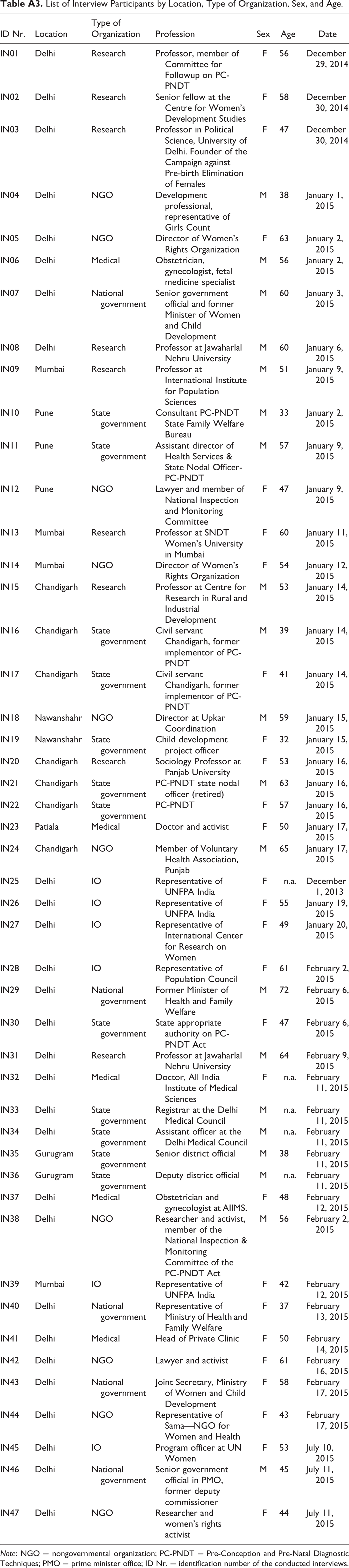
| ID Nr. | Location | Type of Organization | Profession | Sex | Age | Date |
|---|---|---|---|---|---|---|
| IN01 | Delhi | Research | Professor, member of Committee for Followup on PC-PNDT | F | 56 | December 29, 2014 |
| IN02 | Delhi | Research | Senior fellow at the Centre for Women’s Development Studies | F | 58 | December 30, 2014 |
| IN03 | Delhi | Research | Professor in Political Science, University of Delhi. Founder of the Campaign against Pre-birth Elimination of Females | F | 47 | December 30, 2014 |
| IN04 | Delhi | NGO | Development professional, representative of Girls Count | M | 38 | January 1, 2015 |
| IN05 | Delhi | NGO | Director of Women’s Rights Organization | F | 63 | January 2, 2015 |
| IN06 | Delhi | Medical | Obstetrician, gynecologist, fetal medicine specialist | M | 56 | January 2, 2015 |
| IN07 | Delhi | National government | Senior government official and former Minister of Women and Child Development | M | 60 | January 3, 2015 |
| IN08 | Delhi | Research | Professor at Jawaharlal Nehru University | M | 60 | January 6, 2015 |
| IN09 | Mumbai | Research | Professor at International Institute for Population Sciences | M | 51 | January 9, 2015 |
| IN10 | Pune | State government | Consultant PC-PNDT State Family Welfare Bureau | M | 33 | January 2, 2015 |
| IN11 | Pune | State government | Assistant director of Health Services & State Nodal Officer-PC-PNDT | M | 57 | January 9, 2015 |
| IN12 | Pune | NGO | Lawyer and member of National Inspection and Monitoring Committee | F | 47 | January 9, 2015 |
| IN13 | Mumbai | Research | Professor at SNDT Women’s University in Mumbai | F | 60 | January 11, 2015 |
| IN14 | Mumbai | NGO | Director of Women’s Rights Organization | F | 54 | January 12, 2015 |
| IN15 | Chandigarh | Research | Professor at Centre for Research in Rural and Industrial Development | M | 53 | January 14, 2015 |
| IN16 | Chandigarh | State government | Civil servant Chandigarh, former implementor of PC-PNDT | M | 39 | January 14, 2015 |
| IN17 | Chandigarh | State government | Civil servant Chandigarh, former implementor of PC-PNDT | F | 41 | January 14, 2015 |
| IN18 | Nawanshahr | NGO | Director at Upkar Coordination | M | 59 | January 15, 2015 |
| IN19 | Nawanshahr | State government | Child development project officer | F | 32 | January 15, 2015 |
| IN20 | Chandigarh | Research | Sociology Professor at Panjab University | F | 53 | January 16, 2015 |
| IN21 | Chandigarh | State government | PC-PNDT state nodal officer (retired) | M | 63 | January 16, 2015 |
| IN22 | Chandigarh | State government | PC-PNDT | F | 57 | January 16, 2015 |
| IN23 | Patiala | Medical | Doctor and activist | F | 50 | January 17, 2015 |
| IN24 | Chandigarh | NGO | Member of Voluntary Health Association, Punjab | M | 65 | January 17, 2015 |
| IN25 | Delhi | IO | Representative of UNFPA India | F | n.a. | December 1, 2013 |
| IN26 | Delhi | IO | Representative of UNFPA India | F | 55 | January 19, 2015 |
| IN27 | Delhi | IO | Representative of International Center for Research on Women | F | 49 | January 20, 2015 |
| IN28 | Delhi | IO | Representative of Population Council | F | 61 | February 2, 2015 |
| IN29 | Delhi | National government | Former Minister of Health and Family Welfare | M | 72 | February 6, 2015 |
| IN30 | Delhi | State government | State appropriate authority on PC-PNDT Act | F | 47 | February 6, 2015 |
| IN31 | Delhi | Research | Professor at Jawaharlal Nehru University | M | 64 | February 9, 2015 |
| IN32 | Delhi | Medical | Doctor, All India Institute of Medical Sciences | F | n.a. | February 11, 2015 |
| IN33 | Delhi | State government | Registrar at the Delhi Medical Council | M | n.a. | February 11, 2015 |
| IN34 | Delhi | State government | Assistant officer at the Delhi Medical Council | M | n.a. | February 11, 2015 |
| IN35 | Gurugram | State government | Senior district official | M | 38 | February 11, 2015 |
| IN36 | Gurugram | State government | Deputy district official | M | n.a. | February 11, 2015 |
| IN37 | Delhi | Medical | Obstetrician and gynecologist at AIIMS. | F | 48 | February 12, 2015 |
| IN38 | Delhi | NGO | Researcher and activist, member of the National Inspection & Monitoring Committee of the PC-PNDT Act | M | 56 | February 2, 2015 |
| IN39 | Mumbai | IO | Representative of UNFPA India | F | 42 | February 12, 2015 |
| IN40 | Delhi | National government | Representative of Ministry of Health and Family Welfare | F | 37 | February 13, 2015 |
| IN41 | Delhi | Medical | Head of Private Clinic | F | 50 | February 14, 2015 |
| IN42 | Delhi | NGO | Lawyer and activist | F | 61 | February 16, 2015 |
| IN43 | Delhi | National government | Joint Secretary, Ministry of Women and Child Development | F | 58 | February 17, 2015 |
| IN44 | Delhi | NGO | Representative of Sama—NGO for Women and Health | F | 43 | February 17, 2015 |
| IN45 | Delhi | IO | Program officer at UN Women | F | 53 | July 10, 2015 |
| IN46 | Delhi | National government | Senior government official in PMO, former deputy commissioner | M | 45 | July 11, 2015 |
| IN47 | Delhi | NGO | Researcher and women’s rights activist | F | 44 | July 11, 2015 |
Note: NGO = nongovernmental organization; PC-PNDT = Pre-Conception and Pre-Natal Diagnostic Techniques; PMO = prime minister office; ID Nr. = identification number of the conducted interviews.
Acknowledgments
The author specially thanks all key informants who participated in this investigation. This research would not have been possible without their insights and dedication to the subject. The author greatly benefited from the expertise and constructive comments made by Kathleen Starck and Russell Luyt. Furthermore, the author would like to thank Carlos Vargas for the valuable remarks at the initial stage of this research project.
Declaration of Conflicting Interests
The author(s) declared no potential conflicts of interest with respect to the research, authorship, and/or publication of this article.
Funding
The author(s) disclosed receipt of the following financial support for the research, authorship, and/or publication of this article: This article forms part of a PhD research funded by the Heinrich Böll Stiftung and the German Federal Ministry of Education and Research.