



Abstract
Treating the category “martyr” as socially constructed and contested along gendered and political lines, this paper examines how heroes and martyrs have been produced and deployed in post-revolutionary Tunisia. It begins by examining governmental attempts, launched soon after the revolution, to monopolize and institutionally define who could benefit from official recognition as a martyr. The differences in the definition of “martyrdom” between official institutions and families of the deceased are unpacked, arguing that “martyr” is a moral category, the boundaries of which are often drawn in terms of differing masculinities. The paper goes on to demonstrate how the category of “martyrs of the nation” has progressively overshadowed the category of “martyrs of the revolution” in official memorial practices, as the commemoration of the revolution has progressively focused on its uniformed victims, leaving out the civilian ones. One of the interesting features of this shift is that it demonstrates the malleability of the way the category “violence” is understood and deployed. The paper thus shows how neither state officials nor the families of deceased officers, activists, or bystanders accepted that it was sufficient simply to have died during the upheaval in order to be recognized as a martyr. All applied additional moral and political criteria in order to determine who deserved to be labelled as a martyr. At stake in these debates were contrasting representations of masculinity, in particular between triumphant, militaristic masculinities and fragile and damaged masculinities. As the figure of the uniformed “hero” has become increasingly consolidated and hegemonic in post-revolutionary Tunisia, the term “martyr” itself has been increasingly appropriated by state institutions and official memorial practices that serve to reaffirm order and governmental power.
Several narratives regarding the 2011-revolution coexist in Tunisia, performed in rival memorial practices and spaces, and representing and celebrating different faces and names. In the current time period, conventionally referred to as one of “transition”, many political and interpretative frames compete for authority. In this paper, I seek to analyze the methods of depicting and remembering the Tunisian revolution. I more specifically address the debates and social mobilizations regarding the so-called and soon-to-be-published final list of the martyrs of the revolution. The project of establishing such a list, initiated in 2011, provides an illustrative case of the selective processes through which national narratives are constructed, implying the marginalization of subaltern experiences. Determining who should be honored and who should be forgotten, the Tunisian state officially frames not only the history but the political meaning of the revolution. I argue that social hierarchies are not only visible but also actively performed and reproduced in official narratives. Using gendered rhetoric as a tool, the authorities remove entire social groups from official history without having to acknowledge any embarrassing exclusion process. Their choices are justified through terms such as “trouble-makers”, “thugs”, “vandals,” or “terrorists” and other references to problematic and suspicious models of masculinity. How have effects of the Tunisian revolution—and of its violence—produced new gendered models? How are narratives of martyrdom and heroism negotiated in post-revolutionary Tunisia? Who are these “martyrs” or “thugs” and by whom are they labelled as such? What distinguishes them?
In this article, I show that the “rhetorical modes” (Collins 2014) in terms of which the Tunisian uprising’s actors are officially categorized have progressively changed since 2011. They are no longer understood through political repertoires but through moral ones. This discursive turn, organized around hierarchized masculine figures, reveals a depoliticization of the narratives of the 2011 revolution, coherent with the manner in which the revolution has been increasingly discredited in Tunisia. 1 I argue that the recent appearance of the “terrorist threat” and its strategic depiction as a consequence of the revolution have played a catalyzing role in this lexical and moral shift. From now on, the Tunisian state can publicly celebrate the heroism and the martyrdom of policemen and soldiers at the expense of civilian figures by linking terrorist attacks to revolutionary history. The terrorists’ emergence has strengthened the ability of hegemonic narratives to shut down disagreeing or subaltern voices.
Dying During the 2011-Revolution
On December 17, 2010, Mohamed Bouazizi, a 26-year-old fruit and vegetable seller, set himself on fire on the main square of Sidi Bouzid, a small city in the center of Tunisia. He died from his injuries two weeks later. Mohamed Bouazizi was publicly titled the first “martyr”—in Arabic “shahid” 2 —of the Tunisian revolution, one whose sacrifice sparked a national uprising. 3 His name and face appeared on walls, banners, and t-shirts during the first days of mobilization as masses of demonstrators took the streets all over Tunisia demanding the overthrow of the Ben Ali regime (Figure 1).

Stamp dedicated to the “martyr” Mohamed Bouazizi March, 2011 (Internet).
As demonstrations multiplied in several Tunisian cities and as social movements intensified in December 2010 and January 2011, the number of deaths increased. Repression was especially brutal in the marginalized governorates deep inside the country from where the contestation started. This violence did not stop after Ben Ali’s resignation, and many young men were killed, most of them intentionally, in the troubles that followed (Amnesty International 2011). The destruction and burning of jails resulted in particularly high death counts. Even if the causes of these incidents have still not been clarified, their orchestrated nature is suspected: different camps had interests in disorganizing the country in order to discredit the revolutionary movement and justify the return of strong power. The interim government, composed of many members of the former Ben Ali regime, had to be dissolved in February 2011 due to a huge mobilization. Massive demonstrations and ensuing repressive violence continued to punctuate the year 2011. The Bouderbala Commission, which constituted the first official attempt to identify those who died and were injured during and following the Tunisian uprising, documented the killings of 338 persons, amongst them 319 civilians, 14 policemen and 5 soldiers. 4
The word “martyrs” was of major importance in post-revolutionary Tunisia, and it became a strategic source of legitimacy for those who wanted to play a role during the transitional period. It constituted a consensual rhetorical tool for all the political parties as though every public speech had to start and end by referring to “martyrs” and recalling the obligation to honor their memories and sacrifices. The word was often associated with the expressions “of the nation” or “of the revolution”, implying nationalist and secular dimensions. This purposeful use is not surprising since the word “martyr” is historically engrained in the Tunisian national vocabulary. 5 The martyrs of the 2011 revolution were thus publicly depicted in relation to those who came before, as pursuing the same nationalist trajectory. In 2017, during a demonstration I attended in downtown Tunis, I listened to speeches that retraced this historical lineage, proclaiming a national duty to honor the blood of “our martyrs”, including those of “independence”, of the “revolution”, and of “transition”. 6 As Elisabeth Buckner and Lina Khatib (2014) argue about the “Arab springs”, what seemed to distinguish the martyrs of 2011 from their pro-independence predecessors was their political function: they were not used as producers of an internal identity against a foreign occupier, but as producers of a people against the oppression of a regime.
Decree 97/2011, published in October 2011, regulates the ways post–Ben Ali Tunisia should go about dealing with its “martyrs” (Ghozzi 2012). The decree’s first five articles focus exclusively on the issue of “national memory” and the symbolic dimension of the martyrs’ recognition. For example, they mention erecting a monument depicting the martyrs’ names and the importance of publicizing them in public spaces. A museum devoted to the revolution should be built, and school curriculum and textbooks should be rewritten in order to document and honor their sacrifice. Financial reparations were also managed in this decree. The document explains in detail how money devoted to each martyrs’ family—40 000 TND, around 15 000 euros—should be divided amongst surviving relatives under the Ministry of Social Affairs’ supervision. Aside from financial retribution, less calculable forms of aid were planned to be provided: distribution of public transportation tickets, sponsorships for pilgrimages to Mecca, donation of food and meat for religious feasts, and the organization of summer camps for children. The decree also initiated the process of officially listing the “martyrs and the wounded of the revolution,” which was thus formulated early on in the transitional process. Being named on this list was a prerequisite to benefit from the compensation measures outlined in the decree. Decree 97/2011 precisely set out the composition of the commission responsible for generating the official list of martyrs, which included representatives of civil society and of seven ministries.
The project of generating a list can be seen as an attempt by the Tunisian state to control and standardize revolutionary narratives. Through this project, it sought to monopolize the process of determining who would be labelled a “martyr” and to produce an official version of what had happened during the revolution.
“Martyrs” Versus “Thugs”: Time for Suspicion
In November 2011, the first gathering of the National Constituent Assembly started with the public enumeration of the “martyrs’” names, classified by governorate, provoking immediate and violent reactions amongst the “martyrs’” families who pointed out that many names were missing. They denounced the persistence of social and spatial marginalization in the commemoration of the revolution, illustrated by the fact that only seven names of the 27 young men who died in the city of Kasserine were quoted (Schneider 2011). The project of listing the martyrs indeed immediately appeared problematic, since it necessarily implied that not all the victims of the revolution would be recognized as such. 7
Suspicious discourses developed as soon as the Bouderbala Commission released its report in January 2012.
8
Samir Dilou, at the head of the Ministry of Human Rights and Transitional Justice, immediately expressed doubts about the validity of the report and the veracity of some of the victims’ stories. If the official list of the martyrs of the revolution was to be generated from the Bouderbala report, the report should first be checked in order to remove the names of individuals who did not qualify for “martyrs” status. When I asked the head of the General Committee devoted to the martyrs about the necessity of creating a new list, she explained to me: We have to correct the (Bouderbala) list because, and that is sad, not everyone told the truth. There are people who died, but not in the context of the revolution, and their families would like to benefit from the social advantages accorded to the martyrs’ families! (….) This revision will take some time because we have to check every single case in order to identify the fake martyrs. I understand the impatience of the families; it has already been five years since the revolution occurred and the names of their children are still not public. For the families of the true martyrs, this must be disappointing. We have to tell the truth and who the true heroes are. There is no way thugs’ names should appear on the list; the ones who were violent, who killed, who raped, who were carrying weapons or organized looting.
The Martyrs’ Moral Status in Question
Beyond the political dimension, which one could reasonably have expected as far as a revolution was concerned, it was the good morality—or the lack of it—of the social actors that seemed to constitute a decisive argument to label them – or not – “martyrs”. In “Semiotics of martyrdom”, Andy Blunden indeed argues that the “moral character of the subject” is “most important in determining their role as a martyr, and in order to be recognized as such, the martyr should be someone people can positively identify with (2006, 51).
The focus on the morality of martyrs was particularly visible in the discourses surrounding the cases of the many prisoners who died in 2011 during the destruction and burning of their prisons.
9
They numbered almost one quarter of the total casualties of the Tunisian uprising.
10
As I was told in interviews by different persons in charge of generating the “final” list, it seemed problematic to publically give prisoners, who probably were sent to jail because they had committed offenses, the prestigious status of martyrs. The same reservation was expressed regarding the young men who were killed on the margins of the protests. In these cases, the disqualification was often based on the probable immorality of the youngsters, embodied through the suspicion that they died while drinking, like in the previously mentioned criticisms targeting Mohamed Bouazizi. When I met him in his office, in September 2016, one of the members of the Bouderbala commission explained to me: Someone who was reported dead, burned alive inside the Magasin général, it is a supermarket, at midnight, was not expressing any political discontent; in the middle of the night, in a supermarket, in the spirits section (laughs)! While someone who died in front of the trade union center or in front of the Interior Ministry, it is totally different.
In order to be recognized as a “martyr” or a “hero”, Blunden also mentions the necessity for the subject to be an “attractive person” (2006, 2). Although he mainly refers to a moral perspective—the fact of being a good person—his terminological choice stands as an invitation to question aesthetics of martyrdom from gender and social class perspectives. Blunden illustrates this argument through the case of Rosa Parks, who became a major figure of the US-American Black social rights movement for fighting against racial segregation, having refused to give up her seat to a white passenger on the bus in December 1955. A few months earlier, a 15-year-old Black woman, Claudette Colvin, was arrested for the exact same reason, but given the fact that she could not stand as a respectable figure—she was suspected of having an active sexual life-she could not embody “the face of the campaign” (2006, 3). Even if Blunden does not identify them as such, gender considerations, and especially more or less respectable models of femininity, are at the core in the making of heroic figures. The case of the martyrs of the Tunisian revolution rather involves masculinities. If the young men who died while in jail or fighting the police failed to be publicly remembered as “martyrs”, it is because they embodied suspicious—because lower class—models of masculinity. Since their social and gender performances were framed as immoral and violent, and perceived as threats to the social order by those in charge of shaping the official revolution narratives, their names have to remain unknown and their faces invisible. Such young men constitute the “not-so-photogenic” actors of the Tunisian revolution, to adopt an expression used by Lucie Ryzova (2011), “photogene” being interestingly defined by Roland Barthes (1957, 150–152) as a “status” both socially and morally shaped.
As the Tunisian revolution case shows, socioeconomic inequalities are translated into official narratives and iconographies. Actors’ social status determines the ways their violence and political commitment are publicly depicted, and the meaning of their death. Gendered repertoires of morality and respectability constitute major tools to organize and justify the stigmatization process.
Alternative Narratives and Canals of Producing “Martyrs”
Despite the official attempts to monopolize the public making of “martyrs of the revolution”, counter-narratives circulated, resisting the marginalization and depoliticization processes of subaltern experiences. Not only families and relatives of the young men who were killed during the upheaval but also some political groups defended an inclusive definition of martyrdom. Opposing the moral repertoire, they reasserted the political nature of the experiences of the contested martyrs, trying to lend rationality to their violence and meaning to their death.
One of the main argumentative strategies was based on the justification of the use of violence, depicted as a historical and necessary tool for any revolutionary movement. Some middle-class activists, for instance, publicly denounced the criminalization of the lower social classes for their participation in the Tunisian revolution. In April 2014, when 130 young men were charged for vandalism, accused of having burned down police stations during the uprising, they initiated a campaign called “I also set a police station on fire” (Chennaoui 2014). When I interviewed him in March 2016, one of the lawyers publicly committed to the “forgotten” martyrs’ cause stated: This idea of “jasmine revolution” is completely absurd and naïve. Flowers? What’s the point? A revolution cannot be peaceful. If we could have been peaceful, why would we have needed a revolution? Revolutions have always been conducted by the poor people (…), so how dare they talk about robbery or looting when we know the billions that were stolen by our leaders? (…) Yes, police stations were attacked but not for no reason; they constituted the showcases and the symbols of Ben Ali’s regime.
These counter-narratives—claiming the political meaning of the death of the “contested” martyrs—had graphic translations. Martyrdom’s political dimension was for example aesthetically asserted through the portraits martyrs’ families and relatives carried with them and waved in public events. Such portraits illustrated a determination to link the killing of their relatives to the revolution and to politicize their stories. In this picture, taken in January 2018 during a gathering of martyrs’ families, the face of Qaïs Al-Mazlini, killed on January 13, 2011, appears on an expressive background: an image of a demonstration on Bourguiba Avenue, a Tunisian flag and the sentence “Tunisia is free” (Figure 2).
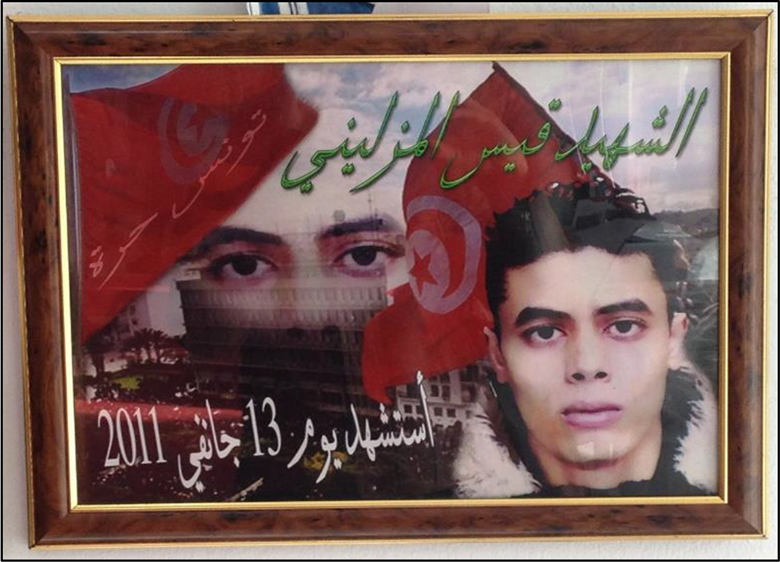
“The martyr Qaïs Al-Mazlini Martyrized on January 13, 2011,” Families’ exhibition, Tunis, January 2018 (P. Lachenal).
These symbolic references are tools to engrain the individual story into the national one, if there were any doubt about that connection. Taoufic Haddad identifies similar aesthetic choices when analyzing a large corpus of posters depicting Palestinian martyrs (2016): it is common for the families or the poster’s designer to choose to make the deceased person appear as an armed fighter, even if it was not the case, to include him in the core of the national struggle.
This picture illustrates that the state was not the only actor able to build and broadcast martyrs’ iconographies in post-revolutionary Tunisia. Despite its attempts to monopolize the public making of martyrs, other portraits circulated through non-official channels and families’ networks. It is worth mentioning that the role of non-state actors in the making of martyrs—in an exemplary way the associations of martyrs’ families—is based on practical reasons such as the democratization of access to designing and printing technologies. If disagreements have always haunted memorial practices and revolutionary iconographies, this technological shift has given them unprecedented visibility. The production of martyrs was easier to control before 2011, de Georges asserts (2013), since there were fewer ways to publicize their portraits. In the Tunisian case, this practical aspect of the making of martyrs was not insignificant and had major political consequences. It allowed rival iconographies to coexist, each associated with different stories of how the revolution should be remembered.
Turning Point: The Securitization of Revolutionary Narratives
In post-2011 Tunisia, at the same time some families continued asking for the publication of a definitive list remembering their children as “martyrs of the revolution”, other kinds of martyrs were being publicly identified. Their faces were displayed in public spaces and their names carved on commemorative plaques: these were the “martyrs of the nation”, meaning the members of the Tunisian security forces who lost their lives in recent years. The distinction between “martyrs of the revolution” and “martyrs of the nation”, which significantly appeared in the first article of the 2011-decree organizing national martyr worship, haunted the memorialization process of the Tunisian uprising since its beginnings. When the names of all people who died during the upheaval were published in the Bouderbala report in 2012, those of policemen and soldiers were separated in a list specifically devoted to the security forces. The commemoration of the revolution had progressively focused on its uniformed victims, leaving out the civilian ones. The turn was neither instantaneous nor straight, but the result of several intermingled processes.
The ability of a state to build and glorify conservative martyr figures, like those embodying order and security, mainly depends on a prior depoliticization process, which is necessary to “set the stage”, according to Daniel Gilman (2015). In post-revolutionary Tunisia, the depoliticization process coincided with the fragmentation and differentiation of the martyrs into different groups. Political parties, families, associations, religious groups, municipalities, army, police, and trade unions claimed ownership of certain martyrs. Depending on their resources and power, these different groups had a greater or lesser chance at success in broadcasting “their” martyrs. As Mittermaier notices (2015, 595), governments unsurprisingly often succeed in proclaiming their heroes, the state’s martyrs being “the ones most loudly celebrated in the mainstream media”. Beside these dynamics, the depoliticization process of the Tunisian revolutionary narratives during the last years mainly stood on the emergence and on the recognition of a “terrorist threat,” which led to a growing national celebration of security forces’ martyrs.
Following the revolutionary period and due to the destabilization of Libya, Tunisia had to face several Islamist terrorist attacks in the past years. Some of them strategically targeted tourist sites, while others were directed at the Tunisian security forces. As the attacks multiplied, commemorative plaques and monuments sprouted here and there. At the entrance of Ben Guerdane, a city that faced a major attack in March 2016 which left 13 members of the security forces dead, colorful murals honored the “martyrs of the nation”. On one of them, as shown in the picture, drawings of the different security forces are accompanied by the sentence “The people, the police and the army hand in hand against terrorism” (Figure 3).
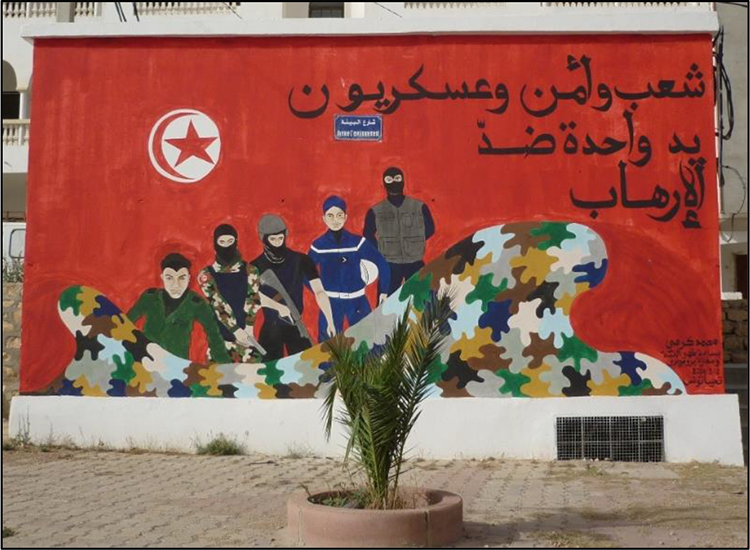
Mural, Ben Guerdane, April 2016 (P. Lachenal).
The terrorist threat and the state of emergency that went with it contributed to the process of securitization of Tunisian national narratives, paving the way for the celebration of militaristic and police martyrs. In May 2016, a lawyer I was interviewing interrupted me: “You want to talk about the martyrs? Well listen to me carefully: our martyrs, and there are no other martyrs than them, are the ones who fell in the line of duty fighting terrorism”. In the same year, the name of the governmental commission devoted to the “martyrs and wounded of the revolution” was significantly lengthened by the words “and of the terrorist attacks”; Madjouline Cherni, a sister of a soldier killed in a terrorist attack in 2013, was chosen to direct it. Among the civilian martyrs’ families, the fear that the crimes of the revolution would be slowly covered up and erased by the terrorist issue kept growing. Lamia, the sister of a 21-year-old man killed by the army during the first days of the revolution, stated: Her (Madjouline Cherni) brother was a soldier. She cannot be neutral. I am not saying that the soldiers who have been recently killed do not deserve justice, but their stories have nothing to do with ours. What does ‘martyrs of the revolution and of the terrorist attacks’ mean? How can we deal with the two different issues together when the first group were often been killed by the second ones? People often ask me: ‘Don’t you feel angry against the martyrs of the revolution? Against the revolutionaries? Because it is because of them that terrorism appeared in Tunisia, and killed your brother?’ But no, I do not blame them.
The fear of misperception due to the “fundamental ambiguity” and “interpretative malleability” of dead bodies (Verdery 2004, 693) resembled an anxiety of contamination. In Tunis in 2016, rumors stating that terrorists’ bodies were buried next to martyrs’ were so powerful that they required official denials ( Jawhara FM 2017). The same year, a controversy erupted around the fact that a father of a “terrorist” who died while perpetrating an attack decided to inscribe the word “martyr” on his son’s gravestone. The father was given a one-year prison sentence and the stone carver was harassed ( Kapitalis 2016). In his article about the attempted military “coup” that happened in 2016 in Turkey, Salih Can Açiksöz reports similar post-mortem precautions through the discursive strategies the pro-military government adopted to condemn the rebel soldiers, labelling them as “terrorists in soldier uniforms” (2017). This remarkable expression “evoked a political fantasy in which the soldier body was displaced by the terrorist body”, which could justify that it should be buried in a “traitor cemetery” with no funerary services (2017, 179). In Tunis, the symbolic criminalization of the 2011-revolution progressively drew on a similar repertoire: the young men who lost their lives and were injured were publicly pictured as not only depoliticized and immoral figures but eventually also as potential terrorists. The circle came back around on Martyrs’ Day in April 2016, when Madjouline Cherni publicly stated that she had the evidence to prove that some “wounded of the revolution” joined terrorist groups in south of Tunisia (Latif 2016). “Terrorism has overshadowed everything”, as I was told by Imen, an activist I interviewed in Tunis in May 2017. Regarding the ways martyrs were increasingly framed in the aftermath of the Tunisian revolution, this statement could not be truer: terrorism has become the main narrative through which security forces’ martyrs—and the hegemonic models of masculinity they embody—were loudly honored in Tunisia, at the expense of civilian figures.
Celebrating Men in Uniforms
These last few years, intensive campaigns have been underway to celebrate the commitment of the security forces to the Tunisian nation. While the dispute regarding who was or was not a martyr was taking place, the state undertook visual production glorifying the security forces. Advertisements popped up all over Tunis. This picture, which was widely disseminated in 2017, illustrates the multiple processes just described (Figure 4).
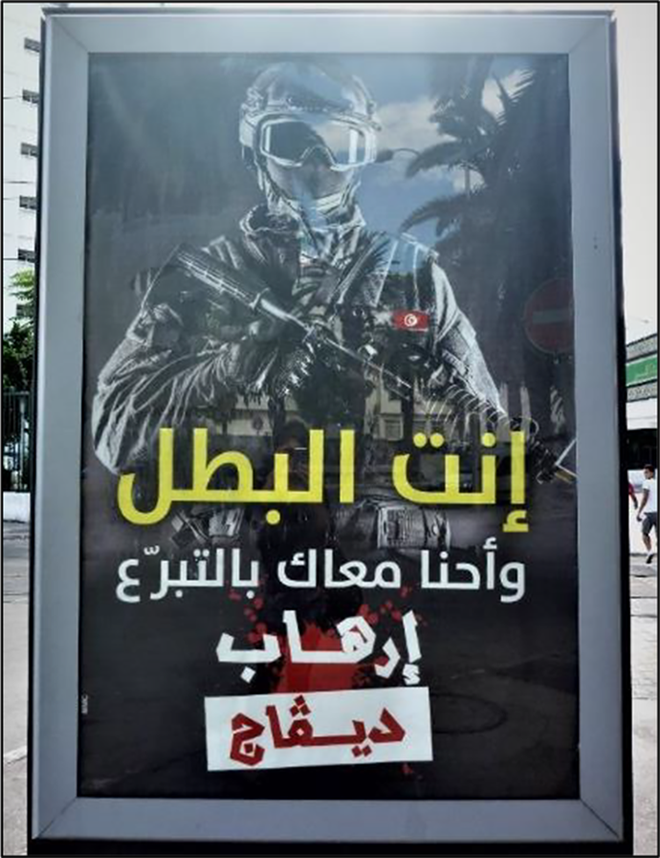
You are the hero. We fully support you. Terrorism “Dégage”, Mohamed V Avenue, downtown Tunis, September 2017 (P. Lachenal).
By mixing together different repertoires, using the notorious “Dégage”—an iconic expression during the so-called Arab springs—in reference to “terrorism”, the struggle against terrorism was integrated into the story of the revolution itself, and the military “heroes” were placed at the forefront of this history. The revolutionary moment seemed to be reabsorbed into state hegemonic narratives, through neoliberal advertising apparatus. This kind of catchy advertisement contributed to the securitization process–which is also a virilization one—of the Tunisian revolution commemoration. The mother of a civilian “martyr” of the revolution I interviewed stated: “Now, people speak in friendly terms about the police. It is like it was the policemen who did the revolution.” This picture also confirms that being recognized as a hero is not a matter of being violent or not, as it was said about the young men who died on the sidelines of the demonstrations. Policemen and soldiers embody a clear potential of violence, symbolized by the weapons they carry with them. It is rather the meaning of the violence and its social perception which are at stake in the making of the martyrs as Blunden argues: “like almost all military heroes, martyrs can be violent, so long as people can empathize with their violent act” (2006, 21).
Uncertainty contributes to setting the stage for the celebration of victorious and heavily armed, perceived as reassuring, models of masculinities. In time of crisis, images of counterterrorist fighters and of militarist masculinities—a part of what Salih Can Açiksöz and Zeynep Kurtulus Korkman call a “war-making governmentality”—are appealing to a large proportion of the population. In the aftermath of the attacks of September 11, 2001, in New York, Judith Lorber (2002) discussed the gendered imagery of American heroes and warriors. She underlined the celebration of exclusively masculine and uniformed “heroes”, interestingly noticing that the sales of G.I. Joe dolls in the USA increased at that time. Although some women died during the rescue operations, firemen and policemen were presented as all men—heroes it seemed could only belong to one specific gender.
Conclusion
On the occasion of the seventh anniversary of the revolution in January 2018, several gatherings were planned in Tunis. One of them was initiated by a political group called “We do not forgive,” which was joined by the martyrs’ families as well as a few wounded of the revolution. While members of the first group were holding portraits of their deceased relatives including pictures of their dead bodies, the second offered journalists images of their wheelchairs, amputated bodies, and burned skin. Unconventional masculine performances were at stake, organized around fragile and damaged models of masculinity. As Hamit Bozarslan argues (2015), Mohammad Bouazizi’s self-immolation could be understood along the same line, revealing a new phenomenon in the Middle East’s political language, which implies that the helplessness and the innocence could constitute “resources of dignity.” Bozarslan suggests that immolations inaugurate a new militant repertoire breaking with the images of over-masculinized martyrs (2015). However, that argument’s applicability seems limited in light of this paper focusing on post-revolutionary Tunisia. Faces and names associated with unusual gender performances were progressively rendered invisible in the official narratives and memorial spaces related to the revolution, incapable of “testifying”—and thereby unable to “speak” to the public. In January 2018, they were literally off the stage: the demonstration I refer to took place a few meters away from the official gathering organized by the Tunisian government and the demonstrators chants, “Loyalty to the martyrs’ blood,” were barely audible, overlaid by the powerful sound system of the official event broadcasting the national hymn and loudly celebrating the “martyrs of the nation”. In post-revolutionary Tunisia, official heroes wear uniforms and die in the line of duty. The models of masculinity they embody radically differ from the ones symbolized by Bouazizi’s body in flames and the fatally wounded bodies of civilian youngsters.
This article dealt with the contested processes through which some deaths would be or would not be officially honored in post-revolutionary Tunisia, showing that competing models of men, each of them being vested with different political and moral meanings, worked in depth with the national narratives in the making. Grasping the political and performative dimensions of martyrdom, it revealed that the public designation of martyrs does not only influence the way the 2011 uprising is being told, but more importantly its political direction. Narrating and labelling is never only about the past. Behind the objective of writing a beautiful story about the past lies the concrete question of the present and future exercise of power (Bonnecase 2016).
Footnotes
Declaration of Conflicting Interests
The author(s) declared no potential conflicts of interest with respect to the research, authorship, and/or publication of this article.
Funding
The author(s) disclosed receipt of the following financial support for the research, authorship, and/or publication of this article: CNMS [Center for Near and Middle Eastern Studies], Philipps Universität Marburg, Germany.