




Abstract
Prostitution clients’ attitudes toward gender equality are important indicators of how masculinity relates to the demand for commercial sexual services. Research on male client misogyny has been inconclusive, and few studies compare men in different markets. Using an online survey of 519 clients of sexual services, we examine whether male client attitudes toward gender role equality are related to the main methods customers used to access prostitution services (i.e., through print or online media vs. in-person contact). We found no differences among men in these markets in attitudes toward gender role equality in the workplace and home. This is in a context where all clients had more egalitarian attitudes toward women’s roles than the U.S. male population in the General Social Survey (GSS). However, clients in in-person markets were less supportive of affirmative action than in online markets in a context where all clients were less supportive compared to the national average. These findings point to need to rethink how masculinity and gender role attitudes affect patterns of male demand for paid sex.
Keywords
Introduction
Anti-prostitution feminists have long argued that prostitution is produced by and produces a cultural ideal of masculinity based on dominance and control of women (Barry 1995; Dworkin 1993). Not all individuals who pay for sex are men, men and transgender individuals provide services (Minichiello and Scott 2014; Weitzer 2009), and studies find real diversity among male clients in different markets (Cunningham et al. 2018; Della Giusta et al.; Monto 2010; Monto and Milrod 2014; Sanders 2008b). Nonetheless, because mostly men buy and women sell, proponents of criminalizing clients, for example “End Demand” policies or the “Nordic Model,” are motivated at least in part, by arguments that “Gender equality will remain unattainable so long as men buy, sell, and exploit women” (Ekberg 2005; Skilbrei 2012).
Men’s attitudes about gender equality are one important piece of this debate. These attitudes are important indicators of how masculinity relates to the demand for commercial sexual services. Relatively little research in sexual commerce has looked at clients’ attitudes about women’s roles directly and even less has looked for differences among client groups. Most research examines violent or aggressive attitudes, finding no consistent evidence that clients accept rape myths, or score high on entitlement, control, or similar scales more than other men (Busch et al. 2002; Della Giusta et al. 2009; Farley et al. 2017; Joseph and Black 2012; Monto and Hotaling 2001; Monto and Milrod 2014). Others argue that prostitution may be fed by attitudes more typical of other consumers in a service economy—a neoliberal “market morality,” “bounded authenticity,” or consumer masculinity connected to individual freedom, contract-based fulfillments of needs, sexual liberalism, and tolerance that is connected to support for gender equality (Bernstein 2007; Brents 2016; Brents, Jackson, and Hausbeck 2010; Joseph and Black 2012; Milrod and Weitzer 2012; Peng 2007; Pettinger 2013; Prasad 1999; Sanders 2008a, 2008b).
How do gender role attitudes relate to the market for paid sex? Are more sexist men likely to participate in more vulnerable markets? Is masculinity in sex markets inevitably sexist? Or might support for equality in women’s roles be consistent with a consumer masculinity that is part of the demand for sexual consumption? Exploring client attitudes towards gender-role equality can better explain the connection between masculinity, gender inequality and the demand for paid sex. As Birch et al. point out, researching gender attitudes in male clients can provide new insights into theorizing masculinities (Birch, Baldry, and Hartley 2017).
The current study uses survey data to examine the link between client attitudes toward gender role equality and the methods clients use to seek service providers. We first contextualize our sample by comparing male clients’ attitudes toward gender equality with a nationally representative sample of males in the U.S. We then compare attitudes across different client groups. We use a unique data source, an online survey of 519 men that asked about patterns in accessing sexual services in several markets. Preferred markets were measured by whether customers indicated that they contacted providers more frequently in-person (e.g., street, bar, or hotel) or through mediated means—electronic and print media. Our survey was conducted before 2018 legislation in the United States closed many online venues, restricting the visibility and accessibility of the online environment. While bar and hotel rendezvous are typically seen as safer than street markets, we felt that service providers who were unable to pre-screen clients were significantly more vulnerable compared to online and print clients who could interact prior to arranging services. Our survey borrowed questions from the General Social Survey (GSS) that are commonly used to measure attitudes about gender equality across four dimensions: (a) working mothers; (b) women in politics; (c) traditional gender roles in the family; and (d) affirmative action for women in the workplace. The research question that underlies the study is the following: Are male client gender egalitarian attitudes associated with the methods they used to contact sex service providers (online/print media vs. face to face)?
We found no difference between markets in attitudes toward women’s equality in the workplace and in the home. Indeed, our descriptive data found clients in all markets are significantly more likely to have positive attitudes toward gender role equality than men in the GSS. Our findings overall contribute to research showing that negative attitudes toward women is not central to the demand for paid sex (Joseph and Black 2012; Milrod and Monto 2012; Peng 2007; Sanders 2008a), and that consumer, flexible, or inclusive masculinities that do not rest entirely on othering or devaluing women are key to understanding sexual consumption. Paying for sex should be examined in the context of other consumer and leisure services.
Literature Review
Client Attitudes and Gender Inequality
Traditional gender roles are important in the sex industry. Men report paying for sexual services because their partners are unable to fulfill their sexual needs or they want emotional care or a girlfriend experience (Milrod and Weitzer 2012; Monto 2010; Sanders 2008a, 2008b), suggesting that clients may hold traditional attitudes about women’s roles at home or as caregivers. But do these gendered motives inescapably rest on devaluing women’s roles, power or abilities?
The notion that prostitution legitimates gender inequality rests in large part on the concept of hegemonic masculinity–an aspirational and relational configuration of discourses, attitudes, and behaviors that legitimizes men’s dominance over women through bifurcating gender, positioning masculinity against the feminine and discrediting and devaluing women or women’s roles (Connell and Messerschmidt 2005). Research exploring masculinities among men who pay for sex finds that some groups indeed construct their sense of manhood against women’s roles and power. For example, some arrested clients evidence a “fragile masculinity” (feeling unattractive, insecure, and rejected in relation to women) that makes them more likely to hold negative and aggressive attitudes toward women (Joseph and Black 2012). Or they assert masculinity characterized by beliefs about women’s inferiority and lack of abilities (Besbris 2016; Shumka, Strega, and Hallgrimsdottir 2017). Huyasamen and Boonzeler (2015) suggest that the online clients they interviewed prefer sex without commitment because they see women as devious and manipulative, striving for hegemonic male sexuality in exaggerated, aggressive, hostile, or hypermasculine ways. In these studies, the struggle to attain masculinity among clients is a gender zero-sum game where a belief in gender equality does not coexist with the masculinity involved in paying for sex.
On the other hand, research on some sex buyers finds that gendering isn’t necessarily based on attitudes opposed to female power. Sanders finds that regulars, men who return to the same providers for services, talk about escaping from the dominant roles they often play in their other worlds, and it was not a discourse of entitlement (Sanders 2008b). Studies of clients in indoor markets find similar patterns, that clients view paying for sex more as one would other consumer services, using their consumer power to meet physical, sexual, emotional, or social needs (Bernstein 2007; Joseph and Black 2012; Milrod and Monto 2017; Milrod and Weitzer 2012; Peng 2007; Pettinger 2013; Sanders 2008a, 2008b). Valuing women’s abilities as “professionals” seems to characterize clients in online markets as much as a desire for feminine services (Pettinger 2011). Others find clients are motivated by clear rules in the economic exchange; paying for sexual services lacks the ambiguity, status-dependence, and potential hypocrisy of romantic sex (Prasad 1999). The clarity of norms in an economic exchange might result in less misogyny toward service providers or be less threatening to masculinity compared to ambiguous norms surrounding romantic sex. Indeed, the same study that found evidence for a link between fragile masculinity and potential violence also found evidence for a “consumer masculinity” among these arrested clients (those who treat sex as a consumer good for diversion, experimentation, and sexual release) that was not linked to violent or misogynistic attitudes (Joseph and Black 2012).
Research looking at the role of gender in commercial sex often links client motivations to traditional masculine traits such as being unemotional, hypersexual, risk seeking, aggressive, or overtly heterosexual. Recent theorizing on masculinities has found evidence for flexible, inclusive or hybrid masculinities that incorporate rather than wholly reject “Others” into the gender identity process, and are less violent, more emotional, and more gender equitable (Anderson and McCormack 2018; Birch et al. 2017; Bridges and Pascoe 2014). Studies of how clients seek intimacy or escape from masculine roles (Jones and Hannem 2018; Milrod and Weitzer 2012; Sanders 2008b) points to a more complex expression of masculinity in commercial sex in some situations. Birch argues that most clients do not exhibit hypermasculinity, and that clients, far from being unemotional, attend to their emotional needs by seeking providers (Birch et al. 2017). Lahav Raz studied how clients in online forums talk about their exploits in seeking street workers and found that they performed power and validated their masculinity more in relation to other men than to women (Lahav-Raz 2019a). While client attitudes toward gender equality are but one component of masculine repertoires, they are key to understanding how certain groups of men may define themselves in relation to women.
Support for gender egalitarian attitudes is increasing in the United States (Bolzendahl and Myers 2004; Kane and Whipkey 2009). Others note that we are in the midst of a “stalled revolution”—beliefs about women’s necessary care giving roles in the interpersonal realm persist alongside egalitarian attitudes about women in the workplace (Cotter, Hermsen, and Vanneman 2011; England 2010; Scarborough, Sin and Risman 2019). Others find support for gender equality, but variation in support for affirmative action (Levtov et al. 2014). Knight and Brinton find that gender-role attitudes are split across the dimensions of egalitarianism, essentialism (a belief that men and women have fundamentally different traits), and a third individual choice belief set. This third set supports gender equality at work but not the idea that men and women must have equal work roles, reflecting an individualistic belief in free choice (Knight and Brinton 2017). These findings highlight “how multidimensional attitudes around gender are, and how other beliefs and values based on local realities (e.g., about the role of government and free markets, or about the fair and consistent application of the law) interact with gender ideologies” (Levtov et al. 2014, 491).
Diversity in Prostitution Markets
Where clients contact providers matters a great deal. Street sex markets draw more vulnerable sellers and buyers with fewer financial and social resources, and both parties, but especially the workers, are likely to encounter violence in the environment by police or criminals (Connelly, Kamerāde, and Sanders; Deering et al. 2014; Weitzer 2009). On the other hand, print ads, and more recently, digital communications provide distance in time and space allowing both buyer and seller to gather more information, be more selective, and screen out dangerous or undesirable clients and situations (Armstrong 2014; Campbell et al. 2018; Cunningham and Kendall 2011; Monto and Milrod, 2014; Nelson et al. 2019; Sanders 2008a, 2008b). Even workers in fixed locations, such as brothels or parlors, can use the internet or similar mechanisms to arrange appointments and assess clients more than can workers on the street or even in a bar or hotel (Brents and Hausbeck 2005; Cunningham et al. 2018). While the 2018 shuttering of many online sites put providers and clients with fewer resources back on the streets, there is evidence that less visible online platforms continue as an important part of commercial sex markets globally (Cunningham et al. 2018).
Studies of client interactions in online review sites finds that buyers regulate themselves, standardizing conduct, socializing novices, and placing respect or connection with workers at forefront (Horswill and Weitzer 2018; Milrod and Monto 2012; Milrod and Weitzer 2012). Monto and Milrod compared data from hobbyists in an online review site with a data set of arrested customers, who tend to be more ethnically diverse and inexperienced, and found differences in attitudes, motivations, and experiences (Monto and Milrod 2014). Whether clients with certain attitudes choose certain markets or whether the market affects their attitudes, these findings highlight the need to examine differences among clients in different markets.
Method
Due to difficulty accessing representative samples of sex buyers for statistically significant comparisons, there are very few large-scale studies and even fewer with the ability to differentiate among clients. Data for this paper is based on a unique online survey of clients of sexual services collected between 2015 and 2017. 1 Research team members enlisted the help of individuals in the sex work community to help recruit consumers of adult services and spread the survey URL. We promoted the survey on social media, online, print and radio news, email groups, online forums and other online sources encouraging circulation to potential participants, and posted the URL of the survey on the first author’s faculty webpage for ease of access. Several sex worker bloggers posted information to their clients. We also recruited clients of Nevada’s legal brothels, recognizing that many also pay for illegal services, although we excluded respondents who only used legal brothels from this study. We posted survey announcements in an online forum for legal brothel clients (CyberWhore Mongers Club) and on one large legal brothel webpage. In addition, organizers posted an email announcement to individuals registering for the CyberWhore Mongers Club annual meeting. While consumers of sexual services can include a wide variety of services, we eliminated all surveys of individuals who indicated that they had not “paid for sex.”
We realized our methods would likely bias toward subjects who access sexual services online. Our questions, however, also asked about the range of ways in which respondents accessed sexual services, and indeed, we found a significant number of individuals who accessed sellers in various ways, including mostly through in-person encounters.
We obtained data on American adults aged 18 years and older from the 2014 General Social Survey to estimate the nationally representative figures to compare to the study respondents in our customer survey (Smith et al. 1976–2016). Our data was collected between June 2015 and June 2017, however because more than half of our subjects responded during 2015 and relatively few during 2017, we decided that the 2014 GSS data were the most comparable national data. The information available in the GSS includes sociodemographic characteristics, attitudes toward society, and politics in general. Given that the respondents in our survey were predominantly men (approximately 94%), we used only male respondents both from our customer survey and the GSS data. After excluding women and cases with missing values in key variables (see further), the final sample size for our buyer survey was 519. The sample from the GSS was 1,141.
Dependent Variable
Clients were classified into two groups—those using mediated online/print or in-person contact. Respondents were asked, “About how many times have you ever paid for sex, or attempted to make arrangements to pay for sex, under each of the following circumstances? (It’s okay if circumstances overlap).” Choices included contacting someone in an outdoor public place, indoor public place (such as a bar, casino, or strip club), indoor private place (such as a massage parlor or sex club, excluding the legal brothels), through printed materials (flyers, cards, and phone books) or online sources. Each item was assessed using a 7-point Likert-like scale [1–7: (1) never; (2) 1–2 times; (3) 3–4 times; (4) 5–6 times; (5) 7–8 times; (6) 9–10 times; (7) more than 10 times]. For the media-group and in-–person group, the average frequencies of two and three items were computed, respectively. Among the media group, average frequencies for the media and in-person contact were 3.86 and 1.97, respectively (about 55% of them never used the in-person contact). Among the in-person group, average frequencies for the media and in-person contact were 1.89 (about 45% of them never used the media contact) and 3.29, respectively. Although some used both nearly equally, respondents were classified into a group based on the greater average frequency. As seen in the mean frequencies, the ways the two groups access sex services are appreciably different. We excluded those who visited legal brothels because legal prostitution is rare in the United States, little is known about those buyers, and there were some distinctive characteristics (e.g., attitudes and socioeconomic status) among brothel buyers. Due to the small sample size from the non-systematic sampling, we were uncertain about the comparability to illegal clients.
Independent Variables
We adopted four questions on attitudes toward gender equality that have been asked regularly in the GSS and frequently are used to assess gender role attitudes (Cotter et al. 2011; England 2010; Kane and Whipkey 2009; Knight and Brinton 2017; Scarborough et al. 2019). For this study, evidence for positive attitudes toward gender equality was operationalized as holding negative attitudes toward working women’s ability to care for children and special efforts to promote qualified women and holding more positive attitudes toward men being more suited for politics and women not working outside the home. Specifically, the survey items we used were, “A working mother can establish just as warm and secure a relationship with her children as a mother who does not work,” “Because of past discrimination, employers should make special efforts to hire and promote qualified women,” “Most men are better suited emotionally for politics than are most women,” and “It is much better for everyone involved if the man is the achiever outside the home and the woman takes care of the home and family.” The responses were originally recorded in a 4-point Likert Scale (strongly agree, agree, disagree, and strongly disagree) but were dichotomized to “Agree” and “Disagree” due to the skewed distributions and insufficient sample sizes (less than 5% of the total sample) in several categories. The same survey items were used from the GSS data, and the response categories were made comparable (i.e., dichotomized) to the present study. One of the GSS survey items, “Because of past discrimination, employers should make special efforts to hire and promote qualified women,” had an additional response category, “Neither agree nor disagree,” and this response category was removed from the analysis to make it consistent with other survey items. Interpretation of findings about this particular survey item requires caution due to this difference in response categories. We choose to analyze items separately rather than combine them because of the size of the sample and its lack of representativeness. We were also interested in seeing possible differences among items that deal with attitudes about familial and workplace roles.
Covariates
The covariates were selected considering the theoretical relevance of the key variables and parsimony in the statistical analysis. Age at the time of the survey was recorded in years. Race and ethnicity were dichotomized to non-Hispanic whites and others (e.g., blacks, Hispanics, Asians) because the vast majority (over 86%) of the respondents were white. Marital status and educational attainment were dichotomous variables (married vs. not married; college or higher degree vs. less than college, respectively). Household income was assessed with 11 levels, roughly by $20,000 [(1) Under $20,000, (2) $20,000 to $39,999, and (11) over $200,000]. The same information was extracted from the GSS data, except for the household income due to the incomparable response categories.
Analytic Strategies
Two sets of analyses were sequentially conducted. First, the descriptive summaries of the survey respondents were compared to the national average. We incorporated the sampling weights into the estimation of nationally representative figures. The PROC SURVEYFREQ, and SURVEYMEANS commands were used in SAS version 9.4 (Copyright © 2013, SAS Institute Inc.). The bivariate significance tests (i.e., t-test or chi-square test) were used to compare the data in the present study to the national average.
Second, a series of binary logistic regressions were conducted to address the main research question (Hosmer, Lemeshow, and Sturdivant 2013). The PROC LOGISTIC command in SAS 9.4 was used to model methods of accessing sexual services as a function of gender attitudes. For each gender attitude item, an unconditional model was evaluated. A fully conditional model was constructed only if a statistically significant association was identified. The model quality was assessed using the Akaike Information Criterion (AIC) and the area under the Receiver Operating Characteristics (ROC) curve (Hosmer et al. 2013). AIC indicates how well the model fits to the data, and the area under the ROC curve indicates the sensitivity (i.e., correctly detect any statistically significant effect) and specificity (i.e., correctly reject any statistically non-significant effect). A lower AIC and a greater area under the ROC curve indicate better model fit and predictive accuracy. Statistical significance was based on an alpha value of 0.05.
Results
Table 1 presents the descriptive summaries (i.e., mean and standard deviation, or percentage for the study sample; weighted mean and standard error, or weighted percentages for the GSS sample) of client groups as well as the bivariate test results and compares them with a national sample of men taken from the 2014 GSS. The test statistics are presented in Table 1. The results are summarized here.
Descriptive Statistics of the Study Participants by the Means to Access Illegal Sexual Services, and Comparisons to the National Average of Men.
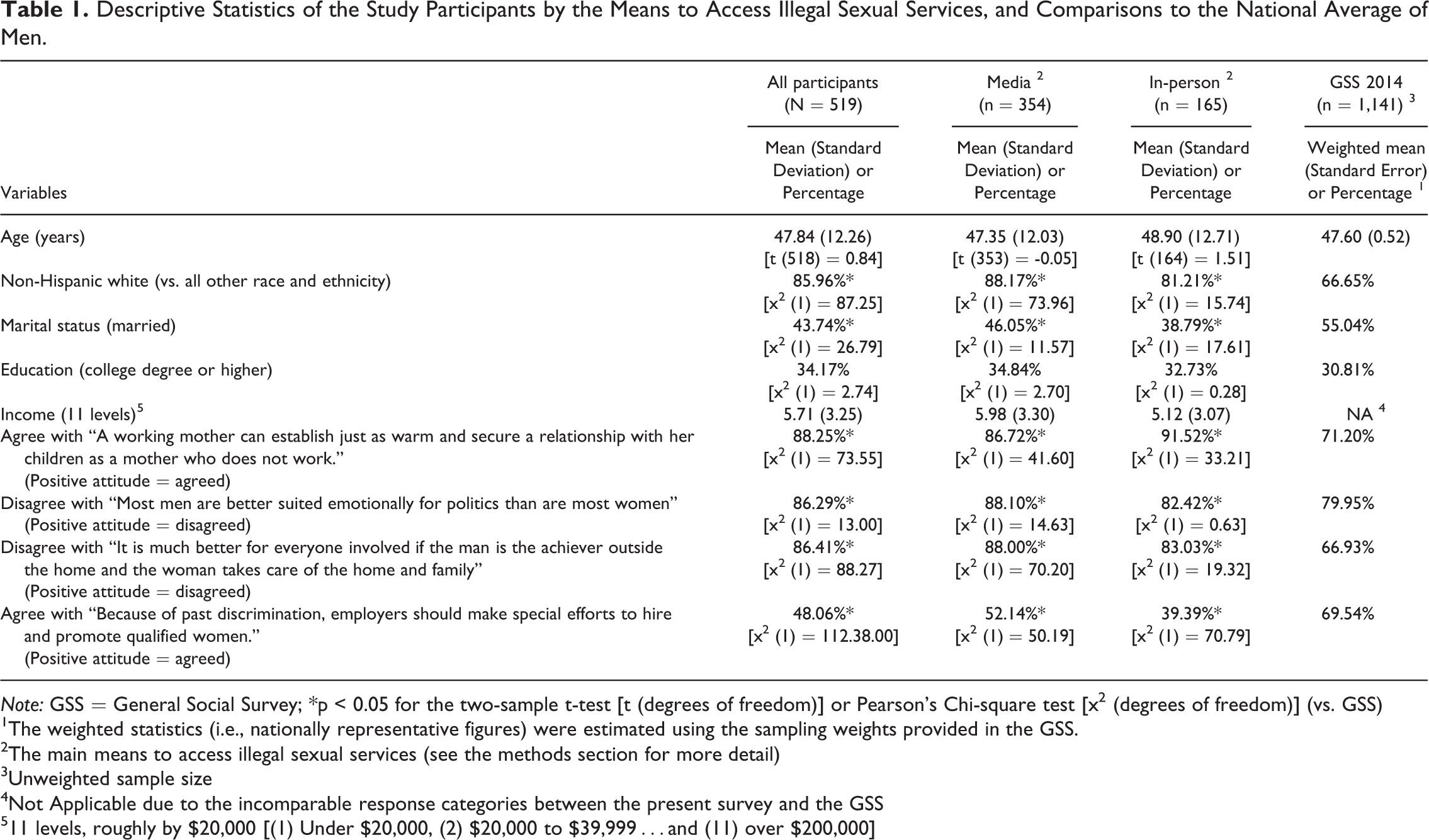
Note: GSS = General Social Survey; *p < 0.05 for the two-sample t-test [t (degrees of freedom)] or Pearson’s Chi-square test [x2 (degrees of freedom)] (vs. GSS)
1The weighted statistics (i.e., nationally representative figures) were estimated using the sampling weights provided in the GSS.
2The main means to access illegal sexual services (see the methods section for more detail)
3Unweighted sample size
4Not Applicable due to the incomparable response categories between the present survey and the GSS
511 levels, roughly by $20,000 [(1) Under $20,000, (2) $20,000 to $39,999…and (11) over $200,000]
Among the client survey participants (n = 519), the majority of them, 354 (about 68%), were classified in the media group; that is, they accessed sexual services primarily either online or through print media. The average age of the client survey respondents (47.84; p > 0.05) was similar to the national average (47.6 years old). The average age of the media (47.35; p > 0.05) and in-person (48.90; p > 0.05) groups were also comparable to the national average. Survey respondents were less likely to be married (34.17%; p < 0.05) compared to the national average (55.04%). This finding was consistent for the media (34.84%) and in-person (38.79%) groups. There was no statistically significant difference in the educational attainment between any of the groups (32.73%–34.84%) and the national average (30.81%).
Surprisingly, gender role attitudes of all surveyed clients in all groups were consistently more positive than the national average (all p < 0.05), except for the question on special efforts to promote and hire more women. Significantly fewer survey respondents (48.06%; p < 0.05) supported these special efforts than the national average (69.54%). However, interpretations of the difference in the special efforts question between our sample and the GSS require caution because GSS data contained an additional response category of “Neither agree nor disagree” that was removed from the analysis to make it consistent with other client survey items.
Table 2 presents results from the binary logistic regressions. The difference in men who used media versus in-person was not significantly associated with attitudes toward the working mother (Model 1), women in politics (Model 2), and traditional gendered family roles (Model 3). Therefore, we did not include the control variables because the baseline model was not significant, and no further analysis was conducted for these three attitudinal items.
There was a statistically significant association between the media vs. in-person markets and the attitude toward special efforts to promote and hire more women at work (b = 0.73, SE = 0.21, p < 0.05). Specifically, clients with positive attitudes toward special efforts to promote women had 2.08 times greater odds of using media to access sexual services, compared to those with negative attitudes. Based on the AIC and area under the ROC curve of the final model (Model 4b in Table 2), the quality of the final model was better than the unconditional model (Model 4). However, the predictive accuracy (area under the ROC curve = 0.64) is slightly lower than the suggested cut-off point of 0.70 (Swets 1988), although greater than the unconditional model (0.56). Taken together, our overall evaluation of the final model is adequate given the lack of previous empirical evidence on client attitudes toward affirmative action in these market classifications. However, future research with other information (e.g., more detailed client behaviors/classifications) is needed to improve the predictive accuracy of the model.
Estimated Coefficients from the Binary Logistic Regressions for the Means to Access to the Illegal Sexual Services.
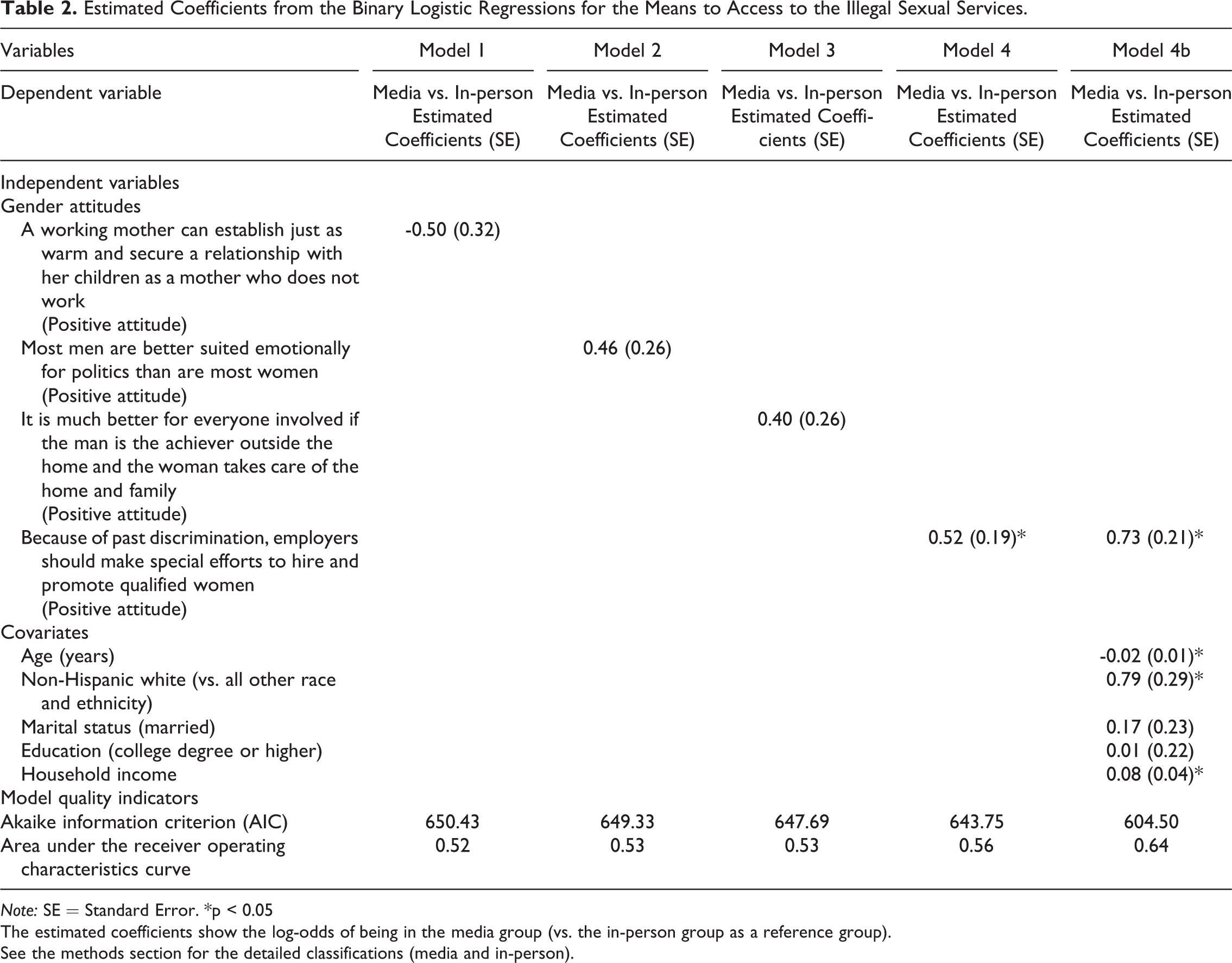
Note: SE = Standard Error. *p < 0.05
The estimated coefficients show the log-odds of being in the media group (vs. the in-person group as a reference group).
See the methods section for the detailed classifications (media and in-person).
Age, race/ethnicity, and household income were significantly associated with methods of contacting service providers. Older clients were less likely to use media than in-person contact. Consistent with most research, non-Hispanic whites were more likely to use media than in-person contact. Finally, those with greater household income were more likely to use media than in-person contact. These findings of the covariates suggest that there are differences between individuals in the methods they use to access sexual services and gender attitudes.
Discussion
The most surprising finding in the descriptive data was that men in all markets were significantly more likely to support gender equality for women’s roles in the home, work, and politics than the general population of males. This contradicts the view that men who pay for sex devalue women’s power, abilities, and roles. While our sample was less ethnically diverse and fewer were married than in the general population, these differences would not seem to explain why clients in our sample were more supportive of gender role equality.
Do male clients’ attitudes toward gender equality relate to the markets in which they mainly participated? We found few differences; egalitarian attitudes were similar across markets in most questions. The absence of differences among client markets in three of the four questions–women being emotionally suited for politics, women working outside the home, and working women’s ability to take care of children—is important. That clients’ generally positive attitudes were not associated with different markets means that these client attitudes likely play no central role in providers’ greater experiences of violence or exploitation in in-person markets. Numerous studies point to a variety of contextual factors that explain violence or negative experiences among street workers, including legal and policing policies and practices, economic conditions, stigma, and other structural relations of power (Connelly et al. 2018; Deering et al. 2014; Monto and Milrod 2019). Many factors explain sex workers’ experiences in different markets, but attitudes towards gender role equality does not seem to be one of them, although a wider range of gender attitudes, masculine repertoires, and structural factors should be examined.
Attitudes on affirmative action did matter in the descriptive statistics. Men using media markets were more supportive of special efforts to promote or hire qualified women in the workplace than men using in-person markets. This is in a context where clients in both markets were less likely to support special efforts than the population as a whole. While questions on gender-related affirmative action are frequently used to measure support for equality in the workplace, sexism in gender-role attitudes does not play a big role in predicting attitudes toward gender-based affirmative action (Harrison et al. 2006; Kane and Whipkey 2009). One cross-cultural study found male attitudes toward gender-based affirmative action are generally lower among some otherwise egalitarian men (Levtov et al. 2014). Questions on gender-based affirmative action are found to be less related to gender and more to issues such as race-related affirmative action, opinions about government involvement with market forces, meritocracy, free choice, or class-based perceptions about one’s own workplace chances (Kane and Whipkey 2009; Morgenroth and Ryan 2018). But we definitely need more research.
Based on the results from the regression analysis, we found that in-person clients, who were more likely non-white, single, and of lower income, were more likely to be against special efforts. This is curious as other findings suggest that these more marginalized groups more likely support gender-based affirmative action (Harrison et al. 2006; Kane and Whipkey 2009). Yet in our study, this finding is robust—we controlled all covariates in the model, and the special effort variable was still significant. It could be that these individuals were more akin to flexible egalitarians who tend to support individual choice in roles, and affirmative action was seen as antithetical to free choice (Knight and Brinton 2017). In terms of the effect size, the estimated odds ratio indicates the relative contribution of affirmative action attitudes to market preference after adjusting for covariates. It is possible that clients who prefer street markets are more threatened by affirmative action policies. However, given the lack of empirical evidence on the same topic, the magnitude of such effects should be further examined in future research when other comparable data become available. This issue is certainly worthy of further study, especially using different measures of the various dimensions of egalitarianism.
Study Limitations
Our sample is certainly not representative of all men who pay for sex. As long as they remain an underground and stigmatized population, it is unlikely there will ever be a representative sample of clients. Regular and frequent clients are more likely to access review sites, online blogs, or social media than casual or one-time consumers (Milrod and Monto 2012; Sanders, 2008b). Our online recruitment process likely missed the full range of individuals who use face-to-face methods and who do not regularly use the internet (Shumka et al. 2017).
Online recruitment methods also access mostly white clients (Shumka et al. 2017), which was the case for our sample. Our recruitment strategy began with subjects in a particular geographic area, that is, the Nevada’s brothels, and this population is fairly racially homogenous (Brents et al. 2010), although we excluded brothel-only clients. Given the importance of exploring racial and ethnic diversity within prostitution markets (Jones 2015), future research should pay attention to the demographic characteristics within online and face-to-face prostitution markets.
Also, the classification method of clients (media vs. in-person) was one of many possible approaches one could take to differentiating markets (Cunningham et al. 2018; Jones 2015). Many respondents used both mediated online/print and in-person markets. Our classification was somewhat simplistic; the available sample size was insufficient for more in-depth analysis. Future research should explore more detailed client-type classifications referring to our study for baseline findings.
In addition, due to low cell sizes, our in-person group included those who initially made contact in a bar or hotel, a space that is typically classed as an indoor venue and seen as somewhat safer than the street. We opted for a distinction based on the ability of client and provider to screen each other, a distinction that greatly affects safety in markets and the amount of third-party control. However, it is also the case that hotel and bar buyers are more similar to other indoor buyers in some respects. Future research should be able to understand if face-to-face initial contact in a bar or hotel is different than on the street.
Also, our study only focused on the examination of associations, and results should not be interpreted as implying causality. Although our sample was sufficient to address the research questions, the causal relationship should be investigated using longitudinal data in future research. Finally, our sample of GSS men includes the 13.9% who report that they have paid for sex in their lifetimes (Monto and Milrod 2014). Future research should examine the sub-populations (e.g., individuals who have paid vs. those who never paid for sex).
Conclusion
Male client attitudes about gender equality are one piece of the puzzle of how masculinities relate to the demand for paid sex. Our study’s descriptive comparison found that clients are more positive toward gender equality than the population of men, and that most attitudes were not related to preferences for different markets for commercial sex. This supports other research that the demand for commercial sex is not uniformly motivated by negative attitudes toward gender role equality, and thus demand may not be centrally driven by a masculinity built on devaluing women’s place in society.
Client support for equality in women’s roles is consistent with attitude research showing that enjoyment of sexual pleasure and even support for extra-marital sex are in line with support for gender equality and support for prostitution in neoliberal regimes (Stack, Adamczyk, and Cao 2010). Trends like the increasing demand for and value of the girlfriend experience, companionship or mutual enjoyment, normative pressures to show respect for women in online review sites, and the existence of consumer masculinities in purchasing sexual services, collectively might be contributing to more egalitarian attitudes toward women in all markets among the average client. We need more research in various markets.
Contemporary masculinity theorizing finds that masculine performances are enacted in relation to other men and to marginalized masculinities as well as in relation to women. While preliminary, our findings suggest that the demand for sexual services coexists with less oppressive and more gender egalitarian forms of masculinities—flexible, inclusive, or hybrid masculinities that are not entirely dependent upon the negation or exclusion of women (and gay men) in certain leisure spaces (Anderson and McCormack, 2018; Birch et al. 2017; Bridges and Pascoe 2014; Crowhurst and Eldridge, 2018; Hearn et al. 2012).
In addition, the demand for sexual services doesn’t just reflect attitudes toward women. The apparent inconsistency in answers to questions on affirmative action actually aligns with neoliberal cultural values such as individual autonomy, class, and color-blind attitudes that reject these differences as determinant of life chances and affirm the superiority of contract-based exchange (Harvey 2007). Clients in our study thus may care more about free choice, free markets, the role of government, and fair and consistent application of the law (Knight and Brinton 2017; Levtov et al. 2014) than about gender inequality (Harrison et al. 2006; Kane and Whipkey 2009). Thus, these kinds of free choice market moralities (Brents 2016; Pettinger 2013; Prasad 1999) may be as important in framing attitudes toward commercial sex in Western culture as sex and gender role attitudes. This market morality includes values centered on “autonomy, democratic equality, and unambiguous and non-discretionary fulfillment of obligations” (Prasad 1999, 185), whether it be called “consumer masculinities” (Joseph and Black 2012), “bounded authenticity” (Bernstein 2007), or “deserving consumers” (Pettinger 2013), to justify the superiority of prostitution over the gift exchange inherent in relational sex (Brents and Hausbeck 2007; Milrod and Weitzer 2012). Exploring this market morality and its relation to sexual consumption is a question certainly worth pursuing in future research.
As this and other research indicates, efforts to promote gender equality should tap into this support for gender equality among clients (Jewkes, Flood, and Lang 2015; Levtov et al. 2014). Findings from cross-cultural studies suggest that for the most part, men’s equitable attitudes were associated with equitable practices (Levtov et al. 2014). Misogyny does exist in the sex industry but given the ability of clients to collectively create market norms online (Lahav-Raz 2019b), policies criminalizing clients or closing online forums to correct gender injustices may unwittingly cut off avenues for positive socialization among clients with gender egalitarian attitudes (Armstrong 2014; Horswill and Weitzer 2018). Understanding the complexities of client attitudes toward women, and especially how these may change with different market preferences, can add important insights into how consumer culture interacts with what it is to be a man in the twenty-first century (Birch et al. 2017).
Footnotes
Declaration of Conflicting Interests
The author(s) declared no potential conflicts of interest with respect to the research, authorship, and/or publication of this article.
Funding
The author(s) received no financial support for the research, authorship, and/or publication of this article.