



Abstract
Evaluator training field experiences seek to reinforce applicable content knowledge and promote applied skills. For students, even a small-scale field experience focusing on limited components of a larger evaluation process can seem particularly challenging. Students often do not recognize the relevance of established evaluation resources capable of focusing, situating, and guiding their early professional practice efforts. For example, anticipating relevant evaluation standards and ethical principles and understanding the potential guidance they offer—in the context of student’s field experiences—requires more than their cursory acknowledgment. This article identifies the challenges that students encountered with course-embedded, small-scale field experiences and introduces the development and application of an instructional tool to help them: (a) more strategically focus evaluation field experiences; (b) situate experiences in terms of the larger evaluation to which it is contributing; as well as (c) ground experiences in terms of relevant evaluation standards, ethical principles, and evaluator competencies.
Training new evaluators is often accomplished through the combination of classroom instruction and practical field-based experiences that seek to integrate theory and practice (Trevisan, 2004). The classroom element of evaluator training seeks to increase students’ conceptual understanding of evaluation and to broaden their evaluation knowledge base. Evaluation classroom instruction focuses on introducing students to evaluation content related to the history of the discipline, the various evaluation theories, methods, and models in the extant literature, as well as the purposes, core elements, and requirements of various types of evaluations. Classroom instruction also seeks to expose students to program evaluation standards and ethical principles along with relevant evaluation process management requirements. At the classroom stage of evaluator training, students are expected to experience hands-on classroom applications addressing evaluation techniques such as logic modeling, instrument development, various data collection methods, as well as related qualitative, quantitative, and mixed-method research techniques. These topics represent the core focus of many popular evaluation texts (Bamberger, Rugh, & Mabry, 2006; Fitzpatrick, Sanders, & Worthen, 2004; Posavac, 2011).
Since the evaluation profession is based upon the application of evaluation knowledge through professional judgment, evaluator training is also expected to provide students with appropriate real-world, field-based experiences that address the needs of actual clients and stakeholders (McDavid & Hawthorn, 2006). Field-based evaluation instruction, similar to training in other practice professions, is a critical aspect of professional preparation that enables controlled and guided application of knowledge and skill development in real-world settings and circumstances. The fundamental importance of field-based evaluation experiences has been well documented in the evaluation literature (Cronbach et al., 1980; Chelimsky, 1997; Fitzpatrick, 1994; Trevisan, 2004). In addition to providing students with practical field exposure similar to the real-world applications they will encounter as future evaluators, Preskill (1992, 1997) noted the broader pedagogical benefits of student engagement in hands-on field experiences as reflected in the literature addressing effective adult education.
However, as we shall discuss, students confront many initial challenges in field-based experiences, especially small-scale course-embedded evaluation experiences that focus on the practice of a narrow set of skills addressing limited elements of a larger evaluation effort. Accordingly, the purpose of this article is to describe and report on the development and initial application of a field experience instructional tool that was designed to help ameliorate some of the challenges novice evaluators encounter in their initial small-scale evaluation field experiences. The following discussion is not based on an empirical study; it reports on the personal experiences and perceptions of a small group of faculty and students collaborating to address field experience challenges with a new instructional tool. Specifically, these include students’ challenges of strategically focusing field experience efforts, situating associated evaluation tasks within the larger evaluation process, and grounding practice efforts in terms of the evaluation standards, ethical principles, and established evaluator competency requirements. Three objectives guide this discussion including (a) a brief overview of field experience challenges students confront in their small-scale evaluation field experiences, (b) the description of a new field experience instructional tool designed to address these challenges, and (c) the initial application of the tool in an evaluation classroom setting.
Student Micro-Level Evaluation Field Experiences
Instructional activities promoting real-world skill application for evaluation students can be achieved through a variety of approaches (Trevisan, 2004), including simulations, role-play, single-course projects, and practicum experiences. This discussion focuses on a field experience approach consistent with Trevisan’s category of a single-course project. However, rather than focus on the academic setting (single course or practicum) of the field experience, we further characterize field experiences based upon the scope of the student’s evaluation experience regardless of the academic structure in which it occurs. For example, we categorize field experiences as either macro or micro in scope, depending on the breadth of evaluation expectations of students. The macro-level field experience perspective represents opportunities for students to take substantial responsibility for a larger evaluation effort under the guidance of an experienced evaluator/instructor. This type of field experience is usually presented in the form of a student practicum addressing a manageable, small-scale program evaluation for a client in a local university or community setting. Typically, this type of field experience comes later in a student’s educational career, after he or she has gained a suitable level of knowledge or skill that can be realistically applied in practice. The second perspective, micro-level field experiences, is centered on the development of targeted basic evaluator competencies in a small-scale, narrowly defined field experience addressing a limited aspect of an existing evaluation effort. Such micro-level experiences are often, but not always, embedded as an evaluation course activity. Instructor involvement in micro field experiences usually requires moderate levels of oversight and supervision consistent with the narrower evaluation scope of the students’ projects.
The particular focus of this article is on course-embedded, micro-level field experiences, where evaluation students are applying a limited number of specific evaluation skills through a narrowly focused field experience, an experience engaging smaller components of a larger evaluation effort. Such micro-level field experiences could address any number of evaluation tasks and related evaluator competencies (e.g., Stevahn, King, Ghere, & Minnema, 2005), such as designing/conducting a needs assessment, instrument design, data collection through interviews or focus groups, the analysis of quantitative or qualitative data, proposal development, logic modeling, evaluation budgeting/management, evaluation report development, and the promotion of evaluation use. Within the university-based evaluator training programs, students likely will engage in multiple micro-level field experiences across several evaluation projects. These experiences will tend to be strategically targeted toward several distinct evaluator competencies of particular interest to the student. Moreover, it is also possible that students may be simultaneously engaged in more than one multiple course-embedded field experience opportunities.
Programmatic Context
The context for this field experience discussion is a graduate program in Evaluation, Statistics, and Measurement within the Educational Psychology and Counseling Department at a large southeastern university. The senior author teaches a two-semester, second-year graduate course sequence for doctoral students who have completed two introductory evaluation courses toward an evaluation graduate certificate or PhD. The program curriculum is specifically aligned with competencies offered by Stevahn, King, Ghere, and Minnema (2005, 2006). Both the courses in the second-year sequence include a micro-level field experience component where students engage in smaller, more focused evaluation field experiences to address targeted skill sets they would like to develop or enhance. Examples of field experiences typically include designing needs assessment, developing an evaluation design and proposal for a client, conducting stakeholder interviews for an existing evaluation project, developing an evaluation survey instrument with strong measurement properties, analyzing qualitative and quantitative evaluation data, or other similar small-scale evaluation activities. Almost all of these narrowly focused field experiences support ongoing or external program evaluation efforts within the university or a local community agency. Students also participate in subsequent multiple internships, usually occurring after coursework is completed.
The senior author noticed a variety of challenges students were encountering in their field experiences and sought to identify and address these challenges with appropriate pedagogical strategies. As this process unfolded, collaborative support and engagement of two advanced graduate students and a faculty colleague gradually expanded initial efforts into a team approach across two semesters of one academic year. In this article, we seek to share our experience and approach for improving student field experiences, present the field experience tool, and hopefully generate further discussion in the evaluation community on the important topic of evaluator field training.
Student Challenges With Micro-Level Evaluation Field Experiences
Over several years of offering the second-year course sequence, the course instructor (senior author) observed that as students wrestled with the implementation realities of their micro-level evaluation field experiences, they encountered somewhat typical evaluation activity challenges, but challenges that they had not quite fully anticipated or appreciated. These challenges included the normal but messy reality of poor project-wide communication, stakeholder slowness to schedule interviews due to time commitments, existing project data sets that were not always consistent with initial client claims, and sometimes inconsistent, rapidly changing, or even unrealistic client expectations. As the semester proceeded, growing levels of student frustration were encountered during weekly class-debriefing sessions. These fairly typical evaluation project realities were being viewed by students with increasing frustration as they constituted interferences with their course assignment.
While multiple, narrowly focused, smaller-scale field experiences are appropriate for developing requisite evaluator skills (Preskill, 1997), three types of student limitations inherent in micro-level field experiences were typically encountered in these second-year courses. The first limitation encountered can be characterized as weak focusing. This refers to the challenge novice evaluators face in specifying the scope, timeline, and resulting deliverables of a proposed small-scale evaluation activity. It would be reasonable to expect that this type of limitation is commonly encountered in the initial practice efforts of novices in any practice profession. Anticipating and specifying evaluation tasks that need to be accomplished in a practice setting, breaking tasks down into manageable pieces, and scheduling and coordinating efforts to address these evaluation requirements are a challenge, since unanticipated contextual factors encountered in real-world settings are often beyond the evaluator’s control. However, this problem is exacerbated by inherent limitations of academic course settings, such as a semester length of 15 weeks and a 6-hr field experience per week workload.
The second student limitation encountered can be characterized as weak situating or the limited ability of students to make a meaningful connection between their micro-level field experience activity and the larger evaluation effort to which they were contributing. While micro-level field experiences provide students with opportunities for targeted skill development and practice, they tend to limit student exposure to much of the real world, broader contextual dynamics, intricacies, and nuances encountered across an overall evaluation effort. Unfortunately, evaluation students can sometimes be so focused on addressing and mastering a specific evaluation activity at hand that they lose sight of a task’s overall relevance to the larger evaluation effort to which it contributes. As students complete a particular evaluation field experience activity and then move on to other field experience and course tasks, they may also tend to develop a limited perspective of evaluation as an array of discrete, self-contained tasks and activities. The typical “give-and-take adjustments” among the various elements of an overall evaluation process are not typically encountered in micro-level field experiences, and thus they may not be readily recognized as an essential component of each evaluation experience.
The third student limitation we encountered can be characterized as weak grounding, of which there are two aspects. The first aspect of weak grounding is the initial weak connection students often make regarding relevant evaluation standards and ethical principles. Actively grounding micro-level experiences in the discipline’s evaluation standards and established ethical principles would help students avail themselves to the support and guidance these evaluation resources provide (American Evaluation Association [AEA], 2010; Joint Committee on Standards for Educational Evaluation, 1994; Stufflebeam, 2007). Initially, students tend not to grasp that even a small, narrowly focused evaluation activity may be informed by multiple evaluation standards and ethical principles. Determining relevant standards and ethical principles as well as understanding the guidance they offer takes more effort than a cursory acknowledgment of their existence. Nonetheless, such effort can provide students with a much needed and firmer foundation for their field experience activities.
The second aspect of weak grounding encountered was students’ inability to recognize that small-scope micro-level field experiences almost always involve the application of multiple evaluator competencies (e.g.,King, Stevahn, Ghere, & Minnema, 2001; Stevahn et al., 2005, 2006). For example, experienced evaluators understand that effective and timely analysis of preexisting survey data in the actual context of an evaluation may well require the application of interpersonal, professional practice, as well as situational analysis competencies. Increasing levels of frustration can result if students naively expect to conduct an orderly, well-defined technical analysis of existing survey data (essentially the practice of one competency), but they actually encounter potential challenges of using survey data previously collected by a client (e.g., ambiguously worded survey questions, delays in accessing the data, unexpectedly high levels of missing data, potentially changing, and/or unrealistic client schedules for reporting survey results). Experienced evaluators understand that most evaluation tasks require the application of multiple evaluator competencies.
The Micro-Level Field Experience Instructional Tool
Our review of the literature did not lead to the identification of potential pedagogical approaches that would be responsive to the challenges identified in this article. There is compelling literature on the need for strong bridges between theory and practice (e.g., Dewey, Montrosse, Schroter, Sullins, & Mattox, 2008), and Trevisan’s (2004) review of the literature on evaluator training identified several studies addressing the types and attributes of course-based and practicum field experiences. However, the studies available for review by Trevisan focused on the nature of field experiences offered, their link to theory, and the types of challenges encountered. We note that some of the challenges identified in these studies reflect the focusing, situating, and grounding issues we are trying to address. However, there was a lack of literature capable of informing our efforts to address the challenges encountered, and this suggested the need to develop our own pedagogical response.
In response to these field experience challenges and subsequent discussion with students and other evaluation faculty, we developed an instructional approach specifically to help students better focus, situate, and ground their micro-level field experience in the form of a field experience instructional tool (hereinafter referred to as the tool). The tool is comprised of five key components that are made operational through five interrelated, sequential steps (Figure 1 ). The tool is expressed in terms of interrelated guidelines for a course-embedded micro-level field experience that is capable of guiding student field experience planning, implementation, reporting, and reflection. Each step of the tool is described below, followed by an example highlighting one evaluation student’s initial use of the tool toward focusing, situating, and grounding a university-based field experience (i.e., Steps 1–3).
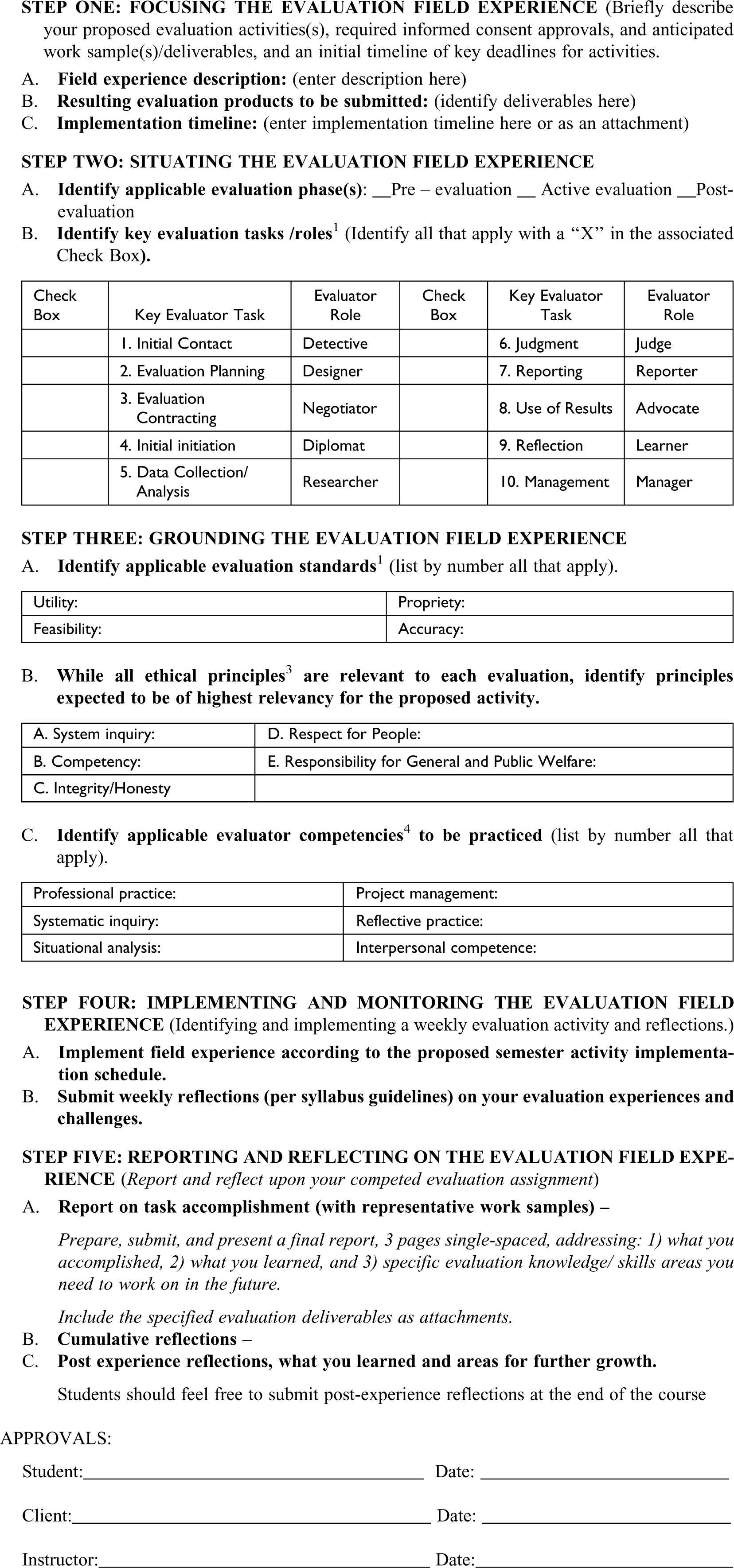
Evaluation Field Experience Tool (Learning Contract)
The first step of the tool, focusing the evaluation experience (Figure 1), requires students to initially define a specific micro-level field experience evaluation activity (or activities) in which they will be engaged, establish a preliminary implementation schedule, and identify the resulting evaluation products they expect to produce (course deliverables in the form of evaluation work samples). Students are required to work closely with an evaluation client to identify the specific evaluation activities to be addressed during the semester. During this first step, students also negotiate with the instructor regarding specific field experience deliverables/work samples to be submitted as evidence of accomplishment and learning. This first tool step results in a brief but sufficiently detailed statement of work that ensures that the student, client, and instructor have a specific mutual understanding as to what the student will accomplish in the semester field experience. These preliminary teacher and client discussions regarding proposed activities, products, and related implementation timelines also provide the student with valuable experience in negotiating a typical small-scale evaluation scope of work. Students are encouraged to view their initial focusing efforts as the start of an ongoing activity, one that must be occasionally revisited and revised. As evaluation activities, deliverables, and timelines can change substantially in some aspects over the semester, students are required to submit any major changes for instructor approval. This helps ensure that the evaluation field experience activity remains meaningful, appropriate, and of sufficient scope to meet course requirements.
Step 2 of the tool, situating the evaluation field experience, is also addressed by students at the time the evaluation task is being designed and formalized. This step requires students to (a) situate the evaluation activities in terms of the associated evaluation phases (preevaluation, active-evaluation, and postevaluation) and (b) anticipate and identify the particular key evaluation tasks and accompanying evaluator roles in which they will be engaging. As part of this activity, students read and discuss an article on evaluator roles (Skolits, Morrow, & Burr, 2009), which introduces evaluation phases, key evaluation tasks, and associated role demands and responses. The first aspect of Step 2 is straightforward, having the student determine the stage/stages of the evaluation they will be engaging (preevaluation, active-evaluation, and postevaluation). Through this effort, students begin to understand that many of their small-scale evaluation activities actually cut across more than one evaluation phase. The second element of Step 2 requires students to situate their field experience assignment in one or more of the 10 key evaluation tasks (i.e., initial contact, evaluation planning, contracting, initial initiation, data collection and analysis, judgment, reporting, use, reflection, and/or management). Since each key task is associated with a designated evaluator role, students are also situating each major task within the associated multiple roles that they can expect to play for each task (e.g., detective, designer, negotiator, diplomat, researcher, judge, reporter, advocate, learner, and/or manager). This situating process enables students to better understand and predict the actual nature and scope of their field experience (i.e., evaluation standards, ethical principles, and evaluator competencies) and, more importantly, the likely roles they will need to prepare for and assume.
The third step of the tool, grounding the evaluation field experience, requires students to consider the proposed field experience evaluation activity in terms of three grounding elements: (a) the applicable program evaluation standards of the Joint Committee, (b) the most relevant or applicable AEA Guiding Principles for Evaluators (ethical considerations), and (c) the broader array of professional competencies likely to be engaged. In preparation for this activity, students revisit relevant literature on the evaluator competencies adopted for the evaluation program (Stevahn et al, 2005), the AEA Guiding Principles (AEA, 2010), and the evaluation standards (Joint Committee on Standards for Educational Evaluation, 1994). First, students identify which program evaluation standards they anticipate to be appropriate for the proposed field experience activity. Second, students identify the particular elements of the Guiding Principles that are most salient. Finally, students also identify the specific evaluator competencies they initially expect to draw upon during the field experience.
Grounding field experiences in terms of the expectations of applicable standards, ethical principles, and evaluator competencies force students to deeply reflect and anticipate the scope of their activities. It helps them establish an initial connection between the upcoming field activity and the useful evaluator resources available, such as evaluation standards, ethical principles, and evaluator competencies. As students gain a deeper conceptualization of their upcoming field experience, they are also developing a basic supporting framework for their independent search for additional relevant field experience references and resources. Grounding efforts can also enable students to extend learning experience beyond their initial conceptualization of the field experience activity. For example, a micro-level field experience opportunity to “conduct, analyze, and report on stakeholder focus groups” may appear initially as the development of a technical skill. However, as students reflect on the broader scope and requirements of an evaluation activity, they will tend to realize that multiple competencies can be relevant, and a broad array of evaluation standards and ethical principles may likely be involved and thus need to be consulted.
The fourth step of the tool, implementing and monitoring the evaluation field assignment, calls for students to implement the field experience in accordance with the originally estimated scope of work and timelines. Throughout the semester, regularly scheduled class-debriefing sessions on weekly progress seek to positively reinforce initial student efforts to focus, situate, and ground their field experience efforts. In support of faculty field experience monitoring and reflection, Steps 1–3 of the field experience tool provides a systematic outline and format for the instructor to periodically probe, reinforce, and address student field experience focusing, situating, and grounding efforts.
The second aspect of the implementation step is the requirement that students maintain a reflective practice journal throughout their field experience. Students make a weekly journal entry identifying their specific field experience activities, related accomplishments, as well as any implementation challenges they have encountered. They are also expected to reflect on their activities, accomplishments, and challenges, especially regarding what they have learned as well as any specific learning needs for future investigation. In addition to written reflection, students participate in periodic debriefings with the instructor and other students throughout the semester where the challenges they have encountered are aired and discussed, especially from the perspective of potential evaluation resources and strategies for addressing them.
The fifth step of the tool, final reporting and reflecting on field experience accomplishment/areas for improvement, requires students to prepare a culminating report on the final status of their evaluation field experience activity at the conclusion of the semester. This includes both a written and an oral presentation on the field experience. On some occasions, however, field experience activities are not always completed in a semester time frame of 15 weeks due to factors often beyond the student’s control. Sometimes, the client seeks to expand the established scope of the field experience as they come to better understand how the student can help them in broader ways. Often, the initial timelines were unrealistic or the student encounters unavoidable and unpredictable implementation delays. For this reason, field experience course deliverables are typically framed to include interim as well as final products.
A second aspect of this fifth step of the tool addresses students’ preparation of a final reflection of their evaluation field experience, including what they learned from the experience as well as areas for continued improvement. This provides students with a chance to reflect on the field experience as a whole and share perceptions about the experience, associated accomplishments, perceived levels of learning as well as specific competencies they want to address in the future. Since the previously conducted field experience grounding activity helped students reconnect with evaluator competencies, guiding principles, and evaluation standards from a more meaningful and relevant basis, the student reflections are structured and shared in terms of these elements.
A Sample Field Experience Tool Application
Figure 2 presents the elements of a prefield experience tool worksheet submitted and revised by a student prior to engaging in a proposed evaluation field experience. The student negotiated a field experience opportunity with a campus unit that provides evaluation services to external organizations. As one of the several aspects of a large (national) ongoing external program evaluation, a stakeholder survey had been completed, and the raw data were available for analysis and reporting. The field experience proposal called for the student to analyze these previously collected survey data (addressing educational materials offered by a vendor) and prepare a technical report for the client. A separate, technical report on survey findings was one of the external evaluation project deliverables. Additionally, the client was seeking support for a multisite case study. This client need fit well with the student’s interests in gaining data analysis and experience. The student had some previous statistical and survey training but wanted to be more experienced and comfortable with survey data analysis. The external project evaluator (i.e., the student’s client) provided the student with an introduction to the larger evaluation project, identified the specific expectations for the analysis of the survey data, shared related expectations for a technical report, and identified the support needed for the case study.
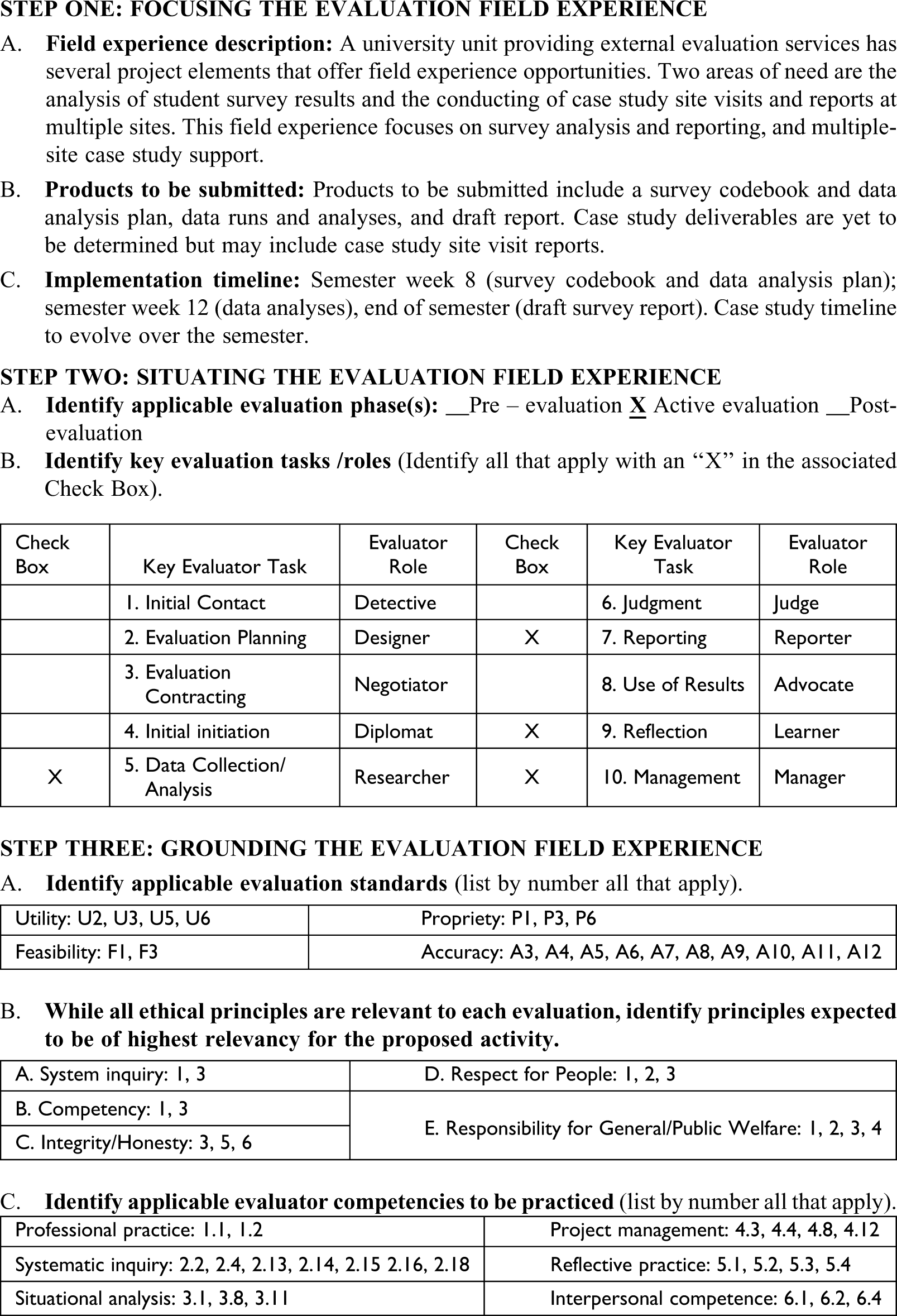
Sample Completed Evaluation Field Experience Tool (Steps one through three)
Using the field experience tool worksheet, the student (upon consultation with the instructor and client) focused, situated, and grounded this course-embedded field experience activity, as reflected in Figure 2: Focusing. The description, product deliverables, and time frame provided by the student was aided by the approved scope of work and implementation timeline of the larger existing external evaluation project. The student proposed to conduct survey data analysis and reporting and to provide support for the external evaluation requirement for case study development. The opportunity for more than one small evaluation task (in this case survey analysis and support for evaluation case study development) is typical of many student micro-level field experience opportunities. Situating. The student reported this field experience (Figure 2, Step 2) as falling within the active-evaluation phase and initially identified three roles that were likely to be engaged during the field experience. These included the researcher role, the reporter role, and the learner role. Instructor input led to the identification and subsequent inclusion of the manager role. Interestingly, students’ introduction to evaluator roles has led to their recognizing that the learner role is part of every evaluation experience, but initially many students did not readily acknowledge the universality of the manager role (which is posited in the literature as a role that cuts across all evaluation project activities). Grounding. The student initially grounded (Figure 2 Step 3A) this field experience solely in terms of the accuracy standards as the role of technical accuracy in this project was obviously paramount and certainly what led the student to engage in this particular evaluation experience. However, the instructor was concerned that none of the other standards were initially viewed as potentially applicable. Upon discussion with the student, additional standards were deemed appropriate and incorporated in the tool worksheet. The student initially defined an array of ethical standards as appropriate for the field experience (Figure 2, Step 3B), and this reflected some level of awareness of the management and interpersonal competencies of the field experience. Moreover, the student also initially identified situational analysis, professional practice, and interpersonal competencies, again providing an indication that the student began with a broader and realistic conception of the project. Figure 2 represents the final revisions in the student’s effort to focus, situate, and ground elements of this field experience.
The proposed field experience project, as it was narrowly defined, more technical in nature, and sponsored under the auspices of an existing external evaluation project, proceeded according to schedule. Overtime, the need for multisite case study support became a larger focus of this student’s field experience project, reflecting shifting priorities of the larger evaluation process. Student progress was routinely reported in weekly reflections and in-class debriefings. However, across the semester, the faculty member increasingly noted a small but growing level of frustration in both verbal and written reflections of the student. This was disconcerting since the field experience itself seemed to be progressing more or less according to the plan. Further discussion with the student led to the realization that while the field experience was proceeding as planned, the student confronted a heavy semester course schedule that included articles and other submissions that coincided with field experience deliverable timelines. These demands on the student’s time, along with an evolving field experience that focused on the case study, created scheduling challenges for the student that at times were extremely demanding. While the student was able to manage the multiple course and field experience deadlines and present high-quality deliverables, the experience reminded the instructor about the challenges of even relatively straightforward field experience projects for student evaluators engaged in multiple course experiences.
While such active preparation and engagement with student field experiences also create substantial time demands on the faculty, it is critically important from a pedagogical perspective (Gredler & Johnson, 2001). Fortunately, from the start, the field experience tool helps frame teacher–student collaborations from the perspective of supporting roles, competencies, standards, and guiding principles, and it continues to provide a framework for discussing field experiences during the regularly scheduled debriefing sessions. Based on the use of the tool, this micro-level field experience was broadly and realistically focused, situated, and grounded by the student and relevant evaluation resources were thoughtfully considered. The elements of the tool offered a foundation for ongoing reflection and debriefing as the project progressed. The student fulfilled the field experience largely in accord with the way it was originally reflected in the instructional tool, although this was not always the case for every student in class. In cases where the field experience tool had to be substantially revised during the semester, changes were due to project implementation timeline modifications or shifting priorities of the client organization.
Field Experience Tool Implications for Evaluation Training
Micro-level field experiences can never substitute for the deep and rich learning opportunities offered by students’ exposure to a complete evaluation process from start to finish (i.e., a well-designed macro-level field experience). Before the completion of an evaluation training program, students certainly should have several opportunities to assume primary responsibility for a complete program evaluation. These macro-level field experiences naturally help students better situate the various elements of evaluation practice within a broader array of competencies and form a realistic and holistic perspective of the components of an actual evaluation and their interrelationships (Gredler & Johnson, 2001). However, the field experience tool introduced in this article suggests that micro-level experiences may also be capable of supporting a meaningful, deeper, real-world experience that maximize students’ knowledge of specific competencies as well as broader professional practice foundations.
Based upon initial applications, the tool suggests an initial promise in several areas of evaluator field experience training. These include the potential to promote a more strategic and holistic conceptualization of evaluation on the part of students, even when students are engaged in limited contributions to a small portion of an ongoing evaluation; provide a simple template that enables novice evaluators to focus and situate their field experience activities within a larger evaluation effort, enabling them to anticipate expectations of them as an evaluator (e.g., evaluation stages, key tasks, and roles); show students how to realistically ground their field experiences within the relevant, applicable evaluation standards, ethical principles, and competency expectations–essential resources capable of helping them guide their evaluation practice; and help students develop a foundation for framing their evaluation practice in a manner that supports the integration of knowledge and skills in practice settings and that also provides a basis for meaningful professional reflection and growth.
While the micro-level field experience tool shows initial promise, it has been developed and applied in only one academic program setting. It is hoped that sharing the tool with a wider audience will lead to its further application as well as the assessment of its utility in a variety of instructional programs and settings. Part of the future validation of the tool will need to include some level of cost–benefit analysis regarding the time it requires on the part of the instructor and the student. Moreover, future research on the field experience tool should also seek to determine its potential effect on student confidence and self-efficacy toward future practice—two areas of improvement reflected in debriefings with students. While the evaluation field continues important discussions on desired evaluator competencies and the potential for an evaluator credential, there will be a growing need for expansion of the evaluation literature related to the most effective methods and techniques for training evaluators, especially regarding field experiences preparing students for future professional practice. The tool presented here has the potential to help inform these discussions.
Footnotes
The author(s) declared no potential conflicts of interest with respect to the research, authorship, and/or publication of this article.
The author(s) received no financial support for the research, authorship, and/or publication of this article.