




Abstract

Introduction, by Joseph Bauer
This Exemplars article tells the story of EvalPartners, the international evaluation initiative to strengthen civil society’s evaluation capacities through collaborative partnerships. We hope to contribute to discussions on how international stakeholders can create synergies and partnerships to build equity-focused and gender-responsive, country-led evaluation systems. Highlighted are the strategic roles that dedicated individuals and civil society organizations, 1 notably Voluntary Organizations for Professional Evaluations (VOPEs 2 ), are playing to create a global evaluation movement that promotes the use of evaluation to enhance evidence-based policy making, transparency, and learning.
This story is told through the voice of Tessie Catsambas, who for the past 3 years was the American Evaluation Association (AEA) representative to the International Organization for Cooperation in Evaluation (IOCE) 3 and also served as the secretary of the IOCE and a member of the EvalPartners Executive Committee. In her “day job,” Tessie is the president of the global consulting company EnCompass LLC. Tessie is an evaluation and organizational development expert with more than 25 years’ experience in evaluation, quality improvement, and innovation. Her work has included supporting organizational change in response to health reform, managing global evaluation projects, program design, corporate strategy development, and e-learning program development. She also coauthored Reframing Evaluation through Appreciative Inquiry (2006) with Hallie Preskill.
John Strand
A Story of Change Agents
Evaluators’ conversations include the words policy, evidence, advocacy, capacity strengthening, evaluation education, funders, and civil society. One powerful engine that has turned these words into action, change, and potential in the global arena is the EvalPartners initiative. Several publications have chronicled the establishment and evolution of EvalPartners 4 conveying the Initiative’s goals, achievements, and potential for evaluators around the world. Hundreds of people are working in the four corners of the earth to bring the EvalPartners profile into focus. This article is dedicated to all of us who are working together and separately to create change, and to make our craft, evaluation, known to people, accepted, and useful in promoting social justice.
EvalPartners is a story of evaluators as change agents—individuals in action, rising above the everyday demands of their lives, who inspire each other: to work double time to complete painstaking work for their volunteer-based professional evaluation associations; to get the attention of political leaders and convince them to speak out for evaluation; and to reach out to colleagues and help in any way they can. This article tells the EvalPartners story through the personal stories of a few of the many individuals who were there from the beginning. Through the stories of these colleagues, we trace the birth and evolution of EvalPartners and the strengthening of evaluation movements around the world. I hope that, through these stories, you, the reader, will appreciate the power of the EvalPartners network and the strength of our collective commitment. The stories here are representative of many others, and I ask forgiveness in advance that I could not include the stories of all who make up the EvalPartners chronicle.
Historical Context of International Cooperation
The evaluation profession has been increasing its visibility in the United States over the last 5 years. The AEA, for example, has gone from 5,000 members in 2010 to approximately 7,700 in 2014 representing all 50 states of the United States and over 60 foreign countries. Parallel to its growth in the United States, the AEA has been a key supporter of international cooperation and a founding member of the IOCE (www.IOCE.net).
In November 1998, during a plenary session of the AEA conference, presidents of the AEA, Associazione Italiana di Valutazione, Australasian Evaluation Society, Canadian Evaluation Society, Kenyan Evaluation Association, and the U.K. Evaluation Society debated the pros and cons of entering into partnership. In the fall of 1999, a discussion was held about the international nature of the evaluation profession and shortly afterward a panel was formed to discuss the creation of a worldwide community of evaluation. A grant from the W. K. Kellogg Foundation allowed the presidents and official representatives from 15 regional and national evaluation organizations to attend a residency meeting in Barbados, West Indies, in February 2000. Through intense negotiation in this highly political meeting, the delegates developed a framework for an IOCE that was formally endorsed in March 2001 and incorporated during a meeting in Lima, Peru, in 2003.
Between 2003 and 2012, the international visibility of the evaluation profession has increased dramatically. One way to demonstrate this is by observing that the number worldwide of subnational, national, regional, and international VOPEs (professional evaluation organizations, usually called evaluation associations, societies or networks) has increased from 32 in 2002 to 151 by late 2014, with a total aggregate membership of over 43,000. There has been an especially significant proliferation of evaluation associations in the Global South—that is, Latin America and the Caribbean, Africa, and most of Asia. Currently, IOCE recognizes 114 national VOPEs in 99 countries.
By 2102, evaluation had become recognized as a strategy for greater transparency, better governance, more effective programming, and building of democratic societies. In the United States and abroad, evaluation became known for its potential to shift the power structure, reframe issues, and increase political education and participation. Funding organizations and international partners (and later on, governments) began paying more attention to evaluation, for example: The U.S. Agency for International Development (USAID) under Administrator Raj Shah experienced a recommitment to evaluation seen in the adoption of an Evaluation Policy and the establishment of the Policy, Planning, and Learning Bureau where evaluation, integrated with planning, project design, and monitoring, became a core function to support USAID strategies and program. The World Bank and International Finance Corporation consolidated their evaluation functions into the Independent Evaluation Group that reports to the board. Most United Nations agencies established their own evaluation offices, notably United Nations Development Programme (UNDP) with its Independent Evaluation Office, and United Nations Children's Fund (UNICEF) with a history of commitment from its directors and previous Senior Evaluation Officer (Marco Segone) to evaluation that supports UNICEF’s mission of voicing equity concerns and uncovering vulnerability.
During these recent years, increased attention was given to building the evaluation capacity of governments and to using evaluation to inform policies and programs; however, civil society was not yet truly recognized as a key evaluation player. Some people, however, were actually thinking about the role of evaluation in promoting social justice and wondering how to bring it to scale.
A Strong, Committed Believer Makes the Difference
Be true to the nature of real partnership; no matter the size or power of partner organizations, it’s an engagement among equals. (Marco Segone)
Currently director of the Independent Evaluation Office at U.N. Women, Marco Segone had been working in M&E at UNICEF since 1998, first in the field, and later on at headquarters in New York City. Committed to equity-focused evaluation, Segone was motivated by a vision of alignment between the field—he had served in Albania, Brazil, Colombia, and Niger—and headquarters. Instead of allowing bureaucracy weigh him down, Segone used his position at UNICEF to launch www.MyMandE.org, a website with free evaluation resources, and he became active in the AEA’s International and Cross Cultural Evaluation Topical Interest Group and in the IOCE. Inspired by the potential of international cooperation, and by UNICEF’s evaluation leader Jean Quesnel (earlier supervisor and mentor of Segone) and Mahesh Patel, first president of the African Evaluation Association, Segone was convinced of the power and usefulness of evaluation to create transparency and influence policy in the area of human rights.
Segone saw the IOCE as an organization with legitimacy and potential to solidify international cooperation in evaluation but was concerned about the low capacity of the organization. Having served on the Board of the IOCE as vice president, he saw the path the IOCE needed to take, but had no access to resources to make it a reality. An opportunity presented itself in the National Evaluation Capacities (NEC) Conference of 2011 organized by UNDP, where Finland’s Ministry of Foreign Affairs Senior M&E Officer, Riitta Oksanen, expressed her interest in promoting evaluation capacity development, including equity-focused evaluation, and invited Segone to speak with her team in Helsinki. Segone recognized this invitation as an opportunity to promote his vision of international cooperation and hoped that Finland might be the type of independent and flexible funder who would consider investing in what to others may have seemed to be a risky venture, yet one with a high potential payoff for evaluation. After an intense discussion on the IOCE and its potential leadership role for civil society, Segone invited Oksanen to the 2012 IOCE Board Meeting in Accra, Ghana.
The EvalPartners movement may seem inevitable in hindsight, but in late 2011, it appeared a risky venture. Nevertheless, the combination of personal commitment and willingness to underwrite a level of collective risk exhibited by Segone was contagious and became part of the EvalPartners culture. Probably even Segone could not have predicted that EvalPartners would tap into a vein of inspired global activism, but this is, in fact, what happened. By the end of 2012, Segone’s contribution to global cooperation in evaluation practice earned him the 2012 Alva and Gunnar Myrdal Evaluation Practice Award by the AEA.
How a Small Donor Changed the International Evaluation World
Be ready to test new mechanisms and take some risks so we select initiatives that lead to results. (Riitta Oksanen)
The Aid Evaluation Office in the Ministry of Foreign Affairs of Finland was committed to working jointly with others to build M&E capacity. Senior Evaluation Officer Riitta Oksanen attended the NEC 2011 pondering the enormity of needs in M&E; she and her colleagues were dismayed at the donor-driven nature of M&E, the significant M&E capacity gaps in government and civil society in the Global South, the lack of recognition of the importance of civil society M&E capacity, and the insufficient attention to equity and gender-equality focused M&E. Segone’s NEC 2011 presentation on equity and gender in evaluation caught her attention, and she invited him to present in Helsinki, and discuss how to build NEC internationally.
Oksanen resonated with Segone regarding the IOCE and understood this international organization’s potential to reach civil society. She had feared that civil society would get lost in the broader context of NEC, and when she realized how many evaluation associations existed, she was excited at the opportunity the IOCE presented to lead the M&E for civil society charge. She was prepared to consider a limited number of bilateral initiatives for Finnish Aid to support M&E capacity development in civil society, but IOCE offered an option that would allow her to leverage Finnish assistance for global influence. Segone and UNICEF made a trustworthy global partner. Oksanen saw this as a significant opportunity for Finland and enthusiastically accepted Segone’s invitation to the IOCE Board meeting in Accra in January 2012.
Segone and Oksanen saw the 2012 IOCE Board meeting in Accra as the turning point where the founding partners agreed to support an international initiative to build civil society evaluation capacity to promote equity and gender equality in evaluation. During the Accra meeting, EvalPartners was born and named. For Segone, the partnership with Finland enabled EvalPartners and everything that followed; for Oksanen, the partnership with UNICEF and the IOCE meant that she had found organizations with legitimacy and credibility and a team of people with shared values that would enable Finland to leverage its funds for maximum impact on M&E for civil society.
The IOCE Board was thrilled at the opportunity EvalPartners represented to strengthen the organization and activate its membership. All those attending—both current and past board members—were excited and energized; they were not aware, however, of the importance of that moment. A little dazed, they tried to decipher what this would mean for the IOCE, and how they were to present it to their home organizations.
Mobilizing Grassroots in Chiang Mai
Participation is essential for engagement, and engagement is essential for creating a global movement. Participation needs to be intentional and well structured. (Tessie Catsambas)
The Finnish investment in EvalPartners was an injection of strength in the arm of the IOCE, whose board members were already motivated individuals with commitment to international cooperation. Earlier IOCE boards had developed initial bylaws, established rules of engagement, and conducted outreach activities in their home organizations. Now, the bar was raised 10-fold: The IOCE board needed to get organized to colead a global initiative alongside UNICEF. IOCE board members felt accountable to their home organizations, to the global community, and collectively and personally to UNICEF and Finland. The IOCE needed to show it could mobilize its grassroots membership. The initial focus would be to organize a Global Forum in Chiang Mai, Thailand. The purpose of that first Global Forum would be to bring together civil society (in the form of VOPEs), the international community, and, potentially, governments. The Global Forum was planned for early December 2012, so the IOCE board was spurred into action. At the forum, the group would commit formally and publicly to cooperation toward specific capacity development goals. Segone proposed working in four areas of joint effort (see Figure 1): enabling environment (national and international level focused on increasing the demand for evaluation); institutional (focused on evaluation associations and representation); individual (building evaluators or increasing the supply of competent evaluators); and equity and gender equality evaluation (supporting civil society to give voice to the underserved and to advocate for social justice). Everyone went to work.
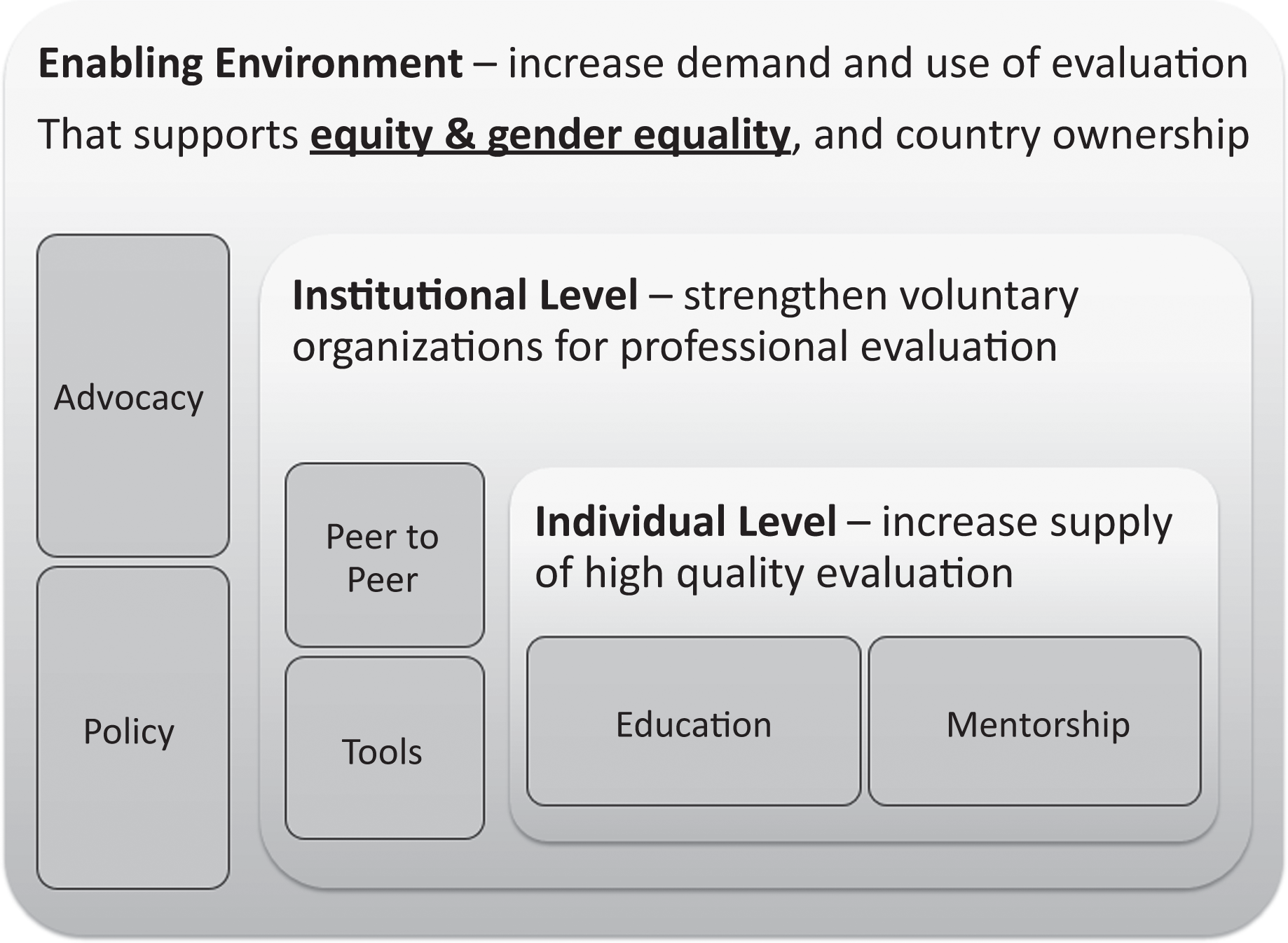
EvalPartners OBJECTIVES at different levels.
In July 2012, members of the EvalPartners Management Group (EPMG) met for a 2-day planning meeting in Beirut, graciously hosted by The Middle East and North Africa Evaluators Network (EvalMENA) President Ziad Moussa who opened his home to the EPMG. This meeting demonstrated the emerging culture of EvalPartners as a partnership of equals. In its first meeting, the EPMG planned for the Forum and developed a compelling vision for the Initiative. Representative of the Australasian Evaluation Society, Scott Bailey, said, “We are on the cusp of momentous change in evaluation. The change about to happen through EvalPartners will be significant, and I am deeply excited to be part of it.” We all felt it, and brought that energy to Chiang Mai.
There were two important challenges for Chiang Mai: (1) the logistics of organizing a high-profile international forum and (2) the need to engage people at a personal level and mobilize global action. UNICEF graciously took charge of planning and hosting with the organizing leadership of Ada Ocampo, UNICEF/Thailand. Tessie Catsambas set the tone, expressing her belief that “If we cannot put into action our values of inclusion and gender equality in our own Management Group, we could not hope to promote it in our global community.” Catsambas took charge of designing participatory processes that encouraged intimacy, invited personal passion and creativity, and embraced everyone. Everyone worked hard. Segone was everywhere. Ocampo and her team exceeded expectations. IOCE President Soma De Silva inspired us all with her calm and gracious spirit inviting everyone to reach in and show his or her best self. IOCE Senior Advisor and EvalPartners Coordinator Jim Rugh managed the Herculean task of collection and publication of case studies from all participating volunteer evaluation organizations (VOPEs) and helped to produce two publications on EvalPartners: the concept paper and the case studies. 5 Wanting to leave nothing to chance, the EPMG met for a whole day on the eve of the Forum and engaged in preparatory training so EPMG members could step into facilitation roles during breakout sessions understanding how they needed to contribute and how breakout sessions would fit into the overall Forum.
The EvalPartners Chiang Mai Forum in December 2012 was a gathering of about 90 representatives of VOPEs from different countries (75%) and 25% international community (i.e., U.N. and bilateral donors). The dogged preparation paid off. Many opportunities arose for rich exchanges between evaluation leaders from different countries, especially during “market place” discussions around the case studies submitted by different countries. Most importantly, many ideas that seemed far-reaching were expressed during the Forum and received peer encouragement and support that made them realities later on.
On the fourth day, Caroline Heider, Director of the World Bank’s Independent Evaluation Group, arrived and remarked in surprise: “I can’t believe you are all so energized! What happened here?” UNDP Director of Evaluation, Indran Naidoo, who attended all 4 days of the Forum, remarked that he was highly energized and had many ideas about how to proceed working together. Most importantly, however, country evaluation leaders were inspired with ideas for how to build their evaluation associations and societies at home.
In the final afternoon, the closing event involved a collective signing of the Chiang Mai Declaration—a voluntary, symbolic, individual signing of an agreement that had been circulated in advance. This declaration stated our common commitment to promote evaluation capacity building for civil society and our commitment to equity and gender equality in evaluation. The full text of the Chiang Mai Declaration can be found on page 16 of the Forum proceedings (http://www.mymande.org/sites/default/files/EP_Forum_Report_Final.pdf).
Leveraging South-to-South Collaboration to Build Capacity
We need to offer everyone opportunities for meaningful and successful engagement. (Natalia Kosheleva)
When Natalia Kosheleva (Russia) accepted the presidency of the IOCE Board from Soma de Silva (Sri Lanka) in Chiang Mai, spirits were high in the international evaluation community—we believed we could ignite a global evaluation movement through EvalPartners! For Kosheleva, one of the most promising features of EvalPartners was the possibility it created for professional exchange of peers, because she believed that people can figure things out themselves. So, when Nino Saakashvili (Georgia) proposed that EvalPartners support peer-to-peer (P2P) collaboration between VOPEs to help each other advocate for evaluation and build capacity, Kosheleva was excited. To catalyze such P2P collaboration, EvalPartners launched a small grants mechanism. The idea was that P2P grants would be awarded in response to proposals from at least two evaluation organizations per grant, which would come together virtually and physically, if possible, to solve common problems.
Kosheleva was convinced of the strategic importance of the P2P grants that were established with the expectation that they would catalyze increases in the capacity of all partners involved. An integral part of the EvalPartners Initiative, the P2P program offers an innovative approach to strengthening individual VOPEs’ capabilities by taking advantage of and maximizing capacities and experiences within the global community of evaluation organizations. Kosheleva further believed that P2P grants would leverage significant volunteer investment. She believed that, by allowing people to make linkages, we would increase social capital and build a global community for evaluation. These strengthened linkages would create networks that evaluators could use to figure things out and that, as time went on, we would see these solutions getting adapted by other VOPEs.
On the Road to Sustainability
The VOPEs need to send to the IOCE Board not just someone of “position” but someone who is dedicated and active. It is a serious commitment. (Jim Rugh)
EvalPartners cochairs Segone and Kosheleva saw another important opportunity in the P2P grants—the opportunity to start on the road to sustainability. Segone spoke to Oksanen about the willingness of Finnish Aid to channel some of the funds directly to the IOCE and entrust to the IOCE the management of P2P grants. With Segone and UNICEF behind it, Oksanen felt confident that funds would be managed responsibly, and she agreed. The IOCE would have to prove itself once more. Would it be able increase its capacity to serve country and regional evaluation organizations at this new level?
Kosheleva drafted an excellent call for proposals, and IOCE member organizations responded with enthusiasm. Collaboration between VOPEs, some of which had not worked together before, produced many exciting ideas. It was clear that significant thought and collaboration was taking place to put the proposals together, and more promised to come during the implementation of the grant-supported activities. As Kosheleva had predicted, P2P proposals leveraged significant volunteer engagement. During the first year (2013), grants were awarded to 25 partnerships, consisting of 32 national VOPEs and six regional VOPE networks.
The success of the P2P grants program was exciting, but taxed the IOCE Executive Committee time significantly. It became clear that the IOCE needed to increase its capacity to manage this increased volume of work and responsibility.
The answer came initially in the face of Jim Rugh (USA), a devoted member of the international evaluation community, predecessor to Catsambas as AEA Representative to IOCE, and who was stepping down from the IOCE Board as EvalPartners began. Rugh had been worried about the long-term viability of the IOCE and was really excited at the promise of EvalPartners to build a sustainable solution in evaluation coordination and capacity for civil society. When Segone approached him early on to become the EvalPartners Coordinator, he accepted immediately, and threw himself into his role with enthusiasm. Rugh’s special talent was bringing order to chaos—soliciting, tracking, collecting, organizing, and posting updates, updating the map of VOPEs, 6 administering the P2P, and later, the innovation Challenge grants, as well as following up on other commitments and deadlines. As part of his role, as part-time coordinator of EvalPartners, Rugh became, in effect, also the first part-time coordinator of the IOCE. Beginning in 2014, the EvalPartners Coordination responsibilities have been shared with Asela Kalugampitiya (Sri Lanka).
We should not underestimate the importance of transferring the P2P grant administration to the IOCE. The vision of EvalPartners included capacity building of the IOCE, and the future of EvalPartners rested (and still rests) on IOCE leadership and capacity. Until recently, the IOCE had not had any staff, while other partner organizations had full-fledged offices. The questions in everyone’s mind had been: Can the IOCE take on this level of responsibility successfully, and what capacities does the IOCE need to develop?
Building the legal and governance structure of the IOCE fell largely on Martha McGuire (Canada), IOCE Treasurer, as the IOCE is an international nongovernmental organization (NGO) registered in Canada. Along with other members of the Board, McGuire helped the IOCE rise to the challenge and continued to build its capacity by selecting a new association management organization (Megram) to act as its secretariat, clarifying its governance structure, revamping of its bylaws, and creating and enforcing budgetary procedures.
This increased capacity of the IOCE was necessary to offer new services to an expanding membership. Since the EvalPartners movement began, new country and regional evaluation associations were formed including EvalMENA (Ziad Moussa, President), Réseau francophone d'évaluation (Marie Gervais, Vice President), and others. A graph depicting the exponential growth of national VOPEs is presented in Figure 2. 7
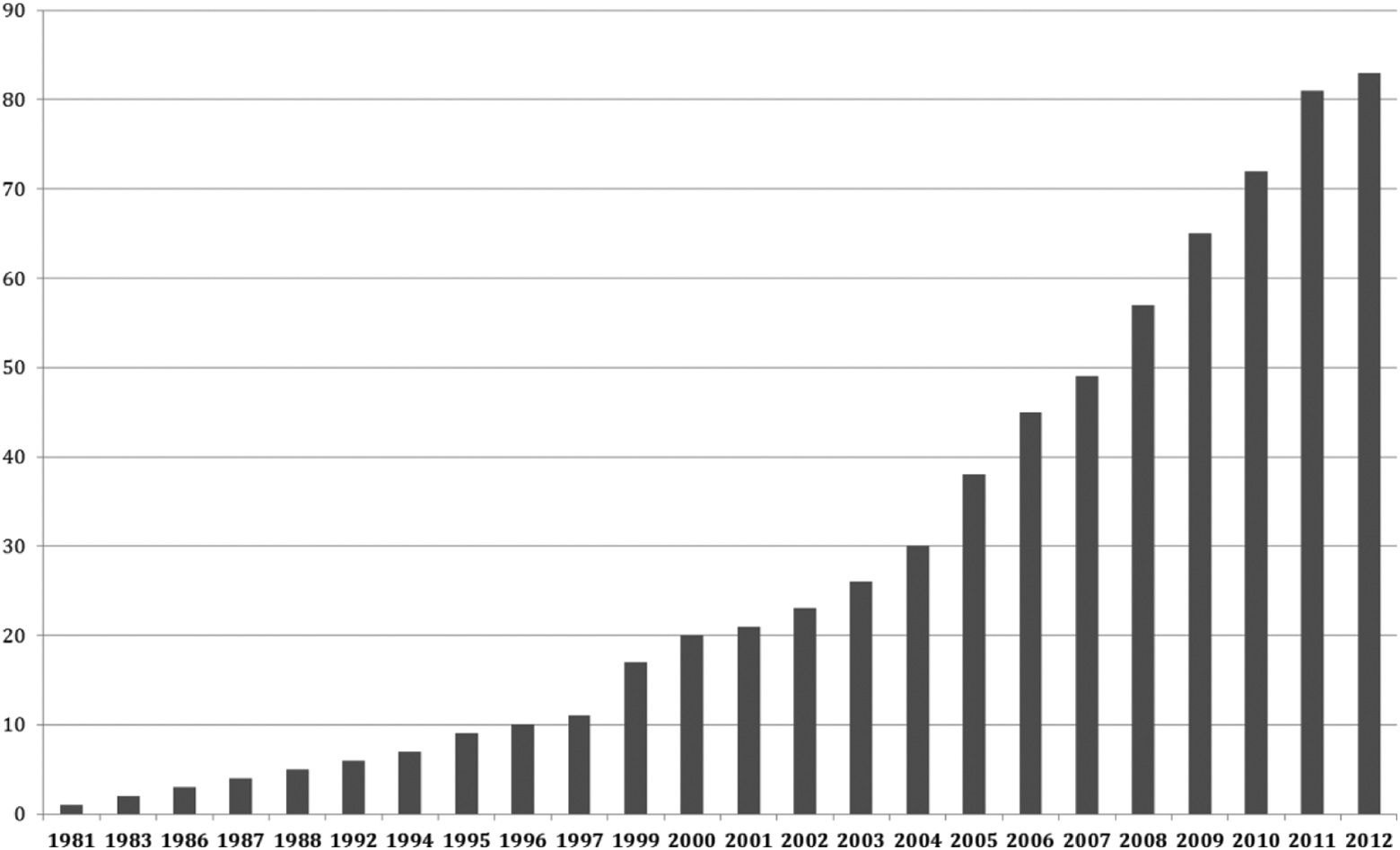
Cumulative number of Voluntary Organizations for Professional Evaluations (VOPEs) by year.
P2P efforts also informed the Institutional Toolkit Task Force that was formed under EvalPartners to pull together all existing tools and good practices of different associations and societies and make them available for all to use. With leadership from Jennifer Bisgard, Patricia Rogers, Martha McGuire, and Benita Williams, these tools will soon be available on the IOCE website for use by any organization that needs them. 8
A Full-Fledged Evaluation Advocacy Campaign
Just like gender and human rights, evaluation should be seen as a basic right…the right to know if the programs being delivered to us are effective! (Deborah Rugg)
Evaluation advocacy emerged as a core strategy from the beginning. Segone had pegged this topic as a key area of focus for the Initiative. There were many advocacy fronts to cover, and he knew he could not do it alone. The first front consisted of the United Nations and other international organizations such as the World Bank, African Development Bank, and Asian Development Bank. The second front was bilateral donors including Finnish Aid, USAID, Department for International Development—United Kingdom (DfID), Swiss Aid, Spain, and others, and their organizing body: Organisation for Economic Co-operation and Development/Development Assistance Committees (OECD/DAC). The third and fourth fronts were at country level, both national governments (executive branch) and parliaments (legislative branch). And the fifth and final front consisted of civil society, in particular the associations and societies of evaluation (VOPEs) themselves. Where to begin?
Initial Steps
Segone began with the development of an advocacy strategy for evaluation and invited a broad base of evaluation stakeholders to take part in its development. UNICEF’s Advocacy Office facilitated the process, offering new perspectives to evaluators about important communications and persuasion skills they needed to develop. David Anthony, Chief of Policy Advocacy at UNICEF said, “I can see that you, evaluators, are passionate about your profession. But you are so boring. You need to think of your audiences and pay attention to your message.” His well-meaning criticism stung but also motivated the group. As cochair of the Enabling Environment Task Force, Catsambas worked with Segone on the next effort, an Advocacy Toolkit for Evaluation, which is available on the MyMandE website that houses EvalPartners—http://www.mymande.org/evalpartners/advocacytoolkit.
In January 2014, Advocacy Toolkit consultant Neha Karkara began work on an accompanying e-learning program based on the toolkit, while in March 2014, assisted by Marie Gervais, head of the Francophonie Network, and Jim Rugh, EvalPartners Coordinator, Catsambas delivered a workshop based on the advocacy toolkit to 30 leaders of African VOPEs—15 Anglophone and 15 francophone—at the AfrEA conference in Yaoundé, Cameroon. Our colleagues in the workshop had some good suggestions for a global evaluation campaign message, for example: Evaluation improves lives Evaluation makes a difference in people’s lives Evaluate development! Develop evaluation!
Advocacy in the United Nations
The counterpart organization for EvalPartners in the United Nations was the United Nations Evaluators’ Group (UNEG). As EvalPartners took off, Deborah Rugg, who leads evaluation at the U.N. Secretariat, was named UNEG Chair, taking over from Belen Sanz, another strong evaluation supporter. Although Rugg was not involved in EvalPartners from the beginning, she was the first organizational leader to endorse 2015 as the International Year of Evaluation or EvalYear, which immediately went up on the EvalPartners website and was tweeted extensively. Then, Rugg began to advocate for a U.N. resolution to support evaluation. Rugg and her UNEG colleagues tirelessly briefed country delegates about evaluation and a proposed resolution on evaluation that would focus on strengthening national evaluation capacity. Even evaluators can learn political skills, and Rugg has moved out of her evaluation comfort zone, walking the complex road of diplomacy! The advocacy campaign paid off: on December 19, 2014, the U.N. General Assembly passed a stand-alone resolution promoting evaluation. 9
Approaching OECD/DAC
In addition to the original funding and continued support, Oksanen opened another important door for EvalPartners; she secured an invitation of the Enabling Environment Task Force cochairs—Marco Segone, Issaka Traore, and Tessie Catsambas—to an OECD/DAC Evaluation Capacity Development Task Force meeting in Helsinki. This meeting offered an opportunity for exchanges on the OECD/DAC Task Force’s work to harmonize evaluations in order to reduce the burden on countries hosting evaluations and also to promote country-driven evaluations. Several countries took part in the meeting including Finland (host), France, Germany, Ireland, and the United Kingdom (DfID). The EvalPartners delegation advocated for the inclusion of country evaluation organizations (VOPEs) as key stakeholders and participants in evaluations conducted in their countries. We also invited OECD/DAC to get involved in promoting the International Year of Evaluation, which they did. 10
Expanding the Definition of “National Capacities” to Include Civil Society
Indran Naidoo, director of the UNDP’s Independent Evaluation Office, was organizing the third conference on NEC—the third NEC—that brought together representatives of governments who support the use of evaluation to inform decision making and public policy. Naidoo, who joined UNDP after leading evaluation in the South African Government, placed great confidence in the independence of evaluation. Having attended the EvalPartners Chiang Mai Forum and signed the Declaration of EvalPartners, he was now excited about including civil society in the third NEC. He hoped that the inclusion of these energetic civil society evaluation leaders would invigorate governments’ engagement with evaluation.
EvalPartners responded enthusiastically, and a model emerged where several pairs of government and civil society evaluators attended the third NEC in Sao Paulo, Brazil, October 2013. All in all, some 23 NEC participants were funded by EvalPartners. Naidoo, who had advocated for the “recognition of the politics of evaluation,” was delighted to listen to the dialogue that permeated this third, more inclusive NEC. Naidoo knew that if NGO and VOPE representatives go into a powerful government agency, they will be intimidated and will not know where to start. He, therefore, wanted to model inclusion and dialogue about evaluation in the third NEC.
Parliamentarians Become the New Friends of Evaluation
We have zero tolerance for politics within the leadership team. We have to do the work. If you cannot contribute, you should give the opportunity to others; otherwise, our community will not be served. We have a responsibility to the team. (Asela Kalugampitiya)
Asela Kalugampitiya (Sri Lanka) was working in Kabul for U.N. Women when he learned about EvalPartners. Asela—as he is known to all—knew Marco Segone as they both worked for the same U.N. agency, and the two had met at the IDEAS Global Conference in Johannesburg in 2009 and Amman in 2011. Asela and his friend Kabir Hashim, a member of Parliament in Sri Lanka for more than 20 years, had been speaking about political participation in M&E, but the general reaction was “good idea, but not possible.” Segone, sitting in the audience of the IDEAS conference in Amman, was intrigued. Segone asked many questions about the idea of political participation in M&E and was generally very encouraging, asking Asela and Kabir to keep him posted.
So, on the afternoon of July 7, 2013, Asela who happened to be with Kabir in Kabul, sent an e-mail to the EvalPartners Executive Committee to promote an idea of engaging parliamentarians in South Asian Countries to gain support for evaluation. The EvalPartners Executive Team exploded with enthusiasm. The support was so overwhelming that Asela and Kabir stayed up all night discussing plans for the Parliamentarians’ initiative and EvalYear. They said to each other: “See how important the Parliamentarians initiative is!” Asela still has the e-mails of that night saved on his computer.
Asela, Kabir, and other active leaders of the Community of Evaluators of South Asia—the evaluation association for the region—went on to achieve impressive results in a short time, holding a meeting with parliamentarians from nine countries of South Asia. This included CoE president Mallika Samaranayake (Sri Lanka), Shubh Kumar Range (India), Bhabatosh Nath (Bangladesh), Gana Pati Ojha (Nepal), and others.
In March 2014, in Yaoundé, the South Asia Parliamentarians initiative inspired African parliamentarians to launch their own initiative of parliamentarians for evaluation, and by May 2014, parliamentarians from countries in the Middle East and North Africa declared their support for evaluation as well! In October 2014, in Dublin, Parliamentarians attending the European Evaluation Society (EES) Conference, after deliberations in a 1-day meeting, launched the Global Forum for Parliamentarians in Evaluation.
It is worth pausing for a minute to appreciate and celebrate this new, powerful stakeholder group that raises its voice demanding for evaluation to inform policy. In the United States, where evaluation is institutionalized in federal government at the General Accounting Office and other federal agencies, as well as in many state and local governments, Congress—our version of parliament—has access to resources (e.g., the Congressional Research Service, http://www.loc.gov/crsinfo/) to conduct research and analyses to arm legislators with evaluation results. It is exciting to see parliaments in other parts of the world interested in enriching their political processes with findings from evaluation and research—and to know that EvalPartners inspired and enabled this significant development.
Advancing the Equity and Gender Equality Agenda in Evaluation
Murray Saunders, the EES representative to the IOCE Board in 2012, and VP on the IOCE Board when EvalPartners was born, brought an important historical perspective. Saunders was part of the original group in Barbados that established the IOCE and had played a significant role in the initial negotiations among the regional evaluation organizations that negotiated the original IOCE pact. Saunders remembers, Arnold Love got a grant from Kellogg, which was instrumental to make [the planning meeting in] Barbados possible. Elliott Stern was there; Mahesh Patel was there; Ada Ocampo, Donna Mertens, and many others…At times, the meeting got heated…Out of that meeting a small working group was formed, and the IOCE name was developed through online collaboration. Fourteen to fifteen months later, we met in Lima. There was more bargaining, the IOCE board was formed, and Elliott chaired the first IOCE group. Unpack the IOCE name, and it embodies very strong values associated with cooperation and internationalism.
In the intervening years, Saunders saw the IOCE struggling to find a role and strapped for money. Many evaluators had not embraced the value of international collaboration, and the IOCE’s sustainability was at risk. When EvalPartners was formed, Saunders saw immediately its potential for boosting international collaboration and fully appreciated the EvalPartners layered agenda—enabling environment, institutional development, individual development, and equity and gender equality—in providing a rational framework for the IOCE’s work and way forward.
Saunders agreed with Kosheleva on the value of small P2P grants but for a different reason; he found the collaboration catalyzed by these grants absolutely critical for changing the perspectives of VOPE members who had previously been positioned against investing in international cooperation. VOPE members moved from skepticism to openness, from “what’s in it for me?” to “how can we be part of this bigger, global movement?”
When Inga Sniukaite (Senior Evaluation Officer at U.N. Women’s Evaluation Office) looked around for a cochair of the Equity—Focused and Gender-Responsive (EFGR) Task Force, she was thrilled to see Saunders step up. She saw in him a combination of tenacity and good humor that would help promote ideas that were still not in the mainstream in the evaluation world. What Sniukaite did not know was that, in his early 20s, Saunders had been a member of the Women’s Liberation movement, pairing up with women members to give talks in schools and universities; his message made young men stop and think—here was a rugby playing, grammar school boy, and he believed in women’s equality; maybe we should listen. Sniukaite had really snagged the right cochair.
Saunders, Sniukaite, and Task Force members found it initially challenging to define clearly how VOPE collaboration might best focus on equity. As time went by, EFGR Task Force members explored strategies for bringing attention to inclusivity and equity in evaluation design, use and usability by more diverse and previously excluded people, and a clearer understanding of equity and gender integration in evaluation. People began to understand that equity and gender are legitimate considerations in evaluation. “We have to ask different questions, ask different people, and set our evaluation up differently,” Saunders said, “to bring equity and gender into mainstream evaluation.” Saunders is particularly excited by a trio of innovation grant collaborations on gender and equity, involving, CoE South Asia, EES, ReLAC, and RedWIM (also in LAC).
EvalYear 2015
As we have moved into the International Year of Evaluation (EvalYear), we have challenged ourselves and evaluators from around the world to be creative in setting up engaging events and activities that promote evaluation and its use in policy and programs, translate our passion for evaluation into messages that excite people, and promote high-quality evaluation that serves social justice.
To promote these message, several initiatives are underway. A growing list of events is planned by evaluation organizations around the world. 11 The final event will be a Global Forum in late November in Nepal, part of which will be held in the parliament to signify the essential role of evaluation in the legislative process. There will be the long-anticipated publication of evaluation stories of excellence from the Evaluation Stories Initiative led by Dayna Albert, Burt Perrin, Pablo Rodriguez-Bilella, Serge Eric YAKEU DJIAM, Scott Bayley, Soma De Silva, Rochelle Zorzi,, Ramon Crespo, and Vanessa Hood. And most importantly, we will experience events and celebrations of evaluation in every gathering of evaluators around the world throughout 2015. These include the passing on of the (symbolic) evaluation torch being lit around the world. 12
Leading and Sustaining a Global Movement
We need to support a vision of an IOCE with enough resources to negotiate its position independently, and continue to generate an agenda for the role of evaluation in development. (Murray Saunders)
We ask ourselves: Is 2012–2015 a special period where we push evaluation and evaluation capacity development, and then our work is done? Conversely, what do we envision on our agenda for 2016–2020? The EPMG that convened in Dublin alongside the EES annual conference deliberated on how to engage our evaluation community around this question, and the vision beyond 2015. EvalPartners has stimulated conversations by all evaluation actors on the Global Evaluation Agenda 2016–2020. 13 Many ideas are being discussed such as continuing to expand evaluation partnerships, strengthening evaluation policies, increasing the quality of evaluations, credentialing evaluators, building gender and equity in evaluation standards and practice, and strengthening evaluation organizations.
We are also considering how the EvalPartners movement itself will adapt to support all partners in promoting evaluation, and the role of the IOCE in those efforts. We are informing our way forward with an evaluation of EvalPartners organized by Tessie Catsambas, Ziad Moussa, Jim Rugh, Oumoul Ba-Tall, Pablo Rodriguez-Bilella, Ada Ocampo, and Asela Kalugampitiya, and conducted by Nancy Gharib and Sarah Parkinson of the Basi Group. A significant part of our plan for sustainability is continuing to build the IOCE to continue to serve its members and the evaluation profession in the best way possible. Saunders believes that we need to move toward a consolidation strategy that focuses on building systems, structures, and practices that center on the IOCE as the permanent international body for evaluation cooperation.
What will it take to reach the tipping point when evaluation is institutionalized as a way of doing business in public policy and government programs? Through the hard work of so many colleagues, we have begun strengthening the voice of civil society in evaluation, and are being noticed. Yet, there is much more to be done. As we ponder together how to sustain our efforts on the way forward, we know there are three key ingredients: commitment, teamwork, and hard work. That is how EvalPartners started and grew and that is how it will be sustained and supported to achieve our collective vision for evaluation.
There is really no way to do justice to the many strong evaluation advocates credited with impressive achievements under EvalPartners; you can see many more by perusing VOPE case studies in the EvalPartners publication. 14 So, please forgive the omissions, and see the interviews that informed this article as examples of the stories of many others. As many original EPMG members get ready to pass the baton to the next team, let me repeat my invitation to the readers: I look forward to seeing what each of you will do and what we will achieve together.
Footnotes
Declaration of Conflicting Interests
The author(s) declared no potential conflicts of interest with respect to the research, authorship, and/or publication of this article.
Funding
The author(s) received no financial support for the research, authorship, and/or publication of this article.