



Abstract
This article presents discussion and recommendations on approaches to retrospectively evaluating development interventions in the long term through a systems lens. It is based on experiences from the implementation of an 18-month study to investigate the impact of development interventions on economic and social change over a 40-year period in the Koshi Hills region of Nepal. A multi-disciplinary team used a mixed-methods approach to data collection and analysis. A theory-based analytical approach was utilized to produce narratives of plausible cause and effect and identify key drivers of change within the context of cumulative and interconnected impacts of multiple programs and factors. This article responds to increasing interest in development evaluation to look beyond intervention-specific impact to broader determinants of change to assist with intervention planning. It is the authors’ hope that this will stimulate debate and progress in the use of high quality research to inform future development work.
Introduction
The Objective of the Paper
To increase the evidence base on the relationship between multisectoral development interventions and long-term population level change, the UK Department for International Development (DFID) together with the National Planning Commission of Nepal commissioned an independent study in 2010 to look back after 40 years of development intervention delivered through Overseas Development Assistance and then by DFID. This unique and innovative study aimed to assess the impact of multiple development interventions on the long-term process of economic and social change, using a particular region (the Koshi hills) of Nepal as a case study.
This focus was identified based on the concentration in time and space of development interventions in the region and the perceived availability of data at district level from project documents and other sources. 1 The study sought to determine whether the Koshi hills region experienced long-term social and economic changes over the study period and, if so, the degree to which these changes could be attributed to specific development interventions.
This article describes and analyses the approach and methodology adopted in the study. Overall, it aims to contribute to the reappraisal of retrospective evaluation studies and more specifically to the assessment of development interventions over the long term. It aims to support future best practice in the design and implementation of such studies both in Nepal and globally. We will highlight the challenges and opportunities associated with retrospectively viewing the impact of development interventions through a systems and long-term lens based on available data.
We found that the biggest challenge in this approach is the need to define and conceptualize what constitutes a “change” over the long term. This required both an assessment of intended results and change processes identified within individual program and project frameworks and of the broader context examined from an interdisciplinary perspective; history, sociology and anthropology, geography and development, politics, economics, and so on. This required a broadening of scope to consider the full range of potential drivers of systems change; not necessarily captured by conventional program management and evaluation tools such as logical frameworks, implementation plans, and program-specific Theory of Change (TOC) documents that normally characterize development programming and evaluation today (Coryn, Noakes, Westine, & Schroter, 2011; Frechtling, 2007).
The article first considers briefly the role of evaluation in development—with respect to policy formulation and planning as well as to specific development interventions—and issues around data availability within the field of long-term retrospective evaluation. It then describes the approach and methodology adopted in the Koshi hills study itself. The article concludes with an assessment of the challenges and general lessons learned from this experience that might be applicable to other researchers or commissioners of long-term evaluation studies through a systems lens in other contexts.
Evaluation in Development
The focus on measuring and demonstrating results of both the Paris Declaration and the Accra Agenda for Action has put evaluation at the forefront of development agendas for donor and recipient countries. This has resulted in increasing efforts dedicated to assessing the effectiveness or otherwise of their investments and interventions and identifying the impact or effects of programs and projects through which they have intervened (Organization of Economic Cooperation in Development [OECD], 2008; Rao & Woolcock, 2003).
A commonly used approach to evaluation in this context is retrospective evaluation, which attempts to assess impact after a program has been implemented by establishing program treatment and comparison groups ex post. Although considered generally less likely to produce credible results of program attribution as compared to prospective evaluations, these evaluations and “impact studies” are now, generally, an integral part of the standard project cycle, largely due to cost and feasibility concerns (Gertler, Martinez, Premand, Rawlings, & Vermeersch, 2011; Hageboeck & Frumkin, 2009).
The trend has also increasingly moved from evaluation being an internal program function to a more “independent” and “objective” function, often contracted to external consultants and organizations (Bamberger, 2009; Bamberger, Vijayendra, & Woolcock, 2010). Most evaluations however remain strongly “program and project focused” in their scope, with the normative assumptions that only the intervention will have an effect (Miyoshi, 2013). This focus draws evaluations into concentrating often exclusively on the linear linkages between specific interventions and those changes identified as program and project “outcomes” and “effects,” and being less concerned, if at all, with other causal linkages and changes less clearly attributable to the program or project.
This may lead studies to falsely attribute a given change to a particular program, project, or other “intervention” and obscure wider economic and social dynamics as contributing factors, or indeed alternative projects, operating within the context of larger, complex systems which may have contributed equally to the observed impact. Widening the lens is therefore key to more effective identification of program attribution and contribution to impact.
The field of prospective impact evaluations using counterfactual analysis, including experimental designs such as randomized control trials to demonstrate causality, is an accepted approach to attempt to overcome some of these issues. These methods underlie the standard evaluation model for many health programs, but programs intended to influence multiple variables and impact upon socioeconomic or political outcomes which are less tangible and harder to measure have been less subject to these designs, though this is changing (Banerjee, 2007; Banerjee & Duflo, 2009; Duflo & Kremer, 2005; Morra & Rist, 2009; Rossi, Freeman, & Lipsey, 1999).
Furthermore, the analysis and assessment of change are rarely examined from the perspective of people who are at the center of change and thus lack some explanatory power. The field of participatory evaluation attempts to address this, but these evaluations are considered less rigorous than experimental designs in their ability to estimate program attribution (Chambers, 1994; Cousins & Earl, 1992; Stern et al., 2012).
Finally, though practitioners may recognize and understand that while some changes may take place within a short period of time, “development” as a multifaceted phenomenon is a long-term and systemic process, evaluations rarely examine effects of a program beyond their immediate program focus, largely due to the short-term project and funding cycles (Hageboeck & Frumkin, 2009).
Evaluation of Long-Term Change
Along with a growing trend in program-specific evaluation, in recent years, donors have also begun to show more interest in assessing the overall effects of investments on poverty alleviation and improvements on the quality of life beyond a project cycle and within the context of more broadly defined systems than those bounded by sectoral definitions. This has caused a shift to look not only for evidence that their interventions resulted in the changes envisioned but also for more broadly derived evidence regarding the determinants of development and change over the long term. For instance, DFID, in recent years, has commissioned a number retrospective evaluations to look at the overall impact of a DFID country program on poverty across a program portfolio (Thornton et al., 2010).
A number of methodologies have also been employed to study change in the long term (Magnussen & Bergmann, 1990; Menard, 1991). These include historical studies, in which a range of sources of evidence is drawn upon to provide a description and analysis, and sometimes even an explanation, of changes in a given location or region or country—“a narrative” (Blossfield & Rohwer, 1995). Another is “the anthropological study,” in which fieldwork over a relatively long period (at least many months and sometimes years) provides the major basis for research into the past, through “oral history” (drawing on local people’s “indigenous” knowledge and memories) and other materials (sometimes documents; Davies & Dale, 1994).
In addition, restudies are often undertaken by government or other agencies for the purposes of national and regional or sectoral planning (i.e., National Living Standards Surveys, Household Income and Expenditure Surveys, Demographic and Health Surveys, Agricultural Surveys, etc.). These studies are based on representative sample surveys which claim to collect data on the basis of carefully defined samples so that statistical analysis is possible and correlations may be made with relative confidence regarding trends and tendencies within a prescribed population (Coleman, 1981; Gershuny, 1998; Ruspini, 1999).
A major limitation of many of these evaluations in producing strong and credible findings of program impact as compared to prospective evaluations are their reliance on the existing sources of information which are available to the evaluator. The limitations in the availability of robust and comparable data across programs and over time pose challenges to estimating a valid counterfactual over the long term and ultimately affect the strength of evaluation findings in terms of estimating attribution and contribution.
It is within this new endeavor that this particular evaluation of long-term impact in Nepal was framed. This article refers to the challenges of retrospective evaluation in a “data-poor” setting. By this we mean that though this particular region of Nepal was chosen for its perceived data availability, the availability of robust and comparable data over the 40 year study period posed a major challenge to the ambition of the evaluation. Data of various kinds were widely scattered, between the offices and archives of diverse institutions, both governmental and nongovernmental, and in numerous libraries, bookshops, and so on, making collation and ordering a significant challenge. Moreover, it was diversely focused making comparative analysis at the same level—change in the Koshi hills as the system of analysis—difficult. Although some restudies and population-based data were available, the majority of the data collected were program reports reporting on project-specific results over a short-time frame. The next section describes how the study design and methodology attempted to overcome these challenges to respond to the overarching research questions.
Study Design and Methodology
Study Setting and Design
A study of this complexity and scope required careful consideration of a combination of quantitative and qualitative approaches. The right mix was expected to explore the notion of change from both an aggregated and disaggregated trend analysis level and the objective and subjective perspective of people living in poverty. Evidence gathered using both qualitative and quantitative methods was intended to enrich the possibilities to interpret findings through the eyes of people living in poverty, to challenge externally imposed assumptions supported through available data, and to build retrospective theories of change to explain how and why (and under what conditions) change occurred.
For the purpose of this study, “the Koshi hills region of Nepal” was understood to comprise four districts of the Koshi zone in the Eastern Development Region of Nepal: Bhojpur, Dhankuta, Sankhuwasabha, and Terhathum districts (Figure 1). The study team used these “districts” as well as subdistricts or “village development committees (VDCs)” as the local units of analysis and comparison across study sites.
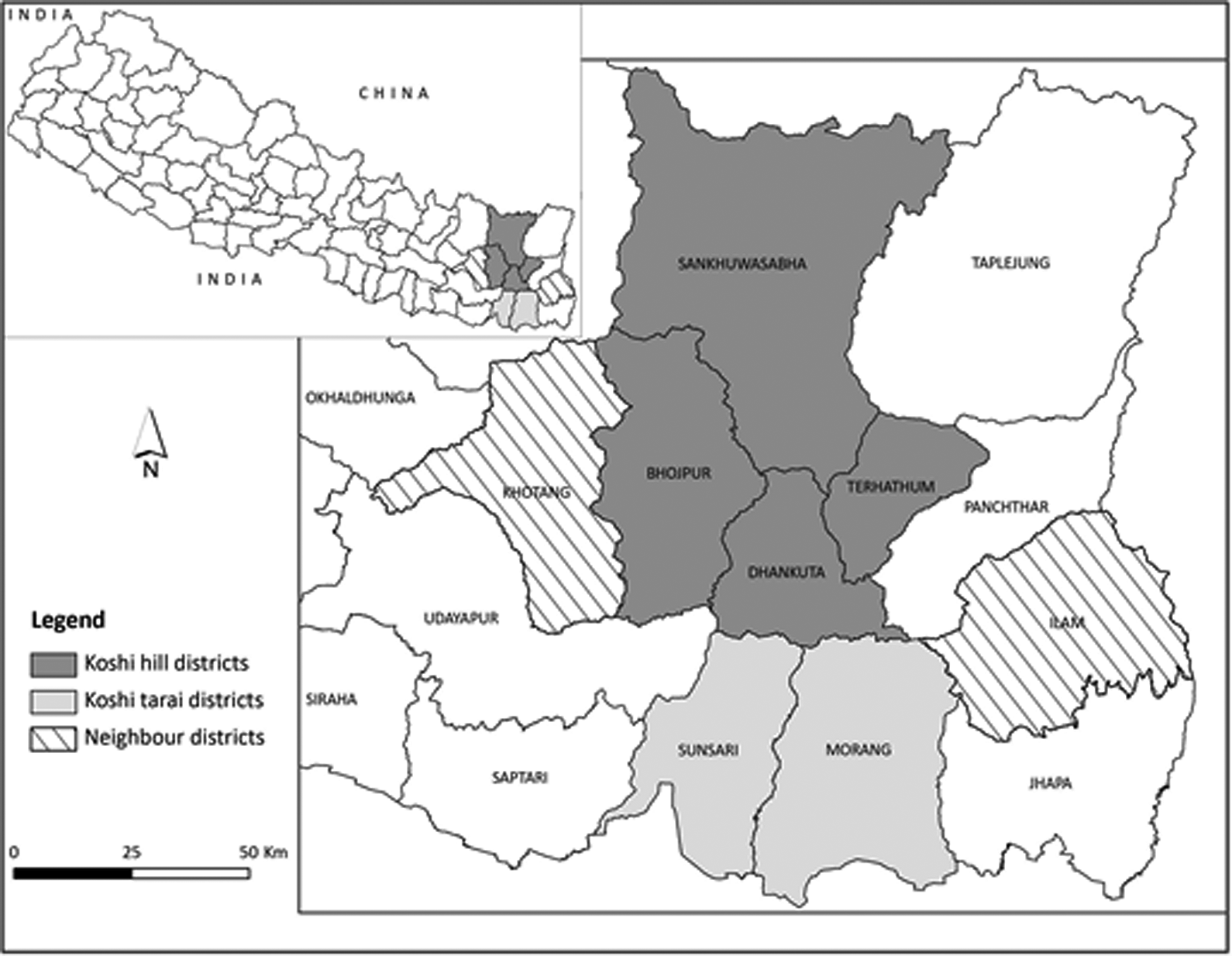
Location of the Koshi hills and surrounding districts, Nepal.
Given the complexity of the study, a broad range of evaluation methodologies were combined within an appropriate theoretical framework to guide study implementation. The team used a multidisciplinary and chronological framework to approach the collection, synthesis, and analysis of data. This was used to address challenges to the accurate measurement and evaluation of development impact presented by complex pathways to change, confounding effects and inputs, unintended as well as intended consequences, and the intangible nature of many of the impacts that were hoped to be achieved over the years in the study area.
It was recognized from the outset that not only would it be difficult to define and measure “long-term impact,” but developing an understanding of what contributed to these changes within a larger system also represented a fundamental challenge. The study thus used a mixed-methods approach using reviews and analysis of quantitative, qualitative, spatial, and historical data to develop complex causal pathways of change and to identify the nodes of social and economic drivers of changes over decades and generations of people living in the study area. Combining the different methods was proposed to make it possible to a certain extent to overcome limitations and to enhance the strength of analysis (Bamberger et al., 2010; Stern et al., 2012).
Individual Research Components
A number of individual research components were conducted to produce the data required to assist in pulling together the complex narratives of social and economic changes over the 40-year study period.
A secondary data review gathered all available existing evidence
First, a secondary data review of the existing evidence and analysis was undertaken from a large volume of project and program implementation, monitoring and impact assessment documents and data sets of population, agriculture, education, health, finance, transport, and communication as well as independent studies—including both qualitative and quantitative material (Coffey & Metcon, 2010). Over 1,000 documents were collected and analyzed by the study team. This also involved examining statistical data from national level surveys, such as population censuses, agriculture surveys, economic bulletins, and living standard surveys by the government.
The results of the review were used to identify the main features and characteristics of long-term change in research sites during the study period and to make preliminary assessments of the main drivers of change, including the “development interventions” of foreign aid agencies. These assessments then provided a theoretical base for subsequent research components.
A “deep history” of the study area, as an extension of the documentary review, provided a historical and contextual basis for the consideration of the more recent changes since the 1970s. This included a review of anthropological and geographical field studies undertaken in the region during and since the 1950s as well as commentaries produced during the 18th, 19th, and early 20th centuries by foreign visitors to and travelers in Nepal. A limited review and synthesis was then undertaken of the available historical analysis, based on state archives and other contemporary sources.
Econometric analyses based on gathered data
The findings of the secondary data review were used to compile statistical data sets for relevant indicators into one master database. Based on this, two econometric studies were also conducted to determine the strength of evidence relating identified drivers of change and observed long-term changes in the research sites. First, an economic analysis of the determinants of economic change in the area was conducted. The study estimated the relative contribution of four main drivers of change—government expenditure, “donor” investment, remittances, and “private investment” (i.e., initiatives of the community including NGOs and people in the district)—to key the outcome measures of economic growth and poverty reduction. These four drivers were identified through a review of the previous literature around economic growth and poverty reduction in Nepal and based on the study research questions.
Second, a district-level poverty analysis on the basis of the three Nepal Living Standards Surveys was also conducted. This analyzed the distribution of and changes in chronic poverty and vulnerability in the research sites. It adopted a multidimensional definition of poverty and vulnerability, and the measures that were chosen were those commonly used in many developing countries to quantify and qualify the amount and depth of poverty.
Geographic information system (GIS) analysis to substantiate econometric findings
In addition to the econometrics studies, a GIS-based spatial approach was integrated into the study approach to exhibit and analyze spatial relationships, using a GIS framework, between land-use change and development interventions (roads, community forestry, agriculture, health, and migration of population; Axinn & Ghimire, 2011). This included analysis of key changes to land-use patterns including changes in social and economic structures and dynamics, accessibility by location and time of schools and health centers, and flows of goods, people, information, and money between places over time (Central Department of Geography Nepal, 2001; Gautam, Webb, & Euimnoh, 2002).
Participatory qualitative research component to gather perspectives from the poor—the Reality Check Approach
In order to complement this hitherto largely external and ‘top down’ analysis of development and change in the region and to provide the only means of primary field data collection within the evaluation, a Reality Check Approach (RCA) study was designed to allow the team to collect information on the personal experiences of people in the Koshi hills regarding current and historical processes of development. The RCA was utilized as a qualitative research method that aimed to examine and provide a peoples’ perspective of the “theories of change” emerging from the other research components. The RCA also sought to provide greater understanding of the perceived and experienced impact of additional (non-project related) contextual factors, development processes on different individuals, and groups across different geographical regions and to consider the drivers of change from people’s perspective within the study area.
The approach can best be understood as “light touch” participant observation. RCA involves researchers living with people in their own homes and joining in their everyday lives. The absence of note-taking together with two-way conversation and experience sharing within private spaces of home and place of work provides a trusted environment for open reflection. It enables the researcher to experience and observe the realities of those living in a given area and provides a meaningful basis for reflection on change together with families and others in the community.
Prior to the actual study, team members were first trained on the ways to gather information through visual tools, observations, conversations, and “immersion” with host families. Scoping exercises to potential sites and communities were also conducted to determine their appropriateness for the study. Households were the main unit of the study, which were purposively chosen within the selected VDCs through consultations with local stakeholders. To conduct the RCA, researchers lived with 27 different households across nine VDCs and four districts. During this time, they interacted with all members of the household individually and collectively, their neighbors and frontline service providers. In total, conversations were undertaken at all times of day with around 600 people.
Conversations were guided by carefully informed “areas of enquiry” derived from the secondary data review and findings from quantitative studies relevant to the study areas. In practice, a careful balance was required between steering and the need for householders to proactively engage and take the lead in explaining change. In addition to conversations, study participants demonstrated change by taking researchers to see evidence for themselves, for example, the old water source. By engaging in activities directly (e.g., carrying milk to the dairy, harvesting potatoes, collecting firewood, and walking to school), researchers were able to both experience what people were talking about and engage in conversations about the changes which had affected such activities.
After deployment, debriefing sessions were conducted. These were reflective sessions that were essential to reassess and determine the key changes and the perspectives of the families studied. It also allowed the study members to ensure faithfulness to the perceptions and opinions expressed and provided the opportunity for validating the findings through triangulation. Finally, the key findings were then interpreted to form a stand-alone report, which was then incorporated to the overall Koshi hills study.
Analytical Approach
The findings of the individual research components were ultimately compiled and analyzed as a comprehensive data set of quantitative and qualitative data in order to integrate findings and draw overall conclusions. The analytical approach developed was similar in structure to a ToC framework, using analytical techniques including causal process mapping, key node analysis, and strength of evidence assessments to identify key drivers in a complex system. The retrospective construction of causal chains irrespective of a development “sector lens” led to the identification of unanticipated cross-sector linkages and relationships which may not have been evident through the framework of a particular program or sector ToC. This approach attempted to recognize the complexity of interrelations within a system and diverse pathways to change. Three key stages of analysis were conducted.
TOC framework development
The team first identified an end point based on two key dimensions of long-term change for development interventions: economic growth and poverty alleviation. Initial analysis indicated that these long-term changes could be divided further into a total of four key areas of change around which causal analysis could be usefully and robustly structured: change in opportunities within Koshi hills, change in opportunities outside of Koshi hills, better quality of life for individuals, and better quality of life for households. The results of the economic analysis and poverty assessment study (see section above) were used to identify the primary resources and investments associated with measurable impact in these key areas. Findings from the other research components, particularly the RCA study and the secondary data review, were then used to construct causal maps linking investments to long-term changes in the four identified areas.
Causal process mapping
Based on these initial areas of change, the team constructed causal maps, determining the primary linkages and relationships (and their relative importance) leading from investments and inputs through intermediary outcomes to long-term changes and effects by assessing the strength of evidence of each causal link. This included rating the quality of the data supporting the linkage or relationship and the quantity and diversity of sources suggesting the link. The RCA study provided key insights from Koshi hill people themselves which shaped the overall narratives for causal mapping. This ensured that study findings were informed by the realities and perspectives of individuals and households themselves, generated from people’s own perception and experience of change rather than from the conventional normative perspectives, and provided a check on assumptions and “presumed knowns” present in quantitative trends.
Key node analysis
Once causal process maps linking collected evidence along the causal chain to long-term impact had been developed, key nodes, or drivers, of change were identified on the basis of those development interventions and other contextual factors that recurred most regularly and with the strongest plausible causal links with a specific observed change. The aim was to critically investigate interrelationship and the reinforcing nature of interactions. For example, with regard to the identified long-term change of growth in alternative livelihoods outside of agriculture within research sites, evidence linking this change to improvements in road network was identified numerous times in the secondary data review, the RCA study, and numerous other research findings. This provided a strong basis for a plausible causal relationship between road transport development and the development of alternative livelihoods.
Figure 2 presents a causal map which frames a complex narrative of change. This causal map indicates the series of complex interrelationships between development intervention and other factors which drove long-term changes over the study period. The causal processes were nonlinear and often cyclically reinforcing and thus, to the extent possible, key processes were highlighted within a nonlinear and complex system. Thus, for example, migration was both an end point in poverty alleviation by way of economic opportunity and increased agency, but also a key driver in the process, as increased money from remittances was spent on further migration opportunities. This is depicted in the figure, where permanent migration is encircled as a key node with forward and backward causal linkages. This causal map provided the basis for the study’s findings in regard to the impact of development interventions (and other factors) on long-term change in the Koshi hills.
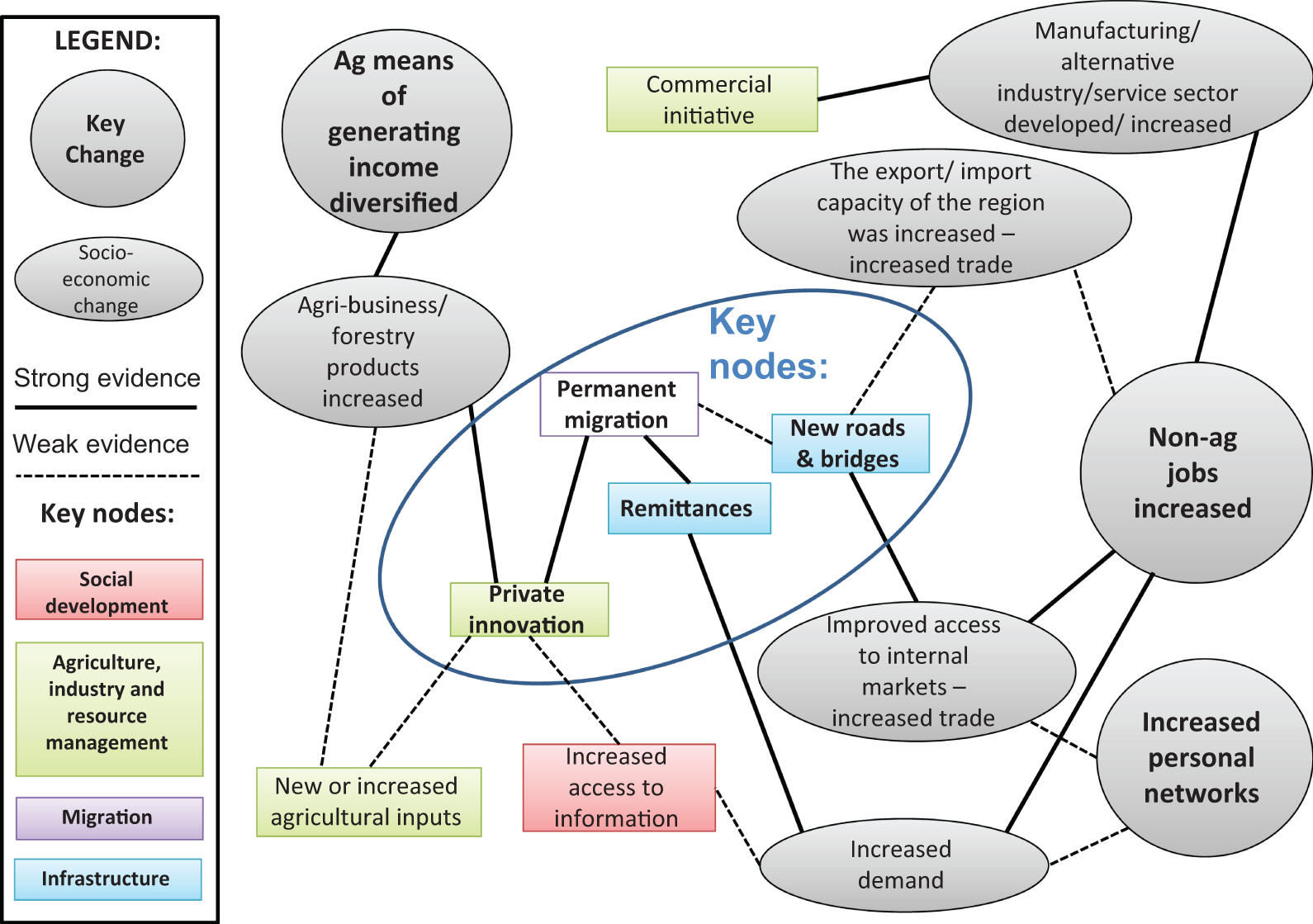
Example of a causal process map and key nodal analysis leading to plausible narratives of change in Koshi hills: changes in economic opportunities available within Koshi hills. Note. Ag = Agricultural.
Example of Study Findings
This section presents an example of how the analytical approach was used to develop key findings and complex narratives of change (National Planning Commission & DFID, 2013).
The Transformative Effect of Cardamom Production
Differentiated from small-scale diversification of agricultural production as a resilience mechanism that has a long history in the Koshi hills, changes detected in commercial agriculture during the study period included the regular growth of agricultural surplus for sale, the adoption of new technology and inputs, and specialization in a saleable product. In relation to this, a significant trend was the growth in production of high value crops.
The story of cardamom as a high value crop in Koshi hills is an illustrative example of the complexity and nonlinear nature of change in the region. Over the study period, the cropping area in the Koshi hills dramatically increased from 7 ha in 1971 to 3,930 ha in 2009. The study identified that cardamom production expanded through a number of drivers of change, including expansion of the transport network, changes to the price in cardamom due to the collapse of production in other regions following the spread of disease, and changes in access to technical information to help small holder farmers increase agricultural production and competitiveness.
Analysis of land holdings dedicated to cardamom production indicated that Ilam and the Koshi hills both began the production of cardamom before the roads in the late 19th century. However, the rapid acceleration of production only began after the completion of the roads and coincided with price increases as a result of higher market demand when production collapsed in Bhutan and Sikkim. This strongly suggests that road construction had an amplifying effect on cardamom production. GIS data demonstrating changes to cardamom production along the main trail to the Tibetan border during the 1990s suggest that it was changes in the transport network as a whole, and not only roads per se, that stimulated production in new areas and on a significant scale.
Analysis suggested that development interventions in the form of agricultural support programs were also a strong factor in the development of cardamom and other high value crop production, as small holder farmers benefited from better technology and information about production parameters and market structures. Studies suggest that farmers became more confident about markets and prices of high-value crops in general with the support of projects such as the Centre for Environment and Agriculture Policy Research Extension and Development and the Koshi Seed and Vegetable Project and provision of technical support and information from projects such as the Pakhribas Agriculture Centre.
This increased utilization of technology and information as well as access to and confidence in markets due to an expanded road network, coinciding with cardamom prices increases, was the right combination to make cardamom an important cash crop in the Koshi hills, and this lifted many households out of poverty.
Implications of Data Availability on Study Findings
Social scientists and other researchers working in development settings often face data challenges, in terms of both availability and quality. As this study employed a multisectoral approach spanning a time frame of at least 40 years, these issues of data availability and quality provided particular challenges to conducting rigorous causal analysis. This section discusses the challenges around the availability of high-quality, quantitative data for analysis and its implications on overall study findings.
A major analytical challenge was the inadequacy of comparable data available. Although substantial amounts of statistical data from the major national and district sources were obtained, much of the relevant information was scattered and patchy, while other data could not be used to assess change at household or even municipal or village unit levels, due to inconsistency in time frames or indicators. For example, quantitative indicators related to demography, migration, and occupation were available from at least 1981 onwards, but reliable indicators related to standards of living were only available from the 1990s. Most data were also not systematically and consistently available at the local levels—at the district, VDC, or household levels. Consequently, the available statistical data to the team were not sufficient to create a coherent database for VDC level analysis. Even at the district level, the data collected were relatively limited, which made systematic interdistrict comparisons (envisaged at one point as a crucial part of the study and the analysis) difficult.
Implications for Ability to Disaggregate Findings
Challenges were also experienced in obtaining appropriate socially and economically disaggregated data. Disparities in poverty and social outcomes in Nepal (and in the Koshi hills) cut across gender, caste, ethnicity, religion, and geographic regions. Yet, the history of the availability of socially disaggregated data is fairly recent. The census of 1991 was the first to identify in detail the 100 or so different caste and ethnic groups in the country. Since then, however, the classification of the population in terms of a range of criteria has become a major preoccupation, with different dimensions of poverty, social discrimination and disadvantage, gender, caste, ethnicity, age, region, and so on all considered when devising “socially inclusive” policies, programs, and projects. While this is the case, the lack of data disaggregated by these factors, specifically gender-disaggregated data, for much of the period reduced the ability of the team to conduct much needed disaggregated analysis and to disentangle the differential impacts of development interventions on these different social groups.
Implications for the Ability to Assess Cross-Sector Systems Level Change Versus Programme-Level Change
Although the intention was to take a perspective on long-term change outside the typical program and project development lens, there was a tendency for both data collection and analysis to be “development-led,” as much of the data was drawn from program and project reports. The Koshi hills, as defined by the study, was not a single geographical or administrative unit; but rather, a development region defined largely by an early foreign aid development intervention (the Koshi Hills Area Development Project). This influenced the type of data collected and available during the time frame. For example, the study had a larger focus on changes in the 1980s, 1990s, and 2000s in part because it was during those decades that development interventions in the Koshi hills were greatest and in part because there was relatively limited quantitative data prior to 1971. Building a coherent narrative of change beyond this “development lens” was therefore problematic. This inevitably led to a less sharp focus on drivers of change beyond “development interventions,” although it was clear that from the mid-1990s onwards, foreign labor migration and the flow of remittances into the region (as elsewhere in Nepal) were having a major effect. Moreover, an additional issue was presented by the lack of continuity and comparability of data generated through diverse project Monitoring and evaluation and reporting systems. The interoperability and short time frames of project data sets pose a consistent challenge to long-term change trend analysis.
Implications for Comparative Counterfactual Analysis
The lack of representative baseline information meant that only the most significant drivers were identified through causal analysis. Without adequate baseline data that covered all the different sectors, the disparate existing data had to be pieced together strategically to develop a coherent narrative of the context in the beginning of the study period. The causal process mapping proved an effective tool in retrospectively constructing baselines and timelines of change, leading to plausible conclusions of contributory impact. This process however was deliberately selective to address only the most significant drivers of change, where the strongest evidence was available. Thus many factors where strong evidence was not apparent in the available secondary data were omitted from analysis, however important they were considered to be. For example, there was little systematic evidence to enable the reliable identification of differential impacts or the nuances of change between different social groups (i.e., defined by class, ethnicity, caste, or gender). This was a major weakness of the methodology.
As such, the study was able to produce a body of interesting findings, but, apart from the economic analysis, which indicated specific correlations between investments and actual changes, the conclusions drawn suggested plausible narratives and complex scenarios of probable cause and effect within larger systems rather than conclusive findings of linear causal (cause-effect) relationships. It is important, however, to recognize that even where data are good, the dynamics of causation may be too complex to allow for simplistic and reductionist models of cause and effect, and that the emphasis on plausible narratives and complex scenarios is not simply a consequence of poor data.
Lessons Learned for Future Studies
This section outlines the major lessons learned in using a cross-sector and systems perspective to retrospectively evaluate long-term impact. It begins with a critical assessment of the strengths and weaknesses of some of the key features of the study design and implementation, including its approach to causal inference and analysis and the use of mixed methods and participatory research. It concludes with our understanding of the importance of focusing on systemic rather than programmatic change in this type of research.
Study Design and Implementation
Retrospective evaluation of long-term impact requires a strongly led multidisciplinary team able to combine their distinctive disciplinary approaches within a single research framework and a clear strategy for iterative data collection and analysis. We derived the following lessons learned in this regard that could be relevant for future researchers.
Using an overarching theoretical framework to guide the research process
The study developed an initial theoretical framework in the design phase which informed the development of different research components such as the economic analysis and the poverty assessment. This initial theoretical framework however should have been more effectively used as an organizing framework to steer data collection and compilation across different research components throughout the life of the evaluation rather than a framework to organize analysis at the end.
The lack of systematic integration, synthesis, and comprehensive analysis of the various separate studies and data collection exercises throughout the entire study period is, undoubtedly, a weakness of this study. Future researchers could consider a more iterative and sequential analytical process, routinely bringing the individual components together, and testing and interrogating the theoretical framework on an ongoing basis. Here, aspects of contribution analysis methodology as proposed by Mayne and colleagues could be considered (Mayne, 2011).
Use of mixed methods in long-term retrospective evaluation
We found the importance of a participatory component essential to conducting analysis and framing narratives, though more in-depth qualitative work could have strengthened findings. An important consideration in the original design of the study was the need to go beyond the confines of program and intervention logic which had defined development assistance throughout the 40-year period under review and understand from the outset how people living in the area had themselves experienced and perceived change. The RCA findings are important, in that they are the only source that provides an indication of the subjective experiences and views of people living in the region, and provide often vivid accounts and impressions of those experiences and views. But the fieldwork was limited in time, space, and scope and was undertaken after the extensive documentary review. It was not possible therefore to feed the results of the fieldwork into an ongoing process of data collation and quantitative analysis as part of the delivery of other individual research components; RCA studies while insightful and relevant cannot provide firm conclusions regarding the effects of development interventions.
Rather, RCA insights were used to frame causal narratives grounded in the experience and perceptions of people living in the area rather than as a primary source of qualitative data for the analysis as a whole. This approach provided insights into how people themselves viewed change, removed from the usual externally imposed program or sectoral lenses. It was able to report on how some people in the area thought change came about and their view of the interplay of outside interventions and local knowledge, and the role of government, development partners and private sector, as well as their perceptions of the varying significance of different factors. It was able to distinguish differences between intended benefits and actual benefits and differences between stated change and actual behavioral change.
A nonprescriptive method such as the RCA proved an effective tool for framing narratives and illustrating the views and experiences of local people. It also provided an effective means of identifying alternative avenues of investigation and inquiry, causing us, as researchers, to question previously assumed truths or realities and return to the data with a more critical appraisal. However, it does need to be combined more systematically with other sources of data to generate more rigorous and generalizable findings.
Managing interdisciplinary teams
The management of the research process itself needs to be strong in order to ensure integration (both coherence and continuity) and adherence to a clear program timetable. The team involved must be able to function as a whole, with individual specialisms harnessed to address a well-defined set of issues and produce a defined set of outputs.
Throughout the data collection and compilation process, several analytical “check-ins” were conducted, particularly in sharing the results of the documentary review to frame the data collection activities of the RCA study in an effort to encourage interdisciplinary exchange among researchers. However, the extensive period of documentary review was carried out for the most part on a sectoral or disciplinary basis, with individual members of the team tending to work on their own area of expertise and sector rather than in a fully integrated manner. Furthermore, the description of the major findings from the documentary review tended to precede the analysis rather than for the two to proceed together. The analysis was, in effect, largely undertaken as a later phase in the project. This led to a number of weaknesses in the study that should be considered by future researchers.
Effective working relationships, coordination, and opportunities to exchange and analyze data in a sequential manner throughout the study are essential to success. Future researchers should consider investigating organizational tools that can be used to improve this critical process, including the right use of general and technical steering committees, or holding regular plenary sessions and/or refocusing workshops at regular intervals with key stakeholder groups.
Looking at Systems Change
Two important lessons from this study include the importance of looking at systems change and the necessity of delineating and understanding overall patterns and dynamics of change before attributing causation. The causal mapping process used as a main analytical approach highlighted the linkages and interrelatedness of change over time, as well as the synergistic effects of interventions. Reviewing the causal maps reveals the nonlinear nature of change and the fact that it is difficult and in some ways not useful to disaggregate change a priori to the program or project level but indicates that an ongoing process of developing scenarios and causal narratives at varying levels of detail is a desirable part of the overall research process.
By combining conventional program-specific TOC approaches as a starting point for each sector in conducting final analysis, it was possible to identify the overlap between different programmatic- or sector-specific TOCs and how outcomes originally conceived within sectors interacted across sectors over time to provide long-term impact in peoples’ lives—extending the delineation of analysis to the complex system level. For instance, changes in attitudes toward the role of women and girls in society cannot be limited to a single program or development intervention, as these changes cut across education, health, and livelihoods.
When considered together, this emphasized the complex nature of change and the risks associated with the narrow view that any one program or even sector can directly “cause” long-term change at a population level. Program or sector-specific theories of change for any one community, locality, or sector will never capture the wider context, or even consider the assumptions and externalities inherent outside that self-induced boundary. Unless an integrated approach is adapted to development planning incorporating all actors and stakeholders (government, donors, private sector, and civil society), there will inevitably be missed opportunities for the identification of synergies and complementary cross-sector dynamics as well as instances where interventions “pull in different directions” or where a promising start is not followed through due to changing priorities or theories.
As such the implementation of prospective studies similar in method to the current assignment but designed to provide a strategic framework to future program planning may be considered. This would provide a strong evidence base for contextual understanding and allow more effective planning of interventions on a longer time horizon and with a cross-sectoral appreciation.
Building on this, the scope and focus of theory-based evaluations, both in short-term and long-term, project-specific evaluations, should be considered within the context of systems change. The recent use of theory-based evaluation in development programs, investigating and testing causal links in a project’s or program’s impact theory, attempts to address this by explicitly stating assumptions in proposing relationships between program interventions and outputs and development outcomes and impacts (Coryn et al., 2011; Donaldson, 2007).
The Koshi hills study shows that long-term socioeconomic change is routed in systems, complex and multisectoral (or rather ‘non-sectoral’), and attempting to deal with this complexity in a project-focused evaluation by controlling for these additional factors in analysis (as is standard practice in economic analysis) on a short, program-defined time horizon, does not provide the analytic sophistication necessary to answer research questions confidently. This raises questions about the value for money or utility of the usual (heavily economic) project-level impact evaluations of interventions of known effectiveness at scale.
These questions are a source of much debate among impact evaluators and development stakeholders. Results from this study can contribute to this debate, demonstrating the complexity of socioeconomic change over a long horizon and the inability of any one programme to demonstrate attributable and sustained changes in a population over time in isolation and in the absence of the myriad of other changes at play at any given time.
Even if attribution is demonstrated in the short term by one intervention through rigorous evaluation methods, our study argues that it is methodologically difficult within a project focus to fully understand how this attributable change will interact positively or negatively with the other developmental and external factors to which a population is routinely exposed over time. Particularly when attempting to demonstrate attribution at the higher impact levels of change, it is well understood that program-level attribution declines and contribution increases.
This issue of estimating attribution in the long term might lead one to conclude that impact evaluation at scale could be reserved to look at the long-term socioeconomic change across development sectors within a community, attempting to understand the mix of development interventions that contributed to this change rather than focusing on impact evaluations of particular programs.
The pace of change is also accelerating and thus outcome level data must be more accessible on a 4–5-year horizon looking across sectors. Program intervention thus might be reserved for specific studies into the effectiveness of delivery and if programs achieve the desired outputs. This has direct implications for how governments and donors plan and fund evaluation activities.
Data-Related Implications for This Type of Research in the Future
Governments and donors interested in measuring long-term change in the future must take data storage and accessibility into consideration. It is axiomatic that effective policy making and planning rely heavily on reliable data. Yet many countries, including Nepal as the focus of this study, still lack a central archive bringing together routine large-scale surveys (undertaken by central statistics agencies and/or other government agencies) and other surveys and studies relating to development (undertaken by government, nongovernment, international nongovernmental organizations as well as local organizations, university, and research institute agencies and organizations).
An effective archiving and storage system for data which makes data available and accessible at the most disaggregated level to any interested parties is thus critical for the ability of other researchers in the future to look in detail as well as in broad terms at long-term change. Equally the establishment of data standards and indicators and variables of change commonly agreed upon and universally applied in all related data collection, whether program focused or long-term indicators, would have a significant positive impact on the ability of researchers and policy makers in the future to understand change and implement policy from a string evidence base. This equally applies to other settings and should be seriously considered by governments and donors.
Conclusion
It was hoped that this study of long-term change in the Koshi hills would collect and compile a comprehensive database, which would not only provide new information and new insights into the complex process of development and change over a relatively long period of time but a coherent analysis of cause and effect. The aim was to describe and explain the major features of long-term change, to identify the main drivers of change, and to assess the role of development interventions. This would thus enable policy makers and planners to have a clearer and more comprehensive idea regarding the role of development interventions in the wider process of change and to be able to better evaluate and assess what kinds of interventions had what kind of effect over time.
The uniqueness of the study however in its scale and ambition required pulling together scattered and disparate information drawn from a wide variety of sources, using diverse methods, to build up a coherent and comprehensive analysis of change within the Koshi hills. This inevitably brought many challenges that are important to consider when undertaking similar evaluations in other contexts or countries. Nonetheless, the study provided interesting findings useful for the development community in Nepal and other researchers and donors interested in understanding long-term change.
Notably, conducting an evaluation that captures these various aspects of long-term development requires a number of different approaches:
A multidisciplinary (or better still an interdisciplinary) approach, which fully recognizes the complexity of relationships between “variables” and of possible chains of causation, particularly when considered over the medium and long term and when the “noise” of external factors becomes greater;
An exceptionally wide-ranging review—and careful analysis—of existing information (objective and subjective; quantitative and qualitative) on development and change covering an exceptionally long period of time;
An effective integration and synthesis of the information collected, reviewed, and analyzed, utilizing a strong common evaluation framework routed in systems thinking. This in order to be able to generate preliminary hypotheses (narratives, suggested chains of causation) to be tested for robustness and plausibility, and subjected to argument, debate, and the development of counterhypotheses; and
Independent “reality” checks of preliminary theories, including re-visiting the original information reviewed, re-considering the review and analysis, and where appropriate undertaking further research, including fieldwork. There is a need for qualitative evaluation as interpretative lens and to humanize the statistics, recognizing the limits of quantitative evaluations as adequate contribution to knowledge generation.
In addition, we found that long-term impact is not program or sector-specific; but is produced by the interactions of intended and unintended changes over time. This provides a crucial framing concept by which to understand the development successes and failures in the Koshi hills over the study period and other similar studies of long-term change in other contexts. By extending the time frame and focus of study it becomes clear that sustainable, long-term change is a result of the cumulative and interconnected impact of multiple programs and factors. This complexity is difficult to capture and address in single programs and long-term evaluation methods must take this into consideration. Any requests for underlying research materials related to this paper can be accessed by contacting the corresponding author.
Footnotes
Declaration of Conflicting Interests
The authors declared no potential conflicts of interest with respect to the research, authorship, and/or publication of this article.
Funding
The authors declared the following financial support for the research, authorship, and/or publication of this article. We received financial support for this study through the UK Department for International Development (DFID) in London, UK.