



Abstract
Photovoice is an empowering, qualitative, community-based participatory research method that engages participants to take photographs and reflect on their meanings. We employed a novel application of a Photovoice-inspired methodology to evaluate perinatal home visiting services. This article describes the feasibility and utility of remote implementation of a Photovoice-inspired project in one state’s federally funded Maternal, Infant, and Early Childhood Home Visiting Initiative. The initial project aimed to identify aspects of parenting roles/identities, goals, and home visitor–client relationship that can be leveraged to improve program engagement and retention. Training materials were sent to home visitors who acted as liaisons with parents. Reflective interviews about this photo-elicitation method conducted with parents, home visitors, and the evaluators following the project revealed that informational materials were beneficial to understanding the process. Home visitors were noted as gatekeepers and key motivators. Trainings, flexibility, timely communication, and logistics should be considered when remotely implementing Photovoice.
Description of Focus
The main focus of this article is to describe the feasibility and utility of remotely implementing Photovoice to evaluate factors related to engagement and retention in a perinatal home visiting program. Engagement and retention were selected as foci of the evaluation as they are indicative of the level of services delivered and level of families’ involvement in the program, and these are important for program effectiveness; however, they can be very challenging to achieve in home visitation due to barriers that exist at the parent level, program level, and community level (Ammerman et al., 2006; Beasley et al., 2018; Folger et al., 2016). One of the components of successful engagement in home visiting programs is the utilization of an individualized approach while addressing the families’ needs, their concerns, and the challenges that they experience (Ingoldsby, 2010). Furthermore, a key factor central to successful engagement and retention in home visiting programs is the relationship between the home visitor and parent (Allen, 2007; Azzi-Lessing, 2011). Therefore, continuous evaluation of engagement and retention in home visiting programs remains a necessity (Latimore et al., 2017).
Previous evaluation efforts on engagement and home visiting have largely focused on the factors that impede or facilitate engagement and retention using quantitative approaches with multilevel modeling design (Latimore et al., 2017; McGuigan et al., 2003), quasi-experimental design (Folger et al., 2016), and reports from qualitative interviews or focus groups (Beasley et al., 2018). Less commonly explored in the literature are evaluative studies on engagement and retention that explore enrolled parents’ needs in home visiting programs. To the best of the authors’ knowledge, no study has utilized Photovoice as an approach to evaluate engagement and retention in a home visiting program.
Description of Program
The federally funded state’s Maternal, Infant, and Early Childhood Home Visiting (MIECHV) Initiative, led by the Association of Healthy Start Coalitions, offers evidence-based home visiting services and referrals to support mothers and pregnant women who live in high-risk-need communities. Home visitors typically provide social support, education, and resources to expectant and young mothers and families with young children. This support is provided through three evidence-based models delivered in 29 counties across the state. The goals of the program focus on outcomes in certain benchmark areas such as improving maternal and newborn health, reducing unintentional and intentional child injuries, reducing emergency department visits, promoting school readiness and academic achievement, and increasing family economic self-sufficiency (MIECHV, 2020). Irrespective of the model being implemented, there is a minimum requirement of two home visits monthly with the aim of fostering the home visitor–client relationship and ensuring sufficient program participation. Ongoing MIECHV program evaluation necessitates an examination of the needs of families served by the program (Florida MIECHV Evaluation, 2020). This article reports lessons learned from an evaluation focused on gaining insight into factors influencing engagement and retention among the state’s MIECHV home visiting participants by identifying their needs and experiences, in the context of the home visitor–client relationship utilizing Photovoice as an evaluative tool.
Background on Photovoice
Photovoice is one example of an empowering, qualitative, community-based participatory research (CBPR) method intrinsically designed to be driven by participants with the intention of laying the groundwork for policy change, with research and researchers acting as mediators between participants and policy makers (Wang & Burris, 1997). CBPR methods are grounded upon a community needs framework which engage community members and research participants throughout the research process, from beginning to end (Israel et al., 2006; Mosavel et al., 2019). The use of CBPR methods has been especially valuable with target populations that are particularly vulnerable or typically voiceless and underrepresented in research and policy-making (Gill et al., 2016). In the literature, Photovoice has been used in a wide range of settings to explore health issues with diverse population groups (Catalani & Minkler, 2010). Wang and Burris (1997) introduced Photovoice as a “creative approach that enabled people to identify, define, and enhance their community according to their own specific concerns and priorities” (p. 374). Carlson and colleagues (2006) suggest that “ultimately, validity will depend on the usefulness of the findings for further theory, research, and practice” (p. 842).
Photovoice has been primarily applied as a needs assessment tool utilized for research to help better understand health determinants among homeless populations (Cheezum et al., 2019). It has also been utilized as an advocacy tool to help strengthen community ties and enlighten policy makers of community issues such as violence (Wang et al., 2004). Photovoice is based on self-efficacy, and its focused and cooperative structure can, for example, empower youth to talk about their health care experiences and bridge intergenerational gaps of understanding (Lightfoot et al., 2019; Pace & Gabel, 2018). Less commonly, Photovoice is also a valid tool for use in program evaluation as is the case in evaluating the impact of home visiting programs on families and individuals (Vaughn et al., 2009), assessing the effectiveness of a community health initiative aimed at addressing obesity (Kramer et al., 2013), and examining participant perspectives of a community-based program working with adults with autism (Krutt et al., 2018). Further studies also found that the Photovoice methodology generates critical consciousness and active grassroots participation resulting in opportunities for reflection, critical thinking, and active engagement (Carlson et al., 2006). The Photovoice methodology enables research to be conducted with different groups and communities (Wang & Burris, 1997), including low-income populations, as it does not require high-end photography equipment (Vaughan, 2016). Overwhelmingly, this CBPR method has been recognized as a way to identify community needs, strengths, and behaviors that contribute to health outcomes as well as increase awareness of circumstances otherwise overlooked and ways to change them (Foster-Fishman et al., 2005; Vaughn et al., 2009).
In program evaluation, Photovoice can elicit unique and unconstrained insight into the experiences of participants, what is or is not working, the programs’ impact on the community, and engagement and retention improvements in programs; this method provides participants with a sense of ownership in the program by influencing the decision-making process (Pace & Gabel, 2018; Vaughn et al., 2009; Wang & Burris, 1997). Specific to our evaluation goal, cross-cultural communication regarding engagement and retention can be a difficult and complex process. “Participatory visual research methods such as Photovoice have the potential to support this process by enabling access to an expanded ‘vocabulary’ and rich ‘language’ that includes images and words” (Vaughan, 2016, p. 28).
Method
Evaluation Approach
This project was an adaptation of Photovoice; as all components of Photovoice were not included (e.g., protocol development, presentations), it could be better described as a photo-elicitation approach. The MIECHV program evaluation was reviewed by the institutional review board and considered exempt. In this project, enrolled parents were invited to take photographs to illustrate images of program engagement and retention, draft textual explanations of their photographs, and discuss themes that they see recurring in the images (Vaughan, 2016). Ethical considerations centered on training for and obtaining consent related to taking and the use of photos. As Photovoice requires that individuals take pictures, these pictures may sometimes be of or include individuals. As such, the evaluation team trained parents and provided them with consent forms to use in obtaining consent from photographed individuals; when the pictures were of their child(ren), parents consented on behalf of their child. These participating parents were also informed of their right to revoke consent at any time prior to publication. Furthermore, because this was done as part of a larger evaluation, the participating parents were informed that the pictures they took may be used in study dissemination products, and only those who agreed had their pictures used.
Project Planning
Steps that were carried out in planning this project included the conceptualization of the project, definition of broad goals and objectives, recruitment and buy-in of stakeholders, development and implementation of Photovoice training, and formulating of specific topics for taking pictures. Project conceptualization involved a review of available literature on Photovoice and discussions with program implementers including MIECHV program directors, supervisors, and administrators. Based on feedback from key program stakeholders, the evaluation team defined the broad goals and objectives of the project—to understand families’ needs and the home visitor–client relationship with a focus on aspects that can be leveraged to improve their engagement and retention in the program. An evaluation protocol was developed detailing these objectives of the evaluation as well as the evaluation time line, training tools, recruitment strategy, and data collection and analytical approaches.
Traditionally, Photovoice implementation involves in-person training of study participants. However, because home visiting enrolled parents are spread out over different counties across the state, remote implementation of this adapted Photovoice approach was deemed necessary. As such, training also had to be conducted remotely with tools developed by the evaluation team. Training tools were originally developed in English with Spanish and Haitian Creole translated versions to accommodate parents’ preferred language. Training tools were sent as part of a Photovoice packet which comprised of (1) a cover letter explaining the process, incentives, prompts based on the themes being explored to guide the picture taking process as well as due dates for picture submission; (2) a digital camera if requested; otherwise, parents were allowed to take pictures on a digital device (e.g., their phone); (3) a link to YouTube videos with information on the Photovoice project and a demonstration on how to take acceptable pictures (Florida MIECHV Evaluation, 2020); and (4) infographic material on how to take a picture, a picture guide with sections where the parents could input notes regarding each picture taken, and a slot for the best time to reach them for the follow-up interview. Figure 1 includes a sample image of the infographic material described. In order to gain insight into factors that could influence enrolled parents’ engagement and retention in the program, data collection focused on identifying their specific needs and experiences. Enrolled parents were requested to take pictures illustrating their parenting experiences, social support systems available to them and/or their child(ren), and their experiences with the home visiting program and their home visitor. Specific question prompts were as follows: (1) In thinking about yourself as a parent or during pregnancy: What is your parenting [or pregnancy] experience like? What makes you happy and gives you joy? (2) In thinking about your child’s influences or your influences during pregnancy: Who are the meaningful/important adults in your child’s [or your] life? and (3) In thinking about you and your home visitor: What does home visiting mean to you? What are your experiences with home visiting (positive or negative)?

Instructional video images.
The Initial Photovoice Project
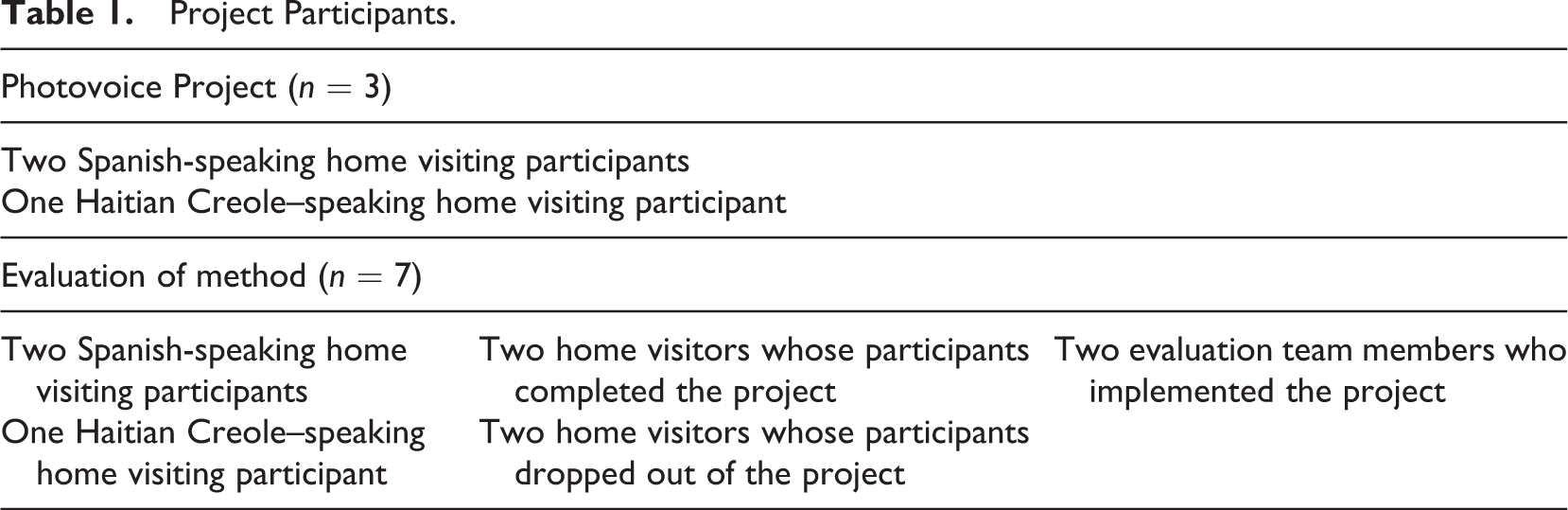
Recruitment was done through quota sampling from random-ordered lists of parents who were currently enrolled in the MIECHV program. The target sample size was 10 participants (to accommodate the time line, budget for incentives, and anticipated response rate), to include roughly seven English-, two Spanish-, and one Haitian Creole–speaking parents, representative of the state’ MIECHV population. Ultimately, this recruitment strategy yielded seven parents (four English-speaking, two Spanish-speaking, and one Haitian Creole–speaking). All enrolled parents who expressed interest in the project provided consent over the phone; then, their individual home visitors were contacted to act as liaisons to deliver the Photovoice packet. Final sample size was three individuals who completed the project, two who spoke Spanish, and one who spoke Haitian Creole (Table 1).
Following delivery of the informational packet, parents took pictures with the camera provided or their personal devices, then returned the pictures via email, text, or camera via the home visitor (if applicable). Participating parents were given 2–4 weeks to return pictures and signed consent forms. Upon receipt of the photos, the evaluation team contacted these parents to schedule individual telephone interviews to discuss their pictures and further explore what each photo meant to them and why they chose to include it in their submission. Interviews were guided by the original structure created by Wang and Burris (1997), with small modifications of the SHOWed guidelines questions, with acronym expressed as: (1) What do we See here? (2) What is really Happening here? (3) How does this relate to Our lives? (4) Why does this concern exist? (5) How can we become Empowered through our understanding? and (6) What can we Do about it?—to accommodate research objectives (Wang & Burris, 1997).
All materials and interviews were conducted in the parent’s preferred language although the one participating parent who spoke Haitian Creole opted to have her interview conducted in English (with a Haitian Creole–fluent interviewer). Each interview took up to 30 min to complete. Participating parents received a US$25 gift card upon submission of their selected photos and captions and an additional US$25 gift card when the interview was completed. All interviews were audio recorded and professionally translated and transcribed verbatim. Although Photovoice typically follows up with group discussions regarding pictures, individual interviews are also appropriate when group discussions are not possible (Budig et. al., 2018; Nykiforuk et al., 2011; Ronzi et al., 2016).
Data Analysis for the Initial Photovoice Project
Data analysis was done under the guidance of the participatory analysis method defined by Wang (1999). Steps included in this analysis are selecting, contextualizing, and codifying. Enrolled parents’ choices for photos that captured what each wanted to communicate (selection) and their provision of the context for selected photo (contextualizing) have been described earlier as part of the data collection. The two evaluation team members—graduate research assistants with qualitative training, one of whom conducted the parent interviews—analyzed the data. Codifying was done after checking transcriptions for accuracy. Initial read through of the program recipient’s interview transcripts alongside reviewing pictures referenced in the interviews allowed data analysts to have a discourse on potential themes. Because of the limited sample size, any identified theme related to parents’ discussions of their pictures was included in the coding scheme. The final coding scheme included themes identified from the interview guide and initial read through of the transcripts. Codes were independently applied to each transcript. To ensure reliability, data analysts first categorized pictures and interview data into themes independently. Afterward, they reviewed findings jointly and engaged in discussions to arrive at a consensus when there were any discrepancies. Joint discussions also yielded captions for pictures based on responses during the program recipient interviews.
Brief Summary of Photovoice Project Findings
With regard to their parenting experiences, the participating parents’ photographs reflected their perceptions of their roles as parents and the goals they had for their children. Parental roles centered on bonding with their children, promoting children’s happiness, and caring for their children, while parental goals illustrated teaching their child and the promotion of cultural and religious values. Meaningful adults in the lives of the parents and their children included members of their nuclear and extended families (e.g., fathers and grandmothers) as well as their home visitors. These individuals were described as providing varying forms of social support for the mothers and their children. Grandmothers were recognized as a source of emotional and instrumental support, while the role of fathers was centered on providing emotional support and spending time with the child. Home visitors provided a lot of social support including instrumental, informational, and appraisal support. Moreover, the relationship between the home visitor and the parent was discussed in the interviews; the quality of the relationship between the home visitor and the client played a key role in parents’ engagement and retention in the program. Detailed descriptions of the study findings can be found in the evaluation report published online (Florida MIECHV Evaluation, 2020).
Evaluation of Project Methodology
Reflective Process Interviews
To evaluate our methodology and the feasibility of executing the Photovoice project remotely, we conducted an additional eight reflective process interviews and one debriefing group interview. The reflective process interviews were with participating parents and home visitors including five individuals who completed the project (i.e., three parents and two home visitors) and two home visitors whose clients dropped out of the project. Parents who completed the reflective interview received a US$25 gift card for their participation. The debriefing group interview was a combined interview with the two evaluation team members who were actively involved in all phases of implementing the Photovoice project. All parents who initially agreed to participate in the project (n = 7) were invited to complete these reflective process interviews (Table 1). Interviews were facilitated using semistructured interview guides developed by the evaluation team.
Project Participants.
The interview guide for individuals who completed the project was designed to elicit information on aspects of the project that were difficult, aspects that went as planned, and recommendations for improvement. Those who did not complete the Photovoice project were asked to share their perceptions of the project, reasons for noncompletion, and changes that may have improved participation in the project. The debriefing group interviewer was an evaluation team member who was not involved in the original data collection so as to gain unbiased insight to the successes and challenges of implementing the project from the perspective of evaluation team members who executed the project. Questions asked about implementation of the project, successes, challenges, and recommendations for future execution of similar projects. All interviews were recorded and transcribed verbatim with the exception of one interview with a home visitor which was not recorded due to a device malfunction; detailed notes were taken for that interview and included in the analysis. Thematic analysis was done to identify challenges and successful elements of executing the project from all perspectives (participating parents, home visitors, and evaluators).
Process Interview Findings
The main success of the project highlighted by parents, home visitors, and evaluators during the process interviews was the ease of execution for both home visitors and parents once the parent was enrolled in the project. Interviewees described several positive experiences as well as challenges in regard to involving home visitors as liaisons, communication, the protocol, and instructional materials.
Benefits of involving home visitors. Home visitors felt that their role as liaisons was easy to carry out; the instructions received from evaluators were clear and easy to follow. The engagement of home visitors was an important element for many reasons. First, home visitors were vital and trusted gatekeepers. In follow-up interviews, home visitors reported receiving calls from parents to verify the project’s legitimacy. Second, home visitors were used as a liaison between the enrolled parents and the research team to share project materials. Third, home visitors reported in follow-up interviews reaching out to participating enrolled parents and encouraging them to complete and submit their photos and project materials. Ultimately, the home visitors, in this evaluation, served as trusted gatekeepers, and their support of the project allowed parents to feel supported and comfortable participating in the project. The research team noted that home visitors played a vital role in driving the project by encouraging parents to complete and submit their photos and descriptions. They also felt that project may not have had as much momentum without using the home visitors as a bridge.
Communication. It was reported by home visitors and parents that the communication between the evaluators and home visitors and between home visitors and parents was seamless. Materials were easily distributed to home visitors. One challenge noted by the researchers was that the time line for the project could have been more rigid to ensure that randomly selected enrolled parents receive project information more quickly. In this project, some parents who consented to participate did not receive project information for a few weeks following their recruitment, which could have led to reduced participation or loss to follow-up.
Protocol and instructional materials. Two of three parents added that the procedures for executing the Photovoice project itself were also easy to follow. Overall, the parents indicated that the instructional materials were beneficial. One parent specifically noted that the instruction sheet with the prompts was helpful. She also stated that the materials in the package were easy to comprehend in that they provided clear direction on what moments to capture. In the debriefing interview, the evaluators noticed that the video created by research staff to orient participants to the Photovoice process was not viewed by all participants.
Perceived benefits of participation. Home visitors noted that participation in this process served as motivation and reinforcement to the families who were involved in the home visiting program. According to them, parents perceived this process as a form of reward for their commitment to the program and felt a sense of partnership for being able to contribute to program improvement. Home visitors were delighted by the opportunity to facilitate, and they felt that the project would present a different perspective to the evaluation team as the pictures taken by the parents afford a broader understanding of activities that impact the child’s life. Similarly, participating parents reinforced this message that they enjoyed participating in Photovoice. Being able to participate in the project gave them an opportunity to reflect on their own experiences and to gain a deeper understanding of the significant/important people who surround and support them and their child. They also noted that the project would enlighten the public on their family’s participation and help to show the success of the home visitation program through their lived experiences.
Functional/logistical issues. Although there was a general perception of ease in completing the project expressed in the debriefing interviews, one participating parent mentioned having some difficulty with the process. Specifically, the difficulty was tied to the task of describing each photo taken and choosing the most salient photo to represent a certain prompt. Similar to this challenge, two parents stated that more specific prompts, along with some concrete examples, would be helpful to future Photovoice participants. Other issues encountered were logistical in nature, including failure of camera provided by the evaluation team (the program recipient used a borrowed camera instead). The evaluators also noted this issue, explaining that one camera was sent without a memory card, and the participant was only able to take one photograph before the internal phone memory was full. To remedy this, the home visitor helped the parent to take photos using her own device, which has the potential to bias the photograph selections.
A miscommunication between the evaluation team and home visitor was noted by one parent. Specifically, she was confused about the legitimacy of the project when she discussed it with her home visitor who was not fully aware of the project at the time. This miscommunication may have been due to the process of waiting for a parent’s consent before reaching out to their home visitor to act as a liaison. Respondents suggested that, as much as possible, minimizing issues related to logistics would serve to make the process more seamless. Evaluation staff also noted that although all MIECHV sites with randomly selected participants were notified through administrators or supervisors, none of the home visitors were initially aware of the project.
Aside from challenges related to executing the project, process interviews also revealed reasons why several parents were unable to complete the project. A home visitor explained that her client was unable to complete the project due to her busy schedule. Although the home visitor understood that parents were randomly selected, she emphasized that participation rates may have improved if the selection process was not random and if there could have been more input from the home visitors on participant selection. Other parents were lost to follow-up, which is not unusual in this population that faces many stressors and competing priorities.
Discussion
Implications for Evaluation Theory, Research, and Practice
Overall, from this project, the evaluation team learned that remote Photovoice or photo-elicitation among home visiting program participants is a method that is accessible for research and evaluation and that incorporating Photovoice into home visiting evaluations can be a helpful way to gain unique insight into participant’s lived experiences. Our evaluation of the methodology yielded several considerations. First, we acknowledge that as a federally funded project, the evaluation plan was preapproved at multiple levels (Health Resources and Service Administration, Office of Planning, Research & Evaluation) in advance, so in this project, only the program administrators and staff were able to give input into the study design; the parent participants did not codevelop the questions or protocol. However, parent participation in the development stage of the project would be feasible, and preferable, for future projects if planned ahead. We did include parents’ feedback in the reflective process after the project was completed to improve our protocols for the next evaluation.
Incorporating Photovoice into home visiting evaluations can be a helpful way to gain unique insight into participant’s experiences. A strength of this project was the creation of materials and interviews conducted in the three dominant languages of the program participant population. Materials were also designed with those who have low literacy in mind. We found that these considerations increase engagement and welcome participants to share cultural aspects of their experience which may not have been shared otherwise. Another consideration is selection and recruitment strategies. Participants may be selected through randomization or snowball sampling or through quota sampling of certain counties/locations, home visiting models, or participant characteristics (in our case, by primary language). Random selection increases the likelihood of low response rate or dropout. If home visitors handpick participants, this can result in selection bias. For this reason, in this and the next Photovoice project, we recruited parents directly from stratified random-ordered lists. Participants may be recruited directly by telephone or a flyer or via home visitors. Our evaluation team recruited and consented parents into the project and provided our email address and phone number on all project materials (along with a voice mail in English, Spanish, and Haitian Creole) but did not contact parents directly throughout implementation of project; home visitors were the primary facilitators. There are pros and cons of directly recruiting participants, and this may not be a viable option if project teams do not have a relationship with participants. In this case, we felt that the home visitors had built rapport and would be able to reach participants more easily.
Remote implementation is useful when circumstances such as distal locations for statewide or multistate evaluations prevent evaluators from having direct access to participants. Virtual methods have also been more widely accepted during COVID-19, when physical distancing measures are in place. It is also important to consider the Photovoice process. Flexibility is required, as there are multiple stakeholders. The project benefits from clear, open, and frequent communication. Videoconferencing was mentioned as a means for providing training and an overview of the Photovoice process. Videoconferencing could also be used following the collection of photos and stories to debrief with participants and/or home visitors. In some cases, it may not be possible to communicate directly with the participants, justifying communication with the home visitors as vital.
One recommendation during the planning phase for a remote project is to develop a thorough protocol and training materials that provide clear prompts. These training materials could be provided to program administrators, as their knowledge and buy-in could ensure that proper and timely communication happens with home visiting staff. Additionally, following-up directly with participants after they receive the training materials from the home visitor may help clarify any outstanding questions and reinforce the intent of the project. Timely communication between the research team or home visitor and the project participant is essential for preventing delays between consenting to participate and the receipt of project materials; some participants dropped out of the project during that lag time.
The parameters and standards for the photographs should also be clearly communicated. Photographs may include sensitive information such as the identification of another person, particularly a minor, or identifying structures in a home or neighborhood. For example, one participant’s husband did not want his child’s photo to be included in Photovoice materials. This instance raises the question of whether consent forms are required from one or both parents if a child’s face is visible in a photograph. As such, participants need to receive clear training on what is acceptable as a subject of a photo as training sessions. Training may occur through printed or recorded material without the interface of questions and answers at a live, in-person session. Furthermore, the importance of reaffirming parent consent once the project is ready for dissemination was highlighted in this project.
Much was learned from participants that would not have been voiced otherwise, particularly around their personal motivations, family influences, and cultural identities and priorities (Florida MIECHV Evaluation, 2020; Rojas et al., 2017). The method was utilized again, with adjustments based on what was learned, for another Photovoice project initiated the following year. The evaluation team has continued to explore ways to utilize participatory methods, which give priority to community members’ needs rather than researchers’ needs (Wang et al., 1998). We believe that this method may give voice to program participants in ways that semistructured interviews alone cannot. In this project, parents were able to take pictures that reflected the centrality of culture, religion, and family in their parenting experience. These aspects may not have come to light using other methods, unless directly asked about; the invitation to take photos along with open prompt offers a blank canvas open to the participant’s interpretation. Although the researcher relinquishes initial control over the content and process of capturing images, community participation does not compromise the integrity of the Photovoice methodology but instead enhances the validity and reliability of participatory research (Wang et al., 1998). Catalani and Minkler (2010) emphasize that Photovoice engages participants in critical dialogue “producing valuable research data in the form of discussion transcripts and serving as an empowerment intervention that had immediate benefits for research participants and their communities” (p. 443).
Photovoice gives control to the participants by providing them the opportunity to (1) represent and enhance their own community through a vivid and specific way of taking pictures and telling stories and (2) give something tangible and personal to others in the form of photographs (Wang et al., 1998). Thus, our evaluation seeks to uniquely communicate home visitor and parent voices toward improving programs and community supports. However, in this case, although the results of the project were disseminated to parents and to all staff through reports, one-page summaries, and a program newsletter article, it is not known to the evaluation team whether the knowledge gained from this project was utilized to improve the home visiting program in specific ways or whether it impacted practice or understanding. Therefore, the communication and dissemination aspects of Photovoice results should be considered in future evaluation projects in order to truly attend to the emancipatory power of this method.
Given the usefulness of Photovoice as a means of empowerment and potential advantage of remote capabilities, evaluators should not be dissuaded from utilizing this approach as a remote evaluation tool. Many of the challenges identified in this project can be overcome. During the COVID-19 pandemic, programs and researchers have adapted methods to virtual communication and work (Saberi, 2020). Photovoice is an excellent example of a remote research tool that can be adapted and utilized, providing a safe approach to research while maintaining its roots in amplifying the voices of diverse population groups (Catalani & Minkler, 2010; Yancy, 2020). When conducting research remotely, as in this case, frequent and constant communication with participants facilitates successful participation.
Footnotes
Acknowledgment
The authors would like to thank Allison Parish and Carol Brady, the current and former project directors of the Florida Maternal, Infant, and Early Childhood Home Visiting (MIECHV) Initiative, for their support of this research.
Declaration of Conflicting Interests
The author(s) declared no potential conflicts of interest with respect to the research, authorship, and/or publication of this article.
Funding
The authors disclosed receipt of the following financial support for the research, authorship, and/or publication of this article: This project was supported by the Florida Maternal, Infant, and Early Childhood Home Visiting (MIECHV) Initiative, Florida Association of Healthy Start Coalitions, Inc. Project 6405107040 (funded by the Health Resources and Service Administration [HRSA] of the U.S. Department of Health and Human Services [HHS], Grant D90MC25705).
