




Abstract
Consensus among the majority of staff is essential for the development and consistent implementation of the Schoolwide Positive Behavior Interventions and Supports (SWPBIS) framework. At the universal level, a shared vision reflects consensus regarding operational definitions of behaviors (rules) and consequences. Yet, decades of research indicate that educators possess idiosyncratic standards for student behaviors. Lengthy and often unproductive discussions can arise when discussing school rules with a large group of adults. To address situations where consensus is difficult to achieve, this article outlines a process that assesses and summarizes the views of all school-based staff and then facilitates discussions based on the aggregated data. To illustrate this approach, we include two case studies involving faculty members struggling to find consensus about their schoolwide rules and describe how agreement was achieved. Recommendations for SWPBIS coaches conclude the article.
Keywords
Successful schoolwide positive behavioral interventions and supports (SWPBIS) require shared vision and collaborative effort among staff members (Liaupsin, Jolivette, & Scott, 2004; Nelson, Martella, & Marchand-Martella, 2002). To enhance school climate and reduce discipline referrals, staff members must agree about what constitutes appropriate and inappropriate student behavior (Duda, Dunlap, Fox, Lentini, & Clarke, 2004; Fenning, Theodos, Benner, & Bohanon-Edmonson, 2004; Scott & Hunter, 2001; Sugai & Horner, 2008). Implementers of SWPBIS strive for 80% agreement among staff. This “80% rule” predicts that universal behavioral standards are likely to be effective if at least 80% of staff members agree upon them (Horner et al., 2004). The assumption is that reaching a majority consensus among staff in this way increases staff buy-in and support, which should in turn lead to more consistent staff responses to rule following and infractions.
Despite the importance of such consensus, specific strategies for reaching 80% agreement among staff are “not well elucidated in the SWPBIS literature” (Feuerborn & Chinn, 2012, p. 220). Indeed, as SWPBIS facilitators, we have struggled to implement SWPBIS in situations where agreement about school rules was unattainable. Accordingly, this article outlines a process we developed to support consensus building concerning rule creation. First, we review reasons why consensus may be difficult to reach. Next, we describe a process for gathering, summarizing, and using data from school staff members. Third, we present two case studies to illustrate this process before offering recommendations for practice.
Challenges to Building Consensus
Ideally, all members of a faculty would help to develop rules for behavior; yet with diverse groups and larger groups, consensus may be difficult to achieve (Scott, 2007). In fact, research has demonstrated that teachers often possess idiosyncratic standards for student behavior (Rimm-Kaufman, Storm, Sawyer, Pianta, & LaParo, 2006). Even within the same school, adults do not always have the same rules for students and may also disagree about consequences (Kerr & Zigmond, 1986; Lane, Wehby, & Cooley, 2006; Vincent, Horner, & Sugai, 2002; Walker & Rankin, 1980). Consequently, each disciplinary event is subject to the interpretations, motivations, standards, and skills of the adult(s) involved (Irvin, Tobin, Sprague, Sugai, & Vincent, 2004). Thus, how educators perceive, attribute, and interpret student behavior could influence how fully they endorse and implement schoolwide systems such as school rules.
Furthermore, staff members’ varied perceptions of behavior might undermine the effective implementation of rules that address behavior. As Feuerborn and Chinn (2012) noted, “tensions between teachers’ perceptions of behavior and discipline may create an undercurrent of discordance that could interfere with staff cohesiveness and stymie the implementation of SWPBIS” (p. 226). Simply put, a faculty divided over the school rules may react differently to students’ display of positive behavior or rule violations. Because inconsistent rule enforcement is ineffective and may place students at risk for aggressive and oppositional behavior (Way, 2011), variation among staff with regard to addressing behavior is undesirable (Liaupsin et al., 2004). Conversely, individuals who agree with the rules may be more likely to reinforce positive behavior and address violations (via disciplinary response or teaching of the rules) than those who disagree with the established standards.
Scott (2007) argued that schools should integrate the opinions of their stakeholders when making “systemic decisions,” to ensure that these decisions align with the values of those operating within the environment. He added that “valuing consensus via authentic participation is key to ensuring the dignity and independence of stakeholders that is necessary for consistent implementation” (Scott, 2007, p. 107). Accordingly, a methodology for integrating staff perception data into a system of school rules is likely to help SWPBIS coaches demonstrate that the personal dignity of their stakeholders is valued.
Reaching Consensus: A Data-Informed Process
While working as SWPBIS coaches in a large urban district, we observed many faculty discussions of proposed schoolwide rules. Many resulted in lengthy, unfocused, and quarrelsome sessions. Consensus was sacrificed as individuals told their “war stories” about challenging students. Given the research on educators’ individualized perceptions of behaviors, we thought it useful to unearth differences of opinions that might be blocking agreement on schoolwide rules. However, we did not want a time-consuming process requiring considerable external resources.
We ruled out faculty interviews because they could be arduous and would require additional staff not typically available to schools. Paper-and-pencil surveys also posed several disadvantages. Handwritten responses could be difficult to read or interpret; survey preparation (making paper copies, distributing, collecting, and organizing them) and data collection (aggregating results) would be time-consuming; completed surveys might be misplaced or altered; and responses might not be anonymous, if one recognized the handwriting. Accordingly, we opted for an electronic survey that offered anonymity, could be completed at home or at school, and resulted in quantifiable data that were automatically summarized.
Collecting staff perception data about school rules (a) respects and engages every staff member; (b) grounds the discussions in a contemporary portrayal of staff views; (c) focuses the discussion, effectively limiting the scope of conversations; and (d) saves time (a valuable commodity in any school) not only prior to establishing rules but also afterward. If staff can focus their discussions and agree on school rules, fewer revisions of the rules during the year may be expected. Furthermore, surveys that can be completed anonymously allow each voice to be “heard” equally without regard to seniority, educational status, or popularity. In addition, reticent staff members who prefer not to speak in a large group can offer their opinions without fear of retribution or disparagement from peers or supervisors.
Surveying Staff About Universal Supports: Two Case Studies
In this section, we describe two cases wherein a large, diverse faculty could not reach consensus on universal behavioral supports. We used the data collected by an online survey to help foster agreement regarding a system of schoolwide rules for behavior. The names of the schools depicted in these case studies have been changed to preserve the anonymity of the districts and employees.
Case 1: Garry Middle School
Garry Middle School is a large urban middle school serving Grades 6 to 8. After demonstrating commitment from district representatives and staff members, Garry joined a cohort of schools implementing SWPBIS. Both authors began working with staff as district SWPBIS consultants providing technical assistance, starting with the creation of a SWPBIS team that included a selection of teachers from all three grade levels, as well as the school’s principal and vice principals. The team’s first task was to create positively stated rules addressing appropriate student conduct (Garry did not have an existing list of rules for student behavior other than the district’s code of conduct). Initial meetings toward creating schoolwide rules had been unproductive and frustrating, as staff members wrangled over the behaviors to address. We needed to engage all staff members while helping to refocus and depersonalize the discussion on student behaviors.
Development of the survey
We began the process by developing a survey to assess all staff members’ opinions. The survey included a list of 50 misbehaviors derived from the district’s code of student conduct as well as additional behaviors typically exhibited in a school environment (e.g., running in the hallways, arriving late to class, etc.). To establish a complete list of behaviors, we consulted several documents, including office discipline referral forms from other schools within the same district and the school-age version of the Child Behavior Checklist (Achenbach & Rescorla, 2001). Behaviors atypical for the school environment (e.g., bed wetting, breaking curfew), and unobservable behaviors (e.g., shyness, excessive worrying) were excluded from the survey. To encourage candid responses, no demographic data were requested on the survey. The survey requested that school staff members rate each behavior on a 5-point Likert-type scale, ranging from not important to extremely important. Asking staff to assign ratings to specific behaviors instead of rating the way a rule was worded offered a direct measure of staff members’ perspectives of each behavior and prevented a focus solely on “wordsmithing.” Before disseminating the survey to staff, we sent the survey to a small pilot sample of professors of education and psychology to assess content validity. In this pilot group, participants offered wording suggestions for a few items and reported that the survey took between 10 and 15 min to complete. Several items were also recommended and subsequently added to the survey. When the survey was completed, we sent it to every school in the district for use in schools such as Garry that exhibited significant disagreement about school rules.
With the principal’s permission, we sent an email to the staff members at Garry, explaining the purpose of the survey and notifying them of the upcoming survey date. One week later, the principal scheduled time for all staff to complete the survey in the school’s computer lab. All full-time employees with pupil contact (i.e., office staff, classroom paraprofessionals, teachers, and administrators) were invited to participate but were not required to do so. Fifty-one staff members participated in the survey, for a response rate of approximately 94%.
Sharing survey data
We later used these data in a staff meeting designed to establish school rules and a behavioral matrix. During the meeting, we shared simple descriptive statistics (means, frequencies, and standard deviations) for each item to show staff how they had rated student behaviors and to identify which should be targeted by school rules. We anticipated that this information would help staff to make informed, data-based decisions about rules by communicating agreement for behaviors that staff rated as important for success in their school, and fostering productive discussions by highlighting differences of opinion that might lead to variable rule enforcement.
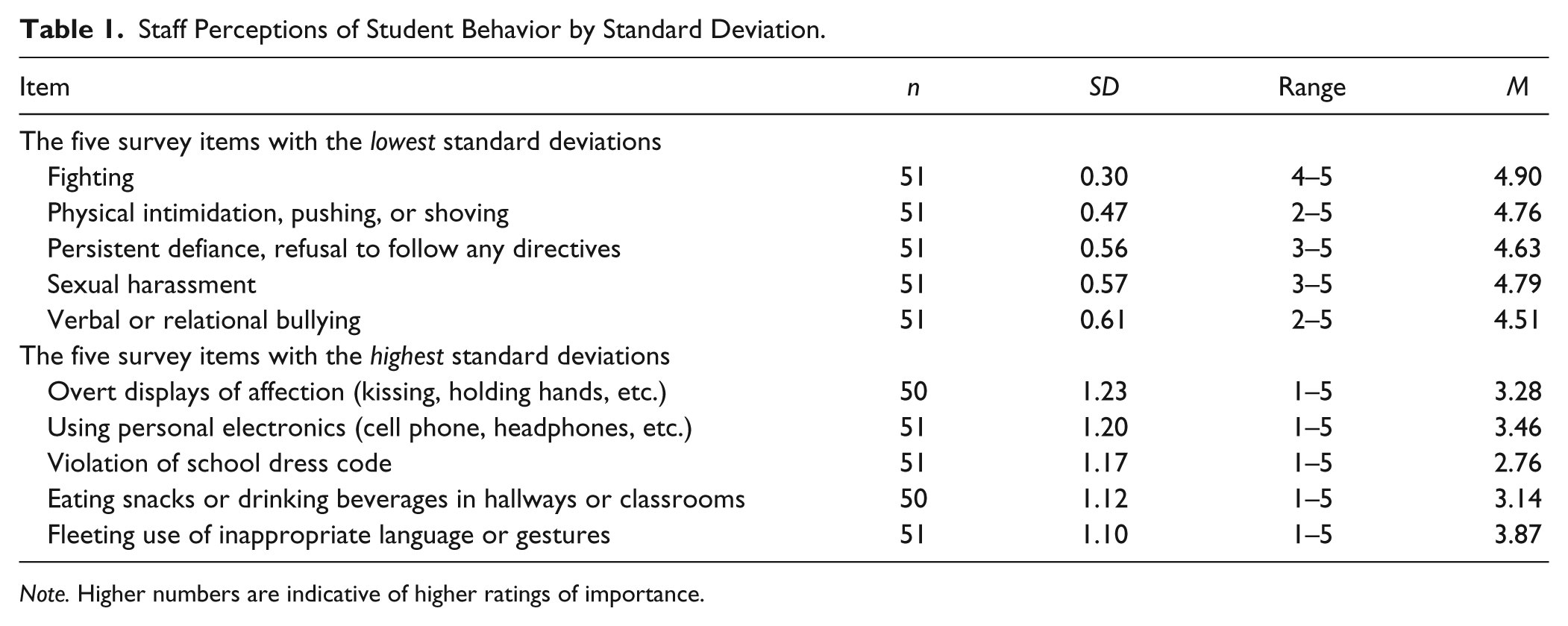
Results from the survey illuminated areas of pronounced agreement and disagreement among the educators at Garry. Table 1 includes the means and ranges of the survey items with the highest and lowest standard deviations, provided as a measure of variability. (Given the large number of items on the survey, we provide only the five highest and lowest values.)
Staff Perceptions of Student Behavior by Standard Deviation.
Note. Higher numbers are indicative of higher ratings of importance.
In general, staff members were in agreement regarding the importance of the five behaviors listed at the top of Table 1. Variability across staff responses for these behaviors was low, while the average ratings for these behaviors indicated that most staff found them to be either very important or extremely important to their work in the school. In fact, no staff member assigned the rating of little importance to any of these behaviors, as indicated by the range of ratings. These behaviors (fighting, physical intimidation, persistent defiance, sexual harassment, and verbal bullying) can cause significant disruption to in the school environment and may even threaten the safety and security of those in the building. Therefore, it is not surprising that most staff members viewed these behaviors as important and would likely want to address the behaviors with school rules.
Conversely, staff members provided lower ratings for the five behaviors shown at the bottom of Table 1 (displays of affection, use of personal electronics, dress code violation, unauthorized food/drink, and fleeting use of inappropriate language/gestures). Standard deviations for these behaviors indicated a larger spread in staff’s perspectives about the importance of these behaviors. Furthermore, the range of responses demonstrated that one or more staff members reported each behavior as not important to their work in the school. Together, these data suggested that staff members’ perspectives were more divided regarding the importance of these behaviors. Thus, it is unlikely that staff members would quickly reach consensus regarding these behaviors. Rather, it was probable that we would need to provide more structure and guidance when discussing these behaviors.
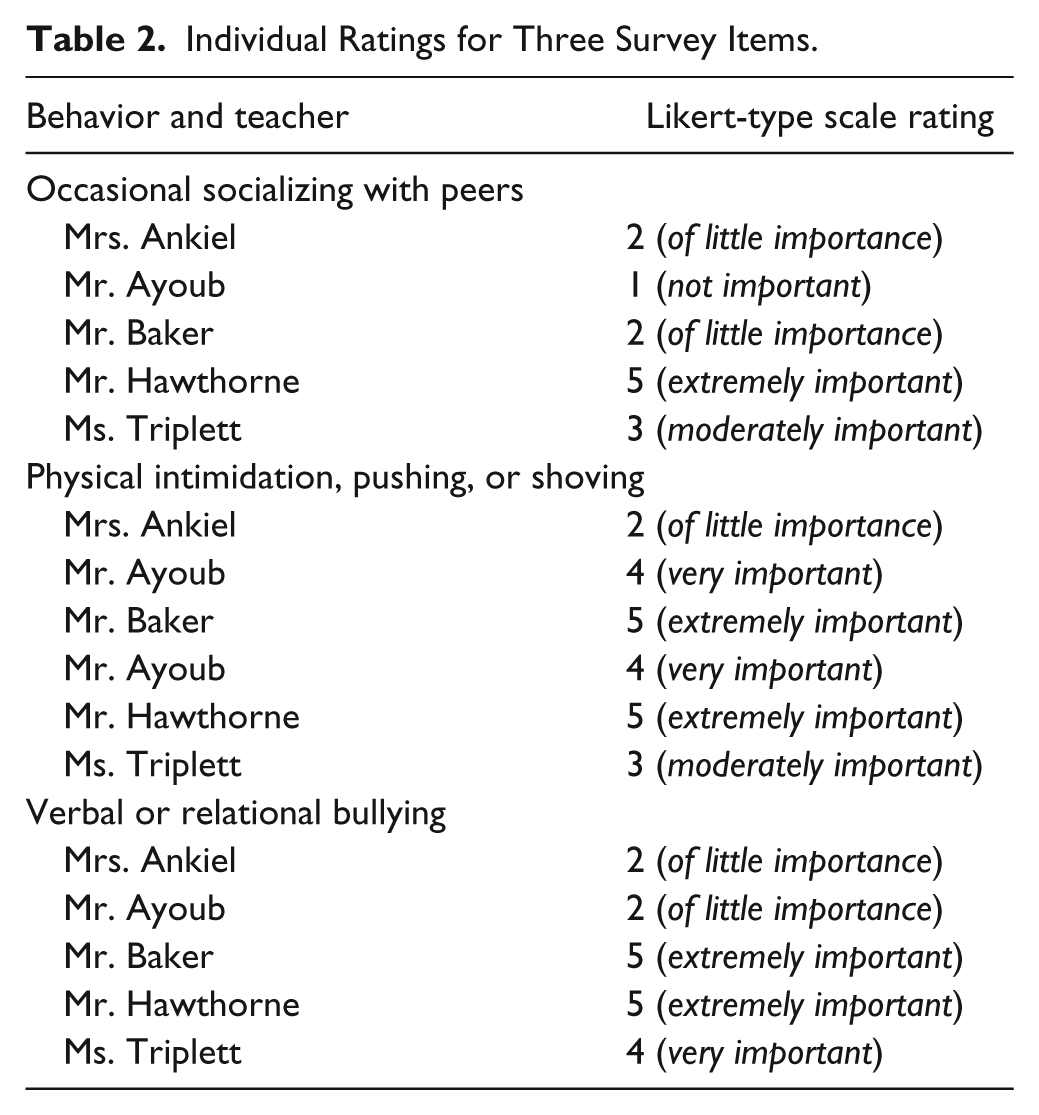
Analyzing individual responses to the survey also demonstrated the differences in the perceptions of staff members at the school. To illustrate this concept, we randomly selected five respondents from the dataset and compared their ratings of three challenging student behaviors, also selected at random (see Table 2). These data elucidate the differences among adults’ opinions of student behavior, as staff members’ perceptions differed considerably. For example, staff members provided highly disparate ratings for the behavior “occasionally socializing with peers.” Although Mr. Hawthorne assigned the highest possible rating to this behavior, Mr. Ayoub rated it as not important. Perhaps this behavior was particularly problematic for Mr. Hawthorne or was a persistent problem in his classroom. Hence, he probably would have supported a schoolwide rule that addressed this behavior. Conversely, Mr. Ayoub’s low rating for this behavior suggested that he was willing to overlook instances of socializing in his classroom, or that his students did not exhibit this behavior very often. Perhaps Mr. Ayoub would not bother to enforce a rule targeting socialization among students. These and other differences confirm that opinions about behavior often vary across individuals.
Individual Ratings for Three Survey Items.
Using staff survey data to create rules and a behavioral matrix
The major goal of the survey was to facilitate the development of a shared vision and collaboration regarding rules for behavior, by using data from all participating staff members. The survey results communicated to staff members how their peers rated each behavior. Using bar graphs that displayed means for staff ratings of behaviors automatically generated by SurveyMonkey™, we were able quickly and efficiently to review all 50 items with staff members (see Figure 1, for a sample graph displaying 4 of the 50 items). These graphs provided staff with a visual representation of their dataset, allowing them easily to identify areas of agreement and disagreement. As we reviewed the graphs, we paused to discuss the implications of their ratings.

Sample bar graph displaying the average ratings of select behaviors from all staff members at Garry Middle School.
As we shared data with staff, we led them in a discussion about how to translate their ratings of behaviors into rules, including instructions concerning appropriate length, language, and phrasing of rules. We also provided a three-step framework to help staff members decide which behaviors should be translated into rules:
Items with high mean ratings and low standard deviations represent staff agreement regarding the importance of these behaviors to success in the school. These items should be translated into rules.
Items with low mean ratings and low standard deviations represent staff agreement on the behaviors that are not as important to success in the school. These items should not be translated into rules.
Items with high standard deviations (and mean ratings around the midpoint) represent disagreement and may require a group discussion and/or vote to decide whether rules are created for these behaviors.
For example, it was clear that “fighting” was an important behavior to the staff at Garry (M = 4.9; SD = .3). Therefore, the staff knew they would need a rule targeting this behavior (e.g., “Keep your hands and feet to yourself”). Conversely, because staff rated “violation of school dress code” rather low (M = 2.76; SD = 1.17), the staff eliminated this behavior from consideration, choosing not to address it with a formal rule. This data-informed decision process was immensely helpful, as we expeditiously developed rules to address behaviors that 80% of the staff viewed as very important or extremely important (i.e., rated 4 or 5). This provided an authentic manner for choosing school rules, as all decisions derived from faculty data.
As the data in Table 1 illustrate, staff members also had disparate views on the importance of several student behaviors. These behaviors warranted additional discussion; however, because we had quickly addressed all behaviors for which 80% agreement had been reached, we faced only a short list of behaviors to discuss as a group. For example, the staff had mixed feelings about “overt displays of affection” (M = 3.28). Although 46% of the group rated this behavior as very important or extremely important, 54% of staff rated it as moderately important or lower. Through discussion, it became clear that staff members were divided over how they responded to displays of affection (some ignored these behaviors while others directly addressed them with students). As more than half of staff members rated this behavior as moderately important or lower, staff ultimately decided not to address this behavior with a specific schoolwide rule.
This process was repeated for each behavior until staff members agreed upon a final list of rules. Staff members then worked in groups to place the rules in a behavioral matrix, organizing rules by locations in the school. For example, staff created the following list of rules for appropriate recess behavior (recess was held indoors):
Stay in designated area
Keep hands and feet to yourself
Follow directions of staff
Be polite . . . use kind words
Keep space neat and clean
Share materials
Take all belongings with you
Walk quietly through the hallways.
Case 2: Snyder K–12
Snyder K–12 is a specialized school serving students with emotional and behavioral disorders (EBD). Prior to our involvement, the school set out to create a system of schoolwide rules and expectations within the SWPBIS model. The principal established a school-based team consisting only of administrators, who created rules and expectations during the summer. The administrators’ individual perceptions of the most persistent problem behaviors determined the new rules. The team introduced the rules to staff and rolled them out when the new school year began.
At the end of the year, behavioral data (incident reports) and staff dissension prompted an overhaul of the rules. Frustrated staff members complained vociferously to administration about the rules they had created. Around this time, the lead author began working with the school as a SWPBIS coach. Together with the school’s administration, we decided to abandon the existing rules in favor of a new system that would integrate data from all staff members working at the school. With this goal in mind, all school staff members who interacted with students were invited to complete an anonymous online survey about school rules.
Development of the survey
The survey developed for Snyder used a different methodology than the Garry survey. Due to scheduling constraints, we had limited professional development time to work directly with staff when the new school year began. Rather than rating student behaviors, the new survey asked staff to directly rate behavioral expectations and their application throughout the school (rules for behavior). The first question presented staff with several sets of 3 to 5 positively stated schoolwide expectations (e.g., “Be Safe, Be Responsible, Be Respectful”) and asked that they rank the expectations according to which they liked the best. The survey included the schoolwide expectations from the previous school year; however, the remaining lists of expectations came from matrices available on the Positive Behavioral Interventions and Supports website (pbis.org) and exemplars from online SWPBIS resources (pbismaryland.org).
Next, the survey presented staff with lists of rules (e.g., “Complete tasks and assignments”) for six specific school locations (classroom, hallway, dining hall, bathroom, arrival/dismissal, and community/field trips), as the SWPBIS process outlines (Kerr & Nelson, 2010), and required staff to rank the rules for respective settings in order of importance. We anticipated that this method would save meeting time by eliminating the need to translate ratings of behaviors into positively stated rules.
We sent the principal of the school an email invitation that included an explanation of the survey and a link to the school’s survey. The principal forwarded the email invitation to all school-based employees working directly with students. To encourage candid responses, we did not collect staff demographic data. Most staff members completed the survey during a scheduled time in the school computer lab. Staff members not available during this time were given 2 weeks to complete the survey at their convenience. A reminder email followed after 1 week to encourage additional responses. All eligible staff members completed the survey for a 100% response rate.
Survey results
Table 3 includes staff rankings for the schoolwide expectations for behavior. There were disparate rankings across each group of expectations. Another important finding was that the behavioral expectations from the previous school year (those developed by administration without staff input) received the lowest ranking from staff members. This low ranking may have been an indication that most school staff perceived the old behavioral expectations as inappropriate for their students and school environment.
Staff Rankings for Schoolwide Expectations for Behavior.
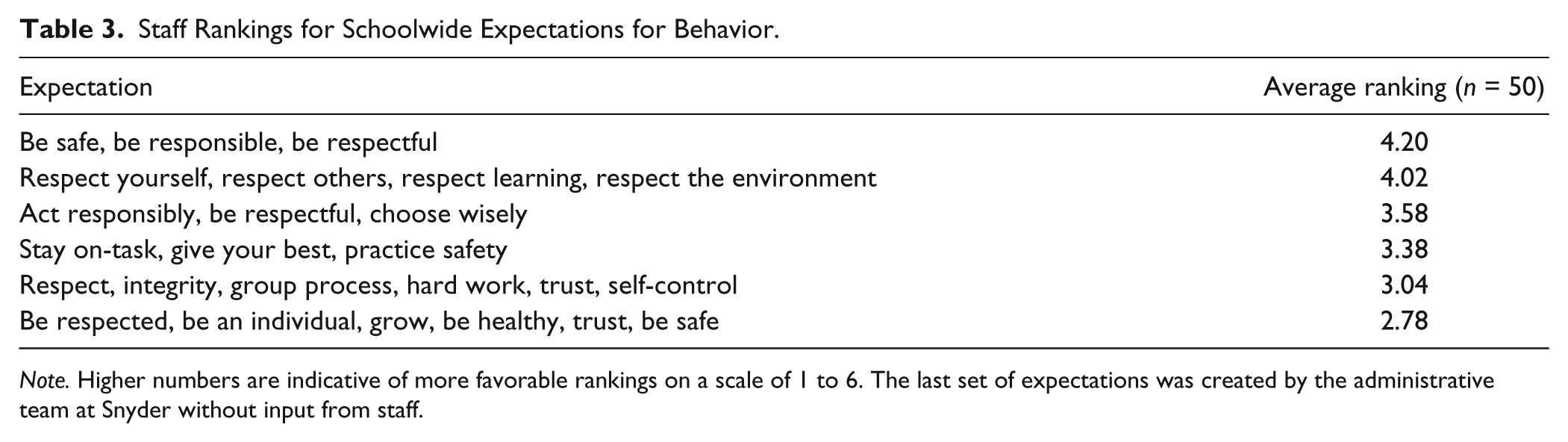
Note. Higher numbers are indicative of more favorable rankings on a scale of 1 to 6. The last set of expectations was created by the administrative team at Snyder without input from staff.
Staff members also ranked rules by location (e.g., hallway, bathroom, classroom, etc.). Table 4 illustrates the staff rankings for one such location (rules for community outings).
Staff Rankings for Schoolwide Rules on Field Trips and Community Outings.
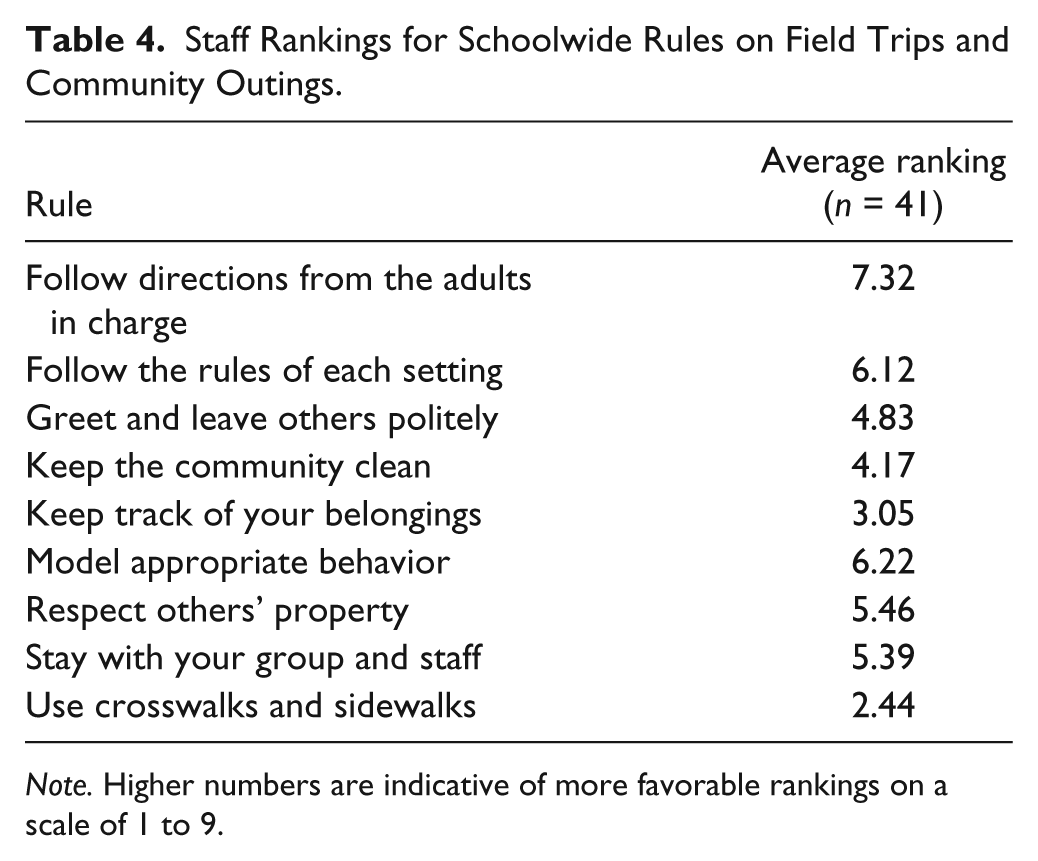
Note. Higher numbers are indicative of more favorable rankings on a scale of 1 to 9.
The two rules with the lowest staff rankings (“use crosswalks and sidewalks” and “keep track of your belongings”) were the two rules the school administrators had added to the survey. The administrators had identified these two behaviors as critical when students went into the community. Yet, the rest of the staff did not agree. Instead, they assigned the least favorable rankings to these two rules. Clearly, the administrators and the rest of the staff did not perceive these behaviors similarly.
Using staff survey data to create a behavioral matrix
Prior to the beginning of the next school year, Snyder K–12 staff met to review the aggregated results of the survey. Alongside the school’s administrative team, we presented charts and graphs of the staff’s rankings, organized by school location (i.e., first classroom rules, then hallway rules, etc.) and engaged staff members in discussions focused on the rankings assigned to each rule. Similar to the process used at Garry Middle School, we identified a framework to help staff make decisions about which rules would be accepted into the new schoolwide matrix. In general, the highest ranked items in each location became part of the new behavioral matrix, while the rest of the items were excluded from consideration. Every staff member had the chance to speak and express concerns with regard to any of the survey items before we finalized a list of rules and moved on to another location. However, because the group already had adopted or eliminated many rules, the scope and length of these ensuing discussions was manageable. The resolution to all disagreements took less than an hour.
Summary
The case examples at Garry Middle School and Snyder K–12 demonstrated a data-based approach for creating school rules that includes all school staff-members. Although the goal was to establish schoolwide norms for behavioral supports, we must always remember that the individuals within an organization must enforce and reward these norms. Horner (2003) noted that organizations do not themselves “behave”; rather, it is the individuals within an organization who engage in behaviors. Accordingly, we argue that any system of rules and expectations should account for the varying experiences, perspectives, and skill sets of the adults in a school. Collecting perspective data and involving staff members in discussions centered on rule creation is one method to achieve this goal.
Perhaps the most gratifying result of this work was the staff members’ realization that they could indeed reach consensus regarding schoolwide rules. Prior to this exercise, many staff members in both schools had resigned themselves to conflicts about how to address challenging behaviors, while others were unaware of the different perspectives present among their colleagues. By quantifying their disagreements and highlighting their many agreements, we provided them with a structured approach that allowed them to discuss their differences dispassionately and efficiently. When discussing the data, we also observed conversations in which staff members swapped ideas for addressing particular behavior problems—a welcome (although unintended) consequence.
Conclusions and Recommendations
To help build internal capacity to establish and maintain effective practices, SWPBIS coaches and facilitators often form school-based teams (Horner et al., 2004; Lewis & Sugai, 1999). These teams are designed to be representative of faculty, and are often charged with managing the establishment of systems of support along each tier of prevention (Lewis, Jones, Horner, & Sugai, 2010). Methods for communicating and discussing team decisions with the rest of the faculty are established, providing a sense of consensus and agreement regarding important, systemic decisions.
However, in large or diverse faculty groups where there is significant disagreement among staff regarding the school rules, it may be prudent to offer staff members more involvement in the process for reaching consensus regarding their school rules. While SWPBIS teams do most of the implementation work on-site, they are also directed to “actively recruit and incorporate feedback from the larger faculty at every step” (Simonsen, Sugai, & Negron, 2008, p. 35). With this in mind, we sought to develop an efficient method to assess all staff members’ perceptions before implementing SWPBIS.
Having now used surveys in many schools, we offer these recommendations to SWPBIS coaches and school-based implementers interested in the process:
In a short staff meeting, explain the goals of the survey and the rule-creation process. This explanation allows coaches to answer questions and clear up any misconceptions before the process begins.
Emphasize the anonymous nature of the survey. Sharing an example of how the data summary will appear (i.e., bar graphs) can relieve staff concerns that the facilitators will disclose their individual views.
Bring copies of the data summaries to the meeting (or project them), so that participants have visual data to focus their discussions.
Designate cutoffs for acceptance or exclusion of rules based on the average staff ratings or rankings. How these cutoffs are established depends both on the nature of the survey (number of items, type of questions, etc.), as well as considerations based on the school culture. For example, in a survey wherein staff members rank behaviors on a 5-point scale, any behavior with a mean rating of 0, 1, or 2 could be excluded from the rules discussion, because staff members rate them as unimportant. Conversely, behaviors with means of four or above require rule development by the SWPBIS team. Behaviors with means between two and four constitute areas for additional group discussion.
If staff members still cannot come to consensus on a set of rules, it can be helpful to break into subgroups. Each subgroup then proposes several different solutions and posts them on the wall. When all groups have posted their solutions, the entire faculty can peruse the options in a manner similar to a gallery walk (Kennedy, Mimmack, & Flannery, 2012) and vote on the rules using small adhesive circles.
If there is significant staff turnover, reissue the survey to garner the commitment of new employees who did not participate in the original process. Personnel changes bring new personalities and new opinions regarding the nature of student behavior and school rules. Any changes to the rules must be introduced and taught to students at the beginning of the school year. We also recommend that schools avoid frequent tinkering with the rules so as not to confuse students and staff. We suggest that schools reevaluate their rules every 2 years.
Consider that staff members who helped to create an original set of rules may form new opinions as they become more experienced or as their roles change. Accordingly, any set of rules established in the past may require reevaluation for fit within the current school environment.
In addition, one can adapt surveys to reflect the distinctive environmental and cultural needs present in different schools (Feuerborn, Wallace, & Tyre, 2013). This flexibility could allow district- or state-level coaches to provide targeted professional development based on the unique needs and challenges of each school. Items can be changed or reworded to fit the school configuration (e.g., elementary vs. high school). Coaches might ask school-based teams to pare down the number of items on a survey to eliminate extraneous items that may not be helpful in certain contexts. In smaller schools, survey designers might ask staff members to nominate rules of their own or offer behaviors in need of attention via a write-in option (we caution that collecting and aggregating qualitative data can be cumbersome in larger schools).
Seeking the perspectives of all staff members when implementing the SWPBIS framework can help foster a sense of unity and commitment (Feuerborn et al., 2013). Surveying staff about student behaviors is just one means to this end. We urge all SWPBIS coaches to continue their work with a keen eye toward increased collaboration and involvement across all members of a school community.
Suggestions for Future Research and Practice
We did not ask students to participate in the survey used at either school; however, it may be prudent to also engage students in the rule-creation process. As one of the teachers at Garry Middle School wrote on our survey, “If we want a real change in behavior, then the students must be part of that change.” Many SWPBIS implementers have taken steps to include students in the process, such as creating student councils and using student-created videos that help to explain or model appropriate behavior to peers. We suggest extending this work to include students in the process of rule creation as well. Surveying students and inviting a student body to participate in discussions about rule creation sends the message that adults value their opinions about behavior. Moreover, student participation might also increase student buy-in and ownership of the rules. Future researchers might empirically evaluate whether student participation increases acceptability of the rules or enhances adherence to the rules.
Another interesting addition to this line of work could be examining the correlation of office discipline referral totals and data about staff perspectives of student behavior. Examining the potential connections between these two datasets could uncover additional phenomenon to explore. A positive correlation between these datasets could suggest that staff members assign discipline referrals according to their personal beliefs about acceptable student behavior (e.g., an individual who strongly believes that students should raise their hands to speak might write many referrals for speaking out of turn). Conversely, the absence of a relationship might indicate that staff members’ perspectives have little to do with their decision to write a referral.
Finally, adults’ varied perspectives about student behavior may have important implications for the implementation fidelity of schoolwide rules and systems. If a staff member’s individual perspectives about student behavior are at odds with an existing set of school rules, is he or she less likely to respond to rule infractions? To date, the literature has not directly studied this potential connection between personal perspectives and the implementation fidelity of rules. A mixed-methods analysis including surveys of staff perspectives and observations of teacher responses to school rule violations would contribute prominently to our understanding of how teachers’ personal beliefs about behavior relate to their discipline practices.
Footnotes
Acknowledgements
We would like to thank C. Michael Nelson for his assistance in critiquing this manuscript.
Declaration of Conflicting Interests
The author(s) declared no potential conflicts of interest with respect to the research, authorship, and/or publication of this article.
Funding
The author(s) received no financial support for the research, authorship, and/or publication of this article.