



Abstract
In elementary school classrooms, students commonly recruit teacher attention at inappropriately high rates or at inappropriate times. Multiple schedule interventions have been used to teach stimulus control by signaling to students when reinforcement is and is not available contingent on an appropriate response. The purpose of the current study was to evaluate the effects of a class-wide multiple schedule on differentiated rates of student recruitment of teacher attention in two public elementary classrooms. General education teachers implemented the multiple schedule intervention in the context of a common instructional routine (i.e., small group rotations among reading centers). Results indicated that the multiple schedule intervention was effective at decreasing disruptive bids for attention when teacher attention was not available. Additional research on teacher implementation of class-wide multiple schedules is needed to evaluate whether this intervention may be identified as an effective supplement to Tier 1 classroom management strategies within multi-tiered systems of support.
Teaching students appropriate ways to recruit teacher attention has been shown to increase levels of teacher praise and instructional assistance, as well as positively impact student performance in the classroom (Alber & Heward, 2000). However, once students learn how to appropriately recruit teacher attention, these behaviors can occur at inappropriately high rates or at inappropriate times (Cammilleri, Tiger, & Hanley, 2008; Sidener, Shabani, Carr, & Roland, 2006; Stokes, Fowler, & Baer, 1978). Because teacher attention is rarely continuously available to all students, it is critical not only to teach students how to recruit attention but when to recruit attention, particularly in classrooms with high student–teacher ratios.
In the applied behavior analytic literature, multiple schedules have been used to teach children to discriminate when adult attention is available contingent on appropriate attention-seeking behaviors. A multiple schedule is a compound schedule of reinforcement in which two or more component schedules alternate (usually according to time), and each component schedule is correlated with a different stimulus (Catania, 2013; Ferster & Skinner, 1957). Discriminative stimuli (SD) signal the availability of reinforcement contingent on a response, whereas delta stimuli (SΔ) signal the unavailability of reinforcement contingent on a response. Multiple schedules have been used to thin dense schedules of reinforcement following the acquisition of a target behavior. Such arrangements typically involve preserving a dense response–reinforcer contingency in one schedule component while introducing and systematically extending extinction in another schedule component. Relative to other methods of schedule thinning, multiple schedules have been found to be more effective at facilitating stimulus control while maintaining low levels of inappropriate behavior (Hanley, Iwata, & Thompson, 2001).
To address inappropriately high rates of attention recruitment, multiple schedule interventions have been applied in simulated classroom settings with preschool-age students (e.g., Tiger & Hanley, 2004, 2005; Tiger, Hanley, & Heal, 2006). Tiger and colleagues alternated between an extinction component during one stimulus (SΔ) and a dense schedule of reinforcement (e.g., fixed ratio 1 [FR1]) during a different stimulus (SD). Each stimulus signaled whether reinforcement (i.e., teacher attention) was available contingent on appropriate bids for attention (e.g., hand-raising or calling the teacher’s name) and verbal reminders of each contingency were provided to students prior to sessions. Such multiple schedule arrangements have effectively produced discriminated responding when applied by experimenters individually and with pairs of students in small instructional rooms intended to simulate classroom settings (Tiger & Hanley, 2004, 2005; Tiger et al., 2006).
Fewer studies, however, have evaluated teacher implementation of multiple schedule interventions on a class-wide level in typical classrooms. Teaching students to discriminate when teacher attention is and is not available may be especially relevant in general education classrooms because attention is seldom continuously available for any single student. In addition, implementation of multiple schedules (i.e., pairing visual stimuli with the availability of reinforcement) requires relatively low response effort for teachers. As general education teachers are increasingly expected to assume greater responsibility in the implementation of academic and behavioral interventions (Franklin, Kim, Ryan, Kelly, & Montgomery, 2012; Horner et al., 2009; Simonsen et al., 2010), the identification of behavior support strategies that can be implemented class-wide with relative ease and efficiency is critical. Thus, multiple schedules may offer an efficient strategy to address a common problem in general education classrooms.
The identification of effective class-wide behavior support strategies is also critical for schools adopting multi-tiered systems of support (e.g., Positive Behavioral Interventions and Supports [PBIS]; Horner et al., 2009; Sugai & Horner, 2006). Class-wide strategies are designed to impact the greatest proportion of students and prevent more serious behavior problems from emerging (Horner & Sugai, 2015; Sugai et al., 2000). Multiple schedule interventions may provide an avenue to strengthen critical components of a universal classroom management plan, including maximizing structure and predictability, acknowledging appropriate behavior, and responding consistently to inappropriate behavior (e.g., systematically withholding attention; Simonsen, Fairbanks, Briesch, Myers, & Sugai, 2008). Specifically, the presentation of visual stimuli to signal the availability of teacher attention may help clarify expectations and maximize structure and predictability during instructional routines. In addition, reinforcing student bids for attention in the presence of one stimulus, and withholding attention following bids in the presence of another stimulus, would support consistent acknowledgment of attention recruitment at appropriate times without acknowledging inappropriately high rates or ill-timed bids for attention. If multiple schedule interventions can be shown to decrease disruptive bids for attention when applied class-wide by teachers, this intervention may be identified as an effective supplement to other Tier 1 classroom management strategies.
To our knowledge, only two studies have trained classroom teachers to implement multiple schedules on a class-wide basis. Cammilleri et al. (2008) trained private school teachers to implement a class-wide multiple schedule and evaluated intervention effects on student social approaches via a multiple baseline design across three private elementary school classrooms. Each classroom was comprised of 10 to 12 students ranging in age and skill level (kindergarten to sixth grade), with each student engaged in self-paced individualized curricula. Teachers conducted 5-min sessions alternating between SD (green lei signaling teacher attention was available) and SΔ (red lei signaling teacher attention was unavailable). Teachers implemented two to four sessions per day and described the contingency to the class before beginning each session. Results revealed that the class-wide multiple schedule produced discriminated responding such that bids for attention decreased during SΔ, and maintained during SD.
Vargo, Heal, Epperley, and Kooistra (2014) evaluated the effects of a class-wide multiple schedule intervention (with verbal descriptions of contingencies) on hand-raising via a multiple baseline design across three preschool classrooms. Each classroom included 18 to 19 students and the multiple schedule intervention was implemented in the context of circle time routines. Teachers alternated between signaling the availability of reinforcement for hand raises in the presence of a blue card (SD) and the unavailability of reinforcement in the presence of a yellow card (SΔ). Results demonstrated that hand-raising decreased in the presence of SΔ relative to SD across all three classrooms. In addition, responding in the SΔ condition decreased overall during the multiple schedules plus rules component relative to baseline across all classrooms.
Because the classrooms in the study by Cammilleri and colleagues (2008) had relatively low student-to-teacher ratios, were comprised of students who ranged in age and skill level, and involved a unique instructional format (i.e., self-paced individualized instruction), it is unknown whether similar class-wide applications of multiple schedules would be effective in the context of typical public elementary classrooms. Results of the study by Vargo and colleagues (2014) suggest that multiple schedule interventions can be effectively implemented in the context of common instructional routines (i.e., circle time) in larger preschool classrooms, but these interventions have yet to be implemented in instructional routines common to elementary classrooms. In light of this small but promising literature on teacher-implemented class-wide multiple schedule interventions, additional research is needed to evaluate (a) the extent to which these procedures can be implemented with fidelity by general education teachers and (b) effects of multiple schedules on differentiated rates of student recruitment of teacher attention in elementary classrooms. The purpose of the current study was to examine the effects of a multiple schedule procedure on stimulus control of students’ recruitment of teacher attention in two general education elementary school classrooms. We addressed the following research questions:
Method
Participants and Settings
The study was conducted in two general education classrooms in two urban, public elementary schools. The percentage of students receiving free or reduced-price lunch was 43% in one school (Classroom A) and 95% in the other school (Classroom B). Classroom A was a second-grade classroom with one general education teacher and 19 students. The general education teacher was a 34-year-old Caucasian woman with 6 years teaching experience and a master’s degree with certification in general education grades K–6. The class included nine Caucasian students, eight African American students, one Latino student, and one Native American student. Three students in the class received special education services. Classroom B was a first-grade classroom with one general education teacher and 18 students. The general education teacher was a 25-year-old Hispanic woman with 3 years teaching experience and a master’s degree with certification in general education grades K–6. The class included 14 African American students, three Caucasian students, and one Latino student. Three students in the class received special education services. Both classrooms contained a U-shaped small group instruction table, a teacher desk, and curricular materials. Classroom A contained 19 individual student desks, and Classroom B contained three student tables.
Each classroom used a Tier 1 classroom management strategy across all experimental conditions including baseline (i.e., Class-Wide Function-Related Intervention Teams [CW-FIT]; Kamps et al., 2011, 2015). CW-FIT is a group contingency intervention implemented on a class-wide level that focuses on decreasing disruptive behaviors by teaching socially appropriate skills and providing positive reinforcement for appropriate behaviors. In the current study, teachers had been trained to provide behavior-specific praise to teams of students who were meeting classroom expectations on average intervals of 3 to 5 min.
Both general education teachers carried out all experimental procedures during reading centers routines in the classroom. During reading centers in both classrooms, the general education teacher provided small group instruction with three to five students at a time at a U-shaped table while the remainder of the class worked at independent reading centers. In Classroom B, the teacher played music to initiate transitions between reading centers and stopped the music once the next instructional routine began; this procedure was present across all study phases. In Classroom A, a special education teacher was present during the first 20 min of the reading instruction routine and taught a small group of four to five students in the classroom. In Classroom B, the school librarian typically was present during the last 30 min of the reading centers routine and delivered instruction to a small group of five students in the classroom.
Inclusion Criteria
Teachers were recruited from schools and classrooms that had previously participated in a randomized control trial evaluating CW-FIT and were required to play CW-FIT in their classroom at the time of data collection (Kamps et al., 2011, 2015). If a teacher from the CW-FIT randomized control trial expressed interest in participating in the current study, the researcher conducted a 20-min observation to determine whether the classroom met inclusion criteria. First, to be included in the study, we required that each classroom have at least one instructional period when the teacher’s attention was unavailable on a class-wide level or unavailable to a select group of students in the class (e.g., the teacher was providing small group instruction), as well as a period when the teacher’s attention was available to the entire class. Second, we required a minimum of four instances of students recruiting teacher attention during the initial observation (i.e., at least one instance per 5-min interval during reading centers). Third, at least one of those instances of students recruiting teacher attention had to have occurred at an inappropriate time (i.e., when teacher attention was not available). Classrooms with no instances of inappropriate recruitment in the initial observation were excluded.
Materials
In both classrooms, a table lamp, measuring approximately 20 inches in height with a 60-W light bulb, was used as the correlated stimulus. Each lamp had been present in each classroom prior to beginning the study. We used tablets with Multi-Option Observation System for Experimental Studies (MOOSES; Tapp, Wehby, & Ellis, 1995) software to collect timed-event data on dependent and independent variables (i.e., procedural fidelity), as well as paper-and-pencil forms to collect additional data on procedural fidelity.
Measurement System and Response Definitions
Student behavior: Recruitment of teacher attention
Data collectors scored an instance of student recruitment of teacher attention each time a student (a) raised his or her hand over the plane of the shoulder, (b) called the teacher’s name, (c) handed materials to the teacher, (d) placed materials in front of the teacher, (e) made a vocal request of the teacher, (f) made a statement directed to the teacher, or (g) walked up to the teacher and stood within 3 feet of her while remaining physically oriented toward her for a minimum of 2 s (adapted from Cammilleri et al., 2008). Statements were considered directed to the teacher if the student was physically oriented toward the teacher, making eye contact with the teacher, or walking toward the teacher when the statement was made. Examples of recruitment included a student saying, “Mrs. Smith,” raising his or her hand and waiting to be called on, asking the teacher to use the restroom, or walking up to the teacher and asking for help. Non-examples included calling out a question that was directed to a peer, turning in materials to a designated classroom location, responding to a teacher’s statement or question, or verbal disruptions not directed to the teacher. Extended instances of recruitment (e.g., raising a hand for 2 min) were scored as a single occurrence.
During FR1 schedule components, occurrences of attention recruitment were coded across all students in the class because the FR1 schedule applied to all students in the class. During extinction components, however, extinction was in place for the subset of students in the class who were not receiving small group instruction. Thus, during SΔ, instances of attention recruitment were only coded for students who were not receiving small group instruction from a teacher. Across classrooms, the number of students who received small group instruction (either from the general education teacher or other adult) ranged from three to 10.
Teacher behavior: Contingent attention
Data collectors scored contingent attention each time a teacher gestured toward or verbally acknowledged student recruitment within 5 s of the instance of recruitment (Cammilleri et al., 2008). If the student’s recruitment of teacher attention took place over an extended duration of time (e.g., the student’s hand remained raised or the student stood in close proximity and oriented to the teacher), contingent attention was scored if attention was provided while the student was recruiting attention or if attention was provided within 5 s of the termination of recruitment. Examples included the teacher calling the student’s name, walking up to the student (within 3 feet), verbally or gesturally responding to the student’s question or comment, providing a redirection, taking materials from the student’s hand, patting the student on the back, or telling the student she would “be right there.” Non-examples included responding to the whole class (e.g., “Remember, everyone needs to be working on his or her own assignment”) or providing attention to a student who did not recruit her attention.
Data collection system
Data collectors used MOOSES (Tapp et al., 1995) to collect timed-event data on discrete instances of student recruitment (dependent variable) and teacher contingent attention (independent variable). Because session durations varied, data on student recruitment were summarized and graphed as rates (i.e., number of student recruitment responses per minute).
Procedural fidelity
From the timed-event data on student recruitment and teacher contingent attention, researchers evaluated the extent to which the teacher provided contingent attention during each component of the multiple schedule. During each FR1 and extinction session, the total frequency of contingent attention was divided by the total frequency of student recruitment and multiplied by 100% to yield a percentage of student recruitments after which attention was delivered. Thus, percentages at or near 100% during FR1 sessions and at or near 0% during extinction sessions represented correct implementation. Based on the number of extinction sessions coded with zero instances of student recruitment, we calculated mean contingent attention percentages in two ways. As summarized in Table 1, sessions in which no instances of student recruitment occurred were scored as 0% contingent attention. Additional percentages are summarized in text, however, reflecting percentages of contingent attention for the subset of sessions in which one or more instances of student recruitment occurred. Researchers also completed a checklist during each session to evaluate whether the teacher (a) explained the contingency to the class at the start of each day’s reading centers routine and (b) presented the appropriate stimulus for the duration of each session. Procedural fidelity data were collected during 100% of sessions across all conditions of the study.
Procedural Fidelity by Classroom, Experimental Condition, and Intervention Component.
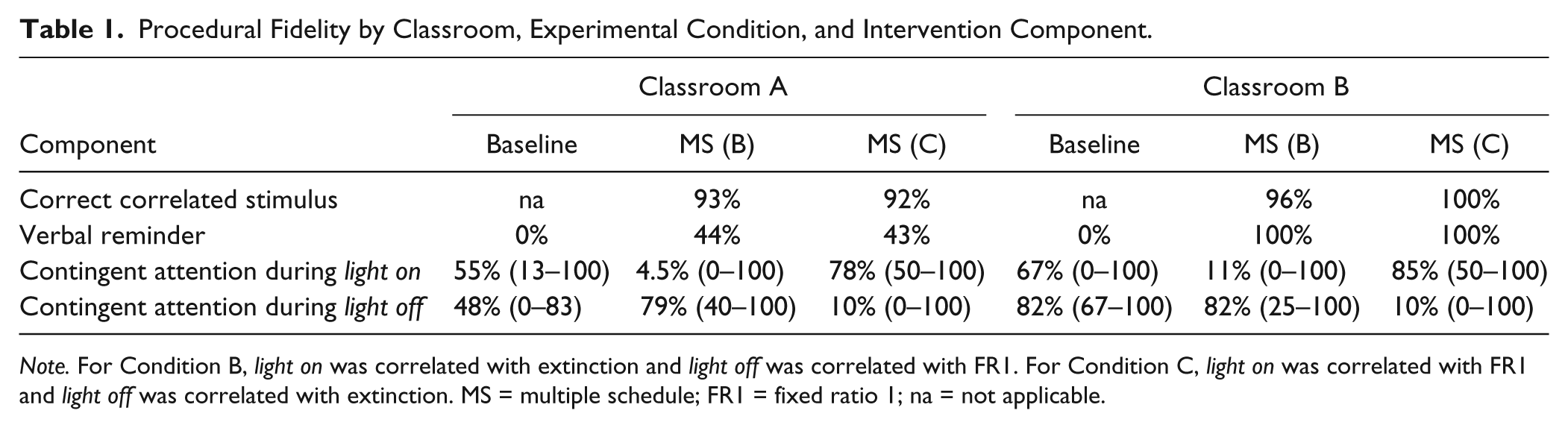
Note. For Condition B, light on was correlated with extinction and light off was correlated with FR1. For Condition C, light on was correlated with FR1 and light off was correlated with extinction. MS = multiple schedule; FR1 = fixed ratio 1; na = not applicable.
Implementation fidelity
The researcher collected implementation fidelity of teacher training procedures by completing a self-checklist with the following items: (a) reviewed the purpose of the study, (b) reviewed planned procedures for the FR1 schedule component, (c) reviewed planned procedures for the extinction schedule component, (d) modeled reinforcement and extinction following a student recruitment, and (e) delivered the teacher script. The researcher completed all items as planned (100%) across Classrooms A and B. Although the researcher offered each teacher an opportunity to role-play both reinforcement and extinction of student recruitment as a potential component of teacher training, neither teacher chose to role-play responses to student recruitment during the training meeting.
Inter-Observer Agreement (IOA)
Observer training included the following procedures. First, the first author met with data collectors to review the coding manual and address questions related to the coding manual and observation procedures. Next, data collectors practiced collecting data with the first author in a classroom setting until they reached a training criterion of 90% agreement for two consecutive observations.
A second observer collected data simultaneously and independently to evaluate IOA. For Classroom A, IOA data were collected during a total of 38% of sessions across SD and SΔ schedule components, but varied by experimental phase (33%, 36%, 69%, 59%, 17%, and 0% for Phases A, B1, C1, B2, C2, and follow-up visits, respectively). For Classroom B, IOA data were collected during a total of 49% of sessions across SD and SΔ schedule components but also varied by experimental phase (17%, 42%, 60%, 50%, 50%, 25%, and 33% for Phases A, C1, B1, C2, B2, withdrawal of correlated stimuli, and follow-up visits, respectively).
IOA was evaluated using a point-by-point method, in which each coded response was identified as an agreement or disagreement according to a 5-s window of agreement. Thus, for each session and dependent variable, the number of agreements (i.e., responses coded by both observers within a 5-s window) was divided by the number of agreements plus disagreements. This quotient was then multiplied by 100%. The mean percentage of agreement across conditions and observers was 94% (range = 67%–100%) for student recruitment and 97% (range = 73%–100%) for contingent attention in Classroom A. In Classroom B, the mean percentage of agreement across conditions and observers was 87% (range = 50%–100%) for student recruitment and 83% (range = 40%–100%) for contingent attention.
For additional fidelity measures (i.e., verbal reminders of contingencies and use of appropriate stimuli), agreements were scored when both observers agreed on the presence or absence of each planned teacher behavior. The number of agreements was divided by the number of agreements plus disagreements, with the quotient multiplied by 100%. We collected IOA data on these additional fidelity variables during 16% of sessions for Classroom A (during Phases B2 and C2 only) and 20% of sessions for Classroom B (during Phases B1, B2, and C2 only). Mean IOA on these fidelity measures was 100% across classrooms.
Experimental Design
We used an alternating treatments design embedded in a multi-treatment design (Birnbrauer, Peterson, & Solnick, 1974) to evaluate the effects of the multiple schedule intervention on students’ recruitment of teacher attention. Specifically, FR1 and extinction schedule components were rapidly alternated within phases, and the stimuli correlated with each schedule component were reversed across phases. Reversing the stimuli correlated with each schedule component strengthened experimental control by providing additional opportunities to demonstrate effects without having to withdraw the intervention. Multiple schedule conditions B and C were counterbalanced across classrooms. Rate of student recruitment for teacher attention was the primary dependent variable used to make design-related decisions. Phase changes were implemented following (a) consistent response differentiation between FR1 (SD) and extinction (SΔ) conditions and (b) stable, near-zero rates of student recruitment during the extinction (SΔ) condition.
Procedures
Baseline (A)
During baseline, each teacher was instructed to follow her typical reading centers routine with the exception of turning the lamp on or off at 10-min intervals. We included these stimuli (light on, light off) during baseline to ensure that the light did not influence student responding prior to being paired with each schedule component. In both classrooms, sessions were conducted during reading centers. The general education teacher provided small group instruction to three to five students at a time at a U-shaped table while the remainder of the class rotated among independent reading centers. In addition, CW-FIT procedures were in place during baseline and all subsequent conditions. For Classroom A, researchers collected data during twelve 10-min baseline sessions across four school days; for Classroom B, researchers collected data during eighteen 10-min baseline sessions across three school days. Observers positioned themselves in an unobtrusive location in the classroom and interacted with students to the minimum extent possible.
Teacher training
Following baseline, the researcher met with the teacher to train her on the intervention procedures. The initial training meeting lasted approximately 15 to 20 min. The researcher reviewed the purpose of the study and the procedures to implement a multiple schedule. Based on the reading center instructional rotation observed during the initial observation and baseline sessions, the researcher proposed how the multiple schedule could be embedded in the rotating centers (i.e., FR1 during transitions; extinction during small group instruction [for students who were not receiving small group instruction]). The researcher explained how to respond to student’s requests for attention when the SD was present (FR1 schedule) and when the SΔ was present (extinction). Emphasis was placed on withholding attention following all instances of recruitment during SΔ to ensure recruitment was not intermittently reinforced. The researcher instructed the teacher to respond to as many recruitments as possible during SD but acknowledged that it may not be feasible to respond to each and every student recruitment. The researcher modeled reactions to instances of recruitment during reinforcement and extinction contingencies and gave the teacher the opportunity to role-play. The teacher was given a script to say aloud to the class prior to the beginning of each daily reading centers routine (see “Multiple Schedule” section). In addition, prior to each contingency reversal phase, the researcher reminded the teacher of the reversal of correlated stimuli and provided a revised script to communicate the new rules to the class.
Multiple schedule conditions
As the reading center rotations and CW-FIT procedures continued, the teacher was instructed to signal when her attention was available on an FR1 schedule (i.e., during student transitions among centers) and when her attention was not available (i.e., when she was delivering small group instruction) using the lamp. During the SD (lamp on or off depending on condition), the teacher was instructed to do her best to respond to each instance of recruitment within 5 s. During SΔ, the teacher was instructed to not respond to any instances of recruitment from students for whom she was not providing small group instruction. Prior to implementing the multiple schedules procedure for the class period, the teacher provided a verbal reminder of the signaled contingencies:
For example, Remember, I’m going to use my light during centers. When my light is off, I can answer your questions and help you. When my light is on, I am working with the group at my table and I am not available to answer questions.
Sessions alternated based on these naturally occurring center rotations. On most days, teachers rotated through three (Classroom A) or four (Classroom B) small group instruction periods, which resulted in three or four sessions of each condition (i.e., FR1 and extinction) per day. Because the SD components were programmed during center transitions, whereas SΔ components were programmed during each reading center, SD sessions were systematically shorter than SΔ sessions across classrooms. For Classroom A, the mean duration of SD sessions was 4 min (range = 1–10 min) whereas the mean duration of SΔ sessions was 18 min (range = 7–45 min). For Classroom B, the mean duration of SD sessions was 2 min (range = 1–5 min) whereas the mean duration of SΔ sessions was 15 min (range = 4–24 min).
Multiple schedule (B)
During multiple schedule Condition B, light off signaled the FR1 component during transitions among centers, and light on signaled the extinction component during each reading center (i.e., teacher delivery of small group instruction). This was the first multiple schedule condition introduced in Classroom A.
Multiple schedule (C)
During multiple schedule Condition C, light on signaled the FR1 schedule component during transitions among centers and light off signaled the extinction component during each reading center (i.e., teacher delivery of small group instruction). This was the first multiple schedule condition introduced in Classroom B.
Withdrawal of correlated stimuli (D)
In Classroom B only, researchers instructed the teacher to (a) no longer deliver the scripted announcement at the start of each daily reading centers routine and (b) stop using the lamp to signal schedule components (Phase D). This phase was conducted to evaluate whether stimulus control had transferred from the light to other naturally occurring stimuli in the environment associated with the reading centers routine. Procedures during these sessions were similar to the previous multiple schedule conditions (i.e., contingent attention provided during transitions and withheld during small group instruction), except that the lamp was not turned on and off with each change in schedule component. The lamp remained present, but the light was off for the duration of the reading centers routine. In addition, research staff instructed the teacher to try her best not to provide any verbal reminders of rules (i.e., when students could request attention) throughout the reading centers routine. This was done to evaluate the extent to which differentiated student recruitment maintained in the absence of verbal reminders or programmed correlated stimuli.
Follow-up visits
At 2 and 3 weeks following the final intervention phase, we returned to each classroom and collected data on student recruitments and teacher contingent attention during components of the reading centers routine (i.e., transitions and small group instruction). Teachers were told that data collectors would come at some point during the week but not told which day they were coming. We communicated to teachers that the study was complete and that they were free to use or not use the multiple schedule intervention according to their preference.
Social Validity
To assess teacher acceptability of intervention procedures, we asked teachers to complete a brief questionnaire designed by the first author. The questionnaire consisted of five items, and teachers rated the extent to which they agreed with each item based on a 5-point Likert-type scale (1 = strongly disagree, 5 = strongly agree). Items included the following: (a) Overall, the intervention has been effective in helping my students know when it is okay to recruit my attention; (b) The intervention was easy for me to implement; (c) I would recommend this intervention to other teachers; (d) I will continue to use this intervention after the conclusion of the study; and (e) The intervention was a helpful strategy for my classroom management. As a more objective measure of social validity, we returned to each classroom following completion of the study to determine whether each teacher chose to continue using the intervention after the study ended, as well as whether intervention effects on student behavior maintained (follow-up visits; Kennedy, 2002).
Results
Research Question 1: Teacher Implementation of Class-Wide Multiple Schedule
Classroom A
A summary of procedural fidelity data by classroom, experimental condition, and intervention component is depicted in Table 1. In Classroom A, the teacher used the correct correlated stimulus during more than 90% of sessions across multiple schedule conditions but provided verbal reminders of contingencies to a lesser degree. Specifically, verbal reminders were provided during 75% of daily reading centers routines during Phase B1, 67% of daily routines during Phase C1, 20% of daily routines during Phase B2, and 25% of daily routines during Phase C2, producing means of 44% and 43% for Conditions B and C, respectively. Mean percentages of contingent teacher attention differed between stimulus conditions correlated with each component schedule. During Condition B, in which light on was correlated with extinction, mean contingent attention was much lower during light on sessions relative to light off sessions (4.5% and 79%, respectively). During Condition C, in which light on was correlated with the FR1 schedule, mean contingent attention was much higher during light on sessions relative to light off sessions (78% and 10%, respectively). For Classroom A, one or more instances of student recruitment occurred in 100% of FR1 sessions, but in only 38% of extinction sessions. When extinction sessions with no instances of student recruitment (i.e., no opportunity for contingent attention) were removed, the mean percentage of contingent attention during extinction was 18% (range = 0%–100%). Low numbers of student recruitments per session contributed to the wide ranges in contingent attention percentages.
Classroom B
In Classroom B, the teacher used the correct correlated stimulus during more than 95% of sessions across conditions. In contrast to Classroom A, the teacher in Classroom B also provided verbal reminders of contingencies during 100% of daily reading centers routines across conditions. In fact, when we instructed the teacher in Classroom B not to refer to the contingency rules when we withdrew correlated stimuli in Phase D, she referred to contingency rules during 26% of daily routines. During Condition B, in which light on was correlated with extinction, mean contingent attention was much lower during light on sessions relative to light light off sessions (11% and 82%, respectively). During Condition C, in which light on was correlated with FR1, mean contingent attention was much higher during light on sessions relative to light off sessions (85% and 10%, respectively). For Classroom B, one or more instances of student recruitment occurred in 100% of FR1 sessions, and in 71% of extinction sessions. When extinction sessions with no instances of student recruitment were removed, the mean percentage of contingent attention during extinction was 15% (range = 0%–100%).
Research Question 2: Effects of Multiple Schedule on Student Recruitment
Classroom A
Results of the multiple schedule intervention on student recruitment in Classroom A are depicted in Figure 1. During baseline, rates of recruitment were undifferentiated during light on and light off. When the teacher initiated the multiple schedule in condition B (i.e., light on signaled extinction and light off signaled FR1), rates of recruitment decreased during light on, and were consistently lower relative to recruitment rates during light off. When the stimuli correlated with each schedule component were reversed across phases, immediate changes in level of rates of student recruitment during each stimulus were observed. In addition, beginning in Phase C1, rates of student recruitment remained at or below 0.14 during the stimulus correlated with the extinction component (SΔ) across all subsequent phases. Rates of recruitment during SD were variable across phases (range = 0.50–4.11 recruitments per min) but were consistently differentiated from recruitment rates during SΔ across all phases. Based on the three demonstrations of effect following each reversal of correlated stimuli, we interpreted these results to indicate that the teacher-implemented multiple schedule intervention was successful in bringing student recruitment under stimulus control.
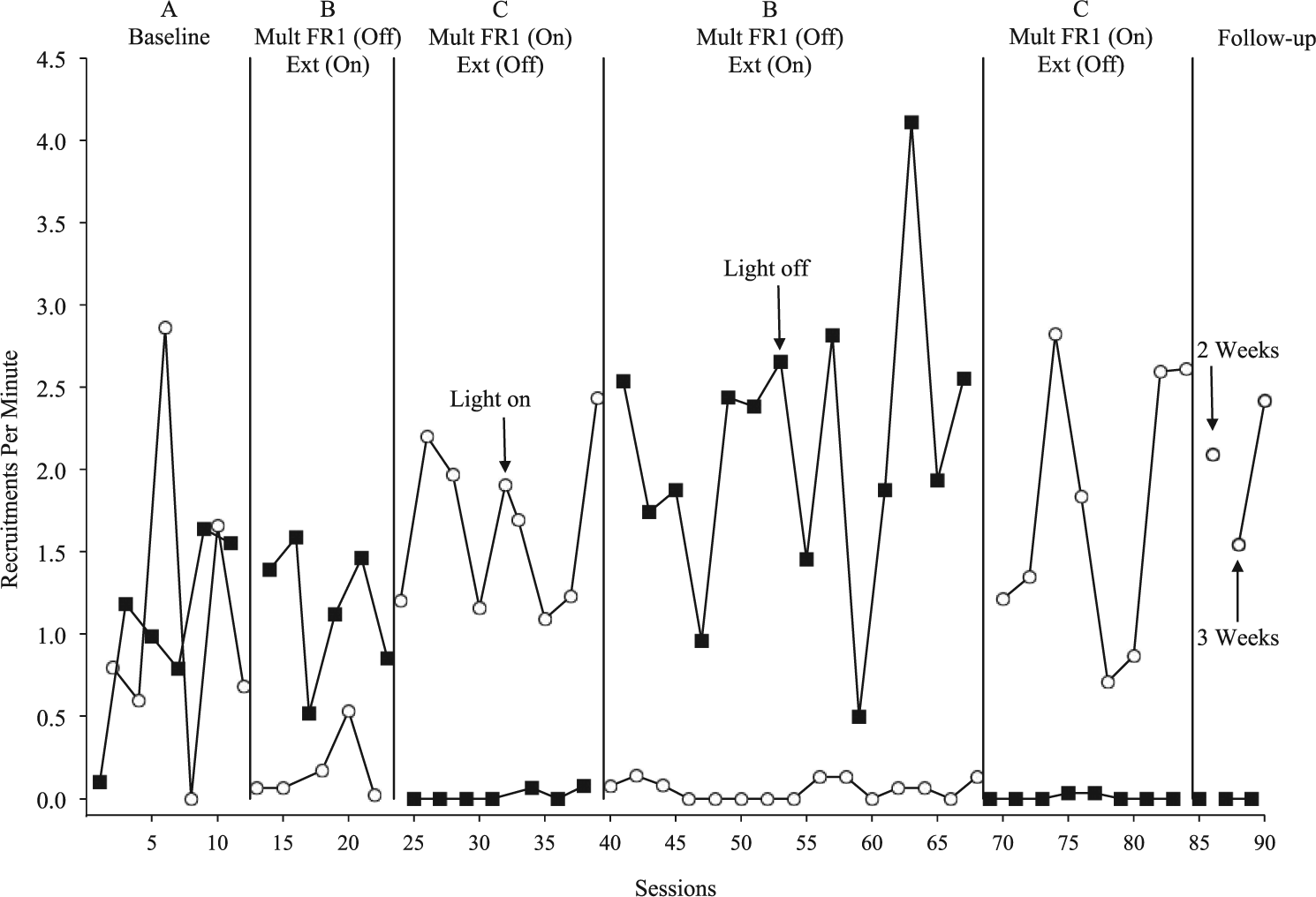
Rates of student recruitments of teacher attention during light on and light off stimulus conditions across study phases (Classroom A).
Classroom B
Results of the multiple schedule intervention on student recruitment in Classroom B are depicted in Figure 2. Similar to Classroom A, rates of recruitment were undifferentiated during light on and light off during baseline. When the teacher initiated multiple schedule Condition C (i.e., light off signaled extinction and light on signaled FR1), rates of recruitment decreased during light off and were less variable relative to baseline, especially as this phase continued. Unlike Classroom A, however, rates of recruitment increased during light on and were highly variable, although consistently higher relative to light off. When the stimuli correlated with each schedule component were reversed across phases, immediate changes in level of rates of student recruitment were observed. Rates of recruitment remained low during stimuli correlated with extinction (SΔ) across phases, but were slightly higher relative to those observed in Classroom A (M = 0.17, range = 0–0.82). Based on the three demonstrations of effect following each reversal of correlated stimuli, we interpreted these results to indicate that the teacher-implemented multiple schedule intervention was successful in bringing student recruitment under stimulus control.
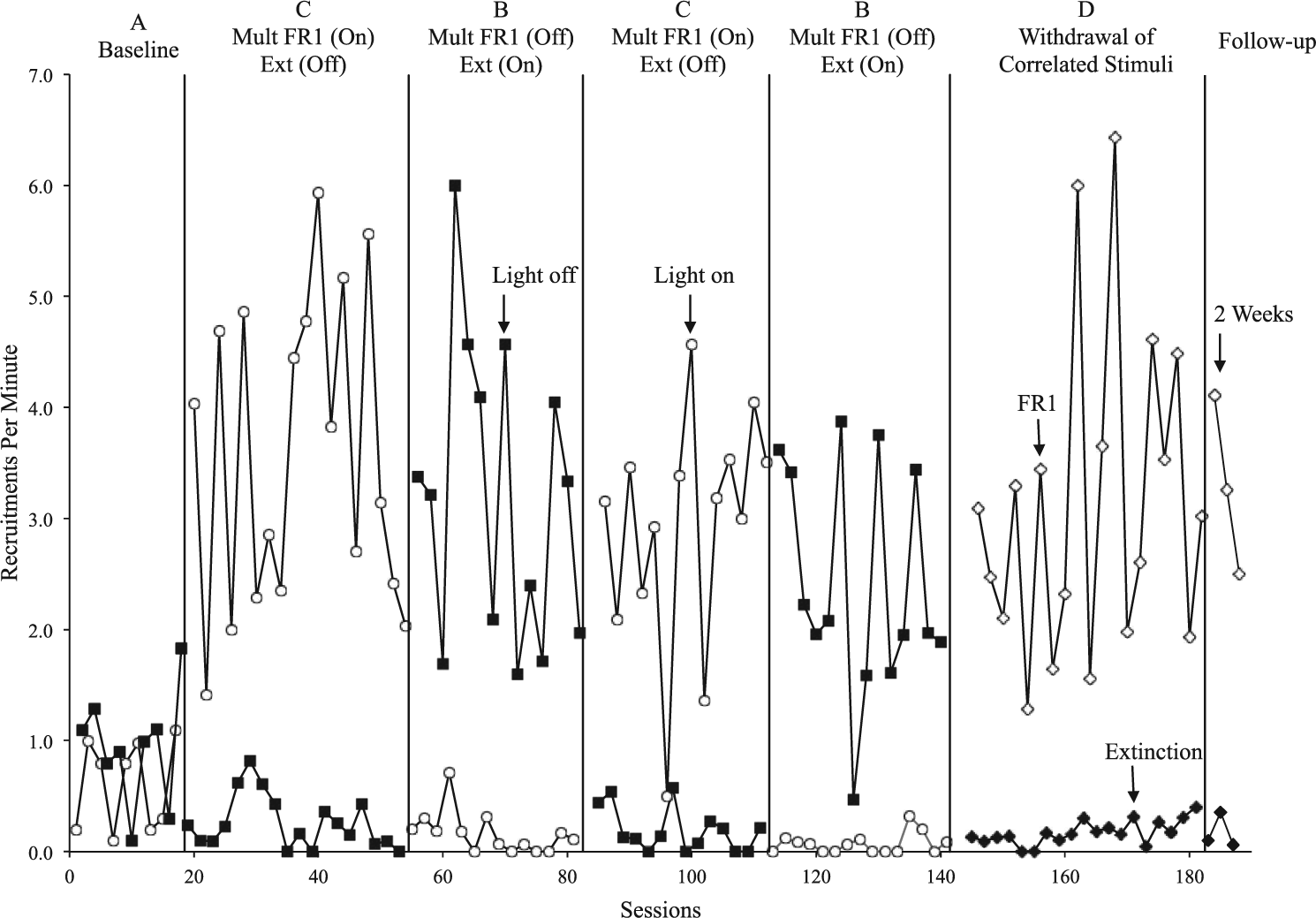
Rates of student recruitments of teacher attention during light on and light off stimulus conditions across study phases (Classroom B).
When correlated stimuli were withdrawn in Classroom B (Phase D), response differentiation persisted with lower rates of recruitment when the teacher was delivering small group instruction (extinction) relative to transitions among centers (FR1). We interpreted these data to suggest a transfer of stimulus control from the light on/light off stimuli to other natural classroom stimuli signaling the availability of teacher attention. However, as this phase progressed, a slight increasing trend was identified in the rate of student recruitment during extinction (M = 0.16, range = 0–0.40).
Descriptive baseline analysis
Because experimental data are graphed by stimulus condition (i.e., light on vs. light off) in Figures 1 and 2, the baseline data represent rates of student recruitment during 10-min sessions in which the lamp was on or off regardless of instructional context. To evaluate the practical significance of intervention effects, we also calculated baseline rates of student recruitment during small group instruction periods (i.e., reading centers) versus transitions among reading centers. Prior to introducing the multiple schedule intervention in Classroom A, the mean rate of student recruitments was 1.60 per min (range = 0.54–3.91) during transitions among centers and 1.03 per min (range = 0-4.11) during small group instruction. In Classroom B, the mean rate of student recruitments was 2.22 per min (range = 0.57–4.29) during transitions among centers and 0.60 per min (range = 0.10–1.29) during small group instruction. That is, prior to implementing the multiple schedule intervention, mean rates of student recruitment were higher during transitions relative to small group instruction. However, the addition of the multiple schedule intervention reduced rates of student recruitment during instructional periods to near-zero.
Social Validity
The multiple schedule intervention was rated by both teachers as highly acceptable. The teacher in Classroom A rated all items on the questionnaire as strongly agree; the teacher in Classroom B rated all items on the questionnaire as agree or strongly agree. The teacher in Classroom A continued to use the intervention at 2- and 3-week follow-up observations, and the rates of recruitment during the instructional periods remained at 0. The teacher in Classroom B did not elect to use the correlated stimuli at the follow-up observation, though she continued to withhold attention during small group instruction and respond to recruitments during transitions. Rates of recruitment during instructional periods remained at a low level (M = 0.17, range = 0.06–0.35). The teacher in Classroom B reported that she continued to use the intervention with correlated stimuli after the study concluded, with light off signaling the FR1 schedule, and light on signaling extinction.
Discussion
The purpose of the present study was to evaluate (a) the extent to which general education teachers were able to implement the multiple schedule intervention during reading centers and (b) the effects of the multiple schedule intervention on differentiation of student recruitment when teacher attention was and was not available. Results indicated that, despite varying levels of fidelity by intervention component and classroom, the multiple schedule procedure was effective in producing differentiated levels of student recruitment. That is, students learned to discriminate between periods in which teacher attention was and was not available contingent on recruitment following the addition of a stimulus (i.e., light on/light off) that was correlated with each schedule component. This study is among the first to demonstrate evidence for a class-wide application of multiple schedule interventions implemented by general education teachers in public elementary school classrooms. In addition, this study contributes an example of how multiple schedules can be embedded within a common instructional routine in elementary classrooms (i.e., small group rotations).
In the present study, differentiated rates of student recruitment per schedule component persisted across study phases, despite varying levels of fidelity by intervention component and classroom. As depicted in Table 1, there was a clear difference in fidelity between classrooms for providing verbal reminders of the contingency rules prior to each daily reading center routine. Whereas the teacher in Classroom B provided these reminders consistently across all intervention phases, the teacher in Classroom A provided these reminders less often overall and to a lesser extent across study phases. Although our design does not allow an isolation of the effects of the programmed stimuli with or without accompanying verbal reminders, such reminders are likely to facilitate stimulus discrimination when initiating a multiple schedule intervention (Tiger & Hanley, 2004) but may not be necessary once behavior comes under control of the correlated stimuli. Additional evidence suggesting the transfer of stimulus control was provided in Classroom B when differentiated responding continued following the withdrawal of correlated stimuli.
The multiple schedule intervention used in the present study differs from previous applications of multiple schedules in that the correlated stimuli were added to existing schedule components in a naturally occurring instructional routine. In contrast, previous applications of multiple schedule interventions implemented for individual students have commonly involved beginning with brief SΔ intervals relative to SD and systematically increasing the duration of the SΔ component to thin the schedule of reinforcement (e.g., Hanley et al., 2001). Previous class-wide applications have involved systematically alternating schedule components in fixed intervals (e.g., 5 min FR1, 5 min Ext [Cammilleri et al., 2008]; 2–3 min FR1, 2–3 min Extinction [Vargo et al., 2014]). In the present study, the SΔ and SD components were embedded into existing reading center routines. Because the SΔ was paired with each reading center, and the SD was paired with transitions between reading centers, SΔ sessions were longer than SD sessions across all study phases. That is, it was not necessary to begin with brief SΔ intervals and systematically increase this duration when the multiple schedule was embedded within the existing reading centers routine. However, in the current study, both participating teachers were implementing CW-FIT as a Tier 1 intervention, which included providing behavior-specific praise on average every 3 to 5 min. Whether similar intervention effects would have been observed in the absence of CW-FIT (or under conditions with lower overall rates of teacher attention) is unknown.
Limitations
Study results should be interpreted in light of the following limitations. First, though we consider embedding the multiple schedule intervention in existing instructional routines a practical advantage of the intervention, the systematic differences in durations of SΔ and SD sessions represents a potential threat to internal validity. In addition, because the SΔ components were programmed when the teacher was delivering small group instruction, extinction was only in effect for the students who were not receiving small group instruction, resulting in systematically fewer students who had the opportunity to recruit teacher attention during SΔ sessions relative to SD sessions. These systematic differences in schedule component durations and number of students “present” impacted rates of recruitment per session. Rates of student recruitment were selected as the primary dependent variable to control for varying durations of sessions across schedule components. To address the difference in number of students, we completed a secondary analysis in which we divided rates of recruitment by the number of students who had the opportunity to recruit attention per session. Analyses revealed similar patterns of response differentiation across study phases for both classrooms.
Second, we did not track recruitment at the level of individual students. Instead, we collected data on recruitment rates across students to evaluate the multiple schedule intervention as a supplement to a Tier 1 strategy. However, collecting data on individual student’s rates of recruitment may provide opportunities to maximize the effectiveness of the class-wide intervention. For example, anecdotally, we noted that during one session in Classroom B, a single student accounted for five of seven recruitments during the SΔ component by repeatedly raising her hand. Evaluating whether specific students consistently accounted for the majority of inappropriate recruitments (i.e., recruitment during SΔ components) would have allowed us to implement supplementary procedures for non-responders (e.g., pre-corrections for individual students).
Third, because each teacher implemented the multiple schedule intervention in the context of a Tier 1 classroom management strategy (i.e., CW-FIT), we do not know the extent to which our results would generalize to classrooms without Tier 1 strategies in place. A primary component of CW-FIT is a relatively dense schedule of teacher praise delivered to teams of students who are meeting expectations. Thus, it is possible that the scheduled delivery of teacher praise functioned as an abolishing operation (AO; Laraway, Snycerski, Michael, & Poling, 2003) for recruiting teacher attention during the reading centers routine. However, the relatively high rates of attention recruitment that maintained during SD components across intervention phases suggest that the value of teacher attention provided to individual students remained high. Finally, although effects of the multiple schedule intervention are consistent with the hypothesis that teacher attention was a reinforcer for student recruitment, we did not conduct reinforcer assessments or confirm response–reinforcer relations prior to implementing the multiple schedule.
Future Research
Additional research on class-wide applications of multiple schedules is needed to evaluate whether this intervention may be identified as an effective supplement to Tier 1 strategies. In addition, several questions that were not addressed in the current study could be addressed in future research. First, we observed consistent intervention effects despite variability in fidelity across components and classrooms. Future studies might systematically manipulate fidelity levels of critical components to evaluate the levels of fidelity necessary to impact student behavior. Second, although there was some evidence suggesting a transfer of stimulus control from verbal rules to correlated stimuli (Classroom A) and from correlated stimuli to natural stimuli associated with the reading centers routine (Classroom B), future research may evaluate systematic strategies for transferring stimulus control (e.g., systematically fading out correlated stimuli following response differentiation). Third, because the purpose of the multiple schedule was to decrease disruptive bids for attention thought to interrupt instruction, incorporating measures of academic engagement in future studies may provide additional insight into whether multiple schedules ultimately impact the time spent academically engaged. Fourth, although we included follow-up visits as a measure of social validity, future studies might evaluate the extent to which intervention effects maintain over longer periods of time and generalize when correlated stimuli are introduced during other instructional routines. Finally, data collection on response differentiation at the level of individual students would allow an identification of students who are not responding to the intervention. For these students, it would be important to identify effective secondary or tertiary strategies to increase the likelihood of treatment response.
Conclusion
Although multiple schedules have been applied to individuals in clinical settings to facilitate stimulus control of a newly acquired response, this study is among the first to demonstrate evidence for a class-wide application of multiple schedules implemented by general education teachers in public elementary school classrooms. With continued research, class-wide multiple schedules may be identified as an evidence-based strategy that can be embedded successfully within common instructional routines to enhance effects of Tier 1 interventions.
Footnotes
Authors’ Note
This research was part of the first and third authors’ theses submitted in partial completion of the MEd degree at Vanderbilt University.
Declaration of Conflicting Interests
The author(s) declared no potential conflicts of interest with respect to the research, authorship, and/or publication of this article.
Funding
The author(s) disclosed receipt of the following financial support for the research, authorship, and/or publication of this article: This research was supported, in part, by the Institute of Education Sciences, Department of Education (R324A120344).