



Abstract
School recess, though beneficial to students in many ways, can be a problematic setting due to inadequate supervision, structure, and safety. A peer praise note (PPN) intervention was implemented on the recess playground to address these concerns at a Title I elementary school. Researchers used a single-subject reversal design across all students to evaluate intervention effectiveness. Results included overall improvements in the level, trend, and variability of office discipline referrals (ODRs), especially from reversal to reinstatement of the intervention, and an effect size (percentage of data points exceeding the median; PEM) suggesting that PPNs effectively decreased ODRs. Results from social validity surveys completed by recess aides and students indicated participants’ perceptions that PPNs helped improve student behavior and peer relations, communicate playground rules, extend supervision responsibilities, and offer structured activity to peer praisers. Limitations, future research, and implications are addressed.
Elementary school recess offers students opportunities to work and play together and to form positive peer relationships (Pellegrini & Bohn, 2005). Social skills and emotional maturity develop as students experiment with sharing and with resolving conflicts (Bleeker et al., 2012). Recess is associated with improved classroom learning: Students who are allotted time for recess tend to be more focused and actively engaged in the classroom, with better executive functioning and response accuracy (Hillman, Erickson, & Kramer, 2008). Thus, a school’s investment in effective high-quality recess is an investment in students’ academic success, prosocial behaviors (Ginsburg, 2007), and effective problem-solving strategies (Bleeker et al., 2012).
Unfortunately, recess playgrounds are also frequently settings for problem behaviors that may not be adequately controlled by recess aides (Lewis, Colvin, & Sugai, 2000). The combination of limited routine and minimal supervision frequently contributes to problem behavior and issues of physical and emotional harm (Walker, Ramsey, & Gresham, 2004). Emotionally unsafe behaviors such as aggression, teasing, harassment, isolation, bullying, and social cliques commonly occur (Marchant, Young, Lindberg, Fisher, & Solano, 2012; Pellegrini & Bohn, 2005). Many teachers are assigned “recess duty” as a part of their contract hours (Marchant et al., 2012), but the unstructured nature of recess can allow tired teachers to feel less accountable, perceiving recess duty only as a break from their daily routine (Novak & Strohmer, 1998). In addition, recess supervision has been shifting from certified staff to classified staff and parent volunteers, who have less formal training in managing student behavior (J. R. Nelson, Smith, & Colvin, 1995). Tired teachers, inadequately trained volunteers, and inexperienced classified staff weaken recess supervision, structure, and safety (Lewis et al., 2000).
Recognizing the widespread problems of inadequate recess aide supervision and students’ inappropriate recess behavior, we investigated shifts and enhancements in both approach and agency. At a Title 1 school where the most common setting for office discipline referrals (ODRs) during the previous year had been the recess playground, we evaluated the implementation of a peer praise notes (PPNs) program, making students responsible for observing, encouraging, and helping monitor their peers’ recess behavior. In addition to empowering students as agents to evaluate and react to behavior, this program changed the focus from the traditional reactive “stop” and “do not” structure of playground discipline to a “do” and “keep doing” proactive approach, aligned with the tenets of school-wide positive behavior support (SWPBS; Sugai & Horner, 2009).
SWPBS
SWPBS can contribute to positive student behavior and social interaction in various contexts throughout the school day with its potential to create a positive school climate, prevent and reduce problem behavior, and support prosocial development in specific settings such as playgrounds (Sugai & Horner, 2009). SWPBS helps school staff (a) define appropriate behaviors that are expected during recess, (b) teach students these behavior expectations during recess, (c) support appropriate recess behavior through encouragement and direct feedback, and (d) use data to guide further decisions regarding supportive interventions (Lewis & Sugai, 1999). Altering the environment by teaching and reinforcing clear behavioral expectations can help prevent problem behaviors and ensure that students enjoy the benefits of a positive recess experience.
Expectations
A school’s SWPBS team develops positively stated behavioral expectations that emphasize what students should do rather than what they should not do and sets up reinforcement systems to promote such behaviors. For example, common expectations are to (a) be responsible, (b) be respectful, and (c) be safe. The team creates a matrix of these behavioral expectations for all areas of the school with area-specific applications (Lynass, Tsai, Richman, & Cheney, 2012). Student behavior problems are handled by classroom teachers, who reteach expectations and interventions as needed. Students whose problem behavior continues to prevent them from meeting these expectations are referred to the school office for administrative interventions focused on teaching and practicing correct behavior (Black & Downs, 1993). Students who meet these expectations are reinforced.
Written Praise
Behavior-specific praise is an evidence-based reinforcement practice that supports the aims of SWPBS. Such praise has been shown to increase (a) student participation (Duchaine, Jolivette, & Fredrick, 2011), (b) desired academic and social behavior (Thompson, Marchant, Anderson, Prater, & Gibb, 2012), (c) on-task behavior (Sutherland, Wehby, & Copeland, 2000), and (d) self-regulated learning (Chalk & Bizo, 2004). Written praise is time and cost-effective, offering positive recognition when issued and additional encouragement when shared with others or reread afterward (Howell, Caldarella, Korth, & Young, 2014). Written praise can decrease undesired student behavior, including social withdrawal (J. A. P. Nelson, Caldarella, Young, & Webb, 2008), disruptive behavior (Wheatley et al., 2009), tardiness (Caldarella, Christensen, Young, & Densley, 2011), and ODRs (J. A. P. Nelson, Young, Young, & Cox, 2009).
Peer Praise
Although results are inconclusive on whether peer praise (Morrison & Jones, 2007) or teacher praise (Lannie & McCurdy, 2007) is more effective in improving student behavior, peer praise has been shown to positively alter peer social networks that involve bullying or other coercive practices (Skinner, Neddenriep, Robinson, Ervin, & Jones, 2002), increase social interaction of withdrawn students (J. A. P. Nelson et al., 2008), and encourage students to recognize and report helpful appropriate peer behaviors (Skinner, Cashwell, & Skinner, 2000). Elwell and Tiberio (1994) hypothesized that peer acceptance may be more important than teacher acceptance. Peer praise may (a) increase the amount of praise given, (b) give students a responsibility that they can rise to, (c) sustain more effectively than teacher praise, (d) support student autonomy, and (e) communicate rules more effectively. These potential benefits may be particularly applicable on the recess playground, where positive student leadership, autonomy, and peer interactions can be channeled to increase supervision and improve school climate, decreasing the need for ODRs.
PPNs are brief notes that (a) are distributed among students, (b) express the observed behavioral expectation and location in writing, and (c) are shared with others besides the student (e.g., teachers, parents, office staff). Schools can use triplicate with no carbon required (NCR) paper so that one copy can be sent home with the student to be shared with parents, another delivered to the classroom teacher, and another filed in the office. Teachers and office administrators can use their copies to track who is being recognized for good behavior, how often, and where. Teachers can also use their copies of students’ PPNs to offer further reinforcement by holding weekly or monthly prize drawings, recognizing students publicly during class or school announcements, or posting the copies on bulletin boards. Research suggests that behavior-specific praise notes are associated with decreases in ODRs (J. A. P. Nelson et al., 2009), though this has yet to be examined for peer notes. ODRs are often used to document changes in students’ behavior (Lassen, Steele, & Sailor, 2006; Sprague, Sugai, Horner, & Walker, 1999).
ODRs
When students behave inappropriately at school and do not respond to interventions in a timely manner, they may be sent to the office. Schools use ODRs to record an event in which (a) a student violated a rule/social norm of the school, (b) a member of the school staff observed a problem behavior, and (c) a member of the administrative staff delivered a consequence of a student’s misbehavior. A written document is used to record the student’s name, date, time, specific setting, school-wide behavioral expectation not met, possible motivation, others involved, and administrative decision made (Sprague et al., 1999). To ensure the consistency of ODRs, teachers and school staff (including recess aides) are trained to recognize behaviors that constitute a minor or a major infraction.
ODRs are the most frequently used method of tracking school discipline, as well as the most documented (Lassen et al., 2006). Schools use ODRs because they are inexpensive and easy to obtain, and they record real-time interactions with students (Lewis & Sugai, 1999). ODRs provide data that are commonly used to make decisions and to evaluate the effectiveness of SWPBS programs (Pas, Bradshaw, & Mitchell, 2011). However, it is important to recognize the limits of ODRs. For example, if several people are involved, information may be accidentally changed, misinterpreted, or lost. In addition, ODRs account for problem behavior that is externalized and easily observed (e.g., physical aggression, profanity), but do not account for problem behavior that is internalized (e.g., depression, anxiety). Despite their weaknesses, the strengths of ODRs make them a common source of outcome data used to evaluate SWPBS programs. ODRs can be an efficient, reliable, and valid source of data for research examining changes over time within a school (Pas et al., 2011) and appear to have the potential for measuring the effects of PPNs.
Study Purpose
If implemented on the recess playground, PPNs may promote appropriate behavior and discourage problem behavior as students recognize, acknowledge, and record what they observe. To extend previous findings of the relationship between praise notes and ODRs (J. A. P. Nelson et al., 2009), two specific research questions were addressed:
Method
Setting and Participants
This study was conducted at a Title I elementary school located in a suburban school district in the Western region of the United States. This school was in its fourth year of implementing SWPBS when the playground PPN program was initiated. The school’s ODR data from the previous school year indicated that the playground was the area where problem behavior was most likely to occur. Of the total ODRs given in the previous year, 32.38% had been given on the playground.
Participants included 462 students who were eligible to receive PPNs: 55% were boys, 83% received free or reduced-price lunch, 38% were English language learners, and 32% were students with disabilities. The school includes eight special education self-contained classrooms, which serve the entire school district, for students with severe disabilities: These students were on the playground during the PPN intervention though they did not serve as peer praisers. Student ethnicity was 52% Hispanic, 39% Caucasian, 4% Pacific Islander, 2% African American, 1% Native American, and 1% Multiple. A total of 167 upper-grade students (42% fourth graders, 36% fifth graders, and 22% sixth graders) were selected to be peer praisers, to distribute PPNs for at least one 3-week period during the intervention phases.
Seven female recess aides (all Caucasian) also participated, along with one male administrator (Hispanic) who also provided recess supervision. All participating recess aides and the school administrator completed a social validity survey at the end of the study, as they were the adults most responsible for overseeing the PPN intervention. A sample of 90 students (15 from each grade level, randomly selected using stratified sampling) was selected across Grades 1 through 6 and invited to complete a social validity survey; 98% of them participated.
Intervention
The intervention was the delivery of PPNs on the playground during lunch recess: Students referred to them as “puma paws,” as the school mascot was a puma. PPNs were printed in triplicate, and students, their teachers, and the office administration all received copies. Students could earn a PPN by demonstrating the following school-wide expectations on the playground: (a) be Responsible by returning equipment, using equipment properly, or playing by the game rules; (b) be Respectful by following directions the first time or being kind and friendly; and (c) be Safe by being careful to keep themselves and others safe while having fun. Teachers were encouraged to acknowledge students who received PPNs as part of their individual classroom management systems. The copies sent to the office were used for data entry, then put into a school-wide drawing for weekly prizes.
School Procedures
During lunch recess, 12 to 15 peer praisers (depending on the 3-week phase) had the opportunity to seek out peers whose behavior was clearly responsible, respectful, or safe. Peer praisers were trained to (a) verbally state the desired behavior they observed, (b) legibly document required information on a PPN, and (c) issue the PPN to the student.
Selection of peer praisers
For each 3-week period, 12 to 15 students were selected to be peer praisers. Two fourth-grade teachers (one male, one female), two fifth-grade teachers (one male, one female), one sixth-grade teacher (female), and one upper-grade resource teacher (female) chose students to be trained from their grade level. Each chose two to three students who consistently behaved well and two to three students who exhibited challenging behavior.
Training of peer praisers and recess aides
Every 3 weeks, a new group of peer praisers was invited to attend a 1-hr training session after a parent or guardian had signed a consent form. At each session, an interactive PowerPoint presentation was used to review the rules for the playground, the role and responsibilities of a peer praiser, the procedures for issuing a PPN, a schedule of the times during which each grade would be targeted for praise, and suggestions for mystery motivators. All included Spanish translation. Peer praisers practiced giving PPNs to each other, and students who had previously served as peer praisers were occasionally selected to participate in training a new group. Because the recess aides were the adults responsible for the students during lunch recess, they were required to attend two training sessions during the year, one in November and one in March. Pizza was provided at each training meeting for all who were present.
PPN distribution goals
Peer praisers were given a visual schedule of PPN distribution goals based on when various grades were at lunch recess. Peer praisers in fifth and sixth grades were trained to target students in grades ranging from kindergarten to third. Peer praisers in fourth grade were trained to target students in grades ranging from fourth to sixth. Each grade level was to be targeted for 5 min; peer praisers were encouraged to equally distribute six PPNs per day among their three specific grade levels, but only to students who demonstrated exemplary playground behavior.
PPN process
The school administrator who trained the peer praisers also supervised them in distributing PPNs. Two fifth- or sixth-grade peer praisers were selected each day to transfer a bag of clipboards from the administrator’s office to the equipment cart located on the playground. All designated fifth- and sixth-grade peer praisers then picked up a clipboard with an attached pen and blank PPNs. Peer praisers were encouraged to spread out and keep moving around to all areas of the playground. They gave the completed white copy of each PPN to the student being praised, telling the student which rule he or she had been keeping, then clipped the yellow and pink copies to the side on the clipboard. When fifth- and sixth-grade peer praisers were finished issuing PPNs for the day, they put their clipboards back in the bag that was hanging on the equipment rack to be ready for the fourth-grade peer praisers, who were just finishing lunch. They were allowed to enter the administrator’s office to receive a piece of candy for their helpful efforts during recess.
Because of the school schedule, fourth-grade students who were acting as peer praisers were allowed to go to the front of the lunch line so they could finish eating by the time their duties as peer praisers began. They followed the same routine as fifth- and sixth-grade peer praisers during recess. At the end of recess, two fourth-grade students returned the bag of clipboards to the administrator’s office. Peer praisers then removed all of the pink and yellow copies of issued PPNs from the clipboards and sorted them. Pink PPNs were placed in piles to be given to the teachers of the students who had received them. Each teacher’s PPNs were clipped together and delivered by an office administrator. Yellow PPNs were rubber-banded together and placed on the administrator’s desk. When all the information on a yellow PPN was entered into FileMaker, the PPN was marked with a check in the upper right-hand corner and placed in a jar for a weekly prize drawing.
Mystery motivator
Each Friday, usually during the last hour of the school day, the administrator drew a random name from the PPN jar and announced the student’s name, teacher, and observed playground behavior over the school intercom. Peer praisers who met their distribution goals throughout the week were also acknowledged. These students were invited to come to the office and claim the mystery motivator of the week, which might be a pizza party with selected friends, a five-dollar bill, a field trip, a gift certificate to a local restaurant, or Wii game time. The PPNs of students who did not win a mystery motivator for the week were put in a separate jar for a chance to win prizes at a school assembly at the end of the year.
Measures
We collected three measures: playground ODRs, social validity surveys, and treatment integrity data. The dependent measure was the number of playground ODRs, graphed as average daily ODRs per week. Playground ODRs were given by recess aides and occasionally by teachers when problematic recess behavior was not made known to a staff member until after recess time. The ODRs were entered and tracked by the school staff using the School-Wide Information System (SWIS; https://www.pbisapps.org/Applications/Pages/SWIS-Suite.aspx). The school administrator routinely standardized the purpose, use, administration, and documentation of ODR procedures (via SWIS resources and staff training/supervision) to prevent inconsistencies with the data. Figure 1 shows a copy of the school’s ODR form.
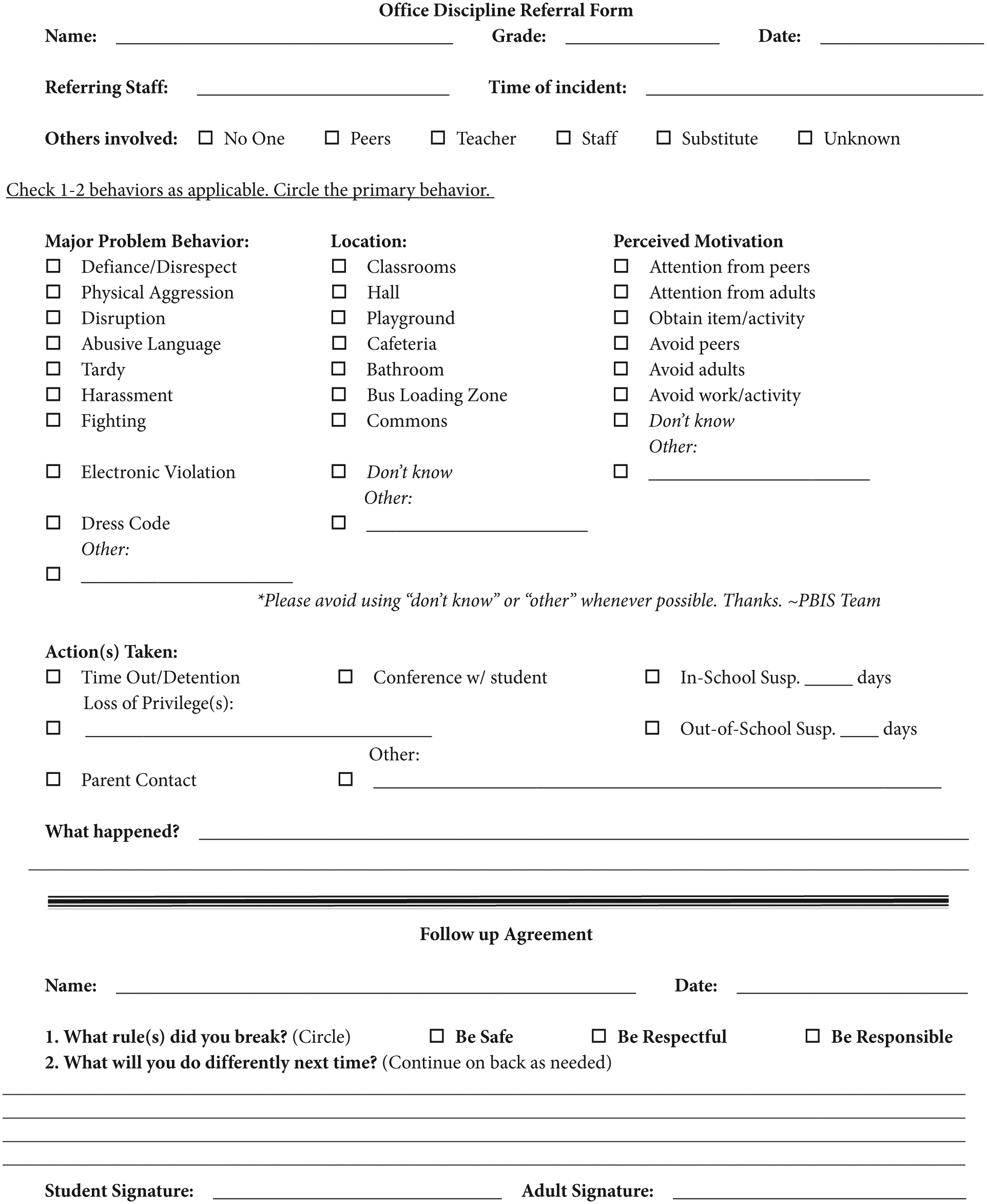
School’s office discipline referral form developed by the positive behavioral interventions and supports (PBIS) team.
Social validity surveys were used to assess participants’ perceptions of the goals, procedures, and outcomes of the PPN intervention (adapted from a survey conducted at the school during 2010–2011; see Howell et al., 2014). Surveys consisted of 11 to 12 items (see Table 1) anonymously rated using a 5-point Likert-type scale: 1 (strongly disagree), 2 (disagree), 3 (neutral), 4 (agree), and 5 (strongly agree). Students in Grades 1 and 2 received surveys with a 5-point picture scale depicting sad and happy faces, similar to scales used in other studies as valid measures for young children (Howell et al., 2014). Two open-ended questions were also included to solicit comments about what participants liked and disliked about the PPN intervention. The survey was administered to 15 students at a time. A teacher read the directions and reviewed a sample question with all survey participants. Students in Grades 3 through 6 were given as much time as they needed to complete the survey. Students in Grades 1 and 2 were read each survey item twice by a teacher and then given sufficient time to respond.
Percentage of Participants Who Agreed on PPN Social Validity Survey Items.
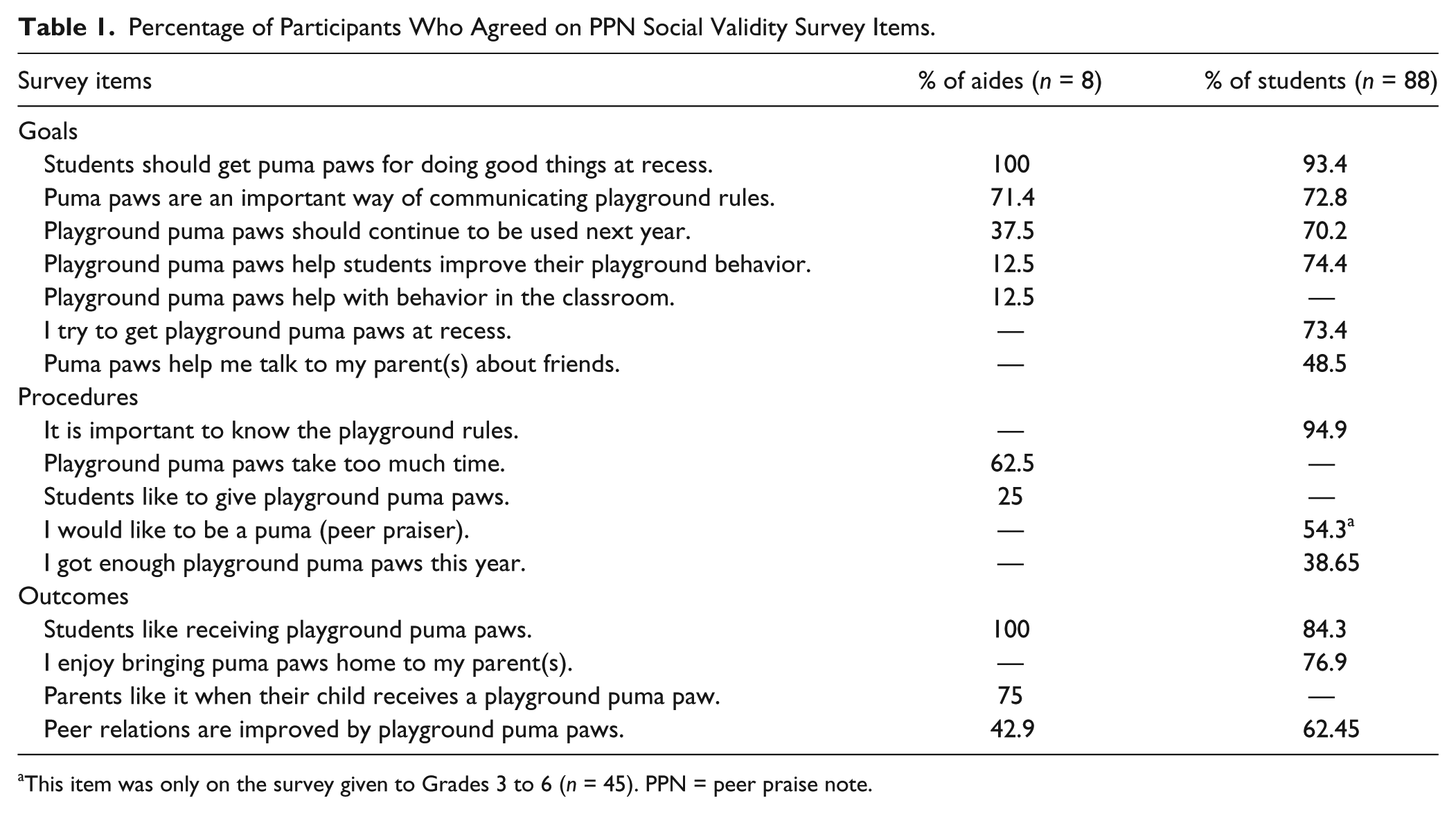
This item was only on the survey given to Grades 3 to 6 (n = 45). PPN = peer praise note.
To measure treatment integrity, we used PPNs, which were permanent products. School staff entered and tracked PPNs in a school data management system called FileMaker, which graphed them by the week as average daily PPNs.
Design
A single-case reversal design (Cooper, Heron, & Heward, 2007) was used to evaluate the effects of the PPNs on ODRs. Points of intervention were chosen to correspond with the school’s quarterly schedule. The study lasted 38 weeks, but data were collected for only 34 weeks due to holidays and school breaks. The school collected ODR baseline data from August 21 to October 24 (8 weeks). During the last week of October, the beginning of the new academic quarter, the PPN intervention began and continued until February 1 (13 weeks). It was withdrawn for the month of February (4 weeks) to examine the effects that removing the intervention would have on ODRs. Beginning in March, the PPN intervention was reinstituted for the remainder of the school year (9 weeks).
Analysis
We graphed recess ODRs per day by week for the academic year and compared the level (median), trend, and variability (range and standard deviation) in baseline phases with treatment phases (Kratochwill et al., 2010). We also calculated the percentage exceeding the median (PEM) for each intervention phase, as it (a) assumes the median best summarizes data points in the baseline phase, (b) does not exclude any data points, and (c) reflects effect size in the presence of floor or ceiling data points, unlike other nonparametrics (Rakap, Snyder, & Pasia, 2014). To compute the PEM scores, we calculated the percentage of intervention data points below the median of the corresponding baseline phase. We then used an evidence-based interpretation of the scores to determine effectiveness. PEM scores between 90% and 100% reflect a highly effective intervention, scores between 70% and 89% reflect a moderately effective intervention, and scores less than 70% reflect a questionable or ineffective intervention (Ma, 2006).
Social validity survey data were analyzed by calculating the percentage of respondents who agreed or strongly agreed with each statement on the survey. We analyzed the open-ended comments qualitatively, similar to the methods of Corbin and Strauss (2007), Miles and Huberman (1994), and Howell et al. (2014). First, two researchers independently analyzed and then compared the student and the recess aide statements, organizing and coding them to reveal patterns associated with satisfaction or dissatisfaction with the PPNs. Next, the two researchers collaborated to make a list of common themes based on the findings of both grouping the comments according to the themes and calculating the percentage of participants whose comments fit each theme. Themes representing less than 20% of student or recess aide comments were not included due to the low sample size.
Treatment integrity was analyzed by recording the number of PPNs distributed by students each week and by examining (a) expected versus actual number of PPNs distributed and (b) PPN distribution across grade levels. The expected number of PPNs was calculated with the following formula: 6 PPNs × Peer Praisers × School Days. The actual number of PPNs distributed each week was divided by the expected number, which yielded a percentage reflecting treatment integrity. These percentages were calculated for each week during both treatment phases (Weeks 10–21, 26–34). Peer praisers were trained to equally distribute the total number of PPNs across six grade levels (16.67% of total PPNs to each grade level). The expected distribution of PPNs across grade levels was determined by dividing 100% (total PPNs) equally by six grade levels, yielding 16.67%. To assess whether PPNs were equally distributed, differences between the actual and expected distributions across grade levels were calculated.
Results
Effects of PPNs on ODRs
The baseline phase lasted 8 weeks. Figure 2 shows ODRs and PPNs per day averaged by week. Baseline data for playground ODRs per day ranged from 0 to 1.2 with a rapidly decreasing variable trend: median = 0.7, SD = 0.4.
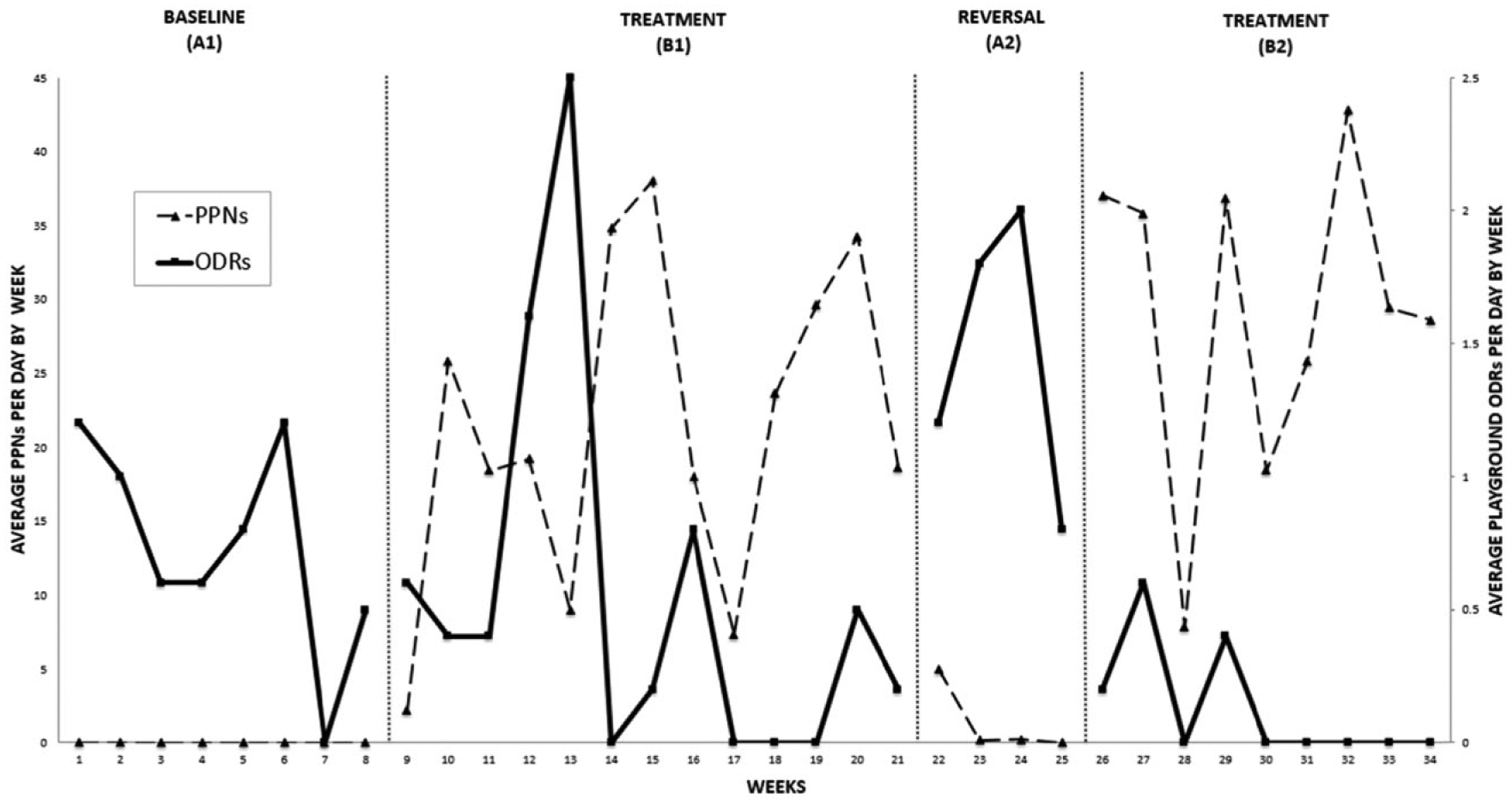
Playground ODRs and PPNs per day (by week) across study phases.
The first intervention phase lasted 13 weeks, during which daily ODRs across weeks ranged from 0 to 2.5 with a gradually decreasing variable trend: median = 0.4, SD = 0.73. The median level of ODRs per day decreased by 42.9% but became more variable compared with baseline. Also, 10 of 13 ODR data points (76.9%) were below the baseline median.
The reversal phase lasted 4 weeks, during which ODRs ranged from 0.8 to 2 with a gradually decreasing variable trend: median = 1.5, SD = 0.55. In the first week of the reversal phase, there were a small number of PPNs which were inadvertently distributed by students due to a misunderstanding as to when the intervention was to end. During reversal, there was a 73.4% increase in median ODRs per day with decreased variability compared with data in the first PPN intervention phase.
The second intervention phase lasted 9 weeks, during which ODRs ranged from 0 to 0.6 with a rapidly decreasing variable trend, followed by the complete elimination of ODRs: median = 0, SD = 0.22. This was a 100% decrease in median ODRs when compared with the reversal phase. In the second intervention phase, 9 out of 9 playground data points (100%) were below the 1.5 median found in the reversal phase.
Examining standard deviations across phases showed that variability of ODRs increased from initial baseline to the first PPN phase, but decreased from the reversal to the final PPN phase. There were also more rapidly decreasing and stable trends during intervention phases as compared with baseline phases.
Social Validity
Results of the social validity surveys were organized by the goals, procedures, and outcomes of the PPN intervention (Wolf, 1978), as shown in Table 1 (“recess aides” responses include the school administrator). Of the seven questions focused on goals, the item with the highest percentage of agreement was “students should get puma paws (PPNs) for doing good things at recess,” with 100% of the recess aides and 93.4% of students agreeing. Results showed 71.4% of recess aides and 72.8% of students agreed that PPNs were “an important way of communicating playground rules.” Also, 37.5% of the recess aides and 70% of the student respondents agreed that “peer praise notes should be continued next year.” In addition, 12.5% of recess aides and 74.4% of students agreed that PPNs helped improve student behavior. On the item “I try to get playground puma paws at recess,” 73.4% of students agreed. Almost half (48.5%) of students agreed that PPNs helped them talk to their parents about school friends.
Five survey items focused on the PPN procedures. Most of the students (93.4%) agreed that “it is important to know the playground rules.” Of the 45 upper-grade student respondents, 62.7% agreed they would like to be a peer praiser. However, 62.5% of the recess aides indicated the intervention “took too much time,” and only 25% agreed that “students like to give playground puma paws.” Just 38.65% of the students felt they had received enough PPNs.
Three survey items focused on the outcomes of the PPN intervention. All of the recess aides and 84.3% of students agreed that “students like receiving playground puma paws.” In addition, 75% of the recess aides and 76.9% of the students agreed that “parents like it when their child receives a playground puma paw.” Apart from this, 42.9% of the recess aides and 62.5% of the students agreed that “peer relations are improved by playground puma paws.”
Respondents were asked what they liked and disliked about the PPN intervention. Recess aides’ responses included 10 things they liked and eight things they disliked: a ratio for positive to negative comments of 1.25:1. Students’ responses included 81 things they liked and 33 things they disliked, a positive to negative comment ratio of 2.45:1. Among the positive comments, 44.5% of recess aides stated that PPNs positively influenced peer relations: for example, “[The PPN intervention] increases peer pressure in a positive way.” Reactions of 33.3% of the recess aides indicated that PPNs gave students a responsibility: for example, “[The intervention] extends the expectations to the school body.” Negative comments by 46.2% of recess aides noted that the 3-week term of service of the peer praisers was too long. One recess aide commented, “After the first week of handing them out, the pumas [peer praisers] were tired of doing this.”
The most common positive theme among students was that they perceived PPNs as rewarding; 42.2% of positive comments included this theme. Students wrote, “You sometimes get prizes” and “Every puma paw I get, my mom owes me one dollar.” On the negative side, 50% of students’ comments were similar to this complaint: “They sometimes don’t give them to people who deserve them.”
Treatment Integrity
On average, peer praisers distributed 34.5% of the PPNs they were asked to distribute. Week 32 had the highest treatment integrity, with 59.4% of expected PPNs distributed. Week 17 had the lowest treatment integrity, as only 8.1% of expected PPNs were given to students. Table 2 compares the expected distribution to the actual distribution of PPNs across grade levels over the course of the intervention. Notable differences were in kindergarten and first grade (+5.07%), third grade (−5.9%), fourth grade (+12.16), and sixth grade (−9.12).
Expected Versus Actual Distribution of PPNs Across Grade Levels.
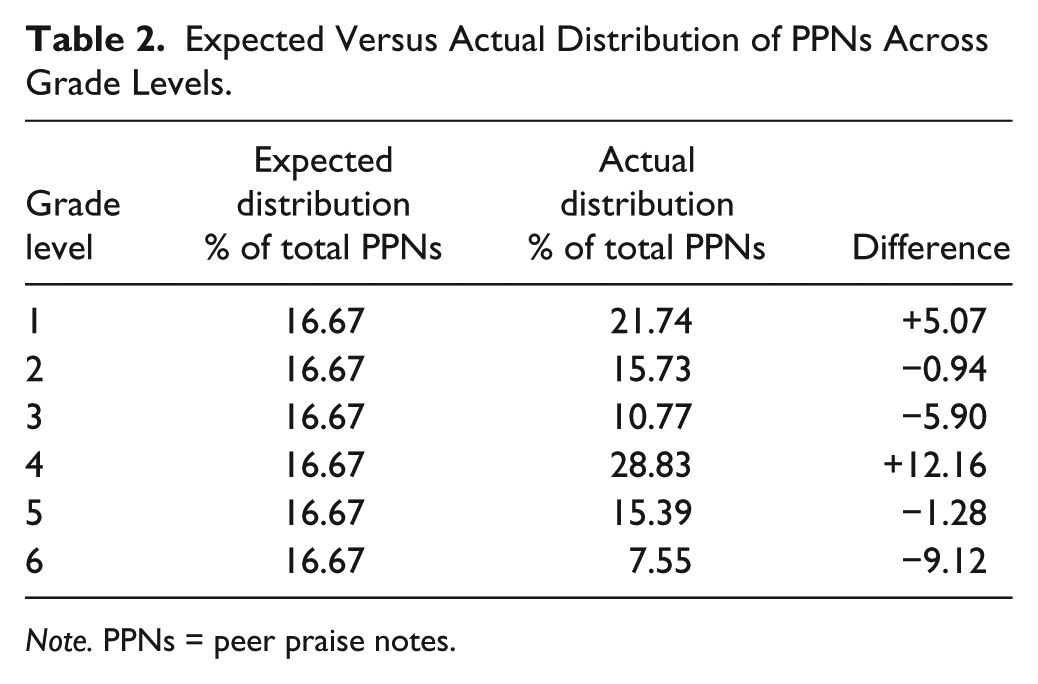
Note. PPNs = peer praise notes.
Discussion
This is the first study to evaluate the school-wide implementation of a praise note intervention in which students issued PPNs to each other on the playground. Merely showing the effectiveness of an intervention is often insufficient to justify implementation (Gresham & Lopez, 1996). Therefore, this study also examined whether recess aides and students viewed the intervention as socially valid and whether peer praisers distributed PPNs with integrity.
Results were promising, though further research in this area is needed. Changes in ODRs between the first intervention phase and reversal, as well as reversal to the second intervention phase, suggested an effective treatment (Ma, 2006). However, the ODR changes from baseline to the first treatment phase were not as compelling. Results from social validity surveys indicated that participants had mostly positive perceptions of PPNs for improving student behavior and peer relations, communicating playground rules, extending supervision responsibilities, and offering structured activity to peer praisers. Perceptions of the students were overall more positive than those of the recess aides. The outcomes regarding ODRs and social validity will be further discussed, as well as limitations, areas for future research, and implications.
ODRs
The changes in ODR level, trend, and variability from intervention to reversal and from reversal to reinstatement of the intervention suggested a potential functional relationship, though these were the only two clear demonstrations of a treatment effect (Kratochwill et al., 2010). There was a downward ODR trend and high variability in the baseline phase, and high variability in the first PPN intervention phase. The PEM of 76.9% during the first intervention phase indicated that the intervention was moderately effective, and the PEM of 100% in the second intervention phase indicated that it was highly effective (Ma, 2006). As time progressed, the effect size increased. However, changes in daily routines could have influenced undesired student behavior. For example, weeks with relatively more ODRs were typically close to major breaks and holidays (i.e., Week 12 leading up to Thanksgiving break and Week 13 preceding Thanksgiving break). Also, ODRs may have decreased as recess aides became more skilled in responding to behaviors that led to ODRs. It was interesting that during the withdrawal phase, the mean ODRs increased sharply (median = 1.5) compared with both baseline (median = 0.7) and the first intervention phase (median = 0.4). The reasons for this increase were not clear, though the school administrator hypothesized that because students were expecting PPNs, but did not receive them, their behavior worsened as a reaction to the removal of the reinforcing contingency.
Another consideration is that approximately half of the students recruited as peer praisers had originally been identified as at risk for problem behavior. The structured requirements of giving PPNs may have kept at-risk students too busy to misbehave. Their responsibility may have also reminded them of the recess behavior expectations. Even when their peer praising period had passed, at-risk students who had served in that role may have been primed to remember and follow the rules. If these students had previously been responsible for many ODRs, the intervention might have influenced their behavior in ways different than expected. Rather than influencing behavior by reinforcing good behavior—as praise notes are typically thought to do—the experience of being peer praisers could have created antecedent conditions that discourage misbehavior or encourage positive behavior.
It is important to note that peer praisers were somewhat inconsistent in the number of PPNs they gave each week, generally giving relatively more in the first week of their praise period and relatively fewer at the end. Even though the number of PPNs given fluctuated during intervention phases, the inverse pattern between ODRs and PPNs was prevalent. Furthermore, though not part of the research design for this study, we found that there was a 28% decrease in the school’s total ODRs during the PPN year compared with the previous year’s data, suggesting that the intervention helped reduce the school’s total ODRs.
Social Validity
Approximately three fourths of students agreed that they tried to get PPNs at recess, yet the same number said they did not always get them when they deserved them. The fact that ODRs improved despite the perception that PPNs were hard to obtain suggests that the intervention may still have motivated students to display better behavior. Also, the presence of peer praisers may have improved behavior by reminding students of the recess expectations. Although a specific cause for varying ODR rates on the playground cannot be fully determined by this study, the conclusion that PPNs contributed to a general reduction is suggested by a combination of (a) the expected overall changes in ODRs and (b) a PEM effect size that reflects an effective treatment.
Participants’ predominantly positive views of the PPN interventions were expressed in several quantitative and qualitative survey responses. The majority of students indicated that they liked PPNs, consistent with findings of previous studies that students generally like praise notes (Elwell & Tiberio, 1994; Howell et al., 2014; J. A. P. Nelson et al., 2008). All recess aides agreed that students liked receiving PPNs. Similar to the results of Howell et al. (2014), student social validity ratings of the PPN intervention were higher than adult ratings. Items on which the percentages of student agreement were higher included desiring that PPNs be implemented the following year and perceiving that PPNs helped improve student behavior and peer relations. Students were the primary people involved in implementing the PPN intervention, and therefore, recess aides may have been less invested affecting their social validity ratings.
Limitations and Future Research
Limitations of the present study suggest possibilities for future research. Results showed only two clear demonstrations of treatment effect at two points in time (from the first treatment phase to reversal and from reversal to the second treatment phase). Three demonstrations of the effect at three points in time are required to establish a functional relationship (Kratochwill et al., 2010). The decreasing trend in ODRs during baseline did not allow for a clear demonstration of treatment effect during the first intervention phase. This could be addressed in future studies by implementing the PPN intervention when ODRs are increasing or more stable at baseline.
Only students in the fourth through sixth grades were peer praisers. In future studies, peer praising responsibilities might be extended to younger grades with appropriate adaptations. For example, younger students who might take longer to complete a PPN could distribute praise stickers or prewritten PPNs. Such an approach is similar to a playground intervention examined by Chelvakumar et al. (2010), in which adults rewarded students with an attractive ink stamp on an adhesive name tag when they demonstrated safe behaviors. The primary difference in a future study of such symbol use would be having students rather than adults give the symbol of praise.
Although ODRs were convenient and practical to use for this study, they do have limitations, as noted earlier. For example, no distinction was made in the present study between major and minor infractions, because the school tracked only major playground offenses for which students would be sent to the office. Future studies could include such a distinction, as well as direct observations of behaviors during recess, to further corroborate what ODRs represent.
Another limitation was that no routine playground observations were conducted to ensure that PPNs were administered as intended. Future research could include direct observations to verify PPNs are given only to students who meet the school-wide expectations and not simply to peer praisers’ friends.
Although recess aides were aware of the PPN intervention, they were not asked to take an active role in it. Perhaps this lack of active participation was linked to their tendency to give lower ratings of social validity than the students did. In future studies, recess aides might be provided an updated list of peer praisers to help by conducting direct observations, training students, and awarding peer praisers for being on time and meeting appropriate distribution goals. Perhaps the recess aides valued behaviors that were different from the expectations set by the SWPBS team. In the future, SWPBS teams might find it helpful to collaborate with recess aides in determining behavioral expectations for recess.
In the present study, the PPNs were implemented only on the playground during recess, which helped focus the intervention and its effects. To broaden these findings, a multiple baseline design across settings could be used to further evaluate PPN effects. Future studies could implement the intervention in additional settings such as the cafeteria, hallways, or bus line. Also, PPNs were used in this study only as a universal intervention, though they could be used at the secondary or tertiary SWPBS levels (Lewis & Sugai, 1999), as implemented by J. A. P. Nelson et al. (2008). To begin examining the potential influence of peer praise as both antecedent and consequence for behavior, researchers could track the relationship of ODRs to the behavior of students in the roles of the praiser, praise recipient, or observer (monitoring the behavior of praisers or recipients). This level of analysis was impossible in the present study due to constraints of confidentiality.
Finally, the goal of asking elementary school students to issue six praise notes during a 15-min recess appeared unrealistic. Based on the average number of PPNs given each week, peer praisers in Grades 4 through 6 can be reasonably expected to issue two praise notes during a 15-min period. In the future, peer praisers should be assigned to give fewer PPNs; as many students want more opportunities to receive PPNs, additional students could be selected to be peer praisers during each time period. As suggested by J. A. P. Nelson et al. (2009), praisers should be provided with specific feedback as to who is getting notes (and who is not) and whether PPN distribution goals are reached. Individual awards could be given to peer praisers who issue the most PPNs in a given time. Group contingency rewards could also be offered when peer praisers as a group reach a certain goal, as done by J. A. P. Nelson et al. (2008).
Conclusions and Implications
Students deserve to receive all the potential benefits of a positive recess experience (Bleeker et al., 2012; Ginsburg, 2007; Hillman et al., 2008; Pellegrini & Bohn, 2005). However, the recess playground is frequently the setting for problem behavior due to the inadequacy of clear expectations, purposeful structure, and other precautions for physical and emotional safety. The PPN intervention examined in the present study is consistent with SWPBS practices to resolve playground behavior problems and promote a positive recess experience.
PPNs can reinforce playground behavior expectations as students are repeatedly reminded of the rules every time they see a peer praiser with a clipboard giving PPNs or notice other students modeling positive behavior to earn these notes. Students can receive positive peer recognition when they demonstrate that they know and obey the rules. Active supervision is increased because others in addition to recess aides are specifically watching students. In their training, peer praisers can be taught to move around to different areas of the playground and proactively scan for good behavior. Overall, the recess environment can be positively restructured as peer praisers are encouraged to (a) interact with a variety of students, (b) follow a structured schedule during recess, and (c) offer peers genuine praise.
The findings of this study addressed concerns specific to the playground setting, a school area typically high in problem behavior (Lewis et al., 2000). The use of PPNs appeared to be an effective and acceptable intervention that improved student behavior, increased positive peer interactions, helped communicate playground rules, extended supervision responsibilities to students as well as staff, and offered a structured activity to peer praisers. PPNs are a relatively simple practice that can support students in positive playground experiences that ultimately influence academic and social success. We encourage educators and researchers to apply and study the effects of PPNs in a variety of appropriate school settings.
Footnotes
Declaration of Conflicting Interests
The author(s) declared no potential conflicts of interest with respect to the research, authorship, and/or publication of this article.
Funding
The author(s) received no financial support for the research, authorship, and/or publication of this article.