



Abstract
A single-case multiple baseline design across three families was used to evaluate the impact of a manualized Prevent-Teach-Reinforce for Families (PTR-F) process for addressing challenging behavior (CB) when delivered in a remote format (PTR-F: R). Results across three U.S. families showed that (a) a functional relation existed between parent implementation of the strategies and reductions in child’s CB, (b) families achieved high levels of implementation fidelity for behavior intervention plans developed using the PTR-F: R process, and (c) families rated the PTR-F: R process and the intervention plans positively. The results replicated findings from previous research on the general efficacy of the PTR process while adapting the method for use in a remote format. Implications for practice and future research are discussed.
As young children grow and develop, they are learning to communicate their wants and needs and regulate their emotions. Due to this typical developmental process, it is not uncommon for children to behave in ways that are confusing or challenging to their parents or caregivers. Challenging behaviors (CBs) are any kinds of actions or behavior patterns that interfere with functioning in daily routines, such as mealtimes, dressing, playtimes, and bedtimes (Division for Early Childhood [DEC], 2017). Examples of CBs include excessive crying or yelling, property destruction, throwing things, hitting, kicking, pushing, and elopement. CB may also include persistent lack of cooperation or noncompliance. Irrespective of the specific topography, these behaviors can impede daily functioning and often persist for months and years without intervention (Dunlap et al., 2017).
Whatever the form, frequency, duration, or intensity of CB, these behaviors potentially affect a child’s development, learning, and relationships and can be difficult for families, caregivers, and educators to address (DEC, 2017). Without effective intervention, CBs have been associated with negative family outcomes, such as increased parent stress levels, parent depression and caregiver burden (Baker et al., 2011; Durand, 2011; Long et al., 2008), and impaired sibling relationships (Orsmond et al., 2009). Parents of children with CB report lacking confidence in their parenting skills and ability to parent effectively (Woodman & Hauser-Cram, 2013). Accordingly, effective interventions for CB should not only focus on reducing CB but also provide adult family members with skills to be effective and confident intervention agents. Dunlap and colleagues have responded to this need through their development of the Prevent, Teach, Reinforce (PTR) suite of products (Dunlap et al., 2010; Dunlap et al., 2013; Dunlap et al., 2017).
Prevent-Teach-Reinforce
PTR is an individualized process including functional behavior assessment (FBA) and individualized intervention strategies originating from applied behavior analysis (ABA). Packaged as manualized protocols, PTR, PTR-Young Children (PTR-YC), and PTR-Families (PTR-F) are distinguished by the precision, step-by-step forms, and strategies for enhancing fidelity of implementation of function-based intervention (Dunlap et al., 2017).
The PTR model has demonstrated effectiveness in reducing CB and increasing desirable behaviors for school-age children in a randomized control trial with 245 participants (Iovanne et al., 2009). Strain et al. (2011) found similar effects with three students with autism spectrum disorder. More recently, Dunlap et al. (2018) investigated differences in outcomes between PTR-YC and typical services provided for preschoolers with CB and revealed statistically significant differences in levels of CB, engagement, and social skills.
Researchers have also demonstrated the use of PTR concepts in family contexts (Dunlap & Fox, 1999; Fettig & Barton, 2014; Fettig et al., 2013). Involving families in decisions helps to ensure that practices are sensitive to the cultural, linguistic, and diverse needs of children and their families (Ortiz, 2014). Best practice guidelines for promoting family engagement include basic relationship elements, such as sincerity, trust, and respect, conveyed through interactions and communications (Sheridan et al., 2014). Providers and families must work together to promote social–emotional competence and address CB (DEC, 2017). For children with CB, their caregiver’s access to services is a critical need and the impetus for which PTR-F was created.
Prevent-Teach-Reinforce for Families
PTR-F is distinguished from the other PTR products by its focus on implementation by parents and other caregivers in family homes and community environments. Similar to the other manuals in the PTR suite of products, PTR-F is a specific, manualized model of intervention planning and implementation for helping families to resolve their children’s serious CB (Dunlap et al., 2017; Fronapfel et al., 2018). Similar to PTR and PTR-YC, PTR-F is backed by extensive research grounded in positive behavior supports (PBS) and ABA (Dunlap et al., 2010; Dunlap et al., 2018; Strain et al., 2011).
The manual includes a comprehensive list of strategies for each component of the behavior support plan (BSP): Prevent, Teach, and Reinforce. Each strategy is complemented with a thorough description, rationale, examples of how the strategy could be used, steps for implementation, special considerations, and supporting evidence. The user-friendly PTR-F framework includes a five-step process: initiating the PTR-F process, PTR-F assessment, PTR-F intervention, coaching, and monitoring plan implementation and child progress.
During the initial meeting for PTR-F, a team is formed of people who will be involved in the process to develop and implement the BSP. The team comprised who will be implementing the plan, such as family members, and support specialists or therapists who observe and support the child and family around the CB or related skills. Step 1 of the PTR-F process includes a team discussion regarding the importance of family centeredness and working as a team, and agreement on the roles of different team members throughout the process. Long-term goals and short-term objectives (e.g., parent child interactions, social–emotional development for the child, and settings prioritized for intervention) are identified, so that team members understand the outcomes and agree they are desirable and realistic. Short-term behavior goals are outlined for the child regarding CB to target for decrease and a desirable behavior to target for increase. These goals should be achievable in about 2-month time and are the smaller stepss toward achieving longer-term outcomes. Finally, the team decides on a strategy for measuring target behaviors for progress monitoring.
During Step 2, an assessment of behavior in the routines that caregivers have described as challenging is completed. This FBA determines under what conditions CB occurs. The FBA consists of simple questionnaires completed by the caregivers and a summation of the responses to understand the relationship between events in the environment and the occurrence of challenging and desirable behavior.
During Step 3, information from Step 2 is used to formulate a BSP that includes a minimum of one prevent strategy, one teach strategy, and one reinforce strategy. The menu of intervention strategies provided in the PTR-F manual comprised evidence-based strategies including, but not limited to, using visual supports and schedules, providing choices, embedding multiple instructional opportunities, and providing reinforcement for desirable behavior. The team develops a BSP targeting the antecedents and consequences of challenging and desirable behaviors which includes planning for the teaching of functional skills that can replace the child’s CB. As part of intervention planning, specific steps are outlined in partnership with the caregivers to maximize the probability of success and ensure the plan is individually tailored to the needs of the family and child.
Step 4 entails coaching, which is woven throughout the entire process; but due to its importance, it has its own chapter in the PTR-F manual. Important components, such as fidelity of implementation, the importance of the relationship, the significance of cultural differences, and the process of fading coaching support, are described in detail.
Step 5 focusses on the practical and feasible strategies the family will use to monitor progress and assess the effectiveness of the developed BSP. Strategies to use data to improve implementation and to share the data with other relevant parties (e.g., school, agencies) are discussed.
Joseph et al. (2021) examined the effects of BSPs developed through the PTR-F process while also examining the level of implementation fidelity and social validity ratings. Results indicated that the families implemented the plans with high levels of fidelity and demonstrated a functional relation between the intervention and decreased child’s CB and increased desirable behaviors. Additionally, satisfaction with target routines and caregiver confidence in implementing the plan improved throughout the process and resulted in high social validity. The authors noted the need for flexibility and availability from the facilitator to support the families. The estimated average time spent with each family across study phases was 16 hr, but this estimate excluded travel time to and from participant’s homes. When travel time was added, each home visit involved 3 hr or more. This time burden severely limits the number of families that any single facilitator can assist. Additionally, the facilitator experienced difficulty providing support during the actual routines as they occurred in the family home (i.e., early in the morning or late at night). Joseph et al. (2021) called for continuation of the research and dissemination of the use of PTR-F as a meaningful tool for practitioners and families that can impact immediate and long-term child and family outcomes.
Remote Delivery Potential
Telehealth, defined as the use of communication technologies (e.g., computer-based videoconferencing) to deliver consultation or other services in real time over a geographical distance (Dudding, 2009), is one way to address the gap in accessible evidence-based practices for the assessment and treatment of CB. Although remote interventions might include self-guided interactive web training (Turgeon et al., 2021), Schieltz and Wacker (2020) suggest live videoconferencing as the most common form of telehealth for the purposes of consultation between providers and the assessment and treatment of CB displayed by children. Empirical evidence supports the utility of telehealth as a service delivery model for providing caregiver training on behavioral strategies for addressing CB (Benson et al., 2018; Dimian et al., 2018; Machalicek et al., 2016; Wacker et al., 2013). More information is warranted, however, on if caregivers can be trained to implement these processes as opposed to them being expert-driven (Board Certified Behavior Analyst [BCBA] or other specifically trained individuals; Gerow et al., 2018). Additionally, future research is needed regarding the fidelity of implementation, coaching mechanisms, and social validity of the mode of service delivery (Chung et al., 2020).
The purpose of this study was to develop, evaluate, and refine a process for remote application of family-centered intervention for reducing CB for three young children in the home setting. Primary research questions included as follows:
Is there a functional relation between caregiver implementation of the function-based BSP and reductions in level of CB?
Does PTR-F:R lead to high levels of caregiver fidelity of implementation of behavior support strategies?
How do caregivers rate the social validity of the goals, procedures, and outcomes of PTR-F:R?
Method
Facilitator
The primary author and researcher served as the PTR-F facilitator for participating families. The researcher was white, had a master’s degree in education, and was pursuing her doctorate in school psychology. She was a BCBA and had worked in homes and schools for 6 years.
Participants
Staff at an inclusive childcare center serving children 2–5 years of age initially shared information about the study with families. This center was known to enroll children with CB yet did not provide ongoing services for families that might represent a treatment confound. Three young children with CB and their families participated. Child participants were white and lived in suburban neighborhoods outside of a large, metropolitan city in the western United States. Each child lived in a two-parent home and both parents participated in the PTR-F: R process. All parents had received a bachelor’s degree or higher.
To determine whether child participants met inclusion criteria for the study, the facilitator administered the Eyberg Child Behavior Inventory (ECBI; Eyberg & Pincus, 1999). Scores of 131 or higher on the Intensity Scale are considered to potentially suggest a significant problem, and a score of 15 or higher on the Problem Scale indicates the caregiver is significantly distressed by the child’s behavior. These were the cut-off scores for inclusion in the study. Children were eligible to participate in the study provided they displayed CB as indicated on the ECBI below the cut-off scores for at least 2 months and were between 2 and 5 years of age. The ECBI has adequate discriminant and convergent validity, is sensitive to changes in CB, and previous studies with similar aims have used this measure (see Joseph et al., 2021). Children were excluded from the study if they did not meet the above criteria, their CB warranted significant safety concerns (e.g., danger to self or others), or there was a medical basis for CB as identified during pre-screening. No one who participated in the pre-screening process for this study was excluded.
Family demographic variables were not used to include or exclude participants. Family participants/caregivers included any caregiver in the home who regularly participated in daily routines with the child. Eligibility criteria included (a) an agreement to be present for all routines in which the CB occurs, (b) availability for sessions that would occur at least once per week for 1 hr for approximately 2 months, (c) spoke English as their primary language in the home, and (d) were expected to remain at their current residence for the remainder of data collection.
Ronald and His Family
Ronald was a 2-year-old male who attended the full-day childcare center 5 days per week where he received speech and occupational therapy (OT) services. Ronald’s parents, 34 and 35 years of age, had both obtained a college education and were working full-time outside the home as an operations technician and a non-profit specialist. Ronald had no reported diagnoses.
Kylie and Her Family
Kylie was a 4-year-old female who lived at home with her two younger sisters (2 years of age and 2 weeks of age), mother and father (both 37 years of age). Both parents had obtained a college education. Her mother was a stay-at-home parent and her father worked outside the home as an attorney. Kylie attended full-day preschool 5 days per week where she received speech and OT services, and had a diagnosis of Cornelia de Lange Syndrome.
Ella and Her Family
Ella was a 2-year-old female who lived at home with her two older sisters (5 and 8 years of age), mother (40 years of age), and father (41 years of age). Both parents had obtained a college education. Her mother worked full-time as a CEO and her father worked part time in real estate. Ella attended full-day preschool 5 days per week. She did not have a reported diagnosis.
Settings and Routines
All coaching sessions took place in a room in the families’ homes with at least six-by-six feet of available space (i.e., living room, dining room, bedroom). All electronic streaming devices were turned off in the room to minimize distractions and improve Internet bandwidth. Environmental modifications were made as necessary to ensure safety and increase the effectiveness of the telehealth sessions. At the first visit, the facilitator and caregiver went over action steps that both parties would take in the event of an emergency and completed a technology check to ensure a secure connection, volume, video, and recording capacity.
Steps 1 through 5 of the PTR-F: R process occurred by two-way audio–visual videoconference between the caregiver and the PTR-F: R facilitator. The facilitator initiated calls from a private office at times selected by the caregiver. The caregiver and the child joined all visits from their home.
Each family chose a particular target routine (i.e., the most difficult routine of their day) to focus on during the PTR-F: R process. The spaces associated with such routines were the settings for the relevant PTR-F:R steps.
Ronald and His Family
The setting for Ronald’s family consisted of the pathway between his bedroom, living room, and kitchen of the family’s home. Ronald’s family indicated that the most difficult routine of their day was in the morning when Ronald was getting ready for school. This routine was the most difficult due to the time restrictions associated with arriving at school on time. Using the PTR-F Assessment Forms, Ronald’s parents and facilitator developed the following hypothesis statement: When getting dressed in the morning, Ronald has a tantrum. As a result, he avoids the task and gets attention from his mom or dad. The BSP included a visual schedule, instruction on how to implement the visual schedule, including prompts and review of steps as each were completed, and differential reinforcement (i.e., a high rate of praise contingent on appropriate behavior and implementation of extinction for occurrences of CB), and access to a preferred activity following successful completion of the routine.
Kylie and Her Family
The setting for Kylie’s family consisted of the large upstairs bathroom in the family’s home. Kylie’s mother indicated that the most difficult time of day was following bath time, when her attention was diverted to Kylie’s younger sisters. Kylie’s mother shared that she typically demonstrates the most CB when asked to perform daily living tasks (e.g., teeth brushing, putting on shoes, putting on clothes) that according to her mother, she can do independently. On completion of the PTR-F Assessment Forms, Kylie’s mother and the facilitator developed the hypothesis statement: When asked to complete bedtime activities, such as put pajamas on, brush teeth, and brush hair, Kylie has a tantrum. As a result, she receives extra attention from her mother and delays the task. Kylie’s BSP included a brief story describing the steps of calm down strategies, prompting the use of a solution, environmental arrangement, not attending to negative vocalizations, descriptive praise for engaging in steps of the routine or using a calm down strategy, and access to a preferred activity with her mother on successful completion of the routine.
Ella and Her Family
The setting for Ella and her family consisted of the child-sized table in the kitchen of the family’s home. Ella’s family noted that dinner time was the most difficult routine of day. During meals, Ella was easily distracted and got out of her chair frequently; as a result, she was not consuming an adequate volume of food during mealtimes. Following the completion of the PTR-F Assessment forms, Ella’s father and the facilitator developed the following hypothesis statement: During mealtime, Ella avoids taking bites of food. As a result, she gets extra attention from her parents and delays taking bites of food. The BSP included review of rules prior to the mealtime routine, removal of distracting materials, teaching Ella to self-monitor using visual supports (i.e., token system), guidance back to table with minimal parent attention, and access to a post-meal reward contingent on meeting the exit criterion (i.e., taking X number of bites).
For each family, the specific elements of the BSP were scored for their presence or absence as part of the PTR-F Fidelity of Intervention Checklist.
Remote Support Equipment
Each caregiver was provided with an iPad inside a protective case and equipped with built-in web camera, a Bluetooth earpiece, and a tripod. Each device was encrypted and equipped with HIPAA compliant Zoom that allowed each caregiver to join videoconference sessions in real time with the PTR-F: R facilitator. The devices were blocked from accessing any additional functions except for Zoom software. Each iPad was mounted to the tripod in an optimal location in the room of the home, so that the caregiver–child dyad would be in clear view of the camera. Ronald’s family elected to join sessions from their personal smartphone due to the necessity to move from room to room to complete the routine. During sessions, families were asked to disconnect any other devices from Wi-Fi streaming to promote a higher quality of video and audio transfer. The PTR-F:R facilitator used an Internet-enabled encrypted device to join sessions using HIPAA compliant Zoom software. All experimental sessions were recorded via Zoom and stored within a secure hard drive for subsequent data collection.
Data Collection
Live observational data (i.e., percentage of intervals with CB, families’ percentage of BSP steps implemented, and coaching strategies used) were collected during weekly Zoom meetings lasting up to 1 hr. Occurrence of CB was scored using individualized operational definitions of the behaviors that were chosen collaboratively by the family and researcher in Step 1 of the PTR-F: R process. A 10-s partial-interval recording system was used during meetings to calculate the percentage of intervals containing CB across four successive 5-min sessions per visit across baseline and intervention phases. These blocks of time were randomly distributed across the visit to minimize any effects solely attributable to the passage of time. Recordings were reviewed later for interobserver agreement (IOA), further described below. The primary dependent variable in the study was the percentage of intervals with CB. The operational definitions used for coding CB consisted of the following:
Ronald: emitting negative vocalizations for longer than 3 s (i.e., crying, whimpering, say “no,” running out of the room, self-injurious behavior [hitting head against hard surfaces], and flopping to the floor);
Kylie: emitting negative vocalizations (i.e., crying, whining) for longer than 3 s (i.e., hitting head with hands and flopping to the floor);
Ella: getting up from the dining table and using her hands to engage in an activity other than consuming food (i.e., playing with toys).
Two forms of procedural fidelity were recorded. First, the procedural fidelity of all experimental conditions was documented using facilitator self-checklists after every meeting. These researcher-created checklists were used to monitor facilitator behavior and determine which adaptations were necessary for the remote facilitation, such as use of bug-in-ear technology. Second, all sessions were scored using the PTR-F Fidelity of Intervention Checklists to document parent implementation of each child’s BSP. The checklist included items on each family’s individualized BSP and were scored as “Yes” if the strategy was implemented as intended or “No” if the strategy was not implemented as intended. An overall average of implementation fidelity was calculated by dividing the total number of items marked “Yes” by the total possible items and multiplying the answer by 100 to obtain a percentage.
Interobserver Agreement
The PTR-F:R facilitator served as the primary data collector for the study. A secondary data collector who held a master’s degree in school psychology was trained using sample video clips until 85% agreement was reached. IOA for observational data (i.e., child’s CB, caregiver use of BSP strategies, coaching fidelity) was collected for 40% of all sessions across each study phase for each caregiver–child dyad. The IOA sessions were randomly determined using a random number generator and the secondary data collector was blind to the phase in which the session occurred. For CB, an agreement was counted if both raters recorded an occurrence or nonoccurrence of CB during each specific interval. For caregiver use of BSP strategies and coaching fidelity, an agreement was scored if both raters counted the step as implemented or not (presence or absence of the strategy). IOA was calculated as the percentage of intervals or steps with agreement. Average IOA was 92% for child’s CB (range: 83% – 100%), 100% for caregiver fidelity of implementation, and 98% for coaching fidelity (range: 97% – 100%).
Experimental Design and Procedures
A single-case concurrent multiple baseline design across three families was used to determine if there was evidence of a functional relation between PTR-F:R implementation and decreased level of child’s CB. The multiple baseline design allowed for the examination of individualized behavior change across multiple families and contexts. Repeated observations afforded answers to the research questions regarding facilitator implementation, family implementation, and child response to intervention.
Baseline
During baseline, caregivers were asked to engage in their typical, existing routine with their child without the facilitator providing any further instruction. Baseline sessions were recorded and later coded in 10-s intervals for the percentage of CB. The facilitator also met with the caregiver to discuss potential function-based strategies generated by synthesizing the results of the FBA. The facilitator provided didactic information on several strategies and guided the caregiver in choosing which strategies they found to be most acceptable and feasible. All four planning steps in the PTR-F process involved in developing a BSP occurred during baseline, but no intervention implementation occurred until the onset of the intervention phase.
Intervention
Intervention began for each family following the demonstration of a stable baseline (i.e., minimum of three baseline data points to establish stability; WWC, 2020) and was staggered across child caregiver dyads. Following the completion of Steps 1 through 4, the PTR-F: R facilitator met with the first caregiver/child dyad during the target routine and coached the caregiver to support their implementation of the individualized BSP and establish fidelity of intervention. During intervention sessions, the facilitator provided the caregiver with materials necessary for carrying out the intervention strategies described in their child’s BSP (e.g., timer, visual schedule, social story) and coached the caregiver on strategy implementation. Coaching included written and verbal instructions, modeling, role-playing, and in-the-moment feedback using bug-in-ear coaching.
Following BSP implementation by the caregiver, the facilitator engaged the caregiver in a brief coaching conversation (approximately 15 min). The facilitator reviewed the BSP steps to ensure caregiver comprehension, identified concerns with implementing the steps as described in the plan, provided feedback, engaged in problem-solving discussion, and rehearsed the plan as needed. Due to the telehealth format, the following adaptations to coaching were made: sharing a video of the use of particular intervention strategy, modeling in a simulated situation to demonstrate the use of the strategy, SMS text reminders, and within-session coaching tips using bug-in-ear technology. A follow-up email was sent to the caregiver immediately after each meeting, noting what was shared during the coaching discussion and indicating action steps needed prior to the next meeting.
Coaching continued until the caregiver met a pre-established criterion of 80% or greater implementation fidelity during a single session. Following the intervention phase once stability in CB was met, families were emailed a modified version of the Treatment Acceptability Rating Form (TARF; Reimers et al., 1991) to measure treatment acceptability. Families completed the TARF without the facilitator present.
Results
Child’s Challenging Behavior
The impact of PTR-F:R on child’s CBs was assessed through visual analysis of the line graph (see Figure 1). Based on visual analysis, there was a basic effect observed between PTR-F: R and child’s CB across each caregiver–child dyad. In general, the data indicate consistent patterns of CB across similar experimental phases and substantial decreases in CB during the intervention phase with minimal overlapping data points between phases. Three demonstrations of the basic effect at three different points in time demonstrate a functional relation between the caregiver-implemented BSP and reduced level of CB.
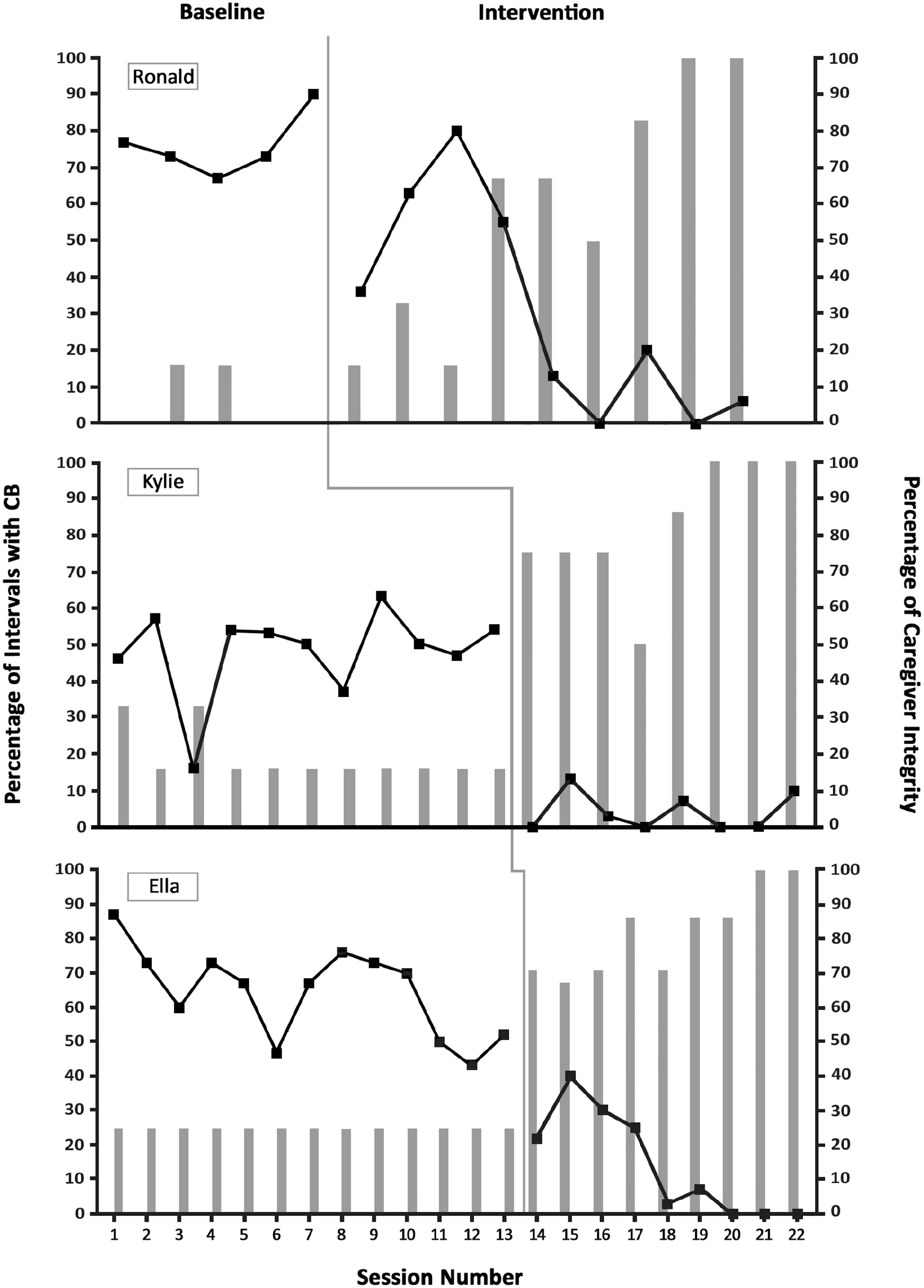
Percentage of Intervals with CB During Baseline and Intervention Sessions and Percentage of Caregiver Integrity per Session.
Ronald engaged in elevated rates of CB (M = 76%, range: 67% – 90%) during the baseline sessions with the final three data points indicating an upward trend. During the intervention phase, Ronald’s CB showed an initial decrease, and then increased for one data point before descending and leveling out. This variability in the data was primarily due to one session in which he engaged in CB for 80% of intervals. This data point was the only point of overlap with the baseline condition and may be explained by the low level of treatment integrity on this session (i.e., 16%). Following this initial spike in CB, the percentage of intervals rapidly decreased to low rates by the end of the phase (M = 30%, range: 0% – 80%).
For Kylie, CB occurred during an average of 48% (range: 16% – 63%) of intervals during the baseline, with some variability and a stable trend. Once intervention was implemented, Kylie’s CB decreased to an average of 4% (range: 0% – 13%) of intervals, with no overlapping data points with the previous phase.
During baseline, Ella engaged in CB during an average of 64% (range: 43% – 87%) of intervals. Although the data show a marginal downward trend during baseline sessions, there was no overlap between baseline and intervention data points and the baseline trend line would not be predictive of the level of behavior change observed during intervention. In the intervention phase, the slope of the line during intervention was steeper than the baseline phase with less variability. Ella’s CB decreased to an average of 14% (range: 0% – 14%) of intervals during the intervention phase.
Caregiver Implementation Fidelity
Regarding caregiver implementation of BSPs, each family achieved a pre-established criterion of 80% or greater during intervention. During baseline, families used some of the strategies that would later be included in their BSP (e.g., descriptive praise, incorporating choices, using a timer). As the data suggest, however, it was not until the onset of facilitator coaching that implementation fidelity increased to desired levels. The mean for Ronald’s family’s fidelity of implementation during intervention was 59% (range: 16% – 100%), and they met the 80% or greater goal during the seventh session; for Kylie’s family, it was 83% (range: 50% – 100%), and they achieved the criterion during the fifth coaching session; and for Ella’s family, it was 82% (range: 71% – 100%) and exceeded the criterion during the fourth session.
Social Validity
All three families favorably rated the PTR-F:R process and their child’s BSP. On questionnaire items on the TARF with a rating of 5 indicating the most favorable score, the average social validity ranking across families was 4.7. On questionnaire items with a rating of 1 representing the most favorable score and a rating of 5 the least favorable score, the average ranking across families was 1.3. All caregivers responded affirmatively that the intervention was effective, acceptable, and feasible. One family reported that they did not think their family benefited from the PTR-F: R process as much as they might have with face-to-face delivery. One family shared that they
. . .really liked how thorough the process was—from taking time to thoroughly examine his problem behavior, to creating a specific plan that was manageable to implement—really set us up for success. Being remote also freed us up to do our meetings/intervention on our schedule.
Another family shared “the story was very well done and fit our family’s values and goals. [Facilitator]’s support, encouragement, and thoughtfulness were incredible. [Facilitator] helped remind me of and teach me tools that really helped.”
Discussion
The purpose of this study was to evaluate the impact of PTR-F:R on caregiver implementation of BSP strategies, child behavior, and caregiver competence in regard to dealing with their child’s CBs. The following adaptations to the PTR-F in vivo format were made: (a) use of Zoom technology, (b) participants’ electronic submission of forms, (c) didactic presentation of information during behavior intervention planning (i.e., Step 4), (d) adaptation of coaching strategies due to remote format and provision of equipment (e.g., iPads, cases, Bluetooth earpieces, tripods), and (f) guided self-reflections post session for caregivers to inform procedures and quality improvements.
The modified intervention package resulted in reductions in child CB and caregiver acquisition of behavioral intervention strategies. These findings align with a broad literature base supporting caregiver implementation of function-based intervention with their young children with CB producing desirable outcomes (Wacker et al., 2013; Fettig et al., 2013, Benson et al., 2018; Joseph et al., 2021). It is particularly important to note that this remote delivery of PTR-F resulted in levels and immediacy of child and family behavior change compared to Joseph et al. (2021) in vivo delivery of PTR-F. The results from this study extend current research by providing evidence of the effectiveness of the PTR-F model specifically when delivered for the first time using remote technology.
Second, caregiver participation in PTR-F: R resulted in sufficient levels of caregiver fidelity to effect child behavior change. The treatment fidelity data indicate the modified intervention resulted in moderate to high implementation for all families. Facilitator coaching strategies included written and verbal instructions, modeling, role-play/rehearsal, problem-solving discussion, feedback, and guided self-reflection. These data replicate and extend the findings of Joseph et al. (2021) that reported high fidelity implementation for families using the in-person PTR-F process. Caregivers’ accuracy of implementation in the trained routine increased following coaching and feedback and reached above 80% accuracy within a few sessions.
Third, the social validity findings of this study support previous studies indicating that families value family-centered behavior support and rate it favorably (Joseph et al., 2021; Fettig et al., 2013). Families responded positively on the TARF regarding their participation in the PTR-F: R process. One family shared how much it meant that the intervention strategy used matched their family’s values and goals by incorporating specific language they frequently used. Furthermore, due to the remote format, the facilitator was able to be more flexible and accommodating to the needs of the families and their schedules. The remote format afforded the opportunity for the facilitator to be available at the time the actual routine occurred (early in the morning or late at night), begin the visit later than anticipated, and reschedule the appointment within the same week (rescheduling occurred infrequently). These aspects of service delivery impacted the efficiency of the process and likely social validity ratings as well.
Intervention effects, fidelity, and social validity were meaningful. First, PTR-F: R is particularly applicable to families during COVID-19 as the telehealth support minimizes face-to-face contact. Our typical support processes for putting consumers in contact with evidence-based practice are too dependent on in-person professional delivery (Education Commission of the States, 2020). PTR-F: R can help to fill this national need and expand the literature around remote delivery of evidence-based interventions. Second, an ongoing concern in the field is the intersection between the numbers of qualified personnel to deliver function-based intervention at the early childhood level (Early Childhood Personnel Center, 2019) and children/families receiving an adequate dosage of intervention (Lucyshyn et al., 2000). A family-mediated intervention approach may well be the key to addressing these convergent concerns and also lead to reductions in family stress and improvements in their perceived competence. PTR-F: R and its reliance on the family’s determination of intervention settings, goals, and strategies directly expands the availability of function-based interventions delivered with an adequate dosage and fulfills the need for more socially valid, function-based intervention service delivery.
Finally, the PTR process has the potential to provide schools and related providers with an evidence-based model of function-based intervention grounded in ABA and the practical strategies of PBS that is consistent in terminology, procedural steps to determine functions, and methods for intervention design and fidelity measurement serving children 2–21 years of age. Therefore, the successful implementation of PTR-F: R can bridge the pervasive issues around service delivery discontinuities as children and families transition from Part C to preschool to K-12 systems (Congressional Research Service, 2019; Government Accountability Office, 2005). Moreover, the consistencies across PTR-F, PTR-YC, and PTR hold significant promise for professional development efficiencies as schools strive to build structures to support the high-fidelity delivery of evidence-based practices.
Limitations
This study had several limitations. First, for Ronald, the iPad used for telehealth sessions caused further disruption in target routines than would have been the case without the iPad and likely impacted the caregiver implementation fidelity during initial intervention sessions. This problem was assuaged by the caregiver using bug-in-ear technology and a personal smartphone. Second, there were the expected challenges with the technology, such as audio delays, tripod malfunction, and child elopement from camera view. However, caregivers were quick to adjust the device, so data collection was not interrupted. The brevity of intervention resulted in an inability to determine the long-term benefits or gains from participation in the study. Future studies should consider collecting follow-up data and incorporating generalization data probes in additional routines or contexts.
Third, no experimental manipulation occurred to determine which individual strategies from the BSP or coaching methodology led to changes in child CB or caregiver implementation fidelity. As noted, Ella’s baseline demonstrated a slight descending trend, although the final data point was ascending. Although not an ideal baseline, a large reduction in CB was observed during intervention. The decision was made to move into intervention because of clinical and ethical concerns around the amount of time the family had been in baseline and caregivers expressed frustration around Ella’s behavior.
Conclusion
PTR-F is used as a tool to assist families to implement individualized PBS in their home and other relevant settings. Historically, caregivers using PTR-F have received live coaching followed by technical assistance as needed for several months. This study responded to the call for research aiming to close the gap in access to services via remote service delivery. Additionally, the study addressed the need for the evaluation of systematic coaching efforts and emphasized continuous contextual fit through the systematic involvement of caregivers throughout the intervention process. The data from this study suggest that PTR-F: R is a viable method to decrease CB for young children.
Footnotes
Acknowledgements
Special thanks to Eleanor (Ellie) Bold and Jaclyn Joseph for their contributions to this manuscript.
Author’s Note
Abby K. Hodges, PhD, BCBA, is now a postdoctoral resident at Children’s Healthcare of Atlanta Multidisciplinary Feeding Program with Emory School of Medicine where she also completed her pre-doctoral internship.
Declaration of Conflicting Interests
The author(s) declared no potential conflicts of interest with respect to the research, authorship, and/or publication of this article.
Funding
The author(s) received no financial support for the research, authorship, and/or publication of this article.
