




Abstract
Police organizations are inherently top down in their managerial style, and order maintenance policing—being a strategy adopted by top management and implemented by lower ranking personnel—may hit a roadblock that is typical in top-down organizations: Lower ranking personnel may not embrace the mission of order maintenance to the same extent that their superiors do. The present study compares attitudes about order maintenance policing across rank in an urban police department. The results indicate that patrol officers express significantly less support for public order maintenance relative to personnel of higher ranks; however, educational attainment and attachment to supervisors emerged as meaningful influences on attitude as well, which suggests that police managers and supervisors can improve lower ranking officers’ endorsement of top-down strategies like order maintenance through their supervisory and hiring practices.
Keywords
Introduction
Order maintenance has become a staple of the touted missions of police agencies nationwide. Wilson and Kelling’s (1982) proposal that the key to the control of serious crime lies in the aggressive snuffing out of less serious “quality of life” offenses and the famous New York City Police Department order maintenance undertaking (Kelling & Bratton, 1998; Kelling & Coles, 1996) propelled this strategy to fame. Despite the furor in academia over the effectiveness of order maintenance policing at reducing serious crime (Harcourt & Ludwig, 2006; Kelling & Sousa, 2001; Kubrin, Messner, Deane, McGeever, & Stucky, 2010; Worrall, 2006a) and the possible collateral consequences for local jail populations (Greene, 1999) and police-community relationships (Gau & Brunson, 2010), police practitioners have generally embraced this initiative.
A potential problem with order maintenance that has yet to be examined is the extent to which this strategy meshes with the top-down organizational structure of police agencies. In keeping with the hierarchical arrangement of these agencies, order maintenance is a top-down strategy insofar as it is spearheaded by managerial personnel who expect lower ranking officers to enact the policy on the street level. Consistent with all top-down organizations and policies therein, information flows unidirectionally down the hierarchy (Sabatier, 1986). A serious problem with top-down strategies is that those on the bottom of the personnel hierarchy—the ones on whom effective implementation depends—may not always agree with or endorse the mission espoused by the higher-ups. This pitfall is particularly poignant in the policing context because officers and agencies are notorious for being resistant to change and difficult to mobilize (Boba & Crank, 2008; Bratton & Knobler, 1998). When top-tier personnel attempt to reorient an agency’s mission and function, they often run headlong into mid- and lower-level employees’ unwillingness to adopt a new ideology, due in no small part to the fact that lower level personnel are generally not consulted and their ideas are not sought (Toch, 2008). Lack of alignment between upper management and line personnel can result in the latter subverting new policies and rendering the entire endeavor null (Braga & Bond, 2008; Moore & Braga, 2003).
The present study addresses the gap in the literature pertaining to officers’ attitudes about order maintenance as a policing priority by examining these attitudes within the context of the police agency as a top-down organization. The data were gleaned from a self-report survey administered to all sworn personnel in an urban police department in Southern California. The chief and other leaders in this department adopted an order maintenance approach to address the seemingly intractable disorder and crime problems that plague the city. This organizational climate offered a prime opportunity to compare the attitudes of different-ranking personnel to determine whether support for order maintenance varied across ranks and/or was influenced by organizational variables. The findings show that although patrol officers expressed more negative attitudes about the importance of order maintenance to the policing mission, attitudes were influenced by some factors that are within the control of police managers and can be shaped by strategic policy choices and management styles.
Top-Down Management
Top-down management begins with decision making by “top” central managers who push policies “down” through the ranks of an organization. Concerns of such managers in policy implementation primarily include whether officials putting a policy into action operate in accordance with the policy’s directives, what the effects of the policy are as measured over time, what factors influence the impacts of this policy, and how the policy and its operators may change over time (Sabatier, 1986). Top-down management depends heavily on effective communication down the chain of command.
There are several crucial conditions necessary for effective implementation of policies in top-down organizations (see Sabatier & Mazmanian, 1980). The policy must be grounded in a sufficient theoretical basis (Pressman & Wildavsky, 1973) so that both the basis and the policy may be tested for effectiveness (Sabatier & Mazmanian, 1980). Officials must be properly trained or educated and, important in regard to the present study, personally committed to actualizing the policy when given the discretion to do so (Lazin, 1973; Levin, 1980; Lipsky, 1971). The policy must have a base of support for long-term sustainment by policymakers and active interest groups (Bardach, 1974; Downs, 1967; Murphy, 1973; Sabatier, 1975). There also must be an absence of social, political, or economic change that would uproot the policy’s theoretical basis and/or base of support (Aaron, 1978; Hofferbert, 1974).
Top-down modeling has been criticized for failing, by its own nature and structure, to account for and include the officials responsible for carrying out policy on a local level (Barrett & Fudge, 1981; Elmore, 1979; Hanf, 1982; Hjern & Hull, 1982). Top-down models also have much difficulty in accounting for how street-level officials can sabotage policies by operating outside of their guidelines and/or using the guidelines for furthering their own agendas rather than those of the organization (Berman, 1978; Elmore, 1978; Weatherly & Lipsky, 1977).
Top-Down Management and Order Maintenance Policing
Order maintenance policing bears the hallmark of top-down management as being an initiative championed by the people at the top of the organizational hierarchy (e.g., police chiefs, mayors) and executed by those at the bottom (namely, patrol officers), the latter of whom are tasked only with the application of the policy and are generally not invited to participate in its initial creation or direction over time. The order maintenance framework does not forbid managers from consulting line personnel, but there is no requirement that such persons’ views be sought and, indeed, they are often not (see Toch, 2008).
Several negative ramifications can result when there is a disconnect between patrol officers and higher ranking staff in attitudes toward order maintenance. Patrol officers’ lack of input into the process could cultivate among persons of this rank a feeling of detachment from the organization and a lack of personal investment in the mission of public order reduction. Patrol officers and even higher ranking personnel such as sergeants also may not be motivated to alter their traditional routines, as it is one thing for the top ranks to articulate values and another entirely for them to successfully energize the middle and lower tiers (Moore & Braga, 2003).
The success of order maintenance depends, in large part, on voluntary compliance among lower ranking personnel. Obtaining such compliance involves two steps. First, managers must ensure that persons in the lower and middle ranks endorse the strategy and see it as an important police activity. Order maintenance is but one of the numerous police roles and expectations, and any given officer may or may not view it as being primary in importance. Second, managers need to ensure that attitudes translate into action (see Decker & Smith, 1980). This can be tricky, given that officers generally possess at least some measure of discretion over how to spend their time (Famega, 2009).
Current Focus
The present study speaks to the first implementation question identified above, that pertaining to officers’ attitudes toward public order maintenance as a policing priority. The goal of the analysis was twofold: (a) To determine whether patrol officers’ attitudes about the importance of order maintenance differ significantly from the attitudes of higher ranking police personnel; and (b) To discover the role of organizational variables in the formation of all officers’ attitudes about order maintenance. The results contribute to an improved understanding of the administration of a public order maintenance mission within the top-down managerial environment of an urban police department.
Method
Data
Data for this study came from an attitude survey designed and administered by managerial personnel in an urban, municipal police department in a Southern California city. This department espouses a community policing philosophy and has identified disorder as a serious problem facing the city. The department recently launched an operation targeting disorder in a particular neighborhood cluster in which disorder problems were especially bad, and managers continue to seek ways for the department to reduce disorder citywide.
The study was conducted at the behest of the newly appointed chief, who wanted information about sworn and civilian personnel’s attitudes, beliefs, and general thoughts regarding the department work environment and certain crime control activities. The survey was designed by a multirank committee who culled questions from similar surveys conducted by other departments. The questionnaire was administered online. All sworn and civilian employees received emails inviting them to participate and guaranteeing them anonymity. The final sample contained 414 complete or semicomplete questionnaires, which represented an 85% response rate. For purposes of the present study, civilian personnel were excluded and the final sample for analysis contained 268 cases.
The city in which this department is located suffers from high unemployment, poverty, and crime. The U.S. Census reports that 26% of the city’s approximately 200,000 residents live below the poverty line. The state Economic Development Department estimates unemployment at nearly 19%. According to the Uniform Crime Reports, the city’s 2009 violent crime rate was 9.6 per 1,000 citizens and its property crime rate was 46.3 per 1,000. The socioeconomic backdrop, then, is one of a city in distress.
Variables
Dependent variable
The dependent variable (DV) in this study was a survey item that asked respondents to rank, on a 1-to-10 scale, the importance of public order maintenance as compared with other types of policing activities (responding to emergency calls, responding to nonemergency calls, promoting police-community relationships, problem solving, enforcing drug and alcohol laws, regulating traffic, educating the public, and encouraging voluntary compliance with the law). This variable was fairly normally distributed, with respondents of all ranks tending to give this strategy modest-to-low priority relative to other policing activities. Based on it being a 10-point, reasonably normally distributed scale, this variable was considered continuous for analytic purposes.
This dependent variable was a perceptual measure. As is the case with prior studies that have analyzed community residents’ perceptions of disorder in their neighborhoods (e.g., Gau & Pratt, 2008, 2010; Sampson & Raudenbush, 1999, 2004; Worrall, 2006b), the DV here required respondents to make a subjective determination of the form and extent of the problem. Although there is no way to tell definitively what “public order maintenance” meant to any given survey respondent, the cultural definition of disorder in this police department revolves around graffiti (especially tagging by gangs), vandalism, public misbehavior (e.g., drinking outdoors, fighting), and troublesome rental tenants/negligent landlords. The study authors have spent substantial time at this police department and have spoken with a variety of personnel there. In discussions of disorder-related problems facing the department and city, these are the issues mentioned most commonly by personnel of all ranks. It is therefore presumed here that these are the types of issues that the term public order maintenance conjured in respondents’ minds as they completed their questionnaires.
This DV, being a perceptual variable, did not measure whether or to what extent officers actually engaged in order maintenance policing in their daily work routines. The relationship between attitudes and behaviors is complex (e.g., Fabrigar, Petty, Smith, & Crites, 2006). There is theory and evidence suggesting that attitudes precede and predict behaviors (e.g., Ajzen & Fishbein, 2005; Glasman & Albarracín, 2006; Homer & Kahle, 1988) and other arguments and empirical support for the opposite notion that behaviors can alter attitudes (e.g., Festinger, 1957; Huebner, Neilands, Rebchook, & Kegeles, 2011). Evidence does imply that attitudes are linked to behavior most strongly and consistently when the attitudes in question are very specific (Ajzen & Fishbein, 2005, 2008). Given that the survey was specific in that it asked respondents about the importance of public order maintenance to the policing mission, it is likely that there is at least a moderate relationship between personnel’s attitudes toward order maintenance and the actions they take in furtherance of that goal. This would be particularly true for officers operating within teams of other officers and/or supervisors who value order maintenance, as a person’s perceptions of normative attitudes within their reference group is a strong predictor of that person’s behavior (Ajzen & Fishbein, 2008), including within the work environment (Fugas, Meliá, & Silva, 2011).
Independent variables
The first independent variable of interest was the binary variable rank and was measured as whether respondents were patrol officers (coded as “1”) or members of higher ranks (i.e., detectives, sergeants, lieutenants, or captains). These higher ranks were collapsed into a single category because there were few respondents per rank to permit a reliable analysis of each one individually.
Four other independent variables were selected to represent key issues from the organizational and managerial aspect of police agencies. These variables all tie into the top-down organizational arrangement. All items and factor loadings are available in the appendix. The first was attachment to supervisor (Cronbach’s alpha = .752), which represented respondents’ beliefs about how well they were mentored by and could communicate with their direct supervisor. Attachment to supervisors is a crucial issue in organizational management (Chen, Tsui, & Farh, 2002; Maertz, Griffeth, Campbell, & Allen, 2007; Vandenberghe, Bentein, & Stinglhamber, 2004) and can affect how well information and priorities “trickle down” the chain of command. Applied to order maintenance, patrol officers’ attachment to their supervisors could affect their willingness to engage in an activity that is outside of the routine role of answering calls for service and may increase their overall workload.
The second organizational variable was inclusiveness in decision making (Cronbach’s alpha = .849) and tapped into respondents’ beliefs that all personnel—regardless of rank—are able to express opinions and give input without fear of retaliation. This scale also measured the extent to which higher ranking personnel are perceived as being open to new ideas and input from lower ranking employees. Perceived inclusiveness is critical to hierarchical organizations, as departments with strict vertical hierarchies have to struggle to win the commitment of their street-level policy enactors (Skogan & Hartnett, 1997). Despite the apparent popularity of the participative decision-making philosophy, a divide lingers between higher ranking and lower ranking officers’ beliefs about how well participative decision making has actually been applied within a department (Auten, 1985; Witte, Travis, & Langworthy, 1990). Given that line officers are generally more receptive to management’s edicts when they feel that they are valued members of the process rather than just warm bodies expected to carry out orders (Toch, 2008), perceived inclusiveness in departmental decisions about policing strategies may be linked to an increased commitment to those strategies.
The third organizational variable was communicated direction (alpha = .841), which conveyed information about how well supervisors and managers transmit information down the chain of command. Accurate descriptions of job tasks that are effectively communicated to employees reduce those employees’ job uncertainty (Bedeian & Armenakis, 1981; Glisson & Durick, 1988; Ting, 1996; Wanous, 1977). It is important that supervisors and managers not only give directions but also explain the rationale for those directions. This is relevant to order maintenance, which is an activity commonly viewed as not being “real” policework. Getting officers to buy into the strategy may require more than merely instructing them on what to do and, instead, telling them why they should do it. This could be particularly crucial to order maintenance because of the ambiguity that has plagued this concept from its inception (Duneier, 1999; Harcourt, 2001; Roberts, 1999). Clarity in directions is a key when the “enemy” (in this case, disorder) takes many shapes and is not always easy to identify.
The final organizational variable was policy manual. This was a single item asking respondents about the extent to which the department policy manual and standard operating procedures guide their day-to-day activities. The rationale for this item mirrored that for the communicated direction variable—clarity in directions and procedures is necessary for conveying information and for ensuring that officers know the “what” and the “why” of all strategies, including order maintenance. Organizational research has shown that effective policy implementation requires that the goals of the policy be easily understood and consistent over time (Van Meter & Van Horn, 1975).
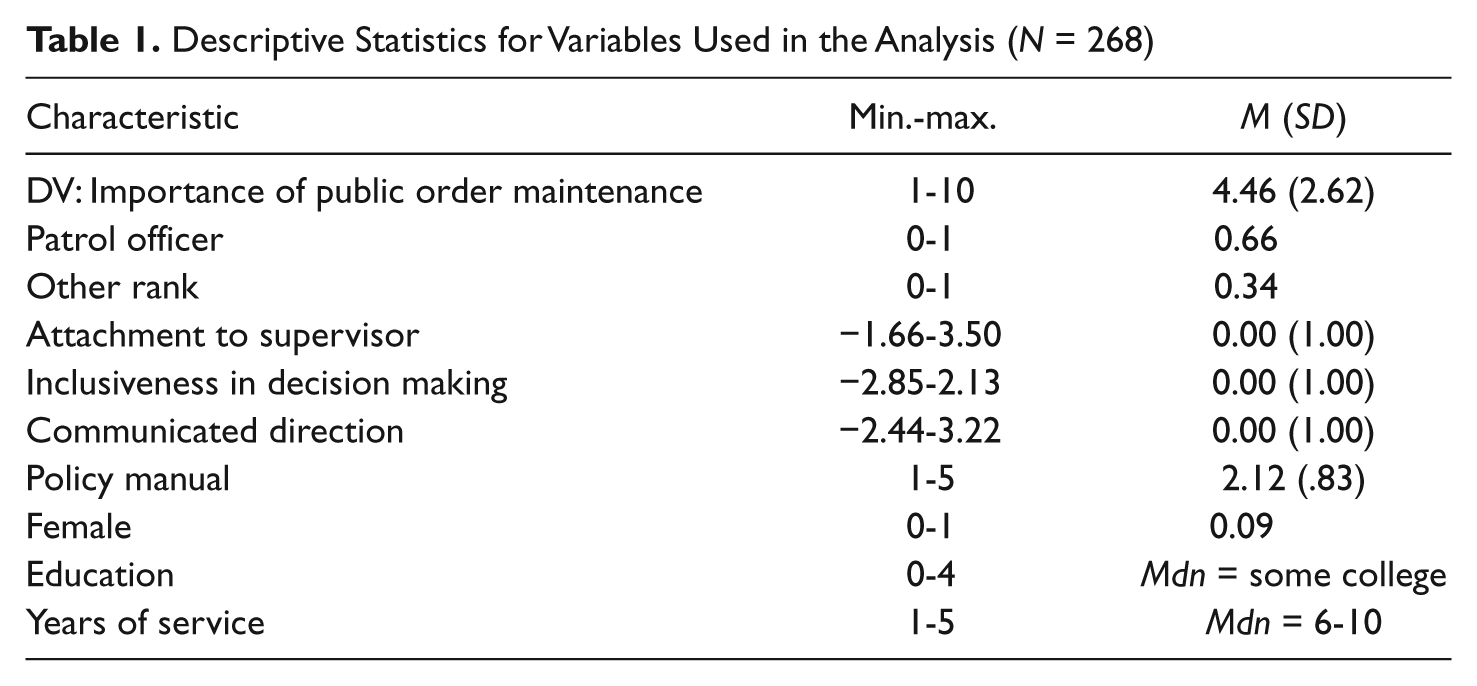
Several control variables were also included to capture any effects that demographic characteristics may exert on the dependent variable. Officers’ “gender” was a dummy variable (female = 1). Education was measured as 0 = no college; 1 = some college, no degree; 2 = associate’s degree; 3 = bachelor’s degree; and 4 = graduate degree. Years of service was measured as 0 = less than one year; 1 = 1-5 years; 2 = 6-10 years; 3 = 11-15 years; 4 = 16-20 years; and 5 = 21 or more years. Respondent race was not gathered in the survey because, like police agencies nationwide, this department’s total force contains a small proportion of persons of color and a race item therefore would have threatened anonymity, particularly among the higher ranks. Table 1 shows descriptive statistics for all of the variables included in the study.
Descriptive Statistics for Variables Used in the Analysis (N = 268)
Analysis
The analysis proceeded in two stages. The first consisted of an independent sample, separate variances t test to determine whether there were differences between patrol officers and higher ranking officers in terms of support for public order maintenance. This served as threshold information about the existence of disparities across ranks. The second stage involved an ordinary least squares (OLS) regression analysis with all above-described variables entered into the model predicting respondents’ attitudes toward public order maintenance. This represented an effort to glean information about the correlates of officers’ beliefs about the level of (un)importance of this policing strategy.
Results
The t test was statistically significant (t = 3.478, p < .001), indicating that patrol officers’ mean ranking of the importance of public order maintenance (M = 4.031) was significantly lower than other officers’ mean (M = 5.231). This was consistent with expectations, as the top-down organizational style can result in attitudinal differences between workers on the bottom rung and those in the middle and upper levels. It appeared that patrol officers were less enthusiastic about order maintenance than their superiors were.
The next step was to run an OLS regression model using the variables described above to test for predictors of sworn personnel’s attitudes toward order maintenance. Table 2 displays the results of this model. Due to the modest sample size in the final regression model (N = 220), a .10 alpha level was permitted to minimize the risk of erroneously overlooking true relationships. Multicollinearity diagnostics showed an absence of worrisome relationships between the independent variables (maximum variance inflation factor [VIF] = 2.188; lowest tolerance = .457; condition index = 13.559).
OLS Regression Predicting Attitudes Toward Public Order Maintenance
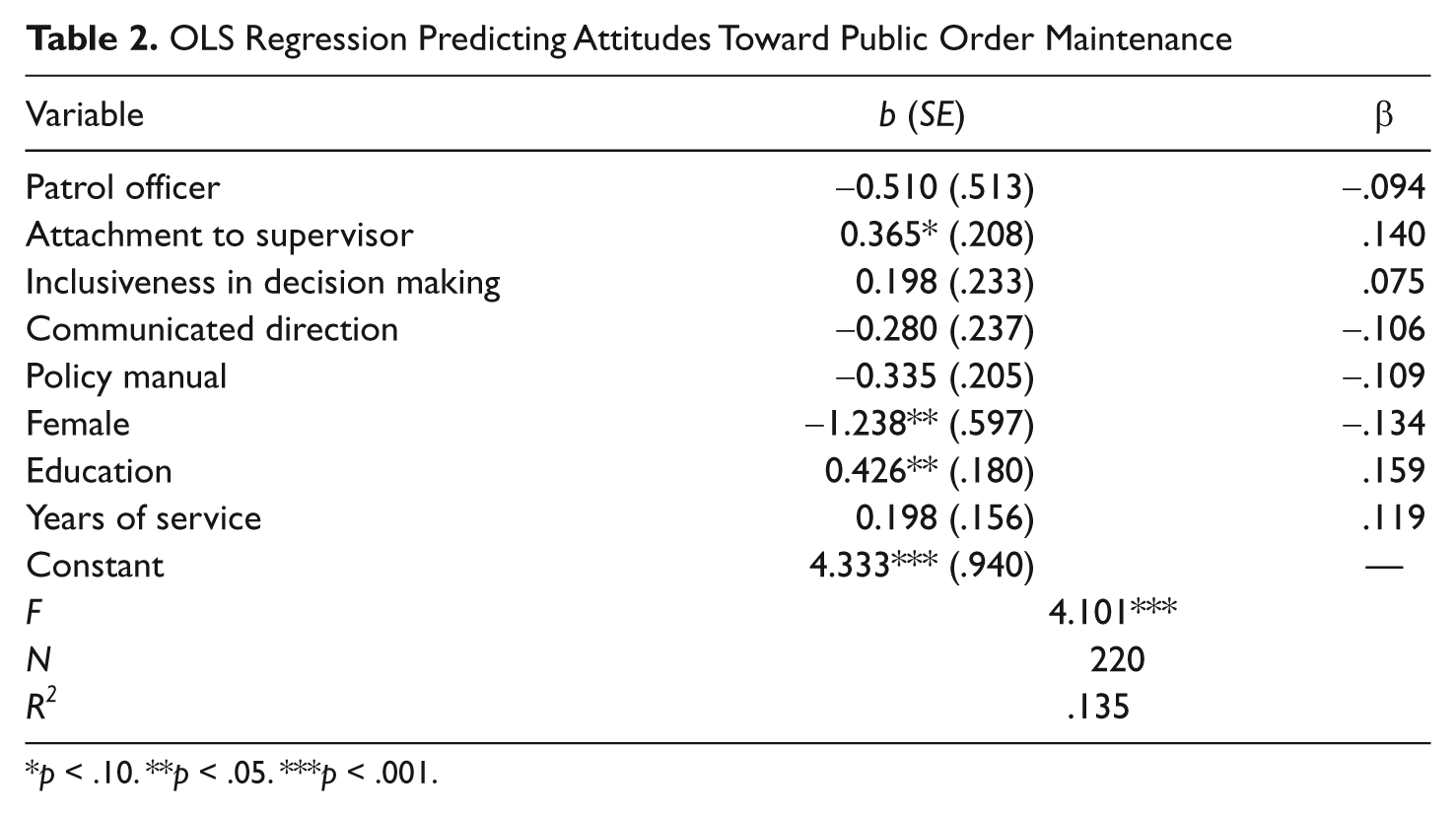
p < .10. **p < .05. ***p < .001.
In the multivariate setting, the apparent differences in ranks vanished. Attachment to supervisors had a positive and significant effect (β = .140, p < .10) on order maintenance endorsement—as predicted, those respondents who had high-quality relationships with their immediate supervisors reported greater support for order maintenance. This finding will be discussed in detail shortly.
None of the other organizational variables emerged as statistically significant. It would appear that, at least in the department under examination here, attitudes toward order maintenance are driven by factors outside of issues relating to organizational structure. The most obvious potential driving force is the macrolevel context in which the department and its officers operate. This will be discussed in the next section.
Two of the control variables emerged as significant predictors of order maintenance support. Greater educational achievement was associated with stronger support for order maintenance (β = .159, p < .05), and being female was associated with significantly less support (β = –.134, p < .05). There were no data in the present study to permit probing into the reasons for these findings, and prior research offers minimal guidance in constructing possible explanations. Research has found that educated officers are less authoritarian (Dalley, 1975), less punitive (Carlan & Byxbe, 2000), more flexible (Roberg, 1978), and less likely to use force (Paoline & Terrill, 2007; Rydberg & Terrill, 2010). It could be, then, that educated police officers are more open to the use of modern policing styles, which would include a proficiency and application of broken windows theory.
With respect to gender, female officers may be more open to broader interpretations of the police role (Sun, 2003) and less likely to resort to physical force (Brooks, Piquero, & Cronin, 1993); however, evidence also suggests that the differences between the genders are negligible with respect to officers’ views about community-based policing (Poteyeva & Sun, 2009) or the police role in general (Worden, 1993). The present finding, then, is difficult to interpret, particularly in light of the fact that these data came from only one department and the statistical results may thus have their origins in something specific to that agency.
Discussion
The present study was conducted in an effort to contribute to both the organizational and the order maintenance policing literatures by merging the two perspectives to explore possible department-generated predictors of sworn personnel’s attitudes about public order maintenance as a policing priority. Based on the troubles that are generally encountered in the top-down organizations like police agencies, it was predicted that patrol officers would be less supportive of order maintenance relative to upper management because order maintenance is a strategy generally adopted by police leaders with little or no input from line-level personnel. It was also expected that respondents’ attachment to their immediate supervisors, perceived inclusion in department decision making, perceptions of the quality of directions, and opinions about the use of the policy and standard operating procedures manuals would be related to enhanced support for public order maintenance.
The t test showed support for the hypothesis that patrol officers evince less support for order maintenance as a policing priority. It is worth noting, however, that although higher ranking officers expressed greater support for order maintenance, it was not exactly a ringing endorsement. These officers’ mean was slightly above 5, the midpoint on the 10-point scale. It would appear, then, that order maintenance is considered low to moderate in priority by all police personnel, irrespective of rank. This finding has implications for the future of order maintenance as a policing strategy. Although police chiefs, mayors, and other high-visibility policymakers may formally declare crackdowns on disorder, such announcements are mere form of words if the people who are supposed to carry out the crackdown (e.g., patrol officers, sergeants) are not on board with the strategy. In top-down organizations, policy implementation revolves around voluntary compliance among line personnel and their willingness to spend their time engaged in a particular activity (Lazin, 1973; Levin, 1980; Lipsky, 1971). Patrol officers generally have at least some amount of discretionary time during their shifts (Famega, 2009) and unless they fully endorse an activity such as order maintenance, they may simply choose not to do it.
The OLS model indicated limited support for the hypothesis that organizational factors influence officers’ attitudes toward order maintenance as a department priority. The model did, though, suggest potential strategies that police managers and supervisors can capitalize on to promote support for order maintenance. One arose from the fact that respondents’ attachment to their immediate supervisors exerted a statistically significant, positive effect on support for order maintenance. It appears that supervisors play an important role in “selling” order maintenance to their subordinates. Supervisory practices that promote lower ranking personnel’s sense of loyalty to their direct superiors may facilitate channels of communication that are not present in supervisor–subordinate relationships that are strained or acrimonious. Implementation of new policies may be fuller and more complete when supervisors are respected by their subordinates and seen as effective leaders. Strong leadership can be encouraged throughout an agency by incorporating this value into the agency’s culture. Every police agency has its own culture that is the product of its unique managerial, political, and community combinations (Paoline, 2004). Executives that value good supervisory practices can ingrain this ethic into their internal cultural fabrics.
Ensuring positive attitudes toward order maintenance policing is, however, not in itself a guarantee that officers will voluntarily engage in these activities on the street. Police executives have several options for maximizing the likelihood that attitudes will translate into behaviors in this context. One strategy is to repeatedly expose officers and supervisors to pro-order maintenance messages, as one of the biggest predictors of the extent to which attitudes influence behaviors is the frequency with which the attitude is endorsed and reinforced (Glasman & Albarracín, 2006). Another is to find out from officers what obstacles they see as standing between themselves and order maintenance. Perceived task difficulty has been shown to dampen the attitude–behavior relationship (Wallace et al., 2005), so anything that police managers do to remove hurdles should increase the likelihood that officers will pursue order maintenance tasks. A third would be to regularly communicate to officers and their immediate supervisors examples of order maintenance successes, such as when a nuisance location has been effectively shut down, and the methods that were used to achieve these victories. Such examples would serve to improve officers’ and supervisors’ knowledge bases about order maintenance, which could both enhance positive attitudes toward the strategy and increase the likelihood that these attitudes would manifest behaviorally (see Fabrigar et al., 2006). Executives would likely find that their efforts had built-in propagatory properties, as individuals’ personal attitudes and actions are shaped, in part, by their perceptions of the extent to which people they admire and refer to seem to hold those attitudes and/or engage in those activities (Ajzen & Fishbein, 2008). Igniting pro-order maintenance attitudes, then, could have a self-perpetuating effect throughout the organization.
The OLS model in the present study also revealed a robust relationship between education and support for order maintenance. Prior studies have shown a link between officer education and a variety of positive outcomes (see Roberg & Bonn, 2004, for a review). Better educated officers are generally less authoritarian, less punitive, and are open to broader interpretations of the police role. It could be that better educated officers are more willing to consider policing strategies—such as order maintenance—that go beyond traditional methods of random patrol and rapid response to calls for service. In conjunction with the above-described ability to shape attitudes via supervisory mechanisms, police managers may be able to promote support for their preferred policies through hiring practices that express a preference for degree-holding applicants. Recruit education is also desirable from a managerial/organizational perspective: Police agencies nationwide are gradually increasing education requirements for applicants (Roberg & Bonn, 2004), and executives who do not implement such prerequisites risk falling behind professionally.
Future research should focus on a continued effort to locate predictors of officers’ attitudes toward order maintenance. It was found in the present study that education was positively related to support for public order maintenance and that female officers in this sample were significantly more critical of this activity than male officers were. It would be worthwhile from both policy and research standpoints to investigate these findings in detail. Variables measuring actual order maintenance activities should also be included in future research. There is not necessarily a direct relationship between attitudes and behaviors in policing (Decker & Smith, 1980) and behaviors can alter attitudes when those behaviors are incompatible with existing beliefs and assumptions (Festinger, 1957), so it is worth considering whether requiring reluctant officers to engage in order maintenance could, over time, produce positive attitudes toward that activity.
Macrolevel factors should also be brought in for consideration. As described earlier, the city in which this department is located suffers from high rates of unemployment, poverty, crime, and socioeconomic decline. The patrol officers in this and similarly distressed cities may simply feel that they have no time for order maintenance because they spend the majority of their shifts answering calls for service. Patrol officers also may question the use of devoting resources to low-level, nonserious crimes when violent crime is such a presence. Wilson and Kelling (1982) conceded the existence of a tipping point whereupon a neighborhood or community becomes too riddled with crime and disorder for order maintenance policing to offer much promise; officers in these areas can do little more than answer emergency calls for service. Macrolevel factors such as crime and disorder affect patrol officers’ attitudes and actions (Klinger, 1997), so future research should examine whether and how police officers’ attitudes toward order maintenance might be shaped by macrolevel concentrations of crime, disorder, and general disadvantage. There is a need for more research into officers’ perceptions of public order maintenance and the extent to which they think that this is a promising and worthwhile strategy for reducing and preventing crime.
Footnotes
Appendix
Acknowledgements
The authors are grateful to the chief and assistant chief of the police department under analysis for providing the data, and to the anonymous reviewers for their helpful comments on earlier drafts of the article.
An earlier version of this article was presented at the 2010 American Society of Criminology meeting in San Francisco, CA, United States.
The authors declared no potential conflicts of interest with respect to the research, authorship, and/or publication of this article.
The authors received no financial support for the research, authorship, and/or publication of this article.