



Abstract
The study aimed to examine sex offender characteristics associated with a decision to confess. Based on the analysis of 624 sex offenders, our findings showed that, depending on the type of sex offender, different characteristics are associated with their likelihood of confessing during the police interrogation. Moreover, distinguishing between those who fully confess and those who only confess partially yielded mixed findings. Finally, our results showed that confession was not static and that offender characteristics were associated with a decision to confess once admitted to the prison. The findings are discussed in light of the implications for interrogation strategies.
Introduction
Research on police interrogation—more specifically on the factors associated with confession—has traditionally looked at generalized offenders. Most interrogation and interviewing strategies have been designed based on a series of individual factors believed to be associated with a decision by offenders to confess. For instance, the Reid technique suggests that the selection of interrogation procedures depends to a considerable extent on the personal characteristics of the suspect himself (Inbau, Reid, Buckley, & Jayne, 2001). For example, the technique classifies offenders on whether they are emotional or nonemotional. Moreover, others have argued that, when preparing to confront a suspect, the interrogator must consider variables such as the age, education, and experience with the criminal justice system (Zulawski & Wicklander, 2001). In the interaction process model of confession (see Moston, Stephenson, & Williamson, 1992; Zulawski & Wicklander, 1993), the characteristics of the suspect are used to determine the approach and style used by the interrogator. Although these authors have argued for the interrogation strategies to also take into account the type of offense committed by the suspect, in practice, the strategies are mainly based on the factors related to confession for offenders in general (e.g., the personality) regardless of offense typology. However, is this appropriate? Is it wise to assume that all offenders react the same way to specific interrogation or interviewing strategies?
When carefully reviewing the studies that investigate offender characteristics related to confession, one striking finding appears: many results are contradictory. For instance, some studies have not found significant associations between offender age and rate of confession (Leo, 1996; Mitchell, 1983; Moston et al., 1992). Moreover, although most studies have found a negative association between previous convictions and the likelihood of confession (Leo, 1996; Softley, 1980), some studies have found either no (Phillips & Brown, 1998) or a positive (Baldwin & McConville, 1980) association. One explanation was suggested by Moston et al. (1992) who demonstrated that these discrepancies were due to a failure to account for interrelationships between factors. Although Beauregard, Deslauriers-Varin, and St-Yves (2010) have confirmed the importance of interactions between the factors leading to confession, we believe there is at least one other possible explanation for these conflicting results. We suggest that these conflicting results may be due to the fact that prior studies have not taken into account the specific type of offender. We intend to explore this issue by examining the specific case of the sex offender.
Sex offenders generally have been identified as less likely to confess their crimes during interrogations in comparison with non-sexual offenders (Beauregard et al., 2010). Lippert, Cross, Jones, and Walsh (2010) found that the rate of confession in a sample of child sexual offenders was 30%. Similarly, Gudjonsson and Sigurdsson (2000) found that the rate of confession of rapists was lower both with the police (61%) and at trial (31%) compared with violent offenders (77% for both). Moreover, the objective seriousness of these crimes as well as their eligibility for very serious imprisonment may inhibit confession, sexual offences often being judged more severely than other crimes (St-Yves, 2006). In addition, sexual offenders more often experience humiliation during interrogation, which could also contribute to a reluctance to confess their crimes (Holmberg & Christianson, 2002).
Very few studies have specifically investigated sex offenders’ characteristics related to a decision to confess during police interrogation. Those that have suggest that offender characteristics associated with a higher likelihood of confessing include being young, single, White, presenting with a high IQ or an introverted or borderline personality, and expressing guilt after the crime (Beauregard et al., 2010; Beauregard & Mieczkowski, 2011; Faller, Birdsall, Henry, Vandervort, & Silverschanz, 2001; Lippert et al., 2010; St-Yves, 2006).
These previous studies have examined confession as a dichotomous outcome: in effect, either one confesses or does not. But for police officers who have been in an interrogation room with a suspect, the reality is more complex. Confessions take on a far more nuanced character. There can be equivocation about a lot of the specifics of the crime event. Offenders may admit that they were at the crime scene but deny having committed the crime, which is essential to the actus reus of the crime. Some may confess to the crime, but deny having committed certain acts. In sexual complaints, the suspect may in fact admit to everything that forms the actus reus, but defend the behavior as consensual between suspect and complainant.
Some researchers have attempted to capture this complexity by operationalizing the confession concept differently. For instance, Moston et al. (1992) identified three outcomes: confess (41.8%); deny (41.8%); or do neither of these things (16.6%; e.g., use of the right to silence). Similarly, Leo (1996) identified four different outcomes: the suspect provided no information to the police that they considered incriminating (35.7%); the suspect provided some information that police considered incriminating (whether or not intentionally) but did not directly admit to any of the elements of the crime (22.5%); the suspect admitted to some, but not all, of the elements of the crime (17.6%); and the suspect provided a full confession to the detectives (24.2%). Pearse, Gudjonsson, Clare, and Rutter (1998) highlighted five different possibilities related to the interrogation of a suspect. A full confession is when the offender accepts his responsibility as well as recognizes the intent associated with the crime. In a partial confession, the offender may admit to the act but denies having the intent to cause any harms. However, a full admission entails that the offender admits committing the act but without the intent of causing any harms, whereas in the partial admission, the offender may admit to being present at the scene with the victim but will make any admission with regard to intent. The final category is when the offender makes no confession. Finally, in Holmberg and Christianson’s (2002) study, a denial-admission scale (1 = not at all to 7 = very much so) was used to examine the confession of murderers and sex offenders. Results showed that 49% of murderers admitted the crime compared with 28% for sex offenders. Although in most of these studies the authors ended up dichotomizing their confession variable (yes/no) to facilitate the analyses, they nonetheless acknowledged the “complexity” and character of the different levels of confession.
This complexity can also be found in the different mechanisms leading to an offender’s confession. Although studies have identified factors associated with a likelihood of confession, more recent studies have shown that this “decision” to confess is not static in time. In fact, Deslauriers-Varin, Beauregard, and Wong (2011) have shown that some offenders would actually change their mind about confessing, going from an intention to confess before entering the interrogation room to a decision not to during the interrogation. Using multinomial logistic regression on a sample of 211 incarcerated offenders, they found that compared with true confessors (i.e., those offenders who actually did confess after making the decision to confess prior to entering the interrogation room), “confessor-nonconfessor” offenders (i.e., offenders who had initially decided to confess but changed their mind once in the interrogation room) were more likely to report weaker evidence against them and to request legal counsel. They also were more likely to have committed their crime with accomplices and were also more likely to have at least three prior convictions (Deslauriers-Varin, Beauregard, et al., 2011). We believe this illustrates that the decision to confess is dynamic in nature. Confession decisions are often treated as static—that is, once made they are in effect irrevocable. Our view is that confessions are dynamic, malleable, and that they vary at different stages of the suspect’s processing by the criminal justice authorities. The confession motivation of the suspect is contextual, and as the criminal justice context changes so do they underlying motives to confess to or deny the criminal accusation the suspect faces.
Aims of the Study
This study aims to answer three distinct questions related to the confession of sex offenders.
Hypothesis 1: Differences in likelihood to confess or not confess vary by offender types.
First, as interrogation and interviewing strategies are mainly based on offender characteristics related to confession, it is important to test whether all types of offenders who decide to confess their crime during police interrogation present these same or very similar characteristics. Although the selection of interviewing and interrogation techniques is not a constant, this comparison can be made by evaluating the effect of sex offender characteristics across three groups: one group of mixed sex offenders, one group of child molesters only, and one group of rapists only. Moreover, research on sex offenders has shown that this group of offenders is heterogeneous (Knight & Prentky, 1990) and that child molesters and rapists present differences in their decision making during the crime-commission process (Beauregard & Leclerc, 2007). Contrary to the most traditional literature on police interrogation and confession, we hypothesize that differences exist between subgroups of sex offenders. We predict that different offender characteristics for child molesters and rapists will be associated with a decision to confess.
Hypothesis 2: Complete or partial confession is related to offender typology.
Second, most researchers and practitioners realize that the decision to confess is more complex than just a dichotomous outcome. However, multivariate models of confession have been limited to binary logistic regression. To better understand, the different factors related to confession while controlling for the other factors, previous research has neglected to examine the suspects who will confess partially. This is potentially important, as St-Yves (2006) points out that some sex offenders compromise by making a partial confession to satisfy their need to confess while at the same time minimizing their feelings of shame. In the current study, we attempt to solve this issue by using multinomial logistic regression to identify sex offender characteristics that are related to a decision to not confess, confess partially, or confess completely during the police interrogation. We predict that different offender characteristics are associated with a decision to confess partially or completely.
Hypothesis 3: Offender characteristics are associated with dynamic changes in confession over the punishment trajectory of the offender.
Finally, we suggest that the decision to confess is not a “static” and irrevocable event (as it has been treated in previous analyses), but rather a dynamic process in which a confession and its context is often likely to change over time. In effect, a confession has a trajectory that is situational. We want to test if the sex offender characteristics associated with a decision to confess during police interrogation are the same once admitted to the prison. Moreover, we are proposing a new scale of confession, which includes several dimensions (i.e., admitting to the acts committed, the responsibility of the crime, and the negative consequences). If several dimensions of confession exist—as several types of denial strategies seem to exist (see Moston & Stephenson, 2009)—this could lead to different questioning strategies at various interrogational stages in an investigation. We hypothesize that, because the context is different and the stakes are not the same (i.e., a sex offender confessing during police interrogation faces a likely conviction whereas, once admitted to the prison, the same offender could face placement in a higher security institution or very strict conditions), a different pattern of offender characteristics related to the decision to confess should emerge.
Method
Participants
All adult males serving a sentence of at least 2 years in a Canadian federal penitentiary for a sexual crime were recruited for a survey between April 1994 and June 2005. The participation rate was 93%, 624 inmates agreeing to collaborate with the research team. 1 All participants signed a consent form indicating that the information gathered would be used for research purposes only. At the time of the survey, the majority of participants were incarcerated in a maximum-security institution (Regional Reception Center) run by the Correctional Service of Canada. The average stay in this institution is about 8 weeks, during which time inmates undergo correctional assessment procedures prior to their transfer to an institution suited to their risk level and treatment needs. Participants included in this study were mostly White (87.7%). On average, they were 39 years old (SD = 12.0) and serving a prison sentence of 4.2 years (SD = 3.6). In this sample of sex offenders, 30.6% were sexual recidivists.
Procedures
Data were collected during a semistructured interview with each participant using the Computerized Questionnaire for Sexual Aggressors (CQSA; St-Yves, Proulx, & McKibben, 1994). The CQSA is an interview guide that includes information on several aspects of the offender’s life and criminal activity, including correctional information, precrime, crime, and postcrime factors, attitudes about the offence, apprehension, victimology, developmental factors, and diagnoses. Details about participants’ criminal activities were also obtained from police records, victim statements, and institutional case files. In cases of disagreement between self-reported data gathered using the CQSA and official data (institutional files, which also include the police report and the victim statement), the official data were used. Interrater agreement was measured on the basis of 16 interviews (and consultation of official files) conducted jointly by two raters. Ratings were done independently following these interviews. The mean kappa was 0.87, which indicates very strong agreement. 2
Measures
Dependent variables
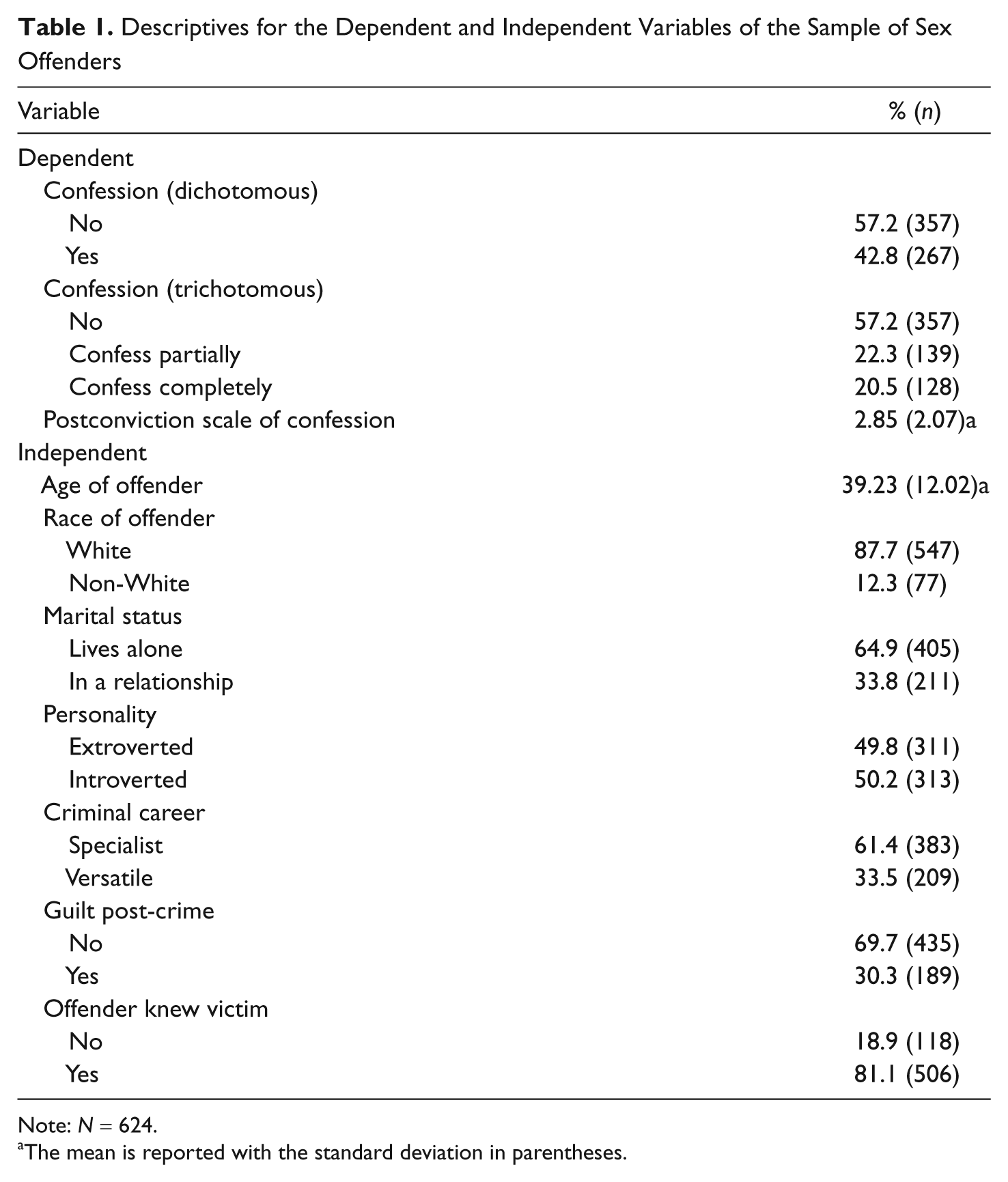
This study examines confession from three different perspectives. The first one looks at confession as a dichotomous outcome (0 = do not confess, 1 = do confess). A total of 267 sex offenders (42.8%) decided to confess during the police interrogation, which is similar to other studies on confession (see Gudjonsson, 2003). The second approach treats confession as a three-level outcome (0 = do not confess, 1 = confess partially, 2 = confess completely), 3 similar to Leo (1996). As can be seen in Table 1, 22.3% decided to partially confess their crime whereas 20.5% confessed completely during the police interrogation. This information was collected from the police report. The third dependent variable—and an approach distinctly different from prior studies—investigates what we call “postconviction confession,” which is the decision to confess once the offender is admitted to the prison. The “postconviction confession” variable is a scale that is computed from the summing of the following three variables: (a) the offender admits the acts committed, (b) the offender admits his responsibility, and (c) the offender admits the negative consequences for the victim. Each of these three variables are scored as 0 = no, 1 = partially, and 2 = yes. Reliability analysis of the scale produced a measure of Cronbach’s alpha of 0.82. The mean of the postconviction confession scale is 2.85 for a range of 0 to 6. Confession once admitted to the prison was obtained during the initial assessment of the offender. Typically, the offender meets a criminologist for an extensive interview for the purpose of his placement and potential participation in treatment programs. During this interview, the offender is asked several questions concerning his involvement in the crime, more specifically if he admits having committed the crime, if he recognizes his responsibility, and if he recognizes the negative consequences for the victim.
Descriptives for the Dependent and Independent Variables of the Sample of Sex Offenders
Note: N = 624.
The mean is reported with the standard deviation in parentheses.
Independent variables
This study examines seven offender characteristics that have been investigated in prior studies on confession:
Age
Race/ethnicity
Marital/relationship status
Self-reported guilt by the offender
Offender personality
Conviction history
Victim/offender relationship
Age of the offender has been examined in several studies. As mentioned previously, most studies have found a negative relationship between age and confession (see Gudjonsson, 2003) but some did not (e.g., Leo, 1996; Mitchell, 1983). In the current study, the mean age of the sample is 39.2 (SD = 12.0), offenders being aged between 18 and 78 years old. This information was collected from the institutional files.
Previous studies have found that race was significantly related to the decision to confess during police interrogation. Thus, White suspects show a greater proclivity to confess their crimes compared with ethnic minorities (e.g., Black and Asian; see Pearse et al., 1998; Phillips & Brown, 1998). In the current study, race was coded as 0 = White, 1 = non-White. As can be seen in Table 1, our sample includes a majority of White sex offenders (87.7%). This information was collected from the institutional files.
Marital status, to our knowledge, has only been examined in two studies, showing that offenders who are married or in a relationship at the time of the interrogation are less likely to confess their crime to the police (Deslauriers-Varin, Lussier, & St-Yves, 2011; St-Yves, 2006). In the current study, marital status was coded as 0 = lives alone, 1 = is in a relationship. Most sex offenders (64.9%) in our sample were living alone at the time of the interrogation. This information was collected from the police reports, included in the institutional files.
Feelings of guilt after the crime have been linked to a greater likelihood of confession during police interrogation (see Deslauriers-Varin, Lussier, et al., 2011; Gudjonsson, 2003). In the current study, this was coded as a dichotomous outcome (0 = no, 1 = yes) and findings in Table 1 show that a majority of sex offenders of our sample (69.7%) did not express feelings of guilt following their crime. This information was collected from the semistructured interview with the offender and was corroborated with several different assessments (e.g., psychological assessment) included in the institutional files.
The personality profile of the offender has also been linked to a proclivity to confess during police interrogation. Prior studies have found that suspects who presented an introverted personality (e.g., avoidant, dependent, schizoid personality disorders) were more likely to confess during police interrogation (see Gudjonsson, 1999; Gudjonsson & Sigurdsson, 1999). In the current study, the personality (0 = extroverted, 1 = introverted) of the sex offenders was examined. An extroverted personality corresponds to a personality profile characterized by antisocial, borderline, narcissistic, and impulsive personality disorders, whereas an introverted personality corresponds to a personality profile characterized by avoidant, dependent, and passive–aggressive personality disorders. Personality diagnoses were made by a psychologist using the Diagnostic and Statistical Manual of Mental Disorders (4th ed., [DSM-IV]; American Psychiatric Association, 1994) criteria during the intake assessment. The psychologists reached their diagnosis after a careful examination of the case file and a thorough interview with the inmate. To limit the number of predictors in our models and to obtain the extroverted/introverted personality profile, we ran two-step cluster analyses on seven personality variables: (a) offender presents an antisocial personality, (b) offender presents a borderline personality, (c) offender presents a narcissistic personality, (d) offender presents an avoidant personality, (e) offender presents a dependent personality, (f) offender presents a passive–aggressive personality, and (g) offender presents an impulsive personality (see Beauregard et al., 2010). Sex offenders included in the current study were almost evenly split as to their personality, with 50.2% presenting an introverted personality.
The presence of prior convictions is another conflicting factor related to the decision to confess during police interrogation. As mentioned previously, although most studies have found a negative association between previous convictions and the likelihood of confession (see Leo, 1996), some studies have found either no (Phillips & Brown, 1998) or a positive (Baldwin & McConville, 1980) association. In the current study, prior convictions were also investigated, but from a different perspective (0 = specialist, 1 = versatile). For the purpose of our study, we distinguished between a “specialized” and “versatile” criminal career for sex offenders. “Specialist” sex offenders describe offenders who started their criminal career late, exhibited almost no variety in their criminal career, and had committed several sexual crimes but few crimes against property or persons, whereas “versatile” sex offenders described offenders who started a varied criminal career early; this career was characterized by few sexual crimes but many crimes against property and persons. Once again, to limit the number of predictors in our models and to obtain the specialist/versatile criminal career profiles, a two-step cluster analysis was run on five criminal career variables that take into account only the offenses committed when the offender was 18 or older: (a) age of onset of criminal career, (b) total number of crimes against persons, (c) total number of sexual crimes, (d) total number of crimes against property, and (e) total variety of criminal career (see Beauregard et al., 2010). This information was collected from the criminal records of the offenders, which are included in the institutional files.
Finally, some studies have shown that the offender–victim relationship may influence the decision to confess during police interrogation. For instance, Beauregard et al. (2010) have shown that offenders were less likely to confess during the police interrogation when they knew the victim. In the current study, we coded whether the offender knew the victim (0 = no, 1 = yes). As presented in Table 1, the majority of sex offenders (81.1%) knew their victim. This information was collected from both the police reports and the victim statements included in the institutional files.
Analytical Strategy
Recall that we have proposed three different hypotheses—differential rates of confession by subgroups of offenders, confession as an ordinal outcome (complete, incomplete, denial of guilt), and dynamic changes in confessional narrative at different stages of criminal justice processing. Because of the varying nature of the dependent variables, we used three different statistical techniques to appropriately examine the relationships between the offender characteristics and the decision to confess. Logistic regression was used to look at the multivariate relationships between the offender characteristics and the dichotomous confession variable.
Although the multivariate research on confession has typically relied on binary logistic regression, such a technique is problematic as it restricts comparison with two categories when in reality three or more categories are of theoretical interest (e.g., Moston et al., 1992). Our second confession variable is a three-category nominal variable: do not confess, confess partially, and confess completely. As binary comparisons potentially result in misspecified models, multinomial logistic regression is a more appropriate analytic technique in this case. In this procedure, the probabilities of not confessing are estimated simultaneously with the probabilities of confessing partially and confessing completely. The procedure uses all the information simultaneously, thereby producing the most efficient estimates with the integration of a number of choice probabilities within an efficient closed form.
Finally, to investigate the multivariate relationships between offender characteristics and the postconviction scale, we had to use a different statistical technique. As the scale in the current study is highly skewed—with a large percent of respondents who scored 0—this condition violates the normality assumption of ordinary least-squares (OLS) regression. The postconviction scale in the current study is treated as a count variable. It is measured by the number of occurrences of each question used to compute the scale. Poisson regression has been designed for discrete count models and allows the use of nonnormal distributions (Long, 1997). We use it to assess the significance of the dynamic change in confessional behavior over the trajectory of the offender’s path through the criminal justice process. 4
Results
Table 2 presents results from our logistic regression analyses. As can be seen from the table, we decided to run three different models. The first model examines the effect of offender characteristics on confession using the full sample of sex offenders. Results show that the older sex offenders are (B = −.02, p < .05) the more versatile (B = −.73, p < .001), and when they knew the victim (B = −.62, p < .05), the less likely they are to confess to the police. However, when they show guilt after the crime, they are more likely to confess (B = .60, p < .01). Being introverted is positively associated to a decision to confess (B = .36, p < .10) whereas being non-White is negatively associated to a decision to confess (B = −.54, p < .10), although these last two relationships are only marginally significant.
Logistic Regression of Sex Offender Characteristics on the Dichotomous Decision to Confess With Full Sample, Child Molesters Only, and Rapists Only

Note: B coefficients are presented (with standard error in parentheses).
p < .10. **p < .05. ***p < .01. ****p < .001.
As we are interested in knowing if the effects of these offender characteristics are the same for different types of sex offenders, we ran a second model with the child molesters only. Offenders were classified as child molesters if the age of the victim was below 14 years. Some differences are noticed. First, personality and race are no longer marginally significant. They appear not to be associated at all to the decision to confess during police interrogation. In addition, our findings show that knowing the victim is not significant for child molesters. However, guilt (B = .87, p < .001) and the criminal career (B = −.74, p < .05) are still significant for child molesters. Age of the offender (B = −.03, p < .05) shows practically the same result as with sex offenders in general.
As to the rapists only (offenders for which the victim is aged 14 years or older), interestingly, they show a different pattern than child molesters. As can be seen in Table 2, two offender characteristics are no longer significantly related to a decision to confess during police interrogation: age of the offender and guilt after the crime. This contrasts with the child molesters for which guilt was a stronger predictor compared with sex offenders in general. Although the criminal career presents the same effect on the decision to confess for rapists (B = −.71, p < .05), two other offender characteristics become significant: personality and the offender–victim relationship. Results show that an introverted personality is positively associated with a decision to confess (B = .61, p < .05), whereas knowing the victim is negatively associated with a decision to confess during police interrogation (B = −.67, p < .05).
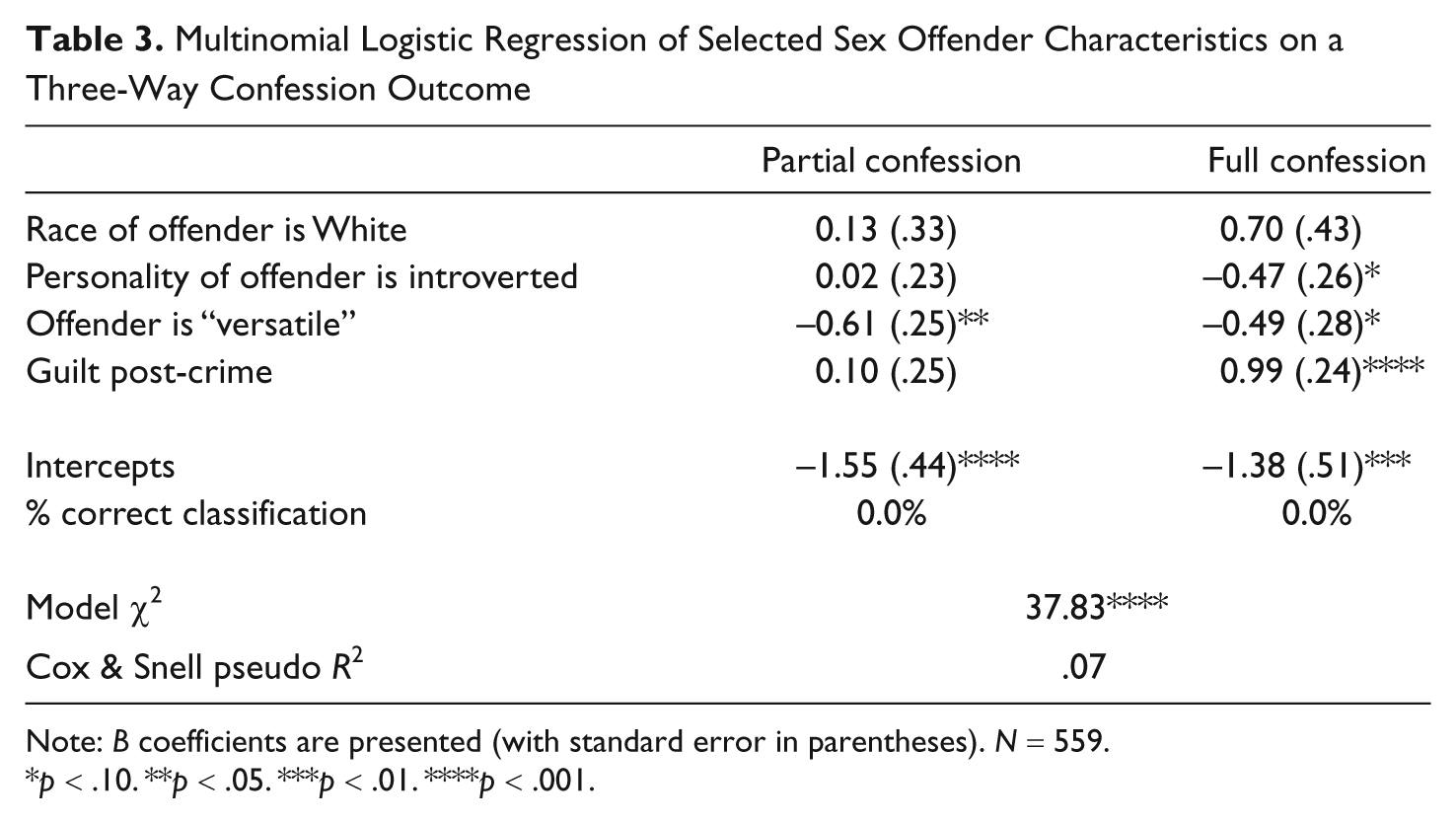
Table 3 presents the results of the multinomial logistic regression model on our three-category confession measure using the full sample of sex offenders. It should be noted that, because of the sample requirement to perform the multinomial logistic regression, we had to proceed differently from our logistic regression analyses. First, it was not possible to run analyses for each type of offender separately because of the sample size. We tested the variable “type of offender” (i.e., child molester/rapist) at the bivariate level, and it was not significant. Second, because too many cells presented zeros when we introduced all of the offender characteristics simultaneously, we had to test each variable individually at the bivariate level. Then, we introduced only the ones that were significant individually to the final model shown in Table 3. Two observations are of interest here. First, only two offender characteristics are capable of distinguishing between those who offered a partial confession and those who offered a full confession. Thus, when sex offenders present a “versatile” criminal career profile, this is less likely to lead to a partial confession (B = −.61, p < .05) and—although only marginally significant—to a full confession (B = −.49, p < .10). In addition, when sex offenders present a feeling of guilt after the crime, they are more likely to provide a full confession (B = .99, p < .001).
Multinomial Logistic Regression of Selected Sex Offender Characteristics on a Three-Way Confession Outcome
Note: B coefficients are presented (with standard error in parentheses). N = 559.
p < .10. **p < .05. ***p < .01. ****p < .001.
The second observation is that, although the model is significant, it is unable to correctly classify the partial and full confessors. To investigate further this finding, we decided to run additional analyses. First, we ran a logistic regression analysis with all of the offender characteristics to predict only those offenders who partially or fully confess during the police interrogation (N = 215). Once again, although the model is significant, only one offender characteristic is significantly predicting those sex offenders more likely to fully confess: feeling of guilt after the crime (B = .93, p < .01). Moreover, the model is not able to correctly classify the partial and full confessors. 5
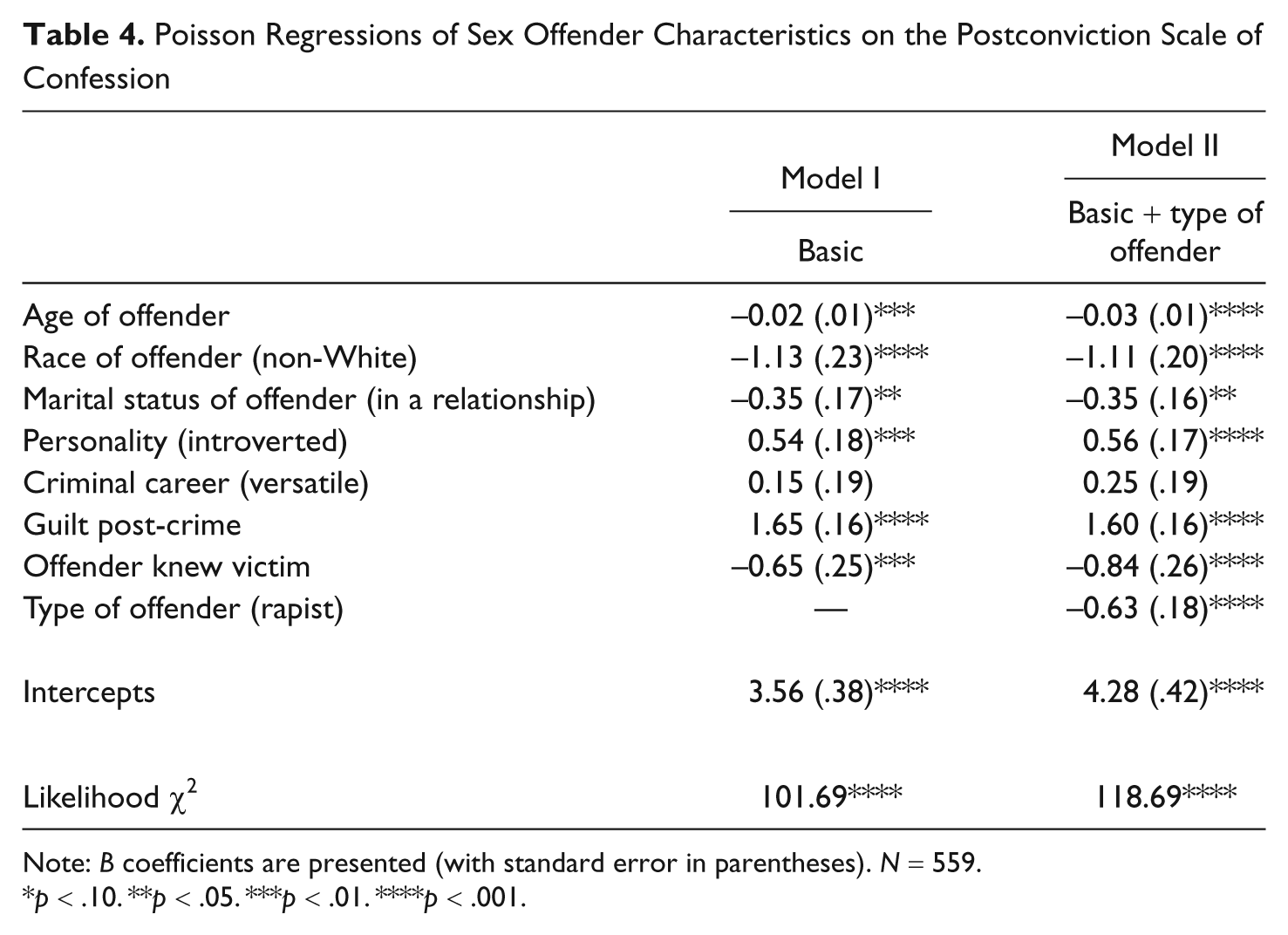
Finally, Table 4 presents the results of the Poisson regression analysis6 on the postconviction scale of confession. Here, to be able to control for the type of offender (i.e., child molesters and rapists), we ran two models: a first “basic” model with all of the offender characteristics and a second model adding the “type of offender” variable to the offender characteristics. Interestingly, all offender characteristics significantly predict the postconviction confession scale, except for the criminal career. This contrasts with our findings on confession during police interrogation. Moreover, we observe that, postconviction, the race of the offender (B = −1.13, p < .001) and his marital status (B = −.35, p < .05) become significantly and negatively related to a decision to confess to the crime once admitted to the prison. Finally, our second model shows that the type of offender is significantly related to the decision to confess once admitted to the prison, suggesting that rapists are less likely to confess than child molesters. In addition, after introducing the variable depicting the type of offender, results show that the effect of age of the offender, offender personality, and the offender–victim relationship is becoming stronger, suggesting once again the effect that type of offender has on the decision to confess.
Poisson Regressions of Sex Offender Characteristics on the Postconviction Scale of Confession
Note: B coefficients are presented (with standard error in parentheses). N = 559.
p < .10. **p < .05. ***p < .01. ****p < .001.
Discussion and Conclusion
Our first aim was to examine if characteristics associated with a decision to confess during police interrogation were the same for all types of sex offenders. When disaggregating sex offenders into two main types—that is, child molesters and rapists—we notice that they present different patterns leading to confession. For child molesters, age at time of offense and feelings of guilt after the crime are significant characteristics associated with a decision to confess. However, what is typical for rapists is a quite different pair of attributes—the personality profile and the offender’s relationship of knowing the victim. Merrill (1995) suggests using emotional appeals with some rapists as a technique to enhance the probability of a confession. He points out that, even though they do not believe that they have committed a crime, they usually feel some remorse for their actions. In light of our findings, we believe that such a strategy would likely prove ineffective, as a feeling of guilt was not significantly related to a decision to confess by rapists. Our findings suggest that investigators in charge of interrogating suspects need to look beyond the offense committed and establish a “profile” of the individual based on his characteristics.
One way to do this is to adopt a “profile” approach, as in St-Yves (2006). Instead of matching interrogation tactics to specific subtypes of sex offenders, St-Yves (2006) identified three profiles of collaboration during the police interrogation. Each profile presents a constellation of characteristics that are associated—positively or negatively—with a likelihood of confessing. It is then possible, for example, to design interrogation strategies based on a suspect characterized by an introverted personality. In this case, the interrogator may exploit the remorse and feelings of guilt associated with the crime as well as the anxiety related to denying and lying, to put pressure on the suspect and provoke in the offender an irresistible need to confess (Gudjonsson & Sigurdsson, 1999).
Our second aim was to distinguish between sex offenders who made the decision not to confess, to confess partially, or to confess completely. As shown in several studies, the decision to confess is more complex than a simple yes/no dichotomy. For instance, St-Yves (2006) suggested that some sex offenders may compromise by making a partial confession that satisfies their need to confess while minimizing their feelings of shame when they describe the crime. Our findings suggest that feeling of guilt after the crime was the only characteristic that distinguished the partial confessors from the full confessors. However, these findings need to be interpreted cautiously as the variable “feelings of guilt” was not strong enough to correctly classify any of the participants in either the partial or full confession category. However, it is important to bear in mind that we have only examined offender characteristics. It is possible that complementary factors (e.g., perception of police evidence; Deslauriers-Varin, Lussier, et al., 2011) could help to better discriminate between the partial and full confessors and improve classification accuracy.
This was exemplified when analyzing our postconviction confession scale. Instead of determining very distinct categories (e.g., partial confessors vs. full confessors), the scale allows us to look at the decision to confess as a continuum. In the current study, our postconviction confession scale included three different dimensions—that is, admit the acts committed, admit responsibility in the crime, and admit the negative consequences for the victim. Offenders who scored zero denied everything related to the crime. However, the scores obtained with the scale show that offenders do not usually adopt a dichotomous (yes/no) response strategy when it comes to confession. Instead, most will only admit some components of the crime. This is not really surprising, as some aspects related to the crime may be too difficult to admit at first. For instance, it is not unusual for a child molester to admit having sexually touched a child, but to deny penetration (e.g., I may have touched her while I was bathing her, but I’ve never put a finger inside of her.). Others will admit their responsibility (e.g., Yes, I did it, it’s my fault. The kid only wanted someone to play with and I took advantage of that to abuse him.), but will deny the negative consequences to the victim (e.g., That kid had problems at school way before I touched him.). Therefore, we believe it is necessary for the operationalization of confession to be as close as possible to what occurs in the real world, as research will and should inform police practices.
The postconviction confession scale also produced some interesting findings regarding the stability—or lack thereof—of this decision throughout the criminal justice system. As shown by Deslauriers-Varin, Beauregard, et al. (2011), some offenders actually change their mind while in the interrogation room. They identified a group that represented 10.9% of their sample who initially planned to confess, but changed their minds following the interrogation process. Our findings show that the decision to confess is not static in time or across contexts (i.e., police interrogation, admission to prison). To investigate further this issue, we have tested the same sex offender characteristics to see how they may be related to a decision to confess postconviction. We observed that specific offender characteristics were significantly related to a decision to confess postconviction. Although race and marital status had no effect on the decision to confess during the police interrogation, these two characteristics were significantly related to the decision to confess once admitted to the prison. Zulawski and Wicklander (2001) suggest that this can be a rational decision by the offender. It may be based on the offender’s need to protect some other component of their life (e.g., risks of losing his partner). Also, it is interesting to note that one of the most important offender characteristics related to a decision to confess during the police interrogation—that is, the criminal career—was not at all significantly related to a decision to confess once admitted to the prison. This suggests that experience with the criminal justice system may play a role during the interactions with the police but has no influence once admitted to the prison. Clearly, the stakes involved in the decision to confess vary according to the context. The offender who has to weigh the costs and benefits of confessing may conclude that a confession to the police will potentially get him a shorter sentence, whereas confessing once admitted to the prison could result in a placement into a segregation unit.
This study is not without its limitations. First, all cases included in the present study were convicted sex offenders incarcerated in a penitentiary. This suggests that this sample is composed of only the most serious offenders, many of which are recidivists. Second, it could be argued that we limited our investigation to offender characteristics, neglecting to include measures of perception of the strength of evidence, the interviewing strategies, the attitude of the police officer during the interrogation, and whether or not the suspect asked for legal representation. Although we are well aware that these variables are crucial to the confession decision making, it was important here to focus on the offender characteristics as these usually guide the interrogation strategies used by the police. Another limitation concerns the unavailability of a non-sex offender sample for comparative purposes.
Our findings have highlighted the fact that offender characteristics associated with confession are not the same for all types of offenders and that the decision to confess was not static and could vary depending on the context. We believe that future studies need to adopt an empirical typological approach—such as a latent class type of analysis—to match existing types of offenders with their typical response during the police interrogation, something already suggested by Napier (2010) with sex offenders.
Footnotes
The authors declared no potential conflicts of interest with respect to the research, authorship, and/or publication of this article.
The authors received no financial support for the research, authorship, and/or publication of this article.