



Abstract
In response to an increase in violent crime during the mid-2000s, the Boston Police Department implemented the Safe Street Teams program to control “hot spots” that generated a disproportionate amount of violence in Boston through the use of community and problem-oriented policing interventions. Like many police programs, the Safe Street Teams strategy was not implemented with a commitment to conduct a program evaluation. The Smart Policing Initiative provided the Boston Police with an important opportunity to partner with academic researchers to perform retrospective process and impact evaluations. Quantitative and qualitative methods were used to analyze the concentration and stability of violent crime in targeted places, examine the integrity of program implementation, and conduct a rigorous quasi-experimental analysis of program impacts. These research products established the crime control effectiveness of the Safe Street Teams and assisted the Boston Police in strengthening the implementation of the program.
Introduction
A small but growing body of research evidence suggests that place-based police interventions focused on crime “hot spots” generate significant crime control gains (Braga, Papachristos, & Hureau, 2012; Braga & Weisburd, 2010). This movement toward place-based policing has been facilitated in many police departments by the adoption of strategic innovations such as Compstat (Weisburd, Mastrofski, McNally, Greenspan, & Willis, 2003) and the rapid diffusion of crime mapping technology (Weisburd & Lum, 2005). While place-based policing strategies have been adopted by a majority of U.S. police departments, very few agencies make a priori commitments to rigorous evaluations of these programs. As such, our existing scientific knowledge base on the effectiveness of these programs remains modest despite the ubiquity of hot spots policing programs across the United States.
The U.S. Bureau of Justice Assistance (BJA) Smart Policing Initiative (SPI) provides police departments with funds to collaborate with academic researchers to analyze recurring crime problems, develop innovative responses to targeted problems, and evaluate the impact of implemented programs (http://www.smartpolicinginitiative.com/). In 2007, the Boston Police Department (BPD) implemented its Safe Street Teams (SST) program that used community and problem-oriented policing interventions to control violent crime hot spots. Like many police programs, this place-based policing strategy was launched without any formal plans for evaluation during initial program planning and implementation. In 2009, the BPD received a SPI grant to work with academic researchers to conduct a rigorous evaluation of the SST program. As described in this article, the evaluation revealed that the targeted hot spots represented some of the most persistently violent places in Boston, SST officers implemented a variety of community problem-solving responses to address problems in the targeted locations, and the program resulted in significant reductions in violent crimes in the targeted places without displacement violent crime problems to nearby areas.
Although it is best to include evaluation as a part of the planning, development, and implementation of police programs, the Boston SPI experience showed that rigorous, retrospective evaluation can still be carried out effectively. The Boston SPI team successfully addressed the challenges associated with building a solid, after-the-fact program evaluation, and the study produced findings that are of considerable value to BPD and other law enforcement agencies across the United States. Indeed, this experience shows that the ideals and principles of evidence-based policing are compatible with the realities of police program development and implementation as currently practiced in the field. 1
Program Evaluation and the Value of Police–Academic Researcher Partnerships
Evidence-based policing is a part of a larger and increasingly expanding movement in social policy to use scientific research evidence to guide program development and implementation (Sherman, 1998). In general terms, this movement is dedicated to the improvement of society through the utilization of the highest quality scientific evidence on what works best (Sherman, Farrington, Welsh, & MacKenzie, 2002). Many police departments, unfortunately, adopt new strategic innovations without considering evaluation (National Research Council, 2004). Police executives exist in high-pressure, political environments that require immediate responses to rapidly unfolding events and crisis situations. In response to troubling increases in crime, some police departments implement reactionary strategies such as mobilizing saturation patrols of large problem areas or establishing a new specialized unit to focus on the issue of concern.
Other police departments quickly review the available professional literature on “best practices” in crime control and prevention or may talk with colleagues in other police agencies that received positive news coverage for a promising program, and then implement their version of whatever program, at face value, seems to fit the problem they need to address. Program evaluation, at best, is an afterthought. These approaches to program development and implementation do not well position police departments to determine whether the adopted strategies are actually generating the desired outcomes. More broadly, it hinders the police profession from developing a scientifically based body of knowledge on “what works” in crime control and prevention (Weisburd & Neyroud, 2011).
This reality of police program development and implementation is not incompatible with an evidence-based policing model. While it is ideal to make evaluation plans before a program is implemented, rigorous evaluation remains a very important exercise after police programs have commenced. However, there needs to be the ongoing commitment within the police department to developing a practical knowledge base on newly implemented programs that is rooted in rigorous scientific methodology. Strong police–academic research collaborations are also essential in conducting high-quality analyses of program operations and effectiveness.
Program Evaluation
The evaluation of police programs is important for at least two different reasons. The first is to ensure that police remain accountable for their performance and for their use of resources. Citizens and their representatives want to know how the money and freedom they surrendered to the police are being used and whether important results in the form of less crime, enhanced security, or increased citizen satisfaction with the police have been achieved. A second reason assessment is important is to allow the police to learn about what methods are effective in dealing with particular problems. Unless the police check to see whether their efforts produced a result, it will be hard for them to improve their practices. The evaluation of programs is a key element in facilitating an active exchange of “what works” among police departments (Eck, 2002). As Clarke (1998, p. 319) suggests, “if law enforcement agencies do not have a mechanism to learn from others’ mistakes and assist others to learn from their experiences, they will always be reinventing the wheel.”
When assessing police crime control measures, evaluation is a scientific process for determining whether the implemented strategies caused any observable decline in the targeted problem (for an excellent overview of program evaluation work, see Rossi, Lipsey, & Freeman, 2004). An impact evaluation focuses on questions of crime prevention effectiveness (e.g., Did the problem decline? If so, did the implemented response cause the decline?), while a process evaluation focuses on questions of accountability and integrity in response implementation (e.g., Did the response occur as planned? Did all the response components work?). A process evaluation focuses on the resources that were employed by the program (inputs) and the activities accomplished with these resources (results), but it does not examine whether the response was effective at reducing the problem (outcomes) (Clarke & Eck, 2005; Moore, 2002). If the program was properly implemented and there was no observable decline in the problem, it would suggest that the police program was not effective. Similarly, if the response was implemented as planned and the problem declined, this could be considered credible evidence that the police program had preventive value.
Depending on the availability of funds, police departments should consider partnering with independent researchers to conduct systematic evaluations of their efforts. In the absence of such partnerships, Clarke (1998) suggested that police should carefully attempt to relate any observed results to specific actions taken, develop evaluation plans while the project is still being developed, present data on control groups when available, and, as is discussed later, measure crime displacement. While the degree of rigor applied to the evaluation of programs may vary, what must not be sacrificed is the goal of measuring results. This will keep the police focused on results rather than on means, and this is one of the most important contributions of the idea of evidence-based policing.
The Value of Police–Academic Researcher Partnerships
Police–academic researcher partnerships can be highly productive in understanding the nature of crime problems and determining whether particular programs work in preventing crime (see Braga, 2008, 2010). Unfortunately, past partnerships between academics and police practitioners were often characterized by role conflicts, such as researchers reporting the “bad news” that an evaluated program was not effective in preventing crime (Weisburd, 1994). For academic researchers, success or failure matters less than does their commitment to the development of knowledge about what does or does not work in preventing crime. For police practitioners, this news could be interpreted as their personal failure, and the skepticism of academics may be viewed as irritating. Traditional research and evaluation roles played by academics, often involving data collection and analysis after programs have been developed, can also be viewed by the police as not particularly helpful in their efforts to do a better job in preventing crime. In recent years, however, the demand for the participation of academic researchers in problem-oriented policing projects has increased as the police have come to recognize the importance of strategic information products in developing effective crime prevention interventions.
Academics can be very helpful to the police by conducting research on urban crime problems to better focus limited enforcement, intervention, and prevention resources on high-risk offenders, victims, and places. Problem-oriented interventions based on research insights have been associated with a 60% reduction in youth homicide in Boston (Braga, Kennedy, Waring, & Piehl, 2001) and a 40% reduction in total homicide in Indianapolis (McGarrell, Chermak, Wilson, & Corsaro, 2006). These success stories have made academic researchers an important part of new crime prevention initiatives. For example, the U.S. Department of Justice–sponsored Project Safe Neighborhoods (PSN) initiative provided each of the 94 U.S. Attorney’s Districts in the United States with funds to hire academic research partners to help understand and address serious gun violence problems in local jurisdictions. A recent national evaluation of PSN found that treatment cities with high levels of implementation, including in-depth problem analysis research to tailor prevention strategies, were associated with declines in violent crime (McGarrell, Corsaro, Hipple, & Bynum, 2010).
The increasing openness of the police to the assistance of academics in understanding the nature of crime problems provides an important opportunity for developing higher quality evaluations of policing interventions. As a partner in the program development and implementation process, academics can make the case for using a more rigorous research design in the assessment of implemented interventions. Many current police executives understand the importance of determining “what works” in police crime prevention efforts. 2 Savvy police executives also understand that simple pre-post analyses of time-series data are not scientifically rigorous enough to provide strong evidence of a program effect.
The Implementation of SST in Boston
When Edward F. Davis was appointed commissioner of the BPD in December 2006, Boston was experiencing decade-high increases in violence. After experiencing dramatic decreases in violent crime over the course of the 1990s, the City of Boston experienced a resurgence of serious violence during the early to mid-2000s, peaking at 7,533 violent index crimes in 2006 (Figure 1). Most concerning was an increase in assaultive street violence, especially assaults committed with guns. The yearly number of fatal and non-fatal shootings increased 133% from 162 in 2000 to 377 in 2006.

Violent index crimes in Boston, 2000–2009.
During this period, Boston residents became more concerned about crime and less confident in the ability of the BPD to prevent crime (Braga, Hureau, & Winship, 2008). In 1997, 14.2% of Boston residents reported crime as their biggest concern. Crime as the biggest concern of Boston residents dropped to only 7.2% in 1999, remained low in 2001 and 2003, and then increased to 15.5% in 2006. In 1997, only 16.2% of Boston residents had little or no faith in the BPD to prevent crime; by 2006, this lack of faith in the police had risen to include nearly one quarter of Boston residents. In minority neighborhoods suffering from elevated levels of violent crime, residents’ concerns about crime were much higher and faith in the BPD to prevent crime was much lower than those of residents in other parts of the city.
Commissioner Davis implemented the SST strategy in January 2007 as the cornerstone of his efforts to reduce violent crime. 3 Davis and the BPD command staff were familiar with the existing scientific evidence on the crime control efficacy of problem-oriented policing and hot spots policing. In designing the SST program with his command staff, Davis drew upon his earlier experiences with implementing a hot spots policing program in Lowell (Braga & Bond, 2008). Unlike the trajectory of the Lowell hot spots policing program, the SST program was implemented with no a priori thought given to evaluation. Commissioner Davis was new to Boston and simply did not have the political capital with the mayor or with the city’s residents to launch an experiment during a disturbing violent crime increase (Braga, 2010). However, Davis did mandate that the identification of violent crime hot spots needed to be a data-driven process.
Using computerized mapping technology and violent index crime data for the 2006 calendar year, the BPD Boston Regional Intelligence Center (BRIC) identified 13 violent crime hot spot areas to receive the SST program. It is important to note here that not all identified violent crime hot spots received an SST. The BPD only had enough patrol personnel to staff 13 teams. The selection of the treatment areas proceeded in a nonrandom manner based on BPD command staff perceptions of need. The 13 SST hot spots covered 6.1% of Boston’s street geography and experienced 23.1% of Boston’s violent index crimes in 2006 (1,743 of 7,533).
A deputy superintendent was assigned to oversee the SST initiative and, in each violent crime hot spot, a team of one sergeant and six patrol officers were assigned to implement the program in the targeted 13 violent crime hot spots. The SST officers applied problem-oriented policing to identify recurring violent crime problems in their assigned hot spot area, analyze the underlying conditions that caused these problems to persist, and develop appropriate responses. Commissioner Davis also required officers to engage community members and local merchants in defining and responding to identified problems in the hot spot areas. SST officers were expected to follow community policing ideals in their efforts to reduce violence. Unless there was an emergency that required additional support outside their defined areas, SST officers were required to stay in their assigned hot spot. SST officers were also not allowed to ride around in patrol cars; rather, they patrolled target hot spots areas on foot or on bicycles.
All SST officers were required to go through additional in-service training on the requirements of the program and on the principles and techniques of community and problem-oriented policing. To ensure that the program was being implemented as intended, the BPD had quarterly accountability meetings with the SST teams. Two of these meetings were held in BPD headquarters, and the other two meetings were held in the policing district stations that covered the SST areas. In these meetings, violent crime trends and patterns in each SST area were reviewed and crime problems and appropriate responses were discussed. In 2009, the BPD received SPI funding from BJA to formally evaluate its SST program in collaboration with a research team from Harvard University and Rutgers University.
SST Process Evaluation
The SST process evaluation examined two key issues. First, the BPD wanted to make certain that the SST areas were indeed centered on some of the most persistently violent places in Boston. Some BPD command staff officers were concerned that violent crime spatial concentrations might not be stable over time. Long-term investments of scarce police resources in violent crime hot spots would make little sense if the location of these hot spots shifted year to year irrespective of police activities. Second, the BPD wanted to confirm that the SST program was being implemented as planned in each of the targeted violent crime hot spots. It was particularly important to Commissioner Davis that the SST officers were using community and problem-oriented policing interventions to ameliorate the underlying conditions and dynamics that cause these places to be violent crime hot spots.
The Concentration and Stability of Violent Crime Over Time in Boston
With the assistance of the BPD BRIC, the academic research team analyzed the concentration and stability of violent crime in specific hot spot locations over time in Boston. The purpose of this exercise was to ensure that the SST were appropriately assigned to those locations that consistently generated repeated violent crime incidents over a longer period. The BPD did not want to make investments of scarce police officer resources at locations that represented short-term or temporary problems.
The analysis began with the creation of a spatial database that captured each intersection and street segment (the street sections in between two intersections) across the city (Braga et al., 2010; Braga, Hureau, & Papachristos, 2011a). The research team identified 18,155 street segments and 10,375 intersections in the City of Boston. The team then gathered data from BPD on all reported robberies (street and commercial; 142,213 robberies) and all injurious shooting events (shots were fired and a person was wounded; 7,602) from 1980 to 2008. 4 These crimes were geocoded and assigned to their appropriate “street unit” (segment or intersection). The research team then used sophisticated growth curve regression models 5 to examine the stability of trends in robbery and serious gun violence over the 29-year study period.
The analysis uncovered remarkable stability in crime trends at these street units. With regard to robbery, from 1980 to 2008 about 1% of street segments and 8% of intersections were responsible for nearly 50% of all commercial robberies and 66% of all street robberies. Figure 2 demonstrates this stability in robbery trends in a slightly different way. The steady lower line demonstrates that about 2% of the street units experienced 50% of the robberies during each of the 29 years under examination. The top line shows the percentage of street units that experienced 100% of the robberies during each year of study. For example, in 1980 all the robberies that year occurred at just under 12% of the street units in Boston. Over time, the concentration of robberies increased rather dramatically. In 2008, all the robberies during that year occurred at just 6% of the street units in Boston.

Robbery incidents at street units in Boston, 1980–2008.
The story was much the same with gun violence, as only 5% of street units experienced 74% of the gun violence from 1980 to 2008. Table 1 shows the distribution of gun violence across each of the 28,530 street units, and from 1980 to 2008, 88.5% of the street units in the city did not experience a single shooting event. Alternatively, 269 street units experienced from 5 to 9 shooting events, and 65 street units experienced 10 or more shooting events. Amazingly, the worst 60 street units in Boston experienced more than 1,000 shootings between 1980 and 2008.
Distribution of Gun Violence at Street Units in Boston, 1980–2008.

Note: Adapted from Braga, Papachristos, and Hureau (2010).
In short, both robberies and gun violence were highly concentrated at a small number of street corners and intersections in Boston, and this concentration remained remarkably stable over time. While the analysis confirmed that SST officers were allocated to persistently violent locations, this exercise also revealed that there were many violent places in Boston that were not covered by the SST. As is described further later, this provided an important opportunity to conduct a rigorous controlled evaluation of the SST initiative.
Policing in SST Violent Crime Places
In partnership with the BPD’s Office of Research and Development, the research team documented the targeted problems and the problem-oriented policing interventions implemented by the SST officers in their 13 hot spots between 2007 and 2009 (Braga, Hureau, & Papachristos, 2011b). These data were collected via reviewing the weekly reports submitted by SST sergeants to the deputy superintendent overseeing the program and by interviewing the SST sergeants on their problem-solving actions in their places over time.
The identified problems and their underlying causes were highly varied across the 13 targeted hot spot locations. For instance, the Downtown Crossing and Tremont/Stuart SST officers faced street violence problems tied to three very different disorder-based problems. First, both of these teams bordered the Boston Common area, which suffers from a large and transient homeless population. While many homeless individuals did not cause violence in the area, a small number of mentally disordered and criminally active individuals engaged in street fights to settle disputes and committed robberies of other homeless people, shoppers, and workers in the area. Second, large groups of high school students congregate around Boston Common during the afternoons after school releases. Most of the students did not cause problems; however, gang members blended into this crowd, sold drugs to homeless individuals and others, and sometimes fired guns when in dispute with rival gang members. Third, during the late-night hours, the many clubs and pubs in the Common area attracted young adults who tended to drink too much alcohol and get into fights inside the bars and out on the streets. Other SST areas, such as Codman Square (C-11), faced street robbery problems generated by local hoodlums preying on commuters, gang violence between rival factions of local youth, disorderly bars overserving clients, and drug market violence.
The number of problems identified and analyzed ranged from 3 to 7, with an average of 4.5 violent crime problems tackled per SST hot spot area. The quality of the problem analysis varied across the teams. Some sergeants and officers were quite adept at using available BPD computer mapping and software programs to analyze data in their hot spot areas and produced more sophisticated analyses. Several officers received support from crime analysts in the BRIC to unravel the nature of violence in their places. Other officers tended to rely more on their informal assessments based on experiences in the area and produced less nuanced analytical products. Nevertheless, the process of identifying discrete problems that cause violent crime to concentrate at specific places and of unraveling the underlying conditions that gave rise to those problems was a highly productive exercise across most SST areas. The place-level analyses of problems advanced a set of problem-oriented responses that were far more nuanced when compared to standard policing actions taken by BPD officers in other parts of the city.
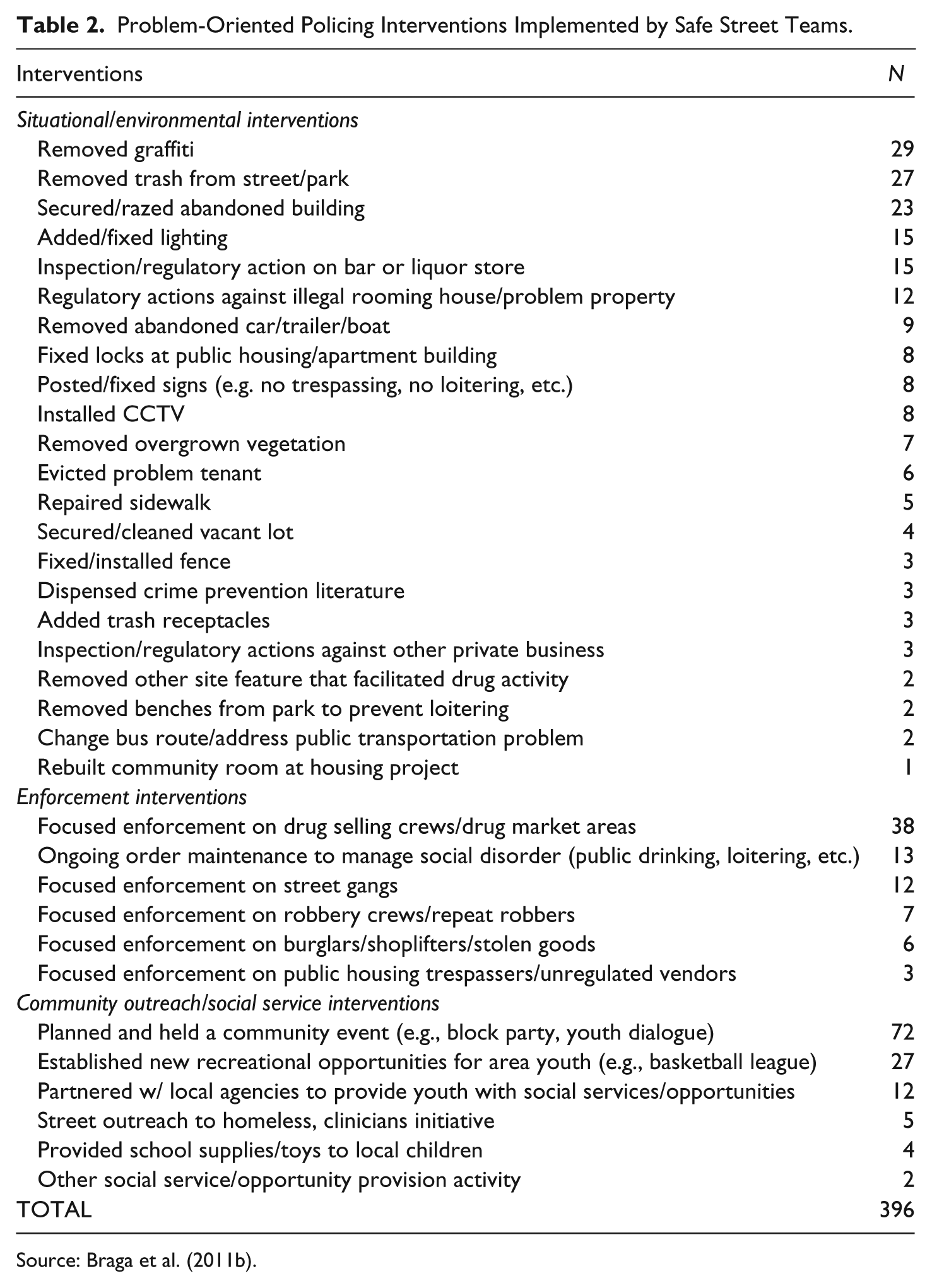
Table 2 summarizes the 396 distinct problem-oriented policing strategies implemented by the SST officers. These actions fell into three broad areas: situational/environmental interventions to change the underlying characteristics and dynamics of the places that the officers believed were linked to violence, enforcement interventions to arrest and to deter individuals the officers identified as committing violent crimes or contributing to a disorderly atmosphere at the places, and community outreach/social service interventions to stimulate community involvement in crime prevention and to address problematic behaviors by disorderly individuals at the places, such as local youth with no recreational opportunities or homeless individuals suffering from mental health issues.
Problem-Oriented Policing Interventions Implemented by Safe Street Teams.
Source: Braga et al. (2011b).
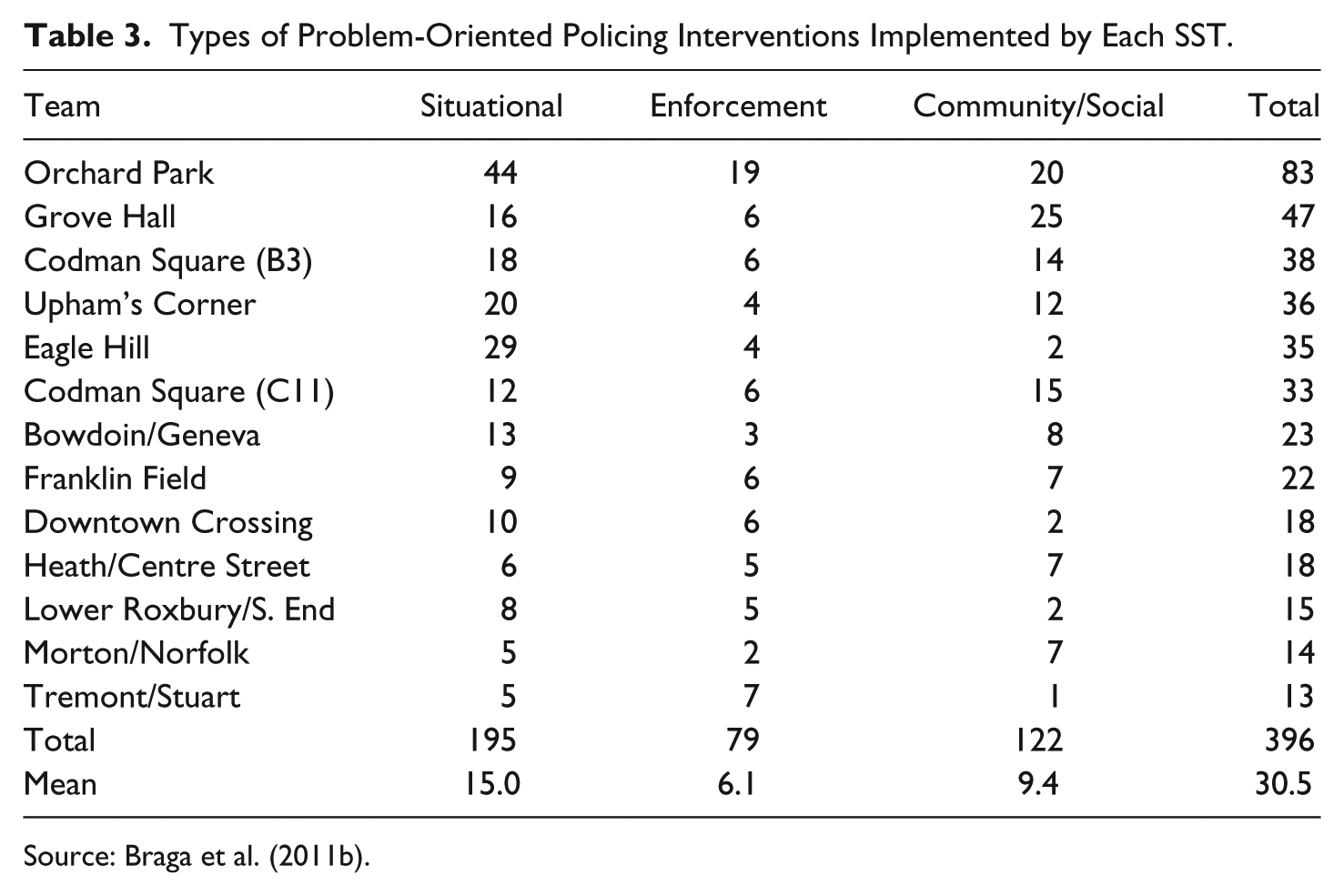
Table 3 presents a summary of the types of problem-oriented policing interventions implemented across the 13 SST hot spots. The 13 teams implemented, on average, 30.5 problem-oriented policing interventions per place comprised 15 situational/environmental interventions, 6.1 enforcement interventions, and 9.4 community outreach/social service interventions. The number of interventions implemented at the places varied based on the nature of problems at the places and each SST sergeant’s commitment to using the problem-oriented approach to deal with those problems in a high-fidelity manner. In the SST areas deemed to be not properly implementing community and problem-oriented policing interventions, the BPD command staff required additional training and closer supervision to ensure that all targeted hot spots received adequate crime control and prevention attention. Fortunately, innovative problem solving was occurring in many SST areas.
Types of Problem-Oriented Policing Interventions Implemented by Each SST.
Source: Braga et al. (2011b).
For instance, in the Orchard Park SST area, high school youth using public transportation were repeatedly robbed and often assaulted by other local youth when commuting between the train station and their high school. The offenders usually robbed the students of their Apple iPods, Apple iPhones, and other technology when they walked in secluded areas and were not paying attention to their surroundings. In addition to increasing their presence and making robbery arrests in the area, SST officers made the place less attractive to youth robbers by collaborating with public works to fence a vacant lot and trim overgrown bushes and other vegetation that helped conceal robbers from their victims. The officers then collaborated with the local high school to raise awareness among the students that they should be aware of their surroundings and refrain from using smart phones and other items that were attractive to robbers when commuting in the risky area. The officers also sponsored a contest for students to design robbery awareness flyers and posters that used slogans and lingo that would appeal to youth. The flyers were distributed to all high school students and posters were displayed on school grounds, in the train station, and in the windows of stores on the route between the train station and the school.
SST Impact Evaluation
Over the course of the three years after SST was implemented, violent index crimes in Boston steadily decreased (Figure 1). By 2009, violent index crimes in Boston had decreased by nearly 18% to a decade low of 6,192 incidents from the decade high of 7,533 incidents in 2007. Unfortunately, in the absence of a controlled evaluation design to accompany program development and implementation, it was unclear whether the SST strategy could claim any credit for the observed decreases. For instance, the observed Boston violent crime decreases could have been part of a larger national trend; U.S. violent index crimes decreased by 7.5% between 2000 and 2009. A simple pre-post analysis of citywide violent crime trend data obviously does not parse out the independent effects of the SST program relative to other rival causal factors.
Given the presence of other untreated violent crime hot spots in Boston, the research team was able to identify equivalent comparison street intersections and block faces for inclusion in a rigorous quasi-experimental research design (Braga et al., 2011b). The researchers developed matched comparison violent crime street segments and intersections by using propensity score statistical matching techniques. Propensity score matching techniques attempt to create equivalent treatment and comparison groups by summarizing relevant pre-treatment characteristics of each subject into a single-index variable (the propensity score) and then matching subjects in the untreated comparison pool to subjects in the treatment group based on values of the single-index variable (Rosenbaum & Rubin, 1983, 1985). In the analysis, the pre treatment characteristics considered in the propensity score matching analysis were 2006 violent index crime counts, whether the street unit was a street segment or an intersection, neighborhood disadvantage in the surrounding U.S. Census block, and the number of street units that experienced three or more 2006 violent Index crimes in the surrounding U.S. Census block. 6 To allow for an analysis of immediate spatial displacement and diffusion effects, all street segments and intersections in two-block catchment areas surrounding the SST areas were excluded prior to the execution of the propensity score matching routine. Two-block catchment areas were selected to measure spatial displacement diffusion and displacement effects based on the state-of-the art used in previous hot spots policing program evaluations (see, e.g., Braga & Bond, 2008; Weisburd & Green, 1995).
The propensity score matching routine yielded a set of equivalent treatment street units and comparison street units. 7 Growth curve regression models, with appropriate covariates to help control for any observable differences between the treatment and control groups, revealed that the SST program was associated with a statistically significant 17% reduction in violent Index crimes in the treatment areas relative to the control areas. Most of this reduction in violent Index crimes was driven by a large 19% reduction in robbery incidents with a smaller 15% reduction in aggravated assault incidents. A subsequent growth curve regression analysis of street units in two-block buffer zones surrounding the treatment and control street units revealed no evidence of significant violent crime displacement 8 (Figure 3). In other words, violent crime did not simply move around the corner due to focused police attention in the hot spot areas.

Spatial distribution of Safe Street Teams treatment and control street units for displacement and diffusion analysis.
Conclusion: Lessons Learned from SPI in Boston
The results of the SST evaluation contribute to the growing body of evidence that the more focused and specific the strategies of the police, and the more tailored to the problems they seek to address, the more effective the police will be in controlling crime and disorder (Braga & Weisburd, 2010; National Research Council, 2004; Weisburd & Eck, 2004). The process evaluation suggested that the SST program was appropriately focused on some of the most persistently violent places in Boston. Moreover, the problem-oriented policing interventions implemented by the SST officers modified the place characteristics, situations, and dynamics that promoted violence at targeted crime hot spots. The impact evaluation found that these problem-oriented interventions were associated with statistically significant reductions in violent crime at the SST treatment street units relative to comparison street units located elsewhere in Boston without simply displacing violent crime problems into proximate areas.
The Boston SPI experience highlights how the realities of police program development and implementation are indeed compatible with an evidence-based policing model (Braga, Davis, & White, 2012). Rigorous evaluations of police programs ideally occur prospectively in “real time.” But that does not have to be the case. Retrospective evaluations can be devised well after a program has been implemented, and if they are methodologically sound, such evaluations can offer important information on the success of a program. When Davis became the commissioner of BPD in late 2006, he quickly developed a plan to address an increasing violent crime problem. Although he had an impressive track record with regard to evidence-based policing, the exigencies of the environment did not allow for a prospective evaluation. Nevertheless, Commissioner Davis required that a data-driven process be employed to identify violent crime hot spots, and he implemented a response strategy with a significant evidence base (problem-oriented policing and hot spots policing). This ongoing commitment to evidence-based policing laid an important foundation for the rigorous retrospective evaluation of the SST strategy that would not begin until 2 years after program implementation. The results presented here clearly demonstrate the compatibility of the evidence-based model with the current policing environment.
The Boston SPI experience underscores the value of police–academic research partnerships in understanding crime problems, crafting innovative crime prevention strategies, and evaluating program impacts. Academic partners offer a different skill set and additional resources that enhance crime problem analysis and facilitate rigorous scientific evaluation of police programs, either prospectively or retrospectively. We believe that it is advantageous for academics to be involved from the outset as more rigorous program evaluation designs, such as randomized controlled trials, are possible. Moreover, if an evaluation is prospective, the analysis conducted by university partners can help to determine early on that a program is not achieving its goals, thereby allowing the agency to redirect or retool its strategy. Academic partners can also draw on the existing evidence base to identify potential strategies that could be deployed to target a problem. In short, strong academic partners can infuse science into police policy and practice.
Police–academic researcher partnerships, fortunately, have become more common in the policing profession over the last two decades, and it is no longer surprising to see researchers in police agencies (Braga, 2010; Weisburd & Neyroud, 2011). Supporting these collaborative partnerships can be challenging, especially in the current funding environment. The evaluation described in this article was supported by a modest SPI grant from the BJA to the BPD. The research team assisted the BPD in acquiring these funds by designing a strong evaluation and writing the associated text in the BJA proposal. The BPD used these external funds to contract with the researchers to conduct the SST evaluation and to support the work of BPD personnel in collaborating with the researchers in developing the databases described here. As such, this project did not directly cost the BPD any money from its operating budget. These types of externally supported police–researcher partnerships have contributed immensely to the policing field’s knowledge of effective crime prevention and control practices.
Acquiring the necessary funds and locating a willing academic research partner are the primary substantive barriers for police agencies interested in completing this type of program evaluation work. In the absence of external funds, we believe this work can still be completed. Police departments could still use their staff to support the data collection work at a slower pace; there are also some academics who are willing to perform pro bono work if the project has the potential to advance scientific knowledge. Whether the work is formally supported or not, the science of policing and, more importantly, public safety will surely benefit as a result of these collaborations.
Footnotes
Acknowledgements
The authors would like to thank BPD Commissioner Edward F. Davis, Superintendent-in-Chief Daniel Linskey, Superintendent Paul Fitzgerald, Superintendent William Evans, Deputy Superintendent Nora Baston, Sharon Hanson, Maria Cheevers, Desiree Dusseault, Richard Laird, and, most importantly, the Safe Street Teams sergeants and officers.
Declaration of Conflicting Interests
The authors declared no potential conflicts of interest with respect to the research, authorship, and/or publication of the article.
Funding
The author(s) disclosed receipt of the following financial support for the research, authorship, and/or publication of this article: This project was supported by Grant Number 2009-DG-BX-K021 awarded by the Bureau of Justice Assistance, Office of Justice Programs, U.S. Department of Justice. The points of view and opinions expressed in this article are those of the authors and do not necessarily represent the official position or policies of the U.S. Department of Justice or the Boston Police Department.