



Abstract
Officers’ responses in suicide by cop (SbC) situations often include use of deadly force. Given their training and experience, officers’ use of deadly force should mean that they reasonably believe that they or other people are in immediate threat of death or serious bodily harm. Using National Violent Death Reporting System data, the current study compares police responses in SbC and non-SbC cases and the possible influences of the characteristics of the situations and of the subjects on officers’ use-of-force decisions. Multivariate analysis reveals different significant predictors impacting different levels of police actions between and with SbC and non-SbC cases.
Introduction
Suicide by cop (SbC) incidents are police shootings that could be considered suicides due to the actions or verbalizations of the subjects demonstrating suicidal motivations (Lord & Sloop, 2010). The uncertainty officers often face after any use-of-force is magnified in SbC cases where subjects often are highly emotional or have mental illness (Johnson, 2012). Family members of the subjects and the public often judge the officers, questioning the need for them to use lethal force. Civil action against the police agency and individual officers is highly probable (Flynn & Homant, 2000), placing additional emotional burden on the officers and financial outlay on the municipalities involved in these shootings.
The increase in technological advances in low-lethal weapons for law enforcement officers has led to changes in the once-straightforward linear use-of-force continuum. In the past, officers were trained to react to the actions of a subject in a stepwise process (Hough & Tatum, 2012) such that officers moved up the levels of force as the offender became more aggressive and less compliant (Robinson, 2011). Unfortunately, offenders rarely act in an orderly fashion, and the additional tools such as chemical spray, conducted energy devises (CEDs), and low-lethal shotguns available to officers have increased the complexity of use-of-force decisions (Hough & Tatum, 2012; Joyner & Basile, 2007; “Las Vegas Metropolitan,” 2012). Also, while the use of deadly force usually is spelled out in specific criteria in law enforcement agencies’ policies and includes the officers’ determination of immediate threat of death or serious bodily harm to themselves or others, officers still must respond based on their split-second decisions.
While policy directs officers’ actions, means to guide their perceptions of immediate threat of death or serious bodily harm is more difficult to devise and cannot be separated from individual officers’ experiences, beliefs, and values that contribute to their assessment of danger. Some use-of-force research examines the impact that personal characteristics of subjects and officers, as well as situational factors, have on officers’ use-of-force and subjects’ actions (Garner, Buchanan, Schade, & Hepburn, 1996). Using National Violent Death Reporting System (NVDRS) data, the current study examines police responses in SbC cases and the possible influence of the characteristics of the SbC subjects and situations on officers’ use-of-force decisions.
Literature Review
Force and the Use-of-Force Continuum
The authority to use force differentiates police from most other professions (Bittner, 1970). This authority is limited by law and to the performance of their duties (Walker & Katz, 2002). Decisions by the U.S. Supreme Court have differentiated between deadly or lethal (force that is likely or intended to cause death or great bodily harm) and nonlethal force, outlining the context in which each can be used by law enforcement (Black, 1990, p. 398 as cited in Kappeler, 2002).
Force used by police as reported by citizens primarily includes pushing, pointing a gun, and using chemical spray. Threats, shouting, and cursing by the police often accompany the force used. Of those citizens who report use-of-force injuries, these injuries occur most frequently with low-lethal weapons such as flashlight, baton, and canines (Durose, Schmitt, & Langan, 2008; Smith, Kaminksi, Alpert, Fridell, MacDonald, & Kubu, 2009). About one third of involved offenders are arrested during the incident in which police force is used (Durose et al., 2008).
During incidents that entail force, officers are injured in 10% to 38% of the cases. As with citizens, the closer officers are physically to individuals, such as through the use of hands-on tactics, the more likely officers will be injured (Alpert et al., 2011). Studies examining use of low-lethal weapons such as chemical spray and CEDs found substantial declines in officers and subject injuries in agencies that adopted their use (Alpert et al., 2011; Hough & Tatum, 2012; Police Executive Research Forum, 2009; Smith et al., 2009).
Studies examining the traditional stepwise, use-of-force continuum conclude that there is not one accepted model nor universal accepted definitions of the different levels or means of force. The International Association of Chiefs of Police (IACP) use-of-force continuum includes six levels of force to be used by the officer (Robinson, 2011). These levels of force are (a) passive interference, (b) commands, (c) physical coercion, (d) incapacitation, (e) threat of deadly force, and (f) deadly force. Others (Hough & Tatum, 2012) recommend a matrix model that includes six levels of subject resistance from presence to aggravated physical resistance on the vertical vertex and six corresponding levels of officer response on the horizontal vertex (officer presence, communication, physical control, intermediate weapons, incapacitating control, and deadly force). Low-lethal weapons are categorized in the intermediate and incapacitating control range.
While the IACP Use of Force Model Policy suggests that use-of-force policies should be short and simple, Hough and Tatum (2012) argue that the policy should include definitions of deadly force, nondeadly force, and “reasonable.” They also believe that the policy should include force options, response/resistance levels, report requirements, the process to review the use-of-force policy annually, criteria for providing medical aid, and training requirements. Policies such as those used by Las Vegas Metropolitan Police Department are more extensive than the IACP model and include not only information recommended by Hough and Tatum (2012) but also definitions for resistance and specific low-lethality tools/restraints and techniques.
Primarily based on Tennessee v. Garner (1985), law enforcement agencies’ policies on the use of deadly force usually outline the criteria in which the use of firearms can be used by officers. These criteria describe the need to consider protection of themselves or others from what is reasonably believed to be an immediate threat of death or serious bodily harm or to prevent the escape of a fleeing felon in which there is probable cause to believe the felon would pose a significant threat to human life if the escape occurred with justification for the action being clear and immediate. As noted by Homant (2004), in assessing what a reasonable person would consider immediate threat of death, officers’ decisions are usually made in emergency situations with little time to reflect.
Overview of Individual and Situational Correlates of Police Use-of-Force
There is extensive research on police use-of-force even though use-of-force is a fairly infrequent response in citizen–officer encounters (Alpert & Dunham, 2004). For example in 2005, of the 43.5 million people who interacted with police, only 1.6% reported use-of-force by the police (Durose et al., 2008). Males, African Americans, and younger citizens are more likely to experience force used by law enforcement. Males have about twice as many interactions as females with law enforcement that result in police use-of-force, and in one study, African Americans’ contacts with police resulted in use-of-force in 25% of the incidents, a rate four times higher than Whites and two times higher than Hispanics (Durose et al., 2008). Although younger citizens have more interactions with police, there are inconsistent findings among reports of higher rate of police use-of-force toward them (Garner et al., 1996; Johnson, 2012).
Subject characteristics of physical aggression, noncompliance with officers’ commands, possession of a weapon, and display of a hostile demeanor consistently are found to be major predictors of police use-of-force (Johnson, 2012), but these characteristics do not explain all or necessarily a large proportion of the variation in the amount of force used by police. Other significant predictors include personal characteristics of the offender such as gang involvement, history of resisting, presence of bystanders, arrest for a violent offense, use of cover tactics by the police officers, and increased number of police present at the incident (Garner et al, 1996).
Kaminski, DiGiovanni, and Downs (2004) introduced the concept, “judgmentally impaired,” which they define as persons who have a mental disorder, or are intoxicated or impaired by drugs. Even after controlling for resistance and possession of a weapon, persons who were judgmentally impaired were more likely to experience police use-of-force. On the contrary, Johnson (2012) found that police do not treat individuals with mental disorders more harshly, but people who are mentally unstable are significantly more likely to physically resist, assault officers, and possess a weapon. Therefore, officers are “influenced most by the violence threat and level of resistance they encounter” (p. 141). In addition, use-of-force incidents in which officers are attempting to effect an arrest of an offender may appear different to the public from those incidents in which individuals are emotionally or mentally disturbed, and officers’ duties are arising from their peace-keeping functions.
Incidents that are categorized as SbC may include a criminal component such as an aggressive act toward another person, but they also often include individuals who communicate that they are suicidal or known to have mental illness. Officers’ responses in SbC situations often include use of deadly force. Given their training and experience, officers’ use of deadly force should mean that they reasonably believe that they or other people are in immediate threat of death or serious bodily harm. Whether SbC subjects’ threatening actions and communications are sufficient to warrant officers’ perception of immediate threat, or whether other characteristics, such as arrest for a violent offense or increased number of police present as concluded by Garner et al. (1996), has not yet been examined.
Suicide by Cop
A phenomenon now accepted by the courts (Boyd v. City and County of San Francisco, 2009), SbC is a term that has been used by law enforcement officers for a number of decades with its introduction into the literature in 1992 (Geller & Scott, 1992; Noesner & Dolan, 1992). Geberth (1993) defined SbC as “incidents in which individuals, bent on self-destruction, engage in life-threatening and criminal behavior in order to force the police to kill them” (p. 105). Hutson et al. (1998) expanded the definition to include more observable details of lethality and intent: intentionally engage in life threatening and criminal behavior with a lethal weapon or what appears to be a lethal weapon to gain attention of law enforcement officers … . These suicidal individuals then intentionally escalate the potential for a lethal encounter by threatening officers or members of the civilian population … . This forces officers to use deadly force by shooting the suicidal individual. (p. 666)
A number of researchers describe SbC subjects as those individuals who through verbalizations and behaviors confront the police with a dangerous weapon or what the police believe is a dangerous weapon, virtually forcing the officer to shoot (Kennedy, Homant, & Hupp, 1998; Lord, 2000; Lord & Sloop, 2010).
Researchers (Drylie, 2006; Homant & Kennedy, 2000; Lord, 2000, 2004, 2012; Parent & Verdun-Jones, 1998) conclude that there are a number of individual and situational factors that are common to SbC subjects. For example, mental illness, or the involvement of the subjects in therapy or past inpatient mental health treatment (when known through information gathered at the scene or past complaints), often is reported as a characteristic of SbC subjects (Hamlin, 2004; Lord, 2000; Parent & Verdun-Jones, 1998). Unique to SbC subjects is the use of an “outrageous act” such as committing a violent crime for the purpose of attracting police attention (Drylie, 2006; Lord, 2004; Mohandie & Meloy, 2000).
Lord and Sloop (2010) and Lord (2012) used a modification of Best, Quigley, and Bailey’s (2004) decision tree composed of primary, secondary, state, and minimal indicators to assess the suicidal intentions of subjects involved in police shootings. The researchers examined cases from the Hostage Barricade Data System of the Federal Bureau of Investigation Crisis Negotiation National Data and the NVDRS. Their studies synthesize factors, such as suicidal ideation or history of suicide attempts, mental illness, abuse of drugs or alcohol, and termination of relationships or other family problems, from a number of studies (Hutson et al., 1998; Klinger, 2001; McKenzie, 2006; Mohandie & Meloy, 2010; Parent & Verdun-Jones, 1998). Primary indicators are classified as planned, showed, or communicated intent to induce police to shoot. Secondary indicators are previous suicide attempts, interruptions in the commission of a crime or domestic dispute, or service of criminal papers such as search or arrest warrants. Evidence of irrational thought, or state indicators, is intoxication at time of incident, mental illness, drug or alcohol addiction, and interpersonal crises. Minimal evidence of suicidal intentions is refusal to surrender and a criminal history. The researchers conclude that to reach a decision about individuals’ intent to commit SbC, more than one point of data should be considered; the more behavioral, verbal, or planned indicators, the more likely the subject intended to be killed by law enforcement. To be considered SbC, there should be evidence that the person intended to die, but manipulated police officers to shoot rather than carrying out the act of suicide himself/herself.
Most SbC data are composed of officers’ articulation of the events in their reports. The officers hear the subjects’ verbal threats or receive information from the subjects’ significant others that the subjects are threatening to act in such a way as to induce officers’ to shoot. The officers also observe subjects’ behavior that appears to be life threatening to the officers and others. As noted by Flynn and Homant (2000), most SbC incidents are considered highly dangerous, usually including lethal force by the subject. A majority of incidents classified as SbC are also categorized in police-involved shooting incidents.
The current study compares the influence of SbC and non-SbC subjects’ personal characteristics and the actions of these subjects toward the police or others on officers’ use-of-force decisions. The researcher hypothesizes that the subjects’ threatening actions and communications are sufficient to warrant officers’ perception of immediate threat in both the SbC and non-SbC cases. Other factors such as subjects’ personal characteristics and secondary SbC factors should not significantly impact officers’ actions.
Methodology
Sample and Description of NVDRS Data Set
Sponsored by Centers for Disease Control, beginning in 2003, NVDRS operates in 17 states compiling data on violent deaths from a variety of sources such as death certificates, medical examiner reports, and law enforcement reports. The purposes of the NVDRS are to (a) link records to describe in detail the circumstances that may contribute to a violent death, (b) identify violent deaths occurring in the same incident to help describe the circumstances of multiple homicides or homicide–suicides, (c) provide timely preliminary information on violent deaths, and (d) better characterize the relationship of the victim to the subject (NVDRS, 2011).
In July 2010, the researcher requested from NVDRS 100 fields of data. The data fields included cause of death; personal characteristics of the subject who died; tested results of the presence of a variety of drugs; geographical information; prior suicide attempts; criminal offenses, domestic violence incidents, and other related contributors to the violent death; weapons used; and medical examiner and police-accompanying narratives of the incidents. The data set contained 12,550 reported incidents for the years between 2004 and 2008.
The manner of death was listed as suicide, homicide, unintentional firearm, legal intervention, undetermined intent, unintentional nonfirearm, pending investigation, natural, and unknown. Cases listed under legal intervention (n = 508 of the total 918 cases) that contained sufficient information (subject and officers’ action were described and subjects’ demographic information was contained) were selected for use in the current study. Legal intervention cases are those cases in which at least one decedent is killed by the police. For purpose of this study, the subjects selected were killed by the police. Content analyses were conducted by the author and a criminal justice practitioner on the medical examiners and police narratives of these cases, allowing additional information to be incorporated especially focusing on the subject’s background, the sequence of events leading up to and involving the situation, the subjects’ actions, and the officers’ corresponding actions. Interrater reliability was 92.4% in agreement on the subjects’ actions and the officers’ corresponding action. There was no systematic reason for the differences.
The additional information from the narratives also allowed the tally of those individuals who possessed at least one primary indicator of SbC: verbal, behavioral, or planned intent to induce officers to shoot them. If the narratives included information that the subject stated to officers or to family or friends a desire to be killed by police or that the police would have to kill him/her rather than surrendering, verbal intent was recorded. If the subject used life-threatening behaviors with a lethal weapon or what appeared to be a lethal weapon toward law enforcement officers or toward others while exposing himself or herself to law enforcement officers’ weapons, behavioral intent was recorded. Planned intent was recorded if the subject left a note detailing his/her actions or deliberately contrived contact with police by direct telephone contact with police or by carrying out an outrageous act. Outrageous acts are criminal actions, serious traffic violations, or suicidal actions that are carried out so that they are observed by or involve the police. For example, a subject drives to a neighbor’s house and tells the neighbor to contact the police because he has just killed his wife. In reality, he has not killed his wife or anybody, but the police respond to his residence, at which time the subject points and shoots a shotgun toward the police. Those subjects who possessed a minimum of one indicator were included in the final sample (n = 262), 28.5% of the total sample. While there is no national database documenting an actual number of SbC cases reported by law enforcement agencies, Hutson et al. (1998) were among the first researchers who concluded that 11% of officer-involved shootings in Los Angeles County between 1987 and 1997 were SbC. Kennedy et al. (1998) examined officer-involved shootings as reported nationally by the media and extrapolated that SbC cases could range between 16% and 46%. Mohandie, Meloy, and Collins (2009) placed the figure at 41% of the officer-involved shootings. So, 28.5% is well within the scope of the SbC literature.
There were significant differences between the SbC and non-SbC subjects in several personal and situational characteristics. The typical SbC subject in the current study was a married, White male older than 34. The majority threatened (48%) or used (45%) lethal force toward officers or others. While 64% of the subjects limited their SbC intent to behavior, an additional 22.5% verbalized and showed their intent, and 12% used all three indicators. Subjects were frequently involved in a criminal act (30.5%) or domestic dispute (34%), and more than 25% had been reported to have previously attempted suicide. Possession of a firearm (51%) followed by knives (32%) were reported.
Descriptive Statistics.

Note. SbC = suicide by cop; NA = not applicable.
p < .001.
Dependent Variable
The dependent variable is police responses obtained and measured by examining the narratives. The police action is categorized as closely as possible to the IACP use-of-force continuum (Robinson, 2011): passive interference (police presence), commands (verbal orders), physical coercion (grabs, but no kicks or body strikes), incapacitation (body strikes, CEDs, chemical sprays, or blunt objects), and deadly force. Attempts by the police to expand their communication to negotiations with the subject are included separately from commands. Physical coercion and incapacitation are combined and labeled use of low-lethal or physical restraints. Officers might use commands only, negotiate, and low-lethal or physical restraint before the inducement to shoot. If the narrative indicates that they only shot without any indication of attempting to de-escalate, shooting is the only engagement measured. The distribution of officers’ level of force is displayed in Table 1. If the officers’ level of force increased from commands or negotiation to use of low-lethal or physical restraints before shooting, then their level of force is recorded at the higher level of force.
Independent Variables
Subjects’ aggressive action
As noted earlier, much of the use-of-force literature concludes that physical aggression, noncompliance with officers’ commands, possession of a weapon, and display of a hostile demeanor consistently are found to be the major predictors of police use-of-force. In the current study, the offenders’ aggressive actions were categorized between 0 and 3 beginning with no aggressive action toward the police, threatening nonlethal action such as attempting to hit or kick officers, threatening lethal action such as pointing a gun or knife at the police officer, and lethal action such as shooting a gun or moving aggressively toward the officers with a knife pointed as if to stab them.
Subjects’ weapons
Subjects’ weapons were recorded as a separate variable and included no weapon, firearm, edged weapon such as knife or ax, other weapons such as motor vehicles driven directly at a police officer, multiple weapons, and fake weapons that appeared to be lethal at the time of the incident.
Subjects’ personal characteristics
Also as noted previously, although these characteristics do not explain a large proportion of the variation in the amount of force used by police (Garner et al, 1996), the current study includes subjects’ personal characteristics such as gender, age, ethnicity, education, and marital status.
SbC indicators
The factors of the SbC model established by Lord and Sloop (2010), primary, secondary, evidence of irrational thought, and minimal indicators of SbC are analyzed. The primary indicators, subjects’ level of SbC intent as described earlier, are categorized as verbal, behavior, or planned. The levels are between 1 and 3, ranging from behavior intent only (1), behavior and verbal intent (due to very few cases of behavior and planned intent, these cases were merged with behavior and verbal intent) (2) to all three indicators, verbal, behavior, and planned (3). Secondary indicators are previous suicide attempts, interruption in the commission of a crime or domestic dispute, or service of criminal papers such as search or arrest warrants. Evidence of irrational thought is intoxication at time of incident, mental illness, addiction, and interpersonal crises. Minimal indicators of suicidal intention are refusal to surrender (but also if noncompliant to officers’ commands) and a criminal history. Except for subjects’ age, actions, and level of SbC intent, the independent variables are dichotomized with 1 = existence of the variable and 0 = variable does not exist (Table 1). If secondary indicators and irrational thought indicators were not included in the data, they were noted as 0.
Findings
Although the dependent variable of police action has four possible ranked levels, ordinal regression was not utilized because the parallel lines assumption would be violated. The ordinal regression model assumes that the slope coefficients are equal across the levels of the dependent variable. This assumption is violated if the test of parallel lines returns a finding of significance such that there is a significant difference between the model where the regression lines are constrained to be parallel for each level of the ordinal-dependent variable compared with the model where the regression lines are allowed to be estimated without a parallelism constraint (Mertler & Vannata, 2002). Therefore, multinomial logistic regression, which allows more than two discrete outcomes and uses the log odds of the outcomes modeled as a linear combination of the independent variables, was the appropriate analysis to use for estimating the equation (“SPSS Annotated Output,” 2011). The category of shooting only was used as the reference category of the dependent variable.
Bivariate Analysis of Police Responses Before Use of Lethal Force.

Note. Data are represented as n (%). SbC = suicide by cop; NA = not applicable.
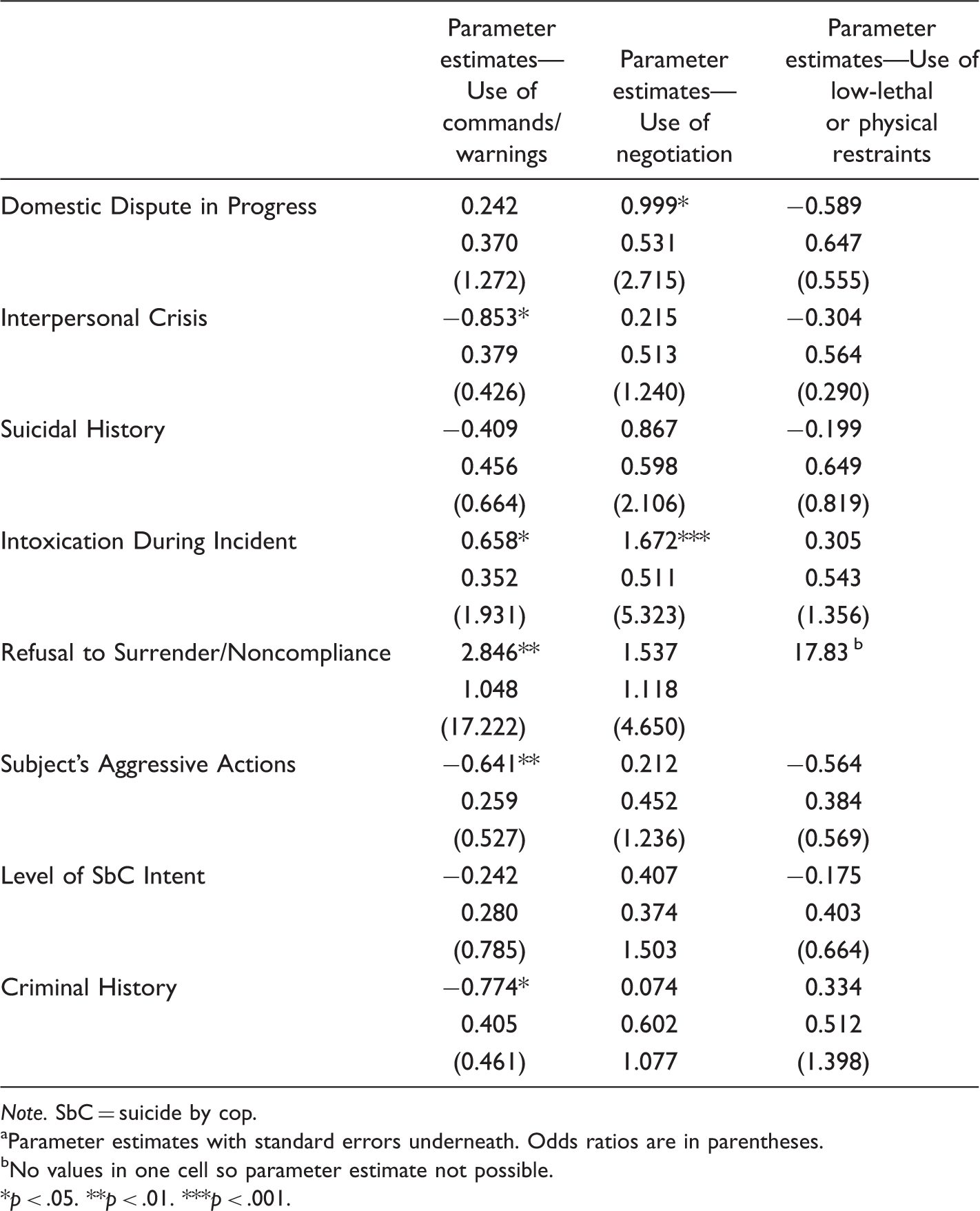
Multinomial Logistic Regression Predicting Police Response for SbC (n = 253). a
Note. SbC = suicide by cop.
Parameter estimates with standard errors underneath. Odds ratios are in parentheses.
No values in one cell so parameter estimate not possible.
p < .05. **p < .01. ***p < .001.
Column 1 of Table 3 reveals several significant relationships, which show that the police are more likely to use commands and warnings before the more lethal action of shooting if the subjects are not experiencing an interpersonal crisis (b = −0.853), they are intoxicated during the incident (b = 0.658), they refuse to surrender (b = 2.846), they use less aggressive actions (b = −0.641), and they do not have a criminal history (b = −0.774). The strength of these relationships can be assessed by examining the odds ratios. For example, the odds ratio for intoxication indicates that the odds of an intoxicated subject being given a command or warning is almost twice as high as the odds of that individual being shot only (eb = 1.931), holding all the other predictors constant. The indicator with the most influence on the police use of commands and warnings is that of the subject’s refusal to surrender or noncompliance. Noncompliance from subjects increases the odds of the police using commands and warnings by a factor of 17.222.
Column 2 examines the officers’ use of negotiation versus shooting. The findings show that police are most likely to attempt to negotiate with subjects versus shooting only in domestic disputes or when the subjects are intoxicated. The odds of police negotiating instead of shooting only are almost three times higher if the incident involves a domestic dispute (eb = 2.751). If the subject is intoxicated, the odds of negotiating in contrast to shooting increase by 5.323 when the other predictors are held constant.
Finally, as seen in Column 3, no factor significantly predicted the use of low-lethal or physical restraints by police in contrast to shooting only for SbC subjects.
Multinomial Logistic Regression Predicting Police Response for Non-SbC (n = 246). a

Note. SbC = suicide by cop.
Parameter estimates with standard errors underneath. Odds ratios are in parentheses.
p < .001.
Column 1 of Table 4 reveals no significant relationships; therefore, none of the independent variables had a significant impact on the police decision to use commands before shooting in non-SbC cases.
Column 2 examines the officers’ use of low-lethal or physical restraints by police in contrast to shooting only for non-SbC subjects. The findings show that police are most likely to attempt to use low-lethal or physical restraints versus shooting only with subjects who are not using lethal force (b = −2.45) and are addicted to illegal drugs or are mentally ill (b = 1.693). The odds of police use low-lethal or physical restraints instead of shooting only are more than five times higher if the subject has an addiction or a mental illness (eb = 5.433).
Significance was examined across the SbC and non-SbC models (see Paternoster, Brame, Mazerolle, & Piquero, 1998 for the formula to compare logistic regression coefficients across equations). For command only police response, refusing to surrender/noncompliance was significantly different between the SbC and non-SbC cases. For low-lethal or physical restraint police response, the subjects’ aggressive actions were significantly different between the SbC and non-SbC cases.
In summary, the findings reveal significant differences between and within SbC and non-SbC subjects and the incidents that also relate to different responses by the police impacting different independent variables.
Discussion
As discussed earlier, subject characteristics such as aggressive behavior, noncompliance with officers’ commands, possession of a weapon, and display of a hostile demeanor consistently are supported by the research as major predictors of police use-of-force (Johnson, 2012); however, other factors such as personal characteristics and history of violence of the offender, as well as situational characteristics such as attempts to arrest the offender for a violent offense, use of cover tactics by the police officers, and increased number of police present at the incident, have been found to be significant predictors of police use-of-force (Garner et al., 1996).
The current study compared the possible influence of specific factors in officer-involved violent deaths and characteristics and actions of the subject on officers’ use-of-force decisions in SbC and non-SbC cases. The current study also continues to expand the research on the variety of officers’ force options rather than just measuring force as a simple dichotomy of force and no force. Consequently, the multivariate analysis revealed different significant predictors impacting different levels of police actions within and across SbC and non-SbC cases, thereby adding noteworthy knowledge to the growing complex area of officer use-of-force that has serious consequences.
Although other studies of SbC note that SbC subjects’ personal characteristics are different, this study is one of the few that compares SbC and non-SbC subjects within one database. It supports other studies that SbC subjects are significantly different from non-SbC subjects in a variety of personal characteristics including race and age, and also marital states, suicidal history, and criminal history. Also, additional areas of differences between SbC and non-SbC incidents are revealed including crimes in progress, domestic dispute in progress, interpersonal crises, and the subjects’ actions and weapons. Based on this current study, the SbC subject is more likely to be White, older, married, suicidal, and less likely to have a criminal history. The SbC incident is more likely to involve a domestic dispute, an interpersonal crisis, threat of lethal force, and an edged weapon (although guns also are prevalent).
Within SbC and Non-SbC Cases
Within SbC
The overall model of predictors that significantly improves the intercept only model of officers’ decision on the type of force to use in SbC incidents includes not only several variables that support previous use-of-force literature but also several variables that have not been analyzed before. Subjects’ aggressive action, past criminal history, refusal to surrender (as one indication of noncompliance to officers’ commands), and subjects’ intoxication during the incident support previous studies (Engle & Silver, 2001; Garner et al., 1996; Johnson, 2012). Specific situational factors such as domestic dispute in progress and acute interpersonal crisis experienced by the subject have not been included as factors in reviewed use-of-force studies. Although significant in the initial bivariate analyses, the specific SbC variables of SbC intent and suicidal history are not significant in the multivariate analysis. Interestingly, possession of a weapon by the subject that has been significant in other use-of-force research was not significant in the current study. Lack of significance may be due to the fact that essentially all of the subjects in this study had some sort of weapon. Whether or not subjects possess any sort of weapon that the officers believe add to the danger of the situation may be what is pertinent.
Examining the three levels of officers’ responses with shooting only as the reference allows for additional meaningful information. Five predictors significantly influence the lowest level of officer use-of-force, verbal commands, and warnings. Two predictors significantly influence the officers’ decision to attempt negotiation. No predictors, including the subjects’ increasingly aggressive actions, significantly influence the officers’ decision to use low-lethal or physical restraint tools. It may be that there is insufficient distinction between officers’ decision to use low-lethal or physical restraint tools and shooting only in SbC cases.
As noted by the “Las Vegas Metropolitan” (2012), presence and verbal communication are to be used by officers whenever possible to attempt to control subjects before resorting to physical restraint measures. In the current study, subjects’ actions is a significant predictor only at the command level of force for SbC cases, and as would be expected, the relationship is negative such that lesser aggressive action by the subject results in officer commands rather than higher levels of officer force. This negative relationship also is true with criminal history in which officers attempt to control the subject with verbal commands if the subjects do not have a (known) criminal history. Interestingly, officers not only attempt to control intoxicated subjects with verbal commands but also will attempt negotiation. Although there is a saying, “you can’t talk to a drunk,” officers at least in SbC situations do attempt to talk to inebriated subjects.
It is not clear why officers are likely to use verbal commands only with individuals who are not experiencing an interpersonal crisis in SbC cases, but perhaps individuals who are experiencing an interpersonal crisis are acting in ways that are considered too dangerous for commands only. Johnson (2012) found that individuals who are mentally disturbed are likely to act violently and resist the police, thereby requiring the police to use physically restraining force. As noted in non-SbC cases, officers do attempt to use low-lethal or physical restraints with individuals with mental illness or drug addictions. Although individuals experiencing interpersonal crises do not necessarily have mental disorders, they may be highly emotional and thinking irrationally.
In the current study, officers are found to attempt negotiation with those SbC individuals who are experiencing a domestic dispute. Although ultimately the officers shot the subjects in these SbC incidents, officers are trained to attempt to calm and mediate domestic disputes whenever possible. Officers appeared to approach these situations involving domestic disputes with the intent to negotiate a resolution between parties.
The current study does not help fill the gaps in the present knowledge about factors influencing officers’ decisions to use low-lethal or physical restraint tools in SbC incidents. Hough and Tatum (2012, p. 45) recommend that these types of tools be limited to subjects who are “actively, aggressively and aggravated” physical. While it is unclear why SbC subjects’ actions do not significantly predict the officers’ use of these tools, it may be that there are other variables such as time, officers’ cover tactics, and number of officers that are more important and could not be measured in the current study.
It is also noteworthy that subjects’ SbC intent indicators were not significant at any level of officers’ use of force. The lack of significance is of particular importance considering the high probability of officer-involved shootings of SbC incidents resulting in civil cases against police agencies and individual officers. This study provides evidence that subjects’ indicators of SbC intent do not directly lead to higher levels of force by officers.
Within non-SbC cases
Officers’ decisions regarding the use of force in non-SbC cases appear to support Johnson’s study (2012) in which subjects’ use of physical aggression and a hostile demeanor are important factors in officers’ decision of use of force. The non-SbC cases primarily involved officers moving directly to using some form of low-lethal, physical restraints, or lethal only in relations to the subjects’ aggressive actions. The only other characteristic was the subjects’ mental health or drug addiction. In cases of subjects who were known to be mentally ill or addicted to drugs, officers attempted low lethal before shooting despite the subjects’ actions, supporting Johnson’s findings (2012).
Between SbC and Non-SbC Cases
Although most of the subjects in all of the cases refused to surrender or comply with police officers, how the officers responded in SbC compared with non-SbC cases to the lack of compliance was significantly different; officers attempted to use commands first in SbC cases. We can only speculate that perhaps SbC subjects provided an interval of time, no matter how minute, that allowed officers to attempt to get the subjects to put down their weapons and surrender. The statistical significant difference between the cases based on the subjects’ aggressive actions is further support of findings of the within non-SbC analysis.
This study is an exciting first step into the exploration of factors that influence officers’ responses in SbC incidents. While the NVDRS data include all violent deaths in 17 states and are quite expansive in the type of data it collects, data are missing in some of the fields and so limit some of the potential predictors. The complete story of subjects’ mental disorders, drug addiction, or history of suicide attempts is not known due to the high percentages of missing data. The NVDRS data will continue to be collected and expand into more states. Hopefully, more cases will increase the selection of cases without missing data.
The NVDRS does not allow for comparison between those cases of SbC in which the subjects are confronted by police but not shot or killed and those subjects who are killed; it includes violent deaths only. The researcher’s earlier studies include databases that allowed for these differences. As in many studies, different databases allow different variables to be measured. Because of NVDRS’ limit to violent deaths, the study can analyze for predictors of police response, but not how effective the response was in preventing a death. This database as well as other databases should continue to be analyzed to expand our knowledge of officers’ response to SbC and other types of subject actions.
Footnotes
Acknowledgments
The author would like to acknowledge the analytical help of Dr. Beth Bjerregaard, University of North Carolina at Charlotte and Allen Cowan, PI.
Declaration of Conflicting Interests
The author declared no potential conflicts of interest with respect to the research, authorship, and/or publication of this article.
Funding
The author received no financial support for the research, authorship, and/or publication of this article