




Abstract
This study examines the extent to which attitudinal dimensions associated with supervisor and officer styles explain subordinate officers’ satisfaction levels. Two frameworks, the average leadership style and person–supervisor fit, were employed and tested. To do so, survey data of 765 patrol officers and 146 patrol sergeants across five departments were used. The results provided little empirical support for the average leadership framework. After controlling for demographics and officer perceptions of work and organizational environments, sergeant style dimensions failed to exert a top-down effect on subordinate officer satisfaction. Support, however, was found for the person–supervisor fit framework. Specifically, when sergeant and officer views were congruent in the areas of support relations and expectations of aggressive enforcement, officers were more satisfied with their jobs. On the other hand, when sergeants viewed aggressive enforcement as important, but officers did not, officers were less satisfied. Finally, the patterning of results from a subsample analysis suggested that supervisory influences were more pronounced in the early stages of the officer–sergeant relationship. Practical implications associated with the person–supervisor fit framework are discussed.
Introduction
Job satisfaction continues to be one of the most widely studied attitudes in organizations (Judge & Klinger, 2008). One occupation where job satisfaction has received considerable attention is policing, due to the profession’s distinct characteristics. The danger and uncertainty associated with officers’ occupational environments coupled with the authoritarian and quasimilitary structures of their organizational environments have been noted as potential sources of dissatisfaction as well as stress, burnout, and turnover (Dowler, 2005). As such, research has tried to identify specific factors that explain why some officers are satisfied with their work while others might be dissatisfied. Collectively, this body of research has focused on three areas: officer demographics, the work environment, and organizational characteristics.
Although research in this area has made significant contributions to the study of police officer job satisfaction, it has not investigated all of the potential correlates of satisfaction. Recently, calls for further research have been made to focus greater attention on factors associated with officers’ work and organizational environments (Johnson, 2012) as well as in identifying factors that can be promoted by police administrators (Skogan & Frydl, 2004). One particular topic that is relevant to both of these calls, but has yet to be fully examined, is the influence that first-line supervision has on officer job satisfaction. For example, in a review of current research needs in the area of police accountability, Walker (2007) noted that a deficiency in the literature on routine supervision is whether the attitudes and styles of sergeants are associated with police officer satisfaction.
The purpose of the current study is to examine the effect that first-line supervisors (i.e., patrol sergeants) have on the overall job satisfaction of patrol officers. Specifically, we investigate the extent to which attitudinal dimensions associated with supervisor styles explain subordinate officers’ satisfaction levels. To do so, we test two competing frameworks that have been used to portray the nature of the sergeant–officer relationship: the average leadership style and person–supervisor fit. The average leadership style framework assumes that supervisors exert a top-down effect and influence each subordinate in similar ways (Dansereau, Graen, & Haga, 1975). On the other hand, person–supervisor fit emphasizes the compatibility between supervisors and subordinates (Kristof-Brown, Zimmerman, & Johnson, 2005).
We begin with a brief review of the literature on job satisfaction, including the factors that have been found to influence officers’ satisfaction. Next, the two theoretical frameworks central to our study, average leadership style and person–supervisor fit, are discussed. This is followed by an overview of the data and methodology used. We then present findings that test the extent to which supervisory styles influence officers’ job satisfaction from both top-down and relational perspectives. Finally, we discuss the practical implications of the results.
Job Satisfaction
Job satisfaction has been defined in numerous ways (see Judge & Klinger, 2008). A common definition that is closely associated with the topic of the current study is Locke’s (1976), who defined job satisfaction as a “pleasurable or positive emotional state resulting from the approval of one’s job or job experiences” (p. 1300). This definition emphasizes four characteristics of job satisfaction: expectancies, needs, values, and the potential conflicts that exist among them. According to Locke, when individuals perceive that their expectancies, needs, or values are not met or are not aligned with the reality of the job, job dissatisfaction will occur. Central to this assertion is the idea that satisfaction depends on the interaction between individuals who develop expectations, needs, and values and their work environment that provides the opportunities for expectations, needs, and values to be fulfilled.
Examining the job satisfaction of police officers is important, as it can impact a number of areas within departments. For instance, it has been argued that satisfaction can affect police performance (Ercikti, Vito, Walsh, & Higgins, 2011), commitment and turnover (Johnson, 2012; Zhao, Thurman, & He, 1999), and department recruitment and training expenditures (Loo, 2004). As a result, research has sought to identify factors that might enhance or minimize officer satisfaction levels. As Johnson (2012) has recently pointed out, the study of these factors usually falls into three areas: officer demographics (e.g., gender, race, education, and experience), the work environment (e.g., job and task characteristics), and organizational characteristics (e.g., size, support, and perceptions of management).
A number of studies have examined the relationship between officer demographics (i.e., gender, race, education, and experience) and job satisfaction (e.g., Buzawa, 1984; Carlan, 2007; Dantzker & Kubin, 1998; Hassell, Archbold, & Stichman, 2011; Hunt & McCadden, 1985; Johnson, 2012; Sheley & Nock, 1979; Zhao et al., 1999). Collectively, demographic effects have been found to be rather weak, as studies have reported demographics to account for approximately 4% (Hunt & McCadden, 1985; Johnson, 2012) to 6% of the variation in satisfaction (Dantzker & Kubin, 1998; Zhao et al., 1999). For this reason, research has looked beyond demographic explanations and incorporated aspects of officers’ work and organizational environments into the study of officer job satisfaction. For example, job task characteristics such as autonomy, variety, role clarity, or stress have been found to influence officer satisfaction (e.g., Buzawa, 1984; Carlan, 2007; Hunt & McCadden, 1985; Johnson, 2012; Zhao et al., 1999). Additionally, organizational features such as support, recognition, or cohesiveness have been examined in relation to satisfaction (e.g., Johnson, 2012; Sheley & Nock, 1979). 1 Research in these three areas has increased our understanding of the factors that lead to greater officer satisfaction. However, it has not fully investigated certain factors that are plausible correlates of satisfaction, such as the influence of first-line supervision.
First-Line Supervision and Job Satisfaction
In organizations, direct supervisors structure the work environment of employees. For example, they communicate job roles and expectations, provide feedback to employees, and relay information about the broader organization. As such, supervisors impact the “affective reactions” of employees (Griffin, Patterson, & West, 2001, p. 538). In police organizations, first-line supervisors, especially sergeants, play a critical role in these processes. Sergeants are often tasked with implementing departmental strategies and communicating expectations to officers (Muir, 1977; Sharp, 1982; Skogan, 2008). In this regard, they serve both higher level police administrators as well as line officers. Additionally, sergeants provide feedback to subordinate officers in the form of performance evaluations and supervisory review practices (Walker, 2007). As a result, sergeants represent an immediate component of officers’ work environments that has the potential to have a significant influence on job satisfaction.
Research has examined certain facets of supervision in relation to officer job satisfaction. For example, research has looked at the effect of officers’ perceptions of supervisors on various dimensions of satisfaction. Studies have found officer trust and perceived organizational support, both of which included measures of supervisor support, to increase job satisfaction (Davey, Obst, & Sheehan, 2001; Hunt & McCadden, 1985). Supervisor recognition has been associated with officers’ willingness to take another job (Sheley & Nock, 1979). Satisfaction with supervisors’ communication skills has also been linked to satisfaction (Brunetto & Farr-Wharton, 2003). On the other hand, perceived quality of supervision was not very influential in explaining job satisfaction (Buzawa, 1984). Finally, supervisor feedback has been found to predict satisfaction with supervisors (Zhao et al., 1999) but not necessarily overall job satisfaction (Johnson, 2012).
Extant research has offered insight as to how aspects of supervision relate to officers’ job satisfaction. This body of research, however, is based largely off of officers’ perceptions of supervisors and supervision rather than off of direct assessments from supervisors. As such, the findings may describe general aspects of supervision and satisfaction, but they do not necessarily identify specific characteristics of supervisors that might influence officers (Engel, 2001). For example, job satisfaction is based on the premise that satisfaction is dependent upon the interaction between the individual and their work environment (Locke, 1976). Thus, it is valuable to include direct measures of the work environment in order to specifically determine how it might affect officer satisfaction. One type of direct measure that could influence officer job satisfaction is supervisory styles.
Due to their position as mediators between upper level administrators and subordinate officers, Engel (2001) argued that first-line supervisors developed their own styles of supervision as ways to address conflicts associated with this unique role. To assess this, nine attitudinal dimensions derived from applicable leadership theories were analyzed, which included supervisors’ views toward subordinates, activity levels, decision making, power, relations orientations, task orientations, inspirational motivation, expectations of community relations, and expectations of aggressive enforcement. From these dimensions, Engel found support for four types of styles: (a) traditional supervisors who expected aggressive enforcement of laws and were highly task oriented; (b) innovative supervisors who had high expectations for community relations; (c) supportive supervisors who emphasized relations orientations and protecting subordinate officers; and (d) active supervisors who favored high activity levels and held positive views toward subordinates. The implication being that the different styles would have an impact on the attitudes and behaviors of subordinate officers.
While subsequent research has examined these styles or associated attitudinal dimensions with respect to officers’ street-level behaviors (Engel, 2000; Engel & Worden, 2003), their influence on job satisfaction has not been investigated, despite calls to do so (Walker, 2007). The aim of the current inquiry is to examine the effect of certain style dimensions on officer satisfaction levels. Before this is done, however, a discussion of two theoretical frameworks that have been used to explain the nature of the sergeant–officer relationship is necessary.
Theoretical Framework
Average Leadership Style
The first framework is the average leadership style of supervision. Based on the early University of Michigan and Ohio State leadership studies that sought to identify behaviors of effective leaders (Graen & Uhl-Bien, 1995), this framework makes two key assumptions about the nature of supervision. First, subordinates are assumed to hold similar perceptions of their supervisors. Second, supervisors behave similarly toward each of their subordinates. In this regard, supervisors are said to influence subordinates in similar ways, and the focus is on “the average or usual behavior of a supervisor” toward the group of subordinates (Dansereau et al., 1975, p. 47).
In policing, the assumptions of the average leadership style framework are closely related to the command and control model of police administration. This model emphasizes the notion that sergeants possess the hierarchical authority to direct the efforts of subordinate officers through the use of bureaucratic rules and procedures (Allen, 1982). As such, sergeants are said to exert a top-down influence on officers under their supervision, which in turn leads to officers holding similar perceptions of supervision (e.g., Sharp, 1982; Skogan, 2008; see also Engel & Worden, 2003; Ingram, 2013). Many studies examining supervisory influences on officers’ attitudes and behaviors adhere to this type of framework.
For example, Ingram, Weidner, Paoline, and Terrill (2014) examined sergeants’ influences on their subordinate officers’ use of force policy perceptions. In this study, officers’ policy perceptions were less favorable when under the supervision of sergeants who held favorable views of their department’s force policy, held negative views toward police administration, and were less supportive of subordinate officers. Additionally, Johnson (2011) examined the influence of immediate supervisors on the number of traffic citations issued by subordinate officers. Here, the number of citations issued was lower for officers who worked under supervisors who placed a priority on traffic enforcement. On the other hand, studies have also failed to find support for top-down supervisory effects. Research has revealed that only two supervisor characteristics (supervisors’ gender and orientations toward aggressive enforcement) significantly predicted problem-solving behavior, leading to the conclusion that “supervisory influence is negligible” (Engel & Worden, 2003, p. 158). Research on the effect of supervisory styles on officer behavior has found only one style type (i.e., active supervisors) to influence officers’ use of force behaviors. Furthermore, supervisory styles were unrelated to arrest and citation behaviors (Engel, 2000).
In essence, research that has followed the average leadership style framework has produced mixed results. Despite this, applying and testing this framework in the current inquiry is warranted. The command and control model of supervision continues to be heavily emphasized in police organizations. Scholars have noted that the role of the sergeant in this model provides them the opportunity to substantially influence and mold subordinate officers’ attitudes and behavior (Muir, 1977, 2008; Sharp, 1982). Others have also pointed out that as departments have subscribed more to community policing and problem-solving approaches, supervisors are now expected to encourage team efforts and focus on officer morale (Engel & Worden, 2003). In this regard, supervisors’ orientations on a particular style dimension could be expected to have a top-down effect on the satisfaction levels of subordinate officers. For example, officers under the command of sergeants who place value on community policing or are supportive of officers may possess greater satisfaction than officers working under sergeants who subscribe to the more traditional command model or fail to support officers.
Person–Supervisor Fit
An alternative framework for examining the nature of the supervisor–officer relationship is person–supervisor fit. Person–supervisor fit constitutes one type of person–environment fit theory. Person–environment fit theory assesses the “compatibility between an individual and a work environment that occurs when their characteristics are well matched” (Kristof-Brown et al., 2005, p. 281). Two concepts are relevant to this theory, congruence and incongruence. Congruence represents the degree of similarity between the individual and the environment and is important because the presence of congruence between an individual and the environment has meant that communication, trust, or cooperation is promoted (Edwards & Cable, 2009). In this regard, congruence (e.g., good fit) is argued to lead to positive individual outcomes, such as job satisfaction. On the other hand, incongruence (e.g., misfit) occurs when individuals’ characteristics do not match those of their environment. Incongruence, then, can occur in two manners: (a) when individual characteristics exceed the characteristics of the environment or (b) when environmental characteristics exceed those of the individual. When either type of incongruence occurs, negative individual outcomes are often expected, such as job dissatisfaction (Edwards & Cable, 2009).
With respect to person–supervisor fit, supervisor characteristics represent the measures of the work environment. As such, the degree of similarity (i.e., congruence) or dissimilarity (i.e., incongruence) between supervisor and subordinate characteristics is what would influence outcomes of interest. In other words, rather than having a top-down effect on officers, supervisor effects would be relative to officers’ own characteristics. Based on meta-analysis results from research in the organizational sciences, person–supervisor fit has been found to be moderately associated with individuals’ job satisfaction (Kristof-Brown et al., 2005). In policing, this framework has yet to be applied to officer job satisfaction, but it has been tested in relation to role ambiguity, where it was found that ambiguity occurred when sergeants and subordinate officers had incongruent views on the importance of order maintenance and law enforcement roles (Ingram, 2013).
Extant research lends support for applying the person–supervisor fit framework to the study of officer job satisfaction. Recall that a common definition of job satisfaction contends that job satisfaction occurs when employees’ values are aligned with those of the work environment (Locke, 1976). Research has shown that officers develop their own individual styles of policing, which are based, in part, on their own views toward police work (e.g., Paoline, Myers, & Worden, 2000; Worden, 1995). Such views are not likely to always be aligned with those of their sergeants. When this misfit occurs, it may be expected that officers will be dissatisfied with their jobs.
Current Study
The purpose of the current study is to investigate the extent to which certain attitudinal dimensions (i.e., support relations, expectations of aggressive enforcement, community policing expectations, and task orientations) relevant to supervisor and officer styles influence officers’ satisfaction levels while controlling for relevant factors identified by prior research. To do so, we test both theoretical frameworks in order to provide a comprehensive assessment of the nature of the sergeant–officer relationship. Finally, and to the extent that the data allows, we explore an issue that has yet to be investigated in research on supervisory influences, which is the role that time plays in sergeant–officer relationships. In the current inquiry, officers may need to have worked for their sergeants for some time before supervisory styles can be discerned. Furthermore, time may be needed in order for officers to realize if their own styles are congruent or incongruent with their supervisors’ styles. In order to examine this possibility, we incorporate length of time for a subsample of officers and sergeants.
Data
Patrol officer and patrol sergeant surveys from five departments that participated in a broader National Institute of Justice (NIJ)-funded project entitled, Assessing Police Use of Force Policy and Outcomes, were used to investigate supervisory influences on officers’ job satisfaction. The departments included Portland, Oregon (PPB); Albuquerque, New Mexico (APD); Colorado Springs, Colorado (CSPD); Fort Wayne, Indiana (FWPD); and Knoxville, Tennessee (KPD). 2 Although the primary purpose of the larger NIJ project was to examine use of force policies and issues, the study design and data components allow for a broad range of research topics. For example, departments of similar size, workloads, and structures that served jurisdictions of comparable social, economic, and crime characteristics were selected in addition to their force policies and practices. In this regard, the study departments represent medium- to large-sized municipal departments. 3
Survey Design and Administration
The survey instrument contained 116 questions measuring a variety of attitudes toward departmental policy, work environments, and background characteristics. The instrument was pretested on a sample of current and former officers from Michigan and Florida, which allowed for their input and recommendations to be incorporated into the instrument before it was administered to the study departments. A standardized protocol was then used to ensure that the survey was administered consistently across study sites. In each department, the survey was group-administered to patrol officers and sergeants during roll calls or in-service training sessions. During administration, trained research staff provided officers with a brief description of the research project, gave instructions for survey completion, and informed officers of confidentiality protections.
The goal was to survey every patrol officer and sergeant within each of the study departments. To do so, project staff prepared an administration plan for each department that would enable them to survey each officer and sergeant. Overall, the survey was administered to approximately 70% of patrol officers (1,022 of 1,460) and 68% of sergeants (146 of 217) with a response rate of approximately 95% (1,022 of 1,051 officers and 146 of 154 sergeants). Even though the administration plan was designed to provide the opportunity to survey every officer and sergeant, it could not control for officers or sergeants who were supposed to be at the roll call but were absent due to a variety of reasons (e.g., illness, vacation, training, court, military duty, suspension, etc.). For those who were physically present during the administration times, nearly all (i.e., approximately 95%) took the survey.
Officer and Sergeant Characteristics
Patrol officers in the study were primarily White and male, approximately 35 years old, and had an average of approximately eight years of experience. The majority of patrol sergeants surveyed was also White and male, approximately 42 years old, and had an average of approximately 16 years of experience. In order to assess the representativeness of respondents, characteristics of the officers and sergeants who completed the survey were compared with the total population eligible to be surveyed. Results (not reported) showed little difference in the gender composition, racial composition, median age of officers, or average experience levels across those who were surveyed when compared with the total population. As such, the final sample closely resembles the population of officers and sergeants.
Officers were matched with a primary sergeant. Albuquerque, Fort Wayne, and Knoxville used a squad system, and so officers were matched with the sergeant who was assigned to the same squad. Colorado Springs and Portland used a staggered work schedule for patrol assignments. Officers in these two departments were matched with the sergeant who worked the same schedule (i.e., closest work times, the same days on duty, same shift, and same precinct). For these two sites, this matching approach was similar to prior studies that have matched officers’ attitudes and behaviors with their direct supervisors (Engel & Worden, 2003). On average, each sergeant supervised approximately seven subordinate officers. In all, there were 765 officer–sergeant pairings across the five study departments. These pairings reflect cases in which both the officer and the sergeant completed the surveys.
Measures
Officer Job Satisfaction
Description of Study Variables.

Note. CSPD = Colorado Springs Police Department; PPB = Portland Police Bureau; APD = Albuquerque Police Department; FWPD = Fort Wayne Police Department; KPD = Knoxville Police Department.
Supervisor and Officer Style Measures
Twelve items from the survey were used to measure four dimensions of both supervisor and officer styles. The items used were all based on 4-point Likert scales and were similar to prior research on supervisory styles (Engel, 2001). They were also created, however, to reflect essentially parallel measures for officers in order to be able to appropriately test the person–supervisor fit perspective (Edwards, 2002). On the basis of prior research (e.g., Engel, 2001), we expected the individual items to form four style dimensions for both supervisors and officers: support relations, expectations of aggressive enforcement, expectations of community policing, and task orientation.
In order to ensure that the dimensions were valid and reliable, exploratory factor analysis and reliability analysis were conducted on the items for both sergeants and officers. Based on the results (see Appendix), there was support for four distinct dimensions (eigenvalues > 1, explaining 57% of variance for sergeants and 55% for officers), with some caveats discussed later. As such, we created three additive indices and one single item measure to represent the four style dimensions.
Support relations comprise two items for both sergeants and officers. For sergeants, this dimension measured the extent to which they reported looking out for the welfare of their officers as well as teaching them how to perform their duties (α = .56). 4 For officers, it measured the extent to which they believed that their direct supervisor looked out for their welfare and if their supervisor’s approach was discouraging (α = .70). Both measures were coded so that higher values equated to more support.
Expect aggressive enforcement comprises three items for both sergeants and officers. This dimension measured the extent to which both sergeants (α = .63) and officers (α = .53) believed that an officers job was primarily law enforcement, that officers should patrol aggressively, and that officers should take charge of encounters. Both measures were coded so that higher values indicated greater expectations for aggressive enforcement.
Community Policing (COP) expectations comprises four items for both sergeants and officers. This dimension measured the extent to which both sergeants (α = .69) and officers (α = .66) believed that it is an officer’s duty to deal with (a) public nuisances, (b) nuisance businesses, (c) litter and trash, and (d) parents who do not control their kids. Both measures were coded so that higher values indicated greater expectations for community policing activities.
Although the factor loadings in Appendix A indicated that the three items for both sergeants and officers loaded on the same factor for task orientation, reliability was unacceptable for this index (α < .50 for both sergeants and officers). The decision was made to use a single item for this style dimension for both sergeants and officers: Police officers should not have to handle social/personal problems where no crime is involved. This item was coded so that higher values reflected greater agreement with this statement.
Control Variables
A number of officer-level measures were also included in the study to serve as control variables. These variables reflect characteristics that the literature has found to explain officer job satisfaction in the areas of demographics, organizational views, and characteristics of the job. Four demographic characteristics of officers were included. Gender (male = 1) and race (non-White = 1) were dichotomous measures. Education measured officers’ highest education level obtained based on an 8-point scale (1 = no high school degree to 8 = graduate degree). Experience reflects officers’ years of service. Additionally, dummy variables were created to control for the department where the officer worked (CSPD, PPB, FWPD, and KPD) with APD serving as the reference department.
Four additional attitudinal variables were included. The survey items used to measure these variables were also based on 4-point Likert scales. With respect to organizational views, officers’ view toward top management was measured. A three-item additive index was created measuring the extent to which officers felt that upper management (a) treated officers fairly for minor rules violations, (b) publicly recognized good performance, and (c) recognized contributions to team efforts (α = .78). Higher values on the index reflect less favorable views toward top management.
Three job characteristic variables were also included. Role ambiguity was measured using the following three survey items: (a) I know exactly what is expected of me, (b) I know what my responsibilities are, and (c) There are clear, planned goals and objectives for my job (α = .73). An additive index was created and coded so that higher values equal greater ambiguity. Stress was also measured using three items: (a) I am usually calm and at ease when I’m working, (b) When I’m at work, I often feel tense and uptight, and (c) A lot of the time my job makes me frustrated or angry (α = .66). Index items were coded so that higher values indicated greater stress. Finally, citizen distrust was measured using the following two items: (a) officers have reason to be distrustful of citizens and (b) officers have reason to be suspicious of citizens (α = .80). Higher values on this index signify greater distrust. Descriptive statistics for all control variables can also be found in Table 1.
Analyses and Results
Correlations Between Supervisor Variables and Officer Job Satisfaction
Correlations Between Supervisor Characteristics and Officer Job Satisfaction (N = 146 sergeants).
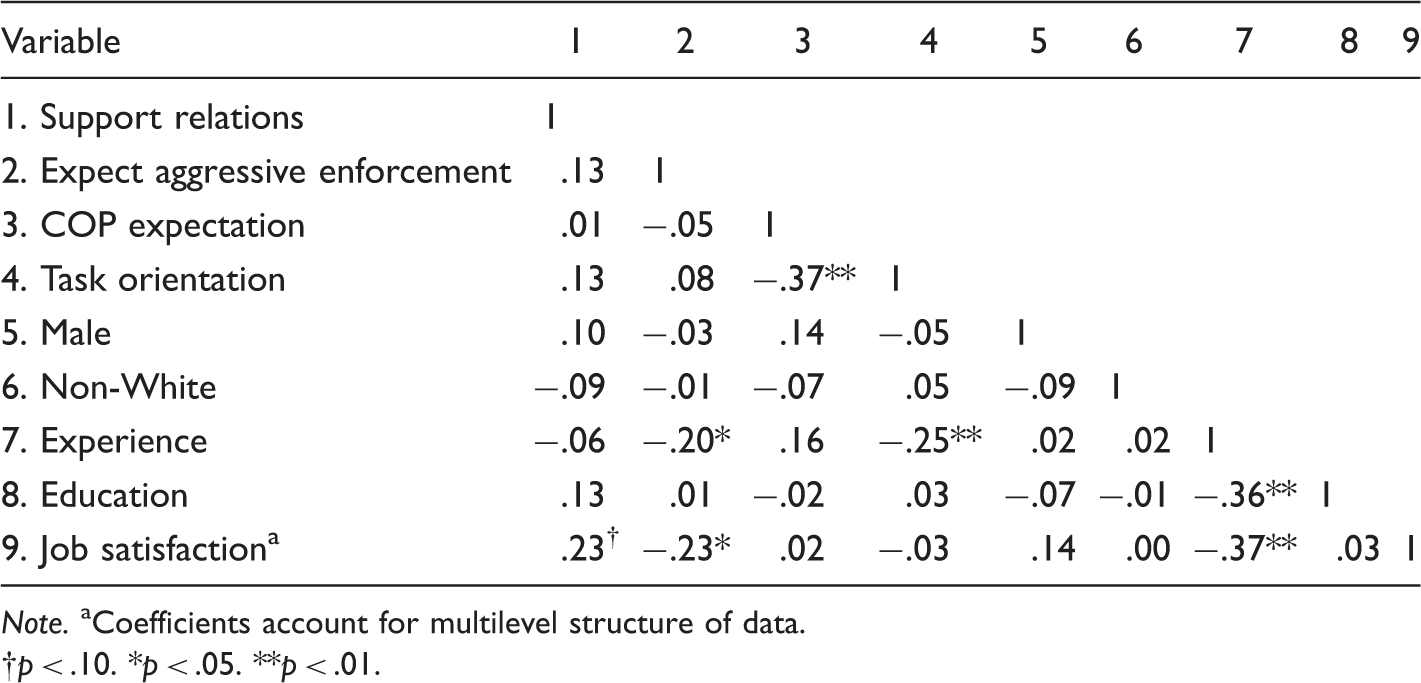
Note. aCoefficients account for multilevel structure of data.
p < .10. *p < .05. **p < .01.
Testing the Average Leadership Style Framework
Recall that the average leadership style framework proposes that supervisory influences are top-down and similar for all subordinates. In this regard, officers assigned to the same sergeant would be expected to hold similar views on job satisfaction, and sergeant characteristics should account for these views. In order to test this framework, two-level, multilevel modeling techniques were employed to investigate supervisory effects while controlling for officer-level factors found by prior research to also explain satisfaction. Specifically, three separate multilevel models were estimated.
Multilevel Models Predicting Officer Job Satisfaction.
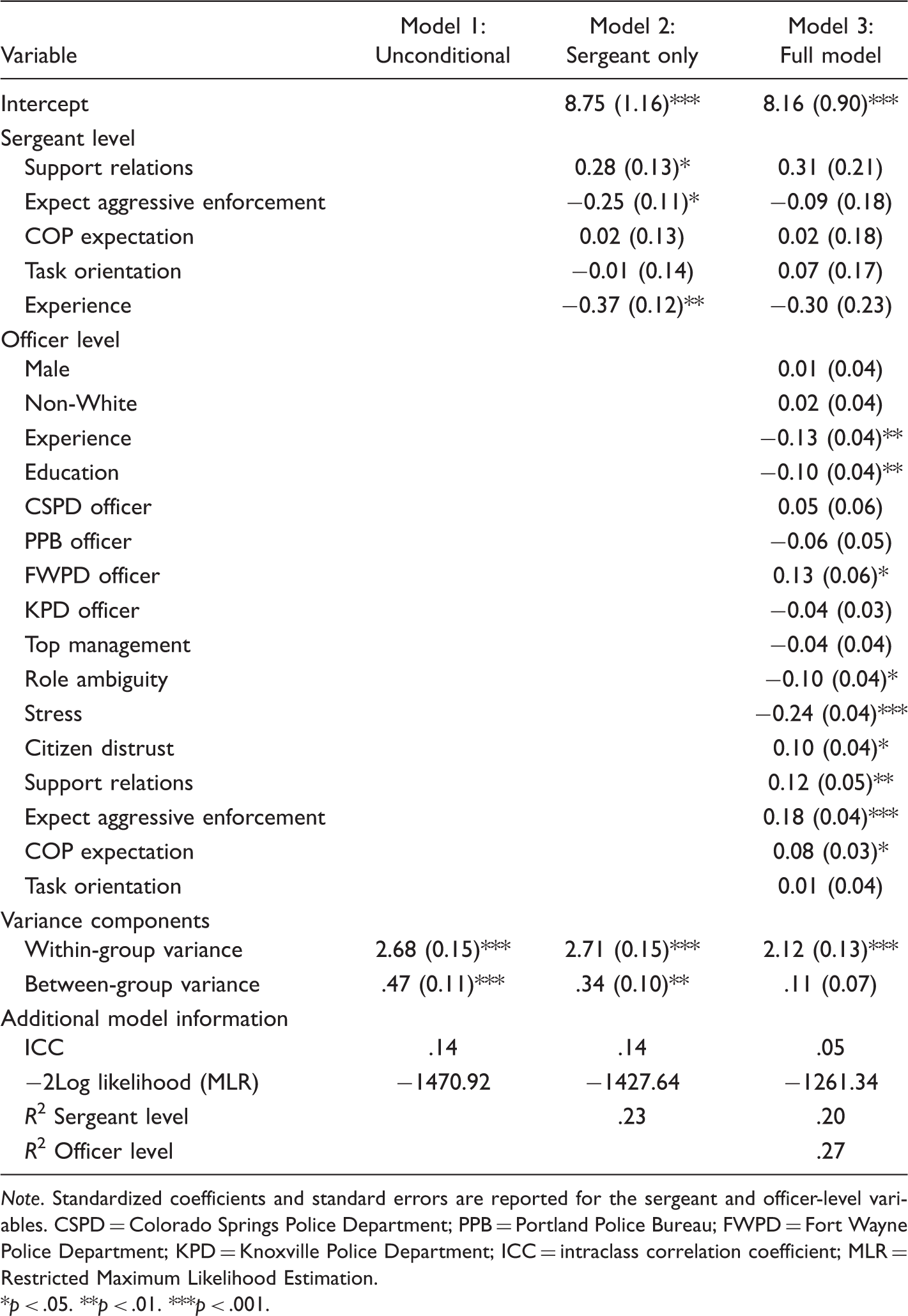
Note. Standardized coefficients and standard errors are reported for the sergeant and officer-level variables. CSPD = Colorado Springs Police Department; PPB = Portland Police Bureau; FWPD = Fort Wayne Police Department; KPD = Knoxville Police Department; ICC = intraclass correlation coefficient; MLR = Restricted Maximum Likelihood Estimation.
*p < .05. **p < .01. ***p < .001.
Second, we estimated a model including only sergeant-level measures (Level 2 variables) in order to see the nature of supervisory effects prior to controlling for officer-level effects (the Level 1 variables). The sergeant measures included in the model consisted of the four style measures and years of experience. 5 These results are also reported in Table 3 (see Model 2), and three are worth noting. Officers reported greater satisfaction under supportive sergeants but were less satisfied under sergeants who expected aggressive enforcement. Officers were also less satisfied under more experienced sergeants. Collectively, the sergeant-level variables explained approximately 23% of the Level 2 variance; however, this translates into only around 3% of the total variance in job satisfaction. Finally, a full two-level model was estimated controlling for the officer-level variables. Because the focus of the current inquiry was on supervisor effects, officer variables were fixed and grand mean centered (see Raudenbush & Bryk, 2002). 6 The results from Table 3 (Model 3) show that all of the previous sergeant effects became nonsignificant after controlling for the officer-level variables. Thus, after controlling for officer characteristics, the influence of sergeants was greatly reduced.
With respect to the officer-level variables, several findings are worth noting. More experienced and more highly educated officers reported significantly less satisfaction. Officers who reported greater ambiguity in role expectations and who experienced higher levels of stress were also significantly less satisfied with their jobs. Interestingly, distrustful and suspicious officers reported greater job satisfaction. Finally, three officer style dimensions were significant predictors of satisfaction. Specifically, officers who believed that their direct supervisor was supportive, officers who believed aggressive enforcement practices to be important, and officers who believed community policing to be important reported higher satisfaction levels. In this regard, while sergeant measures for these style dimensions became nonsignificant, officer perceptions on these dimensions were important. Collectively, the officer-level variables explained 27% of the variance in job satisfaction.
Testing the Officer–Supervisor Fit Framework
While the average leadership style framework proposes top-down supervisory effects, the officer–supervisor fit framework focuses on value congruence and incongruence. For congruence (i.e., sergeant–officer fit), additional estimates can be calculated that represent the effect on officer job satisfaction when officers and sergeants both have the same views toward each of the style dimensions. For incongruence (i.e., sergeant–officer misfit), estimates can be calculated that represent the effect on satisfaction when officers and sergeants both have the exact opposite views on each of the style dimensions. These sets of estimates along with their standard errors can be calculated using the linear combination of variables approach (see Edwards & Parry, 1993; Neter, Wasserman, & Gutner, 1989). 7
Results for Officer–Sergeant Fit and Misfit on Job Satisfaction.
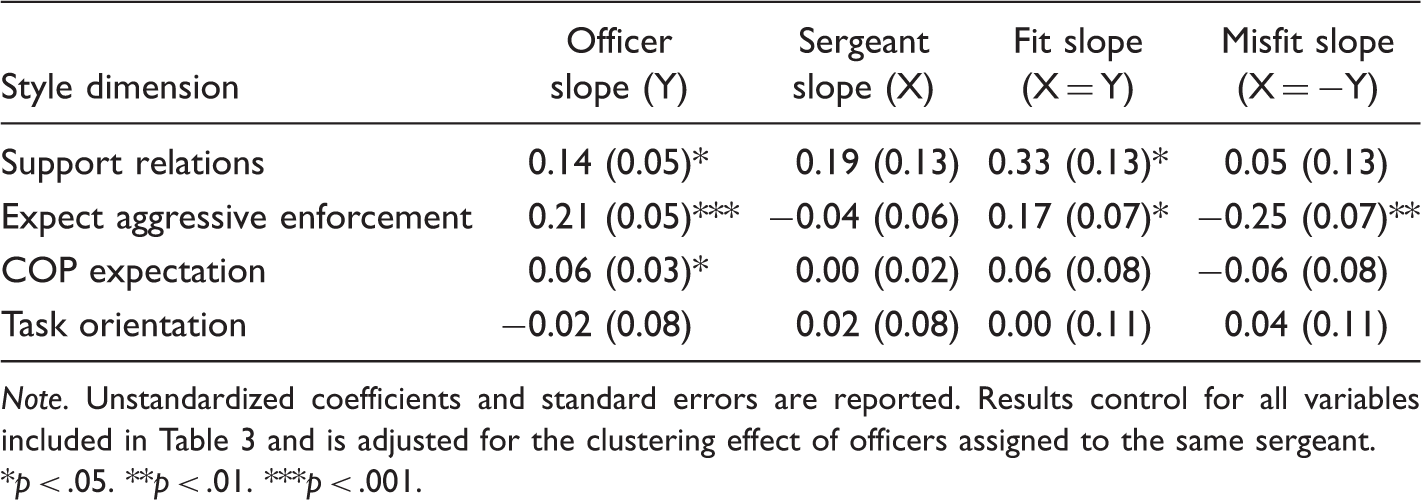
Note. Unstandardized coefficients and standard errors are reported. Results control for all variables included in Table 3 and is adjusted for the clustering effect of officers assigned to the same sergeant.
p < .05. **p < .01. ***p < .001.
First, there was a significant, positive slope for officer–sergeant congruence on support relations. Specifically, officer job satisfaction increased as both officer and sergeant support relation values increased. For example, when both officers and sergeants reported support relations to be low (i.e., both values at the scale minimums), officer satisfaction was lower (predicted value = 12.79). When both officers and sergeants reported average levels of support relations (i.e., both values at the scale means), officer satisfaction increased (predicted value = 13.64). Finally, when both officers and sergeants reported support relations to be high (both values at the scale maximums), officer satisfaction was highest (predicted value = 14.49).
Second, there were significant congruence and incongruence effects for officer–sergeant expectations of aggressive enforcement. With respect to congruence, officer job satisfaction increased as both officer and sergeant aggressive enforcement values increased. An examination of predicted values suggests a modest increase in satisfaction when officer and sergeant values were congruent on this dimension: Satisfaction was predicted to be 12.49 when both reported low expectations, 12.98 when both reported average expectations, and 13.47 when both reported high expectations. With respect to incongruence, an interesting pattern emerged. Job satisfaction was lowest when officers had little expectations of aggressive enforcement (i.e., the scale minimum value) but their sergeants had high expectations (i.e., the scale maximum value). In these instances, the predicted value of satisfaction was calculated to be 12.21 as opposed to 13.75 when officer expectations were high but sergeant expectations were low. Thus, satisfaction was minimized when sergeant expectations (the environment) exceeded officer expectations (the individual).
Finally, it should be noted that the fit and misfit slopes for COP expectations and task orientations as well as the misfit slope for support relations were all nonsignificant. These results mean that officer job satisfaction is constant along the lines of fit and misfit for these style dimensions. In other words, job satisfaction remains the same (or similar) regardless of the matched officer and sergeant values on these dimensions.
Subsample Analysis Incorporating Time
Two of the study departments (APD and KPD) used a squad system where we could systematically capture how long officers and sergeants had worked in their current assignments. Officers were asked how long they had been assigned to their current squad, and sergeants were asked how long they had been a supervisor in their current assignment. The average length of time for both officers and sergeants was 18 months. We then calculated the overlap between officer and sergeant assignment responses. In this subsample, officers had been supervised by their current sergeant for an average of 9 months; however, the amount of time ranged from 1 month to 53 months. From these data, total length of time was calculated for 265 officer–sergeant pairings in these two departments.
Based on these data, two subgroups were formed. The first subgroup represented pairings of officers and sergeants assigned together for 6 months or less, and the second subgroup represented pairings assigned together for greater than 6 months. The rationale for using the 6-month time frame was that it was a natural cutoff point in the data that categorized pairs into meaningful groups. In the group of 6 months or less, there were 116 officer–sergeant pairings, 86 of which were paired for 4 months or less. As such, officers in this group had not spent more than a few months under the supervision of their sergeants. On the other hand, officers in the other subgroup (N = 149) would have been under the supervision of their sergeants closer to the sample average (9 months) or longer. The use of these two subgroups provided the opportunity to conduct a preliminary investigation as to how the length of the working relationship may impact the relationship between style dimensions and job satisfaction.
Subgroup Analysis Incorporating Length of Time (APD and KPD Only).
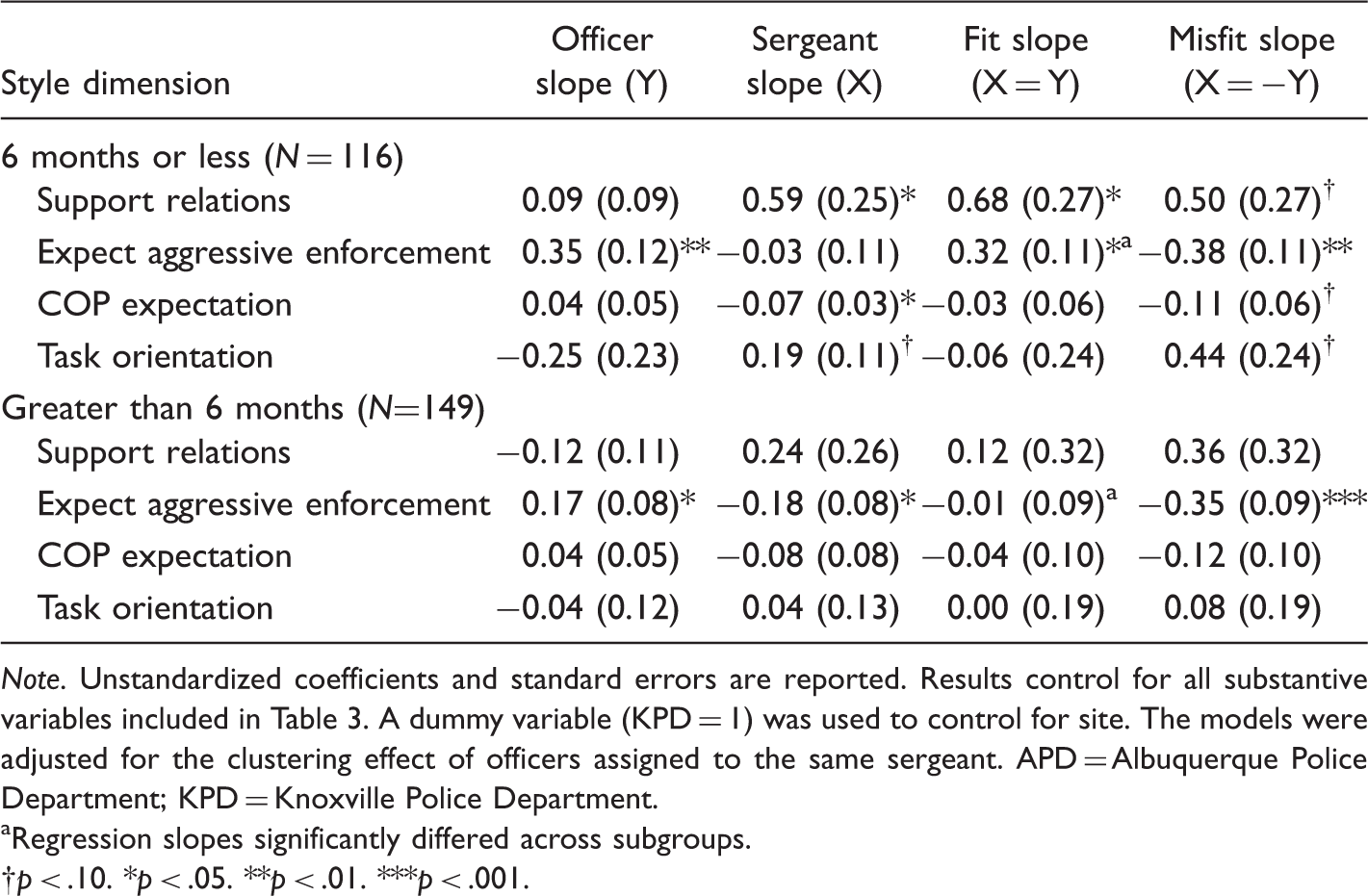
Note. Unstandardized coefficients and standard errors are reported. Results control for all substantive variables included in Table 3. A dummy variable (KPD = 1) was used to control for site. The models were adjusted for the clustering effect of officers assigned to the same sergeant. APD = Albuquerque Police Department; KPD = Knoxville Police Department.
Regression slopes significantly differed across subgroups.
p < .10. *p < .05. **p < .01. ***p < .001.
Second, the patterning of results was examined across the two subgroups. The results in Table 5 also illustrate that sergeant effects as well as congruence and incongruence effects for support relations and task orientation were also more prominent in the group that had been assigned together for 6 months or less, although not significantly different from the other group. In essence, even though the subsample analyses captured only two departments, representing approximately one third of the total study sample, it does provide some preliminary support for the notion that supervisory influences may be more pronounced in the early stages of the officer–sergeant relationship.
Discussion
The purpose of the current study was to investigate the extent to which attitudinal dimensions relevant to supervisor and officer styles influenced officer job satisfaction. Specifically, we tested two theoretical frameworks, average leadership style and person–supervisor fit while controlling for relevant factors identified by prior research. In doing so, the study contributes to research in this area by investigating the nature of supervisory influences (i.e., style dimensions) on officer job satisfaction from both top-down and relational perspectives. This is a topic that has yet to be examined, despite calls to do so (Walker, 2007). Finally, we conducted a partial inquiry to determine if time moderated the relationship between sergeant–officer style dimensions and satisfaction.
The study results provide three important aspects to consider. First, there was little empirical support for the average leadership framework. After controlling for demographics and officer perceptions of work and organizational environments, sergeant style dimensions became nonsignificant. These results are in accordance with prior research that has examined supervisory influences on officer attitudes as top-down effects (e.g., Engel & Worden, 2003; Ingram, 2013). Second, there was support for the person–supervisor fit framework. Thus, even though sergeant style dimensions failed to have a direct effect on satisfaction, two were important when viewed in relation to officers’ views. When sergeant and officer views were congruent in the areas of support relations and expectations of aggressive enforcement, officer satisfaction was enhanced. On the other hand, when sergeants viewed aggressive enforcement as important, but officers did not (i.e., incongruence), officer satisfaction was minimized. Finally, preliminary evidence suggested that such influences may be more pronounced in the early stages of the officer–sergeant supervisory relationship.
Before the implications of these findings are discussed, certain limitations should be acknowledged. First, the study is based off of data from five medium- to large-sized police agencies. Although the findings should extend to police departments of similar size and structure, they may not generalize to smaller or larger agencies where the nature of first-line supervision might vary (e.g., tighter control in small agencies or looser control in very large agencies due to relational distance). Future research could expand upon the current work by incorporating such departments.
Second, the study could only include four style dimensions measures. Because the focus of the broader NIJ project was on force policy and outcomes, only a handful of style dimensions were included as part of the survey. While the four included dimensions were highly relevant to job satisfaction, other dimensions, such as power, decision making, activity levels, and motivation, could also impact officer satisfaction. Future research would benefit by examining these dimensions in relation to satisfaction. Similarly, the nature of the data allowed only for some of the relevant correlates of satisfaction to be included as control variables. The inability to control for certain variables, such as autonomy and job characteristics, could have influenced the results. For example, the fit and misfit slopes could be attenuated with the inclusion of these missing factors. It should be noted, however, that the variance explained in our models (i.e., total variance of 0.30) is within the range reported by prior research (Carlan, 2007; Johnson, 2012; Zhao et al., 1999).
Finally, full incorporation of the time component was not possible. Unfortunately, we could only systematically capture the length of the sergeant–officer relationship in two departments, which limited the sample size. Even though the slope differences for many of the effects between the two subgroups were large, the limited sample sizes may have prevented these differences from being statistically significant. Future research could address this issue by including length of time under officers’ current supervisor as a more direct measure.
Despite these limitations, the results raise important practical implications to consider. Collectively, the study results indicate that sergeants’ views toward policing can have an influence on officer job satisfaction when viewed in relation to officers’ own views toward policing. Police administrators could focus on two specific findings to improve satisfaction in their departments. Encouraging first-line supervisors to be more supportive could serve to enhance officer job satisfaction. As Engel (2001) noted, supportive supervisors show concern for officer welfare, encourage officers through recognition, engage in mentoring, and protect officers from unfair punishment. Although being overly protective could lead to potentially problematic behaviors (see Engel, 2001), the current results suggest that simply showing concern and teaching subordinate officers how to perform their jobs could increase officers’ satisfaction levels. While descriptive statistics (see Table 1) indicated that both sergeants and officers mostly reported positive support relations, there were still some sergeants who indicated that they did not look out for the welfare of subordinates or try to teach officers how to perform their jobs as well as officers who did not perceive their supervisors to be very supportive.
Furthermore, the negative incongruence effect for expectations of aggressive enforcement could be addressed. While it may be difficult (and potentially undesired depending on departmental philosophies) to try and change sergeant or officer views in this area, there are steps that could be taken to potentially minimize the impact that this discrepancy has on satisfaction. For example, prior research has found communication and trust to be two important mediating factors between value congruence and job satisfaction (Edwards & Cable, 2009). If applied to the current results, promoting sergeant communication efforts, such as having clear and honest discussions on enforcement issues as well as coming to an understanding with subordinate officers on enforcement expectations, could have a positive impact. Additionally, trust could be enhanced by clarifying expectations in decision-making processes for enforcement activities. Because sergeants control the daily routines of officers, review officer reports, and prepare performance evaluations, ensuring fairness in the application of these efforts would also be a viable way to develop and sustain the trust of subordinate officers.
These implications should, however, be tempered with the other study results. While the earlier recommendations could assist departments that are experiencing issues with both satisfaction and first-line supervision, administrative efforts should not neglect the importance of job characteristics. For example, stress and officer style dimensions associated with role orientations and role ambiguity were the strongest predictors of officer satisfaction in the current study. Thus, focusing administrative efforts on these areas would likely have a greater impact on officer satisfaction (see also Johnson, 2012).
Finally, time may serve to mitigate officer–supervisor fit (and misfit) effects. Again, the results suggested that fit and misfit, for the most part, had little impact on subordinate officer satisfaction after 6 months of assignment. Two aspects of the police organization may account for this. First, department bid systems allow for officers to be reassigned, usually on an annual basis, depending on available openings. In this regard, officers who do not fit with their immediate supervisors can request to be reassigned. Similarly, those who remain under the command of their sergeants for a period of time may be more likely to subscribe to their sergeants’ views. For these officers, supervision may no longer play a role in their satisfaction, and other factors may likely have a stronger effect, such as job characteristics. Second, officers who do not fit with their immediate supervisors may find support or ways to cope from other areas of the police organization, such as fellow officers. For example, Griffin et al. (2001) found employee perceptions of supervisor support to be less influential (but still significant) in organizations that emphasized teamwork. Similarly, Johnson (2012) found perceived peer cohesion to explain officer job satisfaction over officer perceptions of supervisor feedback. In essence, supervisory influences may be best viewed as short-term influences on officer attitudes and behaviors (i.e., stronger early on but weaken over time). Future research, however, is needed before more definitive conclusions on this issue can be made.
Footnotes
Acknowledgments
We would like to thank the anonymous reviewers for their helpful comments and suggestions. The points of view expressed in this article are those of the authors and do not necessarily reflect the views of NIJ or the U.S. Department of Justice.
Declaration of Conflicting Interests
The authors declared no potential conflicts of interest with respect to the research, authorship, and/or publication of this article.
Funding
The author(s) disclosed receipt of the following financial support for the research, authorship, and/or publication of this article: This research is based on data from the National Institute of Justice grant #2005-IJ-CX-0055NIJ.