



Abstract
The role officer experience plays in shaping behavioral choices has received considerable attention. Officer experience has most often been captured by measuring years of service in policing literature. Thus, the field’s understanding of how officer experience shapes behavior choices is limited because years of service are not experienced monolithically. The current study employed multivariate, multilevel models to test three research hypotheses based on existing theoretical explanations of police behavior and psychology literature to more fully explore the influence of officer experience on discretionary search behavior. The results indicate that years of service provide an incomplete understanding of how experience motivates behavior in the traffic stop search context. A more complete understanding requires accounting for aspects of exposure to certain situational characteristics, activities undertaken, and work performance, suggesting that failing to incorporate multidimensional operationalizations of experience limits our ability to fully understand the influence of officer experience on decision making.
Introduction
Early, qualitative assessments of police behavior describe a socialization process that begins during formal, academy training and continues through informal, on-the-job learning (Brown, 1981; Hunt, 1985; Muir, 1977; Rubenstein, 1973). Some argue this socialization process produces a unique police subculture consisting of idea, value, and norm consensus (Brown, 1981; Westley, 1970), while others note that police officer attitudes and behaviors are far from monolithic (Sherman, 1980). Indeed, Chan, Devery, and Doran (2003, p. 223) recently reported that probationers in their study “were exposed to a variety of policing styles and more than one model of policing,” suggesting officers are unlikely to have uniform experiences even in the early stages of their career. This latter perspective is consistent with theoretical and empirical work that describes and documents a constellation of factors associated with officer behavior.
Officer experience is one element hypothesized to influence decision-making processes and subsequent behavior (Brown, 1981; Muir, 1977; Rubenstein, 1973). Scholars acknowledge the formation of officer experience is complex and develops across a multitude of different contexts by gathering information from a variety of individuals, including peers, citizens, and suspects (Klinger, 1997; Sherman, 1980; Van Maanen, 1978). Unfortunately, the concept of officer experience has most often been operationalized using a generic, single-item measure (i.e., number of years of service) in policing literature. And, while years of service certainly influences officers’ experience, it is not merely the length of service that matters, but rather how the officer spends his or her years of service that is most influential (Sherman, 1980). Simply accounting for years of service assumes that officer experiences are monolithic and that behavior is shaped solely by accruing years on the job without consideration of valuable personal and contextual differences in experience that coalesce to influence future behavior.
The current study contributes to our understanding of discretionary officer decision making by operationalizing officer experience in a nuanced manner that accounts for recent work-related experiences. We develop and test three hypotheses grounded in theoretical perspectives on officer decision making and by drawing from existing psychological explanations outlining the importance of past experiences on future behavior. We explore the development of officer experience by focusing on one dimension of police work, discretionary searches of a citizen, or vehicle during a traffic stop, which allows for the estimation of factors that influence officer behavior when they have the ability to pursue differential courses of action. Results of multilevel models estimated to test these hypotheses indicate that officer experience, as it relates to discretionary searches, is a complex, multifaceted concept that influences officer behavior.
Operationalizing Officer Experience
Officer experience could conceptually influence discretionary search behavior in at least two ways. One potential relationship between these constructs is a heightened likelihood to engage in discretionary activities. For example, an officer with more experience may initiate more discretionary searches of citizens and vehicles because they have developed a strong understanding of the legal foundation for initiating a search and a heightened sense of pride in their job, which may translate to a greater interest in interrupting criminal activity. Thus, a positive relationship would be expected between officer experience and discretionary search behavior.
Conversely, officer experience may induce a degree of burnout or lack of interest in engaging these types of activities. Officers with more experience may also be more selective and skilled in their approach to search activity thereby resulting in fewer searches. Worden et al. (2013) suggest that classic and more recent studies of police activity offer evidence for these processes. Independent of the specific explanation (granted the underlying mechanism is important), a negative relationship between officer experience and discretionary behavior would be predicted.
To date, the collective empirical evidence regarding the effect of officer experience is inconsistent and difficult to summarize in a meaningful way. Primarily, operationalizing officer experience as years of service, the majority of studies suggest a mixed relationship depending on the type of police activity. A handful of studies find no relationship between officer experience and police activity, others report a negative relationship with police activity, and two studies indicate that officer experience is positively related to police behavior (please see Appendix for specifics). The uneven pattern of results is likely due to the fact that the literature is almost exclusively based on a generic, single-item measure that captures the length of officers’ service, but indicates little beyond the passage of time. Thus, although years of service tell us about the quantity of time one has had to accumulate experience, it tells us nothing about the actual experiences gained. As Mastrofski, Ritti, and Snipes (1994, p. 126) argue, “Among police, it is a given that ‘experience is the best teacher’”; however, years of service merely captures the passage of time rather than unpacking the complexities of an officer’s experiences and how those experiences may impact discretionary behavior, such as the decision to initiate a search.
Accounting for officers’ number of years of service is important, but we contend officer experience is a complex, multidimensional concept that goes well beyond the passage of time. It is reasonable to assume that the development of officer experience results from a constellation of factors that coalesce over the course of one’s career, which is probably the reason years of service has dominated the literature as the preferred measure of officer experience (i.e., it generically captures the evolution of an officer’s career). However, this measure indicates little about the amount and types of training, quality of mentorship, experiential and vicarious learning, job assignment, location assignment, peer relationships, and activity measures (i.e., frequency and intensity of actions taken on the job), as well as knowing the importance of a variety of reward systems (i.e., contraband discovery, organizational praise, peer praise, etc.). These are the dimensions of police work that need to be accounted for if we wish to have a rich understanding of officer experience and how it motivates behavioral choices. The aforementioned list is not meant to be exhaustive, but rather serve to demonstrate the myriad of factors that may influence the development of experience. As a result, it is conceivable that some experiences are positively related to future behavior, while other factors are negatively related to later decision making, but simply measuring years of service blurs the line between these factors and makes it difficult to understand how officer behavior is truly motivated by past experiences.
Finally, a comprehensive measure of experience requires information relating to a number of domains, but researchers often encounter difficulties finding data that contain the necessary information to account for all potential dimensions of officer experience. This likely explains why officer experience has been reduced to a single-item measure or overlooked altogether throughout policing literature. Thus, moving from the conceptualization of officer experience to operational measures that tap various elements of experience presents a considerable challenge.
The current study explores this issue by moving beyond a single-item measure of officer experience (i.e., years of service) to specify and test three additional elements of recent officer experiences that are hypothesized to impact future behavior. First, we contend, officer experience develops through exposure to environmental factors. From this perspective, exposure encompasses a variety of factors including citizen characteristics, such as race/ethnicity, gender, age, and criminal history (among others). This has significant implications for discretionary search activity if exposure to specific groups consistently produces negative outcomes. If officer experience is swayed by these situations, future encounters with that group are likely to be influenced. Skolnick’s (1994, p. 212) suggestion that, “African Americans who live in black ghettos are especially prone to being searched according to a ‘reasonableness-of-the-search’ standard” reflects the notion of a symbolic assailant and the perceived link between minorities and criminal activity. If police perceive African Americans as symbolic assailants, it is conceivable that this group would receive differential treatment. More broadly, explanations for officer decision making vary but often reference the role of stereotypes and behavioral schematics as central influencers of officer behavior with scholars suggesting that repeated exposure to situational and contextual cues is important to the process of forming preconceived notions about specific citizen groups (see, e.g., Klinger, 1997; Muir, 1977; Rubinstein, 1973). Related, Smith and Alpert’s social conditioning model (2007) posits officer behavior is influenced by unconscious stereotypes, which are based on repeated exposure to similar situations, vicarious experiences, and media representations of specific citizen groups. Klinger’s (1997) ecological theory of police behavior also makes reference to officer experiences, in particular exposure to similar individuals and geographic characteristics, as crucial in sharpening their ability to discern who is likely to be engaged in criminal activity. The development of suspicion is crucial to this process because officers are motivated by a desire to avoid harm and the arousal of suspicion is a key mechanism in achieving this outcome (Smith, Makarios, & Alpert, 2006; also see Skolnick, 1966/1994; Van Maanen, 1978).
Using this theoretical backdrop, we contend that exposure contributes to the development of officer experience and can lead to differential behavioral choices. We specifically hypothesize that officers with more exposure to racial/ethnic minorities, males, younger citizens, and those with criminal histories will be more likely to engage in future discretionary search behavior. If these theoretical explanations are correct, exposure to these groups should contribute to heightened levels of suspicion when encountering these groups and subsequent behavior should be influenced. Moreover, we expect officers with greater exposure to citizens with a criminal history to be more likely to pursue discretionary searches due to concerns of safety and the possibility of contraband discovery.
1
A second element contributing to officer experience is the actual activity undertaken by the officer. Psychological literature suggests that past behavior is highly predictive of future behavior (Ouelette & Wood, 1998). Recent developments have further suggested the relationship between past and future behaviors is influenced by the frequency of engaging in a certain behavior, as well as the actor’s intent, and the context of the event(s). For example, Danner, Aarts, and de Vries (2008) indicate that as frequency in behavior increases, the intent of the actor becomes less important, and this is particularly true for behaviors that occur in stable contexts. Thus, for behaviors that are only performed annually or biannually (Danner et al., 2008; Ouelette & Wood, 1998), the influence of past behavior on future behavior is reduced and intent of actions is more salient. However, for more frequently replicated behaviors, such as those performed on a weekly or monthly basis (Danner et al., 2008; Ouelette & Wood, 1998), the effect of actor intent is not as strong, and behavioral replication explains most of the relationship between past and future behavior (Danner et al., 2008). Applying these findings to an officer’s decision to search a citizen or vehicle suggests the frequency of past searches is likely to be influential in whether future searches are pursued. Thus, we hypothesize that officers with a higher rate of searches in the past will be more likely to initiate discretionary searches in the future.
The development of officer experience through activity is also likely influenced by past performance (Bandura, 1977). Performance accomplishments are particularly influential in guiding future behavior because they validate self-efficacy, the notion that the individual can successfully perform that particular task (Bandura, 1977). Research in cognitive psychology tends to support the idea that people perceive past successes as indicative of future outcomes. For example, Cohen and Ranganath (2007) found that subjects who lost to a computer in a simulated matching game were more likely, than winners, to change their decision-making behavior on subsequent trials (also see Ayton & Fischer, 2004). Further, Sharpe and Tarrier (1993, p. 409) note, “If the gambler wins, this tends to reinforce the beliefs about the likelihood of winning”; thus, continued behavior (i.e., gambling) is more likely to occur because of an inaccurate appraisal of the likelihood of winning (Clark, 2010).
2
Collectively, these findings suggest that when behavior is reinforced with a positive outcome, the behavior is more likely to occur in the future. This is especially true when the behavior involves actual human performance as opposed to “inanimate chance mechanisms” (e.g., roulette wheels, slot machines, etc.; Ayton & Fischer, 2004, p. 1374). Applying this principle to police officer search behavior leads to a hypothesis predicting that officers with experience in discovering contraband will be more likely to pursue discretionary searches in the future.
Collectively, these hypotheses attempt to contextualize officer experience beyond years of service in an effort to understand how actual on-the-job experiences influence future behavioral choices. Specifically, we contend that exposure, activity, and performance independently impact the likelihood of an officer initiating a discretionary search, net of controls including years of service. Support for these hypotheses would enhance our conceptual and operational understanding of officer experience.
Methodology
Data to test these hypotheses were drawn from a municipal law enforcement agency in a large, urban Southwestern city that services a population of roughly 1.4 million residents (U.S. Census Bureau, 2013). The agency consists of over 3,000 sworn and civilian members who provide a full service function for the population that is slightly more than 60% Hispanic (U.S. Census Bureau, 2013). Data reflect police–citizen interactions conducted during one calendar year (January 1, 2009–December 31, 2009). State law mandates collection of information on all officer-initiated citizen contacts and this process has become routinized through systematic data collection procedures in place since 2001. All data were stored electronically for analysis and state reporting requirements, but they were made available to the research team and supplemented with officer information, including demographic characteristics and years of service. Once collated, these data represent all police–citizen interactions during the study period. The following data rules were subsequently applied to enable hypotheses testing.
First, officer-initiated traffic stops were considered because this type of encounter reflects officer discretion (given a legal reason) rather than officer response to a citizen request for assistance, such as in a traffic accident. Traffic stops were exclusively considered, as they are the most common form of police–citizen interaction (Eith & Durose, 2011), 3 and they offer an opportunity to study officer discretionary decision making. Given pedestrian stops occur within a different context, they were removed from consideration in these analyses. During the study year, 215,190 officer-initiated traffic stops occurred. A small number of cases (approximately 1.5%) were missing information on variables of interest and these cases were discarded to allow estimation of multilevel, multivariate models which resulted in 211,838 encounters, initiated by 1,299 officers, available for analysis.
Second, to develop hypothesized measures of officer experience, the data were split into two 6-month time intervals. Time Period 1 (T1) contains traffic stops occurring between the beginning of January and the end of June in the study year and Time Period 2 (T2) reflects all traffic stops occurring between the beginning of July and the end of December of the same calendar year. Slightly more traffic stops were initiated in T1 (N = 112,116) compared with T2 (N = 99,722); however, no significant differences were found between these time periods in the descriptive statistics of the relevant variables. 4
A rule of 20 was applied to both data sets to ensure stability of estimates within the hierarchical structure of the traffic stop data. To properly estimate traffic stop models that include officer characteristics, consideration must be given to the fact that one officer initiates multiple traffic stops over the course of a study period. Multilevel modeling is an appropriate modeling technique, given the nested nature of these data; however, each officer (i.e., Level 2) must conduct a minimum number of traffic stops (i.e., Level 1) to ensure stability of estimates leading to the requirement that all officers initiate at least 20 interactions with citizens. 5
Once this criterion was applied, the T2 data involved 82,054 police–citizen interactions involving 496 officers. The noticeable reduction in the number of officers is expected, as a large number of officers did not initiate frequent traffic stops due to their rank and assignment. Thus, the data set reflects officers who engaged in a minimum level of traffic stopping activity, roughly three traffic stops per month. T1 interactions were used to create independent variables estimated at Level 2, while T2 interactions were used to measure the dependent variable and independent variables estimated at Level 1.
Measures
A discretionary search is the dichotomous, dependent variable measured at T2. 6 Discretionary searches involve an officer possessing probable cause (i.e., plain view, canine alert, smell of illegal substance, etc.) or receiving citizen consent to search; thus, our analyses distinguish between encounters in which officers could exercise their discretion and those in which they were required by policy to perform a search. 7 During the final 6 months of 2009, discretionary searches were conducted in 6.4% of all police–citizen interactions occurring during a traffic stop.
The independent variables are grouped into Level 1 and Level 2 characteristics. All Level 1 variables are dichotomous and measured at T2. Citizen race/ethnicity was recorded from officer perception of the citizen (Engel & Silver, 2001; Rosenfeld, Rojek, & Decker, 2012; Tillyer, Klahm, & Frank, 2012) and categorized as White, Black, Hispanic, and Other 8 for purposes of analysis. The geographic locale of the study (i.e., the Southwest) explains the high percentage of Hispanic citizens (57.0%) compared with the White population (31.2%), the Black citizenry (10.0%), and citizens of other races/ethnicities (1.9%). The majority of citizens were male (64.0%), and citizen age was dichotomized into those aged 30 or younger for ease of interpretation with 47.0% of all citizens categorized as young. Citizen criminal history, which includes outstanding warrants and previous convictions, was collected as a result of agency policy requiring the officer to check for previous criminal history. Nearly, 10% of all police–citizen interactions involved citizens with a criminal history. A dichotomous measure of whether the interaction occurred on weekday was created from the date of the encounter, with 77.4% of all traffic stops occurring on a weekday. Time of day was also dichotomized into daytime hours (between 0700 and 1900), with 62.4% of all interactions occurring during these hours. 9
Officer characteristics were measured and included at Level 2. Time-invariant officer attributes, including race/ethnicity and gender, were dichotomized into White, Black, and Hispanic, with Hispanics (55.2%) and males (92.7%) representing the majority of officers in the agency. Years of service ranged from 1 to 34 with the average officer on the job for 8.7 years.
Descriptives (L1 = 82,054; L2 = 496).
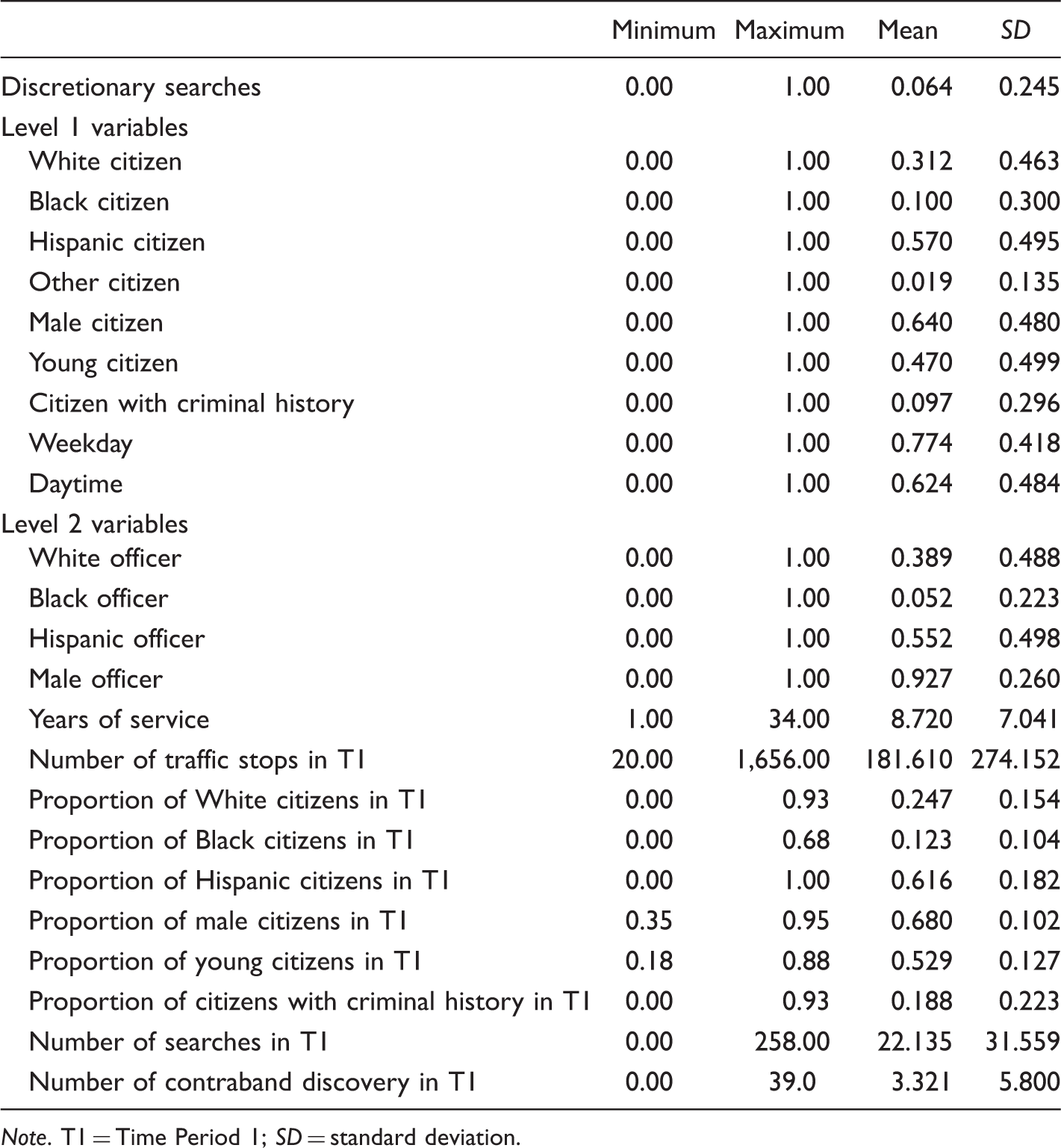
Note. T1 = Time Period 1; SD = standard deviation.
Analytic Strategy
Testing the research hypotheses required the estimation of several multilevel, multivariate models due to the nested nature of the data. Police–citizen encounter data are inherently hierarchical due to a single officer initiating multiple interactions within the study period. Multilevel models are appropriate for analyzing nested data to correct for biased parameter estimates due to data clustering and to provide accurate standard errors thereby ensuring proper significance testing (Guo & Zhao, 2000; Luke, 2004; Raudenbush & Bryk, 2002). All analyses were completed using HLM 6, and given the dichotomous dependent variable, Bernoulli models were estimated.
An unconditional model was initially estimated to test for variation in discretionary searches across officers. Thereafter, three hierarchical models were estimated with identical Level 1 variables and varying Level 2 variables to test the research hypotheses. Model 1 is a baseline model examining the effect of Level 1 variables and some officer characteristics including demographics and years of service. Model 2 adds the exposure variables, while Model 3 is the full model, which includes years of service, exposure, activity, and performance variables. A correction for overdispersion was required in all models because the standard error exceeded the mean of the dependent variable (Hanushek & Jackson, 1977). All variables were grand mean centered, 11 robust standard errors are reported due to the relatively large sample size at Level 2 (Raudenbush & Bryk, 2002), and population-specific models were reported, given the nature of the research hypotheses. 12 Tests for multicollinearity demonstrated no substantial problems (variance inflation factors <1.5).
Results
The unconditional model indicated the log odds of a discretionary search varied across officers (χ2 = 58,813.96, p < .001, df = 496). 13 The interclass correlation coefficient was calculated using the formula suggested by Snijders and Bosker (1999) 14 that is appropriate for dichotomous dependent variables and indicated that 65.5% of the variation in the likelihood of a discretionary search exists across officers. Given the majority of the variation in the dependent variable exists at the officer level, it is increasingly valuable that research focus not only on citizen characteristics but also on variation across officers when studying the use of discretion.
Multilevel Discretionary Search Models (L1 = 82,054; L2 = 496).

Note. T1 = time period 1; SE = standard error; CH = criminal history; CD = contraband discovery. White is the reference category at the encounter level; White officer and proportion of White citizens are the reference categories at the officer level.
p ≤ .05. **p ≤ .01.***p ≤ .001.
Officer demographics were also included, but none were related to the likelihood of a discretionary search. The number of traffic stops initiated by an officer in T1 was statistically significant, but its substantive effect was minimal due to its scale. Importantly, the initiation of a traffic stop is a necessary, but not sufficient, criterion for the potential of a discretionary search; therefore, its inclusion operates as a measure of opportunity. Failure to consider the level of officer activity could bias any effects of officer experience. Years of service was also included in this baseline model with results indicating that officers with fewer years of service were more likely to pursue a discretionary search, net of other factors, which is consistent with some previous research (Mastrofski, Snipes, Parks, & Maxwell, 2000; Paoline & Terrill, 2007; Tillyer et al., 2012). This variable maintained its significance in both the subsequent models even when the additional measures of officer experience were considered. 15 Thus, the current study supports the traditional measurement of officer experience (i.e., years of service), suggesting that officer decision making is influenced by the number of years working within the agency. Overall, this baseline model explained 46.4% of the variation in likelihood of a discretionary search. 16
Thereafter, analyses were conducted by building off the baseline model to test the three hypotheses. Model 2 indicates that exposure to higher proportions of Black citizens and Hispanic citizens (relative to White citizens), male citizens, and younger citizens increased the likelihood of a discretionary search. These results suggest that repeated exposure, over time, to individuals who are perceived to fit a certain stereotype might result in the development of a perceptual shorthand that cues suspicion and motivates search behavior, as suggested by Skolnick (1966/1994) and the social conditioning model (Smith & Alpert, 2007). Somewhat surprising was the lack of influence of exposure to citizens with a criminal history. It was hypothesized this group would spur suspicion and future encounters would result in a search. Perhaps the symbolic assailant is more impressionable than the actual assailant. That is, it seems that the effect from exposure to these groups (Black, Hispanic, male, and young) supersedes the influence of exposure to citizens who actually have a criminal history, thus providing strong support for Skolnick’s (1966/1994) suggestion that one need not actually be criminal to receive scrutiny from police.
The null finding for criminal history might also be explained by the failure to account for the types of criminal histories officers were most often exposed to during traffic stops. Thus, it is possible that frequent exposure to criminal history in and of itself might not affect decision-making processes as much as exposure to particular types of criminal history. For example, it might be that exposure to criminal histories in which contraband is likely to be associated (e.g., drug possession/trafficking and weapon possession) influences decisions in the context of traffic stop searches, but exposure to histories in which contraband is not usually associated (e.g., public intoxication, simple assault, etc.) does not have the same effect. Unfortunately, these data did not allow an investigation of this possibility. In general, it appears that repeated experiences with individuals possessing certain demographic characteristics assumed to be associated with contraband carrying leads officers to act on those cues and initiate discretionary searches. Overall, the exposure variables explained an additional 13.0% of the overall variation in discretionary searches.
The second hypothesis suggested that recent officer activity would increase the likelihood of a discretionary search, and Model 3 offers support for this claim. The number of searches in T1 was positively related to the likelihood of a discretionary search occurring in T2. All encounter-level variables maintained similar effects on the dependent variable; however, the exposure variables were partially mediated by the inclusion of the activity variable, as all statistically significant exposure variables demonstrated weaker effects. The inclusion of officer activity increased the overall explanatory power of the model by 10.2%. This finding directly reflects active decision making and suggests officers gain experience during searches that influences their decision making in the future (independent of whether or not their initial action resulted in a success). Moreover, this influence seemingly operates independently from the effects of exposure to certain groups (i.e., minorities and males).
Model 3 also offers support for our third hypothesis regarding officer performance, although its effect was not as substantive as expected. Given that past research suggested successful outcomes encourage engagement in that behavior (Ayton & Fischer, 2004; Bandura, 1977; Cohen & Ranganath, 2007; Sharpe & Tarrier, 1993), it is surprising that this measure did not possess greater influence. However, this could reflect that highly successful officers refine their skillset to the point at which they limit searches to instances in which they believe they have a good chance of detecting contraband. Thus, there might be two different types of officers who engage in search and seizure activities at higher rates than the average officer. One group might be high rate searchers (i.e., our activity measure) but go on more fishing expeditions than the other group that is more successful at seizures. Ultimately, one group might search whenever they have the legal authority to, while the other group might be more discerning when to search despite having legal authority.
Overall, the results of Model 3 offer insight into the independent impact of exposure, activity, and performance measures and increase the proportion of variance explained from 46.4% (baseline model) to 69.6%. Thus, these results confirm that officer experience is not a monolithic entity that can be captured only with a single measure, such as years of service; instead, it is a more finely grained concept that requires various operationlizations to properly measure and understand its influence. Based on these findings, we contend accounting for actual work experiences (i.e., exposure, activity, and performance, as well as others) is vitally important to understanding how officers spend their time and how those experiences influence their behavioral choices.
Discussion
Officer experience has been historically recognized as an important factor in influencing officer decision making (Brown, 1981; Muir, 1977; Rubenstein, 1973). Existing literature regarding the role of officer experience is inconsistent and difficult to summarize, contradicts what is known among police officers (Mastrofski et al., 1994), and is largely based on a single-item measure. Recognizing that choices, including whether or not to search, are structured based on learned associations between certain stimuli (Clark, Hollon, & Phillips, 2012), we explored whether expanded measures of officer experience would enhance our understanding of how this construct impacts officer behavior.
Support was found for not only the traditional measurement of officer experience, years of service, but also for the importance of exposure, activity, and performance. Our findings suggest the role of officer experience needs to be considered in a much more nuanced, complex manner to understand its relationship to decision making. In particular, while years of service shapes an officer’s behavioral choices, recent on-the-job experiences influence future behavior as well. This oversight in previous research may be due to a bias toward the effects of situational factors (i.e., citizen characteristics) to the detriment of considering officer-related measures, particularly the role of experience. Collectively, our analyses indicate that roughly one half of the variation in discretionary searches is linked to officer characteristics, and specific exposure, activity, and performance measures assist in unpacking some of the complexities of officer experience. Thus, these results suggest that greater conceptual and operational attention is needed to fully understand how officer experience impacts officer behavior.
One area that is underdeveloped in the current study is a broader and more comprehensive measure of other experiential development factors. For example, prior research has demonstrated that citizen demeanor (Engel, Tillyer et al., 2012), officer assignment (Tillyer & Klahm, 2011), and environmental context (Smith, 1986) are also relevant to decision making. Other scholars have suggested the types and intensity of training officers complete are relevant in shaping their experience (Mastrofski et al., 1994). Mentorship, peer relationships, the frequency and intensity of actions taken on the job, and the role of reward systems (i.e., contraband discovery, organizational praise, peer praise, etc.) are other factors that require additional consideration. These factors may further contextualize how years of service, exposure, activity, and performance independently and collectively impact officer decision making.
Another avenue of future research could be structured around changes over time. One limitation of the current analysis is the relatively short time period of the data. While it appears that recent events influence future behavior, it would be valuable to examine officer experiences over time to assess points of change and associated events that increase or decrease their likelihood of a particular outcome from occurring. Similar to the recent emphasis of research on the life course of offenders, the development of officer experience is likely marked by specific points of change or transitions, such as exposure to different supervisory styles, involvement in critical incidents, and training. Thus, to better understand how officer experience develops over time, future research might consider exploring the effects of experience using a longitudinal cohort methodology, although we recognize this is a difficult and costly endeavor.
It is also important to recognize our findings are specific to a single jurisdiction and might not be representative of other areas within the United States. Specifically, the agency under study serves a population that is almost 60% Hispanic, which is significantly higher than the national average of 17% (U.S. Census Bureau, 2013). Moreover, the department is larger than 99.9% of law enforcement agencies in the United States (Reaves, 2011). And, while these caveats are important to consider, we caution against making too much ado about the uniqueness of the research agency or site because there is no reason to believe that officers in other settings are motivated differently by exposure, activity, and performance measures. That is to say, it is likely that officers with a higher rate of exposure to certain groups, activity in searches, and success with seizures are motivated similarly by these factors regardless the size of agency they work for or composition of the jurisdiction in which they work.
Given the theoretical explanation offered for how officer experience impacts behavior, it is likely these various constructs underlying officer experience interact in a manner that influences the creation of stereotypes and subsequent behavior. For example, much commentary has been offered regarding the relationship between citizen race/ethnicity and police behavior, but it would be interesting to assess how citizen characteristics interact and potentially influence how officers use their discretion in the future. Some work in this area (Rosenfeld et al., 2012; Tillyer & Engel, 2013) has already demonstrated the importance of these interactions, but given the effect of contraband discovery reported here, it would be valuable to investigate whether officers exposed to specific citizen groups (e.g., young, Black males) found to be carrying contraband would treat those same groups differentially in the future.
Such a focus would be consistent with research suggesting that the effect of exposure to different stimuli should be given more attention in future research. For example, Campbell (1995) reported repeated exposure to rape victims led to changes in beliefs regarding that group (i.e., rape victims) among her sample of officers. While beliefs and behaviors are not identical outcomes, it seems logical that exposure, over time, to similar situations or contexts may shape beliefs and subsequent behaviors similarly. Related, virtually no empirical work has examined the role of vicarious experiences or media exposure as contributors to the development of stereotypes and subsequent behavior among police. The social conditioning model (Smith & Alpert, 2007) and a large body of work in psychology contend that personal experiences are only part of the process by which stereotypes develop. If stereotypes do influence suspicion, which subsequently affects behavior, greater examination of these sources is a necessary element of understanding the development of officer experience.
Our findings also have practical implications for developing agency policies. Agencies looking to develop their own set of best practices for police–citizen encounters could rely on officers providing rich information regarding how they process situational cues and detail how work-related experiences inform behavioral choices. For example, focus group research with state police officers indicates that there appears to be two types of officers: those who are interested in interdiction work and those who are interested in traffic enforcement (Engel, Tillyer, & Cherkauskas, 2007). This line of research also suggests that officer input is used to develop a set of best practices, and in turn, officers are educated on these policies through in-service training. These best practices illustrate how officers use on-the-job experiences to assist in decision making when confronted with similar situational and contextual characteristics. Moreover, best practices are designed to impart knowledge and, hopefully, influence officer decision making in that specific context.
Our findings also have implications for officer deployment. If officer experiences are built from the passage of time, exposure to specific stimuli, and work-related activities, it is reasonable to suggest that agencies consider these factors in relation to the life histories of officers. One perspective, within the context of patrol, might be that it is best to minimize officer movement to maximize development of officer awareness of local characteristics and ties with the community. Creation of localized knowledge, as suggested by Klinger (1997), may be invaluable in responding to the specific needs of communities. Given our findings, however, there may be a negative effect of this approach particularly in homogeneous communities, as officers may develop stereotypes regarding specific citizen groups that influence future behavior in ways that increase the likelihood of disparate treatment.
Taken together, the findings reported here suggest that officer experience is a complex mosaic that should not be reduced to a single-item measure. The fact that policing outcomes appear to be tenure graded is interesting and valuable, but somewhat limited as it is likely that officers with similar years of service have accumulated very different experiences over the years. Moreover, it would be naïve to assume that these officers demonstrate monolithic behavioral tendencies. This is not a criticism of previous research, as it has laid the foundation for the current study, but our findings should be viewed as an extension and elaboration on the importance of recent experiences in understanding officer behavior. In line with Sherman’s (1980) contention that the mere passage of time does not fully explain behavioral tendencies, we found that officer experience, measured in years of service, provides an incomplete understanding of how officer experiences motivate behavior in the traffic stop and search context. Not only are years of service important, but exposure, activity, and performance are also crucial to understanding officer experience. Based on these results, we suggest that failing to incorporate this type of multidimensional operationalization of officer experience may limit our ability to further understand officer decision making.
Footnotes
Appendix. Summary of Officer Experience Operationalizations and Effects
Declaration of Conflicting Interests
The authors declared no potential conflicts of interest with respect to the research, authorship, and/or publication of this article.
Funding
The authors received no financial support for the research, authorship, and/or publication of this article.