




Abstract
Citizens’ beliefs that officers are employing unnecessary or excessive levels of force can quickly erode police legitimacy and can lead to severe consequences including loss of life, civil disorder, criminal prosecution, and large civil judgments. Although scholars have devoted more than four decades of research to identifying the correlates of police–citizen violence, relatively little study has focused on the relationship between departmental measures of police professionalism and violent outcomes between citizens and officers. The current study uses data from the 2003 Law Enforcement Management and Administrative Statistics survey to examine the impact of five measures of departmental professionalism—(a) agency commitment to education (associate’s degree requirement); (b) the number of hiring or screening standards; (c) the total number of training hours (academy, field training, and in-service); (d) female representation; and (e) agency commitment to community policing—on two indicators of police–citizen violence—(a) citizen complaints alleging excessive use of force and (b) reported assaults on officers—across 526 large municipal law enforcement agencies. Results from ordinary least squares regression analyses show that only departmental commitment to education was related to the police–citizen violence indicators, as agencies that require an associate’s degree experienced fewer citizen complaints of use of force and fewer assaults on their officers. The article concludes with a discussion of the implications of the findings for police policy and practice, as well as for our understanding of the organizational-level correlates of police–citizen violence.
Police rely on the support and cooperation of citizens to function effectively. This reliance is perhaps most evident in a police department’s efforts to fight crime, as citizens serve as the primary source of information on criminal activity as victims, eyewitnesses, bystanders, and informants. As a result, the relationship between a police department and its constituents is critically important. Originally conceived as “police–community relations,” the focus on the rapport between police and citizens has shifted to a larger normative framework grounded in legitimacy (Walker & Archbold, 2014). Under this framework, citizens cooperate with the police (and comply with the law) because they believe it is the right thing to do (Mazerolle, Antrobus, Bennett, & Tyler, 2013; Tyler, 2006). A robust body of research has confirmed the corollaries of police legitimacy, including enhanced citizen compliance with police commands during encounters; greater cooperation with police (i.e., reporting crimes, providing information, etc.); and obedience to the law (Hinds, 2009; Hinds & Murphy, 2007; Tyler, 1990; Tyler & Huo, 2002).
Citizens’ views of police as legitimate, however, can be tenuous and fleeting, especially in the wake of a police–citizen encounter ending in violence. Citizens’ beliefs that officers are employing unnecessary or excessive levels of force can quickly erode police legitimacy (Brunson, 2007; Gau & Brunson, 2010) and can lead to disastrous outcomes, from loss of life and civil disorder to criminal prosecution and large civil judgments (Skolnick & Fyfe, 1993). The events in Ferguson, MO in August 2014 clearly demonstrate this point. As a result, researchers have devoted significant scholarly attention to the identification of correlates of police–citizen violence over the past 40 years, and a sizeable body of literature has developed with regard to the individual-, organizational-, and community-level factors that increase the risk of violence (Fyfe, 1979; Jacobs & O’Brien, 1998; Terrill & Reisig, 2003; White, 2002).
At the organizational level, a substantial amount of research has explored the impact of administrative policy on violence between police and citizens (e.g., use of force), but researchers have devoted considerably less attention to other agency-level characteristics, particularly those organizational features that are associated with professionalism. There is a long history of efforts to professionalize police, and much of that attention has focused on educational requirements (i.e., college degree), prehiring selection standards, and training (Kelling & Moore, 1988). Advocates of police professionalism have maintained that implementation of selective hiring standards coupled with rigorous training curricula will improve the quality of police service and will lead to lower levels of police–citizen violence (see, e.g., the Commission on the Accreditation of Law Enforcement Agencies, http://www.calea.org/; Smith, 2004; White & Escobar, 2008). 1 More recently, professionalism advocates have highlighted the importance of diversifying the police force (e.g., greater female representation) and adopting a community-oriented policing philosophy. However, the presumed link between professionalism and reduced police–citizen violence has not been sufficiently tested. The relative dearth of research in this area represents a major knowledge gap in our understanding of both the factors that contribute to violent outcomes among police and citizens, and the potential for mechanisms of professionalism to moderate that violence.
The current study seeks to address this issue through an investigation of the impact of police professionalism on indicators of police–citizen violence among 526 large municipal law enforcement agencies. The authors use data from the 2003 Law Enforcement Management and Administrative Statistics (LEMAS) survey, and for each police department, we examine five measures of police professionalism: (a) agency commitment to education (measured as a preemployment college credit requirement); (b) the number of agency hiring standards (or screening mechanisms) in place; (c) the total number of training hours required (academy, field, and in-service); (d) female representation; and (e) agency commitment to community policing (CP); and two measures of police–citizen violence: (a) formal citizen complaints alleging excessive use of force and (b) officially reported assaults against police officers perpetrated by citizens. 2 Given the transactional nature of police–citizen encounters (see Binder & Scharf, 1980; Fridell & Binder, 1992; Terrill, 2005; Toch, 1969), these two outcome measures are viewed as different sides of the same proverbial coin. Ordinary least squares (OLS) regression, using the department as the unit of analysis, is used to assess the professionalism and police–citizen violence relationship, while controlling for other relevant factors. The article concludes with a discussion of the implications of the findings for police policy and practice, as well as for our understanding of the organizational-level correlates of police–citizen violence.
Prior Research
The Nature and Prevalence of Police–Citizen Violence
The authority to use coercive force is a central component of the police function (Bittner, 1970; Klockars, 1985). Although police use of force is a statistically rare event, occurring in about 1.4% of all police–citizen encounters, the volume of encounters in a given year (approximately 40 million) translates into an estimated 560,000 use of force incidents per year, or more than 1,500 events per day (Bureau of Justice Statistics [BJS], 2011). Moreover, use of force by police is much more common in arrest encounters, as research indicates about one in five arrests involves the use of some level of force by police (Hickman, Piquero, & Garner, 2008). Research also shows that the vast majority of incidents involve lesser forms of force, including grabbing and control holds—with weapons use being much less common (Alpert et al., 2011; Hickman et al., 2008). Police use of deadly force is exceptionally rare. The BJS (2001), for example, examined national data on police shootings from 1976 to 1998 and concluded that the number of fatal shootings averaged just 400 per year and that the number had not changed significantly during that time despite large increases in the U.S. population and the number of sworn police officers. 3 In addition, research on individual police departments over time suggests that the use of force has actually decreased in recent years (White, 2001; White & Klinger, 2012).
Scholars have noted for several years, however, that there is no national-level system for measuring police use of force—deadly or otherwise—and, in fact, commonly used data sources for measuring the phenomenon have substantial limitations. For example, Sherman and Langworthy (1979) compared justifiable homicide counts from the National Center for Health Statistics and alternative data sources for 36 jurisdictions for various years from 1966 to 1976; the authors concluded that police homicide may be underreported by as much as 50% (see also Mumola, 2007). 4 Scholars have been equally critical of the Federal Bureau of Investigation’s Supplemental Homicide Report (SHR; Fyfe, 2002; Klinger, 2008) and the BJS’ Death in Custody Reporting Program (Klinger, 2008; White et al., 2013). For example, Klinger (2008) concluded “it should be abundantly clear that neither academics nor those who toil in the public policy arena should take either the DCRP or the SHR data at face value” (p. 609).
The data on assaults and deaths of law enforcement officers are more readily available and detailed than police use of force data. For example, the Federal Bureau of Investigation (FBI) produces an annual report with descriptive information about officer deaths and assaults (called Law Enforcement Officers Killed and Assaulted or LEOKA, with summary data available online from 1996 to 2012, http://www.fbi.gov/about-us/cjis/ucr/leoka; see Uchida & King, 2002 for a discussion on the limitations of the LEOKA data). 5 Yet, the scholarly literature on aggression against police is relatively limited compared with the literature on police use of force, although more contemporary work has started to address violence directed against officers (see Kaminski, Jefferis, & Gu, 2003). Scholars, however, have tended to focus on macrolevel factors, such as political and economic subordination (e.g., Jacobs & Carmichael, 2002; Kaminski & Stucky, 2009), as well as situational and individual-level officer features (e.g., Covington, Huff-Corzine, & Corzine, 2014; Gibbs, Ruiz, & Klapper-Lehman, 2014; Rabe-Hemp & Schuck, 2007); less research has been dedicated to organizational and department-level characteristics (see Fridell, Faggiani, Taylor, Brito, & Kubu, 2009; Willits, 2014; Wilson & Zhao, 2008 for exceptions). In addition, more attention has been placed on felonious killings of police than less lethal forms of officer victimization (e.g., Kaminski, 2008; Kent, 2010). In sum, though police–citizen violence is widely recognized as one of the most important social justice issues of our time, available data on the phenomenon are surprisingly poor.
Correlates of Police Use of Force Decision Making
Research has identified three basic classes of variables that influence police officer decisions to use force: “features of the situations in which officers and suspects come together in time and space, conditions of the social environment in which officers work, and aspects of the police agencies that employ officers” (White & Klinger, 2012, pp. 200–201; see also Brooks, 2010). At the situational level, scholars have focused on encounter-related factors such as the actions of the suspect (i.e., posed a threat), as well as characteristics of officers and suspects. For example, research has found that the majority of suspects who are shot at by the police presented an imminent danger to the officer(s) who fired (Fyfe, 1980, 1981a; Klinger, 2004). Similarly, research shows that suspect resistance or aggression is the best predictor of less lethal force (Mulvey & White, 2014; Terrill & Mastrofski, 2002), though the research is mixed on the role of suspect demeanor (Klinger, 1994). Victims of police use of force are disproportionately minorities, especially African Americans, though the causes of this overrepresentation are unclear and may vary by location (Fyfe, 1981b; Geller & Karales, 1981; Milton, Halleck, Lardner, & Albrecht, 1977). Prior studies have generally failed to identify any officer characteristics that are consistently related to use of force (Fyfe, 1989), although some research (see Rabe-Hemp, 2008) has found that female officers are less likely to use coercive force (e.g., threats and physical restraints).
At the environmental level, scholars have explored the impact of state statutes and court rulings on police use of force, as well as features of the community in which police–citizen violence occurs. For example, research suggests that statutory and case law exert little direct influence on officers’ use of their firearms (e.g., Tennenbaum, 1994; White, 2003). Research on the link between community characteristics and police use of force has examined the role of several factors, such as racial composition, arrest rates, economic inequality, and various measures of public violence. The most consistent finding from this line of research is that levels of police use of force are positively related to the prevalence of community violence (e.g., Kania & Mackey, 1977; Liska & Yu, 1992; Matulia, 1985; Terrill & Reisig, 2003).
At the organizational level, researchers have focused primarily on the role that administrative policies play in officers’ decisions to employ force. Research has consistently demonstrated that administrative policies—when enforced—can substantially curtail the rate of police shootings (Fyfe, 1979, 1988; Gain, 1971; Geller & Scott, 1992). Alternatively, administrative permissiveness can also lead to higher rates of police shootings (White, 2001). Walker (1993) concluded: . . . administrative rules have successfully limited police shooting discretion, with positive results in terms of social policy. Fewer people are being shot and killed, racial disparities in shootings have been reduced, and police officers are in no greater danger because of these restrictions. (p. 32)
Administrative policy has successfully influenced other forms of police behavior including less lethal force, high-speed pursuits, use of police dogs, and responses to domestic violence incidents (Riksheim & Chermak, 1993; White, 2007). However, if administrative policy is to be effective, it must be supported and enforced by the organizational leadership (Skolnick & Fyfe, 1993).
Researchers have devoted less attention to other organizational features that may influence police–citizen violence. Several seminal studies of police highlighted the importance of informal organizational culture as a determinant of police behavior, including Reiss (1968), Skolnick (1966), and Wilson (1968; see also Klinger 1997; Skolnick & Fyfe, 1993). Also, a handful of studies have examined the impact of department size on police officer behavior, with mixed results (Brown, 1981; Mastrofski, 1981; Ostrum, Parks, & Whitaker, 1978).
Research investigating the impact of core features of departmental professionalism—educational or hiring standards and training—on police use of force is limited with mixed results. A fair amount of research has examined the impact of college education on police officer behavior, and the results are inconsistent (Sherman, 1978; Truxillo, Bennett, & Collins, 1998). For example, Cao and Huang (2000) examined citizen complaint rates among officers with different educational levels and found little variation in those rates. Several studies have found no relationship between education requirements and rates of use of force (Smith, 2004; Willits & Nowacki, 2014). However, some research has shown that educated police officers may perform better than non-college-educated officers (e.g., Paoline, Myers, & Worden, 2000; Reuss-Ianni, 1983). Kappeler, Sapp, and Carter (1992) reported that college-educated officers received fewer citizen complaints than their non-college-educated counterparts. Kane and White (2009) discovered that college education served as a strong protective factor against career-ending misconduct.
With regard to the impact of rigorous hiring standards or requirements on police behavior (or outcomes), Cohen and Chaiken (1972, 1973) found that records of dismissal in prior jobs and military discipline were associated with internal police rule violations (see also Grant & Grant, 1996). Kane and White (2009) also found that many officers who were fired for misconduct had “red flags” in their past, including prior job problems, criminal histories, and failed background investigations, that should have precluded their hiring. Researchers have long maintained that well-trained officers can avoid precipitating violent confrontations (Flynn, 2002; Fyfe, 1995; Geller & Karales, 1981), though there are few empirical assessments of the influence of training on officer use of force (e.g., Lee, Jang, Yun, Lim, & Tushaus, 2010), and the results are surprisingly mixed. For example, Smith (2004) and Lee et al. (2010) found that the number of training hours actually had a positive association with the prevalence of lethal and nonlethal use of force incidents.
Despite the limited and mixed evidence on the impact of organizational characteristics on police–citizen violence, academics are typically adamant about its importance (Sherman, 1980; Wagner & Decker, 1993). Smith (1984), for example, has stated, “Any theory of legal control that ignores the organizational context in which police operate cannot adequately account for police behavior across different organizational contexts” (p. 33).
Police Professionalism
Professionalism is a primary function of organizations, and organizational sociologists have argued that elements of professionalism define how organizations manage their work (Lipsky, 1971; Stinchcombe, 1959). Scholars and practitioners alike have long stressed the importance of police professionalism. Although the concept has been characterized in a number of different ways, there is a general consensus that the “professional” police department is one that emphasizes education, rigorous recruitment and selection of officers, and training (Smith, 2004; White & Escobar, 2008; Willits & Nowacki, 2014; Wilson, 1968). In addition to these traditional indicators, there is reason to view female representation and departmental commitment to the CP philosophy as more contemporary features of police professionalism. A greater degree of female representation in departments suggests more of a commitment to equal opportunity and gender diversity in the workplace (Schuck, 2014). And with common elements such as increased citizen input and partnership building, a broader view of the police role, and a greater focus on problem solving, adherence to the CP philosophy has the potential to significantly advance the “mind-set” of a department—setting it up for success in modern day policing (see Cordner, 2010).
The effort to reform police departments can be traced back to the early 20th century when a handful of progressive police chiefs initiated a movement to professionalize the occupation. Led by August Vollmer, Richard Sylvester, and O. W. Wilson, the professionalism movement focused on insulating departments from political control, as well as limiting the role of police to crime control (Uchida, 2010; Walker, 1977). In addition, the professionalism movement placed significant emphasis on improving the quality of individuals who became police officers through educational standards, rigorous selection protocols, and intensive training (Kelling & Moore, 1988). 6
The seeds of professionalism planted by Vollmer continue to define policing today. Moreover, their importance has been accentuated as new, innovative strategies have expanded the role of the police and increased the level of difficulty required to succeed in the profession (e.g., community- and problem-oriented policing, focused deterrence, and hot spots strategies; Braga & Weisburd, 2006; Goldstein, 1979; Wilson & Kelling, 1982). For example, the President’s Commission on Law Enforcement and the Administration of Justice (1967) stated that “the ultimate aim of all police departments should be that all personnel with general enforcement powers have baccalaureate degrees” (p. 109). The Law Enforcement Assistance Administration was created by the Federal Government in the 1960s to facilitate greater levels of education for police and included the development of a grant program (Law Enforcement Education Program) to ease the financial burden for interested officers. The Commission on Accreditation for Law Enforcement Agencies (CALEA) concurs, stating that “officers who have received a broad general education have a better opportunity to gain a more thorough understanding of society, to communicate more effectively with citizens, and to engage in the exploration of new ideas and concepts (http://www.calea.org/).” Interestingly, although departments have placed significant emphasis on college education, most still do not require a full 4-year degree prior to employment (e.g., 16% require some college credit, while 9% require a 2-year degree; BJS, 2010).
There has also been significant emphasis placed on officer training, both in the academy and through field and in-service training. For example, the development of Peace Officer Standards and Training boards across the country has served to raise standards overall (White, 2007). In addition, there are now numerous training and technical assistance mechanisms in place at the Federal level, from the Office of Justice Programs Diagnostic Center (https://www.ojpdiagnosticcenter.org/) to the Bureau of Justice Assistance’s National Training and Technical Assistance Center (https://www.bjatraining.org/). Notably, studies show that there is still significant variation across departments in terms of the duration and content of officer training (Haberfeld, 2002; White, 2007).
The focus on professionalism is perhaps best exemplified by the creation and success of CALEA. Established in 1979 by the four leadership organizations in law enforcement (International Association of Chiefs of Police, National Sheriff’s Association, National Organization of Black Law Enforcement Executives, and the Police Executive Research Forum), CALEA has established a process whereby police departments can receive formal “accreditation” if they meet the more than 400 standards and policies set forth in the program, many of which address hiring standards, training, and use of force (http://www.calea.org/). CALEA employs a team of assessors who work with an applicant agency to go through the five-stage process (enrollment, self-assessment, on-site assessment, Commission review and decision, and maintaining compliance and reaccreditation); the accreditation process can take from 3 to 5 years. More than 1,000 law enforcement agencies are either accredited or in the process of being accredited.
Current Focus
Despite these important developments, research has not kept pace with regard to documenting the impact of professionalism on key outcomes for police, most notably indicators of violence between officers and citizens. The current study attempts to fill this void by examining indicators of departmental professionalism across a sample of 526 large municipal police agencies and assessing the impact of those measures on rates of police–citizen violence—operationalized as formal citizen complaints of use of force and officially reported citizen assaults against officers. The authors test five hypotheses: H1: Departments with greater commitment to education will experience both lower rates of formal citizen complaints of use of force and lower rates of assaulted officers. H2: Departments employing more rigorous hiring standards will experience both lower rates of formal citizen complaints of use of force and lower rates of assaulted officers. H3: Departments with a greater emphasis on training will experience both lower rates of formal citizen complaints of use of force and lower rates of assaulted officers. H4: Departments with greater female representation will experience both lower rates of formal citizen complaints of use of force and lower rates of assaulted officers. H5: Departments with a greater commitment to community policing will experience both lower rates of formal citizen complaints of use of force and lower rates of assaulted officers.
Methods
Data
This study uses data from the 2003 LEMAS survey. Administered by the BJS, LEMAS collects organizational data from a nationally representative sample of state and local law enforcement agencies (including information related to hiring standards and training). In an effort to improve available information on police use of force, BJS expanded LEMAS in 2003 to capture data on formal citizen complaints of officer use of force (Hickman, 2006). The authors supplement the LEMAS data with the FBI’s 2003 Uniform Crime Report (UCR) data (including the LEOKA report) and contextual measures drawn from the 2000 U.S. Census.
Sample
Data were gathered from a sampling frame of local law enforcement agencies with over 100 sworn full-time officers, resulting in a sample of 526 departments. 7 These departments constitute 56% of all sworn full-time municipal officers in the country, serving about 32% of the population. Citizens from jurisdictions served by these 526 police departments are responsible for nearly 60% of all violent offenses known to law enforcement (Hickman & Piquero, 2009). In addition, 88% of all citizens’ complaints of use of force in 2003 were received by large municipal police departments, like those in the current study (Hickman, 2006). 8 The agencies under study, therefore, represent a significant portion of policing in America.
Measures
Dependent variables: Indicators of police–citizen violence
Two outcome variables are considered. The first is the rate of formal citizen complaints of police use of force per 100 officers. The authors recognize that this measure is a rough proxy for police use of force. Given the absence of nationally representative department-level data on use of force (see earlier discussion), formal citizen complaints of use of force captured in LEMAS represents one of the best available indicators of the phenomenon across agencies (Hickman & Piquero, 2009; Johnson, 2013; but see Hickman & Poore, 2015 for its limitations). Moreover, Rojek, Decker, and Wagner (2010) note that citizen complaints can act as a “barometer of police performance” (p. 302), providing departments and their leaders with valuable information that may not necessarily be reported by officers (see also U.S. Commission on Civil Rights, 1981; Walker & Archbold, 2014). The mean use of force complaint rate across agencies is 5.73 per 100 officers (SD = 8.01), ranging from 0 to 88.06 per 100. 9 Given that prior research has found citizen complaints to be underreported (Walker & Graham, 1998), we consider the measure a conservative estimate of police–community conflict. The second indicator of police–citizen violence is the departmental rate of officers assaulted per 100 officers. This measure was taken from the 2003 LEOKA report. The reference period was the entire 2003 calendar year. The department rate of victimized officers ranged from 0 to 69.87 per 100 officers, with a mean of 9.21 (SD = 10.03). 10
Independent variables: Police professionalism
Five sets of variables are used to measure department-level professionalism. The first indicator of professionalism involves an agency’s commitment to education. In LEMAS, departments are asked to indicate their agency’s minimum education requirement for applicants. The authors created a dummy variable to measure whether an agency requires the completion of at least an associate’s degree prior to appointment (1 = yes; 0 = no). Nearly 10% of departments require a 2-year degree (n = 52), while 90.1% of departments require only a high school diploma (n = 474). 11 The second indicator of departmental professionalism involves hiring standards. LEMAS asks about the various screening techniques used in selecting new officers. To operationalize hiring standards, the authors developed a variety score based on 10 dummy variables (1 = used by the agency; 0 = not used): background investigation, credit history check, criminal history check, driving record check, drug test, personal interview, personality inventory, physical agility test, polygraph examination, and psychological evaluation. Several of the hiring standards are employed by nearly all departments (e.g., 99.2% of departments conduct a background investigation, and 97.3% conduct a personal interview), while other standards are less common (e.g., 63.9% of departments administer a polygraph examination, and 47.7% employ a personality inventory; see Appendix for more information on each standard). The hiring standards variety score ranges from 4 to 10 (M = 8.63; SD = 1.10), with higher scores reflecting more rigorous hiring standards (i.e., greater professionalism). 12
The third professionalism variable captures departmental training. Three separate dimensions of training are used: academy, field training, and in-service. In LEMAS, departments are asked to report the number of required academy and field training hours for new officers, as well as the number of in-service training hours required annually for nonprobationary officers. The mean training requirements are as follows: 796.30 hr for academy training (SD = 433.28), 580.76 hr for field training (SD = 347.41), and 42.40 hr for in-service training (SD = 45.00). 13 Female representation is the fourth professionalism variable. Calculated as the proportion of female officers in each department, female representation ranges from 0 to 0.34 (M = 0.10; SD = 0.05); this variable was log transformed to address a positive skew.
The fifth and final set of professionalism variables represents a department’s commitment to CP. Following prior work (e.g., Wilson & Zhao, 2008), we used three separate measures. The first, CP plan, is a dummy variable indicating whether an agency had developed a formal CP plan (1 = yes); 47.9% of departments had such a plan in place (n = 252). Next, CP activities is a summated index (Kuder–Richardson [KR20] = .67) of nine dummy variables (1 = yes) tapping into whether a department engaged in specific CP activities, such as utilizing foot patrol, surveying the public, and encouraging officers to engage in problem-solving techniques. CP activities ranged from 0 to 9 with a mean of 5.64 (SD = 2.16). The last variable, CP meetings, is another summated index (KR20 = .88) using eight dummy variables to measure the number of certain groups (e.g., local government, neighborhood associations, and youth service organizations) an agency regularly met with. The mean is 4.17 (SD = 2.88), ranging from 0 to 8. Readers are encouraged to see the Appendix for more information on each item in the two CP indices.
Controls
Descriptive Statistics (N = 526).

Note. CP = community policing.
Natural logarithm.
Rate per 100 officers.
Rate per 10,000 residents.
Analytic Strategy
The analysis was carried out in two phases. First, bivariate relationships (Pearson’s r) were assessed between the professionalism and outcome measures. Second, the professionalism and police–citizen violence relationship is tested at the multivariate level. Given that the police–citizen violence variables are rates, the models are estimated using OLS regression. 15 The cluster function (by state) in STATA was used to account for potential nesting issues, especially in regard to state mandated minimum training hours.
Results
Bivariate Relationships
Zero-Order Correlations.

Note. CP = community policing.
Natural logarithm.
p < .05. **p < .01 (two-tailed test).
Multivariate Analyses
Ordinary Least Squares Regression Models.
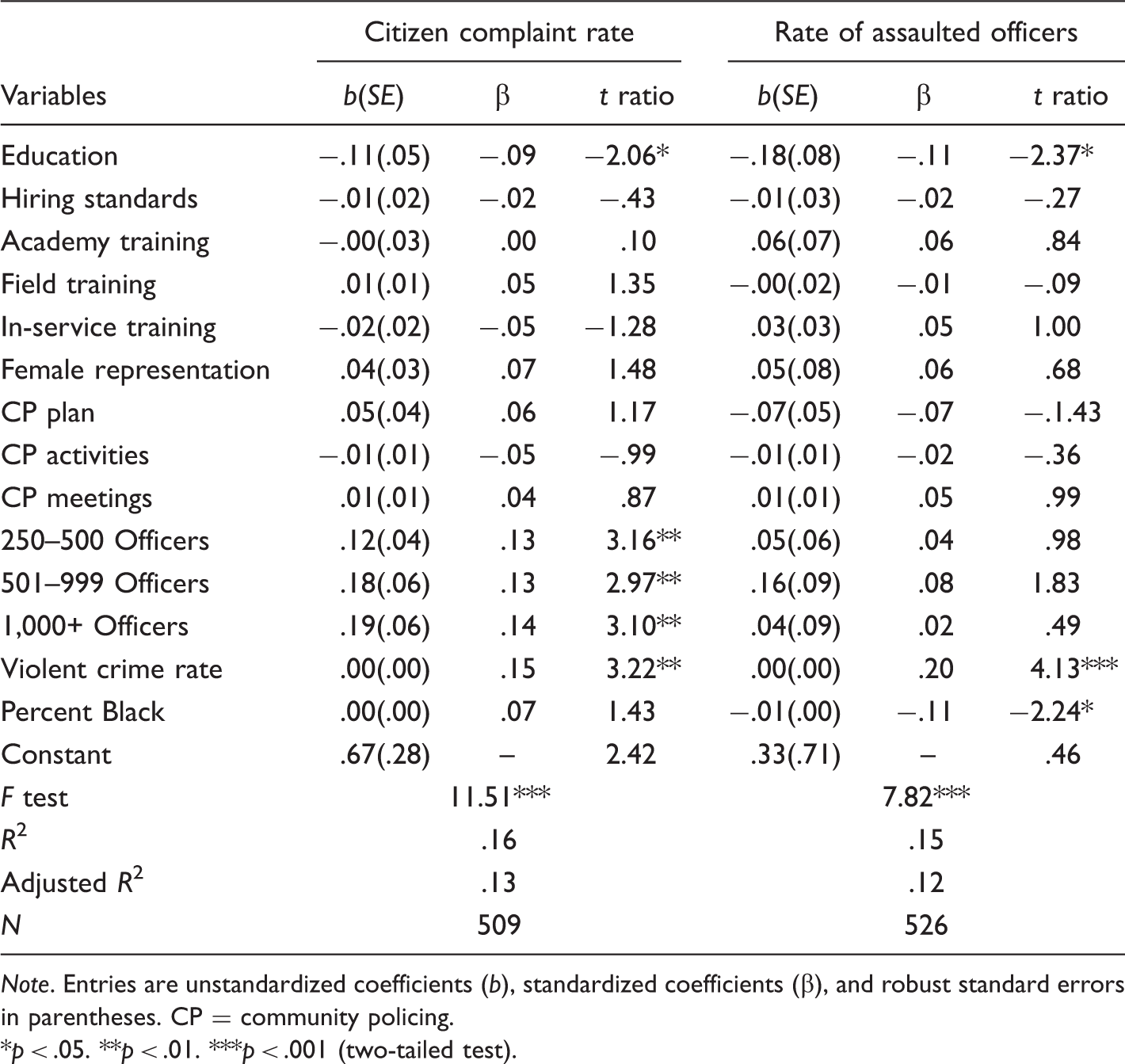
Note. Entries are unstandardized coefficients (b), standardized coefficients (β), and robust standard errors in parentheses. CP = community policing.
p < .05. **p < .01. ***p < .001 (two-tailed test).
Formal citizen complaint rates of use of force
On the left side of Table 3, formal citizen complaint rates of officer use of force were regressed on the independent variables. The F test, or measure of joint association, shows that the model fits the data well and performs better than the constant-only model (p < .001; R 2 = .16). Consistent with Hypothesis 1, the significance of a department’s educational requirement persists in the saturated model. Agencies with a stronger commitment to education have significantly lower rates of citizen complaints of use of force, net of controls, compared with their counterpart agencies that do not employ at least an associate’s degree requirement (β = −·09; p < .05). The four other professionalism measures—hiring standards, training variables, female representation, and the CP variables—are not significant. Female representation, having a CP plan, and the number of community groups a department meets with are no longer positively associated with this outcome measure once the control variables are included.
A number of control variables exert significant effects and are worth noting. Department size influences the rate of citizen complaints of use of force (i.e., more sworn officers and higher complaint rates), as does the violent crime rate. For each one-unit increase in a jurisdiction’s violent crime rate, there is a .15 increase in a department’s rate of use of force complaints from citizens—holding all other variables constant (p < .01).
Rates of assaulted officers
On the right side of Table 3, departmental rates of assaulted officers are regressed on the independent variables. The F test here is statistically significant (p < .001; R 2 = .15), indicating acceptable model fit. In line with the second part of Hypothesis 1 (and consistent with the previous model), higher educational requirements are predictive of lower rates of assaulted officers (β = −.11; p < .05). Again, the hiring standards, training variables, female representation, and CP variables are not significant. The violent crime rate is positively associated with the officer assault rate (β = .20; p < .001), while, surprisingly, the percent Black population is negatively associated with the outcome variable (β = −.11; p < .05). Because the percent Black measure is not statistically significantly correlated with the rate of assaulted officers at the bivariate level (r = .04; p = .49; see Table 2) but emerges as a significant predictor in the multivariate model, we inferred that there might be a suppressor effect at work. Given the strong association between percent Black and violent crime rate (r = .51; p < .001) observed in Table 2, we ran a subsequent OLS regression predicting the rate of assaulted officers (similar to Model 2) but without the inclusion of the violent crime control variable. Percent Black no longer exerted a statistically significant relationship with the dependent variable (unstandardized coefficient = −.0009353; t ratio = −.49; p = .625). This supplemental analysis is available upon request.
Discussion
For nearly a century, police departments have placed considerable emphasis on professionalizing their organizations, most commonly through increased educational or hiring standards and training. Despite this long-term concern with professionalism, few scholars have empirically tested the impact of professionalism on indicators of police performance, most notably those related to police–citizen violence. The implications of police–citizen violence can be profound. Police use of force, even when justified, can lead to long-term severe consequences, including civil liability, riot and disorder (e.g., Ferguson, MO), and loss of life. Police–citizen violence may also lead to irreparable damage to police–community relationships, from the loss of public confidence (Ross, 2000) to compromised police legitimacy (Gau & Brunson, 2010; Skolnick & Fyfe, 1993; Tyler, 1990).
Implications
The present study sought to expand our knowledge in this important area through an examination of the impact of five measures of professionalism on two indicators of police–citizen violence. Among the professionalism measures, only departmental commitment to education was found to significantly affect the outcome measures. More specifically, agencies that mandate their officers to possess at least an associate’s degree (prior to hiring) experienced lower rates of citizen complaints of use of force and lower rates of assaulted officers, compared with those departments that require only a high school diploma. The robustness of the college education finding across both indicators of police–citizen violence, from different sources of data, provides strong support for the requirement that police officers should have at least some college education (e.g., an associate’s degree) prior to employment.
The education finding is also consistent with recent studies examining the relationship between officer education and measures of police misconduct. For example, in their study of career-ending misconduct among New York City police officers, Kane and White (2009) found that “officers with Associate or Bachelor’s degrees were less likely to be separated for misconduct (i.e., criminal and drug failures) as compared with less educated officers” (p. 763). White and Kane (2013) also found that college education served as a protective factor against the early onset of misconduct. The mechanism by which a college education requirement may lead to lower rates of police–citizen violence is not entirely clear. Conceptually, it makes sense that a college education provides additional skills that enhance police performance. For example, Vollmer and others have espoused college education because of the complexity of the police profession. Repetto (1978) noted that “Vollmer viewed police officers as social workers dealing with a range of societal problems which manifested themselves in crime and disorder. In his view, policemen should become college-educated professionals akin to doctors and lawyers” (p. 243)
Moreover, during college, people are likely to interact with others who look and act differently and who adhere to different belief systems. This exposure to other cultures and customs may lead to greater tolerance and understanding among police officers when they interact with people who are different from themselves (White, 2007). A college education can also help individuals improve their critical thinking and communication skills. As a result, college education requirements can be viewed as a mechanism to “raise the bar” while ensuring that agencies are obtaining a higher caliber of recruits from the very beginning of the selection and hiring process. In addition to practical implications (e.g., lower rates of citizen complaints), departments with college-education requirements may benefit from institutional legitimacy (Crank & Langworthy, 1992; Meyer & Rowan, 1977), as the more rigorous standards may positively influence citizens’ and other sovereigns’ (e.g., politicians) perceptions of the police.
Contrary to our hypotheses, hiring standards, the three training variables, female representation, and the three CP variables were not related to the indicators of police–citizen violence. Perhaps the insignificant finding of hiring standards could be explained by the limitation of the measure (see Note 12) or the lack of variance in many of the key standards that departments use to screen out applicants. For example, the Appendix shows that more than 90% of surveyed departments employ 6 of the 10 hiring standards, and more than 80% employ 8 of the 10 standards. In addition, police departments have considerable knowledge regarding the types of factors that serve as individual-level red flags for applicants (prior criminal history, prior job problems, etc.), knowledge that has been reaffirmed by recent empirical research (Harris, 2014; Kane & White, 2009; White & Kane, 2013). Alternatively, hiring police officers is an intensive and complex undertaking, and our efforts to operationalize this activity with the ten selection variables displayed in the Appendix may be too blunt to sufficiently capture the nuances of the process.
Last, perhaps the hiring standards finding would be different if data were available on the factors that departments use to “screen in” applicants (rather than screen out). For example, Grant and Grant (1996) argued that departments should shift away from the more traditional officer selection approach, concluding “efforts to improve the quality of police officer performance by screening out those recruits who will not make good police officers have generally been unsuccessful” (p. 161). Although police departments are less definitive on the individual characteristics they are seeking to find in job applicants, conventional wisdom suggests that police departments do, in fact, screen in candidates—albeit informally. For example, indicators of empathy on a personality test, excellent communication and critical thinking skills demonstrated in a personal interview, and demonstrated volunteerism are nuanced and perhaps less conventional hiring standards. Yet, it could be that such standards are predictive of better street performance and fewer citizen complaints, and departments may value those skills. Unfortunately, data on police departments’ consideration of such characteristics are largely unavailable, and as a result, we are left to speculate about their potential effect.
In addition, the authors’ hypotheses regarding the impact of training were similarly not supported. Conventional wisdom suggests that proper training is an exceptionally important step in preparing recruits for police work. CALEA (1994) speaks plainly about the importance of training: “First, well-trained officers are generally better prepared to act decisively and correctly in a broad spectrum of situations. Second, training results in greater productivity and effectiveness. Third, training fosters cooperation and unity of purpose” (p. 33).
Moreover, logic suggests that the top performers in the academy will be the top performers on the street, while those who struggled in the academy are more likely to struggle on the street. Unfortunately, there is a dearth of evidence linking performance in training to street performance (White, 2008), with a few recent exceptions. Fyfe and Kane (2006), for example, found that New York City Police Department recruits who performed well in the academy were less likely than “marginal recruits to be separated as unsatisfactory probationers” (p. i). Harris (2014) also found that officers who performed poorly in the academy were more likely to receive citizen complaints early in their careers.
The nonsignificant training finding in the current study may again be tied to the lack of nuance in our measures of academy, field, and in-service training, which simply capture the minimum hours required by each police department. Police scholars have long lamented the shortcomings of traditional police training. Traditionally, about 90% of training, whether it is academy, field, or in-service, has focused on honing technical skills like firearms, driving, and self-defense tactics (Chappell, Lanza-Kaduce, & Johnston, 2010). While such skills are undoubtedly necessary to possess, the disproportionate focus on technical skills has resulted in other important areas, such as de-escalation, cultural awareness, and dealing with the mentally ill, getting the short shrift in police officer training. But an increasing number of agencies have recognized this shortcoming and have altered their training curriculum to better prepare their recruits. Many departments now incorporate topics on diversity, public speaking, assessing situations, and de-escalation (Palmiotto, Birzer, & Unnithan, 2000) to improve officers’ critical thinking and communication abilities, thus allowing them to better avoid use of force incidents altogether. Moreover, traditional police training involves a pedagogical approach (Birzer, 2003) with a heavy emphasis on lecture formats. Departments have increasingly adopted alternative, andragogy-based models that are tailored to the learning styles of adults and that use scenario-based delivery methods (Birzer, 2003; Glenn et al., 2003). In sum, results from the current study may reflect the lack of national-level data available on the changing content of training, as well as the tendency to measure “quantity instead of quality;” in effect, resorting to Skolnick and Fyfe’s (1993) “numbers game” to demonstrate, rather ineffectively, the value of training for police officers.
Finally, female representation and commitment to CP were not related to either indicator of violence in police–citizen encounters. Consistent with prior research (see Schuck, 2014), higher degrees of female representation were associated with larger departments serving more racially diverse populations in areas with more violent crime. Thus, greater proportions of females seem to be employed in the very departments where police–community relations may already be contentious. However, female representation remains low in many police departments, which may mitigate any positive impact on police–citizen violence. As female representation in policing increases over time, there may be a threshold effect in terms of achieving key outcomes related to peaceful resolution of police–citizen encounters.
Scholars have been critical of the “true” impact CP has had on changes in departmental philosophy, strategy, tactics, and organizational structure (see Mastrofski, 2006 for a review). Large financial incentives through federal Community-Oriented Police Services grants and the institutional legitimacy that the movement has garnered over the years provide departments with the motivation to present themselves as adopting CP ideals. But according to Mastrofski (2006), there is reason to believe that many, if not most, American police departments fall far short of enacting the kinds of department-wide reforms that demonstrate true commitment to a community-oriented policing philosophy.
The current study suffers from a number of limitations that should serve as a backdrop when considering the findings. First, the authors analyzed national-level data on indicators of police–citizen violence and professionalism, and there are clear shortcomings with these measures. The limitations of using citizen complaint data as an indicator of police officer behavior are well known (Harris, 2014), and research has begun to raise concern about citizen complaints in the LEMAS data (Hickman & Poore, 2015). Also, our measures of police professionalism may be overly superficial and may not capture the necessary level of detail to sufficiently operationalize the intended dimensions. For example, the education measure captures only departments’ entry-level requirement—not the actual prevalence of college education among a department’s officers (e.g., officers may become more educated after employment). Second, though the authors controlled for several potential confounding variables, such as department size, violent crime, and percent Black population, there are likely other relevant variables that may influence the relationships measured in the multivariate models (e.g., measures of social disorganization). However, the significance of department size and violent crime in the current study’s models are confirmatory and consistent with prior research.
Many of the limitations described earlier are a consequence of poor data availability across the 18,000+ law enforcement agencies in the United States. There is no national-level database that captures police use of force against citizens, which severely restricts empirical study of this most extreme form of police authority (Fyfe, 2002). The LEMAS survey represents the only national-level survey of police departments on a range of important issues, including hiring standards and training. However, the data from LEMAS are necessarily superficial, capturing only the most basic pieces of information (e.g., number of training hours and types of selection tests). As a result, empirical study of the issues investigated here—police professionalism and indicators of police–citizen violence—are constrained by weaknesses in the available data. Despite these limitations, the current study advances the knowledge base regarding the potential impact of police professionalism on indicators of police–citizen violence, and perhaps more importantly, it provides a starting point for future studies seeking to advance our knowledge base in this important area of inquiry.
Footnotes
Appendix
Acknowledgments
Publicly available data from the 2003 LEMAS survey (ICPSR 4411) as well as the 2003 UCR’s LEOKA report (ICPSR 4269) were used for this study. The authors would like to thank the three anonymous reviewers and the editor for their helpful suggestions during the review process.
Declaration of Conflicting Interests
The authors declared no potential conflicts of interest with respect to the research, authorship, and/or publication of this article.
Funding
The authors received no financial support for the research, authorship, and/or publication of this article.