




Abstract
Recent events, particularly in the United States, have highlighted strained police-citizen relations and the importance of citizens viewing police as legitimate and trustworthy. Perceptions of unreasonable police officer conduct, particularly related to demeanor and physical force, are often at the center of public complaints. The present study used survey data to explore the attitudes of 577 Australian police recruits regarding behaving disrespectfully toward, and using force against, citizens. Over all, recruits’ attitudes were positive, likely reflecting present screening processes. However, some variation was evident and predicted by selected police culture dimensions, including cynicism and police authority, as well as officer characteristics and background factors. Further, attitudes more supportive of disrespect and force were, in turn, predictive of the code of silence for such behavior, measured through hypothetical unwillingness to report colleagues’ behavior. The implications for understanding police attitudes are discussed, as well as attempts to reduce negative attitudes and behavior.
Police officers occupy a position of power and authority in society, having a high degree of discretion over actions that impact both individuals and communities. Unfortunately, police interactions with members of the public attract relatively high numbers of complaints, with officers particularly susceptible to complaints in their first 5 years of service (Lersch & Mieczkowski, 1996). Around the world, rudeness and disrespect are typically the most common issues of complaint, followed by use of inappropriate or excessive physical force (examples include Seattle, USA, see Office of Professional Accountability, 2015; Queensland, Australia, see Crime and Misconduct Commission, 2013 and Walker & Archbold, 2014). Inappropriate police behavior can reduce the public’s perceptions of police legitimacy, affect their confidence in, and cooperation with, the police, and, in turn, impact wider police performance and citizen unrest (Jonathan-Zamir, Mastrofski, & Moyal, 2015; Murphy, Hinds, & Fleming, 2008). In addition, the use of physical force can carry risk of physical injury (to both officers and citizens). The purpose of this study is to explore attitudes of police recruits to both the use of force and disrespectful behavior toward citizens. Particularly, the research explores the predictive value of individual factors, including fixed demographic, background and trait variables, as well as attitudinal measures that capture some of the more consistent themes of police culture in the literature. Understanding these relationships serves to improve our understanding of police officers, and theories of police behavior, as well as inform police practitioners about ways to improve recruitment and training.
Police–Citizen Interactions
Both real and perceived improper police behavior can seriously impact public attitudes toward police (Weitzer, 2002). Particularly, procedural justice research shows that negative police interactions, such as disrespectful and unfair behavior, reduce public confidence in the police (Murphy et al., 2008). Procedural justice in police interactions with citizens is regarded as demonstrating fair decision-making and fair treatment (Tyler, 1990); this is typically conceptualized as comprising four principles of demonstrating respect, neutrality, trustworthy motives, and an opportunity for voice in decision-making (Lind & Tyler, 1988). Importantly, police use of procedural justice has been shown to encourage public cooperation and compliance with police, which is explained through the mediating role of increased perceptions of police legitimacy (Murphy et al., 2008; Sunshine & Tyler, 2003). Increasing trust and legitimacy has become a primary goal for law enforcement worldwide and is pillar one in the recent report of the President’s Task Force on 21st Century Policing (2015). The U.S. taskforce made recommendations in response to growing public unrest in the wake of several fatal police shootings.
While the majority of research on procedural justice in policing has focused on citizens’ perceptions of their treatment by police, some recent studies have begun to explore police officers’ perceptions of their own behavior as procedurally just and their intentions to use procedural justice in citizen interactions. Interestingly, this work has highlighted links between officers’ views of procedural justice and their views on the use of force, noting that the latter may be important to explore in order to better understand how the former could be enhanced. For example, Bond, Murphy, and Porter (2015) explored the attitudes of police recruits at the start of academy training and found that attitudes supportive of the use of force negatively predicted their intention to use procedural justice in a hypothetical police–citizen interaction. Subsequently, Fildes, Murphy, and Porter (2017) explored recruits’ attitudes at the end of their academy training and found that recruits’ support for using force was negatively related to their procedural justice self assessments. Fildes et al. concluded that “attitudes supportive of the use of force are diametrically opposed to the principles of procedural justice” (p. 14) and that addressing attitudes toward force through recruit training may be key to encouraging the use of procedural justice when interacting with citizens in the field. However, they also acknowledge the importance of officer safety and the role of this in explaining police behavior. Indeed, while disrespectful behavior and excessive and unnecessary use of force are detrimental to police-citizen relations, an officer who fails to use adequate or “appropriate” force could also put citizens at risk. The use of force is a legitimate police power, and officers need to be prepared to use force in the exercise of their duties. It is unclear, though, the relationship between officer use of force and the use of unjustified or excessive force; for example, whether attitudes supportive of the use of force indicate tolerance for excessive force more specifically. Also unclear is the relationship between demeanor and forceful behavior, such as whether the same factors might be predictive of both, or if rudeness and physical force are indicative of different underlying factors or attitudes. Understanding these attitudes, and their predictors, therefore links to the emerging literature seeking to encourage democratic styles of policing and reduce procedurally unjust treatment of citizens by officers.
Police Culture and Inappropriate Police Behavior Toward Citizens
Studies into police behavior have primarily explored the likelihood of officers to invoke their powers of arrest or to use physical force, although research has also looked at officer demeanor. Resulting theories of inappropriate police behavior tend to focus on the influence of individual, social or cultural, or organizational factors (see Skogan & Frydl, 2004 and Lersch & Mieczkowski, 2005 for reviews). Individual-level theories emphasize the concept of the “problem officer” or “rotten apples” (Goldstein, 1977; Lersch & Mieczkowski, 2005). Most police hiring practices still focus on individual characteristics, backgrounds, and attitudes to select out unsuitable applicants (e.g., see Wilson, Dalton, Scheer, & Grammich, 2010). This is despite individual-level theories having largely lost favor to cultural and organizational theories, which go beyond singling out individuals and recognize the impact of the wider policing environment on police behavior (Knapp, 1972; Punch, 2009). Early cultural theories focused on informal influences between police officers, and the development of attitudinal and behavioral norms (e.g., Skolnick, 1994; Westley, 1953). Organizational theories then place the officer in the wider context of the police department, acknowledging the influence of more formal mechanisms; for example, accountability, training, policies, procedures (e.g., Prenzler, Porter, & Alpert, 2013), and more recently, treatment of staff (Wolfe & Piquero, 2011). However, variation in police behavior is still apparent within organizations, with a small proportion of officers often responsible for a large number of behavioral issues (e.g., Lersch & Mieczkowski, 1996). Thus, the influence of cultural and organizational factors may depend on the individual experiences of officers. Indeed, these factors are increasingly conceptualized, measured, and understood at the individual level; showing variation in officer attitudes and perceptions of their environment.
There is a large amount of literature on police organizational climate and culture that is focused on a variety of officer attitudes and forms of behavior. While it is not the intention of this article to test the impact of attitudes on behavior, the premise of the importance of understanding police attitudes rests partly on the underlying assumption that the two are linked. However, Skogan and Frydl (2004) concluded that a general link between police attitudes and behavior is “plausible but not established” (p. 136), noting that the majority of studies find only weak relationships between some specific attitudes and behaviors (the role of specific attitudes to the public is discussed in further detail later). Aside from noting that such research may suffer from invalid or inadequate measurement, Skogan and Frydl did suggest that the influence of attitudes on behavior might be stronger for discretionary forms of behavior than more formal behavior. Thus, the link between attitudes and behavior may be stronger for demeanor than for formal use of force, if force is subject to scrutiny. However, an emerging body of work has found support for a link between officer attitudes (regarding the organization, police role, and public) and views of the use of force (e.g., Bradford & Quinton, 2014), intentions to use force (e.g., Tankebe & Meško, 2015), and use of force in the field (e.g., Terrill, Paoline, & Manning, 2003). Further, while Skogan and Frydl (2004) posited that police agencies may purposely inhibit officers from acting out of their own prejudices, through the use of organizational policies, rules, work structures, and so on, they also suggested that the norms and expectations of coworkers may exert influence on officers’ behavior. Thus, the link between individual officer attitudes and behavior may also depend on the informal culture, and the officer’s relationship to it.
Ethnographic and observational research concludes that police officers share common values and norms (Reiner, 2000; Westley, 1953) that comprise “police culture.” While there is debate over the universality of such a culture, and persuasive arguments that multiple cultures exist, 1 there is strong support for some consistent and enduring—and predominantly negative—facets (see Crank, 2015). These include support for the use of coercion (Bittner, 1975; Muir, 1977), traditional notions of masculine behavior, a sense of social isolation from, and negative attitudes to, the public, and solidarity with fellow officers, (Brough, Chataway, & Biggs, 2016; Loftus, 2010; Reiner, 2000). While variation has been shown in the extent to which officers identify with such dimensions, acknowledging the role of the individual officer, alignment with these traditional norms has been found to predict officers’ coercive behavior in the field (Terrill et al., 2003). Paoline (2003) notes that police officers’ power to use coercive authority provides an environment within which police culture can be understood. Paoline’s model of culture identified the officer’s perception of this environment as producing “coping mechanisms,” in the form of attitudes to their role and the public, which produce the outcomes of social isolation and loyalty to other officers in the form of the “code of silence.” Paoline goes on to suggest that an officers’ career stage may affect their relationship to the culture. It is the aim of this article to explore some of the more commonly described dimensions of police culture that may be applicable to the first stage of the police officer career, that of recruit, 2 and the relationships of these dimensions to attitudes regarding negative interactions with members of the public, and the code of silence for such behavior. The following sections discuss the predominant facets of police culture that will be explored in the present study, incorporating individual, social, and organizational factors relevant to recruits, and how they may relate to disrespectful and coercive police behavior.
Masculinity, Crime Fighting, and Aggression
A number of studies have highlighted aspects of police culture as traditionally masculine. For example, machismo is often stated as part of the dominant police culture (Herbert, 1998; Reiner, 2000). Brough et al. (2016) explored contemporary police culture in Australia through qualitative analysis of interviews with police officers. They identified a theme of masculinity including the “low value placed on service-oriented (‘feminine’) roles” (p. 32) in contrast to enforcing the law. This echoes earlier police culture literature that highlighted the “crime fighter” orientation of agencies and officers (e.g., Paoline, 2003; Reiner, 2000). Use of aggressive patrol tactics was also an aspect of police culture that Terrill et al. (2003) showed related to coercive behavior.
Interestingly, while masculinity is often described as a cultural dimension, research exploring officer demeanor and the use of force often finds that gender itself (an individual factor) is a significant factor. Braithwaite and Brewer (1998) showed female officers to be less coercive and confrontational in their demeanor toward citizens. Research has shown that female officers use less force against citizens (Bazley, Lersch, & Mieczkowski, 2007; Rabe-Hemp, 2008) and receive fewer complaints about their behavior (Lonsway et al., 2002; Waugh, Ede, & Alley, 1998), while younger male officers are more likely to use excessive force (Lersch & Mieczkowski, 2005; Porter & Prenzler, 2015). Increasing gender diversity of police officers has been suggested to improve police culture, particularly in terms of reducing machismo (see Stoughton, 2015 and Paoline, 2001).
However, some studies have failed to find gender differences in the use of force (e.g., Hoffman & Hickey, 2005; Paoline & Terrill, 2005). Rosenbaum, Schuck, and Cordner (2011) reported on survey data from 283 new officers in the United States and found gender, as well as other demographics (race, education, and marital status), was not predictive of self-reported tendencies toward verbal and physical aggressiveness when dealing with people. Instead, the more often recruits had seen various types of violence as a child, the higher their aggressiveness. Thus, individual-level background factors were important. Indeed, Flannery, Singer, Van Dulmen, Kretschmar, and Belliston (2007) report that early exposure to violence increases the risk of mental health symptoms, delinquency, aggression, and violent behavior. However, not all those exposed to violence become perpetrators.
Bond et al. (2015) found that police recruits’ self-reported emotionality, representing reactive hostility, was negatively related to the degree to which they perceived themselves to be procedurally just when interacting with members of the public. However, screening of police applicants for dispositional issues does not always translate to improved behavior toward the public. In Australia, research has explored the ability of the Australian Institute of Forensic Psychology profiling system (AIFP) to predict future behavioral problems in the job. The AIFP (later SafeSelect) utilizes a number of personality measures, including aggression and attitudes to enforcing the law (Lough & Ryan, 2005). However, while use of the AIFP was shown to significantly reduce the likelihood of officer attrition, sick days, and involvement in motor vehicle accidents (Lough & Ryan, 2010; Lough & Von Treuer, 2013), no difference was found for the number of complaints made against screened versus unscreened officers.
Attitudes Toward the Public: Cynicism, Obedience, and Respect
Police officers have frequently been identified as holding negative, cynical attitudes toward members of the public. Particularly, officers can be suspicious of those they encounter due to the perceived threat of danger (Skolnick, 1994). However, there is evidence to suggest that officers believe in the legitimacy of their own authority and expect members of the public should both obey their directions, and show respect. Sykes and Clark (1975) offered the theory of “deference exchange” to explain that police officers feel entitled to citizen respect due to their position of authority. Kleinig (2014) notes cases of arrest for “contempt of cop” where police respond disproportionately to challenges or disrespect, while Paoline (2003) discusses how the perception of danger and the need to maintain authority lead to a cultural belief that officers must “maintain the edge” over citizens.
Studies have shown that failure of citizens to act respectfully toward police officers can increase the likelihood that officers will respond coercively (Sun & Payne, 2004) and with force (Engel, Sobol, & Worden, 2000; Garner, Maxwell, & Heraux, 2002). However, the work of Klinger (1994, 1996) cautioned against the confounding effect of criminal behavior on the relationship between demeanor and arrest, and other studies have since failed to find a relationship between suspect disrespect and coercion (e.g., Terrill & Mastrofski, 2002). Indeed, Bond et al. (2015) found that recruits’ cynicism toward members of the public and their belief that the public should respect and obey the law or police actually positively predicted perceived use of procedural justice as well as their intentions to use procedural justice in a hypothetical routine traffic stop scenario.
Recent work exploring officers’ perceptions of self-legitimacy has offered a differing perspective on the relationship between these beliefs and officer behavior to that proposed by deference exchange. Bottoms and Tankebe (2012) argued that legitimacy is more than a belief that the law, or an officer enforcing the law, should be obeyed. They distinguished “power-holder legitimacy” from other forms of legitimacy and noted the importance of the power-holder’s “self-confidence in the moral rightness of power-holders’ authority, within a framework of official laws and regulations, and societal normative expectations” (p. 154). A number of studies have since explored police officers’ self-legitimacy, including in their definitions and measures: officers’ confidence in their authority (Bradford & Quinton, 2014; Nix & Wolfe, 2017; Tankebe, 2014; Trinkner, Tyler, & Goff, 2016), belief that police occupy a “special position” (Bradford & Quinton, 2014; Nix & Wolfe, 2017; Tankebe, 2014; Tankebe & Mesko, 2015; Trinker, Tyler, & Goff, 2016), belief that they represent the values of the public (Trinkner et al., 2016), as well as belief that people should obey officers’ orders, and general confidence in the ability of police to provide security to citizens (Nix & Wolfe, 2017; Tankebe, 2014). These conceptions of self-legitimacy have been linked to favorable officer attitudes toward democratic policing (Bradford & Quinton, 2014) and less forceful responses to hypothetical scenarios (Tankebe & Mesko, 2015). However, self-legitimacy as conceptualized in these studies clearly extends beyond police authority as the expectation of being respectfully obeyed, and studies rarely separate out the concepts of expectations of respect and obedience. The relationship of these specific expectations to police attitudes regarding treatment of citizens is unclear. Further, Bradford and Quinton (2014) note that there could be contexts where self-legitimacy gives officers confidence to act aggressively in the face of challenges to their authority.
Loyalty and the Code of Silence
Paoline’s (2003) model of police culture presents loyalty as an outcome of police culture components. The sense of danger inherent in policing, and the divide between officers and members of the public has frequently been noted to create an intense feeling of loyalty among officers (see Richards, 2010). While this plays a positive role in enhancing officer safety, with officers feeling secure that they will be “backed up” by fellow officers, the solidarity of police culture has also been criticized for perpetuating misconduct through a code of silence (Alpert, Noble, & Rojek, 2015). Failure to report the misconduct of colleagues can not only constitute misconduct in and of itself in some jurisdictions (Porter & Prenzler, 2012), but silence can encourage the misconduct of others by suggesting that it is condoned or supported, in turn reducing deterrence due to a lower probability that wrongdoers will be identified and disciplined. 3 Therefore, in addition to conceiving of problematic police behavior as behaving improperly when interacting with members of the public (such as being disrespectful or using unnecessary of excessive force), an associated negative behavior is the code of silence; that is, failing to respond appropriately and perpetuating poor behavior through inaction.
The code of silence has been identified in multiple studies using a variety of methods and shows officers expect colleagues not to report wrongdoing, and that whistleblowers can be subject to harassment. However, the studies also show variation in the degree to which officers ascribe to such a code, and that expressed willingness to report misconduct is strongly related to personal opinions as to the seriousness of the behavior in question (Kutnjak Ivkovic & Haberfeld, 2015; Porter, Prenzler, & Hine, 2015). Thus, loyalty to the code regarding issues of citizen disrespect or force may depend on the degree to which officers hold attitudes that are supportive of such behavior, as well as broader police culture dimensions, as noted by Paoline (2003).
The Present Study
The present study tests the influence of individual and cultural (attitudinal) factors at the officer level on support for, and tolerance of, negative behavior toward the public. It does so using self-reported survey data for a cohort of new police recruits. Recruits entering the police academy represent, in some respects, the tabula rasa of police officer culture, not having been exposed to police organizational or peer influences. While demographics and background experiences tend to be fixed, attitudes change over time with exposure to cultural influences (Chan, Devery, & Doran, 2003) and can vary among officers (Fielding, 1988; Terrill et al., 2003). In addition, as Paoline (2003) notes, the relationship between demographic factors and cultural attitudes may vary dependent on career stage. From the point of view of police departments, knowledge of how both fixed and changeable factors may relate to views of appropriate, or inappropriate, behavior toward citizens would be beneficial, particularly if this may signal possible behavioral issues. Recruiters may want to screen out, or further examine, applicants based on certain attributes while trainers and managers may look to encourage or discourage certain attitudes in recruits during early training (and beyond). Exploring such factors in a cohort of new recruits is the first step in this endeavor, serving as both a cross-sectional exploration and a baseline for studying later career stages. However, most of the literature on police culture focuses on experienced officers and so little is known of the attitudes that officers hold when they begin their careers.
Given the significance of officer demeanor and the use of force toward citizens, this article focuses on exploring predictors of attitudes toward negative treatment of disrespectful citizens as well as views on the need to use force. Further, we seek not only to explain recruit attitudes but also to understand how such attitudes may affect future behavioral intentions. Thus, in the absence of measurable behavioral outcomes for recruits (since they are not in the field engaging in police work), and taking direction from Paoline’s (2003) model of police culture, the study tests whether attitudes supportive of negative and forceful public interactions are predictive of tolerance for such behavior in colleagues; that is, perpetuating the code of silence.
Methodology
Sample
The sample for this study was 557 police recruits in Australia who began police training in the Queensland Police Service (QPS) in 2013 to 2014. Participation in the research was voluntary; recruits could also complete the survey but elect for their responses not to be used for research. A 1-year cohort (all recruits entering the academy during a 12-month period), totaling approximately 750 recruits, was invited to participate, and 557 completed the survey and had useable data for this study, resulting in a participation rate of approximately 75%.
Approximately 449 (80%) of the 557 respondents provided demographic and background information. The respondents were primarily young (66% were 29 years old or younger) and male (70%), although the male-to-female ratio is largely reflective of that in the QPS (2015) at the time (p. 152). Nearly two thirds had completed some form of post-high school qualification (24% held a University degree—either undergraduate or postgraduate).
Design
The dependent variables (DVs) of interest for this study were as follows: (a) self-reported attitudes toward public interactions (specifically reacting disrespectfully in interactions and using force against members of the public) and (b) hypothetical willingness to report officers for behaving rudely or with excessive force. First, attitudes toward interactions were explored as DVs. Independent (predictor) variables represented individual characteristics (demographics, trait hostility, exposure to, and experience of, violence) and cultural attitudes (police as crime fighter, cynicism, authority, and expectation of respect). Second, the attitudes toward negative interactions (previously the DVs) became the tested predictor variables and expressed willingness to report fellow officers’ conduct was the DV (representing loyalty or the code of silence).
Materials
Factor Analysis of Items and Cronbach’s Alpha Coefficients of Scales.
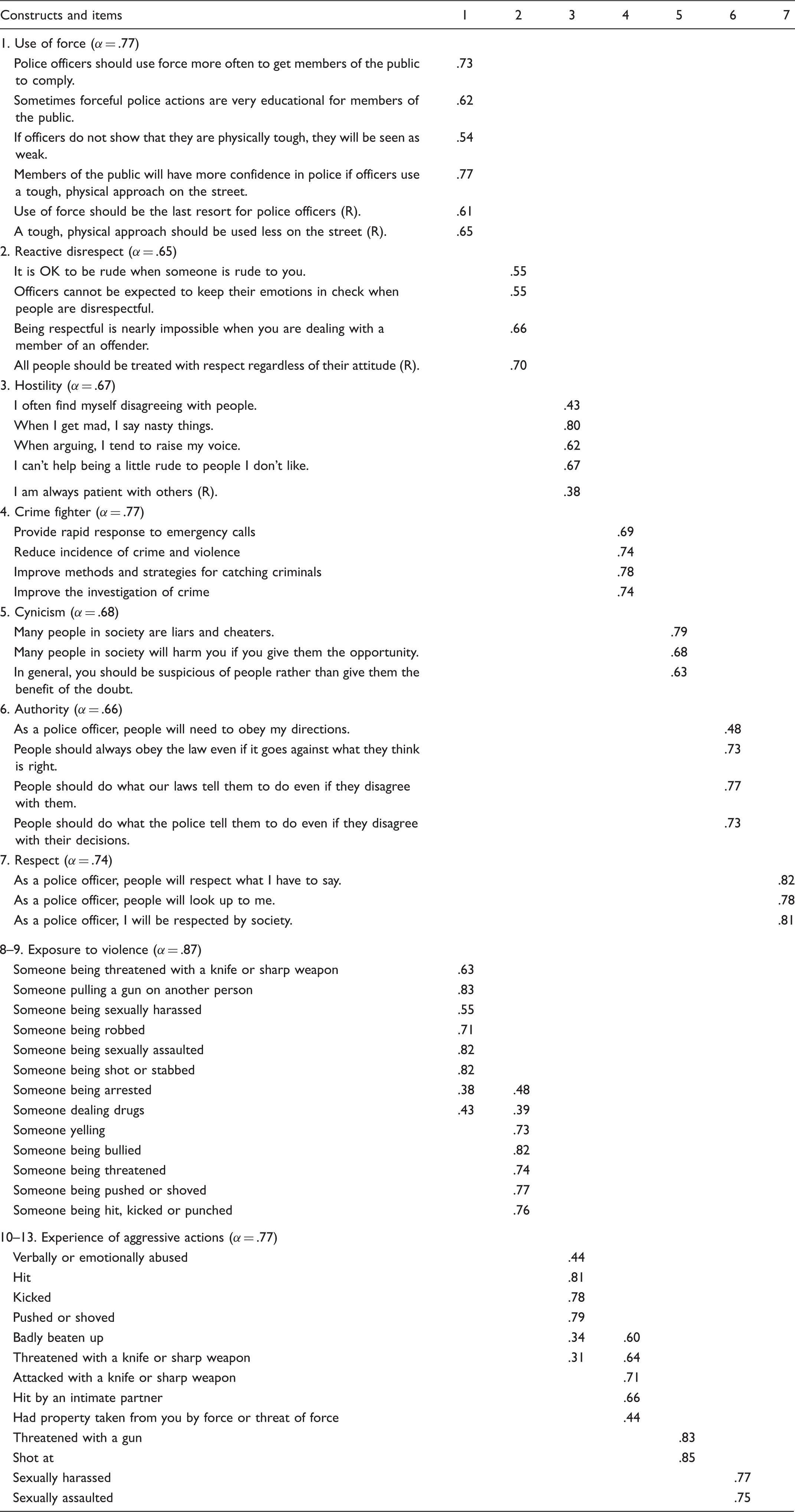
R = reverse scored item.
Means, Standard Deviations, and Correlations Between Variables.
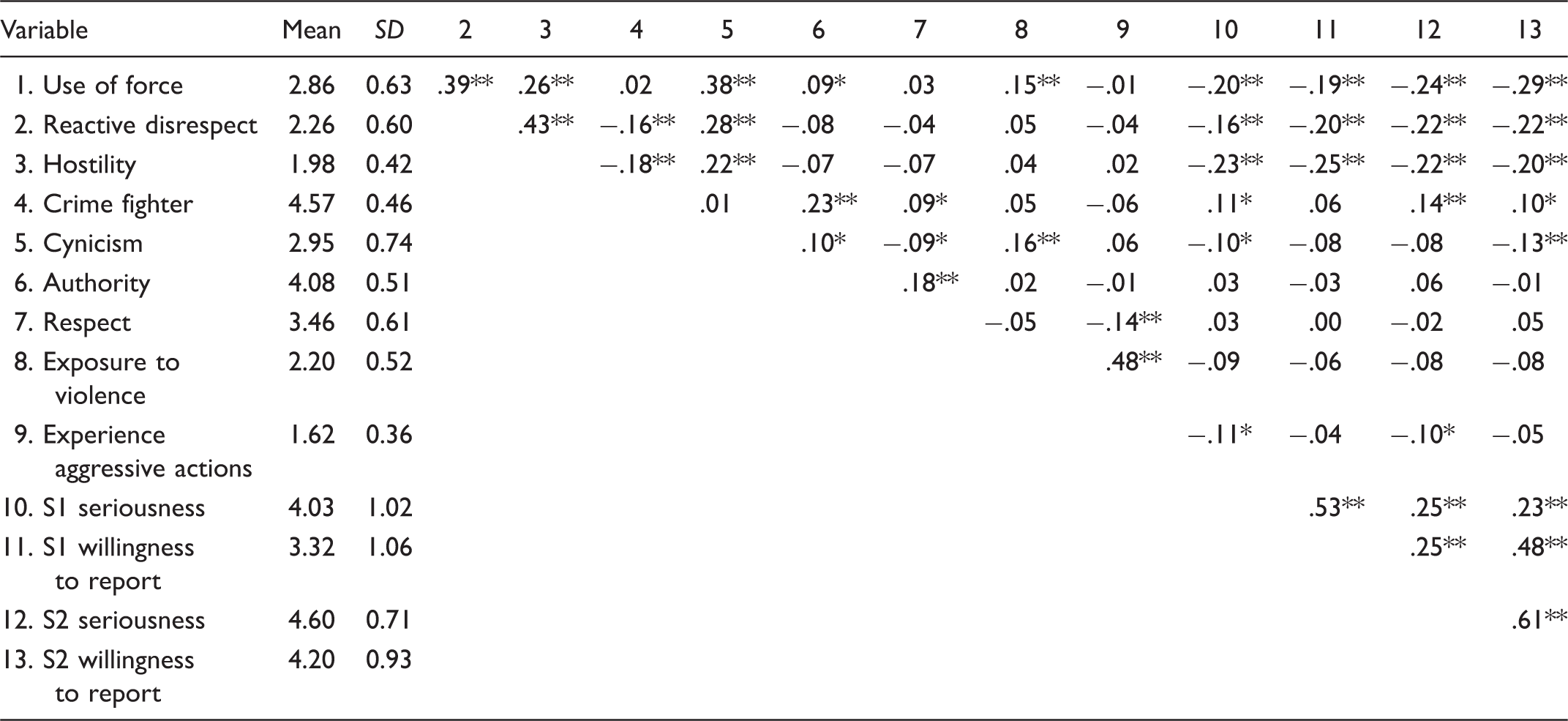
S = scenario.
p < .05. **p < .01.
Dependent Variables
Reactive disrespect
The literature reviewed earlier suggests disrespectful behavior by police officers might be particularly likely in cases where citizens are perceived to be disrespectful. The 4-item reactive disrespect index measured participants’ endorsement of police officers being allowed to respond to disrespect from members of the public with reciprocal disrespect. Responses were measured on a 5-point scale from 1 = strongly disagree to 5 = strongly agree.
Use of force
Support for using force against members of the public was measured by six items (α = .77); for example, “Police officers should use force more often to get citizens to comply.” Responses were measured on a 5-point scale from 1 = strongly disagree to 5 = strongly agree.
Reporting misconduct
Based on the work of Klockars, Kutnjak Ivkovic, Harver, and Haberfeld (1997) and Kutnjak Ivkovic and Haberfeld (2015), recruits’ hypothetical willingness to report misconduct in interactions with members of the public was measured to represent behavioral intentions regarding the code of silence. Two short scenarios were presented describing inappropriate reactive behavior of a police officer. Scenario 1 involved rudeness: A police officer stops a motorist for speeding. As the officer approaches the vehicle, the driver yells, What the hell are you stopping me for? The officer replies, Because today is ‘Arrest an Asshole Day’.; while Scenario 2 involved the use of force Two officers on foot patrol surprise a man who is attempting to break into an automobile. The man flees. They chase him for about two blocks before apprehending him by tackling him and wrestling him to the ground. After he is under control both officers punch him a couple of times in the stomach as punishment for fleeing and resisting.
Both scenarios were followed by the question “do you think you would report a fellow police officer who engaged in this behavior?” with responses measured on a 5-point scale with anchor points of 1 = definitely not and 5 = definitely yes. An additional question measured the perception of seriousness of the behavior: “how serious do you consider this behavior to be?” with responses measured on a 5-point scale with anchor points of 1 = not at all serious and 5 = very serious.
Independent Variables
Hostility
Hostility was measured using five items based on Buss and Durkee’s (1957) hostility-guilt inventory representing aspects of verbal hostility and irritability. Items were carefully selected so as to not include aspects of reactive hostility to avoid collinearity with the reactive disrespect construct described earlier. Respondents were asked how true each statement was in describing them on a 4-point scale from 1 = false to 4 = true. All items were combined to form a total index (α = .67), with higher scores indicating greater overall hostility.
Experience of violence and aggressive actions
Exposure to violence incorporated 13 items that measured how often the respondents had directly seen or heard (not on television) various violent acts prior to 18 years of age (α = .87). Experience of Aggressive Actions focused on how often the police recruits had been the recipient of various types of aggression and violence at some point in their life (α = .77). Responses on both scales were measured on a 5-point scale from 1 = never to 5 = very often.
Crime fighter
An attitude supportive of the crime fighting role of police was measured with four items (α = .77). Recruits were asked their opinion on the importance of several goals of police departments with responses ranging from 1 = not at all important to me to 5 = very important to me. The four items retained here represent goals aligned with fighting crime.
Cynicism
Three items represented a cynical and suspicious attitude toward the public (α = .68). Responses to the items were measured on a 5-point scale from 1 = strongly disagree to 5 = strongly agree.
Authority
Recruits’ sense of legitimate authority was measured with four items (α = .68) that measured a sense of public obligation to obey police and the law. Three of these items were adapted from Mazerolle et al. (2012) measuring a belief that people are obligated to obey police and the law in general. An additional item captured the recruit’s belief of their own authority as a police officer. All items were measured with a 5-point scale from 1 = strongly disagree to 5 = strongly agree.
Respect
Respondents were asked to indicate how much they agreed (from 1 = strongly disagree to 5 = strongly agree) with three items related to how much they expected society or members of the public would respect them as police officers (α = .74).
Procedure
Over the course of approximately 12 months, each intake of recruits entering the QPS academies 5 was invited to participate in this research. New intakes commenced approximately every 6 weeks during this period. Members of the research team and ranking members of the QPS personally briefed each intake of recruits about the research as well as providing written information and consent forms. Recruits were informed that the research was also supported by their union and then provided the opportunity to complete an online survey during a computer class (or during their own time if preferred). 6 Submitted survey responses were downloaded from Qualtrics into SPSS for cleaning and analysis. Cases where respondents opted out were deleted from the database before analysis. Scales were tested and constructed on the remaining 557 cases.
Analysis
A factor analysis was performed across all items to determine the discriminant validity between the constructs outlined above. Principal components analysis (varimax rotation; KMO = .80; Bartlett’s test of sphericity χ2(1485) = 8834.36, p < .001) produced 14 factors explaining 60.74% of the variance, shown in Table 1. All constructs loaded on separate factors showing independence of measures. However, the exposure to violence items loaded on two factors (representing minor and major forms of violence) rather than one. Due to cross loadings of some items on these two factors, and the high Cronbach’s alpha coefficient showing internal consistency across all 13 items, one unidimensional scale was created for analysis purposes. Similarly, the experience of aggressive actions items loaded on four factors (representing different forms of aggressive acts), but with some cross loadings. Again, the alpha for all 13 items showed high internal consistency so one unidimensional scale was created for simplified analysis.
After exploring descriptive statistics and correlations between variables, two sets of regression analyses were performed. The first explored predictors of attitudes regarding behavior toward members of the public (reacting with disrespect and using force), while the second set explored how those constructs predict hypothetical willingness to report officer misconduct (engaging in reactive disrespectful and forceful behavior toward members of the public).
First, two separate regression models were tested, one for each of the attitudinal DVs; “reactive disrespect” and “support for use of force.” For each model, the same predictors were entered: Individual factors were recruit age, gender (1 = male, 0 = female), education (1 = educated post high school, 0 = educated up to high school), “Hostility,” “Exposure to violence,” and “Experience of aggressive acts”; cultural factors were “Crime Fighter,” “Cynicism,” “Authority,” and “Respect.” For the second set of regressions, recruits’ expressed willingness to report each scenario was the DV (one model for each scenario). The tested predictor variables in each model were “reactive disrespect” and “support for use of force” while controlling for recruit age, gender, education, and perception of seriousness of the scenario.
Results
Descriptive Statistics
Table 2 shows the mean scores on the scales. Recruits scored slightly below the midpoint on the support for the use of force scale (mean = 2.86 ± .63). Similarly, the “reactive disrespect” scale (mean = 2.26 ± .6) showed, on average, disagreement that officers can be justified to react disrespectfully to members of the public. The same pattern also holds for hostility and cynicism, with means just below the midpoints of the respective scales.
In contrast, recruits showed a strong belief in the importance of crime fighting and agreement that their authority should be obeyed. On average, recruits viewed the role positively, believing that they would be respected (mean = 3.79 ± .48). Frequencies of both prior exposure to violence and experience of aggressive actions were low (lower than the scale midpoint). On average, exposure to violence (i.e., witnessing) was more frequent for the recruits than direct experience of aggressive actions.
For the scenarios, recruits on average answered that (hypothetically) they would be willing to report both, although the mean for Scenario 1 (rudeness) is only just above the midpoint (3.32 ± 1.06). Both scenarios were also viewed, on average, as at least somewhat serious.
Correlations
Table 2 presents the correlations between the variables of interest. The DVs were themselves significantly correlated (although not as high as to suggest multicollinearity). Approving of being disrespectful was related to supporting the use of force. Both these attitude scales were negatively related to expressed willingness to report poor conduct in the two scenarios and perceptions of their seriousness. There were some differences in the patterns of correlations of each of the DVs with the remaining constructs. Of particular interest, support for the use of force was significantly positively correlated with a sense of police authority, as well as prior exposure to violence, while support for reactive disrespect was negatively correlated with the importance of the crime fighter role. Both, however, were significantly positively correlated with hostility and cynicism.
What Factors Predict Attitudes?
Regression Models Predicting Reactive Disrespect and Support for the Use of Force.
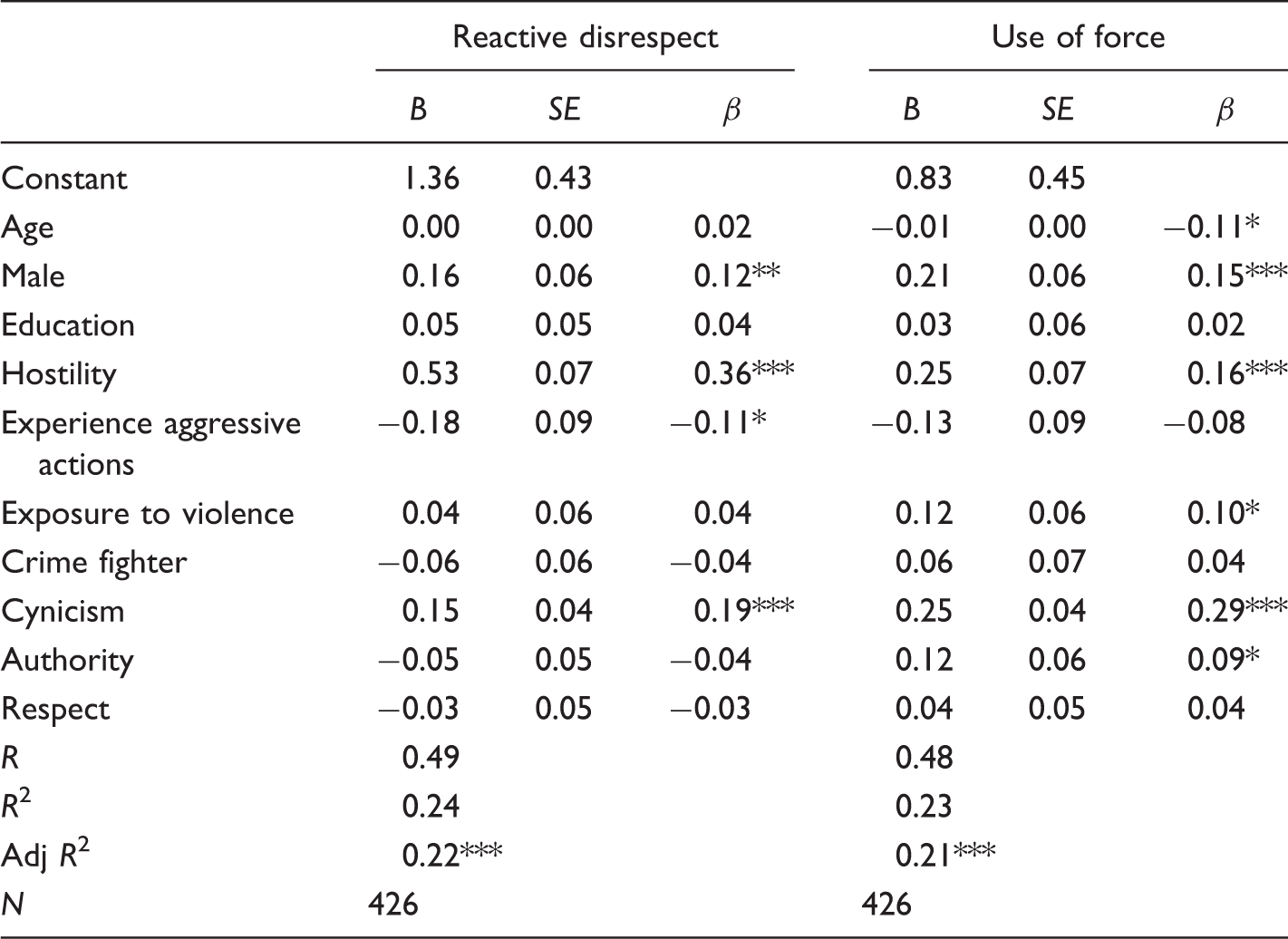
p < .05. **p < .01. ***p < .001.
To investigate the difference between support for disrespect and the use of force, the same regression model was explored with the support for use of force index as the DV. The model was significant and accounted for 21% of the variance, F(10, 415) = 12.36; p < .001. Six of the variables made a significant independent contribution to the model. Being male was a significant positive predictor of support for the use of force (β = .15; p < .001), as was hostility (β = .16; p < .001), exposure to violence (β = .10; p < .05), cynicism (β = .29; p < .001), and authority (β = .09; p < .05). Age was a significant negative predictor (β = −.11; p < .05). Thus, young males who have witnessed (seen) more violence, who expect to be obeyed as a police officer, and who exhibit hostile and cynical attitudes are those who are more likely to support the use of force.
Do Attitudes Predict Behavioral Intentions?
Regression Models With Self-Reported Likelihood of Reporting Colleagues for Scenarios as Dependent Variables.
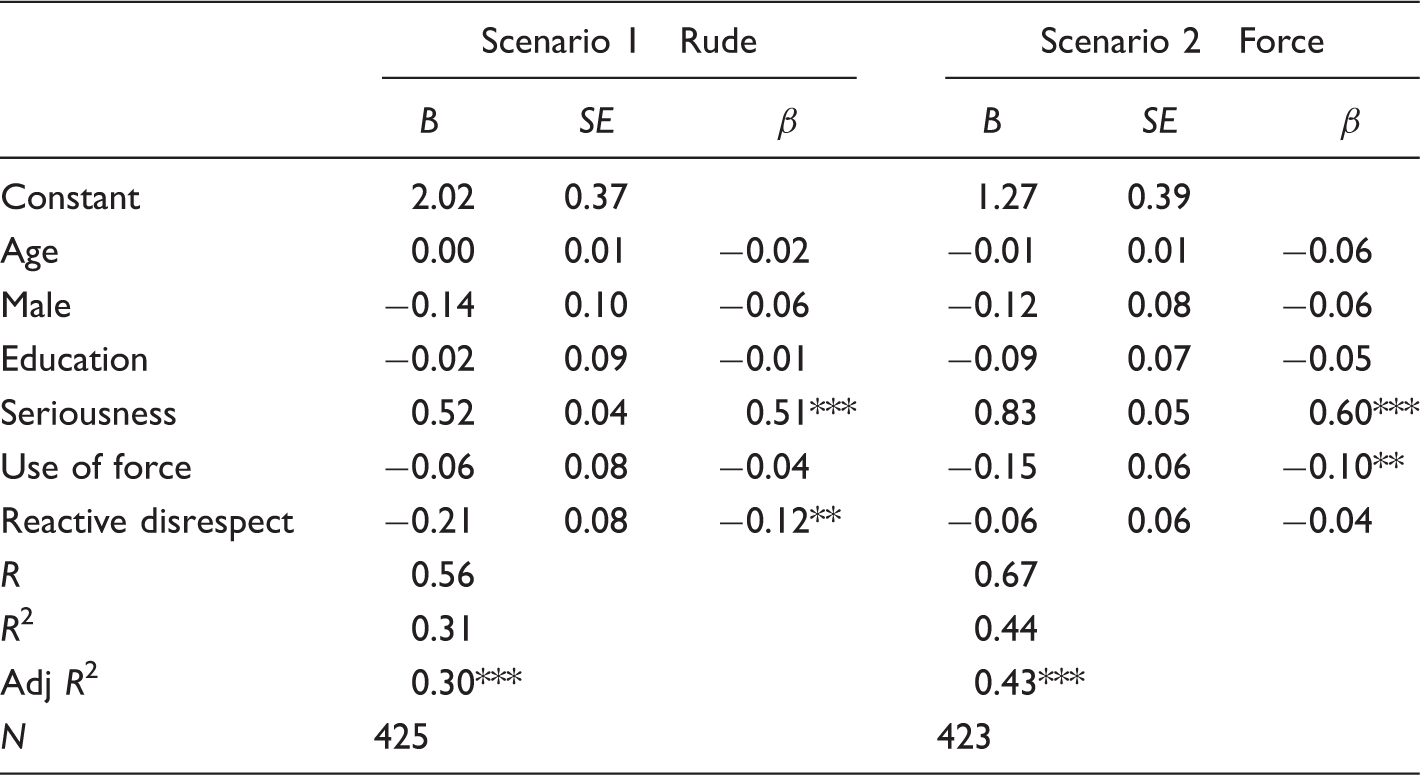
*p < .01. ***p < .001.
For Scenario 2 (force), the model was significant accounting for 43% of the variance, F(6, 416) = 54.87; p < .001. Again, perceptions of seriousness of the behavior significantly predicted expressed willingness to report (β = .60; p < .001). In addition, support for the use of force significantly negatively predicted hypothetical reporting (β = −.10; p < .01), independently of seriousness judgments. Reactive disrespect was not a significant predictor of reporting Scenario 2.
Discussion
Recent events, particularly in the United States, have highlighted the importance of public perceptions of police, and the negative impact that inappropriate police behavior can have on police legitimacy and police-citizen relations. This has spurred an increase in studies on police use of procedural justice. One of the findings from this literature is that police support for the use of force may play an important role in officer support for (or intentions to use) procedural justice. Taking its cue from this work, the present study explored predictors of police attitudes to the use of force, as well as disrespectful behavior toward the public. Aside from the potential links to procedural justice, these forms of behavior also represent common sources of public complaint in many jurisdictions. Thus, knowledge regarding these attitudes, and their predictors, is of benefit to those considering potential ways to improve policing. Our analysis showed attitudes toward force and disrespectful behavior were related but distinct constructs, with both similarities and differences in the factors that predict them. This has implications for understanding such attitudes. Further, the ability of these attitudes to predict hypothetical (and, therefore, potential) future behavior in the form of the code of silence was shown, which indicates that negative attitudes may perpetuate poor behavior, at least through tolerance and inaction.
First, it should be noted that coercive and disrespectful behavior appear to be separate constructs, evidenced both by the statistical discrimination of the items used to measure attitudes toward such behavior, and by their differing relationships with other variables. This is interesting because, while rudeness to the public is not part of the expected role of police officers, the use of force can be necessary to prevent harm to officers and citizens. However, the use of force should be considered carefully in each context; force should be reasonable and used to respond to resistance, not as a way of meting out justice.
The attitudes explored showed predictive value for tolerating similar behavior in colleagues, in terms of upholding the code of silence (at least in the hypothetical scenarios presented here). Again, interestingly, the relationships support the specific nature of the constructs, with support for use of force predicting tolerance for the inappropriate force in the scenario and support for reactive disrespect predictive of the rudeness scenario, but not vice versa. The relationships between the attitudinal and hypothetical behavior measures also suggest that attitudes could predict the likelihood of perpetuating inappropriate behavior in the field, through turning a blind eye. This might also extend to recruits engaging in such behavior themselves. However, there is debate over the link between attitudes and behavior in policing (Skogan & Frydl, 2004). While some psychological research suggests the two are linked, researchers have suggested that police officers should be able to behave according to training rather than personal attitudes (Engel & Worden, 2003), particularly regarding formal police officer behavior. Our study, like others (e.g., Bond et al., 2015; Tankebe & Mesko, 2015), suggests that attitudes are linked at least to hypothetical behavior, or behavioral intentions. Longitudinal follow-up of these recruits could explore if attitudes persist and if they are linked to actual behavior in the field by looking at, for example, numbers of complaints made against them for rudeness or use of force. Support for such a link can be found in the study by Terrill et al. (2003), which found differences in cultural attitudes were predictive of the level of coercive force officers were observed using in the field.
The results from the regressions suggest that there are certain measurable recruit-level factors that relate to negative attitudes, which could signify an increased risk of future behavioral issues in citizen interactions, if attitudes are indicative of behavior. Male recruits measuring higher on hostility and cynicism about citizens were more supportive of being disrespectful in encounters with disrespectful citizens and more supportive of the use of force. However, personal experience of aggression seemed to serve as a protective factor against support for disrespectful behavior, while support for the use of force was additionally predicted by youth, belief in police authority, and having seen more violence growing up.
The practical and theoretical implications of these findings are discussed later, but first, it should be noted that, on average, the sample did not hold negative attitudes toward interactions with the community and did not show high levels of support for the use of force against members of the public. Our sample was a result of individuals selecting in—both to the police service and our study—and screening out—who have made it through recruit selection into the training academy. The prevalence of misconduct and corruption scandals has spurred efforts to professionalize policing, with increased attention to recruitment standards (Fields, 2015). Efforts in this regard have focused on screening out unsuitable applicants but, more recently, parameters have been shifted in order to increase diversity in applicant demography, background, and experiences. The desired result is a move away from a homogenous policing culture characterized by machismo, cynicism, and negative attitudes toward citizens (Reiner, 2000) to one that is more representative, and mindful, of the communities it serves. It might, therefore, be expected that this sample would show little variation in certain key variables of interest, such as negative attitudes. However, some variation in the measures was present and could be predicted from a number of key constructs. Thus, while the current screening and recruitment process has clearly had positive effects, our results can augment the selection process and assist recruiters and trainers understand the characteristics and attitudes of those entering training (and, subsequently, the police service). It should also be noted that, while the use of a sample of recruits enabled exploration of an understudied career stage when it comes to police cultural attitudes, not all dimensions of police culture are applicable to this career stage. Our study was, therefore, limited to those of relevance to recruits; other dimensions, particularly organizational experiences, are likely to become relevant with experience. This serves as a benchmark for exploring the impact of early attitudes on future performance and behavior once in the job, as well as any change in attitudes over time as a result of training and experience. Negative attitudes are believed to increase over time, as officers become more socialized into the culture (Chan et al., 2003), so poorer attitudes and low levels of commitment to reporting misconduct at recruitment may signify even greater problems later.
Predictors of Attitudes
Stemming from the literature on police culture, and the context of citizen complaints, one of our primary interests was recruit attitudes supportive of reacting disrespectfully in encounters with disrespectful citizens. The theory of deference exchange (Sykes & Clark, 1975) and the notion of “contempt of cop” (Kleinig, 2014) suggest that officers may react negatively when citizens are seen to disobey and show disrespect. In contrast, research reviewed earlier on police officer self-legitimacy (including items measuring the expectation of respect and obedience) has suggested links to positive forms of behavior. Contrary to either expectation, recruits’ beliefs that they should be obeyed and that they will receive respect as a police officer, measured through two separate constructs, were not predictive of (or correlated with) support for reactive disrespect. The expectation of respect also did not predict support for the use of force. Thus, an expectation of receiving respect does not predict an inclination for rudeness or coercion when respect is not received, nor does it inhibit this. However, the belief in their authority as police officers—that is, that police should be obeyed—was predictive of support for the use of force. Further, cynicism, or suspicion, regarding citizens was related to both support for the use of force and reactive disrespect. This supports the notion that perception of danger and threats to authority may trigger more coercive or aggressive demeanor to “maintain the edge” over citizens (Paoline, 2003), particularly regarding the use of coercive force.
The analysis also explored recruits’ support for the police role as crime fighter. This has been highlighted previously as an element of masculine police culture (Brough et al., 2016) and has been shown to predict police coercive behavior (Terrill et al, 2003). In our study, however, belief in the crime fighter role was negatively correlated with reactive disrespect, and uncorrelated with support for use of force, but was not independently predictive of either. This potentially highlights a different understanding, or ethos, behind the crime fighting role for our sample. This could reflect their naivety as recruits, or a generational change in those wanting to be police officers. Alternatively, perhaps the measure used here did not adequately capture masculine aggressive enforcement tactics that might be more predictive of the attitudes of interest.
Our analysis also included gender, among other fixed individual factors. Around the world, recruitment efforts have been made to increase the diversity of police officers, particularly in terms of recruiting more women (Hunt, 1990; Langton, 2010). As noted in the introduction, research suggests that female officers may have better quality interactions with members of the public and use less force than male officers. Our findings support this, with males more likely to hold negative attitudes and support the use of force independent of other measures. However, gender was not a significant independent predictor of the code of silence, beyond attitudes. Thus, while gender may predict attitudes, and attitudes may predict hypothetical behavior, it would appear that attitudes, rather than gender per se, are the key variables.
In terms of background, recruits, on average, did not report high levels of exposure to, and experience of, violence. However, these constructs showed interesting, and different, relationships with the attitudinal measures of reactive disrespect and support for use of force. Previously, Rosenbaum et al. (2011) explored recruit aggressiveness using a combined scale of items describing both disrespectful behavior and use of physical force. They found that prior exposure to violence (i.e., witnessing violence) predicted self-reported aggressiveness in U.S. recruits. In our models, witnessing violence was predictive of support for the use of force, but, interestingly, direct experience of aggression negatively predicted support for disrespectful behavior. This builds on the work of Rosenbaum et al. (2011). Perhaps witnessing violence has a de-sensitizing impact that increases preparedness for physical encounters, or produces a learned behavioral script, rather than negative attitudinal effects. In contrast, being the recipient of aggressive acts in the past may make one wish to avoid them in the future, or be less inclined to inflict similar suffering on others. Whatever the explanation, our findings demonstrate the importance of measuring verbal aggressiveness and physical force separately in the policing context to allow exploration of more subtle relationships.
Conclusion and Implications
The results from the present study shed light on the opinions of one large cohort of recruits on interactions with the public, and factors related to these. While not all factors tested were significant in the models, those that were significant were a mix of individual and cultural (attitudinal) factors, with some being fixed and some changeable. Significant fixed factors, such as gender, background experiences, or trait hostility, may be important for recruiters to consider in terms of targeting recruitment campaigns or careful screening of applicants. Cultural attitudes, such as cynicism, may also be a topic of scrutiny for recruitment, but perhaps more so for trainers and managers, since police culture literature suggests officers become more culturally inculcated over time (Chan, et al., 2003). Particularly, cynicism is thought to increase with exposure to police work (Richardson, Burke, & Martinussen, 2006). Both recruit and in-service training could be utilized to address negative perceptions of citizens, as well as enhance interpersonal skills that may counter tendencies toward disrespectful or coercive behavior and help officers resolve or de-escalate conflict (Fildes et al., 2017). Indeed, several studies have now shown positive outcomes of various forms of police procedural justice training relevant to this endeavor (Owens, Weisburd, Amendola, & Alpert, Forthcoming; Shaefer & Hughes, 2016; Skogan, van Craen, & Hennessy, 2015; Wheller, Quinton, Fildes, & Mills, 2013).
There may be different vulnerabilities to police culture at different career stages. There may also be different factors associated with this vulnerability. In our study, young males were more supportive of the use of force. Younger male officers are also more likely to use excessive force (Lersch & Mieczkowski, 2005; Porter & Prenzler, 2015). Youth may create a particular vulnerability to aligning with negative police culture, with males being more susceptible to this influence.
While the attitudes assessed were generally not negative, and recruits tended not to buy into the code of silence for the scenarios, there was variation. Some recruits had higher tolerance for the conduct in the scenarios, or at least less hypothetical willingness to speak out at this stage in their career, and holding more negative attitudes toward public interactions did predict support for this code of silence. This supports Paoline’s (2003) conceptual model of police culture, whereby loyalty was proposed as an outcome of other elements of police culture. Our study suggests that attitudes toward interactions with the public may be the mediating, or explanatory, factor between dimensions of police culture such as cynicism and authority, and loyalty. Our study also suggests that individual factors, particularly hostility, may play some role. Longitudinal analysis would more appropriately tease out these relationships, with our data serving as a baseline for the start of officers’ careers. However, the results suggest that it might be productive for recruitment to consider these factors and for training of recruits and officers to address negative attitudes to the public, both for the specific value of improving the interactions those officers may have with citizens but also in improving broader police culture, specifically the code of silence. In addition, our findings could guide a future investigation into what has been called de-policing, in terms of potential reluctance of police officers to engage with citizens for fear of scrutiny and criticism, and could help disentangle the factors that influence proactive and reactive policing (see Rushin & Edwards, 2017). Indeed, while our study has focused on recruits’ perceptions of the public, an increasing number of studies have shown that officers’ perceptions of “organisational justice” (e.g., the fairness with which officers’ are treated within their organization) affects their attitudes to the public and commitment to organizational rules (Bradford & Quinton, 2014; Trinkner et al., 2016). As recruits go on to gain experience with their organization, their views on these experiences may become important dimensions of police culture, affecting their behavior toward citizens and their likelihood of reporting wrongdoing.
In conclusion, police officer attitudes to the public are important to understand, both in recruits entering the profession and in officers as they advance through their careers. Negative attitudes may perpetuate the stereotypically negative police culture, including, potentially, through the code of silence. Negative attitudes may also impact behavior and create risk for the service in terms of increasing potential for complaint and lowering of public perception of police legitimacy. Understanding the attitudes and behavior of officers, and addressing negative attitudes and behavior, should be a goal of any police department.
Footnotes
Acknowledgments
The authors would like to thank Professor Dennis Rosenbaum for sharing survey measures from the National Police Research Platform for use in the current study. The authors acknowledge the assistance provided by the Queensland Police Service. Special thanks go to Senior Sergeant Damien Hayden and others on the police academy staff who introduced the research team to the recruits and to Mr Ian Leavers of the Queensland Police Union who offered support of the project. The views expressed in this material are those of the authors and are not those of the Queensland Police Service. Responsibility for any errors of omission or commission remains with the authors. The Queensland Police Service expressly disclaims any liability for any damage resulting from the use of the material contained in this publication and will not be responsible for any loss, howsoever arising, from use of or reliance on this material.
Declaration of Conflicting Interests
The authors declared no potential conflicts of interest with respect to the research, authorship, and/or publication of this article.
Funding
The authors received no financial support for the research, authorship, and/or publication of this article.