




Abstract
Little is known about officer perceptions of body-worn cameras (BWCs), and whether perceptions change following implementation within their agencies. BWC deployment varies, with some agencies mandating officers to wear BWCs and others using volunteers. Researchers have yet to assess attitudinal differences between volunteers and mandated officers. This study addresses these gaps using data from an evaluation of BWCs in the Phoenix Police Department to examine officer perceptions of the utility of BWCs, perceptions of organizational justice, and support for using procedural justice. We use inverse propensity weighted difference-in-difference models to examine changes in officer perceptions over time between randomly selected officers who were mandated to wear a BWC, BWC volunteers, officers who resisted BWCs, and control officers. We identified limited significant differences in perceptions of BWCs over time, though effect sizes suggest that BWC volunteers and mandated officers were more subdued in their expectations about BWCs at the posttest.
Despite the widespread expansion of body-worn camera (BWC) programs in police agencies throughout the United States, research examining officer attitudes toward this technology is relatively limited. Much of the extant research in this area examines officer attitudes using cross-sectional methodologies, reporting findings from data collected at one time period only. This is an important limitation given the inability of these studies to assess change in perceptions over time as officers gain experience using BWCs. Those studies that have used pretest–posttest designs have largely found that officers become more favorable toward BWCs in the posttest period (Gaub et al., 2016; Lum et al., 2019).
Many of the studies reporting changes in officer attitudes toward BWCs over time use survey data collected as part of larger evaluations of BWCs (Lum et al., 2019). These evaluations use different methodologies for deploying BWCs, with some using randomly selected officers who were mandated to wear a BWC (e.g., White et al., 2018) and others using randomly selected officers who volunteered to wear a BWC (e.g., Braga et al., 2017 who used volunteers to avoid potential issiues with the police union). The technology required to support BWCs can limit the scope of an evaluation. For example, researchers in Las Vegas were required to reduce the number of area commands eligible for their study because they needed to have sufficient docking stations to charge the BWCs and to upload BWC footage (Sousa et al., 2016). As such, it is not always possible or practical to examine the impact of BWCs using all officers employed by an agency. This variation in the approaches used to deploy BWCs prevents a direct comparison of perceptions of BWCs between officers who volunteer to wear a camera and those who are mandated to do so. Given that officers who voluntarily wear BWCs could differ from those who are required to wear BWCs by their agency, it is important to examine whether the way an officer was assigned a BWC (voluntarily or mandated) impacts officer perceptions of the technology over time.
In addition to potential differences in officer perceptions of BWCs themselves, the ways these officers rate organizational justice within their agency and their support for the use of procedural justice when interacting with citizens could also differ based on how BWCs are assigned to officers. For instance, being mandated to wear BWCs without the option to decline could impact officers’ perceptions of fairness within their agency differently than officers who choose to wear a BWC as part of an evaluation. Furthermore, the perceptions of officers who wear BWCs could change in different ways compared with officers who did not wear a BWC. Those officers who wear a BWC have direct experience using the technology, while those who do not wear a BWC might only hear about BWCs from their fellow officers who are wearing BWCs. As such, officers who do not personally wear BWCs could have unique and different attitudinal changes toward BWCs due to informal conversations with officers who do wear BWCs or due to responding to the same incidents as BWC officers.
However, there is an important distinction between officers who wear and operate BWCs and those officers who do not wear the technology and who only experience being recorded by other officers using BWCs. As such, officers who use BWCs could have different or more notable changes in their perceptions of BWCs than officers who do not use BWCs directly. Expanding the body of research on officer perceptions of BWCs has important implications for police agencies adopting BWCs. As the use and impact of BWCs has been tied to officer receptivity to this technology (Maskaly et al., 2017; Stratton et al., 2015), understanding officer attitudes toward BWCs is important for the successful implementation and use of BWCs.
This study addresses gaps in the police attitudes toward BWCs research using data collected as part of a larger randomized-controlled trial of BWCs in the Phoenix Police Department (PPD). Although the Phoenix BWC evaluation was originally designed to assign BWCs to randomly selected officers who agreed to volunteer to wear a BWC as part of a federally sponsored project, pressure to quickly deploy BWCs resulted in some officers being randomly selected and mandated to wear a BWC without the option to decline. Through the original BWC assignment process, those officers who were asked to volunteer and declined were not assigned a BWC and are referred to as resistors. Randomly selected officers who were not asked to volunteer to wear a BWC and did not wear a BWC during the study are used as a control group. Officers in each of the study groups were surveyed 1 month prior to and 6 months after the deployment of BWCs in Phoenix. These survey data are used to examine change in officer perceptions of BWCs, organizational justice, and procedural justice from pre-BWC deployment to postdeployment. We examine differences between officers who volunteer to wear a BWC, those mandated to wear a BWC, resistors, and control officers.
Literature Review
BWCs are a mechanism that can be used to monitor officer behaviors in individual incidents; as a result, the influence of BWCs on officer attitudes toward BWCs and officer behavior have often been explained as a function of deterrence (Adams & Mastracci, 2019a; Ariel et al., 2018). Deterrence theory suggests that when the perceived risks of detection and the sanctions associated with misbehavior outweigh the potential benefits of that misbehavior, the misbehavior will not occur. As a result, deterrence is rooted in individual perceptions. This highlights the importance of examining officer perceptions of BWCs. If officers do not expect BWCs to change their ability to use discretion or the likelihood that they will be disciplined for their actions, then it is unlikely that wearing a BWC will result in behavioral change for that officer. Namely, BWCs are suggested to make officers more conscious of their actions and whether those actions could result in discipline, which would ultimately impact the way an officer behaves (Demir et al., 2018).
The heightened self-awareness of their behavior as a function of BWCs could result in changes in officer perceptions of their organization as well as improved officer behavior. If officers believe that BWCs will be used fairly by their organization to assess their behavior, their perceptions of organizational justice could increase after BWCs are deployed. Higher perceptions of organizational justice could also result in higher levels of compliance with BWC activation policies. Alternatively, if officers are concerned that BWCs will be used to unfairly discipline them for minor policy violations, their perceptions of organizational justice and their compliance with activation policies could decrease. Increased self-awareness has also been suggested to influence officer behavior during citizen interactions. For instance, Ariel et al. (2018) suggest that when BWCs are used “the otherwise thin-skinned officer responds with what most of us would deem a more accountable, professional approach, demonstrating fairness, dignity, and respect” (p. 10). As such, there is argued to be an explicit link between the deterrent effect of a BWC and the way an officer behaves during their interactions with citizens. This implies that BWCs could influence officer perceptions surrounding the use of procedural justice in citizen encounters. The influence of BWCs on police use of force has also been explained as a function of deterrence. Ariel et al. (2018) argue that the influence of BWCs on officer use of force can be explained by a deterrence spectrum in which officer compliance with use of force policies varies depending on the level of deterrence from using force that officer experiences (with some officers perceiving larger limits on their discretion as a function of BWCs than others). Given their suggestion that the impact of BWCs on officer use of force depends on the deterrent effect of the BWC on the individual officer, it is important to assess officer perceptions of BWCs. In short, there are important links between officer perceptions of BWCs, officer perceptions of procedural and organizational justice, and ultimately officer behaviors.
There is a growing body of research examining officer attitudes toward BWCs, although it remains underdeveloped given the widespread adoption of BWCs. Lum et al. (2019) conducted a comprehensive narrative review of 70 BWC studies and found that 32 studies included a component assessing officer attitudes toward BWC technology. The methodological approaches and rigor used to examine officer attitudes varied widely across studies (Lum et al., 2019). Cross-sectional designs examining officer attitudes at one point in time were the most common. Less research has examined officer attitudes toward BWCs both prior to and following the adoption of BWCs in an agency. Researchers who have examined change in officer perceptions over time often use samples comprised entirely of volunteers (e.g., Braga et al., 2017) or samples comprised entirely of officers mandated to wear BWCs (e.g., White et al., 2018). This limits our understanding of whether the way BWCs are deployed matters when examining change in officer perceptions over time. This section addresses prior literature examining officer attitudes toward BWCs, perceptions of organizational justice, and support for using procedural justice, with each section organized in order from the least rigorous to the most rigorous methodological designs.
Prior Cross-Sectional Research on Officer Attitudes Toward BWCs
Cross-sectional research examining officer attitudes toward BWCs largely involves surveys administered to officers prior to the deployment of this technology in their agency. These studies examine the anticipated impact of BWCs on officer effectiveness, officer behavior, and citizen behavior. For instance, Pelfrey and Keener (2016) found that supervisors and line-level officers in a university police department felt that BWCs would assist in report writing and improve evidence available for prosecution. Officers in Rochester and Buffalo (NY) felt that BWCs would result in increased adherence to departmental procedures and in officers feeling like they have less discretion (Gramagila & Phillips, 2018). BWC volunteers in Orlando (FL) believed that the adoption of cameras would influence the behavior of other officers more than it would influence their own (Jennings et al., 2014). Huff et al. (2018) found that officers who volunteered to wear a BWC were more likely to believe that BWCs would positively impact citizen behaviors (e.g., increased cooperation, acting more respectfully) compared with officers who resisted wearing a BWC in Phoenix (AZ).
Studies evaluating officer attitudes toward BWCs after their adoption have identified mixed findings, depending on the jurisdiction. A survey conducted in the Isle of Wight (United Kingdom) found that officers had positive attitudes toward BWCs across a range of domains, including evidentiary value, identifying offenders, assuring convictions, reducing complaints, improving officer training, facilitating discipline, and to a lesser extent reducing assaults on officers and crime (Ellis et al., 2015). They note that BWCs in the United Kingdom have met with little officer resistance compared with BWCs in the United States. They attribute these differences to the intended goals of BWC programs, with U.K. programs promoted to improve officer effectiveness and U.S. programs suggested to improve problematic officer behavior (Ellis et al., 2015). Officers in a BWC pilot program in Plymouth (United Kingdom) similarly reported favorable attitudes toward the ability of BWCs to improve citizen behavior in police contacts and to provide evidence for court (Goodall, 2007).
In the United States, researchers who examined officer perceptions of BWCs postdeployment in Pittsburgh (PA) found low levels of officer agreement with the expansion of BWCs to all officers in their department (31%), but this agreement was higher for officers who had worn a BWC (57%; Goetschel & Peha, 2017). In contrast, the majority of officers interviewed after receiving a BWC in Orlando (FL) agreed that BWCs should be used for all front-line officers in the department (Jennings et al., 2015). Researchers examining BWCs in Albuquerque (NM) found similar patterns, though officers expressed frustration that their written word was no longer sufficient evidence in court, unless it was accompanied with a BWC video (Guerin et al., 2016). These researchers additionally examined differences between patrol officers and those in specialty units and found that the needs and concerns of these groups of officers differed depending on their assignment (Guerin et al., 2016; see also Gaub et al., 2020)
Other cross-sectional research has utilized surveys collected from officers in multiple agencies to examine differences in officer perceptions of BWCs, depending upon whether the technology is used in their agency. These findings generally suggest that officers working in agencies that have already deployed BWCs have more positive perceptions of this technology than officers working in agencies that are not using BWCs (Kyle & White, 2017; McLean et al., 2015; Smykla et al., 2016).
Many of the studies discussed earlier do not examine the impact of the method of deployment—either to officers who volunteer to wear a BWC or to those who are mandated to do so—on officer perceptions of BWCs. This is likely due to the design of most of these studies, which rely heavily on data for officers mandated to wear BWCs and less so on officers who volunteer. Researchers examining BWCs in Mesa (AZ), an exception, assigned BWCs to 25 officers randomly selected from a list of volunteers and 25 randomly selected officers who were mandated to wear a BWC. These officers were then matched to 50 control officers (Ready & Young, 2015). Officers were required to complete field contact forms detailing police-citizen encounters and their perceptions of the usefulness of a BWC in the encounter on randomly selected days throughout the study period. Officers assigned to the treatment condition (either volunteers or mandated) were significantly more likely to rate BWCs as helpful than control officers (Ready & Young, 2015). Furthermore, officers who volunteered to wear a BWC were significantly more likely to rate BWCs as helpful than those who were mandated to wear a BWC, even controlling for the type of encounter (Ready & Young, 2015). This finding suggests that officers who volunteer to wear BWCs could differ from those who are mandated to wear a camera.
Prior Pre–Post Research on Officer Attitudes Toward BWCs
Studies that have examined officer attitudes toward BWCs prior to and following the adoption of BWCs have largely found that officers become more favorable or remain neutral toward BWCs after BWC programs are implemented (Lum et al., 2019). Beginning with studies that have reported more favorable police perceptions of BWCs postdeployment, several studies have noted that officers become more comfortable using BWCs after being assigned a camera (Katz et al., 2014; Newell & Greidanus, 2018; Wooditch et al., 2020). The majority of officers in a mixed methods study conducted in Bellingham (WA) and Spokane (WA) generally agreed that BWCs should be used in most encounters, and their levels of agreement increased over time (Newell & Greidanus, 2018). Researchers have also found that officer perceptions of citizen willingness to talk to the police and the ability of BWCs to protect officers against citizen complaints improve over time. Officers assigned BWCs in Los Angeles (CA) reported lower levels of agreement that citizens would avoid talking to the police or that BWCs violate citizen privacy 9 months after BWCs were deployed (Wooditch et al., 2020). Research in the London Metropolitan Police found that BWC officers felt significantly more protected against frivolous complaints and were more confident in the evidence they could obtain, compared with control officers at the posttest (Grossmith et al., 2015). Prior research in Phoenix found that 19% of officers agreed that BWCs should be used by all officers in the department at the pretest and 33% agreed at the posttest; though these findings still suggest that Phoenix officers were largely unsupportive of the adoption of the technology (Katz et al., 2014).
Some studies, however, have identified either no change in officer perceptions or decreased favorability toward BWCs over time. One of the main concerns raised by officers in numerous studies has been the perceived impact of BWCs on officer use of discretion. Officers in Sunnyvale (a pseudonym for a small U.S. city) and those in Toronto, Canada reported that BWCs made them feel like they had less discretion and resulted in them acting more legalistically (Koen et al., 2019; Whynot et al., 2016). Officer perceptions of BWCs became more negative for both treatment and control officers in a partial randomized controlled trial of BWCs in the Hallandale Beach Police Department (FL; Headley et al., 2017). The decreased favorability toward BWCs for both BWC and control officers in Hallandale Beach supports other research, which found that officer attitudes about the legitimacy of BWCs were related to how other officers in their social network felt about BWCs (Young & Ready, 2015). These results highlight the importance of examining change for both officers who used and those who did not use a BWC.
Changes in officer perceptions of BWCs over time appear to depend on the agency an officer works for. In their three-city study, Gaub et al. (2016) found that officers in Phoenix (AZ) had consistently more negative perceptions of BWCs compared with officers in Spokane (WA), with officers in Tempe (AZ) having the most favorable attitudes toward BWCs. Although officers in all three agencies reported improved perceptions of the ease of use of BWCs over time, their agreement that BWCs would improve citizen behaviors declined following the adoption of BWCs (Gaub et al., 2016). Generally, officers in Spokane and Tempe became more supportive of BWCs over time, but officers in Phoenix did not (Gaub et al., 2016). Other research examining the implementation of BWCs in Tempe (AZ) suggests that the high level of officer support for BWCs prior to the deployment of cameras in the field likely facilitated the success of the BWC program in that agency, with officers becoming increasingly favorable toward the use of BWCs over time (White et al., 2018). In explaining these differences across agencies, the authors suggested that a temporal effect could be at work, as Phoenix officers were exposed to BWCs much earlier than those in Spokane or Tempe (Gaub et al., 2016). It is also important to note that the timeframe between the pretest and posttest surveys in these studies was relatively short. Phoenix officers responded to surveys 2 weeks before and after the implementation of BWCs. Surveys in both Spokane and Tempe were administered 1 month prior to and 1 month following the deployment of BWCs in each agency (Gaub et al., 2016).
Prior Research on the Impact of BWCs on Officer Perceptions of Their Organization
Officer buy-in is critical to police reform efforts (Rosenbaum & McCarty, 2017). As such, officer perceptions about organizational fairness in the implementation of BWC programs could influence the success of BWCs. Organizational justice is a theoretical construct that incorporates elements of several theories that attempt to explain employee perceptions of fairness within their organizations (Greenberg, 1987). Employee perceptions of organizational justice are influenced by the distribution of outcomes that individuals receive in their organizations, the practices of their organization, and the characteristics of the perceiver (Cohen-Charash & Spector, 2001). As such, organizational justice has been described as incorporating elements of both distributive justice (outcomes) and procedural justice (processes) within organizations. Research has shown that higher perceptions of the procedural justice component of organizational justice have been associated with improved work performance, though performance was unrelated to measures of distributive justice (Cohen-Charash & Spector, 2001). Given that police officer perceptions of organizational justice have been associated with their job performance (Trinkner et al., 2016) and commitment to the organization (Rosenbaum & McCarty, 2017), understanding whether BWCs influence officer perceptions of justice within their organizations is important.
Several studies have identified concerns about the impact of BWCs on officer’s attitudes toward organizational justice. Although officers recognize the potential for BWCs to reduce frivolous complaints, they also note concerns about the potential for supervisors to use footage to punish officers for minor infractions (Headley et al., 2017; Newell & Greidanus, 2018; Pelfrey & Keener, 2016; Smykla et al., 2016). Given the potential for BWCs to be used to monitor officer behavior, Adams and Mastracci (2019a) created a perceived intensity of monitoring scale to assess officer perceptions of the risks associated with BWC footage. The perceived intensity of monitoring scale is comprised of three components: the influence of BWCs on officer use of discretion, concerns that BWC footage could result in public disapproval of officer behavior, and concerns about how the department distributes BWC footage. They found that BWC officers with high levels of perceived intensity of monitoring also experienced high levels of emotional exhaustion (Adams & Mastracci, 2019a). This suggests that the use of BWCs, and officer perceptions surrounding how their agencies could use BWC footage, can influence officer well-being. In their earlier study of the impact of BWCs on officers in five police agencies, Adams and Mastracci (2019b) found that officers who wear BWCs had significantly lower perceptions of organizational support and significantly higher levels of burnout. Furthermore, the relationship between BWCs and burnout was partially mediated by perceived organizational support (Adams & Mastracci, 2019b). Another study found that officers who felt that their agency was organizationally just had more positive perceptions of BWCs (Kyle & White, 2017), suggesting that such concerns can be mitigated. A study of officers in the United Kingdom similarly found that officers with higher levels of organizational commitment were less cynical about the benefits of BWCs, though officer perceptions of internal procedural justice were unrelated to any of the cynicism measures examined (Tankebe & Ariel, 2016). The majority of the officers surveyed felt that BWCs were not a sign that management did not trust them and that BWCs would not be used to discipline officers (Tankebe & Ariel, 2016). However, a study of officers from three agencies in Florida identified no relationship between perceptions of organizational justice and support for BWCs (Lawshe et al., 2019).
Research examining officer perceptions of their organizations before and after the implementation of BWCs has resulted in mixed findings. Goetschel and Peha (2017) found that one of the strongest predictors of officer support for expanding BWCs to the entire department, regardless of whether an officer personally wore a BWC, was officer perceptions of how the BWC would impact their relationship with their supervisors. Importantly, officers who used BWCs and supported the expansion of BWC programs were significantly less likely to agree that BWCs damaged the trust relationship between themselves and their supervisors (Goetschel & Peha, 2017). Officers surveyed prior to and after the implementation of a mandatory BWC recording policy in a U.S. transit police department felt that the mandatory activation policy was an indicator that the department did not trust the officers (Hyatt et al., 2017). Qualitative interviews of officers from a small agency suggested that officers were hesitant about BWCs prior to their deployment due to the potential for video to be used to discipline officers for minor infractions, though these concerns were not mentioned in interviews after the implementation of BWCs (Makin, 2016). Officers in another study indicated that unclear policies dictating how footage would be reviewed and used to hold officers accountable has resulted in officer fear that they would get in trouble (Newell & Greidanus, 2018). Officers who view BWCs as a mechanism for supervisors to identify and discipline minor misconduct could reduce their proactive contacts to avoid additional attention (Newell & Greidanus, 2018). As such, examining officer perceptions of organizational justice in relation to BWC implementation and use is important because it could result in officers changing the way they police.
Prior Research on the Impact of BWCs on Officer Perceptions of Procedural Justice
Researchers are just beginning to examine whether BWCs can increase officer use of procedural justice in citizen encounters. Procedural justice theory suggests that decisions made by authority figures are respected most when the mechanisms used to reach those decisions were fair and neutral. Although early procedural justice scholars emphasized the importance of using procedurally just criteria to reach decisions about the outcome of an event (Thibaut & Walker, 1978), more recent work suggests that the mechanisms used to engage in procedural justice are more important than achieving distributive justice (Tyler & Blader, 2003). Procedural justice encompasses four key elements: participation, neutrality, dignity/respect, and trust (Tyler, 2004). Citizens have higher perceptions of procedural justice when they feel they were allowed to contribute to the encounter, when the officer used objective criteria to make decisions, when the citizen felt they were treated with dignity and respect, and when the citizen trusted the officers’ motives in the interaction. Officer use of procedural justice has been associated with positive outcomes, for instance, citizens who feel they are treated in a procedurally fair way are more likely to comply and cooperate with the police (Tyler, 2004).
Procedural justice is often examined by asking citizens about how they perceived their treatment by the police in an individual encounter (e.g., Worden & Mclean, 2018). For instance, researchers in Turkey found that drivers subject to routine traffic stops by officers wearing a BWC had higher perceptions of procedural justice in their stop than drivers who were stopped by officers who were not wearing a camera (Demir et al., 2018). Researchers have also used systematic social observation and reviewed recorded officer encounters to examine whether officers are engaging in procedurally just behaviors, like giving citizens the opportunity to participate in an interaction (McCluskey et al., 2019; Worden & McLean, 2018). Other researchers have examined officer attitudes toward using procedural justice (Skogan et al., 2015). Although ensuring officers engage in procedural justice has traditionally been challenging for police supervisors (Worden & McLean, 2018), the use of BWCs could facilitate supervisor review of officer behaviors. Specifically, a supervisor could watch a BWC video to see whether an officer treated a citizen in a procedurally just way. This increased potential for supervisors to review officer behavior could change officer perceptions about the use of procedural justice when they wear BWCs.
Systematic-social observations conducted in the Los Angeles Police Department (LAPD) indicated that officers were more likely to use procedural justice after the adoption of BWCs, even controlling for other situational factors (McCluskey et al., 2019). This study diverged from those asking about citizen perceptions of the way they were treated during police encounters and instead examined whether officers were more likely to give citizens a voice, be objective, and be respectful during citizen interactions. Officers in Edmonton (United Kingdom) reported that BWCs made them more concerned about using appropriate language and being professional and patient with citizens; however, some officers felt that the cameras made them more robotic and created barriers in establishing rapport (Stratton et al., 2015). Officer surveys conducted in the Metropolitan Police in London (United Kingdom) found no significant differences in self-reported use of procedural justice after the implementation of BWCs (Grossmith et al., 2015).
Some researchers have suggested that reductions in complaints associated with BWCs could be attributable to officers behaving in more procedurally just ways to compensate for the camera. For example, officers interviewed in a London trial of BWCs said that they would sometimes narrate what they were doing or why they were making a particular decision to the camera (Owens & Finn, 2018). This narration could be perceived by citizens who interact with the police as procedural justice. Although the BWC officers surveyed in the study did not report any differences in their behavior over time or compared with the control group, their findings could suggest that procedural justice is occurring, even without the officer recognizing it (Owens & Finn, 2018).
Current Study
The purpose of this study is to examine the impact of the adoption of BWCs on officer attitudes toward BWCs, organizational justice, and procedural justice as a part of a larger evaluation of BWCs in the PPD. We address limitations in prior BWC attitudes research by examining changes in officer attitudes toward BWCs over time. We further assess whether changes over time differ depending on method of BWC assignment (either voluntarily or mandated), or for BWC resistors, compared with control officers. This is an important contribution because prior studies have used different methods of BWC deployment (some using volunteers and others mandating officers to wear BWCs) and have identified conflicting impacts of BWCs on several outcomes across studies (see Lum et al., 2019). Furthermore, researchers in Mesa (AZ) found that officer perceptions of BWCs significantly differed between officers who volunteered to wear a BWC and those who were mandated to wear a BWC (Ready & Young, 2015). As the impact of BWCs on police behavior is likely related to officer perceptions of this technology, identifying differences in perceptions across different types of officers is important for framing future BWC deployment strategies. Given the lack of research in this area, we assess officer attitudinal changes in a number of different domains. We first examine officer perceptions of the impact of BWCs on officer efficacy, officer behavior, and citizen/resident reactions to the police when officers use BWCs.Officers’ general perceptions about the benefits of BWCs and overall support for expanding the use of BWCs in the department are also assessed.
In addition, we examine whether officer perceptions of organizational justice within PPD and officer perceptions of the use of procedural justice in citizen contacts change over time. The inclusion of organizational justice in this study contributes to the BWC and organizational justice literature because some officers resist BWCs due to the perception BWC videos will be used to discipline them unfairly (Pelfrey & Keener, 2016). By examining officer perceptions of organizational justice prior to and after the adoption of BWCs, we examine whether these concerns are alleviated as officers become accustomed to using the technology. Given the potential for BWC footage to be used to evaluate officer use of procedural justice in individual encounters (Worden & McLean, 2018), it is important to examine whether officer attitudes toward the use of procedural justice change depending on their experience wearing a BWC. Comparing these differences between BWC volunteers, officers mandated to wear BWCs, resistors, and control officers enables us to disentangle the complex influence of BWCs on police officer attitudes. Through understanding the impact of BWCs on officer perceptions of their organization and perceptions of the use of procedural justice, we can more comprehensively evaluate the impact of BWCs on officer perceptions of their organizations and the ways they should interact with citizens.
Methods
This study relies on a sample of PPD officers who agreed to participate in a survey on police officer attitudes and beliefs about BWCs, as part of an evaluation of BWCs. A total of 841 officers assigned to patrol units in six of the seven police precincts were eligible to complete the pretest survey.1 The pretest was administered during preshift patrol briefings in March and April of 2017. Members of the research team briefed officers on the purpose of the survey and the officers were provided with an informed consent document indicating their acknowledgment that the survey was voluntary and that their survey responses would be linked to their employee records. The research team further informed officers that if they participated in the survey that they might be randomly selected and asked to wear a BWC as part of a research study. Officers were assured that wearing a BWC was voluntary and that they could decline to do so, even if they participated in the survey portion of the project. The survey was administered using a scantron format, and all surveys were collected during the same briefing in which the survey was administered. Surveys took roughly 15 minutes to complete. Of the 841 eligible officers, 668 officers were approached and asked to participate in the pretest survey. Contact was not made with the remaining officers (n = 173) due to absences (vacation, sick, training, leave, etc.). Up to three attempts were made to contact officers who were absent. Of the 668 officers approached, 467 completed the survey, resulting in a 70% response rate for officers who were present at the time the pretest was administered and a response rate of 56% for all officers eligible for participation in the study.2
BWCs were assigned to officers and deployed on May 24, 2017 (roughly 1 month after the administration of the pretest survey). Officers were randomly selected from the pool of 467 officers who participated in the pretest survey and asked to volunteer to wear a BWC. Randomly selected officers who declined to volunteer to wear a BWC were replaced by another randomly selected officer assigned to the same precinct. Forty-seven officers who were randomly selected and asked to wear a BWC volunteered to do so (referred to as volunteers). Ninety-six officers who were randomly selected and asked to wear a BWC declined to do so (referred to as resistors). PPD officials elected to mandate officers to wear the remaining BWCs due to time constraints. Thirty-four BWCs were randomly assigned to officers who were mandated to wear them (referred to as mandated).3 Finally, a random selection of 110 officers who participated in the pretest served as the control group for the survey data (referred to as control).4
A posttest survey containing the exact same items as the pretest survey was administered by the research team 6 months after the deployment of BWCs. The posttest survey was again administered using a scantron format during preshift patrol briefings. Of the 287 study officers, 245 officers were present when the posttest survey was administered and 237 agreed to participate. This resulted in an 82.6% overall response rate (96.7% response rate for officers present when the posttest survey was administered). When examining response rates by group, 91.1% of mandated officers (n = 31 of 34), 89.4% of volunteer officers (n = 42 of 47), 73.9% of the resisting officers (n = 71 of 96), and 84.5% of the control group (n = 93 of 110) completed the posttest survey. Of the officers who did not participate, only eight refused (n = 1 for mandated; n = 3 for resistors; n = 4 for controls) and the remainder could not be contacted. In addition, 10 officers were removed from this analysis due to missing information on key study variables (9 control officers and 1 resistor), resulting in a final study group of 227 officers in this analysis.
The PPD BWC policy requires all officers assigned to wear BWCs to wear the camera for the duration of their shift. Although the BWC policy initially only required officers to activate their BWC when engaging in an enforcement contact, the policy was updated 2 months into the study period to require officers to activate their BWC upon receipt of a call-for-service. Officer compliance with activation policies is monitored by their sergeants, who are tasked with reviewing officer BWC footage at random each month. The officers in this study activated their BWCs in 66.41% of the calls to which they responded.5
PPD uses single-officer patrol vehicles, which reduces the potential for contamination as BWC officers would not be routinely partnered with control officers. As such, contamination is limited to those incidents that resulted in both control officers and treatment officers responding to the same scene (36.7% of incidents during the study period). Given that the focus of our study is on officer perceptions of BWCs, and not on the influence of BWCs on the outcomes of police incidents, we do not consider this level of contamination to be a major limitation. However, it is possible that control officers who respond to the same incidents as officers wearing BWCs could change their attitudes toward BWCs as a result of working with BWC officers. Previous research also suggests that officer attitudes toward BWCs are influenced by the attitudes of other officers in their social networks (Young & Ready, 2015). Eliminating all potential for officers in different treatment groups to interact with each other in this study would have been impossible due to routine contact between officers during preshift patrol briefings. Furthermore, the distinction between actually wearing and using a BWC and not wearing a BWC is critical. Even if control officers heard about BWCs from their fellow officers, or experienced being filmed by a BWC officer during this study, we do not consider those experiences as being equivalent to wearing and using a BWC directly.
Measures
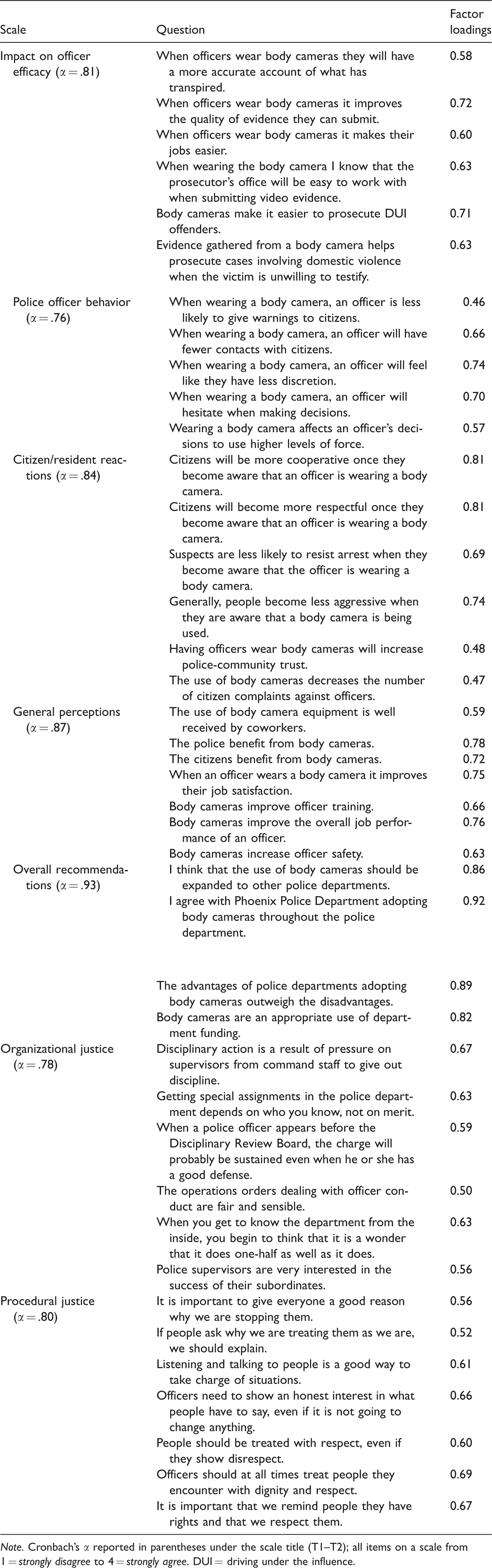
The survey was designed to address several aspects of officer perceptions of BWCs as well as perceptions of organizational justice and support for procedural justice. The full list of survey items is provided in Appendix A. All of the survey items were measured on a scale of 1 = strongly disagree to 4 = strongly agree. Items were reverse coded to ensure higher values indicated higher levels of agreement with the relevant scale. PPD command staff and union representatives reviewed and provided input on all survey items prior to survey administration. These personnel recommended modifications to the phrasing of some items to ensure that the verbiage was consistent with the language used by PPD. Command staff and representatives did not have control over naming or constructing the survey scales. We used exploratory factor analysis with oblique promax rotation, which allows extracted factors to be correlated, to validate our scales (Costello & Osborne, 2005).
The items used to examine perceptions and attitudes about BWCs have been previously used by researchers in a number of cities, including Phoenix (AZ), Tempe (AZ), Spokane (WA), Orlando (FL), and Los Angeles (CA; Gaub et al., 2016; Jennings et al., 2014; Katz et al., 2014; Wooditch et al., 2020). The exploratory factor analyses of these data resulted in the creation of several scales that we use to assess officer perceptions of BWCs: Officer Efficacy (α = .81), Police Officer Behavior (α = .76), Citizen/Resident Reactions (α = .84), General Perceptions (α = .87), and Overall Recommendations (α = .93). Items in each scale loaded sufficiently onto one factor, with all factor loadings exceeding .45. The Officer Efficacy Scale examines whether BWCs improve the accuracy of reports and/or the quality of evidence officers can submit to prosecutors. The Police Officer Behavior scale assesses perceptions of the impact of BWCs on officer discretion and behaviors, including warnings and use of force. The Citizen/Resident Reactions scale examines officer perceptions of citizen responses to a BWC, such as the citizen becoming more cooperative or reducing the likelihood of a complaint. The General Perceptions scale includes whether BWCs are well received by various parties. Finally, the Overall Recommendations scale includes items that ask about whether BWCs should be expanded to all officers and whether BWCs are a good use of department funding.
We also assessed officer perceptions of organizational justice within PPD and support for treating citizens in a procedurally just manner. The items used to tap into perceptions of organizational justice were adapted from Wolfe and Piquero (2011) who examined the impact of organizational justice on officer misconduct in the Philadelphia Police Department. The Organizational Justice scale includes items about the fairness and reasonableness of discipline, policies, and special assignments within the department. The procedural justice items were adapted from the Skogan et al.’s (2015) study of a procedural justice training in the Chicago Police Department. Items in the Procedural Justice scale ask about the importance of giving citizens a voice and treating them respectfully. All items in the Organizational Justice scale (α = .78) loaded sufficiently onto a single factor, with factor loadings exceeding 0.41. Items in the Procedural Justice scale (α = .80) also loaded sufficiently onto one factor, with factor loadings exceeding 0.52 (see Appendix A for all scale items and factor loadings).
Dependent Variables
Given our interest in changes in officer attitudes over time, we calculated the percentage change for each scale (Police Efficacy, Police Behavior, Citizen/Resident Reactions, General Perceptions, Overall Recommendations, Organizational Justice, and Procedural Justice) for each officer using the following formula:

We present these mean percentage changes as descriptive results. We additionally created a factor score for each officer for each scale for both the pretest and the posttest. We use the posttest factor score for each scale as the dependent variable for most of our analyses.
Independent Variables
Officer group assignment is used to establish the impact of wearing a BWC, and the way BWCs were assigned, on changes in officer perceptions of BWCs over time. The group independent variables are dummy indicators of whether the officer was (a) randomly selected and mandated to wear a BWC, (b) randomly selected and volunteered to wear a BWC, (c) randomly selected and asked to volunteer to wear a BWC but declined (aka resistor), and (d) randomly selected to serve in the control group. All dummy indicators are coded as 1 = treatment group assignment (BWC volunteer, BWC resistor, or BWC mandated) and 0 = control group. Control officers are used as the reference category.6
Other independent variables were included for officer gender, race/ethnicity, educational attainment, age, years of service, and precinct assignment to examine potential variation in attitudes toward BWCs based on officer demographic characteristics. We also include independent variables to control for officer activity levels for the 18 months prior to BWC deployment, including the percentage of calls that were self-initiated, the percentage of calls that resulted in arrest, the percentage of calls that resulted in use of force, and the percentage of calls that resulted in a citizen complaint. These variables were obtained from personnel data, precinct rosters, official use of force reports, and citizen complaints.
Analytical Strategy
Given potential differences between BWC volunteers, BWC resistors, and BWC mandated officers relative to the control group, we first assess balance on officer demographic characteristics and activity levels to ensure that officers in each group are comparable, prior to conducting any comparisons between groups. Descriptive statistics for officers in each group are shown in Table 1. The control group is used as the reference category in these analyses. We first compared the BWC resistor group with the control group and observed that the resistor group was significantly younger (M = 35.5, standard deviation [SD] = 9.3 vs. M = 39.0, SD = 9.7, p < .05, g = 0.36) and differed in terms of precinct assignment (5.7% vs. 23.8% for Mountain View, p < .05, g = −0.24). While there were no statistically significant differences between the mandated and control group samples, there were small but meaningful effect size differences between the groups. When contrasted to the control group, the mandated BWC group was more likely to be females (12.9% vs. 4.8%, g = 0.32) and White (77.4% vs. 61.9%, g = 0.33). Finally, when comparing the BWC volunteer and control group samples, there were significant differences with respect to being non-White (19.1% vs. 38.1%, p < .05, g = 0.41) and precinct assignment (7.1% vs. 23.8% for Mountain View, p < .05, g = 0.09). While not significant, we also observed small effect size differences between the volunteer and control groups with respect to being female (14.3% vs. 4.8%, g = 0.35), years of service (M = 8.3, SD = 7.6 vs. M = 10.2, SD = 7.8, g = 0.25), percentage of calls resulting in arrest (M = .13, SD = .05 vs. M = .12, SD = .04, g = −0.28), and use of force (M = .0.0003; SD = .0008 vs. M = .0002, SD = .0004, g = −0.23).
Descriptive Statistics.
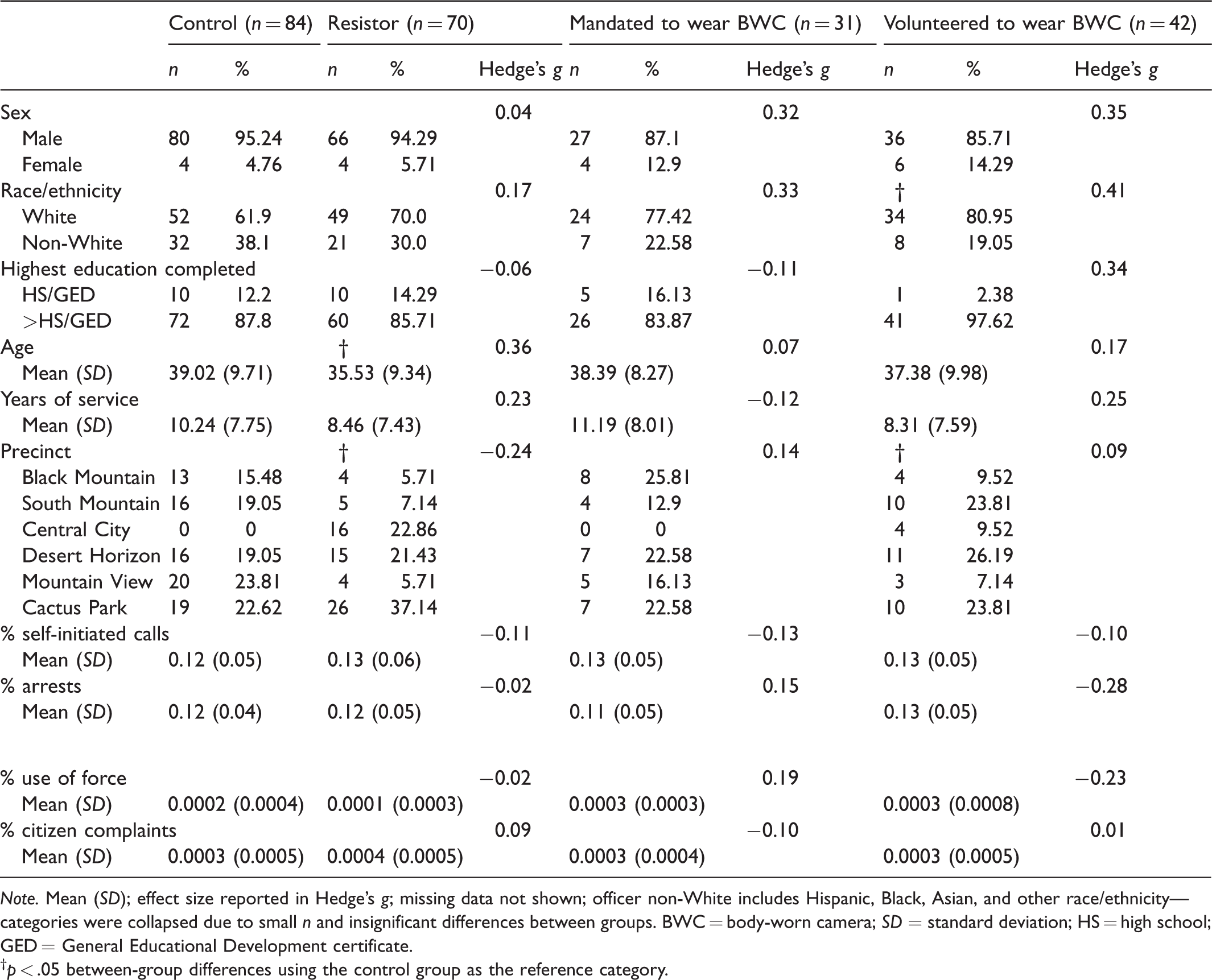
Note. Mean (SD); effect size reported in Hedge’s g; missing data not shown; officer non-White includes Hispanic, Black, Asian, and other race/ethnicity—categories were collapsed due to small n and insignificant differences between groups. BWC = body-worn camera; SD = standard deviation; HS = high school; GED = General Educational Development certificate.
†p < .05 between-group differences using the control group as the reference category.
Mean Percentage Change in Officer Attitudes Within and Between Groups.

Note. Mean percentage change calculated as (group posttest mean-group pretest mean/group pretest mean) × 100. Power calculated based on a two-sample means t test at the p = .05 level. BWC = body-worn camera.
*p < .05 for within-group difference. †p <.05 for between-group difference using the control group as the reference category.
Given the findings earlier, we use inverse propensity weighting and regression adjustment to examine the effect of group membership (resistor, mandated, volunteer, and control) on officer attitudes. Combining inverse propensity weighting and difference-in-differences (DIDs) using adjusted regression models controls for the effects of potential cofounding due to pretreatment differences between groups (Stuart et al., 2014). Based on the identified preintervention differences between our groups of interest, this strategy provides the most reasonable estimates of the effect of treatment assignment on officer perceptions of BWCs. If we did not account for underlying differences between groups of officers in our examination, it would not be possible to suggest that the only factor driving differences in perceptions of BWCs at the posttest was the manner in which an officer was assigned to wear a BWC (volunteered, mandated, resisted, or control). We elected to use propensity weighting instead of propensity matching to maximize the amount of data we could examine. Propensity score weighting has been used in other criminal justice research, including studies that have examined the effectiveness of adolescent substance abuse treatment programs (McCaffrey et al., 2004, 2013) and the effect of driver race on traffic stop outcomes (Ridgeway, 2006).
We first reweighted all of the officers in the study to create homogenous resistor, mandated, volunteer, and control groups. This is an important step given the identified differences between officers in each of the groups. We included the following officer-level covariates in the propensity score model: gender, race/ethnicity, educational attainment, age, years of service, precinct assignment, percentage of calls that were self-initiated, percentage of calls that resulted in arrest, percentage of calls that resulted in use of force, percentage of calls that resulted in complaints, and a factor score that was created to capture each officers pretest perceptions of BWCs, organizational justice, and procedural justice. All of the measures of officer activities and attitudes used in the weighting procedure were captured prior to the assignment of BWCs.
To calculate our propensity weights, we estimated a multinomial probit model estimating group membership including all of our officer-level covariates.7 We then used these results to predict the probability of each officer being assigned to the group they were ultimately in. Using these predicted probabilities, we calculated propensity weights as
In the next section, we start by examining the unweighted data. We first evaluate within- and between-group differences in mean percentage change in officer attitudes toward BWCs. We assess changes in officer perceptions using one-sample t tests to determine whether the mean scale score at the pretest significantly differs from the mean scale score at the posttest for officers in each group. We also assess between-group differences using two-sample means t tests using the control group as the reference category. We then examine the unweighted data using DID estimators comparing BWC volunteers, mandated, and resistors to the control group. The DID models estimate the difference in the treatment group posttest score compared with their pretest score, relative to the difference for the control group. This approach enables us to capture within-group changes over time and to compare those changes between treatment and control groups. We do this by estimating separate regression models to predict each posttest scale factor score using an independent variable for group assignment (either control or treatment), controlling for the pretest scale factor score. This enables us to examine whether the officers in each treatment group changed in a different way than officers in the control group over time (see Braga et al., 2017, for a discussion of DID).
After examining the unweighted results, we repeat the aforementioned DID analysis using the propensity score weighted data. We again use the control group as the reference group for the propensity weighted DID models. This allows us to determine whether treatment officers (resistant, mandated, or volunteer) changed in different ways than control officers, once officers in each group were weighted to ensure that any differences in outcomes are not attributable to preexisting differences between groups.
Due to our small sample size, which limits our statistical power to detect statistically significant effects, we present our findings using both statistical significance and effect size differences. Small sample sizes are not unusual in BWC evaluations, for example, the evaluation of BWCs in Hallandale Beach only involved 51 officers (Headley et al., 2017) and the evaluation in Mesa involved 100 officers (Ready & Young, 2015). Our study is unique in that we compare four groups of officers in our analyses: resistors (n = 70), mandated BWC officers (n = 31), BWC volunteers (n = 42), and control officers (n = 84). Although our sample is not as small as some prior studies, splitting study officers into these groups (as opposed to BWC officers and control officers) reduced our ability to detect statistically significant treatment effects when making between-group comparisons. To address this concern, we report effect size differences in Hedge’s g to account for our small sample size and to present the magnitude of the effects we identify (Lakens, 2013). The reported effect sizes can also be considered as indicators of the practical significance of our findings and may prove useful for planning future studies (Zientek et al., 2016).
Results
Beginning with the unweighted mean percentage change results, as shown in Table 2, control officers (3.8% reduction), BWC mandated officers (8.9% reduction, g = −0.24), and BWC volunteers (8.8% reduction, g = −0.25) were all significantly less likely to agree that BWCs improve Officer Efficacy at the posttest compared with the pretest (p < .05). BWC resistors (2.9% reduction, p < .05, g = −0.20) and BWC mandated officers (10.5% reduction, p < .05, g = −0.42) had significantly more negative Overall Recommendations regarding the expansion of BWCs at the posttest. Officers mandated to wear a BWC also had significantly more negative General Perceptions of BWCs (5.5% reduction, p < .05, g = −0.21) at the posttest. BWC volunteers were significantly less likely to agree that BWCs improve Officer Behavior (6.8% reduction, p < .05, g = −0.37) or Citizen/Resident Reactions (10.8% reduction, p < .05, g = −0.43) at the posttest compared with the pretest. These differences in volunteer perceptions of Citizen/Resident Reactions significantly differed from changes in the control group from the pretest to the posttest (−10.8% vs. −0.7%, p < .05, g = −0.43). In other words, following the assignment of BWCs, the volunteer group was significantly less likely to report that citizens will change their behavior in positive ways (e.g., be more cooperative, respectful, less aggressive, less likely to complain) as a consequence of a BWC being present, relative to the control group. There were no significant differences in changes between the control group and the mandated or the resistor group between the pretest and posttest periods.
The unweighted DID analyses are presented in Table 3. The results indicated no significant differences between control officers and BWC resistors, though the resistors did have a small effect size increase in their perceptions of Organizational Justice, relative to the control group (b = 0.09, g = 0.27). There were no significant differences between BWC mandated and control officers either, though mandated officers had small effect size reductions in perceptions that BWCs would improve Officer Efficacy (b = −0.17, g = −0.36), perceptions that BWCs would result in positive Citizen/Resident Reactions (b = −0.10, g = −0.22), General Perceptions of the use of BWCs (b = −0.11, g = −0.27), and Overall Recommendations for expanding the use of BWCs (b = −0.20, g = −0.34). Mandated officers also had a small effect size increase in perceptions of Organizational Justice, relative to the control group (b = 0.08, g = 0.23). In addition, our DID analyses revealed that, compared with the control group, those officers who volunteered to wear a BWC were significantly less likely to report that BWCs impact Police Officer Behavior, such as officers being less likely to give a warning to a citizen, being less likely to initiate contact with citizens, and being less likely to use higher levels of force (b = −0.2, p < .05, g = −0.43). BWC volunteers also had small, though nonsignificant, effect size reductions in perceptions that BWCs would positively impact Officer Efficacy (b = −0.11, g = −0.22) and result in positive Citizen/Resident Reactions to the police, compared with the control group (b = −0.13, g = −0.28).
Unweighted Difference-in-Difference Coefficients Predicting Officer Posttest Attitudes.

Note. Standard errors are in parentheses; all difference-in-difference estimations included a control for pretest score, pretest coefficient omitted from tables to save space. BWC = body-worn camera.
*p < .05.
Inverse Propensity Weighted Difference-in-Difference Coefficients Predicting Officer Posttest Attitudes.
Note. Standard errors are in parentheses; all difference-in-difference estimations included a control for pretest score, pretest coefficient omitted from tables to save space. BWC = body-worn camera.
*p < .05.
Finally, we reestimated our DID model including the propensity score weights. As shown in Table 4, the results suggest that BWC resistors have significantly more positive perceptions of Organizational Justice than control officers do at the posttest (b = 0.13, p < .05, g = 0.38). BWC mandated officers had significantly more negative perceptions of Officer Efficacy, compared with control officers (b = −0.19, p < .05, g = −0.43). We also observed small effect size differences between mandated and control officers in the remainder of the scales. BWC mandated officers were less likely to agree that BWCs would change Officer Behavior (b = −0.14, g = −0.33), had less positive agreement that BWCs would improve Citizen/Resident Reactions (b = −0.17, g = −0.42), had less positive General Perceptions of BWCs (b = −0.15, g = −0.38), had less positive Overall Recommendations for expanding BWCs (b = −0.22, g = −0.36), had more positive perceptions of Organizational Justice (b = 0.11, g = 0.34), and were more supportive of the use of Procedural Justice (b = 0.07, g = 0.22), relative to control officers.
No significant differences between officers who volunteered to wear a BWC and control officers were identified. A small effect size difference in perceptions of the impact of BWCs on Officer Efficacy suggests that volunteers were less likely to agree that BWCs improve Officer Efficacy (b = −0.10, g = −0.21). Small effect size differences in Police Officer Behavior (b = −0.18, g = −0.39) and Citizen/Resident Reactions (b = −0.14, g = −0.32) indicate that BWC volunteers are less likely to agree that BWCs change officer behavior or improve citizen responses to police, relative to control officers.
Collectively, these effect size differences indicate that BWC mandated and BWC volunteer officers were less optimistic about the ability of BWCs to improve Officer Efficacy, affect Police Officer Behavior, and result in more positive Citizen/Resident Reactions to the police compared with the control group at the posttest. However, these differences between the BWC officers and the control officers were largely not statistically significant, and most of the differences were small in terms of effect size.
Discussion and Conclusions
Using data obtained from 227 randomly selected Phoenix officers, we examined several potential attitudinal changes, extrapolated from prior research, which could result from the implementation of BWCs. This is an important research question because BWCs represent a new and emerging technology being implemented in the majority of police agencies across the country for the purpose of addressing systemic issues between the police and public. Our findings, however, suggest that there were only small changes in officer perceptions of BWCs, organizational justice, and procedural justice following the introduction of BWCs. Our results, and how they compare to results found in prior research, are discussed below.
We identified more negative officer perceptions of the impact of BWCs on Officer Efficacy for BWC mandated and volunteer officers, relative to the control group. In other words, officers who wore a BWC reported less agreement that the BWC helps them have a more accurate account of an event, obtains high-quality evidence, or assists in the prosecution of cases. This finding is contrary to prior research conducted in Phoenix. Morrow et al. (2016) examined official police and court records and reported that BWCs had a significant and substantial impact on the arrest and prosecution of defendants accused of domestic violence. Specifically, cases that involved the presence of a BWC were much more likely to result in charging, conviction, and a more punitive sentence. Although BWCs could be associated with improved court outcomes, it is possible that officers are unaware of these benefits if these differences occur as a function of plea bargaining or other processes that do not involve officer appearances in court. It should be noted that a number of officers told members of the research team that the prosecutor’s office was very difficult to work with. As such, BWCs could improve ultimate case outcomes, as evidenced by administrative data, but these effects might not change officer perceptions toward the effectiveness of BWCs if officers are unaware of these benefits. Prior researchers have found no changes in perceptions of officer efficacy after the deployment of BWCs. For instance, Wooditch et al. (2020) found no difference in officers perceptions of the quality of evidence they could collect as a result of BWCs in LAPD (g = 0.13). Combined, these findings suggest that police officers are not observing the downstream positive impact of BWCs, and additional training might be needed to better align these attitudes with outcomes.
Our findings indicated that officers who volunteered to wear a BWC, when contrasted to control officers, experienced small declines in their perceptions that BWCs impact Police Officer Behavior. For example, after 6 months of wearing a BWC, officers who volunteered to wear BWCs were less likely to believe that wearing a BWC results in: officers having fewer contacts with citizens, hesitation in making decisions, and feeling they have less discretion. Similar trends were observed between the mandated and control officers, albeit the effect size was smaller. These findings suggest that officers who wear BWCs might be less likely to retain their beliefs that BWCs will change the ways officer behave than control officers. This could be considered a positive finding given some concerns that BWCs will result in officer passivity because of increased potential for scrutiny. Wooditch et al. (2020) similarly found that officers in the LAPD did not feel like they have less discretion when wearing a BWC (g = 0.14). Hyatt et al. (2017) found that officers in an Eastern U.S. transit department were more likely to agree that BWCs increase officer accountability after BWCs were deployed (g = 0.25), though Grossmith et al. (2015) found no difference in reported change in officer accountability in London. In short, our findings that officers are less likely to believe that BWCs change the way officers behave after wearing a camera are consistent with prior researchers who have found that BWCs have limited effects on officers perceptions of accountability or the amount of discretion officers feel like they have.
Officers who were mandated and officers who volunteered to wear a BWC reported lower levels of agreement that BWCs would improve Citizen/Resident Reactions, relative to control officers. For instance, officers who were assigned to wear a BWC as part of the study reported lower levels of agreement that BWCs would increase citizen cooperation, increase citizen respect, decrease citizen resistance, and decrease citizen aggression, relative to control officers. These findings are consistent with prior studies that have found that officers were less optimistic about the impact of BWCs on citizens after BWCs were implemented in their agencies (Gaub et al., 2016). One explanation for these findings could be that citizens are not aware of whether or not an officer is using a BWC in a specific encounter (White et al., 2017). In their study of citizens in Spokane (WA) who had BWC recorded police encounters, White et al. (2017) found that only 28% of the citizens they interviewed knew that the officer they interacted with was using a BWC. PPD policy does not require officers who wear BWCs to notify citizens that their interactions are being recorded using a BWC. Citizens who do not know that an officer is wearing a BWC will be unlikely to change their behavior to compensate for the camera. As such, those officers who wore a BWC as part of this study could have expected citizens to be more cooperative but did not experience these changes in practice. This would explain why both BWC mandated and BWC volunteers were more skeptical of the potential for BWCs to improve citizen behaviors while control and resistant officers experienced little change in these perceptions over time. Additional research examining whether citizens are likely to be more cooperative with police officers wearing BWCs when the citizen is notified that their contact is being recorded, as opposed to when citizens are not notified, is needed.
Officers mandated to wear a BWC, compared with the control group, were less likely to have positive General Perceptions of BWCs following their use in the field. For example, officers mandated to wear a BWC were less likely to agree that the police and citizens benefit from BWCs, that BWCs are well received by coworkers, and that BWCs improve police job satisfaction, training, job performance, and officer safety. Likewise, officers mandated to wear BWCs reported more negative Overall Recommendations about BWCs following 6 months of use in the field. For instance, they were less likely to recommend BWCs to other departments and to other officers in their own department. These findings are supportive of psychological reactance theory. Psychological reactance theory is based on the assumption that when people believe they are free to behave in certain ways, or were free to behave in certain ways in the past, they are motivated to restore their freedom when they feel that freedom is threatened (Rosenberg & Siegel, 2018). Police officers who were mandated to wear BWCs might have resented being required to wear a BWC because they perceived it as restricting their autonomy. This could be why they do not recommend the expansion of BWCs, so that others will not be subjected to the same restrictions or loss of freedom. BWCs additionally serve as a mechanism for employee monitoring, which can result in officers feeling like they have less discretion (Adams & Mastracci, 2019a). As noted earlier, perceived restraints on officer discretion and officer concerns about discipline as a result of BWCs could also lead to unfavorable officer attitudes toward BWCs. While a substantial body of literature has examined the impact of BWCs on officer and citizen behavior, much less has focused on how BWCs might affect police officer self-identity and autonomy. Future research that examines the impact of BWCs on officer identity and police culture is needed.
When compared with the control group, volunteers, mandated, and resistant officers reported higher perceptions of organizational justice following the implementation of BWCs. Our findings are in contrast to Adams and Mastracci (2019b), who found that BWC wearing officers reported lower levels of perceived organizational support than those who did not wear a BWC. Our findings suggest that officers who wore a BWC, or who had the opportunity to wear a BWC, were more likely to perceive PPD as seeking to be just and impartial in their decision-making. These findings are interesting in the context of our other findings presented here; namely, that those who wore BWCs—mandated or voluntarily—did not view them as having an impact on citizen reactions (e.g., making a complaint) and behavior (e.g., less aggression) and were less likely to recommend them to other agencies and fellow officers after their implementation. It might be that BWCs represent a unique form of enhanced police supervision that are not representative of a particular interest group or side (e.g., supervisors, police administrators). This might explain why there was little substantive difference between the volunteers and mandated officer’s perceptions of organizational justice following BWC deployment.
Being provided an opportunity to wear a BWC might signal to the officers that the agency has greater capacity for organizational justice, regardless of their personal perceptions of the utility of the technology. Furthermore, resistors who were asked to wear a BWC and refused to do so were not forced to wear a camera. This could result in increased perceptions that what they want matters to the organization, relative to the control group who was not asked to wear a BWC. This supports findings in Hyatt et al. (2017), who identified increased officer agreement that the police department gives officers explanations for decisions that affect them (g = 0.26) and decreases in perceptions that BWCs indicate that management does not trust officers (g = −0.32) after the deployment of BWCs in that agency. As such, their findings similarly suggest that officer perceptions of organizational justice could increase after the deployment of BWCs.
We observed no significant group differences in self-reports of the importance of using Procedural Justice, though mandated officers experienced a small effect size increase. For instance, officers did not report increased agreement that it is important to give citizens a good reason for stopping them, for listening and talking to people, and for treating citizens with dignity and respect. Both McCluskey et al. (2019) and Stratton et al. (2015), however, have reported that officers are more likely to use procedural justice, including using appropriate language, being professional, and being patient with citizens after adopting BWCs. Recall that some researchers have found that officers wearing BWCs are more likely to act in procedurally just ways, even if the officers themselves do not self-report engaging in procedural justice (e.g., Owens & Finn, 2018). Given the limitations of our data, it is not possible to know whether the lack of change in officer support for using procedural justice is also associated with a lack of behavioral change, or whether the officers did not recognize a change that did occur.
Overall, we identified few statistically significant and only small substantively meaningful changes in officer perceptions of BWCs, organizational justice, and procedural justice over time. In some ways, this suggests that BWCs could be viewed as just another tool that officers have once this technology is introduced. Officers who did wear a BWC (either mandated or voluntarily) were generally more pessimistic about BWCs after using them in the field, though these changes were small in terms of effect size and rarely reached statistical significance. The finding that officer attitudes changed relatively little over time, whether officers were directly exposed to BWCs or not, indicates that efforts to increase officer support for BWCs should be made early in the BWC adoption process. Our results, combined with prior research, highlight the importance of a communication strategy that disseminates information about the benefits and limitations of BWCs prior to their deployment so that officers buy-in to their agency’s BWC program, rather than resist its implementation. This suggestion is consistent with research conducted in Tempe (AZ), which indicated that high levels of officer buy-in facilitated the success of BWC implementation in that department (White et al., 2018). Furthermore, because BWC resistors in this study had increased perceptions of organizational justice at the posttest, ensuring that officers feel included in the implementation and deployment of BWC programs is important.
Our findings, however, are limited in a number of important ways. First, the generalizability of the findings is limited to Phoenix and should not be considered representative of police departments in different settings. Prior research has found that there is a wide range of police attitudes toward BWCs in general, and it is worth noting that Phoenix officers have markedly different attitudes about BWCs, even when compared with those in the nearby metropolitan area (e.g., Tempe, see Gaub et al., 2016). Second, while we randomized the selection of study participants, this did not result in statistically similar groups with respect to the volunteer and resistant groups being similar to the control group. This is an interesting finding in itself. Although we randomly selected officers who were asked to volunteer to wear a BWC, those who agreed to do so were more likely to be White, to be female and to have higher educational attainment than control officers. Officers who resisted wearing a BWC were significantly younger and were from different precincts than control officers. Officers who were randomly selected and mandated to wear a BWC were not statistically or substantively different from officers in the control group.
We attempted to mitigate the differences between study groups through various statistical procedures, but the differences in our sample nevertheless might have affected our results. It is possible that important differences between officers who agreed to volunteer and officers who resisted wearing a BWC were not captured in the covariates used to create our propensity weights. For instance, officers with fewer years of service who agreed to volunteer to wear a BWC could have felt additional pressure to comply with the request due to their low level of seniority in the organizational hierarchy. However, the high number of officers who declined to wear a BWC suggests that many officers did not feel coerced to participate. Furthermore, both officers who volunteered to wear a BWC and those who resisted wearing a BWC averaged 8 years of service. This suggests that officers who volunteered and resisted wearing BWCs were relatively similar in terms of seniority. The use of inverse propensity weighting helps mitigate concerns that officers in each group are substantially different from each other.
Some consideration should also be given to one reviewers’ suggestion that our modeling strategy is overly complex. Our philosophy for any analysis is to perform the most straightforward statistical procedure possible that meets the relevant assumptions. The use of inverse propensity weighting and regression adjustment was necessary to account for the potential influence of pretreatment differences between groups on our outcomes of interest. Although the complexity of our analysis does result in some reduction in statistical power, we nevertheless identified some significant differences between groups. Future research examining the impact of BWCs on officer attitudes across different BWC deployment methods (voluntarily vs. mandated) is needed to validate our findings.
Third, and related to the above limitation, our relative lack of findings is likely related to the small sample size of our study, which limited our ability to identify statistically significant results. Although many prior studies suggest that officers have more positive perceptions of BWCs after using this technology, these findings are far from universal, as some studies have resulted in similar null effects (Lum et al., 2019). In their review of the BWC research, Lum et al. (2019) suggest that officers could become increasingly favorable toward or remain neutral to BWCs because they view this technology as serving to provide accountability for citizen behavior, not necessarily influencing the behavior of the officers themselves. However, White et al. (2018) found that officers in the neighboring Tempe Police Department became more skeptical about the potential for BWCs to result in improved citizen behavior. It is important to note that officers in Tempe held more favorable attitudes toward BWCs at the posttest in all other areas examined (White et al., 2018). Officers who wore BWCs in the Mesa Police Department, another agency adjacent to Phoenix, were also more likely to report that BWCs were helpful than officers who did not wear a BWC (Ready & Young, 2015). As such, the lack of findings in this study is consistent with the mixed findings across prior literature and could be related to a number of explanations. It is important to note that different findings across agencies, even in the same geographical area, could be attributable to various policies, training mechanisms, and organizational cultures across different police departments that are not due to BWCs in isolation.
Another potential explanation for the relative lack of between-group differences in our results could be the design of the experiment. Due to infrastructural needs of the department, BWCs were assigned to individual officers in various shifts and squads throughout PPD. This resulted in BWC mandated officers, BWC volunteer officers, BWC resistors, and BWC control officers all interacting with one another, including informal interactions prior to starting their shifts. As a result, officers in each of these groups could have been influenced by officers assigned to other treatment conditions. For example, officers in the control group—who do not have direct experience wearing a BWC—could have communicated about using BWCs with officers in the BWC mandated and volunteer groups. These conversations could have resulted in attitudinal changes about BWCs for control officers, even if they did not wear a BWC themselves. Young and Ready (2015) found that officer perceptions of BWCs in Mesa were influenced by the perceptions of other officers in their social networks, indicating that these interactions could influence officer perceptions. It is also possible that officers assigned to either the control group or those who resisted wearing BWCs responded to the same incidents as officers in either the BWC mandated or volunteer group. Although PPD uses one-officer patrol vehicles, contamination could occur if multiple officers from separate treatment conditions respond to the same incident, which occurred occasionally during the study period. The interactions between these groups of officers could have influenced our null findings, as officers in the control condition could have been influenced by working with officers in the treatment condition. This could have resulted in similar attitudinal changes among all groups of officers over time. A more in-depth analysis of this contamination and the potential influence of this contamination on the outcomes of the experiment are beyond the scope of this study.
Finally, and not discussed nor addressed in the larger body of literature, our study is limited due to the short amount of time between the pretest and posttest surveys (6 months). It is possible that as officers continue to adjust to wearing BWCs and have more direct and indirect experience with them, their perceptions toward the technology might evolve in more notable ways. On the other hand, officers could have experienced more immediate changes in perceptions of BWCs that were more pronounced shortly after the cameras were deployed, which then subsequently returned to baseline as officers became familiar with using the technology. Longitudinal evaluations are necessary to fully understand the totality of the effect of BWCs on officer perceptions over time. It is also important to note that because we used a pretest/posttest design, a testing effect could have influenced the internal validity of the findings. A testing effect would occur if participating in the pretest in some way influenced officer responses to the posttest survey. For instance, if officers responded to the pretest survey and then reflected on their responses with other officers prior to taking the posttest survey, they could have changed their responses to the posttest to be more consistent with the attitudes of their peers. The relatively limited change both within and between groups over time suggests that a testing effect is unlikely in this study.
In conclusion, our findings suggest that the adoption of BWCs causes minor changes in the attitudes and perceptions of police officers. Most of these changes are relatively small in magnitude (i.e., effect size). Although we found some evidence that the implementation of BWCs improved officer’s perceptions of organizational justice, BWCs did not live up to officer expectations in terms of impacting officer or citizen behavior. In general, officers who wore a BWC were less likely to recommend the full adoption of BWCs. This finding is consistent with prospect theory. Prospect theory suggests that individuals are more sensitive to potential negative outcomes than to potential positive outcomes, resulting in individuals overweighing consequences relative to benefits when making decisions (Kahneman & Tversky, 1979). In the case of BWCs, officers could be more sensitive to the potential drawbacks of BWCs (e.g., increased potential for discipline) and less influenced by the potential benefits of BWCs (e.g., the potential for BWCs to result in officer exoneration for unfounded complaints). Future research examining officer perceptions of potential consequences as a result of BWCs and support for the use of BWCs using measures like the perceived intensity of monitoring scale can further untangle these effects. As BWCs are expanded to all officers within the PPD, communicating the benefits of BWCs to officers could help counter negative perceptions and foster greater acceptance of BWCs as an important police tool. Although it was not reflected in the results, the research team became aware of several instances of positive BWC outcomes through the process of administering the posttest. These success stories were especially mentioned in situations where BWC footage exonerated officers in unjustified citizen complaints. Officers, however, could view these success stories as solitary incidents, though the frequency with which different examples were relayed to members of the research team suggests that these benefits were being experienced throughout the department. As such, sharing a broader view of the benefits of BWCs with officers who are apprehensive about wearing cameras could be an important method to use in successful BWC implementation. Such a campaign might help reduce officer resistance to BWCs, increase BWC activation rates, and in turn maximize the effectiveness of BWCs by providing greater protection to police officers and citizens.
Footnotes
Declaration of Conflicting Interests
The authors declared no potential conflicts of interest with respect to the research, authorship, and/or publication of this article.
Funding
The authors disclosed receipt of the following financial support for the research, authorship and/or publication of this article: This research was supported by the Bureau of Justice Assistance under Award No. 2015-WY-BX-0004. The views and conclusions contained in this document are those of the authors and should not be interpreted as necessarily representing the official policies, either expressed or implied, of the Bureau of Justice Assistance.
