



Abstract
A unique dataset is analyzed to investigate the effect of a criminal suspect’s prior criminal record on the probability of arrest. Multivariate logistic regression results show that a criminal suspect with a prior criminal record is approximately 29 times more likely than a suspect without a criminal record to be arrested by police. While findings also reveal that Black suspects and Black suspects with a prior criminal record do not have an enhanced proclivity of arrest, Black suspects with a prior criminal record who target White victims are almost three times more apt to be arrested. When juxtaposed with the finding in the baseline model of a substantive relationship between a suspect’s race and the likelihood of arrest absent the control for prior criminal record, our results suggest that any correlation evinced between a criminal suspect’s race and the likelihood of arrest without controlling for the suspect’s prior criminal history may be spurious due to omitted variable bias.
Research on Criminal Offending
In their landmark study, Wolfgang et al. (1972) highlighted the criminal offending patterns of a cohort of 9,945 boys born in Philadelphia in 1945 through their eighteenth birthday in 1963. The major finding of their study was that approximately 6% of the juvenile offenders, who were arrested five or more times by age 18, accounted for 52% of all arrests of cohort members. These same boys were also arrested for most of the serious crimes committed by the cohort, including 71% of the homicides, 73% of the rapes, 82% of the robberies, and 69% of the aggravated assaults.
Since Wolfgang et al.’s seminal work, countless studies demonstrate that a relatively small number of individuals commit the bulk of crime experienced in society (see DeLisi, 2005 for a review of this literature). Given ample evidence for the existence of a small group of repeat offenders in the general population, social scientists have embarked on a concerted effort to proffer explanations for why certain individuals are inclined to continually partake in criminal activity. Some researchers advance theoretical perspectives rooted in a life-course framework to explain such continuity in offending patterns (Carlsson & Sarnecki, 2015). These developmental or life-course perspectives often take the form of theoretical integration of existing criminological theory as with Sampson and Laub’s (1993) age-graded informal social control theory, which employs social control and social learning concepts to explain the persistence of criminal offending over time. Other similar explanations of persistent criminal offending include Warr’s (1998) assertion that repeat offending is influenced by the stability and change in formal and informal social controls along with social learning processes over the life-course. According to this perspective, life-course transitions that strengthen informal social control such as getting married, securing full-time employment, joining the military, or entering college can have a strong influence on chronicity.
In somewhat of a departure from these common explanations, some argue that there is a certain criminal subtype in the population that has an inflated tendency for participating in illegal activities. Moffitt’s (1993) developmental theory of antisocial behavior posits that there are two basic types of offenders, life-course persistent and adolescent-limited offenders. In contrast to adolescent-limited offenders, life-course persistent offenders exhibit stability, chronicity, and engage in more serious crime. These individuals begin their criminal careers early in life and persist in crime for a longer period. They also suffer lower verbal ability, hyperactivity, and low self-control/impulsivity, which in turn makes them crime-prone (Moffitt, 1993). Other developmental psychological/neuropsychological approaches such as psychopathy also center on distinct criminal subtypes (Flexon, 2018).
However, while these explanations are undoubtedly influential, they are nonetheless incomplete as they often fail to capture situational contexts, such as having a criminal history that may influence repeat offending. Labeling theorists assert that social stigma results from an individual branded as a criminal in society, which can, in turn, engender criminality by influencing a person’s self-concept negatively (Becker, 1963). Self-concept is thought to emanate from the perception of others. If people believe a person to possess a particular undesirable characteristic such as being criminally disposed and then interact with the person based on this belief, whether warranted or not, the targeted person may grudgingly accept this objectionable characteristic in a self-fulfilling type prophecy. This process is referred to as the “dramatization of evil” (Tannenbaum, 1938). The initial labeling of a person as being a criminal, which tends to occur more frequently among individuals belonging to less powerful groups in society, results in the continuation and stabilization of the person’s criminal behavior. Lacking a criminal label, a person’s criminal behavior would probably have remained infrequent and unorganized.
Labeling theorists further argue that individuals possessing a criminal label are scrutinized more closely by social control agents because the criminal label generates an adverse social reaction among the population. This intensification in the social monitoring of criminally labeled individuals results in their having a higher probability than non-labeled individuals of being discovered and punished for any subsequent illegal activity. This unrelenting process of heightened social monitoring of the criminally labeled and the resultant increase in the detection of their illicit activities only causes the initial criminal label to be affixed more firmly to these individuals.
Prior Criminal Record and Arrest
While many studies rely on criminal offending data derived from self-report surveys, others use official arrest data or self-report arrest data because self-report surveys typically fail to capture repeat criminal offenders or serious forms of criminal behavior (Cernkovich et al., 1985). However, a central problem with using arrest data to measure criminal offending involves making the somewhat dubious assumption that holding constant actual illegal behavior, a criminal suspect with a prior criminal record does not have an inflated likelihood of arrest. This situation seems rather unlikely because, as proffered by labeling theorists, people with a criminal record are frequently viewed as being criminally predisposed.
The belief that criminal suspects with a criminal record have the same likelihood of arrest as suspects lacking a criminal record also appears to lack merit when one contemplates the abundance of research showing that a multitude of factors plays a salient role in explaining the use of the arrest sanction. For example, some studies identify situational factors that pertain to characteristics of the criminal suspect (Brown, 2005; D’Alessio & Stolzenberg, 2003; Kochel et al., 2011; Lytle, 2014; McCamman & Mowen, 2018; Riedel, 2008; Schulenberg, 2015; Stolzenberg & D’Alessio, 2004; Visher, 1983), attributes of the victim (Smith et al., 1984), elements of the immediate situation (Brown, 2005; O’Neal et al., 2019; Smith & Visher, 1981), and legal aspects (Smith & Visher, 1981) as being influential in predicting whether a criminal suspect is arrested by police. Other studies find the characteristics of individual police officers (Mbuba, 2018; Rosenfeld et al., 2018), the organizational structure and policies of police departments (Eitle et al., 2005; Mourtgos et al., 2018), or aggregate community factors (Gase et al., 2016; Stolzenberg et al., 2004) as significant predictors of the arrest.
Owing to the dearth of datasets containing a criminal suspect’s prior criminal record, no published research to our knowledge has directly examined this issue of statistical dependency despite ample ancillary empirical evidence that repeat offenders have an enhanced vulnerability of being arrested by police (Alpert et al., 2005; Covey, 2011). Repeat offenders have a higher probability of detection and arrest by authorities because information relating to their fingerprints, DNA, photographs, personal background information, criminal accomplices, and modus operandi are maintained by police departments (Dana, 2001). It is also likely that many repeat offenders have a magnified likelihood of being arrested for their current alleged crime because they are on probation or parole (Miller, 2014) and because their past illegal transgressions make for easier and more plausible incriminating accusations by informants that otherwise would lack credibility (Mosteller, 2009). This latter argument is buttressed by studies showing that repeat offenders are more apt to be falsely accused and prosecuted for a crime they did not perpetrate (Friedman, 1991).
Social scientists have repeatedly sought to explicate the discretionary practices of criminal justice actors. Observed disparities in criminal justice-related outcomes have typically been anchored to social psychological approaches like labeling theory in which decision-makers use heuristic devices (e.g., stereotypes, schemas) to streamline their decision making. It is generally accepted that individuals construct positive or negative cognitive categories based on social dimensions such as age, race, and gender, among other personal or general characteristics (Pager, 2007). This process of thinking in social categories (i.e., schemas) is understood as a non-volitional and subconscious effort to streamline cognitive processing in response to an ambiguous social environment (Andersen et al., 2007; Bodenhausen & Macrae, 1998; Devine & Monteith, 1999; Monteith et al., 1998). The evidence further suggests that stereotype activation is an automatic and unconscious process (Andersen et al., 2007), whereas stereotypes are understood as normal thought patterns that aid in the processing of the social world, the development of attitudes, and in assisting the decision-making process. Stereotypes are triggered through environmental cues or primes, often without an individual realizing that cognitive associations are being formed.
While many studies delve into how a subconscious set of preconceived notions and prejudices about Black criminal suspects regarding culpability, threat, and worthiness can influence police officer decisions (Charbonneau et al., 2017; Fridell & Lim, 2016), this type of implicit bias can also be applied to achieved characteristics of the individual. One such characteristic that can be employed by police officers to help them assess the dangerousness of a criminal suspect is whether the suspect has a prior criminal record. Previous research consistently finds that a criminal defendant’s prior criminal record is a crucial factor in determining the severity of criminal justice processing outcomes (Covey, 2011; Spohn, 2000). The strong influence of prior criminal history on criminal justice processing outcome is telling because it most likely signals to decision-makers something about a criminal defendant’s chronicity, culpability, and threat. The extent of the association between criminal history and potential future dangerousness crosses multiple life domains, which fortifies the cognitive nexus between the two ideas. Problematically in this context, instances where cognitive processing resources are depleted (i.e., cognitive load) decrease effortful cognitive processing in favor of a more heuristic (efficient) approach, i.e., multiple tasks, tiredness, task difficulty, excitability and anxiousness, moods, evaluations (Bodenhausen & Macrae 1998; Devine & Monteith, 1999). This condition is referred to as the principle of limited capacity or bounded rationality in the economic literature (Gigerenzer & Selten, 2002). In effect, stereotype use and schematic/heuristic processing are usually manifested subconsciously to increase efforts toward cognitive efficiency and resource preservation. Hence, because making pensive decisions is less rewarding for the police in terms of liability and personal/public safety than is using heuristics that streamline cognitive processing, there is a strong likelihood that police officers rely on a criminal suspect’s criminal history to some degree when making arrest determinations. When it comes to issues of assessing who poses a personal threat, prior criminal history is perhaps the best indicator available to an officer when confronting an unknown public while being required to make efficient decisions that can impact self and public safety.
Purpose of the Study
The primary objective of the current study is to examine the relationship between a criminal suspect’s prior criminal record and the likelihood of arrest while controlling for factors commonly associated with the arrest decision. It is theorized that criminal suspects with a prior criminal history are more likely than suspects without a record to be arrested by police, even after accounting for other relevant factors. As noted previously, indirect evidence supporting this assertion can be found in research showing that criminal defendants with a prior criminal record are more apt than those without a record to receive a negative criminal justice processing outcome (Covey, 2011). However, while the decision to arrest is certainly different than criminal justice processing decisions related to pretrial detention, the filing of charges by the prosecutor, or the sentencing of a convicted offender by a judge, it seems probable that the police are also negatively influenced by the prior record of a criminal suspect.
A secondary goal of this study is to ascertain whether any observed relationship between a criminal suspect’s race and the likelihood of arrest is due to racial differences in prior criminal history. Although a large and diverse body of empirical research has accumulated that examines the effect of race on arrest, this research is mixed. Some studies find that an arrest is more apt to occur for crimes involving a Black criminal suspect (Kochel et al., 2011), while others report that White rather than Black criminal suspects have a higher probability of arrest (D’Alessio & Stolzenberg, 2003; Stolzenberg et al., 2004). Still, others find no substantive effect of a criminal suspect’s race on the decision to arrest (Austin & Ressler, 2017; Bolger, 2018).
In a meta-analysis of 40 arrest studies that analyzed 23 different data sets, Kochel et al. (2011) examined whether the race of the criminal suspect impacted the arrest decision. They found that racial minority citizens were at least 30% more likely than Whites to be arrested by police. However, they were unable to ascertain the underlying factors responsible for this relationship (Engel et al., 2012). The age of the suspect and exhibiting a hostile demeanor were two additional factors associated with the likelihood of arrest.
Other studies find that while race plays a role in explaining the arrest sanction, White rather Black suspects have a higher probability of arrest. Using data drawn from the National Incident-Based Reporting System (NIBRS), D’Alessio and Stolzenberg (2003) examined the effect of a criminal suspect’s race on the probability of arrest for over 300,000 incidents of forcible rape, robbery, aggravated assault, and simple assault. They focused their analysis on these confrontational crimes because the crime victim was able to furnish authorities with the criminal suspect’s race and other essential demographic characteristics, notwithstanding whether police arrested the suspect. They found that the odds of arrest for White suspects were significantly higher than for Black suspects for the crimes of robbery, aggravated assault, and simple assault. The race of the suspect played no noteworthy role in the likelihood of arrest for the crime of forcible rape.
Finally, some researchers argue that that the disproportionately high arrest rate for black citizens is most likely attributable to differential involvement rather than to racially biased law enforcement practices. For example, using data from the National Longitudinal Survey of Youth and Latent class growth analysis, Bolger (2018) investigated whether the race of the individual predicted class membership for different arrest probability groupings while controlling for other salient factors such as self-reported delinquency, poverty, and deviant associates. Her analysis showed that the race of the youth was not a consistent predictor of class membership. Any observed race effects were also weakened once self-reported delinquent behavior was considered. Her results lead her to conclude that delinquent behavior rather than race is what elicits an arrest.
One possible reason for these inconsistent findings is that the relationship between a criminal suspect’s race and the likelihood of arrest is being obfuscated by the general failure of previous researchers to consider the prior record of the criminal suspect. The pervasive failure to evaluate the influence of a suspect’s prior criminal history on arrest decisions is problematic as it creates a dilemma in interpreting the effect of a criminal suspect’s race because Blacks are more apt than Whites to have a prior criminal record (Elliott & Ageton, 1980; Piper, 1985; Spohn et al.,1981–1982). If having a prior criminal record increases the likelihood of arrest, the coefficient estimated for the suspect’s race in previous analyses would be biased because the omitted prior record variable is almost certainly correlated with the race of the suspect (Skeem & Lowenkamp, 2016). Even if a study finds that Blacks are more likely than Whites to be arrested by police after accounting for other relevant factors, a determination still cannot be made with any degree of empirical certainty as to whether this relationship is related to racial bias or whether the observed racial disparity in arrests is the result of Blacks being more apt than Whites to have a prior criminal record.
A final objective of our analysis is to determine whether a criminal suspect’s prior record interacts with his or her race in predicting the likelihood of arrest. Does having a criminal record magnify the possibility that the police will arrest a Black criminal suspect? The unearthing of such an effect would be consistent with a strong stereotype influence. It is important to recognize that individuals possessing several schematic demarcations (fit multiple categories/categorical conjunction), such as Blacks having a criminal record, will be evaluated based on perceived motivations (Bodenhausen & Macrae, 1998). Simply, one will interpret another individual based on internal or external exigencies. Furthermore, recent or routinely used categories “tend to exert greater influence on social impressions,” and “chronic prejudices of any type may make the relevant categories habitually salient” (Bodenhausen & Macrae, 1998, p. 11). This viewpoint suggests that criminal justice decision-makers and others who routinely make choices concerning the same types of situations will consistently rely on cognitive heuristics in a way that makes stereotypes and schemas readily available and mentally engrained.
Stereotypes are frequently activated through environmental cues or primes often without an individual knowing that cognitive associations are being formulated. If someone says, “young White male” or “young Black male,” mental images and associations are triggered, including related attitudes and beliefs. Cognitively merging more than one mental concept, such as a young Black male, is called categorical conjunction as referenced above. If the mental image is situated in a given context, it would further help to inform and shape the image because the setting offers primes for the most appropriate and common picture. When a Black suspect encounters a police officer, a race image is tied to a criminal justice context and such imagery can evoke powerful thought processes from both parties, but particularly from the officer tasked with rendering decisions. Once the presence of a prior record is established, the effect aimed toward punitiveness may be amplified for the Black suspect. The existence of the Black criminal stereotype is readily acknowledged, and it has been long argued that from a police perspective Black suspects represent a symbolic assailant (Skolnick, 1994). The symbolic assailant essentially represents a categorical conjunction that unites ideas concerning race and criminality. If persistent, the processes associated with stereotype influence would result in a higher probability of arrest for Black suspects with a prior criminal history.
Data
The data analyzed in this study were originally gathered for a study examining the influence of forensic evidence on criminal justice processing (Peterson & Sommers, 2010). These data, which represent criminal cases in five jurisdictions (Los Angeles County, California; Indianapolis, Indiana; Evansville, Indiana; Fort Wayne, Indiana; and South Bend, Indiana), are based on a random sample of the population of reported crime incidents between 2003 and 2006 and are stratified by crime type and jurisdiction. Additionally, because of the relatively low frequency of homicides and rapes committed annually, reported incidents for homicide and rape were over-sampled for Los Angeles and Indianapolis. All homicides and 50% of rape cases were selected for the sample. The original dataset includes 4,205 reported crime incidents, including 859 aggravated assaults, 400 homicides, 602 forcible rapes, 1,081 robberies, and 1,263 burglaries.
Dependent Variable
The dependent variable is a dichotomy measuring whether the police effectuated an arrest for the primary suspect in a reported crime incident. 1 If the police made an arrest, the variable is coded 1 and 0 otherwise. Crimes cleared by exceptional means are not included in the sample. According to the National Incident-Based Reporting System, only about 3% of the five crime types analyzed are cleared exceptionally (National Archive of Criminal Justice Data, 2018). Thus, the omission of these cases should have a negligible impact on our findings.
Independent Variables
The exogenous variable of theoretical interest is the criminal record of the primary suspect. Prior criminal record is measured with a dichotomous variable indicating whether the primary suspect was previously arrested for a crime. Criminal suspects with one or more previous arrests were coded 1 and 0 otherwise. The availability of a criminal record assumes that the police have knowledge of the identity of the suspect prior to the arrest outcome. In the current study, prior arrest records are available in 28.5% of the cases. The race of the criminal suspect is also of interest in this study. Dummy coded variables were used to represent the primary suspect’s race and ethnicity. Asians were eliminated from the analysis because of an insufficient number of cases. The sex of the suspect was also included in the study.
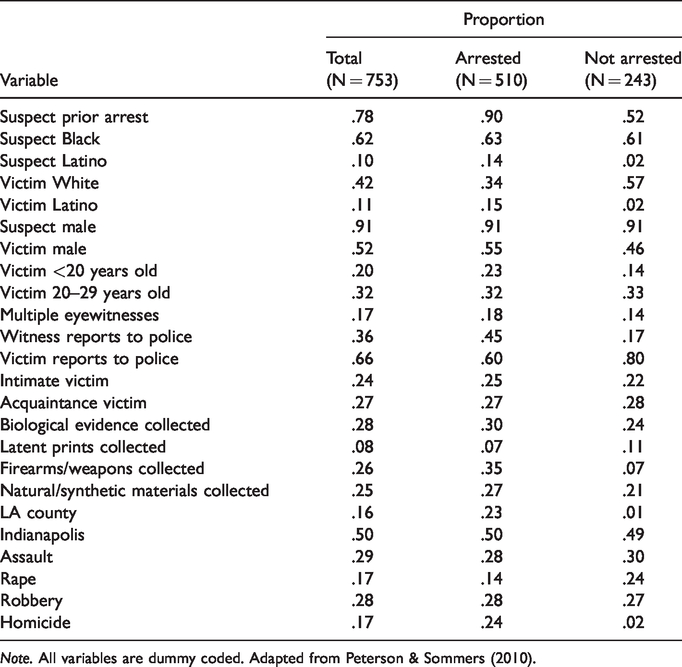
Several other variables were included in the analyses as control variables. These variables help us to avoid basing any conclusions derived from the findings generated here on spurious or suppressed relationships. One group of control variables relate to the demographic characteristics of the primary crime victim. 2 These variables include race, ethnicity, sex, age, and the relationship of the victim to the offender. The second group of control variables pertains to witnesses of the crime. These variables encompass whether the crime victim was able to report the crime to authorities, whether there were witness reports, and whether there were multiple eyewitnesses to the crime. The third group of control variables reflects the types of physical evidence collected in each case. Physical evidence was measured by a series of dummy-coded variables representing four categories of physical evidence collected at the crime scene, including biological evidence, latent prints, firearms/weapons, and natural/synthetic materials. Several studies find that the presence of physical evidence against a criminal defendant is strongly predictive of arrest (Hepburn, 1978; Petersilia, 1983; Tasca et al., 2013). Finally, we incorporated dummy coded variables in the analysis to account for offense type and whether the crime occurred in Los Angeles County, Indianapolis, or in three other Indiana jurisdictions (Evansville, Fort Wayne, and South Bend). Table 1 furnishes a description of the variables used in this study.
Description of Variables Included in the Study.
Note. All variables are dummy coded. Adapted from Peterson & Sommers (2010).
Logistic Regression Analysis
We begin our analysis by examining the bivariate relationship between a suspect’s prior criminal record and the likelihood of arrest. The labeling hypothesis predicts that criminal suspects with a prior criminal record will have an amplified chance of being subjected to the arrest sanction. Results revealed that there is a consequential association between prior criminal record and arrest, as 90% of suspects with a prior record were arrested as compared to 52% of suspects without a prior record (r = .428, p < .001). This bivariate relationship is interesting because it bolsters the argument that repeat offenders carry a social stigma that triggers a perception of their guilt by law enforcement officers.
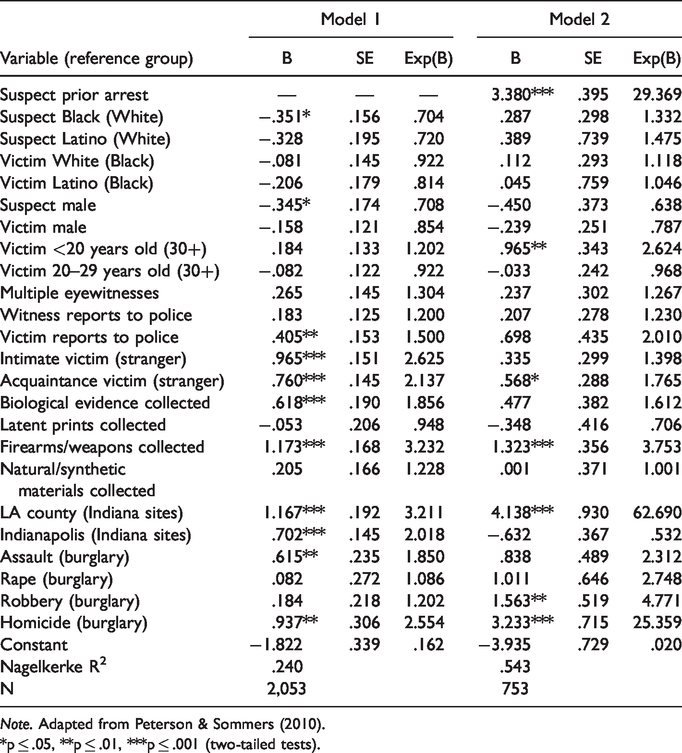
Logistic regression was next employed to determine whether the race of a criminal suspect influences the probability of arrest independently of other factors. Logistic regression is suitable for analyzing a dichotomous dependent variable and allows for the use of both categorical and continuous independent variables. Model 1 in Table 2 reports the results for the baseline equation. The suspect’s prior criminal record was excluded from this equation to better mirror previous studies that investigated the effect of a suspect’s race on the arrest sanction. Results for this model show that a suspect’s race is a noteworthy predictor of arrest but in the negative direction. White suspects are 30% more likely than Black suspects to be arrested by police. 3
Logistic Regression Model Estimating the Likelihood of Arrest.
Note. Adapted from Peterson & Sommers (2010).
*p ≤ .05, **p ≤ .01, ***p ≤ .001 (two-tailed tests).
Surveys consistently show that Black citizens have much less confidence and trust in law enforcement than Whites. For example, findings from a Pew Research Center survey showed that Black citizens are only half as likely as Whites to have a favorable view of local police (Morin & Stepler, 2016). Only 33% of Black respondents reported that the police “do a good job” patrolling their neighborhood as compared to nearly 75% of Whites. In addition to expressing dissatisfaction with police, Blacks are also more likely than Whites to report feelings of injustice (MacDonald & Stokes, 2006), to perceive that they have been victims of racial profiling (MacDonald et al., 2007), and to believe that they have been the targets of excessive use of police force (Flanagan & Vaughn, 1996). These negative feelings and distrust of the police can lessen the likelihood that Black citizens will provide police with assistance in solving crimes (Futterman et al., 2017), which can, in turn, lower the likelihood of arrest for Black criminal suspects because most crime is intraracial rather than interracial (Morgan & Oudekerk, 2019).
Next, the suspect’s prior arrest record variable was added to the model (see Model 2 of Table 2). As initially speculated, the results depicted in Model 2 show that a suspect’s prior record is by far the most salient predictor of arrest. A suspect with a prior criminal record is 29 times more likely than a suspect without a prior record to be arrested by police. The Nagelkerke R2 for the equation is .543. In contrast, the identical equation excluding the prior record variable yielded a Nagelkerke R2 of only .240.
In contrast to Model 1, there also fails to be a discernible relationship between a suspect’s race and the likelihood of arrest once prior record was added to the model. White suspects are no more likely than Black suspects to be arrested by police. This null finding can be interpreted as buttressing the argument that any observed relationship between a criminal suspect’s race and the likelihood of arrest without controlling for the suspect’s prior criminal history may be spurious due to omitted variable bias.
In addition to prior record, several of the control variables are of substantive importance in Model 2. Suspects who victimize younger individuals (less than 20) are 2.6 times more likely to be arrested than suspects who harm older victims (30+). Crimes involving acquaintances are 1.8 times more apt to result in an arrest than offenses perpetrated by strangers. One physical evidence variable also has a discernible effect on arrest. The securing of firearms and other weapons by authorities elevates the odds of arrest by 275%. Crimes are also more apt to be cleared by an arrest in Los Angeles County, as opposed to the four jurisdictions located in the state of Indiana. Visual inspection of Model 2 also reveals that robberies and homicides are significantly more likely to be cleared by arrest when compared to burglaries. An examination of the Variance Inflation Factors (VIF) for all the variables used in Model 2 indicated that multicollinearity had a little adverse impact on our results.
Because all the offense categories were combined in Model 2 of Table 2 to increase sample size, we still felt it useful to construct a figure showing the relationship between prior record and the likelihood of arrest for each specific crime type. Figure 1 depicts the visually striking effect that a suspect’s prior record has on the probability of arrest for four of the five crime types. Only for the crime of homicide, where nearly all the reported homicides culminated in an arrest, did a suspect’s prior record have little effect on the use of arrest.
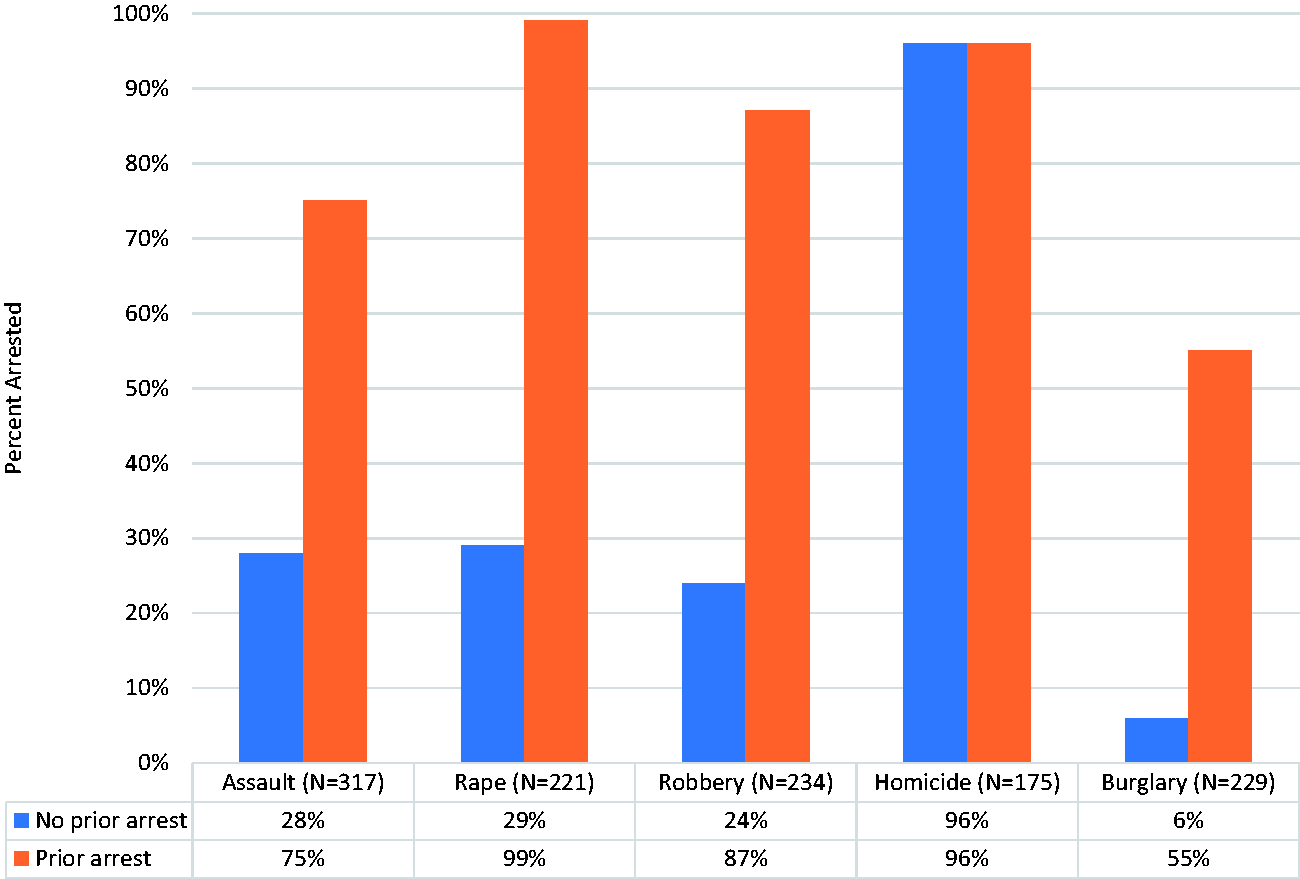
Percent of Suspects Arrested by Prior Arrest Record and Offense Category. Adapted from Peterson & Sommers (2010).
While the logistic regression analyses presented in Table 2 demonstrate that having a prior criminal record amplifies the probability of arrest and that a suspect’s race has little independent effect on the use of the arrest sanction once prior record is taken into account, we felt it warranted to examine whether a suspect’s prior record interacts with his or her race in determining the likelihood of arrest. The finding of such an effect would suggest support for stereotype influence. The most straightforward method for detecting such an interaction effect is to add a product term (Black suspect × prior arrest) to the model. Model 1 of Table 3 shows that the coefficient for the interaction term, which represents a multiple dimension of social stigma, is inconsequential and fails to produce a noteworthy increase in the accuracy of the model predicting the probability of arrest. Black suspects possessing a criminal record do not have an elevated prospect of being arrested by police. The Nagelkerke R2 for this model is .544, which is a slight improvement in model fit from the results without the interaction term.
Logistic Regression Model Estimating the Likelihood of Arrest with Interaction Effects.

Note. Adapted from Peterson & Sommers (2010).
*p < .05, **p ≤ .01, ***p ≤ .001 (two-tailed tests).
We also added a three-way interaction term to the model (Black suspect × prior arrest × White victim). Results for this analysis, which are presented in Model 2 of Table 3, show that Black suspects with a prior arrest record who commit crimes against Whites are almost three times more likely to be arrested by police than are other suspects. However, the model, including the three-way interaction term, only slightly improves on the fit of the two-way interaction model (Nagelkerke R2 = .548).
Supplemental Analyses
We conducted two supplemental analyses to ensure that our original findings remained robust across different specifications. First, we felt it prudent to determine whether our results would vary depending on the measure of prior criminal record used. Although the frequency of prior arrests and frequency of prior convictions are highly correlated (Pearson’s r = .802), we reran the analysis using prior conviction (dummy-coded) as our variable of theoretical interest. The results for this analysis were nearly identical to those reported in Model 2 of Table 2 (b = 3.164, p < .001). Nevertheless, while both variables are measuring the same concept, we still believe that the suspect’s prior arrest record is the more relevant variable when modeling the arrest decision.
Second, we incorporated into the analysis dummy controls for the three relevant independent variables with missing data. These variables included the suspect’s prior criminal arrest record, the race of the suspect, and the race of the victim. Since the same cases are missing for suspect Latino and victim Latino, incorporating dummy controls for these variables would be redundant. The missing data variables were created following the method suggested by Cohen and Cohen (1983). This procedure assumes that if values on an independent variable are missing randomly, then the mean of the dependent variable for cases with missing values will be similar to the mean of valid cases. For each variable with missing data, we created a corresponding dummy variable that identified the missing cases (1 = missing, 0 = observed). We then recoded missing values on the variable to the mean of that variable so that the variable would not be discarded from the analysis. Although this procedure resulted in nearly identical findings for prior arrest (b = 2.851, P < .001) and for Black suspect (b = −.065, P > .05), the strength and direction of the coefficients for indicator variables representing prior arrest (b = −2.556, P < .001) and victim race (b = .395, P = .014) furnish some additional support for the view that prior criminal record is more relevant than race in predicting the arrest outcome.
Conclusion
We proffered the thesis here that the negative stigma associated with a prior criminal record may independently act to inflate the likelihood of arrest. The foregoing logistic regression results support this reasoning and reveal that a criminal suspect with a prior record is substantially more apt than a suspect without a criminal record to be arrested by police. One can only surmise that this robust effect is due to the strong belief among police officers that criminal suspects with a prior record are criminally predisposed, notwithstanding whether they are guilty of the current offense that is being investigated. This finding has noteworthy theoretical implications for developing a better understanding of chronic offending.
Many criminological theories proffer explanations for why some individuals frequently participate in criminal activities over the life-course. Life-course theories generally emphasize differences in the social experiences and circumstances of individuals, as well as on dissimilarities in relevant personal and social resources that are related to criminality and that vary systematically over the life-course. Changes in criminal behavior patterns are speculated to transpire as a person progresses from childhood through old age with him or her undergoing a variety of significant life-altering experiences such as full-time employment, military service, marriage, parenthood, and entering college. Some suggest that these transitional experiences facilitate desistance from crime because of increased exposure to social capital. Others maintain that a criminal subtype with a propensity to partake in illegal activities exists in the population. One commonality that permeates all of the diverse life-course perspectives in explaining criminal behavior is that they accept without question that criminal conduct on the part of the individual did occur.
Drawing from these types of theories, numerous studies have analyzed official arrest data or self-report arrest data to identify the specific biological, psychological, and or social variables predictive of repeat offending. Many of these research endeavors also furnish evidence for the existence of a small group of high rate criminal offenders in the general population. However, based on the results generated in this study, it seems probable that many of these high rate offenders are being arrested repeatedly not only because of their illicit conduct but also because of the negative stigma associated with their prior criminal activities. If true, this situation would result in an overestimation of the amount of repeat offending occurring in society because the probability of arrest would naturally be higher for people with a prior criminal record. This issue of statistical dependency, whereby one arrest engenders additional future arrests, can complicate statistical analyses and needs to be addressed directly by researchers in future empirical studies. However, despite this recommendation, the practical problems associated with obtaining information on the prior criminal record of suspects during their interactions with police will be a difficult hurdle for most to overcome.
Our results also reveal little evidence of systematic racial bias in the arrest decision after prior criminal record is considered. While a central aspect of the racial bias thesis is that some police officers are not race-neutral in the performance of their law enforcement duties and that this racial animus ultimately contributes to the high arrest rate of Black citizens in society, our results show that Black suspects are no more likely than White suspects to be subjected to arrest. Black suspects with a prior criminal history also fail to have an elevated likelihood of arrest unless they target White victims. However, this relationship is relatively weak because the inclusion of the three-way interaction variable does not substantially improve the fit of the model. A person’s prior criminal record thus appears to supersede racial stereotypes in explaining arrest decisions. Having a criminal record is probably more salient than race in predicting the use of the arrest sanction because it signals something about the dangerousness of the person in a manner consistent with currently held beliefs (Steen et al., 2005). Thus, while a suspect’s race may sometimes affect the decision to arrest, a suspect’s prior criminal history engenders a more considerable influence because it is cognitively and practically linked to perceptions, beliefs, and assessments regarding existing and future criminal threats.
The noteworthy effect of prior record coupled with the weak influence of race leads us to believe that the impact of a criminal suspect’s race on the likelihood of arrest may have been exaggerated in previous studies because of omitted variable bias. When one considers the correlation between race and prior record, it seems likely that racial disparity in the use of the arrest sanction noted in many previous studies that failed to control for a suspect’s prior criminal record is probably due to racial differences in prior criminal history rather than to racial bias.
Our findings regarding the effect of prior criminal record on the likelihood of arrest are not that surprising when one recognizes that considerable social stigma results from an individual being labeled as a criminal in our society (Jacobs, 2015). Research readily shows that a criminal label hinders prospects for employment (Pager, 2007), delays the onset of marriage (Huebner, 2005), attenuates the probability of being admitted to a university (Pierce et al., 2014), hampers the likelihood of securing of rental housing (Leasure & Martin, 2017), impedes the ability to vote (White, 2019), and manifests harmful health outcomes (Massoglia & Remster, 2019). Various family and environmental factors attributable to parental convictions and independent of self-reported offending, such as an erratic parental job record, poor housing, poor parental child-rearing (Farrington, 1979), and coming from a low-income family (Farrington, 2001), can also have a salient influence on the future criminal behavior of a youth. A parent possessing a criminal record has been shown to exert a direct influence over whether a child will grow up to have a criminal record through the official labeling process because once a parent becomes labeled through the system, more formal attention is given to their families by social control agents (Besemer et al., 2017). This heightened attention elevates the likelihood that the children of parents with a criminal record will be subjected to more formal state interventions compared to other equally problematic youth.
Besides suggesting that prior research has probably exaggerated the amount of repeat offending in society, our findings regarding the saliency of prior record on arrests may also help to shed light on the inconsistent effect of the incarceration rate on the crime rate and on the high false-positive rate of risk assessment instruments. The policy implications associated with repeat offending has led to the implementation of mandatory sentencing practices such as three-strikes laws and habitual offender statutes across the country in a fiscally responsible effort to attenuate crime. The focus on incapacitation and the correspondingly long prison sentences as a policy objective is deemed warranted because of a valid concern for public safety. The rationale underlying these types of policy initiatives is that a substantial reduction in crime can be actualized if society can incapacitate the relatively small number of high-frequency criminal offenders operating in the population.
However, research on the effect of the incarceration rate on the crime rate is inconclusive. Some studies find that a high incarceration rate reduces crime (Spelman, 2000), while others fail to find a salient effect (Sundt et al., 2016). There are a variety of explanations for these incongruous findings. These explanations include statistical/methodological problems (National Academy of Sciences, 2014), co-offending issues (Andresen & Felson, 2009), the escalation in criminal activity once a prison inmate is released back into society (Pritikin, 2008), and the possibility of offender replacement due to incarceration (Przybylski, 2009). The findings generated in this study suggest a plausible alternative explanation. Maybe the estimated amount of crime committed by repeat offenders, which forms the basis of mandatory sentencing laws, has been overestimated in previous research. If repeat offenders are responsible for a smaller proportion of crime than previously theorized, then sentencing laws based to a large degree on the severity of an offender’s criminal record would be less effective than anticipated.
Our findings regarding the saliency of prior record on the use of the arrest sanction may also provide some insight as to why the false-positive rate of risk assessment instruments, which typically include an individual’s prior criminal history score, is unacceptably high (Campbell et al., 2009; Hanson & Morton-Bourgon, 2009). When relying on a policy of incapacitation, which is foundationally rooted in the assumption of the state’s ability to anticipate future offending, criminal justice actors often depend on various risk assessment tools to help ameliorate their decisions at various stages of the criminal justice system. It is believed that these assessment instruments can accurately identify criminal offenders who pose a continuing threat to society. Recognizing the need of this belief being verified empirically, social scientists have sought to vet the performance of various risk assessments used by clinicians and criminal justice decision-makers. However, these research endeavors typically find that risk assessments have only limited value in prognosticating the likelihood of repeat offending (Fazel et al., 2012). Given the results produced in this study, one can reasonably argue that the inclusion of prior criminal history in nearly all risk assessment tools used today may be responsible for some of the inaccuracy as prior behavior does predict future behavior but not in an absolute way.
Over 55 years ago, Becker (1963) highlighted how social stigma is spawned from an individual being labeled as a criminal in our society. He argued rather adroitly that a criminal label generates a harmful social reaction among the population and that individuals possessing such a label tend to face heightened scrutiny by social control agents that can increase the discovery of their illegal activities. However, social control agents may not only be more adept at discovering illegal activities by more closely monitoring people labeled as being criminal, but our findings appear to show that a police officer’s decision to arrest a criminal suspect is being impacted to a large degree by the negative stigma associated with his or her criminal record.
Yet, despite our findings, certain caveats must be contemplated. First, a weighting variable was not available to adjust the sample to mirror the true population of reported crime incidents in the study sites. While our inability to weight the data may have influenced our results, research does find that in many instances demographic weighting only minimally attenuates selection bias (Gittelman et al., 2015; Yeager et al., 2011). Second, substantial data are missing on the prior record and race/ethnicity variables. These variables also appear to be differentially missing among the various study sites. For example, Los Angeles County has much more missing data than other jurisdictions. However, our inclusion of indicator variables to help account for the missing data along with mean substitution in our supplemental analysis produced nearly identical results. Third, it is important to recognize that case outcomes exist within varying site-specific organizational structures. Relevant factors such as sentencing guidelines, police culture, and prosecutorial attitudes toward various crimes, among others, may vary across sites but not within a site. Thus, contextual analyses are needed because it is plausible that the effect of prior criminal record on arrest may differ to some degree across social contexts.
This study represents an incremental step in the broad and complex task of furthering the empirical literature on police officer decision making by showing a strong relationship between a suspect’s prior criminal record and the likelihood of arrest. The potential existence of such a relationship will surely be a topic of extreme interest to social scientists and the public alike. There are many directions for future work, chiefly the gathering of more complete data on the prior record of criminal suspects during their interactions with police. It is hoped that this study inspires not only additional research on the use of arrest but also theoretical work on labeling theory for a richer understanding of why a suspect’s prior criminal record plays such a salient role in predicting the likelihood of arrest.
Footnotes
Declaration of Conflicting Interests
The authors declared no potential conflicts of interest with respect to the research, authorship, and/or publication of this article.
Funding
The authors received no financial support for the research, authorship, and/or publication of this article.
