



Abstract
Despite calls for police reform that include changes to use of force training and field supervision, evidence regarding their impact is sorely lacking. This study examines survey data collected from first-line supervisors in the Louisville (KY) Metro Police Department after department-wide de-escalation training. Presented as part of a larger randomized controlled trial study, descriptive results from this survey demonstrate that, despite high levels of reported confidence in supervisory ability, supervisors infrequently engage in the activities that support and reinforce subordinates’ use of de-escalation skills. Results from multivariate ordinary least squares (OLS) linear regression models further show that only supervisors’ receptivity to de-escalation training is a significant predictor of engaging in activities that support the training tenets for subordinates. Combined with previous findings, the emerging research and policy implications suggest that training receptivity is critical, and further, that field supervision continues to be an under-utilized mechanism to reduce police use of force.
Introduction
Despite continued improvements in policing effectiveness and reductions in crime over the past 20 years, policing officials face increased scrutiny and debate about their role in providing public safety and enforcing the law. Indeed, the level of trust and confidence in the police has recently reached a modern-day low, where only 48% of Americans indicated they felt confidence in the police—the first time this percentage has fallen below the majority level (Brenan, 2020). The core issues surrounding this distrust concern disparate outcomes in policing, particularly around police use of force and its perceived legitimacy amongst citizens. Calls for reducing police use of force through changes in legislation, policies, and training have become a rallying cry and championed by community advocates and policymakers (Crampton, 2021).
A considerable body of research has been amassed over the last 60 years examining police use of force. Highlighting force as a defining role of law enforcement officers (see, e.g., Bittner, 1974; Fyfe, 1988), this research explores variations in definitions, measurement, prevalence, and predictors of when and how police use force. police force is used. Research consistently demonstrates that both the law and police administrative policies can strongly impact the frequency and severity of use of force (e.g., see Black, 1976; Fyfe, 1982; Prewitt, 2021; Shjarback & Maguire, 2021; Terrill & Mastrofski, 2002). However, what has received less empirical attention is the impact of training and field supervision on police use of force. Although routinely suggested as police reform measures, the evidence regarding the impact of changes to both training and supervision on the frequency, severity, and racial disparities in use of force is exceptionally thin (Engel, 2000; Lum et al., 2016). This gap in research is especially notable given the recent widespread calls for changes in police use of force policies, training, and organizational practices to incorporate (and in some cases mandate) the use of de-escalation (e.g., Council on Criminal Justice, 2021a; President’s Task Force on 21st Century Policing, 2015).
To fill this void, we examine the attitudes and behaviors of first-line supervisors within the Louisville (KY) Metro Police Department (LMPD) after the implementation of de-escalation training. Specifically, using survey data collected in the months following the 2019 department-wide training of LMPD Officers using the Integrating Communications, Assessment, and Tactics, or ICAT (pronounced “I-cat”) training, this study explores supervisors’ self-reported confidence in supervising the use of de-escalation skills by their subordinate officers and the frequency in which they participate in supervisory activities to support subordinates’ use of de-escalation tactics in the field. Variation in supervisors’ confidence and participation is examined through multivariate ordinary least squares (OLS) regression models considering supervisors’ employment and demographic characteristics, professional orientation (i.e., enforcement-oriented, community-oriented), and receptivity to de-escalation training.
We begin with an overview of prior research examining the impact of de-escalation training and the influence of field supervisors on officers’ uses of force. This discussion is followed by a description of the study setting, methods, sample, and analytic plan. The findings are presented across two stages. First, descriptive analyses of the measures of interest are presented, followed by multivariate regression findings examining variations across supervisors. We find that, although LMPD field supervisors express confidence in their ability to supervise their subordinate officers’ use of de-escalation skills, they self-report a rather low frequency of participation in supervisory activities that serve to support or reinforce officers’ use of those skills. Furthermore, results from the multivariate statistical models suggest that supervisors’ demographic characteristics and experience are less important in predicting their confidence and participation in supervisory activities than their own reported receptivity to de-escalation training. Combined with previous findings regarding the impact of first-line supervisors and de-escalation training, important research and policy implications emerge, reinforcing field supervision as a critical part of a holistic approach to reduce the frequency and severity of police use of force.
Literature Review
Examining the literature reveals that how, when, and why police officers use force in their encounters with resistant citizens is typically affected by four primary factors: the law, administrative policies, training, and supervision. Of these four factors, the role of the law and administrative policies have a rich history in both legal and policing research, demonstrating significant impact over the frequency, severity, and disparity associated with police use of force (for review, see Smith, this issue). However, the two remaining factors (training and supervision) have received less empirical attention; the limited evidence available is described below.
Impact of De-escalation Training on Use of Force
Despite widespread support from policymakers, community members, and experts, little is known about the effectiveness of de-escalation training on officers’ attitudes and behaviors in the field (Engel, McManus, & Herold, 2020b; Engel, McManus, & Isaza, 2020c). Even the term “de-escalation” lacks an agreed-upon definition in the policing field (Engel, McManus, & Herold, 2020b; Todak & James, 2018), and some law enforcement officials avoid the use of the term altogether (McFarlin, 2017). Advocates contend that de-escalation training provides officers with better skills to resolve conflicts with citizens in a safer manner (Olivia et al., 2010). However, critics of de-escalation are concerned that the training contains tactics that contradict traditionally taught police operations and may cause officers to hesitate during critical incidents, making them susceptible to attack and increasing the risk of injury for officers and citizens involved in the altercation, along with bystanders (Blake, 2017; Jackman, 2016). Similar to other police training, de-escalation has not been the subject of substantial empirical evaluation (Lum et al., 2016; National Research Council, 2004). Due to the lack of research, it remains unclear if de-escalation training (and the use of de-escalation tactics in the field) may increase or decrease the risk of injuries to officers and citizens.
Highlighting this gap in knowledge, a multidisciplinary systematic review of de-escalation training evaluations showed that although a limited number of de-escalation trainings were evaluated across professions (N = 64), most studies appeared in the fields of nursing and psychiatry; no evaluations were conducted with police or other criminal justice actors for the time period (pre-2017) examined (Engel, McManus, & Herold, 2020b). Fortunately, examinations of de-escalation trainings are now emerging in the policing literature. Although variation in the training under evaluation and the context in which it’s implemented challenge generalizations of the findings, these evaluations provide some initial evidence of the impact of de-escalation training on officers’ attitudes and behaviors.
In one of the first studies conducted, Giacomantonio et al. (2019) examined the impacts of Verbal Judo training on de-escalation-related behaviors during videotaped simulation practice, finding that 5 of 15 coded behaviors reinforced by the training were significantly impacted; although researchers noted that these behaviors were minor changes (e.g., identifying oneself and explaining the reason for stop). In addition, research examining the impact of Polis Solutions’ Tact, Tactics, and Trust (T3) training in two police departments (Fayetteville, NC, and Tucson, AZ) showed that, although officers’ attitudes improved, there were no discernable changes in actual officer behavior in the field (McLean et al., 2020). Similarly, a randomized controlled trial (RCT) evaluation of a customized de-escalation training for the Tempe (AZ) Police Department revealed that, in comparison to untrained officers, trained officers placed greater emphasis on compromising with citizens and reported using more de-escalation tactics based on compromise, maintaining officer safety, and knowing when to disengage (White, 2021; White et al., 2021a). While initial findings showed no detectable reductions in use of force corresponding directly to the training, more recent analyses of body worn camera footage identifed differences in officers’ behavior other than use of force (e.g., trained officers were less likely to use a condescending tone and charged body language during encounters with the public, compared to untrained officers) (White et al., 2021b).
Recently, Goh (2021) examined the impact of ICAT training within the Camden County Police Department (CCPD), New Jersey, on serious use of force incidents. Using a quasi-experimental synthetic control design, Goh did not find that ICAT training impacted serious use of force incidents at the officer level. At the department level, however, Goh observed an overall reduction (40% decline) in use of force during the study period that was not replicated across other New Jersey departments or synthetic controls. Although this study suggests some possibly favorable effects of ICAT training, the strength of conclusions are limited due to the study design. It could not be discerned if the continuation of the downward trend in use of force (experienced before the ICAT training) was the result of ICAT training or the other major police reforms simultaneously implemented in this agency.
One of the largest studies examining de-escalation training effects employed a stepped-wedge randomized control trial (RCT) and repeated measures survey designs to assess the effectiveness of ICAT training implemented by the Louisville Metro Police Department (LMPD) to 1,049 officers of all ranks and assignments in 2019 (Engel, Corsaro, et al., 2020a; Engel et al., In Press). An initial agency report documented the impact of ICAT training on changes to officers’ and supervisors’ attitudes and self-reported behavior. Among other findings, the study demonstrates (1) a vast majority of officers (80%) have positive perceptions and receptivity of training; (2) a majority of officers (>60–70%) self-reported use of de-escalation tactics in the field; (3) significant and positive changes in officers’ and supervisors’ attitudes related to interactions with the public, persons in crisis, and use of force; and importantly; (4) significant reductions in police use of force (−28%); citizen injuries (−26%); and officer injuries (−36%) directly associated with the ICAT training (Engel et al., In Press).
In a companion report, analyses examined the factors that predicted officers’ receptivity to ICAT training, changes in their attitudes, and self-reported use of de-escalation tactics (Engel et al., 2021). These findings demonstrated variation in receptivity to ICAT training based on officers’ demographics (e.g., female and Black officers were more receptive to de-escalation training compared to male and White officers). Further analyses show that officers reporting the most receptivity to ICAT training had a 49.5% probability of self-reporting the use of de-escalation tactics/skills during their most recent encounter with a person in crisis, compared to a 4.5% probability for the least receptive officers (Engel et al., 2021). Follow-up analyses also highlighted the importance of first-line supervisors in supporting the training tenets. Specifically, officers’ perceived support for ICAT from command staff and immediate supervisors was associated with more favorable attitudes toward training. Collectively, these results highlight the vital role that first-line supervisors play in reinforcing the use of de-escalation tactics in the field.
Impact of First-Line Supervisors on Police Use of Force
Many have noted the importance of first-line supervisors in the communication and reinforcement of expectations related to use of force among officers (Haas et al., 2015). The available research examining supervisors’ influence on officers’ use of force, however, is strikingly limited (Van Craen & Skogan, 2017). Still, there are several organizational and empirical reasons to suggest that first-line supervisors play a key role in the implementation and sustainability of use of force and de-escalation policies, training, and practices within an agency.
A recent assessment determined that first-line supervisors directly supervise 85% of agency personnel (Police Executive Research Forum, 2018). Although the specific responsibilities of first-line supervisors might vary across agencies, they are critical for communicating and reinforcing changes in operations and policies to line officers (McManus et al., 2018). From an administrative standpoint, first-line supervisors provide a critical level of accountability, engaging in frequent interactions with their subordinate officers that provide opportunities to influence officers’ attitudes and behaviors (Alpert & MacDonald, 2001; Brown, 1988; Manning, 1977; Police Executive Research Forum, 2018). From a use of force perspective, first-line supervisors are often called to respond to potentially critical incidents. They play an essential role in managing force incidents, promoting teamwork, designating roles for responding officers, and documentation (Police Executive Research Forum, 2018).
Research highlights the significant effect first-line supervisors can also have on the attitudes and behaviors of their subordinate officers. For example, in an early examination of the impact of supervisors and their “supervisory style” on subordinate officers’ behavior, Engel (2003) found that police supervisors who are more active in the field and essentially “lead by example” had the greatest impact on subordinates’ behavior, compared to three other supervisory styles (categorized as traditional, innovative, and supportive). Notably, active supervisors were more likely to be involved in use of force incidents themselves, compared to their peers with other supervisory styles (Engel, 2001). This behavior was mirrored in their subordinate officers, who were shown to be more likely to use force than their peer officers under non-active supervisors (Engel, 2001). Companion research demonstrated that subordinate officers often engaged in behavior they believed their supervisors prioritized, but supervisors’ expectations were often miscommunicated (Engel & Worden, 2003). Correlations between officers’ and supervisors’ activities have been observed across other behaviors, including integrity violations, citations issues, and work avoidance (Huberts et al., 2007; Johnson, 2006; Johnson, 2011).
In a more recent study, Ingram et al. (2014) found that sergeants had an impact on how officers viewed agency use of force policy. Specifically, officers supervised by “supportive” sergeants were more likely to believe their agency’s policies were clear, fair, and provided guidance. However, the research team found that if sergeants favored more force or viewed upper management negatively, officers held more negative attitudes towards use of force policies (Ingram et al., 2014). Similarly, in their survey assessment of officers’ support for their organizations’ rules regarding the use of force, Van Craen and Skogan (2017) found that supervisor modeling affects officers’ views. Fair supervision, they found, fostered officers’ support for restraint in the use of force through officers’ greater moral alignment with citizens and trust in the general public (Van Craen & Skogan, 2017).
Collectively, these findings demonstrate that first-line supervisors have the capacity to influence subordinates’ views regarding their work duties generally—and use of force policies and practices specifically—in both positive and negative ways. This is critical, as research demonstrates that fair supervision can increase officers’ compliance with organizational policies and supervision (Bradford et al., 2014; Tyler et al., 2007); further, officers’ readiness to comply with supervisors and departmental policies is associated with reductions in excessive force (Haas et al., 2015; Tyler et al., 2007). As such, the available evidence suggests that supervisors may effectively influence use of force priorities among officers; however, examinations of priorities for using de-escalation skills specifically have not been conducted.
Methods
Recognizing the gap in research examining the impact of first-line supervisors on the use of de-escalation tactics to reduce the frequency and severity of use of force, this study advances the initial findings reported from a large RCT examination of the impact of ICAT training with the LMPD. 1 Based on personnel records from January 2019, the LMPD (a city-county law enforcement agency consolidated in 2003) is comprised of 1,245 sworn officers and 325 civilian personnel. The agency is organized into three bureaus (administration, support, and patrol), encompassing the LMPD’s eight patrol divisions and other specialized and support units. There are approximately 800 officers assigned to patrol, and the LMPD is responsible for roughly 400 square miles of territory. Using the borders of Jefferson County, Louisville is the largest city in the State of Kentucky, with roughly 620,000 residents, representing over 15% of the state population. Based on 2010 Census figures, Louisville Metro’s residential population is 69.9% White; 23.5% Black; 2.7% Asian; 5.4% Hispanic; and 3.0% other. The percentage of women is 51.6%, foreign-born citizens are 7.4%, and the median age is 37.2 years (U.S. Census, 2021).
The ICAT training, initially developed by the Police Executive Research Forum and subsequently implemented in the LMPD, aims to “provide first responding police officers with the tools, skills, and options they need to successfully and safely defuse a range of critical incidents” (Police Executive Research Forum, 2016). The curriculum is specially designed for situations involving individuals in crisis who are unarmed or armed with less than a firearm. It is estimated that these types of situations account for over 40% of all fatal police shootings (Sherman, 2018; Zimring, 2017). Adopted by hundreds of departments across the country, the ICAT training program aims to develop critical thinking, situational awareness, and informed assessment. In the LMPD, the 16-hour ICAT training was implemented following a pre-determined training scheduled that adhered to a stepped-wedge RCT design (see Engel et al., In Press for details). From February through November 2019, LMPD trained 1049 officers of all ranks and assignments, with 40–50 officers in each session.
To examine the impact of training on LMPD officers’ knowledge and attitudes, three surveys (pre-training, post-training, and follow-up) were administered to officers immediately before, immediately after, and approximately four to 6 months following officers’ participation in the ICAT training (see Engel, Corsaro, et al., 2020a; Engel et al., 2021). The pre-and post-training surveys were administered in paper form, collected by LMPD Training Division staff, placed in a sealed collection box, and retrieved by the research team. All officers and supervisors assigned to a patrol division were administered a follow-up survey electronically via PowerDMS software (LMPD’s internal system). To supplement the evaluation of the ICAT training program, LMPD supervising officers (i.e., sergeants and lieutenants) were also administered a paper survey in March 2020, designed to assess their general perceptions of the role of supervisors, and more specifically, their views regarding how and when they supervise and/or reinforce the training. To administer the supervisor survey, the LMPD Training Division took advantage of a mandatory attendance event for supervisors for an unrelated inspection (i.e., annual gas mask fit testing). All survey responses were entered into an electronic database by the research team, and a unique identifier (i.e., badge number) for each officer allowed survey responses to be linked across measurement waves (i.e., pre-, post-, follow-up, and supervisor-only surveys).
Overall, officer surveys had high response rates across waves of measurement. The pre-and post-training surveys were administered to all LMPD officers of varying ranks and assignments who participated in the ICAT training (N = 1,049). Of these officers, 907 pre-training (86% response rate) and 1,049 post-training surveys (100% response rate) were returned to the research team. Within this group, 172 supervisors completed pre-training surveys, and 199 completed post-training surveys. The field supervisor-specific survey was administered in March 2020 to sergeants and lieutenants only. Of the 157 patrol supervisor surveys administered, 131 (83% response rate) were completed. 2
The analyses conducted in this study are divided into two parts. First, descriptive analyses are provided on the full sample of supervisors (i.e., sergeants and lieutenants) who responded to the supervisor-only survey administered in March 2020. Here we report the distribution of valid responses from supervisors regarding their perceptions of supervising ICAT skills (n = 125) and the frequency with which they engage in specific actions designed to support and reinforce ICAT training (n = 122). 3 Second, multivariate analyses are provided on the sample of supervisors that a) responded to all items of interest on the supervisor-only survey, b) responded to items of interest on both the pre-training and post-training surveys administered to all officers trained in ICAT, c) could be matched across all three survey waves, and d) could be matched with LMPD personnel data—resulting in a sample of n = 88 sergeants and lieutenants. Here we examine the factors that predict supervisors’ self-reported skill for supporting de-escalation, self-reported frequency of supervisory activities to support ICAT training in the field, and supervisors’ receptivity to ICAT training.
Descriptive Analyses
Two dependent variables are drawn from this survey: (1) perceptions of supervising ICAT skills and (2) self-reported frequency of ICAT supervision activities. To date, no other surveys have examined supervisor confidence or activities related to the supervision of de-escalation training in the field. Thus, this section presents the descriptive analysis of these two variables to provide integral baseline measures on the general frequencies of these items.
Perceptions of supervising ICAT skills
Distributions for Responses to Individual Items Used for Dependent Variables.
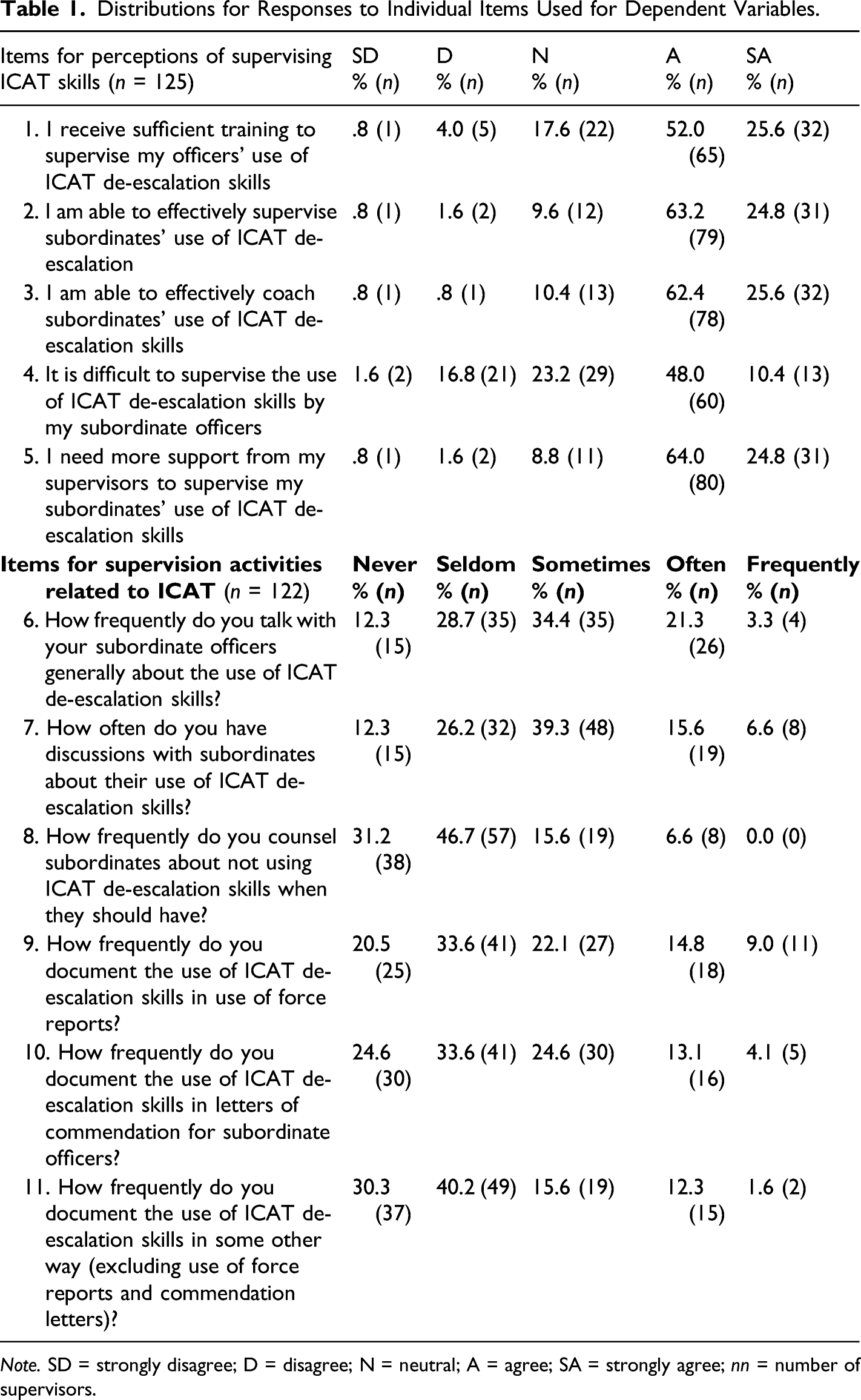
Note. SD = strongly disagree; D = disagree; N = neutral; A = agree; SA = strongly agree; nn = number of supervisors.
Self-reported ICAT supervision activities
In the supervisor survey, first-line supervisors reported their frequency of engaging in six different activities that support the use of ICAT de-escalation skills by subordinate officers. The specific statements and descriptive statistics for each of these individual items are displayed in Table 1. For each activity, supervisors indicated their frequency of engaging in each activity, where 0 = Never; 1 = Seldom (1 per month); 2 = Sometimes (2–3 times per month); 3 = Often (1 per week); 4 = Frequently (more than 2–3 times per week).
While supervisors generally reported positive perceptions of their ability to supervise ICAT de-escalation skills (see Item 2 in Table 1), their self-reported frequency of supervisor activities presents a different story. Of the six activities presented in Table 1, the average frequency of LMPD supervisors’ participation is quite low. Specifically, only 25% of supervisors report talking with their officers about the use of de-escalation skills often or frequently; instead, 41% reported they never or seldom spoke generally with their subordinates about these skills. Similarly, only 22% of supervisors report that they often or frequently discuss the use of ICAT de-escalation skills in a specific incident (compared to 39% reporting never or seldom), and almost no officers (7%) report often or frequently counseling subordinates about not using ICAT skills when they should have (compared to 78% reporting never or seldom). Further, when it comes to documenting the use of ICAT de-escalation skills through a variety of methods (i.e., use of force reports, letters of commendations, or other ways), the majority of officers responded that they either never or seldom (1 per month) do such activities. Table 1 demonstrates an important finding related to police supervision—while supervisors are confident in their ability to supervise ICAT de-escalation, they infrequently engage in activities believed to support and reinforce ICAT de-escalation skills with subordinates.
Multivariate Analyses
Due in part to the low frequency with which supervisors self-reported engaging in ICAT-related supervision activities, additional analyses are conducted to assess if and how supervisors vary in their 1) self-reported skill for supervising and supporting de-escalation training, and 2) self-reported frequency of conducting supervisory activities to support de-escalation training. We rely on the estimation of multivariate ordinary least squares (OLS) linear regression models to address these questions. 4 As noted, after combining all waves of survey data and matching the survey responses to officer demographic data from the LMPD’s employee database, the analytical database contained a total of 111 supervisors. 5 Twenty-three supervisors (20.7%) are removed from the current analyses due to missing values on focal variables. The final analytical sample size (n = 88) includes 67 sergeants and 21 lieutenants. 6
Dependent Variables for Multivariate Analysis
Perceptions of supervising ICAT skills
Described previously, first-line supervisors responded to items associated with their perceptions of their ability to supervise the ICAT de-escalation skills of their subordinate officers. The five specific survey items are shown in Table 1 above. For multivariate analyses, responses to all items are summed to create a single additive scale that captures supervisor perceptions of supervising ICAT skills (α =.81). The additive scale has a possible range of 5–25, and higher scores indicate more favorable perceptions of supervising ICAT skills. The average score for perceptions of supervising ICAT skills across the supervisors in the multivariate analytical sample is 19.67.
Self-reported ICAT supervision activities
Also described above, first-line supervisor reported their frequency of engaging in six different activities that support the use of ICAT de-escalation skills by subordinate officers. For the multivariate analyses, supervisor responses to all are summed together to create a single additive scale of frequency of using supervisor activities related to ICAT de-escalation skills (α =.86). The possible values for the scale range from 0 to 24, with higher scores indicating a greater frequency of use of supervisor activities. The average frequency of use of supervisor activities related to ICAT in the multivariate analytical sample used for this analysis is 8.66.
Independent Variables for Multivariate Analysis
Enforcement orientation
From the pre-training survey, three survey items (shown in Appendix A) are used to assess officers’ agreement with an enforcement-oriented view of the role of the police using a 5-point Likert scale where 1 = Strongly Disagree; 5 = Strongly Agree. The additive scale has a possible range of 3–15 (average for analytical sample = 10.50), with higher scores indicate a greater enforcement-oriented view of the role of police (α =.72).
Community orientation
Within the pre-training survey, seven survey items were used to assess officers’ agreement with a community-oriented view of the role of the police (see Appendix A), where respondents were asked to indicate their level of agreement based on a five-point scale (1 = Strongly Disagree; 5 = Strongly Agree). The additive community orientation scale has a possible range of 7–35 (average for analytical sample = 28.25) with higher scores indicate more of a community-oriented view of the role of police (α = .76).
Receptivity to ICAT training
Six items from the post-training survey are summed to assess the perceived value of the ICAT training and its curriculum (see Appendix A). Officers responded to each item using a seven-point scale, where 1 = not at all applicable to me, 4 = somewhat applicable to me, and 7 = very applicable to me. The additive scale (α = .84) has a possible range of 6–42 (average for analytical sample =34.18), and higher scores on the scale reflect greater receptivity to the ICAT training program.
Descriptive Statistics for Analytical Sample of LMPD Supervisors (n = 88).
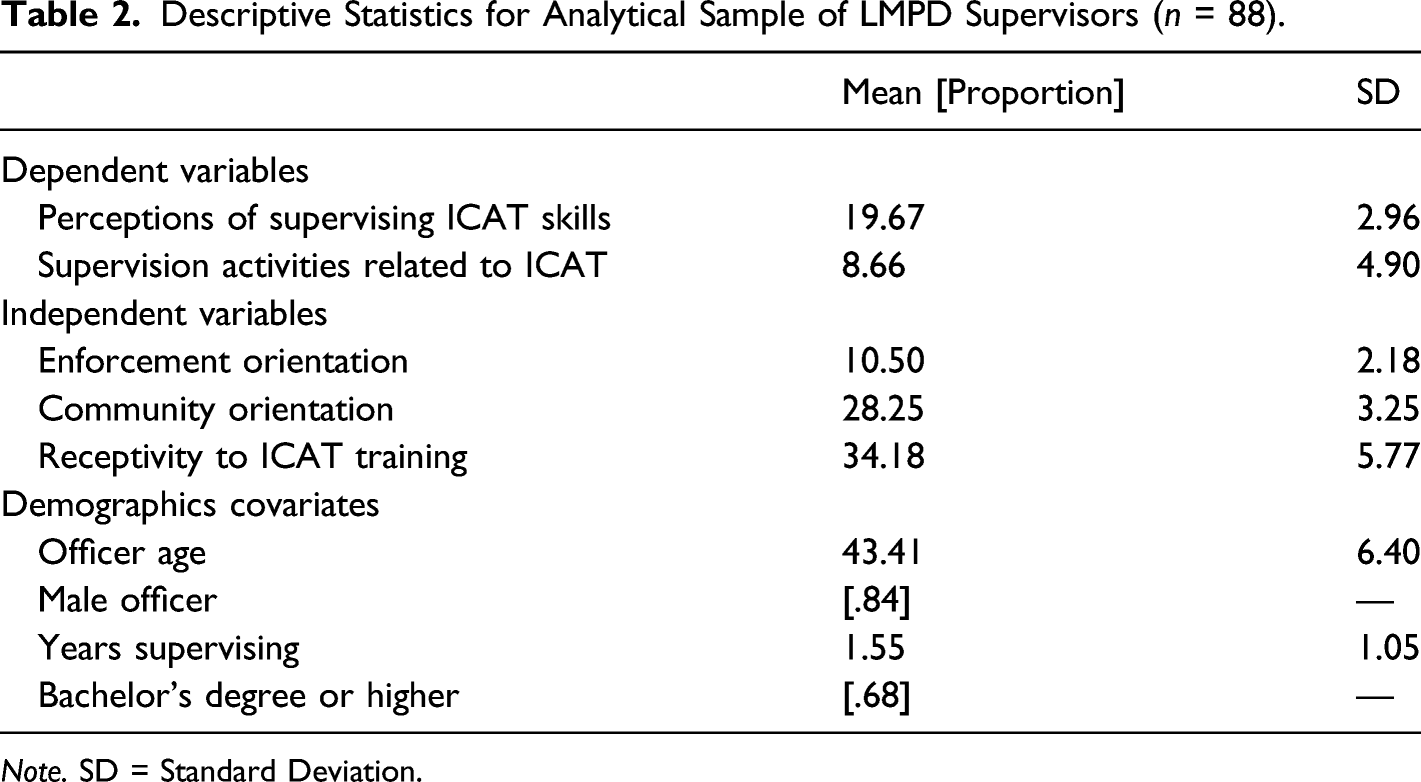
Note. SD = Standard Deviation.
Multivariate Analysis Results
Regression Results Predicting Perceptions of Supervising ICAT Skills and Self-reported Frequency of Supervision Activities Related to ICAT.
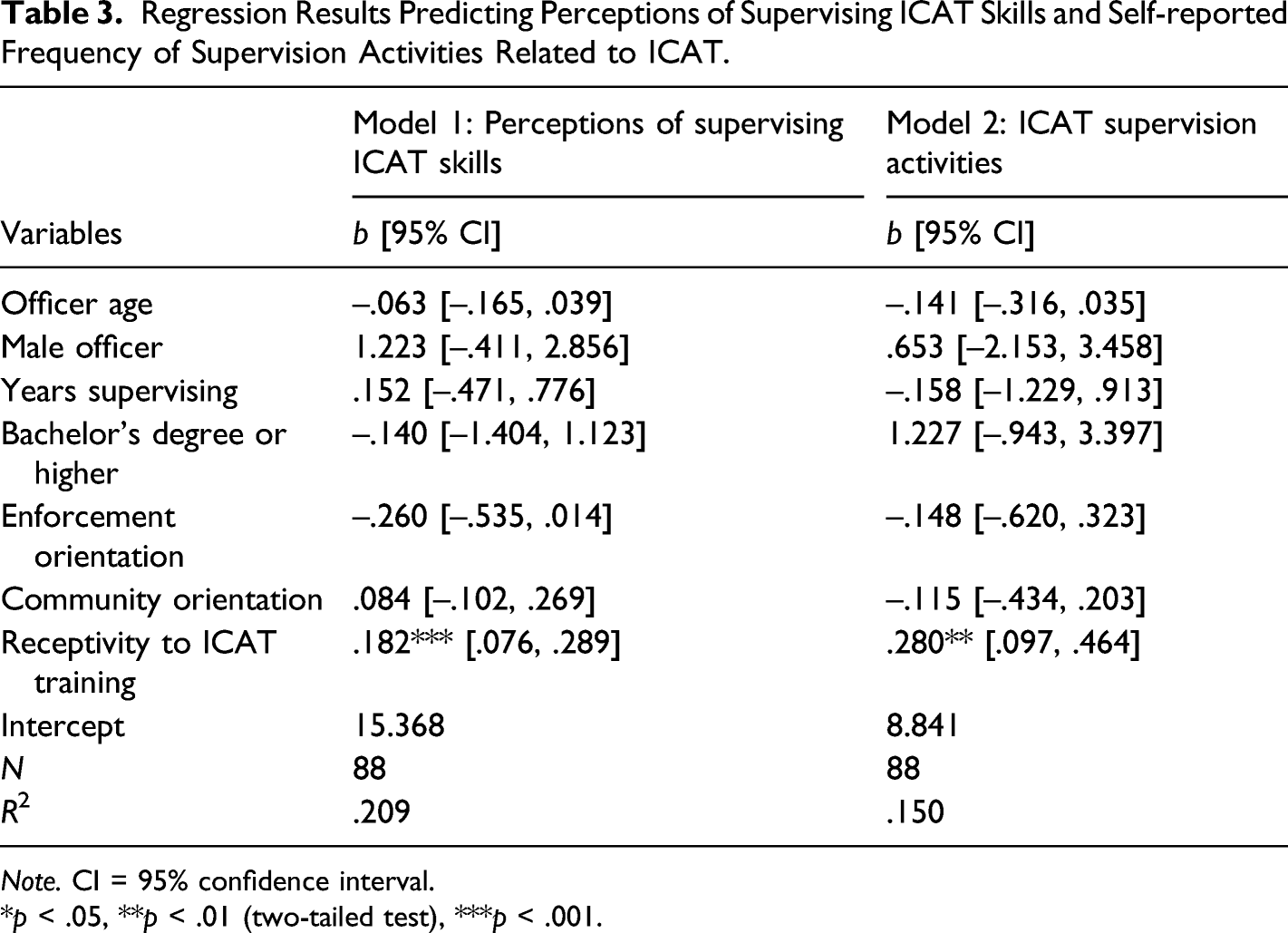
Note. CI = 95% confidence interval.
*p < .05, **p < .01 (two-tailed test), ***p < .001.
Next, we examine what factors predict the self-reported frequency of supervisory activities to support ICAT training in the field. Specifically, Model 2 in Table 3 shows the results of the multivariate OLS regression model predicting the additive scale of supervisor self-reported frequency of using supervision activities. As shown, only one supervisor characteristic—receptivity to ICAT training—is significantly associated with the frequency of engaging in supervisor activities that would reinforce ICAT training to subordinates (b = .280, p = .003). Specifically, supervisors who are more receptive to the ICAT training curriculum report engaging in supervisor activities related to ICAT de-escalation skills more often, on average, than supervisors who are less receptive to the training.
Note the absence of significance of any other supervisor characteristics in both statistical models presented in Table 3. For example, supervisors’ age, sex, education, role orientation, and supervisory experience did not significantly impact perceptions of supervising ICAT skills or the frequency of using supervision activities that reinforce ICAT training to subordinates. Indeed, only overall receptivity to the training itself was predictive of these outcomes.
A primary objective of surveying LMPD first-line supervisors was to gain insight on the frequency of supervisor activities that directly support or reinforce their subordinate officers’ use of de-escalation skills. The previous analyses have demonstrated that overall supervisor receptivity to the ICAT training and its curriculum is critical in this regard. Given the importance of receptivity to ICAT training as a predictor of supervisor differences in supervisory skills and frequency of engaging in activities to support the use of de-escalation tactics by subordinate officers, we also considered what predicts supervisors’ receptivity to ICAT training.
To answer this question, a multivariate OLS linear regression is estimated where the receptivity to ICAT training variable is regressed on officer age, sex, years supervising, educational attainment, enforcement orientation, and community orientation, and a measure of general openness to training. The following seven survey items (adapted from Miller et al., 1994) related to general openness to training were included in the pre-training survey: 1) I would consider myself open to using new training in my everyday work, 2) I am reluctant to change the way I do my work now (reverse-coded), 3) I look forward to new training opportunities, 4) police officers are over-trained in areas that are unhelpful in their work (reverse-coded), 5) it is important for police agencies to continually add innovated training, 6) training makes me more effective in my work, and 7) new training may reduce officer safety (reverse-coded). The additive scale (α = .76) has a possible range of 7–35 (average for analytical sample = 26.63), with higher scores indicating a greater openness to training.
Regression Results Predicting Overall Receptivity to ICAT Training.
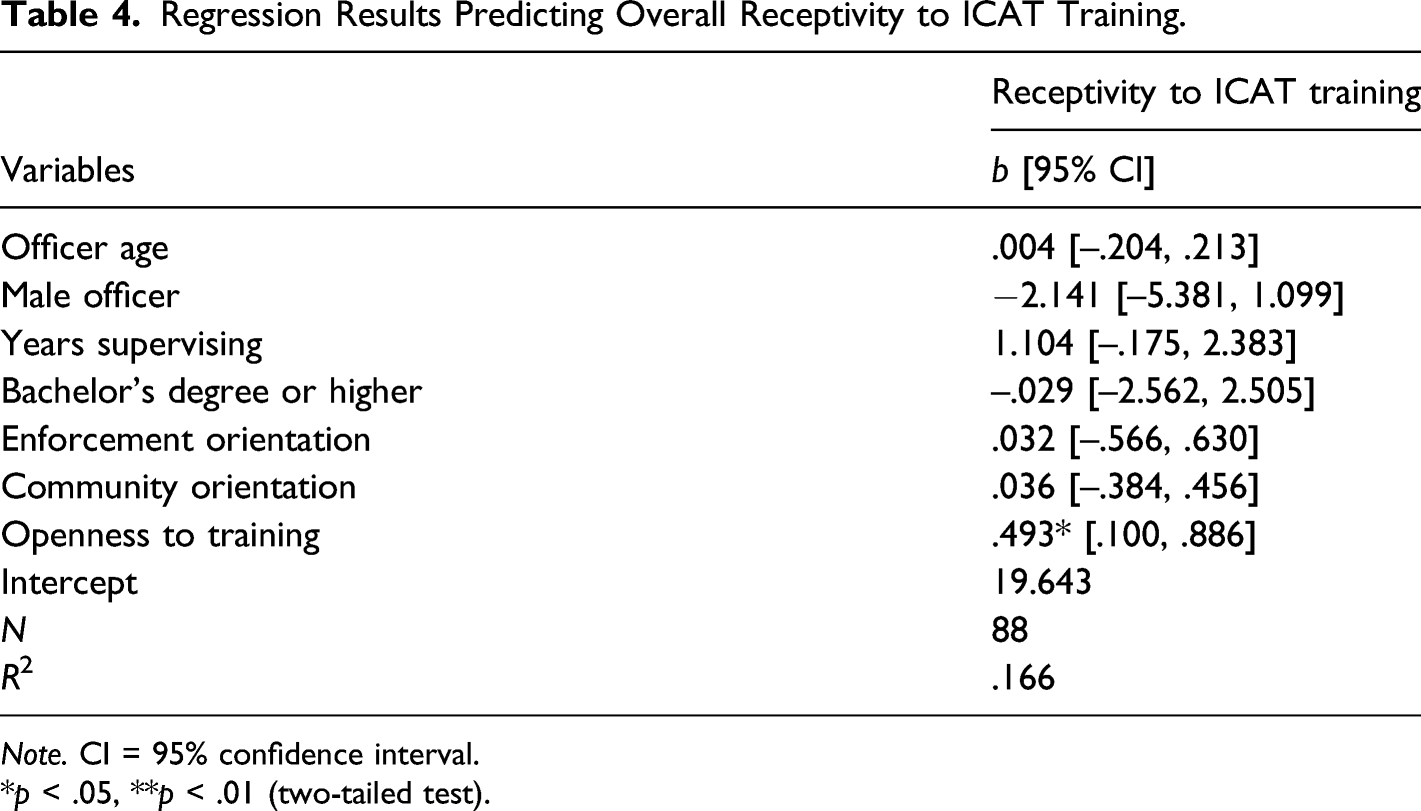
Note. CI = 95% confidence interval.
*p < .05, **p < .01 (two-tailed test).
Discussion
Using data collected through surveys of LMPD’s field supervising officers, this study examined supervisors’ confidence in their ability to oversee the use of ICAT de-escalation skills by their subordinate officers and self-reported activities in the supervision of subordinate officers’ use of those skills. This is the first known study to examine how and when first-line supervisors engage in activities to support de-escalation training in their agency. The findings highlight supervisors’ overall confidence in their ability to supervise their subordinate officers in the use of de-escalation skills. The frequency in which they participate in supervisory activities that serve to support or reinforce officers’ use of de-escalation skills, however, were found to be quite low. Specifically, the average responses suggest that supervisors seldom (i.e., once per month) or only sometimes (i.e., two to three times per month) communicate with their subordinate officers about the use of ICAT de-escalation skills in a general or incident-specific manner. Furthermore, the findings suggest that supervisors rarely document officers’ use of de-escalation skills in use of force reports, letters of commendation, or other forms of recognition.
The low level of self-reported participation across these supervisory activities suggests LMPD supervisors may be missing important opportunities to reinforce the lessons and tactics presented within the ICAT de-escalation training among their subordinate officers. As discussed above, prior research demonstrates that supervisors can significantly influence subordinates’ views of their work duties and environment, including their views on use of force policies and practices (Engel, 2001; Ingram et al., 2014). As such, first-line supervisors represent a critical but often under-utilized mechanism to affect change within a police agency. As Engel noted nearly two decades ago: Although it would seem sensible to believe that police executives would need to “win the hearts and minds of officers” in order to foster change at the street level...Police administrators are more likely to have an influence over officers’ behavior by training and encouraging their supervisors to effectively communicate their priorities for problem solving and community policing (2003, p. 160).
The influence of supervisors within the LMPD has also been observed. For example, statistical analyses using LMPD patrol officer surveys—presented elsewhere—demonstrate that officers’ perceptions of their supervisors’ support for de-escalation training significantly predict their self-reported use of de-escalation in the field (Engel et al., 2021). Furthermore, officers’ perceptions of their supervisors’ support for de-escalation were found to affect changes in their attitudes (measured 4 to 6 months post-training) that positively align with the tenets of the ICAT training. Collectively, these findings suggest the importance of encouraging supervisors to reinforce the primary tenets of de-escalation training and to support officers in their use of de-escalation skills to produce changes in the use of force within encounters.
When considering what factors might impact supervisors’ confidence and self-reported behavior in supervising and reinforcing ICAT training, several independent measures were examined, including supervisors’ employment and demographic characteristics, enforcement orientation, community orientation, and receptivity to the ICAT de-escalation training program. Notably, supervisors’ receptivity to the ICAT training—that is, the degree to which supervisors liked the training and viewed it as valuable to their work—was the only significant predictor across both dimensions. No other supervisor characteristic was a significant predictor of supervisors’ confidence and engagement in supervisory activities related to the support and reinforcement of de-escalation skills among their subordinate officers. Instead, initial receptivity to training appears to drive their confidence and engagement. Specifically, LMPD supervisors who reported greater receptivity to the ICAT training also reported greater ability to supervise the use of de-escalation skills by their subordinates compared to supervisors who were less receptive to the training. Similarly, LMPD supervisors who were more receptive to the ICAT training reported a higher frequency of engagement in the supervision of de-escalation skills used by their subordinate officers than those supervisors who were less receptive to the training.
These findings align with prior research in psychology and organizational behavior, where scholars have observed that individuals’ reactions, or receptivity, to a training program can have important effects on their learning and subsequent behavior (Alliger et al., 1997; Colquitt et al., 2000; Kirkpatrick, 1959; Kirkpatrick & Kirkpatrick, 2016). Specifically, this research suggests that individuals who report more favorable reactions to training, such as satisfaction with the training and perceptions of its value, are more likely to apply the knowledge and skills acquired in training to their work. In this context, the findings from this study suggest the importance of enhancing first-line supervisory officers’ receptivity to de-escalation training to potentially bolster their confidence in the supervision of subordinate officers’ use of de-escalation skills and to encourage greater participation in the supervision of those skills. As such, methods to enhance supervisors’ receptivity to de-escalation training should be a key consideration for future research and practice.
The present evaluation highlights one key predictor of supervisors’ receptivity to the ICAT training program—their general openness to training—with supervisors who report greater openness to training, in general, reporting greater receptivity to the ICAT training program. This finding suggests the benefits of developing a culture within police agencies that encourages acceptance of training and educational opportunities. Past research further suggests that agencies would benefit from building a culture that promotes “training motivation” amongst its supervisors; people who are motivated to participate in training are also more likely to put attentional effort into training and view it as a worthwhile endeavor (Kanfer & Ackerman, 1989). Prior evaluations suggest that training motivation can be affected by three primary factors: organizational justice, individuals’ perceived locus of control (i.e., the extent to which they believe their experiences are caused by their actions or caused by factors outside of their control), and individuals’ perceived self-efficacy (Colquitt et al., 2000). As such, police agencies that successfully build a culture that promotes principles of “internal procedural justice” encourage officers of all ranks to acknowledge the benefits of training and empower officers to apply the training skills to enhance outcomes in their work are more likely to enhance officer receptivity to training and the subsequent application of training tenets and skills (Council on Criminal Justice, 2021b; Wolfe et al., 2019).
We note several limitations of the current study. First, the analytical methods rely solely on self-report survey data related to supervisory orientations and behavioral oversight related to reinforcing important de-escalation principles. The limitations of self-reported behavioral data are well established and should be taken into account in the current study (see Chan, 2008). Data triangulation (official data or aggregating subordinate responses to the supervisor level) would enhance this design but were not possible due to data limitations. Additionally, given that supervisors tend to make up less than 35% of most police departments nationwide (Bureau of Labor Statistics, 2017) while the vast majority of sworn officers are in patrol operations, an agency-wide survey will have limited sample size when focusing specifically on supervisors. The case-to-variable ratio presented in this study was within the defined limits (Osborne & Costello, 2004), but a sample of fewer than 90 supervisors limits the ability to control for potential control and intervening mechanisms in a comprehensive manner. While we are confident in the saliency of the models, the design is limited in terms of size and scope.
Additionally, we caution against assuming causality in the models presented in this study. It is possible that supervisors’ perceived self-efficacy in the supervision of de-escalation could predict their receptivity to training. Research suggesting employees’ pre-existing perceptions of their abilities as they relate to a training topic can impact their reactions to the training (see Colquitt et al., 2000; Wolfe et al., 2019). If officers believe they are good at a particular skill, they are more likely to have positive reactions and greater receptivity to training on that topic.
Research and Policy Implications
The findings presented within this study highlight several important implications for future research, policy, and practice. As police agencies face increasing demands for reforms related to use of force, research examining police organizations must be reinvigorated to inform change. Scholars have highlighted the dearth of research examining the role of police organizational structure in affecting change and innovation in police practice (Mastrofski & Willis, 2010; Reiss, 1992). Although several contemporary studies highlight the impact of specific policies and organizational practices on police use of force (e.g., see Bishopp et al., 2015; Ferdik et al., 2014; Jennings & Rubado, 2017; Shjarback & Maguire, 2021; Terrill & Paoline, 2017), significant gaps in our understanding of the effects of supervision on officers’ use of force remain. As such, the current evaluation presents significant findings within an understudied area—examining why and how first-line supervisors vary in their reinforcement of de-escalation among their subordinates. Given the observed influence of supervisor receptivity to de-escalation training on their supervisory activities, it is recommended that officer and supervisor receptivity to training be considered in future evaluations of police training programs to extend our understanding of why some training programs may be more successful in affecting change, while others fail (see Wolfe et al., 2019 for further discussion of training motivation and receptivity).
To further inform the examination of supervisory activities and their effects, police agencies should develop and implement data processes that can facilitate the measurement of supervisors’ performance, including the systematic collection of supervisory activities designed to reinforce the use of de-escalation skills in the field by their subordinates. This process would include the identification of specific activities that first-line supervisors are expected to engage in, the development of agency policies and procedures to reinforce supervisors’ engagement in those activities, and finally, the documentation of supervisors’ performance across activities.
Additionally, given the relationship between supervisors’ receptivity to de-escalation training and their confidence and participation in supervisory activities to support the use of de-escalation skills by their subordinate officer, it is critical that agencies emphasize the value of training among their supervisors, reinforcing the primary training tenets and the application of the de-escalation skills in their daily work. Police agencies should consider the development of supervisor-specific training that can provide supervisors with the skills necessary to provide support and reinforcement to their subordinate officers. Supervisors should also be supported in their reinforcement of the tenets and tactics presented within de-escalation training to their subordinate officers and encouraged to speak more openly and directly to their subordinate officers regarding the value and application of de-escalation skills. Police agencies should work to identify when messages of reinforcement can be communicated, including roll calls and post-incident reviews. Additionally, incorporating the documentation of officers’ use of de-escalation in use of force reports, letters of commendation, and other formal methods can further serve to positively emphasize the tenets of de-escalation training and use of those skills.
Conclusion
The study findings illuminate an understudied area in the use of force research regarding how and why supervisors do (and do not) reinforce de-escalation practices among subordinates. For the LMPD, the story appears to center around supervisor buy-in and the perceived utility of the training. This highlights the importance of reinforcing de-escalation training to first-line supervisors who, in turn, will be better able to reinforce training to their subordinate officers effectively. This is critical, as previous analyses have demonstrated a significant, positive association between de-escalation training receptivity and skill use during encounters with persons in crisis (Engel et al., 2021).
Agencies should maximize the potential of their first-line supervisors by strategically engaging them to reinforce de-escalation principles while also seeking to implement changes based on the available scientific evidence. For example, based on feedback from our evaluation of the ICAT program (see Engel, Corsaro, et al., 2020a; Engel et al., 2021), the LMPD is developing additional initiatives aimed at enhancing de-escalation tactics to reduce use of force, including the development and delivery of one of the first known supervisor de-escalation training to promote supervisory engagement and oversight of subordinates’ de-escalation activities in the field. Similarly, the Oklahoma City Police Department (OKCPD) has implemented a supervisor mentoring program to supplement their 80-hour supervisor training, providing their new supervisors with support to handle their supervision duties, including conducting use of force reviews with subordinates (Boxwell, personal communication, August 5, 2021). The OKCPD has also implemented a new debriefing process after every critical incident, which includes training unit supervisors to understand what works and what needs improvement for academy and in-service training. Executives from some agencies (e.g., Camden County, NJ and Riverside, CA) are also sharing their successes using the debriefing of incidents—both formally and informally—as a mechanism to provide additional coaching, training, and mentoring opportunities between field supervisors and their subordinates (Lutz & Warren, 2021). Other agencies are considering mandating the collection of data on supervisory activities designed to reinforce de-escalation training. As agencies begin to better document these approaches, new sources of data regarding the use and effectiveness of the activities of field supervisors will likely emerge. In short, police agencies are demonstrating innovative approaches for leveraging supervisors to enhance training and accountability to reduce the severity and frequency of police use of force. We are encouraged by this work and contend that researchers need to support agencies in evaluating the effectiveness of these innovations. In summary, researchers and police executives must collaborate to advance our knowledge of the influences of training and supervision.
Footnotes
Appendix A
Acknowledgments
Portions of this research were supported by Arnold Ventures (AV), formerly the Laura and John Arnold Foundation, in partnership with the International Association of Chiefs of Police (IACP). The findings and recommendations presented are from the authors and do not necessarily reflect the official positions or opinions of AV, the IACP, or the Louisville Metro Police Department (LMPD). The authors wish to thank LMPD Chief Steven Conrad (retired), Interim Chief Robert Schroeder (retired), Chief Erika Shields, Assistant Chief Paul Humphrey, Sergeant Justin Witt, Sergeant Chris Keith, Officer Pete Pastin, Travis Eicher, and all the LMPD Officers and staff for their assistance in conducting this research. Executives, staff members, and trainers from the Police Executive Research Forum also provided valuable assistance to both the LMPD and the UC research team.
Declaration of conflicting interests
The author(s) declared no potential conflicts of interest with respect to the research, authorship, and/or publication of this article.
Funding
The author(s) disclosed receipt of the following financial support for the research, authorship, and/or publication of this article: This work was supported by the Laura and John Arnold Foundation.
