



Abstract
The Turtle Lodge International Centre for Indigenous Education and Wellness in Sagkeeng First Nation, Manitoba, is leading the way in exemplifying and cultivating sustainable self-determination. This is a holistic concept and process that recognizes the central role that land and culture play in self-determination, and the responsibility to pass these teachings on to future generations. This article links theory and practice in the emerging scholarship on sustainable self-determination and examines how Turtle Lodge embodies sustainable self-determination through traditional governance and laws, respectful and reciprocal relationships, cultivation of cultural revitalization and community well-being, and efforts to inspire earth guardianship. Turtle Lodge’s experience underscores the importance of understanding sustainable self-determination as a flexible, community-based process. This case study fits within recent calls in the literature for a shift from a rights-based to responsibility-based self-determination discourse and demonstrates some of the challenges and lessons learned that might support other communities pursuing similar actions.
Introduction
It has been prophesized by our people that there would one day come a time when we would take our rightful place of leadership on our original homelands. (D. Courchene, personal communications, May 25, 2017)
Indigenous peoples’ freedoms and self-determination are directly opposed by the colonial and capitalist systems of settler states (Tully, 2000). In response, Indigenous movements for decolonization, revitalization, and resurgence are growing across Indigenous Nations and geopolitical borders globally, bringing Indigenous issues to the fore in settler societies (Manuel, Derrickson, & Klein, 2015). In the face of policies of imposition and dispossession, many Indigenous peoples are joining together to resist, to enact their rights to self-government, and to assert their sovereignty. Within these movements, there is diversity in experiences of colonization and the pathways advocated and practised in pursuit of Indigenous freedoms vis-à-vis the state.
Indigenous governments, communities, and organizations across Canada have been advocating to reclaim their lands and rights and reverse the dependency created by colonial systems for decades and continuing today (e.g. Tooley, 2006). We begin with an introduction to settler colonialism and Indigenous movements for self-determination in Canada, with particular attention to different understandings of, and approaches to, self-determination. We then examine the case study of Turtle Lodge International Centre for Indigenous Education and Wellness in Sagkeeng First Nation, Manitoba, founded by Elder Dave Courchene (www.turtlelodge.org). This Indigenous-led and community-based organization exemplifies and cultivates sustainable self-determination through their governance, relation-ships, and activities, and in so doing inspires and supports similar processes in First Nations across the country. At the same time, the practices of Turtle Lodge bring to light some of the nuances and challenges of actually achieving sustainable self-determination that theory alone is unable to elucidate, and in turn contributes new insights to the self-determination literature.
Settler colonialism and Indigenous movements for self-determination in Canada
One hundred and fifty years ago, the Canadian nation-state was founded on Indigenous territories with little regard for the rights and title of the First Peoples. With the passing of the 1876 Indian Act, “the social, economic, and political position of Indian Nations was dramatically transformed into one of ‘dependence’” (Pettipas, 1994, p. 37) that created cultural disruptions which have had intergenerational impacts (Alfred, 2009a). Colonial forces separate Indigenous peoples from each other and disconnect them from their relationships to culture and the natural world (Alfred, 2005; Corntassel & Bryce, 2012). The severing of this fundamental relationship to the earth has created crises for Indigenous communities under the settler colonial Canadian state that are spiritual, as much as they are political, social, and economic (Corntassel, 2012). In recent decades, the structure of colonialism within the state has changed—from state domination over Indigenous peoples to recognition of them—but arguably maintains the same aim of controlling and assimilating Indigenous peoples while dispossessing them of their lands and self-determining authority (Alfred, 2009a; Coulthard, 2014).
In direct response to past and present forms of colonialism, Indigenous movements in Canada have emerged with diverse approaches to achieving self-determination, many of which have sought freedom through political recognition of Indigenous rights (Coulthard, 2008; Pettipas, 1994). In their book Unsettling Canada, the late Arthur Manuel and his colleagues (2015) review Indigenous peoples’ struggles “for recognition of [their] land title and sovereign rights”, arguing that they have made important advances in the last decade. Indeed, many Indigenous groups and Nations have fought for decades to have their rights recognized and upheld vis-à-vis colonial Canadian governments to improve the lives of Indigenous peoples across the country. The United Nations Declaration on the Rights of Indigenous Peoples (UNDRIP)—a landmark victory of the international Indigenous rights movement—was only adopted by the Canadian government in 2010 after significant political pressure from First Nations and Indigenous organizations (Corntassel & Bryce, 2012). While UNDRIP may be recognized as the most comprehensive Indigenous rights instrument available (Corntassel & Bryce, 2012), there are differing definitions and strategies within the rights-based discourse. Kulchyski (2013) argues that Indigenous rights—based on peoples’ relationships to land, practised through culture—are distinct from and more powerful than universal human rights as tools in the struggles of Indigenous peoples.
At the same time, many authors highlight the limitations of pursuing freedom within state systems and rights-based strategies. Anishinaabe legal scholar John Borrows (2006) criticizes Canada’s constitutional structures for continuing to marginalize and disempower Indigenous peoples and suggests that Indigenous freedoms must be pursued through multiple, diverse pathways that allow for both engaging with and working outside of state systems. Leanne Simpson (2011) also contends that work needs to be done both within Indigenous Nations and within Indigenous-state relations to decolonize state systems. Some authors criticize all forms of state recognition, contending that it only serves to reinforce colonial power dynamics by granting authority of recognition to the colonizer (Coulthard, 2014; Daigle, 2016). Dene political theorist Glen Coulthard (2008, 2014) argues that self-determination cannot be achieved through institutionalization of liberal systems of reciprocal recognition because state governments will recognize Indigenous rights and identities only to the extent that they do not disrupt colonial power relationships. Cherokee scholar Jeff Corntassel (2008) also suggests that rights-based approaches give the state power to define and deny Indigenous identities and de-emphasize relationships to family, the natural world, and future generations. Considering this, Corntassel brings forward the concept of sustainable self-determination, a more holistic model which considers the environment, community well-being, natural resources, sustainability, and cultural transmission for future generations as part of the process of self-determination. He posits that self-determination that is sustainable is more than a political and legal struggle; it is fundamentally about maintenance and renewal of individual, family, and community spiritual and relational responsibilities (Corntassel, 2008). With this context, we explore the similarities between these principles of sustainable self-determination and Anishinaabe ways of knowing.
Sustainable self-determination and Anishinaabe ways of knowing
Our leadership is not a political leadership, rather a spiritual leadership guided by values. We offer a glimpse into our ways and our traditions, into our values that helped sustain our ancestors for thousands and thousands of years on these lands, living in harmony and peace with each other and the natural world. (Courchene, 2017c, para. 65)
Corntassel (2008) describes sustainable self-determination as a process of “Indigenous livelihoods, food security, community governance, and relationships to the natural world and ceremonial life that enables the transmission of these cultural practices to future generations” (p. 124). He contends that sustainability for Indigenous peoples is fundamentally linked to the transmission of knowledge and culture to future generations and must be included in models of self-determination (Corntassel, 2008). Sustainable self-determination rejects compartmentalization into legal and political rights-based definitions and takes a broader view, encompassing social, economic, cultural, and political aspects and extending to include future generations (Corntassel, 2008). It has been suggested that this holistic model better reflects Indigenous worldviews, which centre on interconnectedness and balance between all aspects of creation (Corntassel, 2008; Little Bear, 2000). As colonial forces seek to disconnect Indigenous peoples from their homelands, reconnecting to the land is a way of rejecting Western ideologies and practicing sustainable self-determination (Corntassel & Bryce, 2012). Since the same colonial-capitalist agenda that threatens Indigenous peoples’ well-being and relationships with their homelands also threatens biodiversity and environmental balance (Alfred, 2009a), adopting the concept of sustainable self-determination could have wider implications for earth stewardship among Indigenous and non-Indigenous people alike.
The model of sustainable self-determination aligns well with Anishinaabe traditional law, which has strong conservation and intergenerational ethics (Borrows, 2006; Johnston, 2004). In Anishinaabe traditions, the earth is alive, imbued with spirit, and cannot be owned but is rather borrowed from future generations (Borrows, 2006). From this understanding, Anishinaabeg have duties and responsibilities to take care of the earth to ensure that its gifts are preserved for their children, grandchildren, and seven generations to come (Kimmerer, 2014). This intergenerational way of thinking is illustrated in the Anishinaabemowin language; for instance, aanikoobijigan is the word used to describe both ancestors and descendants. Anishinaabe legal traditions also include bimiikoomaagewin, stewardship concepts which guide their peoples in their use of and relations to land, plants, and animals (Borrows, 2006). These ethics of responsibility and conservation—grounded in spirit and an understanding of the land and water—are central in Anishinaabe traditions and livelihoods. Indeed, Anishinaabe lifeways and teachings share many of Corntassel’s principles of sustainable self-determination.
Sustainable self-determination in theory and practice at Turtle Lodge
Our leadership will always, always rely on our connection to the Spirit . . . We have to get out of the mindset that we need approval and validation from the colonizer to legitimize who we are as a people, and to legitimize our true leadership in our homeland. (Courchene, 2016a, para. 25–26)
The Turtle Lodge International Centre for Indigenous Education and Wellness is located in Sagkeeng First Nation, Manitoba, on Treaty 1 territory (Figure 1). The Lodge is a gathering place for Indigenous and non-Indigenous peoples from all Nations, founded upon spiritual, land-based teachings and the pursuit of mino-bimaadiziwin (the good way of life) (Turtle Lodge, n.d.). Following the ancestral ways of his people, Anishinaabe Elder Dave Courchene (Nii Gaani Aki Inini—Leading Earth Man) founded Turtle Lodge in fulfilment of a vision he received of a place that would bring healing to the people and to the land. Elder Courchene is a well-respected Knowledge Keeper of the Anishinaabe Nation and has dedicated his life to sharing his knowledge and spreading a message of peace, hope, stewardship, and spirit across Canada and the Globe.

(a) Turtle Lodge International Centre for Indigenous Education and Wellness in Sagkeeng First Nation, Manitoba. (b) Elder Dave Courchene (Nii Gaani Aki Inini—Leading Earth Man), Anishinaabe knowledge keeper and founder of Turtle Lodge.
Since it was built in 2002, the Turtle Lodge has served as a place for sharing ancient Anishinaabe knowledge and practices, cross-cultural knowledge exchange, and collaborative knowledge creation, guided by spirit (Turtle Lodge, 2017c). The Lodge has hosted events, ceremonies, conferences, and gatherings of people from around the world to recognize and honour the rich traditional knowledge of the First Peoples and their lands and territory, and in so doing has developed a network of diverse partners. Through their efforts, the Lodge exemplifies many of the principles of sustainable self-determination put forward by Corntassel (2008)—working towards independence of their community and others with consideration to the environment, community well-being, sustainability, and transmission of cultural knowledge and values for future generations. These principles are reflected in their governance, relationships, and cultural and stewardship activities (Figure 2).
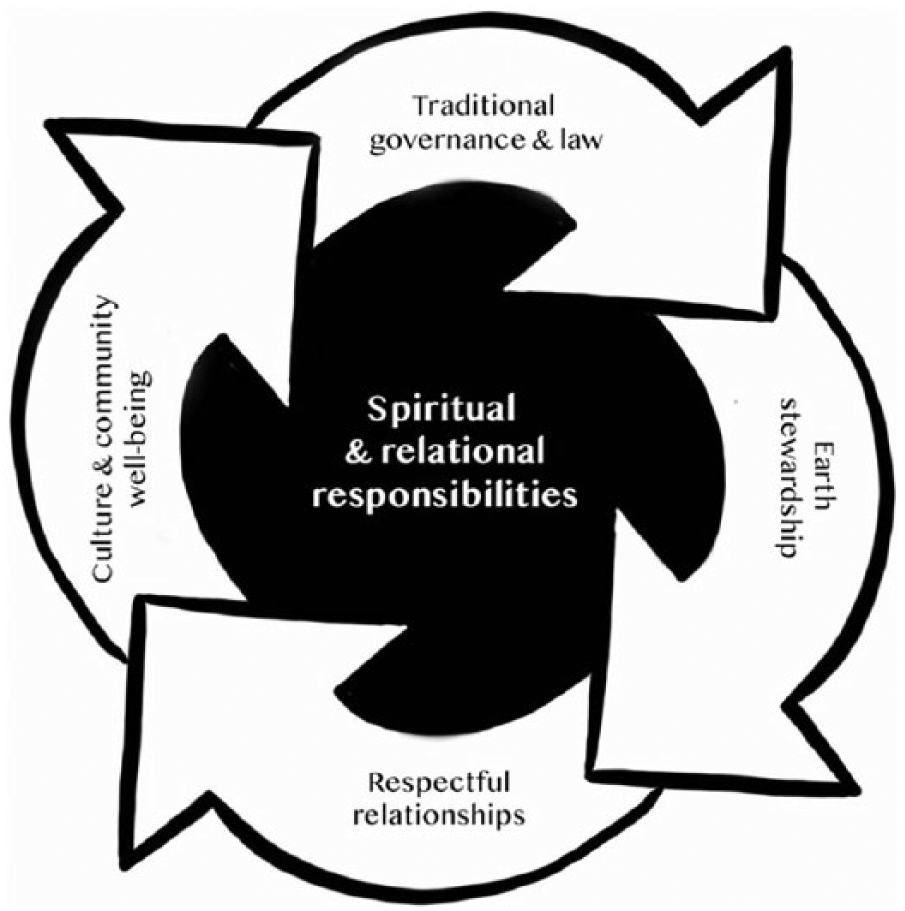
The Turtle Lodge model of sustainable self-determination.
Traditional governance and law
In our belief system, we have our values that we call the seven teachings that are represented by seven animals . . . These laws can’t be legislated, simply because you can’t legislate morality. These teachings must be lived from within us, from the heart, the spirit. It is these teachings, these laws that align and connect us with the natural laws of Mother Earth. (Courchene, 2017c, para. 39)
The Turtle Lodge is governed following protocols of traditional Anishinaabe governance. Gatherings are led by Knowledge Keepers and Elders, and always begin with ceremony (Turtle Lodge, 2017c). In Anishinaabe tradition, pipe and water ceremonies are conducted to establish a connection with Gizhe-manidoo, the Great Spirit, and offer prayers of thanksgiving for the land, plants, animals, humans, and all aspects of creation (Borrows, 2006). Following ceremony, discussions in the Lodge happen in a circle where people are invited to share their points of view and experiences uninterrupted, beginning with the Elders who often speak in their native languages. Talking circles have traditionally been used by Anishinaabe and other Indigenous peoples to facilitate respectful dialogue; the circle itself symbolizes the holism of the earth, continuous compassion and love, and equality of all members (Chilisa, 2012; Wilson, 2008). While partners and guests are often welcomed into the circle, spiritual leadership provided by the traditional Knowledge Keepers, and inspired by the ceremonies, guides the conversations. This model of traditional governance exemplified at Turtle Lodge has inspired Nations across Manitoba, and five communities have recently committed to building similar traditional Lodges, with the blessing, guidance, and support of Turtle Lodge. The Lodge has been recognized by the Assembly of First Nations and the Assembly of Manitoba Chiefs as one of the most significant gathering places for Indigenous peoples in Canada (P. Bellegarde, personal communications, August 5, 2015; D. White Bird, personal communication, January 3, 2013).
Governance rooted in Indigenous traditions and philosophies is a central component of decolonization and self-determination. Mohawk scholar Taiaiake Alfred (2009b) contends that “[t]raditional government is the antidote to the colonial disease and its corruptions and abuses of power, and to the disempowerment of our people and communities” (p. 5). Elder Dave Courchene’s father responded to the 1969 White Paper by coauthoring the seminal position paper Wahbung, Our Tomorrows, which centred traditional governance in Indigenous peoples’ pathway to independence and well-being in Manitoba. Elder Courchene believes it is the responsibility of today’s leadership to bring the spirit of Wahbung to life through traditional governance, which he demonstrates at Turtle Lodge (Courchene, 2016b). Through his leadership, the Lodge is guided by Anishinaabe traditional laws. For instance, in 2015, Elders from the Dakota, Nehetho, and Anishinaabe Nations gathered at the Lodge and wrote Ogichi Tibakonigaywin (The Great Binding Law) which reflects their understanding of ancestral and natural law (Oshoshko Bineshiikwe et al., 2015). The Law contains the Original Instructions given to the First Peoples by Creator on how to be and sustain a relationship with Mother Earth, and is an articulation of Indigenous traditional knowledge, governance, and nationhood.
Maintaining these traditional ways of governing—which were for many decades outlawed across Canada—is part of a holistic, sustainable practice of self-determination that asserts self-governance and transmits these practices to younger generations. Importantly, these governance practices are not fixed, but rather evolve and are adapted in various contexts. For example, Indigenous peoples from other Nations and non-Indigenous people are often invited to bring their own ceremonies and protocols into the Lodge which may be integrated or practised alongside the Anishinaabe traditions, within the context of the local Nation’s leadership. While ancestral knowledge and practices are foundational within traditional governance, the Lodge remains “contemporary, flexible, and fluid” (Borrows, 2016, p. 17) in their pursuit of self-determination. The Lodge maintains autonomy over their governance, which allows them to uphold traditional ways across the diversity of projects and partnerships they engage in.
Respectful and reciprocal relationships
We each bring knowledge of values from the four corners of the earth, based on our cultures and spiritual traditions, which show us how to be kind and how to relate to each other and the Earth. Everyone has something to contribute in knowledge and gifts. We have to find a way to share that. (Courchene, 2017a, para. 5)
Over the past 15 years of their process of self-determination, Turtle Lodge has continued to expand their network and partnerships with Knowledge Keepers, political leaders, and community members from First Nation, Métis, and Inuit communities across the country. They frequently host gatherings to convene people from diverse Indigenous Nations to discuss issues of common concern, recognizing the importance of inter-Nation collaboration and solidarity. For example, in February 2017, the Lodge held a special gathering to unveil a sacred pipe which was commissioned by Elders from Nations of the four directions across Canada, to symbolize all of the pipes that were taken away from First Peoples and illustrate the resurgence of their communities (Mosher, 2017; Turtle Lodge, 2017h). An additional example is the Totem Pole Journey of 2016, in which a special totem pole carved by the Lummi Nation of the Coast Salish peoples travelled through Nations in the USA and Canada before being gifted to Turtle Lodge, where it now stands as a symbol of alliance across Indigenous peoples and Mother Earth (Anderson-Pyrz, 2016). Relationships that the Lodge has forged and facilitated through their gatherings contribute to self-determination, as they unite Indigenous Nations across nation-state borders, bridge diverse knowledge systems, and therein challenge colonial boundaries and tactics of division.
In addition to their Indigenous relationships, Turtle Lodge has partnered with provincial and federal governments, and has a long-standing relationship with departments such as the federal Indigenous and Northern Affairs Canada and provincial Department of Sustainable Development. For instance, in July 2017, Canadian Minister of Environment and Climate Change Catherine McKenna and former Manitoba Minister of Sustainable Development Cathy Cox visited the Lodge to consult the Elders on climate change (Turtle Lodge, 2017g). Through these government partnerships, the Lodge has gained political and sometimes financial support, yet they uphold their independence as an utmost priority and have declined certain opportunities in order to maintain their sovereignty. These dynamics with government illustrate the Lodge’s self-determination, reversing the dependency that colonial systems aim to uphold, and thus creating true nation-to-nation partnerships defined according to their own principles and traditions.
The Lodge also has a network of institutional collaborators, from museums to various professional unions and bodies. Over the last several years, the Lodge has facilitated conversations between Knowledge Keepers and representatives from the Canadian Museum of Human Rights to develop the Mikinak-Keya Spirit Tour, a special Indigenous-led tour of the museum presenting traditional knowledge, teachings, and ceremonies (Canadian Museum for Human Rights [CMHR], n.d.). In the summer of 2017, they partnered with Canada Games to bring Indigenous perspectives to the Games in Winnipeg, lighting the sacred fire at Manitou Api and leading the opening ceremonies (Turtle Lodge, 2017d). Over the years, the Lodge has hosted events with the Federal Judges of Canada, the National Energy Board, the Canadian Association of Police Chiefs, and other professional bodies seeking better understandings of Indigenous peoples of Treaty 1 territory and their diverse knowledges. Turtle Lodge not only shares culture and traditions through these relationships, furthering the goal of cultivating and transmitting their knowledge, but they also provide an example of what a self-determining community looks like in practice to those who visit.
Finally, Turtle Lodge works in partnership with a variety of students, teachers, school administrators, and university academics. The present article is the result of a trusting relationship and ongoing collaboration the Lodge has forged with scholars from the University of Winnipeg. In academic partnerships such as this, the Lodge and their partners operate under First Nations principles of OCAP (Ownership, Control, Access, and Possession; http://fnigc.ca/ocap.html), asserting the community’s control over the information documented and produced. In their relationships with educational institutions, Turtle Lodge affirms their traditional knowledge as equal to Western knowledge and refuses colonial notions of the dominance of universal, positivist knowledge. At the same time, they accept and appreciate other ways of knowing and advocate the parallel use of diverse knowledges in addressing common concerns (Turtle Lodge, 2017c).
Cultivating cultural revitalization and community well-being
The wisdom keepers of our Nations all agree that in order to achieve peace, we must return to the beginning, which for us means returning to the land where all life has been generated from. But in order for us to be able to achieve that, we have to understand first of all our own identity in who we are, and the contributions that each of us can make within that nationhood of humanity. Paramount in these defined actions is the education of youth. (Courchene, 2017b, para. 13–14)
In addition to their traditional governance and relationships, Turtle Lodge practices self-determination through their various programs, events, and initiatives. Through these activities, the community practices everyday acts of resurgence—speaking the language, practicing ceremony to connect to the land and water, building healthy relationships among Indigenous peoples, sharing teachings, and educating others (Corntassel, 2008). These acts disrupt colonial boundaries, restore Indigenous nationhood, and assert Indigenous cultural rights (Corntassel, 2008; Holder, 2008), with far-reaching implications and impacts such as language revitalization, ancient ceremonial practices, youth empowerment, community economic development, and community healing.
Oral histories and languages are central in First Nations communication and transmission of Indigenous knowledge, traditions, laws, spirituality, ceremony, and relationships (Miner, 2013; Pratt, Bone, & Treaty Relations Commission of Manitoba, 2014). Because of its centrality to Indigenous societies, language has been a central target in the project of colonization. Thus, in a movement of decolonization and Indigenous resurgence, language revitalization and oral tradition are critical, and have great implications for other areas of Indigenous society (Pratt et al., 2014). Leanne Simpson (2008a) describes Oshkimaadiziig—the people responsible for the revitalization of language and culture in the time of the Seventh Fire. Elder Courchene and the Knowledge Keepers who gather at Turtle Lodge are Oshkimaadiziig as they continue to speak their languages and pass them to the next generation. In 2017, the Lodge held their second annual Nehiyawewin (Cree) and Anishinaabemowin (Ojibwe) camps for youth and community members from across the province, to learn the languages “in a traditional way, in ceremony and on the land” (Turtle Lodge, 2017a). Through Turtle Lodge’s efforts to revitalize and pass forward the intergenerational Anishinaabe knowledge embedded with their Indigenous languages, they are demonstrating their deep commitment to self-determination that is truly sustainable and helps to bridge millennia of wisdom through cultural transmission that ultimately benefits community and environmental well-being.
Turtle Lodge also contributes to community healing processes and was instrumental in the creation of the Giigewigamig Traditional Healing Centre at the Pine Falls Health Complex, which they have been working on for over 10 years in collaboration with the community in Sagkeeng and neighbouring First Nations of Black River, Hollow Water, and Bloodvein. In July 2017, the Giigewigamig Centre and Turtle Lodge hosted the National Inquiry on Missing and Murdered Indigenous Women and Girls for what was “an intense day of grieving, healing and sharing” (Turtle Lodge, 2017e). In creating spaces and gatherings such as this for community healing, the Lodge is affirming the community’s ability to find peace through their spirituality and traditions, independent of the state.
Turtle Lodge’s commitment to healing and cultural revitalization is also carried out through reviving ancient Anishinaabe ceremonies. In June 2017, they held a ceremony to build a Thunderbird nest to re-establish an alliance between the binesi (thunderbirds) and humanity for protection of the earth, the first time this ancient ceremony has been held in the area in over a hundred years (Turtle Lodge, 2017c). In addition, the Lodge often holds adoption ceremonies to welcome people from other Nations and cultures to Turtle Island, with the understanding that residing on these lands comes with responsibilities to honour and care for the earth. This formal welcoming of newcomers to the community is an example of what Borrows (2016) calls “emancipatory traditions”, facilitating Indigenous freedoms while not being restricted by state systems of citizenship (p. 41). Through these ceremonies, the Lodge is maintaining ancient traditions and making them accessible to the next generation.
In many of their activities, the Lodge practices traditional models of Anishinaabe kinship by centring youth and facilitating intergenerational knowledge exchange. One example of this is their Rites of Passage, a traditional coming of age ceremony that is one of their most important events held annually in the spring (Turtle Lodge, 2017c). Young women receive the Grandmothers’ Teachings and young men participate in a Vision Quest, affirming their identities and responsibilities as they enter adulthood. With participants from across the country, it is clear that the Lodge’s practices of self-determination through culturally grounded youth programmes are having significant impacts extending beyond their immediate community. Through these ceremonies, the Lodge is taking on “one of [the] most critical and immediate tasks in building an Indigenous resurgence, [which] is ensuring that the knowledge of [the] ancestors is taught to the coming generations” (Simpson, 2008b, p. 74).
Through these diverse activities, Turtle Lodge creates opportunities for sustainable community development from an Indigenous perspective, seeing the earth as the source of life rather than a resource to be exploited. This is an example of sustainable development which Heinämäki (2009) argues goes hand-in-hand with sustainable self-determination. The Lodge is yet another exciting example of how it is possible for Indigenous communities to participate in business development and redefine economic narratives in Canada, while supporting shared responsibilities, traditions, and ultimately self-determination. In this way, they have paved a middle road, creating space for what Bhabha (1994) terms “hybridity”—displacing and challenging sites of discrimination and domination while not staying “fixed” in their identity or “frozen” in time (Borrows, 2016).
Inspiring earth guardianship
We are challenged more than ever to find initiatives that support real stewardship of the land. Let us begin with our children, offering them the opportunity to feel the land, and to learn the laws of the land—the laws of nature. (Courchene, 2017b, para. 7)
Connection to land is a source of Indigenous freedoms and autonomy, which is why Elder Courchene and Turtle Lodge focus many of their efforts on initiatives to promote earth guardianship. Courchene believes that to move forward together and address the challenges we face today, “we must return to the land to seek guidance and direction” (Turtle Lodge, 2017c, p. 27). As Anishinaabe scholar Basil Johnson describes, “[t]he earth is our book; the days its pages; the seasons its paragraphs; the years, chapters” (Johnston, 2004, p. vii). This close connection to the earth, common in many Indigenous philosophies, is central in Corntassel’s concept of sustainable self-determination.
In recent years, the Turtle Lodge has started the Onjisay Aki (“Our Changing Earth”) initiative, aimed at providing Indigenous leadership and knowledge in a cross-cultural dialogue on issues of climate change and the environment (Turtle Lodge, 2017b). Building upon his lifetime commitment to stewardship, Elder Courchene convened the Onjisay Aki International Climate Summit in June 2017 which brought together Indigenous Knowledge Keepers and other climate leaders from as far as Japan and Peru in ceremony and discussion. Following the Summit, the Lodge hosted a second gathering of this nature in September 2017 to continue the dialogue of bridging these different knowledge systems, with renowned scientists from across Canada including acclaimed scientist and broadcaster David Suzuki (Turtle Lodge, 2017f). Through this initiative, the Lodge is practicing sustainable self-determination by documenting and sharing solutions rooted in ancestral knowledge and guided by tradition, organizing with Indigenous peoples across nation-state borders, and advocating on behalf of future generations. The Turtle Lodge has also contributed to the creation of national Indigenous Guardianship Programs for youth through their work with the Indigenous Leadership Initiative (n.d.), which seek to “empower communities to manage ancestral lands according to traditional laws and values” (para. 1). These initiatives and others focused on earth guardianship exemplify sustainable self-determination, positioning Indigenous peoples as autonomous authorities on environmental protection with knowledge equal to Western scientific knowledge.
Bridging sustainable self-determination theory and practice
This article takes the case study of Turtle Lodge as one example to contextualize, ground, and contribute to sustainable self-determination theory, illustrating how theory is rooted in and developed from the experiences of Indigenous peoples. The dominant state-centred definition of self-determination compartmentalizes Indigenous political and legal rights; whereas sustainable self-determination seeks to offer a more holistic approach from an understanding that these rights are inherent and interconnected (Corntassel, 2008). While this call for a shift from a rights-based understanding of self-determination to an understanding centred on responsibilities to land and spirit is compelling, there is a need to bridge theory and practice in this area. Self-determination cannot be simply theorized but must be considered in the context of what pathways to self-determination are accessible to Indigenous communities living alongside Canada. Until now, there are few documented examples of sustainable self-determination in practice (see Corntassel, 2012; Corntassel & Bryce, 2012; Tsosie, 2009), which is one of the many reasons why Turtle Lodge’s spiritually guided and ever unfolding real life story is so important.
As outlined herein, the Turtle Lodge’s governance, relationships, and activities exemplify sustainable self-determination and illustrate their movements “for” and “of” freedom as they navigate their autonomy among the colonial Canadian landscape (Tully, 2000). With an understanding that sovereignty is granted by the Great Spirit and not by governments, Turtle Lodge’s work is centred on responsibilities to spirit and creation, rather than their constitutional rights. At the same time, the Lodge takes a pragmatic approach—aimed at staying true to their values while committed to action—which offers insight into how autonomy can be exercised in practice. While rejecting the need for government-granted sovereignty, the Lodge recognizes the value and power of governments, universities, and other Western institutions as partners, and collaborates in ways that leverage their own knowledge, governance, and autonomy. The significance of these collaborations to their work suggests that sustainable self-determination theory should be more flexible and open, to account for the benefits that can come from these partnerships and allow for a process of self-determination that follows a plurality of pathways in relation to and beyond the state.
The experiences of Turtle Lodge also illustrate some of the difficulties that arise in the practice of self-determination, which can inform theory while offering lessons learned for other communities. First, while collaborations and partnerships have been critical to their success, not all partnerships have been successful. In some cases, political or institutional groups seeking collaboration with the Lodge have not been able to fully recognize Western and Indigenous knowledge and Knowledge Keepers as equals, and projects and partnerships have stopped as a result. In addition, economic self-sufficiency to continue their activities while maintaining independence has not been without its challenges. With funding opportunities and partnerships, there are often conditions attached which aim to keep power in the hands of the funder, as well as an immense amount of ongoing work on applications and reporting. Turtle Lodge has resolved not to compromise, concede, or change their work to fit the requirements and objectives of funders, which in some cases has meant forfeiting hundreds of thousands of dollars in favour of maintaining their autonomy and associated values. To this end, the goodwill and support of the community, collective vision, and commitment to spirit are what have allowed the Lodge to continue their work regardless of sustainable funding. They inspire people to give back—financially, donations of important items for their work, as well as people’s time—in return for the knowledge that is shared. This ethic of responsibility and reciprocity is rooted in the Elders’ traditional knowledge and teachings, which is central to Turtle Lodge’s pursuit of self-determination as well as their sustainability as a community and organization.
The success of the Lodge in being self-determining has been recognized across the country and has made it an example to other First Nations, several of which have committed to building Turtle Lodges in their own communities. To communities pursuing sustainable self-determination in this way, Elder Courchene offers several pieces of advice (D. Courchene, personal communications, May 11, 2018). First, there must be a leader to champion the responsibility of guiding the creation of a Lodge, who is grounded in an understanding of the ancestral ways of living and knowing and can unite and motivate community members. In addition, Lodges must be built outside of interference from colonial influences, which requires finding the resources, effort, and goodwill within the community and with partners that value the importance of Indigenous wisdom and autonomy. Importantly, communities should also appeal to and call upon their Knowledge Keepers to be involved in building the Lodge and provide ongoing guidance.
Conclusion
We cannot and must not wait to see [the Indian Act] removed for us to live our own nationhood in our homeland. We do not need their sanction or approval. We already have everything we need. We are already a Nation, we just have to believe it and live it. (Courchene, 2016a, para. 23)
It is said that the movement towards decolonization will happen in small steps by individuals and groups towards a new path (Corntassel, 2008). As discussed herein, the Turtle Lodge is a further step within this global movement. While the Lodge as a building and organization has been around for nearly two decades, the Elders that convene there share millennia of knowledge with current and future generations on how to live in balance with the earth and each other. They operate from a foundation of spiritual and relational responsibilities, and it is educating others about these shared responsibilities that has allowed them to be sustainable in their relationships and as an organization over time. Through facilitating intergenerational ancestral knowledge transfer, they cultivate a caring and engaged community, which in turn strengthens the feasibility and sustainability of self-determination as the community continues to grow.
In this way, the case study of Turtle Lodge offers new insights into how some of the principles of sustainable self-determination can be realized in praxis, and in turn how these practices can inform new perspectives to shape theory. It demonstrates that a shift towards a responsibility-based understanding of self-determination is not only compelling in theory, but can and is happening within communities who are following their traditional knowledge and governance systems. Arguably, these real-world practices and examples, like Turtle Lodge, should ground theory to ensure it is rooted in the ancient wisdom of Indigenous Elders and Knowledge Keepers. Similarly, challenges arising around aspects such as economic self-sufficiency, mutual understanding and respect in partnerships, and the need for leadership and community collaboration shed light on some of the on-the-ground realities which theory has thus far failed to illuminate. As challenges to sustainable self-determination are largely undescribed in the literature, this case study provides important insights into the lived experience of an Indigenous organization seeking to share their traditional knowledge and teachings with full awareness that they are operating within but certainly not beholden to the colonial state. These challenges, and the ways that the community has worked through them, suggest that sustainable self-determination must remain flexible and open to a degree, particularly to collaborations which can help communities increase their autonomy. Turtle Lodge’s adaptable and evolving sustainable self-determination process over a generation underscores the living nature of their struggle and the hope and promise it presents for the future. Overall, Turtle Lodge provides powerful lessons for other communities, while challenging scholars to bridge the gaps between theory and practice by looking to Indigenous community leadership as a means to understand the opportunities, challenges, and suitability of pathways to sustainable self-determination.
Footnotes
Declaration of conflicting interests
The author(s) declared no potential conflicts of interest with respect to the research, authorship, and/or publication of this article.
Funding
The author(s) disclosed receipt of the following financial support for the research, authorship, and/or publication of this article: This research was supported by the Turtle Lodge, University of Winnipeg, Indigenous and Northern Affairs Canada Social Sciences and Humanities Research Council of Canada (SSHRC) (award number 435-2016-0725) and the Province of Manitoba.
Glossary
aanikoobijigan ancestors or decendants in Anishinaabemowin Anishinaabeg Indigenous peoples of central North America, including the Odawa, Ojibwe, Potawatomi, Oji-Cree, and Algonquin bimiikoomaagewin Anishinaabe stewardship concepts (as described by Borrows, 2006) binesi thunderbirds Anishinaabemowin the Anishinaabe (Ojibwe) language colonial-capitalist agenda here refers to “the destruction or dispersal of Indigenous populations from their homelands to ensure access for industrial exploitation enterprises and concomitant non-indigenous settlements” as discussed by Alfred (2009a, p. 44) Nehiyawewin the Nêhiyawi (Cree) language Gizhe-manidoo the Great Spirit, Creator mino-bimaadiziwin the good way of life onjisay aki the earth is changing, giving birth to a new life Oshkimaadiziig the people responsible for revitalization of language and culture in the time of the Seventh Fire (as discussed by Simpson, 2008a) sustainable self-determination a process of “Indigenous livelihoods, food security, community governance, and relationships to the natural world and ceremonial life that enables the transmission of these cultural practices to future generations” (Corntassel, 2008, p. 124)