




Abstract
For researchers and educators working to engage Indigenous knowledges, colonial legacies, including assimilation-driven education curriculum, form challenging and complex pathways to navigate. To address such legacies and support Indigenous education efforts, we developed a participatory research model exploring benefits, barriers, and resources for engaging Indigenous knowledges in science education and research. This article details methods and findings from an inter-island knowledge exchange describing the experiences of seven Indigenous scholars and practitioners working in the Caribbean. We drew from Indigenous research methodologies, participatory action research, and constructivist grounded theory. Our research findings describe how individual experiences weave into a larger collective, intergenerational story of survival, adaptation, resilience, and regeneration. Findings from this study deepen understandings regarding how underlying socio-political challenges manifest at different scales of space and time, from immediate to intergenerational, and practitioner-identified resources to overcome them, such as Indigenous language, community action, and creating support systems.
Keywords
Research purpose and context
Indigenous scholars and education practitioners face a heavy burden addressing the historical circumstances that prevent balanced and respectful inclusion of their communities and Indigenous knowledges held within them, especially within the sciences. Although our research gathering centered around Indigenous knowledges in science education in the Caribbean islands, this article engages in discussions regarding challenges and opportunities in Indigenous education and research more broadly. Our research represents a collective effort to deconstruct these unique challenges and potential pathways forward, detailing how a communal research process can serve as a means of challenging and healing from a colonial legacy. Our primary research question in these efforts asks: What benefits, barriers, and resources do Indigenous education practitioners and scholars identify for including Caribbean Indigenous science knowledge in their work? For the purpose of this study, we define “Indigenous” peoples based on the rights of self-determination, sovereignty, and community acceptance (Anaya, 2004). Specifically, community members holding intergenerational ties to the land, whose lifeways, such as language, cultural practices, and subsistence practices, both sustain and are sustained by their relationship to that land. We reference “Indigenous knowledges” as “dynamic systems of knowledge collectively held by Indigenous community members that draw from intergenerational, place-based, culturally-embedded relation-ships and experiences” (David-Chavez & Gavin, 2018). These knowledge systems include scientific knowledges held within these communities’ worldviews formed through systematic observation of patterns and relationships across Earth, space, time, and being.
In many parts of the world where educational systems originate from foreign colonial and religious agendas, policies and curriculum promoting assimilation and erasure persist (Freire, 2000; Harrison, 2018). Within mainstream educational curriculum, narratives and data from Indigenous sources remain underrepresented, minimized, or invisible, resulting in misrepresentation, appropriation, and erasure of Indigenous histories, knowledges, and contexts (Battiste & Youngblood Henderson, 2000; Smith, 2012). Lack of balanced inclusion of Indigenous worldviews and knowledge systems holds implications for both the communities that hold those knowledge systems and for humanity’s broader adaptive capacity to cope with environmental and social challenges (Adger et al., 2014). Overcoming these challenges requires addressing imbalanced power dynamics and ongoing ethical abuses within academic and social relations stemming from centuries of sanctioned injustices toward Indigenous communities in the forms of genocide, slavery, assimilation, theft, appropriation, and denial of rights to governing processes (Battiste, 2008). Thankfully, a growing movement centered in Indigenous communities is calling for recognition and support in asserting inherent rights to sovereignty regarding Indigenous knowledges and ancestral lands (Battiste, 2008; Kukutai & Taylor, 2016; Rainie et al., 2017; United Nations General Assembly, 2007).
In regard to Indigenous representation in our current education system, pathways for regenerating educational practices that engage multiple worldviews in science exist in community-based, culturally relevant, place-based, and decolonizing methodologies (Aikenhead & Ogawa, 2007; Bang & Medin, 2010; Cajete, 2015; Kawagley & Barnhardt, 1998; Semken, 2005; Semken & Brandt, 2010). To further this movement, we need critically grounded empirical research identifying barriers and support resources impacting Indigenous scholars and education practitioners who are engaging Indigenous knowledges in their work.
Our study helps to fill this research gap through developing an understanding of these issues and how they influence the lives and practice of Indigenous educators, scholars, and communities within the Caribbean island region. Previous studies identify tensions around engaging diverse ways of knowing in Caribbean educational settings, calling for further research on specific methods that can support Indigenous education practitioners (Burke, 2014; George, 2013; Harrison, 2018). Caribbean Indigenous communities and the unique systems of knowledge they hold about the environment remain in a state of near invisibility within the current education system. The myth of extinction perpetuated across school curriculum, literature, and media both on the islands and continental mainland continues to misrepresent Indigenous communities and challenge their existence (Barreiro, 2006; Benn Torres, 2014; Castanha, 2010; Guitar et al., 2006; Neeganagwedgin, 2015; Schroeder et al., 2018). Colonial legacies, such as lack of formal recognition of Indigenous communities, affect numerous issues of sovereignty, such as land rights and tenure (Welch, 2014), food security (Vivian Carro-Figueroa, 2002), and protections of cultural sites and heritage resources (Martínez Torres, 2018; Taboas Cruz, 2017). Studies referencing loss of Indigenous knowledges, acknowledge need for understanding of underlying colonial socio-political drivers and potential pathways forward (Simpson, 2004; Tang & Gavin, 2016). In the Caribbean island region, where Indigenous-led research remains scarce, this study contributes to filling this key research gap, providing data identifying barriers and resources for more balanced inclusion of Indigenous knowledges and perspectives in research and education.
In addressing this research gap, our study emphasizes narratives of community members whose families, lands, and lives are directly challenged by colonial histories. We use a collective first-person narrative voice, noting the authors’ different roles in the research process within the “Acknowledgements” section. This article documents our research story as we work to regenerate our Indigenous knowledges through community-centered research processes. By understanding the historical, cultural, social, and political context through the experiences and stories of community practitioners and researchers, we form a better understanding of barriers Caribbean Indigenous people face for engaging in leadership roles in the sciences and in education, as well as resources for overcoming these barriers.
Centering community in our research design
In this research effort, we specifically sought out a framework that centers Indigenous community values, concerns, and contexts. Working out from this center, we drew from methods focused toward meaningful and relevant outcomes for both Indigenous and academic communities, rather than colonial-driven research paradigms that create challenges for Indigenous communities (Chilisa & Tsheko, 2014; Simpson, 2004).
Conceptual framework
The primary methodological and philosophical frameworks guiding our work include Indigenous research methodologies, participatory action research, and constructivist grounded theory. Across Indigenous (decolonizing) research methodologies, cultural values and protocols explicitly built into the research design include reciprocity and a long-term responsibility to research participants and communities (Chilisa, 2012; Estrada, 2005; Kovach, 2010; Smith, 2012; Weber-Pillwax, 1999; Wilson, 2008). Participatory action research also speaks to this model, explicitly calling for a collaborative process of shared learning and knowledge generation (Hermes, 1999; Kindon et al., 2007). Indigenous research methodologies and participatory action research value ongoing reflexivity, heightening awareness and understanding of social concepts distinct to the unique places and worldviews from which they derive (Chilisa, 2012). These qualities work in balance with a constructivist grounded theory approach, providing a basis for developing concepts that reflect the participants’ voices, and lived experiences as well as the researcher’s subjectivity (Charmaz, 2014). In alignment with Indigenous methodologies, constructivist grounded theory creates space for researchers to engage in their work with humility, acknowledging learning potential within the research process itself (Mills et al., 2006).
We conceptualize our research model as akin to the root and growth system of yuca/cassava (Manihot esculenta), an essential nutritious, drought and spoil-resistant Indigenous Caribbean food source. Yuca provided a culturally relevant metaphor to visualize our study as rooted in community-based, reciprocal learning and knowledge co-creation to nurture growth for praxis—transformative action-reflection, further deepening relevance between theory, research, and practice (Figure 1) (Cajete, 1994; Freire, 2000).
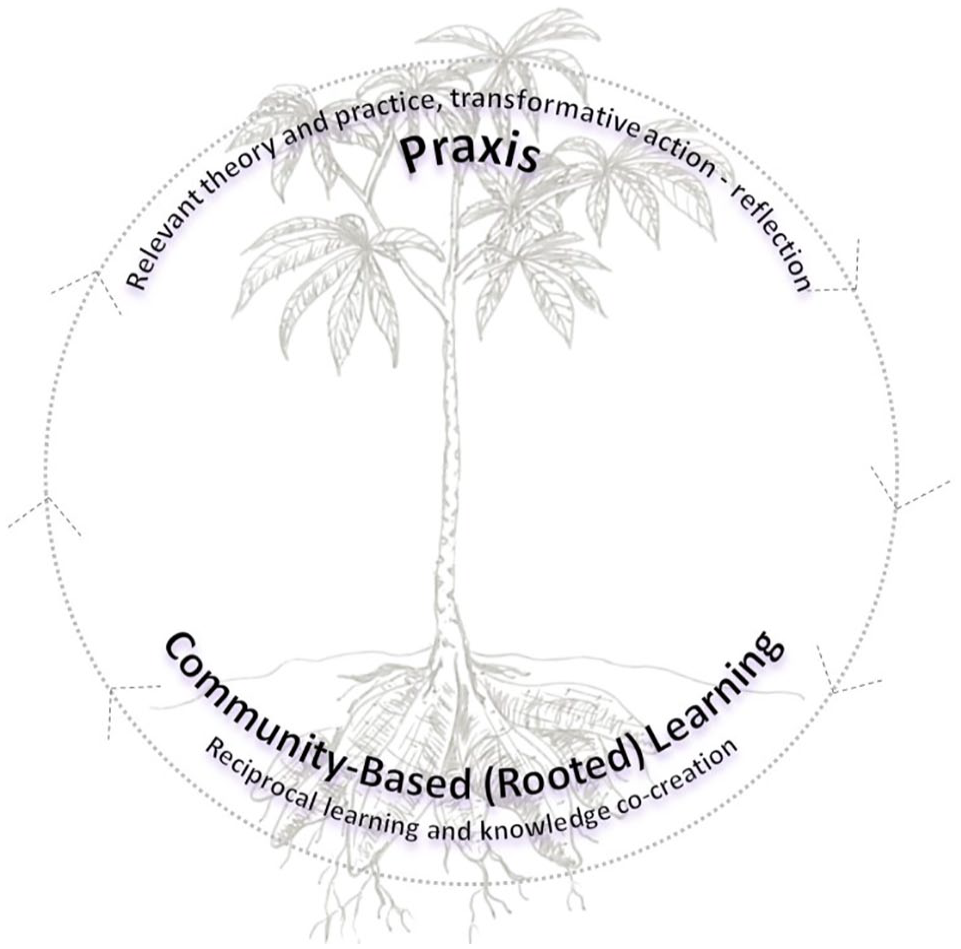
Conceptual model representing our research process through yuca root and growth.
Our research design holds community members and their values at the center where they inform and retain authority over the design, knowledge creation, and outcomes. This included storywork, in which we created space for the sharing of stories and lived experiences of Indigenous practitioners and researchers working within community (Archibald et al., 2019). Both the primary researcher and community members in this study held dual collegial roles as collaborators, researchers, and participants throughout the process. This included the publication process, inviting all participant-researchers to engage as co-authors.
Community-based (rooted) learning: listening and guaitiao
Our early phase in the research process included listening and regenerating the Indigenous Caribbean Taíno (Arawak) concept of guaitiao—extending community relations. During initial site visits in Kiskeya (Indigenous place name for Dominican Republic) and Borikén (Indigenous place name for Puerto Rico), we nurtured cross-community guaitiao through cultural exchanges, including foods, gifts, song, dance, exchange of knowledge and stories, informal discussions, and meeting each other’s relatives. We listened with elders, knowledge holders, and educators at Caribbean Indigenous education centers. Through these early exchanges, the primary researcher who had secured a grant for supporting a network for Indigenous Caribbean scholars and practitioners working in collaborative conservation-related work identified practitioner interests and needs that informed the development of the research project and gathering described throughout this article.
Reflection and action: co-designing the inter-island knowledge exchange
Preliminary site visits and in-person informal discussions were essential for trust-building and inviting study participants to collaborate. Following this, Indigenous scholars and practitioners co-designed the agenda for a 2-day inter-island knowledge exchange. The practices of deep listening and guaitiao proved helpful when co-developing the agenda, identifying meaningful research questions and objectives, and deciding the most effective format for the exchange. For example, we determined the importance of covering costs to improve access for resource-limited practitioners working in rural areas. This process reinforced a sense of ownership and commitment for the knowledge exchange. These relationships also supported sustained dialogue prior to the event to address ethical and personal concerns between potential participants, community organizations, and academic organizations.
We designed the exchange to support a participatory format for gathering research data while also providing a means to strengthen the “coconut wireless network”—informal Caribbean network of who-knows-whom. Most planning took place by telephone and through a shared web platform (Google Drive) over several weeks following initial field visits. We designed our exchange to weave group discussions and opportunities to share stories in with cultural site visits in the community to support discussions about Caribbean Indigenous knowledges and science education. An early career scholar (D. M. David-Chavez) in partnership with a mentor-expert in Indigenous evaluation methods (S. Valdez) led design and facilitation for data gathering.
Methods
The timeline of activities described in the following section includes three main components—our criteria and process for selecting research participants, data gathering methods, and data analysis. We detail facilitation methods for gathering data throughout the 2-day inter-island knowledge exchange, including story-sharing discussion activities held each day. We frame our approaches for data analysis using Indigenous evaluation methods along with participatory and grounded theory analyses.
Participant selection
One project goal from our primary funding grant was to strengthen relationships and learning opportunities across communities engaged in similar experiential practice, fostering a formal peer support network in the process. Therefore, we established our participant selection criteria to include self-identifying Indigenous scholars or education practitioners engaging with Indigenous knowledges and environmental science education in their work in the Caribbean islands. We focused on youth education both in school and community settings, recognizing that engaging Indigenous knowledges often involves bridging formal and informal educational settings, as well as multiple generations within the community (Brayboy & Castagno, 2008; Cajete, 1994). We used snowball sampling, also known as chain-referral (Bernard, 2011; Goodman, 1961), a nonprobability sampling method, in which each participant is asked to recommend additional participants from within the same knowledge domain. Based on available resources, we initially focused on two islands, Borikén and Kiskeya, as geographic boundaries for the project, eventually expanding our geographic scope to include potential participants working in Cuba, Kalinago Territory in Waitukubuli (Indigenous place name for Dominica), Xaymaca (Indigenous place name for Jamaica), and Guyana. In total, we included seven participants—four Indigenous practitioners (three female, one male) leading community-based programs that engaged Indigenous environmental science knowledge and youth (elementary up through early-college age, around age 6 years through early 20s), and three Caribbean Indigenous scholars (two female, one male) whose doctoral research purpose included supporting such programs. Although additional Indigenous communities live in the region, locations and participants accessed for this study include primarily Taíno (Arawak) and Kalinago communities due to time, funding, and access limitations. We acknowledge in limiting our participants, findings may reflect inherent biases which may not generalize to a larger population.
Many of the limitations in this study reflect broader challenges we sought to address through the research. First, the difficulty of finding participants who identify with this research theme (due to lack of value or awareness regarding Indigenous knowledges and identity in the region). Second, and interrelatedly, overcoming the unique geographical, cultural, and political barriers that divide populations in this region. Although many Indigenous communities in the Caribbean share ancestral native language families and cultural knowledge, they are divided by political boundaries, geographic barriers, cultural differences, and accepted colonial paradigms. In addition, most Caribbean island community members hold multi-heritage ancestry, generally Native American, African, European, and Indian. In this contemporary era, many community members may not self-identify as “Indigenous” or “Native American” or recognize their cultural knowledge and practices as Indigenous knowledges, and therefore may not have been included in this study. This also speaks to the question of who holds the right to define “Indigenous” (Corntassel, 2003) and the historic influence of assimilationist education (Harrison, 2018). The concept of Indigenous knowledges must also be addressed within this ambiguous multi-heritage context. Namely, dynamic, and adaptive Indigenous knowledges in practice today do not necessarily represent exact archetypes of Indigenous Caribbean practices documented in 1492—the year marking the beginning of colonial invasion and occupation in the Caribbean region (Pané, 1999). We acknowledge inherent risk for misrepresentation within the language and definitions used in our research study.
Facilitating the exchange
In May of 2016, we convened for a 2-day inter-island knowledge exchange focused on the theme of Indigenous knowledge and science education in the Caribbean. Just prior to beginning the exchange activities, we held an informal welcome dinner in which we synthesized and shared goals for our gathering. This process drew from constructivist grounded theory, generating “sensitizing concepts” to draw the research to variables of interest and concern from the participants’ perspectives (Bowen, 2006).
The 2 days that followed included an ethics and consent protocol, visits with local researchers and educators, visits to local farms and schools, cultural site visits, story-sharing discussions, and community presentations. Before beginning, we discussed the purpose and goals for collecting and recording data, reviewed a confidentiality agreement developed by the Indigenous education program hosting us to protect local intellectual property rights, and provided the university institutional review board consent protocol. During the ethics protocol, participants also specified how they wished to be identified for the study, including the option to remove identifiers for anonymity. Two participatory story-sharing discussions held on consecutive days of the exchange served as the main sources for gathering data. Story-sharing provided a process for unfolding dialogue through story, creating a space for all voices to be valued and heard. We also invited participants who could not physically attend to contribute their voices through telephone interviews (this included one practitioner).
Story-sharing and interviews centered on the following research questions: (a) What benefits do you perceive for including Indigenous knowledge in your program or research? (b) What barriers or challenges do you perceive for including Indigenous knowledge in your program or research? (c) What resources do you use or need to include Indigenous knowledge in your program or research? These questions opened lines of discussion for participant-researchers to reflect on their own awareness and perceptions through personal lived experiences. During our last story-sharing discussion, we added one additional research question: How do you define “Indigenous science” in your Native language? Due to acts of genocide and discrimination, Indigenous languages in the Caribbean islands remain dormant or endangered (Devonish, 2004). Bringing Indigenous language into the exchange discussion allowed us to develop place-based, culturally responsive vocabulary to describe concepts we were reflecting on. Previous studies recognize inclusion of Native languages as a critical element of effective practices for science education programs grounded in Native ways of knowing (Mack et al., 2012; McKinley, 2005) and for transmitting Indigenous knowledges (Battiste, 2008).
For story-sharing, we used a participatory thematic wall activity—an Indigenous evaluation research activity developed by the Native Pathways (n.d.) educational consulting organization. For this activity, we asked participants to consider our gathering theme and record individual responses for each of the research questions. We then invited everyone to orally contextualize their responses as a group. Fortunately, we shared one common language (English); however, some may have been limited in interpreting outside of their mother language. We used digital audio recorders and notetaking to record conversations, dialogue, and engagement both during story-sharing discussions and community site visits. Dialectical differences also proved challenging for interpreting and recording audio transcripts. We used member checking, in the form of participant-researchers reviewing transcribed quotes to ensure accurate interpretation (Lincoln & Guba, 1985). Our story-sharing discussions and activities created a space for storywork in which life experiences and stories (our data) provided shared content for reflection and knowledge co-creation (Archibald, 2019).
Indigenous evaluation methods
Indigenous evaluation methods allowed for an adaptive process that respected local cultural protocol, focused research objectives to meet community needs and interests, and nurtured opportunities for building relationships (LaFrance & Nichols, 2009). We adapted the focus of our exchange as needed based on participant-researcher responses to an open-ended written reflection provided at the end of the first day focused on identifying learning interests of the participants. An open-ended post-event written reflection, focused on critical reflection of the research process and personal outcomes, also helped evaluate whether and how the exchange format served our community of Indigenous education practitioners and scholars for future studies. In addition, we included gift exchanges in practice of reciprocity, traditional meals, and opportunities for reflection at cultural sites to immerse participants in the land and to honor the stories and time given for this research. Visits to cultural field sites provided opportunities for shared experiences and trust-building among participant-researchers. The locations, pre-selected by one of the local practitioners who co-designed the exchange, also served to contextualize our discussions in place.
Participatory and grounded theory data analysis
Participatory activities served as channels for inductive thematic analysis, in which we continuously compared similarities and differences in our experiences and stories connecting them to larger themes (Braun & Clarke, 2006). We explored differences between participant-researchers’ responses on-site through discussions that further contextualized the lived experiences forming these responses. These in-person exchanges informed data interpretation and coding procedure led by the primary researcher in later analyses.
After transcribing story-sharing audio-recordings, analysis followed a process of listening to the data without recording notes or coding. After this, a session of open coding included identifying actions, suggestions, potential themes, and emotions (Corbin & Strauss, 2008). The second iteration of focused coding, comparison, and analysis of differences in data segments aided in our search for the underlying meaning within initial codes. During this phase, the focus in our coding shifted beyond the specific emotions expressed (loneliness, frustration, etc.), to the circumstances and stories contextualizing them (exclusion, lack of resources, government inaction/imposition, etc.). The third iteration of coding refined these focused codes into higher level conceptual and theoretical categories. We adapted several names of conceptual categories directly from the participants’ voices to reflect some of the metaphorical language they used (“crabs in the bucket,” “igniting the youth”). After repeating the same process (reading, listening to the data, open coding, focused coding) for the second story-sharing discussion transcript, we proceeded with axial coding—connecting, comparing, and contrasting the concepts identified in each set of data. We elaborated on some prior categories and developed new ones as relevant for higher level categories (Figure 2).

Conceptual codes for barriers and support resources varying by spatial and temporal scale.
We applied this same coding and memo-writing process for the daily reflection and written reflection open responses recorded immediately following the event, by recording them into a spreadsheet and coding each individually. We also included data from one telephone interview with a practitioner unable to attend the event. Our process for data analysis provided a means to triangulate interpretations and check for gaps, contradictions, and further examples representative in our coding by using constant comparison. Given that some phases of data analysis were undertaken by the primary research facilitator (transcribing, high-level coding, and visualizing the grounded theory), all data findings and publication material underwent numerous cycles of review and comment to ensure accurate interpretation and approval from all participant-researchers prior to submission for publication.
Findings and discussion: unfolding our collective story of survival, adaptation, resilience, and regeneration
Within the following key thematic findings, we observed how our individual voices thread together in a larger, collective, deeply interconnected, and intergenerational story. We grew in our understanding of how the unique barriers we were facing exist within a larger socio-political and historical context. We also grew in our understanding of how barriers and challenges manifest at different scales of space and time, and the resources to overcome them. Culturally relevant visual imagery allowed us to map out how each of these concepts related to one another on various spatial and temporal scales (Figure 3). Through each phase of the research process, we observed our collective story of survival, adaptation, resilience, and regeneration unfolding. Akin to First Nations scholar Jo-ann Archibald’s model of holism applied in Indigenous storywork for Indigenous teacher education programs, we saw the interrelatedness between various levels in spatial scale ranging from individual self out to community and nation (Archibald, 2019). Our visual map allowed us to further connect these with relational forces occurring at varying temporal scales, from immediate and present to intergenerational (both past and future). The following section describes our process for meaning-making and critical reflection through these stories—our primary sources of data, as documented directly from the voices of participant-researchers and framed through varying spatial–temporal levels.
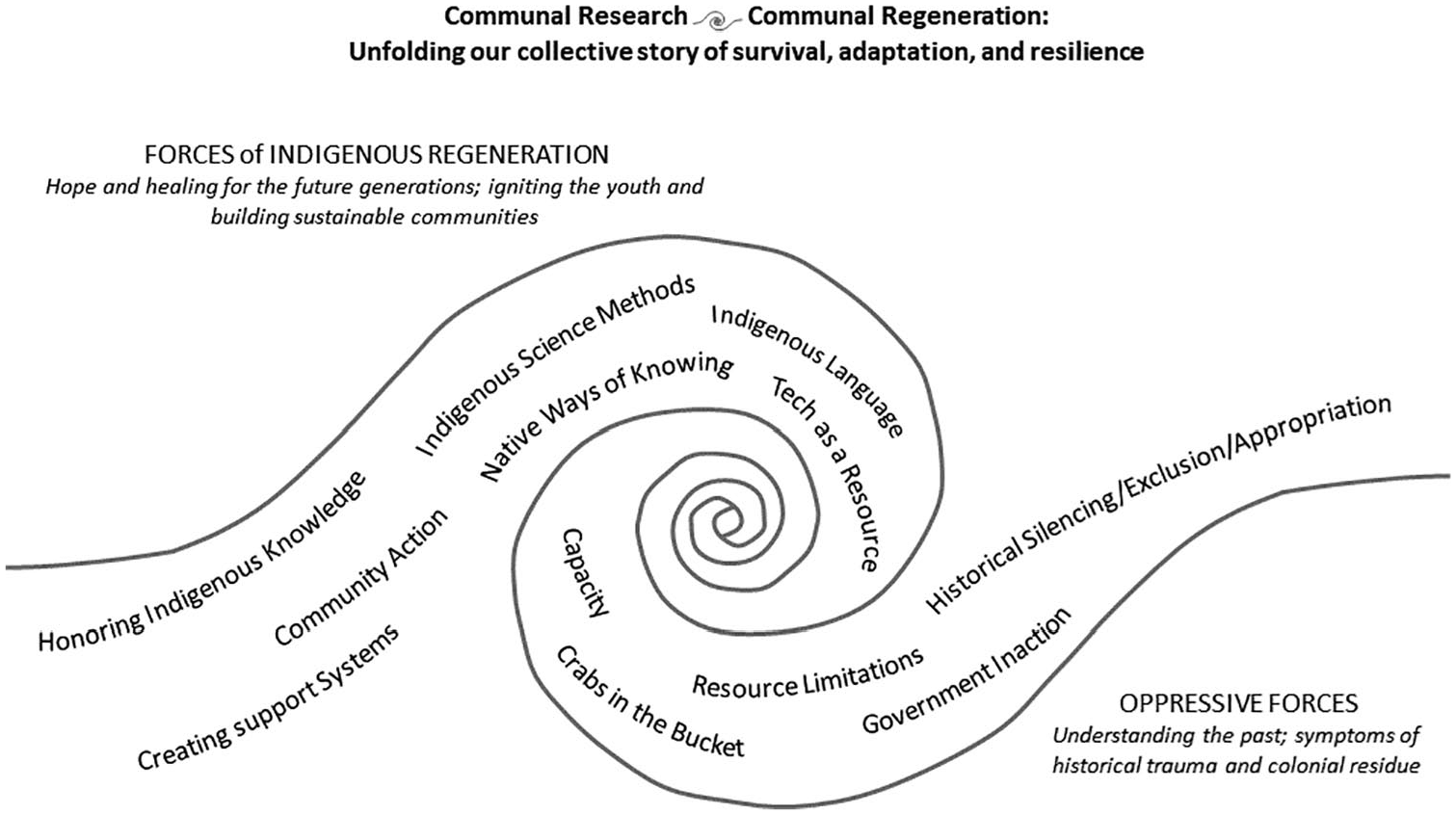
Culturally relevant visual map of grounded theory.
Immediate local to regional challenges and support resources
Looking at findings within these various scales helped us to connect immediate issues participant-researchers faced with deeper socio-political histories and proved helpful for organizing thematic findings. Beginning at an immediate (temporal) and individual or local (spatial) scale, we identified capacity—unique challenges and restraints faced by Indigenous scholars and practitioners who are operating within multiple cultural frameworks—as a key barrier. Here, we share examples informing the development of this category (please note, English may not be speakers’ first language): My job that I do, geology, that’s a natural science and I do ethnography which is a social science. Sometimes I’m not good enough to be a social scientist. Sometimes the work that I’m doing is not at the top to be natural science per say. So, I need to fight with that. (Indigenous scholar working in Borikén and Kiskeya) Still I am finding methods in me, not outside . . . to understand that if I am not spiritually [involved] I won’t be able to rescue anything. I won’t be able to respect Yúcahu . . . I won’t be able to tell the kids the meaning . . . (Indigenous practitioner working in Kiskeya)
These stories speak to personal struggles and limitations regarding how to honor who you are in your practice while meeting internal and external standards necessary for effective work. These quotes reflect challenges seen throughout multicultural and cross-cultural circumstances as scholars and practitioners reconcile between diverse ways of knowing that may hold fundamental differences (Aikenhead & Jegede, 1999). Challenges born from these differences observed in our findings link back to previous research identifying tensions between applying a holistic, interrelated, and interdisciplinary scientific understanding rather than compartmentalizing within standard disciplines (Barnhardt & Kawagley, 2005). In addition, dominant science narratives may conflict with personal obligations to acknowledge the spiritual and cosmological context in which Indigenous knowledges are embedded (Aikenhead & Ogawa, 2007; Brayboy & Castagno, 2008; Little Bear, 2000). In some cases, spiritually contextualizing knowledge may result in exclusion from what is considered legitimate “science” in mainstream culture (Snively & Corsiglia, 2001). In the process of having to face these challenges, we also recognized how they strengthen our ability to navigate and bridge multiple knowledge systems and to support others with diverse worldviews in other contexts of our lives.
We observed support mechanisms actively applied to address challenges in capacity at the individual and immediate scale, including methods, Indigenous language, technology as a resource, and Native ways of knowing. Methods—tools used to engage Indigenous knowledges (with an emphasis on environmental science knowledge) in research and practice—represented research and education methods shared, such as youth and elder interviews, analyzing Indigenous place names, and deconstructing historical texts. These methods reflect similar approaches used in other settings. For example, Mayan environmental knowledge education programs in Belize also recognize the value of youth and elder interviews for drawing out scientific knowledge while retaining cultural context (Baines & Zarger, 2012). Participants contextualized methods used within their respective areas of work, such as the following example: Caliche or calichi it is a Taíno word that means water coming out from the mountain . . . that’s again how I put stuff together using toponymy. So, the place is called Caliche. The place is in the limestone is in caliza. So, water flows through the rock. But the place is called Caliche because there is a story of el niño de caliche, the boy of the caliche, and that pinpoints in a cave that is seasonal that water comes out from the cave. (Indigenous scholar working in Borikén and Kiskeya)
In this example, drawing from multidisciplinary methods including ethnography, hydrology, and toponymy (study of place names) identified in oral history and historical texts helped to deepen our understanding regarding the geological processes of the field site.
This excerpt also emphasized Indigenous language; another significant conceptual category identified in this analysis. As McCarty and Lee (2014) affirm in their discussion on Indigenous education sovereignty, “language is vital to cultural continuity and community sustainability because it embodies both everyday and sacred knowledge and . . . is also significant for sustaining Indigenous knowledge systems” (p. 109). This assertion is also shared by Barnhardt and Kawagley (2005) in their work with Alaska Native ways of knowing, who observe the deep connection between Indigenous knowledges and languages. In our study, we observed how language holds place-specific context and conceptual understandings that helped us expand our capacity and understandings in our own practice.
At this scale, we further recognize how many Indigenous scholars and practitioners use both deep, place-based, cultural knowledge and philosophy (Native ways of knowing) and contemporary resources (technology) simultaneously. In our story-sharing discussion, a practitioner describes these resources in her work: We’re also now engaging in a program to clean the rivers. Ok the kids in each school . . . they go out with the GPS and they identify the hotspots in each community and these hotspots have all the different contaminants . . . I do a map . . . and I send it over to the Department of Natural Resources and the Environment. Ok, do they act on it? No, unfortunately they don’t, but at least we’re showing [the youth] what’s gonna happen to that river . . . for example, you are Mother Earth, and these veins that are flowing through your body, is the water of Mother Earth . . . (Indigenous practitioner working in Borikén)
In this example, the practitioner and youth use both mapping technology and an Indigenous worldview lens to learn about the environment. Geospatial science technology has served as a useful tool for Maōri communities as well for both maintaining and protecting diverse forms of knowledge (Harmsworth, 1999). Besides Indigenous communities adapting modern technology as a resource, we also recognized how communities have developed and utilized innovative forms of technology (as well as science, engineering, and math) since precolonial times to address their needs (Kawagley et al., 1998).
After centuries of observation of Earth’s natural systems, innovation and application of technology in Indigenous communities also reflect Native ways of knowing, the final conceptual category represented in this data finding. Native ways of knowing include unique cultural concepts, such as our relational accountability toward Mother Earth as a living being, described here. Additional studies likewise emphasize the importance of maintaining a relational understanding of the natural environment in which every aspect is alive (Aikenhead & Ogawa, 2007). Furthermore, Bang and Medin (2010) assert that “cultural practices and their connections with Native ways of knowing must be the foundation of a community-based science curriculum” (p. 8).
Crabs in the bucket represents another barrier conceptualized on a local scale. This category reflects interpersonal challenges faced within one’s own community. When several crabs are harvested into a bucket one crab may start to climb out, yet before achieving freedom is pulled back down by the others still in the bucket. As one participant-researcher explained, Competition amongst groups is a big barrier for us, because we’re trying to do something positive, and because we’re doing it then they want to stop it. You can’t be doing that because I didn’t think of it . . . you’re gonna gain recognition, you’re gonna get funding. So, they’ll try to stop it . . . that’s a barrier that we’re fighting against almost every month here. (Indigenous practitioner working in Borikén)
Additional research studies note a need for further understanding of power dynamics, including at the local community scale when determining effective maintenance of Indigenous knowledges (McCarter et al., 2014). The mention of funding also links to the concept of resource limitations, which was identified in several threads of our discussion on challenges and barriers. Educators and community members both within and outside of the Caribbean noted how Indigenous knowledge-related initiatives may not receive priority for government funding (Harrison, 2018; McCarter et al., 2014). In our discussions, lack of funder’s respect for or recognition of Indigenous knowledges parallels previous concerns found in the literature (Snively & Corsiglia, 2001; Van Eijck & Roth, 2007). In the context of these challenges, we observe how competition between organizations, including competition for research funding, can create local level barriers.
Regional challenges and support resources
Moving out in spatial scale, we identify government inaction as a barrier, with community action and creating support systems as related support resources. Government inaction can represent instances of lack of response or neglect by officials and entities. Previous studies in Vanuatu (McCarter & Gavin, 2011) and in Borikén (Harrison, 2018) also identified lack of government support as a barrier to including Indigenous knowledges in education. In our findings, we observed a counter to government inaction through community action, in which community members organize to govern over and address their own concerns. A similar response is recorded in research regarding maintenance of Indigenous ecological knowledge in Malekula Island, Vanuatu, through locally driven formation of kastom schools (centers for cultural knowledge and practice) (McCarter & Gavin, 2014). Community action may also reflect service to community, a core value and standard recognized in First Nations communities in Canada for improving science education opportunities for youth to apply skills and technologies in ways that enhance connections to their cultural communities (MacIver, 1995). Within this same spatial scale and context, creating support systems is reflected in the following example: I’m a strong supporter of making connections with other Indigenous communities. They are resources. (Indigenous scholar working in Kalinago Territory)
The emphasis on making connections also highlights the importance of building relationships through cross-community exchanges such as our research gathering. Numerous studies prior to our own recognize the value of creating and strengthening horizontal support networks bridging Indigenous scholars, educators, and knowledge keepers, along with vertical networks connecting communities with external policy, funding, or research institutions sharing common goals (Barnhardt & Kawagley, 2005; Battiste, 2002; Berkes, 2002; McCarter et al., 2014; Tang & Gavin, 2016). Several participant-researchers emphasized technology as a resource strengthening these connections through digital communication tools including social media. Similarly, Battiste (2002) highlights the significance of communication technology as a resource for developing innovations and sharing across support networks. In the open coding process, we observed several participant-researchers describing feelings of loneliness in their work and feeling limited in their individual capacity with little local support at times. Creating support systems provided a path for them to find allies in this work, share effective methods, and locate funding resources. In informal discussions following the exchange, we observed expressions of gratitude in feeling less alone in these efforts and sustained connections between participant-researchers through social media platforms and by telephone.
Intergenerational and large-scale challenges and support resources
Personal struggles we observed, such as loneliness and anger, also reflect symptoms from another conceptual category rooted in a larger spatial–temporal scale. Centuries of systematic oppression, misrepresentation, displacement, and exploitation of Indigenous peoples and knowledge systems force unique challenges into the lives of the scholars and practitioners who contributed to this study. Other initiatives for improving Indigenous education recognize the need to unpack unresolved legacies colonial history inflicts upon Indigenous learners (Little Bear, 2009). Furthermore, evidence remains of ongoing extractive methods by scientific researchers that neither benefit Indigenous communities nor address underlying historical threats to sustaining Indigenous knowledges (David-Chavez & Gavin, 2018 ; Simpson, 2004). In our case study, we conceptualize these circumstances as historical silencing/exclusion/appropriation, as noted by the following participant-researchers: Even in terms of schools, a lot of Indigenous communities have to send their children to schools where they don’t learn about themselves. That needs to change, because they grow up in the school system that teaches them about other people, doesn’t teach them about themselves. Then they might not have access to learn about themselves at home and so you get this generation that’s disconnected . . . when you have that disconnect, then you start breaking down, the culture starts breaking down. (Indigenous scholar working in Kalinago Territory) The myth of extinction is constantly being thrown at the people . . . campesinos, in trying to elevate themselves, they send their kids to school. When they go into these schools, the schools tell them that [their] culture is gone . . . So now all these stories that were real oral traditions become more like fairytales. (Indigenous practitioner working in Kiskeya and Xaymaca)
These reflections link to previous research describing Caribbean colonial school systems as an extension of national assimilation policy in which, “school curriculum replaced community knowledge tied to the land” through systematic displacement from language and culture, and a push from rural to urban, aiming for “erasing the rural Indigenous knowledge base and identity formation” (Harrison, 2018, p. 76). In the same study, effectiveness of this erasure varied across educators in the twice-colonized island of Borikén, with some holding the belief of cultural extinction and others explicitly recognizing and valuing Indigenous knowledge contributions for maintaining environmental sustainability. In recognition of these and other contributions, we observed the concept of honoring Indigenous knowledge as a partnering support mechanism for overcoming the barrier of historical silencing. This conceptual category represents the process of returning voice, respect, and acknowledgment to Indigenous knowledge holders, while also safeguarding Indigenous knowledges. Indigenous educator and researcher, Robin Kimmerer (2002) posits that “a call to introduce science students to the validity and value of traditional ecological knowledge . . . should be inseparable from a serious discussion of protection of traditional knowledge from exploitation” (p. 437). Additional literature regarding Indigenous knowledges and education recognizes a strong link between power distribution, self-determination, sovereignty, and sustaining knowledge for future generations (Agrawal, 1995; McCarter et al., 2014; Simpson, 2004; Whyte, 2018). To overcome these challenges, stories within our discussions emphasized the importance of Indigenous youth learning about themselves to remain connected to their culture and enrich their learning: From the perspective of including Indigenous knowledge in the work that we do . . . I think that by doing that it respects Indigenous knowledge, to even have their voices be at the table, because they’ve been excluded. Indigenous people have been excluded for a lot. In terms of science, I think it enriches the field . . . it adds another dimension to the field. (Indigenous scholar working in Kalinago Territory)
As Indigenous scientists and educators, we seek to increase our understanding of the world around us and to prepare the next generation in the best way we know how. The specific examples demonstrated in these findings reveal how many of us work to achieve that goal in the face of unique challenges and opportunities, often with limited resources at hand.
Reciprocal learning and knowledge co-creation
Our analysis also highlighted the value of the research process itself. We observed instances, where we were practicing reciprocal learning and knowledge co-creation. In Tewa Indigenous scholar Gregory Cajete’s (2015) discussion extending the work of Paulo Freire, he describes how an Indigenous model of education supports “community to become partners in learning and becoming” through a “community-rooted approach,” shifting “from an expert-recipient relationship to a relationship of mutual and reciprocal learning and co-creation” (p. 71). In the context of our research, these concepts involve intentionally creating spaces for shared learning and inviting participants to generate knowledge together. Through the story-sharing, cultural activities, and time spent together, we were able to build a sense of trust with each other, and to build our own capacities to identify and explore these complexities together with vulnerability and humility. Within the post-event written reflections, for example, one participant-researcher stated, “I think the most important outcome was the growth of ideas and sharing that occurred.”
Theoretical growth
We also reflect on how the stages in this process informed our own theory development for Indigenous education and research in the Caribbean. Indigenous researchers have identified “understanding the interrelationship with our past and how it shapes our present world” as a path for healing (Yellow Horse Brave Heart & DeBruyn, 1998, p. 76). Likewise, we observed how an active process of communal research can simultaneously serve as a form of communal regeneration (growth and healing). This concept of communal research  communal regeneration forms an overarching theme within this research (see figure 3). The symbol between is an ancient Taíno representation of huracán (hurricane). For some, this symbol represents time in a non-linear, spiral form. This symbol also represents forces of destruction and regeneration within a duality of space, time, and being. Dual forces, and concepts we identified within them, woven together in this double-armed spiral include oppressive forces resulting in historical trauma and the colonial residue or symptoms of oppression (barriers identified in the findings). Alternately, forces of Indigenous regeneration represent hope and healing for future generations through igniting the youth and building sustainable communities.
Igniting the youth (inspiring youth to engage with and care for their natural and cultural heritage resources) and building sustainable communities (building communities that care for the land and future generations) are the final higher level conceptual categories constructed from our analysis. The concept of igniting the youth also serves to counter marginalization of Indigenous youth through shaming from mainstream society, another underlying threat to Indigenous knowledges identified in previous studies (Tang & Gavin, 2016). Additional resources for overcoming these challenges include strengthening intergenerational knowledge sharing, supporting youth to learn from the land, and nurturing a sense of cultural pride (Baines & Zarger, 2012; McCarter & Gavin, 2011; Simpson, 2004; Tang & Gavin, 2016). Building sustainable communities relates to Indigenous worldviews, such as those described by Kawagley and Barnhardt (1998) which emphasize a long-term, relational accountability to both land and community. Numerous efforts from Indigenous communities in the Caribbean and in other areas of the world recognize the need for communities to regenerate ties back to land, language, and culture after forced displacement (Goodyear-Ka’ōpua, 2009; Harrison, 2018). According to Kanaka Maoli scholar Goodyear-Ka’ōpua (2009), “degradation of ecosystems and indigenous economic systems have gone hand in hand with the decline of indigenous knowledges” and decline of relationships to the land which nourishes us (p. 50). Regeneration of Indigenous communities and knowledge systems therefore requires interconnected goals for restoring relationships, spiritual context, food systems, economies, governance, and livelihoods. Stories shared throughout our exchange reflected the intergenerational nature of this work and our collective hope for the future as we understand, interpret, and write our own story of survival, adaptation, resilience, and regeneration. Our theoretical contribution, visualized and grounded within these stories of communal regeneration and lived experiences, provides a recontextualized framework for enhancing understanding and prioritizing areas for further practitioner support in the fields of Indigenous education and research.
Conclusion
The process and findings from this inter-island exchange led to a deeper understanding of the unique context surrounding benefits, barriers, and resources for several Indigenous Caribbean educators and scholars who engage Indigenous knowledges in their practice. Understanding how the symptoms of colonization and imperialism manifest within our education systems helped us to further untangle and reweave the webs in which we learn and work. Each step of this process required meaningful reflection and action, which we achieved through applying a participatory research model, consistently placing community concerns, stories, and strengths at the center. By including the languages, places, and formats for exchange that were meaningful to the community members, we fostered a forum for reciprocal learning and knowledge co-creation. We recognize that complexities in the process, including within-community cultural and interpersonal diversity, will require space and time for ongoing reflection and dialogue. A reflexive, adaptive, and culturally responsive research protocol and timeline will support efforts like this in future research endeavors. We hope that the detailed description and methodologies presented here support further research in island and mainland Caribbean Indigenous communities that we were not able to include in this initial study. Based on our research findings, we agree with Battiste (2002), who calls for capacity building for Indigenous education and directing further support toward Indigenous scholars working within their communities. Furthermore, we observed how, as Cajete (2015) explained, “researching ourselves communally through our own process, we empower ourselves to reclaim our cultures and communities” (p. 219). After five centuries of imperial and colonial oppression, we recognize this is generational work. This story, and the process of bringing these voices together, offers a means for helping us remember our history and for forming our own self-determined pathways forward.
Footnotes
Acknowledgements
We thank the Naguake Community-School Survival Program, University of Puerto Rico Cayey, and Humacao community for hosting our exchange. We thank Higuayagua and the Smithsonian National Museum of the American Indian’s Caribbean Indigenous Legacy Project for support with this study. We thank Michael C. Gavin for providing academic advisement. Author contributions include the following: D. M. David-Chavez, (Taíno)—primary researcher and facilitator; S. Valdez, (Laguna Pueblo)—research mentor and facilitator; J. Estevez (Taíno), Á. Garcia, (Taíno), K. Josephs (Kalinago), C. Meléndez Martínez, (Taíno), and A. Troncoso (Neo Taíno)—participant-researchers. Lastly, we thank Jennifer Folsom and two anonymous reviewers for their helpful comment on earlier drafts of this article.
Glossary
Declaration of conflicting interests
The author(s) declared no potential conflicts of interest with respect to the research, authorship, and/or publication of this article.
Funding
The author(s) disclosed receipt of the following financial support for the research, authorship, and/or publication of this article: This work was supported by the Center for Collaborative Conservation Fellows Program, the National Science Foundation Graduate Research Fellowship (grant no. DGE-1321845 Amend 5), and Colorado State University’s Human Dimensions of Natural Resources program.
