



Abstract
Access to publicly funded bariatric surgery in New Zealand is limited, but privileges patients who identify as New Zealand European or Other European. This example of institutional racism in the New Zealand health system further reiterates that Māori face inequitable access to gold standard medical interventions. This article analyses semi-structured interviews undertaken with Māori who had bariatric surgery at Counties Manukau Health which houses the largest public bariatric service. Thirty-one interviews were conducted, from which six themes were identified in relation to the stages of the bariatric journey. A thematic analysis of transcripts using an inductive approach was undertaken. Using Kaupapa Māori Research–aligned methodology, sites of racism, compassion, clinical barriers to positive health experiences and life-changing experiences were identified along the bariatric journey for Māori patients.
Introduction
Obesity and its sequelae are major preventable health issues for Māori, with health inequities persisting since the establishment of the New Zealand (NZ) health system. Bariatric surgery is an inclusive term for weight loss procedures and forms a small part of obesity management (Buchwald et al., 2011). It is the most effective intervention for weight loss (Buchwald et al., 2004, 2009; Sjostrom et al., 2016). While obtaining bariatric surgery is restricted by cost and limited public funding, access to publicly funded bariatric surgery in NZ appears to privilege patients who identify as NZ European or Other European ethnicities (Rahiri, Lauti, Harwood, MacCormick & Hill, 2017; Taylor et al., 2018).
Health equity is the absence of systematic disparities of health and the socioeconomic determinants of health, between different social groups with different levels of underlying social advantage (Braveman & Gruskin, 2003). Monitoring equity involves investigating the distribution of health resources by regular auditing of systems and agencies that determine resource allocation (Reid et al., 2017). Health providers are not positioned to affect change at the level of individual social determinants of health; however, they have a legislative responsibility to support Māori health equity through ensuring Māori are able to access high-quality, responsive and culturally safe healthcare services (Reid et al., 2017).
Despite publicly funded bariatric surgery being offered since 2007 in NZ, studies investigating equity in bariatric surgery for Indigenous peoples worldwide are severely lacking (Rahiri, Tuhoe, MacCormick, Hill, & Harwood, 2019). Even fewer studies describing Māori experiences of bariatric surgery from access to outcomes following surgery exist (Rahiri et al., 2018; Taylor et al., 2018). This study aimed to explore Māori perspectives of the bariatric surgery journey at the largest public bariatric service in NZ.
Methods
A qualitative study with semi-structured interviews was undertaken with 31 Māori who had bariatric surgery at Counties Manukau Health (CMH). This study was guided by Kaupapa Māori Research (KMR) which ensured responsiveness and safety to Māori sharing stories from within a space that is often imbued with contentious narratives surrounding obesity and deservedness for having bariatric surgery (Rahiri et al., 2018).
Eligible Māori participants were identified by National Health Index (NHI) number and invited by letter accompanied with a participant information sheet, consent form and return envelope. Participants were informed that this study sought to understand their perceptions and experiences of bariatric surgery at CMH and that whānau (family) were welcome to participate. Interviews were undertaken from August 2017 to May 2018 using a semi-structured interview schedule by the primary author who is a Māori surgical research fellow, PhD candidate and surgical registrar.
Participants were able to ask questions related to bariatric surgery and their own postoperative journeys as Māori within a safe space. This shared identity and understanding facilitated meaningful relationships and conversations between researcher and participants and supported research responsiveness to Māori (Reid et al., 2017). Interviews were held in private consult rooms at CMH or at participants’ homes with kai (food) provided. Particular care was undertaken to ensure the researcher engaged in reciprocal KMR and acknowledged the power dynamics between the researcher and the participant as well as between the doctor and the patient. Being a doctor, although with complex power issues, was a strength in these conversations as it meant medical advice and queries could be discussed in an ongoing format, particularly if referrals needed to be made. An extended description of the methodological stance for this research is described elsewhere (Rahiri, 2019).
Inductive thematic analysis was independently performed by two authors who are Kaupapa Māori researchers (J.-L.R. and J.T.); this was to ensure diverse Māori perspectives were incorporated into the analysis to reflect Māori realities (Braun & Clarke, 2006; McIntosh, 2005). Transcripts were read through in an iterative manner to identify initial codes which were revised, inspected and grouped into themes. The themes were identified in relation to the stages of the bariatric surgery journey (Figure 1), as these were a natural, organic way to structure participants’ experiences and reflections on their journeys.
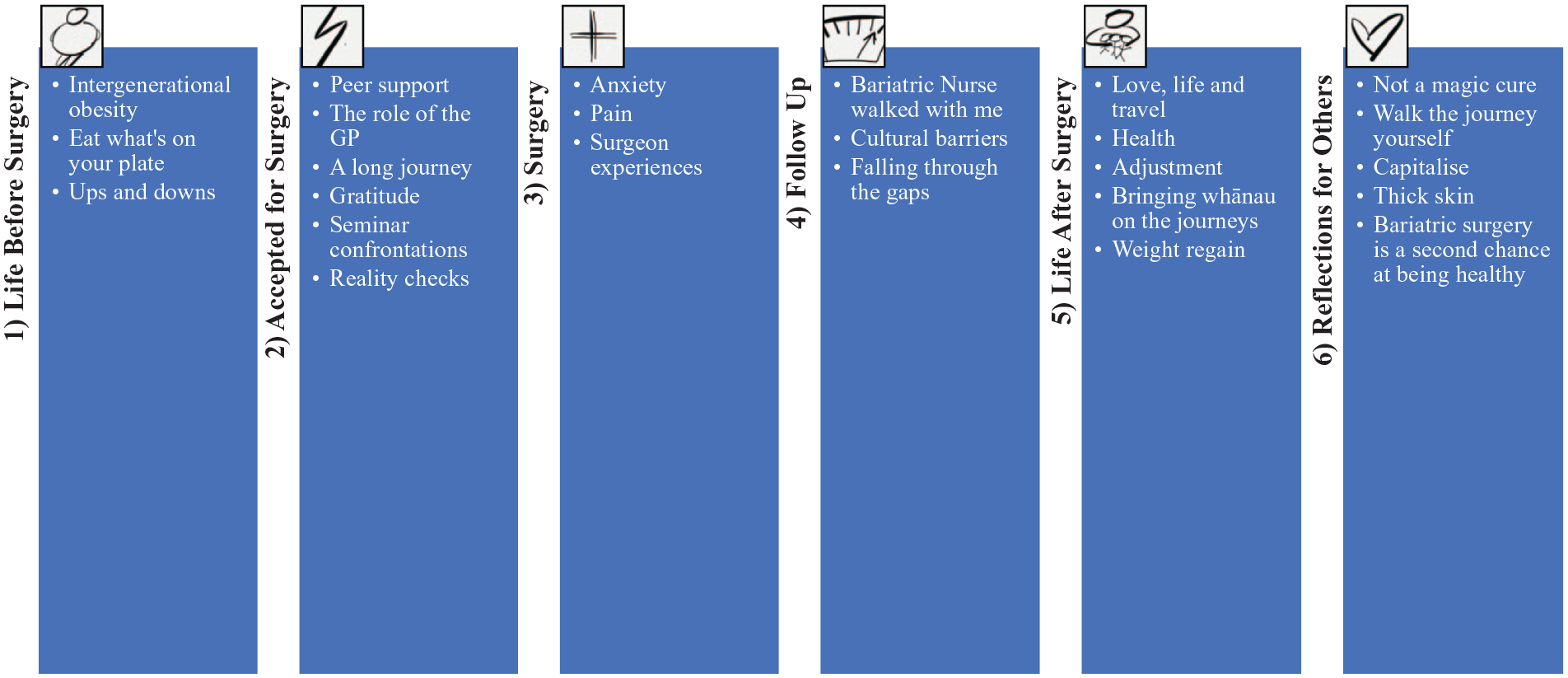
Major themes describing Māori experiences along the CMH Bariatric Pathway.
Results
Thirty-one Māori (22%) participated in this study and were subsequently interviewed from August 2017 to May 2018. Table 1 presents a summary of participant demographics. Transcripts were returned to seven participants as requested; however, no amendments were required following their review. Six main themes were identified in the analysis: life before surgery, accepted for surgery, surgery, follow-up, life after surgery and reflections for others. Participants shared their experiences from the beginning of their bariatric surgery journey up until post-surgery reflections; as such, themes were identified and were mapped along the bariatric surgery pathway (Figure 1). From these steps in the bariatric surgery pathway, 24 sub-themes were identified.
Summary of participant demographics.

SD: standard deviation; BMI: body mass index.
Life before surgery
Life before surgery encompassed a range of narratives and experiences in participants’ lives prior to having bariatric surgery. Intergenerational obesity was identified as a dominant theme reflecting the struggle of obesity-related ill-health that participants and whānau faced over their lifetimes. Participants often reflected on their childhood and could only remember being active. The idea of maintaining a “healthy weight” was often elusive: Now people think that weight loss just happens overnight but for some people it’s from when you were young, and you just struggle, struggle, struggle, struggle. And it’s not like I was a fat kid. . . we were outside playing. You know so I did all those things, but I think it was just hereditary—I was doomed to be that kid. (P4)
The sociocultural complexities of food relationships were illustrated through the sub-theme of “eat what’s on your plate”. “Not wasting food” and “being grateful” for having food prepared typified participants’ upbringings. These practices were common among participants where food and money were scarce. Eating all of your food on your plate was a respectful gesture, but also necessary when the next meal was not guaranteed. Despite this, participants attempted to curb “intergenerational practices” like this in order to alleviate the burden of obesity imposed on their grandchildren, even if it brought discomfort: As Māori, that’s how we’re brought up. Especially in my era you don’t waste your kai (food), you know. People starving and so you kind of consume your whole plate. And that sort of went on through to my kids as well, ’cos they’re big eaters. Now I try to break the cycle with my moko (grandchild), even though I cringe at the waste of food! (P28)
Some participants never considered themselves as “big” or “obese” until it was brought to their attention by others, including healthcare workers, whānau and even people passing by on the street: I thought I was beautiful you know with how big I was, but I noticed everywhere I went people would just look at me and I felt whakamā (embarrassed) . . . (P11)
Participants’ experiences of fat bias were common and often caused social isolation and low self-esteem. While participants appeared nonchalant about others’ hurtful comments and behaviours towards them for “being fat”, they were actually aware and wanted to become “invisible”, so they were not “shamed” in such a way. Participants reported that social stigmatisation placed upon “fatness” was associated with false notions of “being useless”, “being gross” and even “lacking smarts”: But the fat thing was a big thing—that was the only way people could pick on me. I would always have that “oh yeah but you’re fat”. (P5)
For some participants, “being big” was “normal”, particularly if their family were also considered to be “big”. Due to various experiences that shaped participants’ relationships with food and body awareness, “dieting” and “weight loss” were often labile with many “lows and few highs”. This would lead to vicious cycles of weight cycling, which caused mental debilitation and anguish related to the inability to “lose weight”: I’d been going through quite a lot of emotional stuff and I think I was getting a little bit tired. . . I felt it was going on and on and I think mentally I just lost the blinkin’ desire to continue . . . (P15)
Life before surgery was influenced by intergenerational obesity and labile experiences of weight loss through dieting and exercise. Participants were commonly subjected to wider societal pressures of an “ideal body size”, which was underpinned by fat bias and fat stigmatisation. These experiences collectively shaped participants’ desires to pursue bariatric surgery.
Accepted for surgery
Being accepted for surgery signified a clear transition point for participants moving into a clearer pathway with the provision of a date for surgery. Participants described a “long journey” leading up to being offered a bariatric surgery. Some participants intentionally prolonged their journey in order to “become truly informed” about bariatric surgery and to “mentally prepare”. Drastic lifestyle changes were established due to participants’ awareness of the need to dwell in spaces that promoted weight loss (as this is a pre-requisite for qualifying for funded bariatric surgery) and mental preparation: So, I went to our friend’s place in Matamata and begged him for a job. I said can you help me I’ve got to lose weight. If I don’t lose weight I won’t get into surgery. I can’t at home—I’m too spoilt. But here if you give me a job and put me on the farm to work, I’ll work the weight off and I stayed with them over calving season and lost 25kg. (P5)
Being accepted for bariatric surgery was mostly viewed as a privilege. Participants described an overwhelming sense of “gratitude” to the CMH bariatric service and to their general practitioners (GPs). Participants acknowledged their GPs for referring them to the service and for their overall support in their weight loss journey. Several participants were referred more than once to the service. GP advocacy was crucial where there was reluctance for reacceptance by the CMH bariatric service: So, I went to see [GP] and told her and she weighed me and rung you guys up and told yous no you put her in, she’s right here. She has lost 25 kilos. She’s a food addict and she wants it . . . put her on the list, put her back and don’t take too long. (P5)
The “role of the GP” was central to connecting participants with the health system. Twenty-one participants had been with their GP for at least 10 years. Some (n = 9) had followed their GPs if they had moved to new practices, even if it meant driving further from their homes. The mentorship and guidance provided by GPs with preoperative weight loss goals were invaluable. Mentorship and “peer support” were important in the lead-up to surgery. Eighteen participants were closely connected to someone who had bariatric surgery. These relationships optimised participants’ “personal success” on the bariatric programme and provided a source of motivation to aspire for an “end goal” of sorts: So, I saw the benefits for her and how she just lost all her weight and she pretty much changed and that was kind of motivating for me and my health. (P22)
Mentors were important learning sources, especially in regard to learning from others’ “mistakes”. The most typically feared “mistake” was weight regain. This was at the forefront of participants’ minds when drawing upon the experiences of others: I didn’t even know that you could gain the weight back because I’ve had thin people that I’ve met on the journey and they gained weight . . . I was thinking how do you do that? You’re just not being good to your body? (P10)
Upon attending the initial seminar at the beginning of the CMH bariatric journey, participants described a range of experiences. “Seminar confrontations” ranged from “fair” to “daunting”. Many participants described feeling vulnerable, which led to a silencing phenomenon. In these moments, mentors were excellent supports and sources of information where there was discomfort in asking questions at the seminar: I didn’t know what I was going to expect so I felt, I could only say, like a fatso. A fatty. That’s how I felt. And walk in and all of the fatties were pushed in this room to listen. (P21)
Some participants also felt specifically targeted as Māori: The surgeon introduced himself and he goes (which really pissed me off) it’s so wonderful to meet everybody and whatever excuse you make up for you not getting weighed, coming to your sessions, doing as you’re told, this is the one that we hear often; “I went to a tangi.” I looked around the room and there were probably about, you’d be lucky out of the 30 people that were there, 6 of them were Māori. Are you kidding me? That can’t be the only reason. And that’s exactly what he said. You can’t use tangi as an excuse I’ll tell you that now. He said tangi, he didn’t say funeral. (P5)
It was felt that the underlying racist assumption in this statement minimised Māori realities of “death and dying”, and that healthcare professionals feel that Māori lack integrity and “use tangihanga” (funeral) as excuses for non-attendance. The CMH bariatric service has attempted to institute various changes to the bariatric seminar. The addition of bariatric surgery patients sharing their experiences was favoured. The introduction of these changes coincided with more positive experiences of the seminar. Real perspectives from real people describing their own challenges along the bariatric surgery pathway were the most appealing: People that had either been through surgery or who were already on a list ready to go to surgery. Also, people who literally had a chance to have surgery and then ruined it. So, there was a real good across the board variety. (P4)
The journey towards bariatric surgery was lengthy and imbued with gratitude. Mentorship was essential and could be provided by GPs, friends, acquaintances and/or whānau. The bariatric seminar roused many feelings that seemed to override any meaningful recollection of information disseminated. The exception was where “alumni” bariatric surgery patients attended the seminar and shared their own experiences of bariatric surgery.
Surgery
Participants’ recollection of the immediate preoperative phase from prior to entering the operating theatre was limited. On the day of surgery, participants mostly recalled being “anxious”. Such feelings compelled some participants to get their “affairs” in order: We even got so bad that if anything happened my son, who is Power of Attorney, was to take over my land up north. My finances were to be divided between the kids. That’s how far I took it. (P9)
Postoperative “pain” was a primary concern. Several participants felt they “underestimated surgery” altogether and struggled to mobilise and achieve adequate postoperative oral intake. Other participants pushed themselves “through the pain”: Afterwards, I’m not going to lie about the pain—it was sore. But I just listened to what I was told to help me through the recovery. Just pushed through the pain and it was a real quick recovery. (P21)
Participants described “surgeon experiences” that they “cherished”. One participant articulated the respect and gratitude she continues to have for her surgeon: I always think of [him]. Every time I see him, I say, “you blessed me”. Your hands were blessed the day you touched me. God was right there in your hands. (P25)
Follow-up
Follow-up comprised experiences from a multitude of contacts with the CMH bariatric service post-operatively. The most positive aspect of follow-up for participants was their connection with the Bariatric Nurse. The major sub-theme “Bariatric Nurse walked with me” summates participants’ experiences with her. Participants viewed the Bariatric Nurse as a “psychologist”, “confidant”, “friend”, and “champion” for their success. They felt understood and never felt judged for their personal circumstances. In fact, attempts to tailor the service to their needs were made at the hands of the Bariatric Nurse: [She] was really instrumental in all of that. She was lovely just making sure that all the steps, you know dieticians here and she would make sure our appointments could coincide so then she wasn’t wasting anybody’s time. (P4)
Participants felt they were received with compassion during follow-up. Where some struggled with “sluggish weight loss” or “pain”, they felt they could be open and honest about what they were experiencing and felt like they were listened to: She was honest, and, in her eyes, you could actually see she felt sorry for me. You could actually see my pain in her eyes, and I thought shit you’re a good woman. (P9)
Participants felt “lifted up” when they needed to stay on track with lifestyle changes after surgery. Several participants sought their own private counselling; however, many wanted more appointments with the Bariatric Nurse. This was because they felt “safe” and respected her “firm but fair with kindness” approach: It’s a bit like going to the dentist you know when you start brushing your teeth before you go. Well that’s what it was like with [her]. She kept me on track because [she] was a hard taskmistress and as I say, huge respect for her. (P29)
Regardless, participants also reported that meaningful engagement was hampered by sociocultural barriers. These barriers were constructed by socioeconomic and cultural differences between participants and bariatric practitioners. Such differences were heightened where it was felt practitioners did not really understand what it was to “be fat”: We had different dieticians and it was inconsistent and often I felt like I’d go in there and I’d get the third degree one, because I was Māori and two, because I was so obese. Then I’d see someone who’s skinny telling me that this is, what I should have been eating and this is the thing, the BMI and showing me food or kai, and I thought gosh! (P25)
Instituting the dietetic changes as advised by the bariatric dieticians was not feasible with financial constraints and having to cater for wider whānau: As for the things that they (dieticians) wanted, they’re not things I could introduce with the kids. So, it was about I eat separately which I did for a while. Oh, and seriously financially, I can’t afford it. (P29)
It was also felt that follow-up care was “Europeanised”. Having Māori within the bariatric service could help to improve cultural relatability, and participants suggested that having local knowledge of, and from within, the community of “South Auckland” could bridge sociocultural chasms: We relate better to our own. We just need to get information given to us at a different level like “Hey, just go down the road and get this instead”. Just have the information delivered to us so we can understand and in language that we can compute in. (P4)
Participants described “falling through the gaps” due to systemic structures of the bariatric pathway and were “not ready” to be discharged from the service at 2 years. Follow-up provided “sporadic support” given long intervals between appointments. Continuity of care was also disrupted by staff changes, which further lessened the effectiveness of follow-up support: She moved onto another place; I went through 3 dieticians. By the time she moved on her perspective had changed, she was now looking at the holistic person and she took that knowledge with her. The only people that were constant was the head nurse and the office lady. (P30)
Nine participants did not attend one or more follow-up appointments after surgery, of which six did not attend more than one appointment. Reasons included relocating overseas or out of the region for a period and “communication barriers” between participants and administrators: I think there’s a big lack of communication between me and the service. They phoned me up and left a message on my answer machine and then I kept ringing them and still no reply. (P17)
Some participants did not receive notification of their appointment in the mail, and “connecting the dots” with appointments was interrupted with long periods between clinics. As the above excerpt implies, it often became a “game of chicken” between the service and the participant in attempting to make contact.
Life after bariatric surgery
Life after bariatric surgery describes participants’ experiences after bariatric surgery. Overall, this theme described positive experiences of “love, life and travel”. Being able to “simply move” again was an astonishing feat. From “bending down to tie shoelaces” to “running around with the mokos”, body “movement” was a redemptive outcome regained after surgery. New “active lifestyles” empowered participants to involve whānau. The reality of simply being able to walk without struggle for the first time was an emotionally gratifying experience: I cried each time—to be able to walk a kilometre you know and to each pole without sweating. That was a real milestone for me. Wearing gym shoes where I could do the laces up and bending down and seeing my toes—all those. And then to run my first half marathon—wow—dream. (P25)
The gains in health for most were reasonably quick. Many participants had full remission of their comorbidities, and weight loss for most was “fast”. Most participants noticed weight “falling off” within the first 3–6 months post-surgery and had never experienced weight loss of this kind. Weight loss eventually led to participants feeling “holistically healthier and happier”, which interwove with other aspects of their lives: My mental health, my physical health, my relationships with my family members and my children, my ability to deal with stress. It’s so much better, so much more improved. (P15)
Participants described exponential growths in self-confidence which were heightened during participation of seemingly “normal” activities, including the ability to “buy normal clothes”. There was a sense of freedom in having the confidence to “try clothes on”. Participants felt “liberated” and “awake”. They felt “rebirthed” with a “new set of eyes” to truly live their lives. Where life prior to surgery was described as “just getting by” or “surviving”, life after bariatric surgery was “full of hope and adventure”: Before I was living, now I’m alive. That’s how I put it because I was living, I was processing, I was functioning. (P30)
Some participants still felt a “being fat in a little body” complex still existed that required a new mental skill set: I don’t think it’s changed that much; my clothes have changed in size, but I’ve still got that bad habit of getting in big clothes. I’m not used to it. I’m still covering, I’m too well-covered, I’m too used to it. They say you’ve got a figure now try and show a bit of it. (P12)
The internal pressure of “body image” increased as others began to notice weight loss and changes in body shape among participants. This was an illuminating experience for participants as they realised how others’ perspectives of them as people were driven by “approvals” of their physical appearance and body size. While a myriad of personal wins were described in losing weight, gaining health and new life experiences, participants still encountered negative experiences. Oftentimes these were unexpected, and it felt as though “getting healthier” or “looking better” brought out the worst in people around them: I could tell she (Mum) wasn’t used to me. I could tell, she would say you eat like a bird and not in an approving way. I’m not the same person, I don’t think she liked the confidence if I remember. A lot of people didn’t like that. (P2)
Jealousy and spousal insecurity were also described. Participants were often asked whether they were “sick”. People who knew that participants had undergone bariatric surgery would still ask this which felt like a “jealous jibe” for losing weight and seemingly “looking better”. Rather than show support, others would criticise and poke fun for being “skinny”. One participant described losing friends because she was “skinnier than them now” and they felt she had “changed”. For another participant, a friend stated that she liked her better when she was “the fat friend” because she was now “attracting attention” from men when they went out. Some participants felt “guilty” for looking and feeling better. Others were unapologetic: I’ve lost a lot of friends because I look different. Am I showing off? Yes, I am. I’ve got lots to show off about. I’m so much better now. (P5)
An “adjustment” period post-surgery was described by participants. It was a foreign experience to only eat “a teaspoon of food” and “feel full”. Participants remember being counselled on this prior to surgery but stated “you don’t really know what it’s like, until you go through it for real”. Life after surgery required a “re-learning” of appetite, hunger and satiety: I think it was just trial and error and all that. The body would let me know what I could eat and what I couldn’t. I think the hardest to digest was meat and oranges. That was the hardest. (P17)
“Bringing whānau along the journey” was important in dealing with the above phenomena. Participants reported that whānau support was necessary for their continued progress. For participants who felt they had a “successful” journey, whānau support was described as a key factor in that success: They were really supportive, especially my husband. You need that support because I think that it’s not just a personal journey but it’s a whole family thing. Your whole family is involved because you are now cooking smaller portions and eating smaller. You’re eating healthier. So, it’s actually benefiting the family as well. (P26)
Whānau support was also important for participants who experienced “weight regain”. Participants described the weight “sneaking up” on them and felt guilty regaining weight. However, many were not concerned as they only gained 5–10 kg and felt they could easily lose this amount of weight again. Some participants consciously gained weight as they felt “too gaunt” upon reaching their nadir weight. Others felt they were more amenable to becoming sick: The problem I had was I think I dropped too fast because at one stage I think I was 82 kilos . . . and I got to the stage I couldn’t handle not having the layers in winter and I got pneumonia. (P8)
Reflections for others
This theme synthesised shared reflections from participants towards Māori who may be considering bariatric surgery. Most participants in this study would recommend bariatric surgery to others but also cautioned that it is “not a quick fix” despite how it is often portrayed in the media (Rahiri et al., 2018, 2019). A lot of positive experiences were discussed particularly with “losing weight” and “looking better”; however, participants encountered negative experiences for which they felt unprepared. A significant challenge was discrimination for even having bariatric surgery. While many were “caught off guard”, others were well aware of what to expect. Unfortunately, some internalised these beliefs: My biggest thing was I didn’t like peoples’ perceptions of those of us who have had bariatric surgery. That was the part that took me the longest time to get my Head around. It’s “oh it’s a cheats way”, and for a long time I thought the same thing. (P29)
At times, participants socially isolated themselves to hide that they had bariatric surgery. The negative stigma attached to bariatric surgery impeded progress in “maintaining good eating and exercising habits”. The biggest advice participants had for others was to “try and capitalise” on the benefits of bariatric surgery because for the first time participants described “not being hungry”. Bariatric surgery provided you with a “glimpse at what could be possible”, especially in terms of “getting rid of comorbidities” and “losing weight”. They also warned that if lifestyle changes were not established from the get-go, “you could lose these things just as quickly”. Participants who experienced weight regain reminisced about what they could have done to better capitalise on their surgery: If I could do it again knowing what I know—’cos it’s kind of like winning lotto—you win and it’s like wow and then boom it’s gone. I know I’d try a bit harder and the other thing is the weight is coming off so easily and if I knew it was going to come off that easy before I had the operation, I think I would have cashed in on it a bit more. (P3)
Participants also cautioned that bariatric surgery is not without its risks. Some participants experienced complications post-surgery and would not recommend surgery lightly. Participants also reflected on how unprepared they felt with reduced eating, nausea and vomiting immediately after surgery. Many women described feeling like they had “morning sickness” for months on end. Others felt their “vomiting” was due to “overeating” and “overexerting” themselves. Some participants became malnourished and dehydrated, requiring readmission to hospital. One participant developed complications after her operation and described 2 years of “being sick” and having to “force” herself to eat: I was like keep going eat, eat! Because I was just fading away and the skin was just hanging off my face. I was gaunt. So, they gave me these multivitamins I have to take for the rest of my life and I just forced myself to keep food down. Had to. Either that or get sicker. Two years was enough, and I thought, no I gotta do something. (P16)
Participants also felt self-conscious of the “loose skin” they developed after losing weight. Some participants consulted with plastic surgeons to see whether they would qualify for “excess skin removal” procedures. In short, participants acknowledged that just as they found ways to “cope” with being “obese”, they now had to find “new ways of living a quality life” with loose skin and other unwanted side effects after bariatric surgery.
Discussion
This study describes the experiences of 31 Māori patients who had bariatric surgery at the largest public bariatric service in NZ. Participants described many positive experiences of their bariatric surgery journey that were also marred with discriminative experiences related to obesity and the utilisation of bariatric surgery for obesity management.
Psychological support for bariatric patients is frequently overlooked in bariatric surgery pathways despite recommendations for multidisciplinary approaches to bariatric surgery care that include specialist psychological intervention (Fried et al., 2013; Mechanick et al., 2013). The lack of evidence into the efficacy of psychological supports in bariatric models of care may influence its absence in bariatric services (Ogden et al., 2015; Santry et al., 2006). However, peer support groups have influenced greater weight loss (Livhits et al., 2011; Mechanick et al., 2013; Ratima et al., 2007). Participants described significant advantages to peer support and mentorship through interpersonal, peer group and social media forums. Electronic support groups are easy to access although few studies have explored their efficacy in bariatric surgery (Eysenbach et al., 2004). In this study, the various modalities of support accessed by Māori participants along the bariatric surgery journey were described as advantageous.
Experiences of body size–related discrimination before and after bariatric surgery were reported in this study. Fat bias and fat stigma exist in NZ and arise from the belief that “fatness” signifies laziness and a lack of motivation which can lead to anxiety and depression (Carels et al., 2015; Link & Phelan, 2006; Puhl et al., 2015; Rahiri et al., 2018). Healthcare professionals must be critical of these societal narratives, especially in the space of bariatric surgery. With persistent narratives condemning obesity as a self-inflicted phenomenon for which adequate “treatment” is the responsibility of the individual, wider acceptance of bariatric surgery is hindered (Martin, 2004; Puhl & Heuer, 2009). In NZ, an ambivalence towards bariatric surgery has been reported (Claridge et al., 2014). Media portrayals of obesity as a medical condition necessitating medical treatment can help to alleviate weight-related stigmatisation (Glenn et al., 2013). For Māori participants, reports of fat bias and fat stigma intersecting with racism were reported particularly where service concerns regarding clinic non-attendance were concerned.
Experiences of racism at the hands of healthcare providers perpetuate institutional racism and maintain health inequities. In NZ, criticisms of Māori within wider conceptualisations of obesity tend to compound deficit attitudes (Rahiri et al., 2019; Swinburn, 2008). It has been asserted that “fat shaming”, in the context of Māori, may be a manifestation of entrenched societal racism (Warbrick et al., 2019). Fat-shaming Indigenous bodies maintains monocultural ideologies of “Indigenous failure” that render Indigenous peoples hapless and unable to engage in self-care (Warbrick et al., 2019). Therefore, Māori who have bariatric surgery must dwell in a space filled with deficit narratives that intersect and connect at various levels.
Research reporting experiences of outcomes and experiences of bariatric surgery for Māori is limited (Rahiri, 2019). In the media, narratives of health equity for Māori in bariatric surgery are nearly absent (Rahiri et al., 2018). This is despite Māori having played a significant role in championing increased public funding for bariatric surgery in NZ. Publicly funded bariatric surgery in NZ is mainly provided to NZ Europeans/Other Europeans (Rahiri et al., 2018). The assessment of the business case for obesity management in NZ asserts that criteria would naturally prioritise Māori and Pacific due to higher prevalence of obesity and therefore higher need and right. No specific targets were set for fear of one group being favoured over another. However, it is clear that NZ Europeans/Other Europeans are naturally favoured and privileged where no targets are set. The unequal distribution of bariatric surgery in this manner is described by Jones (2000) as institutional racism which is often normalised, legalised and structural (Jones, 2000). Racism is a major driver of health inequities and is a public health issue (Harris et al., 2019). As Māori receive lower access to bariatric surgery, patients’ experiences of bariatric surgery are mainly described from non-Māori perspectives. Therefore, research exploring Māori experiences of bariatric surgery using Kaupapa Māori or Māori-centred approaches are important and necessary.
Eradicating institutional racism has long since been desired by Māori. In 1981, a report submitted to the Department of Social Welfare by the Māori Perspective Advisory Committee outlined 11 recommendations on how to advance Māori through Social Welfare policy using Māori recollections of NZ history. The first recommendation urged the government to “attack all forms of cultural racism in NZ that results in the values and lifestyle of the dominant group being regarded as superior to those of other groups, especially Māori”. Leadership and programmes that develop a society that incorporates the values, cultures and beliefs of Māori in all policies developed for the future of NZ were advised. The elimination of deprivation and alienation among Māori is prevented by distributing resources equitably and sharing power and authority over the use of these resources. In addition, strategies and initiatives harnessing the potential of Māori should be instituted where there is great potential to address health inequities.
This study has several limitations. First, it describes experiences of bariatric surgery from a predominantly female cohort and around 20% of the total eligible Māori population who had bariatric surgery in South Auckland, NZ. Despite this, it is the first study to date that describes experiences of bariatric surgery from the perspectives of Māori and is the first study in this field that has employed a KMR methodological approach.
While there are limitations in this study, it does, however, provide a discussion of an array of experiences had by Māori who had bariatric surgery. This discussion illustrated largely euphoric experiences of a new life following bariatric surgery, with the presence of discrimination at various levels and sites prior to and along the bariatric journey.
Footnotes
Acknowledgements
Nāku te rourou, nāu te rourou, ka ora ai te iwi.
Tēnei te mihi nui ki ngā tūroro i uru mai ki roto i tēnei rangahau. Ko te kaupapa matua hei whakatika i ngā aupiki me ngā auheke ki roto i tēnei ao poka. Ko te tūmanako ko te kōingo i kimi tātou i te māramatanga me te whakaaro nui.
Declaration of conflicting interests
The author(s) declared no potential conflicts of interest with respect to the research, authorship, and/or publication of this article.
Ethics
Ethical approvals were granted by the Human Disability and Ethics Committee (17/CEN/83) and the CMH Research and Māori Advisory Committees.
Funding
The author(s) disclosed receipt of the following financial support for the research, authorship, and/or publication of this article: The primary author (J.-L.R.) was a recipient of a Health Research Council (HRC) of New Zealand Māori PhD Scholarship (Grant 16/449).

Glossary
Kai food/refreshments
Kaupapa Māori Māori epistemology
Māori Indigenous Peoples of Aotearoa, New Zealand
Moko grandchild
Tangihanga (Tangi) funeral
Whānau family
Whakamā to be ashamed or embarrassed