



Abstract
The Te Awa Tupua (Whanganui River Claims Settlement) Act 2017 formalised a new way to view, use and understand Te Awa Tupua—the Whanganui River. While giving legal personhood to a river is relatively recent, the paradigm shift towards a new consciousness of natural phenomena having physical and spiritual identities originates from Indigenous knowledge, values and practices. The framework that will implement this new change, Te Pā Auroa nā Te Awa Tupua, is values-based, appoints positions and governance groups, includes a whole-of-river strategy, is supported with funding and applies legal recognition to the Whanganui River and its intrinsic values. This article seeks to build a bridge of understanding to facilitate non-Indigenous engagement with implementing Te Pā Auroa nā Te Awa Tupua as an organising framework for human action and relations with human and nonhuman entities.
Introduction
For millennia, the world’s Indigenous peoples have successfully managed complex reciprocal relationships between biological and cultural diversity as guardians of the web of life (Nelson, 2008). This relationship is based on what Nelson (2008) considers original instructions on how to live in peace with the earth and with one another—a template for living that examines global human systems from Indigenous perspectives (Yukanporta, 2019). Today though, we live in a purported anthropocene, an age in which human beings arguably have a deciding say about the fate of nature and humanity (Perra, 2020). From an Indigenous perspective, avoiding anthropogenic destruction requires respect for nature and cohabitation in harmony with it (Perra, 2020; Trosper, 2009), if we are to save the planet from global ecological and social collapse (Nelson, 2008; Perra, 2020). Indigenous worldviews, knowledges and frameworks for mutually beneficial human and nonhuman relationships amid anthropogenic calamity are finding their way into the discourses of economics (Rout et al., 2021), management (Mika et al., 2020) and business (Macpherson et al., 2021).
In Aotearoa New Zealand, Indigenous frameworks as alternative ways of knowing, being, and doing are being reintroduced to managerial discourse through treaty settlements. Treaty settlements are legislative attempts to place a postscript on past injustices the Crown has perpetrated against Māori as the Indigenous people by offering forms of financial, cultural and symbolic redress (Wheen & Hayward, 2012). Of greater importance to Māori, however, is what lies ahead—envisaging and enacting a fair, just, peaceful and prosperous future for one and all, grounded in Māori knowledge (Mika & Scheyvens, 2021). An unresolved challenge in this development is how non-Indigenous organisations can implement Indigenous frameworks instituted by treaty settlements, particularly in organisations that have legal, fiduciary and moral responsibilities to Indigenous peoples and places. The article contributes to existing decolonising management literature (Jammulamadaka et al., 2021; Ruggunan, 2016; Woods et al., 2022) by focusing on what is needed to decolonise a river (Hsiao, 2012). Such proposition seeks to understand how non-Indigenous organisations might support breaking down colonial systems of administration that disrupted traditional and customary forms of governance and management (Hsiao, 2012) while acknowledging the transformative power of Indigenous knowledge and practice (Smith, 2012).
The purpose of this article is to help non-Indigenous organisations that have a relationship with Te Awa Tupua, commonly known as the Whanganui River, understand and apply an Indigenous framework—Te Pā Auroa nā Te Awa Tupua (Te Pā Auroa)—an organising framework for human action and relations with human and nonhuman entities—enacted within and through Te Awa Tupua (Whanganui River Claims Settlement) Act 2017. We argue that meaningfully applying Te Pā Auroa requires a paradigm shift in the way humans relate to the earth and to each other. We suggest that viewing Te Awa Tupua from an Indigenous perspective can help unlock the consciousness needed to comprehend and operationalise Te Pā Auroa in non-Indigenous organisations. While the article focuses on Te Awa Tupua, we argue there are important lessons for non-Indigenous organisations in other jurisdictions who are obliged to understand and apply Indigenous frameworks. The article addresses the problems highlighted by Whanganui iwi (tribes affiliated with the Whanganui River) negotiators, and that is one of prescriptive water management systems, fragmented policies, adversarial relationships and failings of current legislation to reflect the values shared by the community, namely Whanganui iwi (Talbot-Jones & Bennett, 2022).
This article has two key components. First, we conceptualise what Te Pā Auroa means from the perspective of Whanganui uri (descendants of the Whanganui tribes) as a basis for facilitating non-Indigenous organisations’ engagement with this Indigenous framework. Second, we discuss the re-emergence of Indigenous knowledge as a paradigm shift and how Treaty of Waitangi settlement processes have been used to give impetus to this transition. In this article, Whanganui iwi refers to the collective group of every individual, hapū (subtribe), tūpuna rohe (ancestral regional grouping) and iwi (tribe), who descend from Ruatipua or Paerangi (the two primary ancestors of Whanganui iwi) and Haunui-ā-Pāpārangi (Whanganui Iwi & The Crown, 2014b). Whanganui uri are persons descended from birth, legal adoption or whāngai (Māori customary adoption) from any individual of Whanganui iwi.
Context
Positionality
This is a conceptual article drawing on Indigenous research methods, kaupapa Māori (Māori research methods), uri (descendant) perspectives and the analysis of relevant literature. The first coauthor is Whanganui uri, whose knowledge, experience, education and upbringing by and on the Whanganui River are interwoven throughout this article. The second coauthor identifies as Mātaatua uri (descendants of Mātaatua, tribes of the Eastern Bay of Plenty) and is an Indigenous Māori scholar with an affinity for Te Awa Tupua and its iwi. The third coauthor identifies as Ngāi Tiriti (a descendant of European settlers enabled by the Treaty of Waitangi), having chosen to migrate to Aotearoa, with ancestors from Russia, Poland, Scotland and England.
Treaty settlements
In Aotearoa New Zealand, the Treaty of Waitangi was signed in good faith between the British Crown and Māori rangatira (chiefs) in 1840 (Hayward & Wheen, 2004). In 1975, the Treaty of Waitangi Act was passed, establishing the Waitangi Tribunal whose role is to investigate Crown breaches of the treaty which resulted in prejudicial treatment and ongoing loss for Māori (Waitangi Tribunal, 2020). Crown breaches against the principles of the Treaty of Waitangi include Māori seeking return of stolen and alienated lands, waters and other resources, protection of the natural environment, recognition and restoration of language and culture, equitable access to government resources and recognition of Māori sovereignty (Mutu, 2018). The Waitangi Tribunal is a standing commission of inquiry, and treaty claims follow four main steps—pre-negotiation, negotiation, ratification and implementation (Andrew, 2008). The negotiation of a claim culminates in a deed of settlement, which signals the resolution of all historical grievances between a Māori claimant group and the Crown (Crocker, 2014). The Māori fight for autonomy and a fair say in the country’s decision-making over natural resources have kept the treaty alive more than any other single factor (Orange, 2015).
The Treaty of Waitangi settlement process is a vehicle Māori use to both validate and execute Indigenous knowledge as part of a shift in paradigm. An inherent part of that Indigenous knowledge is the application of tikanga, which is defined as rule, plan, method, custom, habit, anything normal or usual, reason, meaning, authority, control, correct or right (Williams, 2001). Tikanga is also defined in legislation as Māori customary values and practices (Mead, 2003). The application of tikanga acknowledges a natural order to the universe, a dynamic system built around living and non-living entities (Harmsworth & Awatere, 2013). Māori have always been well-attuned to their environment and understand that life is based around nature’s cycle rather than forcing nature to respond to human intent (Davis, 2006). After the signing of the Treaty of Waitangi, however, tikanga was eclipsed by the introduction of British law and settler policies, resulting in the suppression of tikanga (Gallagher, 2008). As a result, tikanga was seen as mere custom to be accommodated by Crown law as convenient (Mikaere, 2011), despite a Māori system of law already existing which was fully integrated into everyday life (Brittain & Tuffin, 2017).
Te Pā Auroa
The treaty settlement pertaining to the Whanganui River was the culmination of negotiations between Whanganui iwi and the Crown stretching back over 150 years (Whanganui River Maori Trust Board, 2015). The narrative of Te Awa Tupua had been muted by adverse legislation and prejudicial Crown action following the signing of the Treaty of Waitangi. Yet, Whanganui iwi steadfastly maintained that they retained and exercised rights and responsibilities in relation to Te Awa Tupua in accordance with their tikanga. Moreover, the iwi maintain that their rights and interests were never relinquished knowingly or willingly (Ngā Tāngata Tiaki o Whanganui, 2014). The Whanganui River settlement returns the definitive voice of the river and its iwi for the wellbeing of Te Awa Tupua (Ngā Tāngata Tiaki o Whanganui, 2015). This position is outlined in Te Awa Tupua (Whanganui River Claims Settlement) Act 2017. The purpose of this act from an uri perspective is to revert to a pre-1840 lens through which to view and interact with the river (Hawira, 2019).
An outcome and key component of the Te Awa Tupua legislation is Te Pā Auroa. This framework symbolises an extensive set of principles, practices and institutions for Te Awa Tupua that are designed to be fit-for-purpose, enduring and the responsibility of all those who have an interest in Te Awa Tupua—both Māori and non-Māori (Ngā Tāngata Tiaki o Whanganui, 2020c). There are seven key elements, and for ease of reference, the Te Pā Auroa framework is presented as a diagram (Figure 1).
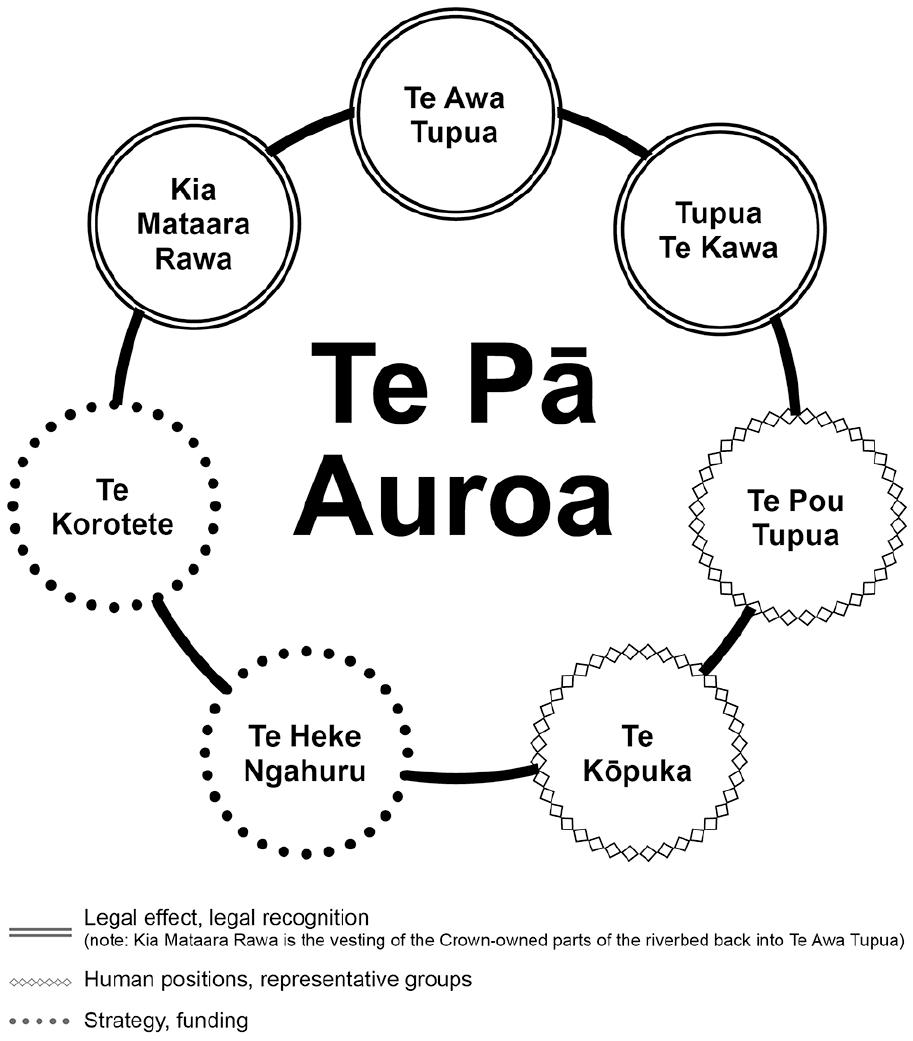
Te Pā Auroa nā Te Awa Tupua = the Te Awa Tupua framework; Te Awa Tupua = the Whanganui River and its legal status; Tupua Te Kawa = the Te Awa Tupua intrinsic values; Te Pou Tupua = the human face of Te Awa Tupua; Te Kōpuka nā Te Awa Tupua = the Te Awa Tupua strategy group; Te Heke Ngahuru ki Te Awa Tupua = the Te Awa Tupua strategy; Te Korotete o Te Awa Tupua = the Te Awa Tupua fund; Kia Mataara Rawa = the vesting of the Crown-owned parts of the bed of the Whanganui River in Te Awa Tupua.
Reasserting an Indigenous framework
Conceptualising Te Pā Auroa
In this article, we articulate a conceptualisation of Te Pā Auroa as an Indigenous framework that privileges the knowledge of uri as tangata whenua (people of the land). Elevating tangata whenua narratives ensures that the paradigm shift enabling application of this Indigenous framework in non-Indigenous organisations is grounded in Whanganui iwi perspectives. We discuss three of the seven components of Te Pā Auroa as the basis for rethinking human to nature relationships and the managerial implications of this for non-Indigenous organisations. They are (1) the legal recognition of Te Awa Tupua as an indivisible and living whole; (2) the legal recognition of Tupua te Kawa—the intrinsic values; and (3) Te Pou Tupua—the human face.
Te Awa Tupua—legal recognition
The legal recognition of Te Awa Tupua as an indivisible and living whole comprises the Whanganui River from its mountain source to the sea, incorporating its tributaries and all its physical and metaphysical elements. This enduring concept of Te Awa Tupua underpins the desire of Whanganui iwi to care for, protect, manage and use the Whanganui River through the kawa (customs, values) and tikanga maintained by uri overtime (Ngā Tāngata Tiaki o Whanganui, 2014). Although treaty settlements are full and final according to the law, they are not full and final for Māori (Mutu, 2018) in that they could never fully compensate for what was lost (Mutu, 2019; Te Aho, 2017). However, Whanganui iwi have devised a legal structure in the form of a framework that incorporates tikanga and kawa.
Hawira (2019) explains that Te Awa Tupua is recognised first and foremost within its statute as a living and indivisible whole, comprising all its metaphysical and physical elements from Tongariro, its mountain source, to the sea. It is only after the totality of Te Awa Tupua is established within the statute that the river is then deemed to be a legal person. Legal personhood is the vehicle to carry the new status, nothing more (Hawira, 2019). This means that, although the legal personhood of Te Awa Tupua is described as pioneering (Salmond, 2020) and a significant legal development (O’Donnell & Talbot-Jones, 2018), it is fundamentally a Crown institution used to better understand and apply Indigenous paradigms. New laws such as legal personhood are an attempt to reset human relationships with nature and are there not to manage the land itself, but to manage how people interact with the land (Ruru, 2017).
Part of resetting the human–nature relationship is necessary because the current view of Te Awa Tupua held by non-Indigenous organisations tends to separate and compartmentalise physical and nonphysical elements and prioritise the former over the latter. As the Waitangi Tribunal (1999) found, the river is to be seen as an indivisible whole, not something to be analysed by the constituent parts of water, bed, and banks, or of tidal and non-tidal, navigable and non-navigable portions, as may be necessary for the purposes of English law. (p. 39)
Legal personhood, therefore, effects a Māori worldview that regards rivers as tūpuna (ancestors), who must be viewed holistically rather than thought of in fragments (Morris, 2009).
Tupua te Kawa—intrinsic values
Te Pā Auroa legally recognises a set of Indigenous values that reflect the intrinsic relationship between the river and uri as guardians and sovereign partners in protecting the mana (prestige and authority) of the river (Ngā Tāngata Tiaki o Whanganui, 2020d). The four intrinsic values are called Tupua te Kawa (Table 1) (Whanganui Iwi & The Crown, 2014a).
Tupua te Kawa—intrinsic values.
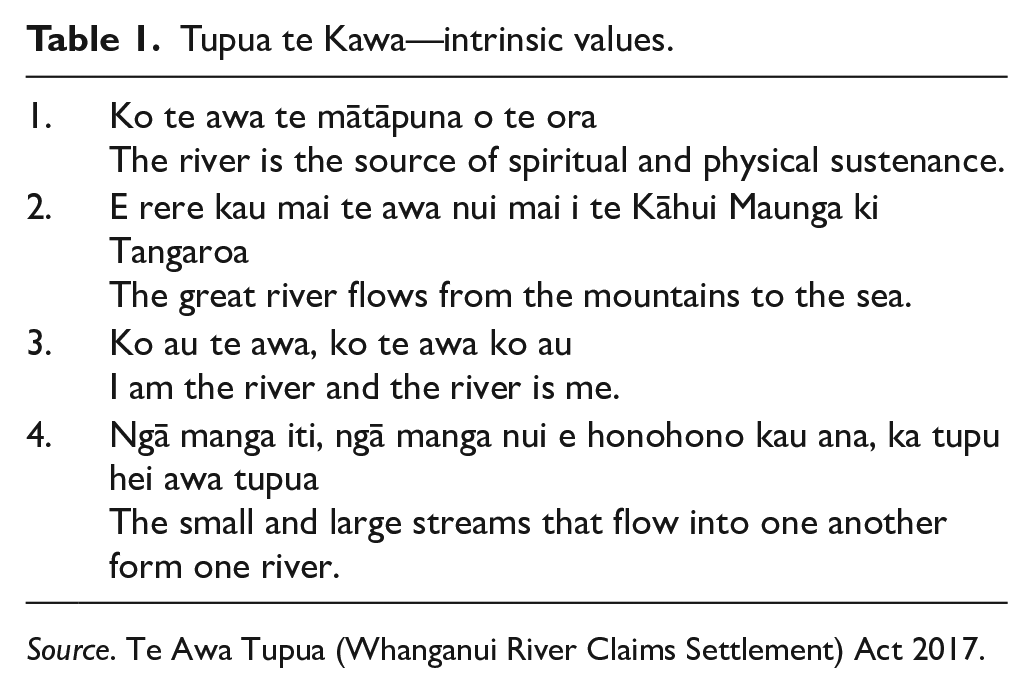
The intrinsic values of Tupua te Kawa are ideally understood as protocols or norms. They not only act as tribal markers identifying who Whanganui uri are, but are metaphors for instructions on how to live with the river and each other. Kawagley and Barnhardt (1999) argue that Indigenous knowledge of nature is rooted in the long inhabitation of a particular place. For Māori, the notion of place is ritualised in pepeha, formulaic tribal expressions which indicate a deep sense of belonging to a place, and whakapapa, genealogical ties to an eponymous ancestor (Carter, 2005). A sense of place is also ritualised in whakataukī, proverbs that capture ancestral knowledge about their world and how it can be aligned to present-day existence (Pihama, 2020).
The first value of Tupua te Kawa
Uri accounts of what the river means both spiritually and physically have been extensively covered in the Whanganui River tribunal report (Waitangi Tribunal, 1999). Clearly, uri endure in the belief that the awa (river) is the source of their spiritual and physical sustenance (Tinirau et al., 2020). The awa is a healer, a kāpata kai (food store), a highway and a protector (Turia, 2001): Our [Whanganui uri] association with our tūpuna awa [ancestral river] goes back to the beginning of time . . . and of all the elements, water is the first because without it there can be no life sustenance of Papatūānuku [Earth Mother]. If we disturb that, then we have upset the balance, and if we upset the balance then there is retribution. (Richards, 2009, p. 15)
An example of disrupting this balance is the diversion of the river’s headwaters for power generation. Physically, this resulted in increased algae, scraping down rapids due to low water, and a downturn in or complete demise of fish supplies. Spiritually, power generators “have severed the cord of our unity” (Mareikura, 2009, p. 36) because diverting the water is cutting the spiritual cord which is sacrilege. Therefore, we must acknowledge the need to restore the mauri (life force) of Te Awa Tupua (Tinirau et al., 2020). The physical and spiritual sustenance of the river also features in tribal development, including education plans and developing tribal graduates (Te Puna Mātauranga o Whanganui, 2000), in language and health strategies, and in performing arts.
The second value of Tupua te Kawa
The whakataukī “E rere kau mai te awa nui mai i te Kāhui Maunga ki Tangaroa” (The great river flows from the mountains to the sea) was encapsulated by iwi leader Rangitihi Tahupārae during Te Tira Hoe Waka, a Whanganui iwi wānanga (tribal forum) (Wilson, 2010). Te Tira Hoe Waka is an annual 2-week wānanga, which sees uri take to the river on a tribal journey. The wānanga starts at a marae (place of gathering) nearest to te Kāhui Maunga, the cluster of mountains where Te Awa Tupua begins. The paddling begins in Taumarunui, a town near the upper reaches where the river is accessible. The river continues 290 km into Whanganui city, where the journey ends at one of two marae in the city.
While the philosophy of the Tira Hoe Waka is based on the intergenerational transmission of Whanganui tribal knowledge and history, it is also a manifestation of the proclamation that the river flows from the mountain to the sea. Whanganui iwi leader, Matiu Mareikura, maintained that the ties between people remained strong all throughout the river (Waitangi Tribunal, 1999). In te ao Māori (Māori society), this unity is best identified as whakapapa, and beyond a simple retelling of genealogical ties, it also speaks of what Whanganui elders called te rau kotahi, meaning the multiple-self (Simon, 2013). Raukotahi—which means come and go, not as a singular identity, but as one who is a culmination of all those who come before you, all those that stand at your side and all those who will follow you—was renewed as an iwi kaupapa (tribal philosophy) in 2013 as a catalyst for the preparation of the Te Awa Tupua Act 2017 through iwi wānanga.
The third value of Tupua te Kawa
While stories of Whanganui are portrayed by non-uri authors such as Downes (1976) and Young (1998), we intentionally sought Whanganui uri perceptions of Te Awa Tupua. The occupation of Pakaitore, a site of significance in Whanganui, was a turning point in the history of Whanganui iwi. On February 28, 1995, Whanganui iwi marched on to Pakaitore, to protest against the injustices of the Crown (Pākaitore Historic Reserve Board, 2020). During that time, a Whanganui Declaration of Nationhood was drafted. The articles in the declaration describe the supreme absolute authority of Whanganui iwi over all our rivers, lakes, streams, mountains, lands and all other taonga (treasures)—tangible and intangible. The declaration signals the inherent rights of uri to utilise and exercise full control, decision-making, participation, enhancement and protection over the use of their rivers, lakes, streams, mountains, lands and taonga. Furthermore, it expresses the inherent right of uri to all physical, emotional and intellectual development for the collective wellbeing of the people as a tribal nation.
In a survey noting the aspirations and priorities of uri, iwi members were asked why is the awa important to you? (Allen & Tinirau, 2021). The responses were formatted according to the four values Tupua Te Kawa. Ko au te awa, ko te awa ko au was the most commonly referenced value and speaks to the inalienable connection and responsibility Whanganui iwi have to Te Awa Tupua. In short, uri defined this particular value as meaning, we—the river and the people—are one (Allen & Tinirau, 2021).
The fourth value of Tupua te Kawa
This value stresses that Te Awa Tupua is a singular entity comprising many elements and communities, working collaboratively for the common purpose of Te Awa Tupua (Whanganui Iwi & The Crown, 2014a). Considered a newly contextualised kawa, its similarities are reflected in older Whanganui whakataukī, such as “He muka au na te taurawhiri a Hinengākau,” meaning, I am a strand of the woven cord of Hinengākau. Whanganui iwi leader Che Wilson explains that it is a whakataukī to remind uri that they are from the same lineage of the one woven cord from Whanganui tupuna kuia (female ancestor), Hinengākau (Pihama, 2020).
This kawa also speaks metaphorically to the interwoven facets of life and how Te Awa Tupua lives through uri. Many Whanganui women, including Honey Winter, tied the awa to their living experiences, day-to-day activities and tribal participation. “I jumped at the opportunity to come home and contribute to our social, cultural, political and economic development. . . . I know that I belong and understand how I fit into the bigger picture of iwi development” (Takiari, 2002, p. 51).
Te Awa Tupua is not only woven through our history, proverbs and past life experiences—it is also our future. This particular kawa will see the social, cultural, educational and political coming together of not only whānau (families), hapū and iwi along the Whanganui River, but all Whanganui River communities including non-Māori to partner, engage and invest in opportunities to advance Te Awa Tupua (Tinirau et al., 2020).
Te Pou Tupua—the human face
Te Pou Tupua is the embodiment of Te Awa Tupua. Te Pou Tupua acts as the human face who speaks on behalf of the river. Te Pou Tupua is a singular role filled by two people, one representative of Whanganui iwi, presently Turama Hawira, and one Crown representative, presently Keria Ponga. The key functions of Te Pou Tupua are to act for and speak on behalf of Te Awa Tupua and to uphold the status of Te Awa Tupua and Tupua te Kawa (Office of Te Pou Tupua, 2019). Whanganui iwi wanted a high level pou (post) as the focal point for the new consciousness non-Indigenous people would need to shift from imported legal and philosophical constructs (Hawira, 2019).
Discussion
Indigenous paradigms
Indigenous paradigms have emerged from Indigenous peoples’ struggle for self-determination and decolonisation processes (Koukkanen, 2000). The resurgence of Indigenous knowledge as a paradigm shift applies here in two contexts—nature and organisations. Western paradigms see nature as property, available for ownership, possession and wealth for citizens (Suzuki & Knudtson, 1993), and is often inclined towards commercial and economic activity, amassed in forms of capital (Kēpa, 2008; Pistor, 2019). The Whanganui River report, which inquired into claims against the Crown for breaches of the Treaty of Waitangi (Waitangi Tribunal, 1999), discusses settler constructs of the river comprising rights, ownership and tenure. Many European New Zealanders have a deep understanding of their property rights, but regard Māori property rights as either illegitimate or incidental, and find the relationship between Māori people and nature bizarre even animist (Finlayson, 2019). Yet, Te Awa Tupua settlement that followed successful prosecution of the claim not only accepted a Māori perspective of nature, but vested legal personhood in the Whanganui River as a manifestation of this Indigenous paradigm of nature.
Indigenous worldviews on nature are premised on connection, reciprocity and ethical relationships (Muller et al., 2019), with substance that has sacred meanings (Davis, 1993). While legal personhood provides western legal precedent, recognising a river as an ancestral being better aligns with a Māori worldview (Morris & Ruru, 2010). This Indigenous worldview should not be characterised as simply nonmaterial or spiritual (Kēpa, 2008) or treated as an add-on, afterthought or as a grudging concession to a dominant mainstream paradigm—instead, it is a view that is integral to te ao Māori (Joseph et al., 2019). A Māori worldview regards water, along with its host—ponds, rivers, lakes, streams, as the bloodways of Papatūānuku (Te Aho, 2019), and as such, water is life (Douglas, 1984; Durie et al., 2017). Preserving water and humanity’s relationships with it are essential to human survival and wellbeing (Mika, 2021; Ruru, 2018). Human societies, however, are greatly confused. Powerful state and nonstate actors are struggling for the control of this life-giving resource, where conflicting ideologies and needs are determining the future of people and environmental resources (Hook & Raumati, 2011).
What uri learn about the river and the knowledge gained from practising the values and beliefs of the river helps to understand life itself (Rawiri, 2005). Uri learn, practice and apply six cultural imperatives: (1) reciprocity, by ensuring the physical and spiritual wellbeing of the river is upheld; (2) responsibility, by ensuring the right protocols are sustained; (3) tiakitanga or guardianship, by taking care of the river, as our ancestors have done; (4) advocacy, by speaking up against those who mistreat the river; (5) honour, by continuing the fight for the river’s effective management for generations past and to come; and (6), praise, by transmitting intergenerational knowledge about the river through our songs and our stories. From the perspective of uri, the knowledge, learnings, teachings and practices which have informed the development of Te Pā Auroa are not new ideas that emerged at the passing of Te Awa Tupua legislation. This knowledge has been with Whanganui uri since time immemorial; are embedded in pepeha, whakapapa, whakataukī and tikanga, and are maintained and actioned through tribal wānanga and kaupapa, strategies, plans and programmes.
Consciousness is the term Hawira (2019) uses to encourage non-uri to emphasise the new way in which to view Te Awa Tupua and to remind the Crown, local government and communities of the changed lens. If this is what is required to understand and meaningfully apply Te Pā Auroa, non-Indigenous organisations must also be supported with access to education and cultural infrastructure to achieve the requisite paradigm shift. More importantly, who this paradigm shift is for and how this is facilitated is a critical consideration.
Shifting paradigms
A paradigm shift in the way non-Indigenous currently relate to the earth and to each other is only the start of what is required to meaningfully apply Te Pā Auroa. Conferring legal personhood in nature requires ontological adjustments (Winter, 2019), which is further complicated by the absence of Indigenous knowledges in modern forms of organising and managing (Love, 2019). As a result, this absence adds pressure for Māori to have their ideologies recognised. For Māori to have their cultural, social and economic philosophies recognised requires a critical perspective (Henry & Pene, 2001) that highlights the inadequacies of western paradigms and theories to accurately explain Indigenous business and management phenomena (Dell, 2017). There is a strong call for non-Indigenous organisations—both commercial and noncommercial—to see an alternative world, to experience another way of knowing and to consider holistic and multidimensional approaches to business (Spiller et al., 2011). This requires a shift in paradigm, one that includes decolonial conversations that both critique dominant Eurocentric models (Dutta, 2015) and imaginaries of what alternative models could look like (Mbembe, 2016). A shift in paradigm is not just about decolonising western paradigms, but it is about the placement of Indigenous peoples and their knowledges into dominant, mainstream discourses (Koukkanen, 2000).
Decolonising management practice is not about substituting one—non-Indigenous—model of knowledge production with control by another—Indigenous. Instead, it is the emancipation from colonial and postcolonial accounts of managerialism (Ruggunan, 2016) while allowing Indigenous peoples to reconnect and engage with their own knowledge systems and ways of knowing (Woods et al., 2022). Colonisation was created through European ideas about how things should be (Thomas, 2020). Transformative praxis, therefore, is about non-Indigenous organisations taking action (Jammulamadaka et al., 2021), to allow Whanganui iwi to assert their rights and responsibilities while removing barriers and predetermined orders historically imposed through political, socio-cultural, legal and economic life (Hsiao, 2012). As previously stated, access to a degree of tribal and Indigenous education and cultural infrastructure is needed for non-Indigenous organisation to proceed with the paradigm shift. This shift should be supported with appropriate methodologies, pedagogy and learning with a focus on indigenising spaces (Woods et al., 2022), a reconceptualisation of rivers (Winter, 2019), capacity development work and critical mass building work, as well as individualistic reflexivity about one’s positionality (Jammulamadaka et al., 2021).
Conclusion
In Aotearoa New Zealand, since the passing of treaty settlement legislation pertaining to the Whanganui River in 2017, there has been an overwhelming national and international reaction, with intrigue centring on Te Awa Tupua as the first river in the world to be granted legal personhood (O’Donnell & Talbot-Jones, 2018). What is written about Te Awa Tupua, however, seldom comes from the Indigenous people who live within its catchment. Moreover, much of the discourse centres on the legal and environmental implications of Te Awa Tupua, rather than giving effect to the settlement through management theory. For instance, embedded within the settlement legislation is an Indigenous framework for relating to Te Awa Tupua—called Te Pā Auroa nā Te Awa Tupua. While Te Pā Auroa privileges Whanganui uri ways of knowing, being and doing on the river, it also creates obligations for non-Indigenous organisations that have responsibilities to the river and its peoples.
We set out to initiate a conversation about how Indigenous frameworks can be understood and applied in non-Indigenous organisations in ways that are culturally appropriate and effective. To contemplate the paradigm shift that is implied by an Indigenous framework like Te Pā Auroa requires a new consciousness preceded by an understanding of Te Awa Tupua, which accords with a Māori worldview. We acknowledge that a spectrum of views to Indigenous paradigms will exist in non-Indigenous organisations. Yet, managers and employees must find ways to comprehend and operationalise Indigenous frameworks because of the legislative mandate of treaty settlements, evidence of anthropogenic harm, and policy shifts towards sustainable, equitable and inclusive development.
We found that a paradigm shift is necessary for non-Indigenous organisations to view human–nature relationships through an Indigenous lens. The shift in paradigm will require decolonising management practices, which involve a critical examination of what may hinder or enable such organisations to effectively implement Te Pā Auroa. An example of an enabler is the ongoing need to socialise and educate all, uri and non-uri, in Te Pā Auroa (Tinirau et al., 2020). This has started through the development of multimedia aids by uri (Ngā Tāngata Tiaki o Whanganui, 2020a, 2020b; Paora Joseph Productions, 2014) and non-uri (MEL Films, 2019). Moreover, we suggest future research should focus on critical factors for operationalising Indigenous frameworks in non-Indigenous organisations and whether or not and how non-Indigenous organisations are able to advance the aspirations of Whanganui uri. We hope that this research may move such organisations beyond a paradigm that simply sees the river in functional or aesthetic terms towards a new consciousness of natural phenomena as having physical and spiritual identities deserving of their care, respect and responsible use in partnership with tangata whenua.
Footnotes
Acknowledgements
The authors thank Te Pou Tupua, Turama Hawira for the use of the title of this article which has been adapted from his presentation made at the Second Annual Assembly of First Nations National Water Symposium, 2019, Niagara Falls, Ontario, Canada.
Authors’ note
Declaration of conflicting interests
The authors declared no potential conflicts of interest with respect to the research, authorship and publication of this article.
Funding
The authors received no financial support for the research, authorship and publication of this article.

Glossary
awa river
hapū subtribe(s)
Haunui-ā-Pāpārangi ancestor of Whanganui iwi
Hinengākau a Whanganui iwi female ancestor
iwi tribe(s)
kāpata kai food store
kaupapa philosophy
kaupapa Māori Māori research methods
kawa customs, values
Kia Mataara Rawa vesting of the Crown-owned parts of the bed of the Whanganui River in Te Awa Tupua
kuia female ancestor
mana prestige and authority
Māori Indigenous people of New Zealand
marae place of gathering
Mātaatua uri descendants of Mātaatua, tribes of the Eastern Bay of Plenty
mauri life force
Ngāi Tiriti descendants of European settlers enabled by the Treaty of Waitangi
Paerangi one of two primary ancestors of the Whanganui tribes
Pakaitore a site of significance in Whanganui
Papatūānuku Earth Mother
pepeha formulaic tribal expressions that indicate a deep sense of belonging to a place and whakapapa, genealogical ties to an eponymous ancestor
pou post, pillar
rangatira chief(s)
raukotahi come and go, not as a singular identity, but as one who is a culmination of all those who come before you, all those who stand at your side and all those who will follow you
Ruatipua one of two primary ancestors of the Whanganui tribes
tangata whenua people of the land; Indigenous people
taonga treasure(s)
te āo Māori Māori society
Te Awa Tupua the Whanganui River, Whanganui River legal status
te kāhui maunga cluster of mountains where Te Awa Tupua begins
Te Heke Ngahuru ki Te Awa Tupua
Te Kōpuka nā Te Awa Tupua
Te Korotete o Te Awa Tupua
Te Pā Auroa nā Te Awa Tupua
Te Pou Tupua the human face of Te Awa Tupua
te rau kotahi the multiple-self
Te Tira Hoe Waka a tribal forum that includes a 290-km journey on the Whanganui River
tiakitanga guardianship, (the action of) taking care (of natural resources)
tikanga rule, plan, method, custom, habit, anything normal or usual, reason, meaning, authority, control, correct or right, Māori customary values and practices
Tongariro the mountain source of Te Awa Tupua
Tupua Te Kawa the Te Awa Tupua intrinsic values
tūpuna ancestor(s)
tūpuna awa ancestral river
tupuna kuia female ancestor
tūpuna rohe ancestral regional groupings
uri descendant(s)
wānanga tribal forum
whakapapa genealogies and descent from an eponymous ancestor
whakataukī proverbs
whānau families
whāngai Māori customary adoption
Whanganui iwi tribes affiliated with the Whanganui River
Whanganui uri descendants of the Whanganui tribes