



Abstract
The current mental health care system in Canada, with its focus on Western biomedical and individualistic approaches, does not support Indigenous holistic views of wellness and silences Indigenous knowledges through colonial ideologies. This research identifies the vital support that mental health services must include to create culturally relevant and safe services: Elders. Elders provide holistic approaches to mental wellness that consider cultural, individual, family, and community needs to promote healing. To explore the roles of Elders in mental health services, a comprehensive narrative review was conducted. All 22 included studies were conducted by Indigenous scholars or with Indigenous communities. Findings were organized into three themes: (a) Elders are knowledge keepers: sharing wisdom; (b) need for cultural-based teachings, ceremonies, and land-based healing led by Elders; and (c) Importance of relationships for increasing youth’s mental wellness. Barriers were identified that prevent Elder involvement, and recommendations for mental health programmes are provided.
Introduction
For thousands of years predating the arrival of European settlers, Indigenous Peoples were thriving with unique knowledges, traditions, and cultures originating from their relationship with their land and communities. These intergenerational knowledges were transferred to Indigenous youth by Elders. The arrival of settlers to Turtle Island, colloquially known as North America, disrupted these traditions and brought with it a long, painful history of colonialism, which has had enduring effects on Indigenous peoples. While the specific historical colonial encounters varied by each Indigenous community, the effects of colonization and attempts at assimilation are almost universal (Reading, 2018). In fact, there has been a vicious cycle of cultural violence and genocide that has particularly affected Indigenous children and youth. Indigenous children and youth have been targeted for generations through different government programmes and policies, including the residential school systems and the 60s Scoop, in an effort to advance a colonial agenda within Canada. Furthermore, all these colonial policies, practices, and the loss of lands have contributed to complex intergenerational challenges as many people struggle to reconnect with their families, community, and culture, which continue to affect Indigenous communities today. Some of the more modern-day issues are highlighted in disparities in areas such as health and education and the over-representation of Indigenous peoples in the child welfare and criminal justice system (Greenwood et al., 2018). The effects of colonial trauma have been referred to by some Indigenous scholars as a “soul wound”—a type of spiritual injury that influences all aspects of Indigenous life (Duran et al., 1998, p. 341).
Indigenous children and youth’s mental health and wellbeing
It is imperative that the mental wellness of Indigenous children and youth in Canada is understood within the context of the long-standing effects of historical colonial trauma. Intergenerational traumas have led to elevated levels of suicide, anxiety, depression, and substance use among Indigenous communities (Ministry of Children and Family Development [MCFD], 2016). Other manifestations of trauma are seen in continual family separation, high levels of incarceration, and high rates of violence against Indigenous girls and women (MCFD, 2016). Furthermore, Indigenous peoples, in a recent survey by Statistics Canada (2021), reported fair or poor mental health at higher rates than non-Indigenous participants, with the COVID-19 pandemic exacerbating their negative mental health. Therefore, it is vital to consider colonialism as one determinant of health for Indigenous peoples, in addition to more “traditional” determinants of health such as housing, education, and access to health care.
Despite the burden of colonization, an overwhelming majority (96%) of Indigenous youth in one study reported pride in their ancestry (Clark et al., 2017). Furthermore, cultural connectedness has been linked to better mental health outcomes for Indigenous youth, and for some youth, cultural connectedness was associated with mental health above and beyond all other social determinants of health, emphasizing the importance of fostering a sense of cultural identity within Indigenous youth (Snowshoe et al., 2017). These findings help to counter the dominating narratives of Indigenous youth having low self-esteem and poor mental health. Indigenous youth’s sense of pride in their ancestry and cultural identity highlights the crucial role of a holistic approach to mental health and wellness that integrates culture. Many Indigenous communities have expressed the need for a holistic approach to mental health and wellness that takes into consideration cultural and individual, family, and community needs to promote healing and recovery (Montesanti et al., 2022). The current mental health care system in Canada, with its focus on Western biomedical and individualistic approaches, does not support an Indigenous holistic view of health and wellness and actively silences Indigenous knowledges through colonial ideologies (Montesanti et al., 2022). A colonial and evidence-based biomedical approach has caused Indigenous approaches to be seen as less scientific and, thus, less needed (Walker & Behn-Smith, 2018) and contributed towards a vicious cycle of cultural violence and genocide. As argued by Steinhauer and Lamouche (2015), it is incredulous to “expect solutions and improvements in health to come solely from these external systems, which have had a large hand in creating and maintaining those poor outcomes in the first place” (p. 154). The resolution to such issues requires attention to the effects of colonialism on Indigenous health and wellness and the promotion of self-determination and community control within mental health care. A potential opportunity to increase the cultural safety of mental health service delivery is to embed Indigenous cultures, teachings, and values through Indigenous Elder engagement so that “we can work together to navigate the tension-filled space between these two systems to move forward in a good way” (Walker & Behn-Smith, 2018, p. 246). Thus, incorporating Indigenous cultures, teachings, and values through Elder engagement in mental health service delivery could be a significant step towards addressing the negative impacts of colonialism on Indigenous youth. Recognizing the unique cultural and historical experiences of Indigenous communities and integrating Indigenous Elder support into the mental health treatment of Indigenous children and youth are crucial for providing holistic and culturally safe care. Elders play a critical role in Indigenous communities as knowledge keepers, advisors, and spiritual leaders. Their wisdom and guidance are valued and respected by Indigenous Peoples, and incorporating their support into mental health services can lead to more positive outcomes for Indigenous youth, including healing, resilience, and overall wellbeing (Crowe-Salazar, 2007; Elliot et al., 2019; Harder et al., 2015). Furthermore, it is crucial to prioritize the voices of Indigenous Elders in the development of culturally safe and appropriate mental health care approaches. Culturally safe mental health services that involve building relationships with Elders can help to restore a sense of connection to cultural traditions and practices, which may be particularly beneficial for Indigenous youth and their families who have experienced the effects of colonial trauma and may not feel connected to their culture and Indigenous identity (Crooks et al., 2017; Harder et al., 2015; Hutt-MacLeod et al., 2019). By embracing Elder engagement, mental health providers and programmes can provide a holistic approach that considers not only the mental health of the child or youth but also their holistic physical, emotional, cultural, and spiritual identity, leading to an approach that targets mental wellness instead of mental health or illness.
In 2007, the United Nations (UN) Declaration on the Rights of Indigenous People (UNDRIP) was adopted by the United Nations General Assembly (2007). Canada did not endorse UNDRIP until 2016, receiving royal assent and implementation in June of 2021 (Department of Justice Canada, 2021). Article 23 in UNDRIP states that “Indigenous Peoples have the right to determine and develop priorities and strategies for exercising their right to development” (United Nations General Assembly, 2007, p. 18). “In particular, Indigenous Peoples have the right to be actively involved in developing and determining health . . . . as far as possible, to administer such programmes through their own institutions” (United Nations General Assembly, 2007, p. 18). Similarly, in Canada, the Truth and Reconciliation Commission (TRC) Call to Action #22 states: we call upon those who can effect change within the Canadian health care system to recognize the value of Aboriginal healing practices and use them in the treatment of Aboriginal patients in collaboration with Aboriginal healers and Elders where requested by Aboriginal patients. (Commission of Canada, 2015, p. 210)
This call to action emphasizes the need for self-determination in the use of traditional healing practices in collaboration with Elders that have prevailed despite systemic oppression and colonialism. Furthermore, in Canada’s health sectors, the emergence of Indigenous-led approaches, which prioritize traditional Indigenous knowledges, has gained significant prominence (Allen et al., 2020). An important approach to promoting the self-determination of Indigenous health care services and prioritizing traditional Indigenous knowledges is involving Elders in mental health service delivery.
Current study
This study aims to critically analyse the current literature by or with Indigenous scholars and communities regarding Indigenous children and youth’s mental wellness in Canada to understand how the unique knowledge and practices of Indigenous Elders can improve mental health services for Indigenous children, youth, and their families. By examining mental health service providers’, Indigenous Elders’, and Indigenous children, youth and their families’ experiences and perspectives, this narrative review also seeks to (a) examine how Indigenous Elders can enhance Indigenous children and youth’s mental wellness, (b) identify factors that influence Elder involvement in mental health care, and (c) generate recommendations based on the findings.
Methods
This review is rooted in three guiding principles which include (a) avoiding a pan-Indigenous approach and tokenism by actively collaborating with a community Elder, (b) using the Circle as a restorative process, which was developed by British Columbia’s Aboriginal Practice and Policy Framework (APPF) in 2015, and (c) only including research completed by or with Indigenous communities. First, by acknowledging the diversity and uniqueness of Indigenous communities while also identifying areas of commonality, these results aim to avoid a pan-Indigenous approach and instead provide a nuanced understanding of how integrating Indigenous Elder support can meet the specific needs of each community while still respecting their unique traditions, knowledges, and cultures. This approach allows for better explanation of the singularities within each theme to explain what comprises culturally safe and beneficial mental health services for Indigenous children and youth to improve overall mental wellness.
This approach also aimed to ensure avoiding tokenism of Elders to ensure that Indigenous knowledges, traditions, and perspectives are treated with the respect and significance they deserve. Simply including an Elder in a research study without actively engaging them and incorporating their perspectives can perpetuate colonial attitudes and undermine the goal of promoting Indigenous-led research and knowledge production. Thus, it was essential to include only literature that described meaningful engagement with Indigenous Elders. For example, seeking their guidance to co-develop a research project, as seen in Rowe et al. (2020). It also means actively collaborating in this project with a community Elder as co-author through a process that involves principles of respect, relationality, reciprocity, and responsibility, as described by Kirkness & Barnhardt (1991, as cited in Crouch et al., 2023). In creating and supporting research by or with Indigenous Peoples, our guiding principle aligns with increasing the self-determination of Indigenous communities and not promoting harmful or unethical research.
Another guiding principle for this study was utilizing the APPF (MCFD, 2015). Since 1999 in British Columbia, Delegated Aboriginal Agencies (DAAs) for Indigenous children and youth have been guided by the Aboriginal Operational and Practice Standards and Indicators (AOPSI). In July 2013, AOPSI co-created with Indigenous communities, the APPF. The goal of which was to provide an overarching framework that all service delivery lines, such as the DAAs, contracted agencies, and MCFD, could apply when working with Indigenous families, with the hope that regardless of where someone is receiving services, they are operating with the same policies (MCFD, 2015). The APPF is informed and guided by the values of Respect, Inclusion, Truth Telling, Wisdom, and Belonging. A key aspect of the APPF is the Circle as a restorative process, which “strengthen[s] relationships through sharing, collaborating, and striving for consensus in collective decision making” (MCFD, 2015, p. 17). In this research, the Circle was used as a process to conduct this research in a respectful and meaningful way (Figure 1).
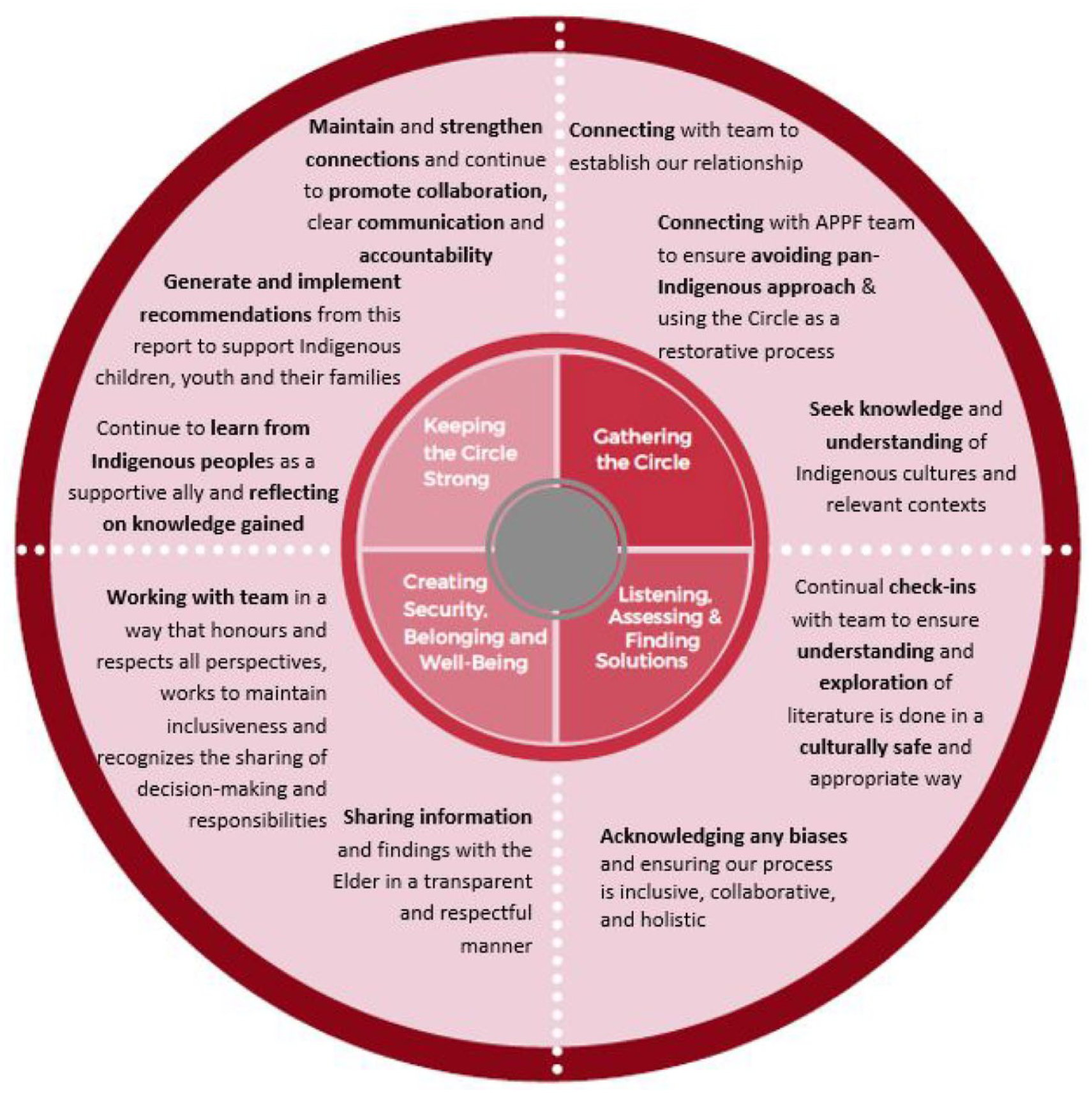
Aboriginal Policy and Practice Framework (APPF): The Circle (Adapted with permission from Ministry of Children and Family Development (2015)).
The APPF Circle Framework was created to highlight the importance of strengthening relationships through collaboration and sharing, while striving for consensus in decision-making processes.
Search strategy
A comprehensive search of seven databases associated with mental health, psychology, and Indigenous Peoples was conducted in March 2023. The databases were: Academic Search Complete, Bibliography of Indigenous Peoples in North America, APA PsycINFO, Social Sciences Abstracts, MEDLINE, CINAHL Complete, and Social Sciences Full Text. To capture all potentially relevant articles, it was necessary to recognize the unethical terminologies that have been, and occasionally continue to be, used to describe Indigenous Peoples in academic research. The terms used do not reflect our beliefs about or relationships with Indigenous Peoples. If an article was deemed to be considered racist, harmful, or unethical, it was excluded from review. The search summary was created to aid in information retrieval, to foster transparency of the type of literature included and where it was found (Figure 2).
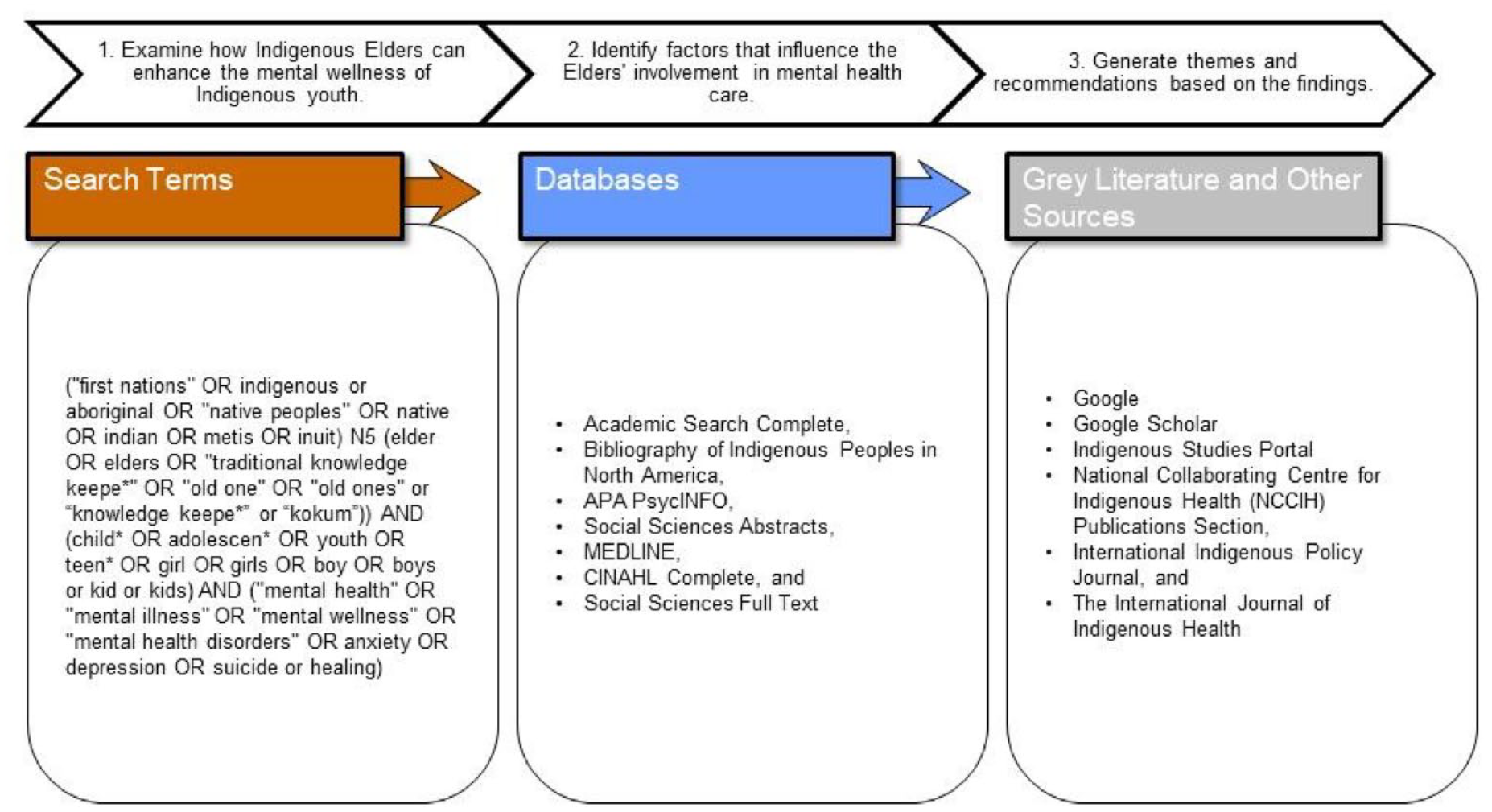
Search summary.
The Indigenous Studies Portal, National Collaborating Centre for Indigenous Health Publications section, International Indigenous Policy Journal, and the International Journal of Indigenous Health were also specifically hand-searched for relevant articles. Grey literature was then searched by using relevant search terms through the first five pages of Google Scholar and Google. Finally, the reference sections of included articles were also searched for relevant articles. Only resources written in English and published within the last 10 years were included.
Screening and data extraction
The first author completed the screening of the articles by initially reading titles and abstracts. The initial screening excluded articles that were not in a Canadian context or did not focus on children or youth. Records were then inspected in full text to ensure they included discussion of Elder involvement and mental health or wellness in Indigenous children and youth. The studies were also screened to ensure that they were conducted either by Indigenous scholars or with Indigenous communities, not research on Indigenous Peoples. A data extraction form was used to collate the findings, which included extracting information regarding the Indigenous communities involved, participant information, Elder involvement, and main findings. These findings were then shared in circle with Author 3 to better understand and ground the findings in lived experience, which is the most honoured and respected part of the work that focuses on Indigenous ways of knowing, traditions, relation with self, other, land, and spirit, and continued focus on the wellbeing of Indigenous peoples.
Results
Study selection and inclusion
The initial database searches yielded 169 results. An additional 30 sources were identified through grey literature searches. A total of 134 articles were excluded through the title and abstract screening. Next, the remaining 65 studies were inspected in full text to ensure they included discussion around Elder involvement and mental health or wellness in Indigenous children and youth. The studies were also screened to ensure that they were conducted either by Indigenous scholars or with Indigenous communities. Of the 65 studies examined in full text, 22 met all the inclusion criteria and were included in this review.
Study characteristics and demographics
The included studies were published between 2015 and 2022. Most included studies (n = 8) utilized qualitative methodology, such as interviews or focus groups, while the rest used a mixed-methods approach (n = 4). The remaining included articles were book chapters (n = 2), reports (n = 4), and reviews (n = 4). Participants included in the studies were primarily Indigenous youth, but some studies interviewed land-based healing programme providers (Redvers, 2020; Walsh et al., 2020), Indigenous Elders (Rowe et al., 2020), or a mix of Elders, youth, stakeholders, or community members (Healey et al., 2016; Kyoon-Achan et al., 2018; Mellor et al., 2021; Montesanti et al., 2022).
Of the five studies with solely Indigenous youth participants, two described participants as “urban Indigenous” (Clark et al., 2017, p. 43; Moscou, 2022, p. 5), while two studies reported if participants identified as First Nations, Métis, or Inuit (Crooks et al., 2017; Sasakamoose et al., 2016). The fifth study described participants as “from Carrier Sekani communities” (Harder et al., 2015, p. 26). Only one study reported gender outside of the gender binary, which was described as LGBTQ2+ (Moscou, 2022). No studies reported specifically on demographics related to Two-Spirit identity, or other gender diverse identities. Since studies focused on understanding Indigenous youth’s mental wellness or described programmes outside of traditional mental health service delivery, no studies reported services being mandated for Indigenous youth. Seven studies described an intervention or programme that specifically mentioned the role of Elders. In five of the seven studies, connecting with Elders was depicted as an essential component to mental wellness, and Elders were described as serving as mentors sharing their traditional teachings and knowledges (Crooks et al., 2017; Healey et al., 2016; Hutt-MacLeod et al., 2019; Moscou, 2022; Walsh et al., 2020). However, two studies described the importance of the service, programme, or intervention being led by Elders (Harder et al., 2015; Redvers, 2020).
Themes
Thematic analysis was used to identify, analyse, and report patterns across data sets (Braun & Clarke, 2006). Through inductive thematic analysis, we identified patterns consisting of three interrelated themes: (a) Elders are knowledge keepers: sharing their wisdom, (b) The need for cultural-based teachings, ceremonies, and land-based healing led by Elders, and (c) The importance of relationships for increasing youth’s mental wellness. We also identified numerous barriers that were discussed in the articles regarding Elders’ involvement within mental health service delivery.
Elders are knowledge keepers: sharing their wisdom
The first theme we identified was the importance of recognizing that Elders are knowledge keepers; having many wisdoms and knowledges that can be valuable to youth. Prior to contact, Elders traditionally passed on knowledges and values and provided guidance and support to the younger generations, including children and youth (Moscou, 2022; Rowe et al., 2020). An Elder, gender and age unknown, noted that when Elders were sought out for direction, there would be a story: when they told a story, they never said to you, “this is the reason I’m telling you this story” or “this is the moral of the story.” They told you the story, and you had to come up with your own version of what you heard. There was a teaching there. (as cited in Rowe et al., 2020, p. 64)
These teachings were not necessarily direct or explanatory, but instead nuanced stories that helped the listener to better know themselves and left room for experiential understanding. There was an understanding held by many participants that Elders had expansive knowledge and that these knowledges spanned time and were important to their collective past, present, and future.
Scholars highlight how some Indigenous youth feel that they have “lost that connection with ourselves and what is our purpose . . . . continuous cultural connection is essential to our identities and who we are” (Elliot et al., 2019, p. 35). Many Indigenous youth want to be better connected with their Elders who have knowledges, values, and wisdoms to share (Champlain Aboriginal Health Circle Forum, 2013; Clark et al., 2017; Montesanti et al., 2022; Sasakamoose et al., 2016; Toupin & Chase, 2017). The studies discuss the importance of Elders sharing their unique histories and stories that contain values and knowledges needed to “live a good and balanced life” (Mellor et al., 2021; Rowe et al., 2020, p. 165). As a child matures, they become capable of comprehending more complex renditions of the stories that contribute to a greater understanding of how to live in a good way (Rowe et al., 2020). Elders also pass on their knowledges and wisdoms through language, ceremony, knowledge of the land, and skills related to hunting, fishing, gathering, and stories (Lopez-Carmen et al., 2019; Rowe et al., 2020).
Elders as knowledge keepers includes the sharing of information, and it is experienced by Author 3 as also sitting in relation with others, providing comfort, care, connection, and calm. All of which are required to connect relationally, especially if one wishes to share knowledge and hopes to have it be received in a good way. In her work as an Elder, Author 3 is often invited to sit with families and their counsellors, and her presence and energy are a reminder of familial connection, holistic wellbeing, and cultural continuity. She further explains her role noting that being an Elder is about being a person who holds hope for others and who also has been through their own healing journey.
The literature emphasizes the significance of recognizing the role of Elders as knowledge keepers and the crucial role they play in guiding and advising the younger generations, including children and youth. Indigenous youth express a strong desire to reconnect with their cultural roots and Elders who have invaluable knowledge, values, and wisdom to share. Sharing stories containing values and knowledge is essential for Indigenous youth to understand how to live a balanced life. Overall, these findings highlight the importance of promoting and maintaining a continuous cultural connection with Elders to preserve Indigenous identities and promote a sense of wellbeing among youth.
Need for cultural-based teachings, ceremonies, and land-based healing led by Elders
The second identified theme was the importance of cultural-based teachings, ceremonies, and land-based healing led by Elders to connect with Indigenous youth who desire to learn various aspects of their culture, such as their traditional language and cooking (Clark et al., 2017). Ceremony can help individuals deal with confusion and low self-esteem (Kyoon-Achan et al., 2018). Author 3 emphasized the importance of reclaiming culture and providing opportunities for youth to tune into that part of themselves, a part which may have become disconnected due to colonization and the efforts of government in Canada to eradicate indigeneity. To Author 3, culture is healing. Author 3 embraced this theme and recounted how, in her work, she provides culture-based teaching to children, youth, and families, with her focus on providing teachings about medicine, ceremony, and by contextualizing it as an enduring, relational way of being at the heart of family.
In addition, the literature emphasized the importance of Elders in promoting resilience, healing, and cultural pride in Indigenous youth through opportunities to learn language, customs, and traditional teachings (Drawson et al., 2016; Elliot et al., 2019; Moscou, 2022). One Elder, gender and age unknown, described the need for traditional teachings as: those [traditional] teachings have to come back in order to know who we are and how to balance ourselves. We need to go back to having the mind, the body and the soul reconnect with each other to walk in that way to find that balance. (as cited in Kyoon-Achan et al., 2018, p. 648)
These teachings are dependent on the unique practices of each Indigenous community, but can include traditional pipe ceremonies, sweat lodge ceremonies, naming ceremonies, Grandmother Moon ceremonies, blanket ceremonies, and Letting Go ceremonies, as well as activities like drum making and basket weaving (Allen et al., 2020; Elliot et al., 2019; Hutt-MacLeod et al., 2019). Elliot and colleagues (2019) discuss how youth shared that “knowledge of one’s own gifts and purpose in life is an important aspect of wellbeing. Developing these gifts under the guidance of knowledge keepers and Elders is viewed as just as important as formal education” (p. 11). Furthermore, Indigenous knowledges and cultures are deeply rooted in the land, and Elders play a critical role in leading youth back to their connection with the land (Beaulieu & Reeves, 2022; Moscou, 2022). Land-based healing is a highly developed field of practice informed by Indigenous epistemologies and Indigenous ways of teaching and learning that can promote protective factors like self-reliance and self-confidence (Atkinson, 2017; Redvers, 2020). Elders recognize the land as a healer, and there is evidence in the broader literature of the health and wellness benefits of connecting with nature (Barton & Pretty, 2010; Bratman et al., 2015; Redvers, 2020).
Overall, the need for cultural-based teachings, ceremonies, and land-based healing led by Elders highlights the importance of preserving and passing on Indigenous knowledges and cultures to future generations. It recognizes the significant role that Elders play in promoting wellness and healing in Indigenous communities, particularly with Indigenous youth who want to learn from their Elders and emphasizes the importance of connecting with the land for health and wellness.
Relationships between Elders and youth increases mental wellness
The importance of relationships between Elders and youth in increasing mental wellness was identified as the third theme. As explained in the previous section, Elders occupy an essential place in preserving and passing on cultural knowledges, but perhaps more importantly, Elders “make room for others in their hearts and listen to their issues” (Kyoon-Achan et al., 2018, p. 685). Elders were described as embodying qualities such as love, acceptance, trustworthiness, and patience, all deemed vital for supportive relationships (Kyoon-Achan et al., 2018). These relationships with Elders were identified as central to the holistic health of the youth, and talking with Elders was described as imperative to their mental wellness (Clark et al., 2017; Crooks et al., 2017; Hutt-MacLeod et al., 2019; Sasakamoose et al., 2016). Author 3 describes relationships between Elders and youth in the same way, describing her work as an Elder as providing hope, love, and support with hard decisions. Of note, Author 3 described relationships between Elders and youth as always having the best interests of the children at heart, always putting the child at the centre.
Furthermore, these relationships were described as reciprocal, with both Elders and youth learning from each other, which is a key aspect of this relationship and is different from a Western-centred mental health provider–client relationship (Healey et al., 2016; Viscogliosi et al., 2020). Building these relationships with Elders provides opportunities to bring youth “into the circle” to engage in more cultural activities, understand their identity, and create a space in which they can believe they deserve to be loved, respected, and treated well (Kyoon-Achan et al., 2018; Rowe et al., 2020; Walsh et al., 2020). The lack of relationships with Elders was described by one participant, whose age and gender are unknown, as follows: Without knowing these relationships and knowing how you are connected with other you become isolated and alone . . . . This loneliness seems to be a big factor that is affecting the youth—they lack awareness about the relationships that exist with others. This lack of awareness also extends to culture and being a part of the land. (as cited in Walsh et al., 2020, p. 213)
Nurturing these relationships between Indigenous youth and Elders was associated with many positives, including personal growth, positive development, self-awareness, and Indigenous identity (Harder et al., 2015; Rowe et al., 2020).
The importance of relationships between Elders and youth in promoting mental wellness cannot be overstated. These relationships provide a space for sharing cultural knowledges, emotional support, and personal growth, which are essential for the holistic health of Indigenous youth. Building these relationships with Elders not only benefits the youth but also allows the Elders to share their wisdom and learn from the youth, creating a reciprocal and distinctive relationship that differs from current Western mental health provider–client relationships.
Barriers to Elder engagement and support
The identified barriers to Elder Engagement were (a) financial barriers, (b) clashes in Indigenous and Western conceptualizations and ideologies, (c) colonialism and associated factors, and (d) high demand for Elders. These identified barriers were confirmed by Author 3 as factors that impact her work as an Elder personally, and as a barrier when inviting other Elders to join in her work. For example, if there is an Elder who has a teaching that Author 3 is unfamiliar with, inviting that person to share the teaching would be impacted by these factors.
Financial barriers
One of the most commonly identified barriers to maintaining stable Elder engagement was financial (Beaulieu & Reeves, 2022; Redvers, 2020; Walsh et al., 2020). Not having adequate and consistent funding for Elders was often identified as a stressor (Redvers, 2020). Furthermore, the provision of land-based healing programmes can be hindered financially as they are not considered a “mental health treatment” programme, and thus, funding sources can be limited (Walsh et al., 2020). Another financial barrier was related to the restrictions of granting agencies (Walsh et al., 2020). Overall, the financial barriers to maintaining stable Elder engagement and funding for land-based healing programmes led by Elders are significant and multifaceted. The lack of consistent and adequate funding for Elders and the limited access to funding sources for land-based programmes pose a considerable challenge to the sustainability of these initiatives. The restrictions imposed by funding or granting agencies also present a further obstacle, particularly for youth and land-based programming. Complicating financial aspects, for example, reporting one-time payments on income taxes, also impact Elder engagement, and they can be challenging for Elders working on a part-time basis or for those who have retired. Addressing these financial barriers will be critical to ensuring that Indigenous communities can continue to benefit from the valuable contributions of Elders and the healing potential of land-based programmes.
Clash in ideologies
The studies found that combining Indigenous and Western mental health and wellness services can be challenging due to differing epistemological and conceptual views on mental health and healing. The paradigms of healing between Indigenous and Western approaches exhibit notable contrasts, such as the focus on Indigenous holism versus Western mind-body dualism, the significance of spirituality, relationship, culture, and an Indigenous community approach, and the conceptualization of Western illness aetiology (Beaulieu & Reeves, 2022). Indigenous approaches to mental wellness are more holistic and, thus, may not fit well into the current colonial mental health service delivery system (Redvers, 2020). The notion of integration also implies a Western dominant approach that requires the accommodation of Indigenous approaches into an already established service delivery model. Finally, Elders may be reluctant to build partnerships with mental health service providers due to concerns about disrespectful treatment, cultural appropriation, tokenism, and loss of autonomy (Allen et al., 2020).
In Canada, this clash of ideologies is further exacerbated by the fact that most government mental health services are individualized and compartmentalized, for example, some programmes provide mental health services focused solely on Indigenous children and youth. Thus, for Indigenous children and youth to access holistic wellness services, they must navigate a complex and, at times, an unresponsive support system that spans across multiple branches and provincial ministries.
The disconnect between Indigenous and Western approaches has contributed to the underutilization of mental health services in Indigenous communities (Redvers, 2020). Counselling Indigenous peoples using non-Indigenous perspectives has been criticized as a form of colonial oppression that discredits Indigenous understandings of health and healing (Redvers, 2020). Thus, incorporating a mix of Indigenous and Western mental health and wellness services is hindered by fundamental differences in epistemological and conceptual views of mental health, mental wellness, and healing. In addition, the compartmentalization of government health services, which are primarily individualized, poses a significant barrier to the incorporation of Indigenous holistic approaches. To overcome these obstacles, it will be crucial to promote culturally responsive mental wellness services that recognize and embody Indigenous paradigms of healing.
Colonial institutions
Another reported barrier to having Elders involved in mental health care can be the challenge of entering colonial institutions, where many child and youth mental health service providers have office locations. Some Elders may feel uncomfortable or unwelcome in these settings, which can create a barrier to their involvement in mental health care. Furthermore, some Elders may face their own mental wellness challenges due to their own experiences, such as attending residential schools. The impacts of intergenerational trauma, displacement, and cultural loss can have significant effects on mental health and wellness, and Elders are not immune to these impacts (Greenwood et al., 2018). It is crucial to recognize and address these challenges, as Elders’ mental health and wellbeing are essential to their ability to provide support to others.
Demand for Elders
The last barrier identified in this review was the high demand for Elders’ participation in various community events and activities (Redvers, 2020). Elders are often called upon to lead ceremonies, teach traditional skills, and provide guidance and support to community members. This demand can create challenges when inviting Elders into mental health care settings, as their time and availability may be limited. It is essential to recognize and respect the Elders’ commitments to their communities and find ways to involve them in mental health and wellness care in a way that does not overload their schedules.
Discussion
This narrative review sheds light on a critical aspect of mental health and wellness care for Indigenous youth: the essential role of Indigenous Elders. It highlights how Elders’ knowledge, teachings, and guidance can help support Indigenous youth’s connection to the land, community, and their own identity, ultimately promoting mental wellness. Compared to individualized Western approaches to mental health, Indigenous Elders’ unique knowledges and practices can better meet the holistic needs of Indigenous youth and their families to foster mental wellness. However, achieving this requires overcoming barriers such as a lack of stable funding, colonial systems or practices, and high demand for Elders. To truly provide culturally based mental health and wellness services, Indigenous organizations must take the lead in service provision, working in partnership with Western organizations that prioritize culture as primary care (Toupin & Chase, 2017). This partnership can focus on prioritizing protecting Indigenous medicines, healing practices, and knowledges in their full integrity while promoting self-determination in Indigenous-led health care services and systems to create culturally safe spaces for youth and Elders (Allen et al., 2020). Finally, a shared understanding of colonization’s history and its impact on Indigenous cultures is essential to move towards restorative policy and practice, with the promotion of Indigenous-led services as the ultimate goal.
In alignment with UNDRIP and APPF, the following recommendations can assist mental health services in increasing Indigenous children and youth’s mental wellness. As the findings of this narrative review show, Indigenous cultures, teachings, and practices are central to mental wellness with Indigenous youth. Therefore, Indigenous Elders need to be recognized, respected, and welcomed as leaders and integral members of any health care team with the aim of increasing Indigenous children and youth’s mental wellness.
Key recommendations
Through this narrative review, several broad recommendations have been identified for better supporting Indigenous peoples in mental health care systems. There have also been specific recommendations that discuss how the inclusion of Elders, and collaboration with Elders, within the mental health system would be beneficial to both services and those people being served. Broadly, the literature points to several important considerations and recommendations. First, it is recommended that those professionals delivering services to Indigenous people understand colonialism as an Indigenous determinant of health and challenge the pervasive paternalism, racism, and power imbalances that colonialism has created (Reading, 2018). There must be a recognition of how historical and intergenerational traumas continue to impact Indigenous children, youth, and their families (MCFD, 2016). This would include both historic and current systemic factors affecting the health and wellness of Indigenous people. The last broad-based recommendation from the literature points to expanding the recruitment and education of Indigenous Peoples within the mental health field to facilitate a holistic approach to mental health care that aligns with Indigenous principles and values, ensuring services are culturally responsive, safe, and equitable, and that they are led by Indigenous communities (Montesanti et al., 2022).
Following the three identified themes from this study, a key recommendation for practice within mental health service settings involves the provision of stable funding for Indigenous Elders to work alongside and in collaboration with mental health professionals within all mental health systems (Elliot et al., 2019; Montesanti et al., 2022). Given the importance of relationships, it would take time and collaboration to ensure a co-created way of working together, ensuring that Elders and mental health professionals would have time to build and maintain relationships with one another, with Indigenous youth, and in communities (Restoule et al., 2015). This engagement would include fairly compensating Elders from nearby Indigenous communities and involving them in the training of staff, recognizing the diversity of cultural teachings and ceremonies between different Indigenous communities to avoid pan-Indigenous services (Montesanti et al., 2022).
Mental health services in Canada for children and youth often involve multidisciplinary teams. These teams often include counsellors, social workers, psychiatrists, and other health professionals. Adding an Elder to support both the teams themselves, and the people they serve, would be important to increasing Indigenous frameworks of wellness (Restoule et al., 2015). These services would benefit being led by Elders, grounded in traditional Indigenous knowledges, and utilize Indigenous conceptualizations (Montesanti et al., 2022). It is recommended these services support Indigenous communities in achieving autonomy in deciding their own health and mental wellness needs and to only procure help from Western services as communities or individuals deem necessary (Redvers, 2020).
Mental health services should recognize that high demands are placed on Elders; some may have their own struggles with mental health due to colonial trauma, including residential schools, and entering colonial institutions, such as government mental health offices, may be difficult or traumatic. Subsequently, it is recommended that services work, in collaboration with each individual Elder, to determine strategies and solutions to best support Elders moving forward (Beaulieu & Reeves, 2022; Montesanti et al., 2022).
Limitations
While this review is unique in that it is the first to examine the important role of Elders within mental health services for Indigenous children and youth in Canada, it is not without limitations. Although we made a substantial effort to conduct a comprehensive literature search across databases, it is possible that some relevant studies may have been missed. While we also attempted to avoid a pan-Indigenous approach, it is important to note that these findings may not be relevant to all Indigenous communities or mental health programmes, as each is distinct and unique, with differing ideas of mental health, wellness, and the role of Elders.
Conclusion
This review aimed to discover vital supports that mental wellness services must include to serve Indigenous clients and provide culturally relevant and safe services. We determined that Elders provide holistic approaches to mental health that consider cultural, individual, family, and community needs to promote healing. These findings highlighted the role Elders embody as knowledge keepers, as leaders of cultural-based teachings and ceremonies, and that connection with Elders supports the wellness of youth. As Author 3 concluded, Elders are a bridge, connecting people, and working with Indigenous youth provides an opportunity for both Elder and youth to learn together. Ultimately, having Elders at the centre of mental wellness and healing for Indigenous children and youth is vital for the success of Indigenous mental health service delivery programmes.
Footnotes
Acknowledgements
The authors extend our gratitude to Darryl Phelan and Jamey Dye for their invaluable support and insights during the initial stages of this project. In addition, we are grateful to previous instructors, Dr. Allison Gerlach and Ms. Thais Amorim, for their constructive feedback on earlier drafts of this article, which originated as a graduate class project. Their guidance was instrumental in shaping the initial version of this work.
Authors’ note
Declaration of conflicting interests
The authors declared no potential conflicts of interest with respect to the research, authorship, and publication of this article.
Funding
The authors received no financial support for the research, authorship, and publication of this article.

Glossary
Inuit Indigenous People of Northern Canada
kokum grandmother
Métis a distinct Indigenous People of mixed Indigenous and Euro-American ancestry; one of the three recognized Indigenous Peoples in Canada with a unique culture, language, history, and political tradition